Paper Doll
Organizing A Fresh Start: Catalysts for Success
[Editor’s note: This post originally appeared on September 26, 2022. Rosh Hashanah will not be until October 2 in 2024, and changes each year, as the holiday is dependent upon a lunar calendar. The remainder of the content of this post is still accurate.]
As I go to press on this post, it’s about to be Rosh Hashanah, the Jewish New Year. (We’re going into the year 5783, though as the old joke goes, I’ll be writing 5782 on my checks for weeks.)
What I always liked about the idea of the Jewish New Year was the opportunity for a fresh start. Sure, in Western culture, we already have one (in either August or September, depending on your part of the country) with the beginning of a new school year. That always brings new clothes (and the jettisoning of old ones), new school supplies (especially brand new crayons and notebooks), and new opportunities.

Apples & Honey photo by Igal Ness on Unsplash
One of those opportunities, especially as we all got older (moving from elementary school to middle school, or middle school to high school) was that we could create ourselves anew, be seen as a different kind of person.
Let’s say you’d had a reputation as a goody two-shoes; you could make yourself over as a bit of a rebel. A ne’er-do-well punk could become an athlete lettering in varsity track. An academic washout could study a trade, and a beauty school dropout could rejoin the old gang. (Any resemblance to the plot of Grease is purely coincidental.)
But if you found yourself slipping back into old habits (messy lockers, messy friendships, messy study habits), the clean slate of a new year in the guise of a millennia-old religious and cultural tradition sure could be appealing. And if the start of the school year didn’t keep you on the straight-and-narrow toward a more perfect version of you? Well, Rosh Hashanah offered another shot.
And if that didn’t work, well, the new calendar year was only another 90 days or so away.
FRESH STARTS FOR THE NEW YEAR(S)
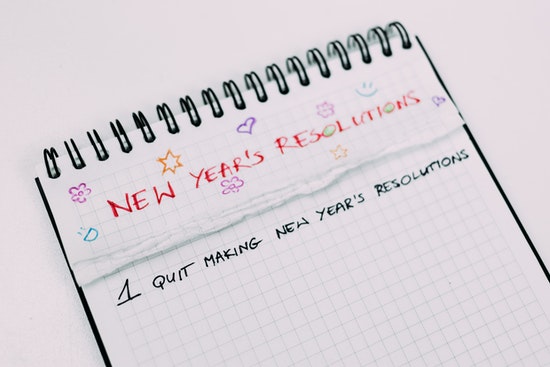
The best known annual fresh start is January 1st; worldwide, people explore New Year’s resolutions, to various degrees of success. Indeed, because of the difficulty of maintaining adherence to wholesale changes in one’s self, I often encourage alternatives to resolution making, like having goals, themes, phrases, or words of the year, such as those I wrote about in:
Review & Renew for 2022: Resolutions, Goals, and Words of the Year
Organize Your Life: The Truth About Resolutions, Goals, Habits, and Words of the Year
That said, some people still hold to the idea of making big changes when there’s a marker on the calendar to do so. If that’s you, I recommend reading what my colleagues and I have had to say at:
Join The Resolution Revolution
New Year’s Resolutions: Professional Organizers Blog Carnival
And, of course, your annual fresh starts aren’t limited to the new calendar year, new school year, or Rosh Hashanah. Worldwide, particularly in East and Southeast Asian nations and cultures, there are numerous religious and cultural new year’s observations, and you could choose any of those to give yourself a burst of inspiration.
Because lunar calendars (similar to the ones that make the Jewish holidays like Rosh Hashanah and Hanukkah bounce around the Gregorian calendar) are measured differently from what we use, these holidays don’t sync up to January first, nor do they fall on the same Gregorian calendar date each year.

These include:
- Chinese New Year — between late January and mid-February
- Lunar New Year (in Vietnam and other Southeast Asian nations) — between late January and mid-February
- Seollal (Korean New Year) — January or February, on the second new moon after the winter solstice
- Tết Nguyên Đán/Spring Festival/Lunar New Year/Vietnamese Lunar New Year — late January to mid-February
- Nyepi (Balinese New Year) — March
- Nowruz (Persian/Iranian New Year) — between March 19th and 22nd
- Aluth Avurudda (Sinhalese New Year) — April 13th or 14th
- Puthandu (Tamil New Year) — follows the spring equinox and generally falls on April 14th
- Willkakuti (Andean and Amazonian New Year) — June 21st
- Mayan Aboriginal New Year — mid-July
- Diwali (Marwari and Gujarati New Year Day) — mid-October to mid-November
- Raʼs as-Sanah al-Hijrīyah (Islamic New Year) — early July to late August
- Australian Aboriginal Murador New Year
As you can see, there are year-round “New Year’s” observations, if you’re looking to get a bit of institutional support for your new beginnings.
The meanings behind these holidays are as varied as the cultures from which they derive. Some focus on joy and celebration, others on introspection and focused self-improvement. The point is not to suggest that you necessarily observe religious or cultural New Year’s holidays or festivals, and certainly nobody should indulge in cultural appropriation.
Rather, consider these as inspirational opportunities to forgive yourself for any backsliding, identify ways you can tweak your efforts, and give yourself a motivational pep-talk.
FRESH STARTS EVERY QUARTER
If you work in the corporate world, you’re probably used to buzzwords about splitting the year into quarters. “Let’s ramp this up in 2Q!” or “We’re looking at projections for fourth quarter.” The year is carved into four 12/13ish week quarters with new collaborative goals structured into that temporal space.
Indeed, Brian Moran’s best-selling book and website, The 12-Week Year, is focused on the idea of setting shorter-term goals quarterly instead of annually. Rather than trying to transform yourself in a binary way, from “not this” yesterday to “this” today, this program posits that there’s an advantage to carving the year up into shorter 3-month blocks vs. trying to make changes on an annual basis.

If you’ve only got 12 weeks, there’s less likelihood that you’ll get complacent — it’s like having a book report due every week instead of just one term paper at the end of the semester — and more chance that your sense of urgency (and thus, motivation) will increase.
Is your inspiration to make life changes based a little more in the earth and sky than the boardroom and stock exchange? You might be motivated to make changes according to the equinoxes (in March and September) and solstices (in June and December).
Feng shui consultant (and promoter of all things organized) Dana Claudat of The Tao of Dana has a great weekly email newsletter and videos that may help you focus on the types of changes you’d like to make and the environmental support to do so.
FRESH STARTS EVERY MONTH
Although there are cultural inclinations toward inspiring fresh starts annually, these are not the only opportunities. In the UK and parts of North America, there’s a superstition that saying “rabbit rabbit,” or “rabbit, rabbit, rabbit,” or “rabbit, rabbit, white rabbit” upon arising on the first day of the month will bring good luck. (One imagines that this is, at the very least, luckier than attaching a rabbit’s foot to a keychain…at least for the rabbits)
There’s also a tradition in many English-speaking nations, including throughout the UK, Ireland, Australia, New Zealand and South Africa, for children to say “a pinch and a punch for the first of the month.”
The point isn’t necessarily to start acting like kids, but to recognize that the start of a new month, the flipping of the old paper calendar page, is worthy of notice. As they say, the days are long but the years are short. Taking notice of the passage of time is a superior way to value your time and make, if not resolutions, and least decisions regarding how you’ll use time mto serve your values.
As they say, the days are long but the years are short. Taking notice of the passage of time is a superior way to value your time and make decisions on how you'll use it. Share on XA new month, like a new year, offers an opportunity for a reset.
A FRESH START EACH DAY
Of course, you can make a fresh start every day. Every time you go to sleep at night, you are giving yourself the chance to reverse the humbling mistakes of the prior day and start anew.
And heck, you aren’t even stuck with a crummy day once it begins. As I wrote in Organize To Reverse a Bad Day, there are proven techniques for turning around a bad day (or one where you’ve failed to be your best self) and accomplishing more of what you want.
But you already knew that.
You know that each day is an opportunity to begin a new (good) habit or break an old (bad) one; intellectually, you know that you don’t need the permission of the calendar to commit to putting all appointments into your planner or hanging up your clothes or putting away your files before you leave the office.
You are absolutely aware that you don’t need to wait until a new calendar month or new fiscal quarter to stop yelling at your kids or start flossing your teeth more regularly.
But it helps, doesn’t it, to feel like you’re part of something bigger, a global effort to make positive changes? Certainly that’s why New Year’s resolutions have been effectively made (if not so effectively kept) for so long. Everyone joins together on December 31st to put that resolution energy out into the world, but by mid-January most people are struggling, all on their own, to stick with their goals.
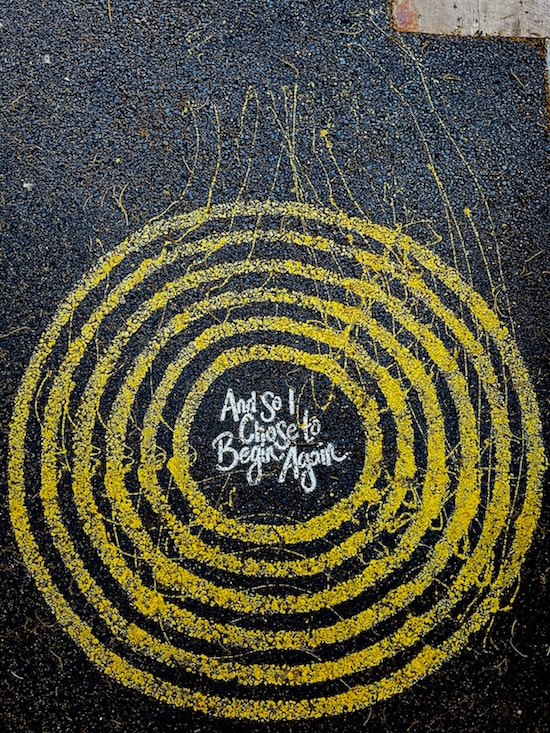
“And So I Choose to Begin Again” Photo by Jon Tyson on Unsplash
STEPS TO KEEP YOUR FRESH START FROM SPOILING
Appeal to all, or least most, of your senses. (I’m sure someone who knows more about essential oils or fragrances can suggest what scent might inspire creating and maintaining changes. If this is your area of expertise, please weigh in down in the comments.)
Start with signage.
The more you see a message, the more you’re likely to embrace it. If you’ve got a theme word or phrase for the year (or the month), post it where you can see it — on your fridge, the bathroom mirror, a sticky note in the center of your steering wheel, or wherever it will grab your attention.
Create inspiring images.
If you’re more visual than linguistic, create a vision board (showing the change you’d like to see in the world) as one that represents the change you wish be in the world.
If, like me, you’re not particularly adept at collage-making and vision boards, see if you can find one photo that represents what you’re trying to achieve — an organized bedroom, an office that you’ve left behind at the end of the day, a better effort at self-care — and post that where you can see it at transition points during your day.
When you’re focused, you may not be thinking about your goals, but when you transition, moving between tasks, between rooms, or between stages of your day, those images will resonate.
Sing out loud. Sing out strong.
Pick an empowering song, one that makes you feel like you can conquer anything, or create a whole playlist of them. Making a big change, or a series of small ones, may be easier if you’ve got your own personal theme song. Some that I really like (but which may include some salty language) include:
Roar by Katy Perry
Good As Hell by Lizzo
RESPECT by Aretha Franklin
Stronger (What Doesn’t Kill You) by Kelly Clarkson
It’s My Life by Bon Jovi
Confident by Demi Lovato
Fight Song by Rachel Platten
Unstoppable by Sia
And, for an amazing take on this song, check out Sri Lanken singer and cover artist Sandaru Sathsara’s version of Unstoppable. It’s not glitzy or glossy, but it’s motivating in it’s raw vocal and visual power.
For more motivation, check out these lists of songs that might hit the right note:
- 30+ Songs About New Beginnings & Change
- 18 Songs About New Beginnings and Starting Over
- 25 Empowerment Anthems
- 15 Empowering Songs to Blast Every Morning
- 55 Best Women Empowerment Songs For A Girl Power Playlist
Set the stage for success.
Whatever aspects of your life you are trying to change, whether they’re physical, temporal, psychological, or interpersonal, the world around you can offer support. Want to exercise more and know that you’ll never have the energy at the end of the day? Lay out your exercise clothes across the room and then put your alarm clock on top of the pile to make your morning work for you. (Give last month’s Do (Not) Be Alarmed: Paper Doll’s Wake-Up Advice for Productivity a peek for good measure.)
If you want to make 20 cold calls for your business, design an environment that makes it easy and motivating. Create a one-sheet with the points you want to make, and before you leave the office each day, lay it on your desk so it’s the first thing you see every morning. One of my clients used to keep a box of dominos by his desk, and each time he’d made a sales call, he’d stack a domino on his desk, just beyond reach. Seeing that small stack pile up over the course of the month would motivate him; a sort of “domino effect” akin to Jerry Seinfeld’s “don’t break the chain” advice.
Be willing to start small…and keep going.
From Mark Twain, who said that, “Continuous improvement is better than delayed perfection” to productivity expert Brian Tracy, who advises us to “Practice the philosophy of continuous improvement. Get a little bit better every single day,” the experts recognize that we’re not going to get where we want to be by magic or overnight success.

James Clear’s Atomic Habits tells us that starting small, super-small, on the atomic level, and making itty-bitty, teeny-weeny changes and achieving incremental improvement is the key to getting where we want to go. Our fresh start doesn’t have to be a big step, it just has to be a step that we actually take.
What are you waiting for? pic.twitter.com/QF7wRXhGwf
— Junhan Chin | Visual Designer (@junhanchin) June 27, 2022
Count on accountability.
When you want to create a fresh start and accomplish your goals, you don’t have to try to achieve things on your own. Check out two now-classic Paper Doll posts on the subject of accountability:
Count on Accountability: 5 Productivity Support Solutions
Flow and Faux (Accountability): Productivity, Focus, and Alex Trebek
Block time for success.
If we wait to feel like doing something, we’ll be waiting forever. As you’ve heard me say time and again, action precedes motivation. The way to take action, so you can get started and achieve enough success to feel motivated is to block time in your schedule. That means that you need to have a calendar, and you have to abide by what it tells you to do.
Action precedes motivation. The way to take action, so you can get started and achieve enough success to feel motivated, is to block time on your schedule. Share on XDon’t like being bossed around? Remember, you’re the one who told your calendar what to tell you! Don’t fight with the calendar; thank Past You for wanting what’s best for Current You. For some thoughts on how to block time in your schedule, start with:
Playing With Blocks: Success Strategies for Time Blocking Productivity
While you’re at it, much of the advice I offered in this summer’s 5-part series on conquering toxic productivity is helpful for making changes the right way. Work your way through the ideas at:
Toxic Productivity, Part 4: Find the Flip Side of Productivity Hacks
to develop good habits, use the Pomodoro Technique and the Pareto Principle, and focus on momentum rather than perfection.
Borrow from the wisdom of others.
Getting a fresh start means jettisoning the weight (but not the lessons) of everything that’s come before. Look through the quotes below and find one or two that resonate with you. Post your favorite on your lock screen or your computer’s desktop wallpaper to prompt you to embrace fresh starts and keep working on the transformative changes you find meaningful.
Getting a fresh start means jettisoning the weight (but not the lessons) of everything that's come before. Share on X“Getting over a painful experience is much like crossing monkey bars. You have to let go at some point in order to move forward.” ~ C.S. Lewis
“Forgiveness says you are given another chance to make a new beginning.” ~ Desmond Tutu
(This includes forgiving yourself. Every moment is a chance to be a “you” that is more congruent with your values.)
“The first step towards getting somewhere is to decide you’re not going to stay where you are.” ~ J.P. Morgan
“Isn’t it nice to think that tomorrow is a new day with no mistakes in it yet?”
~
(Is there any character more of a perfectly imperfect role model for making fresh starts than Anne (with an E) of Anne of Green Gables?)
“Be willing to be a beginner every single morning.” ~
“Every moment is a fresh beginning.” ~ T. S. Elliot
Please let me know which of these quotes resonate with you, or if you have a quote about new beginnings that you like even better.
Are you struggling to make a fresh start on something, whether it’s related to organizing and productivity or some other area of your life? I hope you’ll give these tips a try.
L’shanah tova. Happy New Year!
How Professional Organizers (& Hair Stylists) Reverse Some Intolerable Problems
Kabarett der Komiker; Gisela Schlüter unter Friseurhaube by Willy Pragher (CC BY 3.0)
What’s annoying you today? What’s been annoying you so long that you almost don’t notice the annoyance until someone else mentions it?
Over Labor Day weekend, my air conditioner died. This was an acute problem, one that I noticed almost immediately (as the temperature was rising overnight instead of going down) and which led to much misery until the holiday weekend ended and the maintenance staff could address the problem fully.
(To be fair, they did bring a mobile A/C unit, which cooled my bedroom to a bearable temperature; unfortunately, it was so loud, I felt like I was sleeping adjacent to a jet engine. Sometimes, you trade one intolerable thing for another. That’s often what keeps you from seeking, or implementing a solution in the first place.)
That same weekend, I realized that my fridge was dying. Unlike the A/C unit, this was a less obvious thing to tolerate. The freezer was still working perfectly, and the contents of the fridge weren’t warm; they just weren’t entirely full-on chilly. Weeks earlier, the refrigerator had been making some moaning noises, but fiddling with the settings of the circa-1986 fridge seemed to stop the noise. And then I stopped noticing.
Two household problems, but one felt a lot more urgent than the other. But these weren’t the only problems.
Early in the pandemic, to ensure everyone’s safety, our complex had asked us to understand that they’d only be performing inside maintenance for emergencies. So, when we had torrential rains in the summer of 2020, the roof was repaired immediately; the ceiling, well, not so quickly.
When my hot water heater expired in the spring of 2021, I vacated my home and the nice gentlemen figured out the complexities of draining a water heater on the second floor to enable removal and installation of a new one. And later that summer, my smoke detector decided to start beeping in eight sequences of three loud bursts, every ten minutes, ALL.NIGHT.LONG. That was something I could not tolerate (and thankfully, the leasing office agreed).
However, there were other, smaller repairs where I managed DIY solutions or made do. It was easier to avoid contact during the pandemic for non-emergency issues. And then I just started tolerating some inconveniences.
WHAT YOU TOLERATE NEVER GOES AWAY
A few years ago, in Organize Away Frustration: Practice The Only Good Kind of “Intolerance,” we discussed how the first step to creating the kind of life you want is to start by identifying the unsatisfying things that you tolerate. Knowing what makes you unhappy helps you create a strategy for eliminating those “tolerations,” the obstacles to your happiness. (This is true with organizing tangible items, as well as dealing with things in your schedule, and even non-organizing things, like annoyances in our relationships and whether we live our true values.)
Knowing what makes you unhappy helps you create a strategy for eliminating those 'tolerations,' the obstacles to your happiness. Share on XAs I mentioned in that prior post, I see part of my role as a professional organizer and productivity expert as helping my clients identify the areas in which they’ve been tolerating inconveniences far too long. Recent client situations have included:
- Carla* never could find gift certificates when she was ready to use them. They were always in drawers, or in the greeting cards with which they were given. We collected all of them and then separated restaurant gift certificates from shopping gift certificates. The former might be used on any given evening when she and her spouse were already out of the house and might drop in somewhere to eat, so we created a wallet for dining out cards. For the latter, given that Carla only shopped on Saturday, we clipped them together and put them in the Saturday slot of her tickler file. (Every new gift card or certificate went to one of those two places from then on.)
- Joe always had trouble figuring out how to adjust the settings on his DVR. It didn’t help that his box of manuals included instructions for every gadget and device he’d owned since the early 1970s. We purged all of the manuals that applied to defunct gadgets, created folders in the “household” section of the Family Files with one folder for each type of technology (computers, entertainment, kitchen, etc.) But then we scanned the DVR instructions that plagued him as a PDF and put it in the Notes app on his phone so it was even easier to access (and enlarge).
- Jenny’s pantry was crowded with ingredients, including a wide variety of items marked “gluten-free.” But nobody in Jenny’s household was avoiding gluten! It turns out that an occasional weekend houseguest cooked while visiting and she needed gluten-free ingredients. We rearranged the pantry so that the occasional guest had her own labeled shelf, and everyone was happier.
- Patsy saw that when she’d click on a link, her browser would sometimes give her a “web kit error” or just a blank page. She’d been copying the link from one browser (Safari) to another (Chrome) where it would work just fine, but lately, she’d been having to do that more and more, increasing her frustration. Upgrading her operating system allowed her to upgrade her browser, and she no longer had to struggle.
* All names have been changed to protect client confidentiality.
Sometimes professional organizers are dealing with clutter, but all organizers end up dealing with obstacles to productivity. The problem is that we’re all more likely to ignore a problem that can’t be fixed immediately.
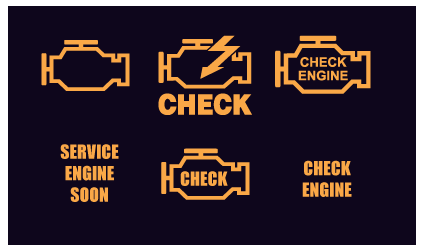
When we’re focused on the task at hand, whether that’s work or school or driving or parenting, the thing we’re doing is more likely to have a deadline or at least be time-based. We postpone removing the obstacle until such time as it becomes too large or problematic to withstand. This is what happens when people keep driving with the “Check engine” light glowing on their dash panel.
RECENT TOLERATIONS TACKLED
As I wrote about in Organize Away Frustration: Practice The Only Good Kind of “Intolerance,” many of the “intolerables” in our lives can be conquered with a little research and applying one of the following:
- A product
- A service
- A change in behavior
- A change in attitude
In that post, I shared how I was almost unrelievedly ecstatic to find a new kind of shower curtain hook that made changing out shower curtain liners much easier on my short-of-stature self. Today, I’d like to share just a few recent examples of how applying a combination of solutions have removed annoyances.
A Tale of Two TVs
Do you have any of those old, boxy CRT TVs in your home? I did. In fact, I had three, which is kind of ridiculous when you realize I’m a singleton. You see, I’d had a television in my living room and another in my bedroom. When the bedroom TV died (so long ago that I’m embarrassed to discuss the exact date), I moved the living room TV to the bedroom.
When I met a friend for lunch one day, she surprised me by having brought one of her old, boxy CRT TVs for my use! To this day, I’m flummoxed as to how she ever got it into her car, and though I recall basically rolling/sliding it up the carpeted stairs of my apartment, I’ve got no idea how I ever managed to get it from my car to my own front door. (Perhaps this is like how they claim women forget the pain of childbirth?)
Eventually, I got a modern flat-screen TV for my living room. But I also embraced the advice not to have screens in the bedroom (to avoid that sleep-stealing blue light) and got rid of cable in that room. Thus, I had a broken TV, a gifted (no longer used) TV, and an unused TV. All on the second floor of my home.
Did I mention these are big, heavy, boxy TVs?
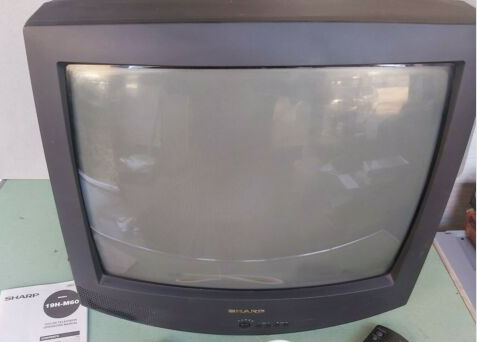
Remember how I said I had my hot water heater replaced last year? Well, one of those TVs took up most of the empty space at the top of the staircase, and so even though our apartment complex had been pretty insistent that we were never to ask the maintenance men to carry or remove anything unrelated to their work, the guys decided that it would be to everyone’s benefit to get that one TV out. Yay! But that still left two.
To be fair, I wasn’t always just tolerating the annoyance of having two unused, dust-catching, space-hogging CRT TVs in my home. I had called the various junk haulers in town, but they wanted a frustratingly large fee for something that I could have done myself, had I only been stronger, had slightly longer arms to get fully around the TVs, and had been a bit taller (so I could have seen the stairs over the top of the TVs and not feared tumbling down).
Yes, even we professional organizers fall prey to those self-imposed obstacles. Had I thrown a little money at the problem, it would have been solved back then.
I also called many non-profits, but nobody wanted donated CRTs.
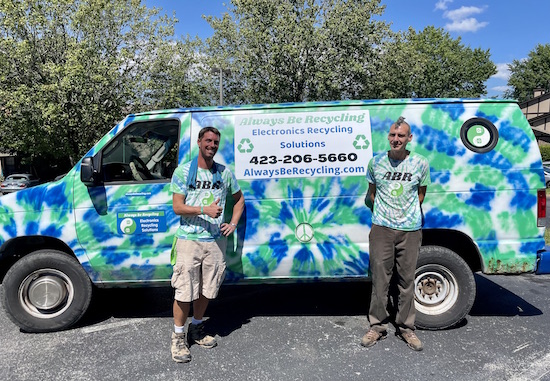
Fast forward to late August, when I contacted Chattanooga’s Always Be Recycling. The owners, a couple who’d moved from Pennsylvania, opened their business here just at the start of the pandemic. I’d networked online with Leann Cinaglia to see how their services might dovetail with my clients’ needs. The last time we’d spoken, they weren’t able to handle CRTs because of the difficulty in recycling them, but on a day where the frustration had just gotten too high, I called to see if they might have any suggestions for other solutions. And that’s where the magic happened!
It turns out that annoyingly boxy 20″ CRT TVs have become popular with the retro gaming crowd! After one short phone call, Always Be Recycling’s co-owner Jamison Cinaglia and his associate Bret (pictured above) arrived on time the next day and quickly removed both TVs and oodles of old landline phones, cables, and cords as well — at no charge. (Had I lived significantly farther from their venue, there would have been a fee, but significantly less than the various junk haulers had quoted me.)
Throughout the entire interaction, they were professional, careful, friendly, and polite. This bodes well for knowing they’ll treat my clients, especially the elderly and/or delicate ones, with respect and compassion.
So, this is a reminder that sometimes, the key is to continue to ask for input on solutions until the right one appears.
No Longer Hot Under the Collar
Not all intolerances are about excess or clutter. A major frustration in my life is heat. (And no, that’s not specific to the air conditioning and refrigerator woes.) I’m just always too hot. I hydrate. I wear temperature-appropriate clothing. But no matter what, even my head perspires and my hair frizzes and I end up looking like Art Garfunkel. (No offense, Art.)
And yes, I realize that a Buffalonian living in the Deep South might have found a more obvious solution to that problem over three-plus decades.
I’ve tried those evaporative cooling neck scarves and “chilly towels.”

Honestly, they just end up feeling damp and heavy.
However, in addition to my own research, I’ve made it a habit of telling everyone I know, particularly people who participate in outdoor activities, that heat is the non-clutter bane of my existence. So, friends are on the lookout for solutions on my behalf.
Recently, Paper Mommy was at the hair salon and saw a stylist wearing something that looked like headphones around her neck. When my mom casually asked, the stylist enthused about this life-changing product, a fan that you wear around your neck. Paper Mommy bought me one (in pink) that very day!

Two days later, I received a Jisulife bladeless neck cooler. (Due to autocorrect, I accidentally praised it to my BFF as a “bloodless” neck cooler. Thankfully, it’s also that.)
You place it around your neck as if you’d just removed headphones, and the three-speed fan gently blows cooling air upward, along the neckline and up into your hairline (without causing any tangles or mess). I’ve used it several times to great effect at client locations where the combination of the kind of work we we’re doing and the actual temperature made the heat intolerable for me.
It’s battery operated and rechargeable via the included USB-C charging cable. The manufacturer notes that the 4000mAh large capacity batteries provide anywhere from 4-16 working hours of service, depending on which speed levels you use.
There are a number of brands with similar styles, but this one ranges from $32-37 and comes in dark blue, dark green, grey, and pink.
They Say Nothing Can Live in a Vacuum
Recently, my longtime hair stylist (hey, this continues a theme!) left the salon where I’ve been going for years and moved to her own location. In this new place, several providers (offering a wide variety of beauty services) have one collaborative location. All of them have their own private pods or units, about the size of a single or double dorm room. As I’m still wearing a mask whenever I’m inside anywhere, and trying to avoid being in close contact with strangers, I love this bright and cheery, but private space.
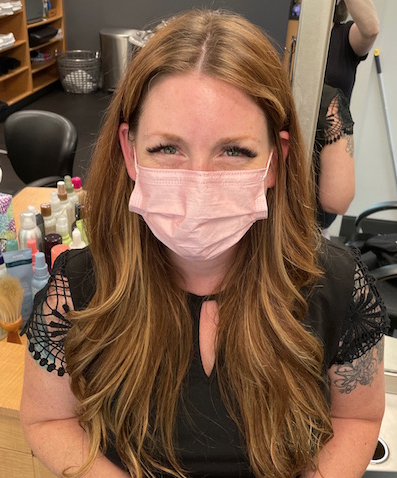
Terri Hart of RoseMary Beauty Company in a photo at her old salon
My fabulous stylist (shoutout, Terri!) has decorated her salon space to make it inviting. At my first visit, I applied my professional organizer curiosity (with her permission, of course) and marveled at all of the scaled-down storage and gadgets. There’s a cozy snack bar with a lovely little fridge and coffee maker, cabinets and cupboards, a tiny towel warmer, and all sorts of appealing products.
At one point, I looked toward the floor and saw what I jokingly guessed was a Doctor Who Dalek-adjacent gadget. OK, I assumed was either a Bluetooth speaker, humidifier, or some kind of air cleaner. But nope.
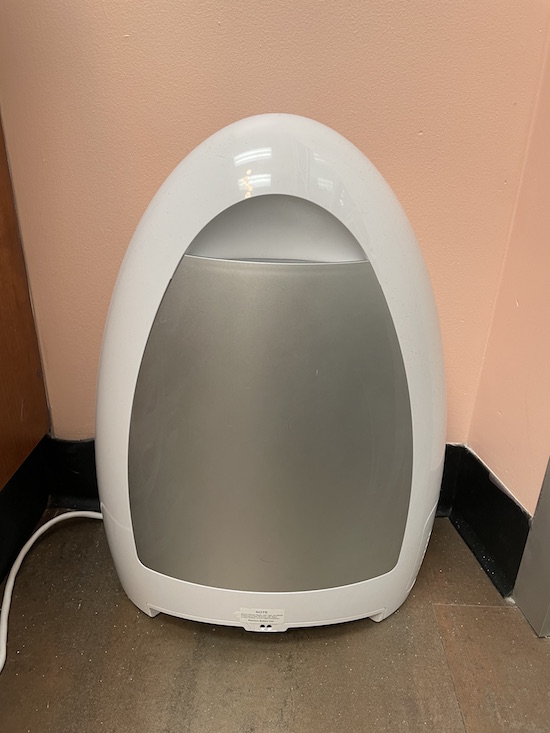
It’s an EyeVac Home Touchless Vacuum. The prior salon had been designed with one of those in-wall central vacuum systems. When homes have central vacuum systems, you can usually plug a hose into the wall in any of a variety of spots and attach the appropriate devices. In the salon, it was a matter of sweeping hair clippings up to the edge of baseboard and shwooooop it would get sucked in and away to some mysterious central location. But that was a big salon specially built for the purpose.
Terri found her EyeVac Home Touchless Vacuum through a site for salon products. She simply sweeps clippings up to the front of this little robot-looking dude, and motion detectors sense the schmutz! (There are buttons on the top for manual control when you want it.) Debris is stored inside an environmentally-safe canister until you’re ready to empty it, at which point it’s much like emptying a shredder.
It comes in six colors (Designer White, Tuxedo Black, Matte Black, Silver, Rose Gold, and Sea Glass), measures 8″ long x 13″ wide by 18″ high, comes with a six-foot electrical cord, and uses dual HEPA filters. It’s available for $129 from EyeVac and Amazon, which is currently offering a $10 clickable coupon.
Had Terri not found this nifty tool, I’m sure she would have figured out a sweeping/vacuuming, but by acquiring this up-front, she avoided having a frustrating, untenable “toleration.” She also never has to bend down or deal with a dustpan! The company doesn’t have a YouTube channel, but the late, lamented (and slightly resurrected) gadget site The Grommet shows it off to nice effect here:
Cooler still, in the days after seeing this EyeVac Home Touchless Vacuum in action, I’d been mentioning it (as well as the bladeless neck cooler) to clients. And with this, we have solved so many frustrations in household with babies and toddlers who drop food from their high chairs, cats who swoop bits of kitty litter all over the room, and crafters who drop bits of cuttings, sequins, and yarn-y bits, etc.
Instead of schlepping out a full-size or handheld vacuum or having to bend or lug, a quick and simple swoop of a broom right up to the bottom edge of this little Dalek cousin and all of your schmutzy clutter will be exterminated!
HOW TO STOP TOLERATING THE INTOLERABLE
Nobody’s house or office or computer gets cluttered overnight. Ignoring or avoiding frustrations for weeks or months or years just allows those frustrations to be build. So, I leave you with an update of the advice I offered a little over two years ago:
- Google (or use your favorite search engine) to see who has created content about your problem, tweaking your search terms to find what you need. There are tricks to improve your searches on Google, on DuckDuckGo, and on Bing.
- Search on YouTube (which is ideal for solving “how to” problems, whether for plumbing repair, tying a tie, or fixing a stuck spacebar). A few years ago, someone stole my driver’s side mirror, yanking it from the electrical connections. (Who does that?!) A clear, concise YouTube video allowed me to purchase just the mirror and replace it myself, rather than having to take it to mechanic and pay for service.
- Search in an online forum like (the less dodgy parts of) Reddit, Facebook or community groups, or neighborhood groups. I’ve seen people ask for everything from how to get a car out of locked garage to how to get teenagers to respond to texts.
- Ask for suggestions on your social media pages. (I learned from TikTok that you’re not supposed to roll/fold modern sleeping bags before putting them in compression carrying bags; you’re supposed to smoosh them in. Who knew?)
- Visit or call your local public library. Librarians are experts at finding information. (Let’s say your problem requires a tool, and you don’t want to buy a specialized tool. Did you know many cities have tool libraries?) You can also use the Library of Congress’ Ask A Librarian for general and specialized help solving those intolerable problems.
- Ask a professional organizer. We know stuff. (We professional organizers get asked all sorts of things. “How do I fold a fitted sheet?” “What’s the best label-maker?” “How do I pay off my mortgage faster?” “Where can I donate this random item that’s of no use to me but might make someone else’s life magical?” Ask your PO!
And, if we’ve learned anything this week, consider asking your hair stylist!
A New VIP: A Form You Didn’t Know You Needed

Brown Plush Bear Patient Photo by Kristine Wook on Unsplash
As a professional organizer for 20 years, I am rarely stumped by organizing-related questions, especially those having to do with vital documents or what I call VIPs (very important papers). However, a client recently presented me with an article making a recommendation for a particular document, and it sent me down a rabbit hole of research.
THE USUAL SUSPECTS: VIPS AND HOW TO MAINTAIN THEM
Over the past years, we’ve discussed (at length) the essential documents everyone should have and how to organize and keep them safe. Posts covering these topics have included:
How to Create, Organize, and Safeguard 5 Essential Legal and Estate Documents
The Professor and Mary Ann: 8 Other Essential Documents You Need To Create
Ask Paper Doll: Do I Really Need A Safe Deposit Box?
Paper Doll’s Ultimate Guide to Getting a Document Notarized
Over the years, we’ve looked at documents granted by a government entity, like birth and marriage certificates, divorce decrees and custody documents, citizenship and military separation papers, passports, and Social Security cards.
We’ve also reviewed essential documents you must create for yourself (or with assistance), including home inventories, insurance policies, estate planning documents (like wills and trusts, pre- and post-nuptial agreements), and living wills (also known as advanced medical directives).
And, for ensuring that your loved ones can take care of you (and you can take care of them) in the event of incapacitation, we have always accented the importance of having both a Durable Power of Attorney for finances and Durable Power of Attorney for healthcare (known in some states as a healthcare proxy).
BEHOLD: THE POWER OF ATTORNEY
A Durable Power of Attorney for financial decisions is necessary if you are unable to make financial decisions or take financial actions on your own. This might occur if you are ill and lack the cognitive capacity to make your own decisions (such as if you’re comatose, heavily medicated, or experiencing some sort of dementia), but it might also come in handy in other circumstances.
Imagine that you are taking an around-the-world cruise or hiking in the Himalayas. In such cases, communication may be spotty or impossible. If the stock market were tanking or a financial opportunity of great importance occurred, or if your return were delayed and you needed to make sure your child’s college tuition was paid or some other financial arrangement was secured, knowing that someone with your Power of Attorney for financial concerns was handling everything would certainly put your mind at ease.
A Durable Power of Attorney for healthcare, or a healthcare proxy, is similarly important if you are unable to make your own healthcare decisions, pretty much for the same reasons initially outlined. If you are physically or cognitively incapacitated and need someone to make decisions on your care, it’s essential to have that paperwork in place.
And, as a periodic reminder to all parents who’ve recently sent their kids off to college, without a Power of Attorney for healthcare or healthcare proxy in place, if your away-at-school adult child were ill and had not granted you PoA for healthcare, the college’s health center or local hospital would not be allowed to provide you with any information about your child’s condition or care.
So, Power of Attorney documents are pretty darned important. You want them in place so that your spouse, partner, adult child, or trusted friend or advisor can be kept informed of your situation and can, if necessary, make decisions and take actions on your behalf.
This is the be-all and end-all of advice we paper specialists generally need to give. But guess what? We’ve been missing a pretty important document related to older adults!
BEYOND THE POA: THE DOCUMENT YOU DIDN’T KNOW YOU NEEDED
Let’s imagine your spouse is 65 or older. Or perhaps we’re talking about your parent, or another slightly older loved one. (I say slightly older, as now that Paper Doll has reached 55, the age of 65, when you can get Medicare coverage, doesn’t seem that far off.) Or perhaps you’re the one with Medicare.
You’d assume that as long as Powers of Attorney had been executed with regard to financial and medical decisions, then everything would be A-OK. Right?
Mostly. But not entirely.
It turns out that, by law, if you want someone (your spouse or significant other, your adult child, your caregiver, etc.) to speak to Medicare on your behalf, having a both a Durable Power of Attorney for financial issues and one for medical issues is not enough.
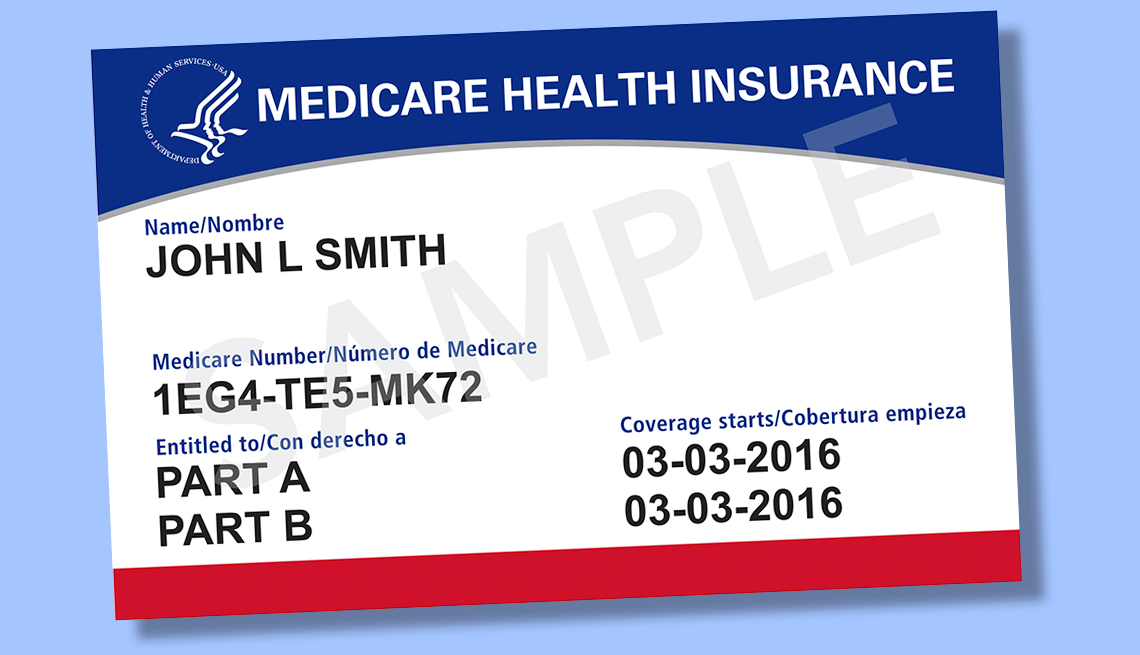
Perhaps because each state has a different variation on PoA forms, or perhaps because the government just likes to be wackadoodle, Medicare requires you grant prior authorization via a surprisingly under-mentioned form called the 1-800-MEDICARE Authorization to Disclose Personal Health Information Form or CMS-10106. (Doesn’t that just roll trippingly off the tongue?)
You must fill out the CMS-10106 well in advance if you want someone to potentially be able to discuss any of the following with Medicare:
- Medicare eligibility
- Medicare claims
- Plan enrollment (including part D or other drug plans)
- Payment of premiums
- Other information, including payments to beneficiaries
So, if you have Medicare, are you thinking “Whoops!” and wondering what happens if you have secured your financial and healthcare PoAs but haven’t ever filled out this authorization?
It turns out there’s a quirky loophole. If a person HAS done both of their PoA forms but hasn’t actually filled out this authorization form, it’s entirely not a catastrophe. That’s because the person who fills out the form has to be either one of the following:
- the beneficiary (that is, the person on Medicare)
OR
- the personal representative of the person on Medicare (that is, the person who has the Powers of Attorney, or otherwise has been granted authorization over your information).
So, yes, if you’re the person with the Power of Attorney for a Medicare beneficiary, you can authorize yourself to let Medicare talk to you about someone’s health and payment information. And if that seems a little weird to you, well, you’re not the only one.
The problem is that if someone hasn’t ever filled out the CMS-10106 in advance and their personal representative has to do it, it’ll take time to process because you have to MAIL it to Medicare.
That’s right — you can’t submit the authorization form online or even by fax. You have to mail it, like it’s 20th century, to a post office box in Lawrence, Kansas!

So, that’s why I’m writing this post, so that if you or someone you know is enrolled in Medicare, you (or they) can jump right on this.
WHAT TO KNOW ABOUT THE CMS-10106
The first thing to know about the long-windedly named 1-800-MEDICARE Authorization to Disclose Personal Health Information Form (CMS-10106) is that it’s a fillable PDF.
For those unfamiliar, that’s a digital form that allows you to type the information right into the blank fields on the screen so that when it’s printed, the information you typed is blended with the form provided, as if you were using a typewriter and typing right on the paper. One supposes that Medicare doesn’t want people to print and fill the blank documents by hand to prevent confusion caused by messy handwriting.
Open the CMS-10106 instructions and form on a computer. (While I have not tested all browser options, the fillable PDF function does not work on my iPhone or iPad.)
The form has only six questions (with a few sub-sections) and they are pretty self-explanatory.
Q1: First, fill in the name, Medicare number, and birthday of the person who is a Medicare beneficiary. That’s either you, or if you’re the person with Power of Attorney for a person with Medicare, you’ll put their information. (You’ll get to identify yourself as the Medicare beneficiary’s personal representative later on in the form.)
Q2: Next, you get to choose whether you’re allowing all information to be disclosed, or only a limited amount.
You can specify whether Medicare can disclose information related to any or all of the categories mentioned: eligibility, claims, plan enrollment, payment of premiums, and/or other information, including payments to beneficiaries.
(There is a special sub-question just for New York residents, allowing them to grant or withhold authorization to discuss alcohol and drug abuse, mental health treatment, and HIV status. If you are not a New York State resident, you will skip this question.)
Q3: At this point, you get to decide whether you want authorize Medicare to disclose your personal information indefinitely, or only for a limited period of time (and you would provide a start and end date).
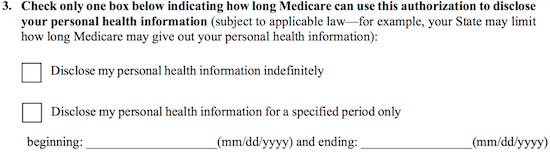
In most cases, you would grant authorization indefinitely to your spouse, adult child, or loved one. However, if you’re a singleton and asking a good friend (but perhaps not your BFF) to help you with these things, you might want to date-limit authorization. (Also, as you’ll see below, you may have reasons to grant authorization for a limited period to representatives of an agency or organization.)
Note: even if you grant indefinite authorization, your state may have separate regulations regarding how long authorization stands. Yes, that lack of uniformity between states and a federal agency is another example of how wackadoodle red tape can be.
Q4: The fourth question could prove a little confusing, so Medicare offers a twinge of help. The question reads, “Fill in the reason for the disclosure (you may write “at my request”):”
It’s good that they’ve added that parenthetical option, because most people would end up filling the two blank lines with some variation on, “Because I’m having this yucky surgery and my brain is going to be floopy for a while and I’ll be in the hospital and then in a rehab facility without good cell service, I want my cousin Bernice to be able to talk to Medicare for me.” And that won’t really help anyone. Just write, “at my request” and be done with it.
Q5: The fifth question gives you the opportunity to name two people (and provide their addresses) to whom Medicare can disclose your personal information. If you have named primary and secondary “agents” as your Powers of Attorney, these would be the people you’d most likely list here. (You can add more names on a separate sheet of paper.)
Note: Medicare allows you to list organizations instead of, or in addition to, individual persons; for example, if you’ve hired a professional financial organizer, daily money manager, geriatric care manager, or elder attorney, you might want to list the company/service so that assigned team members can provide assistance.
Another reason you might want to list a particular organization is if you’ve been injured in an accident. Let’s say you need to make a personal injury claim because your neighbor’s giant skeleton display for Halloween falls on you.

If you are making a claim, you have to prove that you sustained injuries, and your medical records (including Medicare records) may be required to support your claim and get your neighbor’s insurance to pay. Authorizing Medicare to talk to your neighbor’s insurance company may help speed things along.
Q6: The final question is formatted a little differently. First, there’s the official authorization statement:
“I authorize 1-800-MEDICARE to disclose my personal health information listed above to the person(s) or organization(s) I have named on this form. I understand that my personal health information may be re-disclosed by the person(s) or organization(s) and may no longer be protected by law.”
Underneath, there are fields for a signature (the only field you will leave blank until after you print the document), phone number, and date you’re filling out the form. Then there’s a box to list the complete address of the person with Medicare (that is, the beneficiary).
Note: if you’re not the beneficiary (rather, you’re the one helping the person with Medicare), you’ll check the box that says, “Check here if you are signing as a personal representative and complete below. Please attach the appropriate documentation (for example, Power of Attorney).”
Then you’ll provide your own address, telephone number, and your relationship to the beneficiary, and you’ll attach a copy of the Power of Attorney documents to prove you are authorized to be a personal representative. (Again, you’re authorizing yourself to authorize yourself to talk to Medicare. Yes, it’s weird.)
Remember, the person with Medicare is the beneficiary; the person helping the beneficiary is the personal representative!
Once you complete the entire form, there’s a grey PRINT FORM button at the bottom. Click it, and then sign on the signature line for question #6. Remember, I said the fillable PDF wouldn’t let you type anything there? That’s because, of course, you have to hand-sign the document. You can’t use Adobe or Apple Preview’s digital signature feature because the form won’t let you click there.
Make a copy of the CMS-10106 for your own records and mail the signed, blended form to:
Medicare CCO, Written Authorization Dept.
PO Box 1270
Lawrence, KS 66044
WHAT IF I CHANGE MY MIND?
At any time, even if you’ve granted indefinite authorization or the ending date of the limited authorization has not yet occurred, you can revoke your authorization.
This doesn’t have to seem like a mean thing. I mean, sure, you could be in a huge fight with your Cousin Bernice because she said the potato salad you brought to the last family reunion wasn’t as good as hers, and you’ve decided you don’t want her to be authorized to talk to Medicare on your behalf.
More likely, however, you may have divorced your spouse or separated from your significant other, or the person you’d previously assigned authorization to might be ill themselves, or otherwise unavailable. Or you may have just moved to a different city, where it wouldn’t make sense for the formerly authorized person to help you with your Medicare issues.
How To Revoke Authorization
To revoke authorization, you must notify Medicare in writing and send it to the Lawrence, Kansas address, above. There’s no form, nor is there a sample letter. I would advise writing a simple letter (in the format of a business letter as you learned in school, along the lines of:
[Your Street Address]
[Your City/State/Zip]
[DATE]
To Whom It May Concern:
I, [YOUR NAME]/Medicare #[YOUR MEDICARE NUMBER] hereby revoke my authorization to disclose personal health information, previously granted on [DATE you signed the original CMS-10106], to [insert NAME OF PERSONS to whom you granted authorization].
I may be reached at [insert PHONE NUMBER] if there are any questions.
Sincerely,
signature
[YOUR NAME]
Be sure to sign the letter (between the “Sincerely” and the typed version of your name). If you’re old enough to receive Medicare, you probably know how to write a business letter in block format. If you’re GenZ or a younger Millennial, you’re welcome.
WHAT IF THE MEDICARE BENEFICIARY HAS PASSED AWAY?
There are times when a personal representative will not have Power of Attorney status. If the beneficiary is deceased (let’s say, it’s your great-grandfather), you may still use this same form, but you will need to add copies of different legal documents. This is because Power of Attorney documents “do not survive” — in other words, they don’t retain power — after an individual’s death.
So, instead of PoA documents, you might need to attach copies of “personal representative paperwork” that signifies that you are the executor of the deceased’s will or the administrator of an estate or have a similar role. Documents might include:
- a court document that states you are the deceased’s next of kin*
- a Letter of Testamentary (or Letter of Administration)*
- other personal representative papers indicating you are the executor or administrator*
*In any of the above cases, the documents will need to have a court stamp and judge’s signature.
You’ll also want to include a statement of how you’re related to the deceased Medicare beneficiary.
September is National Preparedness Month, and Ready.gov has a wide variety of information on how to plan ahead and prepare for disasters. However, being “ready” involves being prepared for far more than natural disasters. While I encourage you to visit Ready.gov, I also urge you to (re)visit the Paper Doll posts linked at the top of this page so that you have all the essential Very Important Papers you need, securely organized and accessible.
Do (Not) Be Alarmed: Paper Doll’s Wake-Up Advice for Productivity
September’s approach means many things: a new school year, a new television season, Europeans coming back from their August-long vacations.
But in September, when I see kids lined up for the school bus, I remember when I went to kindergarten and Paper Mommy bought me a giant, orange, retro, two-bell alarm clock.
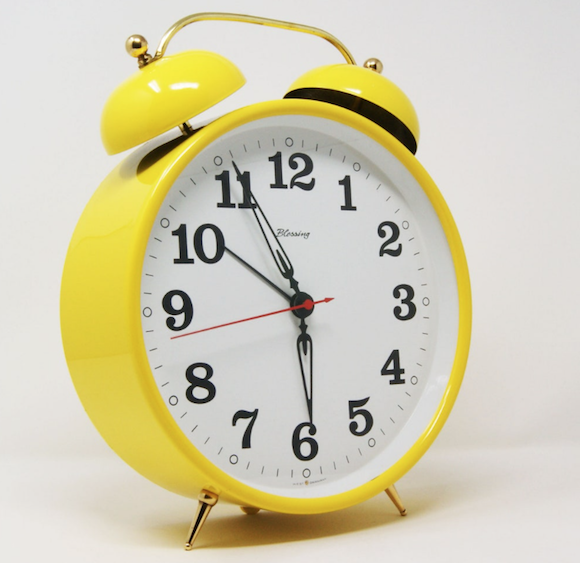
(I realize this is yellow and not orange, but we don’t have a photo of my childhood alarm clock. This is a very close reproduction.)
You could see the clock from any vantage point in my room, and the ring was sonorous. There was no way I’d ever oversleep and miss the school bus with that loud din. (Initially, as with all school-related things that year, I was excited. But it takes about three days of being awakened by something that loud for the delight to wear off.)
If you think about it, time management and productivity begins with waking up in time to set your plans in motion, so I thought we’d take a foray into idea of waking up on time.
A SHORT HISTORY OF ALARM CLOCKS
The alarm clock — even the very concept of waking up at a specific time — is fairly new.
Throughout history, people were generally awakened by natural occurrences: the sun rising (and warmth on one’s face or light in one’s eyes), the crowing of roosters, the crying of babies, or the call of nature. City dwellers might have been awakened by church bells or street noise, but farmers far from villages were dependent upon their own natural body clocks and the people and animals around them.
These not-very-specific waking hours were not a problem for most people until the Industrial Revolution in the 19th century. Before that, unless you were within proximity of a clock tower or your family had the wealth to own a clock at home, it was enough to speak generally of meeting someone at dawn’s first light or midday or supper time. However, with the advent of trains (and the ability to catch them) and factory work, it became essential to know the specific time of day. That included waking up on time.
Before the invention of alarm clocks (and into the twentieth century), city dwellers in the UK hired “knocker uppers,” people who would literally knock on one’s windows and doors with everything from broom handles to batons (as in police sticks, not beauty pageant contestant’s silver poles with streamers) to pea shooters! Believe it or not, some people continued “knocker upper” subscriptions long past the invention of alarm clocks; in fact, the last knocker upper service in the UK didn’t cease until the 1970s, long after the rise of household electricity and clock radios.
If you didn’t mind having a giant water wheel handy, you could have been awakened on time (to the sound of a powerful chime and a puppet show) with the assistance of the Water-Driven Spherical Bird’s-Eye-View Map of the Heaven, invented by Chinese monk Xi Ping in the year 725.
Although the first mechanical alarm clock was invented in 1787 by American Levi Hutchins but his design was never patented. Sixty years later, Antoine Redier in France patented the first adjustable alarm clock wherein each hour on the clock’s dial/face had a hole; if you wanted to get up at 7, you put a pin next to the hole next to the number seven. Want to get up on the half hour (or any time except on the hour)? You were out of luck.
It wasn’t until 1876 (which may seem a long time ago to you GenZ and Millennial readers, but that was only eleven years before one of my grandfathers was born) that an American patented a more workable alarm clock and began mass-producing them.
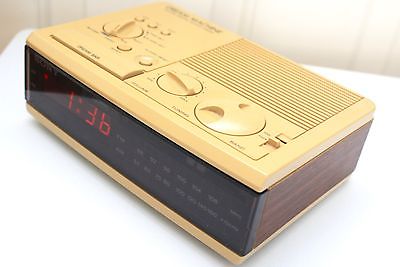
For more on the history of alarm clocks, from the World War II era shortage (due to the use of all spare metal for wartime production) to the development of clock radios, snooze alarms, and my beloved college-era SONY Dream Machine (in production from 1960s until the early 2010s),
you can read Atlas Obscura’s lovely piece on the 2000-Year History of Alarm Clocks and All That’s Interesting’s How Did People Wake Up Before Alarm Clocks?
HAS PAPER DOLL FALLEN INTO A TIME WARP?
Are you fearing that Paper Doll has had an alarm clock dropped on her head?
You may be wondering why I’m talking about alarm clocks. After all, hasn’t everyone replaced alarm clocks with their smart phones? Yes, pretty much, most have.
But Paper Doll has a secret for you. Quite a bit of research finds that you might be healthier and happier using an actual alarm clock rather than your phone. And a happier, healthier you has a better chance of being productive and getting things done.
YOUR PHONE AS AN ALARM CLOCK, YAY OR NAY?
Sure, there are good reasons to use your phone as your alarm clock:
- You and your phone are already inseparable. You’re much more likely to trust it than a hotel’s front desk wake-up call or even your spouse’s promise to wake you up.
- It takes no effort to set your phone’s clock to the right time. Your cell phone provider already links your phone’s clock to the atomic clock of wherever you’re located by its connection to low-orbit GPS satellites; it (usually) even readjusts automatically when you change time zones. (If you’re not connected to cell towers, your phone’s internal clock takes over until the next time in connects to the network.)
- You can set your phone to wake you up with your favorite song or sound. Whether you’d like to wake up shaking your groove thing to Lizzo’s About Damn Time or prefer to pretend that you’re standing in for Bill Murray in your own version of Groundhog Day, there’s audio for you.
- There are lots of different alarm clock apps for iOS or Android to help you either ease into your day or be shocked out of your sleepy stupor, depending on which you prefer.
However, the ubiquity of phones in our lives is part of the reason they can be harmful in the bedroom:
Light at night is bad for us.
Harvard researchers found that increasing the amount of nighttime light study participants received increased their blood glucose levels similar to those found in people who are pre-diabetic. The nighttime light also decreased participants’ levels of leptin, the hormone that makes you feel satiated after a meal, so you stop grazing between dinner and bedtime and throughout the next day. So, too much light at night can impact your health, overall, and your waistline.
While any light at night can wreck our sleep, this is especially true of blue light. And yup, the screens on our digital devices (like our phones) tend to make use of blue wavelengths. This is a double-edged coin.
The blue light wavelengths are great during the day, as they amp up our moods, our reaction time, and our ability to stay focused and attentive. Yay, blue!
But those same wavelengths of blue light at night tinker with our circadian rhythms, making it harder to fall asleep. All that unnatural light tricks our bodies into thinking it’s still daytime, and so we don’t feel that pleasantly fuzzy sleepiness that makes it easy to drop off without worry or care. Boo, blue!
In fact, while all night light suppresses the production of melatonin, a hormone that controls our circadian rhythms, blue light is the most potent. So, not to scare you, but as cozy at it is to have your phone under your pillow or at your bedside, it’s not worth that blue light messing with your sleep and putting you at risk for obesity, hypertension, or diabetes.
Scrolling, and especially doom scrolling, spells doom for our sleep quality.
Watching any screens in the hour or two before bed is bad for us because of that blue light. But the content on our phones can be just as precarious.
Doom scrolling is the compunction to engage in negative information. When doom scrolling through Twitter or your favorite news feeds, keeping up with what’s going on in the world, you’re probably finding a preponderance of bad news, things that will stress you out and make you angry or frustrated.
It’s not your fault. Our brains are wired to experience a negativity bias, wherein (controlling for the emotional power of a piece of information), we’re more likely to see something negative as having a deeper impact on our lives than something positive. A study at the University of Sussex found that doom scrolling is more likely to make us feel anxiety, stress, fear, depression, and sense of isolation. (And yes, this got worse during COVID.)
Let’s not forget dopamine. Dopamine works when you’re scrolling through social media the same way it works when you’re pulling the arm (or pushing the button) on a slot machine. Dopamine is a hormone that works like a drug, urging you to seek further gratification, which may be a TikTok video that makes you laugh or a tweet confirming your negativity bias that a particular politician is leading to the ruination of all that is good and holy.
Of course, it doesn’t have to be social media. Video games, movies, videos, and TV shows are all (generally) energizing, and the last thing we should be engaging in before sleepy-bye time is whiz-bam-pow!
All of this is bad for your before-bed brain in the same way that letting a toddler get all “sugared up” and run around in the hour before bed will make it harder to get them to sleep. That’s why we focus on good sleep hygiene for tiny humans, giving them baths and stories and snuggle time, in hopes of relaxing them off to dreamland. Grownups need that help to power down, too.
And for those of you who are partnered, a phone-free bedroom mean an increase in the likelihood of intimacy, whether that’s relating emotionally or canoodling.
Scrolling is just as bad in the morning as at night.
Everything we need to avoid at night so that we can wind down and get to sleep is still going to be there when we wake up. But does it have to be there the very minute we wake up?
Whether it’s an email your boss sent off at 2 a.m., a tragic news story from the other side of the world, or whatever is “trending,” your phone can be a royal messenger of frustration.
Give yourself some time in the morning to ease into your day, whether that’s with your significant other, children, or pet. Even just having some quiet time between waking and breakfast can help you create the right mood for the day.
So, I challenge you to banish your phone from the bedroom.
REPLACE YOUR PHONE WITH AN ALARM CLOCK
So, if you’re not going to let the not-so-dulcet tones of your phone wake you up and start your heart racing, what should you use? Unless you have the funds (and the trust) to hire a knocker upper, an old school two-bell alarm clock or travel might be just the ticket. (Or, the noise might set your teeth on edge.)
Of course, it doesn’t have to be old school. There are some nifty modern alarm clocks that might be better suited to your particular needs, from glowing sunrise-simulation clocks that gently wake you with the kind of light that’s healthy for starting your day to clocks that shake, rattle, and roll you to your feet.
Here is just a sample of what you might consider, especially if you tend to hit the snooze button until the last possible moment.
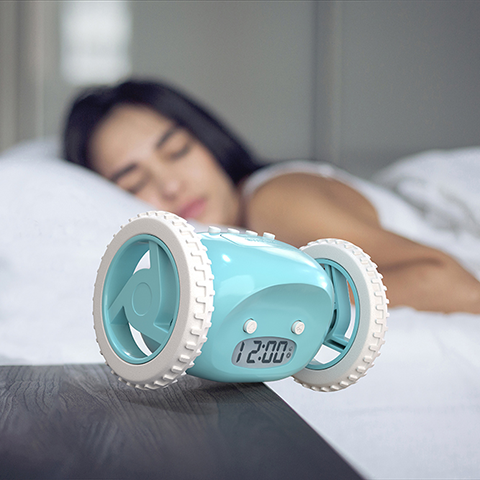
Clocky — is an EXTRA LOUD alarm clock on wheels. What Roomba is for vacuuming the living room, Clocky is for getting you to actually wake up and start your day. When the alarm goes off, you get one chance to snooze, but after that, Clocky rolls and runs away, and you have to chase after it!
An MIT student who had trouble getting herself up and out of bed, Gauri Nanda combined her engineering skills with a desire to improve the aesthetics of alarm clocks to make them delightful instead of solely alarming.
Clocky comes in several colors (black, white, light blue, peach, blue, silver, and gold). It sells for $39.99 on the web site and on between $20 and $40 on Amazon, depending on the style.
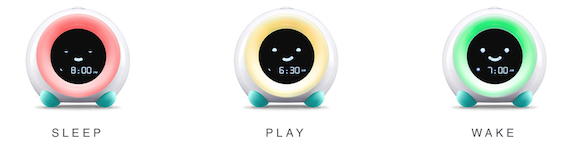
Little Hippo’s Mella Sleep Alarm — This kid-oriented charmer is a sleep trainer, alarm clock, sleep sounds machine, night light, nap timer, and digital nanny (helping convince your tiny humans to stay in bed until it’s time to actually wake themselves and the rest of the house).
Mella is white with accent features in Arctic Blue, Blush Pink, Bright Purple, Tropical Teal, and Kickstarter Green. You can buy Mella from the website or on Amazon for $49.99.
Pavlok’s Shock Clock 2 — This wrist-band waker-upper seeks to retrain your brain to make waking up about engaging your mind immediately. Pavlok’s Shock Clock 2 is very high-tech, able to track your sleep patterns using advanced motion detection via a 9-axis accelerometer. (No, don’t ask me what that is.)
To take advantage of your sleep rhythms, you can set the alarm so that it will only wake you between 0 and 20 minutes before your pre-programmed time to ensure it wakes you during the lightest stage of your sleep cycle.
The clock wakes you and gives you assignments to get your brain and body moving; if you’re a heavy, heavy, “I-hate-you-go-away” sleeper, it might make you do jumping jacks; Fitbit-style, it knows if you’re jumping (and no, unlike with Fitbit, you can’t put the Shock Clock 2 wristband on your dog…and I doubt your dog can do jumping jacks). The alarm won’t turn off until you’ve responded to its order to jump with “How high?” (OK, I made up that part.)
The Shock Clock 2 might assign you other kinds of activities, like going on a treasure hunt around your house to scan QR codes placed in various locations. If you seriously want to train yourself out of snoozing, this is definitely an intense way to go about it.
The Shock Clock 2 comes in red, blue, pink, and black, and costs $149 at the Pavlok store.
Ruggie Alarm Clock — This doesn’t even look like an alarm clock; rather, it looks more like a cozy bathroom rug for keeping your tootsies warm when you get out of the shower. But Ruggie is sneaky.
You can’t just hit the snooze. You have to get out of bed, and STAY out of bed for at least three seconds, with both feet on the pressure-sensitive mat. Plus, Ruggie has a library of morning greetings so your can personalize the start of your day with affirmations, empowering messages, and giggles.
Ruggie is a little too popular; it’s out of stock right now, but check back with the company, because this could be a fun way to entice yourself (or your not-so-self-starting kids) to get out of bed.
FURTHER RESOURCES
If you have any heavy sleepers in your house with special wake-up needs, consider perusing:
The Best Alarm Clocks for Sleepyheads (ADDitude Magazine)
When Alarm Clocks Fly: The Tools to Get You Out of Bed — The Best Alarm Clocks for Children and Teens with ADHD (ADDitude Magazine)
19 Best Alarm Clocks of 2022 (NYMagazine’s The Strategist)
Just remember to bear in mind what I said about light disturbing your sleep, and check reviews for mechanical clocks to make sure nobody is complaining about ticking noises.
Do you wake up on your own, or do you need an alarm? Is an alarm (on your phone or alarm clock) not quite enough? What’s your ideal way to wake up in the morning?
Have I convinced you to keep your smart phone out of the bedroom?
Please share in the comments and let us know how you wake up.
Paper Doll on the NAPO Stand Out Podcast: Why Paper Still Matters
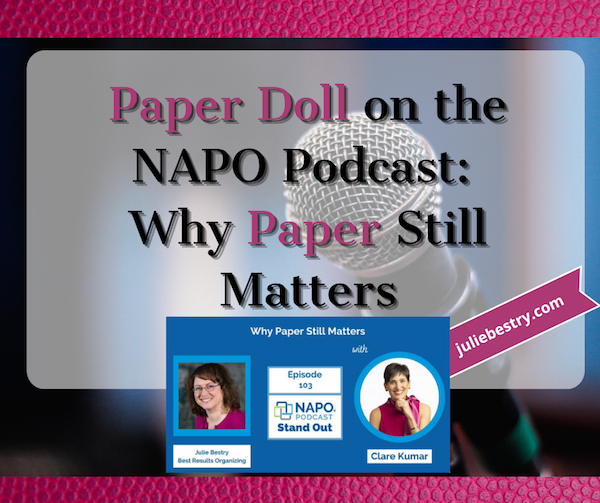
Today’s Paper Doll post is part confessional, part promotional, and part educational. But first…
Have you listened to any good podcasts lately?
I love sharing my research and philosophies of organizing and productivity here in the Paper Doll blog, but I know that sometimes it’s more convenient to listen to (or watch) material that interests you. To that end, back in May, I shared Paper Doll Picks: Organizing and Productivity Podcasts, a list of my favorite podcasts and podcasters in the realms of organizing and productivity. (If you didn’t check it out previously, now is a great time to find some new favorites!)
When I wrote Paper Doll on Planning & Prioritizing for Leadership, I even gave you a two-for-one, recommending you sign up for The Leader’s Asset, a July/August interview series I participated in, as well as sharing my interview on Dr. Frank Buck: Productivity for Total Control & Peace of Mind.
If you didn’t catch my episode, “Julie Bestry: Don’t Apologize…Organize!” the first time around, you can listen at the show link or via Apple Podcasts, Spotify, or all your usual yummy podcast hangouts. (Consider it a summer rerun.) Given the high temperatures around the country, why should you have to struggle and run clicking around the internet dial? Here’s the YouTube version.
Casting a Backward Glance
I started my business twenty years ago, the year that the federal government started prosecuting Enron, the term “Axis of Evil” was coined, and Kelly Clarkson won the first American Idol competition. I joined what was then the National Association of Professional Organizers (NAPO) in the spring of 2002.
When asked what I wanted to do with my business, I said that while I was looking forward to working one-on-one with clients to make their spaces more organized and their lives more productive, my dream project was to have my own newspaper or magazine column.
I started blogging (which is kind of like having a column) in 2007, the same year I became a Certified Professional Organizer.
Over the years, I’ve written some ebooks and had a book (now out of distribution) traditionally published.
I have also been interviewed for a variety of media outlets , including newspapers and magazines (including, I’m always delighted to say, Real Simple), as well as on local television and radio, and on the podcasts in the Paper Doll Picks poast, linked above.
But what I really want to tell you about is a particular career highlight for me.
The NAPO Stand Out Podcast (and a Case of Nerves)
NAPO is still NAPO, but now that stands for the National Association of Productivity and Organizing Professionals. (As you’ve probably noticed, the focus of Paper Doll has also expanded to include more time management and productivity topics, along with paper and information organizing posts.) Since 2018, NAPO has had its own podcast, The NAPO Stand Out Podcast.
The NAPO Stand Out podcast invites organizers, productivity experts, and related experts to share their successes, challenges, best practices, proven strategies, industry developments, and fabulous anecdotes. Of course I listen, as it’s tailor-made for someone like me.
Near the end of last year, the host of the NAPO Stand Out Podcast, my friend Clare Kumar, messaged me to see if I’d like to be on the NAPO podcast.
Clare is a Canadian professional organizer, coach, and media darling, and as I’ve mentioned on these pages before, has a laugh that completely draws you in. She specializes in helping Highly Sensitive Persons (HSPs) optimize their professional performance, and she has her own podcast, Happy Space with Clare Kumar, all about helping HSPs find their own happy spaces. Clare is a force of nature.
Now, as you longtime readers know, I’m not exactly a shrinking violet. I’m always eager to talk (until the cows come home) about residential or business organizing, time management, Evernote, and everything else from notebooks to toxic productivity.
But the NAPO Stand Out Podcast was a different kettle of fish. One of its main audiences includes thousands of my professional organizing colleagues. This wasn’t a matter of talking to strangers who follow other people’s podcasts; this would be heard and seen by my peeps, including the professional organizing rock stars to whom I’ve looked up since I started my business.
The first-ever guest was Geralin Thomas, who is as fashionable as she is business-savvy, and has pivoted to training the next generation of organizing stars. The guest the week before I was set to appear was Harold Taylor, an absolute pioneer of time management and author of numerous books, including the seminal Making Time Work for You

and a time management blog that never ceases to deliver. (You might like The Return of the Checklist.)
From Geralin’s podcast episode #1 and Harold’s #102, the NAPO Stand Out Podcast interviewed powerhouse talents, from former NAPO president and absolute goddess Standolyn Robertson to author/TV star Peter Walsh to multimedia “happiness” guru and best-selling author Gretchen Rubin.
I mean, come on!
I have no trouble getting up to give a presentation in front of a room full of moms of preschoolers or accountants or CEOs because, as speaker training indoctrinates us, in that situation, the speaker is the expert. But a huge number of NAPO Stand Out Podcast listeners are professional organizers; they’re already experts.
“What could I possibly say that would be new or interesting to them?” I whined to my mastermind group. They were amused and not-at-all persuaded by my rare show of humility, and convinced me to have a Zoom call with Clare, who could sell galoshes to desert-dwellers.
Within moments of making delightful conversation, Clare was able to identify some very specific areas in the paper realm about which I feel passionate, and “organized” my anxieties right out of existence. (“Why paper still matters?” Just try to keep me from talking about that!) And then when I procrastinated week after week about actually scheduling the official interview, Clare appeared as if by magic to take the bull (or at least my bull-headedness) by the horns.
And this is the result. You can watch the whole, extended podcast here, via YouTube.
If you’d rather listen while walking (and don’t mind missing the secret squirrel video bonus material), check out the official NAPO Stand Out Podcast page for episode #103 for Why Paper Still Matters with Julie Bestry or the Why Paper Still Matters LibSyn podcast syndication page (with extended show note and links for literally every darned thing I mentioned). Of course, the episode is also available on various podcast platforms, including:
Over the course of the episode, Clare and I discussed how our relationship to paper has changed in recent decades, especially since the advent of smartphones. (We were promised a paper-free office after the advent of the computer revolution, but it didn’t really turn out as we expected!)
We also delved into the importance of finding a system that works for you, whether that’s digital, paper, or hybrid, and how different areas of our lives, from note-notetaking to capturing tasks, benefit from different approaches. I even got to put in a plug for my beloved Cornell note-taking method, which will be a topic of an upcoming blog post for the back-to-school season.
No matter whether you agree or disagree with my take on the beauty of an invitation addressed with calligraphy — I find it superior to an emailed save-the-date reminder — I think you’ll enjoy our hearty discussion of how and why paper still matters in many ways, from paper’s role in cognitive processes to its place in our hearts.
I hope you will take some time this week to watch or listen to the podcast and let me know what you think. Does paper still matter to you?
Follow Me