Archive for ‘Time Management’ Category
How to Be On Time — Smart Strategies to Stop Running Late

Last week, as I walked up to a client’s door, she opened it with a giggle. “Do you realize you always arrive at exactly 12:59? How do you manage it?”
Some of it is luck. The client’s in my zip code, I don’t have to get on the highway, and (thus far) I haven’t encountered traffic delays. But I also have a client on the back side of one of the mountains near Chattanooga, and no matter how early I leave, there’s invariably an accident blocking traffic to (or up) the mountain. But in every instance, I walk out the door at the exact time I’ve intended; for my own sanity, I don’t even attempt to do anything unanticipated (especially answering the phone) in the ten minutes before I’m supposed to leave.
Being on time is no moral victory. (Nor is being late a moral failing.) But to be a good role model for clients regarding organizing and productivity, I need to walk the talk, and time management — particularly arriving on time — is important. It’s also doable!
WHY BEING ON TIME MATTERS
Different cultures have different experiences and expectations of time. In some places, it’s considered the height of rudeness to arrive after the appointed hour, whether for a meeting or social event. In others, start times are “suggestions” and arriving at the time for which you were invited might find someone still in a meeting or (for a dinner party) still cooking or getting dressed.
On The West Wing, there’s an episode where President Bartlet is interviewing secretaries and one makes a comment about how “the French have a pliable relationship with time.” Conversely, there’s this about German perceptions of punctuality:
For our purposes, we’ll focus on North American standards for being on time.
What’s Wrong With Being Late?
Tardiness has bad PR. It causes a wide variety of negative consequences for the person waiting and for you:
- Confusion — At the very least, particularly when the appointed meeting is at a third location (neither your home or office nor theirs), if you aren’t somewhere when you say you will be when you planned to be, like for a first date or a meeting, it can cause confusion. The person you’re meeting may fear they’ve gotten the time, the date, or the location wrong.
- Worry — If you’re meeting someone with whom you’re close, like a friend, family member, or loved one, as the minutes click onward and you’ve neither arrived nor called, they’ll start worrying that you’re in a ditch somewhere, bleeding from a head wound. Not cool, dude.
- Inconvenience — Showing up late causes situational stress for others. If you have an appointment to see the doctor or to get a haircut and you are materially late, it forces them to determine whether to try to squeeze you in and risk making everyone else late for the rest of the day, or to give up on the appointment (which you might need very much) and require you to reschedule. In this way, being late inconveniences the person you are meeting, others with no relationship to you, and you, yourself.
- Perceived Disrespect — If there’s a power imbalance (for example, you’re late for an interview or a meeting with a prospective client), or if you exhibit habitual lateness, others are more likely to perceive your tardiness as a sign of either arrogance or laziness.
Perception of Arrogance
With arrogance, others may assume that you believe your time is more valuable than theirs, and that you’ve judged them unworthy of the deference or respect due to them, personally or professionally.
People who are generally on time (assuming they’re from a culture that values temporal precision) take lateness as a sign of disrespect. Failure to arrive on time sets a tone for business relationships as well as friendships and romantic relationships, and you may encounter a frostiness based on an inaccurate perception of your intentions.
Perception of Laziness
As for laziness, you may have been late because you tried to squeeze in one more sales call or review one more email, but the other person’s perception is that you couldn’t get your act together. Being late repeatedly makes a person seem flaky.
Failure to attend to small details, like arriving at the appointed hour, can make others doubt your ability to serve their needs and master larger details related to delivery dates, precise measurements, or accurate financials. If you show up late for a date, or if you call half an hour after you were supposed to have arrived at the restaurant to say you’re “Be there in 5” when you haven’t even left yet, it isn’t going to endear you to anyone. As time goes on, you may find yourself not taken seriously.
Stress
Think about the last time you were late, whether or not it was your fault. How did you feel? Did your heart race? Did you start to perspire? Did you react by driving faster than you normally would, or with less care? For people who value being perceived as responsible, detail-oriented, and caring, and who value the time of the person waiting, knowing that you’re running late can feel terrible.
In the olden days, before we had cell phones, if you were running behind after you got in the car, there was little you could do except rehearse your apologies and curse the traffic (and maybe yourself). With cell phones connected to cars, we can now text or call hands-free (though it’s not entirely distraction-free and still carries dangers), but being late can still be embarrassing and stressful.
Poor Self-Esteem
Nobody wants to think less of themselves. But when we make promises or agreements to be somewhere and we are not, particularly if any part of our lateness is our own fault, and even more particularly if we grew up with parents who equated tardiness with moral failings, being meaningfully late is going to wear away at one’s self-esteem.
Rather than seeing the situation as one that requires new strategies, you might start imagine yourself through others’ eyes in a not-very-compassionate way and think of yourself as a “screw-up.”
Resentment
The harder you perceived yourself working — doing one more task before you left the office or taking care of one more thing at home — the more likely you are to be resentful when you run late. You may resent your boss or co-workers or a client weighing you down or resent loved ones for “causing” you to be late (perhaps by not fulfilling spoken or unspoken expectations).
You could unreasonably resent the person you’re meeting because they even have expectations of you. (“Why don’t they know how busy my life is?!”) You might resent your parents for not teaching you better time management skills or drilling them so intently that you rebelled against them. And you may resent yourself for failing to live up to your own expectations.
Conversely, for what it’s worth, if you follow strategies for being on time, on the rare occasions that you are late, people will assume that it was not your fault. (However, you run the risk of your one-time tardiness being played for sport.)
WHY PEOPLE ARE LATE
They Have Difficulty Perceiving Time
Before I get too far into the weeds, it would be irresponsible for me not to note that in addition to the aforementioned cultural differences experiencing time, there are also neurological differences in how some people perceive time.
People with ADD and ADHD, as well those on the autism spectrum or with any of various executive function disorders, may perceive time differently. They may fail to experience or “feel” the passage of time the same way someone neurotypical does, and transitions between finishing one task and moving on to the next can be more difficult or uncomfortable to accomplish. It would be an unkind mistake to assume that they can “just set alarms” or “just leave earlier.”
Neurodivergence notwithstanding, perceiving the passage of time can be difficult for many people. Paying more attention to how long it takes to do a task, using tools that help you visualize the passage of time, and creating audiovisual alerts to transition times can help you identify when your time perception is out-of-sync with that of others. (Or maybe you’re just French and have a pliable relationship with time?)
If you tend to mis-estimate how long something will take to accomplish, if you don’t have a good sense of what ten minutes or an hour “feels” like, or if you tend to hyper-focus and aren’t aware of the march of time, the following posts may help you in this regard.
- How to Use Timers for Improved Productivity and Focus — Part 1
- How to Use Timers for Improved Productivity and Focus — Part 2: Picking a Good Timer
- How to Use Timers for Improved Productivity and Focus — Part 3: Tangible Timers
- How to Use Timers for Improved Productivity and Focus — Part 4: Digital Timers
- How to Use Timers for Improved Productivity — Part 5: Hybrid Timers and Bonus Material
They Lack of Reality Checks on Time Use
Do you know how you spend your time?
Knowledge is power, so self-knowledge should give you superpowers. If you have a “pliable” relationship with time and are often surprised that the entire morning has gone by, or that you’ve tarried far longer on a task than you’d planned, you and the clock need to have a diplomatic summit.
Take a reality check on how much time you use to accomplish a task. Do you rarely complete a task in one sitting? It might be due to excessive interruptions from others, or you might suffer from shiny object syndrome, ping-ponging your attention to whatever catches your eye at the time. While ADD or ADHD may be a contributing factor, it’s also possible you just never strengthened the behavioral muscles necessary to focus on one task to completion.
A time audit may be just what you need to get a handle on where your time is leaking. My post from January, How to Use Time Tracking to Improve Your Productivity, explains how to use time tracking to improve your mindfulness and focus, better prioritize your tasks and time use, make decisions about time use based on more accurate date, reduce your stress, and be more accountable.
It’s a known scientific phenomenon that measuring a behavior can change it. People who write down how much they eat instinctively refrain from eating when they’re not really hungry. Logging when you’re aimlessly surfing the web forces you to realize that you’re aimlessly surfing the web. Identifying how much time you spend on a low-priority task can encourage you to automate or delegate it.
Note when you get sidetracked. An unexpected caller or visitor can throw your planned schedule out of whack. When you answer the phone and again when you hang up, take note of the time. (Your phone’s caller ID feature is useful for time tracking.) In person, don’t clock-watch while chatting, but stand up. Your back and your feet will make you more cognizant of the passage of time and prompt you to curtail stories that aren’t on point when you’re on deadline. Use time-tracking software (as suggested in the above post) to measure your digital activities.
Finally, if your schedule is truly jam-packed and you can’t attend all of everything, it’s less disruptive to leave the first meeting early than arrive at the second one late.
They Neglect Prioritizing and Planning
Sometimes, people are late because they are either overscheduled, so they’re delayed in getting where they’re going, or underscheduled (lacking necessary structure) and don’t realize where they should be.
There are numerous posts in the Paper Doll vault regarding how to prioritize, plan, and schedule your tasks so you can accomplish what’s most important. Start with the concepts reviewed in February’s Paper Doll’s Cheat Sheet for Celebrating Time Management Month.
Too many people fly by the seat of their pants, doing things when they feel inspired or when they remember to do them. They fear that putting anything on the calendar except appointments to which they are required to show up will ruin their their inspiration and natural “flow.”
But ask yourself, what are you good at accomplishing on time, every time? Chances are it’s what you’ve scheduled uninterrupted time to do. It’s essential to build time into your schedule for tackling all of the work to be completed. If you cringe at the idea of a schedule, fear being too regimented, and think you prefer to go by your gut, ask yourself how effective acting on instinct has been thus far for your productivity.
Perform a brain dump and list of all of your regular activities. Sort them into categories, just like in school, when you had math (now it’s bookkeeping) or English (perhaps marketing) or debate (meetings and negotiations). All of those activities were regulated by a fixed schedule that ensured you had ample time to focus on each subject.
A bell triggered transition time. Your schedule even accounted for lunch and gym, to keep your brain and body healthy. Both work and life are learning environments, so take yourself back to school.
We’ve often discussed how useful time blocking can be, so start by drafting the ideal calendar week so that all of the essential categories of life have time slots in which to fit them. Just as you can’t organize until you’ve reduced the unnecessary or less needed items so there’s room to fit them in your space, you will need to consider what you might have to remove from your schedule so that you have enough time to do the things you need to do and (most of what) you want to do.
If you need a little help decluttering your schedule, consider the advice in 52 Ways to Say NO to a Request So You Can Say YES to Your Priorities.
They Forget About Transitions and Obstacles
Do you carefully enter everything on your schedule but still find yourself showing up late to appointments, even when they’re online and you’re sitting right there in your chair?
You may be missing out on one of the most important strategies for being on time, accounting for delays and obstacles over which you have no control.
Schedule Buffer Time
If you have an appointment from 1 p.m. to 2 p.m. and another from 2 p.m. to 3 p.m., it might seem like as long as the first one ends on time (and how likely is that?), you’re all set. Nope.
When will you:
- listen to phone messages?
- check email?
- reply to messages?
- use the rest room?
- shift your mental focus?
Taking breaks is essential, both to keep your personal engine from wearing down and to ensure that there’s enough mental and temporal space between tasks. (Check out Take a Break — How Breaks Improve Health and Productivity.)
Plan buffer time before and after meetings, Zooms, business lunches. Add buffer time after your deep work sessions, as it might take your brain some time to transition after you’ve spent an hour (or hours) of focused work time on an important project.
Schedule buffer time between your last appointment and the end of each workday to review your planner, tickler file, and action items for the next workday.
In your personal life, you have more flexibility because you can skip unloading the dishwasher or doing the laundry if your toddler is having a meltdown. But you’ll still need buffer time to cope with unanticipated problems.
Let’s say your morning schedule is usually a well-oiled machine: wake up, breakfast, brush teeth, get the kids in the car, and do drop-off at day care and school before heading to work. What will you do if your toddler refuses to wear her shoes? If you spill coffee down the front of your shirt?
Anticipate obstacles beyond your control: the need for safety precautions due to weather or traffic, interruptions that are both urgent and important and can’t be delegated, and technical difficulties. Life occasionally has sharp edges; pad them.
Schedule Travel Time
Travel time is a sub-category of buffer time, and it’s one that’s likely to cause you the most frustration. Setting aside enough time to get to an out-of-office appointment (and then afterward back to work or home) means that you’re somewhat able to control for variables like extra-chatty people or if the person meeting you is running late.
You can’t control traffic, but you can schedule your day so that there’s 20% more travel time allotted than GPS says it will take. You can set a reminder for 30 minutes before you’re supposed to leave to check what GPS or Waze says is going on with traffic on your route. You can call the person you’re meeting to let them know you’ve monitored the situation and will be leaving early, but to prepare for delays.
Count Backward to Consider All Activities
When you’re planning your ability to add something to your schedule (or evaluating whether you need to subtract something, or a few somethings), count backward. If your doctor’s appointment is scheduled for 3 p.m., you’re probably supposed to be there to do paperwork by 2:45 p.m. Unless you know the parking situation well, give yourself ten minutes to park, so you need to arrive by 2:35 p.m. If GPS says it will take 30 minutes, give yourself about 40 minutes.
If you need to leave where you are by five minutes to 2 p.m., follow the most important time management rule and use the restroom before you get in the car! To accomplish all of this, you have to be dressed, with everything you need to take with you, by 1:50 p.m., which means that by about 1:30 p.m., you need to have:
- finished lunch (and brushed your teeth)
- wound down any meetings or Zooms
- anyone leaving the house or office with you ready and prepared
In other words, just because you have an out-of-office appointment at 3 p.m., it doesn’t mean you can schedule right up until the minute you have to be there.
If you count all the way back to the start of your day and find that’s where you’re getting stuck, Do (Not) Be Alarmed: Paper Doll’s Wake-Up Advice for Productivity can help you create buffer time between sleep and your first daily obligation.
GET COMFORTABLE WITH BEING EARLY
If you’re habitually late, you may subconsciously be uncomfortable with the idea of being early or kept waiting. If disorganization normally makes you feel overwhelmed and pressed for time, you’ve probably developed habits to avoid waiting for others or missing out on the productive use of your time.
Cookie Monster meme via GIPHY
Reject the siren call of doing “just one more thing” when it’s time to make a transition to a new task or walk out the door. You may think these efforts will make you more efficient, but it’s likely you haven’t anticipated the associated pitfalls.
To prepare for being early or kept waiting by others:
- Double-check the meeting location and time in advance so your early arrival won’t fill you with anxiety over whether you’ve done all the right things. Review the purpose of the meeting, the details you want to cover, the questions you want to ask (or answer), and the desired result.
- Keep your briefcase or backpack stocked with materials that will absorb your interest while you wait. If you’re a paper person, maintain a folder of clipped journal or magazine articles you’ve been meaning to read; if you’re all-digital, read the open tabs on your phone. If something triggers an actionable task, schedule it.
- Bring a book or e-reader so that you can catch up on the business or personal reading you rarely have time to do.
- Review your running list of notes from the past week to see if anything needs to be moved to a higher priority or rescheduled.
- Maintain social relationships with a quick text to say, “I’m heading into a meeting/doctor’s appointment/haircut but I wanted to tell you I’ve missed you and was thinking about you today.” Modern life is stressful and it’s easy to lose connection when you’re rushing around. Use “found time” to make quick connections with people who matter to you.
Become more adept and comfortable with the idea of arriving early and waiting serenely, instead of always being the last person to rush through the door, apologizing. Think of buffer time as an emergency fund for your schedule. It’s there if you need it; if not, you have something small but productive to occupy your time and thoughts.
Think of buffer time as an emergency fund for your schedule. It’s there if you need it; if not, you have something small but productive to occupy your time and thoughts. Share on XFINAL THOUGHTS ON BEING ON TIME
Some people insist that everyone has the same 24 hours each day to get everything done. However, the single mother with two jobs and an unreliable (or no) car, sometimes forced to take public transportation, or the person taking care of children while being caregiver to an ill or elderly parent or in-law has far more to squeeze into those 24 hours each day than a single dude just out of college or a person with financial means to just “make things happen!”
Similarly, if you’ve got a chronic illness or a job that has you on-call, you can’t always be where you intended (or even promised) to be, on time every time. Sometimes, you have to give yourself grace.
That’s why time management is a misnomer. You can’t manage time, but you can manage your use of it, to the best of your abilities, given the circumstances. And, if you still end up late, you can manage your attitude when you arrive:
Paper Doll Organizes Your Shower Thoughts and Keeps You On-Task

A client recently asked me if I’m always productive.
Of course, the answer is no. Professional organizers may have superpowers when it comes to pattern recognition or creative use of space, but we aren’t magical beings or robots. Most of us have developed systems to make it easier to get tasks done on time and prevent things from falling through the cracks.
For example, I’m not a morning person. You’ll find a lot of people praising the 5 o’clock miracle of early rising to get a jump on the day. That’s not me. I’m more likely to say, “Wait, there’s a five o’clock in the morning, too?!”
I can accomplish a wide variety of tasks while the world sleeps, from midnight until the wee hours, but from 5 a.m. until much closer to lunchtime, the world better not make any serious demands of my critical thinking.
I want to sleep until the very last possible moment before I get out of bed on days when I have client sessions or Zoom meetings, which means that I limit everything I have to do in the morning before an appointment to the bare minimum: grooming and eating.
That means that the day before, I’ve made sure that there’s enough gas in my tank, and that there’s an umbrella by the door if it looks like rain (and another in the car, in case it didn’t look like rain before I left the house). My clothes are laundered and my email replies already await others when they arrive in their offices. The next day’s locations are already entered into my maps app for easy navigation the minute I get in the car.
This kind of lifestyle also means that the night before, I have selected (and laid out) my outfit for the next day, right down to the shoes. I have packed my work bag and literally the only thing I need to do (once I am fed, groomed, and dressed) is to put my phone in my purse, pick up my bag, purse, and keys (which are neatly awaiting me), and walk out the door.
LOST TIME AND SHOWER THOUGHTS
But this doesn’t mean I never get tripped up.
My biggest stumbling block is “lost time.” No, not in the sense that I’ve been abducted by aliens, though that would be a better explanation. And unlike my clients with ADHD, I’m not sucked into hyperfocusing and forgetting to make transitions from one tasks to another; nor do I let myself get distracted by unexpected things. (When the phone rings in the morning, if caller ID doesn’t show that it’s the client to whom I’m heading, I let it go to voicemail.)
In general, I’m pretty systematic such that I’m always doing what I have to do by when I have to do it. But “empty,” unplanned time? Time not scheduled for writing, client sessions, research, or personal tasks? That’s when things may go off the rails for a few minutes. And yes, it’s only a few minutes, but when you hate mornings and schedule your time so that every moment has an assignment, even a few misspent moments can be a problem.
The truth is that I daydream. Some people call them shower thoughts. Other people, night thoughts.
(Once you get to the bit about the bear, it gets a little scatalogical, so you might want to stop there.)
Sometimes, these are random, as Kumail Nanjiani describes in the video. On occasion, they can be what’s called L’esprit de l’escalier, the French term meaning “staircase wit,” when you realize too late the perfect comeback you should have made in some recent conversation. Often, I’m rewriting scenes from a TV show in my head so that storylines end up the way I wish they had.
And more often than I have ever previously admitted in public, I’m having imaginary conversations with the Founding Fathers, gently explaining where they went wrong, lacking either anticipatory imagination or clarity of expression — or explaining to Jane Austen why Elinor Dashwood deserved so much better than Edward Ferrars (with apologies to both Hugh Grant and Dan Stevens, who did much to elevate that emo rich boy with no aspirations or direction).
I like to think of these little mental forays as a testament to my own creativity, but given my tightly timed mornings, I do need to explore ways to stick to my schedule without hiccups.
SPINBRUSH SMART CLEAN™
Sometimes, I start rewriting a Grey’s Anatomy scene in my head while brushing my teeth, but if I get lost in thought, it wouldn’t be very healthy for me to brush my teeth for ten minutes straight. This isn’t a particularly worrying occurrence, but while tumbling through some daytime night thoughts (as it were) about this blog, a product in my local Ollie’s Bargain Outlet caught my eye.
Intrigued, I picked up a Spinbrush Smart Clean™, a battery-operated toothbrush that keeps time at the forefront of one’s mind.

This isn’t a commercial. I’m not a dentist, and even if I represented four out of five Paper Dolls, I’d have no way to evaluate the claims made, which are that it:
- Removes more plaque in hard-to-reach areas than a manual brush
- Reduces surface stains by 50% after one week when used with regular toothpaste
- The soft, triple-sided bristles clean deeper between teeth; split-head design moderates the amount of pressure applied, so it’s gentle on teeth and gums.
What I can corroborate is that the Spinbrush Smart Clean™ has what they call a 30-second pacer that gently pulses after each of four blocks of time, ostensibly to assure that you adequately brush each quadrant of your mouth rather than brushing your front teeth and then falling into a daydream.
Then, it turns off automatically after two minutes, which is just (gently) jarring enough to shake you out of a reverie and reminded you to move on to the next essential ablutions.
(If you’d like to try it out, the Spinbrush Smart Clean™ is $12.90 at Amazon or about $2.99 if you manage to find it at Ollie’s.)
If this toothbrush seems vaguely reminiscent of something else, it may be because I wrote Organize Your Health: Parental Wisdom, Innovation, and the New Time Timer® Wash in which I evaluated how helpful (particularly during the pandemic) the Time Timer® Wash, a touchless, water-resistant visual timer, might be for children and adults to visualize the passage of time and spend enough of it washing their hands.
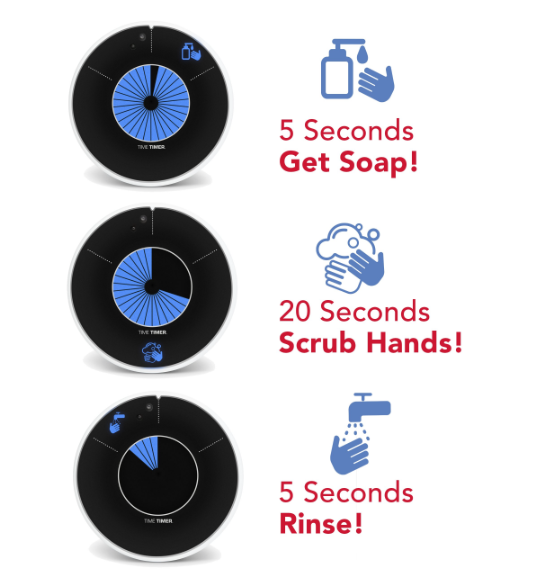
And lookie there, the perfect opportunity for a transition!
TIME TIMER ELEMENT
Time Timer is always innovating, and recently shared the pre-launch of their newest product.
The Time Timer Element is a compact, water-resistant visual timer that’s designed — like many of the Time Timer products — to assist children and adults build time awareness and improve their self-management skills.
It other words, it’s ideal for anyone who has a tendency to daydream or have so many shower thoughts that they get distracted and forget to stop dawdling, get out of the shower, and continue on with their day.
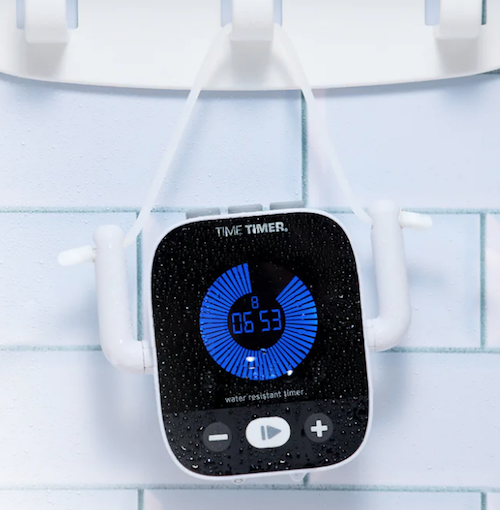
The Time Timer Element seeks to help users stay on track with their daily routines in a place where there’s unlikely to be other stimuli (clocks, TVs with commercial breaks, other human activity) to call attention to the passage of time. And, in particular, it’s made to work in the shower or near the sink!
As a personal note, once I’m putting on my makeup or doing my hair, I’m pretty attentive. But some of you ladies know what I mean — there’s a very narrow window from the time you take your hair down from the towel for you to use product and apply heat, and if you miss that window, well, you may not look like a clown for the rest of the day, but you definitely won’t look like you.
Dawdling can be an image-killer, so a timer for making sure your grooming activities stay on-task is a win-win for productivity and your personal brand.
The Time Timer Element has a variety of features to that make it an interesting option.
The Time Timer Element Is IPX6 Water-Resistant
Are you wondering what the heck IPX6 water resistance is? Well, so was I.
“IP” refers to “Ingress Protection” — It turns out that the International Electrotechnical Commission (IEC) has developed ingress protection (IP) ratings to grade the resistance of an enclosure (like a plastic or metal case) “against the intrusion of dust or liquids.”

IP6 means means a device (like this timer) is “protected against powerful, high-pressure water jets from any direction for at least 3 minutes.” Picture heavy rain, spray from a hose, or — you guessed it — water coming from a shower nozzle. IP6 indicates a high water resistance, but not so high that you could submerge it in water. (That would be an IPX7 or IPX8 rating.)
The “X” just means it is not tested for dust. So if your bathroom is dusty, well, you’re on your own.
The point is that the Time Time Element is specifically designed to work in wet environments like showers and bathrooms in general. Don’t turn it into a float for your rubber ducky, but otherwise, it should be fine.
The Time Timer Element Has Customizable Presets
The Time Timer Element comes with three customizable pre-set timer buttons on the top of the timer for increments of:
- 2 minutes
- 8 minutes
- 25 minutes
Additionally, you can program a countdown on the Element for any duration up to 99:59. (If you need more than an hour and forty minutes for grooming, I don’t know what to tell you.)
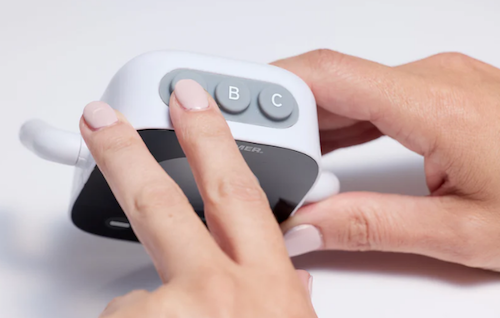
So, if you’re deep conditioning your hair with a hot oil treatment, the two- or eight-minute timers might be just perfect. If you want to take a bath but are fearful of drifting off and missing your transition to making dinner or watching your favorite show, the 25-minute timer might be apt.
And, for those who are familiar with the now-viral Gen Z references to an “everything shower” — where you accomplish it all from exfoliation to hair masks to lymphatic drainage — setting timers for both the activities and the transition time might make the whole process seem less daunting.
The Time Timer Element Has a Flexible Design for Varying Display Styles
As with all of the digital Time Timer products, like the Wash and the Twist, on the “face” there’s a digital countdown in the center (for those who can easily envision time numerically/digitally) and a visual, colored disk that decreases as the time time remaining decreases for those who need to better “feel” the passage of time.
Below the timer face, there are buttons for increasing, decreasing, or pausing/playing the timer. As previously shown, on the “head” of the Element, there are the three pre-set buttons.
As you examine the whole timer, you may find that the Element looks a bit like a cute little dude.
It includes:
- adjustable arms (bending upward, to hold the removable cord in place, if you’re hanging it, or bending downward, as if it were monkey-walking on its hands)
- a removable cord
- suction cups to display the Element at various angles on the wall of a shower or other vertical surface
Thus, the Element can hang from the shower head, sit on the corner of the bathroom counter, or climb the wall.

Other Uses for the Time Timer Element
Additionally, the bathroom is not the only place the Element can be of use for helping you keep track of the time. Time Timer notes that “you can use the Element indoors or outdoors, wherever water is part of the routine” and suggests its other applicability in:
- In the kitchen when cooking — Although there are a variety of Time Timer products that can be used in the kitchen, particularly the Time Timer Twist, the water resistance of the Element makes it particularly apt for when you’re doing “splashy” activities near the sink.
- Throughout the house while you’re cleaning — Some household cleaning tasks require waiting a certain amount of time (like while the Scrubbing Bubbles are hard at work); do you really want to use your expensive cell phone near a bucket or sink full of soapy water?
- Outdoors, while playing or gardening — Do you want to teach your kids that they can stay in the pool for just 20 more minutes? Or keep yourself from straining your knees or back too long while you’re tending to your flowers or veggies? Whether it’s splashing from the pool or the hose, the water-resistant Element can keep everyone on-task.
- At school or work in a lab — Splashes don’t just occur at home. Whether you’re in Home Ec (though they probably call that something else these days?) or a chemistry lab, keeping yourself on-task with a water-resistant timer can be a boon to safety as well as productivity.
The Time Timer Element is selling for $38.95 at the Time Timer shop. not yet for sale, so there is no pricing information. Sign up for pre-sale notifications at the website and they’ll let you know when it’s ready for Prime Time.
For more on timers and other ways to prompt yourself to stay on task, revisit other Paper Doll posts, including:
- How to Use Timers for Improved Productivity and Focus — Part 1
- How to Use Timers for Improved Productivity and Focus — Part 2: Picking a Good Timer
- How to Use Timers for Improved Productivity and Focus — Part 3: Tangible Timers — This post does a SUPER-deep dive into Time Timer products, in particular!
- How to Use Timers for Improved Productivity and Focus — Part 4: Digital Timers
- How to Use Timers for Improved Productivity — Part 5: Hybrid Timers and Bonus Material
- Do (Not) Be Alarmed: Paper Doll’s Wake-Up Advice for Productivity
CAPTURE THOSE VITAL SHOWER THOUGHTS
Sometimes, people can’t make it out of the shower for fear they’ll lose a great idea and stand there, dripping, reciting the idea to themselves. If that’s your issue, you might enjoy a delightful product that’s been around for a long time but seems to operate under the radar.
Aqua Notes is a waterproof notepad that affixes to the shower wall with suction cups. Each 5.25″ x 3.5″ pad with 40 sheets of waterproof paper and an Aqua Pencil with its own suction cup pencil holder.
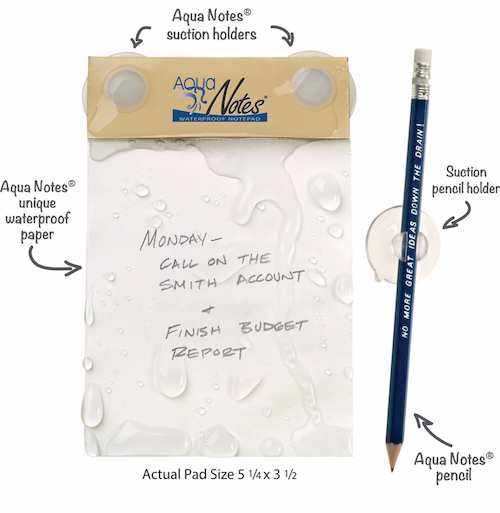
Purchase them directly from the Aqua Notes web site for $15 or from Amazon for $11.95. (A 5-pack of refill notebooks is $50; they also have Twistable colored pencils with suction cups for kids, shower artists, or anyone who needs to be able to write color-coded shower notes.)
Good luck getting out of the shower and getting on with a productive day! But if your brain is still still full of thoughts that are holding you back or slowing you down, know that you are not alone. Case in point, Lorelei Gilmore.
Affiliate Disclosure: Some of the links above are affiliate links, and I may get a small remuneration (at no additional cost to you) if you make a purchase after clicking through to the resulting pages. The opinions, as always, are my own. (Seriously, who else would claim them?)
Whimsical Tools to Improve Your Productivity: Mochi Focus, Mom Clock, and Kiki
THE NASTY TRUTH ABOUT PRODUCTIVITY
Would you like to know a nasty little secret from the world of productivity? Sometimes, getting things done — or more often, not getting them done — is a drag.
Last month, in Paper Doll’s Cheat Sheet for Celebrating Time Management Month, we looked at all the steps for making progress on the tasks we wish to (or must) complete. We talked about memento mori and knowing what we want to achieve in the precious amount of time we have on Earth, and revisited blocking time so that we can be both effective and efficient.
We also reviewed ways to prioritize the tasks we strive to complete and then dove deeply into the strategies for getting ourselves to start, from body doubling and accountability partners to using timers to make use of activation energy. (Speaking of energy, the post also reminded everyone to manage their physical energy through sleep, rest, and rejuvenation through breaks.)
We explored methods for blocking interruptions and obstacles (whether created by others or ourselves), and tracking our time to reflect on our entire systems to figure out where to make tweaks.
Whew. If that sounds like it would be a lot of work, well, that’s part of the problem. Being productive requires work. That’s why we say we’re going to work rather than we’re going to fun.
In a perfect world, if we followed all of these steps, failure would be impossible. We would know what we had to do, figure out what steps were the most important, schedule the work, settle ourselves in, and get it done. Huzzah!
But this is not a perfect world. We told the clocks to spring ahead over the weekend, so many of us are tired and cranky. (A little of that can be eased along with the advice in Organize Your Sleep When the Clocks Change and Beyond.) Depending on where you are today, it may be cold and grey outside.
And mostly, the inability to accomplish one’s goals — even when applying all of these strategies — comes down to a single, solitary truth: I don’t wanna!
Yes, people want the end result. They want their taxes done, their closets organized, and their dreams fulfilled. But they do not want to be bored, annoyed, wearied, or tasked with labor.
Sometimes we all, even professional organizers, just don’t wanna.
When this happens, it’s usually a matter of more than managing one’s physical energy. There are seasons of life when we need serious mental health care and tenderness, such as when we are grieving, experiencing anxiety, or suffering from depression, before we can think about make headway.
When our internal obstacles are less severe, activation energy, or getting ourselves to start, sometimes needs a rousing kick in the pants. Other times, we need the 21st century to stop kicking us when we’re down. Sometimes, we just need to give ourselves a break and find a way to add a little joy to the process.
At the end last year, in 2025 Wrapped: Do An Annual Review To Design Your Best Life, I wrote that my word for 2026 was WHIMSY. What is whimsy, exactly? It’s defined as:
“a playful, quaint, or fanciful attitude and behavior that is often unpredictable, spontaneous, and charmingly eccentric. It represents a shift away from rigid, serious, or conventional thinking, favoring instead a lighthearted, imaginative approach to life.”
Today’s post looks at some tools that offer a few charmingly eccentric, lighthearted, imaginative tools to tip self-management part of time management in your favor.
MOCHI FOCUS
Do you find that you’re better getting things done when you’re modeling good time management for others?
Mochi Focus combines a playful take on a Pomodoro timer with both a gamification element and a site blocker-turned-gentle-taskmaster.
Rather than an app, Mochi Focus is a browser extension for Chrome. (Why are all the good extensions only built for Chrome? Surely Safari deserves as much love!)
When you begin, Mochi Focus starts you off with a little blob of a pet, which they call it a “mascot.” You set to work, and the longer you stay on task, the bigger the little blob grows. Basically, instead of feeding your app food, you are nourishing it with your focused attention.
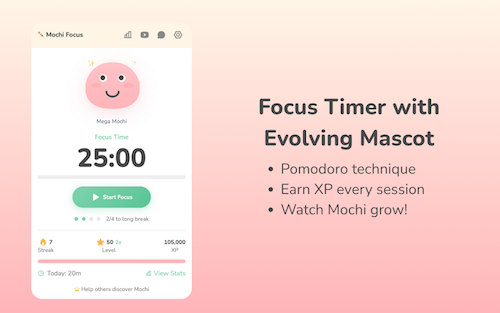
Mochi Focus Timer
A traditional “official” Pomodoro requires 25 minutes of work with a 5 minute break, and no more than four sessions without a longer break. In the abstract, the Pomodoro Technique works well to get our butts in our seats and complete many kinds of tasks.
However, not all tasks are created equal. Crafting an employee review isn’t the same as paying monthly bills, and neither one is the same as editing a chapter of your novel or cleaning out your closet.
Mochi Focus recognizes that some tasks require focus for shorter or longer periods of time. Thus, you get to customize your focus session lengths, anywhere from 1 minute (perhaps to do a plank or sun salutation) to 120 minutes (to rehearse for a presentation or make the mud room look less muddy).
You set the timer, and then Mochi Focus automatically switches between periods of intense focus and the break periods that keep your mental and physical energy from getting stale or expiring altogether. As with an “official” Pomodoro, Mochi Focus enforces a longer break after four sessions for use, but after set-up, you get to keep your hands off the timer for the duration.
The Mochi Focus Timer Mascot
Mochi incorporates gamification, because if we would do the work we have to do just because we have to do it, we wouldn’t need apps to make it fun.
Competing against ourselves is low-stakes, unlike competition with strangers. We win the “game” of getting things done to give our little pal Mochi a boost. You earn 1 XP (in the parlance of gamers, that’s experience points) for each minute you spend on focused work.

As you work, your Mochi mascot grows from baby-sized to Mega form. Depending on your level of experience (from 1 to 50), there are four stages of evolution. As you go along, you build daily streaks for bonus XP, and there are 14 achievement badges to give you positive reinforcement as you attend to your tasks.
In addition to tracking your progress through Mochi’s growth, there are also some adorable (might we say “whimsical?”) interactive features, including five interactive expressions in reaction to completed activity. The little guy expresses pride in your efforts with eye tracking, blinking, and click reactions.
Mochi Focus Website Blocker
Focus is not achieved by one’s competitive nature alone. Let’s face it, we all sometimes need a little help with boundary-setting.
The Mochi Focus website blocker feature is similar to Rescue Time, Cold Turkey, and Freedom, and allows you block yourself from accessing distracting sites during your focused work time. To get you started, Mochi Focus suggests more than 50 sites to block, and you can add your own time-wasters.
If you try to access those sites when you’re supposed to be working, you get a cheery page both reminding you that your access is blocked and encouraging you to go back to what you’ve assigned yourself to do. It’s like having the most gentle of accountability companions with a hint of Jeeves the butler.
On the up-side, when you’ve finished your pre-set focus session, Mochi Focus automatically unblocks those tempting sites so you can play during your breaks.
Pros and Cons of Mochi Focus
On the plus side, Mochi Focus has great features. It’s:
- is a simple, distraction-free interface that doesn’t require a steep learning curve.
- installs right in your browser.
- works offline, so you aren’t web-dependent.
- doesn’t require an account.
- tracks your progress through the main screen and a stats dashboard.
- stores all data locally on your device.
- is 100% free, with all of the various features unlocked. There aren’t even pesky ads or attempts to up-sell you to higher tiers.
But, more importantly, especially when it’s the mental weight that’s detracting from your motivation, Mochi Focus:
- doesn’t nag you to work, but encourages you to get back to your planned area of focus
- digitally prevents you from goofing off while also giving you a reason to care for yourself and your goals by nurturing a little blobby dude.
- offers a whimsical approach, with a blobby cartoon companion who shares your focus journey, joins in celebrating your achievements, and keeps you motivated!
Mochi Focus isn’t for everyone, though. Consider if the following might make it a bad fit for your practice focus.
- It only works with Chrome, so it’s not for you if you swear by Safari or are fixated on Firefox.
- Because it only works in the browser, if you use multiple devices (computers, tablets, phones, etc.), your stats aren’t going to reflect your entire progress. (Update: Mochi Focus was created by Boyd Guang, a solo developer from Thailand. He reports that cloud sync is coming, along with focus-oriented audio and more themes.)
- If you get anxious when competing against yourself, or this brings up memories of the Tamagatchi digital pet you let die 30 years ago, this might not be your thing.
- It’s simple, gentle, and visually sweet. If you prefer the stick to the stick (vs. carrot) approach, this may not be your jam.
To get a sense of the Mochi Focus vibe, check the Focus with Mochi YouTube channel with a variety of videos (with four+ Pomodoro sessions) backed by focus-inducing, lo-fi music.
Whether you’re a remote office worker or a student or just someone looking for more sticktoitiveness, if you’re looking for something to pep up your Pomodoro-style focus sessions, this might be fun to try. And again, it’s free, so there’s no downside to trying.
Mochi Focus works on a few different levels. It has your back by blocking your distractions and giving you a competitive approach with points and stats, but also covers your softer side by pairing you with a teammate for whom your success is their success. It’s animated accountability.
Whatever works, right?
But hey, if the gentle companion approach doesn’t work, perhaps you need something a little bossier.
Mom Clock
Sometimes, neither the gentle, companionable approach nor the competitive angle works. If that’s the case, you may have to consider seeking support from the one person who can strike fear in you by using your full name — first, middle, and last — in a tone that brooks no debate.
Sometimes, you just have to call in a mother.

The Mom Clock is an iOS app and Chrome extension that adopts a strict disciplinarian approach to stop procrastination.
This is no gentle parenting. Instead, Mom Clock uses alarms and app-blocking to force you to do what you said you intended to do.
The way Mom Clock’s creators explain it:
Mom Clock is not a productivity tool.
It doesn’t motivate you. It doesn’t encourage you. It doesn’t ask how you’re feeling.
You already know what you’re supposed to do. Mom Clock simply enforces it.
Once you set up Mom Clock with your plan for when you’re going to work, you go to work. Full stop.
You’ve got (relatively) little choice, because Mom Clock understands time blocking (as in, when you’re supposed to work) and uses the power of blocking (as in, it will block all of those distracting websites during the hours you tell it you’re supposed to be focused).
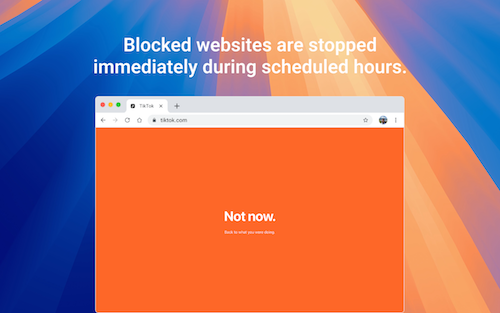
When you’re supposed to be working, you can’t do anything else with your device. When your time is up, Mom Clock starts firing alarms that tell you to stop whatever you’re doing. (Just as “she” enforces your work time, she’s serious about those breaks, too! After all, your mom always knew when you needed a nap, right?)
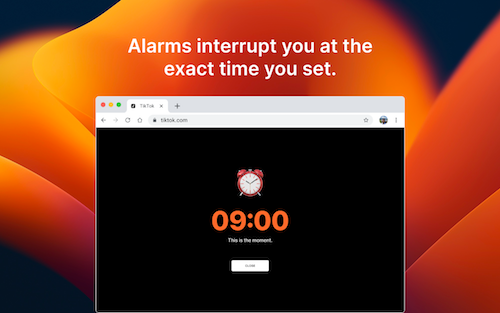
In between your start and stop, Mom Clock is working quietly in the background, just like she was when you were a kid, doing your homework. Unlike Mochi Focus’ companion style, Mom Clock calls to mind the phrase, “I’m not your friend, I’m your mother!”
Pros and Cons of Mom Clock
Depending on your style, pros and cons may be interchangeable, so you have to know your own preferences. Mom Clock is:
- Designed to be as simple as possible to reduce friction and make the activation energy easy to obtain.
- You don’t need to register for an account.
- There’s no cloud sync.
- There’s no data collection.
- Mom Clock runs in the app or locally in your browser.
- Uses no gamification — Because there are no stats, there’s nothing to keep track of and there’s no attention to what you’ve done in the past or where you’re headed in the future. Mom Clock is about what you’re doing RIGHT NOW.
- Brooks no backtalk — There’s no negotiation for snoozing “just five more minutes!” You just do what mom says! There’s not even an “or else!”
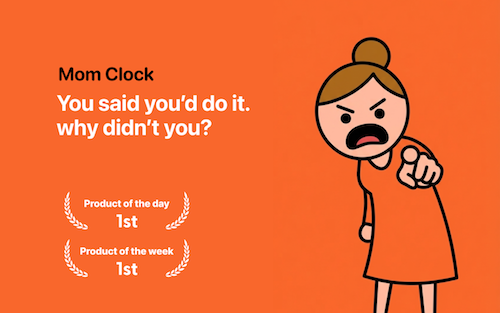
It it just me, or does she remind anyone else of the Angry Mama microwave cleaner?

Just set the rules once for when you want to work, and Mom Clock makes sure you follow them.
Your “Mom” knows your routine, only instead of innately knowing which days you have soccer practice and when you have to stay late for drama club, “she” knows (because you set) your different schedules for work, study, fitness, or sleep. Mom Clock doesn’t ask whether you “feel” like working. She’s just going to stare you down.
Your “Mom” takes away your phone privileges by blocking the tempting apps and websites that prevent you from doing what you should be doing.
As Mom Clock says:
She doesn’t remind. She insists.
No soft nudges. No ‘maybe later.’ Just action.
You don’t need more motivation
Start doing what you said you would. She shouldn’t have to ask twice.
Beyond the main features, Mom Clock has several additional elements, including:
- an online clock — Showing the exact hour, minute, and second; it is constantly updating; it also reports the date (to remind you of time ticking down on those work or school deadlines)
- a time conversion page — Whether you want to convert seconds to minutes or minutes to seconds, minutes to hours or hours to minutes, hours to days or days to hours, or even days to weeks or weeks to years, it’s all available at a click. This way, if you want to remember how many minutes are in a year, and don’t want to start singing Seasons of Love from Rent (though why wouldn’t you?), there’s an accessible feature.
- countdown timers — whether you need to count down to holidays, events, work deadlines, or personally-important dates, just set your timezone, track the countdown in real time, and share links to the countdown when and if necessary. There are a variety of pre-created countdowns for international holidays, so you’ll never forget Mother’s day or Diwali or Hanukkah. You can also select options to count down to when you have to pay your rent, will get paid, can move to your dream home, or may finally retire.
- planner tools — for doing a Pomodoro session (or several) or using time blocks. The Pomodoro timer comes with pre-sets for a traditional 25:5, a 50:10 for deep work, and 90:20 extended session. The time blocking planner has pre-sets to help you with a workday, a study day, and a balanced day for blending focused work, meetings, and recovery time.
- days since counter — whether you’re counting down from the first day you started exercising or the last day you engaged in a bad habit, Mom Clock is keeping track of your landmark dates.
But mostly, the key to Mom Clock is that it eliminates all of the discussion you have with yourself where you let yourself off the hook. There are no more promises to yourself to start “later” or “tomorrow” that you never fulfill.
Mom Clock states its mission as: To make the things you promised yourself actually happen.
Mom Clock knows that willpower is often too challenging and that you can’t always wait to get psyched up into that activation energy.
Sometimes you just need the power of your “Mom” telling you to just do it. NOW!
If Focus Mochi is for workers who embrace gentle parenting, Mom Clock is for those who are seeking an Old School parenting approach because more than motivation, they need someone to hold their feet to the fire.
It’s worth checking out the Mom Clock blog, with wise “motherly” wisdom in posts like:
KIKI
Maybe you need something not as cute as Mochi, but not as bossy as your Mom.
KiKi, created by Isaac Blankensmith, is a MacOS program that calls itself “the accountability monster for people who are easily distracted.” It’s not a very monstrous monster, to be sure.
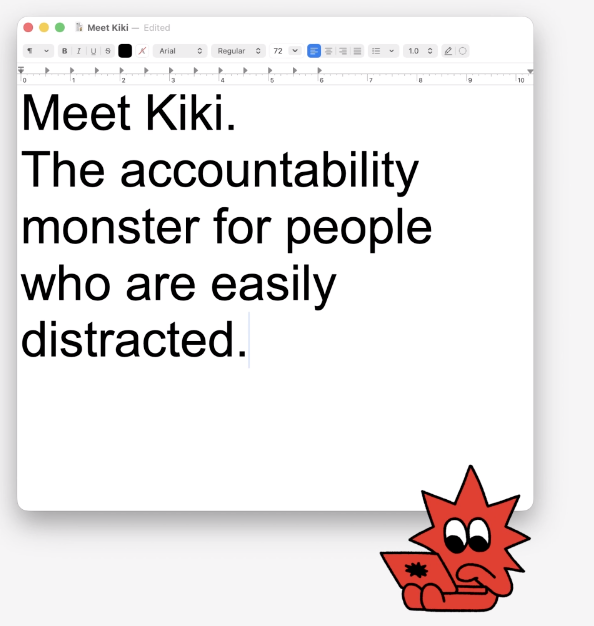
The makers of Kiki envision the program as similar in function to a Pomodoro timer, but better.
First, you identify for Kiki what you’re supposed to be working on in the most specific ways. You write down one concrete task, like:
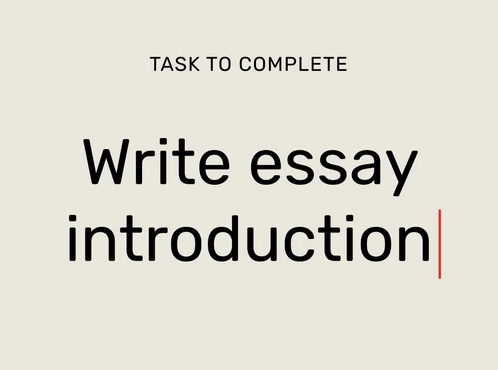
Next, instead of eliminating all the apps and websites you aren’t allowed to use, you select just what sites you will need to complete your task.
For example, if I’m writing a blog, I need WordPress and Canva, and maybe Pexels or Unsplash. (Yes, I’ll need YouTube later for pop culture videos, but to get the writing and graphics selection stage down, just these sites would be essential.) Kiki will block everything else.
Once your intention, resources, and time are set, just focus on your work. Kiki creates a distraction-free, multitask-free realm until your time is up. If you try to do something outside of the plan, Kiki throws flames onto your screen and pipes up with verbal admonishments!
Mono-focus for the productivity win!
Kiki’s Bonus Features
Kiki tracks your progress, showing how focused you were in each session and over time. For those who analyze data points (or need it to keep them honest), Kiki’s tracking feature may help you stay on course.
Kiki is the escape room you cannot escape. There’s no “safe word” and, allegedly, Kiki cannot be tricked. Once Kiki is activated, there’s literally no way to sneak off to entertain yourself while you’re on that device. (I mean, yes, you can go use your phone, but that’ll likely just guilt you out, and if it’s guilt you want, wouldn’t that be better from your (Clock) Mom than from a monster?)
Or, as Kiki says on the website, “Sometimes good work happens after you run out of ways to avoid it.”
Be forewarned about Kiki’s more “monstrous” alerts. One reviewer noted that it shouted “Get back to work!” while she was in a meeting and attempting tasks that we’re part of her scheduled activity. Eek!
Kiki has a free trial, after which it’s $4.99/month paid monthly or $2.49/month paid annually ($29.88year). While it’s designed for Mac, it only plays nicely with Chrome and Safari browsers.
So, if you want to be nagged (by my a monster rather than a Momster) but also want statistics, Kiki may be worth a look.
These are just a few of the delightful productivity-related apps and extensions I’ve found recently. There are others, with sheep and llamas, quirky gamification and silly stats, and there will be follow-up posts with other tools for this year of whimsy.
Is there an app or tool that you use to organize your time or tasks and that you’d describe as whimsical?
Paper Doll’s Cheat Sheet for Celebrating Time Management Month
Happy National Time Management Month!
There’s an irony that this observation takes place during the shortest month of the year. It’s as if someone said, “Hey, our problem is that we never feel like we have enough time to do what needs to be done. Let’s honor that challenge — with the fewest possible days to do them!”
It’s a challenge, a prompt, a call to action, a reminder — to focus on our choices of priorities, and use time to serve those priorities. If, instead of barreling through each day, reacting to what’s thrown at us, we can use this month to remind us to take a proactive approach.
The reward? The possibility that each day of February can offer baby steps to help us ramp up our productivity, reduce our stress levels, and achieve not only what is expected of us, but what we sometimes dare not expect of ourselves.
SO HOW CAN YOU MANAGE YOUR TIME?
It would be lovely if we could just get in the Doctor Who TARDIS to jump past slow days and let time stretch on when we need to do something complicated. Then again, as fans have learned over 60 years, if being stuck in one time weren’t bad enough, being a stuck time traveler is even worse.
Time management involves the following elements, each with it’s own challenges. Today’s post gives you multiple posts through which you can time jump to find the advice that best serves your needs.
Know What You Want from Your Time
Last year, a few days before the start of Time Management Month, I shared Paper Doll’s Ultimate Guide to Memento Mori and Appreciating Your Time. It examined the unexpected complexity of time (and why children perceive time more slowly than adults), looked at the “finitude” of life, and explored the analog and digital ways to remind ourselves to focus time passing so we didn’t lose the forest for the trees.
It was also a deeply personal post, as I was sharing the joy of seeing my favorite band and feeling returned to my young adulthood again. I’ve been thinking about that post a lot lately, for two reasons. First, I recently started counting down 60 weeks until I turn 60 (!); second, I will be seeing The Floating Men again in concert later in February. I already know that time will stand still for a few hours!
Literally, memento mori comes from the Latin reminder that we will someday die. It is a challenge — much like Time Management Month — to weigh the aspects of your life, decide what you value, determine what you want to achieve, and be prompted to recognize the passage of time so that you do not fritter your life away.
(Lots of frittering is bad. A little frittering helps you refresh your brain. An apple fritter is just yummy. But I digress. If you are digressing too often, you may be hungry, so see the section below about taking breaks!)
Time management isn’t really about managing time. The seconds, minutes, hours, days, and years pass, no matter how much we wish they might speed by or slow down. Rather, time management is a misnomer for what is actually task management and self-management.
Time management is a misnomer for what is actually task management and self-management. Share on XPrioritize Tasks
It’s essential that we use our time both effectively (doing the right things) and efficiently (in the speediest way but with the greatest reduction of errors). If we throw ourselves at whatever task shouts the loudest, we may miss important deadlines.
Although I’ve covered the concept of prioritizing many times over the years, I shared my most successful approaches in Use the Rule of 3 to Improve Your Productivity. That post allowed me to reference one of my favorite tools, the Eisenhower Decision Matrix (which, as you may have read in Paper Doll Shares Presidential Wisdom on Productivity, wasn’t actually invented by Eisenhower, but presidents often get the credit for popularizing nifty wisdom).
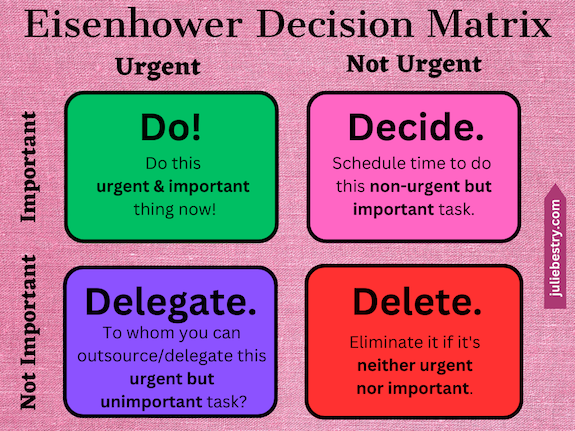
That post also talked about key skills:
Knowing what to do — as a result of a brain dump that gets everything out of your head and onto a piece of paper or screen so that nothing is forgotten or missed.
Knowing what to do first — that’s where the decision matrix kicks in, and then the next first thing gets done after that, and the next, and so on.
When we focus on important and urgent tasks over those that are important but not timely, or urgent but not, ultimately, important, we train ourselves to prioritize ourselves out of overwhelm.
Scheduling Effectively
In her book The Writing Life, author Annie Dillard famously shared:
How we spend our days is, of course, how we spend our lives. What we do with this hour, and that one, is what we are doing. A schedule defends from chaos and whim. It is a net for catching days. It is a scaffolding on which a worker can stand and labor with both hands at sections of time. A schedule is a mock-up of reason and order— willed, faked, and so brought into being; it is a peace and a haven set into the wreck of time; it is a lifeboat on which you find yourself, decades later, still living. Each day is the same, so you remember the series afterward as a blurred and powerful pattern.
Dillard explored the constantly existing tension between being productive — for ourselves (to achieve our goals) for, as they said in the 70s, “the man” (academia, industry, capitalism) — and being present or showing up (for our partners, our children, our friends, and for justice for our neighbors far and wide).
Planning our days, and then our moments and hours, assures that we get things done. But getting things done, which is important for achieving our goals, is not the same as living our lives.
We must have, if not always balance, then opportunity for variety. After all, all work and no play makes Jack a very dull boy. We must work, but we must also play. We must dine and sleep. We must make time for boredom to reinvigorate our creativity. We must dance, preferably while singing into a hairbrush.
Scheduling should take into account all of the pieces of our lives. Just as we make “homes” in our houses for our clothing and accessories, our food and our food preparation tools, and so on, we must make room in our schedules for all of the other aspects of our lives. The best way to do that is with time blocking. It doesn’t mean that you’ll schedule yourself so tightly that every moment is accounted for and pre-determined.
Time blocking just means that you’ll create safe spaces for your priorities. Start with these posts to get some insight on how to build time blocks into your schedule.
- Playing With Blocks: Success Strategies for Time Blocking Productivity
- Surprising Productivity Advice & the 2023 Task Management & Time Blocking Summit
Do the Tasks
I find that one of the most common places where people’s time management practices fail is that no matter how well they plan their schedules, they don’t actually do the work. It’s like how just buying a gym membership doesn’t actually get us into shape.
Shocking, I know.
To often, people have omitted the most key aspect of time management, and that is to put their butts in the chair (or in the car, to get them to the gym or to run the errands).
Longtime readers know that while I believe motivation is important, action precedes motivation! This means you must do whatever it takes to get your tiny patootie into position.
An object at rest tends to stay at rest; an object in motion tends to stay in motion. (That Isaac Newton knew his stuff!)
You need to get yourself in motion to the point that you are either in micro-motion (typing, reading, writing) or macro-motion (doing a workout, cleaning your house). It might look like you are at rest if you’re in micro-motion, but at the very least, your eyeballs and your brain are a flurry of activity.
For both motivation to get yourself into action and strategies to get started and keep going, avail yourself of the advice in the following posts to get to the starting line, focus, and actually do the tasks!
- Frogs, Tomatoes, and Bees: Time Techniques to Get Things Done
- Count on Accountability: 5 Productivity Support Solutions
- Flow and Faux (Accountability): Productivity, Focus, and Alex Trebek
- How to Use Timers for Improved Productivity and Focus — Part 1
- How to Use Timers for Improved Productivity and Focus — Part 2: Picking a Good Timer
- How to Use Timers for Improved Productivity and Focus — Part 3: Tangible Timers
- How to Use Timers for Improved Productivity and Focus — Part 4: Digital Timers
- How to Use Timers for Improved Productivity — Part 5: Hybrid Timers and Bonus Material
Track Your Time
You can tell yourself where you’ll travel in time, but although you will always travel forward, it will almost assuredly not be in a straight line. The problem with real life is that it takes us off-course.
No matter what we plan, interruptions from others (and unwittingly, from ourselves) creates not merely bumps in the road but ten megaton blasts in our day. The trick is to figure out whether these are unavoidable one-time problems or actual trends.
I’m a huge fan of time tracking to see where my minutes and hours go, and spend the second full week in January participating in Laura Vanderkam‘s annual Time Tracking Challenge.
Last year, I wrote How to Use Time Tracking to Improve Your Productivity, and how it helps with mindfulness and focus, prioritization (see? we always come back to prioritization), data-driven decision-making, stress-busting, and accountability. It also explored the benefits and occasional obstacles of time tracking and offered up a bevy of tools for making it easier to track your time.
If you feel like you’re planning your schedule, but still get to the end of the day with too few of the right things achieved, review that post and see how you might identify what’s going awry with the help of time tracking.
Block Interruptions and Push Through Obstacles
Once we spot the interruptions and obstacles in our days, we need to be vigilant about holding our boundaries.
If you have trouble keeping small children (or spouses, colleagues, or employees who behave like small children) from interrupting your focus, or you find that you are the one standing in your own way, the following posts can help you fight the battle, recapture your time, and post sentries along your boundaries to prevent future incursions.
- 52 Ways to Say NO to a Request So You Can Say YES to Your Priorities
- Paper Doll On Understanding and Conquering Procrastination
- Use the Zeigarnik Effect to Finish Off Your Unfinished Tasks
- Whoopsie! What To Do When Your Week Doesn’t Go As Planned
And sometimes, between time tracking and overcoming your obstacles, you figure out that some things just aren’t possible.
Don’t Forget That You Need to Sleep, Rest and Take Breaks
It’s easy to focus on the task aspect of time management, and yes, self-management does involve conquering your personal inertia (like lack of motivation). But it’s not all in your head — sometimes, it’s in your body!
You can start by scheduling yourself to tackle tough physical tasks when you’re brimming with physical energy and saving the complex mental tasks when your brain is at its peak. That’s different for each individual, so it’s important to track your energy.
Managing your energy is also essential for getting yourself into the groove and using your time well. Lack of motivation may be mental, but it just may be that you are exhausted or burnt out.
Take note of when you’re most likely to make excuses for not getting things done. Pay attention to when you need a snack, a conversation, a walk in fresh air. Don’t know when that is? Then note the times you’re flagging, that you’re reaching for the phone to doomscroll, or just generally feeling cranky.
As you work on self-management, remember that just as your devices need to be recharged, so do you. Check out the following posts when you’re trying to figure out how to bring your best, most energized self to the tasks at hand but it’s not quite working:
- Organize Your Sleep When the Clocks Change and Beyond
- Take a Break — How Breaks Improve Health and Productivity
- Take a Break for Productivity — The International Perspective
- Celebrate the Global Day of Unplugging
- Global Day of Unplugging 2025: Phones and Apps to Reduce Phone Use and Improve Your Life
- Organize To Reverse a Bad Day
TIME MANAGEMENT FOR THE REBELS
With all of the advice out there on how to set yourself up for managing your time, the truth is, some people just need something more, something different, something weird. Just as some office workers need bedazzled or sparkly charging cords

or colorful file folders, others need something that’s just a little left of center.
Big Picture Yearly View
Depending on how complicated your life is, the type of calendar you need may vary.
I depend heavily on a monthly view on my paper planner. I work best when I can see how heavily scheduled I am in terms of client sessions and Zooms so that I can see the flow of days and add my personal obligations and joyful plans accordingly.
I rarely allow myself to have so many fixed events in my schedule that I need to actually see my daily time blocks in a printed or digital calendar. However, many of my clients swear a digital view of their daily schedule, one quarter-hour block after another.
I have one client, a retired artist, who draws his own calendar when we set the next month’s session. From a blank page, he counts forward from the end of the month to visualize the start date of the next month, and draws boxes for each. Meanwhile, another client has 12 large (two-and-a-half foot high), colorful monthly pages decorating her office walls so she can see the ENTIRE year just by swiveling her neck; in addition, she she schedules appointments and gathers task categories in her Planner Pad, but echoes the fixed appointments on her digital calendar.
Only you know what level of scheduling detail you need to see to keep yourself moving forward successfully.
Neato Calendar 2026
Just in case you’re a true minimalist, and the idea of schlepping around a physical planner or typing things into your phone gives you hives, the free Neato Calendar has you covered. It puts the entire calendar on one single page.
Each month has its own column with the day of the month and a letter code for which day of the week it is; weekends are shaded in. It’s probably ideal for people who either have very few events on their calendars, or want a separate calendar to keep track of just one thing, like which days are trash pick-up vs. recycling, or mileage driven, or whose day it is to do one household chore.
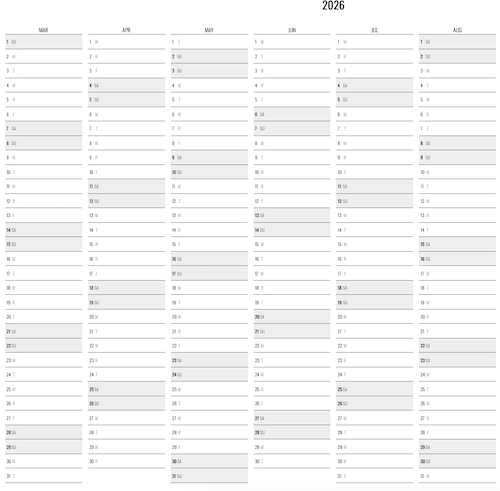
This open source (free to the public) calendar page is too wide for me to provide a legible screen capture here on the blog, so this is just a chunk from the middle of 2026. To print, don’t forget to use landscape settings and the option to fit to one page. I suspect for best results, it probably needs to be printed to a longer sheet than is standard in the US, perhaps a sheet of legal paper, though I suspect it was designed for the longer A3 paper (11.7″ in x 16.5″) popular in Europe.
The main advantages of this super-minimalist calendar calendar are that it’s free, lightweight, portable (to the point that it could be folded and put in a wallet), and it’s so minimalist that by its nature, the user can’t get overwhelmed by details. The main disadvantages are that it lacks nuance and granularity. You’re not going to truly manage much of your time with this calendar, but you may be able to manage one aspect of your time use.
I should note that last year, in anticipate of someday using the link, I’d found an identical one-page yearly calendar called Neatnik, created by Adam Newbold; the only discernible difference is that Neatnik comes with a friendly greeting screen.
A Weekly View
Most planners provide a monthly view with the option for a weekly or daily view, and for those who want granularity, the daily view is usually a top choice. Some people operate best seeing one week at a time.
I’m already a fan of the funnel system of Planner Pads, and if they were more colorful, I often think I’d use them myself, as my clients are always delighted when I explain how they work.
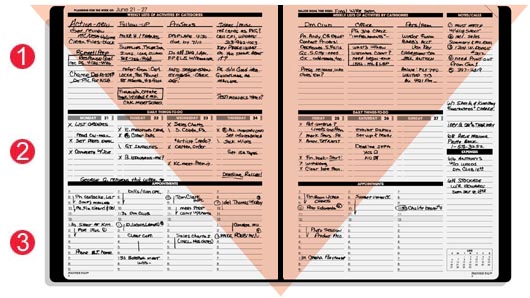
Ink & Volt Dashboard Spiral Deskpad
It’s hard to find a weekly view scheduling tool on par with PlannerPads. While I can often find weekly task pads, I’ve never found a similar product with planning space for categorized tasks, tasks scheduled by day, and appointments.
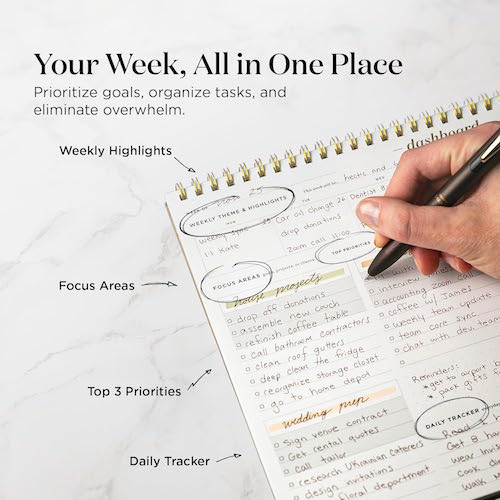
Recently, I saw ads on social media for the Ink & Volt Dashboard Spiral Deskpad that, while not equaling a PlannerPad, does offer interesting features.
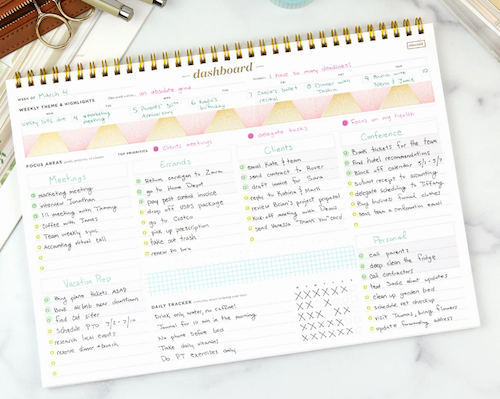
Available on the Ink & Volt website for $31 (or Amazon for $33 in Black, only), it has 52 undated sheets, a landscape layout, and a left-handed-friendly top-spiral binding. Select from among nine colors of covers: Onyx Black, Midnight Blue, Carbon (grey), Matcha (green), Mulberry (shown below), Black (but less black than the Onyx Black), Cloud (white), as well as two pre-order only shades of Bleu (a sort of light sky blue) and Fleur (a light pink).
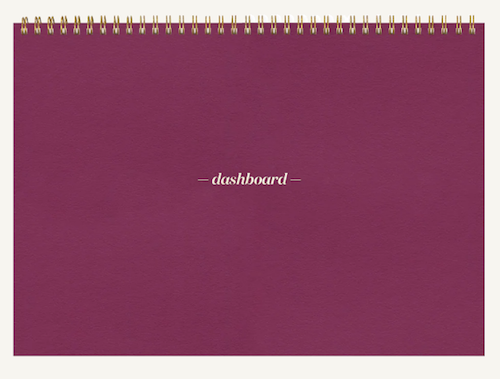
There are six areas of focus, with a highlighted section for your top three priorities within that focus category. There are also spaces for weekly highlights, a habit tracker, and a section for themes and highlights by day. My favorite aspect is that the checkboxes are printed right on the page to make it easier to check off your successes in a tidy, orderly manner.
Find Your Moment in Time
In the 5-post series on timers (linked above in the task-doing section), I championed analog timers over digital ones for productivity and focus. To be able to truly see the passage of time, an analog clock (like most of the analog timers I shared) gives you a visual appreciation of what time it is and how it relates to the moments used and the time remaining. But hey, if you’re rebel or you just need something to delight you in a different way, I’ve yet to see something more unusual than this next item.
Author Clock
Author & Company has created Author Clock, which tells time by quotations from literature. Using more than 13,000 passages from more than 2500 books by famous authors, time is told with a sentence or fragment from a literary work referencing a moment of the day. New quotes (and software upgrades) are added by WiFi.

Quotes are available in English, French, Spanish, and German, with each language collection specially curated by Author & Company’s editorial team.
The frame is made of solid oak, with brass dial controls, an easy-to-read E-Paper display that changes from minute to minute, and a rechargeable battery. There are also parental control settings, in case you want to ensure that more mature quotes aren’t seen by little time-tellers.
You can customize a variety of the features, including font style and size, quote frequency (from every minute to every hour), and even add in “vague” quotes, like one relating to “A few minutes to midnight.” A digital clock in the screen’s header is optional.
There are two versions:
Author Clock Volume 1 has an E-Paper measure 4.3″ E-Paper screen and sits on a brass base. It’s suitable for sitting on your desk or nightstand, for when you are close enough to see the smaller letters.
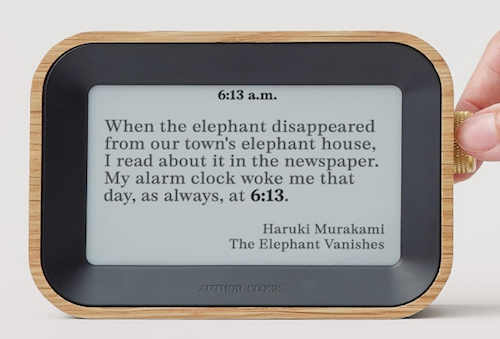
The larger Author Clock Volume 2 has a 7.8″ E-Paper screen. The brass base is removable, in case you want to mount it on the wall and view the larger letters from across the room.
Happy February, and however you manage your time, I hope this month brings you moments to treasure.
26 Ways to Celebrate GO Month to Get More Organized and Productive

Happy New Year! Happy GO Month!
Each January is Get Organized & Be Productive (GO) Month. Back in 2005, NAPO (then called the National Association of Professional Organizers) proclaimed the first Get Organized Month, as a national public awareness campaign about organizing and our profession.
A decade later, the month was expanded to incorporate productivity, just two years before we officially became the National Association of Productivity & Organizing Professionals. Our purpose remains the same. All of us — professional organizers, productivity specialists, declutterers, coaches, etc. — celebrate how we improve the lives of our clients by creating environments and developing skills to support productivity, health, and well-being.
Practitioners like Paper Doll are here to help you create systems and skills, improve your homes, workspaces, and attitudes, and live your best, most productive life.
For more great organizing and productivity tips during GO Month, you can also follow NAPO’s Social Media Accounts:
Today’s post offers some 26 ice cream samples of organizing and productivity tactics to make 2026 a little easier.
ORGANIZE YOUR PAPER IN 2026
1) Create a Tax Prep Folder
April 15th will be here before you know it. From now through February, you’ll receive tax documents (1099s, 1098s, W2s) in the mail. You may also get emails reminding you to log in to brokerage and other accounts to download your important tax documents.
Don’t wait until the last minute to gather these items. It’s not just good organizing advice, but helpful financial advice, too, because the sooner you get your important tax documents together, the faster you (or your accountant) can get you your refund, or at worst, let you prepare for the size of your tax bite.
Your tax prep folder doesn’t have to be fancy; a plain tabbed folder kept at the front of your financial files section should suffice. However, if you’re dealing with a lot of documents, you might prefer a dedicated accordion-style folder like the Smead All-in-One Income Tax Organizer.

Organize now so you won’t lose deductions, pay more taxes, or get in trouble with the IRS!
2) Roll Out the Red Carpet for Your VIPs
Make 2026 the year that you get your affairs in order. Estate documents and other essential paperwork must be created, obviously, but also reviewed and updated on a periodic basis.
As I’ve said before, this aspect of organizing may be boring (if you aren’t a professional organizer), but boring is good! If your VIPs are boring, it means that you and your family won’t ever experience any ugly surprises during difficult times, like when someone is in the hospital, when there’s been a death in the family, or even when dealing with the aftermath of a natural disaster.
Start by reading these from-the-vault posts to figure out your next steps.
- How to Replace and Organize 7 Essential Government Documents
- How to Create, Organize, and Safeguard 5 Essential Legal and Estate Documents
- The Professor and Mary Ann: 8 Other Essential Documents You Need To Create
- Paper Doll’s Ultimate Guide to Organizing Yourself to Get a REAL ID
- Paper Doll’s Ultimate Guide to Getting a Document Notarized
- Paper Doll’s Ultimate Guide to Legally Changing Your Name
- A New VIP: A Form You Didn’t Know You Needed
Then list documents you already have (and their locations) and identify what you need to create, and then plan meetings with your family and a trusted advisor to set things in motion.
3) Declutter and Preserve Your Family Photos and Memorabilia
Two years ago, a beloved client passed away, and I’ve been working with his son to go through more than a century of photos, from passed-down black-and-white picures of ancestors on both sides of the family to lighthearted snapshots and travelogues from the gentleman’s young military years. We review prints and slides, as well as delicate (and crumbling) correspondence.
Do you have print photos that would be lost in case of a fire or flood because you don’t have the negatives (or store them with the photos)? Would digital photos on your phone be lost if your phone got smushed or stolen? You need backup!
I’m not suggesting you do this every day in January, but make a plan. What if you spent an hour every Sunday morning sorting through photos? Could you invite a family member or friend to help you consider what to keep and what categories to use?
Contact a NAPO member who specializes in organizing photos, or visit The Photo Managers to find experts who can help you safeguard your photo history.
While I’m on the subject, I absolutely have to recommend, yet again, my colleague Hazel Thornton‘s What’s a Photo Without the Story? How to Create Your Family Legacy.

For more ideas, consider:
- How to Collect, Organize, and Preserve Family Memories and History (Part 1) — The Questions
- How to Collect, Organize, and Preserve Family Memories and History (Part 2) — The Methods
- How to Collect, Organize, and Preserve Family Memories and History (Part 3) — AI & More
4) Know What’s In Your Wallet
Have you looked at what’s in your wallet lately? Would you notice if one of your credit cards went missing? It’s a new year — did you put your new health insurance card in there?
- Pull everything out of your wallet.
- Discard or put away anything that doesn’t belong in there. (Receipts for taxable events, like medical expenses? Keep. The name of a book your friend recommended? Log it in your Notes app or put it on hold at the public library before you forget.)
- Take an inventory of everything in your wallet. Depending on your patience, you have two options:
- Lay two columns of cards (side by side), face-down, on a copy machine. Press “copy” and then flip each card in place to the rear-side, and copy that, two. Repeat the process until everything in your wallet has been secured. Alternatively, you can scan these to your computer and save it all as a multi-page PDF. If you ever lose your wallet, you’ll be happy to have the account numbers, expiration dates, security codes, and contact numbers for your licenses, insurance cards, and credit and debit cards.
- Use your phone to take photos of the front and back of the cards and upload the pictures.
Whichever method you choose, password-protect digital versions of this document in storage or on your phone, and keep the paper copies in your fireproof safe or lockable file drawer.
5) Clean Off Your Desk
Next Monday, January 12, 2026 is National Clean Off Your Desk Day. Celebrate it by making a clean sweep of everything piled up on your desk, de-germify it, and think carefully about what belongs on it.
Read last year’s Paper Doll Celebrates National Clean Off Your Desk Day for step-by-step for making your desk a space for productivity instead of mystery crumbs and mountains of papers.
Then refresh your space with ideas from Organize Your Desktop with Your Perfect Desk Pad: 2025 Update and Paper Doll Explores the Best of Desktop File Boxes.

ORGANIZE YOUR DIGITAL SPACES IN 2026
Digital clutter may not take up physical space, but it wears down our batteries, both in our devices and our personal batteries because of the overwhelm of excess.
6) Declutter Your Phone Apps
The Pareto Principle says that 80% of our success comes from 20% of our efforts. It holds true in many ways; 80% of the time, we wear the same 20% of our wardrobe, kids play with the same 20% of their toys; we use the same 20% of our apps.
It’s why letting things go from the 80% we hardly ever use makes us feel less cluttered and more productive, even though we anticipate we’ll feel anxious about having let them go — that’s why they’re cluttering up our digital spaces in the first place!
- Flip through your home screens and take inventory — What apps did you download and never even try because they required creating a login? What apps did you give up on because they were buggy? Let go of low-hanging fruit.
- Clean up by deleting apps you used the least often (or never). To see the last time you used an app on iOS (for iPhone or iPad), follow this path: Settings>General > iPhone (or iPad) Storage. There are a few different ways to check app usage on Android devices.
- Addicted to your phone? Check your Digital Wellbeing feature on Android or ScreenTime on iOS. Uninstall whatever is obviously distracting you with overuse.
- Move distracting apps that you can’t (or can’t bear to) uninstall to your last home screen page to create more friction and make it less likely you’ll happen upon them when looking for your bank app.
- Fill your first home screen with apps you need and want to use because of the benefits they bring to your well-being.
- Organize the remainder of your apps by dragging-and-dropping them into folders labeled for shopping, dining, social media, productivity apps, etc. Keep them — just make them less convenient.
The point isn’t to get rid of your digital life. Just eliminate what distracts you from what’s important.
7) Clear Out Your Voicemail Inbox
In the olden days, people called you and either you were home and answered, or not home, and never knew you had a call. (If you’re GenZ and reading this: yes, really.) At work, if you weren’t at your desk during working hours, a receptionist took a message. After hours, either the “answering service” took your urgent call, or people waited until you got in on the next business day.
In the 1980s, we got answering machines and our messages lived where our landline phones did.
In the 1990s, we had voicemail, and at the turn of the century, people started calling less and texting more. Now, too many of our messages are spam, and voicemail fills up.
Have you ever called someone — or worse, returned a call — only to hear “This voicemail box is full and is not accepting messages. Please try again later.”
What if your message is important? Do you text? What do you do if it’s a business? On the flip side, if your child’s school, your doctor’s office, or a client needs to reach you, do you want them to suffer this frustration?
Clear up your voicemail box with the following steps:
- On landlines, dial in, listen, and start deleting messages.
- On cell phones, iPhones and most Android phones show transcribed messages. Known contacts should appear by name, making it easy to figure out whether a message is still needed even before you read it. Unknown numbers may be spammers (swipe left!), but may be people you’ve never entered into your contacts. Review those messages, and anything that doesn’t make the cut, delete!
- Save numbers for contacts you may need in the future. — Add a last name and any context necessary. I have a contact saved as First name: MaryBeth, Last name: “Hit my car in the parking lot.”
Until recently, the only “Terri” in my contacts was my hair stylist, but when I was in Portugal and Spain in September, I added my tour-mate to my regular iPhone contacts. Just before my last haircut appointment, I voice-texted, “I’m here, but looking for parking. I’ll see you in a minute.” When I got to her space, she said she hadn’t received my message. A moment later, my tour-mate Terri texted, “You’re here to see me?” with a series of laughing emojis. Doh!
Last names (and context) are important!
- Be ruthless in getting rid of old voicemails. What should make the grade? Messages that you save for:
- work purposes — but confer with your boss or your IT department regarding rules in this regard
- legal purposes (such as when someone is stalking or harassing you, or offering a set of deal points for a contract.
- sentimental purposes — but be judicious. Can you picture yourself sitting in an airport, listening to a loved one’s message over and over?
- Download messages you want to keep permanently. On iPhones, tap the voicemail you wish to save and you’ll see the share icon in the upper right corner; share the resulting MP3 to your photos or notes app, Evernote, social media or wherever else, just as you’d share an article or a picture.
On Android phones, tap on the message to see a list of options. Click one of the save or archive options you prefer and select the storage location. For more voicemail-saving techniques, read Smith AI’s How to Download and Save Important Voicemails.
8) Clear out your email inbox
For years, people have laughed at me, saying that search worked so well and email providers granted so much storage space that it was no longer necessary to clear inboxes. Still, I blithely went on advising my clients to regularly clear their inboxes, and to create a hierarchy based on categories matching their analog filing systems.
Recently, I’ve felt vindicated as Gmail and other email providers have been adding storage limits, and people recognize that search (even AI-assisted search) sometimes takes longer than going to a particular sub-folder with a helpful title.
Email is a headache! According to an analysis by the McKinsey Global Institute, on average, 28% of work time is spent reading or replying to emails. And the average worker — and yes, you’re all above average — checks email 11 times per hour. 84% of us keep email open in the background while working, making it oh-so-easy to “check” our email.
The problem is that we CHECK IT over and over again looking for that dopamine hit, but we often look at emails without doing anything with them, like opening the fridge in hopes that someone has magically made something delicious and put it in there. 
You may think that Inbox Zero is the cure, plowing away at email but getting further behind in important work. James Clear has said, “The most invisible form of wasted time is doing a good job on an unimportant task.” Email clutters our lives like that.
There’s no permanent state of inbox zero (unless you stop sending outbound emails and block all inbound senders), any more than finishing all of the laundry today will create laundry basket zero unless your family plans on becoming very tidy nudists.
There's no permanent state of inbox zero, any more than finishing all of the laundry today will create laundry basket zero unless your family plans on becoming very tidy nudists. Share on XProcessing email isn’t your job, it’s just one method of communication and information acquisition, and it’s not always the right one. Instead:
- Unsubscribe from whatever you never read. (It’s like buying vegetables that you know you should eat but they disappear into the back of the fridge and eventually get slimy.) Take five minutes a day to declutter your future inbox.
- Set up a simple hierarchy of subfolders with names of major projects, client names, or whatever works for you. Having a place for emails to safely, dependably live will encourage you to manually or automatically route necessary ones of your inbox. As with voicemail, don’t feel like you should save everything.
- Learn how to use your email platform’s filters or rules function to automatically sort mailing lists to one sub-folder, anything you’re always CCed on even though you know it’s nothing to do with you to another, and so on.
- If you’re overwhelmed by your huge backlog, move everything from more than a month ago to a folder you call “Archived” and start with a minty-fresh inbox. You can always go into the “Archived” folder and sort if you’re feeling enthusiastic, but at least you’re dealing with something more manageable.
9) Know What You Don’t Know About Your Tech
In Digital Disaster Prep: How to Organize Your Tech Info Before You Need It earlier this year, I walked readers through all sorts of information you need to know before something goes wrong with your tech. Do you know where to find your:
- IP Address
- Network and router information
- ISP contact information
- Device Identifiers
- Operating system license keys
- Software and game activation codes
Your household probably added some hardware and software goodies this holiday season. This is the perfect time for you to read the post and start logging all of your essential tech information.
ORGANIZE YOUR TIME IN 2026
10) Track Your Time to Figure Out Where Your Time Is Going
To improve your productivity, the first thing you must do is get a handle on how you’re spending your time.
Read my How to Use Time Tracking to Improve Your Productivity from last January to understand the benefits of time tracking, including mindfulness and focus, prioritization, data-driven decision making, stress reduction, and accountability. The post also prepares you to face challenges and overcome the obstacles, and offers strategies and resources for tracking your use of time.
Track for just one day, or participate in a weeklong time tracking project such as Laura Vanderkam’s annual event. Register for her 2026 Time Tracking Challenge from January 12-19, 2026. I do it every year!
11) Get a Better Sense of the Passage of Time
For some people, knowing what time really “feels” like takes some effort.

First, put real, analog clocks wherever you tend to get lost in time. Is that your desk (even though you wear a watch and your computer has a clock)? Is that the bathroom, because you lose awareness of time while doing your hair or soaking in the tub? Is it your car, which has a perfectly serviceable clock but the time is always wrong because you never learned how to change it for Daylight Saving Time?
Next, read about all the ways timers can help you get a better sense of your time.
- How to Use Timers for Improved Productivity and Focus — Part 1
- How to Use Timers for Improved Productivity and Focus — Part 2: Picking a Good Timer
- How to Use Timers for Improved Productivity and Focus — Part 3: Tangible Timers
- How to Use Timers for Improved Productivity and Focus — Part 4: Digital Timers
- How to Use Timers for Improved Productivity — Part 5: Hybrid Timers and Bonus Material
12) Time Travel in Your Planner
If you use a paper planner, hopefully you already have one for 2026; if not, that’s step #1. But even if you are 100% digital, this advice goes for you, too.
It’s tempting to just fill in your January pages and figure you’ll adjust as you go along. But even if you’ve had the same meeting every Tuesday for the past 5 years, somehow, some way, you’ll double-book if it’s not in your planner or calendar.
Spread out at your desk or your kitchen table, grab a cup of cocoa or something to soothe you into the new year, and do the following:
- Page through each week of last year’s planner and copy everything that recurs by date (like birthdays and anniversaries).
- Add events that happened in 2025 and are already scheduled to happen again, but not on the same dates (like conferences, work retreats, medical tests and appointments, etc.).
- Use last year’s schedule activities to prompt you to make a list of anything you might need to schedule or add to your long-range tasks, like meeting with your accountant, scheduling annual medical tests/exams.
13) Eliminate What Doesn’t Excite You
I’m a big believer in the concept that whatever isn’t a “Hell, yeah!” is a “Heck, no!” at least in terms of what you can control. (Unlike Marie Kondo, who encourages people to get rid of tangible items that don’t bring joy, I know that you can’t just toss your old tax returns.
Similarly, you can’t strike everything that isn’t joyous off of your calendar. You still have get a dental cleaning at least twice a year, whether you like it or not.
But why not make 2026 the year you step back from volunteer positions that take your time and energy, but don’t give you delight?
How about taking that book club (for which you never like the selected books) off your schedule? You can always agree to meet the people one-on-one without the obligation to read the newest oversized dystopian novel.
Set yourself, and your calendar, free.
14) Pick a Problem-Solving Day
Theming your days can make you more productive because you don’t have to keep switching tasks. Marketing Mondays or Financial Fridays let you schedule a block of similarly-themed tasks so you can focus and get into “flow.”
I encourage clients to pick one day of the week for problem-solving. Block a few hours on a specific day for sitting on the phone and asking, repeatedly, for someone to escalate your call. This is the day you set aside for time to get help on whatever is making your computer do THAT THING.
Knowing that you have a slot firmly in place will allow you to worry less about getting problematic or frustrating things accomplished, and because there’s one place in your schedule for solving problems, you will be able to focus when that day arrives.
ORGANIZE YOUR FINANCES IN 2026
15) Stop Singing “I Owe, I Owe, It’s Off To Work I Go”
Debt creates mental clutter. Knowing is always better than not knowing, so make 2026 the year that you know what you owe and figure out what’s going on with your money and where it’s going.
- Make a list of every credit card, loan, and any other kind of debt you have. Note the creditor, the amount, and the interest rate.
- Next, make a list of every fixed expense you have.
Seeing it all in black and white (and red) may be sobering, but it’s the first step toward figuring what you can do about it.
Maybe you can refinance a car loan or mortgage to lower your monthly costs?
Perhaps you can call your credit card companies and request a reduction in your interest rates. (Nerd Wallet has a great article on How to Get a Lower APR on Your Credit Card.)
Maybe you can cut expenses for things you’re not even using.
16) Go Spelunking for Lost Money
Start with your couch cushions. Whether your loose change is in a jar in the laundry room or at the bottom of your purse, it’s (literally) weighing you down wasting your financial potential. Put on some music and start rolling coins (or bribe your kids to do it) and take the money to the bank. Alternatively, dump it all in a canister and take it to a Coinstar machine or any credit union that accepts and counts coins for free.

To recoup other “lost” money, follow steps in these Paper Doll posts:
- Show Me the Money — A 2025 Guide to Finding Forgotten Funds & Unclaimed Property
- Lost & Found: Recover Unclaimed Money, Property, and Savings Bonds
- How to Track, Lower, or Cancel Your Recurring Subscription-Based Bills
- Organize and Lower Your Medical Bills: Spot Errors, Negotiate Costs, and Save Money
17) Re-Shop Your Auto Insurance
When was the last time you actually shopped for car insurance? If you’ve kept the same insurance for years, you’re almost assuredly overpaying. As with the cable company, this is one of those instances where newer customers are rewarded with the best deals, and loyal customers are not rewarded for loyalty.
It doesn’t cost anything to shop around. Even if you find a better rate, you may be able to return to your agent and say, “Hey, the guys across the street quoted me quite a bit less. Can you match it?”
Note: if you use online pricing comparisons, you’ll be bombarded with emails, so consider creating a new Gmail account just for these replies.
Before you make any calls, though, familiarize yourself with the basics of car insurance with Organize for an Accident: Don’t Crash Your Car Insurance Paperwork [UPDATED]

RECITE THESE ORGANIZING AND PRODUCTIVITY MOTTOS
When you’re having a hard time tackling the clutter or focusing on the work, pick one of these mantras to help point you in the right direction.
18) Don’t put things down; put them away.
19) Declutter first, then contain it. (Don’t acquire clutter to contain your clutter!)
20) Everything should have a home, but not everything has to live with you.
21) Someday is not a day on the calendar.
22) Break every task into its smallest possible step. If you can’t get started, the first step is probably not small enough.
23) Cut yourself slack. Give yourself grace.
24) Progress, not perfection.
25) Albert Einstein said, “Organized people are just too lazy to go looking for what they want.” Be lazy!



Follow Me