Paper Doll’s Cheat Sheet for Celebrating Time Management Month
Happy National Time Management Month!
There’s an irony that this observation takes place during the shortest month of the year. It’s as if someone said, “Hey, our problem is that we never feel like we have enough time to do what needs to be done. Let’s honor that challenge — with the fewest possible days to do them!”
It’s a challenge, a prompt, a call to action, a reminder — to focus on our choices of priorities, and use time to serve those priorities. If, instead of barreling through each day, reacting to what’s thrown at us, we can use this month to remind us to take a proactive approach.
The reward? The possibility that each day of February can offer baby steps to help us ramp up our productivity, reduce our stress levels, and achieve not only what is expected of us, but what we sometimes dare not expect of ourselves.
SO HOW CAN YOU MANAGE YOUR TIME?
It would be lovely if we could just get in the Doctor Who TARDIS to jump past slow days and let time stretch on when we need to do something complicated. Then again, as fans have learned over 60 years, if being stuck in one time weren’t bad enough, being a stuck time traveler is even worse.
Time management involves the following elements, each with it’s own challenges. Today’s post gives you multiple posts through which you can time jump to find the advice that best serves your needs.
Know What You Want from Your Time
Last year, a few days before the start of Time Management Month, I shared Paper Doll’s Ultimate Guide to Memento Mori and Appreciating Your Time. It examined the unexpected complexity of time (and why children perceive time more slowly than adults), looked at the “finitude” of life, and explored the analog and digital ways to remind ourselves to focus time passing so we didn’t lose the forest for the trees.
It was also a deeply personal post, as I was sharing the joy of seeing my favorite band and feeling returned to my young adulthood again. I’ve been thinking about that post a lot lately, for two reasons. First, I recently started counting down 60 weeks until I turn 60 (!); second, I will be seeing The Floating Men again in concert later in February. I already know that time will stand still for a few hours!
Literally, memento mori comes from the Latin reminder that we will someday die. It is a challenge — much like Time Management Month — to weigh the aspects of your life, decide what you value, determine what you want to achieve, and be prompted to recognize the passage of time so that you do not fritter your life away.
(Lots of frittering is bad. A little frittering helps you refresh your brain. An apple fritter is just yummy. But I digress. If you are digressing too often, you may be hungry, so see the section below about taking breaks!)
Time management isn’t really about managing time. The seconds, minutes, hours, days, and years pass, no matter how much we wish they might speed by or slow down. Rather, time management is a misnomer for what is actually task management and self-management.
Time management is a misnomer for what is actually task management and self-management. Share on XPrioritize Tasks
It’s essential that we use our time both effectively (doing the right things) and efficiently (in the speediest way but with the greatest reduction of errors). If we throw ourselves at whatever task shouts the loudest, we may miss important deadlines.
Although I’ve covered the concept of prioritizing many times over the years, I shared my most successful approaches in Use the Rule of 3 to Improve Your Productivity. That post allowed me to reference one of my favorite tools, the Eisenhower Decision Matrix (which, as you may have read in Paper Doll Shares Presidential Wisdom on Productivity, wasn’t actually invented by Eisenhower, but presidents often get the credit for popularizing nifty wisdom).
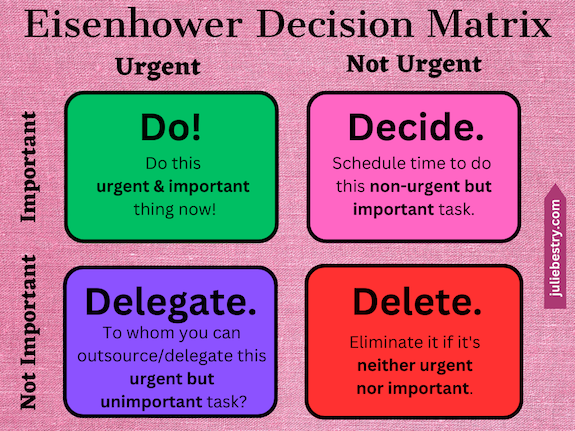
That post also talked about key skills:
Knowing what to do — as a result of a brain dump that gets everything out of your head and onto a piece of paper or screen so that nothing is forgotten or missed.
Knowing what to do first — that’s where the decision matrix kicks in, and then the next first thing gets done after that, and the next, and so on.
When we focus on important and urgent tasks over those that are important but not timely, or urgent but not, ultimately, important, we train ourselves to prioritize ourselves out of overwhelm.
Scheduling Effectively
In her book The Writing Life, author Annie Dillard famously shared:
How we spend our days is, of course, how we spend our lives. What we do with this hour, and that one, is what we are doing. A schedule defends from chaos and whim. It is a net for catching days. It is a scaffolding on which a worker can stand and labor with both hands at sections of time. A schedule is a mock-up of reason and order— willed, faked, and so brought into being; it is a peace and a haven set into the wreck of time; it is a lifeboat on which you find yourself, decades later, still living. Each day is the same, so you remember the series afterward as a blurred and powerful pattern.
Dillard explored the constantly existing tension between being productive — for ourselves (to achieve our goals) for, as they said in the 70s, “the man” (academia, industry, capitalism) — and being present or showing up (for our partners, our children, our friends, and for justice for our neighbors far and wide).
Planning our days, and then our moments and hours, assures that we get things done. But getting things done, which is important for achieving our goals, is not the same as living our lives.
We must have, if not always balance, then opportunity for variety. After all, all work and no play makes Jack a very dull boy. We must work, but we must also play. We must dine and sleep. We must make time for boredom to reinvigorate our creativity. We must dance, preferably while singing into a hairbrush.
Scheduling should take into account all of the pieces of our lives. Just as we make “homes” in our houses for our clothing and accessories, our food and our food preparation tools, and so on, we must make room in our schedules for all of the other aspects of our lives. The best way to do that is with time blocking. It doesn’t mean that you’ll schedule yourself so tightly that every moment is accounted for and pre-determined.
Time blocking just means that you’ll create safe spaces for your priorities. Start with these posts to get some insight on how to build time blocks into your schedule.
- Playing With Blocks: Success Strategies for Time Blocking Productivity
- Surprising Productivity Advice & the 2023 Task Management & Time Blocking Summit
Do the Tasks
I find that one of the most common places where people’s time management practices fail is that no matter how well they plan their schedules, they don’t actually do the work. It’s like how just buying a gym membership doesn’t actually get us into shape.
Shocking, I know.
To often, people have omitted the most key aspect of time management, and that is to put their butts in the chair (or in the car, to get them to the gym or to run the errands).
Longtime readers know that while I believe motivation is important, action precedes motivation! This means you must do whatever it takes to get your tiny patootie into position.
An object at rest tends to stay at rest; an object in motion tends to stay in motion. (That Isaac Newton knew his stuff!)
You need to get yourself in motion to the point that you are either in micro-motion (typing, reading, writing) or macro-motion (doing a workout, cleaning your house). It might look like you are at rest if you’re in micro-motion, but at the very least, your eyeballs and your brain are a flurry of activity.
For both motivation to get yourself into action and strategies to get started and keep going, avail yourself of the advice in the following posts to get to the starting line, focus, and actually do the tasks!
- Frogs, Tomatoes, and Bees: Time Techniques to Get Things Done
- Count on Accountability: 5 Productivity Support Solutions
- Flow and Faux (Accountability): Productivity, Focus, and Alex Trebek
- How to Use Timers for Improved Productivity and Focus — Part 1
- How to Use Timers for Improved Productivity and Focus — Part 2: Picking a Good Timer
- How to Use Timers for Improved Productivity and Focus — Part 3: Tangible Timers
- How to Use Timers for Improved Productivity and Focus — Part 4: Digital Timers
- How to Use Timers for Improved Productivity — Part 5: Hybrid Timers and Bonus Material
Track Your Time
You can tell yourself where you’ll travel in time, but although you will always travel forward, it will almost assuredly not be in a straight line. The problem with real life is that it takes us off-course.
No matter what we plan, interruptions from others (and unwittingly, from ourselves) creates not merely bumps in the road but ten megaton blasts in our day. The trick is to figure out whether these are unavoidable one-time problems or actual trends.
I’m a huge fan of time tracking to see where my minutes and hours go, and spend the second full week in January participating in Laura Vanderkam‘s annual Time Tracking Challenge.
Last year, I wrote How to Use Time Tracking to Improve Your Productivity, and how it helps with mindfulness and focus, prioritization (see? we always come back to prioritization), data-driven decision-making, stress-busting, and accountability. It also explored the benefits and occasional obstacles of time tracking and offered up a bevy of tools for making it easier to track your time.
If you feel like you’re planning your schedule, but still get to the end of the day with too few of the right things achieved, review that post and see how you might identify what’s going awry with the help of time tracking.
Block Interruptions and Push Through Obstacles
Once we spot the interruptions and obstacles in our days, we need to be vigilant about holding our boundaries.
If you have trouble keeping small children (or spouses, colleagues, or employees who behave like small children) from interrupting your focus, or you find that you are the one standing in your own way, the following posts can help you fight the battle, recapture your time, and post sentries along your boundaries to prevent future incursions.
- 52 Ways to Say NO to a Request So You Can Say YES to Your Priorities
- Paper Doll On Understanding and Conquering Procrastination
- Use the Zeigarnik Effect to Finish Off Your Unfinished Tasks
- Whoopsie! What To Do When Your Week Doesn’t Go As Planned
And sometimes, between time tracking and overcoming your obstacles, you figure out that some things just aren’t possible.
Don’t Forget That You Need to Sleep, Rest and Take Breaks
It’s easy to focus on the task aspect of time management, and yes, self-management does involve conquering your personal inertia (like lack of motivation). But it’s not all in your head — sometimes, it’s in your body!
You can start by scheduling yourself to tackle tough physical tasks when you’re brimming with physical energy and saving the complex mental tasks when your brain is at its peak. That’s different for each individual, so it’s important to track your energy.
Managing your energy is also essential for getting yourself into the groove and using your time well. Lack of motivation may be mental, but it just may be that you are exhausted or burnt out.
Take note of when you’re most likely to make excuses for not getting things done. Pay attention to when you need a snack, a conversation, a walk in fresh air. Don’t know when that is? Then note the times you’re flagging, that you’re reaching for the phone to doomscroll, or just generally feeling cranky.
As you work on self-management, remember that just as your devices need to be recharged, so do you. Check out the following posts when you’re trying to figure out how to bring your best, most energized self to the tasks at hand but it’s not quite working:
- Organize Your Sleep When the Clocks Change and Beyond
- Take a Break — How Breaks Improve Health and Productivity
- Take a Break for Productivity — The International Perspective
- Celebrate the Global Day of Unplugging
- Global Day of Unplugging 2025: Phones and Apps to Reduce Phone Use and Improve Your Life
- Organize To Reverse a Bad Day
TIME MANAGEMENT FOR THE REBELS
With all of the advice out there on how to set yourself up for managing your time, the truth is, some people just need something more, something different, something weird. Just as some office workers need bedazzled or sparkly charging cords

or colorful file folders, others need something that’s just a little left of center.
Big Picture Yearly View
Depending on how complicated your life is, the type of calendar you need may vary.
I depend heavily on a monthly view on my paper planner. I work best when I can see how heavily scheduled I am in terms of client sessions and Zooms so that I can see the flow of days and add my personal obligations and joyful plans accordingly.
I rarely allow myself to have so many fixed events in my schedule that I need to actually see my daily time blocks in a printed or digital calendar. However, many of my clients swear a digital view of their daily schedule, one quarter-hour block after another.
I have one client, a retired artist, who draws his own calendar when we set the next month’s session. From a blank page, he counts forward from the end of the month to visualize the start date of the next month, and draws boxes for each. Meanwhile, another client has 12 large (two-and-a-half foot high), colorful monthly pages decorating her office walls so she can see the ENTIRE year just by swiveling her neck; in addition, she she schedules appointments and gathers task categories in her Planner Pad, but echoes the fixed appointments on her digital calendar.
Only you know what level of scheduling detail you need to see to keep yourself moving forward successfully.
Neato Calendar 2026
Just in case you’re a true minimalist, and the idea of schlepping around a physical planner or typing things into your phone gives you hives, the free Neato Calendar has you covered. It puts the entire calendar on one single page.
Each month has its own column with the day of the month and a letter code for which day of the week it is; weekends are shaded in. It’s probably ideal for people who either have very few events on their calendars, or want a separate calendar to keep track of just one thing, like which days are trash pick-up vs. recycling, or mileage driven, or whose day it is to do one household chore.
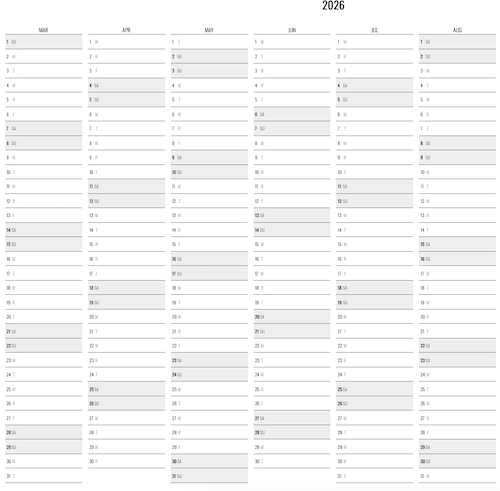
This open source (free to the public) calendar page is too wide for me to provide a legible screen capture here on the blog, so this is just a chunk from the middle of 2026. To print, don’t forget to use landscape settings and the option to fit to one page. I suspect for best results, it probably needs to be printed to a longer sheet than is standard in the US, perhaps a sheet of legal paper, though I suspect it was designed for the longer A3 paper (11.7″ in x 16.5″) popular in Europe.
The main advantages of this super-minimalist calendar calendar are that it’s free, lightweight, portable (to the point that it could be folded and put in a wallet), and it’s so minimalist that by its nature, the user can’t get overwhelmed by details. The main disadvantages are that it lacks nuance and granularity. You’re not going to truly manage much of your time with this calendar, but you may be able to manage one aspect of your time use.
I should note that last year, in anticipate of someday using the link, I’d found an identical one-page yearly calendar called Neatnik, created by Adam Newbold; the only discernible difference is that Neatnik comes with a friendly greeting screen.
A Weekly View
Most planners provide a monthly view with the option for a weekly or daily view, and for those who want granularity, the daily view is usually a top choice. Some people operate best seeing one week at a time.
I’m already a fan of the funnel system of Planner Pads, and if they were more colorful, I often think I’d use them myself, as my clients are always delighted when I explain how they work.
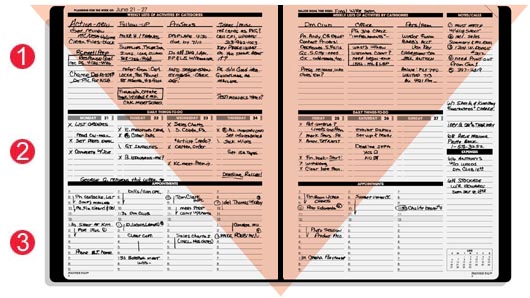
Ink & Volt Dashboard Spiral Deskpad
It’s hard to find a weekly view scheduling tool on par with PlannerPads. While I can often find weekly task pads, I’ve never found a similar product with planning space for categorized tasks, tasks scheduled by day, and appointments.
Recently, I saw ads on social media for the Ink & Volt Dashboard Spiral Deskpad that, while not equaling a PlannerPad, does offer interesting features.
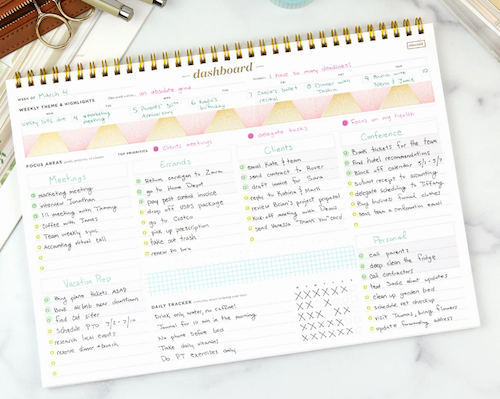
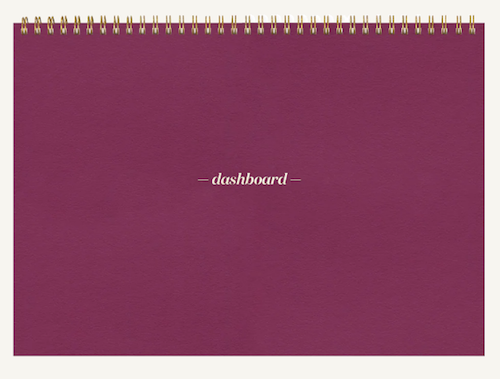
Available on the Ink & Volt website for $31 (or Amazon for $33 in Black, only), it has 52 undated sheets, a landscape layout, and a left-handed-friendly top-spiral binding. Select from among nine colors of covers: Onyx Black, Midnight Blue, Carbon (grey), Matcha (green), Mulberry (shown below), Black (but less black than the Onyx Black), Cloud (white), as well as two pre-order only shades of Bleu (a sort of light sky blue) and Fleur (a light pink).
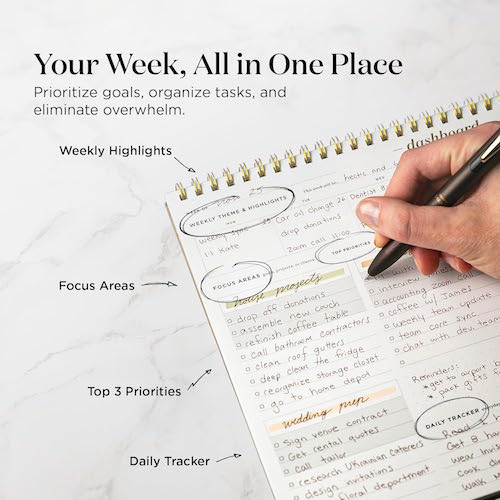
There are six areas of focus, with a highlighted section for your top three priorities within that focus category. There are also spaces for weekly highlights, a habit tracker, and a section for themes and highlights by day. My favorite aspect is that the checkboxes are printed right on the page to make it easier to check off your successes in a tidy, orderly manner.
Find Your Moment in Time
In the 5-post series on timers (linked above in the task-doing section), I championed analog timers over digital ones for productivity and focus. To be able to truly see the passage of time, an analog clock (like most of the analog timers I shared) gives you a visual appreciation of what time it is and how it relates to the moments used and the time remaining. But hey, if you’re rebel or you just need something to delight you in a different way, I’ve yet to see something more unusual than this next item.
Author Clock
Author & Company has created Author Clock, which tells time by quotations from literature. Using more than 13,000 passages from more than 2500 books by famous authors, time is told with a sentence or fragment from a literary work referencing a moment of the day. New quotes (and software upgrades) are added by WiFi.

Quotes are available in English, French, Spanish, and German, with each language collection specially curated by Author & Company’s editorial team.
The frame is made of solid oak, with brass dial controls, an easy-to-read E-Paper display that changes from minute to minute, and a rechargeable battery. There are also parental control settings, in case you want to ensure that more mature quotes aren’t seen by little time-tellers.
You can customize a variety of the features, including font style and size, quote frequency (from every minute to every hour), and even add in “vague” quotes, like one relating to “A few minutes to midnight.” A digital clock in the screen’s header is optional.
There are two versions:
Author Clock Volume 1 has an E-Paper measure 4.3″ E-Paper screen and sits on a brass base. It’s suitable for sitting on your desk or nightstand, for when you are close enough to see the smaller letters.
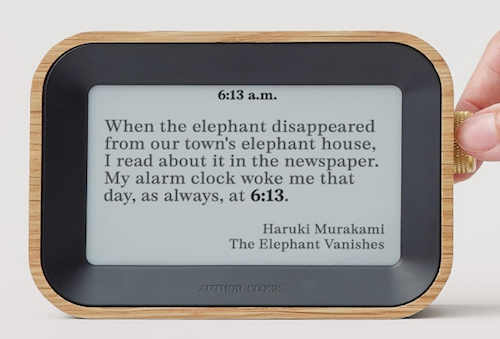
The larger Author Clock Volume 2 has a 7.8″ E-Paper screen. The brass base is removable, in case you want to mount it on the wall and view the larger letters from across the room.
Happy February, and however you manage your time, I hope this month brings you moments to treasure.



As always, you provide a wealth of knowledge, tools, concepts, and humor to delight and educate us. Thank you, Julie!
I just wrapped up National Get Organized Month and forgot that February was Time Management Month. I appreciate the reminder. And it is ironic, as you said, that ‘they’ chose to tie it to the shortest month of the year. Even when it’s a leap year, it’s still the shortest month. 🙂
But then again, time is funny. No one ever feels like they have enough time. So maybe it’s actually super appropriate that this ‘event’ falls when it does.
Your statement resonates with me about how time management is about task and self-management. You can’t actually manage time. It keeps on ticking. But the elements that make the time we have valuable and workable CAN be managed. And you shared some fun tools like the time quote clock. What? Such a unique and fun time expression! And those bedazzled charging cords? Sign me up!
Thank you, too, for your digression on frittering. You cracked me up, and now I want some apple fritters!
I had something different planned for this week, but realized late last week that “Hey, it’s Time Management Month again!” It sneaks up on because it’s just after GO Month, so I do wish it were later in the year. But it makes sense, because everyone is in holiday hangover mode until mid-January, and then January storms often keep people in “ad hoc” mode. This is the first month of the year where people aren’t as likely to be distracted.
Your comment reminds me of the lyric, “Time keeps on ticking, ticking, ticking into the future.” I may have to use that for another post during this Time Management Month observation.
I’m glad you liked the Author Clock; I’ve been waiting a long while to find an appropriate post for its inclusion. And our colleague Connie Johnson deserves the credit, as she recently shared a bedazzled power block with me, and it’s both whimsical and rebellious. We deserve fun things!
And I want apple fritters, too. I almost included a video with an apple fritter recipe, I distracted myself so much. 😉
Wow, another jam-packed post full of good stuff.
It is funny that Time Management Month is in February. I never thought of that LOL.
I think finding the tools that help us make the most of our time is so important. Some of those tools are planners and calendars, clocks, and lists, all of which you covered so well.
Another set of tools are those that we use to manage our motivation and energy. As you so rightly say, motivation follows action.
Also important are tools that make us function, like timers, body double partners, accountability partners, deadlines, environmental management, etc.
There’s more to this executive functioning stuff than first meets the eye!
It’s funny how we spend so much of our lives feeling we have insufficient time, until we are sick, disabled, or lonely, and then time moves by so slowly. It’s really a weird thing!
The frittering line cracke me up too! Personally, I love a fritter!
There are so many different ways we can support ourselves and our time; the more I talk to my clients, though, I find that it’s still only support. You still have to want to do the task more than you want to avoid doing the task. The “I don’t wanna” bug is viral, I’ll tell ya!
I’m glad the frittering made you laugh. Sometimes, I crack myself up while I’m writing, and decide that as long as I’ve made myself laugh, it’s OK if nobody else does. So, you’ve made me extra happy. I raise a fritter in your general direction!
Love this, Julie! I never knew that February is Time Management month. I love that you point out that we can never manage time. We can only manage the way we schedule the time that is available to us. As you say, task management and self management.
I’m a planner pad lover and user. I must see the whole month so I don’t schedule myself too tightly and I love the weekly funnel system.
I don’t recommend it to many of my clients because it is a little too bland and asks a lot of the user.
The ink & volt dashboard looks very interesting. Thanks for all this great information!
I suspect most of us in organizing (though, I’ve learned, not all) are planners and plotters, and we love to set a schedule, make a list of tasks, tackle the items, and check them off. But even we can struggle with maintaining boundaries, getting enough sleep, or having ample motivation.
Perhaps you and I should create a proposal for PlannerPads to show them that their excellent product could be even more profitable for them if they just added some color to help motivate those who need an extra bit of dazzle?
Thanks for reading!
Loved the fritter bit – now I’m hungry.
For me, when I think of how I use my time I think of my purpose. Why am I doing this now? What would happen if I didn’t do it? What else could I be doing?
I love it when my day/week is all planned out but does have the flexibility that if a friend calls and says, “Are you busy? Can I come over?” I can quick go into my calendar to shift tasks around so that I can answer, “Come on over! I’ll fix lunch.”
Ha, imagine how I felt when I came up with the fritter bit while writing late at night. (I made do with an Eggo Cinnamon Churo Waffle, which is decidedly not the same.)
You make such an important point. If we know our purpose, or as Simon Sinek says, our “why” it transforms our feelings and motivation, sometimes even our posture. It’s too rare for us to stop and think whether the thing we’re doing now needs to be the thing we’re doing now, or even at all!
I’ll admit, I’ve never been the most spontaneous person, but yes, the flexibility to be able to move things to engage in joy is really something special. So, I’ll be over for lunch; I’ll bring the fritters! 😉
Thanks for reading!
What an amazing post! This sentence really jumped out for me: “Take note of when you’re most likely to make excuses for not getting things done.”
My most common excuse is that I don’t have time to do it, but in reality, most things don’t take as long as I think they will. Those that will, I try to break down into steps and do whatever I can in the available time – that helps a lot.
I’m so glad you liked that line. I have a fellow mastermind group member who always asks, “Why do you think you’re avoiding doing that thing?” and it always stops me in my tracks. Once I can verbalize why I am making excuses, it forces me to ask myself whether I’m resenting having to do it, why, and whether I can quit or outsource or delegate. It’s pretty powerful.
My excuse, more often than not, is that SOMETHING about the task is making me cringe. I’m afraid it will cost money, or that I won’t do it perfectly, or that it will yield more cringe-inducing activities. But once I name the fear, I can battle it! And yes, breaking it down into the tiniest next step is pretty magical.
Thanks for reading!
What a great compilation of time management posts, Julie! Also — uh oh — I think I might have to finally watch Dr. Who. We’ll see if I can make time for it.
Watching Doctor Who while eating an apple fritter might be the best possible use of your time. 😉
Thanks for reading and for your kind words, Hazel!
Happy Time Management Month! I have to check out Laura Vanderkam’s annual Time Tracking Challenge. This post is packed with many ways to learn how to make changes in time management. Thank you for bringing them together.
Thanks for reading, Sabrina. I have done the challenge every January (it was a few weeks ago) and I find it to be a super way to pay attention to how I’m really spending my time. This year? Too much nervous following of the news, and too much dooms-crolling. But what you measure gets noticed, and what you notice can be modified, and I count on that. I wouldn’t track my time every day of the year, but one week a year works pretty well as a reality check.
When you come home I’l make you 🍎fritters.⏱️If I can find the time.⏱️⌛️
LOL! Mommy, you crack me up! 😂😂😂