Paper Doll
Why You Think You’ll Regret Decluttering and Why You (Mostly) Won’t

As a Certified Professional Organizer in my 25th year in the organizing and productivity field, I’ve found that one of the spoken (and often unspoken) fears people hold is that they will regret having let go of things. This fear persists whether they’re worried about letting go of tangible possessions, obligations in their schedules, or even mindsets.
Tangible Clutter
In Paper Doll Explains Aspirational vs. Inspirational Clutter, I reviewed the main types of tangible clutter:
- Practical clutter — These are useful items, like clothing, bedding, or kitchen implements, which may no longer suit your lifestyle or exceed the amount you need.
- Informational clutter — This includes general information, curated research, and personal documents, but is out of date otherwise no longer useful.
- Identity clutter — These include an excess of items that help us define ourselves (to ourselves or to others). The items might say, “I’m the kind of person who runs marathons [or wins spelling bees or bakes from scratch].” But identity clutter can keep us from evolving.
- Aspirational clutter — These items support hobbies you tell yourself that you are going to take up, but never really do. Whether you’re saving a closet full of fancy papers and Cricut gadgets for when you finally become a scrapbooker or amass shelves of books on the topic of “How To [Train Championship Greyhounds/Write a Novel/Mine Crypotocurrency],” you’re collecting an excess of items for a life you don’t actually lead.
- Inspirational clutter — These range from motivational posters to self-help books to knickknacks that don’t motivate you to do a specific activity, but to live a “better” way.
- Nostalgic clutter — Nostalgia is defined as “a sentimental longing or wistful affection for the past, typically for a period or place with happy personal associations.” However, an excess of nostalgic emblems of the past can fill up our homes in the present and prevent us from having space in our lives to make a future.
- Painful or sad clutter — These are things that remind us of bad times or bad people.
Temporal and Mindset Clutter
Temporal clutter (in our schedules) falls into the same kind of categories. These are the tasks, activities, and meetings we have — whether at all or just too many — which we hold onto for fear of an anticipated feeling of unease without them.
- Practical temporal clutter — includes activities that feel like necessities, but can become busywork. In our personal lives, they may be tasks related to cleaning, cooking, shopping, self-care, etc.; at work, they might be networking events, meetings, marketing tasks, non-essential emails, or doing anything that’s not directly related to actual professional success. We may be them because we’re trying to keep the plates spinning, but delegating to family members or colleagues/co-workers, outsourcing, or eliminating them altogether may yield essential breathing room.
- Informational temporal clutter includes webinars and online courses we register for, email newsletter subscriptions, and everything we allow into our lives with the hopes of learning and growing but which end up making our inboxes and browser tabs feel claustrophobic. Informational temporal clutter keeps us feeling behind, no matter how much work we get done.
- Identity clutter is made up of everything we agree to do because it reflects who we think we are, believe we want to be, or hope to be seen as by others. Thus, it relates to temporal and mindset clutter. If you’ve been led to believe that “a good mother” cooks every meal from scratch, and you’d feel guilty for not doing it rather than happy that you’ve done it, those tasks are really clutter. If you keep chairing a committee or remain at a job or in a career path that no longer gives you satisfaction, the obligations are clutter.
- Both aspirational and inspirational clutter in our schedules are related to identity clutter.
Instead of clinging to a schedule laden with events that define us as “the kind of person who” does such tasks, aspirational clutter includes activities in which we participate because we think it will make us into that type of person.
Inspirational clutter can include activities that we hope will make us feel the way we wish we felt, like going on dates with someone whom we don’t like, but whom we wish we did like, or attending social, professional, or activist events we think will make us feel a particular way.
If activities crowd us out of the opportunities that would give us the kinds of joy that would lead us to careers, personal lives, and emotions that would better match our best, happiest selves, then they are clutter.
- Nostalgic clutter in our schedules may find us showing up for events that once brought happy memories, but now make us feel lonely or disconnected. Not all events where you once experienced happy memories will continue to fulfill you, and chasing that high can be expensive, both in terms of money and time.
- Painful or sad temporal clutter includes all of the efforts we go to in order to satisfy unfortunate mindsets. Think of people who spend their lives in relationships that give them nothing but heartache or who remain in careers that offer payment, but not true reward, often because they’ve been groomed (personally or professionally) to believe that they are not deserving of better.
In every case, whether clutter is tangible, temporal, or related to beliefs and mindsets, people hold onto that excess of the unnecessary, undesirable, or no longer rewarding out of fear that a future without them would bring negative consequences. It could all be summed up as “better the devil you know than the devil you don’t know.”
However, good organizing principles aren’t just about moving things around, but moving the right things into the right places after letting go of the wrong (or, at least, no longer right) things altogether.
REGRETS, I (THINK I WILL HAVE) HAD A FEW
Frank Sinatra will have to forgive me.
When people tell me that they fear decluttering, I find that they generally fear that they will regret decluttering. After the fact, folks regret not having jettisoned unhelpful stuff or tasks sooner.
Yes, people may briefly regret decluttering because the process of letting go of possessions can stir complex and unforeseen emotions. However, you can control for fears about anticipated regret by being proactive.
Fear About Emotional Attachment
Our hearts are in good places, but our hearts and heads need to communicate better.
Sentimentality
When objects carry emotional significance, reminding us of absent loved ones, meaningful events, or cherished memories, letting go can feel like losing a part of our personal history, even if the items themselves don’t serve an immediate practical purpose. Working with a professional organizing or close friend and telling the story of how the item came to be often shakes loose “false” attachment, reminding us that the item, itself, isn’t needed to keep those memories intact.
Nostalgia
Again, nostalgia is defined as a longing or wistful affection for a period in the past, but that period is often idealized as being happier or simpler. When we dig deeper, we find bittersweet feelings that tinge pleasure with sadness. The longing is for something that can’t be recovered by merely possessing the object or participating in the activity.
(You’ve probably never heard this full version, and it’s a good reminder of how nostalgia isn’t everything it’s cracked up to be.)
We can’t regain our enthusiasm for learning by holding onto our college textbooks. We can’t hold onto youthful idealism by keeping a T-shirt with an activist phrase emblazoned on it. But we can make plans with a friend to take a course or join a book club; we can get involved in a movement to achieve an important community goal.
The initial stages of decluttering often provoke feelings of nostalgia, and items can seem like tangible connections to the past. However, once these possessions (that haven’t been used, displayed, or paid attention to for decades) are gone, that anticipated sense of loss will be tepid.
In part, that’s down to the Pareto Principle, or 80/20 rule. It says that 80% of our successes come from 20% of our effort. Eighty percent of our utility and enjoyment comes from 20% of our “stuff” — and pretty much none of that utility and enjoyment comes from what’s buried in the back of a closet!
Fear of Future Lack
It’s normal to fear that if you get rid of something, you’ll regret the loss. But when it comes to decluttering, the “road not taken” (keeping the clutter) is often filled with potholes.
“What If” Scenarios
When I work with clients, it’s common for them to worry about needing an item in the future, even if they haven’t used it in a long time (or ever). This fear of not being prepared can lead to second-guessing. It’s not impossible that someone may have regret after they’ve already discarded an item, but that can be minimized by taking “What if?” to its natural conclusion.
Unanticipated Events or Trends
Decluttering clothing, tools, or hobby materials (or the hobbies, themselves) may stir up a momentary twinge of regret when future circumstances arise where those items could be useful.
In the 1970s, the popularity of Happy Days and Laverne & Shirley made 50’s Days at schools popular; in the 1990s, That 70s Show had a similar, if muted, impact. While people may have been disappointed that they no longer had their poodle skirts or bell-bottom jeans, the regret was almost always mild and short-lived because the space and time needed to store and care for such items was more than the value of occasionally having them on-hand.
Fear of Misjudging Value
Clients are sometimes fearful of donating or discarding something and then someday finding out the monetary, sentimental, or practical value of an item after it’s too late. This is why professional organizers strive to know when something should be appraised, or recognize when a client hasn’t adequately come to terms with an emotional connection.
Financial Pain Points
I could write an entire blog post of examples about how people tend to hold onto things they don’t need or want because they fear finding out later that the items had monetary value. My colleagues and I have seen more than our share of clients who invested in Beanie Babies because they were (mistakenly) certain they’d become solid retirement investment instruments.
For example, the value of an antique is not merely that it’s old. Age is only one element of value; others are rarity, condition, provenance (history of ownership), authenticity, design/craftsmanship, and demand. The more you know about somethings monetary value (or lack thereof), the more easily you can make a decision about how and whether to let it out of your life (and home).
Sentimental Blind Spots
Items that might not seem valuable today can gain significance as personal context changes. People may regret not foreseeing the future importance of something seemingly trivial at the time of decluttering.
It helps to accept that there is only so much foresight we can have. I had a late-1985 Macintosh computer. It was cutting edge. Then it was out of date. And then it was a lump on my closet floor. And then I happily sent it to my friend to turn into an Macquarium. Years later, he spent quite a bit of time in an ashram in India, so I’m not sure whatever became of it. If I sat mired in regret that 40 years after I acquired it, it wasn’t still being used to give utility or delight, I’d make myself ill.
Decide now that if you let go of something you later wish you’d kept, you’ll give yourself grace.
Fear of Making Poor Decisions
The whole decluttering process can lead to poor decision-making.
Rushed or Emotional Decisions
Decluttering under pressure — whether due to a move, family expectation, or a desire for fast results—can lead to rash decisions. Later, people often regret discarding things without giving enough thought to their significance.
Overwhelm
Sorting through possessions can be emotionally exhausting, leading to decision fatigue. When overwhelmed, people may simplify be discarding more than intended, only to later wish they had been more selective.
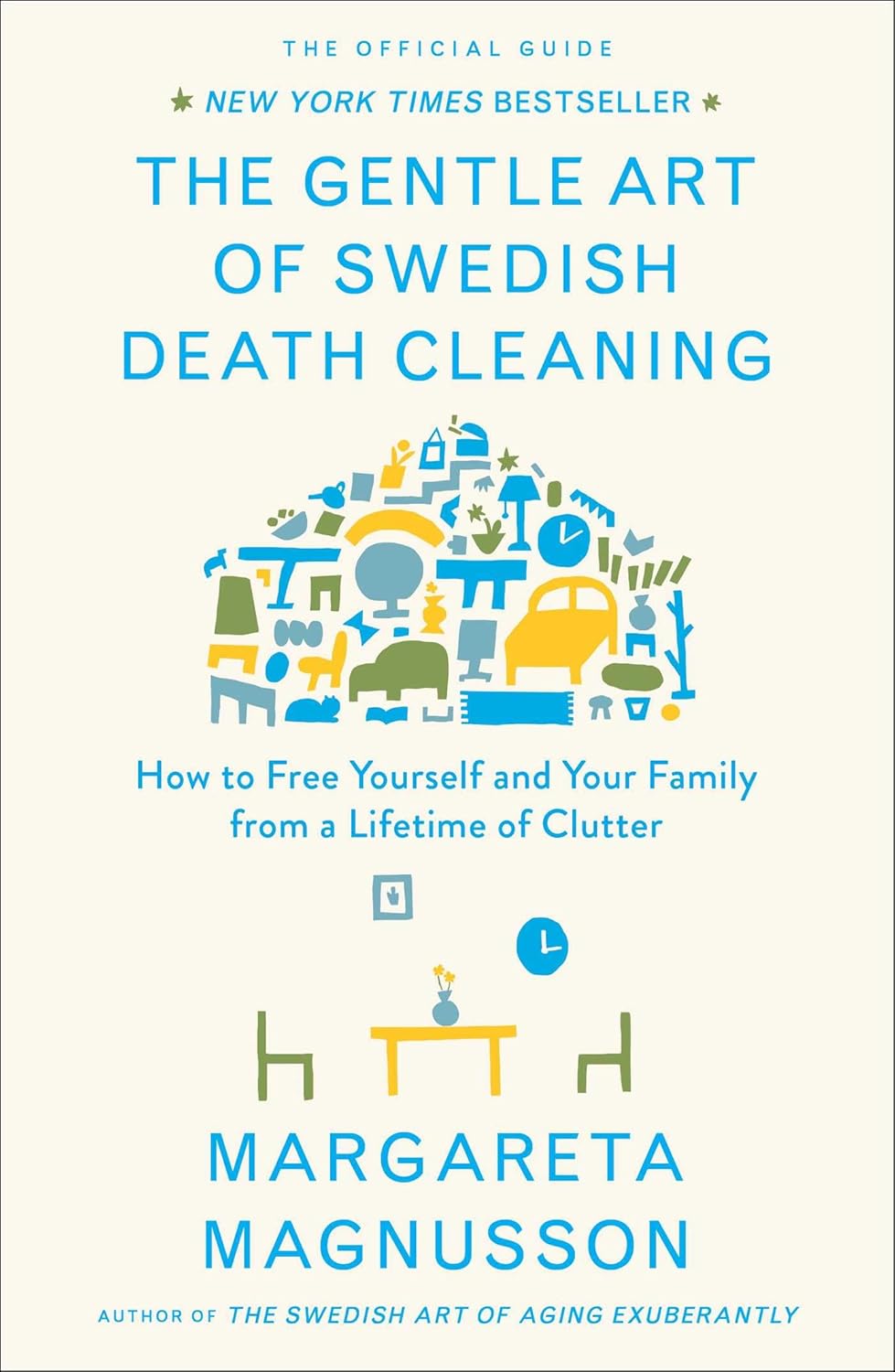
This is why we encourage people to start decluttering early and continue it as an ongoing practice. Even thinking about this in your thirties or forties can make life easier down the road. Expand your mindset on getting comfortable with jettisoning possessions by reading The Gentle Art of Swedish Death Cleaning: How to Free Yourself and Your Family from a Lifetime of Clutter by the late Margareta Magnusson.
Fear of Lost Identity
People fear that letting go of possessions will lead to a loss of connection to who they are.
Personal Identity
Objects help establish and define people’s identities — whether they’re tied to professions, hobbies, interests, or memories. Downsizing can feel like giving up parts of one’s identity, leading to a sense of loss or disconnect from who they were in their heyday.
Cultural or Family Connections
It’s common to hold onto objects that connect one’s family or cultural history. Letting go of these items can feel like breaking ties with heritage or family roots.
You can diminish the fear by talking through the role each item actually plays, and whether the possession is really tied to living your identity.
Does the absence of dust-catching plaque on a shelf really mean you’re no longer a past “Teacher of the Year?” Can you trust that your legacy is actually all the students you guided? If you have half a dozen rosary beads or seder plates but only ever use one favorite, wouldn’t passing along the others to someone who will love and use them actually enhance, rather than detract, from cultural or family connections?
Fear of Minimalism
If you’re used to having a very “full” space, especially as you declutter with an eye toward downsizing to a smaller home, other fears may creep in.
Over-Purging
In the pursuit of minimalism, some people swing too far and end up feeling their space is too bare, missing the comfort and personalization that their possessions once provided. This is particularly common when one member of a married couple is inclined to “pitch things willy-nilly” as one of my clients complained of their spouse. Working with a professional organizer who monitors emotions and asks questions about your future needs throughout the process can soothe frayed nerves.
Similarly, not everyone thrives in minimalist environments. People may feel pressured to declutter because it’s trendy, only to regret it later when they realize it doesn’t align with their personal preferences. I always come back to the William Morris quote, “Have nothing in your house that you do not know to be useful or believe to be beautiful.”
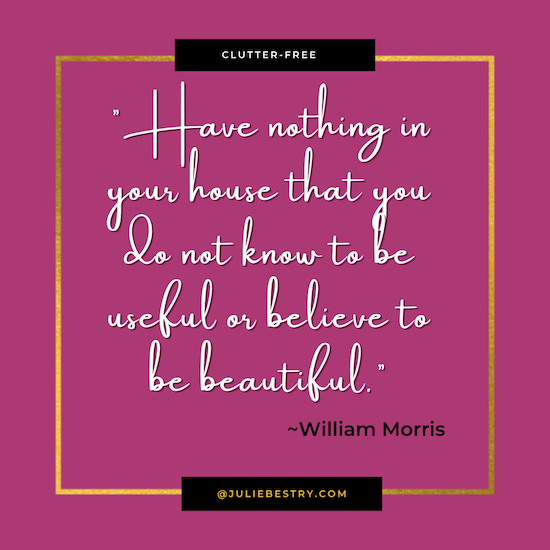
Using this as a rubric will help dissipate fear that you will let go of “too much” and allow you to focus on keeping what is “just right.”
Practical Inconveniences
When people downsize “too much,” they can find themselves in situations where they miss basic, practical items they took for granted, leading to frustration and regret. Again, the solution isn’t to avoid decluttering, but to consider what “after” should look like and set aside favorite essentials before the purging begins.
THERE’S NO BIG FIX FOR FEAR OF DECLUTTERING
There’s no one magic wand to get rid of the fear of decluttering, but there are a few strategies to become more comfortable with uncertainty about how you will feel after decluttering.
Jettison the Expectation of Quick Satisfaction
There’s often an expectation that decluttering will bring immediate peace or satisfaction, but the emotional void left by discarded items can take time to heal, leading to disappointment when results aren’t instantaneous.
Decluttering brings clarity and simplicity. It saves time and money, reduces stress, and increases productivity. Nonetheless, humans are psychologically complex.
We have emotional attachments (and false beliefs about emotional attachments), fear of future situations, quirky needs, experiences of loss, and fears that we will be judged (or judge ourselves) for making poor decisions that leave us without the value we might otherwise have had.
But the alternative to decluttering is physical overwhelm in one’s space and emotional overwhelm as a result of one’s schedule.
Somewhere in between is the balance between keeping what matters and letting go of what we don’t need. We achieve this with mindful, intentional decluttering that respects both the practical and emotional roles possessions play.
PROACTIVITY OVERPOWERS REGRET
Clients are often a bit surprised when I encourage that they *not* let go of certain things for which there are guidelines regarding retention (like old tax returns and supporting documents, loan payoff documentation, etc.).
Clients who take the time to work through a decision regarding whether to keep or discard something rarely have regrets. I’ve never had a client ever say, “Darn, that wagon wheel coffee table that we discussed? I really wish I’d kept it.”
Again, most people express regret that they didn’t let go of things sooner. A substantial aspect of that comes from the proactive nature of working with a professional organizer to consider the consequences. When there is regret related to decluttering, it most often comes from never stopping to think clearly about the value, failing to cautiously review what’s purged, and not being given the choice at all.
The most common circumstance in which people regret the absence of their things is when they didn’t get to control the parting and don’t get closure. This may happen when:
- People are evicted and no arrangements have been made to move their possessions
- There’s a house fire.
- Victims of abuse or neglect escape or end up in foster care without their things.
- Sudden ill health forces elderly people to leave their homes and go into assisted living or nursing care.
- Students haven’t done anything to prepare for end-of-the-year dorm clean-outs and whatever doesn’t fit in the car gets tossed.
It’s much like when a relationship ends. When a spouse dies unexpectedly, you’re left adrift. But no matter how painful, if you have enough time for a “good goodbye,” when the end comes, after a period of mourning, you’re likely to have a lifetime remembering the good rather than obsessing about the fact that it’s over.
If you get a divorce (amicably, or at least if it’s your decision or you agree that it’s for the best), while you may sometimes miss aspects of the relationship, you’ll have a healthy recognition of what transpired. But if a six-month situationship ends when the other person ghosts you, you’ll miss the hoodie left at their house and the lost chance for proper closure.
Separating from your possessions can be similar. If the parting is forced on you, it’s understandable that it will unleash a variety of negative emotions.
FIND THE BALANCE BETWEEN REGRET AND JOY
Marie Kondo’s idea of letting go of everything that fails to give you joy is problematic.
Joy is a great rubric for deciding to get rid of a significant other. If your partner doesn’t give you joy at least 85% of the time, there’s a problem. (It’s OK if it’s not 100%; there’s something to be said for even-keeled neutrality or boredom. But if they make you unhappy more than 1% of the time, toss ’em in the recycling bin.)
Joy is also probably an excellent way of judging what tasks and obligations you should cut from your life, provided that cutting those non-joyful obligations won’t also delete joy. Hate going to meetings at work? Just refusing to go may eventually mean that your employer will jettison you from the workplace, and you’ll lose out on the joy that a paycheck brings.
But outside of the work environment, decluttering tasks should mostly be joy-based.
You don’t get joy from driving your kid to soccer practice? OK, but if your child being happy does bring you joy (and I hope it does), the trick isn’t to stop the soccer but stop the driving. Arranging with another parent to carpool and split the driving (so you only do pickup) might work; so might paying for a ride-share service designed for kids and teens.
You get no joy from having lunch with your complaining, unappreciative something-in-law? Encourage your spouse to pick up the slack and let go of that draining emotional load.
You won’t regret choosing self-care over task clutter. Figure out when, and when not to, emulate Herman Melville’s Bartleby the Scrivener and learn to say, “I would prefer not to.”
Fear of how you will feel about letting go of items and activities is understandable, but don’t let it keep you from taking control of your space and schedule.
Sustainable, intentional decluttering can minimize your fears and regret, and empower you to live the life you want.
Paper Doll Organizes Your Shower Thoughts and Keeps You On-Task
A client recently asked me if I’m always productive.
Of course, the answer is no. Professional organizers may have superpowers when it comes to pattern recognition or creative use of space, but we aren’t magical beings or robots. Most of us have developed systems to make it easier to get tasks done on time and prevent things from falling through the cracks.
For example, I’m not a morning person. You’ll find a lot of people praising the 5 o’clock miracle of early rising to get a jump on the day. That’s not me. I’m more likely to say, “Wait, there’s a five o’clock in the morning, too?!”
I can accomplish a wide variety of tasks while the world sleeps, from midnight until the wee hours, but from 5 a.m. until much closer to lunchtime, the world better not make any serious demands of my critical thinking.
I want to sleep until the very last possible moment before I get out of bed on days when I have client sessions or Zoom meetings, which means that I limit everything I have to do in the morning before an appointment to the bare minimum: grooming and eating.
That means that the day before, I’ve made sure that there’s enough gas in my tank, and that there’s an umbrella by the door if it looks like rain (and another in the car, in case it didn’t look like rain before I left the house). My clothes are laundered and my email replies already await others when they arrive in their offices. The next day’s locations are already entered into my maps app for easy navigation the minute I get in the car.
This kind of lifestyle also means that the night before, I have selected (and laid out) my outfit for the next day, right down to the shoes. I have packed my work bag and literally the only thing I need to do (once I am fed, groomed, and dressed) is to put my phone in my purse, pick up my bag, purse, and keys (which are neatly awaiting me), and walk out the door.
LOST TIME AND SHOWER THOUGHTS
But this doesn’t mean I never get tripped up.
My biggest stumbling block is “lost time.” No, not in the sense that I’ve been abducted by aliens, though that would be a better explanation. And unlike my clients with ADHD, I’m not sucked into hyperfocusing and forgetting to make transitions from one tasks to another; nor do I let myself get distracted by unexpected things. (When the phone rings in the morning, if caller ID doesn’t show that it’s the client to whom I’m heading, I let it go to voicemail.)
In general, I’m pretty systematic such that I’m always doing what I have to do by when I have to do it. But “empty,” unplanned time? Time not scheduled for writing, client sessions, research, or personal tasks? That’s when things may go off the rails for a few minutes. And yes, it’s only a few minutes, but when you hate mornings and schedule your time so that every moment has an assignment, even a few misspent moments can be a problem.
The truth is that I daydream. Some people call them shower thoughts. Other people, night thoughts.
(Once you get to the bit about the bear, it gets a little scatalogical, so you might want to stop there.)
Sometimes, these are random, as Kumail Nanjiani describes in the video. On occasion, they can be what’s called L’esprit de l’escalier, the French term meaning “staircase wit,” when you realize too late the perfect comeback you should have made in some recent conversation. Often, I’m rewriting scenes from a TV show in my head so that storylines end up the way I wish they had.
And more often than I have ever previously admitted in public, I’m having imaginary conversations with the Founding Fathers, gently explaining where they went wrong, lacking either anticipatory imagination or clarity of expression — or explaining to Jane Austen why Elinor Dashwood deserved so much better than Edward Ferrars (with apologies to both Hugh Grant and Dan Stevens, who did much to elevate that emo rich boy with no aspirations or direction).
I like to think of these little mental forays as a testament to my own creativity, but given my tightly timed mornings, I do need to explore ways to stick to my schedule without hiccups.
SPINBRUSH SMART CLEAN™
Sometimes, I start rewriting a Grey’s Anatomy scene in my head while brushing my teeth, but if I get lost in thought, it wouldn’t be very healthy for me to brush my teeth for ten minutes straight. This isn’t a particularly worrying occurrence, but while tumbling through some daytime night thoughts (as it were) about this blog, a product in my local Ollie’s Bargain Outlet caught my eye.
Intrigued, I picked up a Spinbrush Smart Clean™, a battery-operated toothbrush that keeps time at the forefront of one’s mind.

This isn’t a commercial. I’m not a dentist, and even if I represented four out of five Paper Dolls, I’d have no way to evaluate the claims made, which are that it:
- Removes more plaque in hard-to-reach areas than a manual brush
- Reduces surface stains by 50% after one week when used with regular toothpaste
- The soft, triple-sided bristles clean deeper between teeth; split-head design moderates the amount of pressure applied, so it’s gentle on teeth and gums.
What I can corroborate is that the Spinbrush Smart Clean™ has what they call a 30-second pacer that gently pulses after each of four blocks of time, ostensibly to assure that you adequately brush each quadrant of your mouth rather than brushing your front teeth and then falling into a daydream.
Then, it turns off automatically after two minutes, which is just (gently) jarring enough to shake you out of a reverie and reminded you to move on to the next essential ablutions.
(If you’d like to try it out, the Spinbrush Smart Clean™ is $12.90 at Amazon or about $2.99 if you manage to find it at Ollie’s.)
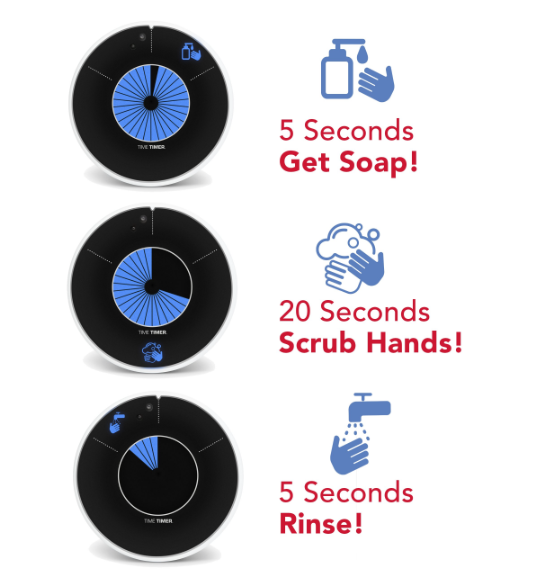
If this toothbrush seems vaguely reminiscent of something else, it may be because I wrote Organize Your Health: Parental Wisdom, Innovation, and the New Time Timer® Wash in which I evaluated how helpful (particularly during the pandemic) the Time Timer® Wash, a touchless, water-resistant visual timer, might be for children and adults to visualize the passage of time and spend enough of it washing their hands.
And lookie there, the perfect opportunity for a transition!
TIME TIMER ELEMENT
Time Timer is always innovating, and recently shared the pre-launch of their newest product.
The Time Timer Element is a compact, water-resistant visual timer that’s designed — like many of the Time Timer products — to assist children and adults build time awareness and improve their self-management skills.
It other words, it’s ideal for anyone who has a tendency to daydream or have so many shower thoughts that they get distracted and forget to stop dawdling, get out of the shower, and continue on with their day.
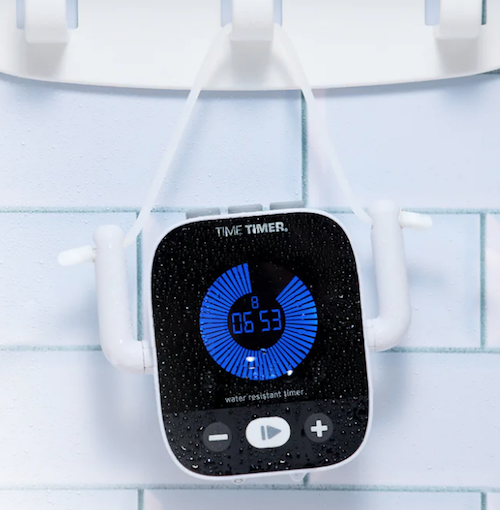
The Time Timer Element seeks to help users stay on track with their daily routines in a place where there’s unlikely to be other stimuli (clocks, TVs with commercial breaks, other human activity) to call attention to the passage of time. And, in particular, it’s made to work in the shower or near the sink!
As a personal note, once I’m putting on my makeup or doing my hair, I’m pretty attentive. But some of you ladies know what I mean — there’s a very narrow window from the time you take your hair down from the towel for you to use product and apply heat, and if you miss that window, well, you may not look like a clown for the rest of the day, but you definitely won’t look like you.
Dawdling can be an image-killer, so a timer for making sure your grooming activities stay on-task is a win-win for productivity and your personal brand.
The Time Timer Element has a variety of features to that make it an interesting option.
The Time Timer Element Is IPX6 Water-Resistant
Are you wondering what the heck IPX6 water resistance is? Well, so was I.
“IP” refers to “Ingress Protection” — It turns out that the International Electrotechnical Commission (IEC) has developed ingress protection (IP) ratings to grade the resistance of an enclosure (like a plastic or metal case) “against the intrusion of dust or liquids.”
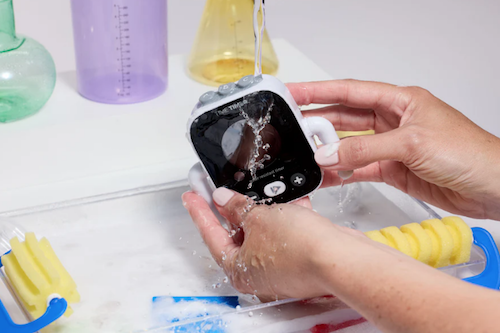
IP6 means means a device (like this timer) is “protected against powerful, high-pressure water jets from any direction for at least 3 minutes.” Picture heavy rain, spray from a hose, or — you guessed it — water coming from a shower nozzle. IP6 indicates a high water resistance, but not so high that you could submerge it in water. (That would be an IPX7 or IPX8 rating.)
The “X” just means it is not tested for dust. So if your bathroom is dusty, well, you’re on your own.
The point is that the Time Time Element is specifically designed to work in wet environments like showers and bathrooms in general. Don’t turn it into a float for your rubber ducky, but otherwise, it should be fine.
The Time Timer Element Has Customizable Presets
The Time Timer Element comes with three customizable pre-set timer buttons on the top of the timer for increments of:
- 2 minutes
- 8 minutes
- 25 minutes
Additionally, you can program a countdown on the Element for any duration up to 99:59. (If you need more than an hour and forty minutes for grooming, I don’t know what to tell you.)
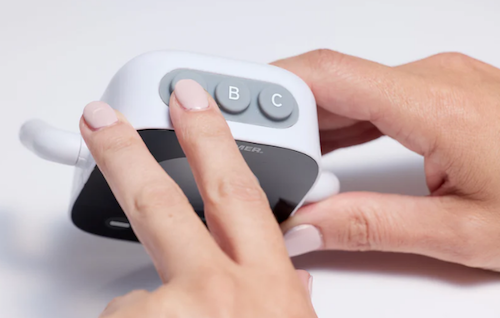
So, if you’re deep conditioning your hair with a hot oil treatment, the two- or eight-minute timers might be just perfect. If you want to take a bath but are fearful of drifting off and missing your transition to making dinner or watching your favorite show, the 25-minute timer might be apt.
And, for those who are familiar with the now-viral Gen Z references to an “everything shower” — where you accomplish it all from exfoliation to hair masks to lymphatic drainage — setting timers for both the activities and the transition time might make the whole process seem less daunting.
The Time Timer Element Has a Flexible Design for Varying Display Styles
As with all of the digital Time Timer products, like the Wash and the Twist, on the “face” there’s a digital countdown in the center (for those who can easily envision time numerically/digitally) and a visual, colored disk that decreases as the time time remaining decreases for those who need to better “feel” the passage of time.
Below the timer face, there are buttons for increasing, decreasing, or pausing/playing the timer. As previously shown, on the “head” of the Element, there are the three pre-set buttons.
As you examine the whole timer, you may find that the Element looks a bit like a cute little dude.
It includes:
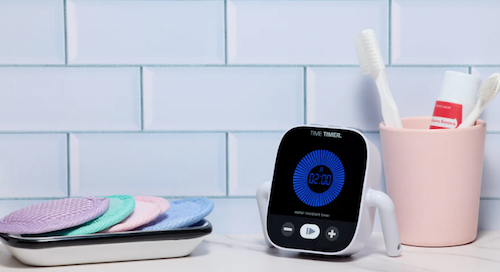
- adjustable arms (bending upward, to hold the removable cord in place, if you’re hanging it, or bending downward, as if it were monkey-walking on its hands)
- a removable cord
- suction cups to display the Element at various angles on the wall of a shower or other vertical surface
Thus, the Element can hang from the shower head, sit on the corner of the bathroom counter, or climb the wall.
Other Uses for the Time Timer Element
Additionally, the bathroom is not the only place the Element can be of use for helping you keep track of the time. Time Timer notes that “you can use the Element indoors or outdoors, wherever water is part of the routine” and suggests its other applicability in:
- In the kitchen when cooking — Although there are a variety of Time Timer products that can be used in the kitchen, particularly the Time Timer Twist, the water resistance of the Element makes it particularly apt for when you’re doing “splashy” activities near the sink.
- Throughout the house while you’re cleaning — Some household cleaning tasks require waiting a certain amount of time (like while the Scrubbing Bubbles are hard at work); do you really want to use your expensive cell phone near a bucket or sink full of soapy water?
- Outdoors, while playing or gardening — Do you want to teach your kids that they can stay in the pool for just 20 more minutes? Or keep yourself from straining your knees or back too long while you’re tending to your flowers or veggies? Whether it’s splashing from the pool or the hose, the water-resistant Element can keep everyone on-task.
- At school or work in a lab — Splashes don’t just occur at home. Whether you’re in Home Ec (though they probably call that something else these days?) or a chemistry lab, keeping yourself on-task with a water-resistant timer can be a boon to safety as well as productivity.
The Time Timer Element is selling for $38.95 at the Time Timer shop. not yet for sale, so there is no pricing information. Sign up for pre-sale notifications at the website and they’ll let you know when it’s ready for Prime Time.
For more on timers and other ways to prompt yourself to stay on task, revisit other Paper Doll posts, including:
- How to Use Timers for Improved Productivity and Focus — Part 1
- How to Use Timers for Improved Productivity and Focus — Part 2: Picking a Good Timer
- How to Use Timers for Improved Productivity and Focus — Part 3: Tangible Timers — This post does a SUPER-deep dive into Time Timer products, in particular!
- How to Use Timers for Improved Productivity and Focus — Part 4: Digital Timers
- How to Use Timers for Improved Productivity — Part 5: Hybrid Timers and Bonus Material
- Do (Not) Be Alarmed: Paper Doll’s Wake-Up Advice for Productivity
CAPTURE THOSE VITAL SHOWER THOUGHTS
Sometimes, people can’t make it out of the shower for fear they’ll lose a great idea and stand there, dripping, reciting the idea to themselves. If that’s your issue, you might enjoy a delightful product that’s been around for a long time but seems to operate under the radar.
Aqua Notes is a waterproof notepad that affixes to the shower wall with suction cups. Each 5.25″ x 3.5″ pad with 40 sheets of waterproof paper and an Aqua Pencil with its own suction cup pencil holder.
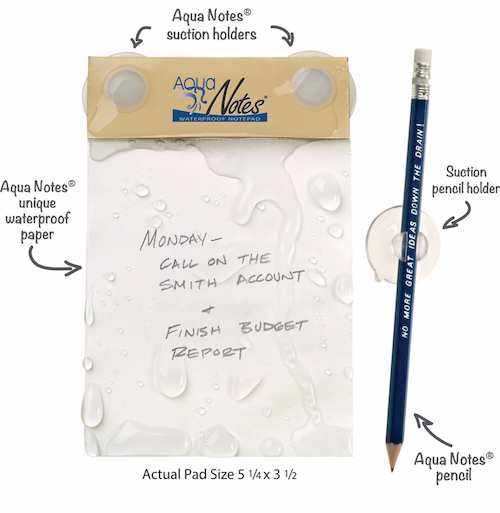
Purchase them directly from the Aqua Notes web site for $15 or from Amazon for $11.95. (A 5-pack of refill notebooks is $50; they also have Twistable colored pencils with suction cups for kids, shower artists, or anyone who needs to be able to write color-coded shower notes.)
Good luck getting out of the shower and getting on with a productive day! But if your brain is still still full of thoughts that are holding you back or slowing you down, know that you are not alone. Case in point, Lorelei Gilmore.
Affiliate Disclosure: Some of the links above are affiliate links, and I may get a small remuneration (at no additional cost to you) if you make a purchase after clicking through to the resulting pages. The opinions, as always, are my own. (Seriously, who else would claim them?)
Whimsical Tools to Improve Your Productivity: Mochi Focus, Mom Clock, and Kiki
THE NASTY TRUTH ABOUT PRODUCTIVITY
Would you like to know a nasty little secret from the world of productivity? Sometimes, getting things done — or more often, not getting them done — is a drag.
Last month, in Paper Doll’s Cheat Sheet for Celebrating Time Management Month, we looked at all the steps for making progress on the tasks we wish to (or must) complete. We talked about memento mori and knowing what we want to achieve in the precious amount of time we have on Earth, and revisited blocking time so that we can be both effective and efficient.
We also reviewed ways to prioritize the tasks we strive to complete and then dove deeply into the strategies for getting ourselves to start, from body doubling and accountability partners to using timers to make use of activation energy. (Speaking of energy, the post also reminded everyone to manage their physical energy through sleep, rest, and rejuvenation through breaks.)
We explored methods for blocking interruptions and obstacles (whether created by others or ourselves), and tracking our time to reflect on our entire systems to figure out where to make tweaks.
Whew. If that sounds like it would be a lot of work, well, that’s part of the problem. Being productive requires work. That’s why we say we’re going to work rather than we’re going to fun.
In a perfect world, if we followed all of these steps, failure would be impossible. We would know what we had to do, figure out what steps were the most important, schedule the work, settle ourselves in, and get it done. Huzzah!
But this is not a perfect world. We told the clocks to spring ahead over the weekend, so many of us are tired and cranky. (A little of that can be eased along with the advice in Organize Your Sleep When the Clocks Change and Beyond.) Depending on where you are today, it may be cold and grey outside.
And mostly, the inability to accomplish one’s goals — even when applying all of these strategies — comes down to a single, solitary truth: I don’t wanna!
Yes, people want the end result. They want their taxes done, their closets organized, and their dreams fulfilled. But they do not want to be bored, annoyed, wearied, or tasked with labor.
Sometimes we all, even professional organizers, just don’t wanna.
When this happens, it’s usually a matter of more than managing one’s physical energy. There are seasons of life when we need serious mental health care and tenderness, such as when we are grieving, experiencing anxiety, or suffering from depression, before we can think about make headway.
When our internal obstacles are less severe, activation energy, or getting ourselves to start, sometimes needs a rousing kick in the pants. Other times, we need the 21st century to stop kicking us when we’re down. Sometimes, we just need to give ourselves a break and find a way to add a little joy to the process.
At the end last year, in 2025 Wrapped: Do An Annual Review To Design Your Best Life, I wrote that my word for 2026 was WHIMSY. What is whimsy, exactly? It’s defined as:
“a playful, quaint, or fanciful attitude and behavior that is often unpredictable, spontaneous, and charmingly eccentric. It represents a shift away from rigid, serious, or conventional thinking, favoring instead a lighthearted, imaginative approach to life.”
Today’s post looks at some tools that offer a few charmingly eccentric, lighthearted, imaginative tools to tip self-management part of time management in your favor.
MOCHI FOCUS
Do you find that you’re better getting things done when you’re modeling good time management for others?
Mochi Focus combines a playful take on a Pomodoro timer with both a gamification element and a site blocker-turned-gentle-taskmaster.
Rather than an app, Mochi Focus is a browser extension for Chrome. (Why are all the good extensions only built for Chrome? Surely Safari deserves as much love!)
When you begin, Mochi Focus starts you off with a little blob of a pet, which they call it a “mascot.” You set to work, and the longer you stay on task, the bigger the little blob grows. Basically, instead of feeding your app food, you are nourishing it with your focused attention.
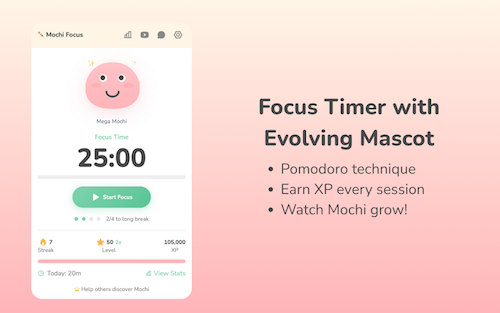
Mochi Focus Timer
A traditional “official” Pomodoro requires 25 minutes of work with a 5 minute break, and no more than four sessions without a longer break. In the abstract, the Pomodoro Technique works well to get our butts in our seats and complete many kinds of tasks.
However, not all tasks are created equal. Crafting an employee review isn’t the same as paying monthly bills, and neither one is the same as editing a chapter of your novel or cleaning out your closet.
Mochi Focus recognizes that some tasks require focus for shorter or longer periods of time. Thus, you get to customize your focus session lengths, anywhere from 1 minute (perhaps to do a plank or sun salutation) to 120 minutes (to rehearse for a presentation or make the mud room look less muddy).
You set the timer, and then Mochi Focus automatically switches between periods of intense focus and the break periods that keep your mental and physical energy from getting stale or expiring altogether. As with an “official” Pomodoro, Mochi Focus enforces a longer break after four sessions for use, but after set-up, you get to keep your hands off the timer for the duration.
The Mochi Focus Timer Mascot
Mochi incorporates gamification, because if we would do the work we have to do just because we have to do it, we wouldn’t need apps to make it fun.
Competing against ourselves is low-stakes, unlike competition with strangers. We win the “game” of getting things done to give our little pal Mochi a boost. You earn 1 XP (in the parlance of gamers, that’s experience points) for each minute you spend on focused work.

As you work, your Mochi mascot grows from baby-sized to Mega form. Depending on your level of experience (from 1 to 50), there are four stages of evolution. As you go along, you build daily streaks for bonus XP, and there are 14 achievement badges to give you positive reinforcement as you attend to your tasks.
In addition to tracking your progress through Mochi’s growth, there are also some adorable (might we say “whimsical?”) interactive features, including five interactive expressions in reaction to completed activity. The little guy expresses pride in your efforts with eye tracking, blinking, and click reactions.
Mochi Focus Website Blocker
Focus is not achieved by one’s competitive nature alone. Let’s face it, we all sometimes need a little help with boundary-setting.
The Mochi Focus website blocker feature is similar to Rescue Time, Cold Turkey, and Freedom, and allows you block yourself from accessing distracting sites during your focused work time. To get you started, Mochi Focus suggests more than 50 sites to block, and you can add your own time-wasters.
If you try to access those sites when you’re supposed to be working, you get a cheery page both reminding you that your access is blocked and encouraging you to go back to what you’ve assigned yourself to do. It’s like having the most gentle of accountability companions with a hint of Jeeves the butler.
On the up-side, when you’ve finished your pre-set focus session, Mochi Focus automatically unblocks those tempting sites so you can play during your breaks.
Pros and Cons of Mochi Focus
On the plus side, Mochi Focus has great features. It’s:
- is a simple, distraction-free interface that doesn’t require a steep learning curve.
- installs right in your browser.
- works offline, so you aren’t web-dependent.
- doesn’t require an account.
- tracks your progress through the main screen and a stats dashboard.
- stores all data locally on your device.
- is 100% free, with all of the various features unlocked. There aren’t even pesky ads or attempts to up-sell you to higher tiers.
But, more importantly, especially when it’s the mental weight that’s detracting from your motivation, Mochi Focus:
- doesn’t nag you to work, but encourages you to get back to your planned area of focus
- digitally prevents you from goofing off while also giving you a reason to care for yourself and your goals by nurturing a little blobby dude.
- offers a whimsical approach, with a blobby cartoon companion who shares your focus journey, joins in celebrating your achievements, and keeps you motivated!
Mochi Focus isn’t for everyone, though. Consider if the following might make it a bad fit for your practice focus.
- It only works with Chrome, so it’s not for you if you swear by Safari or are fixated on Firefox.
- Because it only works in the browser, if you use multiple devices (computers, tablets, phones, etc.), your stats aren’t going to reflect your entire progress. (Update: Mochi Focus was created by Boyd Guang, a solo developer from Thailand. He reports that cloud sync is coming, along with focus-oriented audio and more themes.)
- If you get anxious when competing against yourself, or this brings up memories of the Tamagatchi digital pet you let die 30 years ago, this might not be your thing.
- It’s simple, gentle, and visually sweet. If you prefer the stick to the stick (vs. carrot) approach, this may not be your jam.
To get a sense of the Mochi Focus vibe, check the Focus with Mochi YouTube channel with a variety of videos (with four+ Pomodoro sessions) backed by focus-inducing, lo-fi music.
Whether you’re a remote office worker or a student or just someone looking for more sticktoitiveness, if you’re looking for something to pep up your Pomodoro-style focus sessions, this might be fun to try. And again, it’s free, so there’s no downside to trying.
Mochi Focus works on a few different levels. It has your back by blocking your distractions and giving you a competitive approach with points and stats, but also covers your softer side by pairing you with a teammate for whom your success is their success. It’s animated accountability.
Whatever works, right?
But hey, if the gentle companion approach doesn’t work, perhaps you need something a little bossier.
Mom Clock
Sometimes, neither the gentle, companionable approach nor the competitive angle works. If that’s the case, you may have to consider seeking support from the one person who can strike fear in you by using your full name — first, middle, and last — in a tone that brooks no debate.
Sometimes, you just have to call in a mother.

The Mom Clock is an iOS app and Chrome extension that adopts a strict disciplinarian approach to stop procrastination.
This is no gentle parenting. Instead, Mom Clock uses alarms and app-blocking to force you to do what you said you intended to do.
The way Mom Clock’s creators explain it:
Mom Clock is not a productivity tool.
It doesn’t motivate you. It doesn’t encourage you. It doesn’t ask how you’re feeling.
You already know what you’re supposed to do. Mom Clock simply enforces it.
Once you set up Mom Clock with your plan for when you’re going to work, you go to work. Full stop.
You’ve got (relatively) little choice, because Mom Clock understands time blocking (as in, when you’re supposed to work) and uses the power of blocking (as in, it will block all of those distracting websites during the hours you tell it you’re supposed to be focused).
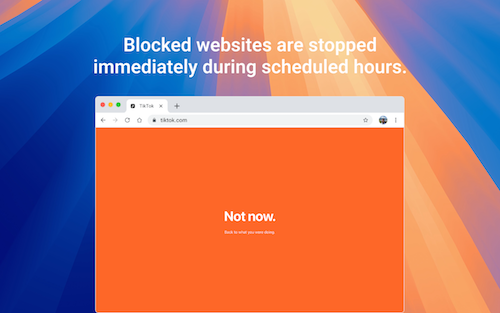
When you’re supposed to be working, you can’t do anything else with your device. When your time is up, Mom Clock starts firing alarms that tell you to stop whatever you’re doing. (Just as “she” enforces your work time, she’s serious about those breaks, too! After all, your mom always knew when you needed a nap, right?)
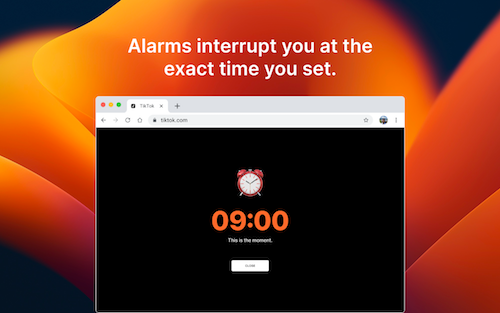
In between your start and stop, Mom Clock is working quietly in the background, just like she was when you were a kid, doing your homework. Unlike Mochi Focus’ companion style, Mom Clock calls to mind the phrase, “I’m not your friend, I’m your mother!”
Pros and Cons of Mom Clock
Depending on your style, pros and cons may be interchangeable, so you have to know your own preferences. Mom Clock is:
- Designed to be as simple as possible to reduce friction and make the activation energy easy to obtain.
- You don’t need to register for an account.
- There’s no cloud sync.
- There’s no data collection.
- Mom Clock runs in the app or locally in your browser.
- Uses no gamification — Because there are no stats, there’s nothing to keep track of and there’s no attention to what you’ve done in the past or where you’re headed in the future. Mom Clock is about what you’re doing RIGHT NOW.
- Brooks no backtalk — There’s no negotiation for snoozing “just five more minutes!” You just do what mom says! There’s not even an “or else!”
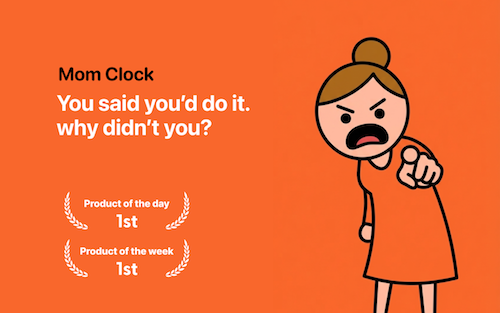
It it just me, or does she remind anyone else of the Angry Mama microwave cleaner?

Just set the rules once for when you want to work, and Mom Clock makes sure you follow them.
Your “Mom” knows your routine, only instead of innately knowing which days you have soccer practice and when you have to stay late for drama club, “she” knows (because you set) your different schedules for work, study, fitness, or sleep. Mom Clock doesn’t ask whether you “feel” like working. She’s just going to stare you down.
Your “Mom” takes away your phone privileges by blocking the tempting apps and websites that prevent you from doing what you should be doing.
As Mom Clock says:
She doesn’t remind. She insists.
No soft nudges. No ‘maybe later.’ Just action.
You don’t need more motivation
Start doing what you said you would. She shouldn’t have to ask twice.
Beyond the main features, Mom Clock has several additional elements, including:
- an online clock — Showing the exact hour, minute, and second; it is constantly updating; it also reports the date (to remind you of time ticking down on those work or school deadlines)
- a time conversion page — Whether you want to convert seconds to minutes or minutes to seconds, minutes to hours or hours to minutes, hours to days or days to hours, or even days to weeks or weeks to years, it’s all available at a click. This way, if you want to remember how many minutes are in a year, and don’t want to start singing Seasons of Love from Rent (though why wouldn’t you?), there’s an accessible feature.
- countdown timers — whether you need to count down to holidays, events, work deadlines, or personally-important dates, just set your timezone, track the countdown in real time, and share links to the countdown when and if necessary. There are a variety of pre-created countdowns for international holidays, so you’ll never forget Mother’s day or Diwali or Hanukkah. You can also select options to count down to when you have to pay your rent, will get paid, can move to your dream home, or may finally retire.
- planner tools — for doing a Pomodoro session (or several) or using time blocks. The Pomodoro timer comes with pre-sets for a traditional 25:5, a 50:10 for deep work, and 90:20 extended session. The time blocking planner has pre-sets to help you with a workday, a study day, and a balanced day for blending focused work, meetings, and recovery time.
- days since counter — whether you’re counting down from the first day you started exercising or the last day you engaged in a bad habit, Mom Clock is keeping track of your landmark dates.
But mostly, the key to Mom Clock is that it eliminates all of the discussion you have with yourself where you let yourself off the hook. There are no more promises to yourself to start “later” or “tomorrow” that you never fulfill.
Mom Clock states its mission as: To make the things you promised yourself actually happen.
Mom Clock knows that willpower is often too challenging and that you can’t always wait to get psyched up into that activation energy.
Sometimes you just need the power of your “Mom” telling you to just do it. NOW!
If Focus Mochi is for workers who embrace gentle parenting, Mom Clock is for those who are seeking an Old School parenting approach because more than motivation, they need someone to hold their feet to the fire.
It’s worth checking out the Mom Clock blog, with wise “motherly” wisdom in posts like:
KIKI
Maybe you need something not as cute as Mochi, but not as bossy as your Mom.
KiKi, created by Isaac Blankensmith, is a MacOS program that calls itself “the accountability monster for people who are easily distracted.” It’s not a very monstrous monster, to be sure.
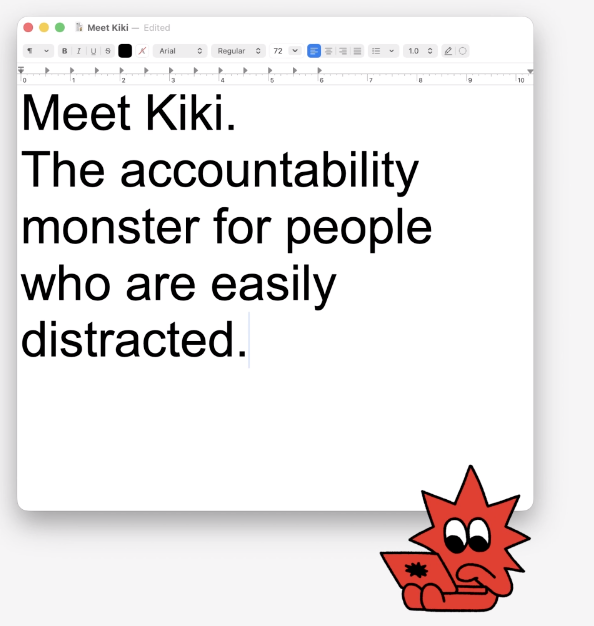
The makers of Kiki envision the program as similar in function to a Pomodoro timer, but better.
First, you identify for Kiki what you’re supposed to be working on in the most specific ways. You write down one concrete task, like:
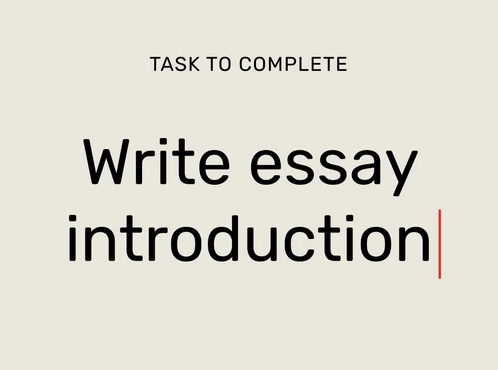
Next, instead of eliminating all the apps and websites you aren’t allowed to use, you select just what sites you will need to complete your task.
For example, if I’m writing a blog, I need WordPress and Canva, and maybe Pexels or Unsplash. (Yes, I’ll need YouTube later for pop culture videos, but to get the writing and graphics selection stage down, just these sites would be essential.) Kiki will block everything else.
Once your intention, resources, and time are set, just focus on your work. Kiki creates a distraction-free, multitask-free realm until your time is up. If you try to do something outside of the plan, Kiki throws flames onto your screen and pipes up with verbal admonishments!
Mono-focus for the productivity win!
Kiki’s Bonus Features
Kiki tracks your progress, showing how focused you were in each session and over time. For those who analyze data points (or need it to keep them honest), Kiki’s tracking feature may help you stay on course.
Kiki is the escape room you cannot escape. There’s no “safe word” and, allegedly, Kiki cannot be tricked. Once Kiki is activated, there’s literally no way to sneak off to entertain yourself while you’re on that device. (I mean, yes, you can go use your phone, but that’ll likely just guilt you out, and if it’s guilt you want, wouldn’t that be better from your (Clock) Mom than from a monster?)
Or, as Kiki says on the website, “Sometimes good work happens after you run out of ways to avoid it.”
Be forewarned about Kiki’s more “monstrous” alerts. One reviewer noted that it shouted “Get back to work!” while she was in a meeting and attempting tasks that we’re part of her scheduled activity. Eek!
Kiki has a free trial, after which it’s $4.99/month paid monthly or $2.49/month paid annually ($29.88year). While it’s designed for Mac, it only plays nicely with Chrome and Safari browsers.
So, if you want to be nagged (by my a monster rather than a Momster) but also want statistics, Kiki may be worth a look.
These are just a few of the delightful productivity-related apps and extensions I’ve found recently. There are others, with sheep and llamas, quirky gamification and silly stats, and there will be follow-up posts with other tools for this year of whimsy.
Is there an app or tool that you use to organize your time or tasks and that you’d describe as whimsical?
How to Send Large Files the Organized Way — Simple, Stress-Free Solutions
In the olden days, if you wanted to send an important message, you could send it in the mail, and it might go by steamboat, stagecoach, or train to get to your recipient. Hopefully, your Pony Express rider wouldn’t lose it in a saloon. Perhaps if you were from a family of means (the Bridgertons, for example?), you might entrust your very urgent message to your ladies maid, who would give it to the hall boy, who would run through the streets to deliver your a note.
The telegraph was invented in 1837 and by the second half of the 19th century, it was widely used for messaging. But priced by the word, it was essential to limit what you wanted to say to the fewest number of words. As a classic Borsht Belt joke ran, “Start worrying. Details to follow.”
And for those of us of a certain age who recall pay phones, you could place a collect call for “Mom, I need you to pick me up at the mall” or “I arrived safely” and the operator looked the other way. Or, there’s this classic:
HOW TO SHARE SMALL AND MEDIUM FILES
At this point in the 21st century, things are much the same. The truth is that when you have a (relatively) small piece of information, it’s “no big whoop” to transfer that kernel of knowledge inexpensively and easily. The bigger the slab of data (what we’ll generally call “a file,”) the more expensive and complicated things are, and the more strategy you need to keep the cost and effort down.
Methods for Sending Small and Medium Files
For small files, like photos, PDFs, a resume, or a quick video, you can relay information by:
- Text — Whether you use iMessage, SMS, Whatsapp, or Slack, you can quickly relay information or and attach to those texts.
- Email attachments — As long as when you say “attached, please find,” you actually attach the file you intend to share, you’re good to go.
- AirDrop — This works as long as you’e in the same room or area as your recipient and are using an iOS device (or, as of late 2025, are able to duplicate the process on Android using QuickShare).
- Physical media — While tangible media method isn’t as convenient or as quick as a digital transfer, if you have lots of files, it can be helpful to download your files to a USB drive, external hard drive, or SD card, and then carry it to someone in a different location or even ship it to them.
The advantages of these non-tangible methods are that they are generally fast, and there’s little to no set-up needed. You just find the file, click a few buttons or drag-and-drop the file, and you don’t need to be particularly tech savvy as a sender or recipient. If you’re using tangible media, no internet is required, you have total control over the physical file, and it will work anywhere you’ve got the hardware into which to plug it.
The main disadvantage of the first three of these methods are that you’re limited as to the size of whatever file you wish to use, particular to share via text or email.
For example, last week, I had a funny experience when a client had a pregnant pig at her house. The pig had lived at her barn, with horses and chickens, but during a recent cold snap a few weeks prior, the client made a safe, cozy space in her home for the mommy-to-be.

With my client’s permission, I shared a photo in a group text thread with colleagues, and someone said they wanted to see a video! My client provided an adorable video of the pig’s first day in her new space; we were both using iOS, and there was no problem texting it. However, when I went to send the same video to our group thread, I got the message that because it was a mixed iOS/Android group thread, the video was too long to share. Harrumph.
In addition to size limits for file text/email/AirDrop filing sharing, you (or the post office) could lose a thumb drive, hard drive, or SD card in transit, or your recipient could lose it between plucking it from the mailbox and the moment they intend to use it. And none of these methods are particularly useful if you want to ensure that a file is backed up or easy to collaborate upon.
And what you if do you have a BIG file? Certainly text and email are out, as is AirDrop.
For bigger files, the two main methods to get important information from one location (yours) to another (theirs) will be through cloud storage or file transfer platforms.
SHARE FILES IN THE CLOUD
You probably upload files to the cloud (or create them in the cloud in the first place) all the time. This method works best for families and friends sharing documents and photos, professionals sharing client work, ongoing personal and work projects, and providing long-term access to content. As long as you don’t remove the file from the cloud, recipient(s) can re-access it as many times as they like.
How File-Sharing in the Cloud Works
This method involves the following steps:
- Upload a file to your cloud account.
- Set the permissions for the file. Sometimes, you just want the recipient to be able to view a file; other times, the permissions might allow them to edit and even share it with others.
- Share the link with the people or teams who need access. This could be photos of the baby so Great-Grandpa can see how much junior’s smile is like his, or the latest TPS report your staff needs before the next Monday meeting.
- Your recipient then views and/or downloads the file.
The advantages of sharing files in the clouds are:
- Large file support — Cloud storage means that you can upload multi-gigabyte files. Sharing videos, folders of files, and project archives is easy-peasy lemon squeezy.
- Easy sharing — File attachments can be a sticky wicket. If you attach five files to an email, and someone downloads them but then can’t figure out whether the files have ended up in their attachment folder, their desktop, or the most recent folder to which they moved something, it’s a headache. But if you’re just sending someone a link, it’s just a matter of one click to get what they need.
- Ongoing security — With cloud sharing, you can change the permissions at any time. So, if you don’t want your now-insignificant other to access that photo, or your mother-in-law can’t be trusted to not post photos of your little angel to social media per your stated boundaries, or your former employee is “former” for a reason, one quick click denies access to files you no longer what them to have.
- Backup as a perk — When you upload files to the cloud to enable sharing, those files stay conveniently stored until you decide that you don’t want them there anymore. You never have to worry about a crashed hard drive or an accidental local deletion.
- Collaboration made easy — When you upload a file, multiple people can access it (if you wish) and you can keep track of version history, which is great at work or if you’re collaborating with others on a screenplay or story.
Of course, there are drawbacks to the cloud method of sharing files.
- Storage limits — The free tiers for storage sites can fill up fast, so if you do a lot of file sharing and never purge your account, you’ll hit your free limit quickly and need to upgrade to a paid plan. Free tiers with enough storage space will let you upload content, but watch to see if there’s an upload limit on individual files.
- Account registration requirements — Yes, I heard you groan. Nowadays, almost everyone has too many accounts and too many passwords. It may not be a big deal to you (because if you’re uploading, you probably already have a cloud or two that belongs to you), but if your recipients don’t have cloud accounts, they’ll usually have to register to gain access. Note: some accounts will allow recipients to view files without accounts, but not edit or share.
- Learning curves for setup — Unfortunately, the less tech-savvy recipients might be frustrated if they aren’t accustomed to navigating a cloud space. Additionally, some users are inexperienced at setting up permissions, so it’s important to pay attention to the difference in permissions between view, edit, and share.
- Privacy depends on settings — With some cloud accounts, you can create public links for file sharing. That’s great if you want everyone in your neighborhood to have access to a file, but if you meant for only the members of “I hate the dude who leaves his Christmas lights up all year” club to view the link but it’s available for public consumption, it’ll make the next block party a bit awkward.
The Main Players in Cloud Sharing of Files
You’re likely already familiar with the big names in the cloud arena for sharing files, even if you’ve never used them for file sharing.
Google Drive — Every Google user has 15GB of free storage; beyond that, there are different file upload limits at different paid tiers. Just upload your file to your Google Drive, get a link to share, and provide the link to your recipient.
However, there’s also a nice mix of the “attach” method I mentioned for small files and the cloud method.
As a Gmail user, if you start a new message with an attached file that’s over the 25MB limit for an individual file, Google automatically creates a link to that file in your Google Drive. When you go to send the email (the one you mean to attach), Gmail will ask you to grant your email recipient access to that file and prompt you to set the permission (view or edit). The default setting, wisely, is just to allow them to view your file. However, your recipient will need to have a Google/Gmail account.
iCloud — You automatically get 5 GB of iCloud storage for free, but an upgrade of just $0.99/month yields 50GB; $2.99/month provides 200GB; and for $9.99/month, you get a whopping 2TB! Store your files, share the link, and you’re all set.
However, as with Google Drive and Gmail, if you use Apple’s Mail, try the Mail Drop feature to send large files up to 5 GB via iCloud Mail on Mac, iPhone, or iCloud.com, without it counting against your storage quota. Read more about Mail Drop.
It will generate a secure download link that lasts for 30 days. Just attach a large file in Mail, and it will automatically offer to send it via Mail Drop if the file exceeds standard email limits.
Dropbox — You probably know Dropbox for its cloud storage with file syncing and collaboration tools. Their plans range from a free 2GB storage option up through premium business plans 15-freaking-terrabytes of storage. But that 2GB lower end storage limit for free accounts (with a 2GB file upload limit, isn’t going to win any beauty pageants. However, in addition to the storage
(In addition to the basic cloud storage method, Dropbox also has it’s own File Transfer protocol for large files.)
Microsoft OneDrive — Upload your file to your OneDrive cloud account; granting access to others is straightforward. OneDrive allows individual file uploads and downloads of up to 250 GB for both personal and business accounts, and while there isn’t a strict total data transfer limit, syncing oodles (like 300,000+ files can cause performance issues). They recommend using the OneDrive desktop app to accomplish large transfers rather than using browser uploads.
Note, Microsoft does something similar to Google and Apple, in that if you use Outlook 365 and try to send a too-large file as an attachment, you’ll be prompted to upload the file to your OneDrive and share a link to it in your Outlook email (rather than attaching the file, itself). You’ll just use the “Upload and Share as a OneDrive Personal Link” option. Recipients can click to open the file and view it from your OneDrive.
SHARE FILES USING FILE TRANSFER SERVICES
I like to think of this approach as a “send it and forget it” method. It’s great for when you want to send videos to family members or the tour group friends you made on your last cruise vacation, submit creative files to a client or virtual assistant, send one-time deliveries of a massive file — or if you know the person getting your file is a bit of a grumpus about dealing with tech.
Fewer people will be familiar with file transfer service method than the methods I described above, but it’s really efficient for the one-and-done file transfers, plus it’s surprisingly easy for the sender and the recipient.
Upload a file, then enter the email address of the person or people you want to receive it (or, alternatively, you can get a link to put in your own email, text, newsletter, blog, etc.). That’s it.
From there, it’s up to the recipient to click on the link, which takes them to the file transfer site. They click a link, and the file downloads to their computer, where it waits for them to open and use it. The best part is that the file auto-expires after a set period (like a week), so you don’t have to clean up after yourself or purge files or worry that someone you later part ways with could still have access.
I have a friend from high school who was always the most in-the-know person about music. Four decades later and he’s a professional in the music industry, but he still makes mix tapes, or at least the high-tech version. For years, he’s been sending his own little funnily-named, curated “albums” of music for his personal email list to enjoy. Only instead of a fiddly cassette requiring us to have a pencil at the ready to fix it when everything unspools (hello, 1983!), he sends a big MP3 file every month or so.
My music industry friend was my introduction to the file transfer service option, but certainly not my only experience. A few years ago, when I had to create a video presentation an online summit, my colleague had me submit my video via a file transfer service, and I was delighted with how easily it worked.
The advantages of file transfer services are:
- No account (generally) is necessary — Just like you don’t need a UPS account to have UPS deliver a package to your door, file transfer services deliver the sender’s file to anyone.
- Low-friction transfer — Remember how I said that some people can be overwhelmed by having to navigate cloud accounts to find a file? That doesn’t happen with file transfer services. My musical friend sends me to a big, splashy webpage with a big, obvious button to click to start the file download.
- Big-file friendly — These services were designed to tackle large transfers. Did you write the Great American Novel? Produce your own album? Make a movie? Share it easily.
- Automated file cleanup — Because the file auto-expires, once you tell the file transfer service to send to your recipients (or you’ve sent them the link or published access to it), you’re done.
There are a few potential drawbacks to file transfer services, though:
- This is temporary storage — For those who prefer cloud storage to warehouse their files, it’s important to recognize that what’s a boon to some (the automated expiration of the files) means file transfer services do not store your files indefinitely.
- You have limited control of your file — Because there are few (if any) options for permissions with a file transfer service, once you send that file, it’s out in the wild. Someone has it and can copy it, share it, change it and then share it, wear it as a hat, etc. Don’t provide access to your file to someone you don’t trust to have that access. Duh.
- It’s not ideal for super-sensitive data — File transfer services are secure-ish. They use varying methods of encryptions, so if you need ultra-encryption or password-protection, don’t send your super-secret spycraft through a platform that doesn’t offer that. OK? OK!
- Consider the money, honey! — As with everything in the era of late-stage capitalism, you get what you pay for. Free platform tiers work, but if you want bells and whistles, like password protection, longer-termed storage, and higher size limits, you’ll have to shell out the money.
The Big Names in File Transfer Services
There are a variety of file transfer platforms. As a professional organizer, I am not an expert in the technology, and none of these should be considered recommendations. Rather, they are a starting point for your own research into the right file sharing solution for you.
We Transfer — This is the platform my musical friend uses, and it’s the one that seems to be the best known.
Share and receive up to 3 GB/month (10 transfers/month) for free, with transfers expiring after three days. With a paid subscription ($25/month), you get unlimited transfers, unlimited file sizes, no expiration of (uploaded) files, custom branding, and automatic malware scanning.
FileMail — Send large files, up to 5GB, for free, to up to three recipients, with up to ten downloads per transfer. Just drag-and-drop the file from your desktop onto the website. Of note, they impose no restrictions on commercial usage. There are multiple FileMail tiers: Beyond the free Basic plan, there are paid personal ($6/month), professional ($14/month), and business ($24/month) account levels, with each level offering increased file size, storage capacity, and customization.
Smash — The free tier lets you send an unlimited-sized file, has no upload limits (vs. 2 per 24 hours for FileMail), offers password protection, and files are stored for seven days. At the paid tiers, $4.90/month for Pro and $12/month for ten users, 1TB and 2TB of storage, respectively, for 30 days of file storage. (I also think the platform has a more user-friendly experience than FileMail, but your mileage may vary.)
Drop Send — At the free level, send files up to 2GB, up to two files per week, and get 250 GB online storage. At the paid levels ($5/month for basic, $9/month for standard, and $19/month for professional) you get faster transfer speeds, can send 50GB files, increasing numbers of sent files per month and increased amounts of online storage.
Other popular options include:
My Air Bridge — This European platform is best for professionals and teams. Their service is free for individual transfers up to 20 GB in size, with multiple paid plans.
Wormhole — Right now, this is a free services. They note: “For files up to 5 GB, Wormhole stores files on their servers for 24 hours. For files larger than 5 GB, Wormhole uses peer-to-peer transfer to send your files directly from your browser to the recipient. So you’ll need to keep the page open until the recipient downloads the files.”
Send Anywhere — At the free level, send a file up to 50GB; the Lite tier is $5.99/month and the Standard tier is $9.99/month, with additional perks related to downloading, speed, and link management.
BEST PRACTICES FOR ORGANIZING YOUR LARGE FILES FOR SHARING
Before you send your files, consider some tactics for keeping the whole experience organized.
Name your files clearly — If you’re sending a photo, change it from IMG15678 to “Baby’s First Ice Cream.” If it’s a file for work, consider the nomenclature rules and best practices/guidelines your company generally uses for documents. If you’re a solopreneur, this is a great time to develop rules for how to organize and label files so that you know WHAT they are and WHEN they were created. “2026 1Q Earnings Report” tells your recipients at a glance what they’re getting.
Use folders when sending multiple files — Don’t send 3 (or 33) files all higgledy-piggledy. Group them in a folder with a clear name.
Check to make sure you’ve removed duplicates or changed the names — If your recipients are poking around in a cloud folder you’ve created and to which you’ve linked them, and you’ve got 16 iterations of ClientProposal.Final.Final.Final, that’s going to cause confusion.
Add a README file — If your recipients need to know more details about what they’re getting in files or folder, tell them what it’s all about.
Consider file compression — If your files are too big to send as-is for free, consider zipping those large files (or folders) so in order to reduce the size before you send it. Save money by putting your files on a diet, but only if your recipients are tech-savvy enough to know to double-click on a file to unzip them.
What do you do when you have a massive file and need to get it to someone quickly, efficiently, and safely? Have I omitted your favorite method? Please share your thoughts in the comments.
How to Organize Yourself for a Stress-Free Tax Season
Nobody likes paying taxes, but if you’re organized, the discomfort can be limited to the money leaving your bank account and not all the work leading up to it. Preparing your tax returns (or getting the information to your tax preparer) doesn’t have to be annoying. To that end, every few years, I try to provide a Paper Doll primer on what you need to know and understand to make tax time bearable. This year, it has bonus pop culture to keep you entertained!
SET THE STAGE FOR PAYING THE TAX MAN

Photo by The New York Public Library on Unsplash
Tax prep is the homework of the adult world, but that doesn’t mean it can’t be easier (or more fun) than finding the area under a curve or remembering what cosin and tangent are.
Start by creating a comfortable work environment. Clear your desk of clutter and distractions. If that’s not possible (in the amount of time you have), consider moving to a new workspace just for doing your taxes. That might be the dining room table, the guest bedroom, or the conference room at work on a Saturday afternoon.
The key elements are ample workspace, a place to put (and if necessary, plug in) your computer, functional Wi-Fi, a pad of paper for taking notes, access to good lighting and a comfortable chair, and your tax prep documents (of which, more later).
More importantly, do what you can to eliminate interruptions, whether that means working when others are out of the house (or getting out of the house to do your work).
Create the right ambiance for your style. Some people need a window facing sunlight, while I prefer to have my chair face a blank wall to eliminate distractions. Some people need silence, while others prefer white noise. If you used to do your 9th grade math homework with your stereo blasting, try making a tax prep playlist using Hubpages’s 50 Best Songs for Tax Day.
Don’t feel like you have to get your taxes done all in one sitting. If your return is simple (one W-2 and few 1099s) and you’re filing online, you might wrap it all up in an hour. But if there’s a lot of complexity in your finances, plan multiple shorter stints. Find chunks of time to:
- gather (and if necessary, download and print) official documents
- isolate and review all types of income
- isolate and review deductible expenses reflected on forms
- locate deductible expenses reflected on receipts (tangible and digital)
- fill in online tax preparation software like TurboTax or TaxCut, but then walk away and come back later to check your work; or
- make an appointment to sit with a professional tax preparer
Take frequent breaks to keep your mind fresh. Stay hydrated and have light, healthy snacks. When you finally finish, celebrate with a small ritual to reward yourself for all that adulting.
While I’m not always happy with the way my tax dollars are spent, I often find that the filing (if not the paying) of them goes down better with a listen to Irving Berlin’s WWII-era I Paid My Income Taxes Today. (The only version I found with Berlin singing it himself was a bit too jingoistic, so I present singing cowboy Gene Autry.)
GATHER YOUR RESOURCES
One of the most common frustrations my clients have is that they don’t know where to start. The fear of mysterious forms and documents starts the buzz of anxiety. I encourage a few simple steps for making the experience easier to bear.
Time Travel to Last Year
The easiest way to estimate what forms you’ll need this year is to start by looking at what you dealt with to prepare your taxes last year. You should have a folder with everything you (or your tax preparer) used to support last year’s tax returns. Scanning through last year’s taxes and supporting documents will help you create a checklist of what you’ll need for your treasure hunt.
Photo courtesy of Chris Potter/CCPix at www.ccPixs.com under CC 2.0
First, there’s the income side of things. Did you have a job? You’ll be looking for a W-2. Were you freelancing? Find those 1099s! Did you get paid interest or dividends? There will be 1099s for those, too.
Then, on the flip side, there are your expenses. You’ll have some fancy forms, like 1098s for interest paid on mortgages or tuition costs, but you’ll also need to gather receipts.
But that’s generally it, just what did you earn and what did you spend? (Obviously, not everything you spend is tax-deductible. The cheeseburger and fries you eat on your way home from the gym? That receipt can go. The one from when you took your best client to lunch to propose extending a contract? Hold on to that receipt!)
Answer Mail Call
In general, employers and financial institutions are supposed to mail tax documents like most 1099s and 1098s by January 31st, so you should have them in hand already. (Got a pile of unopened mail on top of the fridge? Now’s the time to open it!) Other forms, like 1099-B, 1099-S, and 1099-MISC don’t have to go out until February, so watch your mail. And, annoyingly, Schedule K-1 forms (related to partnerships, LLCs, and S-corps) generally don’t get mailed until early-to-mid March!
Don’t just think in terms of U.S. postal mail. Be sure to check your email, too!
I have quite a few clients, particularly those over 80, who don’t dependably check their email, and don’t necessarily realize that institutions have stopped sending paper copies of essential forms. Instead, they send emails alerting you to the existence of your forms in online portals.
If your inbox is full of hundreds or thousands of unread emails, try using the search bar for terms like “tax forms,” “1099,” or the word “tax” and the name of some of the institutions that should be sending you tax documents.
Let Your Fingers Do the Walking
Waiting for the official mail can be frustrating, especially if you are hoping to get a tax refund and want to get your taxes prepared and your return filed as soon as possible. In many cases, you don’t have to wait — just head to your keyboard, log in, download, and print.
For example, a client was recently frustrated with herself because she suspected that, in a fit of tidying the paperwork from last fall for enrolling in a 2026 health insurance plan, she’d accidentally shredded her 1095-A, her Health Insurance Marketplace Statement. Frustration turned to delight, however, when we logged into her Healthcare.gov account and quickly downloaded another copy.
Starting with your list of all of the institutions that have sent you tax documents in the past, and then adding any that know about your income/outgo, log in and search for a menu title like “tax forms” or “documents.” For example, log in to your:
- Bank accounts for 1099s
- Brokerage/investment accounts for 1099s
- Lender sites for 1098s
- Social Security for SSA-1099
- Health Insurance Company for annual summaries of medical and pharmaceutical expenses
- Paypal, CashApp, Venmo, Square, and similar platforms (for 1099-K and other records of income and expenses)
Remember that you may also have receipts that came to you by email. (If you haven’t gotten into the habit creating a “receipt” folder in your email or printing receipts for potentially deductible expenses, this is this is the time to start.)
Further, if you need to access information that’s on your prior tax returns and you don’t have them accessible — for example, if you’ve been the victim of a natural disaster, or you and an ex haven’t been able to amicably share data — you can get tax records and transcripts directly from the IRS.
Once you file your taxes, make a list of all the forms you received this year (and how/where you acquired them), and tuck that list into your tickler file for next January. Check off each form as it arrives, and you’ll have a better sense of when you’ll be ready to start working on your 2026 taxes in 2027.
KNOW YOUR FORMS
Much of the fear associated with tax time comes from the fact that the language referring to the different types of forms seems like gibberish.
Here’s a reminder of what each of the most common forms related to income and deductible expenses represent.
Let’s start with income.
W-2 (Wage and Tax Statement)
Were you an employee in 2025? If so, your employer should have provided one W-2 to you and one to the IRS, reporting how much you were paid (in wages, salaries, and/or tips). If applicable, the W-2 should should also indicate how much money was withheld (from you) and paid to another entity.
Federal, state, and local taxes, FICA (Social Security and Medicare), unemployment insurance, and a few other withholdings are considered statutory payroll tax deductions, because they are governed by statues (AKA: laws).
Sometimes, courts rule that an employee’s wages can be garnished (which sadly has nothing to do with caviar or sprigs of parsley). In these cases, individuals who owe money from lawsuits or are behind on child support may have money removed directly from their earnings, before it ever gets to their paychecks, to ensure it goes directly to whomever is owed. A W-2 will reflect this.
A W-2 may also report voluntary payroll deductions, amounts withheld from paychecks with your permission. Examples include your portion of health and life insurance premiums, contributions to a 401(k) or other retirement fund, employee stock purchasing plans, one-time or ongoing donations to the United Way, union dues, etc.
In theory, a W-2 should be mailed to the address listed on your W-4. (The W-4, is the form that tells your boss how much to withhold based on your number of dependents you have.)
Smaller companies may just hand you your W-2 instead of mailing or emailing it, but if your W2 is missing, consider:
- Did you change employers last year? You should have received W-2s from each employer. (If you changed jobs at the same company, you’ll receive one W-2 from each employer, not one per position. If you changed companies within a larger corporation, though, you may get one for each.)
- Did you change addresses since you filled out your W-4? There’s only so much a former employer will do to track you down to give you your W-2. Keep the Madge in HR updated!
Don’t assume that if you don’t have your W-2, then nobody knows what you made. Remember, your employer sends the IRS a copy of your W-2. Since the IRS knows what you made, be sure you do, too! (If your former company went out of business or is otherwise not returning your calls, the IRS has a procedure to help you file your taxes in the absence of a W-2.)
Examine your W-2 it carefully. Do the numbers seem right? Compare them to the final pay stub you got for last year. Calendar years may end mid-week (or even mid-pay period), so the numbers won’t correspond perfectly, but they’ll be close enough for you to spot if something is seriously wrong. The sooner you call your employer’s attention to an error, the sooner you can prepare your return.
W-2G (Certain Gambling Winnings)

Gambling Photo by Pavel Danilyuk on Pexels
The W-2G is the wild-and-wooly cousin of the W-2. While a W-2 is for money you make while working, the W-2G is what you get while playing. If you win more than $600 in any gambling session at a casino, the “house” should request your Tax ID (generally your Social Security number) and either prepare a W-2G on the spot or send it to you in January.
Casinos aren’t interested in keeping up with your losses, just your winnings, so they only tell the IRS about what they paid you. If you want to deduct losses to offset winnings, the IRS requires receipts, tickets, statements, or other records to support both your winnings and losses.
1099s
A 1099 is a form that basically says, “Hey, you weren’t an employee but we paid you money this year.” You get a copy; the IRS gets a copy. (Cue Oprah: “You get a copy! You get a copy! Everybody gets a copy!”)
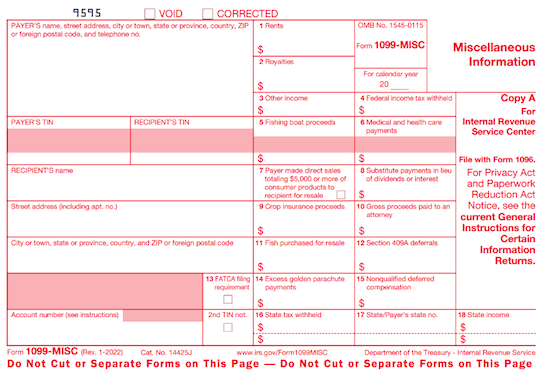
There’s not just one type of 1099; actually, there are 22 different kinds of 1099s as of 2026! Don’t worry, you won’t be tested on this. But it helps to be familiar with some of the more common versions, like:
You may not have interest in 1099s, but 1099-INT reports the interest you receive — from interest-bearing savings and checking accounts, money market bank accounts, certificates of deposit, and other interest-paying. It also reports whether (U.S. or foreign) taxes were withheld and if there were any penalties assigned for early withdrawal from an interest-bearing account.
If you received less than $10 in interest, your bank may not send a 1099-INT.
Whether you’re TikTok’s viral man in finance, 6’5″, with blue eyes, and a trust fund or your grandma bought you one share of stock in Disney for your 10th birthday, you’ll get a 1099-DIV to indicate the dividends or capital gains you received as an investor. (Note: if you have a DRIP — a dividend re-investment plan — you many never see these dividends as checks sent to you. They’re literally re-invested in your portfolio.)
Again, if you didn’t earn at least $10 in dividends, you are unlikely to receive a 1099-DIV.
1099-G (Certain Government Payments)
This random-sounding form can cover everything from state unemployment compensation to tax refunds, credits, and offsets at the state and local level. It can also be used to report payment of taxable grants, agricultural payments, and other nifty things where a state or local government gives you money.
The 1099-K reflects payments to you from third-party settlement organizations (TPSO) like PayPal, Apple Pay, Venmo, or Zelle and platforms like Etsy or TikTok. This form was supposed to go into effect several years ago, but due to the pandemic, its use was delayed, and for several years, the threshold was $600, but has now been raised to $20,000 (and 200 transactions).
If you’re self-employed (a freelancer, an independent contractor, etc.), clients should send a 1099-NEC. However, although 1099-NEC came into use in 2021, some offices still send 1099-MISC by mistake. Just remember, whatever form you get, the IRS knows about it, so don’t try to hide that money.
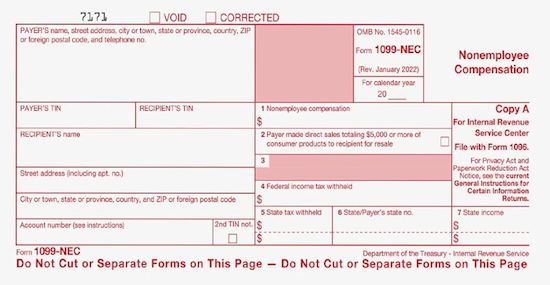
Also remember that even if someone paid you for doing work as an independent contractor, they may not know they should be sending you a 1099-NEC or any form at all.
So, if you are self-employed or irregularly employed, it’s essential to keep track of your own incoming revenue. (Otherwise, if the person who paid you ever gets audited, it could trigger some messy situations for you, too.)
Now that the 1099-NEC covers income for freelances and independent contractors, this one is much more “miscellaneous.” As I’ve said before, it’s the junk drawer of tax forms!
1099-MISC is used to report payment of royalties, broker payments, certain rents, prizes and awards, fishing boat proceeds (yes, really!), crop insurance proceeds, and some payments to attorneys that wouldn’t be reported on a 1099-NEC, like if you received a settlement that required an attorney to get paid a portion contingent upon your winning.
If you get Social Security benefits, you should receive an SSA-1099. (Non-citizens living outside the US, like widows/widowers receiving spousal Social Security benefits, may get a SSA-1042.) The 1099-SSA tends to come on a weirdly long form, folded and sealed such that it makes its own envelope. Unfortunately, it looks like junk mail, so watch out for it and replace it, if necessary!
You Never Give Me Your Money, or Why Income Isn’t Always “Real” Money
A 1099 doesn’t always indicate that you were literally paid money. For example, remember how I said that you may get a 1099-DIV, even if you never actually got the dividend payment because it was re-invested?
Similarly, a 1099-C indicates that someone forgave a debt, like a student loan or a credit card balance. That forgiveness is a relief, but you may owe tax on forgiven debts, and the 1099-C alerts the IRS that since you didn’t pay money owed (and got to keep it), it’s as if you received money.
1099s May Be Hidden in Plain Sight
Sometimes, instead of sending a 1099 in a separate envelope, a bank or brokerage house may include a 1099 form in the same envelope — sometimes perforated at the bottom of a quarterly or end-of-year financial statement, or on the reverse side of a related form. Brokerage houses often send multiple forms as a “combined 1099,” scrolling across multiple pages.
Check all that boring-looking official mail!
Of course, income is only half of the equation. On the other side, you get to use forms and receipts to determine how much you can deduct or write off.
So, let’s look at expense documentation.
1098 (Mortgage Interest)
A 1098 is not a 1099 that’s been taking Ozempic. A vanilla, no-frills 1098 reflects the interest paid on a mortgage, which is generally deductible on federal taxes. Renters don’t pay interest, so they don’t get 1098s; neither do homeowners with paid-off mortgages.
Sub-types of 1098s reflect money you’ve paid for things other than interest on property loans:
- 1098-T shows tuition you paid; you’ll get this from a college or training school.
- 1098-E reflects you’ve paid interest on a student loan; it will come from your lender.
- 1098-C indicates the value of a donated car, boat or airplane. So, if you’re a fancy-pants, monocle-wearing Thurston Howell III or his wife, Lovey, you’ll get this from the agency or organization receiving the donation.
1095-A (Health Insurance Marketplace Statement), 1095-B, and 1095-C
You’ll get a 1095-A if you enrolled in health insurance coverage through a state or federal exchange.
1095-B (supplied by companies with fewer than 50 employees), details the the type of coverage you had through work, the period of coverage, and your number of dependents, so you can prove you had the Minimum Essential Coverage (MEC) required by law.
A 1095-C is similar, but for employers with more than 50 employees.
Schedule 1-A (Additional Deductions)
The Schedule 1-A, to be used with the 1040 return, the 1040-SR return (for seniors) and the 1040-NR (for non-resident aliens) is a new form for calculating some of the new deductions related tips, overtime, new purchases of cars manufactured in America and the enhanced deductions for seniors (see below).
Got all that?
IMPORTANT NEWS FOR THE 2026 TAX SEASON
Know Your 2026 Tax Deadlines
The federal tax deadline is Wednesday, April 15, 2026.
If you file a (valid) extension request, you have until October 15, 2026 to file your tax return. However, you still have to PAY what you (estimate that you) owe by April 15th to avoid a fine.
It’s true that if you won’t owe anything, there’s no penalty for filing late (without an extension), but then you’ll be delaying receiving a refund.
Age Has Its Advantages
Did you know that adults aged 65 and older may qualify for a new $6,000 deduction this year, in addition to existing standard deductions?
The deduction starts phasing out for single filers with incomes above $75,000 and for joint filers above $150,000. Once you hit the threshold, the deduction gets reduced by six cents on each dollar above the applicable threshold. Once your adjusted gross income hits $175,000 (for single filers) or $250,000 (for joint filers), the deduction is effectively reduced to zero.
This $6,000 deduction applies regardless of whether you take the standard deduction or choose to itemize. Also, it’s not permanent, applying only from this year through the 2028 tax year.)
Direct File Is No Longer An Option
A few years ago, I shared information about a government program that allowed people with simple returns (income solely from from employment, unemployment compensation, or Social Security, and only taking a standard deduction) to file directly with the government at no cost. The current administration has cancelled this program.
If you’re seeking a no-cost or low-cost way to file your taxes without working with a professional or filing through paid commercial software or online platforms, consider the following options for filing your 2025 returns:
- file out a paper form (often available in public libraries) or use IRS Free Fillable Forms
- see if you are eligible (depending on your adjusted gross income) to use IRS Free File and file through one of the eight online programs
- seek volunteer tax preparation programs like the Volunteer Income Tax Assistance VITA and Tax Counseling for the Elderly (TCE)
Don’t Procrastinate If You Plan to Mail Your Return
Filing tax returns at the last minute is a time-honored tradition. I’ve seen postal workers outside in the late hours, clad in reflective gear, taking possession of people’s returns.
Unfortunately, if you prefer to mail your tax return, filing on the last possible day may not be workable anymore.
At the end of last year, the US Postal Service announced that it was changing the methods for postmarking mail. They will still stamp the current day’s date on your tax return envelope, birthday card to your grandma, or care package to summer camp when they get to a USPS processing facility. The problem? It might take longer for your mail to get from where you give it to them to an actual facility.
Apparently the USPS is looking at ways to save money. One of those strategies includes reducing the frequency with which it picks up mail from local post offices. This means fewer trips from your drop-off point to a processing center, and THAT means it’s less likely that you’ll get a same-day postmark.
So, if you put your mail in your outside mailbox with the flag up, it could take a few days to get where it’s going. If you drop it in a blue maiilbox in front of a post office that isn’t a processing facility, it could take at least another day. Grandma may not care when an envelope is postmarked, but the IRS does. (And if you’ve got a deadline for mailing something for legal purposes, it definitely does.)
So, your mail may not get postmarked the same day you send it, even if you send it from a post office. That means that finishing your taxes at 11:30 p.m. and jumping in your car to head to the post office on the corner just isn’t going to cut it anymore.
Your best option is to file and pay your taxes online. But if you must mail your return, you may want to ask at your local post office if they are able to manually stamp and postmark your tax return.
While it will be more expensive, another option is to use a private shipper for your tax paperwork, like FedEx or UPS.
FINAL THOUGHTS
Paper Doll is a Certified Professional Organizer, not CPA or enrolled tax preparer. Always verify your questions with a tax specialist. If you receive a funky form and don’t know what to do with it, the IRS has a surprisingly easy Forms, Instructions and Publications Search.
Most importantly, remember that the sooner you get organized for tax time, the less likely you are to end up like Homer Simpson.


Follow Me