Archive for ‘Downsizing’ Category
Why You Think You’ll Regret Decluttering and Why You (Mostly) Won’t
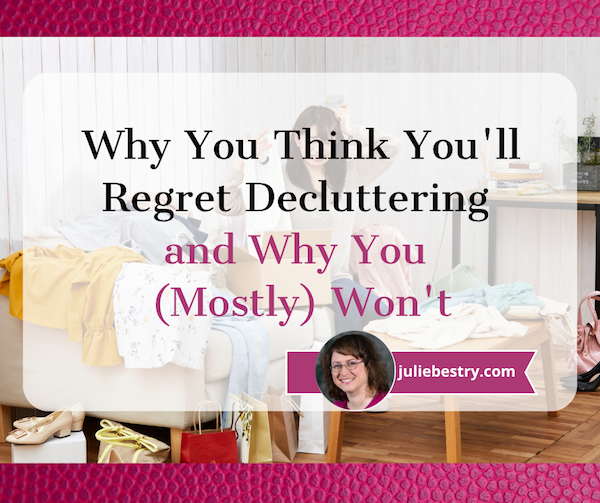
As a Certified Professional Organizer in my 25th year in the organizing and productivity field, I’ve found that one of the spoken (and often unspoken) fears people hold is that they will regret having let go of things. This fear persists whether they’re worried about letting go of tangible possessions, obligations in their schedules, or even mindsets.
Tangible Clutter
In Paper Doll Explains Aspirational vs. Inspirational Clutter, I reviewed the main types of tangible clutter:
- Practical clutter — These are useful items, like clothing, bedding, or kitchen implements, which may no longer suit your lifestyle or exceed the amount you need.
- Informational clutter — This includes general information, curated research, and personal documents, but is out of date otherwise no longer useful.
- Identity clutter — These include an excess of items that help us define ourselves (to ourselves or to others). The items might say, “I’m the kind of person who runs marathons [or wins spelling bees or bakes from scratch].” But identity clutter can keep us from evolving.
- Aspirational clutter — These items support hobbies you tell yourself that you are going to take up, but never really do. Whether you’re saving a closet full of fancy papers and Cricut gadgets for when you finally become a scrapbooker or amass shelves of books on the topic of “How To [Train Championship Greyhounds/Write a Novel/Mine Crypotocurrency],” you’re collecting an excess of items for a life you don’t actually lead.
- Inspirational clutter — These range from motivational posters to self-help books to knickknacks that don’t motivate you to do a specific activity, but to live a “better” way.
- Nostalgic clutter — Nostalgia is defined as “a sentimental longing or wistful affection for the past, typically for a period or place with happy personal associations.” However, an excess of nostalgic emblems of the past can fill up our homes in the present and prevent us from having space in our lives to make a future.
- Painful or sad clutter — These are things that remind us of bad times or bad people.
Temporal and Mindset Clutter
Temporal clutter (in our schedules) falls into the same kind of categories. These are the tasks, activities, and meetings we have — whether at all or just too many — which we hold onto for fear of an anticipated feeling of unease without them.
- Practical temporal clutter — includes activities that feel like necessities, but can become busywork. In our personal lives, they may be tasks related to cleaning, cooking, shopping, self-care, etc.; at work, they might be networking events, meetings, marketing tasks, non-essential emails, or doing anything that’s not directly related to actual professional success. We may be them because we’re trying to keep the plates spinning, but delegating to family members or colleagues/co-workers, outsourcing, or eliminating them altogether may yield essential breathing room.
- Informational temporal clutter includes webinars and online courses we register for, email newsletter subscriptions, and everything we allow into our lives with the hopes of learning and growing but which end up making our inboxes and browser tabs feel claustrophobic. Informational temporal clutter keeps us feeling behind, no matter how much work we get done.
- Identity clutter is made up of everything we agree to do because it reflects who we think we are, believe we want to be, or hope to be seen as by others. Thus, it relates to temporal and mindset clutter. If you’ve been led to believe that “a good mother” cooks every meal from scratch, and you’d feel guilty for not doing it rather than happy that you’ve done it, those tasks are really clutter. If you keep chairing a committee or remain at a job or in a career path that no longer gives you satisfaction, the obligations are clutter.
- Both aspirational and inspirational clutter in our schedules are related to identity clutter.
Instead of clinging to a schedule laden with events that define us as “the kind of person who” does such tasks, aspirational clutter includes activities in which we participate because we think it will make us into that type of person.
Inspirational clutter can include activities that we hope will make us feel the way we wish we felt, like going on dates with someone whom we don’t like, but whom we wish we did like, or attending social, professional, or activist events we think will make us feel a particular way.
If activities crowd us out of the opportunities that would give us the kinds of joy that would lead us to careers, personal lives, and emotions that would better match our best, happiest selves, then they are clutter.
- Nostalgic clutter in our schedules may find us showing up for events that once brought happy memories, but now make us feel lonely or disconnected. Not all events where you once experienced happy memories will continue to fulfill you, and chasing that high can be expensive, both in terms of money and time.
- Painful or sad temporal clutter includes all of the efforts we go to in order to satisfy unfortunate mindsets. Think of people who spend their lives in relationships that give them nothing but heartache or who remain in careers that offer payment, but not true reward, often because they’ve been groomed (personally or professionally) to believe that they are not deserving of better.
In every case, whether clutter is tangible, temporal, or related to beliefs and mindsets, people hold onto that excess of the unnecessary, undesirable, or no longer rewarding out of fear that a future without them would bring negative consequences. It could all be summed up as “better the devil you know than the devil you don’t know.”
However, good organizing principles aren’t just about moving things around, but moving the right things into the right places after letting go of the wrong (or, at least, no longer right) things altogether.
REGRETS, I (THINK I WILL HAVE) HAD A FEW
Frank Sinatra will have to forgive me.
When people tell me that they fear decluttering, I find that they generally fear that they will regret decluttering. After the fact, folks regret not having jettisoned unhelpful stuff or tasks sooner.
Yes, people may briefly regret decluttering because the process of letting go of possessions can stir complex and unforeseen emotions. However, you can control for fears about anticipated regret by being proactive.
Fear About Emotional Attachment
Our hearts are in good places, but our hearts and heads need to communicate better.
Sentimentality
When objects carry emotional significance, reminding us of absent loved ones, meaningful events, or cherished memories, letting go can feel like losing a part of our personal history, even if the items themselves don’t serve an immediate practical purpose. Working with a professional organizing or close friend and telling the story of how the item came to be often shakes loose “false” attachment, reminding us that the item, itself, isn’t needed to keep those memories intact.
Nostalgia
Again, nostalgia is defined as a longing or wistful affection for a period in the past, but that period is often idealized as being happier or simpler. When we dig deeper, we find bittersweet feelings that tinge pleasure with sadness. The longing is for something that can’t be recovered by merely possessing the object or participating in the activity.
(You’ve probably never heard this full version, and it’s a good reminder of how nostalgia isn’t everything it’s cracked up to be.)
We can’t regain our enthusiasm for learning by holding onto our college textbooks. We can’t hold onto youthful idealism by keeping a T-shirt with an activist phrase emblazoned on it. But we can make plans with a friend to take a course or join a book club; we can get involved in a movement to achieve an important community goal.
The initial stages of decluttering often provoke feelings of nostalgia, and items can seem like tangible connections to the past. However, once these possessions (that haven’t been used, displayed, or paid attention to for decades) are gone, that anticipated sense of loss will be tepid.
In part, that’s down to the Pareto Principle, or 80/20 rule. It says that 80% of our successes come from 20% of our effort. Eighty percent of our utility and enjoyment comes from 20% of our “stuff” — and pretty much none of that utility and enjoyment comes from what’s buried in the back of a closet!
Fear of Future Lack
It’s normal to fear that if you get rid of something, you’ll regret the loss. But when it comes to decluttering, the “road not taken” (keeping the clutter) is often filled with potholes.
“What If” Scenarios
When I work with clients, it’s common for them to worry about needing an item in the future, even if they haven’t used it in a long time (or ever). This fear of not being prepared can lead to second-guessing. It’s not impossible that someone may have regret after they’ve already discarded an item, but that can be minimized by taking “What if?” to its natural conclusion.
Unanticipated Events or Trends
Decluttering clothing, tools, or hobby materials (or the hobbies, themselves) may stir up a momentary twinge of regret when future circumstances arise where those items could be useful.
In the 1970s, the popularity of Happy Days and Laverne & Shirley made 50’s Days at schools popular; in the 1990s, That 70s Show had a similar, if muted, impact. While people may have been disappointed that they no longer had their poodle skirts or bell-bottom jeans, the regret was almost always mild and short-lived because the space and time needed to store and care for such items was more than the value of occasionally having them on-hand.
Fear of Misjudging Value
Clients are sometimes fearful of donating or discarding something and then someday finding out the monetary, sentimental, or practical value of an item after it’s too late. This is why professional organizers strive to know when something should be appraised, or recognize when a client hasn’t adequately come to terms with an emotional connection.
Financial Pain Points
I could write an entire blog post of examples about how people tend to hold onto things they don’t need or want because they fear finding out later that the items had monetary value. My colleagues and I have seen more than our share of clients who invested in Beanie Babies because they were (mistakenly) certain they’d become solid retirement investment instruments.
For example, the value of an antique is not merely that it’s old. Age is only one element of value; others are rarity, condition, provenance (history of ownership), authenticity, design/craftsmanship, and demand. The more you know about somethings monetary value (or lack thereof), the more easily you can make a decision about how and whether to let it out of your life (and home).
Sentimental Blind Spots
Items that might not seem valuable today can gain significance as personal context changes. People may regret not foreseeing the future importance of something seemingly trivial at the time of decluttering.
It helps to accept that there is only so much foresight we can have. I had a late-1985 Macintosh computer. It was cutting edge. Then it was out of date. And then it was a lump on my closet floor. And then I happily sent it to my friend to turn into an Macquarium. Years later, he spent quite a bit of time in an ashram in India, so I’m not sure whatever became of it. If I sat mired in regret that 40 years after I acquired it, it wasn’t still being used to give utility or delight, I’d make myself ill.
Decide now that if you let go of something you later wish you’d kept, you’ll give yourself grace.
Fear of Making Poor Decisions
The whole decluttering process can lead to poor decision-making.
Rushed or Emotional Decisions
Decluttering under pressure — whether due to a move, family expectation, or a desire for fast results—can lead to rash decisions. Later, people often regret discarding things without giving enough thought to their significance.
Overwhelm
Sorting through possessions can be emotionally exhausting, leading to decision fatigue. When overwhelmed, people may simplify be discarding more than intended, only to later wish they had been more selective.
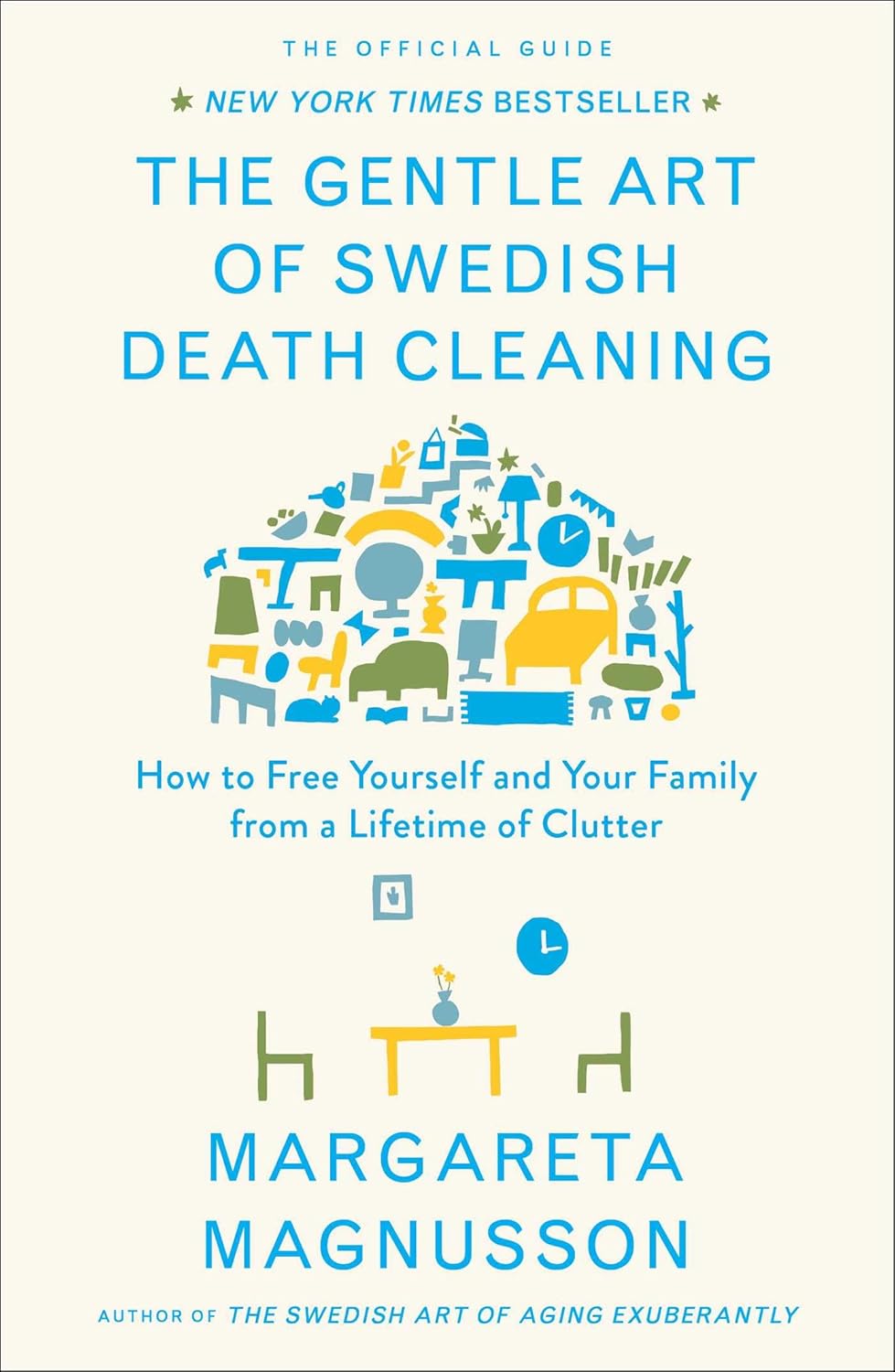
This is why we encourage people to start decluttering early and continue it as an ongoing practice. Even thinking about this in your thirties or forties can make life easier down the road. Expand your mindset on getting comfortable with jettisoning possessions by reading The Gentle Art of Swedish Death Cleaning: How to Free Yourself and Your Family from a Lifetime of Clutter by the late Margareta Magnusson.
Fear of Lost Identity
People fear that letting go of possessions will lead to a loss of connection to who they are.
Personal Identity
Objects help establish and define people’s identities — whether they’re tied to professions, hobbies, interests, or memories. Downsizing can feel like giving up parts of one’s identity, leading to a sense of loss or disconnect from who they were in their heyday.
Cultural or Family Connections
It’s common to hold onto objects that connect one’s family or cultural history. Letting go of these items can feel like breaking ties with heritage or family roots.
You can diminish the fear by talking through the role each item actually plays, and whether the possession is really tied to living your identity.
Does the absence of dust-catching plaque on a shelf really mean you’re no longer a past “Teacher of the Year?” Can you trust that your legacy is actually all the students you guided? If you have half a dozen rosary beads or seder plates but only ever use one favorite, wouldn’t passing along the others to someone who will love and use them actually enhance, rather than detract, from cultural or family connections?
Fear of Minimalism
If you’re used to having a very “full” space, especially as you declutter with an eye toward downsizing to a smaller home, other fears may creep in.
Over-Purging
In the pursuit of minimalism, some people swing too far and end up feeling their space is too bare, missing the comfort and personalization that their possessions once provided. This is particularly common when one member of a married couple is inclined to “pitch things willy-nilly” as one of my clients complained of their spouse. Working with a professional organizer who monitors emotions and asks questions about your future needs throughout the process can soothe frayed nerves.
Similarly, not everyone thrives in minimalist environments. People may feel pressured to declutter because it’s trendy, only to regret it later when they realize it doesn’t align with their personal preferences. I always come back to the William Morris quote, “Have nothing in your house that you do not know to be useful or believe to be beautiful.”
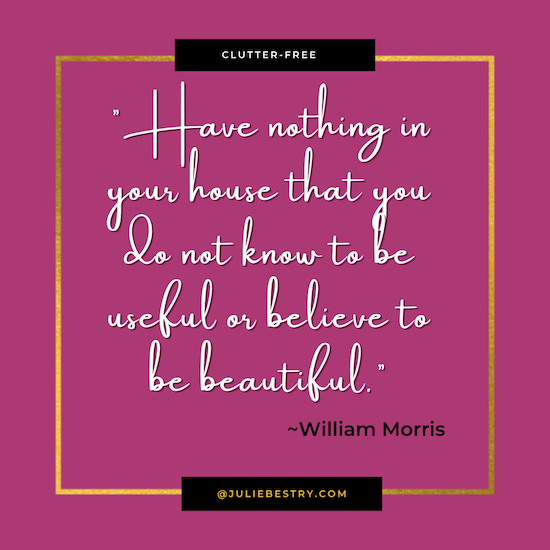
Using this as a rubric will help dissipate fear that you will let go of “too much” and allow you to focus on keeping what is “just right.”
Practical Inconveniences
When people downsize “too much,” they can find themselves in situations where they miss basic, practical items they took for granted, leading to frustration and regret. Again, the solution isn’t to avoid decluttering, but to consider what “after” should look like and set aside favorite essentials before the purging begins.
THERE’S NO BIG FIX FOR FEAR OF DECLUTTERING
There’s no one magic wand to get rid of the fear of decluttering, but there are a few strategies to become more comfortable with uncertainty about how you will feel after decluttering.
Jettison the Expectation of Quick Satisfaction
There’s often an expectation that decluttering will bring immediate peace or satisfaction, but the emotional void left by discarded items can take time to heal, leading to disappointment when results aren’t instantaneous.
Decluttering brings clarity and simplicity. It saves time and money, reduces stress, and increases productivity. Nonetheless, humans are psychologically complex.
We have emotional attachments (and false beliefs about emotional attachments), fear of future situations, quirky needs, experiences of loss, and fears that we will be judged (or judge ourselves) for making poor decisions that leave us without the value we might otherwise have had.
But the alternative to decluttering is physical overwhelm in one’s space and emotional overwhelm as a result of one’s schedule.
Somewhere in between is the balance between keeping what matters and letting go of what we don’t need. We achieve this with mindful, intentional decluttering that respects both the practical and emotional roles possessions play.
PROACTIVITY OVERPOWERS REGRET
Clients are often a bit surprised when I encourage that they *not* let go of certain things for which there are guidelines regarding retention (like old tax returns and supporting documents, loan payoff documentation, etc.).
Clients who take the time to work through a decision regarding whether to keep or discard something rarely have regrets. I’ve never had a client ever say, “Darn, that wagon wheel coffee table that we discussed? I really wish I’d kept it.”
Again, most people express regret that they didn’t let go of things sooner. A substantial aspect of that comes from the proactive nature of working with a professional organizer to consider the consequences. When there is regret related to decluttering, it most often comes from never stopping to think clearly about the value, failing to cautiously review what’s purged, and not being given the choice at all.
The most common circumstance in which people regret the absence of their things is when they didn’t get to control the parting and don’t get closure. This may happen when:
- People are evicted and no arrangements have been made to move their possessions
- There’s a house fire.
- Victims of abuse or neglect escape or end up in foster care without their things.
- Sudden ill health forces elderly people to leave their homes and go into assisted living or nursing care.
- Students haven’t done anything to prepare for end-of-the-year dorm clean-outs and whatever doesn’t fit in the car gets tossed.
It’s much like when a relationship ends. When a spouse dies unexpectedly, you’re left adrift. But no matter how painful, if you have enough time for a “good goodbye,” when the end comes, after a period of mourning, you’re likely to have a lifetime remembering the good rather than obsessing about the fact that it’s over.
If you get a divorce (amicably, or at least if it’s your decision or you agree that it’s for the best), while you may sometimes miss aspects of the relationship, you’ll have a healthy recognition of what transpired. But if a six-month situationship ends when the other person ghosts you, you’ll miss the hoodie left at their house and the lost chance for proper closure.
Separating from your possessions can be similar. If the parting is forced on you, it’s understandable that it will unleash a variety of negative emotions.
FIND THE BALANCE BETWEEN REGRET AND JOY
Marie Kondo’s idea of letting go of everything that fails to give you joy is problematic.
Joy is a great rubric for deciding to get rid of a significant other. If your partner doesn’t give you joy at least 85% of the time, there’s a problem. (It’s OK if it’s not 100%; there’s something to be said for even-keeled neutrality or boredom. But if they make you unhappy more than 1% of the time, toss ’em in the recycling bin.)
Joy is also probably an excellent way of judging what tasks and obligations you should cut from your life, provided that cutting those non-joyful obligations won’t also delete joy. Hate going to meetings at work? Just refusing to go may eventually mean that your employer will jettison you from the workplace, and you’ll lose out on the joy that a paycheck brings.
But outside of the work environment, decluttering tasks should mostly be joy-based.
You don’t get joy from driving your kid to soccer practice? OK, but if your child being happy does bring you joy (and I hope it does), the trick isn’t to stop the soccer but stop the driving. Arranging with another parent to carpool and split the driving (so you only do pickup) might work; so might paying for a ride-share service designed for kids and teens.
You get no joy from having lunch with your complaining, unappreciative something-in-law? Encourage your spouse to pick up the slack and let go of that draining emotional load.
You won’t regret choosing self-care over task clutter. Figure out when, and when not to, emulate Herman Melville’s Bartleby the Scrivener and learn to say, “I would prefer not to.”
Fear of how you will feel about letting go of items and activities is understandable, but don’t let it keep you from taking control of your space and schedule.
Sustainable, intentional decluttering can minimize your fears and regret, and empower you to live the life you want.
Meet Your Organizing Elves: The Pros Who Help Get Your Life in Order

Recently, at the end of a session, my client joked that I was her own Santa’s elf. We laughed, but her description is not that far from the truth.
YOU AND SANTA BOTH NEED ORGANIZATIONAL SUPPORT
Santa’s elves (and Mrs. Claus and the reindeer, of course) help keep Santa from becoming overwhelmed. After all, Santa is basically running a multi-national corporation.
Certainly, he has to control the means of production for his factory. Can you imagine how much paperwork (and how many computer files) it takes to source, order, acquire, and unpack the resources before the toyshop starts making the toys?
But our friend Kris Kringle also manages a customer base of upward of two billion children (the current number of the world’s newborns through fourteen-year-olds), not even counting all the people for whom the magic of the holidays involves believing in Santa. I’m sure, at some point in the late 20th-century, Santa had to learn how to manage a computer database and CRM system to keep straight not only who was on the nice vs. naughty lists, but track them as their behavior meandered from one to the other and back again.
Due to non-compete clauses, nobody’s ever ascertained whether Santa has only one sleigh or a huge fleet with one for each of the 24 time zones to which he delivers. Nonetheless, keeping up with the vehicle maintenance and registration requirements in 195 nations must be quite the task!
Time management is a huge headache, too. Not only do those requests for toys and bikes and little red wagons (and all the modern digital doodads) need to be filled, wrapped, and packed onto the sleigh, but timing all of these deliveries in one night, with no respite for bad weather or reindeer infighting, has to be wearying.
It’s a good thing Santa has his elves.
My clients often feel the same oppressive weights upon them, even if they don’t necessarily have the same international fame as the guy in the big red suit. Whether you need to deal with organizing and productivity pitfalls at home or at work, in your computer or your kitchen, your closet or your warehouse, there are professionals who can give you support.
Perhaps between preparing for Thanksgiving and the winter holidays, entertaining company, trying to make headway on languishing projects with end-of-year deadlines, and figuring out how to make space for everything coming in (to your home, to your schedule, and to your life), you have realized that you could use a little elf-like magic as you go into next year.
Today’s post is a chance for you to get to know all of the organizational (and organizing-adjacent) experts who can help you reduce overwhelm, coach your decision-making, and bring subject-matter expertise to help you overcome obstacles (whether tangible, temporal, or cognitive) so you can be your best self.
(Heh. Maybe that should be my holiday marketing campaign: I’ll be my best elf so you can be your best self.)
PROFESSIONAL ORGANIZERS AND PRODUCTIVITY SPECIALISTS
We professional organizers and productivity gurus didn’t all start out and orderly elves. Paper Doll was a television executive. Many, many of my colleagues were teachers. Some were attorneys, social workers, hoteliers, accountants, designers, and so many other types of professionals.
Sometimes, we felt like we were on the Island of Misfit Toys, but almost as if by holiday magic, we all found where we truly belong. And yes, we know that not all elves are always so lucky to find their fit right away.
NAPO
Longtime readers of Paper Doll are already familiar with the concept of professional organizers, but many people are surprised by the variety of services we provide.
If you think a professional organizer is just about moving the stuff around, I’ve got a surprise for you. As I tell my clients, “Housekeeping is about the stuff; professional organizing is about the person who owns (and uses, and maintains) the stuff.”
Housekeeping is about the stuff; professional organizing is about the person who owns (and uses, and maintains) the stuff. Share on XAmong the professionals in the National Association of Productivity and Organizing Professionals (NAPO), there are plenty of generalists. In just the past few weeks, I’ve:
- helped a client pare down a collection of family photos and slides ranging from the late 1800s to the 1970s
- organized holiday charitable requests, identified the client’s philanthropic priorities, and oversaw the donation process
- supported a client with cognitive decline to maintain daily productivity
- decluttered and downsized: cleaning supplies in kitchen cabinets, books and décor from bookshelves, a wardrobe that largely no longer served a client’s physique or style, and more
- assisted clients in accessing funds by searching for unclaimed property, organizing supporting documentation for class action suits, and submitting claims for health insurance
- reworked a client’s overly-ambitious December schedule so that she actually had time to enjoy the holidays.
Although I do specialize in paper and information management and productivity coaching, my in-person clients seek my help for solving all manner of organizing-related mysteries and kerfuffles in their lives, and it’s the same for my colleagues.
Some professional organizers specialize in particular types of clients:
- people with chronic disorganization or hoarding disorders
- individuals with brain-based conditions ranging from ADHD and autism to traumatic brain injuries to dementia
- people with physical disabilities
- seniors
- new parents
- children
- older students
- solopreneurs and small business professionals
Others in our field focus on particular types of spaces for downsizing, clutter control, and organizing in:
- kitchens
- closets
- living spaces (main and guest bedrooms, living rooms, bathrooms)
- home offices
- playrooms
- basements
- attics
- storage units
- work spaces (like professional kitchens, law offices, physicians offices, science labs, theaters, etc.)
We also specialist in particularly kinds of services that cross the “who” and “where” categories, like:
- time management coaching
- paper management
- digital organizing
- organizing and managing photographs and memorabilia
- financial organizing, including bill-paying, budgeting assistance, and bookkeeping
- estate management
- medical history management
- household management
- eco-organizing
- home inventorying
- home staging
- yard/garage/estate sale management
- packing and unpacking for moves
- space planning and design
This doesn’t even begin to take into account the services some professional organizers provide to businesses, including: business automation, corporate operations, event planning, records management, technology training, and more.
Basically, are overwhelmed by it, exhausted by it, stymied by it? Do you “just” need someone to come in and do it (or teach you how to do it — or how to do it better)? If it takes less time and you can focus on what’s important to you — then organizing and productivity specialists can help.
To find a professional organizer, visit the NAPO directory directly, or navigate from NAPO’s front page to the Find a Pro menu at the top. Search geographically or within a radius from your zip code, pick the business and/or residential specialties in which you need assistance, and review the list of my colleagues provided.
And don’t forget, much of the work we do with and for our clients can be done virtually, so you can pick that option from the specialty drop-down if you’re open to getting help from afar.
NAPO members represent thousands of separate professionals, coming together to gain continuing education and support one another so that we can support our clients.
Certification, Certificates, and Skills
When the NAPO directory provides you with names to peruse, you may see some additional notes.
Certified Professional Organizers (CPOs) are those of us who have attained credentials reflecting specific standards. That originally included 1500 hours (now 1000 hours) of paid client-centric work prior to sitting for a comprehensive exam (among other requirements), adhering to the BCPO Code of Ethics for Certified Professional Organizers, and obtaining continuing education in a variety of subjects during a three-year certification period.
For more about certification, you can check out the “What is a Certified Professional Organizer” tab here on my website, including my article, In Checkbooks And Underwear Drawers: What Certified Professional Organizers Offer Our Clients.
Specialist Certificates — In addition to the deep and wide subject matter expertise needed for certification, NAPO members may also hold certificates in specialized subjects, including:
- Brain-based conditions
- Household management
- Life transitions
- Move management and home staging
- Residential Organizing
- Team productivity
- Work productivity
Institute for Challenging Disorganization
Founded in 1990 by my colleague Judith Kolberg and originally called the National Study Group on Chronic Disorganization, the Institute for Challenging Disorganization (ICD) has as its mission to provide organizing professionals and the public with education and helpful strategies, and conduct research, regarding chronic disorganization.
Membership in NAPO and subscribership in ICD often overlap, and professionals in our field may obtain a variety of ICD specialist certificates related to chronic disorganization, hoarding disorders, and other related conditions.
Other Organizing and Productivity Associations
There are helpful organizing elves everywhere!
Outside of the United States, there’s an ever-growing universe of organizing and productivity professionals.
For our colleagues to the north, Professional Organizers in Canada (POC) has a similar search engine to NAPO’s. At their Find An Organizer page, you can specify services areas and specialties as well as languages spoken. (You didn’t think Santa’s elves spoke only English, right?)
NAPO, ICD, and POC do not stand alone. We have colleagues around the world as part of the International Federation of Professional Organizing Associations, including:
- Associaçāo Nacional de Profissionais de Organizaçāo e Produtividade (ANPOP, in Brazil)
- Association of Professional Organizers of Spain (AOPE)
- Association of Professional Declutterers and Organisers (APDO, in the UK)
- L’Associazione Professional Organizers Italia (APOI, the site at which Paper Doll supplements her Duolingo Italian practice by trying to discern meaning)
- Chinese Association of Life Organizers (CALO)
- Finnish Association of Professional organizers (FAPO)
- Federation Francophone des Professionnels de l’Organisation (FFPO, in France)
- Hong Kong Association of Professional Organizers (HAPO)
- Heart Home and Space Organizer (HHS, in Taiwan)
- Japanese Association of Life Organizers (JALO, not to be confused with Ja-Lo AKA: Jennifer Lopez)
- Korean Association of Professional Organizers (KAPO)
- National Association of Black Professional Organizers (NABPO, headquartered in Atlanta)
- Nederlandse Beroepsvereniging van Professional Organizers (NBPO, in the Netherlands)
- Swedish Association of Professional Organizers (SBPO)
Several times a month, I am asked by friends, former classmates, clients, and random acquaintances to provide referrals and recommendations for professional organizers to help people’s loved ones, whether across the continent or across the world. It’s heartening to know that I have colleagues in so many places, ready to help those who are seeking a little more space or serenity.
OTHER ORGANIZING-RELATED PROFESSIONAL ELVES
In addition to ICD and POC, and the National Association of Black Professional Organizers (NABPO) referenced above, NAPO has other affiliate organizations.
Daily Money Managers
Santa has to deal with financial transactions in 180 different worldwide currencies. Your finances may not be so complex, but whatever your needs, whether to help Grandma keep up with her retirement investments or to just make sure the bills get paid on time, the American Association of Daily Money Managers (AADMM) has financial organizing professionals to assist you.
Daily Money Managers (DMM) offer a wide variety of personal financial services to individuals and families, and manages financial tasks including bill-paying and oversight, budgeting, and record keeping. Some serve as fiduciaries for clients who are incapacitated.
Aging/Geriatric Care Professionals
Santa and Mrs. C. aren’t exactly spring chickens, and like all of us, may someday need support.
The professionals in Aging Life Care Association (ALCA) specialize in aging and disability issues while ensuring client “safety, continuity, and dignity.” As experts in health and human services, they can assist and advocate for families caring for older adult relatives or individuals with disabilities. They can partner with professional organizers and senior move managers whenever clients and their families are going through major life transitions — whether they’re downsizing so family members can age in place or to help them relocate to other living situations.
Photo Organizers
Many NAPO professional organizers are comfortable helping their clients organize their photos or find solutions for digitizing them. But The Photo Managers (formerly the Association of Personal Photo Organizers) use their passion for photo collections and personal storytelling to assist clients with culling, organizing, and digitizing photos, as well converting older media to newer formats and sharing pictures.
OTHER MONEY ELVES
Every year, I learn about new types of professionals who can help me help my clients overcome the obstacles that clutter their daily lives. These include:
Claims Assistance Professionals
As I discussed in Organize and Lower Your Medical Bills: Spot Errors, Negotiate Costs, and Save Money, there are a variety of medical billing specialists, medical cost advocates, and patient advocates. In addition, if you’re drowning in medical claim paperwork that makes no sense, or you’re getting the runaround from the insurance company, you may want to reach out to a claims assistance professionals through The Alliance of Claims Assistance Professionals.
Financial Advisors
Knowing what to do with your money can be confusing, and it’s scary to wonder whether the advice you’re being given is good for you, or just good for an advisor taking a percentage of what you earn.
Before considering hiring a financial advisor, talk to the elves in your life: your family members, friends, and colleagues who seem to handle their dollars with sense. I am neither a fiduciary nor a money maven, but I do recommend that if you’re seeking help with building your financial future, you should find a fee-only financial planner. That’s someone you pay a flat fee, rather than a percentage, to provide you with advice.
The National Association of Personal Financial Advisors (NAPFA) is a great first start. You can also find Certified Financial Planners via the location search at PlannerSearch.org.
Appraisers
A professional organizer can help you divide the wheat from the chaff when you’re figuring out what to donate and what to keep; we’ll hold your hands when we tell you that your collection of mini Beanie Babies you got at McDonalds will not fund your retirement. We may help you research the provenance and potential value of what you own. But no organizing professional is going to tell you for certain whether that piece of furniture or jewelry or coin collection is worth. For that, you need an appraiser.
An art appraiser is not a stamp appraiser; fields of specialty range from wine to textiles, furniture to musical instruments, coins to fine art to books. Start with an accredited appraisal association like:
to find the experts that can help you understand the value of your property and make wise decisions regarding what to do with what you own.
Certified Divorce Financial Analyst
Paper Doll hopes you never have to deal with a divorce (unless it’s something that will make your life better). However, I’ve worked with enough clients going through the divorce process to know that attorneys don’t have the bandwidth to deal with some of the intricacies of the financial situation.
Certified Divorce Financial Analysts are professionals who can help you figure out the complex financial aspects of your divorce. This may help you secure an equitable share of marital assets in order to plan your financial future.
If you or someone you know needs support in this area, start with the Institute for Divorce Financial Analysts.
OTHER HOUSE ELVES
When you hear house elves, you probably think of Harry Potter. As a GenXer who grew up near Canada, I start daydreaming about house hippos.
But I digress.
In addition to the residential professional organizer services covered by NAPO and her sister organizations, there is some crossover into home relocation specialties.
Senior Move Managers
The National Association of Senior and Specialty Move Managers is made up of relocation specialists. They’re focused on strategies for helping older adults (and their families) with the relocation process, including downsizing, as well as packing and unpacking, and assisting with logistics.
Home Stagers
In the olden days, when you wanted to sell your house, you hired a real estate agent. They told you to clean the house and pop a sheet of cookies in the oven to make things smell nice. Over the last few decades, however, home staging — literally staging your home to make it possible for prospective buyers to imagine themselves living there — has become a big deal.
Staging can involve removing objects that are overly personal or reflect particular belief systems, subtracting or adding furniture or décor to create a particular aesthetic, and generally working to show a house off in the best light.
As with senior move managers, you will likely find some crossover between NAPO/IFPOA professionals, but to find a home stager in your area, start with the Real Estate Staging Association and the America Society of Home Stagers and Redesigners.
Obviously, your organization and productivity needs are complicated, and by talking about elves, I am not entirely making light of anyone’s struggles.
Sometimes you just need a handy-person to help you lift and carry things to the attic or out to the curb; however, most of the time, a professional organizer or productivity specialist is the ideal person to guide you through the myriad decisions to make to move your life in the direction you want.
And when the real obstacles are not the things, but ourselves, and special services are needed, their are ADHD coaches, life coaches — even decision-making coaches — and mental health professionals!
Today’s post is a reminder that whatever is causing clutter in your space, your schedule, your finances, or your mind, you’re not alone. Reaching out to experts is a gift you can give a loved one — or yourself.
I suspect Santa would approve.
Find New Life for Unfinished Needlework Projects and Pre-Loved Stuffed Animals
It’s rare that Paper Doll wanders away from the productivity topics of organizing paper, information, and time management, but a few intriguing services were shared with me recently and may be just what some readers need to put a smile on their faces.
When I work with organizing clients to help them downsize or declutter, some things are always easier to let go off than others. Whether we have ample time or are restricted due to an impending move or change in life circumstances, I always try to begin with the areas of a home that have lesser sentimental attachments. It’s just easier to declutter a bathroom cabinet, linen closet, or kitchen than it is to reduce personal memorabilia, photos, or keepsakes.
Today, we’re going to look at some novel ideas for letting go of things you no longer need or can’t use as-is, but are having difficulty parting with because you feel an obligation to the item in question or the person who owned it.
LOOSE ENDS
Some people just have the knack for knitting, crocheting, and needlework projects.
For example, my grandmother (Paper Mommy‘s mother) supplied the family with an inordinate number of multicolored knit afghans (and, admittedly one set of toddler mittens with square, too-short compartments for thumb and fingers). Her sister, my great-aunt, created a sumptuous brocade coat, sewed an inspired wedding gown, and crocheted the loveliest butter-yellow sundress — all for my sister’s Barbies.
The skills, however, did not pass down to later generations. Finding Paper Mommy sewing on a loosened button, my sister squinted and inquired, “Who are you and what have you done with my real mother?!” I, myself, have never stooped to, but have considered, fixing a ripped seam with a stapler.
Of course, my family is not your family, and your mileage may vary. (In which case, could you help me with this hem?)
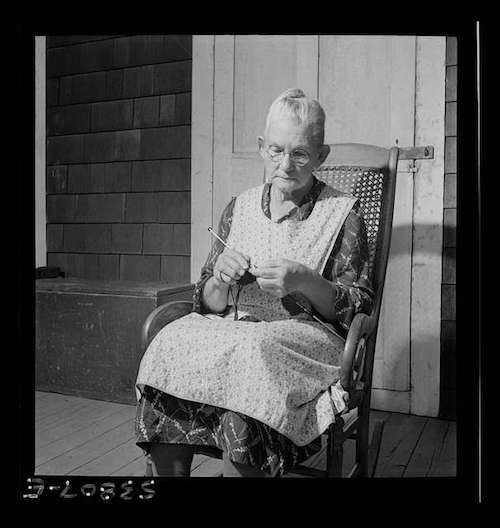
Public Domain, Library of Congress, circa 1944
When You Are At Loose Ends with Unfinished Knitting/Needlework Projects
Have you ever gone through the closets or drawers of a loved one who has passed away to find that they’ve left behind a number of unfinished needlework projects? So many of my clients have found that their spouses or parents or grandparents have left half-finished sweaters or blankets. These left-behind pieces of handiwork reside in a no-man’s land, neither finished projects nor purely raw materials.
Or, have you known people who have derived great satisfaction from their needlework projects but are no longer able to complete them due to serious illness or disability? I have clients, for example, who suffer from conditions ranging from macular degeneration to debilitating arthritis to Parkinson’s, and they have had to relinquish their needlework hobbies.
It can be demoralizing for them to have these unfinished projects mocking them, so they may stuff them away in cabinets or closets. Meanwhile, it’s heartbreaking to give up on the idea of them being transformed into enjoyable pieces.
If you’re an accomplished knitter, and the yarn selection appeals to you, and you have the time and energy, you might take up the project yourself and finish it. But if one or more of those circumstances doesn’t apply?
Yes, you could donate the unfinished piece, as is, and leave it for the universe to match the project to the right person, but what if you could help the universe along?
Enter Loose Ends, a free service for getting your loved one’s needlework projects completed.
The founders, Jen Simonic and Masey Kaplan are avid knitters who found that they both had the experience of friends asking them to complete needlework projects originally begun by loved ones who had passed away. They were enthusiastic to do so, but recognizing the joy of wearing or using something a loved one created, they realized that there was an opportunity to create and share more joy.
In doing so, they built an organization that turns the clutter of unfinished projects into beautiful collaborations involving those who started the projects, the loved ones who see a chance for completing them, and volunteers who bring the projects to fruition.
Loose Ends turns the clutter of unfinished projects into beautiful collaborations involving those who started the projects, the loved ones who see a chance for completing them, and volunteers who bring the projects to fruition. Share on XSimonic and Kaplan see themselves and Loose Ends, now a 501(c)3 nonprofit (as of May 2023), as matchmakers. Their website notes that, “In knitting patterns, this is noted as K2Tog (knitting two together).” Not being a knitter, I’ll take their word for it.
How Loose Ends Works
Imagine you’ve gone through Grandma’s craft room, identifying all the unfinished sweaters or doilies or baby blankets. You can submit these unfinished projects to Loose Ends and Simonic and Kaplan’s team will survey the Loose Ends database of “finishers” to find a likely match based on geography, skill level, and the ineffable “druthers,” of what volunteers’ profiles show as their interests.
Loose Ends then contacts the finishers to see if the project is a good match, and if so they introduce the finisher and project owner by email.
Then, like any good yenta (matchmaker), Loose Ends leaves the project owner and finisher to develop the project-completion relationship in their own time and manner. (Of course, if it’s necessary, the Loose Ends team is available for troubleshooting problems, offering advice, or reassigning the project to a different finisher, if circumstances proves necessary.)
It usually takes up to a few weeks to find a finisher for a project, and then more time for the finishers to receive the project from the sender. As I discussed in Paper Doll On Understanding and Conquering Procrastination, it takes activation energy to get the ball rolling.
I imagine how much activation energy it must take just for someone to reach out for help; it might take quite a bit for the project owner to move to the next step of communicating with a finisher and even more to finally ship the project.
Finishers, whether they are knitters, crocheters, quilters, or other types of textile crafters, sign up online; similarly, project owners submit their projects online.
What Projects Will Loose Ends Accept?
Loose Ends has a detailed FAQ section, but you may be wondering who actually qualifies to have their projects finished by Loose Ends volunteers. The criteria related to who started the project and the material and projects involved:
- The original crafter must be deceased or unable to do handwork due to illness or disability. (In other words, this isn’t a service for people just looking to get free needlework done! These volunteers are lovingly completing projects started by those who are unable to do so.)
- The project must be partially begun. (So, no sending in Grandma’s unopened needlepoint kits.)
- The project and its materials must be free of moths and moth eggs. Similarly, they will not accept any contaminated yarn or rotting materials. (You would think that this would go without saying, but during my time as a professional organizer, I’ve seen people try to “donate” things that are dirty or otherwise, for want of a better term, yucky. You wouldn’t want someone sending something yucky to your home; right?)
- The project must be clean and not smell of mothballs or mold. If the project has been in a home with cigarette smoke, Loose Ends will try to match the project to a volunteer finisher whois not bothered by the scent of cigarettes.
- The project owner must want the project back — to keep! (I don’t imagine this means you can’t give the blanket to your kids.)
Submitted projects don’t have to involve knitting. Loose Ends notes that the projects can involve “any textile handwork… knit, crochet, sewing, quilting, mending, rug-making, Tunisian crochet, embroidery, cross-stitch, needlepoint, weaving, etc.”
I didn’t even know what Tunisian crochet was, but apparently it’s not quite as exotic as you might think, and involves the stitching used to make afghans.
Logistics and Costs
Understandably, the more specialized the craft, the more time it may take to match the project to the finisher, and if the project and its finisher are far apart geographically, shipping in both directions will increase the time.
Speaking of geography, finishers and project owners need not be in the United States. Work can come from or be finished anywhere in the world! As of six months ago, Loose Ends had 19,000 finishers in 64 countries!
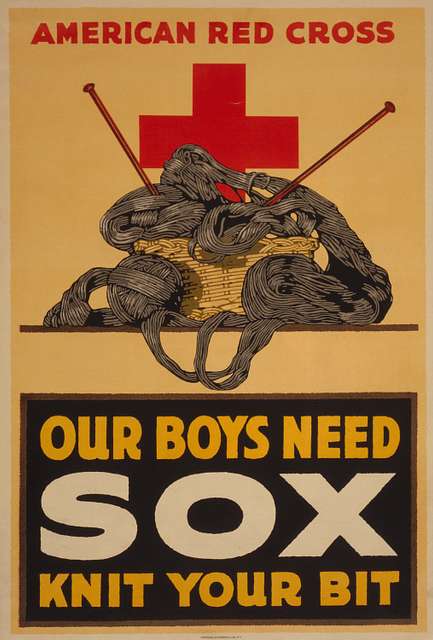
Public Domain Photo Circa 1914-1918
Library of Congress CALL NUMBER: POS – WWI – US, no. 118 (C size) [P&P]
Finishers complete projects at no cost, but (understandably) any shipping costs in both directions get covered by the project owner. Loose Ends works to minimize costs by matching individuals in nearby geographic areas whenever possible.
Impressively, the site notes that if a project requires acquisition of extra materials, JOANN Fabric and Craft Stores (Loose Ends’ partner) will supply anything available at their stores at no cost. (Editor’s Note: JOANN has recently filed for chapter 11 bankruptcy, so it’s not clear if this will have an impact on their future support.) However, if a project requires the purchase of supplies elsewhere, that’s the project owner’s responsibility.
Sundries, Notions, and Benefits
What if you (or your loved one) had no projects to finish, but oodles of fabrics, yarn, or craft supplies? Loose Ends can’t accept those materials, but they’ve amassed a huge state-by-state and country-by-country list of organizations that can give new life to these supplies. Go to their donations page and scroll down.
Speaking of donations, if you’d like to donate financially to Loose Ends’s efforts, you can do so through Zeffy, a Canadian donation processing company for nonprofits that does not charge fees.
Paper Doll may not be into crafting, but I find Loose Ends to be a lovely project with benefits for all.
Are you an inveterate knitter whose family and friends just don’t want or need one more sweater, lap blanket or tea cozy? If you just can’t give up the clickety-clacking of your needles, this gives you a fun project to work on without fear of adding fuzzy clutter to your space or the spaces of those you love. (I’m sorry, but some of us just don’t need any more yarn things!)
Meanwhile, those who’ve lost someone one can get one final gift of connection, completed lovingly by a crafter who shares their loved one’s passion for handiwork.
The finished project becomes a legacy instead of a piece of clutter.
For a more in-depth discussion of Loose Ends, co-founder Jen Simonic just appeared on the most recent episode of the video podcast Fiberchats, hosted by Irina Shaar.
LOVED BEFORE
My fabulous colleague Janice Simon, better known as The Clutter Princess, knows I’m a sucker for nifty projects like Loose Ends and recently sent me a TikTok about another sweet service, this one saving the environment while reducing household stuffed animal clutter.
If you’ve got stuffies that your children have outgrown (or which were given to you by boyfriends later found to be poopyheads) then you know how difficult it can be to move them onward.
We professional organizers usually consider donation first whenever helping clients let go of excess possessions. Stuffed animals and other such toys can be donated to standard charities like Goodwill, hospitals, shelters for unhoused individuals and families, domestic violence shelters, daycare centers, social services agencies, and organizations like Stuffed Animals for Emergencies (SAFE), which give them to the police departments to share with children who’ve experienced a trauma.
The problem? These donations generally need to be brand-new, or at least very gently used, toys. Typically, well-loved stuffed toys generally can’t be donated for hygiene reasons.
The alternative to donation, especially for once-loved but beaten-up fuzzy friends, is the landfill, and nobody wants that.
And, of course, if you believe that your stuffed friends won’t find loving owners through donation, and you can’t bear the thought of them ending up on the junk heap, how will you ever bear letting them go at all? It’s no wonder that so many people have houses filled with ignored, dust-gathering stuffed animals!
Loved Before, a London, UK-based organization, has found an alternative for giving new life to old “soft toys” (what we call stuffed animals). Their mission is to:
make a difference by recycling pre-loved toys into “eco toys” that are not only adorable but also sustainable. We believe through the medium of soft toys we can teach the importance of preserving our planet to future generations.
Loved Before sees itself as the first eco-friendly, fully sustainable soft toy adoption agency.
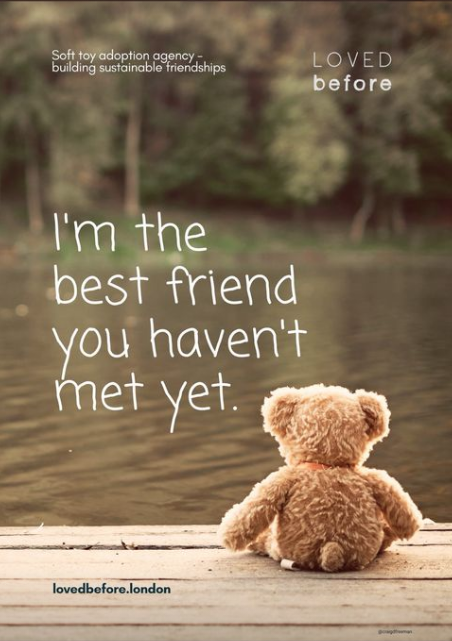
Donate Your Stuffies — And Their Stories
Loved Before accepts donations of soft toys in “all shapes, sizes, species and conditions,” no matter whether they are store-bought Steiff, Gund, Beanie Babies, or Build-a-Bear friends or multi-generational, wonky, and handmade with love. (However, they can’t accept plastic toys or those with electronic or mechanical parts.)
People are invited to pack the soft toys/stuffed animals to donate securely in a cardboard box, along with a return address (in case the process goes awry and the package must be returned to the sender). You can even include a little note with contact information so Loved Before can assure you that your little friend has arrived at its destination safely.
Along with your donation, you’re encouraged to write up the life story of your sweet little stuffed friend. Attach it with a string or ribbon tied around the neck or waist. It’s helpful to “add a clear descriptions or even photos” so Loved Before can be sure they’re matching the right life story to the right stuffie, especially if you’re sending more than one.
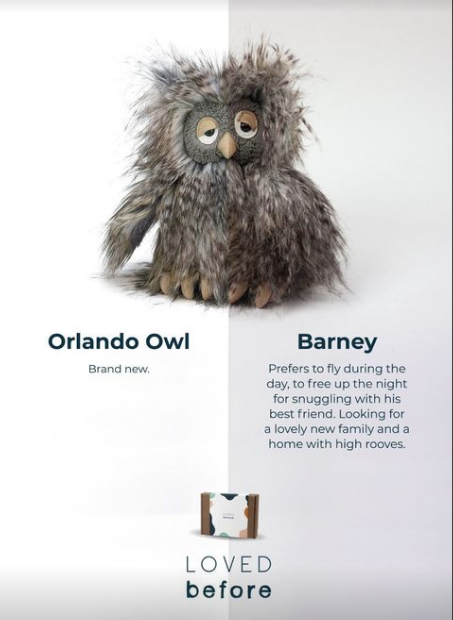
Including your soft toy’s life story is optional, but contributes to the delight of how they will be matched to future families. Loved Before provides prompts to help you become your toy’s biographer, like:
- What are the likes and dislikes of your teddy?
- What is your teddy looking for in a new home?
- Do you have any memories or funny stories with your teddy?
- How has your teddy helped or been special to you?
- Is there anything you’d like to say about yourself?
Package up your soft toy and biography and either book a drop-off appointment at, or ship it to, Loved Before’s HQ:
202 Heath Road
LU73AT
Leighton Buzzard
Bedfordshire, UK
or register to donate it at one of their UK roadshow donations.
UK? Yes, unfortunately for all of us on on this side of the pond, Loved Before currently operates only in the UK. However, they’re looking to expand their efforts globally, and are even seeking volunteers worldwide to reduce the landfill and spread joy.
The Loved Before Spa Experience & Photo Shoot
But wait. Why can these used, possibly shmutzy soft ties be donated? That’s the nifty part!
Loved Before states that although it’s overarching mission is to “change perspectives through the medium of eco-friendly soft toys, our biggest commitment is to ensure all of our pre loved soft toys are safe and clean.”
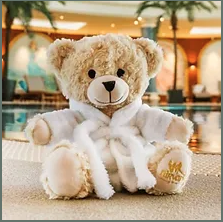
To ensure safety, every toy gets a “health check.” Then, to make sure that every little stuffed friend is sparklingly clean, Loved Before sends them for a full-on spa experience to clean and re-fluff these “pre-loved” toys.
The actual spa process varies by individual stuffie, and depends on the age, condition, and materials of the soft toy in question. All are “thoroughly cleaned, repaired, and disinfected to ensure cleanliness and safety.”
Want to see what’s going on during this process? Loved Before documents the entire experience on their Instagram page (and you can see many of the new adoptees and friends on their TikTok).
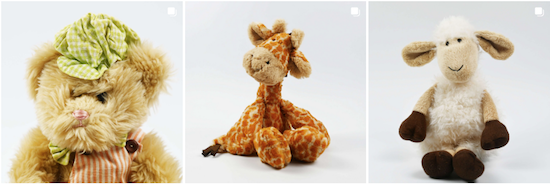
Eventually, your soft friends make their way through the spa for a full shampoo-and-set (plus any necessary refreshing) and then have their own personal photoshoot before being added to the Loved Before adoption center.
The Path to Happily Ever After
Once stuffed friends are spa-pretty and have their photo shoot, they are ready to be adopted, and their photos and stories of their adventures go up on the Loved Before store site in anticipation of them being re-homed to find new their new families!
“Meet” the adoptees newly-ready for adventures by going to the Loved Before website each Monday at 8 pm GMT (3 pm EST). Want a reminder to make sure you get to see each new, delightful adoptee? Subscribe to be sent reminders via a link in the banner!
You can peruse potential adoptees by:
- brand (Aurora World, Beanie Babies, Build-a-Bear, Charlie Bears, Gund, Jelly Cat, Keel, Merrythought, Steiff, Wild Republic, etc.),
- species (bears, giraffes, dinosaurs, etc.), or
- collection (teenies, mythical creatures, woodland or sea creatures, farm animals, famous “celebrity” characters, etc.)
It’s also possible to see who has been recently adopted.
Once you select a new friend to adopt, click to purchase — I mean, process your adoption fees.
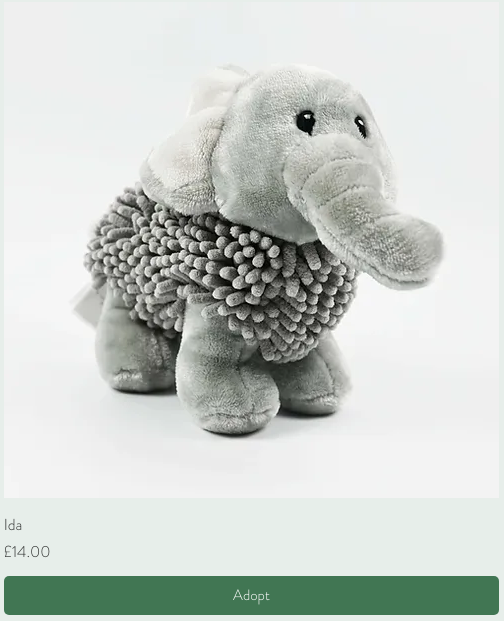
“Meet Ida, the soft toy with a passion for folklore! This little cutie loves listening to stories about mythical creatures and magical adventures. One time, I caught Duha trying to cast a spell with a wand made of popsicle sticks! Always keeping me entertained with their whimsical imagination.”
Loved Before uses fully recyclable, biodegradable, and sustainably sourced materials for all packaging.
The Benefits of Loved Before
Original families who no longer have the space for, or the tiny humans to give attention to, the soft toys can lovingly find them refreshed bodies and new families.
Children (and adults) have the delight of finding new eco-friendly chums with whom to share adventures.
The landfill stays clear of stuffies.
At least half of the profit from each sustainable soft-toy adoptee goes to Make-A-Wish UK. (Read more about Loved Before’s charity model.)
Final Thoughts
Yes, Loved Before is in the UK, so it’s much farther away than the 100 Acre Woods to send your stuffies or adopt from there. Still, it’s heartwarming to read about the little friends who’ve found new lives with their new families in an environmentally sound way, and we can be hopeful that their efforts will go global sooner rather than later. Here’s the latest update on that very thing!
(P.S. If anyone knows how to center a YouTube short on WordPress, please let me know in the comments!)
Paper Doll Explains Aspirational vs. Inspirational Clutter
Do you ever think about all the different flavors of clutter?
A few years ago, I wrote The Boo-Hoo Box: Organizing Painful Clutter.
In that post, as a precursor to discussing the kinds of heartbreaking clutter people keep, I introduced some of the major categories of clutter, and this is worthy of a review as we explore today’s topic.
CATEGORIES OF CLUTTER
When working with my organizing clients, we tend to identify six different kinds of clutter (though these are only the main ones — there are others).
- Practical clutter — These are things that are useful, in and of themselves, like clothing, bedding, or kitchen implements. It’s not that we don’t need these things, but we generally don’t need so many (black skirts, frying pans) and we need to let go when specific items no longer suit our needs.
- Informational clutter — We keep documents and clippings, whether on paper or digitally, because we believe the information is valuable. The problem is that we rarely go back to consider how valuable something is now vs. when we acquired it, and we tend not to think about whether it might be better to eliminate (outdated) information, digitize it, or access the information anew via the internet to reduce the bulk.
- Identity clutter — Sometimes, the clutter we keep is an excess of items that we feel help define us. Our clutter may not be useful (in a practical sense) but we perceive it as useful for defining who we are or who we wish to be seen as. Our clutter might say, “I’m the kind of person who runs marathons [or wins spelling bees or bakes from scratch].”
- Aspirational clutter — This type of clutter accounts for all of the items in your space which support hobbies you tell yourself that you are going to take up, but never really do. Whether you are saving a closet full of fancy papers and Cricut gadgets for the day when you finally decide to become a scrapbooker or amass shelves of books on the topic of “How To [train championship Greyhounds, write a novel, become a successful crypotocurrency miner],” there comes a point when you’ve got to recognize that you have an excess of items supporting a life you don’t really lead.
- Nostalgic clutter — Nostalgia is defined as “a sentimental longing or wistful affection for the past, typically for a period or place with happy personal associations.” Obviously, life is made better by the things that truly remind us of happy (or happier) times, but an excess of nostalgic emblems of our past can fill up our homes in the present and prevent us from having space in our lives to make a future. Sometimes, we just have to take photos of those ancient macaroni art projects and discard the originals, letting them crumble in peace.
An excess of nostalgic emblems of our past can fill up our homes in the present and prevent us from having space in our lives to make a future. Share on X - Painful or sad clutter — This category encompasses things that remind us of bad times or bad people.

Break-Up Photo by Kelly Sikkema on Unsplash
Clients tend to have a good handle on both practical and informational clutter. Someone might save useful things that they used in the past (or acquire in the present) because they might be useful now or in the future; the same is true of clippings or online information in case they might be desired later.
Identity clutter, nostalgic clutter, and painful clutter is almost always about the past. But as we’ll see, aspirational clutter is about the future.
WHAT KIND OF CLUTTER IS IT REALLY?
Too often, we think of clutter as if it were a monolith. Yes, a house full of clutter is daunting, but identifying what kind of clutter something is helps us determine why we’re holding onto it so we can (eventually) confidently let it go.
I do prospective client consultations by phone; this gives me a chance to get to know what a client may need and helps them determine whether they like my philosophy and can bear my goofy sense of humor. Early on, I ask them to describe what kinds of clutter they have.
I’m not looking for a hierarchy or categorization, just a sense of what “stuff” is bothering them. Usually, I hear something like: too many clothes that don’t fit (or don’t fit in the closet); outgrown children’s toys; an overwhelm of papers, books, and digital media. This gives me an idea of the tangible items needing attention. However, once in people’s homes, I’m able to see that clutter is not so simple.
For example, a closet filled with maternity clothes may reflect that that a client has spent a number of years bearing and raising kids. If she’s in her 30s, this may just be practical clutter. She’s been pregnant one or more times, acquired clothing through shopping and gifts, and hasn’t yet winnowed the collection down. However, if the woman is older, perhaps in her 50s or 60s (and her own children are already having babies), she may be holding onto the clothing out of a strong sense of nostalgia, remembering fondly when her family was small (but growing) and possibilities were endless.
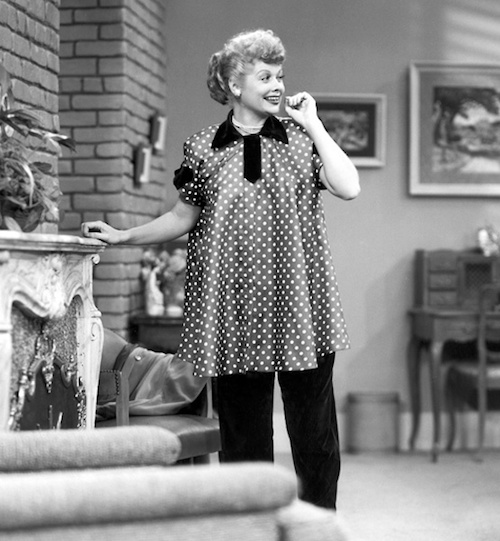
It’s even possible that now that her children are adults, she may feel adrift and unneeded. At this point, all of the maternity clothes can be identity clutter, items that people hold onto out of fear of becoming unmoored from their identities. If the woman’s sense of self is closely tied to being a mom, the idea of letting go of those clothes may feel very much like letting go of one’s sense of self. Until a client is prompted to discuss the possessions in question, the category of clutter may not yet be clear.
I recently spoke with an older couple who were hoping to downsize in advance of an eventual move to senior living. When I asked them to describe how they felt about downsizing, the husband recounted that every time he thought about letting go of materials related to his career and hobbies, it made him feel like they (and now he) lacked worth.
Ouch. That showed incredible self-awareness on his part, as well as a pain point. I gently asked him to consider that his identity exists in his memory and in the memories of all who worked with him and knew him.
His adult daughter, also on the call, riffed on some things we’d discussed earlier about donating items, and reminded him that these could be a living legacy if donated to an organization related to his former profession; his materials could find a new life with someone who needs them rather than just rusting away in a storage unit, unused and unnoticed. His identity could actually get refreshed through possessions finding a new life as something other than clutter.
Proud possessions from the past can become clutter in the present and the future, but self-awareness and analysis can open our eyes to options and opportunities.
ASPIRATIONAL CLUTTER VS. INSPIRATIONAL CLUTTER
This brings us to considering things we have acquired (and continue to acquire) for the future.
After a client and I discussed painful clutter and how the Boo-Hoo Box can counter emotional pain, she mentioned that she had a lot of items she’d purchased to inspire her to overcome emotional distress. She said that what I called aspirational, she considered inspirational. It’s a great point, and I think it might be helpful to look at how aspirational and inspirational clutter can be similar and how they are different.
Aspirational Clutter
The way I look at it, aspirational clutter is made up of items that support hobbies or activities you tell yourself that you are going to take up, but never really do. They’re gathering dust. It’s clutter because they can be used, but you aren’t using them. Examples include:
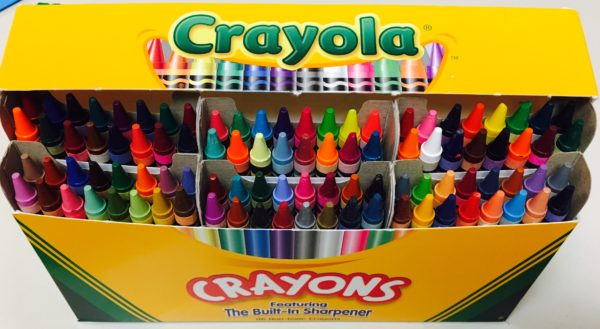
- Crafting and art supplies — Over the years, I’ve visited a lot of clients homes where cabinets and even rooms are overflowing with yarn and needlework supplies, boxed up sewing machines, canvases, paints and brushes, and packaged art projects. They’re bought with the aspiration of tapping into creativity and expressing artistic talents. But so many people accumulate art supplies without actually dedicating time to create art.
- Exercise equipment and fitness devices — From gyms to treadmills and Pelotons to fitness trackers, they exist because we aspire to be fit and svelte. Gym memberships can be financial clutter; home equipment and trackers might be tangible clutter. We buy them because we aspire to improve our physical health and believe they’ll get us to work out and track our activity. But if we never unbox the trackers or walk on the treadmills and end up using the equipment to hang cute workout clothes we wear (but don’t work out in), it’s aspirational clutter.
- Gardening supplies — Got pots? Seeds? Trowels and knee pads and garden storage? Oh, my! Do you aspire to cultivate a green thumb or make everyone in the neighborhood association green with envy? If you never slice open those seed packets or remove the price tags from the tools, you’ll make your self green around the gills with how much you’ve spent on untouched aspirational clutter.
- Outdoor gear — My sister once had a blind date lean across the table and ask, “Don’t you just love camping?” No, she did not. We do not. But some people would be better off buying stock in REI rather than throwing down money on bikes, boats, hiking gear, camping equipment. Do you aspire to be an outdoorsman or outdoorswoman but never make the time or take the first step to go outside?
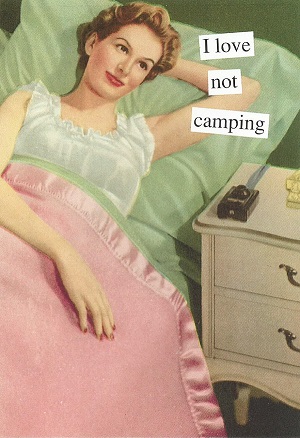
I love this Anne Taintor card, sold by Quiltinia. You can also get magnets at Artworks.
- Clothes that don’t fit your life — I went through a stage where every time I went shopping, I tried on little black dresses, suitable for fancy dinner parties. But I never went to dinner parties. I was craving a wardrobe for an imaginary life to which I aspired. (TV in the 1970s and 1980s set me up for thinking I’d be going to a lot of dinner parties, even Mary Richards’ famously bad ones!)
- Musical instruments — When digging through client’s basements or closets, I find dusty electric keyboards or drum sets, or out of tune pianos. Having the intention of learning an instrument (or revisiting childhood lessons) is understandable, but if you never get an instructor, schedule lessons, or practice, it’s an unfulfilled aspiration.
- Cooking gadgets — I get it. The pandemic made everyone aspire to be a sourdough artiste. But if you’ve got a plethora of bread machines and pasta makers, and drawers bulging with immersion thingies, but you order Door Dash every night, your plan of becoming the next Barefoot Contessa might be a pipe dream.
- Language education tools
- Photography equipment
- Travel Gear
These last three tend to go together. People buy books, recordings, and software courses to learn foreign languages. They purchase luggage and compression cubes, plus all manner of travel guides, to use on those trips where they impress the populace with their fluency in the native language. And oh, the cameras, lenses, and accessories they buy with the intention of learning about f-stops and taking social media influencer-level photos on those trips.
But if they never practice the language, figure out how the photo equipment works, or book the trips, it’s all just layers of aspirations that go unachieved. Shopping provides that dopamine hit that scratches the itch in our novelty- and reward-seeking brains. But when purchases go ignored, the clutter sneers at us.
(Aspirational clutter is a close cousin of nostalgic or identity clutter. If you formerly used something and keep it to maintain a happy connection to the past or how you see yourself, it could be nostalgia- or identity-driven, but if you’ve never used it at all, that’s purely aspirational.)
Inspirational Clutter
If aspirational clutter is “stuff” that supports who you’d be if you’d do something, inspirational clutter is the tangible reflection of ways to motivate you not to do a specific activity, but to live a “better” way. Inspirational clutter is (usually) commercially-created and message-oriented, designed to make you live out certain values:
- Motivational posters and wall art — If it features an inspirational quote or affirmations and reminds you to “Live, Laugh, Love,” but it’s gathering dust in the closet or you’ve stopped even noticing it on the walls, it’s inspirational clutter.
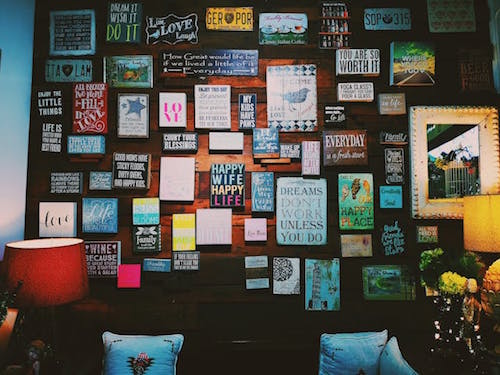
Cluttered Wall of Inspirational Clutter Photo by Mikechie Esparagoza
- Calendars, sticky notes, and affirmation cards – Ditto. All the positive, empowering, and encouraging messages in the world, no matter where you stick them (if you’ll pardon the expression) start to become like wallpaper (or “parsley”) if you don’t notice them.
- Self-help and personal development books — Obviously, as a published author myself, I believe in the power of books that focus on organizing, productivity, self-improvement, personal growth, etc. But buying the latest Brené Brown book and leaving it unread on the bedside table won’t really inspire you. It will mock you.
- Spiritual or religious books and recordings — My clients often own recordings of sermons from their houses of worship (or, quite often, family members’ houses of worship, sent to them with kind intent). The content of the material is inspirational, but there is nothing inspiring about old cassettes, DVDs, or prayer group handouts collecting dust in random corners. Words unread or unheard are meaningless.
- Mindfulness apps — Digital motivational clutter could be its own category. Whether it’s an app for guided meditation, relaxation techniques, or mindfulness exercises, if you’ve never even signed in because it requires setting up yet another password, what does it inspire?
- Blank journals — Wow, people buy (and get gifted) a lot of blank journals. Although I’ve never been able to get the hang of journaling, the research is clear that writing by hand, whether gratitude journals or Julia Cameron’s morning pages, has the positive effect of fostering optimism. But piles of blank notebooks (ignored year after year) foster nothing but dead trees!
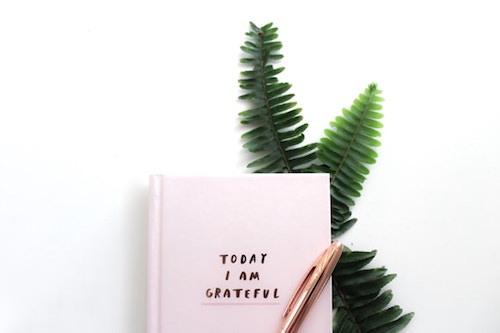
Gratitude Journal Photo by Gabrielle Henderson on Unsplash
- Seminar notes — You can gain tremendous insights at workshops, seminars, and personal development conferences. If going to these events inspires you, keep going! But whether you painstakingly take notes you never look at again or buy the workbooks and lesson plans the speakers and coaches sell, if they are still shrink-wrapped years or decades later, free yourself from the obligation to go through them “someday.”
HOW DO ASPIRATIONAL AND INSPIRATIONAL CLUTTER COMPARE?
There are definite similarities between the two types of clutter.
Perceived Value — Sure, there’s monetary value. You (or someone) spent money on this stuff. But there’s also the value you place on their potential to bring you closer to the life you want to live.
Aspirational clutter (before you recognize it as clutter) holds potential for doing, while inspirational clutter is valued for its anticipated ability to change how you think, feel, and (possibly) act.
Emotional Attachment — Both types of clutter have emotional heft, and decluttering without dealing with the underlying issues can lead to emotional distress.
Aspirational clutter may represent ambitions or dreams that have never been fulfilled, and letting go of the items before reckoning with that can feel like dashing those dreams, leading to a sense of grief. Letting go of inspirational clutter before coming to terms with the diminished (or imaginary) value may evoke a loss of self-worth.
Intentional Acquisition — People generally acquire both types of clutter with good intentions. Whether you buy equipment for a hobby or motivational wall hangings to boost your mindset, the initial intention is positive: a way to enrich your life.
In both cases, the common thread may be the lack of intentionality. Not all gifts are equally desired by the recipient. Ahem.
The differences between aspirational and inspirational clutter come down to the why and the what:
Intended Purpose — Again, aspirational clutter builds up when people intend to pursue hobbies or activities, either out of true desire or hope of becoming “the kind of person who (does X).” Conversely, inspirational clutter comes not from a desire to do something, but to be a better person, either in their own eyes or the eyes of others.
Actual Outcome — Whatever the desired outcome, the two types of clutter tend to yield different effects.
Aspirational clutter often leads of feelings of guilt or frustration over wasted money, lost space, or inconvenience. Inspirational clutter usually has a less deleterious effect; people feel less like they’ve “failed” if they’re still being reminded to “Be the change they wish to see in the world” than if they have spent hundreds or thousands of dollars on hobby materials that fill the closets and cabinets.
Inspirational clutter tends not to yield the same level of guilt or shame as aspirational clutter; it’s also more easily ignored.
REDUCING ASPIRATIONAL AND INSPIRATIONAL CLUTTER
As I previously said in defining aspirational clutter, there comes a point when you’ve got to recognize that you have an excess of items supporting a life you don’t really lead.
There comes a point when you've got to recognize that you have an excess of items supporting a life you don't really lead. Share on XApproach reducing both types of clutter from logical and emotional perspectives.
Reality Check
For aspirational clutter, get real. Analyze how functional the items really is; is it so old, it’s not useful anymore? Is it way beyond the skill level you’re reasonably likely to achieve?
How feasible is it that you’ll invest time in pursuing the activities you’ve ignored? Questions like, “Have I used this item in the last year (or ever)?” are less productive than asking, “Am I willing to start doing this thing (scheduling lessons, getting out in the garden) this month?” If you’re not going to prioritize time for an activity, send the aspirational clutter packing.
Groove is in the Heart
For aspirational clutter, talk about your emotional attachment to the what’s behind the items; what do they mean beyond their ability to create art or make music or improve the garden? Reflect on the significance of the objects, and whether they still represent what you want to do, or if they are echoes of a former version of yourself.
For inspirational clutter, reflect on whether the items are in alignment with your current goals and values. Do you actually need these items to achieve your true and higher self?
Do the messages on all those wall hangings still genuinely inspire and uplift? Do they actually sometimes make you feel pressured or inadequate? Or are they parsley, unnoticed and unappreciated? Surround yourself with fewer messages, but ones that truly resonate with who you want to to be right now.
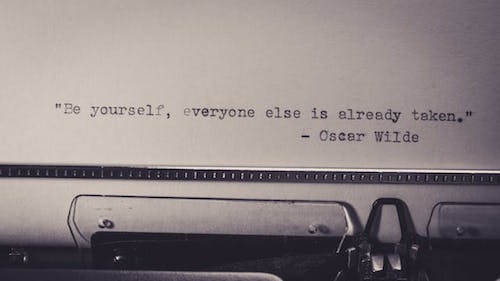
Oscar Wilde Quote Photo by Matej
Think Gratitude, Not Guilt
Even enjoying a sense of freedom, people sometimes feel guilty about letting clutter go on so long. Shift your focus toward being grateful that you’ve developed the ability to recognize your evolving self.
If you like, take Marie Kondo’s advice and express gratitude to (or at least for) things you’re letting go of, knowing they can bring joy to someone who will want, need, and use them.
Once you understand the similarities and differences between aspirational and inspirational clutter, it’s easier to identify your own examples and assess them more critically. Cultivate spaces that authentically support your goals and well-being.
Paper Doll Shares 12 Kinds of Paper To Declutter Now
After last week’s 24 Smart Ways to Get More Organized and Productive in 2024, we continue with GO Month, an entire month devoted to getting organized and being productive. I thought it might be time to hit a classic Paper Doll topic topic: decluttering papers!

Quite often, Paper Doll focuses on the papers and documents you need to acquire and keep. Always start with the essentials:
How to Replace and Organize 7 Essential Government Documents
How to Create, Organize, and Safeguard 5 Essential Legal and Estate Documents
The Professor and Mary Ann: 8 Other Essential Documents You Need To Create
Ask Paper Doll: Do I Really Need A Safe Deposit Box?
However, we must also look at what we no longer need, and what papers we’d be better off without.
OLD RECEIPTS
Some people throw out all of their receipts. Their desks, bags, dresser-tops and bedside tables are clear of crumpled papers, but they have trouble reconstructing their financial history at tax time, they can’t figure out where their cash went, and can’t prove ownership or value of high-ticket items.
More often, people go to the opposite extremes and keep all of their receipts. When working with clients, I’ll often find zip-locked bags and drawers filled with random receipts. In addition to receipts strewn about, the collected and squirreled-away receipts tend to be older, anywhere from a year to five+ years in the past.
These clients have a vague sense that someone once told them to save receipts in case they needed to return something or create a budget based on tracked expenses. The problem? Neither of these well-intentioned reasons are based on a realistic view of their paper-cluttered lives.
Yes, you should hold onto receipts for purchases you might return, but most return policies that limit how long after the purchase something may be returned. In general, you’ll need the receipt to return something for a full refund for up to 30 days after purchase; after that, the best you can hope for at most retailers is store credit. (Stores vary, and Nerd Wallet has a great piece, Return Policy Guide: What to Know and Which Stores Stand Out, on the most generous return policies at stores like Costco, Kohl’s, and IKEA.)
Similarly, if you were going to track your expenses to create a budget, receipts from years ago won’t help now. Paper Doll gives you permission to start fresh with January (and last week’s receipts) and let go of the bulk of your random receipt clutter.

Woman with Receipts Photo by Karolina Grabowska at Pexels
Reasons to Keep Receipts
There are five main reasons to keep receipts, and none are “forever” reasons:
1) The item is returnable — only keep the receipt until the return period ends.
2) It’s a big-ticket item — keep a Big-Ticket Purchases folder for these kinds of receipts in your financial filing section.
Figure out your comfort level to determine whether “big-ticket” is $50 or $500 or $5 zillion; if the receipt is above a certain threshold, you may want to add a rider to your homeowners or renters insurance policy.
The IRS allows taxpayers to choose between deducting state taxes and sales tax; if you opt for sales tax, the default amount is often the wisest option; however, you’ve purchased a house, auto, boat, private plane, or personal rocket ship, you’ll definitely want proof of that big ticket deduction.
3) The receipt helps you prove ownership. This tends to go along with Big-Ticket items, as you’ll rarely be asked to prove that the soon-to-be-moldy asparagus in your fridge actually belongs to you.
4) The receipt is for something tax-deductible. Non-business purchases are more likely to be deductible if they’re related to healthcare, government fees or taxes, child/dependent care, or tax credits for things the government is trying to promote, like environmentally beneficial or energy efficient home improvements.
5) The purchase will be reimbursed by someone (employer, insurance company, etc.) at a later date.
Additionally, if you’re divorcing and seeking alimony and/or child support, you may need to collate receipts to prove the costs of life maintenance.
Here are some basic guidelines for the receipts you can discard, with a few caveats.

Crumpled Receipt Photo by Michael Walter on Unsplash
Cash Receipts
- Let go of cash receipts for consumable products (like food and beverages) whenever you want. If you’re not tracking expenses, you can toss them immediately. You can even refuse to accept receipts.
If you buy a Slushie at 7-Eleven or a burrito at the taco truck and pay with cash, you’re generally safe tossing receipt — unless you watch too many Law & Order reruns and are convinced you need to be able to prove your time-stamped whereabouts at all times.
- Keep cash receipts for things you might return, but only for the duration return period. After the return policy, buh-bye!
For example, if you buy clothes, a toy, or anything for your home, car, or family with cash, keep a plain #10 envelope to stash purchase receipts. Keep the envelope near where you handle your daily finances so that you know where to find receipts if you need to make a return.
Set a reminder, perhaps on the 5th of every month, to flip through the receipts. Once past the store’s return policy, shred the receipt.
The above assumes you’re not buying fancy-pants, expensive things with cash (and that you are not a member of a Sopranos-style crime family. If you are, please confer with your accountant.)
Debit and Credit Card Receipts
- Keep debit and credit card receipts until the return period has expired and you’ve eyeballed your statement or online account to verify that the final price is accurate.
As with cash receipts, pop credit card and debit card receipts in that #10 envelope. If you get paper statements for your bank and credit card accounts, reconcile the values monthly when your statements arrive. If you no longer get statements, reconcile receipts against your running online account weekly.
Deposit Slips and ATM Withdrawal Slips
If you think about it, a deposit slip is really a receipt, only instead of paying a store or service provider for what they’ve given you, you’re paying the future version of yourself who will spend that money later.
As for the five reasons to keep receipts, none particularly apply here. If you wanted to return the cash you withdrew, you could do that without the ATM slip, and taking or giving back your own money doesn’t involve tax deductions. Reimburse-ability doesn’t apply. The “big ticket” status isn’t applicable with withdrawals (as banks limit how much you can take out in one day); deposits are a little stickier, as there’s a paperwork rigamarole to go through if you ever deposit more than $9,999.99.
Of course, if you’re sort who worries about that pesky Law & Order issue regarding your whereabouts, you might also fear having to prove ownership of the money you’ve withdrawn.
In general, treat these as if they were debit or credit card receipts, and save them until your bank has accurately recorded the information. (But if you are making manual deposits of $10,000 or more, note the purpose, save the receipts, and tuck them in your tax prep folders just in case the amounts are questioned in an audit.)
A Few Other Notes About Receipts
Your pharmacy will print a summary of all prescription purchases. Once you’ve checked your receipts against your bank or credit card statements, you can shred pharmaceutical receipts; just ask your pharmacy to provide printout in early January for the preceding calendar year. (It’s to your benefit to only use one pharmacy so you don’t have to keep track of these things. If you must use a different pharmacy — if you’re on vacation or your regular pharmacy is out of your prescription medication — save those receipts.)
Collect all receipts for tax-deductible expenses (like charitable donations, or medical and pharmaceutical expenses in your Tax Prep hanging folder until you’ve completed your taxes for the prior year. (You won’t know until the end of any given year whether you accumulated a high enough percentage of your adjusted gross income to deduct itemized expenses.)
Keep receipts for anything for which you are due reimbursement until you get paid. This may include:
- Work and travel-related expenses where your company reimburses you. Label a folder “Reimbursable Expenses” and toss receipts in there. Set a reminder on your calendar for the week prior to when expense reports are due, to ensure you don’t put it off and delay recouping your costs.
- Healthcare expenses for which your health insurance company reimburses you. Usually, you pay a co-pay or co-insurance to a healthcare provider, but sometimes providers won’t file insurance claims. You may have to submit documents from the provider, plus your receipt, and forms directly to your insurance company to get reimbursed for medical expenses.
- Sometimes, you’ll need to submit receipts to your car or homeowners/renters policy insurance company for repairs done to your auto or home. You might need to submit receipts to someone else’s insurance company if the other party was at fault. Always keep the original and provide them with photocopies).
If you’re reimbursed for a high-dollar amount for anything unusual, keep the receipt and the proof of reimbursement in your tax prep folder. If audited, it will be easy to say, “Hey, I anticipated that you’d wonder about this! So, here’s the receipt where I chartered a helicopter to get my boss to the top of the mountain for a super-important meeting, and here’s the income you’re questioning, where I was reimbursed for what I paid out.”
Always have a system for collecting your receipts until you get home. Do not stuff receipts in your coat pocket, no matter how many people are behind you in line. Do not put receipts in the shopping bag, because it’s too easy for them to fall out in the car, or for the bag to be discarded with a receipt still inside. Make 2024 the year you resolve not to have any crumpled receipts in your pockets or your car!
[We’ll take a fresh look at digital receipts in a future post, but the rules regarding what you can let go of are the same for digital as paper.]
OLD HOUSEHOLD UTILITY BILLS
It’s common for me to find that clients have saved multiple years of old electric, gas, water, and sewer bills. They shrug. Someone, somewhere, told them they were supposed to save all records.
People’s parents (particularly fathers) rightly told them that it’s important to keep all records regarding auto maintenance. A full and detailed record helps boost the resale value of a car. (Secondarily, if there’s a recall, the car owner can get reimbursed for work previously done.)
The thing is, even if you keep meticulous records, a prospective home buyer isn’t going to offer you more for your house based on ancient utility bills. Knowing what it cost to heat your home in January or cool it in July back in 1992 is not useful information!

Little House Photo by Kostiantyn Li on Unsplash
Keep paper utility statements for the prior calendar year and the current one, just so that you can easily compare year-to-year (for example, to trace the likelihood of a leak vs. “Oh, yeah, July water bills are always high because we use the Slip & Slide). Shred the older ones.
(Note: if you take a tax deduction for a home office for your home-based business, keep utility bills as supporting documents for business tax returns.)
OLD INSURANCE POLICIES
People have a habit of keeping really old insurance policy paperwork.
I advise that if you don’t have any pending claims against your insurer and nobody has a lawsuit against you, it’s OK to shred old declaration pages and toss the generic boilerplate from old home and car policies. You may want to keep the front page of the policy listing the old policy number and contact information for the insurer.
With health insurance policies, if you’ve changed policies recently, I find it’s helpful to keep the paperwork related to coverage you had in the prior calendar year. While medical providers are supposed to process claims within 90 days, I’ve seen where physicians’ offices were so disorganized they were trying to recoup fees (either through insurance or directly from patients) more than a year later. Keeping the essential info about the policy can help if you get caught with “zombie” claims. But policies older than the prior calendar year, unless you’re still fighting about claims, can be shredded.
One insurance policy caveat: If you cash in a life insurance policy, either for the cash value or after someone has passed, make sure you log that you have done so. I’ve worked with clients where there’s been great excitement upon finding old life insurance policy paperwork, only to learn the original policy holder cashed in the policy up to 50 years earlier, but never destroyed or discarded the old paperwork. Bummer.
For clarity, if you cash in a policy, make a note somewhere accessible (like your inventory of assets and debts) so that your future fuzzy brain or your inheritors can make sense of what happened.
EXPIRED WARRANTIES
If the warranty or guarantee period has already expired, toss out the warranty/guarantee card. (If it was a bigger ticket item and you’d stapled the receipt to the warranty card, make sure the receipt gets saved.)
If you no longer even own the product associated with the warranty or guarantee, dunk it like a basketball! Swoosh! (But shred the receipt.)
MANUALS FOR THINGS YOU DON’T OWN (AND SOME YOU DO)
If you don’t own the thing anymore, you don’t need the manual!
If you own the thing, but know how to use it, you don’t need the manual! (I often joke that if you don’t know how to use your toaster or hair dryer, you have a bigger problem than clutter.)
For guidance, there are ways to pare down and organize your manuals, find digital alternatives, or even digitize your collection to help keep things streamlined:
Paper Doll’s Manual Override – Part 1: Declutter and Organize Owner’s Manuals
Paper Doll’s Manual Override – Part 2: Twelve Resources To Find An Owner’s Manual
Paper Doll’s Manual Override – Part 3: Create & Organize A Digital Owner’s Manual Library
OLD DRIVING DIRECTIONS MADE REDUNDANT BY GPS

As you go through your files and piles of old papers, you may find driving directions to anywhere from hotel venues to summer camps to doctor’s offices.
If you’re never going there again, toss the paper. If Siri or Google Maps can get you there, toss the paper. If there’s anything special about the directions (maybe for the last tenth of a mile) and you could get the information again easily, toss the paper. If that last bit of the trip requires special instructions, create a contact (for the venue, the camp, or the office) in your phone and put those final, special directions in the “Notes” field.
DUPLICATE DOCUMENTS
Have you ever accidentally printed a copy of something multiple times and kept the copies? If the item is a form or a template you have to share (physically) with others and can’t just forward a digital file, make a folder. But if you just have random duplicate or triplicate or seventeenplicate of something you printed for no discernible reason, recycle or shred, as applicable.
OLD BOARDING PASSES
Yes, most of us now use digital boarding passes, but if anything changes about your flight, the nice typey-typey airport people will give you a new set of paper boarding passes. When you get home, don’t toss them in a pile with other crumpled receipts. Old boarding passes are of no future use to you. Shred them!
FYI, those QR codes along the edges have all sorts of personally identifiable information about you. They may not be useful to you, but leaving them out on your desk for anyone to find makes it easier for someone to purloin that information.
OLD CONFERENCE PAPERS AND BINDERS
Not all conference material is created equal. Go through your old conference binders and folders, especially those from early in your career. Be ruthless about letting go of handouts and notes related topics that no longer interest you or fields of study in which you never worked, or never intend to work again.
Trust that any information you want can be found again, and found more easily than spelunking in piles of old binders in the back of a closet.
Similarly, get rid of flyers, programs, and any other conference materials that don’t contain essential information.
JUNK MAIL

Did you ask for it? Do you want or need it? No? It’s junk! Instead of letting it pile up, shred it and sent it on its way. To stop junk mail in its tracks:
- Opt out of credit card and insurance offers for 5 years by going to optoutprescreen.com or call 1-888-5-OPT-OUT (1-888-567-8688), operated by the major credit bureaus. You’ll have to supply personal information like your name and address. They’ll also ask for your Social Security number and date of birth; it’s optional, and they’ve always claimed it’s confidential, but this is the 21st-century, so who knows?
- If you prefer to opt out permanently, start the process at optoutprescreen.com or call 1-888-5-OPT-OUT, but to complete the request, they’ll make you sign and return a Permanent Opt-Out Election form.
For other kinds of marketing junk mail, register at the Direct Marketing Association’s (DMA) consumer site, DMAchoice.org and pay a $4 processing fee for ten years of protection from most (but not all) junk mail.
OUTDATED, LOW-QUALITY, OR IRRELEVANT INFORMATION
I once worked with a (very) organized author. I initially joked that I wasn’t sure how I could help, as her office seemed orderly and tidy. However, when we looked in her files, I saw the problem.
The client wrote novels with storylines that included medical information, so she’d saved a few decades of internet printouts regarding diagnoses and treatments of various conditions. In almost every folder, any clip from the web from more than two or three years earlier was completely outdated. While some fields may include timeless information, research related to the sciences is likely to be superseded by newer data and analysis each year.
Unless your actual job description requires analyzing what used to be advised or believed vs. what is now known to be true, toss the outdated information.
Similarly, let go of any clipped articles or printouts that reflect information you already know (or that has become common knowledge), that has been disproven, lacks credibility, or isn’t related to your work or interests.
Tips from 1999 on traveling to Europe won’t fly (pun intended) in a post-9/11 world, but even advice from pre-COVID may not be valid. Introductory-level parenting articles from when your kids were tiny might have been useful, but if you’re cruising toward grandparenthood, you’ll find guidance has changed. Just let the internet be your filing cabinet!
DAMAGED PAPERS
This should go without saying, but discard any papers that are damaged due to water, fire, or animal predation. Papers with tiny blobs of mold can damage your neurological and pulmonological health. If a piece of paper is readable but yucky, digitize it (but then disinfect your scanner).
FINAL RESOURCES
You’ll be delighted to lessen your paper clutter knowing that much of what you’ve saved (due to misinformation, fear, or just plain inertia) can go. However, anytime there’s anything personally identifiable in your papers, make sure you shred them.
Paper Doll’s Secrets: Shred Successfully & Save Money is a good resource for making it easy to destroy what you don’t need and prevent identify thieves and other sneaky folks from benefiting from your decluttering.
Finally, knowing what to get rid of is only part of the paper decluttering process. For a full-on look at strategies for knowing papers to keep, and for how long, check out my classic ebook, Do I Have To Keep this Piece of Paper.
Follow Me