Archive for ‘ADHD’ Category
Paper Doll Shares 5 Organizing and Productivity Podcasts to Add to Your Playlist
Recently, I caught up with a friend I hadn’t seen in a while. We chatted about what I’d been doing (working with clients, visiting Paper Mommy, and not blogging) and what he’d been doing (work, complaining about work, and doomscrolling). I mentioned that when the world gets too much for me, that’s my cue to clean out my junk drawer (as in Is Your Junk Drawer a Drunk Drawer? 3 Steps to An Organized Junk Drawer) or otherwise dig into some project that will absorb me, physically and mentally.
He was dubious. (I understand. Not even organizers want to organize all the time.) Then I shared the New York Times‘ Wirecutter column, 118 Things to Do Instead of Doomscrolling.
As an alternative to reading about war, crime, politics, and the whole general <waves arms around in dismay> everything, the piece promotes varioius typical and offbeat tasks. There’s advice to read and write, cook and make art, play games, train pets, learn origami, write a thank you note, and tend to houseplants. The piece also suggests learning to make latte art, chatting with a farmer about their favorite produce, and rewriting the end to your favorite book/play/movie/TV show.
I wasn’t exactly shocked that amid the more entertaining and physically active pursuits, the only organizing tasks that made it onto the list were at #39 (organizing the medicine cabinet) and #43 (do some “soft decluttering”). However, I was surprised to find that podcasts weren’t listed among these uplifting methods of distraction.
Podcasts abound, and it seems as though almost everyone has one! (Paper Doll does not. I like being a guest on podcasts, which is much like playing with someone else’s baby — all fun and very little ongoing responsibility.) I realized that it’s been four years since I posted Paper Doll Picks: Organizing and Productivity Podcasts and Paper Doll on the NAPO Stand Out Podcast: Why Paper Still Matters, so it’s definitely time for an update, especially as so many of my friends and colleagues have entered the podcast space.
Listening to (or watching) podcasts focused on organizing- or productivity-related topics has a variety of advantages. In addition to providing an alternative to doomscrolling, keeping your mind active, introducing you to new resources, and giving you something to talk about when the conversational well runs dry, a good organizing or productivity podcast can help you solve problems you hadn’t considered having achievable solutions.
In this post, I’d like to introduce (or re-introduce) you to some podcasts I think you’ll find appealing.
SIMPLE ENOUGH
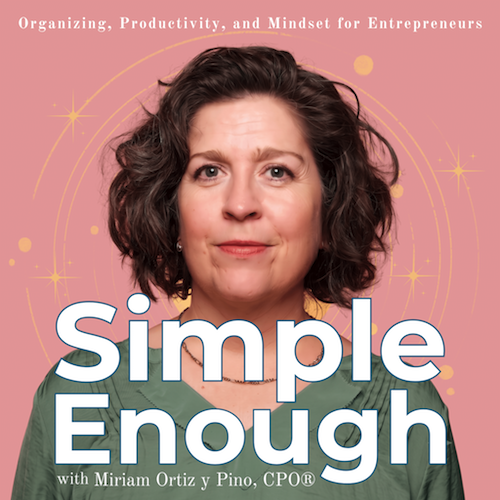
My friend and colleague Miriam Ortiz y Piño of More Than Organized in Albuquerque, New Mexico is a Renaissance woman. Like me, she’s an inaugural Certified Professional Organizer®. She’s also a Money, Mindset, and Marketing Coach, and a Streamlined Money Breakthrough Business Coach, and I had the pleasure of being one of her clients early in the pandemic when we were all trying to figure out the art of the “pivot” during unprecedented times.
Now, as a few months ago, Miriam is a podcaster!
Simple Enough: Organizing, Productivity, and Mindset for Entrepreneurs is the perfect extension of Miriam’s expertise as an organizer and business coach. Here’s her own description of what she brings to her audience:
Do you have no shortage of ideas or ability, but still feel buried under decisions, half-finished projects, clutter, and systems you started but never quite finished? Simple Enough is for entrepreneurs, creatives, and overthinkers who want a calmer, clearer way to organize their space, decisions, mindset, and life – without forcing themselves into someone else’s system.
Miriam takes the conversation beyond the “how do I fix this” and gets to the nitty-gritty of “why did this get like this in the first place?” because she knows that there are always underlying issues, and until you figure those out, the problem (or the clutter) will keep coming back.
If your get-up-and-go has got-up-and-went, and you’re having trouble finding the motivation and clarity to achieve your personal and professional dreams, dial up a few of Miriam’s recent podcasts to see how her perspective can help you find some of your own. Check out some episodes like:
- Organizing Starts with the Dream, not the Stuff
- Why You Can’t Let Go of Stuff: How to Decide What to Keep
- Downsizing Without the Overwhelm
- Company is Coming: How to Get Your Home Ready for Guests without the Panic
- Your Home Office is Working Against You
As Paper Doll, I hold special affection for the episode, How to Organize Paperwork So You Can Find What You Need, but you could also dive into a more iconoclastic episode, The Organizing Rules You Never Need to Follow.
Find Miriam’s Simple Enough podcast at her Substack on the web or in the Substack app, or on YouTube, Apple Podcasts, Spotify, Pocket Casts.
RETHINK TIME, a Podcast by Time Timer
Longtime Paper Doll readers know how much I adore Time Timer as a resource: for teachers, parents, and therapist when working with children, for people with ADHD, and for anyone who has a complex relationship with time. I’ve written about Time Timer’s timers, app, and approach numerous times, most recently in:
- How to Use Timers for Improved Productivity and Focus — Part 3: Tangible Timers
- Paper Doll Organizes Your Shower Thoughts and Keeps You On-Task
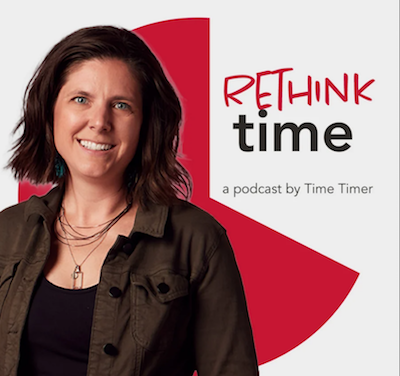
So, I was delighted when I learned that Time Timer was starting REThink Time.
Hosted by Christen Barbercheck, REThink Time looks at time, not merely from the perspective of how to use it more efficiently, but how to make it less challenging and more rewarding. In Time Timer’s own words:
We will explore how we teach, support, and experience time in classrooms, therapy spaces, and everyday life. Whether you’re a teacher, a parent, or struggle managing time yourself, we will be interviewing experts in the fields of education and neurodiversity to share real-life strategies you can use in everyday moments—so time feels more understood to everyone in your life.
I’ve really been impressed with how REThink Time combines expert talk on technology, education, ADHD, neurodiversity, and the wider workplace to provide true understanding and real-world applications of innovative solutions. It’s easy for experts to talk about abstract theory, but I suspect most people hunger for ways to make their lives (and the lives of their children or the people they support) more satisfying. REThink Time delivers!
Although the premiere episode did share the history of Time Timer in From “How Much Longer?” to a Global Tool: The Time Timer Origin Story, this podcast is not a commercial for the company.
- Is Tech Changing Our Kids
- Raising Independent Kids Through Montessori Principles
- Make Back to School Easier
- Why Telling Kids to “Calm Down” Doesn’t Work (This episode explored emotional regulation, mindfulness, and breathing techniques, and while focused on children, offers stellar stress management techniques for adults, too!)
- Neurodiversity at Workplace
I particularly recommend the most recent episode, Outsmart Your ADHD Brain. Christen interviewed Jeff Copper, a cognitive engineer, attention coach, and founder of DIG Coaching Practice about ADHD, working memory, and task initiation.
You can watch on REThink Time on YouTube or listen on Spotify.
SURFING THE QUICKSAND

I first knew Kathy Vines, my colleague, friend, and one-time NAPO-conference roommate, as a professional organizer, productivity coach, and founder of Clever Girl Organizing. And she IS a clever girl!
But Kathy is also a speaker, author, certified smarty-skirt (my own term!), and the host of Surfing the Quicksand. Now in its second season, this GenX-friendly show is, in Kathy’s words,
“a podcast for helping midlife women get a little more organized, productive, healthy, sane, and unstuck, one chat at a time.”
Boy, do I get that!
Organizing our lives means so much more than the tangible “stuff.” It’s the relationships, the career and life paths, the decision trees, and everything you remove or add to your life, or the way you rearrange aspects of it, to make your time on this planet more fulfilling.
(For those of you watching Ted Lasso‘s fourth season, you may have noticed Mae reading Mary Oliver’s moving poem, When Death Comes, over the final shots; rather than being depressing, as the poem name might imply, it’s about living your live to the fullest, and I think we can well imagine that getting “unstuck” from the quicksand is key to that endeavor.)
I can’t say it any better than Kathy’s own media kit. So, if you’re interested in any of the following: caregiving, career shifts, identity changes, health and wellness, financial planning, household responsibility, productivity, wellness, personal development, organization, reinvention, and practical life tools, this podcast is for you.
Season 1 had a whopping 41 fascinating, meaty episodes, and Kathy is already a half a dozen episodes deep into season 2, so you’ve got your choice of topics. You can start at the beginning or pick and choose the episodes that call to you. Personally, I’ve had the most fun with the episodes where Kathy interviewed Paper Doll friends and colleagues (often mentioned in the pages ofthis blog), including:
- Seizing the Moment: A Journey of Serendipity (with Sara Skillen)
- Resilient Kids, Sane Parents (with Leslie Josel)
- Productivity for How You’re Wired (with Ellen Faye)
One of my favorite episodes was a recent one where Kathy sat down with one of my besties, Deb Lee.
Deb’s a genius at productivity, tech, and making a person feel valued and heard, and when I listened to Deb and Kathy chat on the podcast while driving up a mountain to my client day, it was so warm and inclusive that forgot I was listening to a podcast and not on a three-way phone call! Sample the episode, The Onion Years: Peeling Back the Layers of Caregiving.
Surfing the Quicksand is available on YouTube, Spotify, and Apple Podcasts, and you can keep up with the show at the Surfing the Quicksand site above, or on Facebook and Instagram.
As a professional organizer, I’m usually disinclined to promote tangible goods, but if you’re in deep need of T-shirts, hats, water bottles, or totes (or are stymied for holiday gift options), you may want to check out the Surfing the Quicksand merch shop.
OLD FAVORITES — PODCASTS WORTH REVISITING
In addition to these new (or new-to-you) podcasts, I’d love to call your attention and share some love for some other beloved podcasts.
Getting to Good Enough
I was always a huge fan of my friend and colleague Janine Adams’ and Shannon Wilkinson’s Getting to Good Enough show, which was billed as “A podcast to help you let go of perfectionism so you can live life with more ease, less stress and a lot more laughter.”
From 2018 through 2023, Janine, a fellow professional organizer and founder of Peace of Mind Organizing, and Shannon, a life coach, offered up a gentle “You Are Enough” NPR-style hug in a world of loud, pro-achievement, miracle morning, hard-core press podcasts. So, as a recovering Type A+ (who has, over decades, barely chilled to a Type A-), I was crestfallen when Janine and Shannon stepped away from their podcasts booths.
Then, last year, much like my beloved Ted Lasso (which also went off the air in 2023), Janine and Shannon unexpectedly announced that they were coming back! Also like Ted Lasso, Getting to Good Enough revels in finding a compassionate approach to living your life.
If you’ve never listened, you might want to go back to the beginning and alternate new episodes with working your way through the backlog. If you’re excited but didn’t realize the show was back, there’s no time like this cozy autumnal season to get back in the anti-perfectionist groove.
From the very first 2018 episode, Done is Better Than Perfect, to Imposter Syndrome: Why It Happens (and What Actually Helps) to Getting Unstuck After a Mistake, you’re going to find something that floats your boat.
The recent The Beauty of a Good Checklist had me nodding along as I listened and drove, and I soaked up What it Takes to Take a Break at the airport as I jetted off to visit Paper Mommy last month.
I should note while almost all podcasts have show notes worth checking for key points and resources, Janine and Shannon provide particularly good (and organized) notes.
You can watch Getting To Good Enough on YouTube (though only the episodes since the show’s return have actual video of Janine and Shannon), or listen on Apple Podcasts, Spotify, Pocket Casts, or as an RSS feed.
Get Organized With Dr. Frank Buck
I’ve promoted the excellent Get Organized! with Dr. Frank Buck podcast many times in the past (and have been a guest on several occasions), most recently last year in Take Note: Paper Doll’s Guide to Organized Note-Taking (Part 1). Frank’s zippy episodes deliver practical advice at the intersection of productivity, organization, technology, and his original area of expertise, education.
Some nifty episodes recently have included:
- Stop Losing Money to Forgotten Auto-Renewals (My Money Calendar System)
- Time Management for Teachers: 3 Principles That Matter
- How to Make Reading Fun Again (An interview with Danny Brassell)
Frank continues to deliver weekly episodes on all the topics that drew me to share his material, but a recent show, 12 Apps That’ll Make You an Organized College Student reminded me of how great this podcast is with keeping up with both essential principles and new solutions.
You can listen to Get Organized! with Dr. Frank Buck on Apple Podcasts, Castbox, Overcast, Pocket Casts, Spotify, and an RSS feed, but I encourage you to tune in to the show on YouTube, at least when Frank is discussing technology, to get the full effect.
Of course, there are so many podcasts out there to stir your passion for getting organized, being more productive, and keeping you from doomscrolling, and this is only a taste. However, after taking a short sabbatical from blogging in August and September, Paper Doll HQ is aiming for somewhat shorter posts.
Note, I said shorter and not short. I am who I am, and like Ted Lasso, I am built out of words, and will continue to share so, so many of them with you readers. And if this post inspired you to listen to podcasts and think more about Ted Lasso, well, here’s a list of the 18 Best Ted Lasso Podcasts.
It’s good to be back in the blogging groove and to be back with Paper Doll readers again!
Meet Your Organizing Elves: The Pros Who Help Get Your Life in Order

Recently, at the end of a session, my client joked that I was her own Santa’s elf. We laughed, but her description is not that far from the truth.
YOU AND SANTA BOTH NEED ORGANIZATIONAL SUPPORT
Santa’s elves (and Mrs. Claus and the reindeer, of course) help keep Santa from becoming overwhelmed. After all, Santa is basically running a multi-national corporation.
Certainly, he has to control the means of production for his factory. Can you imagine how much paperwork (and how many computer files) it takes to source, order, acquire, and unpack the resources before the toyshop starts making the toys?
But our friend Kris Kringle also manages a customer base of upward of two billion children (the current number of the world’s newborns through fourteen-year-olds), not even counting all the people for whom the magic of the holidays involves believing in Santa. I’m sure, at some point in the late 20th-century, Santa had to learn how to manage a computer database and CRM system to keep straight not only who was on the nice vs. naughty lists, but track them as their behavior meandered from one to the other and back again.
Due to non-compete clauses, nobody’s ever ascertained whether Santa has only one sleigh or a huge fleet with one for each of the 24 time zones to which he delivers. Nonetheless, keeping up with the vehicle maintenance and registration requirements in 195 nations must be quite the task!
Time management is a huge headache, too. Not only do those requests for toys and bikes and little red wagons (and all the modern digital doodads) need to be filled, wrapped, and packed onto the sleigh, but timing all of these deliveries in one night, with no respite for bad weather or reindeer infighting, has to be wearying.
It’s a good thing Santa has his elves.
My clients often feel the same oppressive weights upon them, even if they don’t necessarily have the same international fame as the guy in the big red suit. Whether you need to deal with organizing and productivity pitfalls at home or at work, in your computer or your kitchen, your closet or your warehouse, there are professionals who can give you support.
Perhaps between preparing for Thanksgiving and the winter holidays, entertaining company, trying to make headway on languishing projects with end-of-year deadlines, and figuring out how to make space for everything coming in (to your home, to your schedule, and to your life), you have realized that you could use a little elf-like magic as you go into next year.
Today’s post is a chance for you to get to know all of the organizational (and organizing-adjacent) experts who can help you reduce overwhelm, coach your decision-making, and bring subject-matter expertise to help you overcome obstacles (whether tangible, temporal, or cognitive) so you can be your best self.
(Heh. Maybe that should be my holiday marketing campaign: I’ll be my best elf so you can be your best self.)
PROFESSIONAL ORGANIZERS AND PRODUCTIVITY SPECIALISTS
We professional organizers and productivity gurus didn’t all start out and orderly elves. Paper Doll was a television executive. Many, many of my colleagues were teachers. Some were attorneys, social workers, hoteliers, accountants, designers, and so many other types of professionals.
Sometimes, we felt like we were on the Island of Misfit Toys, but almost as if by holiday magic, we all found where we truly belong. And yes, we know that not all elves are always so lucky to find their fit right away.
NAPO
Longtime readers of Paper Doll are already familiar with the concept of professional organizers, but many people are surprised by the variety of services we provide.
If you think a professional organizer is just about moving the stuff around, I’ve got a surprise for you. As I tell my clients, “Housekeeping is about the stuff; professional organizing is about the person who owns (and uses, and maintains) the stuff.”
Housekeeping is about the stuff; professional organizing is about the person who owns (and uses, and maintains) the stuff. Share on XAmong the professionals in the National Association of Productivity and Organizing Professionals (NAPO), there are plenty of generalists. In just the past few weeks, I’ve:
- helped a client pare down a collection of family photos and slides ranging from the late 1800s to the 1970s
- organized holiday charitable requests, identified the client’s philanthropic priorities, and oversaw the donation process
- supported a client with cognitive decline to maintain daily productivity
- decluttered and downsized: cleaning supplies in kitchen cabinets, books and décor from bookshelves, a wardrobe that largely no longer served a client’s physique or style, and more
- assisted clients in accessing funds by searching for unclaimed property, organizing supporting documentation for class action suits, and submitting claims for health insurance
- reworked a client’s overly-ambitious December schedule so that she actually had time to enjoy the holidays.
Although I do specialize in paper and information management and productivity coaching, my in-person clients seek my help for solving all manner of organizing-related mysteries and kerfuffles in their lives, and it’s the same for my colleagues.
Some professional organizers specialize in particular types of clients:
- people with chronic disorganization or hoarding disorders
- individuals with brain-based conditions ranging from ADHD and autism to traumatic brain injuries to dementia
- people with physical disabilities
- seniors
- new parents
- children
- older students
- solopreneurs and small business professionals
Others in our field focus on particular types of spaces for downsizing, clutter control, and organizing in:
- kitchens
- closets
- living spaces (main and guest bedrooms, living rooms, bathrooms)
- home offices
- playrooms
- basements
- attics
- storage units
- work spaces (like professional kitchens, law offices, physicians offices, science labs, theaters, etc.)
We also specialist in particularly kinds of services that cross the “who” and “where” categories, like:
- time management coaching
- paper management
- digital organizing
- organizing and managing photographs and memorabilia
- financial organizing, including bill-paying, budgeting assistance, and bookkeeping
- estate management
- medical history management
- household management
- eco-organizing
- home inventorying
- home staging
- yard/garage/estate sale management
- packing and unpacking for moves
- space planning and design
This doesn’t even begin to take into account the services some professional organizers provide to businesses, including: business automation, corporate operations, event planning, records management, technology training, and more.
Basically, are overwhelmed by it, exhausted by it, stymied by it? Do you “just” need someone to come in and do it (or teach you how to do it — or how to do it better)? If it takes less time and you can focus on what’s important to you — then organizing and productivity specialists can help.
To find a professional organizer, visit the NAPO directory directly, or navigate from NAPO’s front page to the Find a Pro menu at the top. Search geographically or within a radius from your zip code, pick the business and/or residential specialties in which you need assistance, and review the list of my colleagues provided.
And don’t forget, much of the work we do with and for our clients can be done virtually, so you can pick that option from the specialty drop-down if you’re open to getting help from afar.
NAPO members represent thousands of separate professionals, coming together to gain continuing education and support one another so that we can support our clients.
Certification, Certificates, and Skills
When the NAPO directory provides you with names to peruse, you may see some additional notes.
Certified Professional Organizers (CPOs) are those of us who have attained credentials reflecting specific standards. That originally included 1500 hours (now 1000 hours) of paid client-centric work prior to sitting for a comprehensive exam (among other requirements), adhering to the BCPO Code of Ethics for Certified Professional Organizers, and obtaining continuing education in a variety of subjects during a three-year certification period.
For more about certification, you can check out the “What is a Certified Professional Organizer” tab here on my website, including my article, In Checkbooks And Underwear Drawers: What Certified Professional Organizers Offer Our Clients.
Specialist Certificates — In addition to the deep and wide subject matter expertise needed for certification, NAPO members may also hold certificates in specialized subjects, including:
- Brain-based conditions
- Household management
- Life transitions
- Move management and home staging
- Residential Organizing
- Team productivity
- Work productivity
Institute for Challenging Disorganization
Founded in 1990 by my colleague Judith Kolberg and originally called the National Study Group on Chronic Disorganization, the Institute for Challenging Disorganization (ICD) has as its mission to provide organizing professionals and the public with education and helpful strategies, and conduct research, regarding chronic disorganization.
Membership in NAPO and subscribership in ICD often overlap, and professionals in our field may obtain a variety of ICD specialist certificates related to chronic disorganization, hoarding disorders, and other related conditions.
Other Organizing and Productivity Associations
There are helpful organizing elves everywhere!
Outside of the United States, there’s an ever-growing universe of organizing and productivity professionals.
For our colleagues to the north, Professional Organizers in Canada (POC) has a similar search engine to NAPO’s. At their Find An Organizer page, you can specify services areas and specialties as well as languages spoken. (You didn’t think Santa’s elves spoke only English, right?)
NAPO, ICD, and POC do not stand alone. We have colleagues around the world as part of the International Federation of Professional Organizing Associations, including:
- Associaçāo Nacional de Profissionais de Organizaçāo e Produtividade (ANPOP, in Brazil)
- Association of Professional Organizers of Spain (AOPE)
- Association of Professional Declutterers and Organisers (APDO, in the UK)
- L’Associazione Professional Organizers Italia (APOI, the site at which Paper Doll supplements her Duolingo Italian practice by trying to discern meaning)
- Chinese Association of Life Organizers (CALO)
- Finnish Association of Professional organizers (FAPO)
- Federation Francophone des Professionnels de l’Organisation (FFPO, in France)
- Hong Kong Association of Professional Organizers (HAPO)
- Heart Home and Space Organizer (HHS, in Taiwan)
- Japanese Association of Life Organizers (JALO, not to be confused with Ja-Lo AKA: Jennifer Lopez)
- Korean Association of Professional Organizers (KAPO)
- National Association of Black Professional Organizers (NABPO, headquartered in Atlanta)
- Nederlandse Beroepsvereniging van Professional Organizers (NBPO, in the Netherlands)
- Swedish Association of Professional Organizers (SBPO)
Several times a month, I am asked by friends, former classmates, clients, and random acquaintances to provide referrals and recommendations for professional organizers to help people’s loved ones, whether across the continent or across the world. It’s heartening to know that I have colleagues in so many places, ready to help those who are seeking a little more space or serenity.
OTHER ORGANIZING-RELATED PROFESSIONAL ELVES
In addition to ICD and POC, and the National Association of Black Professional Organizers (NABPO) referenced above, NAPO has other affiliate organizations.
Daily Money Managers
Santa has to deal with financial transactions in 180 different worldwide currencies. Your finances may not be so complex, but whatever your needs, whether to help Grandma keep up with her retirement investments or to just make sure the bills get paid on time, the American Association of Daily Money Managers (AADMM) has financial organizing professionals to assist you.
Daily Money Managers (DMM) offer a wide variety of personal financial services to individuals and families, and manages financial tasks including bill-paying and oversight, budgeting, and record keeping. Some serve as fiduciaries for clients who are incapacitated.
Aging/Geriatric Care Professionals
Santa and Mrs. C. aren’t exactly spring chickens, and like all of us, may someday need support.
The professionals in Aging Life Care Association (ALCA) specialize in aging and disability issues while ensuring client “safety, continuity, and dignity.” As experts in health and human services, they can assist and advocate for families caring for older adult relatives or individuals with disabilities. They can partner with professional organizers and senior move managers whenever clients and their families are going through major life transitions — whether they’re downsizing so family members can age in place or to help them relocate to other living situations.
Photo Organizers
Many NAPO professional organizers are comfortable helping their clients organize their photos or find solutions for digitizing them. But The Photo Managers (formerly the Association of Personal Photo Organizers) use their passion for photo collections and personal storytelling to assist clients with culling, organizing, and digitizing photos, as well converting older media to newer formats and sharing pictures.
OTHER MONEY ELVES
Every year, I learn about new types of professionals who can help me help my clients overcome the obstacles that clutter their daily lives. These include:
Claims Assistance Professionals
As I discussed in Organize and Lower Your Medical Bills: Spot Errors, Negotiate Costs, and Save Money, there are a variety of medical billing specialists, medical cost advocates, and patient advocates. In addition, if you’re drowning in medical claim paperwork that makes no sense, or you’re getting the runaround from the insurance company, you may want to reach out to a claims assistance professionals through The Alliance of Claims Assistance Professionals.
Financial Advisors
Knowing what to do with your money can be confusing, and it’s scary to wonder whether the advice you’re being given is good for you, or just good for an advisor taking a percentage of what you earn.
Before considering hiring a financial advisor, talk to the elves in your life: your family members, friends, and colleagues who seem to handle their dollars with sense. I am neither a fiduciary nor a money maven, but I do recommend that if you’re seeking help with building your financial future, you should find a fee-only financial planner. That’s someone you pay a flat fee, rather than a percentage, to provide you with advice.
The National Association of Personal Financial Advisors (NAPFA) is a great first start. You can also find Certified Financial Planners via the location search at PlannerSearch.org.
Appraisers
A professional organizer can help you divide the wheat from the chaff when you’re figuring out what to donate and what to keep; we’ll hold your hands when we tell you that your collection of mini Beanie Babies you got at McDonalds will not fund your retirement. We may help you research the provenance and potential value of what you own. But no organizing professional is going to tell you for certain whether that piece of furniture or jewelry or coin collection is worth. For that, you need an appraiser.
An art appraiser is not a stamp appraiser; fields of specialty range from wine to textiles, furniture to musical instruments, coins to fine art to books. Start with an accredited appraisal association like:
to find the experts that can help you understand the value of your property and make wise decisions regarding what to do with what you own.
Certified Divorce Financial Analyst
Paper Doll hopes you never have to deal with a divorce (unless it’s something that will make your life better). However, I’ve worked with enough clients going through the divorce process to know that attorneys don’t have the bandwidth to deal with some of the intricacies of the financial situation.
Certified Divorce Financial Analysts are professionals who can help you figure out the complex financial aspects of your divorce. This may help you secure an equitable share of marital assets in order to plan your financial future.
If you or someone you know needs support in this area, start with the Institute for Divorce Financial Analysts.
OTHER HOUSE ELVES
When you hear house elves, you probably think of Harry Potter. As a GenXer who grew up near Canada, I start daydreaming about house hippos.
But I digress.
In addition to the residential professional organizer services covered by NAPO and her sister organizations, there is some crossover into home relocation specialties.
Senior Move Managers
The National Association of Senior and Specialty Move Managers is made up of relocation specialists. They’re focused on strategies for helping older adults (and their families) with the relocation process, including downsizing, as well as packing and unpacking, and assisting with logistics.
Home Stagers
In the olden days, when you wanted to sell your house, you hired a real estate agent. They told you to clean the house and pop a sheet of cookies in the oven to make things smell nice. Over the last few decades, however, home staging — literally staging your home to make it possible for prospective buyers to imagine themselves living there — has become a big deal.
Staging can involve removing objects that are overly personal or reflect particular belief systems, subtracting or adding furniture or décor to create a particular aesthetic, and generally working to show a house off in the best light.
As with senior move managers, you will likely find some crossover between NAPO/IFPOA professionals, but to find a home stager in your area, start with the Real Estate Staging Association and the America Society of Home Stagers and Redesigners.
Obviously, your organization and productivity needs are complicated, and by talking about elves, I am not entirely making light of anyone’s struggles.
Sometimes you just need a handy-person to help you lift and carry things to the attic or out to the curb; however, most of the time, a professional organizer or productivity specialist is the ideal person to guide you through the myriad decisions to make to move your life in the direction you want.
And when the real obstacles are not the things, but ourselves, and special services are needed, their are ADHD coaches, life coaches — even decision-making coaches — and mental health professionals!
Today’s post is a reminder that whatever is causing clutter in your space, your schedule, your finances, or your mind, you’re not alone. Reaching out to experts is a gift you can give a loved one — or yourself.
I suspect Santa would approve.
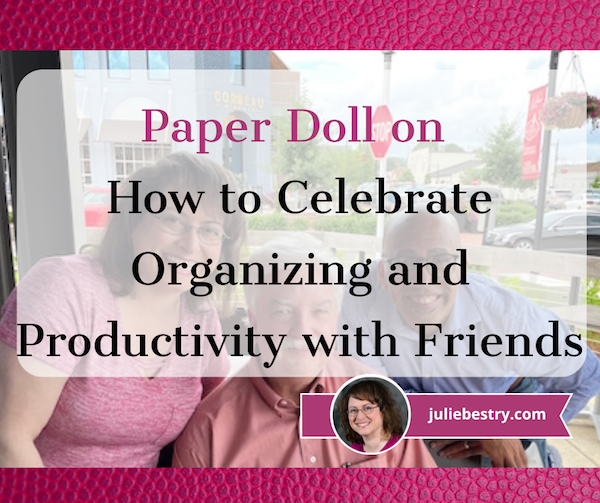
Paper Doll on How to Celebrate Organizing and Productivity with Friends
DO IT TODAY
Back in March, I told you all about my fabulous friend-of-the-blog (and of the blogger — me!), Kara Cutruzzula in Paper Doll Interviews Motivational Wordsmith Kara Cutruzzula. Writer/editor/playwright/lyricist/librettist & all-around-cool-kitten Kara and I have been collaborating for years and sharing one another’s achievements, and today is a chance to share something fun we’ve created together.
If you didn’t get the chance to read that post back, I recommend you jump over to do that. (There are some cool comedic and musical interludes!) We covered Kara’s talents at writing dialogue, especially spitfire-fast banter for whip-smart female characters like those in The Gilmore Girls and The Marvelous Mrs. Maisel, and her skills at writing musicals. That post dug deep into Kara’s background and the resources she creates, including her uplifting Brass Ring Daily newsletter, and her books:
Do It For Yourself: A Motivational Journal,


and her forthcoming Do It Or Don’t: A Boundary-Creating Journal.

In that prior blog post, I also told you that Kara and I had recorded an episode of her Do It Now podcast to air in the podcast’s second season — and that episode is out now!
Today with Julie Bestry: Letting Go of the Stress of Getting Things Done

And it’s not just out, but it’s hot! The episode premiered last Monday, while I was off celebrating a long Mother’s Day weekend with Paper Mommy. Meanwhile, Kara promoted our lively conversation in her Brass Ring Daily newsletter, and listeners really took to it. Kara even forwarded one fabulous email message she received:
“I just wanted to share that on average, I listen to zero podcast episodes a year (it’s not a format that works for my brain usually) — and I could have listened to another two hours of you two talking. I enjoyed that so much this morning. Thank you for making this and sharing it, and to Julie of course. Inspiring as always, and so expansive. Wow. ❤️ thank you.”
Given that Paper Doll readers know how extensively I like to cover a topic, and how delightful and wise Kara is, I’m pretty sure we could have spoken for another two hours — maybe even another two days!
Kara’s podcast usually involves interviews with people I’d consider a much bigger deal than I am — Broadway bigwigs (performers, producers, and stage managers), screenwriters, musicians, journalists, and others who do their work on a big stage (no pun intended). But what we all have in common is the need to get things done each day, and that’s exactly what Kara asks guests about as a jumping off point — what we’re doing that day, and what goes into making sure we get it done.
I’d been fascinated by, and had taken gems away from, every episode of the podcast’s first season, and I was a little uncertain as to what new I could bring to the table. It’s not like I could break into song or share any behind-the-scene secrets from Hamilton or Six. (Oh, if only I could!) But it took all of two seconds for Kara to put me at ease, Oprah-style, and we were off and running. We covered a lot of ground, including:
- Body doubling (as we discussed in Paper Doll Sees Double: Body Doubling for Productivity and Paper Doll Shares 8 Virtual Co-Working Sites to Amp Up Your Productivity)
- Brain dumps, administrative tasks, and making your schedule work
- Setting boundaries, closing loops, and getting back to people without interrupting your flow
- Time blocking to achieve your most meaningful work (as covered in Playing With Blocks: Success Strategies for Time Blocking Productivity Struggling To Get Things Done? Paper Doll’s Advice & The Task Management & Time Blocking Virtual Summit 2022, and Highlights from the 2023 Task Management & Time Blocking Summit
- Using the 1-2-3 system to make sure you’re accomplishing essential tasks and deep work
- Toxic productivity and the necessity of letting go of the stress, shame, and overwhelm of not doing “enough” (alluding to my five part series: Toxic Productivity In the Workplace and What Comes Next, Toxic Productivity Part 2: How to Change Your Mindset,Toxic Productivity, Part 3: Get Off the To-Do List Hamster Wheel, Toxic Productivity, Part 4: Find the Flip Side of Productivity Hacks, and Toxic Productivity Part 5: Technology and a Hungry Ghost)
- Overwhelm and the complexity of living in the 21st century
- Paper shame, the call to do everything digitally, and permission to go the analog route
- Living (and working) authentically for the way your brain works
- Plus, a book recommendation that Kara followed up on and ended up loving! (You’ll have to listen to the podcast to hear which book it was, unless you’re one of the dozens of people I’ve pressed to read it in the last few months!)
- “Building a canoe” — and what I’ve learned to consider differently since listening to the Do It Today podcast
- How do you know when you’re “done” for the day? (In other words, once you “do it today” how do you know that “today” is over?)
Having so much fun talking to Kara and riffing on these kinds of topics *almost* makes me wish she and I had a regular podcast where got to talk all the time!
You can catch Kara’s and my conversation on the podcast episode page, or at pretty much anywhere you listen to podcasts, like Apple Podcasts, Spotify, Google Podcasts, Overcast, Pocket Casts, Amazon Music, Castro, Castbox, Podcast Addict, Player FM, and Deezer. (And no, I hadn’t heard of most of those services, either.) You can also subscribe to the podcast by RSS.
WORLD ORGANIZING DAY
This past Saturday, May 20, 2023, was World Organizing Day. To quote from NAPO‘s web site:
World Organizing Day is a global initiative founded by the International Federation of Professional Organizing Associations (IFPOA) to celebrate the work of organizing and productivity professionals.
This designated day aims to increase public awareness of the benefits of getting organized. It highlights the work of organizing and productivity professionals who enrich the personal and professional lives of their clients.
It also recognizes the accomplishments of individuals and organizations in their efforts to become more organized and productive.
With regard to benefits, it’s obvious that being more organized allows us to save time and money, and to be more productive. When we have organized systems and skills to get (and stay) organized, we can more effectively and efficiently use our space and find what we need when we need it.
However, the psychological benefits of organizing are manifold, as well. When we declutter our living and working spaces, we also reduce the psychological friction that stands between us and getting things done. We reduce frustration and overwhelm, giving ourselves a sense of confidence about our abilities and our surroundings, and increase our sense of ease around having others in our environment with us.
In honor of World Organizing Day, the Institute of Challenging Disorganization (ICD) is making four 90-minute sessions from their 2021 virtual conference available for free to professional organizers as well as to members of the public. Start by watching this video:
Next, go to the ICD website page for World Organizing Day. If you’re already a subscriber or otherwise have an account, you can just log in and go straight there; otherwise, you can quickly create an account.
Then you’ll be taken to the Request for Access to World Organizing Day online form. Once you fill in a few details, you’ll immediately be sent an email granting you access to watch any or all of the four available courses in the World Organizing Day 2023 Package, covering a wide variety of issues related to chronic and challenging disorganization:
- Thriving with Distraction: The Science and Strategies You Need to Know to Make a Transformative Impact in Your Client’s Life taught by Edward (Ned) Hallowell, M.D., author of many famous books on ADHD, including Driven to Distraction (Revised): Recognizing and Coping with Attention Deficit Disorder, Delivered from Distraction: Getting the Most out of Life with Attention Deficit Disorder, Driven to Distraction at Work: How to Focus and Be More Productive, and last year’s ADHD 2.0: New Science and Essential Strategies for Thriving with Distraction–from Childhood through Adulthood.

- A Fabulous Way to Build Resilience to Mitigate the Impact of Compassion Fatigue, taught by Barbara Rubel MA, BCETS, DAAETS, author of a variety of books on loss, grief, bereavement, and renewal.
- Neuroarchitecture Contributions To Challenge Disorganization, taught by Andréa de Paiva, MA, professor, founder of NeuroAU, and an architect seeking to bridge research, education and design.
- Turning Pain into Purpose: My OCD Journey, taught by Ethan S. Smith
Please note that while all four sessions are free of charge, they are only available through June 3, 2023.
OLD HOME WEEK & PRODUCTIVITY PEEPS
Meanwhile, as my colleagues across the planet were celebrating World Organizing Day, I went on a little road trip and got to enjoy camaraderie and talk about productivity with two people whose names might be familiar to Paper Doll readers.
Each March for the past several years, I’ve participated in the Task Management and Time Blocking Summit run by Francis Wade. As I’ve mentioned, not only do I know Francis from the productivity community, but we actually lived in the same dorm, the International Living Center, at Cornell University!
Although we’ve popped up on the same podcasts, webinars, and virtual meet-ups, Francis and I hadn’t seen each other in person in about 37 years! A few months ago, I found out Francis was flying in from Jamaica to Atlanta to present at an International Association for Strategy Professionals (IASP), and would be taking a quick jaunt to Alabama to see family and meet up with our fellow productivity colleague (and my fellow Evernote Certified Expert), Dr. Frank Buck. We knew we’d have to find a way to meet up!
You readers know Frank from when he interviewed me for his own podcast. And all three of us have crossed paths in a variety podcasts and summits recapped in Paper Doll posts, including those mentioned above and Paper Doll Picks: Organizing and Productivity Podcasts.
I wonder if anyone frets over (I mean, “embraces the challenges of”) logistical concerns more than organizing and productivity people. Over several weeks, we squared away the details of triangulating the travel details of our little circle. (See what I did here?) Francis was arriving from Jamaica and driving west to an outer suburb of Birmingham, Alabama to spend the weekend with family before heading back to Atlanta for his conference.

(Ignore the total time and mileage; I couldn’t figure out how to make Google show two separate routes simultaneously, so it added two routes together.)
Added to the complications of planning were my continuing reliance on COVID precautions (not dining indoors) and the fact that I don’t eat meat, but Frank took on the role of cruise director with aplomb and dove into research mode!
Once we knew Francis had arrived safely, I’d be driving southwest from Chattanooga, and Frank would drive a far shorter (but not insignificant) route westward. Through the magic of Google, we identified the unfortunately-named but absolutely delightful community of Trussville, Alabama for our meet-up. There were a few kerfuffles due to weather and communication (take note: always agree on which method of communication — email or texting or whatever — before arranging any muti-location adventure), but we still managed to arrive at our destination within moments of one another.
For anyone ever hoping to meet up with friends in the general vicinity of central Alabama (and I’m not sure how many of Paper Doll readers might find that likely), and not having a reason or inclination to go all the way to Birmingham, I can’t recommend Trussville more highly. This walkable community, filled with restaurants, shops, and a central “entertainment district“ with a communal dining pavilion, outdoor theater, and hanging-out lawn was perfect for getting together for a late lunch/early dinner.



Interrupted only a few times by bursts of rain that moved along in minutes, Francis, Frank, and I enjoyed an afternoon and evening of hearty discussion of productivity methods, Evernote, Artificial Intelligence, video editing, our respective families’ genealogical histories, the current politics of education in America, international perspectives on long-term strategic planning (as a nod to Francis’ conference topic), and the meaning of an all-gender bathroom pictogram (which apparently is not a common sight in Jamaica — we assured Francis that it’s just like any one-person bathroom available to all, like in one’s home or on an airplane, ).
 At Pinchgut Pies, the fellas partook of a specialty “Gaitor Bait” pizza with alligator sausage, while I ordered a pesto-and-fresh-mozzarella pie; later, after hearty discussion of all of the above topics, plus early 20th-century treatments of polio and our experiences of 9/11 (Frank was a school principle; I was working in television), we sampled the wares of Cookie Dough Magic, which sells both ice cream and edible cookie dough.
After three years of COVID and not traveling to any professional gatherings in person, it was a delight to gather outside and talk to colleagues/friends (about productivity as well as personal topics), and getting to finally meet Frank in person, and seeing Francis for the first time in 37 years, seemed like something worth sharing with all of you readers.
Being organized and productive is wonderful, but we must remember that we do it in service of a greater good, to have the opportunity to accomplish not only our labors, but achieve our joys.
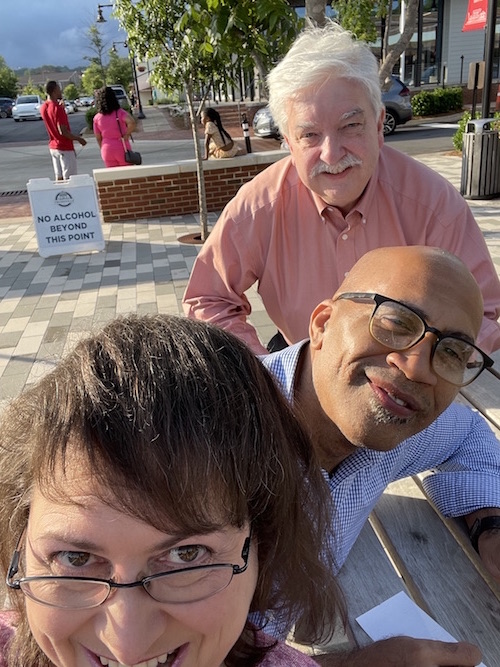
As Memorial Day weekend approaches and we head into a (hopefully) more sociable summer, may you be organized and productive, but I hope you also get to enjoy good company, good food, and good times.
Highlights from the 2023 Task Management & Time Blocking Summit
As you know from my post Surprising Productivity Advice & the 2023 Task Management & Time Blocking Summit a few weeks ago, I was set to spend three days at the beginning of this month attending, and being a panelist and presenting at the summit. This is the fourth year I’ve been involved, and it was definitely the best yet.
The theme of this year’s summit, One-Size-Doesn’t-Fit-All. Now what?, is dear to my heart. In February, the summit’s creator, Francis Wade, and Productivityist Mike Vardy delivered a pre-summit session to set the stage. Generally, Francis posited, when people are struggling with productivity (and this is true of tangible organizing struggles, too), they seek out experts, “gurus” who identify their so-called secret formulas. “Do this and all will be well!” And that may be true, but only for a while.
No one system for anything — career paths, life balance, making cookies, or having an organized and productive life — works for every person in every situation. At some point, it’s essential to take the guru’s advice and customize it for yourself so you can live an authentic life.
Even Marie Kondo, whom I chided for insisting her way was the one-true way (in my post The Truth About Celebrity Organizers, Magic Wands, and the Reality of Professional Organizing) has had to face the fact that her way doesn’t exactly work for the kid-filled life she now embodies. (See all the various recent articles with titles like “Professional tidier Marie Kondo says she’s ‘kind of given up’ after having three kids.”)
Early on, especially pre-internet, there were no centralized places to access productivity advice. Then, so many people got into David Allen’s Getting Things Done (GTD to those in the know) that it was evangelized everywhere. But with the expansion of the web, “productivity porn” proliferated, and people had (and have) access to so many options.
The problem? Whatever popular productivity methods are out there, people aren’t all the same. They are unique. As I presented in “Paper Shame” — Embracing Analog Productivity Solutions in an Increasingly Digital World:
Because I know my own style, I know what works best for me. Because I stay abreast of all of the options out there, I know how to suggest what might be best for my clients. And my job is to know that what works for me won’t work for each of my clients, and what works for my overwhelmed, 30-something client with ADHD and a toddler won’t be the same as for my single-dude on-the-road salesperson client or my new-retiree client whose spouse was just diagnosed with Alzheimer’s. We’re each unique.
So, it’s important to know that it’s normal if the productivity strategies that work for your bestie don’t work for you. As you read blogs and books and incorporate advice, instead of accepting every bit of it “hook, line, and sinker,” Francis encouraged what he calls an ETaPS framework.
Simply put:
Evaluate your current situation and needs
Target where you want to move the needle (and by when)
Plan how you’re going to incorporate change into your approach, and get
Support through coaches, friendly accountability, and exposure to a wide variety of opinions and methods.
The summit was one stellar way to get that exposure.
These three jam-packed days included 27 recorded video presentations as well as live interviews, panel discussions, and networking at digital Zoom-like tables. It would be impossible to share all of the highlights, which ranged from Olga Morett‘s compassionate, vulnerable approach to “unmasking” and self-exploration for neuro-diverse individuals to Hanifa Barnes‘ framework for building without burnout (which included a deep dive into understanding circadian rhythms and body clocks for chronotypes — apparently I’m a cross between a wolf (night person) and a dolphin (insomniac).
 Dolphin photo by Ádám Berkecz on Unsplash
Thus, rather than providing a full recap of the summit, I’m going to share highlights and snippets that caught my attention, and which I look forward to sharing with my own clients.
QUICK BITES
“The menu is not the meal.”
Henrik Spandet, while talking about the differences among task management, calendar management, and meeting management, cautioned participants to remember that a task list is merely a list of opportunities, just as a menu is a list of dining alternatives. One must prioritize to maximize the experience. You can’t expect to do it all, or do it all at once. (He did not, however, discuss the advantages of eating dessert first.)
“If you’re not doing what you’re supposed to be doing, just sit.”
Carl Pullein‘s take on self-discipline dovetails with my own advice for dealing with writer’s block, and it’s kind of like the reverse of the bartender yelling, “You don’t have to go home but you can’t stay here.” You don’t have to perform the task you’ve set for yourself, but if you don’t, then you can’t do anything else. No perfectionist procrastination by tidying your desk; no mindless scrolling.
Sit. Just sit.
And in sitting and not doing, you may find yourself motivated to start writing, creating, or tackling whatever you’ve been avoiding. If not, you will find yourself having to face the reason for your avoidance, which may prove equally productive.
During a third-day “Boundaries, Burnout and Balance: Finding Peace When Working from Home” panel with Renee Clair, Clare Evans, and Olga Morett, the concept of “the booty hour” came up — and how getting the butt-in-the-chair is that make-or-break moment.
Do, or do nothing, is a powerful choice. We are so fixated on never being bored that the idea of having to do nothing may make the thing we are avoiding suddenly a much more compelling alternative!
“What gets measured gets managed — even when it’s pointless to measure and manage it, and even if it harms the purpose of the organization to do so.”
Too often, Peter Drucker‘s quote is truncated as “What gets measured gets managed” but the full quote is so much more powerful. In other words, be aware of how your methods and strategies impact your work, but do not get so caught up in the minutia of how many emails you’ve cleared (or not), and focus on the bigger picture of accomplishing what you want and need to do.
Don’t spend so much time tweaking your systems to get a micro-percentage point of difference. Know what metrics will help you achieve the return on investment of your time, energy, and attention, and focus there. Prioritization can feel abstract, but pay attention to what has the greatest impact on your life, and what brings you closest to your goals.
“Busy leads to burnout; productivity leads to prosperity.”
Ayana Bard‘s message at the start of her five-part approach to mindfully productivity has been in my head for the past week. Her approach involves gaining clarity (and understanding yourself and your tasks so that you can prioritize), knowing where your time is actually going (by doing a time audit), and managing your attention and (mental, emotional, and physical) energy.
Ayana accented the importance of mindfulness (i.e., paying attention with purpose), and noted that practicing mindfulness is easy to skip but not easy to do. (Hence the practicing part, eh?) She recommends incorporating mindfulness of your energies with regard to ultradian rhythms by working 90 minutes at top performance, taking 20 or so minutes for healing and recovery, and then starting another 90 minute cycle of top performance.
BOOK RECOMMENDATIONS
Professor Bret Atkins‘ presentation The Zen of Ten offered lists of ~ten (though he cautioned, not “top” ten) books (both well-known and a second list of sleepers), podcasts, videos, terms, and tools. The big-name list included works by David Allen, Steven Covey, Cal Newport, and Brian Tracey, as well as the “habits” triumvirate of The Power of Habit by Charles Duhigg, Atomic Habits by James Clear, and Tiny Habits by BJ Fogg.

Slightly lesser-known gems ranged from The Autobiography of Benjamin Franklin (worthy of a future Paper Doll post), Ryan Holiday’s The Daily Stoic, Tony Buzan’s The Mind Map Book, 1908’s How to LIve on 24 Hours a Day by Arnold Bennett, and 4000 Weeks: Time Management for Mortals by Oliver Burkeman, about which I wrote extensively in Toxic Productivity Part 3: Get Off the To-Do List Hamster Wheel.

There is no way to do his superb lists justice (and will be revisiting his other recommendations in future posts), but I will note that out of 22 highlighted books (yes, there were a few bonuses), there was only one book authored by a woman: Molly McCarthy’s The Accidental Diarist: A History of the Daily Planner in America.

I note this because it’s a more damning comment on the publishing industry than of Atkins and his discernment. But that’s also a topic for a future day!
Other books recommended by presenters were:
Why We Sleep by Matthew Walker
Time Surfing: The Zen Approach to Keeping Time On Your Side by Paul Loomer
SCOPE — IT’S NOT JUST A MOUTHWASH
Trevor Lohrber felt that the true key to time management is often reducing the scope of a task rather than trying to increase your productivity and ability to do more. After all, our time is limited by strictures — where we have to be and when and how soon the work must be completed. Trevor presented three concepts, but it was the idea of pacers that caught my attention.
Did you ever take an exam in school and spend so much time writing the first part of your essay that when they called “15 more minutes!” you had to rush through your remaining points?
Although the point of deep work is to get into flow, Trevor points out that we often hit a wall when we look up and realize, “Oops, I’ve run out of time!” He suggests that by becoming more aware of time passing while we’re within a block of time, we can adjust our scope.
Trevor encourages using gentle timers at fixed intervals during a time block; for example, every 15 minutes during an hour-long work session. They key points are that these aren’t alarms (in that they’re not alarming), but gentle sounds, like an ocean or wind chimes; set your “snooze” to 15-minute increments and you can brush it away with the flick of your finger across your phone.
The idea isn’t to startle you out of flow, but just lightly alert you to the passing of time so you can stop to consider whether you need to limit the scope of what you’re doing now so you can finish the whole task on time.
The benefits of Trevor’s approach is that these “moments of mindfulness” keep you from going down any rabbit holes and ensure you’re repeatedly reassessing the work to be done in the time allotted. It allows you to work smarter because you are reassessing your scope regularly through the process, and improve your focus because you’re more aware of the scarcity of your time. (Trevor also cautions that this is not ideal for creative tasks, like writing a key chapter in a novel, because that focus can lead to tunnel vision, something you want when you’re trying to finish your accounting but not so much when you’re trying to develop dazzling prose.)
THE HOCUS POCUS OF FOCUS AND WHAT’S GOING ON IN OUR BRAINS
Achieving focus is the Holy Grail of productivity. We can do a brain dump to make sure we’ve examined all of our obligations, prioritize so we can work first (and longest) on what matters most, and create blocks of time dedicated to that deep work.
But how do we gather the motivation to get our tushies in the chair and then maintain our focus to actually get it all done?
This is where mindset is essential. Misha Maksin talked about the flow state, something we’ve covered here extensively, starting with Flow and Faux (Accountability): Productivity, Focus, and Alex Trebek (in the section called Sidebar on Flow and the Unpronounceable Mihali Csikszentmihalyi), and how four “mega” time wasters (anxiety, overwhelm, indecision, and procrastination) block our ability to achieve flow.
He casts it as a question of whether we are in a “primal state” where we feel we are under threat, ruled by our sympathetic nervous system, and using closed, contractive survival thinking, vs. in a “powerful state” ruled by the parasympathetic nervous system, thinking in an open and expansive, creative way. I mean, wouldn’t you prefer to be curious, compassionate, and joyous vs. fearful, anxious, and overwhelmed? I know Ted Lasso would!
Misha explained how the mechanism of unproductive behaviors starts with beliefs driving our thoughts, which then drive our emotions, which lead to our actions, and then results, and those results then determine our core beliefs. This means that results are both initially determined by past beliefs and reinforce future beliefs, in a perpetual cycle that, if our beliefs about ourselves or our abilities are negative, our results very likely will be, also.
However, we can rewire our mindset so that the driving force is not our beliefs but our decisions. Per Misha, if decisions determine thoughts, which activate emotions, which motivate actions, which produce results, which reinforce decisions, keeping us in that productive “powerful state,” — we have a much better shot at attaining flow in our work and joy in our lives.
The key, Misha posited, was to notice when our brains are moving us to that ineffective “primal state” and use our tools to focus on making wise, proactive decisions rather than being ruled by the negative self-talk often inherent in our beliefs. Perhaps easier said than done, but it’s a powerful switch. We can decide to get our butts in the chair now rather than repeat a belief ingrained since childhood that we “always” procrastinate.
DRIVEN TO DISTRACTION
Dr. Melanie Wilson identified a three-part approach to changing reaction distractions, and while there are practical elements, this is basically a psychological approach.
- Adopt a new identity, eschewing the one that says “I am an easily distracted bunny” and trading it for one that says, “I’m a focused, productive person.” This echoes what James Clear says in chapter 2 of Atomic Habits.
- Identify your unmet (emotional) needs so you can stop using ineffective, distracting coping mechanisms. Wilson notes that certain feelings lead us to distract ourselves with unproductive alternatives — overshopping, overeating, drinking, gambling, compulsive social media scrolling — and that the common advice to replace those habits with more productive ones (go for a walk, read a book) fails because they don’t get at the underlying emotion that drives the self-distraction. If we can identify the negative emotion, we can satisfy it with planned activities that do satisfy it. For example, Wilson’s personal example was having ADHD and craving novelty. By planning her days with lots of intentional novelty built in, she was less likely to seek distractions (like compulsive shopping) when she was supposed to be doing deep work.
- Acknowledge troubling issues (what she calls “gnawing rats”) instead of avoiding them. Wilson notes that scheduling quiet time to think (and not merely to meditate), journaling, praying, or planning time to deal with a distracting issue, you’ll be less likely to experience the harsh (and distracting) negative side effects of those problems, like sleep issues, IBS, heart trouble, etc.
BEGIN WITH PERFECT
We know there’s no such thing as perfection in achieving a schedule that doesn’t overwhelm. That said, there was a repeated theme across the summit, the idea of starting with a “perfect” or “ideal” week, beginning with a completely blank schedule.
Carl Pullein advice was to:
- Block out your sleep for the amount you really need, not the amount you usually get
- Create a morning routine and block time for that (and if that’s not when you want to be doing physical self care, block out the optimum time for that for your needs elsewhere in your schedule)
- Section off one or more blocks for communication (like replying to emails) rather than having it be the task you return to each time you transition between meetings or projects
- Create space for “dynamic” aspects of your calendar that change, like appointments. Carl noted that we all need to have blocks on our schedules for our “Core Work” — basically, the thing for which we are paid. For me, that’s time working with clients, and those blocks are fixed; I work on weekday afternoons. For a salesperson, that time is spent on sales calls, not in staff meetings.
- Set boundaries for the available times for these elements (obviously, depending on the level of control you have over your own schedule). For example, Mondays are my Admin Days when I don’t see clients, and I only schedule personal appointments (doctor, dentist, haircut) on Mondays; if your energy levels make it hard for you to be creative in the late afternoons, make sure your core work isn’t scheduled at those times.
Anna Dearmon Kornick and Trasetta Washington both took a similar approach, hewing closely to the formulation laid out in the well-loved “Rocks, Pebbles, and Sand” story of filling a jar.
Using slightly different language, Anna described the elements as:
- boulders — the immovable, important, but non-urgent essentials of life, like health and wellness, and maintaining our major interpersonal relationships,
- big rocks — our high-priority, important-and-urgent-but moveable aspects of work, particularly our deep work focus,
- and pebbles — everything else, the non-important/non-urgent to-dos from laundry to errands to all the random reports and meetings that endlessly tend to crowd us out of our own lives if we do not preserve our boundaries.
Anna encouraged designing one’s week with four concepts in mind:
- Parkinson’s Law — Basically, work expands to fit the time available.
- Planning Fallacy — Due to an optimism bias, we consistently underestimate the time it takes to complete tasks.
- Time Blocking — The act of carving out specific sections of our schedule for specific categories of tasks
- Task Batching — Grouping thematically or platform-related tasks together, like replying to emails or sourcing graphics for blow posts.
Meanwhile, Trasetta added an element to the story, with the professor being prepared with containers of big rocks, pebbles, sand, and two beers (indicating always having time in your schedule for a friend). Her approach to designing the perfect week included color-coding (and name-theming) calendared categories with:
Green Machine — tasks that drive revenue
Blue Skies — educational and personal development
Mellow Yellow — self-care and rest activities
Red Tape — meetings, commutes, and essential but ultimately unimportant activities
She also added “advanced” operations, color-coding them as:
Orange Operations — general business operations
Violet Vision — planning and strategic activities
Purple Passion — tasks related to community and spirituality
TECH OR NOT TO TECH, THAT IS NOT THE QUESTION
My own presentation,“Paper Shame” — Embracing Analog Productivity Solutions in an Increasingly Digital World, delved into the idea that focusing on what we need to do and then getting it done varies; it can be helped or hampered by a system or platform depending on our own personal needs and characteristics.

In our live panel, Ray Sidney-Smith led me and Misha Maksin through a discussion of “Paper vs. Digital in Time Management,” but it was less of a debate than the title might imply. We acknowledged that we each embrace a hybrid approach, whether by choosing disparate methods for different areas of our lives, or by combining them.
This year’s summit had the fewest presentations on using particular types of technology, and instead looked at platform-agnostic approaches to understanding your task management needs at a personal level. For example, Dr. Frank Buck‘s presentation on handling multiple projects looked at removing the friction often inherent in task management from three perspectives: using an analog (paper) approach or either of two different digital models.
Again, not only does one size not fit all people, it doesn’t even fit all different versions of ourselves.
That said, Gynanendra Tripathi introduced us to his new player in the productivity realm, AlphaNotes, which seeks to help users “carve out their own trusted system for employing GTD elements.” They concentrate on leveraging digital storage and “lightning-fast query” ability to store and access information to support getting things done.
ONE SIZE FITS YOU — TODAY
During a live recording of the Productivitycast podcast at the summit, Ray led Francis, Augusto Pinaud and Art Gelwicks in a lively debate and discussion about the concept of “one size fits all” within the framework of productivity.
Francis posited that we are inherently greedy — we want to do more and achieve more, and the concept of “more” means that we will eventually outgrow many of the systems, tools and methods we have in place. Augusto reflected on what happens when we reach capacity — this is where our geeking out on productivity (and not just productivity tools) comes into play.
Our skill sets may stay the same, but our tools may need to change. To the idea that “one size fits all” with regard to tools and platforms may fit just for that particular function, Art made a great metaphor about “pants” in the closet. Tuxedo pants, sweatpants, work pants, etc. all serve one narrow function, but each is not appropriate for other functions.
They’re all pants, they served the needs you have at a particular time, but we have to accept that we probably won’t find one pair of pants to rule them all. We have to stop to think, “What fits you now” and:
“What productive pants do you have on today?”
Later, during networking, a bunch of us continued the “one size fits all” and “productivity pants” metaphors and I got to shock the Art, Trevor, and many of the men, who had no idea that women’s clothing sizes are not based on measurements (waist, inseam, neck circumference, etc.) as mens’ are but are often arbitrary and conflicting, and that even the same size across different clothing designers, or the same size across different styles in the same designer’s line, won’t fit the same.
Just trying to buy a pair of pants can adversely impact productivity! Maybe we can discuss that at the 2024 summit?
Paper Doll Shares 8 Virtual Co-Working Sites to Amp Up Your Productivity
Last week, in Paper Doll Sees Double: Body Doubling for Productivity, we looked at the concept of body doubling and the mechanisms by which it helps us with productivity and accountability through social pressure, task orientation, biological cues, and extended focus.
My wise colleague Diane Quintana, CPO®, CPO-CD, who has expertise using body doubling with her clients with ADHD, added “…body doubling is a calming strategy. I find that when my clients are anxious or stressed over a particular task, using this strategy – quietly working alongside them – is a calming influence. They get more done in less time and with less stress.”
In that post, I walked through my experiences with body doubling one-on-one with clients, and virtually, in a group setting in co-writing sessions and at a writing retreat. I also laid out how to identify the ideal body-doubling method for your needs and the attributes to consider in seeking out a platform.
Whether you call it social focus, group body doubling, or co-working, if you haven’t been able to find the right mix of support and aren’t eager to create your own, you might want to consider one of the platforms profiled in this post.
FREE CO-WORKING WITH PREMIUM UPGRADES
Groove
Groove bills itself as a free accountability club and is targeted toward solopreneurs. It’s not a networking or venture capital matchmaking site, but it does seem to lean into convivial support and the possibility of making connections.
To start, and “to ensure the trust and safety” of their community, you fill out an online form with basic information: name, email, why you want to try Groove, a project you might like to conquer, and how you found out about Groove.
Next, download the Groove app for your mobile device. From the home screen, start a “groove” session, where you will be joined by one-to-three other participants. The app prompts each person through a one-minute video check-in to share goals for the forthcoming groove.
Next, microphones are muted and cameras are turned off, and you’re presented with a screen to enter your goal and break it into distinct tasks. As you work, you check off the tasks, and your fellow Groovers (Groovies?) can cheer your accomplishments via the in-app text chat.
After 50 minutes (the length of two Pomodoros without a break in between), cameras and microphones are turned back on, and there’s another video check-in to debrief.
Each Groove is exactly 60 minutes, including the worktime and the bookending check-ins. After completing one Groove, you can go right into another or just move on with your day. Groove says it helps users “ditch distraction, find focus, and celebrate small wins through social connection and peer support.”
If Groove assigns someone to your session with whom you’ve grooved before, the app adds a little caption to let you know the folks you’ve previously met (so you can say “Nice to see you again” instead of “Nice to meet you,” preventing social embarrassment for those who don’t really remember names or faces).
Groove operates 24/7 around the world, but notes that you’re most likely to encounter fellow Groovers during regular business hours in the US (and, one assumes, Canada).
In addition to ad hoc sessions with whomever is using the platform, you can also start a private Groove with specific individuals or schedule a Groove for later in the week. The latter is restricted to those who have grooved at least five times previously. Instructions are in the site’s FAQ.
If you’re a solopreneur and are looking for body doubling at no cost, this is a chipper and free option.
I see some potential disadvantages, however. The app is phone based; while some people (read: Millennials and Gen Z) might be comfortable using a phone for this kind of video chat experience and typing goals and tasks into a phone, others may be frustrated.
My vanity has taught me how to set up the light and achieve the best angle when I’m on a video call. Even if talking with strangers, I don’t want to be shot from below and my middle-aged arms can’t comfortably hold a camera up for that long. Also, I can barely type on my phone, so I dictate. I vastly prefer to use a full-sized (with numerical keypad) keyboard with my two desktop iMacs.
Of course, if the overall approach appeals to you, there are a few solutions. I found this inexpensive aluminum phone stand in a variety of colors, including a purple one that matches my iMac.

Additionally, you could use a small Bluetooth keyboard to type on the phone.
It’s not clear how Groove makes its money. Usually, if you are not the consumer (paying the fee) then you are the consumed, being targeted with advertising. Hm.
GoGoDone
I was in the middle of researching this post when Renaissance woman and friend-of-the-blog Kara Cutruzzula of Brass Ring Daily emailed saying, “Since November, I’ve been dropping into “GoGoDone” sessions…Usually small groups, a mix of entrepreneurs and small business owners and marketers. They’ve improved my concentration 110% — and I’m a Questioner! It’s like a free Caveday.”

GoGoDone co-working sessions are conducted over Zoom and are moderated by hosts to keep everything running smoothly. At the start of a session, you share what you’ll be working on during the session, and they recommend bringing tasks at which you’ve been procrastinating.
Work sessions last for 90 or 120 minutes, during which microphones are muted, and there are networking breaks to help “to keep you sharp.”
Participants can Zoom in from anywhere in the world. Look at the GoGoDone calendar to find a session you’d want to join, and then access the session via Zoom link shared in GoGoDone’s Slack community.
(Registering with Slack, a free website companies and organizations use to communicate in a closed environment, instead of via email, is easy; once you join, you’ll have access to the evergreen Zoom link for sesions. There’s no obligation to participate in GoGoDone’s Slack “channels” (i.e., discussion threads).
Sessions are generally available on weekdays from 4 a.m. to 8 p.m. Eastern time (though there are occasional weekend opportunities). This makes it less useful for night owls like Paper Doll but has fantastic opportunities for you early birds!
GoGoDone is designed specifically for solo professionals to get the camaraderie they need to conquer procrastinated-on work, including producing podcasts and newsletters, developing client proposals and doing the actual work, promoting content via social media, writing, building websites, and more.
In addition to the free co-working community, there are GoGoDone Sprints, two hours each Monday through Thursday for two consecutive weeks (so, 16 hours) to get ahead on projects for which you’ve always wanted to work on but have never set aside the time. Check-ins bookend each two-hour session and there’s a short, fun discussion break to keep brains fresh. With GoGoDone Sprints’ structure, masterminding, and community makes it a short-term accountability group combined with body doubling. Sprint participation is limited and costs $99 (with deep discounts for their newsletter subscribers).
(GoGoDone also has a premium community for anyone seeking extra support and guidance specifically on marketing a solo business. This includes mastermind sessions, 1:1 coaching, co-promotion opportunities, and social outreach sessions.)
Focusmate
Pitching itself as a virtual co-working model for anyone who wants to get anything done, Focusmate provides body doubling in a more traditional sense. There are only two participants, you and your randomly-assigned Focusmate partner.
 Create an account and then book a session for the time you want, and at the appointment moment, you join a video call. New sessions are available every 15 minutes, so if you’re feeling the need for support, you won’t have to wait long, even on weekends or in the evenings.
Connect via the Focusmate web app in your browser. On your computer, you’ll need to use Chrome. On a mobile device, you can choose Chrome or Safari. You can add virtual backgrounds, screen sharing, and video effects.
Each session is either 25 minutes (the length of a standard Pomodoro), 50 minutes, or 75 minutes, bookended by an opportunity for you each to share your goals and then recap how you did…and celebrate your mutual successes. Your partner remains in a minimized picture-in-picture while you work.
Interestingly, while you are co-working, your camera remains on for the entire session, sound is optional — there’s a mute button — but some people thrive at body doubling when they hear another person’s typing or breathing. However, you are not supposed to converse; there’s a text-based chat for entering the tasks you’re working on, or if you need to communicate. On the plus side, this ensures that you will feel the complete body doubling experience, with the presence of another person matching your energy completing a similarly-styled task.
Although most often used for professional (i.e., desk-based work), the FAQ notes that as long as you keep your camera (and audio) on, you can use the platform for other kinds of tasks, including household tasks like cooking and cleaning, as well as “art, music, writing, reading, even at-home exercise!”
Although partners are typically randomly assigned, you can “favorite” them by tapping the star (☆) next to your partner’s name in a session, on their profile, or on the People page. Then, you can later choose to schedule a “locked-in” Focusmate session with that specific favorited person. Once you favorite someone, you can “snooze” them so you’re not partnered with them again for a set time.
You can use the Availability setting to control who can book scheduled sessions with you: all Focusmate members (except anyone you might have blocked or snoozed) or only favorites, or refuse all invitations to scheduled sessions.
The FAQ notes that, “Accountability is enforced by Focusmate and its community members. If you’re late or don’t show, Focusmate can detect it and your timeliness score will be reduced, and your account can also be frozen. If your partner goofs off during the session, you can report it using the reporting button on the appointment card in your dashboard.” This is great for rule followers who seek a serene experience, but it feels kind of like how you and your Uber driver rate one another — potentially stressful.
I really like that Focusmate talks about the science-based success of the behavioral triggers of the body double method, similar to what we discussed last week: pre-commitment, implementation intentions, social pressure, accountability, task definition, neurotransmitters and brain chemistry and flow.
Focusmate is free for up to three co-working sessions per week; at the Plus level, it’s $6.99/month if billed annually or $9.99/month if billed monthly.
There are also two separate Community and Team plans with special pricing designed to increase interaction and member connection within far-flung communities or companies without direct supervision. Additionally, businesses (especially those with employees who works off-site and without supervision) can reduce remote workers’ sense of isolation while improving productivity and focus.
CO-WORKING MEMBERSHIP SUBSCRIPTIONS
Flown
Want help taking flight with your creative inspiration? Flown’s founder started with Cal Newport’s Deep Work, and then experimented with creating in-person deep work retreats – at a villa in Spain, a chateau in France, and a townhouse in Portugal. (Nice work if you can get it, eh?) COVID scuttled the in-person events, but not the concept, and Flown was born.

Flocks are group co-(deep)working sessions run on Zoom and facilitated by experts. Choose the session types on the dates you want to attend, and Flown sends you calendar invites to ensure you can have the time blocked out, uninterruptible. Click the link in the invitation, turn on your camera, state your goals, and work! Share your achievements at the end!
Flocks have a wide array of styles and focus areas. Deep Dives, offered five times a day, are silent work sessions for anything you want to focus on. After Flockers (attendees) state their goals, everyone settles into two 50-minute deep-working flights; there’s a “quirky” quick break at the one-hour mark to keep your mind fresh.
Twice per day, you can attend a sprint-styke Power Hour where you focus on getting key tasks completed. They’re designed for getting you into a flow state for that productivity boost.
Flown also has four 20-minute morning Take-Off sessions, which include a short meditation, handwritten journaling time, and an opportunity to state your day’s intentions to fellow Flockers. Finally, there are 8-hour freestyle Drop-In sessions; arrive and leave whenever you like to take advantage of body-doubling co-working sessions to get your deep work done.
For those who would like a bit of motivation without actually interacting with other humans, you can watch a Flown Porthole, videos of other people doing deep creative work. Pick the ceramicist, author, sculptor, athlete, or others. It’s faux body doubling, similar in theory to what I discussed in Flow and Faux (Accountability): Productivity, Focus, and Alex Trebek), but more motivating.
Flown also offers three recharging events:
- Airflow — Live, coached breathwork sessions to renew focus and boost well-being, side-by-side with other session attendees.
- Almanac — Nugget of inspiring content designed to help you refresh between Pomodoros or other stretches of work sessions; they’re designed to help “fuel divergent thinking.”
- Awe Walks — Live, guided active meditation walks to help you detach from work and refresh your mind.
Flown offers a 30-day free trial, after which there are two membership options. Join Flown Free and participate in Flocks, Take-Offs, Airflow, and Awe Walks for free on Fridays only; avail yourself of Portholes and other on-demand content twice/month with limited access to Flown’s Academy (guides to deep work) and community. Flown Free members can only schedule one live event at a time.
For $19/month ($225 billed annually) or $25/month (billed monthly), Flown Full offers unlimited access to everything and extra booking options. (UK-based members with ADHD can apply for grants for financial support.)
On the down side, Flocks are only offered on weekdays, which makes it less advantageous for working on a side-hustle outside of your Monday-Friday grind.
Cave Day
Two years ago, this was the best-known, most-researched co-working brand.

Trained focus experts lead Cave Day participants through 1- or 3-hour, pre-scheduled sessions. There are 50+ participants in each session, held via Zoom, though you announce your goals in smaller breakout rooms. Cavers are invited to hide their phones, turn off their mics, keep their cameras on, and settle in for “head-down focus” in their work sprints.
To maintain energy and focus, each Cave session alternates between deep work sprints and invigorating breaks. Based on efficacy research, sprint lengths vary from 45 to 52 minutes to “optimize the brain’s focus capacity.” The exact length is a surprise so you will immerse yourself in work and not watch the clock. They note, “Because of the nature of deep work and distractions, we don’t allow late arrivals. Sorry.” (You can, however, leave early.)
Click on a Cave in the weekly schedule to book it. Ad hoc drop-in sessions are $20, or you can purchase one of three membership types: $30/month (paid annually), $35/month (paid quarterly) or $39.99 for monthly members.
Flow Club
This online co-working option has a sleek, clean look and a focus on achieving flow, and is particularly promoted to professionals with ADHD.
Flow Club has its own web app, which operates inside your browser. There are hundreds of live sessions each week, around the clock, and session lengths can be 60, 90, or 120 minutes in duration.
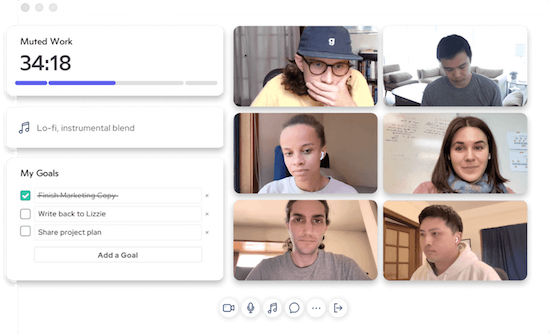
Book a session listed on the schedule of upcoming options to “pre-commit” and make yourself more likely to attend. (You can schedule at the last minute, though.) Sessions are hosted to keep everything on track, and there are up to eight participants at any session.
Show up at the appointed time; participants share their goals and then the host sets a timer (and may begin playing focus-inducing music to help induce a flow state. (The schedule indicates which sessions have music, in case that’s something you want to avoid.) Meanwhile, cameras stay on, but everyone is muted and focuses on completing their own deep work. At the conclusion of the session, everyone debriefs and celebrates their achievements (or at least their progress).
You can try Flow Club for free, but then it’s $40/month (or $33.33/month if paid annually) for unlimited access.
TWO MORE OPTIONS AT OPPOSITE ENDS OF THE COST SPECTRUM
Social Pomorodo
Perhaps you want something a little more casual? Don’t want to have to register? Social Pomodoro is about as low-fi as you can get and still be on the computer. Choose one of three options:
- Single Player — To get the hang of it, opt for a computer to be your body double.
- Veteran — Once you know what you’re doing, click on this option to be assigned a work buddy. Traffic is relatively low on this platform, so they suggest clicking Veteran status in “idle mode” and wait for someone to join you. (You can use Single Player in another tab simultaneously.)
- Friend in Mind — Want to body double but don’t want a Zoom, Meet, or Teams account? Have a friend head to Social Pomodoro around the same time, and you can click this button to make sure you get put in the same Pomodoro room.
In all three versions, buddies have 120 seconds to one another in the chat box and text about goals for the session. You’ll see the timer count down to ensure you each get time to talk and are ready to hit the ground running.
Next, work for 25 minutes, a standard Pomodoro measurement, without chatting. The one-screen countdown timer helps you keep pace. At the end of the session, there’s another 120 seconds to share how things went.
Social Pomodoro is a quick alternative if you need your feet held to the fire to complete short tasks like making phone inquiries, scheduling appointments, reading school assignments, drafting emails, or doing a brain dump.
On the up side, it’s free, low-tech, and you don’t have to create an account. However, you’re not going to must live body-doubling suppor unless you bring your own.
Spacetime Monotasking
This simultaneously one of the most flexible, most expensive, and most proactively progressive co-working platforms, stating that they are “committed to creating a welcoming environment for BIPOC, LGBTQIA+, neurodivergent, and people of other systemically marginalized identities.”
Two like-minded women on TikTok founded Spacetime Monotasking (the opposite of multitasking) designed it to “support creatives, entrepreneurs, freelancers, and anyone who wants to use their time differently” by tuning out the outside world and focusing on your priorities. They call it mindfulness in motion.

Spacetime Monotasking hosts live sessions every weekday run through a Discord server. (In case you’re not familiar, think of Discord is a worldwide social media for voice, video, and text chat.) Begin with Spacetime Monotasking’s start page, accept the invitation, and register with Discord.
There are three levels of ongoing memberships: $35 for 5 sessions/month, $55 for 10 sessions/month, and $85/month for unlimited sessions. You can also opt for a drop-in session for $10.
Additionally, individuals can apply for a discounted membership: “Our Boost Rate is intended to uplift BIPOC and others who experience systemic economic disadvantages.” There’s no free trial for the live, hosted monotasking sessions, but you can experience a video version of a Spacetime Monotasking 1-hour sprint:
If you don’t belong to an organization that offers co-working sessions and aren’t up for starting your own, would you try one of these platforms? From free up to $1020/year (with many price points in between), from one body double to a crowd of fellow workers, which appeals to you the most for conquering procrastination and getting into that flow state?
Follow Me