How to Avoid or Minimize Probate: Paper Doll’s Guide to Getting Started
October 19-25, 2026 is National Estate Planning Awareness Week. In 2008, Congress established this as an annual event, in part because so many Americans do not have wills or other estate documents, and often do not understand the elements involved.
We’ve previously talked about important documents to have when someone is alive, in case of emergency, like a:
- Power of Attorney
- Healthcare Proxy
- Advanced Care Directive or Living Will
To refresh your memory on these documents, see past Paper Doll’s classic post How to Create, Organize, and Safeguard 5 Essential Legal and Estate Documents.
Most people understand how these are used during someone’s life. However, there is often confusion as to how things will work after a death.
Recently, while organizing a client’s vital documents, I asked some general questions regarding the basics of the paperwork: filling trusts, naming beneficiaries, changing the status on accounts, etc., and the client said, “Thankfully, we don’t have to worry about any of that. I have a will!”
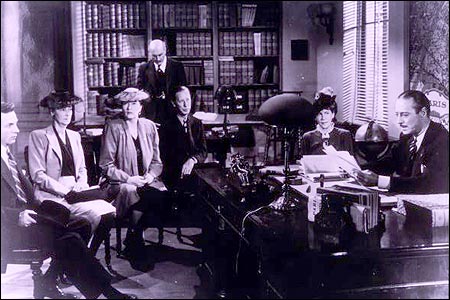
The reading of the will in Monseiur Verdoux (1947), in the public domain
If you watch old movies about such things, there’s usually a death, a sobbing person falling to their knees, a funeral, and then a formal reading of the will, at which point a portly lawyer turns the assets over to whomever is there — loved ones, a mysterious woman in a veil, a beloved dog. In movies, after a few shocking disclosures, everyone leaves the room owning what they were bequeathed.
Yeah, no. That’s not how it works.
In most cases, assets are transferred from the person who is deceased to the new owner(s) in one of two ways, either through a process called probate or as the result of specific probate-avoiding actions, like setting up trusts, joint ownerships, or direct transfers (like registering an asset as Transfer-on-Death or Payable-on-Death).
Over the next few posts, we’re going to cover these concepts, including how to properly set up accounts, ownership, and beneficiaries of assets to reduce the emotional and financial stress on those who are left behind.
WHAT IS PROBATE?
You’ve certainly heard about probate before. You know it has something to do with wills and what happens when someone dies, and that may be the limit of your familiarity.
Most adults who haven’t ever dealt with probate tend to nod sagely when someone else is discussing it, and hope nobody will ask them questions. (In that way, it’s similar to being in an algebra class. Look interested, but not so interested that anyone will ask you to weigh in.) Don’t let embarrassment or uncertainty lead you to miss out on the opportunity of easing the entire process.
In the simplest terms, probate is a legal process where a court supervises the distribution of the assets of a deceased person.
Probate exists because no matter what the will says about who gets what, the government (under the guise of the probate court) has a vested interest in making sure that all of the estate’s debts (if there are any) get paid off before any heirs collects assets. The court also needs to make sure that taxes are paid and that assets are properly transferred.
Probate doesn’t only happen when there’s a will. If someone dies intestate — that is, without having left a will — and there are interested parties (heirs), an estate usually goes through the probate process as long as the value of the personal property of the estate (not counting a house or other types of real estate) is above specific dollar value.
Plus, if someone does die without a will, the probate code determines who gets what. That means, for example, if someone dies while going through a nasty divorce but doesn’t have a will, the court will give a lot of their assets to the not-yet-ex instead of to the non-profit or beloved friends they might have wished to receive those things.
How To Start Probate
As a reminder, Paper Doll is a professional organizer and not an attorney, so nothing in this post series should be taken as legal advice. Rather, it should serve to give you a better understanding of what to expect when you organize your important documents and information to make the estate management process easier.
- Name an executor — The testator (that’s the person making the will — also known as the last will and testament) names an executor, the person who controls someone’s assets after death, carries out the deceased’s wishes, and distributes the assets. The executor can be a spouse, an adult child, a friend, or even an individual hired for the purpose.
- Submit the will to the probate court — The executor submits the original, signed will to the office of the probate court clerk in the county where the deceased person lived. So, if Great Uncle Phil lived in Polk County, Iowa but you’re his executor and you live in Hawaii, you’ll need to submit everything to Polk County.
- Submit a certified copy of the death certificate to the probate court clerk’s office. Typically, the funeral home will provide the family of the deceased with multiple copies of the death certificate. You can always get more from your state’s Office of Vital Records.
- Fill out a sworn petition to probate the will — The word “petition” is just a fancy legal term for request or application. The petition form will include information about:
- the testator (again, that’s just the deceased)
- an estimation of the total value of their assets — Later in this series, we’ll talk about how to organize that information so the amount submitted can be accurate.
- the names, addresses, and relationships (to the deceased) of anyone named in the will, or if there is no will, the same information for any relatives who might be entitled to inherit.
Note: in some counties, the petition to probate a will has to be drafted and filed by an attorney, so check with the Probate Court Clerk before trying to use or submit any online forms on your own.

Probate Lawyer Scrabble Photo by Melinda Gimpel on Unsplash
The court will charge fees for the probate process; if you have to hire an attorney, there will be fees for that, too. Know that that all estate-related fees can be paid (generally, reimbursed) from the deceased assets.
What Happens Next
Once you file all the paperwork with the probate court, you’ll be schedule for a hearing in front of a probate court judge. Unlike anything you’ve ever seen on Perry Mason or Law & Order, this is not likely to have much dramatic effect. Assuming nobody objects to the person named as executor, the judge will officially appoint the named person to do it.
If there are objections (let’s say Big Brother and Little Sister have a longstanding beef), the judge may name a more neutral party, like an attorney, to serve as the executor. Either way, whoever takes on the role with make an oath to “faithfully” pay the owed debts and distributed whatever assets are left over according the wishes the deceased expressed in the will.
The Executor’s Role
Next, the judge will give the executor a legal document called Letters Testamentary, and yes, it sounds like something out of an 18th-century English novel. Just go with it. In some jurisdictions, it may be called letters of administration. It’s just a document authorizing the executor to act on behalf of the estate.
Again, it’s a legal document. Don’t fold it into quarters and stick it at the bottom of your purse with the half-eaten bag of gummy bears. Don’t clip it to the sun visor of your car. Make a folder for it and put in the VIP (very important paper) section of your filing cabinet. Scan it and keep a copy on your phone so you can refer to it when aren’t at your home or office.
One of the rights of being an executor is actually an obligation: to withdraw all the money from the deceased’s bank accounts and then deposit it in a new account for the estate. This way, the executor can pay the debts and distribute any financial assets to the heirs.
Once the executor has notified all creditors, paid all debts and/or filed objections to creditors’ claims with the court, and distributed the assets, the estate can be closed. This involves filling out and signing a form documenting all payments made from the estate and sending it to all beneficiaries named in the will. If everyone gives the okey-dokey and feels the accounting is correct, they also sign the form. Finally, the form gets submitted to the probate court judge for approval and the estate can be officially closed.
Can you see the advantage of organizing your assets so that your estate can avoid, or at least minimize, probate?
SMALL ESTATE AFFIDAVITS AS AN ALTERNATIVE TO PROBATE
A small estate affidavit isn’t the deed to a tiny house.
“Small estates” are those valued at a relatively low amount. Heirs can collect the assets/property without going through a formal probate process by securing something called a Small Estate Affidavit.
Depending on the state, that “small” amount may be $10,000-$25,000, like in Alabama, Georgia, New Hampshire, and Vermont, or it could be what some of us would not consider small at all, like $150,00-$400,000 in states like Arizona, California, and Wyoming. Most states fall somewhere in the middle. For example, in Tennessee, where Paper Doll resides, the limit is $50,000.
There are usually special requirements for filing small estate affidavits:
- the assets must have been owned solely by the deceased. That means that jointly-held assets don’t count.
- real estate is excluded. Almost all states deny the transfer of real estate to heirs via a small estate affidavit.
- there are waiting periods after the date of death. Almost all states require you to wait some amount of time, generally 30-45 days, before the affidavit can be obtained.
- your executor or proxy will have to get their signature on the affidavit notarized.
There’s an additional hiccup with small estate affidavits. During the normal probate process of a well, the probate court determines if there are creditors owed anything for the deceased’s outstanding deaths and makes sure they get paid.
Because there’s no parallel process with small estate affidavits, the individual filling out the affidavit generally has to report any known debts and take responsibility for them. This is why many people who could avoid the costs and effort that probate entails don’t seek this alternative.
It can also just be a bother. Earlier this year, I found that one of my clients was receiving mail at her address regarding two sets of stock holdings in the name of her deceased father. Although he had a will for which my client was the executor, by the time he died (about five years earlier), the family had not known/felt that he had any assets making the probate process with it. He’d arranged for joint ownership of bank accounts, and no longer owned property, as he was living in a nursing home. At the time of his death, the two stock holdings weren’t at the forefront of anyone’s mind.
Had my client’s father named her (or anyone) as a beneficiary for those stock holdings, she could easily have transferred the funds by supplying a copy of the death certificate. However, because he had never named a beneficiary, my client had to jump through several hoops in order to secure (and pay for) a small estate affidavit, submit it to the stock transfer agent, transfer the account ownership to her name, and finally arrange to sell the stock and receive the proceeds. It took time and effort (for both of us) and money just to ensure a transfer of assets reflecting what his will had originally stated — than anything of his was to go to his daughter.
As you can see, not planning ahead can be a headache for loved ones left behind.
WHY YOU WANT TO AVOID PROBATE
I don’t mean to scare you. The emotional weight surrounding death, either of a loved one or of all of our eventual shuffling off this mortal coil, is heavy. Rather than add the unwanted (and unexpected) weight of the financial and legal aspects of passing, it’s better to get to know and understand the big picture so that you can take actions early enough to smooth the entire process.
So, why avoid probate or at least lessen the complexity?
Lower Costs
Probate can be pricey!
Attorney fees, executor fees, appraiser fees and notary fees all add up. Executors can’t always be expected to donate all of the time necessary to accomplish probate tasks. And, sad to say, courts don’t run on good vibes. If you go through probate, you’ll likely have to shell out for:
- Filing fees — While they vary by state and county, most initial filings costs between $200 and $500 for a standard probate petition filing.
- Attorney fees — Probate attorneys generally charge hourly fees, and an “easy” probate may take 30+ hours at anywhere from $200-$500/hour; alternatively, attorneys may have flat package fees for uncomplicated probate. Note, however, some states have statutes governing attorney fees as a percentage of the estate’s gross value. For example, in California:
- 4% on the first $100,000
- 3% on the next $100,000
- 2% on the next $800,000, and
- 1% on the next $9 million!
- Executor fees — Executors have a right to compensation. While family members may choose note to charge the estate for their labor as executors, they have the right to do so. Plus, in states that have statutory attorney fees for probate, executors are due equivalent payment as a percentage of the estate’s gross value.
- Appraiser fees — In order to determine the fair market value of assets, appraisers bring their expertise to the valuation of everything from real estate and businesses to jewelry, antiques, artwork, and collectibles. And appraisals are usually required as part of the formal inventory of an estate’s holdings.
- Accountant fees — If an estate generates income (like from rent, dividends, interest, or business holdings), someone has to prepare the the taxes!
- Notice and publication costs — Executors incur costs for mailing formal notices to creditors and publishing notices to creditors.
- Certified copies of court orders — While these are small charges, generally from $5-$25 per copy, the executor will need several copies to show title companies, banks, transfer agents, and other financial institutions.
The more fees there are, the less value remains in an estate. If you’re Scrooge McDuck with oodles of gold, it may not make a material difference, but for most people, keeping costs down is essential.
Why let an estate’s value be eaten up and depleted by fees you can avoid?
Save Time
Even in the best of times, probate can take months — sometimes years — to work its way through the courts. During the early COVID pandemic, courts were closed, and once they re-opened, with so many employees working from home without access to physical documents, the process was extended.
Even in normal times, during certain seasons the courts slow down as staffers are on vacation and during holidays. It’s not uncommon for it to take months just to get a probate court hearing date in large metropolitan locations.
In addition to court backlogs, probate can be slowed by other factors, like:
- Mandatory creditor notice periods — States requires executors to notify any creditors and potential creditors and provide a window (often 3-6 months) in which to file claims against the estate. (Creditors, like credit card companies, are easy to notify. Other potential creditors may be unknown, so it’s common to post in the classifieds of Penny Saver newspapers, even almost nobody reads them.) Even if the estate doesn’t have any debts, that notice period is obligatory, and the executor can’t distribute any assets until the window closes. The process is really complicated and varies by state, debt type, and method, so if you’re eager to learn more take a peek at Probate Notice to Creditors and Claim Deadlines by State, and then maybe take an aspirin.
- Sales of real estate and other property required by a will or to satisfy debts — And it’s not just the sale. A property first needs to be appraised, and then it may need to be maintained/remodeled/made “safe for habitation.” If the property wasn’t covered by insurance at the time of death, it must get covered before the property can be sold. Except if the will didn’t grant the executor the authority to sell the property, the whole process could require the court’s approval, and that means scheduling (and then waiting, and then having) another hearing, just to be allowed to accomplish these tasks. And then someone has to be willing to purchase the property! Oy! (Where’s that aspirin?)
- Tax preparation and filings — Depending on the size of the estate, a federal estate tax return using Form 706 (including schedules A through W!) might be due 9 months after the person dies. And if the estate, itself, earned any income during that period (like from investment dividends, rental income, or a business), then the estate may have to file a federal income tax return. Plus, some states have their own estate tax and inheritance tax, so preparing returns and waiting for government entities to process them can takes several months depending on how complex the tax situation is.
- Contested wills — You’ve seen the ripped-from-the-headline cable movies. You’ve heard the gossipy stories. Everything seems like it’s going along smoothly and then someone objects to the will. It can be a creditor, an heir, or mysterious “other” and they might challenge whether the will is valid at all. Siblings argue that Grandma had no mental capacity to make the will or that another individual used “undue influence” to get a will revised. Sometimes, someone argues that an old will is real and a newly-found one is not (or vice versa). It can takes years for contested wills to complete probate!
Where you live can also determine how quickly the probate process goes. In the United States, probate takes an average of 9-24 months; if the deceased had no will, the process generally takes 2-4 extra months, although it can be longer. In Florida and Texas, probate may be completed in six months to a year; in New York and California, 1-2 years is more common.
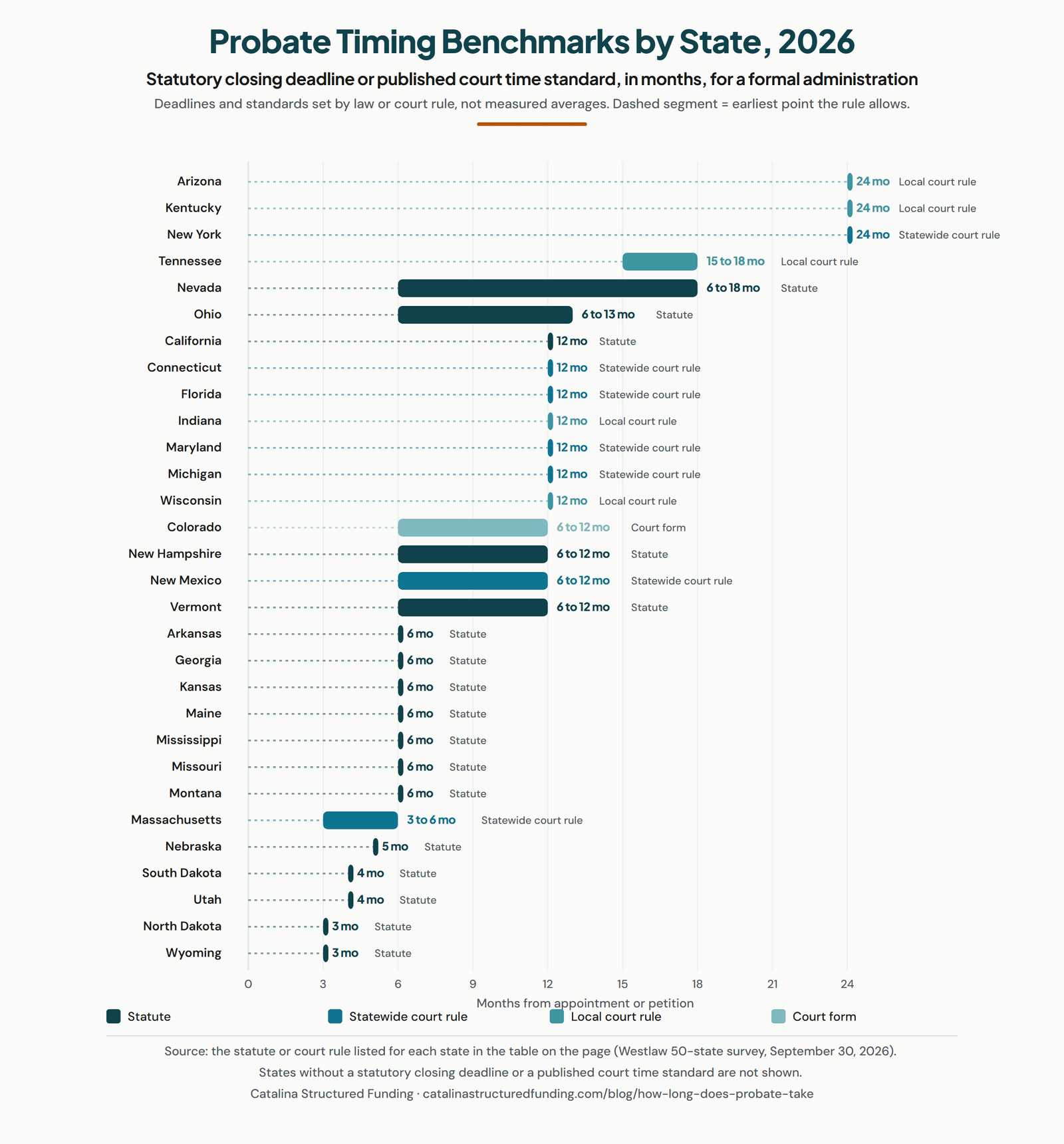
Chart: Catalina Structured Funding, “How Long Does Probate Take? State-by-State Timelines for 2026,” https://www.catalinastructuredfunding.com/blog/how-long-does-probate-take
The longer probate takes, the longer the delay before assets can be distributed to beneficiaries. Doesn’t it make sense to avoid or at least minimize the probate process?
Ensure Family Privacy
Did you know that probate proceedings are a matter of public record?
That means anyone, from your ex-mother-in-law to Gladys Kravitz can access the details of your estate holdings and know who the recipients of assets are. Maybe you’d rather the world didn’t know that Cousin Floyd left you stock in Playboy Enterprises. When you avoid probate, you get to maintain your family’s privacy.
Reduce Stress
Grief is difficult and unwieldy. When families are in mourning, loved ones feel surges of grief at unexpected times; it’s why you feel “waves” of grief, and why it’s important to keep from being pulled under.
Why add to the emotional pain of loss with a complex and lengthy probate period when you can make inheriting many of the assets easy?
Next time, we’ll explore the specific ways you can avoid probate, or at least limit the process, labor, and costs.
In general, there are three main categories of ways to avoid probate:
- Own property jointly
- Create (and then fill and fund) revokable living trusts
- Arrange for beneficiaries (through Payable-on-Death/Transfer-on-Death assignments)
That last bullet may seem like something you only do with life insurance or retirement accounts, but there are easy, no- and low-cost ways to transfer ownership of everything from bank accounts to stock holdings, and even cars and houses, and we’ll walk through them all.
As we go through this series, we’ll also look at how to organize information about your assets to make the probate process (or avoiding the probate process) so much easier for you and your loved ones.



Follow Me