How to Avoid or Minimize Probate: Organize Your Beneficiaries, POD Accounts, & More
Nobody likes thinking about death, but as Benjamin Franklin said, “[I]n this world, nothing is certain except death and taxes,” and as such, we’re better off being organized for the eventuality than trying to wish it away.
Last week, in How to Avoid or Minimize Probate: Paper Doll’s Guide to Getting Started, we began by looking at the essentials: what probate is, how the process is started and then progresses, and then the alternative use of Small Estate Affidavits. Perhaps more importantly, we reviewed (in depth, as only Paper Doll can do), why you want to avoid probate whenever possible, in order to:
- lower (considerable) costs
- save time
- maintain family privacy
- ease the stress felt during a time of mourning
Now clear on why you want to avoid probate, or at least minimize it as much as possible, we come to the heart of the matter. What do you actually have to do to avoid the pains of probate?
HOW DO YOU AVOID PROBATE?
Whether she realized it or not, my maternal grandmother had an interesting way of making sure that probate would be as unproblematic as possible. If you came to her home and managed to praise anything — a teacup, a lamp, a painting — she would hand it to you at the end of the visit!
Giving everything away during your lifetime is an intriguing approach, but not necessary practical. Also, while it reduces what has to go through probate, if you’re giving actual money, remember that gifts exceeding $19,000 per person are subject to federal gift tax.
Rather, there are three main methods for securing assets so they go from your ownership to those you intend to receive them — avoiding probate — without ever pressing an oversized ceramic dog statue into a departing guests hands.
The three categories actions you can take to avoid probate:
- Own assets jointly
- Name a beneficiary through a beneficiary transfer form, Payable on Death form, or Transfer on Death form
- Create a revokable living trust (RLT) in which the trust is the owner of your “stuff” and can be passed to named beneficiaries
Again, as a reminder, Paper Doll is a Certified Professional Organizer® and not an attorney. Nothing in this post series is, or should be taken as, legal advice. Rather, it gives you a jumping off point for approaching the appropriate parties (at your bank, brokerage, insurance company, county government, or your actual attorney) with your wits about you.
Today, we’ll focus on the first two (easier) categories of getting assets into the hands of your loved ones while avoiding probate.
ARRANGE JOINT OWNERSHIP
If you own something (a bank account, a house, a chestnut-colored thoroughbred horse) all by yourself, you have to take a variety of steps to ensure that when you shuffle off this mortal coil, it goes to whomever you wish.
However, if you jointly own something, when one owner passes away, ownership passes to the other owner(s) in a straightforward way. Let’s start with a simple example — bank accounts.
Joint Ownership Bank Accounts
A joint bank account is one jointly owned by two (or more) people. Duh! Most commonly, people open joint bank accounts when they get married so that they can pay for joint expenses, such as mortgages, utilities, household upkeep, childcare, family vacations, etc.
Marriage or cohabitation isn’t the only reason you might have joint ownership of a bank account.

Paper Mommy, wrist in a cast, but with a perfect manicure, 2016
Almost a decade ago, when Paper Mommy broke her wrist, I took over paying her bills by phone; however, the next time I visited Buffalo, we went to her bank so set up checkwriting access for me and for my sister, and my mother found that it made sense to add us as joint holders of the account.
If you set up joint ownership (either when you open an account or subsequently), and then pass away, your joint accountholder(s) will have still access to the funds in the account. They won’t have to present a death certificate to the bank until/unless they take your name off the account, at any future time.
This is a great option for seniors, assuming they’re comfortable with the other joint accountholders (like their adult children) always having access to the money. Obviously, it’s necessary to consider the maturity, stability, and trustworthiness of anyone named as a joint account holder.
Joint Tenancy
Joint tenancy is a probate-avoiding method of owning assets, commonly focused on real estate. When one owner (the “joint tenant”) passes away, the other, surviving joint owner(s) will automatically inherit the portion owned by the person who died, through a legal status known as “right of survivorship.” If you survive — that is, live beyond the time that co-owner ceased to do so — you have the right to own their share.

Little Red Houses Photo by Tierra Mallorca on Unsplash
It’s not magic; there’s paperwork to transfer the property into the name of whomever inherits, but for all practical purposes, this right of survivorship makes it easy to transfer real estate — houses, condos, farms, etc. — without the stress of probate. Joint tenancy can be used to transfer ownership for assets other than real estate, like car titles or a bank accounts, as described above, but let’s keep this simple.
When you buy property or set up ownership, make sure the deed, title, or other paperwork establishes joint ownership, usually by referencing “joint tenancy with the right of survivorship,” though a few states require a little bonus language.
In most U.S. states, joint tenants own equal shares. So, if Ernie and Bert co-own the brownstone at 123 Sesame Street, each owns 50%. (Of course, neither Ernie nor Bert will EVER pass away, so this is merely for discussion purposes. Are we clear? Let’s proceed.)
A joint tenant can’t leave their share to anyone but the other joint tenant(s). So, Ernie can’t stipulate in his will that his share of the brownstone goes to Grover; if Ernie ever did ascend to the great unknown, Bert would own the whole building.
Joint tenancy, especially with real estate, does have some drawbacks:
- Creditors can sue for your joint tenant’s portion. If you jointly own a house with your deadbeat boyfriend, the court could force the sale of the house to reimburse his creditors; you’d get your share of the money (while some or all of his share would go to the creditors), but you’d no longer own your home or have the full buying power that house represented. The other joint tenant can also take out a mortgage on their share to get cash, so you’d now own a house half-owned by the bank!
- You can’t unilaterally un-share ownership. If darling becomes a devil, you’re still bound to them.
- You’re stuck if your joint tenant becomes incapacitated. If a couple own a house in joint tenancy and the wife suffers from dementia, the husband can’t just unilaterally decide to sell (or take a mortgage) to afford assisted living for her. Instead, he’d have to get conservatorship from a court. Messy.
Tenancy by the Entirety
Tenancy by the Entirety (TBE) is very similar to joint tenancy, but it’s only available to married couples.
The other major difference is that neither spouse can sell or otherwise transfer ownership of their half of the property during the lives of the either spouse without the other’s permission.
It’s also only allowed in some states, and for some inheritance purposes. Tenancy by the entirety is possible for:
- All property types (i.e., real estate and personal property) in Arkansas, Delaware, Florida, Hawaii, Maryland, Massachusetts, Mississippi, Missouri, New Jersey, Oklahoma, Pennsylvania, Tennessee, Vermont, Virginia, and Wyoming, and in the District of Columbia
- Real estate only in Alaska, Indiana, Kentucky, New York, North Carolina and Rhode Island.
- And in special situations:
- Illinois — it’s limited to married couple’s primary residence, called a homestead property.
- Michigan — all joint tenancy situations are automatically converted to TBE status upon a couple’s marriage.
- Ohio — TBE is only recognized for property deeds issued before April 4, 1985.
- Oregon — both spouses own the entire property rather than each holding a 50% share
TBE is complicated; get an attorney to help you with estate planning because it can impact a variety of issues, including creating trusts, planning gifts, or Medicaid lookbacks.
Community Property With Right of Survivorship

Miniature Couple Photo by Nothing Ahead
Nine states — Arizona, California, Idaho, Louisiana, Nevada, New Mexico, Texas, Washington, and Wisconsin — are considered community property states for married couples. (California and Washington allow registered domestic partners to do this as well.) Basically, it’s “what’s mine is yours and what’s yours is mine” such that when one spouse dies, the ownership of their community property automatically goes to the surviving spouse.
In these community property states, you can avoid probate by putting “community property with right of survivorship” (or an approximate phrase) on any account registration paperwork, deed, or transfer documents. Check for the exact language your state requires.
Joint ownership can be complicated. Let’s examine variety of alternate ways to transfer ownership that cost little-to-nothing, and require so little effort that you’ll think you’re gaming the system.
BENEFICIARIES / PAYABLE ON DEATH / TRANSFER ON DEATH
You know what a life insurance beneficiary is. You take out a policy, name someone as the beneficiary, and when you’re gone, the proceeds go to the named person. But the concept of beneficiaries can be applied to much more than life insurance!
The key thing to know about these options is that everything belongs to you and stays under your control during your life. Whether an investment or retirement account is listed as having beneficiaries, or a bank account or asset is categorized as Payable on Death or Transfer on Death (TOD), beneficiaries don’t have access until the owner of those assets dies.
Payable-on-Death (POD) Bank Accounts
You can name an individual (or individuals) to inherit money from a bank account when you pass away. The difference between a jointly held account and a payable on death account is that with the former, you all have access to the money at any time; with a POD account, you name individuals who get your money after you’re gone.
Arrange this when you open the account or at any time thereafter. While it’s not difficult, every bank has its own procedures, so be sure to ask.
Rather than calling, you’ll likely have more luck going to your actual branch and asking one of the “desk ladies.” (This is how Paper Mommy and I refer to a non-cashier bank employee with a desk or office. Yes, a man can be a desk lady.) While researching this post, I tried calling Paper Mommy‘s bank branch, but nobody ever answered. Eventually, I called the toll-free number, and after suggesting they check to make sure my mom’s branch wasn’t being robbed (yes, I watch too much TV), I was able to confirm some aspects of the process.
Some banks make it very easy. With Bank of America, you can log into the app, click on the three horizontal lines in the top left corner, select Profile, then Settings, and scroll down to the Beneficiaries option under Feature Settings.
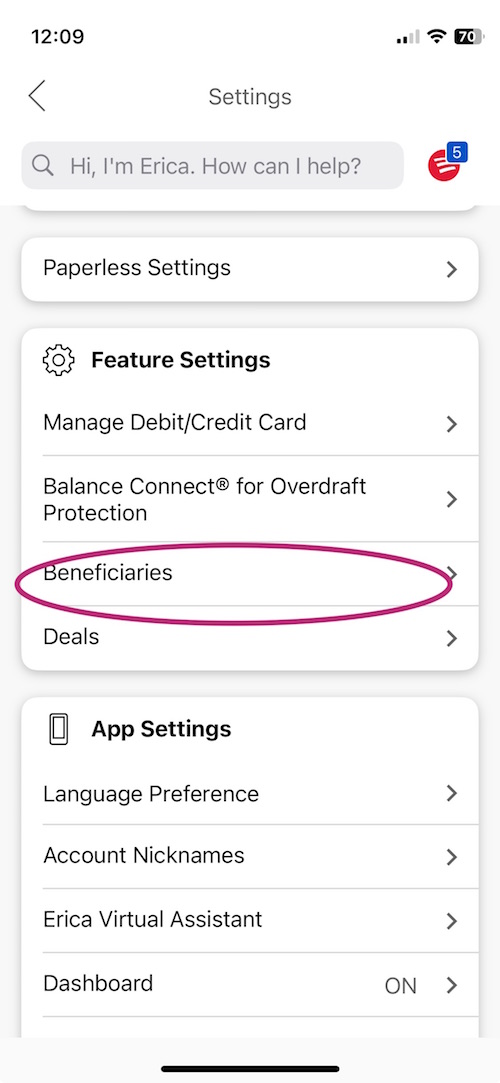
The resulting “Your Beneficiaries” page shows all of your accounts:
- Pick an account
- Click “Add beneficiary”
- Choose the beneficiary relationship:
- Spouse, family member, or friend not on the account, or
- Business, charity, estate, or trust
- Fill in the beneficiary’s full name, birthdate, country of citizenship, and current address or tax ID (Social Security number or EIN)
- Click Save
I accomplished the whole task during one commercial break! However, some banks make it slightly more laborious. Plan to follow some approximation of these steps:
- Go to your bank’s branch. It’s often best to schedule an appointment through your banking app.
- Ask the banker to change your account’s designation to Payable on Death (POD). Note that your bank may call this something else, like:
- Informal Revocable Trust — Unlike formal revokable trusts, which are established by written trust agreements (requiring lawyers and lawyers’ fees), an informal revocable trust account works just like setting up a beneficiary for an insurance policy or investment holding. When the account-holder dies, the “deposit” (that’s the account) “passes” from the owner directly to the beneficiary/beneficiaries without the need for any written trust agreement.
- Totten Trust
- Beneficiary
- Transfer-on-death (TOD) or In Trust For (ITF) or As Trustee For (ATF)
- Provide the following for each beneficiary:
- Full legal name
- Residential address
- Phone number
- Date of birth
- Relationship to you
- Set your intended allocation. The default allocation divides the account balance equally among all beneficiaries still alive when you die.
- Confirm that your signature card is on file.
- Review the form for accuracy and sign it.
If you use an online-only bank, call but be prepared to explain (a few times) what you want and know that you’ll likely have to upload proof of identification to a secure portal.
Once a person dies, the beneficiary can just go to the bank, show the death certificate and their own proof(s) of identify, and obtain the funds.
Advantages of POD Accounts
You avoid probate!
It’s also relatively simple and and cost-free, not counting the value of your time. You don’t need a lawyer; just go to your bank or credit union, fill out the POD paperwork, and you’re set.
POD accounts are revocable. If your one of your kids becomes a meanie, or your sibling becomes a candidate for a political party that turns your stomach, just go to the bank with an explicit written revocation — or just withdraw all the money from the account, close it, and open a different account.
Limitations of POD Accounts
A POD account only applies to bank (or credit union) accounts, like bank deposit or checking accounts, savings accounts, or certificates of deposit (CDs); you can’t set up this kind of POD for real estate, stocks and bonds, or physical property like cars or boats or your Beanie Baby collection.
Even though it might be called an informal revocable trust, it doesn’t safeguard money from creditors the way a trust does. While you’re alive, if you owe personal debts, creditors can still make claims against whatever money is in that account.
Transfer-on-Death (TOD) Registration of Securities
Per the Uniform Transfer-on-Death Securities Registration Act, you can name someone as the beneficiary of your stocks, bonds, mutual funds, or brokerage accounts. This is known as Transfer on Death or TOD.
You’re likely already familiar with how this works if you’ve ever set up any kind of standard investment account, as listing beneficiaries is generally part of the basic paperwork. Just provide the individual’s name and Social Security number, plus some contact information and you’re done. When you die, the assets in that account will pass to your beneficiaries once the financial institution is notified of your passing.
That said, it’s important to periodically check your beneficiary listings. If you name your spouse as beneficiary and have an acrimonious divorce, or even an amicable one but then remarry, you’ll want to change that beneficiary paperwork. Also, as the years go by, not all beneficiaries may still be alive; if someone passes, update your beneficiary names!
While you aren’t required to list beneficiaries, if you don’t do it, all of your investments will just sit in your account upon your death, going nowhere until your will goes through probate. And without a will, your loved ones will have to wait even longer for everything to be resolved.
You can generally name anyone as beneficiary of your securities investments: a parent, spouse, child, sibling, distant relative, friend, George Clooney — even a business or non-profit/charity. You can also name your trust as the beneficiary.
Note: You may be limited by state property law. Remember those community property states? There, you must get your spouse’s signed, witnessed consent to designate anyone other than your spouse as your primary beneficiary for a TOD for securities.
Retirement Accounts

Retirement Beach Photo by Costa Karabelas
You worked hard for your retirement benefits, so make sure that money goes where you want. When you set up any kind of retirement account — a pension plan, an IRA (of any kind), or a 401(K) — you’re required to list a beneficiary, usually a primary and secondary one.
Whether you live in a community property state or not, you’ll need spousal permission to list anyone except your spouse as your beneficiary.
Again, this isn’t entirely set-it-and-forget-it. People change spouses. Friends and relatives pass away, or just out of our lives. Businesses close or change ownership and charities don’t always maintain their mission. Periodically review your beneficiaries and make changes if necessary.
As with securities, retirement accounts live up to the concept of a TOD designation — they get transferred upon (proven notification of) death. When a you die (eons from now), your beneficiary should contact the retirement account custodian — that’s the financial institution that holds the account’s investments, processes the transactions, keeps all records, documents incoming contributions and outgoing distributions, and oversees the reporting to the IRS and other government agencies, as required.
Your beneficiary should provide a death certificate and their own ID, and then claim the funds directly or transfer the account into their own name(s) so they can maintain those investments, either as-is, or adding/revising the assets in them, just as if they’d opened the account themselves.
Transfer on Death Deeds for Real Estate
In 31 states and D.C., you can avoid probate on real estate by creating a Transfer on Death deed. Those states are: Alaska, Arizona, Arkansas, California, Colorado, Georgia, Hawaii, Illinois, Indiana, Kansas, Maine, Minnesota, Missouri, Montana, Nebraska, Nevada, New Hampshire, New Mexico, New York, North Dakota, Ohio, Oklahoma, Oregon, South Dakota, Texas, Utah, Virginia, Washington, West Virginia, Wisconsin, and Wyoming.
Also, in Florida, Michigan, Texas, Vermont, and West Virginia, a Ladybird Deed, (also called an enhanced life estate) allows Medicaid beneficiaries to protect their home from the Medicaid Estate Recovery Program and pass the house to a loved one as inheritance, rather than to a state Medicaid agency to reimburse long-term care costs.

- Complete the deed — Depending on the state, homeowners may be able to access a free deed template; look for downloadable forms on your county or state website. Otherwise, an attorney can prepare your Transfer on Death deed. The TOD deed requires:
-
- your name and personal information
- a legal description of the property — a single family home, a condo, or a banana stand?
- the beneficiary’s full name and address
- the beneficiary’s relationship to you
- Sign the deed and have it notarized — Legal lingo: you’re the transferor and must sign the deed, but your beneficiary does not need to sign it.
- File it with your county’s land records office — Don’t leave it sitting in a pile on your microwave, because if you die before it’s officially filed and recorded with the governing authority, it’s invalid.
Note: The deed must state that it won’t take effect until your death and that it is revocable by you at any time prior to your death.
Revoking a TOD deed
Speaking of which, as with almost all of these options today, you can revoke your transfer on death deed altogether, or change your beneficiary. Just file a revocation, a written document starting you want to revoke the terms of the beneficiary deed you’ve previously made and recorded (that is, filed).
States vary, so if you were able to download a form to file, look online for a downloadable revocation form. (Some states have sample revocation language in the statutes that legalized TOD; copy that language.) File the revocation at whatever governmental office where you filed the original TOD deed.
You may have to pay an attorney if your state requires a grownup to prepare the document. You also may have to pay a filing fee.
Thus, unlike setting a beneficiary for your bank account, securities, or retirement account, TOD deeds are neither super-quick nor always inexpensive. However, they’re much quicker and less expensive than going through probate.
For those who live in a state not listed above, the best option for avoiding probate is to place your home or other real estate in a trust, which we’ll discuss next time.
Transfer on Death Registration for Vehicles
Got a car? (Or a truck, motorcycle, boat, RV, jet ski, snowmobile, tractor, or airplane?) You may be able set up a TOD registration so that when you die, ownership will pass directly to whomever you wish, avoiding probate.

Little Red Car Photo by Gimmel Magaway on Unsplash
Vehicles are generally registered in the name of one owner, though it can be more than one in the case of co-owners, as we discussed with joint tenancy, above. However, in 15 states (Arizona, Arkansas, California, Colorado, Connecticut, Delaware, Illinois, Indiana, Kansas, Missouri, Nebraska, Nevada, Ohio, Vermont, and Virginia), contact your state’s department of motor vehicles and request a copy of your “car title in beneficiary form.”
Once you register the vehicle, the title certificate will not only list your name as owner, but also the beneficiary you choose. After your death, they go to the DMV with the death certificate and ID, fill out the new title, and pay a transfer fee (ranging from $15-75).
While you’re alive, nothing about naming a beneficiary on the Transfer on Death registration form impacts your ownership. You can sell it to the teenager next door or donate it to 1-877-Cars4Kids. If you get annoyed at your beneficiary for playing bad music on the car radio, just name a new/different beneficiary.
Residents of the other 35 states (and DC) have limited alternatives. Your state may have TOD systems limited to surviving spouses or one’s that apply only to low-value vehicles. Contact your state’s Department of Motor Vehicles to find out what your options are.
As this series continues, we’ll look at setting up trusts and assets you can’t bequeath by will.
We’ll also look at how to organize information about your assets to make things easier for your loved ones, and provide resources for asset-holders, executors, and beneficiaries.
Follow Me