Archive for ‘Psychological’ Category
Paper Doll Shares 8 Virtual Co-Working Sites to Amp Up Your Productivity
Last week, in Paper Doll Sees Double: Body Doubling for Productivity, we looked at the concept of body doubling and the mechanisms by which it helps us with productivity and accountability through social pressure, task orientation, biological cues, and extended focus.
My wise colleague Diane Quintana, CPO®, CPO-CD, who has expertise using body doubling with her clients with ADHD, added “…body doubling is a calming strategy. I find that when my clients are anxious or stressed over a particular task, using this strategy – quietly working alongside them – is a calming influence. They get more done in less time and with less stress.”
In that post, I walked through my experiences with body doubling one-on-one with clients, and virtually, in a group setting in co-writing sessions and at a writing retreat. I also laid out how to identify the ideal body-doubling method for your needs and the attributes to consider in seeking out a platform.
Whether you call it social focus, group body doubling, or co-working, if you haven’t been able to find the right mix of support and aren’t eager to create your own, you might want to consider one of the platforms profiled in this post.
FREE CO-WORKING WITH PREMIUM UPGRADES
Groove
Groove bills itself as a free accountability club and is targeted toward solopreneurs. It’s not a networking or venture capital matchmaking site, but it does seem to lean into convivial support and the possibility of making connections.
To start, and “to ensure the trust and safety” of their community, you fill out an online form with basic information: name, email, why you want to try Groove, a project you might like to conquer, and how you found out about Groove.
Next, download the Groove app for your mobile device. From the home screen, start a “groove” session, where you will be joined by one-to-three other participants. The app prompts each person through a one-minute video check-in to share goals for the forthcoming groove.
Next, microphones are muted and cameras are turned off, and you’re presented with a screen to enter your goal and break it into distinct tasks. As you work, you check off the tasks, and your fellow Groovers (Groovies?) can cheer your accomplishments via the in-app text chat.
After 50 minutes (the length of two Pomodoros without a break in between), cameras and microphones are turned back on, and there’s another video check-in to debrief.
Each Groove is exactly 60 minutes, including the worktime and the bookending check-ins. After completing one Groove, you can go right into another or just move on with your day. Groove says it helps users “ditch distraction, find focus, and celebrate small wins through social connection and peer support.”
If Groove assigns someone to your session with whom you’ve grooved before, the app adds a little caption to let you know the folks you’ve previously met (so you can say “Nice to see you again” instead of “Nice to meet you,” preventing social embarrassment for those who don’t really remember names or faces).
Groove operates 24/7 around the world, but notes that you’re most likely to encounter fellow Groovers during regular business hours in the US (and, one assumes, Canada).
In addition to ad hoc sessions with whomever is using the platform, you can also start a private Groove with specific individuals or schedule a Groove for later in the week. The latter is restricted to those who have grooved at least five times previously. Instructions are in the site’s FAQ.
If you’re a solopreneur and are looking for body doubling at no cost, this is a chipper and free option.
I see some potential disadvantages, however. The app is phone based; while some people (read: Millennials and Gen Z) might be comfortable using a phone for this kind of video chat experience and typing goals and tasks into a phone, others may be frustrated.
My vanity has taught me how to set up the light and achieve the best angle when I’m on a video call. Even if talking with strangers, I don’t want to be shot from below and my middle-aged arms can’t comfortably hold a camera up for that long. Also, I can barely type on my phone, so I dictate. I vastly prefer to use a full-sized (with numerical keypad) keyboard with my two desktop iMacs.
Of course, if the overall approach appeals to you, there are a few solutions. I found this inexpensive aluminum phone stand in a variety of colors, including a purple one that matches my iMac.

Additionally, you could use a small Bluetooth keyboard to type on the phone.
It’s not clear how Groove makes its money. Usually, if you are not the consumer (paying the fee) then you are the consumed, being targeted with advertising. Hm.
GoGoDone
I was in the middle of researching this post when Renaissance woman and friend-of-the-blog Kara Cutruzzula of Brass Ring Daily emailed saying, “Since November, I’ve been dropping into “GoGoDone” sessions…Usually small groups, a mix of entrepreneurs and small business owners and marketers. They’ve improved my concentration 110% — and I’m a Questioner! It’s like a free Caveday.”

GoGoDone co-working sessions are conducted over Zoom and are moderated by hosts to keep everything running smoothly. At the start of a session, you share what you’ll be working on during the session, and they recommend bringing tasks at which you’ve been procrastinating.
Work sessions last for 90 or 120 minutes, during which microphones are muted, and there are networking breaks to help “to keep you sharp.”
Participants can Zoom in from anywhere in the world. Look at the GoGoDone calendar to find a session you’d want to join, and then access the session via Zoom link shared in GoGoDone’s Slack community.
(Registering with Slack, a free website companies and organizations use to communicate in a closed environment, instead of via email, is easy; once you join, you’ll have access to the evergreen Zoom link for sesions. There’s no obligation to participate in GoGoDone’s Slack “channels” (i.e., discussion threads).
Sessions are generally available on weekdays from 4 a.m. to 8 p.m. Eastern time (though there are occasional weekend opportunities). This makes it less useful for night owls like Paper Doll but has fantastic opportunities for you early birds!
GoGoDone is designed specifically for solo professionals to get the camaraderie they need to conquer procrastinated-on work, including producing podcasts and newsletters, developing client proposals and doing the actual work, promoting content via social media, writing, building websites, and more.
In addition to the free co-working community, there are GoGoDone Sprints, two hours each Monday through Thursday for two consecutive weeks (so, 16 hours) to get ahead on projects for which you’ve always wanted to work on but have never set aside the time. Check-ins bookend each two-hour session and there’s a short, fun discussion break to keep brains fresh. With GoGoDone Sprints’ structure, masterminding, and community makes it a short-term accountability group combined with body doubling. Sprint participation is limited and costs $99 (with deep discounts for their newsletter subscribers).
(GoGoDone also has a premium community for anyone seeking extra support and guidance specifically on marketing a solo business. This includes mastermind sessions, 1:1 coaching, co-promotion opportunities, and social outreach sessions.)
Focusmate
Pitching itself as a virtual co-working model for anyone who wants to get anything done, Focusmate provides body doubling in a more traditional sense. There are only two participants, you and your randomly-assigned Focusmate partner.
 Create an account and then book a session for the time you want, and at the appointment moment, you join a video call. New sessions are available every 15 minutes, so if you’re feeling the need for support, you won’t have to wait long, even on weekends or in the evenings.
Connect via the Focusmate web app in your browser. On your computer, you’ll need to use Chrome. On a mobile device, you can choose Chrome or Safari. You can add virtual backgrounds, screen sharing, and video effects.
Each session is either 25 minutes (the length of a standard Pomodoro), 50 minutes, or 75 minutes, bookended by an opportunity for you each to share your goals and then recap how you did…and celebrate your mutual successes. Your partner remains in a minimized picture-in-picture while you work.
Interestingly, while you are co-working, your camera remains on for the entire session, sound is optional — there’s a mute button — but some people thrive at body doubling when they hear another person’s typing or breathing. However, you are not supposed to converse; there’s a text-based chat for entering the tasks you’re working on, or if you need to communicate. On the plus side, this ensures that you will feel the complete body doubling experience, with the presence of another person matching your energy completing a similarly-styled task.
Although most often used for professional (i.e., desk-based work), the FAQ notes that as long as you keep your camera (and audio) on, you can use the platform for other kinds of tasks, including household tasks like cooking and cleaning, as well as “art, music, writing, reading, even at-home exercise!”
Although partners are typically randomly assigned, you can “favorite” them by tapping the star (☆) next to your partner’s name in a session, on their profile, or on the People page. Then, you can later choose to schedule a “locked-in” Focusmate session with that specific favorited person. Once you favorite someone, you can “snooze” them so you’re not partnered with them again for a set time.
You can use the Availability setting to control who can book scheduled sessions with you: all Focusmate members (except anyone you might have blocked or snoozed) or only favorites, or refuse all invitations to scheduled sessions.
The FAQ notes that, “Accountability is enforced by Focusmate and its community members. If you’re late or don’t show, Focusmate can detect it and your timeliness score will be reduced, and your account can also be frozen. If your partner goofs off during the session, you can report it using the reporting button on the appointment card in your dashboard.” This is great for rule followers who seek a serene experience, but it feels kind of like how you and your Uber driver rate one another — potentially stressful.
I really like that Focusmate talks about the science-based success of the behavioral triggers of the body double method, similar to what we discussed last week: pre-commitment, implementation intentions, social pressure, accountability, task definition, neurotransmitters and brain chemistry and flow.
Focusmate is free for up to three co-working sessions per week; at the Plus level, it’s $6.99/month if billed annually or $9.99/month if billed monthly.
There are also two separate Community and Team plans with special pricing designed to increase interaction and member connection within far-flung communities or companies without direct supervision. Additionally, businesses (especially those with employees who works off-site and without supervision) can reduce remote workers’ sense of isolation while improving productivity and focus.
CO-WORKING MEMBERSHIP SUBSCRIPTIONS
Flown
Want help taking flight with your creative inspiration? Flown’s founder started with Cal Newport’s Deep Work, and then experimented with creating in-person deep work retreats – at a villa in Spain, a chateau in France, and a townhouse in Portugal. (Nice work if you can get it, eh?) COVID scuttled the in-person events, but not the concept, and Flown was born.

Flocks are group co-(deep)working sessions run on Zoom and facilitated by experts. Choose the session types on the dates you want to attend, and Flown sends you calendar invites to ensure you can have the time blocked out, uninterruptible. Click the link in the invitation, turn on your camera, state your goals, and work! Share your achievements at the end!
Flocks have a wide array of styles and focus areas. Deep Dives, offered five times a day, are silent work sessions for anything you want to focus on. After Flockers (attendees) state their goals, everyone settles into two 50-minute deep-working flights; there’s a “quirky” quick break at the one-hour mark to keep your mind fresh.
Twice per day, you can attend a sprint-styke Power Hour where you focus on getting key tasks completed. They’re designed for getting you into a flow state for that productivity boost.
Flown also has four 20-minute morning Take-Off sessions, which include a short meditation, handwritten journaling time, and an opportunity to state your day’s intentions to fellow Flockers. Finally, there are 8-hour freestyle Drop-In sessions; arrive and leave whenever you like to take advantage of body-doubling co-working sessions to get your deep work done.
For those who would like a bit of motivation without actually interacting with other humans, you can watch a Flown Porthole, videos of other people doing deep creative work. Pick the ceramicist, author, sculptor, athlete, or others. It’s faux body doubling, similar in theory to what I discussed in Flow and Faux (Accountability): Productivity, Focus, and Alex Trebek), but more motivating.
Flown also offers three recharging events:
- Airflow — Live, coached breathwork sessions to renew focus and boost well-being, side-by-side with other session attendees.
- Almanac — Nugget of inspiring content designed to help you refresh between Pomodoros or other stretches of work sessions; they’re designed to help “fuel divergent thinking.”
- Awe Walks — Live, guided active meditation walks to help you detach from work and refresh your mind.
Flown offers a 30-day free trial, after which there are two membership options. Join Flown Free and participate in Flocks, Take-Offs, Airflow, and Awe Walks for free on Fridays only; avail yourself of Portholes and other on-demand content twice/month with limited access to Flown’s Academy (guides to deep work) and community. Flown Free members can only schedule one live event at a time.
For $19/month ($225 billed annually) or $25/month (billed monthly), Flown Full offers unlimited access to everything and extra booking options. (UK-based members with ADHD can apply for grants for financial support.)
On the down side, Flocks are only offered on weekdays, which makes it less advantageous for working on a side-hustle outside of your Monday-Friday grind.
Cave Day
Two years ago, this was the best-known, most-researched co-working brand.

Trained focus experts lead Cave Day participants through 1- or 3-hour, pre-scheduled sessions. There are 50+ participants in each session, held via Zoom, though you announce your goals in smaller breakout rooms. Cavers are invited to hide their phones, turn off their mics, keep their cameras on, and settle in for “head-down focus” in their work sprints.
To maintain energy and focus, each Cave session alternates between deep work sprints and invigorating breaks. Based on efficacy research, sprint lengths vary from 45 to 52 minutes to “optimize the brain’s focus capacity.” The exact length is a surprise so you will immerse yourself in work and not watch the clock. They note, “Because of the nature of deep work and distractions, we don’t allow late arrivals. Sorry.” (You can, however, leave early.)
Click on a Cave in the weekly schedule to book it. Ad hoc drop-in sessions are $20, or you can purchase one of three membership types: $30/month (paid annually), $35/month (paid quarterly) or $39.99 for monthly members.
Flow Club
This online co-working option has a sleek, clean look and a focus on achieving flow, and is particularly promoted to professionals with ADHD.
Flow Club has its own web app, which operates inside your browser. There are hundreds of live sessions each week, around the clock, and session lengths can be 60, 90, or 120 minutes in duration.
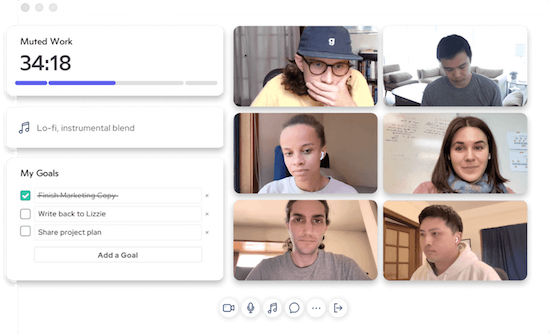
Book a session listed on the schedule of upcoming options to “pre-commit” and make yourself more likely to attend. (You can schedule at the last minute, though.) Sessions are hosted to keep everything on track, and there are up to eight participants at any session.
Show up at the appointed time; participants share their goals and then the host sets a timer (and may begin playing focus-inducing music to help induce a flow state. (The schedule indicates which sessions have music, in case that’s something you want to avoid.) Meanwhile, cameras stay on, but everyone is muted and focuses on completing their own deep work. At the conclusion of the session, everyone debriefs and celebrates their achievements (or at least their progress).
You can try Flow Club for free, but then it’s $40/month (or $33.33/month if paid annually) for unlimited access.
TWO MORE OPTIONS AT OPPOSITE ENDS OF THE COST SPECTRUM
Social Pomorodo
Perhaps you want something a little more casual? Don’t want to have to register? Social Pomodoro is about as low-fi as you can get and still be on the computer. Choose one of three options:
- Single Player — To get the hang of it, opt for a computer to be your body double.
- Veteran — Once you know what you’re doing, click on this option to be assigned a work buddy. Traffic is relatively low on this platform, so they suggest clicking Veteran status in “idle mode” and wait for someone to join you. (You can use Single Player in another tab simultaneously.)
- Friend in Mind — Want to body double but don’t want a Zoom, Meet, or Teams account? Have a friend head to Social Pomodoro around the same time, and you can click this button to make sure you get put in the same Pomodoro room.
In all three versions, buddies have 120 seconds to one another in the chat box and text about goals for the session. You’ll see the timer count down to ensure you each get time to talk and are ready to hit the ground running.
Next, work for 25 minutes, a standard Pomodoro measurement, without chatting. The one-screen countdown timer helps you keep pace. At the end of the session, there’s another 120 seconds to share how things went.
Social Pomodoro is a quick alternative if you need your feet held to the fire to complete short tasks like making phone inquiries, scheduling appointments, reading school assignments, drafting emails, or doing a brain dump.
On the up side, it’s free, low-tech, and you don’t have to create an account. However, you’re not going to must live body-doubling suppor unless you bring your own.
Spacetime Monotasking
This simultaneously one of the most flexible, most expensive, and most proactively progressive co-working platforms, stating that they are “committed to creating a welcoming environment for BIPOC, LGBTQIA+, neurodivergent, and people of other systemically marginalized identities.”
Two like-minded women on TikTok founded Spacetime Monotasking (the opposite of multitasking) designed it to “support creatives, entrepreneurs, freelancers, and anyone who wants to use their time differently” by tuning out the outside world and focusing on your priorities. They call it mindfulness in motion.
Spacetime Monotasking hosts live sessions every weekday run through a Discord server. (In case you’re not familiar, think of Discord is a worldwide social media for voice, video, and text chat.) Begin with Spacetime Monotasking’s start page, accept the invitation, and register with Discord.
There are three levels of ongoing memberships: $35 for 5 sessions/month, $55 for 10 sessions/month, and $85/month for unlimited sessions. You can also opt for a drop-in session for $10.
Additionally, individuals can apply for a discounted membership: “Our Boost Rate is intended to uplift BIPOC and others who experience systemic economic disadvantages.” There’s no free trial for the live, hosted monotasking sessions, but you can experience a video version of a Spacetime Monotasking 1-hour sprint:
If you don’t belong to an organization that offers co-working sessions and aren’t up for starting your own, would you try one of these platforms? From free up to $1020/year (with many price points in between), from one body double to a crowd of fellow workers, which appeals to you the most for conquering procrastination and getting into that flow state?
Paper Doll Sees Double: Body Doubling for Productivity
Knowing what you have to do and doing it aren’t the same things. If you were raised in the 1980s or 1990s, you learned you were supposed to eat according to the food pyramid. Nowadays, there’s the updated MyPlate approach to healthy eating, to make sure everyone gets the right proportions of fruits and vegetables, grains, protein, and dairy each day.

But knowing how you should eat doesn’t mean that you’ve never contemplated chowing down on break room doughnuts for breakfast. And it’s not just fictional characters like Olivia Pope who’ve had wine and popcorn for dinner.

And while sometimes family, friends, and colleagues can lead us astray from nutritional goals, it’s been proven that hanging out with people whose health goals are similar to yours can help keep you on the straight and narrow.
Simply put, when you’re with people who model good behavior, you’re more likely to participate in that good behavior. So, what does this have to do with organizing or productivity?
BODY DOUBLING AND ACCOUNTABILITY
Two years ago, I wrote Count on Accountability: 5 Productivity Support Solutions, one of the most popular posts I’ve had in the 15+ years I’ve been writing the Paper Doll blog. The concept of getting accountability support to conquer procrastination and achieve more productivity really resonated.
Perhaps you only know about body doubles in movies or on TV. That kind of body double often appears when the featured character is doing something the actor can’t do, like a backflip or fancy dance move. Subsets of body doubles are stunt doubles, or in the case of some films with a bit of nudity, “butt doubles.” However, when we’re talking about productivity, the “butt” is not about someone else’s; it’s about getting your own derriere into the chair to attack avoided tasks.
In that post two years ago, I explained the body doubling technique developed in the ADHD community. In support groups, participants found that when another person was present, participating in quiet tasks with a similar (non-distracting) energy, it helped the individual maintain focus and motivation. We professional organizers often work as body doubles with clients (both those with ADHD and those without) because it successfully creates an environment for focused work.
Any of us on our own (but particularly clients with ADHD) might (intentionally or unintentionally) delay working on a task or get distracted. Realized or unrealized anxiety about a task — fear of failure, for example — can prevent someone from starting, but you have to start in order to have anything you can improve upon. (See: “You can’t edit a blank page.”)
When a project is hanging over your head, you might find ways to delay or distract yourself, but when someone is there, investing their time in you (and you’re investing your time and money to achieve your goals), body doubling helps you push past the anxiety and be more productive.
As a professional organizer, when I’m body doubling with a client, we may be working side-by-side or across from one another. I may pre-sort piles of papers into categories (bills to pay, documents to review, items to file) while the client is working through one category at a time to complete distinct tasks. Students quietly studying for an exam in the library or doing homework in study hall are similarly using the body doubling method to achieve focus and productivity.
Scientific research on the benefits of body doubling are scant, but I can think of at least six (interlocking) ways in which body doubling advances an individual’s ability to stick with a task:
- Accountability — By definition, accountability is “the obligation or willingness to accept responsibility for one’s actions.” You may feel like introducing a second party to get your own work done is cheating, but it’s not.
Really, accepting responsibility means marshaling all of your resources to attack a problem and achieve the stated outcome. If a body double, accountability partner, mastermind or study group, workout partners, or anyone else can help you achieve your goals by their mere presence in your life, availing yourself is no different from having a state-of-the-art computer, a current eyeglass prescription, or properly-fitting running shoes. A body double is just a quiet, human-shaped resource for maintaining accountability.

Studying in Library Photo by Robert Bye on Unsplash
- Social pressure — If someone present with you expects you to get something done, you’re probably going to stick with it and do it. Of course, we’re not all equally responsive to the presence and expectations of others.
Gretchen Rubin’s work on her Four Tendencies framework (how we respond to inner and outer expectations) is a great place to start for understanding the role of social pressure in getting things accomplished.
Some people are Upholders, disciplined at meeting both their own expectations and those of others. Me? I’m an Obliger. I’ve got superior discipline when someone is waiting for me to do something. I am always on time to meetings or appointments, and I deliver what is expected of me by deadlines. However, I’m iffy at goals that only satisfy my own preferences.
Rebels can’t be forced or convinced, but the beauty is that a body double isn’t a boss or a manager telling you what to do. The body double is just mirroring what you’re doing. There’s nothing to rebel against; the body double is just along for the ride. Meanwhile, Questioners can’t be convinced by expectations, only their own pathway to finding meaning in the task. As with Rebels, the body double’s role is as travel companion.
The key is that for those who struggle with getting started or sticking with a task, a partner or several can improve the likelihood of reaching goals.
- Project or task orientation cues — On their own, many people have difficulty maintaining focus on the project at hand. This can be the result of any of a variety of executive function disorders or just a byproduct of living in the 21st century.
For every work-related search you do on Google, you’ll encounter numerous links — both on the search page and then in the sidebars, body, and bottom of the articles you’re reading — specifically designed to take you somewhere else on the web.
On our own, we go down rabbit holes and can’t find our way back to the original link or get trapped in dozens of open browser tabs. Body doubling means that just on the periphery of our consciousness, we’re aware that someone else is present, and that keeps us tethered to our work. We may go astray, but our body double’s presence can bring us (and our focus) back to the here and now.
- Biological cues — The experience of participating in body doubling and mirroring the body double’s behavior can help activate some nifty neurotransmitters. Literally, doing the task cues the bodily systems to kick start, making it easier to hunker down and do the work.

Do It Now Scrabble Tiles by Brett Jordan on Unsplash
- Task execution — “Well begun is half done.” (Aristotle) “You don’t have to be good to start … you just have to start to be good!” (Joe Sabah) “Only put off until tomorrow what you are willing to die having left undone.” (Pablo Picasso)
Such quotes are all well and good, but if you’re using procrastination to soothe your present discomfort, you already know you’re going to feel worse as the deadline approaches. To borrow from what I wrote in my original post on accountability:
Canadian psychology professor and all-around expert on procrastination, Timothy Pychyl, author of Solving the Procrastination Puzzle: A Concise Guide to Strategies for Change, explains that procrastination isn’t just delay. He explains that procrastination is “a voluntary delay of an intended act,” one where the person procrastinating is cognizant that the delay is going to have a cost, whether that cost is financial, interpersonal, professional, legal, or otherwise.
When we procrastinate, we know that there’s no upside; we aren’t merely weighing a logical choice between two options of equal value. It’s less, “geez, how can I decide on whether to go on this romantic anniversary date with my spouse or prepare for my presentation this week?” and more, “Eek, I’m feeling icky about doing this thing for some reason and I’ll latch on to any random thing, like bingeing a sit-com I’ve seen in its entirety three times!”
Experts like Pychyl have found that at its base, procrastination is “an emotion regulation strategy” – a way to cope with a particular emotion while failing to self-regulate and perform a task we know we need to do. We convince ourselves we’d rather feel good now, thereby causing more trouble for our future selves.
Getting started on those tasks is hard. But the minute you have another person there with you, you’ve got a (silent) partner whose presence makes getting procrastinating less possible and doing the (appropriate) activity a smidgen easier.
- Extended focus — It’s common to have trouble sticking with tasks that are boring, repetitive (and thus boring) or lengthy (again, yawn). The presence of others who match your energy and behavior type (reading, writing, doing math homework, sorting, etc.) sprinkles a little extra fairy dust to keep focus a bit longer.
If you were doing a series of Pomodoros (25 minutes of work, 5 minute breaks) on your own, you might give up after one or two. Someone else doing the same or similar tasks in your nearby environment is kind of like keeping pace with another random jogger or bicyclist on your route. If you were on your own, you might give up, but just a little bit of what I think of “competitive companionship” may be all you need to keep going.
To learn more about body doubling, consider:
Could a Body Double Help You Increase Your Productivity? (CHADD)
‘Body doubling,’ An ADHD Productivity Tool, Is Flourishing Online (Washington Post)
Use Body Doubling to Increase Your Productivity (Life Hacker)
How Body Doubling Helps When You Have ADHD (VeryWellMind.com)
I Tried A ‘Body Doubling’ App To Help With Focus – It’s Weird But It Works (Refinery 29)
What to Know About the ‘Body Doubling’ Trend That’s Keeping People with ADHD on Task (Men’s Health)
CO-WORKING FOR ACCOUNTABILITY
Body doubling as a method of accountability has been on my mind lately. In addition to regular client-related work and this blog, I have four special projects in the course of six weeks. I’m being interviewed for a podcast and for a video summit, participating an online summit requiring me to make a video and appear on live virtual panels, and I’ve got an in-person speaking engagement next week. Yikes!
All of these projects require research, writing, and finessing of verbal expression. (I like to be prepared, even when I will eventually have to be extemporaneous.) Deep down, I know it will be fine, but we all have bits of performance anxiety seep in. Timothy Pychyl might say that my temptation toward procrastination is a bit of (messed-up) emotional regulation strategy. But I’ve had (and will soon have more) help in sorting it all out.
Co-Writing Sessions
I’m a member of the Authorship and Publishing Special Interest Group (SIG) in the National Association of Productivity and Organizing Professionals (NAPO). We have monthly meetings and an email group for supporting one another as we write books, articles, blog posts, presentations, and other projects.
Last week, the SIG began holding weekly two-hour co-writing sessions. A small number of us log on to a Zoom call, talk about what we hope to accomplish, and then settle down to write. We each muted our microphones (especially important for me, as I tend to think out loud, which would make it hard to be a silent body double for anyone else), content in the knowledge that if we needed to reach out to our fellow writers, we could type a message into the Zoom chat.
When I minimized the Zoom window, instead of it dropping into the Mac dock or otherwise hiding, it turned into a tiny, floating, repositionable window (about 3/4″ high by 2″ wide). I could see one of my co-writers — in miniature — and it reminded me that I had a goal and that someone <waves hands> out there is on my side in the effort to get my project done.
At the top of the next hour, we turned our mics back on just long enough to check in, offer support, and return to our writing for another hour. I used the first co-writing session to prepare my notes for the summit interview two days later, and felt so confident and prepared because I had this co-writing time.
These are drop-in sessions on a fixed day each week; the participants will change according to each writer’s need and availability, but I’m already looking forward to the next one.
“Making Space to Write” Virtual Writing Retreat
In some ways, that co-writing session was a practice run for an event this past Friday, January 27th. Two of our Authorship & Publishing colleagues, Standolyn Robertson and Leslie Hatch Gail, put a lot of planning into the event. Registration was required, and we had an hour-by-hour retreat agenda.
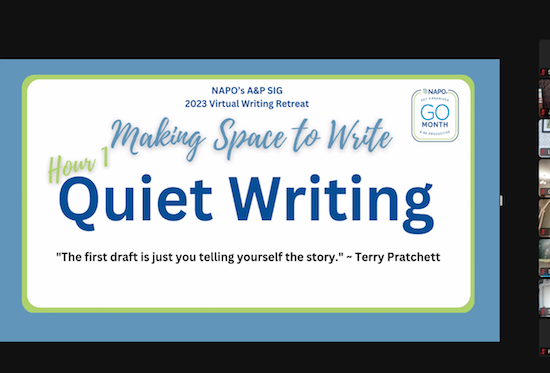
We were encouraged to set our goals in advance, and once we arrived, after brief introductions and some housekeeping announcements, we hunkered down for 45 minutes of quiet writing time, nudged by a slide with a motivating quote.
(Per participant requests, I am not including any identifying photos.)
Because the live Zoom screen showed the participant gallery and a shared slide, the minimized floating screen wasn’t showing me my colleagues, just the slide. I thought that might lessen my feeling that I was being body doubled, but it didn’t. I was always aware (and calmed by) the slide’s reminder of everyone’s presence.
From then on, at the top of each hour we had 15-minute “human breaks” to stretch, address any biological needs, and answer a prompt slide prompt. Questions were lighthearted and ranged from “What hobbies are you participating in?” to “What was your best purchase in the last year?” We entered our answers on the chat screen, had a little verbal interaction on Zoom, but at the quarter hour mark, we all went back to writing.
What fascinated me was that every time I’d get to a logical stopping point in my writing, ready to take a breather, I’d look at the clock and see it was just the 59 minute mark of the hour!
Around 1 p.m. (in my time zone), we took an hourlong lunch break. Some attendees had to run errands, but for the majority who stayed, it was like having a lunch with co-workers, something we professional organizers (mostly solopreneurs) rarely get to do. Finally, after a full day of writing, we had a social hour during which time we played a rousing and hysterical online version of Scattergories.

Which Experience Was Better?
Comparing and contrasting these two events, it’s easy to see the differences. The co-writing session was fairly informal, of a short duration, and included only four participants. While we used one member’s Zoom account, there were no real leaders; we each took responsibility for our own behavior.
Conversely, the virtual writing retreat was more formal (with the exception of wardrobe), with Standolyn and Leslie moderating and leading us through activities. It ran from 11a to 6p (including lunch and our day-ending Scattergories socializing) and had about a dozen writers in attendance.
On an ongoing basis, I can see the advantage of short, weekly co-writing sessions. I’m not usually a fan of events that are too formal or rigid in terms of an agenda. But I absolutely loved the retreat and am hoping we’ll have them a few times a year, as I can picture using the experience to keep me motivated and focused for long-form writing projects.
What’s Next for Paper Doll and Body Doubling Accountability Sessions?
My first experience with these kinds of virtual session was more than a decade ago, when my colleague Deb Lee ran “Action Day” events, which were similar, but run on the telephone. Participants called in, talked about their goals for household or work projects — technology-related tasks were always popular — and stepped off the phone to work. We had various check-ins throughout the day. (In later years, Action Day went high-tech with video conferencing.)
Deb and I used to be on various committees together, but rarely get to chat nowadays. I’d been missing the inspiration she brings to every encounter. After a quick email discussion, we’ve scheduled our own Action Day/Body Doubling/Accountability Extravaganza for mid-February. It’ll be suuuuuuper-informal and only for a few hours, but just anticipating the experience is helping to dispel my procrastination gremlins from their usual hiding places.
FINDING YOUR IDEAL BODY DOUBLE OR ACCOUNTABILITY PLATFORM
My experience has focused on writing, and certainly as evidenced by research summarized in pieces like Writing Accountability Groups (WAGs): A Tool to Help Junior Faculty Members Build Sustainable Writing Habits, it works. But body doubling works to support accountability and boost goal achievement for any activity, from getting your housework done to writing your overdue post-wedding thank you notes. It’s just a matter of finding the right approach and platform for your needs.
In my original post, I focused on five types of accountability options (with some suggested links):
- accountability partners, like friends, colleagues, or people you can meet through apps
- accountability groups, like mastermind groups, in-person or virtual study groups, and professional groups
- professionals, including professional organizers, ADHD coaches, life coaches, and fitness trainers
- apps and gadgets
- accountability events
Not all accountability experiences or platforms are designed for body doubling, per se. For example, mastermind groups tend to focus on support through discussion; all coaches act more like instructors some of the time, though some will offer body doubling support.
Attributes of Body Doubling Platforms
If you want to experiment with body doubling for accountability, consider these factors:
- Formality — Do you prefer things to be structured or loosey-goosey?
- Number of participants — Would you rather only know there’s one other person in a session?
- Familiarity with participants — Would you feel more comfortable with strangers or people you know well (or perhaps people you only know a little bit)?
- Cost — Will you be more motivated if you pay someone (like a professional organizer or coach) or an organization, or might that cause you stress? Would you rather sign up for a monthly membership (like going to the gym) or would you prefer to only pay for drop-in or ad hoc activities?
- Level of communication — Do you want to mostly be a Silent Sam and not have any interaction with your body double(s)? Would you prefer frequent social check-ins, perhaps each hour?
Group Body Doubling For Productivity and Accountability
Two years ago, there were only a few major platforms for group co-working that embraced the body doubling approach as part of accountability groups; now, there are many more. Next time, I’ll be sharing a post comparing the different platforms, their features and costs, and how they work.
And, based on my recent experience, I’ve been considering setting up my own virtual events, perhaps starting with my (in-person and virtual) clients — perhaps a Study Hall for Grownups or Admin Action Adventure. (Yeah, I’ll keep working on the name.)
Similarly, you might gather family, friends, or colleagues to participate on a more ad hoc basis when you need a little support.
Have you participated in any (virtual or in-person) body-doubling activities? What do you do when you need accountability support, and don’t want to talk that much about it, but just do it?
Paper Doll’s 23 Ideas for a More Organized & Productive 2023
Happy New Year! And welcome to GO (Get Organized) Month 2023, where we celebrate efforts to make our spaces more organized and make ourselves more productive.
We in the National Association of Productivity and Organizing Professionals (NAPO) love this opportunity to help you make this year your best. To that end, today’s post offers up 23 ideas for achieving what you want this year in your space, schedule, and life.
CREATE A FRESH MINDSET
1) Learn last year’s lessons to build next year’s success.

You were probably super-busy last week, but I encourage you to read the final Paper Doll post of 2022. (Trust me, it was a good one!)
Organize Your Annual Review & Mindset Blueprint for 2023 is full of questions and resources for figuring yourself (and your last year) out.
I often joke to clients that while I’m not a mental health professional, I am like a marriage counselor between you and your stuff. Well, last week’s post is like a cross between a therapy session and a deep dive with your BFF. It rejects the demoralizing proposition of resolutions in favor of creating a fresh, motivating mindset for the coming year, whether with a word, quote, or motto of the year, and uses signage, a vision board, or a music playlist to keep your eyes on the prize that is your new and improved life.
2) Don’t take my word for it. Listen to James Clear.
If you’ve been paying attention to the news in the “habit” realm at all in the last few years, you know that James Clear wrote Atomic Habits: An Easy & Proven Way to Build Good Habits & Break Bad Ones, a book that takes the research of habit researchers (like Charles Duhigg in his The Power of Habit) and makes it all actionable.

Theory is good, but what most of us want is someone to tell us how to do it, and preferably in a way that doesn’t make us hungry, cranky, poor, or frustrated. Clear delivers.
But this year, he’s doing something special. Clear is offering a free email course called 30 Days to Better Habits: A simple step-by-step guide for forming habits that stick.
It’s not a bootcamp. Rather, as Clear explains, “Habits are not a finish line to be crossed, they’re a lifestyle to be lived.” Over eleven emails (after an introduction), one sent every three days, he’s going to gently teach principles to help cultivate a new lifestyle (and not merely a set of “tasks you can sprint through during a 30-day challenge.”)
There’s also an 18-page PDF workbook and a Google spreadsheet with more than 140 examples (!) of how to implement the strategies in the course and apply them to different habits.
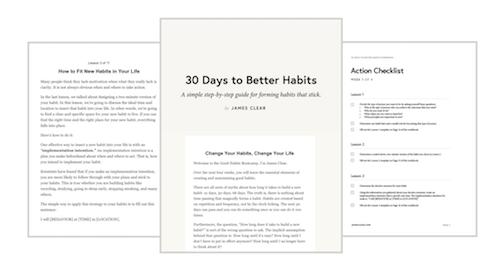
The course is based on Atomic Habits, but he notes that you don’t need the book to successfully complete the course. However, because I originally read a library copy, I decided to buy my own, because he’s also got a nifty set of bonus packages for those who do buy the book. Basically, you email a copy of your receipt or other proof of purchase, and you get:
- Bonus Guide: How to Apply Atomic Habits to Business
- Bonus Guide: How to Apply Atomic Habits to Parenting
- The Habits Cheat Sheet
- Companion Reading Guide email series
- Habit Tracker
For what it’s worth, I bought my copy New Year’s morning, and had received the bonuses by the time I had lunch!
3) Make strides towards delight, too!
One of my favorite sites is the UK-based Action for Happiness. Each month, they put out a stellar calendar of tiny (Clear might even call them atomic) actions you can take toward a better life. Each month is themed, and you can find daily reminders on their Instagram, Twitter, and Facebook accounts.
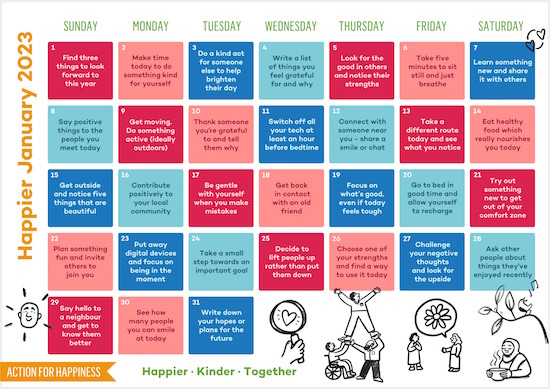
January 2023’s theme is Happiness, and on New Year’s Day, the assignment was to “Find three things to look forward to this year.”
If you’re wondering what happiness has to do with organizing and productivity — hi, you must be new here!
But seriously. Clutter — all the excess stuff in our spaces, in our schedules, and in our brains — wears us down. It’s not at all uncommon for clients to be dealing with clinical depression or anxiety disorders, and disorganization and lack of productivity (and the stress of toxic productivity), only contribute to greater unhappiness. Think of these daily themes less as homework (“I have to”) and more as opportunities (“I get to”) on the path to organizing your mental health.
4) Collect good days — literally!
Each day, make a habit of writing down something great that happened. You can consider this part of (or instead of) a gratitude practice.
Our lives fill up with what we give our attention, so let’s pay attention to the good stuff. Next year, when you’re doing your annual review, you’ll have a tangible resource for looking back on the year and see the highlights, what you considered valuable at the time, and what might have been forgotten had you not made a notation.
Our lives fill up with what we give our attention, so let's pay attention to the good stuff. Share on XCreate a spreadsheet, an Evernote note, a pretty notebook, or — and this is my favorite idea — a Jar of Joy! (Someone else came up with the concept, but I came up with the name. Write a few words or a sentence about whatever great thing happened on a slip of paper. Fold or roll it up, and toss it in a jar or glass canister. Consider using colored slips of paper to make the contents look prettier, and keep your Jar of Joy visible, so you can be reminded each day that good things are happening!
5) Remember that tiny tasks count toward a more productive life.
There’s a reason why James Clear (and, ahem, Paper Doll) believes that those teeny, tiny steps lead to success. Whatever you want to achieve, whatever goals you have, I’d like to encourage you to figure out the teeniest, tiniest, itsy-bitsyist thing you can do to get yourself microscopically closer to the finish line…heck, to the starting line.
Adam Bulger at Fatherly.com came up with 27 Life-Changing Micro Habits That Require Only A Few Minutes. Many of the habits on this list take less than a full minute to accomplish. I liked item #23 on his list:
Always put one thing away before you leave whatever room you’re in. If you’re overwhelmed by clutter, you feel like you don’t have time to clean but habitually chipping away at the mess, one piece at a time, can make it more manageable.
— Liz Fosslien (@fosslien) June 28, 2022
START PLANNING YOUR YEAR
6) Select your planning system.
If you’re a digital person, your calendar is a continuous scroll of everything you’ve got planned. But if you’re a paper planner person (try saying THAT three times quickly!), you may have delayed getting a planner out of fear of buying the wrong one, or perhaps you’ve just not written in what you did buy, because you “don’t want to mess it up.”
It’s your planner. You can fill it in with crayons and use scratch-&-sniff stickers, and it’ll be OK. Whatever inspires you to log your meetings and appointments, block your time, and work toward your deadlines is fine with me. (And if anyone gives you guff, send them to Paper Doll. I’ll set them straight!)
If you’re still struggling with how you’ll plan your 2023, go visit Paper Doll’s Guide to Picking the Right Paper Planner. It covers the features you need to consider in a planner (including whether you’re better off with digital or paper), as well as pointing out some of the best options.
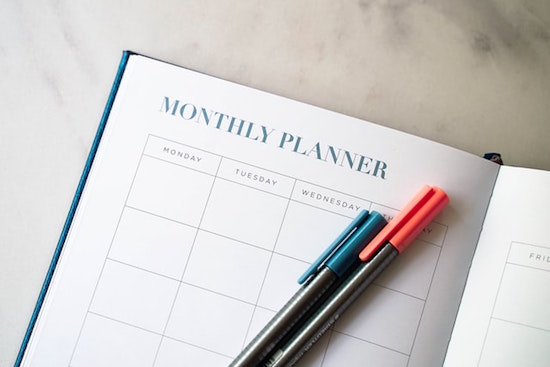
The key to organizing your life is being able to visualize your time. So get everything out of your head and in front of your beautiful eyeballs.
7) Move into your new planner now.
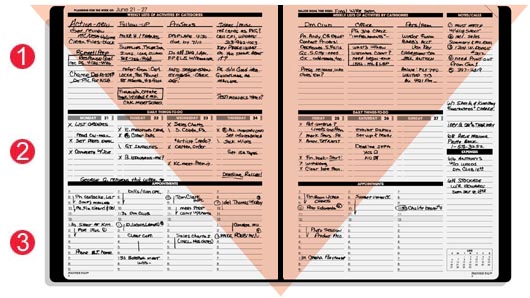
Make a cup of cocoa, grab last year’s planner or pull up your digital calendar (using two screens, like your computer and your phone simultaneously) — compare apples-to-apples.
Go page-by-page through last year’s schedule and copy over everything that recurs on the same dates, like birthdays and anniversaries. Digital users can skip this step.
Next, add events that happened last year and are already scheduled to happen again, but not on the same dates (like conferences, work retreats, mammograms, dental appointments, etc.).
Use last year’s calendar to help prompt you to make a list of everything you need to schedule or add to your long-range tasks, like setting an appointment with your CPA to discuss tax issues.
8) Don’t forget to plan time for your activities.
Appointments aren’t everything. Make time in your schedule for thinking, doing your creative work, attending to self-care, and so much more. Whenever clients complain to me that they don’t have time to accomplish something that they swear is important to them, I ask them to show me where they’ve put it on their schedules. [Insert cricket noises here.]
The truth is that if you don’t prioritize something by making time for it, it’s not really a priority to you. Treat yourself with the same respect you’d treat your boss or your best client or your Grandma, and make time for what matters:
Struggling To Get Things Done? Paper Doll’s Advice & The Task Management & Time Blocking Virtual Summit 2022 (I’ll have news about the 2023 summit coming soon!)
Playing With Blocks: Success Strategies for Time Blocking Productivity
Organize Your Writing Time for NaNoWriMo 2022 (Even though the post is ostensibly about making time to write, it’s applicable to make time for anything you value.)
9) Nurture your commitment to your planning system…every day.
If there’s so much going on in your life that you forget to check your planner or digital calendar and task system until it’s too late, upgrade your accountability support:
- Set an alarm on your phone to ring at around 5 p.m. daily to remind you to check your calendar and tickler file for the next day and the coming week.
- If you have an assistant (especially if you both work remotely) schedule time each day to review newly-added appointments and obligations.
- Have a family meeting on the weekend to make sure every appointment and school pick-up is covered.
- Schedule your next appointments before leaving anyplace you visit intermittently (doctor, dentist, massage therapist, hair or nail salon, etc.) — but only if you have your calendar with you. Otherwise, ask them to call you. Never agree to any date without your planner nearby. In fact, if you tend to agree to too much, say that your professional organizer told you that you’ll have to wait to check your schedule before taking on any new obligations. (Blame me; I won’t tattle.)
10) Know where your time is going — before it gets away from you!
It really doesn’t help you schedule all of the things you’re supposed to be doing if you don’t have a handle on what you’re actually doing. To that end, Laura Vanderkam is doing something nifty.
You may know Laura from her podcasts, her blog, or her several books, including 168 Hours: You Have More Time Than You Think, Off the Clock: Feel Less Busy While Getting More Done, and the recently published Tranquility By Tuesday: 9 Ways to Calm the Chaos and Make Time for What Matters.

Laura is running the 168 Hours Time Tracking Challenge — and yes, I signed up for this one, too. I’ve always enjoyed Laura’s writing, but when we both participated in the 2022 Task Management and Time Blocking Summit, I really got to peek behind the curtain to see how she thinks about time and our use of it. She’s talking about time concepts and strategies that are too rarely discussed.
The 168 Hours Time Tracking Challenges doesn’t start until the middle of next week, January 9, 2023, so there’s still time to sign up. After signing up, you’ll get links to resources and suggestions for tracking your time on paper (via Laura’s time sheets) or digitally, as well as links to her other writings on the subject.

Like tracking what you eat (which can be emotionally distressing), tracking what you do with your time can be uncomfortable. When you realize you’re spending 3 hours a day on social media — and your job is not as a social media influencer — you may be upset. But if you recognize that you’re spending 90 minutes (or more) of every day “making do” with software that keeps freezing or helping a co-worker who takes advantage of your kindness, you’ll become more aware of challenges you can then overcome!
BECOME YOUR OWN MONEY HONEY
11) Make a TAX PREP folder. Actually, make two.
Tax season has started. Within a matter of weeks, your mailbox will start filling up with W-2s and 1099s, and you’ll need to keep them safe. At the very least (if you haven’t done it already), create a folder with a simple name like 2022 Tax Prep.
Look around for all of your tax-deductible receipts and charitable donation paperwork, and pop those in; when forms start arriving in the mail, put those in, too. Some of your important tax forms may come by mail; others, like your investment accounts or health insurance annual summary, might live in your online accounts, requiring you to log in.
This one two-minute task will save you so much time down the road. And time is money, so whether you do your own taxes or hand things off to a CPA, you’ll be saving the Benjamins as well as the clock-hours.
You don’t have to get fancy. A manila folder set in the front of your financial files is fine; or get a dedicated accordion folder like the Smead All-in-One Income Tax Organizer.

12) Stop hiding from your financial truths.
You have to answer mail call! Not looking at your bills when they come in the mail (or email) is like ignoring a pain that gets worse and refusing to go to the doctor because you’re afraid of bad news. Financial ills don’t go away on their own.
Not looking at your bills when they come in the mail (or email) is like ignoring a pain that gets worse and refusing to go to the doctor because you're afraid of bad news. Financial ills don't go away on their own. Share on XWhy not start bossing your money around instead of letting it bully you?
Over the course of the next few weeks, get in the habit of putting your bills and statements all in one place, like a folder next to your computer. If you normally just get a reminder to log in and pay a bill, make a point of downloading and/or printing out your monthly statement.
Make a list of all of your credit cards, loans, and other debts, as well as their balances and interest rates. Seeing it in black and white is the first step toward taking control of your financial future.

13) Get a financial accountability partner!
Last year, I said, “If you don’t know the difference between an NFT and BBQ…” It turns out a lot of people were investing in NFTs and cryptocurrency when they would have been better off having a backyard barbecue and inviting their friendly neighborhood fee-only Certified Financial Planner.
I’m no expert in cryto-currency. (And your brother-in-law’s cousin almost assuredly isn’t!) But whether you want to know whether you invest more in your 401K or your IRA, a fee-only CFP can help you out when your eyes start to glaze over. You pay for their expertise, and they give you unbiased advice because fee-only CFPs don’t get any commissions on investments you make.
Does thinking about investment vehicles feel like choosing between between becoming a rock star or an NBA star (because of their equal improbabilities)? If you need support and strategies for getting your bills paid on time, every time, there are NAPO members who are financial organizers; you can also find a Daily Money Manager through the American Association of Daily Money Managers (AADMM).
BECOME A VIP WITH YOUR VIPs
14) Get your vital documents in order.
It’s a sad fact of life that people get sick or incapacitated, and sometimes shuffle off this mortal coil far too soon. Whether it’s illness or natural disasters or some other kind of calamity we don’t want to think about, we need to get our affairs in order. And that means getting paperwork straight.
Check in with these posts for step-by-step guidance to making sure you’re covered with up-to-date vital documents and a way to keep them organized.
- A New VIP: A Form You Didn’t Know You Needed — If you or anyone in your life is in Medicare, please make sure you read and act on this post! This is not one that you should put off.
- Ask Paper Doll: Do I Really Need A Safe Deposit Box?
- How to Replace and Organize 7 Essential Government Documents
- How to Create, Organize, and Safeguard 5 Essential Legal and Estate Documents
- The Professor and Mary Ann: 8 Other Essential Documents You Need To Create
- Protect and Organize Your COVID Vaccination Card
15) Put your foot on the brake before automatically renewing your car insurance.
If you haven’t shopped insurance to compare prices and coverage in recent years — or ever — this is really the time to do it.
This year, I updated an older post that explained all of the elements of auto insurance, as well as how and where to organize your paperwork.
Organize for an Accident: Don’t Crash Your Car Insurance Paperwork [UPDATED]

But the post also talks about the wisdom of comparison shopping. While you’re at it, shop around for homeowners’ or renters’ insurance, as well. Why not organize some discounts while you’re organizing your paperwork?
16) Clean out your wallet and make an inventory.
You’ve probably got too much in your wallet. If you keep it in your purse, it’s giving you shoulder pains; if it’s in your back pocket, you’re likely misaligning your spine. Why not take a lunch hour and declutter your wallet, and then put it all back so it makes sense to you?

While you’re at it, this is the perfect time to take an inventory of the licenses, insurance cards, and debit/credit cards you have in there and all the information contained on them.
Pull everything out of your wallet, make two columns of cards on the table, and take a photo with your smartphone. Then flip each card over in the same position, and photograph the back. Easy-peasy. (If you’ve got a home scanner/copier, it’s fine to use that, but I’ll discourage you from using a public copier; it’s too easy for someone to surreptitiously snap photos of your information over your shoulder.)
Remember to password-protect the document on your phone or in your cloud back-up.
EMBRACE PAPER DOLL‘S CLASSIC PRINCIPLES ABOUT ORGANIZING
17) Follow the Ice Cream Rule.
I tell my clients, “Don’t put things down, put them away.” The word “away” assumes you’ve already got a location in mind. But good organizing systems have two parts: the where & the how.
When you bring groceries home, you put the ice cream away in the freezer immediately to keep from having a melted, sticky mess. It’s pretty rare for someone to put away the toilet paper or breakfast cereal before the frozen foods. The freezer is the “where” but putting the ice cream away first is the “how.” It’s so innate, you don’t even think about. But for most of your stuff, including papers, you do have to think about it.
Whatever comes into your space, when you go shopping, or even when things are free, decide on a home before you bring it in.
Once it’s in your space, build fixed time into your schedule for how/when you’ll deal with maintaining it or getting it back to where it lives. When will you do laundry? When will you file financial papers? What will be your trigger — when the laundry basket or in-box is full, or will you put it on your calendar?
Remember: “Someday” is not a day on the calendar.
18) Everything should have a home, but not everything has to live with you.
Clients are often so focused on organizing what they already have that they ignore a key truth: not everything you own needs to stay with you forever.
If it’s broken and you’re not willing to spend the time or money to repair it, let it go. If you’re sentimentally attached to something that’s outdated or takes too much space or effort to keep, take a photo of you holding it or wearing it. Then set it free!
If you have piles and files full of clippings and articles you haven’t looked at in years, you’re not alone. 80% of what gets filed is never accessed again. Trust that the internet is a vast storehouse of everything you’d want to look up, and if the paper you’re holding has nothing to do with you, personally, or reflects information you’ve long since learned by heart, recycle it and give yourself space.
19) Don’t fight clutter with more clutter.
I love The Container Store and all the office supply stores as much as every other professional organizer. (Really!)
But buying oodles of storage containers — bins, boxes, tubs, and shelves — can only help you organize if you pare down to what you need and want.

Photo by Lia Trevarthen on Unsplash
When you see a great outfit at the store but it’s not in your size, you shouldn’t say, “Hey, I’ll buy this now and then lose (or gain) 30 pounds to fit into it.” Even if you do declutter the personal poundage, you never know from where, exactly, that weight will disappear. It almost certainly won’t be a perfect fit.
I’m not saying never to acquire storage containers (adorable or otherwise), but do it last. Once you pare down, pick colorful, fun containers that suit your needs, space, and tastes.
20) Take baby steps. Declare small victories. Don’t feel like you have to do it all.
When it comes to clutter, it’s not the space it takes up in your house, it’s the dent it puts in your life! If you’re late every day because you can’t find your keys and your kids can’t find their homework, it’s a much bigger deal than a cluttered guest room closet or drawers of old birthday party pictures that haven’t been scrapbooked.
Focus on your biggest daily stressors, break them down into small, actionable steps, and solve those first. You don’t need to do it all at once, but if you develop a habit of doing a little bit at a time, once your space is straightened up, maintenance will feel natural.
What you don’t do is just as important as what you do. pic.twitter.com/sE6BrMyUAm
— Sarah Arnold-Hall (@saraharnoldhall) November 6, 2022
21) Declare bankruptcy on clutter debt.
Give yourself permission to declare bankruptcy on the “debt” of unread magazines, charitable contribution requests that aren’t really your cause, unworn clothes three sizes too small, or email from last July. In the words of Elsa, LET IT GO!
Keeping something just because you spent money on it or because it was a gift doesn’t make it any more valuable or useful; it just ends of costing you time (dusting or caring for it), space (that you could use for more important things), or money (spent on dry-cleaning or storage rental).
Keeping something just because you spent money on it or because it was a gift doesn't make it any more valuable or useful; it just ends of costing you time, space, & money. Free up the mental energy! Share on X22) Hire a professional organizer.
As a Certified Professional Organizer®, I see how much my clients get out from support to make difficult decisions and develop systems to surmount those challenges. Find a professional organizer near you (or a virtual organizer) by using NAPO’s search function. You may also want to consult with our colleagues in the Institute for Challenging Disorganization.
Whether you need to reinvigorate a closet, learn how to use Evernote to get your productivity zipping along, or downsize Grandma’s house so she can move to Boca, professional organizers can show you the way. We’re not just experts in organizing stuff, but experts in helping you figure out how best to organize your ways of thinking and living.
23) Be gentle with yourself.
Getting organized and being productive is a constant battle between your goals and other people’s expectations of you. Focus on what you need and want.
In the words of Mary Oliver poem The Summer Day, “What is it you plan to do with your one wild and precious life?”
The purpose of organizing and being more productive is to make your life easier — so that you can spend it doing the things you like with the people you love.
Happy New Year! Happy GO Month!
Paper Doll Helps You Get By With a Little Help From Her (Brilliant) Friends

I love sharing my expertise and research with you about a wide variety of topics, from getting more (of the right things) done to conquering toxic productivity to accessing and organizing vital documents.
Although I’m a generalist in my professional organizing practice, I specialize in blogging about organizing paper and information and boosting productivity. But that doesn’t mean that’s all you want to hear about. After all, man (and woman) cannot live by bread alone. We also need cheese. (In Paper Doll‘s case, lots and lots of cheese.)
As a Certified Professional Organizer®, member of NAPO, and Evernote Certified Expert, I get to hobnob with other likeminded specialists, learn from them, and share their knowledge with you. Today, I’ve got a cornucopia of resources for making your life, family, and world run a little more smoothly.
LATE, LOST & LAGGING: UNDERSTANDING ADHD & EXECUTIVE FUNCTIONING
October is ADHD Awareness Month.
As recently as a few decades ago, people lacked a clear understanding of ADHD. If they thought about it at all, they considered it as something that only impacted little boys, that it was about being rambunctious and intentionally (or rebelliously) inattentive, and that it was something people grew out of. It was rarely acknowledged as something that impacted women and girls, and most people, if they considered it at all, thought it was something kids grew out of.
Now, we know more. We know that ADHD is a brain-based disorder, a neurological condition that affects people across all ages, genders, and socio-economic and cultural areas. (It’s diagnosed two-to-three times more often in boys than girls, but that may be because the expression of ADHD in girls can be less disruptive, which says more about socialization norms and pressures than it does about ADHD.)
ADHD impacts the lives people across all levels of education and intelligence. Willful ignorance about ADHD expresses itself in all levels of education and intelligence, as well.
I once worked with a client for whom her late-in-life diagnosed ADHD had caused distress throughout her life, and the emotional abuse inflicted on her by her physician spouse, who refused to “believe” in ADHD, was both eye-opening and frustrating as we tried to implement solutions. (Yes, Dr. Shouty-Dude, ADHD is real, and no, you can’t “conquer” it by having more “diligence” and “willpower.” Grrrr.)
If you or someone you know has ADHD or other challenges with executive functioning, ADHD Awareness Month is a great opportunity to learn more, and I’ve got a great webinar resource for you.
My NAPO colleague, ADHD Student Coach Leslie Josel of Order Out of Chaos, is one of my absolute go-to experts when I have a question about ADHD and executive function.
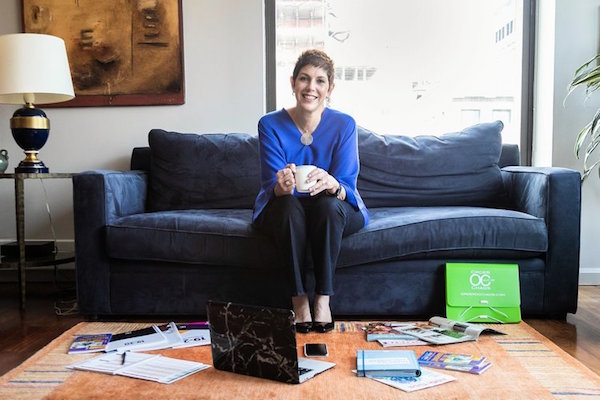
If Leslie’s name sounds familiar (and it should), it may be from the post Paper Doll Peeks Behind the Curtain with Superstar Coach, Author & Speaker Leslie Josel, where we talked about her multi-award-winning Academic Planner: A Tool for Time Management, which is celebrating its tenth anniversary,
and her book, How to Do It Now Because It’s Not Going Away: An Expert Guide to Getting Stuff Done, which helps middle school, high school, and college students overcome academic procrastination and better manage manage time and study skills.

On Monday, October 24, 2022 at 7 p.m. EST, Leslie is going to be interviewed by another of my go-to NAPO colleagues, fellow Certified Evernote Expert Kimberly Purcell of Amethyst Productivity. Kimberly is an Evernote consultant and trainer for personal and business use, and is stellar at knowing the right questions to achieve the best results. I can’t wait to see what she asks Leslie.

Leslie and Kimberly will be talking about some of the pillars of executive function, including time management, memory, focus, and effort. Leslie will also be sharing the differences between ADHD and other obstacles to executive function.
The webinar, entitled Late, Lost & Lagging: Understanding ADHD & Executive Functioning, is free to attend, and is sponsored by
LESLIE JOSEL’S MASTER CLASS SERIES FOR PARENTS
Sometimes, the news isn’t just about my friends, but about friends of my friends. In fact, Leslie has two upcoming master class events that might be up your alley if you’re a parent (or grandparent) trying to create some order in your family or someone’s academic life.
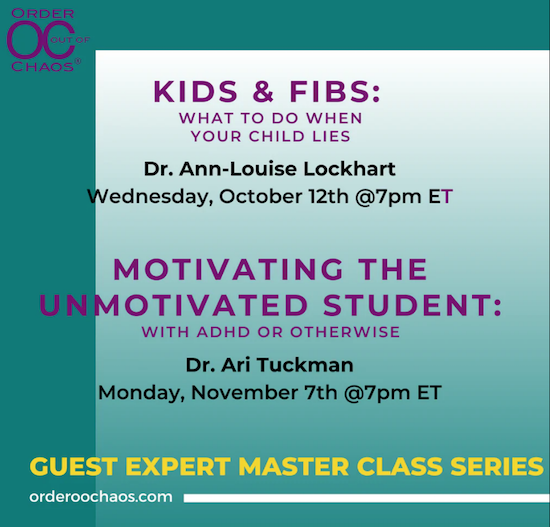
In the first webinar, Leslie will be presenting the wisdom of Dr. Ann-Louise Lockhart in Kids & Fibs: What to Do When Your Child Lies. Dr. Lockhart is a leading expert in pediatric psychology and a parenting coach. Here’s a bit of the description of the event from Leslie’s site:
All children lie. Especially those with weak Executive Functions and ADHD. Some lie because they are testing limits and boundaries, others because their “developing” brains lead to impulsive or inappropriate decision-making. And then there are those children who find lying easier than doing the task or chore they are being asked to do.
There are many reasons and theories behind lying behaviors. But what we do know for sure is that parents feel very hurt or angry, and tend to take the lying personally. Or they are confused and want to correct the behavior immediately.
In this 1-hour online master class, Dr. Ann-Louise Lockhart, pediatric psychologist, and a parenting coach, will discuss the three reasons why children fib. She’ll explain how the most important step to remedy dishonest behavior is to address the underlying reasons behind it. She’ll also show parents how they can dig deeper to discover what’s driving their child’s decision to lie and offer tools to promote future truth-telling. Practical strategies will be discussed along with real-life examples to help parents effectively manage their child’s behavior.
This webinar is Wednesday, October 12, 2022, at 7 p.m. EST. Register at: Kids & Fibs: What to Do When Your Child Lies; the master class, on its own, is $29.99.
I’m particularly excited about Leslie’s November virtual master class Motivating the Unmotivated Student: With ADHD or Otherwise with Dr. Ari Tuckman. Longtime readers of the blog have seen me buzz about the brilliant programs Dr. Tuckman has put on at NAPO conferences over the years. I can honestly say that the bulk of my true understanding of how to help my clients with ADHD and executive function disorders came from attending presentations by Dr. Tuckman.
Topics covered in this virtual master class include:
- Why many teens struggle with motivation — and especially those with ADHD and executive dysfunction.
- Understanding how attention gets hijacked and why prevention is more effective than willpower.
- How to “feel the future” more in order to increase motivation in the present so your student actually uses these strategies.
(As a side note to my Certified Professional Organizer colleagues, this seems like an ideal class for getting continuing education units toward our CPO® recertifications.)
Leslie’s master class with Dr. Ari Tuckman is November 7, 2022 at 7 p.m. EST. Sign up for Motivating the Unmotivated Student: With ADHD or Otherwise on its own for $29.99.
If both tickle your fancy, click here to register for Leslie’s master classes with both Drs. Lockhart and Tuckman, and you can save 10%.
It’s not necessary to join either webinar live, as Leslie will send links to the replay the following day, and you’ll have one week to watch. However, you’re urged to act quickly, as there are limited virtual seats available, and only the first 1000 participants are able to register. (FYI: Leslie’s master classes and webinars tend to sell out.)
HOW TO CONQUER CLUTTER WORKSHOP
Friend of the blog, NAPO colleague, and fellow lover-of-purple Linda Samuels, CPO-CD®, CVOP® of Oh, So Organized also has a big event this month. Linda is a past president of the Institute for Challenging Disorganization, an expert in chronic disorganization, and a coach extraordinaire.

She also has amazing empathy, warmth, and insight into the human condition, as evidenced by her blog, The Other Side of Organized, which shares a title with her now-classic book, The Other Side of Organized: Finding Balance Between Chaos and Perfection.

Later this month, Linda is delivering a workshop entitled How to Conquer Clutter: Understanding the Where, Why & What.
This lively virtual workshop is designed for those who are overwhelmed by clutter. Given that clutter can adversely affect levels of anxiety, as well as the quality of a person’s interpersonal relationships, sleep, and ability to focus, a little guidance can go a long way. A little buffer in your space is surprisingly effective in giving you room to breathe!
In Linda’s one-hour workshop, attendees will discover the truth about where clutter really comes from (and no, it’s not the Clutter Fairy), why it’s so hard to let go of possessions, and what you can do to reverse the clutter trend.
Linda says that you will come away from the workshop with at least one powerful and actionable strategy to use immediately to reduce your clutter. Attendees will have the opportunity ask questions and discuss their organizational and clutter-related challenges.
Linda’s How to Conquer Clutter: Understanding the Where, Why & What Workshop is scheduled for Thursday, October 20, 2022 at 7 p.m. EST and costs $59.
Be sure to register by Monday, October 17, 2022 at 6:00 p.m. to ensure your participation. This live workshop will be presented via Zoom; within 48 hours after registering, you will receive an email with the Zoom link and handout. I’m willing to bet something in that email will be purple.
MY LIST SIMPLIFIED JOURNAL
This last item is neither a webinar nor a master class nor a workshop. It’s something you can hold in your hands and make your own.
My List Simplified is yet another brainchild from my NAPO colleagues and friends from my own NAPO-Georgia chapter, Diane Quintana, CPO®, CPO-CD® and Jonda Beattie, M. Ed.

I’ve previously blogged about their various ventures, like their stellar book, Filled Up and Overflowing: What to do When Life Events, Chronic Disorganization, or Hoarding Go Overboard,

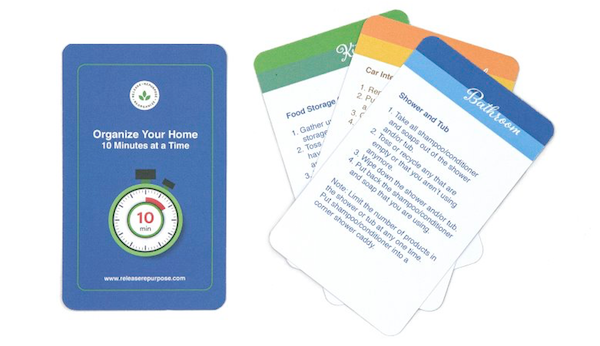
and their children’s books, Suzie’s Messy Room and Benji’s Messy Room. We discussed Diane and Jonda’s Organize Your Home 10 Minutes at a Time Deck of Cards in Paper Doll Models the Spring 2021 Organizing Products.
Their newest collaboration is a journal called My List Simplified.
As experienced professional organizers, Diane and Jonda recognize that people often have oodles of scribbled paper notes cluttering their desks, reminding them of phone calls to be returned, cards and emails to write, errands to run, and so on.
Clients inclined to rid themselves of little bits of paper by going digital might select an app or online platform to rid themselves of the mess. But Diane and Jonda (and I, and most organizers) know that there are still many, many people who are both comforted by, and more efficient with, paper solutions. For them, the business partners have created a journal to capture and corral all these lists, plans, and ideas in one place.
My List Simplified is a spiral-bound, lay-flat, undated journal with solutions that work for those who best comprehend a paper environment. There are a number of features for simplifying information and making it easy to retrieve without bogging users down in a system that might be too complicated to maintain.
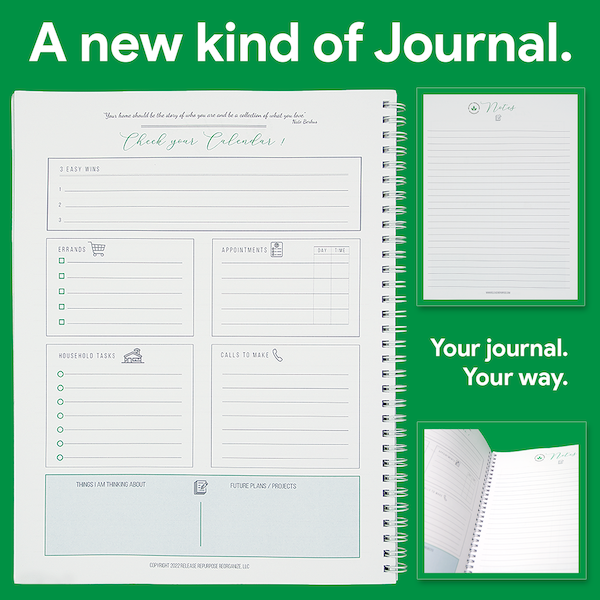
Use the left-side Check Your Calendar page to capture the various lists you’d otherwise keep on (too many) scraps of paper. This page starts with an inspirational quote and a place to specify the date (of which, more later), and includes small sections for:
- 3 quick wins
- Errands
- Appointments
- Household tasks
- Calls to make
- “Things I am thinking about”
- Future plans/projects
Facing the Check Your Calendar page on the opposite (right) side is a Notes page for capturing information on the fly, such as when you’re on the phone and someone is giving you directions or instructions. You can also use it to capture context related to any of the lists on the reverse page.
This journal is not so much for the person who would normally use a Franklin Planner or Planner Pad to keep every 15-minute block of life scheduled and annotated. Rather, it’s for the person who wants to transition from lots of little sticky notes and fluttering pieces of paper to a centralized system they can trust, but which will not overwhelm them.
My List Simplified would be a great resource for anyone planning a move or home remodeling/renovation project. If you’re juggling to-do items for any sort of major ongoing project and prefer a paper approach, this gives you space to collect, collate, and keep it all in front of your eyes. And if you’re trying to keep track of which service providers were called, what they promised, and when materials were due to be back in stock, here’s your central location.
They key difference of this journal is that it’s a flexible planner for those who need a want or need a little support, but don’t wish to be locked into a system. The journal is undated, so you can determine the date and day for each Calendar page. As Jonda and Diane say, it is a “forever journal.”
You might use it during the school year but not during the summers. You might only use it when you’re starting to feel overwhelmed by everything going on during the holidays or for the run up to a vacation.
As professional organizers and productivity specialists, we can get caught up in presenting clients with complex systems to cover all possible eventualities and forget that that’s not what everyone needs (or wants). This journal offers a more relaxed, flexible approach to keeping all of “this week’s” essentials in front of you, even if you only need it one week a month (or a season, or a year).
My List Simplified has 114 pages measuring 8 1/2″ x 11″ and is made in the United States. It costs $25 at Diane and Jonda’s collaborative Release*Repurpose*Reorganize site.
If you have any questions about the webinar, master classes, workshop, or journal above, please contact my genius friends directly. In ease case, their names are linked to their own sites. Happy October!
Organizing A Fresh Start: Catalysts for Success
[Editor’s note: This post originally appeared on September 26, 2022. Rosh Hashanah will not be until October 2 in 2024, and changes each year, as the holiday is dependent upon a lunar calendar. The remainder of the content of this post is still accurate.]
As I go to press on this post, it’s about to be Rosh Hashanah, the Jewish New Year. (We’re going into the year 5783, though as the old joke goes, I’ll be writing 5782 on my checks for weeks.)
What I always liked about the idea of the Jewish New Year was the opportunity for a fresh start. Sure, in Western culture, we already have one (in either August or September, depending on your part of the country) with the beginning of a new school year. That always brings new clothes (and the jettisoning of old ones), new school supplies (especially brand new crayons and notebooks), and new opportunities.

Apples & Honey photo by Igal Ness on Unsplash
One of those opportunities, especially as we all got older (moving from elementary school to middle school, or middle school to high school) was that we could create ourselves anew, be seen as a different kind of person.
Let’s say you’d had a reputation as a goody two-shoes; you could make yourself over as a bit of a rebel. A ne’er-do-well punk could become an athlete lettering in varsity track. An academic washout could study a trade, and a beauty school dropout could rejoin the old gang. (Any resemblance to the plot of Grease is purely coincidental.)
But if you found yourself slipping back into old habits (messy lockers, messy friendships, messy study habits), the clean slate of a new year in the guise of a millennia-old religious and cultural tradition sure could be appealing. And if the start of the school year didn’t keep you on the straight-and-narrow toward a more perfect version of you? Well, Rosh Hashanah offered another shot.
And if that didn’t work, well, the new calendar year was only another 90 days or so away.
FRESH STARTS FOR THE NEW YEAR(S)
The best known annual fresh start is January 1st; worldwide, people explore New Year’s resolutions, to various degrees of success. Indeed, because of the difficulty of maintaining adherence to wholesale changes in one’s self, I often encourage alternatives to resolution making, like having goals, themes, phrases, or words of the year, such as those I wrote about in:
Review & Renew for 2022: Resolutions, Goals, and Words of the Year
Organize Your Life: The Truth About Resolutions, Goals, Habits, and Words of the Year
That said, some people still hold to the idea of making big changes when there’s a marker on the calendar to do so. If that’s you, I recommend reading what my colleagues and I have had to say at:
Join The Resolution Revolution
New Year’s Resolutions: Professional Organizers Blog Carnival
And, of course, your annual fresh starts aren’t limited to the new calendar year, new school year, or Rosh Hashanah. Worldwide, particularly in East and Southeast Asian nations and cultures, there are numerous religious and cultural new year’s observations, and you could choose any of those to give yourself a burst of inspiration.
Because lunar calendars (similar to the ones that make the Jewish holidays like Rosh Hashanah and Hanukkah bounce around the Gregorian calendar) are measured differently from what we use, these holidays don’t sync up to January first, nor do they fall on the same Gregorian calendar date each year.

These include:
- Chinese New Year — between late January and mid-February
- Lunar New Year (in Vietnam and other Southeast Asian nations) — between late January and mid-February
- Seollal (Korean New Year) — January or February, on the second new moon after the winter solstice
- Tết Nguyên Đán/Spring Festival/Lunar New Year/Vietnamese Lunar New Year — late January to mid-February
- Nyepi (Balinese New Year) — March
- Nowruz (Persian/Iranian New Year) — between March 19th and 22nd
- Aluth Avurudda (Sinhalese New Year) — April 13th or 14th
- Puthandu (Tamil New Year) — follows the spring equinox and generally falls on April 14th
- Willkakuti (Andean and Amazonian New Year) — June 21st
- Mayan Aboriginal New Year — mid-July
- Diwali (Marwari and Gujarati New Year Day) — mid-October to mid-November
- Raʼs as-Sanah al-Hijrīyah (Islamic New Year) — early July to late August
- Australian Aboriginal Murador New Year
As you can see, there are year-round “New Year’s” observations, if you’re looking to get a bit of institutional support for your new beginnings.
The meanings behind these holidays are as varied as the cultures from which they derive. Some focus on joy and celebration, others on introspection and focused self-improvement. The point is not to suggest that you necessarily observe religious or cultural New Year’s holidays or festivals, and certainly nobody should indulge in cultural appropriation.
Rather, consider these as inspirational opportunities to forgive yourself for any backsliding, identify ways you can tweak your efforts, and give yourself a motivational pep-talk.
FRESH STARTS EVERY QUARTER
If you work in the corporate world, you’re probably used to buzzwords about splitting the year into quarters. “Let’s ramp this up in 2Q!” or “We’re looking at projections for fourth quarter.” The year is carved into four 12/13ish week quarters with new collaborative goals structured into that temporal space.
Indeed, Brian Moran’s best-selling book and website, The 12-Week Year, is focused on the idea of setting shorter-term goals quarterly instead of annually. Rather than trying to transform yourself in a binary way, from “not this” yesterday to “this” today, this program posits that there’s an advantage to carving the year up into shorter 3-month blocks vs. trying to make changes on an annual basis.

If you’ve only got 12 weeks, there’s less likelihood that you’ll get complacent — it’s like having a book report due every week instead of just one term paper at the end of the semester — and more chance that your sense of urgency (and thus, motivation) will increase.
Is your inspiration to make life changes based a little more in the earth and sky than the boardroom and stock exchange? You might be motivated to make changes according to the equinoxes (in March and September) and solstices (in June and December).
Feng shui consultant (and promoter of all things organized) Dana Claudat of The Tao of Dana has a great weekly email newsletter and videos that may help you focus on the types of changes you’d like to make and the environmental support to do so.
FRESH STARTS EVERY MONTH
Although there are cultural inclinations toward inspiring fresh starts annually, these are not the only opportunities. In the UK and parts of North America, there’s a superstition that saying “rabbit rabbit,” or “rabbit, rabbit, rabbit,” or “rabbit, rabbit, white rabbit” upon arising on the first day of the month will bring good luck. (One imagines that this is, at the very least, luckier than attaching a rabbit’s foot to a keychain…at least for the rabbits)
There’s also a tradition in many English-speaking nations, including throughout the UK, Ireland, Australia, New Zealand and South Africa, for children to say “a pinch and a punch for the first of the month.”
The point isn’t necessarily to start acting like kids, but to recognize that the start of a new month, the flipping of the old paper calendar page, is worthy of notice. As they say, the days are long but the years are short. Taking notice of the passage of time is a superior way to value your time and make, if not resolutions, and least decisions regarding how you’ll use time mto serve your values.
As they say, the days are long but the years are short. Taking notice of the passage of time is a superior way to value your time and make decisions on how you'll use it. Share on XA new month, like a new year, offers an opportunity for a reset.
A FRESH START EACH DAY
Of course, you can make a fresh start every day. Every time you go to sleep at night, you are giving yourself the chance to reverse the humbling mistakes of the prior day and start anew.
And heck, you aren’t even stuck with a crummy day once it begins. As I wrote in Organize To Reverse a Bad Day, there are proven techniques for turning around a bad day (or one where you’ve failed to be your best self) and accomplishing more of what you want.
But you already knew that.
You know that each day is an opportunity to begin a new (good) habit or break an old (bad) one; intellectually, you know that you don’t need the permission of the calendar to commit to putting all appointments into your planner or hanging up your clothes or putting away your files before you leave the office.
You are absolutely aware that you don’t need to wait until a new calendar month or new fiscal quarter to stop yelling at your kids or start flossing your teeth more regularly.
But it helps, doesn’t it, to feel like you’re part of something bigger, a global effort to make positive changes? Certainly that’s why New Year’s resolutions have been effectively made (if not so effectively kept) for so long. Everyone joins together on December 31st to put that resolution energy out into the world, but by mid-January most people are struggling, all on their own, to stick with their goals.
“And So I Choose to Begin Again” Photo by Jon Tyson on Unsplash
STEPS TO KEEP YOUR FRESH START FROM SPOILING
Appeal to all, or least most, of your senses. (I’m sure someone who knows more about essential oils or fragrances can suggest what scent might inspire creating and maintaining changes. If this is your area of expertise, please weigh in down in the comments.)
Start with signage.
The more you see a message, the more you’re likely to embrace it. If you’ve got a theme word or phrase for the year (or the month), post it where you can see it — on your fridge, the bathroom mirror, a sticky note in the center of your steering wheel, or wherever it will grab your attention.
Create inspiring images.
If you’re more visual than linguistic, create a vision board (showing the change you’d like to see in the world) as one that represents the change you wish be in the world.
If, like me, you’re not particularly adept at collage-making and vision boards, see if you can find one photo that represents what you’re trying to achieve — an organized bedroom, an office that you’ve left behind at the end of the day, a better effort at self-care — and post that where you can see it at transition points during your day.
When you’re focused, you may not be thinking about your goals, but when you transition, moving between tasks, between rooms, or between stages of your day, those images will resonate.
Sing out loud. Sing out strong.
Pick an empowering song, one that makes you feel like you can conquer anything, or create a whole playlist of them. Making a big change, or a series of small ones, may be easier if you’ve got your own personal theme song. Some that I really like (but which may include some salty language) include:
Roar by Katy Perry
Good As Hell by Lizzo
RESPECT by Aretha Franklin
Stronger (What Doesn’t Kill You) by Kelly Clarkson
It’s My Life by Bon Jovi
Confident by Demi Lovato
Fight Song by Rachel Platten
Unstoppable by Sia
And, for an amazing take on this song, check out Sri Lanken singer and cover artist Sandaru Sathsara’s version of Unstoppable. It’s not glitzy or glossy, but it’s motivating in it’s raw vocal and visual power.
For more motivation, check out these lists of songs that might hit the right note:
- 30+ Songs About New Beginnings & Change
- 18 Songs About New Beginnings and Starting Over
- 25 Empowerment Anthems
- 15 Empowering Songs to Blast Every Morning
- 55 Best Women Empowerment Songs For A Girl Power Playlist
Set the stage for success.
Whatever aspects of your life you are trying to change, whether they’re physical, temporal, psychological, or interpersonal, the world around you can offer support. Want to exercise more and know that you’ll never have the energy at the end of the day? Lay out your exercise clothes across the room and then put your alarm clock on top of the pile to make your morning work for you. (Give last month’s Do (Not) Be Alarmed: Paper Doll’s Wake-Up Advice for Productivity a peek for good measure.)
If you want to make 20 cold calls for your business, design an environment that makes it easy and motivating. Create a one-sheet with the points you want to make, and before you leave the office each day, lay it on your desk so it’s the first thing you see every morning. One of my clients used to keep a box of dominos by his desk, and each time he’d made a sales call, he’d stack a domino on his desk, just beyond reach. Seeing that small stack pile up over the course of the month would motivate him; a sort of “domino effect” akin to Jerry Seinfeld’s “don’t break the chain” advice.
Be willing to start small…and keep going.
From Mark Twain, who said that, “Continuous improvement is better than delayed perfection” to productivity expert Brian Tracy, who advises us to “Practice the philosophy of continuous improvement. Get a little bit better every single day,” the experts recognize that we’re not going to get where we want to be by magic or overnight success.
James Clear’s Atomic Habits tells us that starting small, super-small, on the atomic level, and making itty-bitty, teeny-weeny changes and achieving incremental improvement is the key to getting where we want to go. Our fresh start doesn’t have to be a big step, it just has to be a step that we actually take.
What are you waiting for? pic.twitter.com/QF7wRXhGwf
— Junhan Chin | Visual Designer (@junhanchin) June 27, 2022
Count on accountability.
When you want to create a fresh start and accomplish your goals, you don’t have to try to achieve things on your own. Check out two now-classic Paper Doll posts on the subject of accountability:
Count on Accountability: 5 Productivity Support Solutions
Flow and Faux (Accountability): Productivity, Focus, and Alex Trebek
Block time for success.
If we wait to feel like doing something, we’ll be waiting forever. As you’ve heard me say time and again, action precedes motivation. The way to take action, so you can get started and achieve enough success to feel motivated is to block time in your schedule. That means that you need to have a calendar, and you have to abide by what it tells you to do.
Action precedes motivation. The way to take action, so you can get started and achieve enough success to feel motivated, is to block time on your schedule. Share on XDon’t like being bossed around? Remember, you’re the one who told your calendar what to tell you! Don’t fight with the calendar; thank Past You for wanting what’s best for Current You. For some thoughts on how to block time in your schedule, start with:
Playing With Blocks: Success Strategies for Time Blocking Productivity
While you’re at it, much of the advice I offered in this summer’s 5-part series on conquering toxic productivity is helpful for making changes the right way. Work your way through the ideas at:
Toxic Productivity, Part 4: Find the Flip Side of Productivity Hacks
to develop good habits, use the Pomodoro Technique and the Pareto Principle, and focus on momentum rather than perfection.
Borrow from the wisdom of others.
Getting a fresh start means jettisoning the weight (but not the lessons) of everything that’s come before. Look through the quotes below and find one or two that resonate with you. Post your favorite on your lock screen or your computer’s desktop wallpaper to prompt you to embrace fresh starts and keep working on the transformative changes you find meaningful.
Getting a fresh start means jettisoning the weight (but not the lessons) of everything that's come before. Share on X“Getting over a painful experience is much like crossing monkey bars. You have to let go at some point in order to move forward.” ~ C.S. Lewis
“Forgiveness says you are given another chance to make a new beginning.” ~ Desmond Tutu
(This includes forgiving yourself. Every moment is a chance to be a “you” that is more congruent with your values.)
“The first step towards getting somewhere is to decide you’re not going to stay where you are.” ~ J.P. Morgan
“Isn’t it nice to think that tomorrow is a new day with no mistakes in it yet?”
~
(Is there any character more of a perfectly imperfect role model for making fresh starts than Anne (with an E) of Anne of Green Gables?)
“Be willing to be a beginner every single morning.” ~
“Every moment is a fresh beginning.” ~ T. S. Elliot
Please let me know which of these quotes resonate with you, or if you have a quote about new beginnings that you like even better.
Are you struggling to make a fresh start on something, whether it’s related to organizing and productivity or some other area of your life? I hope you’ll give these tips a try.
L’shanah tova. Happy New Year!
Follow Me