Archive for ‘Psychological’ Category
Organize Your Summer So It Doesn’t Disappear So Quickly

When I was a child, each July 4th as the music in the bandshell would stop and we’d pack up our chairs and blankets to the post-fireworks hubbub of people making their way to their cars, my father would always say the same thing.
As Independence Day would ebb away, he’d say, “Well, it’s the 4th of July. Summer’s over.”
And this would always annoy Paper Mommy.
It didn’t make sense. In New York State where we lived, school had usually only let out about two weeks earlier. Summer didn’t even officially begin of June 21st, and wouldn’t end until the third week of September. How could summer be over?
As an adult (and likely to Paper Mommy‘s dismay), I understand what my father was getting at. We all struggle through dark, dismal winters of our lives (literally and figuratively), holding out for the bright energy of the summer. I contend that it’s not spring we ever really eagerly anticipate. Springtime is rainy and windy; it contains the misery of April 15th and paying taxes, and after all, as T. S. Eliot said, April is the cruelest month.
But as May is ushered in, we finally get warm weather. Early graduations, while signaling the end of schooling, also bring new beginnings. And though the holiday is meant to pay tribute to those who died in service of protecting our nation and democracy, Memorial Day is nonetheless the marker we all use to signal the first real refresh of our lives and plans since New Year’s Day.
January 1st puts us on notice (or has us put the world on notice) that we have the power to make changes in who we are. Of course, we experience these changes every day, and don’t need holidays or permission to make ourselves new, as I wrote in Organizing A Fresh Start: Catalysts for Success.
And remaking ourselves and renewing our outlooks doesn’t have to take the shape of a resolution, as I’ve shared for many years, most recently in Review & Renew for 2022: Resolutions, Goals, and Words of the Year.
That said, we’re five full months into the year, and we may not have accomplished what we’d hoped. June is still a few days away, but if we’re not careful, if we’re not intentional, July 4th will be here in the blink of an eye. The week after the July 4th holiday is usually spent recovering from either revelry or obligatory travel to relatives. The heat of the summer builds up and our motivation wears down, and then suddenly it’s August.
For European friends and colleagues, life comes to a stop in August and entire nations turn their backs on toxic productivity and go on holiday. On this side of the Atlantic, we trudge on, working on what we must and shocked at the brevity of weekends when there’s fun to be had at barbecues and pool parties. And then there’s a shocking moment when someone asks what we’re doing for the holiday and Labor Day is one flip-of-the-calendar away!
To Paper Mommy‘s chagrin, my father was right. By the time the smoky scent of the fireworks retreats on July 4th, it’ll be a merely blink, two at most, and summer will be over.

But it doesn’t HAVE to be that way. We can take our summer back. We have 98 days from Memorial Day to Labor Day. What if we make a pact to make some of our plans, perhaps even actual dreams, come true?
UNDERSTAND WHY THE SUMMER DISAPPEARS SO QUICKLY
Way back in March 2020, in Does Anybody Really Know What Time It Is? 5 Strategies to Cope With Pandemic Time Dilation, I talked about how the oddness of the COVID lockdown made us lose track of time. I compared it to how in the first few days of a vacation, we’re hyper-aware of the strange stillness of not abiding by our usual and strict minute-by-minute schedules. But by a while into the vacation, we let our guards down and allow ourselves to drift off into the seductive haziness of having too few obligations.
If your work has “summer Fridays” or your kids don’t have scheduled activities (camp or lessons or clubs), you likely know what it’s like when summer makes your schedule feel more amorphous. Mealtimes, bedtimes, worktimes…summer time, in general, lacks structure.
When we aren’t careful about adding structure, we sink. (And while most TV-viewing GenXers have been shocked by how little literal quicksand we encounter in our 21st-century lives, we’ve nonetheless found that summer, like a mini-version of our early pandemic lives, causes us to sink into a malaise.)
MAKE YOUR SUMMER SCHEDULE SERVE YOUR GOALS
What I said in Struggling To Get Things Done? Paper Doll’s Advice & The Task Management & Time Blocking Virtual Summit 2022 is still apt. While much of that advice was envisioned for accomplishing things when there’s too much going on in your life, it’s surprisingly useful when the summer’s vagueness and low expectations melts our brains and our aspirations.
1) Put structure in your life.
Create daily rituals so you have a real sense of the start and end of your workday, and develop buffer habits so your brain gets the same benefits of a commute even if you’re walking around the block instead of driving to work while listening to your favorite podcast.
Time block to create boundaries in your day. By blocking off specific times in your schedule for overarching categories (passive work projects, creative/active work projects, self-care, self-education, entertainment) you’re guaranteeing that there’s a place in your schedule for each. Knowing this gives you a sense of security, a system upon which you can depend.
Someday is not a day on the calendar. Whether you schedule 15 minutes in the morning or two hours on each weekend day or a chunk of time on Tuesdays and Thursdays, nothing gets done unless you assign a place for a task or behavior to live (in your schedule). For help, revisit:
Playing With Blocks: Success Strategies for Time Blocking Productivity
Highlights from the 2023 Task Management & Time Blocking Summit
Surprising Productivity Advice & the 2023 Task Management & Time Blocking Summit
2) Enhance novelty.
During the summer, the weather tends to offer a delightful and dreamy sameness. With the exception of rain, the weather tends to offer little variance. The temperature tends to be the same, daily, and it requires fewer precautions on our part. So, we have to create opportunities for novelty.
If you work from home, especially on days where you don’t have to Zoom into a meeting, work at least a few hours a day from a different venue. Set up on the patio or your balcony before the day gets too hot. A friend often posts a photo of his laptop balanced on his outstretched legs in a hammock! Even moving to a different area in your house with a different view from the window can refresh your energy and give you the spark to tackle new opportunities.
Don’t stop with work. Make a point of eating different foods the usual, and consider dining al fresco in your backyard. Without a lot of advanced effort or admin, invite friends over to picnic after dinner without planning. They bring their meal, you eat yours, and maybe you share, but the point of the conviviality (beyond the loveliness of their company) is doing something different.
Author Laura Vanderkam‘s Tranquility by Tuesday: 9 Ways to Calm the Chaos and Make Time for What Matters, has a good handle on overcoming the sameness of our days.

As a result of her research on the tracked time use of 150 of her study participants, Vanderkam posits that to get out of the ruts our lives inevitably fall into, we need more novelty, texture, and richness in our time and our tasks.
I’ve talked about Vanderkam’s nifty idea before. She encourages people to identify one “big adventure” (lasting perhaps half a weekend day) and one “little adventure” (lasting an hour) each week to introduce novelty. Why? As Vanderkam noted, “We don’t ask where did the time go when we remember where the time went.”
As @LauraVanderkam noted, *We don't ask 'where did the time go?' when we remember where the time went.* Share on X3) Create vivid sensory clues for the passing of time!
You’ve heard this from me before. Go analog!
Digital time just doesn’t provide the same sense of the passage of time as analog wristwatches and clocks. You don’t have to chuck everything out, though.
Identify which of your digital clocks you can change to an analog appearance.
- Car — This weekend, I couldn’t figure out why my car was playing a podcast over Bluetooth when my phone was plugged into the charger. (Short answer: the charging cable worked fine for charging but decided not to be helpful for CarPlay. Apparently, that’s a thing that happens.) But while I was trying to figure out what the heck was wrong with CarPlay, I tapped on literally every function on my Kia’s screen. And I learned that the default screen has ALL SORTS of different display options, just like you can change the wallpaper on your phone. And one of those options let me me change the default screen to an analog one.
- Trackers — For example, my FitBit has multiple clock faces, from plain digital to an avant guard look to a lovely, old-fashioned analog clock face.
- Phones — Android phones allow you to change your lock screen from digital to analog easily. Things are a little murkier on the iPhone; the clock app icon is a working analog clock (Yes, really! Watch the red second hand sweep the clock face), but the lock screen stays digital. Sigh.
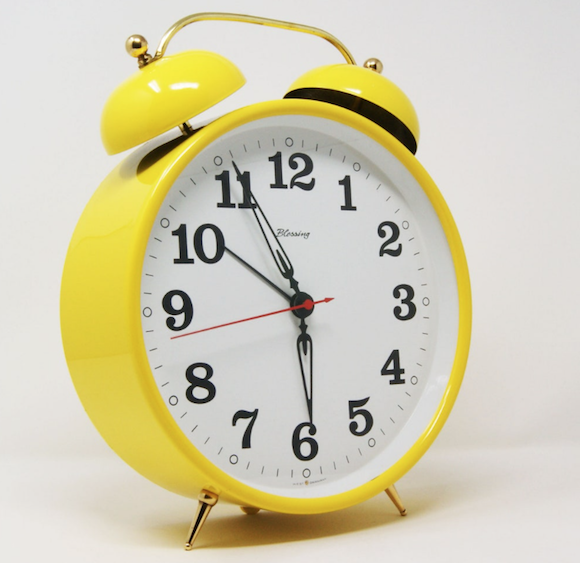
Invite physical analog clocks into your space to make the passage of time more visible and real, and shake up your relationship with time.
4) Remember self-care!
It’s no secret that I’m not a morning person, but it’s only been in the past few years that I’ve learned that our bodies need daylight in order to set our internal clocks to that we’re able to sleep at night. (This explains so much!) So, while there’s more daylight in the summer, it does you no good if you’re stuck inside your office or home and toiling away, missing it.
At work, your fellow staffers may take advantage of smoke breaks. (Ugh.) That’s paid break time of which you may never have availed yourself. So try it. No, don’t smoke (seriously, don’t), but take the break time and go outside. Here are some good moments to take a fresh-air-and-sunshine break:
- When you’ve come out of a meeting
- If you’ve just finished a virtual call on Zoom or Meet or Teams
- When you make three mistakes in a row. Everybody makes booboos, but if you mis-speak three times, or get confused about a concept, or just have a series of oopsies, that’s a sign that your brain is getting fuzzy and you need to refresh.
- If you’re angry, frustrated, hurt, or disappointed. There’s a reason the “Taking a stupid walk for my stupid mental health” TikTok trend has become so popular. It works!
- When you’ve just finished a chunk of deep work. Whether you’ve done a series of 25-minute pomodoros and are ready for a longer break, or you’ve tried the 52/17 Method and you’re ready for 17 minutes of sunlight, get the heck away from your desk. (More more on this, re-read Frogs, Tomatoes, and Bees: Time Techniques to Get Things Done.)
You also need sleep (aim for multiples of 90 minutes, so try 7 1/2 or 9 hours rather than your usual eight) to make sure you’re getting complete REM cycles.
Remember exercise. Whether it’s gentle yoga or power cardio, your body needs strong muscles, flexibility, and stamina.
Hydration and good nutrition are also essential. And no, this isn’t a wellness blog. But all of these things require good organization and management of your time. Set an alarm on your smartwatch or use an app to remind you to drink water.
5) Take a Technology Break, or a Few
Our dependence on technology can prevent us from noticing the real world all around us and the passage of time. I’m not saying to send letters by carrier pigeon instead of using email or scribbling numbers on the wall instead of using a spreadsheet. (Though it might be neat to receive a letter via the Owl Postal Service in the Harry Potter books!) But consider some options for reducing your dependence on tech when it’s not serving your productivity needs.
Keep the phone out of your bedroom. You’ll be less likely to doom scroll into the wee hours, and the blue light of your device won’t wreck your ability to fall and stay asleep.
When you do wake up, don’t grab your phone right away. Instead, do something intentional that will help you achieve your goals for making these hazy, crazy days of summer something more productive (or relaxing or dream-fulfilling). Why not:
- Meditate or explore silent devotion?
- Read a few pages of a real book?
- Visualize your goals for the day and embrace some positive affirmations?
- Get moving? Do some yoga stretches, go for a brisk walk, or do a short workout, or any tiny movement that won’t feel like labor but a nice blip of activity!
Start your day calmly and in control so you have a much better chance of achieving whatever it is you’d like to do with your summer.
When you’re working (or playing), keep your phone in your drawer or your bag. You’ll be distracted and interrupted far less often, allowing you to focus on what you’re doing and get into a flow state.
And maybe consider a digital detox where you put your gadgets and gizmos away after a certain time in the evening, or a technology sabbath where you eschew those pings and whooshes and curated feeds for 24 hours a week.
IDENTIFY WHAT YOU WANT TO ACCOMPLISH THIS SUMMER
Only you know what you want to achieve this summer. Once you’ve got an overarching goal, you can consider how you’ll implement it in small, manageable ways.
Write a book? If you do want to write a book, check out the sixth year of acclaimed author Jami Attenberg‘s 1000 Words of Summer challenge. It provides accountability and motivation for getting a jump start on your writing.
[Editor’s note: Jami’s series of challenges led to the 2024 release of 1000 Words: A Writer’s Guide to Staying Creative, Focused, and Productive All Year Round.]

Get in shape? Pick just one thing. If you’re intrinsically motivated, block time to swim in the morning before work instead of scrolling social media and hitting your snooze alarm, or after work to give your brain a complete refresh before having a “part 2” of your day. If you need external motivation and support, explore joining a summer workout program. Many cities and communities have outdoor sponsored by the Parks & Recreation departments for free or at minimal costs, and it’s less pressure (and cost) than joining a gym.
Maybe you don’t even know what you want to do this summer, but you just know you want this summer to be different and not whoosh by in a series of passing strangers on the street and saying, “Hot enough for you?” over and over. Peruse these posts for ideas:
102 Summer Goals That Are Perfect For Overthinkers
31 Best Summer Goals to Set This Season (2023)
45 Summer Goals: A List to Set for 2023
25 Summer Goals to Make the Most of the Season
Your summer plan doesn’t have to be a big thing. It doesn’t have to be a thing at all. Not everything has to be a big enough deal to make your family’s holiday newsletter. You could decide to eat more seasonal produce (rather than letting it turn to glop in the back of your fridge).

(I don’t know why this man needed so many bananas, but I applaud his enthusiasm!)
Maybe decide to set aside your spare change all summer and then donate it to charity…or splurge on something fabulous Labor Day weekend. (I won’t judge!) You could even strive to do some the things you missed out on during COVID, whether that’s seeing your favorite band on tour or traveling to a far-flung place.
Maybe you want to spend more time with your children to build memories, or have more quality time with your Significant Other or your BFF (not that your best friend isn’t also extremely significant)! Follow Laura Vanderkam’s suggestion and plot out big and little adventures for the summer weeks. By Labor Day, you’ll have stacked up a series of adventures that will make the summer memorable.
FIND A PARTNER
As I mentioned briefly in Paper Doll To the Rescue: How To Save Wet Books & Documents, a few summers ago, after a lifetime of trying (and failing) to read Anna Karenina, I partnered with my college friend and pre-COVID traveling buddy to read the book together. She’s a pediatrician in Upstate New York; I’m a Paper Doll in Tennessee. But through email and texts and phone calls, we were able to explore the characters and how we interpreted their behaviors through a modern lens. (Honestly, we gossiped about them as if they were Grey’s Anatomy characters. Just very, very Russian.)
We’ve decided to do it again, knowing we’re less likely to give up at a boring point if we’re doing this together. We agreed on reading another classic — we’re both fans of Jane Austen, but I already reread all six novels annually, and we wanted something new to both of us. I suggested Middlemarch, but she’s anti-George Eliot due to an unfortunate high school Silas Marner experience. She countered with Frankenstein, and while I appreciate Mary Shelley’s under-appreciated talents, I’ve read it before and it’s a downer.

And that’s how we ended up starting reading Vanity Fair this weekend. Mr. Thackeray, do your darnedest!
Having a partner in crime is always a great way to stick to your goals, large or small. As a reminder, you’ll find lots of suggestions for getting support and accountability in:
Paper Doll Sees Double: Body Doubling for Productivity
Count on Accountability: 5 Productivity Support Solutions
Flow and Faux (Accountability): Productivity, Focus, and Alex Trebek
ESTABLISH BENCHMARKS AND CELEBRATE YOUR SUCCESS!
Whatever you want to do this summer, whether it’s a big, honking deal or just a plan to find more time for your bliss, formally noticing that you’ve made strides toward your goal is a great way to honor your effort (and your magnificence).
Formally noticing that you've made strides toward your goal is a great way to honor your effort (and your magnificence). Share on XWhether you choose to notice your successes by posting updates on social media or just calling your mother (or my mother — she’s great for building up confidence), the point is that you take time to pat yourself on the back and say, “Yay, me!”
Enjoy your summer!
Pulitzer Prize-winning Mary Oliver‘s oft-quoted poem, The Summer Day, has a profound message. After pondering the nature of nature, prayer, and mortality, and debating whether one even knows how to do what they’ve already been doing all day, the narrator asks with passion and reverence what we might want to ask ourselves as we set forth into the summer:
Tell me, what is it you plan to do
with your one wild and precious life?
You’ve got 98 days. Whatever your answer to the question, go for it!
Frogs, Tomatoes, and Bees: Time Techniques to Get Things Done
ESSENTIAL ELEMENTS FOR TACKLING YOUR TO-DOS
Getting things done takes a lot of moving parts.
- You need to know WHAT to do. (This is where a to-do list or a task app comes in.)
Our brains can hold about seven things in our short-term memory, plus-or-minus a few. I always think of it as plus-or-minus three, given that phone numbers in North America being seven digits plus a three-digit area code. However, a misinterpretation of a famous psychological paper from 1956 leads people to understand Miller’s Law as allowing us to remember 7 things, plus-or-minus two.
That said, we can certainly remember more things, as long as we don’t have to recite them in very quick sequence. After all, a neurosurgeon doesn’t consult a to-do list to remember all of the steps in a complicated surgery, and we can (usually) handle remembering to make dozens of turns to get from where we work to where we live without benefit of GPS, assuming we’ve driven the route several times.
The simplicity or sophistication of your list of tasks is immaterial. Whether it’s on a sticky note, a page of a legal pad, a digital note in Notes or Evernote or OneNote, or any of a variety of task apps, if it shows the things you need to accomplish, you’re golden.
- You need to know what to do first.
The delightfully weird comedian Stephen Wright used to say, “You can’t have everything, where would you put it?”
Prioritizing is a toughie. We often say, “Well, all things being equal…” but of course, things aren’t equal. Some things are naturally high-priority — if you’re dealing with smoke, fire, blood, a baby crying (or a grownup crying hysterically), you need to tend to that first.
Most tasks in life don’t come with such obvious signs of their priorities. Usually, things we want to do are high emotional priorities but may be low productivity priorities. If I gave you a choice between doing an expense report or going to brunch, and assured you my magic powers extended to bippity-boppity-boo-ing your expense report for you and taking all calories and carbs out of your meal, you’d pick the corner table on the patio, convivial conversation with friends, and bottomless mimosas over filling cells on a spreadsheet.
We must prioritize our tasks. As we discussed in Paper Doll Shares Presidential Wisdom on Productivity, the key is to identify two essential characteristics of tasks: importance and urgency.
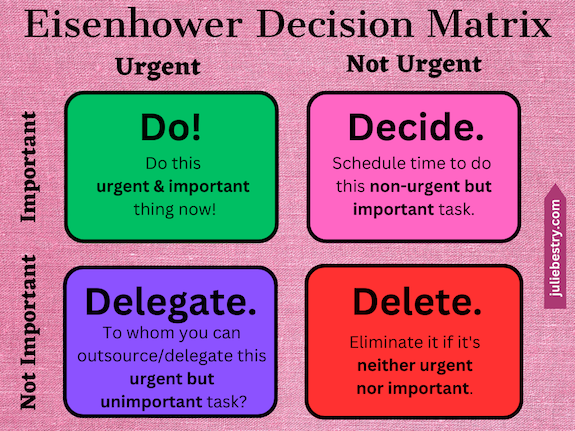
The Eisenhower Matrix isn’t the only method for determining these two factors, but it illustrates that only once you’ve figured out what are the most important and urgent things to get done, can you can figure out what things you should do yourself now, what you can delay and schedule for later, what you can delegate or assign to someone else, and what you can delete (or schedule for that non-existent “someday”).
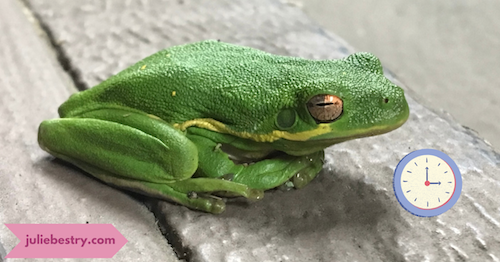
Some people like to eat the frog, per a quote originally ascribed to Mark Twain, “If the first thing you do in the morning is eat a live frog, you can go through the rest of the day knowing the worst is behind you.”
This method encourages attacking the biggest, hairiest task first. Proponents of Eat the Frog, like Brian Tracy, who authored Eat That Frog!: 21 Great Ways to Stop Procrastinating and Get More Done in Less Time, believe will this prevent you from spending the day procrastinating.
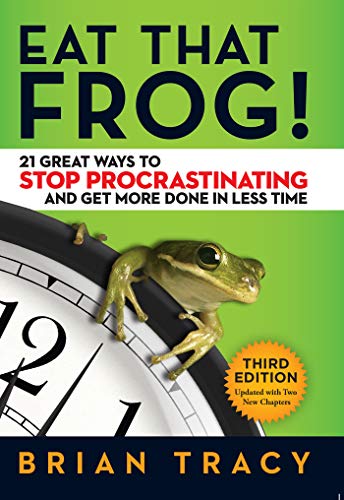

Me? I’m not so sure. I mean, yes, if you do the thing that you’re most likely to avoid first, of course you’ll feel strong and mighty and start knocking everything out of the park.
But how will you get yourself to do that? Even armed with all of the advice in last week’s and today’s, some of us are just going to keep avoiding the BIG YUCKY, certainly at the start of the day. Personally, I’m more inclined to start with something easy, as I believe that small victories breed success.
So, prioritizing isn’t just about the relative measure of the tasks, but of your emotional relationship to doing them. In other words, you do you, boo!
- Sit down (or stand up) and do it!
Knowing what you have to do and in what order (or at least at what level of soon-itude) is great, but it won’t get your tushy in the chair. As Sir Isaac Newton reminded us in last week’s post, Paper Doll On Understanding and Conquering Procrastination, a body at rest tends to stay at rest and a body in motion tends to stay in motion. If your particular body has been at rest for a bit too long, how are you going to get it to hunker down, in derriere-in-chair position, to get cracking?
Today’s post examines the methods, both popular and lesser-known, for proudly placing your posterior in position for productivity.
ONE HOT TOMATO: THE POMODORO TECHNIQUE
Pomodoro is the Italian word for tomato, and a popular form of kitchen timer in the 20th century was tomato-shaped.
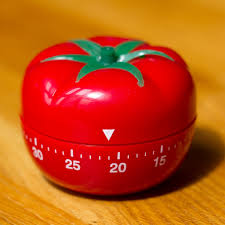
In the 1980s, Francesco Cirillo developed the Pomodoro Technique as a method for circumventing procrastination. The steps are basic:
- Identify the task you’re going to work on.
- Set a (kitchen) timer for 25 minutes.
- Work on that task (without interruptions or distractions) for the entire 25 minutes.
- Stop after 25 minutes (and if you’re strictly following the technique, check the task off on your official “To Do Today” sheet).
- Take a short break of about five minutes.
After four completed pomodoros, take a longer break. Four pomodoros plus four short breaks would equal about two hours, so that’s an opportunity for quite a bit of focus each day.
Simple, eh? But there are a few caveats. If you get interrupted, you start over. If you get distracted, you start over. And no matter how well you enter the flow state when working, when the buzzer goes off after 25 minutes, you have to take the break.
You remember flow state, right? We talked about it extensively in Flow and Faux (Accountability): Productivity, Focus, and Alex Trebek. Psychologist Mihaly Csikszentmihalyi, the “father of flow,” described flow as “being completely involved in an activity for its own sake” and when our sense of self and our surroundings cease such that we hyper-focus on a task.
For some people, that last part is a real sticking point of the Pomodoro Technique, because the break in the flow at 25 minutes may lead to a break in inspiration and concentration. For others, it’s like stopping a movie just when it’s getting to the good part — you can’t wait to get back to it.
Does it have to be a tomato-shaped timer? No, although it may help some people feel they are doing the technique in an “official” way, and for rule followers, that may help them get into the right head space.
Does it have to be a physical timer? Not necessarily. But the mind-body connection is a powerful thing, and physically manipulating a handheld kitchen timer (tomato-shaped or otherwise) might be be the key for some people to feel their activation energy getting triggered.
If the physical sensation of turning on a timer helps you set your attention on using your time intentionally, then use that to increase your motivation. But if you’re just not that touch-feely, just give a shout to Siri or Alexa to set a timer for 25 minutes, or use some of the zillions of digital pomodoro sites and apps out there.
Does it have to ring like a kitchen timer? Once again, no. Some people may find the harsh and unyielding ring or buzz of a timer to be too jarring, not only ending the flow state, but setting them on edge. If you are neurodivergent or categorize yourself as a highly sensitive person, you may be overwhelmed by an intense buzz; consider a tangible timer with a more melodious sound or pick a digital timer or phone alarm with your favorite “ta da, I did it!” song to gently break you out of your reverie.
Again, only you know what’s going to help you surface from your underwater focus bubble vs. what’s going to make you feel like you’ve narrowly avoided fender bender.
TOCKS
Tick-tock goes the clock, and that 25-minute tomato-based technique is practiced world-wide. But a similar method was developed independently by Daniel Reeves, co-founder of the productivity app Beeminder. (It’s been years since we covered Beeminder, but it’s a data-driven, habit-tracking productivity app where you put your money where your mouth is, pledging that if you don’t hit your goals, Beeminder will charge your credit card!)
Back in 2004, Reeves (independently) developed a variant of the Pomodoro Technique based on the idea of working for 45 minutes and taking 15-minute breaks. Each 45-minute block is called a tock. Like the Pomodoro Technique, Tocks rely on specifying what you’ll be working on during the tock.
Those who practice these hourly tock/break blocks are encourage do start on the hour, making it easier to track how much you accomplish (and see when it’s time to get your tushy back to work). Reeves also urges users to take note of mental distractions so they don’t end up like the guy in the Distracted Boyfriend meme.
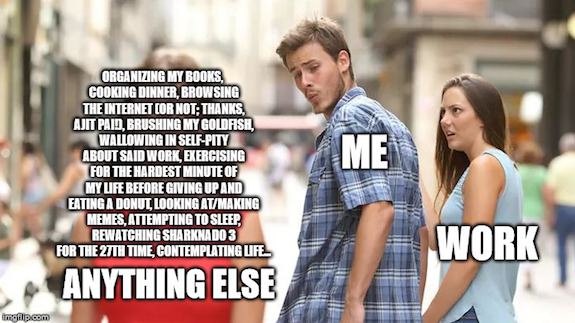
This reminds me of something I heard Alan Brown of ADD Crusher once say, that when one is being distracted by other possible tasks, it’s important to remember that there are “only three types of things.” There’s:
- What I’m working on now
- Important things that are not what I’m working on now, and
- BS things that are not what I’m working on now.
I see two advantages of noting your distracting thoughts. First, it will give you confidence that you won’t forget the (possibly) brilliant ideas that you had, and letting go of that fear will allow you to focus on what you’re doing. Second, it will yield a tangible list of other tasks to consider when you take your break, or later on when you’re deciding what is important or urgent to schedule.
Beeminder is bee-themed, and the original Tocks blog post sourced a bee-shaped timer that was later unavailable. However, I’ve found it, as well as a slightly less adorable alternative. If something like this would inspire you to be a busy (and productive) bee, go forth and create some buzz!
Etsy has the original version for $19.98 (plus shipping) for a set of two Spring Bumble Bee Design 60 Minute Kitchen Timers:
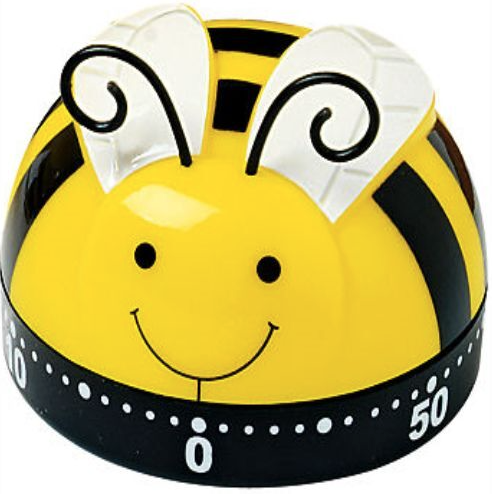
Less adorable and lacking actual deelyboppers, but available with Amazon Prime for $17.55, is this Kitchen Bee Timer:

THE 90-MINUTE FOCUS BLOCK
At first glance, this just seems like a super-sized Pomodoro. Instead 25 minutes of focus plus a break, you work for 90 minutes. But there’s scientific backing.
The field of sleep research has found that our bodies experience ultradian rhythms, recurrent 90-minute cycles throughout each 24-hour day. These are similar to the cycles of rapid eye movement (REM) sleep, discovered by researcher Nathaniel Kleitman. (This is why sleep researchers advise sleeping in multiples of 90 minutes to ensure you don’t get awakened mid-cycle, and why 7 1/2 hours of sleep (five 90-minute cycles) may make you feel more refreshed than 8 hours (four 90-minute cycles but then being jarred awake partway through your fifth).
Kleitman found evidence that we have 90-minute periods of high-frequency brain activity alternating with 20-minute periods of low(er)-frequency brain activity. (There’s a whole science-y explanation of how the cycles are governed by how our brains use our potassium and sodium ions to conduct electrical signals, but this is a blog post about productivity, not neurobiology. Thank goodness.)
So, if our energy levels and cognitive functions are optimal during particular 90-minute periods when we’re awake, and we attack tasks during the 90-minute blocks when our high-frequency brain activity is running on all cylinders, we’re going to be more attentive, more creative, and more productive. Winner, winner, chicken dinner!
Our brains use more energy than any other organs in our bodies, and when our brains are in that high-frequency mode, we’re using up that energy and freaking out the sodium/potassium levels. We NEED that 20-minute break, but we’re too distracted to take it. So the brain says, “hold my beer,” and slows us down into the low(er) brain wave frequencies, making us distracted, tired, foggy, and cranky.
If we take that 20-minute break, the sodium-potassium partnership ramps back up and we’re ready to tackle our tasks in a focused way. If we ignore that break, we’re going to experience a diminishing return on our time-and-focus investment.
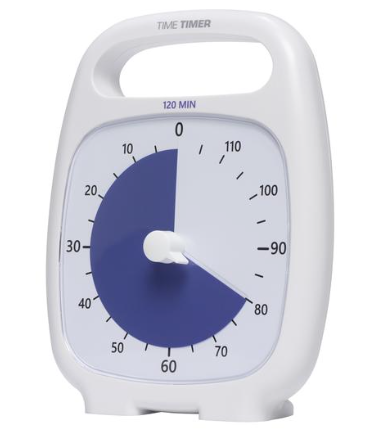
TimeTimer Plus 120-Minute Timer
So, using a 90-minute focus block is similar to the Pomodoro Technique, except that you’ll trade your 25-minute work sessions for 90-minute blocks, and extend your 5- or 10-minute breaks to 20.
That said, humans can be weird. Have you ever gotten hungry but instead of eating (which you knew you should do), you pushed yourself to keep going to the point that you pushed right through hunger and into queasiness? Those of us who get migraines know that when we first experience symptoms, we should take meds, hydrate, go to a dark room, etc., but many migraineurs will tell you that at least sometimes, they ignore the symptoms until it gets much worse. Again, humans are weird.
Alarms may not be enough. You might want to set the sleep mode on your computer monitor — or borrow from the accountability and body doubling lessons I’ve recently shared. For example, ask a friend to call or swing by your desk to remind you to stop after 90 minutes, then go for a refreshing walk outside.
THE 52/17 METHOD
Perhaps you feel that somewhere between 25 minutes and 90 minutes is your sweet spot? There’s an option that looks random, but anecdotal research may persuade you otherwise. As Julia Gifford wrote in a piece for The Muse, she identified another work-to-break ratio workflow that might help you focus more productively.
Gifford’s team studied the top 10% most productive employees using the time-tracking and productivity app DeskTime — and learned these folks rocked at taking productive breaks. (If you read my Toxic Productivity Part 3: Get Off the To-Do List Hamster Wheel, the efficacy of these breaks won’t surprise you.) In particular they found that, on average, these super-productive employees were working for 52 minutes and then taking 17 minute breaks before getting back into the thick of it.
Giffords’ theory is that these highly-productive employees treated their 52-minute blocks as sprints, a popular concept in the corporate world, particularly in technology fields. In a sprint, you work with “intense purpose” and dedication to the task, whatever it is, and then (as with the 90-minute focus block) let the brain rest and recuperate (and NOT think about work, or at least that work) before the next big sprint.
We aren’t robots. We just can’t sit and stare at a screen or make the widgets on a factory floor, or whatever, for 8-hours straight. Even robots can’t always work like robots!
“Repeating tasks causes cognitive boredom,” says Gifford, and whether we break it up with cake in the staff room (mmmm, cake) or a brisk walk or a convivial chat around the water cooler, we need a pause that refreshes.
So, the big drivers of 52/17 are purpose (backed, I’m sure, with a hearty dose of motivation), distraction-free worktime, and flow.
FLOWTIME
The Flowtime Technique, as developed by educator Zoe Read-Bivens (writing as Urgent Pigeon for Medium) in 2016, was designed to take a major drawback of The Pomodoro Technique — that it interrupted the flow state — and use performance analysis to improve productivity.
All of the above options count on working for a set time (25 minutes, 45 minutes, 52 minutes, 90 minutes), and then stopping at a pre-ordained time as prompted by an alarm. As noted, for some people who are neurodivergent, have ADHD, or are otherwise sensitive to loud noises or task transitions, this can be counterproductive.
As with all of the other methods, Read-Bivens’ Flowtime approach insists on uninterrupted work sessions, but instead of stopping when an external force (like an alarm) prompts you, you work until you start to feel distracted, or mentally or physically fatigued. Then you log how long your focused work session lasted — how long you stayed “in flow.”
- Pick a specific task from your to-do list.
- Write down your start time for each task.
- Work with focus as long as you can.
- Write down the distractions taking you out of your flow state as they happen.
- When you’re tired or hungry or muddled, stop.
- Write down your stop time, and then note the total elapsed time you focused on the task. Basically, it works like a time sheet; you can use an app like Taskade or create a spreadsheet with cells formatted for time, and create a formula to calculate the elapsed start/stop time.
- Take a break for however long you want.
- Lather, rinse, repeat.
Without scheduled breaks, you’ll be less likely to anxiously await the “end” and be more likely to get into flow and stay there. Flowtime gives you flexibility to have productive sessions personalized to your work style, and it pushes you to be really clear on what’s interrupting your focus.
I can also imagine that if you get to know your cycles of productivity, it can help you block out your work time around meetings and other obligations so that you have adequate space in your schedule for your work without friction, and lead you to schedule your high-effort tasks when you’ve got the most mental energy.
On the other hand, there’s a lot of admin associated with this method, requiring planning beforehand and performance analysis afterward. It’s adding more work to your work. If you’re the kind of athlete who tracks your steps and reps and miles and measures performance to better know yourself, Flowtime might be ideal. However, if giving yourself no stopping time isn’t enough of a trade for all this admin, or if not having a limit on your break time might lead you to procrastinate on getting back to work, it may not be for you.
I suspect Flowtime might be best used when your work is creative in nature. I’d never encourage my clients who are artists to paint for 25 minutes and then take a break, and novelists probably shouldn’t be zapped out of flow by an alarm. If your entire job is creative, perhaps in the arts, or you’re needing to do brainstorming sessions for ad campaigns or client pitches, Flowtime might make sense. But if you’ve got lots of distinct (and perhaps not-entirely-creative) tasks to complete, one of the strict time-based methods seems like a better fit.
What methods to you use to get your activation energy, circumvent procrastination, and get your work done? Which methods might you try in the future?
Paper Doll On Understanding and Conquering Procrastination
Nothing is so fatiguing as the eternal hanging on of an uncompleted task. ~ William James
We all procrastinate. Everyone knows that it’s irrational to put off doing something until the quality of the work might suffer. It’s obvious that it doesn’t make sense to keep not doing something when the deadline is fast approaching. And yet, at least sometimes, everyone procrastinates.
WHAT IS PROCRASTINATION?
Contrary to what you might have been told in your childhood (or even more recently), procrastination is not about laziness. Rather, it’s a self-protective mechanism.
Research shows that we use procrastination as a technique to regulate our moods. More specifically, to regulate, manage, and prioritize a negative emotion in the present over the negative outcome of our procrastination in the future.
Instead of delving into the science and scaring you off with words like amygdala and prefrontal cortex, here’s a cartoon to ease you into what’s actually happening in your brain when you procrastinate.
WHAT TRIGGERS PROCRASTINATION?
The tippy-top expert on procrastination, Canadian professor of psychology Timothy Pychyl of Carleton University in Ottawa, is the author of Solving the Procrastination Puzzle.
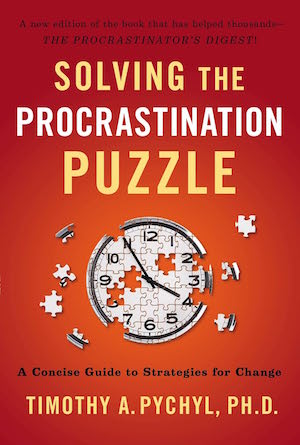
According to Pychyl, there are seven triggers that cause people to procrastinate:
- Boredom — Whether a child is delaying doing homework because the assignment isn’t challenging or an adult is facing a stultifying task (vacuuming, I’m looking at you!), doing anything stimulating (even if it’s counterproductive) may feel better than doing the boring thing.
- Frustration — The task itself may be frustrating because it’s full of difficult, fiddly little steps, like putting together a spreadsheet from multiple sources of data or figuring out how to build an Ikea desk without any written instructions; or, you might be frustrated because the work involves dealing with annoying members of your team.
- Difficulty — When something seems like it’s going to be too mentally or physically taxing, it’s comforting to procrastinate. Sometimes we tell ourselves that we’re preparing, or doing pre-work, to set the stage for the difficult task, but there are only so many pencils your teen can sharpen before settling in on that calculus homework.
- Lack of Motivation — This may seem the same as boredom, but it’s actually more complex. Boredom is mostly about the task; some activities are just inherently lacking in stimulation. But motivation relates to internal drive. Even if you aren’t happy in your current role at work, you may not be that excited about applying for a new job (perhaps because of depression, anxiety, or fear of change). You have to see the benefit of working on your resume and prepping for an interview as steps toward a personal goal of being more professionally confident, rather than just items to be completed to “get a job,” which may not be inherently motivating.
- Lack of Focus — Mental focus depends on physical and emotional stimuli as well as external stimuli. A variety of emotional concerns related to the task at hand — fear of failure, being embarrassed in public, losing a scholarship or a job — as well as unrelated issues like family or relationship troubles, or health concerns, can detract from your focus. Similarly, working in a crowded or noisy space, or even in an environment with visually distracting elements, can dilute your focus. Some people need to turn down the radio while driving to find the address they’re seeking; others need a tidy desk in order to read, even if the desk is outside their line of sight. You can’t focus if you’re hungry or tired, either.
- Feeling Overwhelmed — Too much of too much will always keep you from taking clear action. In the professional organizing field, we talk about suffering from decision fatigue and often say, “The overwhelmed mind says ‘No’.” Have you ever stood in the toothpaste or shampoo aisle and been shocked by the ridiculous number of competing alternatives? Similarly, if there are many different ways to approach a talk (writing a blog, replying to an email, making a plan for a move), overwhelm may lead us to just physically or mentally wander away.
so much to do pic.twitter.com/fiSm7Y2Erg
— poorly drawn lines (@PDLComics) December 21, 2022
- Being Overworked — Burnout is definitely a trigger for procrastination. If you’ve ever worked day-in and day-out on a project such that by the time you got home, you had literally no mental space or physical energy to do anything, even to prepare food, that’s a sure sign of overwork. Alternative options might be more or less pleasant (think: socializing or housework), but you might choose to lay on your couch and mindlessly scroll through social media instead of either thing you were supposed to do. Overwork eliminates the energy necessary for doing anything in the now, so everything gets pushed to a theoretical later.
Of course, Pychyl is not the only one to define triggers for procrastination. Others have identified fear of failure, impulsiveness (sometimes associated with ADHD), and generalized anxiety. Various executive function disorders can make it difficult to sequence or prioritize tasks.
The point is, procrastination is not laziness, but a conscious or even subconscious need to not feel icky now, even if you’re going to feel doubly icky later.
Procrastination is not laziness, but a conscious or even subconscious need to not feel icky now, even if you're going to feel doubly icky later. Share on XPRACTICAL STRATEGIES TO COMBAT PROCRASTINATION
Obviously, once you identify your trigger to procrastinate, you can employ techniques to reverse the behavior. For example, if a task is boring, like housework or working out, you might pair it with music or a streaming TV show.
It also may be helpful to take away the temptations of more entertaining options. Lock your phone in a drawer — having to unlock it to play Candy Crush may give you the necessary pause to stick with your task. If you’re tempted by websites that are more entertaining than the work you’re supposed to be doing, lock yourself out of those websites (for whatever time period you set) by using a website-blocking program like:
Cold Turkey — works with Windows and MacOS
Focus — works with MacOS-only
Forest — designed for your phone, it works with Android, iOS, and in your Chrome browser
Freedom — works with Windows, macOS, iOS, Android, in as a plugin for Chrome
LeechBlock — works in various browsers, including Chrome, Firefox, Edge, and Opera (but not Safari)
Rescue Time — works with Windows, macOS, Android, iPhone, and iPad
Self-Control — works with acOS-only
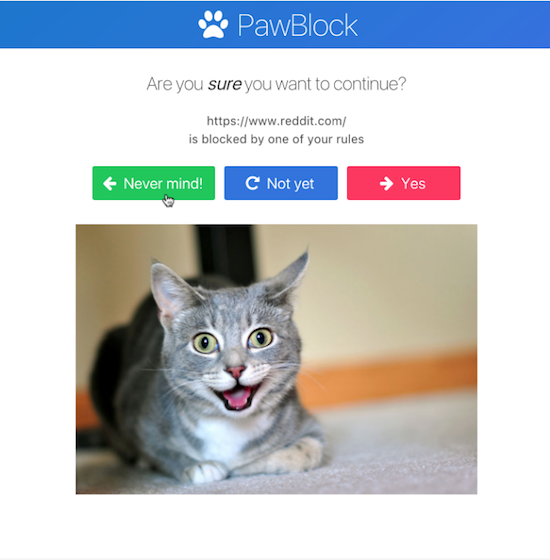
There’s also Paw Block, which, while it only works as a Chrome or Firefox extension, has the benefit of showing you pictures of kittens from the around the internet when it prevents you from accessing distracting websites.
If you’re frustrated by the elements or situation of the task, you might bring in a friend or colleague to help you do it, someone who doesn’t have the emotional connection to the stressors that are throwing you off. They don’t necessarily need to perform the tasks, but just body double with you so you feel soothed and less frustrated.
You can break down difficult tasks into the tiniest possible elements, or seek a supervisor’s guidance, so the annoyances seem less annoying. (It’s tricky in the moment, but you might also try to reframe “difficult” tasks as challenges and contests with yourself.)
If you’re feeling unmotivated, see if you can find a short-term reward. (Cake? Cake is always good! But a refreshing walk outside after finishing the first of three elements of a task may help you get your head back in the game.) For a deeper lack of motivation, work with a therapist or coach to help you identify the meaningful benefits you can get from doing the things at which you tend to procrastinate, or possibly find a life path that eliminates those tasks. (If creating PowerPoint slide decks gives you a stomachache, maybe you need to consider becoming a lumberjack or a lighthouse keeper. Not everyone wants to be an knowledge worker, and that’s OK!)
If your procrastination is due to floundering focus, determine what’s contributing to the lack of focus. If it’s internal (troublesome thoughts and emotions), consider meditation, walking in nature, and talking through the excess thoughts with a friend and/or in therapy.
But if it’s external, if you’re feeling attacked from all sides by an overload of sensory stimuli, you may need to declutter and organize your space or move your workspace elsewhere (or invest in noise-canceling headphones). But it’s possible you’ll want to see if an ADHD or other diagnosis might help support your efforts to get assistance dealing with distractions.
Overwhelm may seem a lot like frustration. While you may be frustrated by just one (big) annoying thing, overwhelm feels like you’re getting pelted with dodge balls from all directions. It’s a good time to sit down with someone who can help you see the Big Picture and identify the priorities and sequences. Professional organizers and productivity specialists excel at helping you battle overwhelm and get clarity.
And if you’re overworked and experiencing burnout, it’s time to have a realistic discussion with your partner, therapist, boss, and anyone else who can help you achieve balance before you suffer health consequences more serious than just the emotional distress related to procrastination.
In the short term, some meditation and schedule modifications might work, but if you’re experiencing chronic overwork, more intense career and life changes might be necessary. Start by revisiting my series on toxic productivity, below, and pay special attention to post #3.
Toxic Productivity In the Workplace and What Comes Next
Toxic Productivity Part 2: How to Change Your Mindset
Toxic Productivity Part 3: Get Off the To-Do List Hamster Wheel
Toxic Productivity, Part 4: Find the Flip Side of Productivity Hacks
Toxic Productivity Part 5: Technology and a Hungry Ghost
You’re more than your job pic.twitter.com/qAHwtnT6Ux
— Junhan Chin | Illustrator (@junhanchin) August 31, 2022
EMOTIONAL AND INTELLECTUAL STRATEGIES TO COMBAT PROCRASTINATION
Making changes in your space and schedule, breaking your projects into smaller tasks, and giving yourself rewards are all smart practical solutions, but they’re external. Changing your external world can only eliminate some of the obstacles to your productivity. To truly conquer procrastination, experts advise making internal changes as well.
Admit it!
Denial is not just a river in Egypt. When you catch yourself procrastinating, acknowledge it. Once you call your own attention to the fact that you’re delaying doing the thing you’re supposed to be doing, you can look at that list of triggers and say, “Yikes! I’m avoiding writing this report. Why is that?” You can’t solve a problem if you don’t realize it exists. Admitting it gets you halfway to a solution.
Forgive yourself
This isn’t the same as letting yourself continue to procrastinate. And just like forgiving someone else isn’t the same as saying that the undesirable behavior never occurred, forgiving yourself gives you the opportunity to recognize that past behavior doesn’t have to dictate future performance.
A 2010 study by Michael J.A. Wohl, Timothy A. Pychyl, and Shannon H. Bennett entitled I Forgive Myself, Now I Can Study: How Self-Forgiveness for Procrastinating Can Reduce Future Procrastination found, as the title indicates, that students who forgave themselves for procrastinating on preparing for exams earlier in the semester were far less likely to procrastinate on studying for the next exams.
You’re human; if you were a perfect person … well, you’d be the first one ever. Forgive yourself for having procrastinated in the past.
Practice self-compassion
Related to self-foriveness is self-compassion. Researchers found that people who procrastinate tend to have higher stress levels and lower levels of self-compassion, and theorized that compassion cushions some of the more negative, maladaptive responses that cause repeated procrastination.
Think of it as similar to overeating. If you cheat on your diet, low self-compassion might get you so down on yourself that you figure, “I’ll never lose this weight. I might as well just eat the whole ice cream carton!” But if you’re able to have self-compassion, you may tell yourself, “Yup, I did eat more than a half-cup serving of ice cream. But I understand why I did it. Next time, I’ll try drinking a glass of water and walking around the block first. Or maybe I’ll go out and eat the ice cream on the front porch, where the rest of the carton won’t be so accessible!”
(Seriously, whoever thought half a cup of ice cream was an adequate serving, anyway?)
Be intentional
All of the alternatives I described up above for seeking assistance and changing your environment (and the ones we’ll discuss next week) will only happen if you place your intention and attention on making changes.
Yes, this means a little extra labor on your part. If you know you procrastinate because you anticipate interruptions (from co-workers in the office or tiny humans when remote-working), you’re creating a problem before the problem exists, so you’re missing out on productivity before you need to and then again when the problem actually occurs. (And then you’ll spend the time after the interruptions being resentful about them, and that will lead to less productivity, too!)
Once you know what you’re up against and which triggers present a problem for you, build time into your schedule to plan your way around the obstacles and triggers. That might mean seeking out time with professionals who can help you, whether those are therapists, professional organizers, productivity specialists, or life or career coaches.
Embrace consistency
The various popular books on forming habits, like James Clear’s Atomic Habits, all agree that it starts with changing your identity, and seeing yourself as “the kind of person who” does things in a more agreeable, positive way.
Showing up daily is easier than showing up once in a while. pic.twitter.com/5CrOdIQjCu
— Sarah Arnold-Hall (@saraharnoldhall) February 6, 2023
One of the ways you can prod the formation of that kind of identity is to develop consistent actions and behaviors. In order to be the kind of person who goes to bed on time (and thus, can get up on time), you need to jettison the behavior of doom-scrolling for hours before bed. To consistently do that, you might set an alert on your phone for 8 p.m. to put the phone away, somewhere far from the couch or your bed. (Afraid you won’t get up on time if the phone isn’t near your sleeping area? Revisit my post from last summer, Do (Not) Be Alarmed: Paper Doll’s Wake-Up Advice for Productivity.)
Be a Self-Starter
You’ve heard me talk about activation energy before. In my post, Rhymes With Brain: Languishing, Flow, and Building a Better Routine, I wrote:
We also depend on activation energy. Because the hardest part of what we do is the getting started, we have to incentivize ourselves to get going. There are all sorts of ways we can trick ourselves (a little bit) with rewards, like pretty desk accessories or a coffee break, but the problem is that action precedes motivation. We’re not usually psyched to get going until we have already started!
Action precedes motivation. We're not usually psyched to get going until we have already started, whether it's a runner's high or Csikszentmihalyi's flow. Share on XA huge key to breaking the procrastination habit is getting started. After all, Sir Isaac Newton’s First Law of Motion states that a body at rest tends to stay at rest and a body at motion tends to stay in motion. (OK, it actually says, “a body at rest will remain at rest unless an outside force acts on it, and a body in motion at a constant velocity will remain in motion in a straight line unless acted upon by an outside force.” But this isn’t Physics 101.)
Did you watch the cartoon at the start of this post? (It’s OK if you skipped it; just scroll up and watch now and we’ll wait.) If you did watch, you know that you’re more likely to feel negative emotions about a task when you’re avoiding it, but when you’re actually doing the task, it doesn’t feel so bad.
So, get yourself in motion so that you can stay in motion! Get yourself past the hurdle of starting and that small victory of starting, and the realization that it wasn’t as bad as you feared, might make you less likely to procrastinate the next time you’re facing that same challenge.
GET STARTED AT GETTING STARTED
Once you’ve read all of the preceding advice, you still have to get your butt in the chair. (OK, yes, you could use a standing desk. Let’s not be pedantic!) There are two key ways to do that.
First, embrace accountability. As I’ve previously described in these various posts, borrowing willpower from others by getting support from “partners in crime” can be just the motivation you need to get started and stick with it, whatever the “it” is:
Paper Doll Sees Double: Body Doubling for Productivity
Paper Doll Shares 8 Virtual Co-Working Sites to Amp Up Your Productivity
Count on Accountability: 5 Productivity Support Solutions
Flow and Faux (Accountability): Productivity, Focus, and Alex Trebek
Second, even when you’ve got accountability support (and especially when you don’t), there are techniques for helping you get started on tasks in ways that feel hopeful, and that make finishing seem possible.
So, come back for next week’s post, Frogs, Tomatoes, and Bees: Time Techniques to Get Things Done, where we’re going to be doing a deep dive into a variety of well-known and sleeper strategies for eliminating procrastination. We’ll be talking about tomatoes and frogs, blocks and tocks, and so many numbers that you’ll think we’re in math class. (But I promise, just in case you tended to procrastinate on math homework, there will be no trains leaving Chicago at 120 miles per hour.)
Until next time, read more about the nature and causes of procrastination:
Why You Procrastinate (It Has Nothing To Do With Self-Control) ~ The New York Times
Why People Procrastinate: The Psychology and Causes of Procrastination ~ Why People Procrastinate
6 Common Causes of Procrastination ~ Psychology Today
7 Triggers of Procrastination ~ ChrisBaily.com
Procrastination triggers: eight reasons why you procrastinate ~ Ness Labs
When you tend to procrastinate, what triggers tend to haunt you? What methods do you use to keep procrastination at bay?
Highlights from the 2023 Task Management & Time Blocking Summit
As you know from my post Surprising Productivity Advice & the 2023 Task Management & Time Blocking Summit a few weeks ago, I was set to spend three days at the beginning of this month attending, and being a panelist and presenting at the summit. This is the fourth year I’ve been involved, and it was definitely the best yet.
The theme of this year’s summit, One-Size-Doesn’t-Fit-All. Now what?, is dear to my heart. In February, the summit’s creator, Francis Wade, and Productivityist Mike Vardy delivered a pre-summit session to set the stage. Generally, Francis posited, when people are struggling with productivity (and this is true of tangible organizing struggles, too), they seek out experts, “gurus” who identify their so-called secret formulas. “Do this and all will be well!” And that may be true, but only for a while.
No one system for anything — career paths, life balance, making cookies, or having an organized and productive life — works for every person in every situation. At some point, it’s essential to take the guru’s advice and customize it for yourself so you can live an authentic life.
Even Marie Kondo, whom I chided for insisting her way was the one-true way (in my post The Truth About Celebrity Organizers, Magic Wands, and the Reality of Professional Organizing) has had to face the fact that her way doesn’t exactly work for the kid-filled life she now embodies. (See all the various recent articles with titles like “Professional tidier Marie Kondo says she’s ‘kind of given up’ after having three kids.”)
Early on, especially pre-internet, there were no centralized places to access productivity advice. Then, so many people got into David Allen’s Getting Things Done (GTD to those in the know) that it was evangelized everywhere. But with the expansion of the web, “productivity porn” proliferated, and people had (and have) access to so many options.
The problem? Whatever popular productivity methods are out there, people aren’t all the same. They are unique. As I presented in “Paper Shame” — Embracing Analog Productivity Solutions in an Increasingly Digital World:
Because I know my own style, I know what works best for me. Because I stay abreast of all of the options out there, I know how to suggest what might be best for my clients. And my job is to know that what works for me won’t work for each of my clients, and what works for my overwhelmed, 30-something client with ADHD and a toddler won’t be the same as for my single-dude on-the-road salesperson client or my new-retiree client whose spouse was just diagnosed with Alzheimer’s. We’re each unique.
So, it’s important to know that it’s normal if the productivity strategies that work for your bestie don’t work for you. As you read blogs and books and incorporate advice, instead of accepting every bit of it “hook, line, and sinker,” Francis encouraged what he calls an ETaPS framework.
Simply put:
Evaluate your current situation and needs
Target where you want to move the needle (and by when)
Plan how you’re going to incorporate change into your approach, and get
Support through coaches, friendly accountability, and exposure to a wide variety of opinions and methods.
The summit was one stellar way to get that exposure.
These three jam-packed days included 27 recorded video presentations as well as live interviews, panel discussions, and networking at digital Zoom-like tables. It would be impossible to share all of the highlights, which ranged from Olga Morett‘s compassionate, vulnerable approach to “unmasking” and self-exploration for neuro-diverse individuals to Hanifa Barnes‘ framework for building without burnout (which included a deep dive into understanding circadian rhythms and body clocks for chronotypes — apparently I’m a cross between a wolf (night person) and a dolphin (insomniac).
 Dolphin photo by Ádám Berkecz on Unsplash
Thus, rather than providing a full recap of the summit, I’m going to share highlights and snippets that caught my attention, and which I look forward to sharing with my own clients.
QUICK BITES
“The menu is not the meal.”
Henrik Spandet, while talking about the differences among task management, calendar management, and meeting management, cautioned participants to remember that a task list is merely a list of opportunities, just as a menu is a list of dining alternatives. One must prioritize to maximize the experience. You can’t expect to do it all, or do it all at once. (He did not, however, discuss the advantages of eating dessert first.)
“If you’re not doing what you’re supposed to be doing, just sit.”
Carl Pullein‘s take on self-discipline dovetails with my own advice for dealing with writer’s block, and it’s kind of like the reverse of the bartender yelling, “You don’t have to go home but you can’t stay here.” You don’t have to perform the task you’ve set for yourself, but if you don’t, then you can’t do anything else. No perfectionist procrastination by tidying your desk; no mindless scrolling.
Sit. Just sit.
And in sitting and not doing, you may find yourself motivated to start writing, creating, or tackling whatever you’ve been avoiding. If not, you will find yourself having to face the reason for your avoidance, which may prove equally productive.
During a third-day “Boundaries, Burnout and Balance: Finding Peace When Working from Home” panel with Renee Clair, Clare Evans, and Olga Morett, the concept of “the booty hour” came up — and how getting the butt-in-the-chair is that make-or-break moment.
Do, or do nothing, is a powerful choice. We are so fixated on never being bored that the idea of having to do nothing may make the thing we are avoiding suddenly a much more compelling alternative!
“What gets measured gets managed — even when it’s pointless to measure and manage it, and even if it harms the purpose of the organization to do so.”
Too often, Peter Drucker‘s quote is truncated as “What gets measured gets managed” but the full quote is so much more powerful. In other words, be aware of how your methods and strategies impact your work, but do not get so caught up in the minutia of how many emails you’ve cleared (or not), and focus on the bigger picture of accomplishing what you want and need to do.
Don’t spend so much time tweaking your systems to get a micro-percentage point of difference. Know what metrics will help you achieve the return on investment of your time, energy, and attention, and focus there. Prioritization can feel abstract, but pay attention to what has the greatest impact on your life, and what brings you closest to your goals.
“Busy leads to burnout; productivity leads to prosperity.”
Ayana Bard‘s message at the start of her five-part approach to mindfully productivity has been in my head for the past week. Her approach involves gaining clarity (and understanding yourself and your tasks so that you can prioritize), knowing where your time is actually going (by doing a time audit), and managing your attention and (mental, emotional, and physical) energy.
Ayana accented the importance of mindfulness (i.e., paying attention with purpose), and noted that practicing mindfulness is easy to skip but not easy to do. (Hence the practicing part, eh?) She recommends incorporating mindfulness of your energies with regard to ultradian rhythms by working 90 minutes at top performance, taking 20 or so minutes for healing and recovery, and then starting another 90 minute cycle of top performance.
BOOK RECOMMENDATIONS
Professor Bret Atkins‘ presentation The Zen of Ten offered lists of ~ten (though he cautioned, not “top” ten) books (both well-known and a second list of sleepers), podcasts, videos, terms, and tools. The big-name list included works by David Allen, Steven Covey, Cal Newport, and Brian Tracey, as well as the “habits” triumvirate of The Power of Habit by Charles Duhigg, Atomic Habits by James Clear, and Tiny Habits by BJ Fogg.

Slightly lesser-known gems ranged from The Autobiography of Benjamin Franklin (worthy of a future Paper Doll post), Ryan Holiday’s The Daily Stoic, Tony Buzan’s The Mind Map Book, 1908’s How to LIve on 24 Hours a Day by Arnold Bennett, and 4000 Weeks: Time Management for Mortals by Oliver Burkeman, about which I wrote extensively in Toxic Productivity Part 3: Get Off the To-Do List Hamster Wheel.

There is no way to do his superb lists justice (and will be revisiting his other recommendations in future posts), but I will note that out of 22 highlighted books (yes, there were a few bonuses), there was only one book authored by a woman: Molly McCarthy’s The Accidental Diarist: A History of the Daily Planner in America.

I note this because it’s a more damning comment on the publishing industry than of Atkins and his discernment. But that’s also a topic for a future day!
Other books recommended by presenters were:
Why We Sleep by Matthew Walker
Time Surfing: The Zen Approach to Keeping Time On Your Side by Paul Loomer
SCOPE — IT’S NOT JUST A MOUTHWASH
Trevor Lohrber felt that the true key to time management is often reducing the scope of a task rather than trying to increase your productivity and ability to do more. After all, our time is limited by strictures — where we have to be and when and how soon the work must be completed. Trevor presented three concepts, but it was the idea of pacers that caught my attention.
Did you ever take an exam in school and spend so much time writing the first part of your essay that when they called “15 more minutes!” you had to rush through your remaining points?
Although the point of deep work is to get into flow, Trevor points out that we often hit a wall when we look up and realize, “Oops, I’ve run out of time!” He suggests that by becoming more aware of time passing while we’re within a block of time, we can adjust our scope.
Trevor encourages using gentle timers at fixed intervals during a time block; for example, every 15 minutes during an hour-long work session. They key points are that these aren’t alarms (in that they’re not alarming), but gentle sounds, like an ocean or wind chimes; set your “snooze” to 15-minute increments and you can brush it away with the flick of your finger across your phone.
The idea isn’t to startle you out of flow, but just lightly alert you to the passing of time so you can stop to consider whether you need to limit the scope of what you’re doing now so you can finish the whole task on time.
The benefits of Trevor’s approach is that these “moments of mindfulness” keep you from going down any rabbit holes and ensure you’re repeatedly reassessing the work to be done in the time allotted. It allows you to work smarter because you are reassessing your scope regularly through the process, and improve your focus because you’re more aware of the scarcity of your time. (Trevor also cautions that this is not ideal for creative tasks, like writing a key chapter in a novel, because that focus can lead to tunnel vision, something you want when you’re trying to finish your accounting but not so much when you’re trying to develop dazzling prose.)
THE HOCUS POCUS OF FOCUS AND WHAT’S GOING ON IN OUR BRAINS
Achieving focus is the Holy Grail of productivity. We can do a brain dump to make sure we’ve examined all of our obligations, prioritize so we can work first (and longest) on what matters most, and create blocks of time dedicated to that deep work.
But how do we gather the motivation to get our tushies in the chair and then maintain our focus to actually get it all done?
This is where mindset is essential. Misha Maksin talked about the flow state, something we’ve covered here extensively, starting with Flow and Faux (Accountability): Productivity, Focus, and Alex Trebek (in the section called Sidebar on Flow and the Unpronounceable Mihali Csikszentmihalyi), and how four “mega” time wasters (anxiety, overwhelm, indecision, and procrastination) block our ability to achieve flow.
He casts it as a question of whether we are in a “primal state” where we feel we are under threat, ruled by our sympathetic nervous system, and using closed, contractive survival thinking, vs. in a “powerful state” ruled by the parasympathetic nervous system, thinking in an open and expansive, creative way. I mean, wouldn’t you prefer to be curious, compassionate, and joyous vs. fearful, anxious, and overwhelmed? I know Ted Lasso would!
Misha explained how the mechanism of unproductive behaviors starts with beliefs driving our thoughts, which then drive our emotions, which lead to our actions, and then results, and those results then determine our core beliefs. This means that results are both initially determined by past beliefs and reinforce future beliefs, in a perpetual cycle that, if our beliefs about ourselves or our abilities are negative, our results very likely will be, also.
However, we can rewire our mindset so that the driving force is not our beliefs but our decisions. Per Misha, if decisions determine thoughts, which activate emotions, which motivate actions, which produce results, which reinforce decisions, keeping us in that productive “powerful state,” — we have a much better shot at attaining flow in our work and joy in our lives.
The key, Misha posited, was to notice when our brains are moving us to that ineffective “primal state” and use our tools to focus on making wise, proactive decisions rather than being ruled by the negative self-talk often inherent in our beliefs. Perhaps easier said than done, but it’s a powerful switch. We can decide to get our butts in the chair now rather than repeat a belief ingrained since childhood that we “always” procrastinate.
DRIVEN TO DISTRACTION
Dr. Melanie Wilson identified a three-part approach to changing reaction distractions, and while there are practical elements, this is basically a psychological approach.
- Adopt a new identity, eschewing the one that says “I am an easily distracted bunny” and trading it for one that says, “I’m a focused, productive person.” This echoes what James Clear says in chapter 2 of Atomic Habits.
- Identify your unmet (emotional) needs so you can stop using ineffective, distracting coping mechanisms. Wilson notes that certain feelings lead us to distract ourselves with unproductive alternatives — overshopping, overeating, drinking, gambling, compulsive social media scrolling — and that the common advice to replace those habits with more productive ones (go for a walk, read a book) fails because they don’t get at the underlying emotion that drives the self-distraction. If we can identify the negative emotion, we can satisfy it with planned activities that do satisfy it. For example, Wilson’s personal example was having ADHD and craving novelty. By planning her days with lots of intentional novelty built in, she was less likely to seek distractions (like compulsive shopping) when she was supposed to be doing deep work.
- Acknowledge troubling issues (what she calls “gnawing rats”) instead of avoiding them. Wilson notes that scheduling quiet time to think (and not merely to meditate), journaling, praying, or planning time to deal with a distracting issue, you’ll be less likely to experience the harsh (and distracting) negative side effects of those problems, like sleep issues, IBS, heart trouble, etc.
BEGIN WITH PERFECT
We know there’s no such thing as perfection in achieving a schedule that doesn’t overwhelm. That said, there was a repeated theme across the summit, the idea of starting with a “perfect” or “ideal” week, beginning with a completely blank schedule.
Carl Pullein advice was to:
- Block out your sleep for the amount you really need, not the amount you usually get
- Create a morning routine and block time for that (and if that’s not when you want to be doing physical self care, block out the optimum time for that for your needs elsewhere in your schedule)
- Section off one or more blocks for communication (like replying to emails) rather than having it be the task you return to each time you transition between meetings or projects
- Create space for “dynamic” aspects of your calendar that change, like appointments. Carl noted that we all need to have blocks on our schedules for our “Core Work” — basically, the thing for which we are paid. For me, that’s time working with clients, and those blocks are fixed; I work on weekday afternoons. For a salesperson, that time is spent on sales calls, not in staff meetings.
- Set boundaries for the available times for these elements (obviously, depending on the level of control you have over your own schedule). For example, Mondays are my Admin Days when I don’t see clients, and I only schedule personal appointments (doctor, dentist, haircut) on Mondays; if your energy levels make it hard for you to be creative in the late afternoons, make sure your core work isn’t scheduled at those times.
Anna Dearmon Kornick and Trasetta Washington both took a similar approach, hewing closely to the formulation laid out in the well-loved “Rocks, Pebbles, and Sand” story of filling a jar.
Using slightly different language, Anna described the elements as:
- boulders — the immovable, important, but non-urgent essentials of life, like health and wellness, and maintaining our major interpersonal relationships,
- big rocks — our high-priority, important-and-urgent-but moveable aspects of work, particularly our deep work focus,
- and pebbles — everything else, the non-important/non-urgent to-dos from laundry to errands to all the random reports and meetings that endlessly tend to crowd us out of our own lives if we do not preserve our boundaries.
Anna encouraged designing one’s week with four concepts in mind:
- Parkinson’s Law — Basically, work expands to fit the time available.
- Planning Fallacy — Due to an optimism bias, we consistently underestimate the time it takes to complete tasks.
- Time Blocking — The act of carving out specific sections of our schedule for specific categories of tasks
- Task Batching — Grouping thematically or platform-related tasks together, like replying to emails or sourcing graphics for blow posts.
Meanwhile, Trasetta added an element to the story, with the professor being prepared with containers of big rocks, pebbles, sand, and two beers (indicating always having time in your schedule for a friend). Her approach to designing the perfect week included color-coding (and name-theming) calendared categories with:
Green Machine — tasks that drive revenue
Blue Skies — educational and personal development
Mellow Yellow — self-care and rest activities
Red Tape — meetings, commutes, and essential but ultimately unimportant activities
She also added “advanced” operations, color-coding them as:
Orange Operations — general business operations
Violet Vision — planning and strategic activities
Purple Passion — tasks related to community and spirituality
TECH OR NOT TO TECH, THAT IS NOT THE QUESTION
My own presentation,“Paper Shame” — Embracing Analog Productivity Solutions in an Increasingly Digital World, delved into the idea that focusing on what we need to do and then getting it done varies; it can be helped or hampered by a system or platform depending on our own personal needs and characteristics.

In our live panel, Ray Sidney-Smith led me and Misha Maksin through a discussion of “Paper vs. Digital in Time Management,” but it was less of a debate than the title might imply. We acknowledged that we each embrace a hybrid approach, whether by choosing disparate methods for different areas of our lives, or by combining them.
This year’s summit had the fewest presentations on using particular types of technology, and instead looked at platform-agnostic approaches to understanding your task management needs at a personal level. For example, Dr. Frank Buck‘s presentation on handling multiple projects looked at removing the friction often inherent in task management from three perspectives: using an analog (paper) approach or either of two different digital models.
Again, not only does one size not fit all people, it doesn’t even fit all different versions of ourselves.
That said, Gynanendra Tripathi introduced us to his new player in the productivity realm, AlphaNotes, which seeks to help users “carve out their own trusted system for employing GTD elements.” They concentrate on leveraging digital storage and “lightning-fast query” ability to store and access information to support getting things done.
ONE SIZE FITS YOU — TODAY
During a live recording of the Productivitycast podcast at the summit, Ray led Francis, Augusto Pinaud and Art Gelwicks in a lively debate and discussion about the concept of “one size fits all” within the framework of productivity.
Francis posited that we are inherently greedy — we want to do more and achieve more, and the concept of “more” means that we will eventually outgrow many of the systems, tools and methods we have in place. Augusto reflected on what happens when we reach capacity — this is where our geeking out on productivity (and not just productivity tools) comes into play.
Our skill sets may stay the same, but our tools may need to change. To the idea that “one size fits all” with regard to tools and platforms may fit just for that particular function, Art made a great metaphor about “pants” in the closet. Tuxedo pants, sweatpants, work pants, etc. all serve one narrow function, but each is not appropriate for other functions.
They’re all pants, they served the needs you have at a particular time, but we have to accept that we probably won’t find one pair of pants to rule them all. We have to stop to think, “What fits you now” and:
“What productive pants do you have on today?”
Later, during networking, a bunch of us continued the “one size fits all” and “productivity pants” metaphors and I got to shock the Art, Trevor, and many of the men, who had no idea that women’s clothing sizes are not based on measurements (waist, inseam, neck circumference, etc.) as mens’ are but are often arbitrary and conflicting, and that even the same size across different clothing designers, or the same size across different styles in the same designer’s line, won’t fit the same.
Just trying to buy a pair of pants can adversely impact productivity! Maybe we can discuss that at the 2024 summit?
Surprising Productivity Advice & the 2023 Task Management & Time Blocking Summit
In fields like science, medicine, and technology, surprising information comes out all the time, and with that, novel guidance and advice. In the world of organizing and productivity, however, there aren’t a lot of unexpected, planet-sized discoveries or wrecking balls to old beliefs.
Rather, in most aspects of organizing and productivity, we seek to find novel examples and tweaks to help people understand the best approaches for what they already know deep down. Today, I’d like to share three intriguing ideas I’ve heard recently, and an opportunity for you to discover more.
WORK AS HOBBY: OVERCOME PROCRASTINATION WITH A MINDSET SHIFT
The first concept comes from my friend and colleague Hazel Thornton. You may recall her from Paper Doll Interviews the Genealogy Organizers and when I profiled her new book, Go With the Flow! The Clutter Flow Chart Workbook, in Paper Doll Presents 4 Stellar Organizing & Productivity Resources a few weeks ago.

I love Hazel’s blog, because she always offers practical yet warm insights. Earlier this month, she came up with an idea for a mindset shift for conquering procrastination, and it really got me thinking.
Usually, we approach procrastination from a practical perspective. For example, we look at how to use planning and scheduling, particularly time-blocking, to set expectations. Social science research, for example, has found that making a voting plan for when and where you will vote and how you will get there makes it more likely that you will cast a ballot.
We also look at tactical methods for getting ourselves into position to complete a task, such as using the Pomodoro Method, or enlisting accountability, as we discussed recently in Paper Doll Sees Double: Body Doubling for Productivity and Paper Doll Shares 8 Virtual Co-Working Sites to Amp Up Your Productivity.
Hazel, however, piqued my interest in suggesting something I hadn’t seen before in her post entitled Think of Your Big Project as a New Hobby. Now, I don’t want to steal Hazel’s thunder, so you should read her post in its entirety. But the basic concept is that when you find yourself procrastinating on a big project — as I recently found myself doing — a shift in mindset could ramp up your enthusiasm and make the work more appealing.
Hazel notes that the more often you do something, the easier it gets. Typically, we choose to do something repeatedly — like a hobby — because it’s fun. So, Hazel suggests approaching a project, particularly one about which you’re procrastinating, as if you were embracing a new hobby.
She notes that new hobbies usually require the acquisition of new skills and new information — just like projects do — and setting aside time to work on them. Hazel even offers a list of practical solutions (and even pointed people back to my body doubling posts — neato!) for hobby-fying a project.
If we perceive something as drudge work, we’re more likely to procrastinate on it, not set aside time to do it, and think about it as something to be avoided. We don’t get particularly excited about doing expense reports or preparing our taxes. But if we reframe a project and consider it as something that benefits us, or the people we love, or our community, if we re-set our expectations regarding how to approach something not-that-fun, our avoidance might fade away to nothing.
I think Hazel was right on the money. Over the last month, I’ve had a number of projects that were out of the ordinary for me, and one in particular involved employing technological skills that aren’t in my wheelhouse. I had to create a video (of which, more later), and as the days ticked down, I remembered my misery at completing the project last year, even though I was excited about the content. Shockingly, the video editing skills I learned in 1989-1990 in my graduate program in television production and management have very little application in 2023!
This year, I was eager to do the research and prepare my presentation, but anticipating the video production and editing was wearing me down. However, with Hazel’s blog post in mind, I started exploring ways to learn about new approaches with what Zen practitioners call, shoshin or Beginner’s Mind. It’s supposed to encourage eagerness, dispel anxiety and frustration, and yes, make procrastination less likely.
I hate being a beginner, but I psyched myself into beginnerhood for the “hobby” of making a visually-appealing, non-talking-head video. The same day I read Hazel’s post, I spoke with my accountability partner and all-around cool kitten, Dr. Melissa Gratias (whom I’ve also interviewed on the blog, in Paper Doll Interviews Melissa Gratias, Author of Seraphina Does Everything!).
Melissa had some amazing ideas that let me drop-kick PowerPoint and edit video content directly in Canva, the same platform I use to make the blog post banners at the top of every Paper Doll post. (Melissa also came to my aid every time I was stymied by an aspect of Canva that Googling didn’t solve.)
Hazel may not have realized she was channeling a key idea in Zen Buddhism, but by inspiring me to transform a hyperventilation-inducing project into one that was more hobby-like, she changed my entire outlook. I enjoy researching. I love learning new concepts. I particularly like developing skills that I can make systematic so they’re easier and easier as I do them more often. Hobbies for the win!
If you’re having trouble getting your mojo going on a project (or can envision that happening in the future), give the ideas in Hazel’s post a try.
A DIFFERENT KIND OF BACKUP
If you’ve read the Paper Doll blog for a while, you’ve probably seen me promote the importance of backup. Usually, I’m touting computer backup, such as in Paper Doll’s Ultimate Stress-Free Backup Plan.
But I’ve also looked at backing up from the perspective of human backup, such as in Cross-Training for Families: Organize for All Eventualities. Those two posts reflect both a plan for backing up, and having a backup plan for life.
However, last week I heard about a different concept for backing up that’s worth discussing. At the start of the year, in Paper Doll’s 23 Ideas for a More Organized & Productive 2023, I mentioned that I was going to be doing Laura Vanderkam‘s annual 168 Hours Time Tracking Challenge. I enjoyed it so much that I also signed up for her Tranquility by Tuesday Challenge based on her book, Tranquility By Tuesday: 9 Ways to Calm the Chaos and Make Time for What Matters. (I already knew I’d like it because she previewed the book at the 2022 Task Management and Time Blocking Virtual Summit. See below)

For each week of the challenge, Vanderkam sends emails encouraging participants to put one of her nine lessons into practice. Last week was Lesson #5: Create a Backup Slot. Here, Vanderkam talked about how even the best of intentions are not enough when we try to create a schedule that allows us to be productive and accomplish all of the things that are important to us. Most tellingly, she wrote:
I have learned that anyone can make a perfect schedule. True time management masters make a resilient schedule.
Yes! Resilience is essential! A schedule is a map of our time. With a road map, sometimes there’s a crash up ahead, or a road is washed out, or someone gets car sick. If we want to accomplish what’s important to us, we have to be prepare for unanticipated calamities.
To this end, Vanderkam advises that we not fill our schedules from morning to night (of course!) but instead designate more times in our schedules than we plan to use.
Borrowing from my cross-training approach for human backup, I might schedule Monday afternoons for writing, but cross-train Saturday so it knows how to handle the task. (OK, we’re anthropomorphizing the days of the week. Just go with it.) You might plan to do your bookkeeping on Wednesday mornings, but if an all-hands meeting gets called or you have to pick up a sick kid from school, and your Wednesday morning blows up, Thursday needs to step in as backup.
Rather than searching your schedule for places where you can either cancel something or squeeze in one more task, if you already have backup slots scheduled, you’re prepared in the eventuality of your life falling tush-over-teakettle.
Rather than searching your schedule to cancel something or squeezing in one more task, if you already have backup slots, you're prepared for when your life falls tush-over-teakettle. Share on XVanderkam’s approach is wise but too rarely practiced. We see blank spots in our calendars and jump to fill them, to do more, to accomplish more, to achieve more. This can be aspirational, or it can be stressful. If the latter, harken back to my posts on toxic productivity from last summer:
- Toxic Productivity In the Workplace and What Comes Next
- Toxic Productivity Part 2: How to Change Your Mindset
- Toxic Productivity Part 3: Get Off the To-Do List Hamster Wheel
- Toxic Productivity, Part 4: Find the Flip Side of Productivity Hacks
- Toxic Productivity Part 5: Technology and a Hungry Ghost
If the idea of too much empty space on your schedule makes you nervous, try just one or two slots, maybe an hour or ninety minutes, on Thursday or Friday, where you’ll be the most likely to catch up on tasks that got displaced from earlier in the week. Think about designating themed slots, like for marketing or accounting or personal development. That way, if you get to your backup slot and don’t need it, you can use it either for something within that theme, or for something fun and rejuvenating.
If you find that you’re drop-kicking things that matter to you because something blew up your schedule, adding backup slots could help you master your time and life. And Vanderkam asks, “If life went perfectly, what would you use your open time for?”
Good question. After all, why are you doing all this work in the first place?
THE WORK IS NOT ENOUGH
I read a lot of email newsletters. (Seriously. It may be an addiction.) So, to remember to read blog posts and newsletters of people whose work I’m not regularly seeing on social media, I use an RSS feed. My preferred platform is Feedly, and I can segment the blogs I read by category like entertainment, finances, productivity, tech, etc. and do a deep dive into all the posts I’ve missed over a week or month, keeping my inbox less crowded.
One of the authors I read is Anne Helen Petersen’s Culture Study. The essay that caught my eye was a fairly personal one, The Work Is Not Enough. (Note, there is one not-safe-for-work vocabulary word in the essay. Please do not click through if you are likely to be offended.)
Petersen’s post dovetailed with Vanderkam’s lesson, because, starting a few weeks ago, her life and schedule sort of blew up. Her partner was ill, her doggie was sick, it’s tax season, and there were work kerfuffles. Each thing caused the dominoes to fall:
Losing a day, an hour, an afternoon — if that was time used to put things in place to keep them rolling through the week, and that time is lost, then you find yourself in a 17-task pile-up. … and pretty soon you’re in laundry apocalypse, and the only thing that’s going to save you is […] the next weekend.
Can’t we all relate?
Petersen notes that all of the tasks, in their own version of a sort of life laundry apocalypse, could have been handled individually, but together, her mind was whirling trying to figure out which enjoyable things she should have culled to avoid the apocalypse, or could cull in the coming days to get back on track. But she recognized,
I don’t need to stop taking care of my friends’ kids, or stop running, or stop having dogs, or stop skiing in order to make this all [waves hands wildly] fall into place. I just need to be vigilant about not taking on more work than I can reconcile with the rest of my life. The work matters; the work is important; the work is wonderful. But the work is not enough.
Petersen is recognizing that often, when we have to choose what to toss from our busy schedules to get back on track, we throw ourselves overboard.
For most of us, the thing that’s easiest to jettison is the thing that’s most precious to you — because letting it go ostensibly affects you and you alone. A hobby, a personal goal, a book club, a walk, a nap, all so readily sacrificed. But those are the things that allow us to stand up straight as we carry the weight of everyday annoyances and tasks. They are the counter-balance. They are essential. We cannot mistake the ease with they can be put down with disposability.
Wow. Seriously, wow. I wish I’d had this essay to share back when I wrote the toxic productivity series, and I’m glad I can share Petersen’s wisdom here. Yes, we should develop our skills to manage our time and tasks well, but let’s not do it at the risk of what makes our lives worth living — our relationships, our joys, or our humanity.
THE 2023 TASK MANAGEMENT AND TIME BLOCKING VIRTUAL SUMMIT
For the fourth year in a row, I’m participating in Francis Wade‘s Task Management and Time Blocking Virtual Summit. Francis is a fellow Cornell University alum — we actually lived in the same international dorm — founder of 2Time Labs in Jamaica, and author of Perfect Time-Based Productivity: How To Protect Your Mind As Time Demands Increase.

In last year’s preview to the 2022 summit, I covered a lot of the reasons behind productivity struggles in Struggling To Get Things Done? Paper Doll’s Advice & The Task Management & Time Blocking Virtual Summit 2022, from external struggles like lack of structure and technology overwhelm to personal challenges and tool/user mismatches.
I recapped the gems from experts at the summit in Paper Doll Shares Secrets from the Task Management & Time Blocking Summit 2022. So, if you missed all that, basically you’ve got a tons of wisdom (theirs, as well as mine) to review.
This year’s theme absolutely delights me: One-Size-Doesn’t-Fit-All. Now what? If you ever read my post, The Truth About Celebrity Organizers, Magic Wands, and the Reality of Professional Organizing, you know how how I feel about the inadequacy of one-size-fits-all approaches to organizing and productivity.
My own presentation by pre-recorded video (about which you’ve now heard) is Paper Shame — Embracing Analog Productivity Solutions in an Increasingly Digital World. (Pssst: Melissa Gratias helped inspire the title!) I’ll also be a panelist on Saturday afternoon (because Francis has his wife/co-founder Dale know I’m not a morning person). The topic? “Paper vs. Digital.”
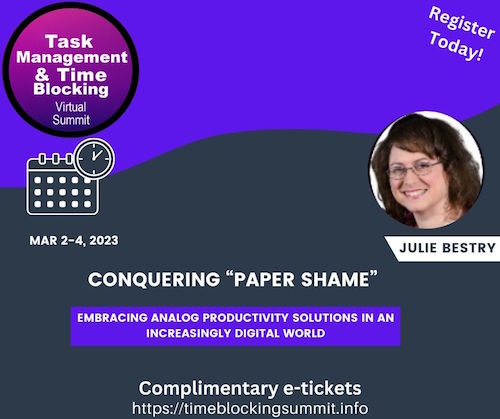
That panel will be moderated by friend-of-the-blog and productivity dude extraordinaire Ray Sidney-Smith. We’ll be joined by Artificial Intelligence expert, Misha Maksin.
Each year, the summit is refined and improved. This year, 27+ experts are participating, and I’m excited that I know so many of them!
On each of the three days of the summit, attendees get 24-hour access to a selection of video recordings on topics with titles like:
- Handling Multiple Projects with Ease: How To Remove the Friction and Handle the Details
- Productivity and Neurodiversity: Should I Fit in Productivity’s World or the Other Way Around?
- Mastering Productivity with Mindfulness in 5 Steps
- Build Without Burnout: Setting a Schedule for Your Business and 9-5
- What’s Really Driving Your Distractions?
- From Micro to Macro: How to Make Time Blocking Work for You
- 3 Techniques to Level Up Your Time Blocking
- Get a Game Plan: Three Steps to Designing Your Winning Week
- Why You Aren’t Achieving Your Goals: Breaking the Cookie Cutter Approach to Goal Setting
- Your Ultimate Productivity Tool: You Already Have It and It’s Not Paper or Digital
And that’s barely a third of the video options this year!
On Friday, the live portion of the TMTB Virtual Summit begins with Francis opening the event, followed by a full day of live panels and interviews. Another slew of video presentations will also be released.
I’m looking forward to Dr. Frank Buck interviewing his sort-of namesake, Dave Buck, as well as a live episode of The Productivitycast, with the aforementioned Ray, Augusto Pinaud, Art Gelwicks, and Francis. (Read more about this gang in Paper Doll Picks: Organizing and Productivity Podcasts.) I’ve been a guest on that podcast many times, and am sure it’ll be a hoot.
I’m also really excited about the panel discussion, “How Does Time Management Work Across Cultures and Countries?” and the interview with Mike Vardy about The Productivity Diet.
On Saturday, there will be more video presentations released (including mine!) as well as another spate of live interviews and panels. (You’ll enjoy everything, but if you want to see my panel, it’s from 1:45 p.m. until 3 p.m. on Saturday.)
There are also oodles of bonus offers and “swag bag” items.
The whole event takes place on a very cool interactive platform called Airmeet, allowing us to interact at digital “tables” in a sort of cloud-based ballroom and attend Zoom-like lecture rooms for official events. As with previous summits, there’s time for networking with attendees and these great speakers and geeking out on productivity.
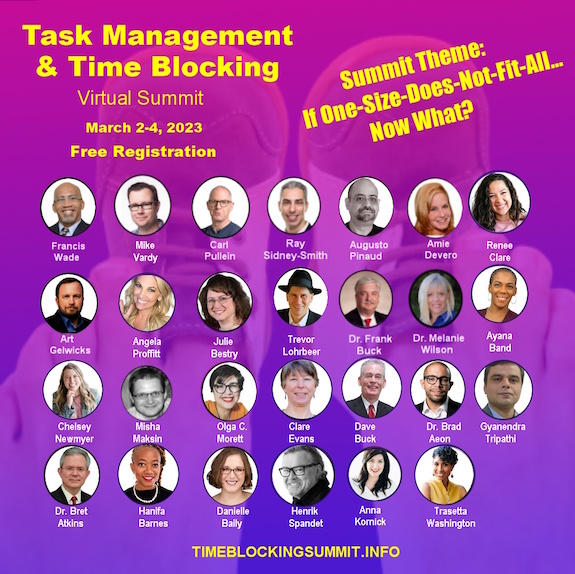
When you register for a free e-ticket to the event, you get 24-hour access to each “chunk” of videos, plus all of the live interviews, panels, and networking events in the Airmeet Lounge.
Again, attendance is free, but you’ll have to carve out time in your schedule to watch the videos — it helps that Thursday is a video-only day! — and attend the live events, which run from 9:30 a.m. to 4 p.m. on Friday and Saturday.
 If you want more time to absorb everything, you can purchase an All-Access Pass, which is basically a smörgåsbord of summit offerings and bonus extras, including:
- recordings of all of the pre-recorded video presentations (including mine!)
- recordings of all of the live panels, interviews, and events
- an audio or PDF copy of Francis’ book
- a 50% discount on Francis’s My Time Design Rapid Assessment program
(Be sure to pay attention to the resulting screen post-purchase so you know how to access your goodies.)
The full price for the All-Access pass is $249. But because I love you, I’ve got a super-nifty coupon link good up until the start of the summit that takes the price down to $99!
What project might you approach as if it were a hobby?
Where can you create a backup slot in your schedule?
How will you protect the elements of your schedule that give your life meaning?
Will I see you at the 2023 Task Management and Time Blocking Summit?
Follow Me