Archive for ‘Gifts’ Category
Paper Doll Organizes Snoop-Proof Ways To Hide, Label, and Wrap Holiday Gifts
With only a week until Hanukkah and 2-1/2 weeks until Christmas, we’re in the home stretch of the holiday season.
It’s possible you’re the kind of person who bought all your presents over the summer, wrapped and labeled them, and stored them in your secret hiding place months ago. (It’s also possible now you’re wondering why you can’t recall where that secret hiding place might be.)
Or maybe you haven’t even started buying gifts yet.
Either way, how are you going to keep the gifts a surprise until unwrapping time? How are you going to keep the kids (and the grownups who act like kids) from finding the gifts, poking at them, shaking them, and generally behaving like the gang on Friends.
ORGANIZE YOUR HOLIDAY GIFT HIDING PLACES
Very often, I find that the best place to keep gifts, wrapped or otherwise, from the prying eyes of tiny humans and others with insatiable curiosity is in an old suitcase. People may in cabinets and closets, but nobody looks in those cheerless valises in the basement, the ones that are faux leather and lack wheels and haven’t been used in 40+ years.
Yes, as a professional organizer, I encourage people to donate or recycle things that they don’t use, but quietly repurposing that blue vinyl-and-cardboard suitcase circa 1978 counts as recycling!
Develop a Variety of Hiding Places for Gifts
Obviously, if you’ll be traveling for the holidays and using all of the suitcases at your disposal, you may need a bevy of secret-stash solutions:
- Hidden in plain sight — Would your kids (or your spouse) actually show any interest in prying up the lid of a Bankers Box labeled “2015 Tax Receipts,” “college textbooks,” or something similarly boring? Probably not. (Piling other stuff on top of those couldn’t hurt.) If you’re the only one in your house who cooks, a small wrapped gift or two hidden in the back of a kitchen cabinet, inside a rarely-used fondue pot, may be just what you need to stymie the sneaky searchers.
- In a decoy household container — A similar idea, depending on the size of the gifts you want to hide, is using a decoy box may be just the ticket. Check your own storage spaces or ask your friends if they have boxes that were used for vacuums, TVs, or other medium-to-large appliances. A box labeled “seasonal décor” may suffice, unless someone else in your home is really eager to start decorating without your assistance.
- Masquerading as kitchen equipment — The people who are most likely to sneak around and try to find their gifts are probably not looking in the Crock-Pot. A bread maker or ice cream machine may serve similarly. If you’ve got small-to-medium-sized gifts and unused, lidded pots and pans, this may work. Just don’t put a gift inside kitchen equipment and then gift that kitchen item as a gift and then let your wacky boss throw a hissy fit and turn the Secret Santa into a Yankee Gift Swap. (If you know, you know.)
- At your friends’ and neighbors’ houses — One solution is just to trade storage. Take your wrapped gifts in boxes or lidded tubs to your cousin’s, co-worker’s, or BFF’s place, and return with hers. You can even tell your family not to bother snooping because you’ve made this trade. (Note: if your kids and their kids are friends, one may spy on the other’s behalf.)
- In trunk of your car — Obviously, this works in only two situations, when you normally have an incredibly tidy trunk (with ample room to store a gift-filled box labeled “work project”) or if you normally have a predictably packed and untidy trunk (in which case you’ll need to hollow it out and hide gifts underneath the faux facade of mess. (Do not mark any boxes as “donations” or someone may unhelpfully deliver all your holiday gifts to charity!)
- Cardboarded up — Store all your wrapped, labeled gifts in the million Amazon and Chewy boxes you already have laying around your house. You can just stack them in the corner until you’re ready to put them under the tree or at people’s place settings, and then open the big cardboard boxes.
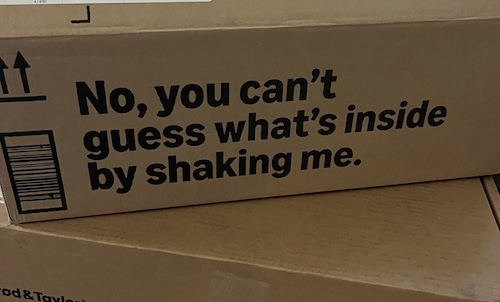 Photo courtesy of Kimberley Purcell
- Up in the attic — The upside is that children and pets generally can’t get up to the attic on their own. The downside? It’s probably not that easy for you to get up there, either. Also, it’s probably dusty, there may be “critters,” and there’s almost certainly temperature and humidity variations throughout the year. Keep that in mind if you’re storing any gifts that are sensitive to those kinds of changes, and store the gifts in a tightly lidded tub.
- Inside old purses and backpacks — This is a riff on the old suitcase approach, but may be easier to access. If a shelf of your closet has all of your handbags, messenger bags, no longer used diaper bags, computer cases, or backpacks, load them up with wrapped gifts, as long as they’ll fit without scuffing the wrapping or stretching the container too much.
- In guest room — This is a good option assuming a) you won’t have guests between now and gift-giving time or b) the storage space in your guest room is ample enough to hide the kids’ things, at least, in drawers or closets, or under the bed.
- In the guest bathroom — Sandwich wrapped flat gifts between guest towels; there’s almost no reason those box-shakers will be thinking to peek between the layers of towels. Consider it a fabric lasagna of secrecy.
- Laundry hamper — Let’s face it; nobody is enthusiastic about doing laundry. Your kids aren’t about to suddenly volunteer to take the laundry to your room to the washer/dryer, even to please Santa. Note: the humidity in a laundry room may be unfriendly to your wrapping paper, so try keep gifts well protected in the hamper or basket, perhaps covered by an old blanked or comforter.
- Inside board game boxes — Do you have board games that nobody has played since the Eisenhower administration? You have two options. You could just jettison the contents and replace it all with someone’s (or a bunch of someone’s) small gifts. Or, you could turn some of the gifts into surprises, if your family is more loosey-goosey with the gift exchange present exchange: put a LEGO mini-fig in with the Monopoly tokens or a gift card in your old game of Life, and then suggest a game.
- Hiding inside trash bags — Big, black trash bags or leaf bags, especially if you have an attic, or garage, or basement with a variety of things already obscured by bags, may be the ticket. The problem? If there’s anyone who ever visits your house trying to be “helpful,” they may assume it’s trash and toss it out. You may want to warn your spouse, in-laws, or houseguests.
- Inside other holiday decorations — If you’ve got a hollow ceramic tree, a Santa cookie jar in which nobody expects to find actual cookies, or a Nutcracker the size of a Buick, gifts can wait within.
- Up, up, and away, or down among the dust bunnies — Let’s face it, you may not need to be creative at all. If everyone in your household is staring at screens all the time, just hiding gifts in a nondescript box at the top of any closet may work just fine. Similarly, if you’ve got a dust ruffle hiding the area underneath your bed (or the guest bedroom bed), and you don’t have pets or tiny humans at the crawling age, sliding things under the bed will work.
- At the office, with a caveat — If you have a home office that’s off-limits to the rest of the household, or if you have decent private storage at your place of work, you’ve got additional hiding places for your gifts. However, if the gifts aren’t at home, they may not be covered by your homeowner’s insurance, so think twice before stashing something pricey that could get stolen or damaged if it’s at your workplace.
Wherever you hide the gifts, make a plan for when you’re going to pull them out of their hiding places, especially if it involves climbing up, wiggling down, or matching schedules with someone else.
Make a Treasure Map for Hidden Holiday Gifts
The key to hiding your gifts without making you crazy or ruining the holidays? Make a list of each person’s gift, what it is, and where you’ve hidden it.
Whether it’s hand-written or digital, hide it from prying eyes. On the computer or in the cloud, give it an innocuous name, as long as it’s one that you will remember. With a paper copy, keep it in your wallet, or tidy it away among the holiday bills — anywhere your average household member won’t think to look.
In professional organizing, we often point out that if you have so many things, or so much clutter, that you can’t find what you own, it’s as if you don’t even after it. This is just as true for gifts you’ve stashed so safely that you’ve hidden them from yourself.
Try Some Sneaky Gift Labeling Tricks
If your storage is at a premium and you have to keep wrapped gifts out and on display — and this trick works once you’re ready to put the gifts under the tree — fake the name tags. Instead of Grandma, Dad, Aunt Jen, etc., use celebrity names but don’t match the names to the personality of the recipient. So, Dad gets Taylor Swift’s present, Uncle Joe’s gift says Dolly Parton, and the baby gets a gift labeled for Keanu Reeves.
Of course, you could pick any category group. Choose board games, and label different gifts as Scrabble, Monopoly, and Cards Against Humanity. Label your gifts with the names of different countries, cities, rides at Disney World, movie superheroes, or whatever suits your fancy.
If your family isn’t inclined toward whimsy, you can just number the gifts. The key is that you really should know whose gift is whose before the unwrapping begins.
As with gift hiding spots, make yourself a cheat sheet matching real names to “gift” names.
GET WRAPPING SAVVY
Paper Doll is terrible at wrapping any gifts that don’t come in perfectly rectangular shapes. All the way back in NAPO2014: It’s a Wrap! Organizing Your Wrapping Supplies with Wrap It!, I told a story of my wrapping failures (and shared this adorable photo of a now thirty-something) opening a stuff lion I’d wrapped so badly that only a two-year-old could look at it with any affection.

Many years ago, I offered up some alternatives for people with wrapping skill deficits. This was early enough in my blogging years that the formatting of the posts lacks some panache, but I stand by the efficacy of the solutions:
It’s a Wrap! Wrapping Paper Alternatives, Furoshiki & Frogs (2008)
Paper Doll Wraps Up the Holidays and Makes It All Stick (Part 1) (2011)
Paper Doll Wraps Up Some Alternatives to Wrapping Paper (Part 2) (2011)
Still, I’m obviously not the only person who has trouble wrapping presents when there’s no perfect box, as there are videos all over YouTube and social media, offering up guidelines for ensuring that enough wrapping paper (or a reasonable facsimile) prevents your gift from being naked. For example, That Practical Mom has a short video with great gift-wrapping tricks:
The coolest trick, to my mind, is turning gifts diagonally when you don’t have quite enough wrapping paper.
By the way, if you care, Popular Mechanics has a feature on the math behind the diagonal wrapping hack.
WRAPPING & PACKING & SHIPPING, OH MY!
Finally, while I’m my logistical skills as a professional organizer are pretty top-notch, I’m definitely not an expert at wrapping and packing gifts. I generally buy gifts online and have them sent directly to recipients and then just warn them the day that the shipper says they’re arriving so they don’t spoil the surprise by opening them to early. Otherwise, I usually put presents in gift bags topped by an excessive amount of tissue paper and call it a day.
Luckily, Quill developed and Visualistan has shared this infographic to walk you through each of these holiday headaches. Isn’t this better than getting wrapped up in cellophane and ending up with a million mismatched and weirdly cut bits of wrapping paper? (That’s always so disorganized!)
 You can also find more infographics at Visualistan.
THINK BEYOND TANGIBLE GIFTS
Of course, the best gifts don’t necessarily need to be wrapped or shipped.
Over the years, I’ve written many holiday posts focused on giving gifts of experiences. It’s a lot easier to wrap, label, and hide gift cards and certificates for experiences than big, awkward, stuff-lions!
- adventures — like the NASCAR Racing Experience or an afternoon in an escape room)
- entertainment (tickets to sporting events, museum exhibits, concerts, theater events, six months of Netflix or Hulu, or a year of Amazon Prime)
- practicality — think gift certificates for car washes or an auto club membership like AAA
- consumables — consider homemade yummies or one-time or subscription-based foods. Alternatively, give the opportunity to look forward to meals out with gift certificates to restaurants or coffee houses.
- organization and productivity — whether it’s a gift for a loved one, or a gift for yourself, opt for some delight and peace of mind with a session, or package of sessions, with a professional organizer (like Paper Doll), either in person or virtually.
For a more in-depth look at gifts of experience, you may want to review Paper Doll on Clutter-Free Gifts and How to Make Gift Cards Make Sense, which also harkens back to older Paper Doll posts on experiential gifts.
It may feel early in December, but the days pass quickly. Whether you’ll be celebrating Hanukkah starting this Sunday night, December 14th, or have ten more days after that for your Christmas Eve festivities, whether you’re celebrating Festivus, or Yule, or the Solstice, I wish you joy (and organization) through the end of this year, and into 2026.
Organize Your Desktop with Your Perfect Desk Pad: 2025 Update
This post originally appeared in November 2023 and has been updated for June 2025.
WHY USE A DESK PAD?
It’s funny how small, random things resonate with people. In early September, in Paper Doll Explores New & Nifty Office and School Supplies, I included a small section on how desk pads have come back into vogue, and shared some examples of brightly colored, inexpensive options. I’ve been surprised by how many people had follow-up questions about this rarely discussed office supply.
Desk pads are similar to but not quite the same as desk blotters, even though the two are often conflated. However, as we’re not writing with quills or fountain pens anymore, nobody is really blotting anything. Still desk pads have a variety of benefits for organizing your desk physically as well as psychologically.
Practical Reasons
Desk pads have a variety of purposes for keeping your workspace safe, organized, and comfortable. A desk pad will:
- Protect the desk from spilled beverages, sticky or crumbly foods, and scratches (either from your watch or jewelry, or from pens that dig into the desktop surface).
- Create a more comfortable workplace. This includes making the traditional writing surface smooth for when you’re actually using pen or pencil (like a caveman) or protecting your arms from the desktop’s surface. If your desk is metal or glass, the surface can be ice cold; an old wooden desk may feel scratchy or splintery. Desk pads vastly improves your comfort level because they’re generally made from softer or sleeker materials. This also provides a gentler surface to reduce friction against your wrists.
- Yield more slide-y space than a mousepad. Whether you’re using your desktop for working or gaming, a mousepad offers little space to slide your mouse around. A desk pad makes that smooth area much wider and eliminates your worry about making grander gestures.
- Reduce the sound and vibrations of a clickety mechanical keyboard.
- Designate zones for different tools. Some desk pads give you specific areas to help carve out the niche areas of purpose on your desk.
Personal Reasons
Beyond the practicalities, desk pads can create an ambiance that appeals to you on an emotional level.
- Aesthetics may help you feel more productive; at least, they put you in the right headspace to tackle spreadsheets or TPS reports.
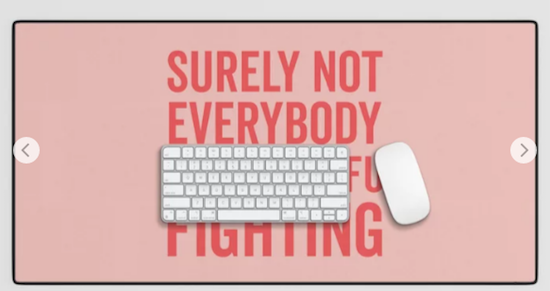
- A desk pad makes a statement of style for the owner of the desk, to communicate personality with visitors and to delight you when you’re sitting at your workspace. Given that most of day’s post focuses on more mature styles of desk pads, in leather and and leather-like materials, I thought I’d share the kind of desk pad that the less grown-up version of me is often tempted to acquire. Because, as you may have wondered at some point, Surely Not Everyone Was Kung Fu Fighting (from Society Six).
- A desk pad makes a desk look “put together.” This is less about looking attractive vs. looking finished. Paper Mommy drummed it into me that when you want to make a good impression, you should always wear a jacket, blazer, or cardigan — something that pulls an outfit together and makes it look intentional. A desk pad does the same for your desk.
DESK PAD ATTRIBUTES TO CONSIDER
Most of the inquiries I received asked about what features they should consider in a desk pad. For those used to the traditional oversized calendar style of blotter, the number of modern desk pad possibilities come as a bit of an overwhelming surprise. Let’s look at several.
Size
One hesitates to say that “size matters,” but you need to consider a variety of size-related elements:
- How large is your work area? — If your desk is enormous and you’ve got an itty bitty desk pad not much bigger than a mousepad, the desk pad is going to be engulfed, both logicically and aesthetically. If it’s only the width of your keyboard, the friction of the edges against your arm may annoy you.
Conversely, if you’re working on a tiny desk, make sure your desk pad will actually fit. Read the actual measurements, but also keep your eyes out for keywords, like “extended,” that give you an idea of the size of a product. A standard goal is to pick a desk pad that covers 2/3 of the width of your desk, but your needs may vary, given other factors.
- How much of your stuff do you want on the desk pad? — Do you want the deskpad to cover just the area closest to you, or would you prefer your computer to sit atop it? If you want your desktop and keyboard located on top of your deskpad, you’ll need more space than if you just want to put it under your laptop (or just prefer it under the area where you rest your arms).
Some desk pads are designed to be large enough to have space for your phone, mouse (so a mousepad is unnecessary), office supplies, and any papers essential to your work.
- What kind of surface do you need for your work functionality? — If you’re using a mouse instead of a track pad and a desk pad in lieu of a mouse pad, the mouse needs to be able to move smoothly but not slip on too glossy a surface. The surface should also allow you an adequate, comfortable area upon which to rest your mousing wrist.
- Do you need a desk pad to accommodate a special purpose? — Gamers often use oversized (overly wide) desk pads; engineers and computer specialists may need specialized pads for work on computers or with tools.
- Do you need options? There are varieties of desk pads with different surfaces on each side (like for gaming vs. standard computing or intricate work vs. writing). If your work and play tasks vary widely, consider looking at dual-dided pads to make sure you’re comfortable. A distracted worker is an unproductive worker.
Think about width as well as depth of your desk (and desk pad) as you look at your purchase options.
Materials
The material from which your desk pad is constructed will impact how it looks, how long it will last, and how much it will cost. Common desk pad materials include:
- Leather looks sumptuous and sophisticated, is easy to keep clean, and tends to be durable over the long term. However, it is often one of the most expensive options.
Leatherology has a wide variety of classic and modern desk pad options, but they also have some spiffy extra-long desk pads and narrower “conference and laptop” pads. They’re all in gorgeous Italian leather and are (for real leather) fairly affordable, from $95 to $170. Even their colors sound luxurious, with Bordeaux (below), Oxblood, Mocha, and Dove mixing with Tan, Black, Midnight Blue.
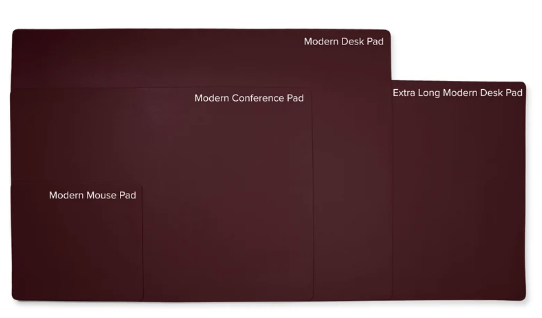
Grovemade is a similarly delicious vendor of 3.5mm-thick premium leather desk pads with cork backing in six sizes: Small – 11” x 24.75”, Small Plus – 14″ x 31.5″, Medium – 11.5” x 38”, Medium Plus – 15.75″ x 38″, Large – 26” x 38.5”, and Extra Large – 26.5″ x 49″. Small, medium & medium plus provide room for an external keyboard and mouse, while Large is designed to work under the Grovemade Monitor Stand and Laptop Stand. Prices range from $110 to a whopping $400!

Of course, leather can get incredibly pricey. Smythson of Bond Street’s Large Desk Mat in Panama (available in Black or Sandstone) runs a hefty $1095!
- “Vegan” leather is what we used to call vinyl. It’s durable, though not so much as real leather, but it avoids the whole Bambi’s mother issue. You will sometimes see this described as “Eco” leather. If you’re not spending in the $100s, you’re almost assuredly not seeing a leather pad.
- Plastic or PVC vinyl is inexpensive, but may feel cold against your arms, can split or crack over time, and likely won’t last as long as some other varieties. That said, whether clear or opaque and colored, plastic surfaces are usually easier to clean and ideal for people who tend to stain their horizontal surfaces with coffee cup rings.
- Wool/Felt provides a cozy, hygge look, but can feel itchy or scratchy to your arms. (If you’re buying a wood desk pad as gift, make sure your recipient doesn’t have wool allergies.) Of course, a mouse will not slide on wool so you’ll still need a mouse pad, and you’re not really going to be able to handwrite on it unless you’ve got a notebook or want to fuss with cardboard backing while drafting your thank you notes.
If you’re up for spending $45-100 on cloth that you can’t even wear on date night, Graf Lantz has sophisticated Mosen Medium and Large Merino Wool Felt Desk Pad measuring 31” wide x 19 ½” high in multiple subdued colors.
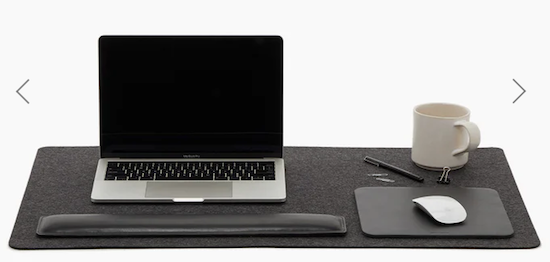
- Microfiber or Polyester — These materials tend to be relatively thin, on to top of spongy backing, making it hard to write with pencil or ball point pens, and can be hard to keep clean over the long run. These range from lower-end options to more fancy-pants versions, like the Harber London Microfibre Minimalist Deskmat, available in three sizes, from about $60-$84, from the UK.
- Cork — For example, IKEA’S minimalist Susig, measuring 17 3/4″ by 25 1/2″ is made of cork, which repels dirt and water. It’s only $8.99. Bear in mind that cork can have a strong odor, as anyone who’s ever purchased a new bulletin board will know. Buyer beware.
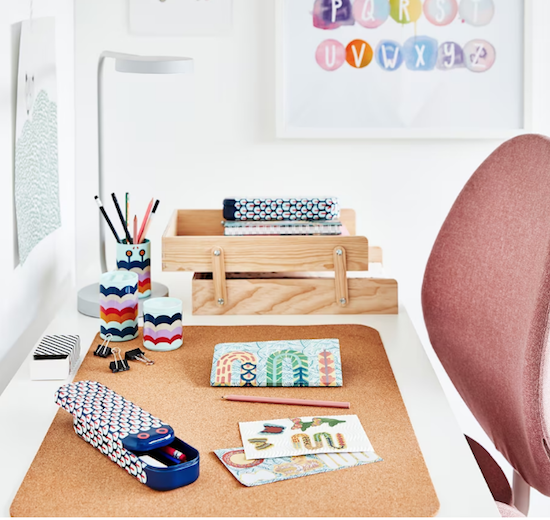
- Linoleum is an atypical options, but Grovemade makes them from linseed oil, natural pine rosin, wood flour, and calcium carbonate, with a cork backing, in ten different colors. They resist fingerprints and are antistatic and durable.
- Aluminum or Copper desk pads provide anti-static attributes. These metals have conductive properties, and will protect your computers and electronic equipment from static electricity. If you work around equipment that’s sensitive to static, like in a computer lab or server room, this is something to consider.
- Marble, glass, acrylic — These atypical desk pads are going to be cold, heavy, and slippery, but easy to clean.
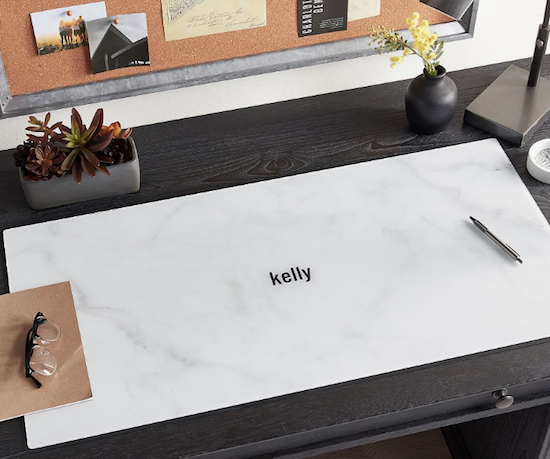
I’d recommend against these icy materials unless you are far more into aesthetics than computing, but the Pottery Barn White Marble Desk Blotter may put you in “fancy society matron” mode. It comes in 24″ wide by 18″ high for $79 or 36″ wide by 18″ high (pictured below) for $99 and can be personalized.
This stunning Abstract Stained Glass Desk Pad from Cozy Street Designs at Etsy might make you feel as though you are writing on behalf of royalty from the distant past to readers in the future. It comes in 7″ x 9″, 12″ x 18″, 12″ x 22″, and 15.5″ x 31″ (from $18.99 to $42.50).
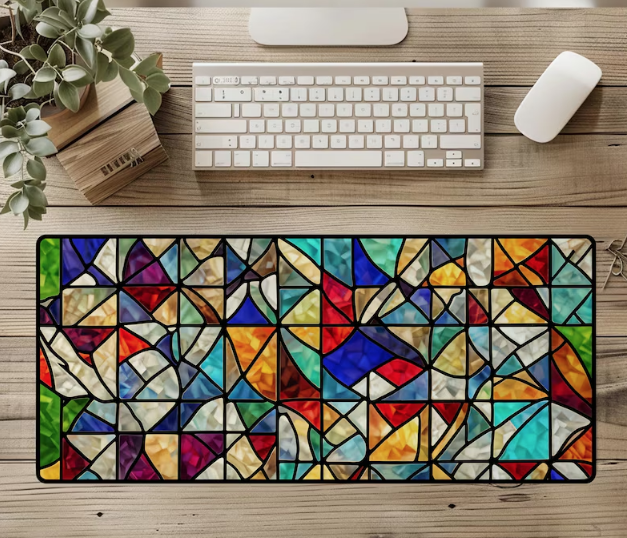
As you examine your options, ask yourself, will this material deflect spills? Morning Starbucks? Afternoon Starbucks? Late night pizza grease?
Leather and “vegan” leather are sumptuous, but will they withstand ink stains and the pressure of a ball point pen?
Do you need gutters (indentations) for pens or cord organizers or side panels on the edges to give you a sense of boundaries (and let you tuck in note cards)?
Whatever material you choose will reflect your personal style. Select something that uplifts and inspires you (or at least doesn’t frustrate you) when you approach your desk.
That said, consider that how you organize your desk reflects on your office mates or your employers. There’s some wiggle room, but if your desk pad quote Jean-Jacques Rousseau’s Eat the Rich! but you work at a high-end accounting firm, you may encounter some conflict.
Grip/Traction
You know the trick about putting a wet paper towel under your cutting board to keep it sliding around, right? You need a solution that will approximate that for your desktop.
A super-slick desk surface such as one made of metal or glass will improve your mousing capabilities but may make it hard for you to keep things from rolling away. A good desk pad has backing that provides traction for keeping your keyboard from jiggling, your pens from rolling, and your podcast microphones from sliding away.
Think about how the backing material will affect the grippiness of the pad on the desk’s surface. Look for a desk pad with backing that’s sufficiently rubbery to keep the desk pad from sliding around, but not something so inexpensive that it will get sticky or goopy near a heater or in direct sunlight as the years go by.
You also want a smooth top surface for writing, but not so smooth that your keyboard will slide around.
Organization
Psychologically, a desk pad has a calming, centering effect, much like a tablecloth or table runner in a home, dissuading you from piling junk or excess materials in your space.
A desk pad also helps you create zones, both on the pad and around the perimeter. You might find yourself keeping resources on the back third of the desk, beyond the far edge of the depth of the pad, or papers to the left of the pad and your phone and gadgets to the right.
Let your desk pad support your organizational structure, and you might find that it supports your physical as well as cognitive sense of order.
Design Aesthetic
Design also has both a functional and psychological impact.
Functionally, the design and manufacture of your desk pad can affect your comfort while you work. Those with some extra padding may be more comfortable under your arms while you’re typing. Of course, you don’t want a pad so thick that it adds bulk or adversely impacts your ergonomics. And, as mentioned, size will matter if you’re trying to create a sleek, uniform look on your desk.
Aesthetically, the combination of materials, colors, and styles determine whether your desk pad looks:
- Professional — Let’s define this to mean anything from serene to stuffy, but generally appropriate for an attorney’s office or anywhere you’re expected to dress conservatively for work.
- Sleek, modern, minimalist — If the bulk of your workspace is glass, metal, or full of spare IKEA-styled wooden furniture, you’ll want a desk pad that sets a similar tone.
- Activist-oriented — Does everything in your office convey a written message? Is your tone political (in the wider use of the term)? You may want a bold look.
- Too Cool for School — If you’re working with younger people (by which I mean adults younger than you, as parents may bristle at middle school guidance counselors decorating with edgy messages), you may want a more youthful, expressive style to maintain integrity.
- Personal — Whether you want Barbie pink or a custom-designed desk pad from NovelKeys, in the end, you need to ask: does the desk pad fit your tastes? If not, you’ll never feel entirely at ease at your desk or in your workspace.

For example, this Muppet Science Chemistry Deskpad from Deep Space Designs at RedBubble measures 31.5″ x 15.7″. For less than $25, it makes a strong statement that the user cares about science — or at least Beaker.
In the end, however, it’s a desk pad, not a wedding dress. Pick a color, pattern, and material that reflects your style insofar as you’re allowed to express your true style at work.
And if you find the perfect desk pad but expect it will be received poorly at work, use it in your desk area at home — and start looking for a job that won’t stifle your soul.
Portability
If you set up a desk once and never remove anything, this won’t be a concern. However, if you hot-desk at your office, or if you’re a student who relocates to different work areas and likes your desk pad to come with you, portability may be an issue.
Some desk pads easily roll up like small yoga mats and you can keep them rolled with a rubber band or yoga mat band. Conversely, some fancy-pants desk pads, the kind made to emulate old-fashioned leather pads, are not only stiff and un-rollable, but are often weighted heavily on the left and right edges and not ideally portable.
Special Features
A desk pad is not always just a desk pad, especially in the 21st-century. Some, like the KeySmart Charging Taskpad have built-in charging capabilities. Measuring 35.43″ x 16.54″, in comes only in black. What it lacks in panache, in makes up for in features.
You can just set your phone, Airpods, or other doohickies on the mat and they’ll charge quickly, even when in their cases. It’s also water- and stain-resistant, and anti-scratch, with a no-slip-backing and PU Leather surface. There’s a “micro-textured mouse pad built in, with cushioning for wrists and forearms. It’s $120 from KeySmart and currently on sale at Amazon for $69.
Gaming keyboards are built with colorful, lighted margins to help set the ambiance. For example, see the Razer Goliathus Chroma line, which runs about $55 at Walmart and Amazon for the extended version. (You may want to turn down your volume if you’re over 30 years of age.)
And in one of the most unusual findings for this updated post, there’s The CozyDesk, a heated deskpad for those of you who grip your coffee cup for warmth, whether it’s deep in winter or your office A/C is just too brisk for your tastes.
At 31.5″ x 9.4″, the smooth leather CozyDesk has 50 different heat settings but a heat-resistant base. Your desktop and your accessories (like your mouse and keyboard) remain safe, while your fingers stay toasty warm. It has built-in safety features, including an auto-shutoff and a low-power consumption setting.
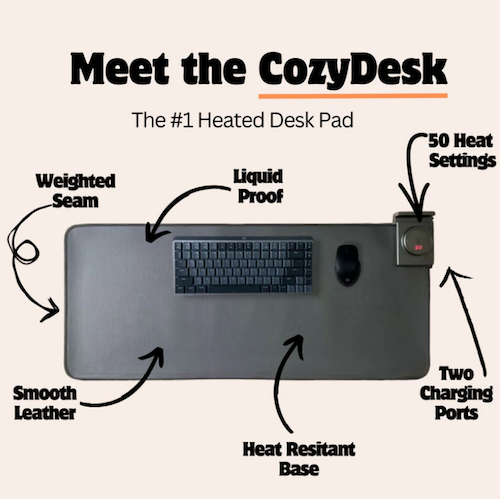
Whether you’re an office worker, student, gamer, someone suffering from poor circulation or Reynaud’s Syndrome, or just someone whose office space (or hands) are colder than you’d like, this CozyDesk promises customized warmth for your desktop workspace from 50° to a whopping 140° Fahrenheit (10°-60° Celsius).
Normally, the CozyDesk sells for $80 but is currently half off at $39 for a mid-year sale.
While there are a variety of similar heated desk pads listed on Amazon, ranging from $25 to $200, the lower-priced items are often marked as “frequently returned items.” Let the shivering buyer beware.
Price
Do you want to make a long-term commitment to one desk pad or “date” around with different options depending on your mood of the week? The more committed, the higher a price point you can embrace.
I’ve seen desk pads ranging from $10 to $200, so you should be able to augment your work space at a cost that works for you.
A FEW MORE DESK PAD EXAMPLES
Smead Desk Pads
Just as I was considering writing this blog post, I got an email from one of my favorite companies to recommend about the brand new Smead Desk Pads. The waterproof surface, described as being crafted from “premium vegan leather,” has a sturdy design to protect against keyboard scratches, water marks, and spills.
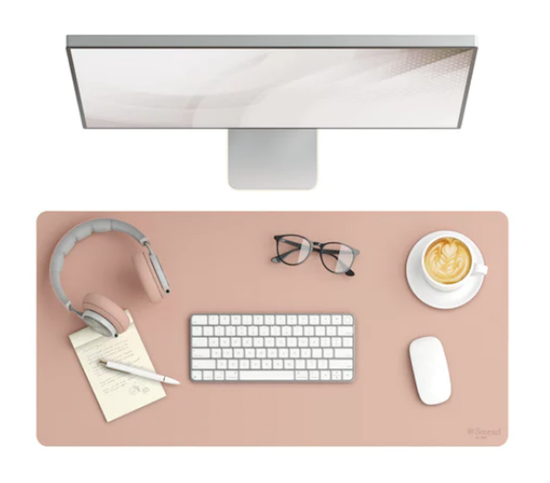
Smead notes that the faux-suede, non-slip backing will ensure stability, so it won’t wiggle while you work or write. They stated that it comes rolled for easy shipping but will lay flat without curling once it’s on your desk.
The Smead Desk Pads come in three sizes:
- Small (23.6″ x 13.7″) for $10.49
- Medium (31.5″ x 15.7″) for $12.99
- Large (36″ x 17″) for $14.99
and five colors: Blue, Dusty Rose, Saddle, Sandstone, and Charcoal.

If you’re seeking a serene, serious, vibe, like for the office of a therapist or ADHD coach, this might be ideal.
OrbitKey Desk Mat
The OrbitKey Desk Mat comes in Black or Stone, in two sizes: Medium (27.01″ wide x 14.69″ high) and Large (35.28″ wide x 16.65″ high). It’s made of premium vegan leather and 100% recycled PET felt and comes with a two-year warranty.

The OrbitKey Desk Mat has some intriguing features, including:
- a quick-access indented toolbar across the top
- a magnetic cable organizer
- a document hideaway feature, suitable for keeping your cheat sheet formulas and codes, or sensitive papers you need at your fingertips
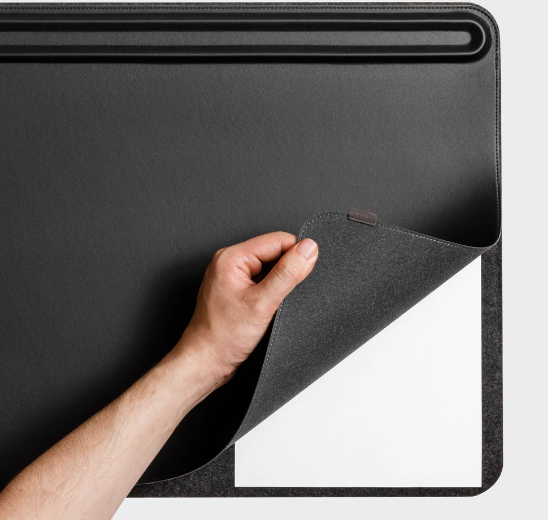
It’s also somewhat pricey (at just under $80 for Medium or $100 for Large) from OrbitKey and Amazon.
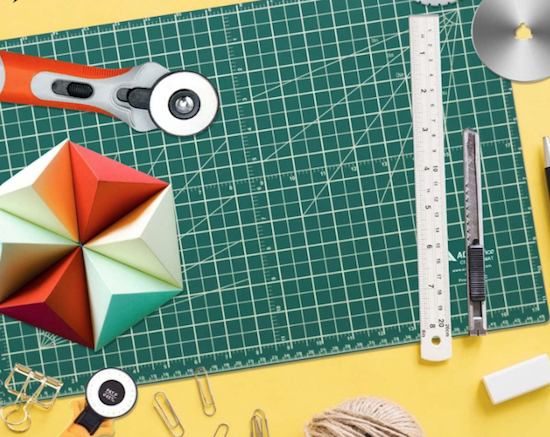
Adir Professional Reversible Self-Healing Cutting Mat
Adir’s dual-sided green and black desk pad is made of “self-healing” vinyl and comes in four sizes: 12′ x 18″ ($15), 18″ x 24″ ($25), 18″ x36″ ($45), and 36″ x 48″ ( $76) from Amazon. If you’ve got someone on your shopping list whose desk is equal parts computer desk and work bench, this option will “self-heal” if an art or mat knife or rotary cutter slices through it, keeping the surface smooth. It’s marked with 0.5 inch, as well as measurements in centimeters and millimeters, 45- and 60-degree angle guides, and diagonal cutting lines.
Excel Tips Deskpad (and Morning Brew)
This is actually two recommendations in one. Do you subscribe to the Morning Brew newsletter? It’s a stellar daily newsletter for catching up on all the (mostly non-stressful) national, international, business, and entertainment news delivered in a delightfully Dad-joke tone to make starting your day easier.
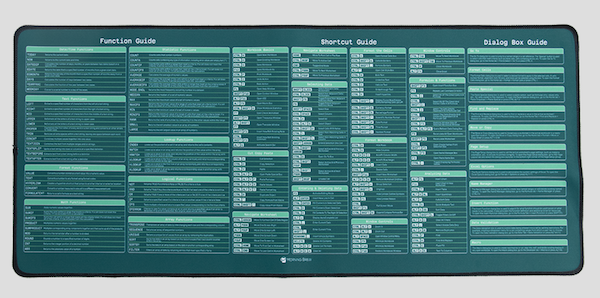
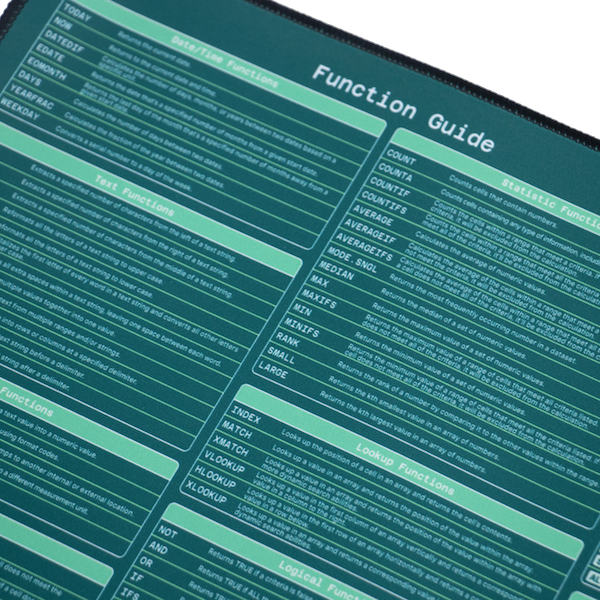
If you spend too much time on Microsoft Excel, you might want to look at the Morning Brew Excel Tips desk pad. It measures 27.20″x11.75″ and provides more than 60 Excel functions, 100+ Excel shortcuts, and top dialog box definitions, all for $35.
Paper Doll HQ hasn’t had the opportunity to use or rank every desk pad, so you may wish to peruse recent coverage of the best of desk pads.
The 7 Best Desk Mats, Tested By Our Editors (The Spruce)
8 Best Desk Mat Options For 2025 (Rosstopia)
9 Best Desk Mats of 2024 for a More Organized Workspace (Good Housekeeping)
The 10 Best Desk Pads to Elevate Your Workspace (The Robb Report)
The 13 Best Desk Pads to Make You More Productive and Organized at Work (Esquire)
The 15 Best Desk Pads & Mats for Your Office (Werd)
The 17 Best Desk Pads For Your Home Office (GearMoose)
21 Stylish Deskpads and Blotters for Writers (Accessory to Success)
Do you use a desk mat? What are the most important features for you to work comfortably? Do you care more about looks or texture? Do your tastes run toward luxe or funky?
Organize Your Holiday Gift-Giving With Social Science Research

It’s that time!
Every December, my professional organizing colleagues and I write blog posts about giving (and asking for) clutter-free gifts, experiential gifts, and gifts that that help you be more organized.
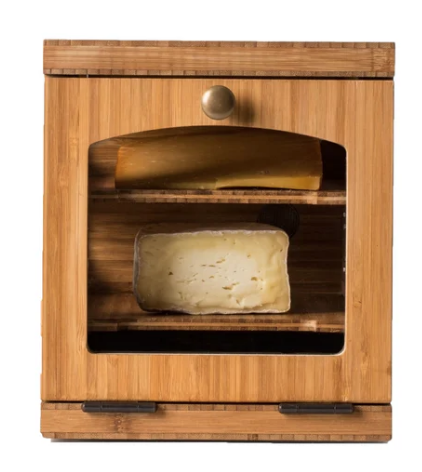
The years I’ve written about consumable gifts, I’ve made myself so hungry that I’ve stopped blogging halfway through to eat close approximations of whatever I’ve researched. And I’ve coveted experiential gifts of practicality, adventure, education, and pampering. I still want the Petite Cheese Storage Vault that I wrote about in Paper Doll’s Holiday Gift List: Warm Their Hearts and Fill Their Tummies.
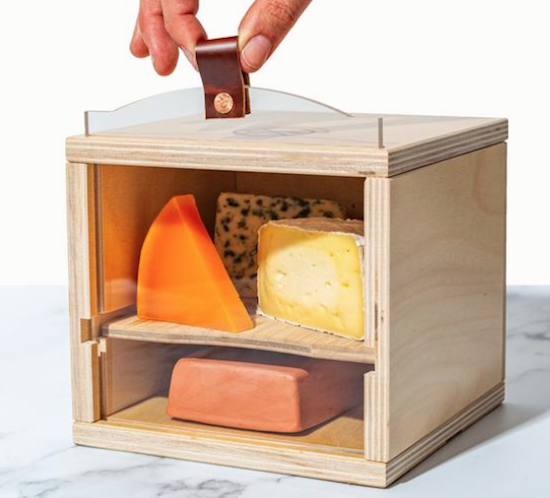
Apparently it no longer exists, though Cheese Grotto™ seems to have a nice approximation!
But recently, I’ve been reading some scientific research that may help organize and improve the gift-giving process and reduce some of the (emotional and financial) stress around gift-giving.
HABITUATION AND THE DELIGHT OF GIVING
I’m reading Look Again: The Power of Noticing What Was Always There, by Tali Sharot and Cass R Sunstein.

The book is focused on helping us appreciate habituation, the way we are less and less delighted by things — from tangible items to our homes to our relationships — as we get used to them, and how we can change our behaviors (take breaks from our spaces, our habits, social media, and our habitual ways of living) to “resparkle” and appreciate our lives more.
The authors even quote economist Tibor Scitovsky’s classic, The Joyless Economy: The Psychology of Human Satisfaction, explaining that “pleasure results from incomplete and intermittent satisfaction of desires.”
In other words, things are more fun when we do them intermittently, rather than constantly. It’s one reason why we get delight from giving and getting gifts at the holidays. Goodies are nice, but we’d probably get bored, or at least habituated, if we got gifts every day. (OK, yes, I’m sure we’d all like to test that theory out.)
Early in the book, Sharot and Sunstein talk about the values of happiness (however you define it) and having a meaningful purpose are key to enjoying life, but that we tend to habituate to both happiness (new jobs with new salaries or new relationships) and meaning.
As an example, you might enjoy bingeing a TV show, which isn’t particularly meaningful, and the ROJI (return-on-joy-investment, in my own silly coinage) will wear off; conversely, you may invest your time in volunteering, which is fulfilling and purposeful, but you may not be particularly happy if the effort is laborious or wearying. (Why is it that good deeds can be both uplifting and exhausting?)
The authors note that one exception is the joy and meaning that comes from raising children, and they posit that we habituate much more slowly to the “satisfaction” that results from doing things for (or giving things to) others.
They evaluated and built on the social science research of Ed O’Brien and Samatha Kassirer in People Are Slow to Adapt to the Warm Glow of Giving in the journal Psychological Science, and found that if individuals were offered a $5 treat day after day for five days, the sense of joy wore off quickly.
However, when people were given (or “won”) similar funds to spend on others, day after day, while the delight they experienced did lessen somewhat, over the course of the week, they habituated to the “warm glow of giving” much more slowly. Per Sharot and Sunstein, giving “provides a greater sense of meaning than getting” and according to O’Brien and Kassirer, this is because focusing on the act of giving is inked to feelings of social connection, and by extension, value.
This doesn’t mean that you’re always going to feel great about giving your sister-in-law a gift that you know from past experience she will return. However, from an organizational perspective, keeping this concept in mind might help you avoid procrastinating on getting that “difficult” gift.
For example, when you’re dealing with the hubbub of the holiday season and are perhaps feeling dubious about the prospect of shopping or giving the “right” gift, or are even wondering if your efforts will be for naught because the other person won’t be getting you a gift that is as nice or that takes as much effort as you’re putting in, take a breath.
Gift-giving isn’t obligatory, and you need not go into debt for the holiday season. But it’s also not so that you’ll get a gift of equal value and effort. (I mean, it can be, but it shouldn’t be. Let’s organize ourselves out of these habits and attitudes.)
If you are giving gifts, and the shopping and the lists and the traffic are all giving you a headache, pause. Go have a hot cocoa (or whatever overly frothy Starbucksian beverage is your fave) and think about the fact that you’re going to get more sustained joy out of giving gifts that you might think.

Cocoa photo by Sixteen Miles Out on Unsplash
Give yourself kudos and let yourself feel some delight with the knowledge that science says gift-giving is good for you.
WHAT SCIENCE SAYS ABOUT GOOD GIFT-GIVING
Did you know there’s serious research into what goes into giving a good gift? In fact, there’s a lot of it.
In the Society for Consumer Psychology Journal, Julian Givi and his team reviewed more than 160 published research papers on the topic and reported on their findings in An Integrative Review of Gift-Giving Research in Consumer Behavior and Marketing. (If you’re into reading social science research, there are links to the source material at the end of their abstract, and you can read some of the papers through Google Scholar. However, social science research tends to be a little dry, and you might nod off into your egg nog.)
Why understand the science of good gift-giving if we know the mere fact that giving gifts makes us happy?
To start with, a lot of gifts end up in the landfill. According to one estimate in 2017, five billion pounds of gift returns ended up in the landfill! And an updated 2020 estimate placed that figure at 2.6 million tons, and yes, this is just counting the United States. If we give better gifts (and here’s a one of many plugs for experiential gifts, that don’t take take up space anywhere, let alone a landfill), we’ll be kinder to the environment.
Experiential Gifts for the Win!
Every year, I sing the praises of experiential gift-giving. For example, here’s what I said last year, in Paper Doll on Clutter-Free Gifts and How to Make Gift Cards Make Sense:
The social-psychological research is sound — experiential gifts are both more memorable and more satisfying.
Memorable
With rare exceptions of special surprises and greatly anticipated gifts, we tend not to remember the tangible stuff we get. (This also means we often don’t remember the gifts we’ve bestowed on others; my organizing clients and I have discussed how we’ve received quite a few “repeats” from well-intentioned loved ones.)
Tangible gifts rarely take us out of the way we live; they fit into the lives we already lead. We may be changing what we’re wearing or how we’re cooking or what we’re playing with because the new gift varies the activity (as an accessory), but experiential gifts are uniquely different from how we spend our everyday lives. Participating in an experience changes our cognitive and physical lives in a few ways.
Part of the fun is anticipatory. When we get a tangible gift, we unwrap it and then…what? Maybe we’ll use it, maybe we’ll put it away until we think of wearing it or using it (or attempt reading the manual to learn how to use it). But when we get a gift of an experience, from the time we receive the gift card or certificate or gift announcement, we begin anticipating everything it involves. We research and get a sense of what might happen. Our imaginations take the gift we receive and add flourishes to what has been given to us.
When we get a gift of an experience, we begin anticipating everything it involves. We research and get a sense of what might happen. Our imaginations take the gift we receive and add flourishes to what has been given to us. Share on XGive someone a gift that allows them the excitement of anticipating the experience on top of the experience itself and it will be a gift that delights on the holiday, during the intervening period until the experience, and then later in retrospect in the relived and shared memories of the experience. Whoohoo! Now compare that to a sweater or a gadget (if your recipient hasn’t specifically asked for a sweater or that gadget) and you can see how an experiential gift is more nuanced and layered.
Uniquely Satisfying
Experiential gifts are unique. Human beings are social animals and even when we don’t intend to be, we are competitive. We log onto social media, see what our co-workers or our exes’ new partners got for gifts and we compare. Even if we loved our gifts before we logged on, if they got a fancier upgrade or a snootier brand, our holiday cheer is just a bit tarnished. Even if our tangible thing is somewhat superior, the excitement doesn’t last.
However, we don’t compare experiences in the same way. Even if we both went to the same escape room or to Las Vegas or on a cruise, the variables — who we’re with, the weather, our moods, etc. — are going to be so different that there’s no valid comparison. Our experiences are unique to us.
But guess what, it’s not just me saying that!
In reporting on his research review, Givi said that the published papers he looked at found several interesting things about experiential gifts.
What a Girl (or a Guy) Wants
First, as much as we professional organizers have tried to persuade you that experiences are the way to go, gift-givers like giving material gifts but recipients really want gift of experiences. In “Remember me, will you?”: Overusing Material Gifts for Interpersonal Memory Management, researchers found:
Givers are more likely than recipients to consider the memory consequences of gift options, as givers intuitively use material gifts as interpersonal mnemonic devices to facilitate the recipient’s retrieval of giver-related memories. As such, this preference discrepancy occurs in various stages of developing relationships but is mitigated in very close relationships.
In other words, “Hey, mom, remember when I got you that expensive hair dryer made by the people who made your vacuum cleaner?”

We’re often focused on trying to make sure our recipients remember not just the gift (which, as I’ve already suggested above, is less likely with tangible things than experiences) but remember that we were the ones who gave it. I mean, I don’t want to say we’re being manipulative when we do that, but there’s obviously some ego involved. Are we buying love? Are we jockeying for position in the family hierarchy relative (no pun intended) to our siblings? Are we trying to get our in-laws to stop referring to us by our significant other’s ex’es name?
Personally, I suspect that if you give your Aunt Sylvia a gift certificate for a massage or Gramps a National Parks pass, they’re going to remember where the gift originated from a lot more than they would with a fuzzy sweater or a book about World War II.
Don’t Focus on the Face!
Second, not only do we not give people what they want (leaving aside the people — usually teens — who are very specific about what they want), but research says that we tend to give people what will yield a more (visibly) positive reaction than one what will actually satisfy them!
In The Smile-Seeking Hypothesis: How Immediate Affective Reactions Motivate and Reward Gift Giving, researchers found (through six (!) studies) that people put a lot of effort into giving gifts based on what they anticipate the recipient’s reaction will be, “independently (and even in spite of) anticipated recipient satisfaction.”
(When the first of my friends had a child, I put way too much effort into imagining how they’d react when opening the gift. Given my terrible job trying to wrap a stuffed lion, I suspect the emotion was pure relief that the gift was finally uncovered!)
If you’re dealing with a five-year-old, the “affective reactions” and their feelings about their Barbie or video game will likely be the same, but adults mask their true feelings and give socially-acceptable reactions to gifts. (Think about how moms and dads made a huge show of getting misshapen clay ashtrays as gifts even if they didn’t smoke, or how fancy-pants successful young adults in Hallmark movies give their parents expensive but impersonal gifts when the parents just want their kids home for the holidays on their reindeer milk farm.)
One other intriguing thing: this “reaction-maximizing preference” where givers focus on reaction rather than recipient satisfaction was lessened when the gift wouldn’t be opened in the presence of the giver.
Apparently, we try to psychoanalyze our recipients and figure out what’s going to make them make us feel good about what we gave them. If we’re not going to be there to see their faces, especially in this era where almost nobody sends thank you notes, we don’t fret as much about their reactions.
Maybe this explains why we’re less likely to give experiential gifts? There’s a ritual involved in unwrapping a gift and showing it off to all in attendance, and you can’t really do that to the same effect with a gift certificate, theater tickets, or a fancy reservation.
We don’t know that’s what we’re doing, so it’s not like we’re monsters, but maybe now that we know, we can reign in this behavior? (If nothing else, you can share this post with your significant other so that when your whole family is exchanging gifts and you get something wildly inappropriate that you know you’re supposed to gush over, you can tug on your ear Carol Burnett-style to share an understanding of the ridiculousness of the situation.)
Build Stronger Connections
Third, Givi found another reason for giving gifts of experiences that I’ve never touched on in all the years I’ve written about this topic. He notes that in Experiential Gifts Foster Stronger Social Relationships Than Material Gifts in the Journal of Consumer Research, Cindy Chan and Cassie Mogilner found that, as the title notes:
…experiential gifts produce greater improvements in relationship strength than material gifts, regardless of whether the gift giver and recipient consume the gift together. The relationship improvements that recipients derive from experiential gifts stem from the intensity of emotion that is evoked when they consume the gifts, rather than when the gifts are received. Giving experiential gifts is thus identified as a highly effective form of prosocial spending.
Which is all a dry, academic, social science-y way of saying that when you give someone an experiential gift — even if they’re not going to be having the experience with you — it strengthens the bonds between you.
And further, the Big Wow of emotion doesn’t come at the moment when you tell someone that you’ve bought them tickets to Hamilton (though they’ll likely be super-psyched) or a year’s supply of car washes; it comes when they’re all dressed up and humming “The Room Where It Happens” or driving through the car wash without having to open their wallet.
Other Findings About Gift Giving
Skip the novelty gifts — Once again, gift-givers are focused on the moment the gift gets unwrapped.
I get it. You see something cute or funny or outrageous and want to see your giftee’s expression when they see they got Big Mouth Billy talking bass, but aside from the fact that it’ll be one of the first things their eventual professional organizer will be helping them let go of, recipients are focused more on the long-term utility of a tangible (non-consumable) gift.
Skip grand but meaningless gestures — Similarly, a gift that evinces shock, surprise, or humor isn’t as big a draw as things that are useful. If your recipient has an Amazon wish list, look at it and select a gift from it. (If you must do something that reflects your personality, make that a stocking stuffer or night 7 Hanukkah gift.)
Rethink gift cards — As I wrote about last year, gift cards give people flexibility. Yes, there are some negative connotations surrounding gift cards among the Silent Generation and older Boomers. But the younger people are, the happier they are likely to be if they get a gift card that reflects their tastes. (Still, unless they asked for it, don’t give your spouse a gift card as their main gift. Figure out what they really want.)
If you give a Dungeons & Dragons dungeon-master a gift certificate to her favorite game store or a fashionistas gift cards to their favorite clothing shops, letting them pick out what’s perfect for them, you’ve ensure that the thought does, indeed, count, and the thought is that you know them well enough to guess, at least generally, and care enough not to impose your own tastes.
Don’t be afraid to be sentimental — Researchers (such as in the Journal of Personality and Social Psychology) have found that people tend to avoid giving sentimental gifts because they may seem schmaltzy or fear they will miss the mark. A candle or a picture frame may seem safe, but is “safe” the way you want to go when giving a gift to someone you love? I think not.
And again, as with experiential gifts, sentimental gifts have a value that keeps you off the hedonic treadmill.
You remember the hedonic treadmill, right? As I wrote in Toxic Productivity Part 2: How to Change Your Mindset,
In the famous story of Diderot’s dressing gown, the French philosopher was gifted a fancy robe to replace a tatty one. As Diderot got used to his new dressing gown, he came to see his sense of self as defined by its finery. He felt dissatisfaction with his older possessions and began of spiral of 18th century keeping-up-with-the-Joneses consumerism, replacing the perfectly good items associated with his old life and going into debt to keep up with the identity of the new.
Just as experiences are unique and uniquely satisfying, sentimental gifts that recall (and reinvigorate) personal relationships — gifts like photo books, albums, family recipe collections, and anything that evokes memories — are unique to those involved. You don’t habituate to sentimental gifts the way you do to an air fryer or bathrobe.
So, to wrap it up:
- Remember that gift-giving will make you feel good.
- Take your ego out of gift-giving and focus on the recipient’s needs and tastes.
- Give gifts of experience because they’re meaningful, recipients like them, and it’ll bring you closer together.
- Don’t focus on the big reveal (when they unwrap the gift) or your recipient’s social-norm-induced reaction.
- Think about what they asked for, what you know about their tastes, and what will make them really happy.
RECAPPING THE BEST OF PAPER DOLL’S GIFT-GIVING ADVICE
If you need some inspiration for what to get the people in your life this holiday season, I invite you to explore some of my posts over the last few years.
Paper Doll on Clutter-Free Gifts and How to Make Gift Cards Make Sense
Paper Doll’s Ultimate Guide to Clutter-Free Experiential Gifts: Adventure, Practicality & Pampering (Note: this is one of my of all of my holiday posts over the last 17 years.)
Paper Doll’s Ultimate Guide to Clutter-Free Experiential Gifts: Educational
MORE GOOD ADVICE FROM MY COLLEAGUES
Collectively, my colleagues have written too many stellar posts on giving great clutter-free, experiential, or organizing-themed gifts over the years for me to name them all. However, I think you’ll enjoy taking a peek at these recent posts:
Great Organizing and Productivity Gifts for 2024 from Seana Turner of The Seana Method is chock-full of gifts that — if you are set on giving someone something to unwrap — will solve organizational problems without screaming “I’m practical and boring!” (I’m partial to the rechargeable lamp and the cool yoga storage tube.)
Tons of No-Clutter Gifts for the Holidays from Sabrina Quairoli of Sabrina’s Organizing focuses on consumable gifts (so, yummy!), memberships, and charitable donations, as well as her Sabrina’s take on experiential gifts with days/evenings out and lessons.
Plus, The Spruce interviewed three professional organizers for their 5 Holiday Gifts That Will Only Make Your Home More Cluttered, According to Organizers, and I have to say I agree.
That said, I have to admit that I’m a sucker for coffee mugs with messages or images that delight. Several years ago, my colleague Dr. Regina Lark gave me a coffee mug with a funny (though naughtily unprintable in a “family” blog) message that delights me each morning that it comes up in my rug rotation. Also, I really like my Mr. Rogers mug. (His sweater changes colors when you pour in a hot beverage!)

Again, this is where knowing your recipient is important!
As this post goes to press, you’ve got about two and a half weeks until Christmas and the start of Hanukkah. I hope today’s post and the links to past advice will help you find delight in giving.
Recapping Paper Doll’s 2023 Posts — Which Were Your Favorites?
With one week left in 2023, have you taken time yet to review your year?
For the December Productivity and Organizing Blog Carnival, Janet Barclay asked us to identify our best blog posts of 2023, and I had a tough time.
“Best” is subjective, and Janet let us have free reign as to which post fit. Some bloggers chose their most popular posts in terms of readership; others, the ones that garnered the most comments. Some of my blogging colleagues picked their most personal posts, while others selected what they felt would have the most impact on people’s lives.
The problem is that picking just one means leaving the others behind, and I wrote forty-two posts this year! Eventually, I narrowed the selection to half a dozen posts, and then turned to colleagues and friends who were almost evenly split, bringing me no closer to a solution. In the end, I picked Paper Doll On Understanding and Conquering Procrastination because it served as the foundation for so many other posts, but also because I’d been lucky enough to find some great visuals, like this one from Poorly Drawn Lines:
so much to do pic.twitter.com/fiSm7Y2Erg
— poorly drawn lines (@PDLComics) December 21, 2022
Beauty, like clutter, is in the eye of the beholder. To that end, here’s a recap of everything we’ve discussed in 2023, with a few updates and tweaks along the way. My personal favorites are in bold, but I’d love to know which ones resonated the most with you during the year!
ORGANIZE YOUR INSPIRATION
After uploading last week’s post, Toss Old Socks, Pack Away 2023, and Adjust Your Attitude for 2024, I got to thinking about all the different ways we can take our word, phrase, or song of the year and keep it in the forefront of our minds.
I’d reviewed the traditional methods (vision boards, posted signs, turning the song into your wakeup alarm), but felt like there needed to be something that stayed with you, independent of your location. Only being reminded of your goal to be a leader when you’re standing in front of your fridge doesn’t really help you in your 1-to-1 meetings at work. (I mean, unless you’re the Queen of the Condiments or King of the Crisper Drawer.)
Only being reminded of your goal to be a leader when you're standing in front of your fridge doesn't really help you in your 1-to-1 meetings at work. (I mean, unless you're the Queen of the Condiments or King of the Crisper Drawer.) Share on XSerendipitously, within minutes of thinking about this, an ad came across one of my social media pages. (Normally, I ignore ads, but this one had me thinking maybe “serendipity” would be a good theme word for some year!) The ad was for Conscious Ink, an online temporary tattoo retailer specifically for creating body art to help you mindfully connect with your themes and messages to yourself, disrupt negative self-talk, and promote the healthy habits you’re trying to embrace!
As Conscious Ink’s About page explains, if you want to keep something top of the mind, why not try something that keeps it “top of the body?” Whether body art is your thing or you haven’t experimented since your Minnie Mouse temporary tattoo at summer camp <mumble mumble> years ago, this is a neat trick!
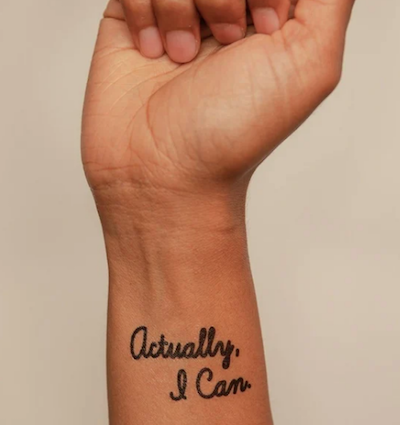
There’s even research as to how a temporary tattoo can support permanent emotional and cognitive transformation and improve mindfulness and focus on things that uplift one’s higher self. And that’s the point of a theme word, phrase, or song, to keep you focused on what you want rather than what you allow to drag you down! Manifest what you want your life to be.
Conscious Ink’s temporary tattoos use non-toxic, cosmetic-grade, FDA-certified, vegan inks. Each one lasts 3-7 days, depending on where you apply it, your skin type and activity level, and (I suspect) how many life-affirming, stress-reducing bubble baths you take. Categories include mindset, health and wellness, spiritual/nature, relationships, parenting, celebratory, and those related to social causes. Prices seem to hover at around $10 for a three-pack and $25 for a 10-pack. There’s even a Good Karma Guarantee to make sure you’re satisfied.
Whether you go with Conscious Ink (which is designed for this uplifting purpose) or seek an alternative or custom-designed temporary tattoo (through vendors like Momentary Ink or independent Etsy shops), it only makes sense if you place it somewhere you can see it often.
After all, if you place a temporary tattoo reminder to stand up for yourself on your tushy, it probably won’t remind you of much. For most of us of a certain age, putting it at our wrists, covered (when we prefer) by our cuffs, will give us the most serene “om” for our buck.
If you place a temporary tattoo reminder to stand up for yourself on your tushy, it probably won't remind you of much. Share on XAlong the same lines as my advice on adjusting your attitude for 2024, you may want to consult Gretchen Rubin’s Tips for Your “24 for 2024” List. Rubin and her sister/podcast co-host always have an inspring Happier Trifecta: a year-numbered theme, along with with a challenge and a list.
PRODUCTIVITY AND TIME MANAGEMENT
This was a big year for productivity discussion. I’m a firm believer that keeping your space and resources organized is key to being productive. However, it’s hard to keep the world around you organized when outside influences prevent you from being efficient (doing things well) and effective (doing the right things).
We continue to see the value of body doubling, whether through friendly hang-outs, co-working (virtually or in person), or professional organizing services, whether you want to conquer garden-variety procrastination or get special support for ADHD.
Partnering for Success
Paper Doll Sees Double: Body Doubling for Productivity (I almost submitted this post to the carnival. Accountability and motivation for the win!)
Paper Doll Shares 8 Virtual Co-Working Sites to AmpUp Your Productivity
If you’d like to explore the body doubling or co-working experience, friend-of-the-blog Deb Lee of D. Allison Lee is offering a no-cost, two-hour Action Day event on Tuesday, January 9, 2024, from 10 a.m. to 12 p.m.

This event is designed for her clients and subscribers, but after a cheery holiday conversation, Deb said it was OK to let my readers know about the opportunity.
Deb describes an Action Day as “personal training for your productivity muscles!”
An Action Day (especially as Deb runs them) is a stellar way to narrow your focus and start taking action on your goals. (And what better time than at the start of the new year?) You’ll get to connect with others who are also working on goals and habits with the support of Deb, a productivity coach I admire and adore.
Just bring your top two or three priorities, and you can conquer anything, like:
- organize your workspace
- write your book outline
- clean up your digital files
- test a new productivity app
- send out client proposals
- anything!
You’ll videoconference with a small, select group via Zoom. Share your goal and tasks, work for the bulk of the two hours, and then take time to debrief and share your successes!

Moving Yourself Forward
Getting anything done involves figuring out what you have to do, knowing what’s kept you from getting started, making it easy for you to begin, and celebrating even the smallest wins. These next three posts were where the magic happened this year!
Paper Doll On Understanding and Conquering Procrastination (This is the post I submitted to the Productivity & Organizing Carnival.)
Frogs, Tomatoes, and Bees: Time Techniques to Get Things Done
Use the Rule of 3 to Improve Your Productivity
Dealing with the Pokey Times
If you’re overwhelmed by all you’ve got going on during late December and early January, you can skip onward. However, if your workplace closes down during the holidays, or your professional and personal lives just feel like they’re kind of in a slump right now, you may find some inspiration in two pieces I wrote for the summer slowdown.
The weather outside may be frightful (unless you’re reading from Australia), but if you are looking for ideas to pump you up when everyone is in a post-shopping/meal/travel haze, these posts may stir your motivation:
Organize Your Summer So It Doesn’t Disappear So Quickly
Use Your Heart, Head, and Hands to Organize During the Slow Times
Try To Do It All (And Knowing When to Step Away)
Maybe you did your annual review and found that you’re feeling burned out. If so, you are not alone. It’s easy for your groove to turn into a rut, and for all of your drive to accomplish come crashing down because you never take your foot off the gas all year!
If you missed these posts earlier need a second shot at embracing the importance of variety, small breaks, and actual vacations, here’s your chance to read some of my absolute favorite posts of the year:
Paper Doll Says: Don’t Get Stuck in a Rut — Take Big Leaps (Be sure to watch the diving board video!)

Was baby Paper Doll burned out? In a rut? Just pooped?
Take a Break — How Breaks Improve Health and Productivity
Take a Break for Productivity — The International Perspective (This is the post that introduced the Swedish convivial snack break, fika!)
If you had any doubts about what I said about the importance of taking breaks in your day to refresh your body, your brain, or your spirit, a new report just a few weeks ago confirms that we need that late afternoon break if we don’t want our productivity to turn to mush! And the more we push ourselves beyond work hours, the greater our decrease in productivity!
If you’re desperately in need of a full break, but are suffering from decision fatigue and don’t have the energy to begin planning a whole vacation, there are options to make it easier for you. In the BBC’s piece, Why 2024 May Be the Year of Surprise Travel, you may find some rousing options.
Need a little inspiration to spend your holiday gift money on experiences rather than tzotchkes? Check out Time Out’s 24 Best Things to Do in the World in 2024 to envision where you could take long breaks to refresh yourself. Those vintage trains in Italy are calling to me, but perhaps you’d prefer the immersive “Dream Circus” in Sydney, Australia, or Montréal en Lumière’s 25th anniversary?
(Never mind, I know. Everyone wants to go on the Taylor Swift cruise from Miami to the Bahamas. Just come back with good stories instead of memento clutter, OK?)
TOOLS AND IDEAS FOR GREATER PRODUCTIVITY
Sometimes, rereading my own posts reminds me how many nifty things there are to share with you, and how many are still to be discovered.
Paper Doll Helps You Find Your Ideal Analog Habit Tracker — So many people have requested a follow-up covering digital habit trackers, so watch for that in 2024.

Paper Doll Presents 4 Stellar Organizing & Productivity Resources
Paper Doll Shares Presidential Wisdom on Productivity — From the Eisenhower Matrix to Jefferson’s design for the swivel chair, from limiting wardrobe options to understanding the difference between being busy and being productive, we’ve had presidents who have known how to get more (of the right things) done. With an election year in 2024, I’d love a debate question on the candidate’s best tips for staying organized and productive!
Surprising Productivity Advice & the 2023 Task Management & Time Blocking Summit
Highlights from the 2023 Task Management & Time Blocking Summit
3 Simple But Powerful Productivity Resources — Right in Your Browser Tab — The offering that got the most attention this year was definitely Goblin.Tools. I’m sure that as we head into 2024 and beyond, I’ll be sharing more resources that make use of artificial intelligence.
Let’s just remember that we always need to give precedence to our own intelligence, in the same way we can’t follow GPS to the letter if it directs us to drive in to a lake. In fact, like all organizing and productivity guidance, remember what I said way back in 2020 in The Truth About Celebrity Organizers, Magic Wands, and the Reality of Professional Organizing: there is no magic wand.
AI and other solutions, tangible or digital, and even professional organizers, can make things easier, but the only way to get the life you want is to embrace making positive behavioral changes.
RESOURCES FOR ORGANIZING YOUR WORK AND TRAVEL SPACE
Privacy in Your Home Office: From Reality to Fantasy — It’s interesting to see that privacy, and not just in home offices but in communal workspaces, has become a priority again. Check out this recent New York Times piece, As Offices Workers Make Their Return, So Does the Lowly Cubicle.
Paper Doll Refreshes Your Paper Organizing Solutions
Paper Doll Organizes Temporary Papers and Explores Third Spaces — Do you have systems for dealing with your “temporary papers,” the ones that you don’t need to file away but aren’t triggering an immediate action?
Paper Doll Organizes Your Space, Money, and Well-Being While Traveling
Paper Doll is Clearly Organized — Translucent Tools for Getting it Together
Paper Doll Explores New & Nifty Office and School Supplies
Organize Your Desktop with Your Perfect Desk Pad
No matter where I go in 2024, be assured that I will be keeping my eyes open for solutions for keeping your paper and work supplies organized.
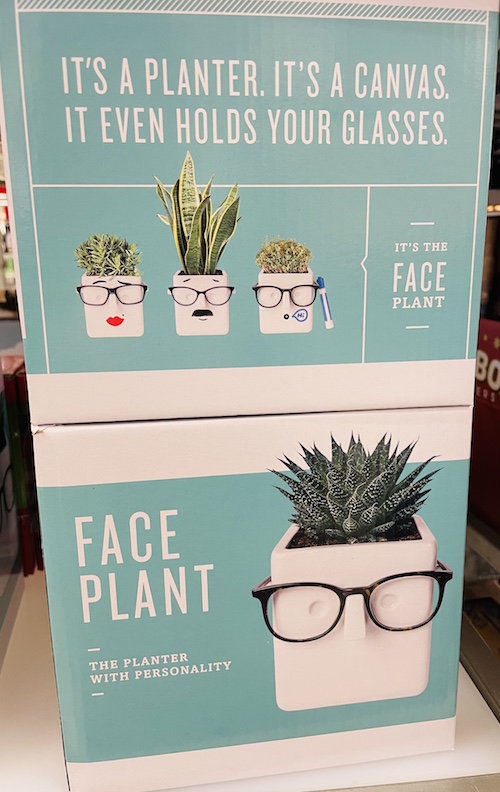
My Thanksgiving weekend shopping trips brought me a variety of intriguing options. At Kohl’s, I saw 30 Watt‘s Face Plant, a way to keep your eyeglasses handy while refreshing the air around you (and keeping you perky) with greenery. The 5.5″ x 6″ x 5.25″ ceramic planter holds a plant, gives you a place to rest your glasses (so you won’t misplace them under piles of paper on your desk), and is dry erase marker-friendly! (It’s currently on sale for under $14.)
A stop at IKEA in Atlanta was so productive for organizing tools that you’ll be seeing posts with nifty names like Övning (for tidying a child’s desk accessories and creating privacy), Kugsfors (wall-mounted shelves with tablet stands for keeping books and iPads visible while working), Bekant (sit/stand desks) and more.
ORGANIZING YOUR FINANCIAL & LEGAL LIFE
Not everything in the organizing and productivity world is fun to look at, and that’s especially true of all the financial and legal documents that help you sleep soundly at night. Still, Paper Doll kept you aware of how to understand and protect your money, your identity, and your legacy.
Speaking of which, if you haven’t created your Apple Legacy Contact and your Google Inactive Account Manager, why the heck not? Use the power of body doubling up above, grab a partner, and get your digital life in order!
Lost & Found: Recover Unclaimed Money, Property, and Savings Bonds
Paper Doll’s Ultimate Guide to Legally Changing Your Name
Paper Doll Explains Digital Social Legacy Account Management
How to Create Your Apple & Google Legacy Contacts
Paper Doll Explains Your Health Insurance Explanation of Benefits
DEALING WITH EMERGENCIES AND STRESSFUL SITUATIONS
Sometimes, I write a post I wish I’d been able to read earlier (like the one on preventing and recovering from a car theft). Other times, like when a friend had a health emergency, or when Paper Mommy had her fall in November, I’m glad the posts already exist. If you missed these the first time around, please be sure to read, share, and bookmark them; think of them as an insurance policy, and let’s hope you won’t need them.
How to Organize Support for Patients and Families in Need
Organize to Prevent (or Recover From) a Car Theft
Paper Doll Organizes You To Prepare for an Emergency
GRAB BACK OF INTERVIEWS, UPDATES, AND PHILOSOPHY
Paper Doll Interviews Motivational Wordsmith Kara Cutruzzula
You already know how beloved my friend Kara Cutruzzula‘s Brass Ring Daily newsletter and Do It Today podcast are at Paper Doll HQ.
After having read and enjoyed Kara’s Do It For Yourself — A Motivational Journal and her follow-up, Do It Today — A Motivational Journal (Start Before Your Ready), I had no doubt that I’d be jumping on her third when it was released in September.
If you haven’t already picked up Do It Or Don’t — A Boundary-Creating Journal, use that Amazon money you almost certainly got this holiday season!
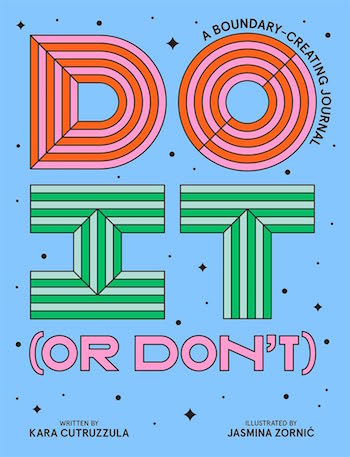 One of the Paper Doll themes for 2024 will focus on setting (and maintaining) better boundaries to accomplish more of what’s meaningful, and I’ve got multi-color tape flags sticking out of Kara’s book from all the chapters to share her bounty with you.
What’s in a Name? “Addressing” Organizing and Productivity
Paper Doll Suggests What to Watch to Get More Organized and Productive — As we head into the new year, I’ll be keeping my eyes open for podcasts, webinars, and TV shows to help you keep your space organized, your time productive, your finances orderly, and your life joyous. Readers have been sending in YouTube and TikTok videos that inspire them, so please feel free to share programming that you’d like to see profiled on Paper Doll‘s pages.
Paper Doll on How to Celebrate Organizing and Productivity with Friends
Paper Doll and Friends Cross an Ocean for Fine Productivity Conversations
From in-person get togethers with frolleagues (what my accountability partner Dr. Melissa Gratias calls those special folks who are both friends and colleagues) to Friday night professional organizer Zooms, accountability calls, and Mastermind group collaborations, this has been a great year for staying connected and sharing the benefits of those conversations with you.
I also loved guesting on so many fun podcasts related to organizing, productivity, technology, and more. If there’s someone you’d like to hear me debate or banter with, let me know!
SEASONAL POSTS
Spooky Clutter: Fears that Keep You from Getting Organized
Paper Doll’s Thanksgiving Week Organizing and Productivity Buffet
Paper Doll De-Stresses Your December
Paper Doll on Clutter-Free Gifts and How to Make Gift Cards Make Sense
Are you stressed out because you haven’t gotten someone a gift yet? Maybe a good start would be to help an overwhelmed special someone take my advice about going on a travel break. Consider gift certificates for something like Get Your Guide, with opportunities to get guided tours of locally-vetted, expertly-curated sporting, nature, cultural, and food experiences. With 118,000 experiences in 150 countries, pick a multiple of $50 or set your own amount, and your recipient can pick the domestic or international travel experience that fits best.
If you know your recipient will be traveling by rail, consider a gift card for Amtrak or ViaRail in North America. Eurail doesn’t sell gift cards, but you can pay for a pass, or buy a gift card for a rail pass for more than a dozen specific European train lines. And if you’d like to help someone organize vacation serenity and secure a bundle of travel attractions for a given city, try TurboPass in Europe or City Pass and The Sightseeing Pass in North America.
HERE’S TO A MORE ORGANIZED AND PRODUCTIVE 2024
Whether you’ll be spending the next few days reading, traveling, or doing your annual review, I hope this last week of 2023 is a happy and healthy one.
To send you off for a cozy week, I’d like to share a Whamagaddon– and Mariah–free, retro 100-minute holiday playlist from the late 1930s through the early 1960s. It’s somehow easier to dismantle the tree and write thank-you notes to Guy Lombardo. (My favorite clocks in at 52:42 with “What Are You Doing New Year’s Eve?”)
Please let me know your favorite Paper Doll posts from this year, and I’ll meet you back here in 2024!
Paper Doll on Clutter-Free Gifts and How to Make Gift Cards Make Sense
Chances are good that you’ve got three things on your mind right now: shopping for holiday presents, trying to keep your shopping and your budget organized in this most expensive of months, and dealing with the fact that — holy canoli! — the year is almost over! Paper Doll can’t stop time, but I’ve got some ideas for the first two.
EASY-TO-BUY EXPERIENTIAL HOLIDAY GIFTS
Almost every year since I began writing this blog, I’ve sung the praises of experiential gifts rather than tangible ones. The social-psychological research is sound — experiential gifts are both more memorable and more satisfying.
Memorable
With rare exceptions of special surprises and greatly anticipated gifts, we tend not to remember the tangible stuff we get. (This also means we often don’t remember the gifts we’ve bestowed on others; my organizing clients and I have discussed how we’ve received quite a few “repeats” from well-intioned loved ones.)
Tangible gifts rarely take us out of the way we live; they fit into the lives we already lead. We may be changing what we’re wearing or how we’re cooking or what we’re playing with because the new gift varies the activity (as an accessory), but experiential gifts are uniquely different from how we spend our everyday lives. Participating in an experience changes our cognitive and physical lives in a few ways.
Part of the fun is anticipatory. When we get a tangible gift, we unwrap it and then…what? Maybe we’ll use it, maybe we’ll put it away until we think of wearing it or using it (or attempt reading the manual to learn how to use it). But when we get a gift of an experience, from the time we receive the gift card or certificate or gift announcement, we begin anticipating everything it involves. We research and get a sense of what might happen. Our imaginations take the gift we receive and add flourishes to what has been given to us.
When we get a gift of an experience, we begin anticipating everything it involves. We research and get a sense of what might happen. Our imaginations take the gift we receive and add flourishes to what has been given to us. Share on XGive someone a gift that allows them the excitement of anticipating the experience on top of the experience itself and it will be a gift that delights on the holiday, during the intervening period until the experience, and then later in retrospect in the relived and shared memories of the experience. Whoohoo! Now compare that to a sweater or a gadget (if your recipient hasn’t specifically asked for a sweater or that gadget) and you can see how an experiential gift is more nuanced and layered.
Uniquely Satisfying
Experiential gifts are unique. Human beings are social animals and even when we don’t intend to be, we are competitive. We log onto social media, see what our co-workers or our exes’ new partners got for gifts and we compare. Even if we loved our gifts before we logged on, if they got a fancier upgrade or a snootier brand, our holiday cheer is just a bit tarnished. Even if our tangible thing is somewhat superior, the excitement doesn’t last.
However, we don’t compare experiences in the same way. Even if we both went to the same escape room or to Las Vegas or on a cruise, the variables — who we’re with, the weather, our moods, etc. — are going to be so different that there’s no valid comparison. Our experiences are unique to us.
Reviewing Experiential Gifts
Over the years, I’ve collected so many examples of experiential gifts in each category that in 2022 I had to split my traditional post into two (also enormous) posts. I’ve checked (and, where necessary, updated) the links, so rather than give you all the options over again, I’ll just point you to the general categories you can find in those two posts (with a teeny bit of commentary).
Paper Doll’s Ultimate Guide to Clutter-Free Experiential Gifts: Educational
This set of experiential gifts included a wide variety of classes and lessons, including:
- Learn by doing (like music lessons, performance classes like singing or dancing, physical fitness training, horseback riding, language learning and practice, cooking, and food and wine tours). I’m still engrossed in my learning of Italian, having hit 1975 days straight in practicing.

My colleague Maria White of Enuff With The Stuff in Reston, Virginia asked me on social media, “How does it feel to be in the 1% class?” and I replied, honestly, that “I feel like the smartest 56-year-old in a class of preschoolers.”
I may never learn the future conditional tense well enough to respond aloud quickly, but I can suss out a good smattering of what’s written on the web site for L’Associazione Professional Organizers Italia, aka: The Italian Association of Professional Organizers. Grazie mille, Duolingo!
- Learn for the delight of knowledge — This covered educational opportunities for those on your list who miss school and are charmed by an online academic setting. I loved the Jane Austen class I was gifted from The Great Courses a few years ago, and I’d be delighted if I got a Master Class subscription so I could take James Clear’s just-added Small Habits class.
Paper Doll’s Ultimate Guide to Clutter-Free Experiential Gifts: Adventure, Practicality & Pampering
- Gifts of adventure — Whether your (or your giftee’s) idea of adventure is physical exertion in the great outdoors (of which Paper Doll is not exactly a fan), indoor physical adventures that guarantee you won’t get eaten by wolves (like axe-throwing or trampolining) or something more physically sedate but intellectually adventurous (like an escape room), there are options galore.
- Gifts of practicality — Don’t pooh-pooh practical gifts as ho-hum. Obviously, you have to know your recipient. (For example, gifting Paper Mommy a new spring and mattress for her 40th birthday was not one of my father’s wisest moves.) Giving gifts of home care or car care, or coverage of monthly costs (like internet, cable, streaming, digital backup, or video conferencing) can be a boon that lets your recipients spend their (possibly limited) money on ideal needs and wants.
(For what it’s worth, I am a longtime user of Backblaze‘s backup services, and just got an email saying that if you sign up via my Backblaze referral link between December 15, 2023 and January 31, 2024, you get a free trial month. (It’s usually two weeks.) That’s kind of like a gift for all you readers. Disclaimer: If you end up buying Backblaze services, I’ll get a free month, too!)
- Gifts of pampering — Modern life is hard. Everyone deserves gifts that make it (or skin or hair) a little softer. The people most in need of pampering are often the least likely to splurge on themselves.
- Gifts of organization — No clutter-free gift advice can go forward without suggesting the services of a professional organizer, whether in-person or virtually. Again, know your recipient if this isn’t something that’s been requested. The magic of a professional organizer’s services is likely to be an appreciated unasked-for gift for a parents-to-be who want to set up a nursery or pals wanting to support a friend setting up a productive office for a new home-based business. The services of a professional organizer as a “gift” from a parent-in-law who tends to harp on the tidiness of adult child’s partner may not be seen in the same light.
So, click on those two Paper Doll posts above and I bet you’ll find perfect clutter-free presents for the harder-to-buy-for folks on your list.
One more advantage of buying these kinds of clutter free gifts? They’re quick and easy to purchase. In almost every case, you can buy these gifts online. In the rare case where a venue requires a purchase in-person, it’s still easier than wending your way through a big box store; whether it’s a salon, store, or event venue, you can generally go to a desk right inside the front door to purchase gift certificates.
MAKE A (SMALL) MOUNTAIN OF MONEY OUT OF A SERIES OF (GIFT CARD) MOLEHILLS
Do you cringe when you think about giving gift cards? Do leftover gift card balances annoy you?
Get Over Feeling that Gift Cards Are Too Generic
Some people hate gift cards because they’re “generic,” as if a gift card that allows someone to get what they like (or love) is more generic than a random picture frame or candle for a recipient who has shown no interest in such things.
Personally, I think gift cards are fabulous because they are less crass than cash.
As an aside, I have no idea why we in Western society consider giving cash as crass for anyone except adorable octogenarian grandparents. Grandmas gift crisp currency to their grandchildren and we grin at the quaintness. I just worked with a client in his 60s, and in a box of clutter we found a birthday card from his mother containing a crisp bill bearing the likeness of Benjamin Franklin!
Lots of people would love to have a little extra cash at the holidays, when they’ve scrambled to purchase gifts for others, especially versus an ill-fitting gift they can’t return.
A nice alternative, when you truly don’t know what someone wants is a gift card that gives someone an opportunity to get exactly what they want. A teenager or college student is probably going to prefer an Apple or Amazon gift card to one for a clothing store that doesn’t sell the style of clothing they and their friends wear. And failing that, gift cards can be re-gifted.
If you know someone whom you fear may not have the funds to fully experience a gift you’d like to give, you can pair a gift with a gift card. For example, perhaps you know someone who’d appreciate a popular new cookbook but might not be able to buy all the special groceries.
One of the most popular (and most highly rated) cookbooks right now is Baking Yesterday: The Best Recipes from the 1900s to the 1980s, based on B. Dylan Hollis’ TikTok account, where he prepares random dishes from the last century, like Depression-era Peanut Butter Bread or 1950s Tomato Soup Cake. His videos are hysterical, and the recipes can be intriguing.
But have you been to the grocery store lately? The average recent college grad probably has a food budget one step up from packets of ramen noodles. Without the funds to make the recipes, this cookbook would just be clutter.
Show your fave wanna-be chefs that you know what’s trendy without bumming them out over their budgets. Pair the cookbook with a gift card for a grocery store near them.
Almost all grocery chains and many local supermarkets offer gift cards, and you can pick them up conveniently when you’re buying you’re own groceries, or purchase them online. If you don’t know which grocery story best serves them, try a gift card for a delivery service like Instacart or Shipt, which covers the cost of the food and store-to-door service.
If your recipient has such a busy life that getting out to buy groceries, let alone having time to prepare and cook meals, is a non-starter, try gift cards for Door Dash or GrubHub. (You can even buy gift cards for these services on Amazon!)
How to Solve the Tiny Denomination Gift Card Conundrum
The one problem with gift cards (for the recipient) is when someone has received a generic cash-like gift card, such as a Visa/Mastercard/American Express gift card. It’s nice to have a gift that can be spent anywhere, but it’s awkward when you have a gift card (or many) with teeny balances. Imagine going to a store, with oodles of people behind you in line, and saying, “I’d like to pay with these seven Visa gift cards, which have balances ranging from $1.43 to $5.87.”
Recently, I received a payout from a class action lawsuit. Usually, the class action funds are sent as small check that you would have felt embarrassed to hand to a bank teller. Nowadays, everyone makes deposits via their phones or at ATMs, sparing us the indignity of having to summon a challenging stare at the teller, telepathically communicating: “Yes, I am going to deposit this check that will barely cover the cost of a soft drink! What of it?!”
This class action check came in the form of a digital code to get a MasterCard e-gift card. In the process of registering, I was given the option to applying the card to my Apple Wallet on my iPhone. I’ve never actually used my Apple Wallet in-person, but figured I could use the e-gift card to pay toward my tiny monthly Apple card expenses (for iCloud and Apple TV).
But guess what? You can’t pay your Apple Card from a gift card in your wallet unless you’re spending at least $10, and the class action money was less than that!
How could I spend that teeny bit of class action money? How could my clients get those minuscule amounts off of their Visa gift cards? How can we stop cluttering wallets (digital and tangible) and drawers with mostly-used Visa/MasterCard/AmEx gift cards?
I’m delighted to tell you that I’ve got a solution I hope you’ll share with others. Did you know that you can purchase Amazon e-gift cards in any denomination from one dollar upward? The process takes a multiple (tiny) steps, but is easy to accomplish.
1) Log into your Amazon account.
2) Go to the Amazon gift card page or type “Amazon gift cards” into the search box.
3) Select the option for Amazon.com eGift Card $1.00 – $2,000. (For me, it’s usually the second option. It looks like this:

4) On the next page, make a few selections:
- First, it will ask you for what kind of design you want. You’re buying this for yourself, basically just trading gift card credit for Amazon credit, so skip this step and it’ll just apply the default Amazon design.
- On the amount line, fill in the value on the far right, where it says “$ Enter Amount.”
- Fill in the rest such that you’re sending the “gift” from yourself to yourself. It will automatically fill in your name in the “from” section.
- Click “Add to Cart.”
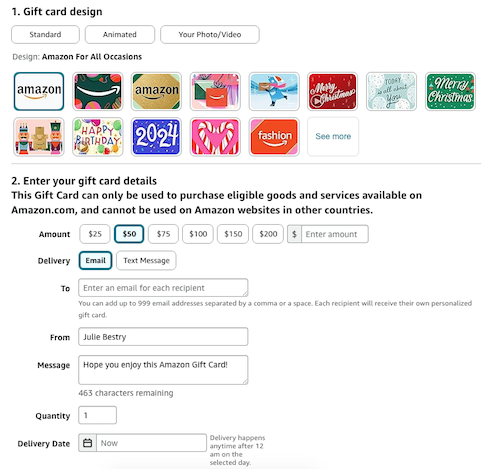
5) Proceed to the checkout page.
- When you go to pay for the gift card, it will ask you to verify the recipient. (Again, it’s you.)
- Then, it will ask you what method you want to use to pay, just as it normally does when you make an Amazon card purchase. This is where you get to “spend” your random Visa/MasterCard/AmEx gift card money. You do this by ADDING the gift card to your Amazon wallet.
- You probably have one or more credit or debit cards and checking accounts listed in this section. Down at the bottom of the “Your Credit and Debit Cards” section, you’ll see where it says, “Add a credit or debit card>Amazon accepts all major credit cards“ — click on it.
- Add the information on the Visa, MasterCard, or AmEx gift card you’re getting rid of. Fill in the number, the security code, and any other information it requests, just as you do when you enter or update credit card information in your Amazon account.
- Once Amazon accepts this as a payment amount, you’re done with the hardest part.
6) Complete your purchase of the Amazon e-gift card as if you were making any other purchase.
7) Wait a few minutes and then check your email. You’ll have received an email telling you that your purchase went through. Hurray! Then you’ll get another email — surprise! — telling you that someone has sent you a gift card.
8) Follow the steps in the email to add the new Amazon eGift Card to your Amazon balance. Usually, you’ll just just have to click a redemption link it’ll be done, but you may have to paste a code from the email into the resulting Amazon page.
- If you never run an Amazon gift card balance, know that the next time you make a purchase, this little amount will be automatically applied and used up, with the remainder charged to your preferred card.
- If, like me, you tend to have lots of random Amazon credit (due to gifts, survey rewards, returns, etc.), this will just increase the total amount of your Amazon balance, which you can always check by going to the Accounts tab when you’re logged in to Amazon and clicking on the Gift Card button. You’ll see your gift card (i.e., account) balance as well as a history of gift card transactions.
Once you’ve done it once or twice, you’ll get the whole process down to about two minutes, not counting waiting for the “Hey, someone sent you an Amazon gift card!” email.
After you’ve completed all of this, and you’ll also get an email telling you that your recipient (again, you!!!) received the gift.
Bonus Tip: How To Delete an Amazon Payment Method
I’ve had clients complain that although they love being able to get rid of dribs and drabs left on generic gift cards using this method, it tends to fill up their Amazon Payments Method section with a mess of random cards that are no longer usable. And it’s not obvious how to remove unnecessary payment methods.
I’ve got a solution for that, too!
If your Amazon Payments Method section is too crowded, you can delete any generic gift carsd you used (to buy the Amazon card):
- Log into your Amazon account.
- Click on Account from the Account & Lists tab dropdown.
- Select the “Your Payments” button.
- You’ll see your Amazon Wallet with all of your payment methods, both the “real” ones you use with your actual debit and credit cards, and whatever random debit or credit card balances you’ve cashed in for Amazon credit.
- For any item you want to delete, click on the card in the column on the far left.
- A graphic of a card will pop up in the center of the page. Click on “Edit.”
- On the resulting screen, you’ll be able to edit the details of the card (name, expiration date, billing address, etc.) or delete it altogether. Click the red “remove from wallet” at the bottom of the pop-up.
You can use this method to get rid of the one-off cards or update any of your regular credit or debit cards, making your Amazon Wallet more organized.
Happy holiday shopping, and please feel free to share these gift card tips with anyone who suffers from a mountain of gift card clutter.
Follow Me