Archive for ‘Paper Organizing’ Category
Paper Doll Interviews Motivational Wordsmith Kara Cutruzzula
Welcome back to another installment of our rare Paper Doll series of interviews with colleagues and special guests. I’ve interviewed productivity specialist Melissa Gratias, academic/life coach and inventor Leslie Josel, genealogy organizers Janine Adams, Jennifer Lava, and Hazel Thornton, and life coach/author Allison Task.
Today, I’m excited to introduce you to journalist/writer/editor/playwright/lyricist/librettist Kara Cutruzzula (rhymes with Methuselah!), friend-of-the-blog and purveyor of motivational oxygen.
We met when I subscribed to Kara’s newsletter Brass Ring Daily in 2019. She’d provided a link to a spec script she’d written for Gilmore Girls, one of my all-time favorite TV shows, and I wrote a fan-girling email to tell her how brilliant and talented she was, the subject line of which was, “My neighbor was awakened by my raucous laughter thanks to your Gilmore Girls script!” Kara’s ear for dialogue and how she made secondary and tertiary characters like Michel and Lane absolutely shine were impressive.
Paper Doll readers may initially wonder what Kara’s talent for capturing the distinct voices of characters on a hit television show has to do with organizing and productivity, the bread-and-butter topics here on this blog. But you’ll soon see — and it all started with that get-to-know-you chain of emails where Kara and I traded our insights about the process of getting things done — and the frustration of not getting things done.
it’s OK to archive that email you never responded to back in August 2021.
it’s also OK to respond! yes, today!
less OK is staring at in your inbox for another six months.
free yourself. one or the other.
— Kara Cutruzzula (@karacut) February 22, 2022
We kept finding ways to work together and support one another’s efforts. I interviewed Kara about newsletter writing and magazine editing for a monthly meeting of the NAPO Authorship & Publishing Special Interest Group and then she interviewed me for a great feature for Forge, Medium’s personal development outlet. Readers, that piece, Now Is the Right Time to Declare Bankruptcy on Your Projects, is so good, you should open it in another tab right now so you don’t forget to read it.
And Kara just interviewed me for the soon-to-premiere season #2 of her Do It Today podcast! If you find productivity compelling, or you could use a little motivation to turn your dreams into reality, get to know Kara!

EVERY SUPERHERO HAS AN ORIGIN STORY
Paper Doll: Could you tell Paper Doll readers about your early life and college years? I know you majored in English at UCLA. What did you plan to do when you finished school?
Kara Cutruzzula: Hearing this question makes me laugh because…I didn’t have a solid plan! My Big Idea was to move to New York and find a job “working with words.” (So cute!) I was applying for internships and editorial assistant jobs every day. Book publishers, magazines, websites, university presses, you name it.
A few weeks after graduating I bought a plane ticket and took advantage of the generosity of my aunts Gina and Jo by crashing on a pull-out couch in their apartment (we called it “the nook”) and crossed my fingers I would find something to do. Then I did.
This highlights something that’s come up over and over again in my career: First you leap, then you figure it out.
You have used your words to craft a set of interlocking and parallel careers. Basically, you’re a polymath (a fancy-pants way of saying Renaissance Woman). Your fascinating and diverse experience includes work as an editor, writer, newsletter creator, playwright, lyricist, and podcaster.
Did (or how did) your internships in film and TV prepare you for the career path you’ve had? How did you get your start in writing for online outlets?
In hindsight these unpaid college internships (at a film development company, at a publicity firm working on Oscar campaigns, and a B2B travel magazine) laid stepping stones for the future. I loved taking the bus (yes, I was the rare LA bus rider) to the 20th Century Fox lot to work at the film development company.
Sure, I picked up chopped salads for the executives, but I also read and wrote coverage of screenplays and TV pilots, and covered assistants’ desks when they were out of the room. (To this day, there’s still nothing scarier to me than “rolling calls” — placing and returning phone calls to intimidating execs at a lightning-fast pace!)
Working at the travel magazine was a great stroke of luck, too. The editor-in-chief, Ken, kindly set me up on an informational interview with a magazine editor when I moved to New York. No job came from that interview, but even a short getting-to-know-you meeting is a huge lift to your spirits when you’re 21 and don’t know anyone in the industry.
As for writing, if you caught me during the first five years of my career, I wouldn’t have called myself a writer at all! In 2008, I was hired as a culture intern at The Daily Beast, a then two-month-old website founded by editor Tina Brown. The team was small, maybe 15 people, and that was my real education. I helped the culture editor plan out culture coverage — what was the site going to cover and how were we going to cover it? — and transcribed interviews and contacted publicists and all sorts of other tasks.
Then I became a homepage editor. Remember, this was back in 2008. We weren’t getting traffic from social media. People actually visited a website’s homepage. As a homepage editor, you were responsible for story placement, headlines, photos, and deciding what needed coverage on the Cheat Sheet — basically “the mix,” as Tina called it. What did people want to read? (Actually, being a homepage editor was scarier than rolling calls!) But there was a real sense that what you were doing was important. You were covering the news. Everyone was incredibly invested, and the team was brilliant.
After The Daily Beast merged with Newsweek in 2010, I moved over to the magazine side to edit and assign stories for the back-of-book section covering film, TV, theater, fashion, and a back-page feature called “My Favorite Mistake,” where I interviewed James Earl Jones, Barbara Corcoran, Richard Branson, and other fun folks. But I got a crash course in magazine editing. Very different from editing for a website! You can only fit so many words on a page. I loved it.
This is a very long way of saying I was primarily an editor for four years. It was fun and rewarding and also exhausting. Newsweek published its Last Print Issue in 2012 (it’s since been resurrected) and I was laid off.
I didn’t want to work full-time at another magazine or website. (This was 2012; freelancing was a little less common than it is now.) So I thought: What else is out there?
Over the next 10 years, I became a writer.
GRABBING THE BRASS RING
You launched Brass Ring Daily in 2017. What caught my eye in those daily emails and the (now) 1000+ newsletter archive was the fact that while you were writing about disparate aspects of your own life, theater, and things that were going on in the world, you were blending motivational quotes, advice about productivity and self-empowerment, and doing it all without trying to sell anything. And Vanity Fair called it, “A life coach in your inbox.”

What prompted you to start the Brass Ring Daily? What has meant the most to you about the experience?
I became a freelance writer and editor — I even spent a solid three years as a travel writer — but I was also holding these monthly “summits” at my apartment where creative folks and friends would talk about projects and share resources.
[Paper Doll Editor’s Note: My late, great high school history teacher, Mr. Fred Murphy, would have wanted me to draw the parallels between Kara and Madame de Staël, an 18th- and 19th-century Frenchwoman and writer, famous for connecting the greatest minds of her era in salons.]
I took notes during these meetings so that one editor’s name or that great productivity tool was recorded for anyone who needed it. I wrote up a summit recap and sent it out to the group.
After a year or two, my friends Alison and Daphna asked if I ever thought about starting a newsletter. So…I did! And it’s the smartest thing I’ve ever done for my career and also my sense of self as a writer. I always tell people to own something for themselves, even if that something is small.
The newsletter gave me a daily deadline that wasn’t attached to an editor or assignment. I didn’t have to answer to anyone, except my own nagging guilt if I skipped a day. And it gave me a place to collect all the inspirations, book quotes, and my own thoughts on creating. The newsletter collects them and allows me to let them go — basically, it’s my most important tool for organization!
[Paper Doll Editor’s Note: Brass Ring Daily often has delightful cameos by baby animals.]
WORDS AND MUSIC: KARA’S NAME UP IN LIGHTS
You’re also a musical theater lyricist and librettist, and from your newsletter, I know you’ve worked on a wide variety of projects as part of the BMI Musical Theatre Advanced Workshop and the BMI Librettists Workshop. Can you tell readers about Letters from May and The Marvelous Mrs. Maisel Musical?
The Kara of 2008 would think it is completely wild that the Kara of 2023 writes musicals. I got into the BMI Workshop, which has been around since 1961; the workshop self-describes as “the setting where the writers of A Chorus Line, Little Shop of Horrors, Nine, Ragtime, Avenue Q, Next To Normal, and The Book of Mormon, among many others, learned their craft.”
For the first two years, lyricists and composers attend a two-hour weekly workshop and present songs they’ve written and get feedback from the room. I only cried like five times. Learning something new is hard. Being a beginner is hard. Thankfully, now I cry much less often.
Lyricists and composers attend a two-hour weekly workshop, present songs they've written, and get feedback. I only cried like five times. *Learning something new is hard. Being a beginner is hard.* ~ @karacut Share on XLetters From May is a 10-minute musical written with composer Kristoffer Bjarke as our first-year project. It tracks the life of an artist, May Dalton, over 50 years as she wrestles with questions of fame and sacrifice. Last year, it was produced at a festival in New York, which was a joyful experience after the pandemic knocked the wind out of the sails of many musical theater writers (myself included).
During year two of the workshop, composer Ron Passaro and I adapted [the Amazon Prime TV show] The Marvelous Mrs. Maisel into a musical, which was another great joy.
Musicalizing such strong and vivid characters was a fun challenge — and of course, Julie, you know I love Amy Sherman-Palladino’s writing more than anything. [Paper Doll Editor’s Note: Sherman-Palladino created Gilmore Girls, Maisel, and the under-appreciated Bunheads, which starred Broadway’s beloved Sutton Foster. It’s streaming on Hulu. Thank me later.]
Right now, Kristoffer and I are developing Marathon, which is an original one-act musical which takes place entirely during a race. It’s about patience, persistence, and finding the capacity within yourself to do hard things.
THE TURNING POINT: MOTIVATION & GETTING PUBLISHED
I usually ask interviewees, “What would you say was the turning point that helped you identify your true calling and fine-tune what you do professionally?” But you seem to be what folks have been calling a multipotentialite. Have you HAD a turning point, or are you still discovering many different true callings, all around your love of words?
LOL. I usually feel like I have no idea what I’m doing and also like I’m just getting started. The last 15 years have felt like a prolonged learning process — a stage I named “percolation” in Do It Today. Culture editing informed my freelance writing; editing influenced my lyric writing; and on and on. I want to do a lot of things and am always worried about not finishing enough or over-thinking what I’m making.
One kind of guiding light over the past 15 years was following random flickers of interest. What sounds interesting? Where do I want to go? What do I want to learn? I’ve never regretted going toward those new endeavors.
Writing is obviously a passion for you. Your first book was Do It For Yourself: A Motivational Journal, beloved by readers and reviewers for the combined uplifting wisdom and snazzy design. For people struggling, procrastinating on doing the big things that would make their hearts sing, you offer exercises to change mindset, overcome obstacles, and pursue follow-through.

How did you come to publish it? Can you tell us about that writing experience? What did writing that book change in your life?
Do It For Yourself actually came from writing my newsletter! Madeline, an editor at Abrams, read my newsletter and reached out — the publisher wanted to release a motivational journal and she said she liked my writing style and point-of-view. At the time, I was working as a consultant at Money Magazine covering personal finance and careers, and I had also just gotten into the BMI Workshop.
But I’m a big believer that you can do almost anything if there’s a clear goal and end date. Your life organizes itself around these important pillars. So I wrote the journal in a few months, then it was published, oh, 18 months later! (Book publishing exists on its own timeline.)
pov you find out the motivational journal that TikTok & Pinterest keep selling out is by none other than @karacut !! pic.twitter.com/NFA54npegZ
— delia (@delia_cai) June 23, 2021
Seeing people connect with the journal and hearing how it improved their own practices and projects has been incredibly rewarding. It was also nice to create something tangible and concrete, and beautiful enough that people want to display it on their nightstands (or their TikToks).
This past fall, you published Do It Today: An Encouragement Journal, the second in your “Start Before You’re Ready series. I reviewed and profiled it in-depth last month in Paper Doll Presents 4 Stellar Organizing & Productivity Resources. It is freakin’ superb!
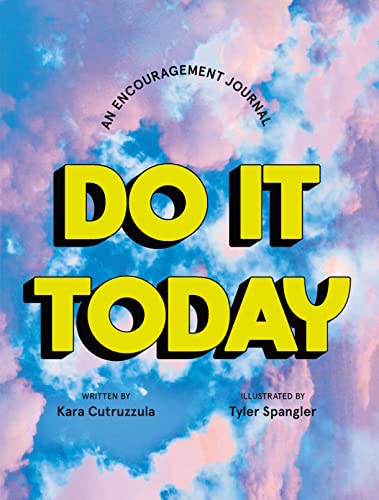
Can you tell us how this book came together? With its accent on motivation and productivity, I have to ask, did you write this for yourself? Do you follow the advice and follow the journal prompts yourself?
Do It For Yourself kind of took off — it’s currently in its ninth printing! — and my editor and I started talking about a possible follow-up. I asked myself, what might people need right now? And the answer was obvious: encouragement. Encouragement to try new things, pick up old projects, bounce back from rejection, and expand their web of connections.
So this journal features short essays and prompts along those lines — and yes, I wrote this entirely for myself because I needed all this encouragement, too. If you don’t connect with the work you’re putting out there, it’s unlikely it will resonate with other people. You have to believe it! I need constant reminders about all of these things and often turn back to the journal, hoping a prompt will thaw some frozen part of my brain or create a new idea. And it does.
You’re not a coach, but your books play a cheerleading, guiding role in helping your readers create and achieve. Aside from what you write in your newsletter, do you test your advice out on your friends and fellow creators?
I’m lucky enough to have many brilliant friends and collaborators and we bounce ideas around all the time. From “can you read this email and let me know if it sounds OK” to “could you edit this draft” or “do you want to set a mutual deadline by Friday to accomplish that nagging task?” So all of this “advice” is actually a distillation of what I’ve witnessed and experienced around other people.
The writing experience is different for every author. In the lingo of NaNoWriMo, there are “plotters” (writers who outline) and “pantsers” (those who write by the seat of their pants). What are you? What’s your writing routine like?
I do not like outlines. Let me rephrase that: I HATE OUTLINES. But I have convinced myself to try to outline – or reframe what an outline is in order to make it less painful. For my last two journals, I wrote a loose structure, basically a paragraph of what I wanted to cover in each chapter. I’m working on a new screenplay right now, and forced myself to write a bullet point list of scenes I wanted to include. Technically that’s an outline, but my brain still resists that word. Figuring out what I want to say usually comes from the writing itself.
My routine is all over the place. Some days I’ll write nothing, other days I’ll write 10 pages! If a deadline is involved, I’ll get it done — it’s the old journalism training, knowing that the story had to be finished by a certain time or the page in the magazine would be left blank. You gotta get it done.
HOW WE ARE DOING IT TODAY
As I wrote in my review of Do It Today, my favorite part of the book was the section on “percolation,” or letting yourself have an idea on the back burner without having to constantly “produce,” non-stop, and noted that it reflected a lot of what I’d been writing about combating toxic productivity.
If you had to pick one journaling exercise/section from the book that you wish everyone would try, which would it be?
Oooh, I love writing thank you notes to rejections! Failures and rejections are a part of life. But I try to remember that you get to choose how you respond. Rejection often stings, but I’ve found writing and sending off a thank you to whatever opportunity turned me down frees up a lot of mental space and allows me to move forward.
Writing and sending off a thank you to whatever opportunity turned me down frees up a lot of mental space and allows me to move forward. ~ @karacut Share on XSo if you didn’t get that residency/client/gig/opportunity, try not to simmer in the angst for too long. Consider why you were so drawn to it in the first place and use it as an arrow to move forward. Write a little thank you and get ready to start the next big thing.
What have readers been telling you is their favorite exercise/section?
Chapter two is called Start Before You’re Ready, and that idea seems to resonate with readers. Asking yourself, “What is the next smallest step I can take?” and then “How long will it actually take to complete?” changes your perspective. You’re getting honest!
So instead of saying “I need to reorganize my entire office,” I might ask myself, “Which area is giving me the most angst right now?” and “How long will it actually take to go through it?” The same idea holds true for our work and creative projects. Get honest with yourself about time estimates; it’s much less intimidating than a scary, open-ended task.
Last summer, as part of the launch of the Do It Today journal, you started the Do It Today podcast, where you interview people about how they are spending their days while they’re deep into creation mode or working on solving a problem. As you’re gearing up for season two, will you describe what this podcast experience meant to you?
For most of last year, I felt like I was floundering. Truly. When you’re in charge of structuring your days, the freedom is nice but also overwhelming.
I wanted to know: How do other people do it? What does another person’s day look like? How do they overcome obstacles? How do they do their best work? So I impulsively started a podcast, mostly as an excuse to ask people I admire slightly invasive questions about their work and creative processes. Our conversations were incredibly encouraging, and I can happily say this year I’m in a much better daily groove, thanks in part to hearing about other people’s strategies.
I’m gearing up to release next season, featuring a wonderful interview with you Julie, and also a Broadway producer, a personal finance expert, an author and keynote speaker, and an A-list screenwriter. There are so many common threads and themes between how people work — it’s extraordinary to see.
THE CURTAIN CALL
What else should Paper Doll readers know about you, your life, your take on motivation, creativity, and musical theater? What’s on the highlight reel of your life these days?
It’s never too late to try something new!!! That deserves three exclamation points.
I’m surrounded by people making big career pivots, adopting new skills, moving around the world, and also doing the less glamorous and equally hard work of showing up for their most meaningful work day after day. You can do it, too. I’m cheering you on! (That might be my most-used slogan.)
My highlight reel right now consists of seeing lots of theater with my husband Colin (we just got married in December!) and taking winter naps with our rescue cat, Lula. And leaning into work and activities I actually enjoy. Everything else either gets paused or cleaned out. Life’s too short.
Before we wrap things up, tell us what’s next for Kara Cutruzzula, multipotentialite and musical maven?
My third book, Do It (or Don’t): A Boundary-Creating Journal is coming out September 12, 2023 and is now available for pre-order! Get ready to do a deep dive into setting boundaries for your projects, creativity, and relationships. (This is an area I wanted to work on myself, so figured we could all work on it together!)

This year I’m developing the musical and also turning back to screenwriting and playwriting, and have some big goals attached to those mediums. I’m also having fun connecting with people through my newsletter.
Most of all, I’m embracing empty space. It’s kind of like leaving one drawer in the closet completely free, and not believing you have to fill it up right now. I’m leaving a little space in my calendar for what is going to light me up in the future — whether that’s tomorrow or two months from now.
And that is music to a professional organizer’s ears.
Paper Doll Shares Presidential Wisdom on Productivity
In honor of Presidents’ Day, I thought it might be fun to look at some of the values various US presidents have embraced to help them not only get more things done, but get more of the right things done.
Be assured, this is completely apolitical content. Additionally, let’s agree that we’re all aware of the complicated lives and backgrounds of presidents (particularly those born prior to the 20th century); none of this should be taken as full-on endorsements of them as men (few of whom would compare entirely favorably with Mr. Rogers), but only as people who endeavored to accomplish much.
And I give you a Presidents’ Day guarantee: you will not be encouraged to purchase a mattress anywhere within the text of this post. (That said, the vast majority of presidents who had something to say about productivity spoke robustly on the importance of sleep!)
PUNCTUALITY
People who are on time are dependable. If you arrive on time (or a little early), then those you are meeting need never fear that they are in the wrong place, that they are late, that you met with some misfortune, or that you forgot them.
Being somewhere on time shows respect for the value of other people’s time. It proves that you don’t consider what you were doing beforehand (or whatever made you late) to be more important that the activities of the person you are meeting.
But from a productivity standpoint, punctuality is efficient. If you’re on time, and if everyone else is on time, then you can stick to the agenda without apologies, hurt feelings, or distractions due to late arrivals or missed information.
George Washington was a stickler for punctuality. As a teenager, he carefully read and took notes on more than 100 rules about civility put together by 16th-century Jesuit priests. From there, Washington developed his Rules of Civility and Decent Behavior in Company and Conversation.

While an inordinate number of these would fall under Miss Manners-type advice, like keeping your nails clean and not taking off your clothes in front of company, one particular guiding principle caught my eye.
82. Undertake not what you cannot Perform but be Careful to keep your Promise.
That includes showing up when you said you would.
I’ve heard half a dozen stories about Washington’s keenness for punctuality. Allegedly, he dined daily at 4 o’clock; when he invited senators or representatives to dine with him, if they arrived late, they found the president midway through finishing his meal or even having completed it. “We are punctual here. My cook never asks whether the company has arrived, but whether the hour has come.”
By 21st-century standards, this may seem inflexible. After all, Ralph Waldo Emerson wrote, “A foolish consistency is the hobgoblin of little minds, adored by little statesmen and philosophers and divines.” But the word “foolish” carries a lot of weight here. Habit and ritual have value, and they help presidents and fourth-graders alike to get more done.
Once, Washington’s secretary kept POTUS #1 cooling his heels. The secretary blamed a malfunctioning watch for his delayed arrival. Displeased, Washington replied, “Then you must get another watch, or I another secretary.”
Diplomatic, at least on these occasions, Washington was not. But hewing to strict rules and not letting anyone else mess with his temporal boundaries meant he could accomplish more of what he had planned.
Be assured, I understand that we all have different obligations. A doctor may be running late because a patient earlier in the day had a medical emergency. (Having once been that medical emergency, I am much more sympathetic in this regard.) The person meeting you may lack the (financial and human) resources you have, so when a caregiver or babysitter cancels, or transportation breaks down (or public transportation runs late), it’s important to have some empathy.
And if someone is chronically late (and you’re sure it’s not some kind of narcissistic power play), it may be due to neurological challenges related to any of a variety of executive function disorders or ADHD. Yes, it’s frustrating. And if that chronically late person is you, well, we know it’s frustrating for you, as well. But there’s hope.
Punctuality is often seen as a static personal characteristic rather than a skill set, but you can improve. For example:
- Know how long it actually takes to accomplish your most common tasks. Be realistic.
- Do not over-schedule yourself. Ever brain needs time to refresh and re-set.
- Schedule buffer time, recuperative time, and travel time. If you don’t schedule time to transition between tasks and/or locations, you are likely to fall further behind. In middle and high school, we called it “passing time,” as you had to pass from classroom to classroom. Do not engage in the magical thinking that you can start one meeting or appointment at the same time you are ending another one, even when video conferencing. Try the therapy model of 50-minute hours when scheduling Zooms.
- Don’t depend on willpower. Your lateness is likely not because of laziness but attempting to do “just one more thing.” Curbing that instinct will take effort and support.
- Set alarms. When the time is up, the time is up. For some people, it can be emotionally uncomfortable to stop and transition, but consider the emotional discomfort both you and the other person will experience if you are late.
- Accept/request help from others to move you along.
If all you remember of Washington is false teeth and cherry trees, you might enjoy reading You Never Forget Your First: A Biography of George Washington by Alexis Coe. It’s less worshipful than other biographies (or Christopher Jackson’s portray of General Washington in Lin-Manuel Miranda’s Hamilton), but it’s compelling reading.

BACKUPS, OPEN TABS, AND SWIVEL CHAIRS
Whatever one might say about Thomas Jefferson (good, bad, or … let’s be real, it’s never indifferent), there’s no getting around the fact that the guy loved his gadgets for getting things done.
Jefferson wrote a lot of letters; historians estimate that he sent approximately 20,000 letters over the years to friends, family members, and colleagues, not even counting official diplomatic or presidential correspondence. (He also wrote some nasty poison-pen newspaper editorials under false names.)
Nowadays, to keep track of our email trail, we might thread the conversations, or sort by sender, or develop complex archiving and tagging systems. Thomas Jefferson made use of a polygraph.
No, not that kind of polygraph. This isn’t an episode of Law & Order: Monticello.
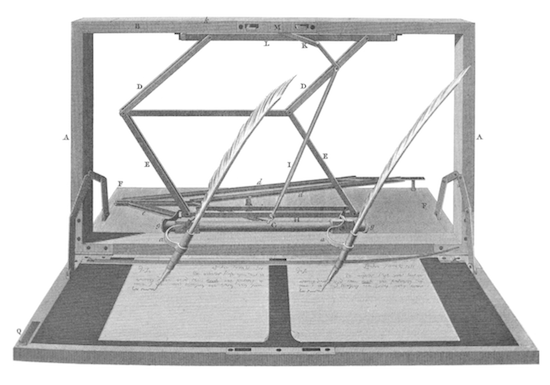
Annotated engraving of Hawkin’s Polygraph from Rees’s Cyclopædia, ca. 1820
Over the years, Jefferson acquired increasingly refined versions of a polygraph device that allowed creation of simultaneous copies of the letters he wrote — as he moved the pen, another pen, on another sheet of paper, wrote in parallel. He needn’t be attended by a secretary, nor did he have to worry about the security and privacy of his letters. Thomas Jefferson made use of a low-labor method of backup.
Jefferson also understood that — in an era before Google, 2-day delivery, or Boolean Search — having quick access to his resources helped him research and write more quickly. He oversaw the creation of a revolving bookstand, modeled on a sheet music stand, that allowed him to access any five books at once with a simple spin. You can even purchase a table-top model from the Monticello store.
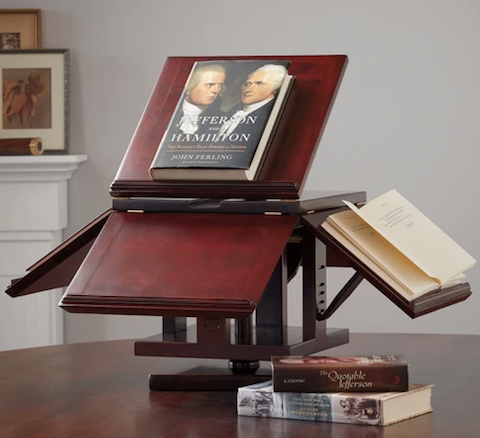
While I’m loathe to promote multitasking, unlike our modern browsers, at least his number of open tabs was limited to five!
And that’s not the only way he set his productivity in motion — Jefferson invented (some say “refined”) the swivel chair! While drafting the Declaration of Independence, Jefferson used the popular and oh-so-British Windsor chair. (You’d recognize one immediately — a wooden seat with four legs attached below and a bunch of wooden spindles slotted into the seat from above form the back of the chair.)
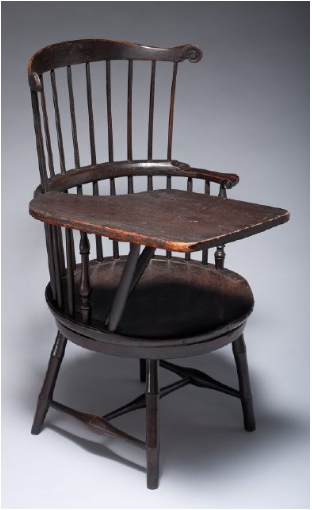
Jefferson Swivel Chair
The traditional Windsor chair was too confining. Jefferson added an iron spindle between the top and bottom halves of the seat, enabling the chair to rotate on doohickeys he repurposed from window sash pulleys! Later, he replaced the original legs of the chair with bamboo ones and added a writing desk. Considering the writing desks are ubiquitous in college classrooms worldwide, this was quite a special invention.
For what it’s worth, productivity-wise, Thomas Jefferson was also a proponent of rising early, stating, “Whether I retire to bed early or late, I rise with the sun.” While Paper Doll doesn’t personally abide by the notion of The 5 a.m. Miracle, Jefferson’s consistency in his schedule — rising early, hosting a hearty breakfast for his guests, and spending the morning writing letters to get his creative juices flowing before working on other projects — reflects the same kind of time blocking that we know helps people build successful productivity habits.
How can you put Jeffersonian wisdom to work?
- Back up everything so you always have a safeguarded copy. For tips, look at Paper Doll’s Ultimate Stress-Free Backup Plan.
- Experiment with ways to keep your resources front-and-center. That doesn’t mean letting your mess pile up. Earmark part of a shelf next to your desk for resources supporting projects you’re working on right now. For digital resources, embrace technology that makes your resources easily searchable, like Evernote.
- Develop consistency in your own schedule by creating blocks to ensure there’s ample time to accomplish what you most value.
EFFICIENCY VS. EFFECTIVENESS
If his diaries are any indication, John Quincy Adams, our sixth president, really understood the paradoxical nature of how some people, although working very hard, often fail to achieve their goals.

Before he was even president, John Quincy Adams was Secretary of State, and of that period of this life, he said with dismay,
Every day starts new game to me, upon the field of my duties; but the hurry of the hour leaves me no time for the pursuit of it, and at the close of my Career I shall merely have gone helter skelter through the current business of the Office, and leave no permanent trace of my ever having been in it behind.
He saw that without foresight and planning, without identifying the most worthy pursuits, he would be busy without being productive.
Even in John Quincy Adams’ early years, he bemoaned,
I find it easy to engage my attention in scientific pursuits of almost any kind, but difficult to guard against two abuses — the one of being insensibly drawn from one to another, as I now have from Chronology to Astronomy and from Astronomy to Logarithms — the other of misapplying time, which is essential to the business of life; public and private.
Long before we talked about “going down the rabbit hole” as we surfed the internet, linking from article to article, or followed social media links hither and yon, JQA recognized how easily time can control us if we don’t seek to control it, or at least our use of it.

Vintage Alarm Clock (Public Domain)
He admonished that we should wisely plan our time to include what is necessary for our work, appealing for our personal interest, and meaningful for our personal and professional growth. To that end, you might:
- Identify what are your highest priorities (whether they are externally-driven, like a paycheck or attention from prospective clients, or internally-driven, like gaining a deeper understanding of a subject or investing in your physical health).
- Time-block for the categories of your life/work so nothing vital will fall through the cracks.
- Take note of your bad habits and work on improving your good ones to give yourself more focus on those higher priorities. Check Paper Doll Helps You Find Your Ideal Analog Habit Tracker to see ways to do that.
- Set alarms or plan catch-up calls, or use accountability methods to make sure you’ve maintained focus and haven’t strayed. For useful guidelines:
Paper Doll Sees Double: Body Doubling for Productivity
Paper Doll Shares 8 Virtual Co-Working Sites to Amp Up Your Productivity
Flow and Faux (Accountability): Productivity, Focus, and Alex Trebek
PLANNING AND PREPARATION
“Give me six hours to chop down a tree and I will spend the first four sharpening the axe.”
This is a phenomenal quote, portraying the importance of facing every problem by focusing on planning, preparation, and identifying the right resources.
Unfortunately, just as with Washington’s cherry tree, Abraham Lincoln never actually made this statement. It was, apparently, an old loggers’ saying, fitting in with folksy wisdom like “measure twice and cut once.” Although it’s often been erroneously ascribed to Lincoln, the quote first appeared in an agricultural education textbook in the 1950s and the first association with Lincoln came in 1960, ninety-five years after his fateful night at the theater.
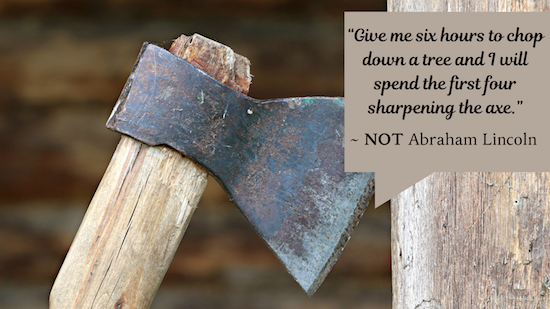
And you may have heard the so-called quote as minutes instead of hours. As a 21st-century suburbanite, I’ve no idea how long it should take to chop down a tree. But even though we have no reason to believe Lincoln said this, we would not be surprised that he might agree with it. Nor do I imagine he’d take umbrage with a quote from a similar 1901 comment in “The Times and Young Men” by Josiah Strong:
He will see that the necessary time spent in preparation for his life-work is better spent than as if he had rushed into it ill-prepared. Time spent in sharpening the axe may well be spared from swinging it.
Honest Abe didn’t ignore concepts of time and project management. In his first inaugural address (in 1861), he said,
Nothing valuable can be lost by taking time. If there be an object to hurry any of you, in hot haste, to a step which you would never take deliberately, that object will be frustrated by taking time; but no good object can be frustrated by it.
This was not a call for procrastination. Certainly, he was talking about caution on the precipice of Civil War. But the lessons from both the real quote and the false one are the same. We must be cautious and consider our situation. So:
- Add planning time to your days, perhaps the last 15 minutes of each workday, to check the next day’s schedule and verify that you have all of your essential resources (whether that means Zoom links or a child’s cardboard Medieval diorama for school).
- Add planning time to your weeks. Laura Vanderkam is a proponent of planning the next week on Friday. So is Paper Doll.
- Build review time into your years so that you have a better sense how your dreams and visions measure up against your realities. Review Organize Your Annual Review & Mindset Blueprint for 2023.
I should note, Lincoln is also alleged (probably erroneously) to have said, “The best thing about the future is that it comes only one day at a time.”
This notion is one we should embrace as we seek to be more productive. We don’t need to be fearful, overwhelmed, or cowed by what is coming. We have time to plan.
The future isn’t a cartoon anvil or speeding train, but a knock on the door each morning. If we schedule time to work on something a little bit every day, whether it’s a 10th grade Social Studies report or a presentation for work, Pomodoro-by-Pomodoro, bit-by-bit, we can achieve our goals.
PRIORITIZING
Often, the problem isn’t that we aren’t getting things done, but that we’re not getting the right things done. This happens when we treat every sensory input as urgent and important, even though it might be only one or the other — or neither.
Before Dwight D. Eisenhower became the 34th president, he was a 5-star general in the United States Army. (Trivia note: only 5 people have ever held this rank, which has now been eliminated. But they didn’t become presidents, so you won’t be tested on their names today.) We can be fairly sure this was a guy who needed to manage his time well.
In a 1961 address after he left office, Eisenhower said,
Who can define for us with accuracy the difference between the long and short term! Especially whenever our affairs seem to be in crisis, we are almost compelled to give our first attention to the urgent present rather than to the important future.
He also reflected these thoughts in his first presidential term when he quoted a university president (whose name has been lost to history), saying,
I have two kinds of problems, the urgent and the important. The urgent are not important, and the important are never urgent.
While this may have (mostly) been true for the university president, it was almost assuredly not quite that simple for Ike. However, by championing evaluation all of those sensory inputs before taking action, Eisenhower inspired many, including Stephen Covey of The 7 Habits of Highly Effective People fame.

Covey took Eisenhower’s wisdom and distilled it into an easily-understood, accessible chart to help you:
- pause and consider the value of a task or situation
- avoid giving urgency a leg-up on importance
- drop-kick the fluff and time-wasters from your life, habits, and schedule, and
- help clear your mind so you can focus on your real priorities
Covey gave Eisenhower the credit. Unlike the Lincoln quote, it’s not made up from whole cloth, but the Eisenhower Decision Matrix (also known variably as the The Urgency-Importance Matrix, The Eisenhower Method, yadda yadda) is really the work of Covey.
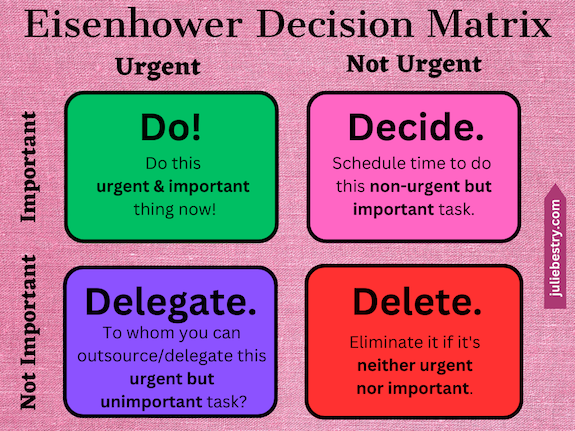
Importance is something that has a high degree of value in terms of whether it helps you achieve your goals, particularly long-term. Note: some things are important but not important enough for you to do them!
Urgency refers to the speed at which it must be dealt with to avoid unfortunate circumstances. True urgency means fire, flood, smoke, blood, or a lawsuit waiting to happen. Things aren’t urgent just because someone is yelling.
True urgency means fire, flood, smoke, blood, or a lawsuit waiting to happen. Things aren't urgent just because someone is yelling. Share on X- Urgent and important tasks will have a high impact on the achievability of your goals and must be competed with alacrity. They have quickly-approaching deadlines. Do them!
- Important but not urgent tasks require you to stop — calm down — and start making decisions. Schedule when you can do the task in the future, assuming it’s an important task that you can’t comfortably delegate. Break the task into smaller component elements to make it easier.
- Urgent but unimportant tasks may still need to be completed, but they may not need to be completed by you. The solution can involve anything from outsourcing a task for pay or delegating to an employee, a child, or laterally (to your spouse or co-worker, though you’ll want to call it something that sounds less bossy).
- Neither important nor urgent tasks might be anything from social media (when it’s not part of your job) to keeping up with certain trends. Not everyone has to know the latest TikTok dance or what’s going on with AI.
Of course, as Eisenhower would have understood, the world is in flux. Getting your taxes completed is important (for legal and financial reasons), but is not particularly urgent in July. By April 14th, the urgency is at its pinnacle. Having to use the rest room is urgent, and assuming you do so today, in 2033 you won’t likely reflect on that bathroom visit as important.
The number 10 can be a highly useful way of determining something’s importance. Ask yourself:
- Will this matter in 10 minutes?
- Will this matter in 10 days?
- Will this matter in 10 years?
The Zoom call that seems so important may long be forgotten a month from now, but the dinner with your friend or promised tea party with your child that you blew off to attend it? That could have a long-lasting impact.
The Eisenhower (By Way of Steven Covey) Decision Matrix gives you a framework for evaluating the decisions you make about the way you spend your time and attention. But it’s only a framework. Only you know what you truly value. You are the President of your future.
This post was originally written for Presidents’ Day 2023. Although a few sentences have been tweaked, the timeless advice remains the same.
In these contentious times, I tried to be as ideologically balanced as possible, picking presidents from the 18th, 19th, 20th, and 21st centuries.
I selected one Democrat (Obama), one Republican (Eisenhower), one Democratic-Republican (Jefferson), one unaffiliated president (Washington), and two presidents affiliated with multiple parties. Abraham Lincoln was Republican and re-elected as a National Union candidate, while John Quincy Adams was, at various times, a Federalist, Democratic-Republican, National Republican, Anti-Masonic, and Whig.
This covers all political parties with which elected presidents were affiliated.
Paper Doll Presents 4 Stellar Organizing & Productivity Resources
Given that it’s Valentine’s Day week, I wanted to give all of my Paper Doll readers some treats. In this post, we’ll be looking at three books covering organizing, motivation, and productivity, as well as an upcoming video interview series for taking a proactive approach to productivity in leadership.
GO WITH THE FLOW! (The Clutter Flow Chart Workbook)
If you’ve been reading Paper Doll for a while, the name Hazel Thornton won’t be new to you. We’ve been colleagues and friends for many years, and I’ve shared Hazel with you when I interviewed her (along with Jennifer Lava and Janine Adams) for Paper Doll Interviews the Genealogy Organizers and when I profiled her stellar book, What’s a Photo Without the Story? How to Create Your Family Legacy in my 2021 holiday gift list post.

Hazel is a delight and full of wisdom — and how many other professional organizers do you know who are experts on photo organizing, genealogy, and family legacies and who served on the jury in the famed Menendez trial?
But Hazel is pretty famous for one other thing — flow charts. If the topic of flow charts even comes up in any organizing circles, Hazel’s is the first (and sometimes only) name that gets raised; she’s that much of a subject matter expert. So, it made sense that Hazel would take her favorite creations from her wealth of flow chart wisdom and leverage them into a resource.
Hazel’s newest book, published just a few weeks ago, is Go With the Flow! The Clutter Flow Chart Workbook. And it’s a whopper for anyone looking for some turn-by-turn directions for getting organized, from where to start to how to progress logically so you don’t get stuck.
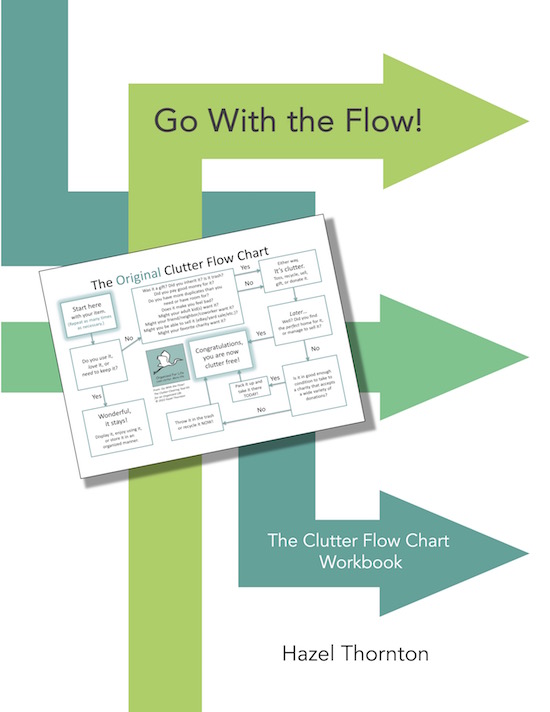
This 170-page, 8.5″ x 11″, portrait-oriented paperback workbook includes 17 charts covering all different kinds of clutter:
- clutter in your spaces (closet, garage, kitchen, office)
- daily clutter (to-do lists, general paper, kids’ paper, cash flow, mental clutter)
- legacy clutter (keepsakes, ancestry, photos)
- life event clutter (holiday activity, holiday décor, occupied staging)
There are even flow charts to tell you which clutter flow chart you need and to help you get back on track if you’ve had some backsliding in the decluttering process.
(You won’t be surprised that Paper Doll‘s favorite flow chart was the one on dealing with paper clutter. But I suspect one of the most useful flow charts overall might be the one on keepsakes.)
Of course, the book would be pretty short if it only had flow charts. In each section, Hazel follows the flow chart with detailed answers to four questions.
- What is clutter? — You might think you know what type of clutter you’re dealing with, but the book helps you identify items you may not have even considered. In each chapter, this section asks pertinent questions about how you interact with the item (tangible or otherwise) and feel about it, probes whether it needs to be in your life, prompts you to consider its condition or situation, and leads you to make wise decisions regarding whether it still fits you and your life. These are the exact questions we professional organizers gently pepper clients with when we work together.
- Why can’t I part with my clutter? — As a veteran professional organizer, Hazel doesn’t just tell you to “buck up, buttercup!” but employs the analysis of the “what is clutter?” sub-questions to dig deeply into why the reader might be experiencing challenges in letting go.
- What should I do with my clutter? — With each distinct category, the book offers clear suggestions as to where that clutter can go so it will really, truly leave your life in the most beneficial way possible.
- What if, despite my best intentions, I am still living with clutter? — Nobody’s perfect. And Rome wasn’t built (or decluttered) in a day. So, the book has guidance for continuing to make progress and for getting support.
There’s bonus material, like resources for getting help organizing and decluttering and blank clutter worksheets to help you identify answers and track efforts. (Be sure to read the content in the clutter worksheet examples, because Hazel’s down-to-earth sense of humor shines there!)
In addition, there’s a special section advising professional organizers how to use the content of the workbook with clients.
Go With the Flow! is subtitled The Clutter Flow Chart Workbook, and for those who are feeling stuck with (or stymied by) their clutter, this can be the catalyst to actually make progress by working through the clutter instead of just reading about it. The combination of the flow charts, where their visual approach to “If X, then Y” fork-in-the-road decision trees, with straightforward prose coaching through the what’s and why’s of decluttering, offers a one-two punch for knocking clutter out of your life.
Go With the Flow! The Clutter Flow Chart Workbook is available for $27.50 at Amazon. If you’re in Australia (to which Amazon/KDP will not market books with color images), or if you desperately want a landscape-oriented version of the book, you can purchase a PDF copy directly from Hazel’s website. (It’s a slightly finicky process, Hazel reports, so do follow the instructions.)
DO IT TODAY
You’ve got dreams that sparkle. Friends see your eyes light up when you talk about your big, bold visions for the future. You know you’ve got fabulous ideas inside of you that can make the world smarter, happier, healthier, weirder (in a good way), or just plain better.
So why aren’t you working on them?
Why aren’t you getting on that stage, giving your TED Talk or taking a bow for your award-winning creation? Why are you scrolling through social media or counting your excuses or being held back by fear?
Once I got Kara Cutruzzula’s Do It Today: An Encouragement Journal in my hands, I realized I’d never seen a journal like this. It’s colorful and beautiful, with each turn of the page yielding a vibrant new palette, but the aesthetics are just the frosting on this empathetic, wise cake, a combo of a journal and motivational coach.
Friend-of-the-blog Kara Cutruzzula is a writer and editor, and I start my day reading her newsletter, Brass Ring Daily. BRD is pithy, perky, and just philosophical enough to get you out of your bed and headed to the coffee maker. (Kara is other things: a musical theater lyricist, playwright, podcaster, and fellow Gilmore Girls aficionado. But the rest I’m saving for an upcoming interview, so you’ll just have to be patient.)

As a follow-up to her Do It For Yourself, the first in her Start Before You’re Ready series, Do It Today offers gentle motivational coaching. Read straight through and tackle the guided motivational exercises one by one, or devour the section-starting essays and then ping-pong through exercises that resonate most with you on that day.
(Or, perhaps start each day with the journal, using an exercise as Julia Cameron’s The Artist’s Way-style morning pages?)
Personally, I’ve started using Do It Today to help me avoid procrastination by — you guessed it — procrastinating with the journal. When I find myself doing everything except the writing or project I really know I should be working on (to reach my own goals), I settle in to reread one of Kara’s essays and then tackle a journal entry. (In full disclosure, the journal is so beautiful that I can’t bring myself to actually write in it, and tend to type my responses so that I don’t obsess about my ever-more chicken-scratchy handwriting.)
To give you sense of the approach, the chapter-starting essays include:
- Go Toward Your Nerves
- Start Before You’re Ready (I’m sensing a theme here!)
- Don’t Be Productive, Percolate Instead — Worth the price of admission!
- Stamina, Courage, and Mirages
- Sweet, Sweet Rejection — Trust me, whether you fear failure (or, like me, fear mediocrity), Kara’s stance here will conjure up the best kinds of attitude adjustments.
- Weave a Generous Web
- Do It Today
It would be hard to pick, but the chapter on percolation is probably my favorite. Maybe because Kara’s writing here dovetails with what I wrote in my series last year on toxic productivity, I was prepared to embrace what she had to say. Or maybe it’s because she illustrates (through a tale of John Steinbeck and examples you’ll recognize from your own life) that percolation is a brilliant cheat code.
Have you ever circled an idea for a while, finding the tendrils of a concept while never locating key to actually getting started?
Percolation is “…giving yourself time and space to think without the extra pressure to track your performance…allowing yourself to enjoy reflecting and exploring your options.” Instead of coming up with ready-for-Prime-Time ideas, Kara helps you find your sources of inspiration, ideas, and solutions, areas you may have closed yourself off from by focusing on the perfect end result. Long story short, when you’ve focused too long on the checkmark at the end, Kara reminds you to focus on the joy of creation and accomplishment.
In each chapter of Do It Today, Kara has interspersed pop-art messages to uplift, free-writing journaling prompts, and list templates to get you thinking.
Some of my favorite, deceptively astute lines and what they mean to me:
- You are more powerful than your productivity — battering toxic productivity’s lie that your worth comes from what you deliver
- Everyone is just trying their best with the information they have — reminding you that none of us are perfect and prompting us to start now (because you can’t edit a blank page)
- Look at all you have — focusing on gratitude as well as noticing the bounty we possess rather than the short stack and what we lack
- Do, don’t overdo — I think I resemble — I mean, resent — that remark. I feel seen.
In terms of journaling prompts, in the section on starting before you’re ready, there’s a page that asks, “Is there one conversation you’re not ready to have? Even if you don’t know how to say it, begin here by writing a few possible opening sentences.” Down deep, you know this works. You’ve felt a sense of ease after telling your BFF about a problem at work and how you dread dealing with it. But by letting yourself stop thinking of the issue, and just giving yourself a few minutes to think about it, in context, you’ll find the weight is lifted!
I suggested one of the prompts from the Courage chapter to a client who wanted to apply for an opportunity but feared putting herself forward. Kara writes, “Have you ever had to ask someone to write you a letter of recommendation? What if you wrote one for yourself, highlighting your strengths and what you would bring to your next opportunity?” It worked!
The list-making prompts are incredible in their powerful simplicity. If you’re feeling like a slug, unable to clarify your thoughts, Kara encourages that you write a list of ten ideas completely unrelated to your current project, and offers some examples. The key is that taking your focus off of a lack of productivity hoovers up all the cobwebs.
Other list prompts help you strengthen your arsenal of motivation-boosting weapons of stress-destruction, like noting people who’ve historically provided safe spaces for you to share your works in progress.
I can’t do justice to this creative, colorful guide to getting un-stuck, but I’d describe it as being like meeting your most inspiring friend for brunch and leaving full of waffles and excitement.
Do It Today is available in paperback for $16.99 or Kindle for $9.99 at Amazon, as well as at Barnes & Noble, Books-A-Million, Bookshop, Powell’s, and Indigo. You can also purchase directly from the publisher, Abrams Books.
PRODUCTIVITY FOR HOW YOU’RE WIRED
My longtime colleague Ellen Faye is a consummate professional and ridiculously unflappable. She’s a Certified Professional Organizer®, Professional Certified Coach, and Certified Productivity Leadership Coach. She’s even been the president of the National Association of Productivity and Organizing Professionals!
Ellen recognized that there are far too many books out there by coaches telling readers how to be successful they way they, the coaches, have done it. Ellen, however, saw that her clients needed productivity solutions and systems that worked for them, not merely for her. That realization of the need for customization inspired her to write Productivity for How You’re Wired: Better Work. Better Life.
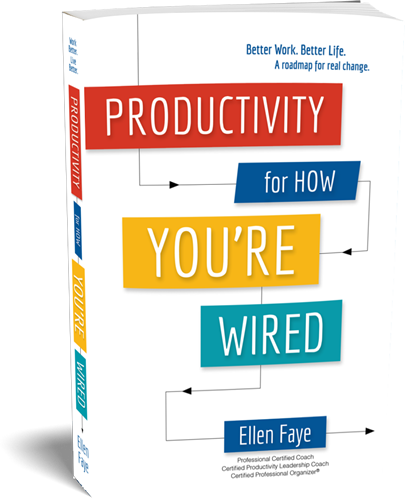
Ellen’s book is designed for people seeking to be “more intentional about how they use their time and live their life,” and the book approaches this concept in three main ways.
First, she wants readers to understand how they are truly wired with regard to how they deal with time and productivity. Ellen recognizes that individuals have different needs and ways of thinking in terms of structure preference as well as productivity style.
In the first section of the book, Ellen guides readers to identify how their brains work best. She explains far better than I could even attempt, but the key is that you have to understand whether your priority focus is tasks vs. relationships, and then really comprehend what kind of structure (low, medium, or high) you need in your work and life — that’s situational structure. Through clear examples and charts, she walks you through identifying where, given your focus and structure preference, you’ll thrive or feel overly confined, struggle or succeed, power up or feel lost.
Meanwhile, Ellen’s take on productivity style borrows from, and refines, other research on the topic, and the book helps you isolate which productivity style (Catalyst, Coordinator, Diplomat, or Innovator) best fits you, laying out the characteristics and best work process approach for each. It’s really eye opening.
This section also illustrates how understanding challenges like perfectionism, procrastination, chronic stress, and burnout plays into making positive changes.
In the second part of the book, Ellen teaches the reader how to create a productivity flow framework to transform current unworkable systems into customized pathways to success. Productivity for How You’re Wired walks you through setting your goals and intentions, using a time map, defining the essential structures, creating a priorities task list, and doing your daily and weekly planning.
Productivity books often have one uniform approach to everything and then vague pointers for understanding how to begin and continue; you have to find where you fit in. Instead, Ellen provides detailed guidance so that no part of your life is going to fall through the cracks. Basically, it’s like having Ellen as your coach, sticking by you step-by-step, so you can get clear on your priorities and focus on the essentials elements for achieving what means the most.
The third part of the book combines the deep understanding you’ll gain regarding the right approach for you and the overarching framework you developed so you can apply the concepts to your own life and work demands. Using the right structure preferences and productivity style, you’ll see how to deal with meetings, email, decision-making, remote work, team leadership, and more.
I particularly liked that Productivity for How You’re Wired‘s chapters start with “Highlights,” overviews of what’s coming so that you can find your place. (I like to know where I’m going when I read so I have an “ah-ha” when I get there!)
The book has myriad real-life stories to help you see parallels between your situation and others who’ve been through it and achieved success. To that end, each chapter also has “Making It Fit” charts so you can make decisions using your own structure preference and productivity style and know what to do in the situation described.
You can use the Productivity for How You’re Wired as a bit of a workbook, as each chapter ends with a place to note those “Takeaways” you don’t want to forget and commit to the “Actions” you’ll take to help you develop your own systems.
The only drawback to the book is that some of the material on the charts can be hard to read (due to the confines of a tangible book); however, there are colorful versions of the charts available online, which allow you to expand the charts so you can see them more clearly. There are also supplemental resources on the website.
Productivity for How You’re Wired is fluff-free. This is just about the meatiest book I’ve ever seen on achieving personalized productivity. This book is a real commitment — to yourself and the material — but short of working in person with Ellen herself, it’s an amazing way to tweak every detail of your approach to work and life to fit in everything important to you. If you make the commitment, I think you’ll be impressed with what you get out of it.
Productivity for How You’re Wired is available from Amazon for $17.64 for paperback or $9.99 on Kindle.
CREATING ORDER AMONG CHAOS
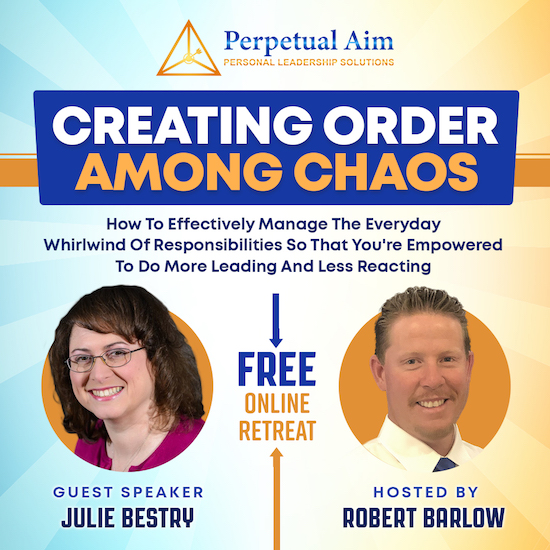
Starting February 15, 2023 and running through February 28, 2023, I’m participating in the adventurously titled Creating Order Among Chaos: How To Effectively Manage The Everyday Whirlwind Of Responsibilities So That You’re Empowered To Do More Leading & Less Reacting!
This free online video retreat is headed up by personal coach and business consultant Robert Barlow from Perpetual Aim. You might recall his name from when I did Robert’s The Leader’s Asset series on prioritization and leadership last summer.
If you’re a solopreneur or small business owner, you know what it’s like when you’re constantly reacting instead of acting, always putting out fires (that often turn out to be fireflies) instead of setting off your own carefully planned fireworks. Simply put, it can feel impossible to feel like you’re running the show, and instead everything (and everyone, and every sensory input) is distracting you from achieving success.
It’s hard to lead when the ducklings behind you keep getting out of line. It’s hard to make progress when the phones won’t stop ringing about yesterday’s efforts (and other people’s priorities). That’s where the video retreat comes in!
Robert has gathered 14 speakers, myself included, who all share a passion for empowering small business owners and professionals to work more on their businesses instead of in their businesses (to borrow from Michael Gerber’s now-classic The E-Myth Revisited: Why Most Small Businesses Don’t Work and What to Do About It.)
Each of us participating are bringing our knowledge and expertise to these short but powerful video interviews with Robert, and you can anticipate that each will leave you with actionable options to achieve your priorities. Topics covered will include:
- How to manage juggling responsibilities
- How to lead and delegate to others
- Ways to create stronger boundaries so that you are less overcommitted and overwhelmed
- Tips, tools, and strategies that move you forward in life
- What thinking patterns are keeping you mired in place
- How to stay connected with your vision, goals, and ideals
- How to manage your time on a day to day basis to accomplish what you desire.
This two-week video series is virtual; that means you can watch it at home, in the office, on your commute (provided someone else is driving the car/bus/train), or wherever you can get away from the hubbub.
I think we’d all love the opportunity to pick the brains of experts in productivity and leadership, and have conversations to help guide professional success. I’m excited to not only have contributed my thoughts, but I can’t wait to hear what the other experts have to say. Participating experts include:
- Dr. Frank Buck, long-time friend-of-the-blog, with whom I’ve shared many virtual stages. (You might recall that Frank interviewed me on his podcast last year, and I’ve referenced him often on these pages.)
- Alexis Haselberger is a fabulous coach and consultant whom I fist met when I spoke at Ray Sidney-Smith‘s 2019 Productivity Summit. I love her motto: “Do More, Stress Less.”
- Steven Dossou is all about personal transformation. His background in marketing leadership, his executive and life coaching experience, and what I’ve heard him say about fear, self-doubt, and self-esteem, has me really intrigued about what he’ll discuss in his interview.
- Rudy Miick, founder of the Miick Method for purpose-driven creating, maintaining, and expanding excellence, should bring some fascinating ideas to the table.
- Stephanie Paillé is a leadership coach specializing in mindset shifts and high performance culture.
- Gill Tiney, an expert on the power of collaboration, should have an amazing take on how we can do more (even with all those distracting inputs) by working together.
And that’s only hitting half of the presenters!
I have a complimentary ticket for you to attend. Just click on https://perpetualaim.com/JulieBestry to register for this free, online two-week “retreat,” and you’ll start getting emails to take you to each daily interview. I hope you’ll attend, and if you watch my interview with Robert, feel free to come back and share your thoughts on what I’ve said about conquering overwhelm and achieving prioritized focus for improved leadership.
Happy Valentine’s Day, my wonderful readers. I hope these books and the video series will help you achieve your organizing and productivity goals.
Much (productive) love,
Paper Doll
Paper Doll Shares 8 Virtual Co-Working Sites to Amp Up Your Productivity
Last week, in Paper Doll Sees Double: Body Doubling for Productivity, we looked at the concept of body doubling and the mechanisms by which it helps us with productivity and accountability through social pressure, task orientation, biological cues, and extended focus.
My wise colleague Diane Quintana, CPO®, CPO-CD, who has expertise using body doubling with her clients with ADHD, added “…body doubling is a calming strategy. I find that when my clients are anxious or stressed over a particular task, using this strategy – quietly working alongside them – is a calming influence. They get more done in less time and with less stress.”
In that post, I walked through my experiences with body doubling one-on-one with clients, and virtually, in a group setting in co-writing sessions and at a writing retreat. I also laid out how to identify the ideal body-doubling method for your needs and the attributes to consider in seeking out a platform.
Whether you call it social focus, group body doubling, or co-working, if you haven’t been able to find the right mix of support and aren’t eager to create your own, you might want to consider one of the platforms profiled in this post.
FREE CO-WORKING WITH PREMIUM UPGRADES
Groove
Groove bills itself as a free accountability club and is targeted toward solopreneurs. It’s not a networking or venture capital matchmaking site, but it does seem to lean into convivial support and the possibility of making connections.
To start, and “to ensure the trust and safety” of their community, you fill out an online form with basic information: name, email, why you want to try Groove, a project you might like to conquer, and how you found out about Groove.
Next, download the Groove app for your mobile device. From the home screen, start a “groove” session, where you will be joined by one-to-three other participants. The app prompts each person through a one-minute video check-in to share goals for the forthcoming groove.
Next, microphones are muted and cameras are turned off, and you’re presented with a screen to enter your goal and break it into distinct tasks. As you work, you check off the tasks, and your fellow Groovers (Groovies?) can cheer your accomplishments via the in-app text chat.
After 50 minutes (the length of two Pomodoros without a break in between), cameras and microphones are turned back on, and there’s another video check-in to debrief.
Each Groove is exactly 60 minutes, including the worktime and the bookending check-ins. After completing one Groove, you can go right into another or just move on with your day. Groove says it helps users “ditch distraction, find focus, and celebrate small wins through social connection and peer support.”
If Groove assigns someone to your session with whom you’ve grooved before, the app adds a little caption to let you know the folks you’ve previously met (so you can say “Nice to see you again” instead of “Nice to meet you,” preventing social embarrassment for those who don’t really remember names or faces).
Groove operates 24/7 around the world, but notes that you’re most likely to encounter fellow Groovers during regular business hours in the US (and, one assumes, Canada).
In addition to ad hoc sessions with whomever is using the platform, you can also start a private Groove with specific individuals or schedule a Groove for later in the week. The latter is restricted to those who have grooved at least five times previously. Instructions are in the site’s FAQ.
If you’re a solopreneur and are looking for body doubling at no cost, this is a chipper and free option.
I see some potential disadvantages, however. The app is phone based; while some people (read: Millennials and Gen Z) might be comfortable using a phone for this kind of video chat experience and typing goals and tasks into a phone, others may be frustrated.
My vanity has taught me how to set up the light and achieve the best angle when I’m on a video call. Even if talking with strangers, I don’t want to be shot from below and my middle-aged arms can’t comfortably hold a camera up for that long. Also, I can barely type on my phone, so I dictate. I vastly prefer to use a full-sized (with numerical keypad) keyboard with my two desktop iMacs.
Of course, if the overall approach appeals to you, there are a few solutions. I found this inexpensive aluminum phone stand in a variety of colors, including a purple one that matches my iMac.

Additionally, you could use a small Bluetooth keyboard to type on the phone.
It’s not clear how Groove makes its money. Usually, if you are not the consumer (paying the fee) then you are the consumed, being targeted with advertising. Hm.
GoGoDone
I was in the middle of researching this post when Renaissance woman and friend-of-the-blog Kara Cutruzzula of Brass Ring Daily emailed saying, “Since November, I’ve been dropping into “GoGoDone” sessions…Usually small groups, a mix of entrepreneurs and small business owners and marketers. They’ve improved my concentration 110% — and I’m a Questioner! It’s like a free Caveday.”

GoGoDone co-working sessions are conducted over Zoom and are moderated by hosts to keep everything running smoothly. At the start of a session, you share what you’ll be working on during the session, and they recommend bringing tasks at which you’ve been procrastinating.
Work sessions last for 90 or 120 minutes, during which microphones are muted, and there are networking breaks to help “to keep you sharp.”
Participants can Zoom in from anywhere in the world. Look at the GoGoDone calendar to find a session you’d want to join, and then access the session via Zoom link shared in GoGoDone’s Slack community.
(Registering with Slack, a free website companies and organizations use to communicate in a closed environment, instead of via email, is easy; once you join, you’ll have access to the evergreen Zoom link for sesions. There’s no obligation to participate in GoGoDone’s Slack “channels” (i.e., discussion threads).
Sessions are generally available on weekdays from 4 a.m. to 8 p.m. Eastern time (though there are occasional weekend opportunities). This makes it less useful for night owls like Paper Doll but has fantastic opportunities for you early birds!
GoGoDone is designed specifically for solo professionals to get the camaraderie they need to conquer procrastinated-on work, including producing podcasts and newsletters, developing client proposals and doing the actual work, promoting content via social media, writing, building websites, and more.
In addition to the free co-working community, there are GoGoDone Sprints, two hours each Monday through Thursday for two consecutive weeks (so, 16 hours) to get ahead on projects for which you’ve always wanted to work on but have never set aside the time. Check-ins bookend each two-hour session and there’s a short, fun discussion break to keep brains fresh. With GoGoDone Sprints’ structure, masterminding, and community makes it a short-term accountability group combined with body doubling. Sprint participation is limited and costs $99 (with deep discounts for their newsletter subscribers).
(GoGoDone also has a premium community for anyone seeking extra support and guidance specifically on marketing a solo business. This includes mastermind sessions, 1:1 coaching, co-promotion opportunities, and social outreach sessions.)
Focusmate
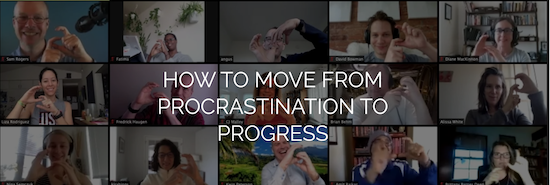
Pitching itself as a virtual co-working model for anyone who wants to get anything done, Focusmate provides body doubling in a more traditional sense. There are only two participants, you and your randomly-assigned Focusmate partner.
 Create an account and then book a session for the time you want, and at the appointment moment, you join a video call. New sessions are available every 15 minutes, so if you’re feeling the need for support, you won’t have to wait long, even on weekends or in the evenings.
Connect via the Focusmate web app in your browser. On your computer, you’ll need to use Chrome. On a mobile device, you can choose Chrome or Safari. You can add virtual backgrounds, screen sharing, and video effects.
Each session is either 25 minutes (the length of a standard Pomodoro), 50 minutes, or 75 minutes, bookended by an opportunity for you each to share your goals and then recap how you did…and celebrate your mutual successes. Your partner remains in a minimized picture-in-picture while you work.
Interestingly, while you are co-working, your camera remains on for the entire session, sound is optional — there’s a mute button — but some people thrive at body doubling when they hear another person’s typing or breathing. However, you are not supposed to converse; there’s a text-based chat for entering the tasks you’re working on, or if you need to communicate. On the plus side, this ensures that you will feel the complete body doubling experience, with the presence of another person matching your energy completing a similarly-styled task.
Although most often used for professional (i.e., desk-based work), the FAQ notes that as long as you keep your camera (and audio) on, you can use the platform for other kinds of tasks, including household tasks like cooking and cleaning, as well as “art, music, writing, reading, even at-home exercise!”
Although partners are typically randomly assigned, you can “favorite” them by tapping the star (☆) next to your partner’s name in a session, on their profile, or on the People page. Then, you can later choose to schedule a “locked-in” Focusmate session with that specific favorited person. Once you favorite someone, you can “snooze” them so you’re not partnered with them again for a set time.
You can use the Availability setting to control who can book scheduled sessions with you: all Focusmate members (except anyone you might have blocked or snoozed) or only favorites, or refuse all invitations to scheduled sessions.
The FAQ notes that, “Accountability is enforced by Focusmate and its community members. If you’re late or don’t show, Focusmate can detect it and your timeliness score will be reduced, and your account can also be frozen. If your partner goofs off during the session, you can report it using the reporting button on the appointment card in your dashboard.” This is great for rule followers who seek a serene experience, but it feels kind of like how you and your Uber driver rate one another — potentially stressful.
I really like that Focusmate talks about the science-based success of the behavioral triggers of the body double method, similar to what we discussed last week: pre-commitment, implementation intentions, social pressure, accountability, task definition, neurotransmitters and brain chemistry and flow.
Focusmate is free for up to three co-working sessions per week; at the Plus level, it’s $6.99/month if billed annually or $9.99/month if billed monthly.
There are also two separate Community and Team plans with special pricing designed to increase interaction and member connection within far-flung communities or companies without direct supervision. Additionally, businesses (especially those with employees who works off-site and without supervision) can reduce remote workers’ sense of isolation while improving productivity and focus.
CO-WORKING MEMBERSHIP SUBSCRIPTIONS
Flown
Want help taking flight with your creative inspiration? Flown’s founder started with Cal Newport’s Deep Work, and then experimented with creating in-person deep work retreats – at a villa in Spain, a chateau in France, and a townhouse in Portugal. (Nice work if you can get it, eh?) COVID scuttled the in-person events, but not the concept, and Flown was born.

Flocks are group co-(deep)working sessions run on Zoom and facilitated by experts. Choose the session types on the dates you want to attend, and Flown sends you calendar invites to ensure you can have the time blocked out, uninterruptible. Click the link in the invitation, turn on your camera, state your goals, and work! Share your achievements at the end!
Flocks have a wide array of styles and focus areas. Deep Dives, offered five times a day, are silent work sessions for anything you want to focus on. After Flockers (attendees) state their goals, everyone settles into two 50-minute deep-working flights; there’s a “quirky” quick break at the one-hour mark to keep your mind fresh.
Twice per day, you can attend a sprint-styke Power Hour where you focus on getting key tasks completed. They’re designed for getting you into a flow state for that productivity boost.
Flown also has four 20-minute morning Take-Off sessions, which include a short meditation, handwritten journaling time, and an opportunity to state your day’s intentions to fellow Flockers. Finally, there are 8-hour freestyle Drop-In sessions; arrive and leave whenever you like to take advantage of body-doubling co-working sessions to get your deep work done.
For those who would like a bit of motivation without actually interacting with other humans, you can watch a Flown Porthole, videos of other people doing deep creative work. Pick the ceramicist, author, sculptor, athlete, or others. It’s faux body doubling, similar in theory to what I discussed in Flow and Faux (Accountability): Productivity, Focus, and Alex Trebek), but more motivating.
Flown also offers three recharging events:
- Airflow — Live, coached breathwork sessions to renew focus and boost well-being, side-by-side with other session attendees.
- Almanac — Nugget of inspiring content designed to help you refresh between Pomodoros or other stretches of work sessions; they’re designed to help “fuel divergent thinking.”
- Awe Walks — Live, guided active meditation walks to help you detach from work and refresh your mind.
Flown offers a 30-day free trial, after which there are two membership options. Join Flown Free and participate in Flocks, Take-Offs, Airflow, and Awe Walks for free on Fridays only; avail yourself of Portholes and other on-demand content twice/month with limited access to Flown’s Academy (guides to deep work) and community. Flown Free members can only schedule one live event at a time.
For $19/month ($225 billed annually) or $25/month (billed monthly), Flown Full offers unlimited access to everything and extra booking options. (UK-based members with ADHD can apply for grants for financial support.)
On the down side, Flocks are only offered on weekdays, which makes it less advantageous for working on a side-hustle outside of your Monday-Friday grind.
Cave Day
Two years ago, this was the best-known, most-researched co-working brand.

Trained focus experts lead Cave Day participants through 1- or 3-hour, pre-scheduled sessions. There are 50+ participants in each session, held via Zoom, though you announce your goals in smaller breakout rooms. Cavers are invited to hide their phones, turn off their mics, keep their cameras on, and settle in for “head-down focus” in their work sprints.
To maintain energy and focus, each Cave session alternates between deep work sprints and invigorating breaks. Based on efficacy research, sprint lengths vary from 45 to 52 minutes to “optimize the brain’s focus capacity.” The exact length is a surprise so you will immerse yourself in work and not watch the clock. They note, “Because of the nature of deep work and distractions, we don’t allow late arrivals. Sorry.” (You can, however, leave early.)
Click on a Cave in the weekly schedule to book it. Ad hoc drop-in sessions are $20, or you can purchase one of three membership types: $30/month (paid annually), $35/month (paid quarterly) or $39.99 for monthly members.
Flow Club
This online co-working option has a sleek, clean look and a focus on achieving flow, and is particularly promoted to professionals with ADHD.
Flow Club has its own web app, which operates inside your browser. There are hundreds of live sessions each week, around the clock, and session lengths can be 60, 90, or 120 minutes in duration.
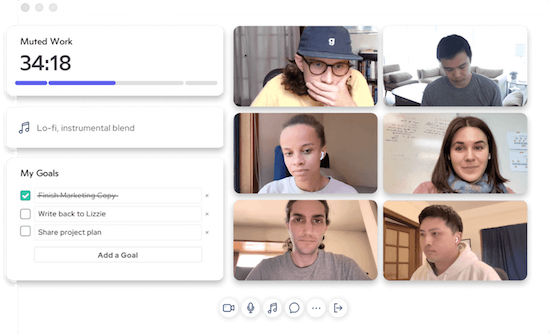
Book a session listed on the schedule of upcoming options to “pre-commit” and make yourself more likely to attend. (You can schedule at the last minute, though.) Sessions are hosted to keep everything on track, and there are up to eight participants at any session.
Show up at the appointed time; participants share their goals and then the host sets a timer (and may begin playing focus-inducing music to help induce a flow state. (The schedule indicates which sessions have music, in case that’s something you want to avoid.) Meanwhile, cameras stay on, but everyone is muted and focuses on completing their own deep work. At the conclusion of the session, everyone debriefs and celebrates their achievements (or at least their progress).
You can try Flow Club for free, but then it’s $40/month (or $33.33/month if paid annually) for unlimited access.
TWO MORE OPTIONS AT OPPOSITE ENDS OF THE COST SPECTRUM
Social Pomorodo
Perhaps you want something a little more casual? Don’t want to have to register? Social Pomodoro is about as low-fi as you can get and still be on the computer. Choose one of three options:
- Single Player — To get the hang of it, opt for a computer to be your body double.
- Veteran — Once you know what you’re doing, click on this option to be assigned a work buddy. Traffic is relatively low on this platform, so they suggest clicking Veteran status in “idle mode” and wait for someone to join you. (You can use Single Player in another tab simultaneously.)
- Friend in Mind — Want to body double but don’t want a Zoom, Meet, or Teams account? Have a friend head to Social Pomodoro around the same time, and you can click this button to make sure you get put in the same Pomodoro room.
In all three versions, buddies have 120 seconds to one another in the chat box and text about goals for the session. You’ll see the timer count down to ensure you each get time to talk and are ready to hit the ground running.
Next, work for 25 minutes, a standard Pomodoro measurement, without chatting. The one-screen countdown timer helps you keep pace. At the end of the session, there’s another 120 seconds to share how things went.
Social Pomodoro is a quick alternative if you need your feet held to the fire to complete short tasks like making phone inquiries, scheduling appointments, reading school assignments, drafting emails, or doing a brain dump.
On the up side, it’s free, low-tech, and you don’t have to create an account. However, you’re not going to must live body-doubling suppor unless you bring your own.
Spacetime Monotasking
This simultaneously one of the most flexible, most expensive, and most proactively progressive co-working platforms, stating that they are “committed to creating a welcoming environment for BIPOC, LGBTQIA+, neurodivergent, and people of other systemically marginalized identities.”
Two like-minded women on TikTok founded Spacetime Monotasking (the opposite of multitasking) designed it to “support creatives, entrepreneurs, freelancers, and anyone who wants to use their time differently” by tuning out the outside world and focusing on your priorities. They call it mindfulness in motion.

Spacetime Monotasking hosts live sessions every weekday run through a Discord server. (In case you’re not familiar, think of Discord is a worldwide social media for voice, video, and text chat.) Begin with Spacetime Monotasking’s start page, accept the invitation, and register with Discord.
There are three levels of ongoing memberships: $35 for 5 sessions/month, $55 for 10 sessions/month, and $85/month for unlimited sessions. You can also opt for a drop-in session for $10.
Additionally, individuals can apply for a discounted membership: “Our Boost Rate is intended to uplift BIPOC and others who experience systemic economic disadvantages.” There’s no free trial for the live, hosted monotasking sessions, but you can experience a video version of a Spacetime Monotasking 1-hour sprint:
If you don’t belong to an organization that offers co-working sessions and aren’t up for starting your own, would you try one of these platforms? From free up to $1020/year (with many price points in between), from one body double to a crowd of fellow workers, which appeals to you the most for conquering procrastination and getting into that flow state?
Paper Doll Sees Double: Body Doubling for Productivity
Knowing what you have to do and doing it aren’t the same things. If you were raised in the 1980s or 1990s, you learned you were supposed to eat according to the food pyramid. Nowadays, there’s the updated MyPlate approach to healthy eating, to make sure everyone gets the right proportions of fruits and vegetables, grains, protein, and dairy each day.

But knowing how you should eat doesn’t mean that you’ve never contemplated chowing down on break room doughnuts for breakfast. And it’s not just fictional characters like Olivia Pope who’ve had wine and popcorn for dinner.

And while sometimes family, friends, and colleagues can lead us astray from nutritional goals, it’s been proven that hanging out with people whose health goals are similar to yours can help keep you on the straight and narrow.
Simply put, when you’re with people who model good behavior, you’re more likely to participate in that good behavior. So, what does this have to do with organizing or productivity?
BODY DOUBLING AND ACCOUNTABILITY
Two years ago, I wrote Count on Accountability: 5 Productivity Support Solutions, one of the most popular posts I’ve had in the 15+ years I’ve been writing the Paper Doll blog. The concept of getting accountability support to conquer procrastination and achieve more productivity really resonated.
Perhaps you only know about body doubles in movies or on TV. That kind of body double often appears when the featured character is doing something the actor can’t do, like a backflip or fancy dance move. Subsets of body doubles are stunt doubles, or in the case of some films with a bit of nudity, “butt doubles.” However, when we’re talking about productivity, the “butt” is not about someone else’s; it’s about getting your own derriere into the chair to attack avoided tasks.
In that post two years ago, I explained the body doubling technique developed in the ADHD community. In support groups, participants found that when another person was present, participating in quiet tasks with a similar (non-distracting) energy, it helped the individual maintain focus and motivation. We professional organizers often work as body doubles with clients (both those with ADHD and those without) because it successfully creates an environment for focused work.
Any of us on our own (but particularly clients with ADHD) might (intentionally or unintentionally) delay working on a task or get distracted. Realized or unrealized anxiety about a task — fear of failure, for example — can prevent someone from starting, but you have to start in order to have anything you can improve upon. (See: “You can’t edit a blank page.”)
When a project is hanging over your head, you might find ways to delay or distract yourself, but when someone is there, investing their time in you (and you’re investing your time and money to achieve your goals), body doubling helps you push past the anxiety and be more productive.
As a professional organizer, when I’m body doubling with a client, we may be working side-by-side or across from one another. I may pre-sort piles of papers into categories (bills to pay, documents to review, items to file) while the client is working through one category at a time to complete distinct tasks. Students quietly studying for an exam in the library or doing homework in study hall are similarly using the body doubling method to achieve focus and productivity.
Scientific research on the benefits of body doubling are scant, but I can think of at least six (interlocking) ways in which body doubling advances an individual’s ability to stick with a task:
- Accountability — By definition, accountability is “the obligation or willingness to accept responsibility for one’s actions.” You may feel like introducing a second party to get your own work done is cheating, but it’s not.
Really, accepting responsibility means marshaling all of your resources to attack a problem and achieve the stated outcome. If a body double, accountability partner, mastermind or study group, workout partners, or anyone else can help you achieve your goals by their mere presence in your life, availing yourself is no different from having a state-of-the-art computer, a current eyeglass prescription, or properly-fitting running shoes. A body double is just a quiet, human-shaped resource for maintaining accountability.

Studying in Library Photo by Robert Bye on Unsplash
- Social pressure — If someone present with you expects you to get something done, you’re probably going to stick with it and do it. Of course, we’re not all equally responsive to the presence and expectations of others.
Gretchen Rubin’s work on her Four Tendencies framework (how we respond to inner and outer expectations) is a great place to start for understanding the role of social pressure in getting things accomplished.
Some people are Upholders, disciplined at meeting both their own expectations and those of others. Me? I’m an Obliger. I’ve got superior discipline when someone is waiting for me to do something. I am always on time to meetings or appointments, and I deliver what is expected of me by deadlines. However, I’m iffy at goals that only satisfy my own preferences.
Rebels can’t be forced or convinced, but the beauty is that a body double isn’t a boss or a manager telling you what to do. The body double is just mirroring what you’re doing. There’s nothing to rebel against; the body double is just along for the ride. Meanwhile, Questioners can’t be convinced by expectations, only their own pathway to finding meaning in the task. As with Rebels, the body double’s role is as travel companion.
The key is that for those who struggle with getting started or sticking with a task, a partner or several can improve the likelihood of reaching goals.
- Project or task orientation cues — On their own, many people have difficulty maintaining focus on the project at hand. This can be the result of any of a variety of executive function disorders or just a byproduct of living in the 21st century.
For every work-related search you do on Google, you’ll encounter numerous links — both on the search page and then in the sidebars, body, and bottom of the articles you’re reading — specifically designed to take you somewhere else on the web.
On our own, we go down rabbit holes and can’t find our way back to the original link or get trapped in dozens of open browser tabs. Body doubling means that just on the periphery of our consciousness, we’re aware that someone else is present, and that keeps us tethered to our work. We may go astray, but our body double’s presence can bring us (and our focus) back to the here and now.
- Biological cues — The experience of participating in body doubling and mirroring the body double’s behavior can help activate some nifty neurotransmitters. Literally, doing the task cues the bodily systems to kick start, making it easier to hunker down and do the work.

Do It Now Scrabble Tiles by Brett Jordan on Unsplash
- Task execution — “Well begun is half done.” (Aristotle) “You don’t have to be good to start … you just have to start to be good!” (Joe Sabah) “Only put off until tomorrow what you are willing to die having left undone.” (Pablo Picasso)
Such quotes are all well and good, but if you’re using procrastination to soothe your present discomfort, you already know you’re going to feel worse as the deadline approaches. To borrow from what I wrote in my original post on accountability:
Canadian psychology professor and all-around expert on procrastination, Timothy Pychyl, author of Solving the Procrastination Puzzle: A Concise Guide to Strategies for Change, explains that procrastination isn’t just delay. He explains that procrastination is “a voluntary delay of an intended act,” one where the person procrastinating is cognizant that the delay is going to have a cost, whether that cost is financial, interpersonal, professional, legal, or otherwise.
When we procrastinate, we know that there’s no upside; we aren’t merely weighing a logical choice between two options of equal value. It’s less, “geez, how can I decide on whether to go on this romantic anniversary date with my spouse or prepare for my presentation this week?” and more, “Eek, I’m feeling icky about doing this thing for some reason and I’ll latch on to any random thing, like bingeing a sit-com I’ve seen in its entirety three times!”
Experts like Pychyl have found that at its base, procrastination is “an emotion regulation strategy” – a way to cope with a particular emotion while failing to self-regulate and perform a task we know we need to do. We convince ourselves we’d rather feel good now, thereby causing more trouble for our future selves.
Getting started on those tasks is hard. But the minute you have another person there with you, you’ve got a (silent) partner whose presence makes getting procrastinating less possible and doing the (appropriate) activity a smidgen easier.
- Extended focus — It’s common to have trouble sticking with tasks that are boring, repetitive (and thus boring) or lengthy (again, yawn). The presence of others who match your energy and behavior type (reading, writing, doing math homework, sorting, etc.) sprinkles a little extra fairy dust to keep focus a bit longer.
If you were doing a series of Pomodoros (25 minutes of work, 5 minute breaks) on your own, you might give up after one or two. Someone else doing the same or similar tasks in your nearby environment is kind of like keeping pace with another random jogger or bicyclist on your route. If you were on your own, you might give up, but just a little bit of what I think of “competitive companionship” may be all you need to keep going.
To learn more about body doubling, consider:
Could a Body Double Help You Increase Your Productivity? (CHADD)
‘Body doubling,’ An ADHD Productivity Tool, Is Flourishing Online (Washington Post)
Use Body Doubling to Increase Your Productivity (Life Hacker)
How Body Doubling Helps When You Have ADHD (VeryWellMind.com)
I Tried A ‘Body Doubling’ App To Help With Focus – It’s Weird But It Works (Refinery 29)
What to Know About the ‘Body Doubling’ Trend That’s Keeping People with ADHD on Task (Men’s Health)
CO-WORKING FOR ACCOUNTABILITY
Body doubling as a method of accountability has been on my mind lately. In addition to regular client-related work and this blog, I have four special projects in the course of six weeks. I’m being interviewed for a podcast and for a video summit, participating an online summit requiring me to make a video and appear on live virtual panels, and I’ve got an in-person speaking engagement next week. Yikes!
All of these projects require research, writing, and finessing of verbal expression. (I like to be prepared, even when I will eventually have to be extemporaneous.) Deep down, I know it will be fine, but we all have bits of performance anxiety seep in. Timothy Pychyl might say that my temptation toward procrastination is a bit of (messed-up) emotional regulation strategy. But I’ve had (and will soon have more) help in sorting it all out.
Co-Writing Sessions
I’m a member of the Authorship and Publishing Special Interest Group (SIG) in the National Association of Productivity and Organizing Professionals (NAPO). We have monthly meetings and an email group for supporting one another as we write books, articles, blog posts, presentations, and other projects.
Last week, the SIG began holding weekly two-hour co-writing sessions. A small number of us log on to a Zoom call, talk about what we hope to accomplish, and then settle down to write. We each muted our microphones (especially important for me, as I tend to think out loud, which would make it hard to be a silent body double for anyone else), content in the knowledge that if we needed to reach out to our fellow writers, we could type a message into the Zoom chat.
When I minimized the Zoom window, instead of it dropping into the Mac dock or otherwise hiding, it turned into a tiny, floating, repositionable window (about 3/4″ high by 2″ wide). I could see one of my co-writers — in miniature — and it reminded me that I had a goal and that someone <waves hands> out there is on my side in the effort to get my project done.
At the top of the next hour, we turned our mics back on just long enough to check in, offer support, and return to our writing for another hour. I used the first co-writing session to prepare my notes for the summit interview two days later, and felt so confident and prepared because I had this co-writing time.
These are drop-in sessions on a fixed day each week; the participants will change according to each writer’s need and availability, but I’m already looking forward to the next one.
“Making Space to Write” Virtual Writing Retreat
In some ways, that co-writing session was a practice run for an event this past Friday, January 27th. Two of our Authorship & Publishing colleagues, Standolyn Robertson and Leslie Hatch Gail, put a lot of planning into the event. Registration was required, and we had an hour-by-hour retreat agenda.
We were encouraged to set our goals in advance, and once we arrived, after brief introductions and some housekeeping announcements, we hunkered down for 45 minutes of quiet writing time, nudged by a slide with a motivating quote.
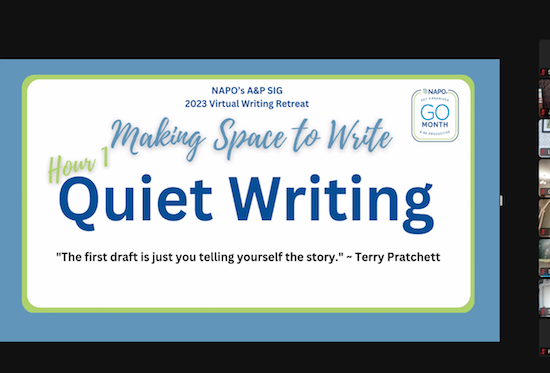
(Per participant requests, I am not including any identifying photos.)
Because the live Zoom screen showed the participant gallery and a shared slide, the minimized floating screen wasn’t showing me my colleagues, just the slide. I thought that might lessen my feeling that I was being body doubled, but it didn’t. I was always aware (and calmed by) the slide’s reminder of everyone’s presence.
From then on, at the top of each hour we had 15-minute “human breaks” to stretch, address any biological needs, and answer a prompt slide prompt. Questions were lighthearted and ranged from “What hobbies are you participating in?” to “What was your best purchase in the last year?” We entered our answers on the chat screen, had a little verbal interaction on Zoom, but at the quarter hour mark, we all went back to writing.
What fascinated me was that every time I’d get to a logical stopping point in my writing, ready to take a breather, I’d look at the clock and see it was just the 59 minute mark of the hour!
Around 1 p.m. (in my time zone), we took an hourlong lunch break. Some attendees had to run errands, but for the majority who stayed, it was like having a lunch with co-workers, something we professional organizers (mostly solopreneurs) rarely get to do. Finally, after a full day of writing, we had a social hour during which time we played a rousing and hysterical online version of Scattergories.

Which Experience Was Better?
Comparing and contrasting these two events, it’s easy to see the differences. The co-writing session was fairly informal, of a short duration, and included only four participants. While we used one member’s Zoom account, there were no real leaders; we each took responsibility for our own behavior.
Conversely, the virtual writing retreat was more formal (with the exception of wardrobe), with Standolyn and Leslie moderating and leading us through activities. It ran from 11a to 6p (including lunch and our day-ending Scattergories socializing) and had about a dozen writers in attendance.
On an ongoing basis, I can see the advantage of short, weekly co-writing sessions. I’m not usually a fan of events that are too formal or rigid in terms of an agenda. But I absolutely loved the retreat and am hoping we’ll have them a few times a year, as I can picture using the experience to keep me motivated and focused for long-form writing projects.
What’s Next for Paper Doll and Body Doubling Accountability Sessions?
My first experience with these kinds of virtual session was more than a decade ago, when my colleague Deb Lee ran “Action Day” events, which were similar, but run on the telephone. Participants called in, talked about their goals for household or work projects — technology-related tasks were always popular — and stepped off the phone to work. We had various check-ins throughout the day. (In later years, Action Day went high-tech with video conferencing.)
Deb and I used to be on various committees together, but rarely get to chat nowadays. I’d been missing the inspiration she brings to every encounter. After a quick email discussion, we’ve scheduled our own Action Day/Body Doubling/Accountability Extravaganza for mid-February. It’ll be suuuuuuper-informal and only for a few hours, but just anticipating the experience is helping to dispel my procrastination gremlins from their usual hiding places.
FINDING YOUR IDEAL BODY DOUBLE OR ACCOUNTABILITY PLATFORM
My experience has focused on writing, and certainly as evidenced by research summarized in pieces like Writing Accountability Groups (WAGs): A Tool to Help Junior Faculty Members Build Sustainable Writing Habits, it works. But body doubling works to support accountability and boost goal achievement for any activity, from getting your housework done to writing your overdue post-wedding thank you notes. It’s just a matter of finding the right approach and platform for your needs.
In my original post, I focused on five types of accountability options (with some suggested links):
- accountability partners, like friends, colleagues, or people you can meet through apps
- accountability groups, like mastermind groups, in-person or virtual study groups, and professional groups
- professionals, including professional organizers, ADHD coaches, life coaches, and fitness trainers
- apps and gadgets
- accountability events
Not all accountability experiences or platforms are designed for body doubling, per se. For example, mastermind groups tend to focus on support through discussion; all coaches act more like instructors some of the time, though some will offer body doubling support.
Attributes of Body Doubling Platforms
If you want to experiment with body doubling for accountability, consider these factors:
- Formality — Do you prefer things to be structured or loosey-goosey?
- Number of participants — Would you rather only know there’s one other person in a session?
- Familiarity with participants — Would you feel more comfortable with strangers or people you know well (or perhaps people you only know a little bit)?
- Cost — Will you be more motivated if you pay someone (like a professional organizer or coach) or an organization, or might that cause you stress? Would you rather sign up for a monthly membership (like going to the gym) or would you prefer to only pay for drop-in or ad hoc activities?
- Level of communication — Do you want to mostly be a Silent Sam and not have any interaction with your body double(s)? Would you prefer frequent social check-ins, perhaps each hour?
Group Body Doubling For Productivity and Accountability
Two years ago, there were only a few major platforms for group co-working that embraced the body doubling approach as part of accountability groups; now, there are many more. Next time, I’ll be sharing a post comparing the different platforms, their features and costs, and how they work.
And, based on my recent experience, I’ve been considering setting up my own virtual events, perhaps starting with my (in-person and virtual) clients — perhaps a Study Hall for Grownups or Admin Action Adventure. (Yeah, I’ll keep working on the name.)
Similarly, you might gather family, friends, or colleagues to participate on a more ad hoc basis when you need a little support.
Have you participated in any (virtual or in-person) body-doubling activities? What do you do when you need accountability support, and don’t want to talk that much about it, but just do it?
Follow Me