Archive for ‘Paper Organizing’ Category
Paper Doll Organizes Temporary Papers and Explores Third Spaces
WISDOM IN THE COMMENTS SECTION
Although the comments sections of most locations online can be scary, organizing and productivity blogs tend to avoid that unpleasantness. In fact, some of the niftiest ideas for posts come from the comments sections of other posts.
Last week, commenting on the cute magazine files in Paper Doll Refreshes Your Paper Organizing Solutions, Sara Skillen mentioned:
I’ve always loved magazine holders for all kinds of paper…but also, high quality, shallow, flat trays work for a lot of my clients (those who pile). I know, I know, we all think piling is not a great idea, but for temporary kinds of paper like bills, notices, etc. it can be an amazing solution. Less barrier to putting things into broad categories, and easy to dump in the recycle bin when things are no longer relevant. I’m also a fan of very small filing boxes (like the Bigso ones at the Container Store) for temporary paper. Easy to place on the desk for quick access.
I think that Sara and I might slightly disagree about what constitutes “temporary” paper. I believe that if you receive a paper bill, the best practice is to have a system in place so that you not only pay the bill, but file and store it for later (potential) retrieval for tax purposes, troubleshooting, budgeting, etc.
However, Sara has truck on a topic that we discuss far too infrequently — paper that doesn’t fit into either of the two main, overarching paper categories.
Last week, I referenced a guest post I’d written for Yve Irish’s blog. In that guest post, How To Make Paper Less Overwhelming, after discussing the reasons why paper management can be so difficult, I wrote:
Paper categories can be much more complex and require more thought than most other tangible items. It starts off easily enough, with two basic categories:
-
-
-
Action paperwork — This reflects all the paper that triggers an activity. From the lowly coupon for a free car wash at the new Wash-o-Rama to the reminder postcard for your medical appointment to the registration forms for your child’s summer camp, action paperwork is relatively easy to corral in an in-box or my preferred method, a tickler file. (Getting motivated to actually do the tasks is another issue altogether.)
-
Reference paperwork — If a piece of paper doesn’t trigger an action, but it’s something you need (or want) to keep for later retrieval, it’s reference.
-
-
In between the action paperwork that’s designed to trigger us to do something and the reference paperwork (whether current, or archival) for us to keep records at least semi-permanently (until they expire or are replaced), there’s a third category of papers that neither requires our activity or our long-term storage. For want of a better name, let’s go with Sara’s simple title, temporary papers.
WHAT ARE TEMPORARY PAPERS?
Beyond describing what they are not, let’s look at what constitutes an example of a temporary paper.
- Receipts — Certainly, there are different categories of receipts, each treated differently. If you’ve purchased something in cash that is not, for whatever reason, going to be returned, you can immediately shred or toss the receipt. A lunch at fast food restaurant comes to mind.
Other receipts need to be filed and kept semi-permanently, such as for any big ticket items for which you’ll need to prove value or ownership (like a piece of jewelry) for insurance purposes or use as support for your taxes.
But there are a whole slew of receipt types that you may need to keep temporarily, for short-term purposes. For example, if you’re cautious about making sure your credit and debit card receipts are accurate, you may keep a month of receipts (please — tidily in an envelope for that month and not crumpled all over your dresser) until the credit card bill comes or you remember to check online. (Restaurant receipts seem to be the most common culprit for inexact matches. Although sometimes the charge reflects a tip much higher than what you wrote on the slip, I recall one restaurant that regularly (at least 25% of the time) failed to apply the tip. Eventually, I gave up and started tipping in cash.)
Another common temporarily-maintained receipt is for any purchase you might return. Except around the December holidays, most retail locations have a return policy limiting returns to no more than 30 days. It’s understandable that you wouldn’t want to file away a receipt only to dig it out a few weeks after you make a purchase; you’ll want to have those receipts handy in case something fails to fit or flatter. (Some people, like Paper Mommy, hold onto their grocery receipts in case something turns out to be yucky or spoiled; only you know whether you have the time and willingness to return a $3 bottle of salad dressing.)
- Temporary Driver’s License — To get a driver’s license, you generally have to go to the DMV, fill out all the forms, pay a fee, and take a written test and a driving test. If your experience doesn’t turn out like Reverend Jim’s on Taxi, you’ll be approved for a license and then have your photo taken.
(If the last minute or two of this video doesn’t make you feel like the laughing-crying emoji, I don’t know how you ended up on my blog.)
However, because driver’s licenses are hard, fancy plastic cards with bar codes and holographic images and sometimes magnetic stripes, you generally don’t get your real driver’s license the same day. Instead, you usually get a paper printout of what your card should look like.
When you come from another state, most DMVs will require you to turn in your out-of-state license, and your temporary license is all you have to prove that you are a licensed driver until the real license arrives. You’ll want to keep this temporary license with you, in your wallet until the new, real license is in hand.
However, if this is a driver’s license renewal, the paper version is just your proof that your new license, with an extended expiration date is coming. If you’ve renewed at least a few weeks ahead of the expiration of your current license, there’s no need to carry the temporary paper around with you (unless you’re afraid you’ll forget that the process isn’t complete. In that case, set a reminder on your phone for a day before the expiration date to make sure you’ve received the new license and replaced the old one in your wallet!).
- Shipping and Return Slips with Tracking Information
When you ship packages and documents, the United States Postal Service has a variety of ways to ensure that you can protect your package and track its progress. For example:
Registered Mail Receipts and Tracking Numbers — Registered Mail provides security when you send something that’s difficult to replace, valuable, or otherwise needs to be tracked for additional security. You might choose Registered Mail if you’re sending something via First-Class Mail, First-Class Package Service, or Priority Mail. In theory, at least, your mail or package is secured in a sealed container or locked cage or safe during transportation, and the USPS obtains electronic and physical signatures to show you the chain of custody along the way.
You get a receipt for the item when you send it, and the then your recipient must sign for it. And if you want proof that the item was delivered, you can purchase Return Receipt or Return Receipt After Mailing service and get electronic verification of either delivery or an attempted-but-failed delivery.

Mailbox Photo by Abstrakt Xxcellence Studios
When you send a letter through Registered Mail, the post office gives you tracking information. This is important to keep handy so that you can type the tracking number into the online system or scan the QR code or bar code to track the item until it arrives at its destination. At that point, whether you keep it or not depends on the situation.
You get similar information when you send something through a delivery service like UPS or FedEx. Have you ever returned an Amazon package at a UPS store or another retail location? Brandish a printout of an email or show a QR code on your phone, and a staffer enter the essential information into the computer and hand you a sticker with the vital details, including the tracking code. Type the string of letters and numbers into the delivery service’s tracking system (or even directly into Google!) to track your item.
So, if you’re making sure your grandchildren got their birthday gifts and your son-in-law calls to let you know the LEGO arrived, the temporary paper (the tracking slip) can be discarded. (Let’s hope you don’t have to wait for toddlers to get old enough to write their own thank you notes!)
If, however, you’re returning an ill-fitting or broken item to Amazon or other vendor, you’ll want to hold onto that temporary paper until your account has been properly credited or a replacement item makes its way to you.
USPS Certified Letter Receipt — Certified Mail is similar to, but not the same as Registered Mail. With Registered Mail, you get all that yummy tracking goodness, but you’re (allegedly) getting extra security for your item. However, with Certified Mail, you’re just paying for tracking and proof of delivery, generally for important documents like tax returns, legal notices, and financial transactions.
To send a certified letter, you fill out two forms, a flimsy piece of green and white paper and a stiff green piece of card stock.
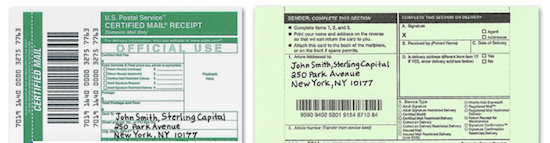
The flimsier piece of paper is your receipt, and it shows your unique article number so you can prove the piece was mailed and track the delivery status online. When it gets delivered, you’ll get notified of the time and date of delivery and then you’ll get the signed green card back in the mail.
If you’ve taken the measure to send something via Certified Mail, it’s pretty likely that you’re going to want to prove, longer-term, that the thing you sent was delivered, so your receipt (and the eventual green card) may not be so temporary.
It may be temporary while you’re waiting to confirm delivery, but if you don’t get proof of receipt, it’s likely to turn into an action item, because you’ll have to fuss with the post office, but even if it is delivered, you’ll then have to wait for the attorney, the IRS, or the person you’re paying to acknowledge that the item was received and that they are actually acting upon said receipt.
So, your Certified Mail paper may go from being temporarily temporary paper to being action paper (and go into your tickler file) and/or permanently stored in your reference paperwork in case there are long-term legal or financial implications.
- Problem/Conflict-related Papers — How often do you receive a bill that appears to have a mistake on it? Do you ever get a notice about a recall for your car or a household appliance? Ever get invitations to showers or weddings that give no indication of where the person’s gift list is registered?
Sometimes, you open the mail and immediately make a call or send an email asking for clarification. And then you wait. And wait. It would be nice if all questions and conflicts could be handled within moments, but sometimes you have to wait hours or days for a response before you can determine whether the temporary piece of paper is now fodder for the trash or recycling bins or needs to be scheduled as task or filed away.
So what do we do with this temporary paper while we wait?
WHERE SHOULD YOU KEEP TEMPORARY PAPERS?
There are two main approaches to keeping temporary papers. As much as I’m tempted to say, “my way or the high way,” it really is a matter of either Paper Doll‘s way or a Third Space way.
Tickler File
Longtime Paper Doll readers know I like using a tickler for action-oriented paperwork. It avoids paper clutter on the desk, and it triggers the owner of the paper to make decisions about when and how the piece of paper will be acted upon. How strongly do I feel on the topic? Well, I did write a whole ebook about it!
Whether you purchase a tickler file with slots for each day of the month and for each month of the year or create your own DIY version with 43 file folders, you get a parking space for anything that requires, or might require, action. Sometimes, the action required is checking to see whether you still need to be waiting.

In examples above, you might use the tickler file for temporary papers in the following way:
- Receipts — Keep receipts in a #10 envelope located in a slot for a particular day of the month, like the 1st or the 15th. If you need to return something, you’ll know exactly where to find the receipt for what you purchased. Otherwise, on a monthly basis, when you get to that day’s slot, flip through the receipts, check them against your credit/debit statement (if you’re so inclined), and then toss or shred receipts for anything that went unreturned and didn’t need to be questioned/resolved.
- Temporary Driver’s License — If told you’ll receive your permanent license within 7-10 days, pop the temporary one in the tickler for that 10th day (or, if you need to carry the temp in your wallet, just leave yourself a note in the 10th slot). If the new one arrives, shred the temporary one that day; if you open the tickler file on the 10th day and your permanent license still hasn’t arrived, it will trigger the action of following up.
- Shipping Slips with Tracking Information — Unless you have a reason to track the path of whatever you’ve shipped on a daily basis, just set it in the tickler file for the day you expect the item to arrive (based on estimates) and when you get to that day’s slot, if you haven’t already received some kind of confirmation, track the item online.
- Problem/Conflict-Related Papers — Put the paper on the day you intend to act on it (by making a call, sending an email, visiting a venue, etc.). If you’re waiting for a return call/email, move the paper forward, day after day, until you hear back or choose to take another follow-up action.
In summary, I treat temporary papers as action paperwork. It keeps them tidy and sorts them according to the likely day on which you want to act.
But it takes commitment to the system. If you aren’t that into commitment (to your paper system — Paper Doll doesn’t need to know your private beeswax), there’s a second path.
Sara Skillen remarked in her original comment, “we all think piling is not a great idea, but for temporary kinds of paper like bills, notices, etc., it can be an amazing solution.”
So, how can you pile your temporary papers and make it work?
Third Spaces
I’ve been fascinated by the concept of third spaces in modern life. We spend most of our lives in two places, home or work (or, if you are a student and doing the work of childhood or youth, home or school). But a third space is an all-important “somewhere else.” The official definition of Third Space Theory says it’s a “postcolonial sociolinguistic theory of identity and community realized through language.”
Um. OK. But all a third space really needs to be is another place where you get together with others of your kind, in a space that’s neither home nor work (or school). Examples of third spaces are coffee houses (like on Friends), bars (like on Cheers or How I Met Your Mother), houses of worship, barber shops/beauty salons, or gyms.
As I got to thinking about Sara’s comment, I couldn’t help thinking that for people who aren’t inclined to use a tickler file, what they really need is a third space for their temporary papers to hang out, a place that is neither for action papers or permanent files.
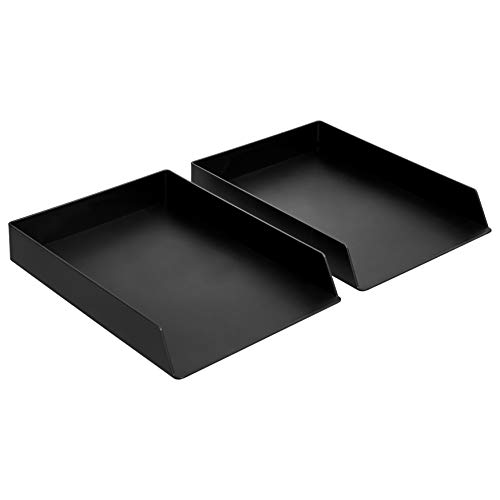
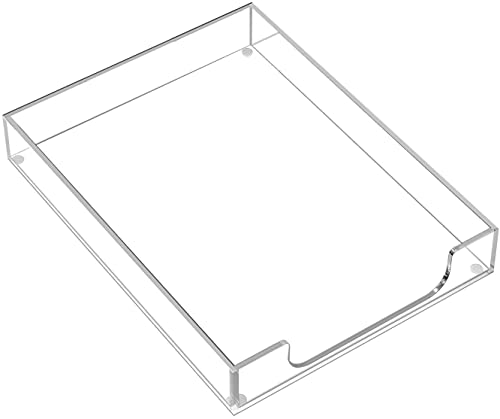
Sara suggested high quality, shallow, flat trays. Examples of these would range from the standard “in” tray (available in black or white, for about $20 for 2),
to a repurposed acrylic serving tray
to any kind of fancy wooden or leather in-box tray.
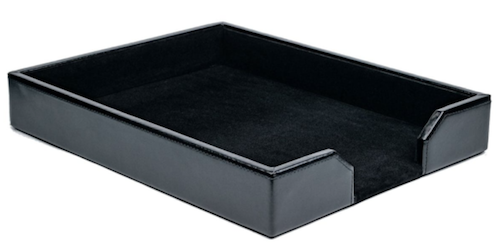
If your piles get high, you’ll have to sift through them, and there’s no date to trigger your attention, but they’ll be kept front-and-center.
Sara also referenced very small filing boxes, like the Bigso boxes at The Container Store. A document box (12-1/4″ x 17-1/4″ x 3-3/8″) like this one is less than $12, and the low profile keeps you from letting it fill up with papers long after their temporary use has passed.
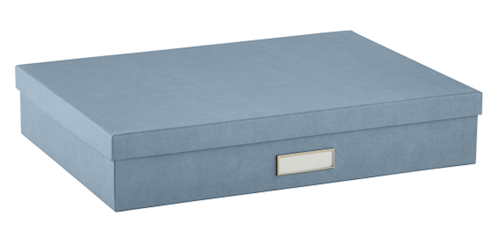
A smaller letter-sized box (10-3/8″ x 13-7/8″ x 3-3/8″) is similar for about $9, and both come in a variety of colors (Navy, White, Steel Blue, Graphite, Grey, Gold dots on White, Blush, and Sage Green).
Bigso of Sweden (and, obviously, other companies) also makes stacked paper drawers, also called paper chests or drawer chests, like this one in Blush (and all of the colors listed above) for about $18:
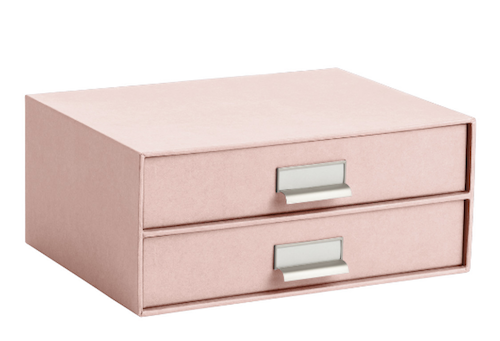 These kinds of boxes will take up about the same amount of desktop real estate as a tickler file or in-tray. However, the lid creates an out-of-sight, out-of-mind concern not present with in-box trays.
If you get distracted and fail to keep your eye on tasks that are hidden from you, set a daily alarm on your phone or computer to approximate the kind of reminder that a tickler file offers, counteracting the tidy-but-forgettable hidden aspect.
But what if you lack desk or counter space to keep your temporary paper handy?
Try a vertical third space alternative:
- Clipboards — Attach your temporary papers to a clipboard and hang one or more on hooks on your wall or from a retractable laundry line. If you have a lot of temporary paper, you might want to label each clipboard with a life or work category, like “household,” “kid #1,” “financial stuff,” and so on.
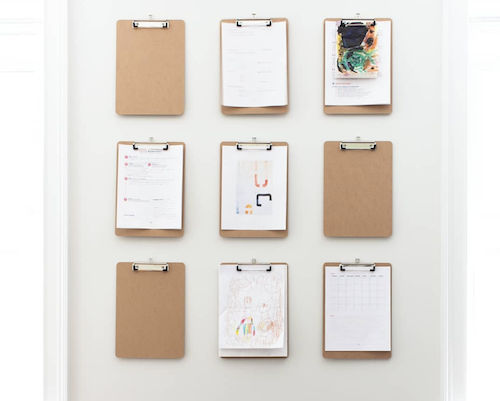
-
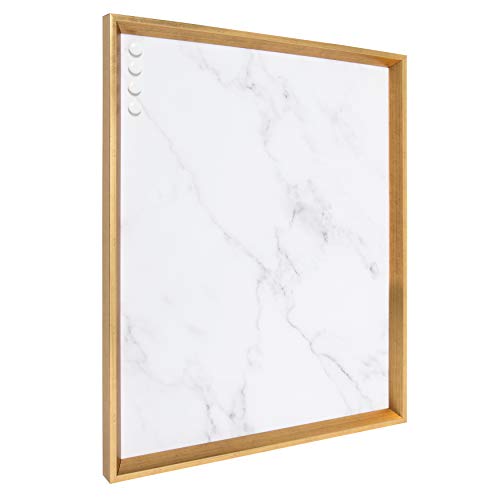
- Magnetic Bulletin Boards and White Boards — If you’re looking for a vertical solution in your work space, and especially if you don’t want to risk poking a hole in a temporary document or piece of paper, a magnetic board will keep a page vertical and visible (provided you’re using strong enough magnets). While there are a lot of standard metal and whiteboard options, a little searching will bring you offbeat or stylish options to fit your office décor, like this framed, marble magnetic board:
- Cork Bulletin Boards and French Boards — If you don’t have a lot of temporary paper but do need to keep it at eye level or you’ll tend to forget about it, bulletin boards and French boards are far tidier options than refrigerator doors, and the kids are less likely to put their sticky jam hands on your papers. Aim for a traditional cork bulletin board, go a little upscale with a French board that matches your decor,

or if you really need a lot of space for temporary papers, a cork room divider is a nifty option.
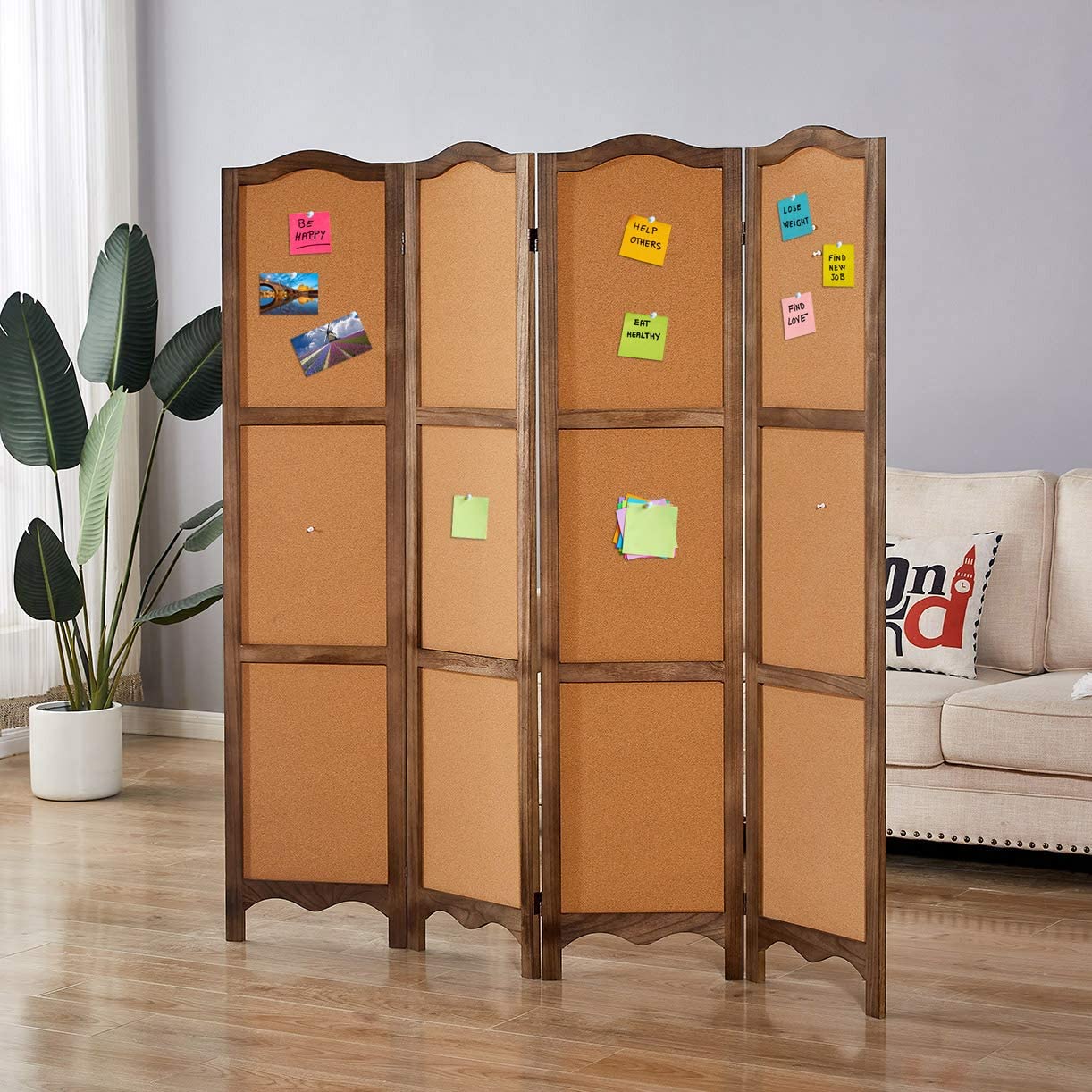
Unlike the file boxes and drawers, a vertical solution will keep your temporary paper visible, but will you actually see it?
The problem with vertically displaying papers is that it’s common for anything on the walls to eventually turn into wallpaper, blending in with the scenery and becoming forgettable, adn what’s forgettable becomes unnoticeable.
Where do you keep your temporary papers?
Do you have a third space for the papers in your life that are neither action-oriented or for reference?
Paper Doll Refreshes Your Paper Organizing Solutions
Springtime gives us an opportunity to refresh how we do what we do. Today, we’re going to give some new thought to our obstacles and strategies for keeping our papers organized, and then take a peek at opposite ends of the spectrum for paper storage solutions: one fun and one seriously sturdy.
REFRESHING YOUR PAPER PROCESSES
My friend and professional organizing colleague Yve Irish in Rochester, New York recently asked me if I’d like to write a guest post for her blog.

We’re in the same Mastermind group, and we’re often talking about how we can help support one another’s businesses, and this seemed like a fun opportunity. It made sense for me to talk about my favorite topic — paper!
How To Make Paper Less Overwhelming
In that post (which is much shorter than the typical Paper Doll post, so you might not need a sandwich to sustain you as you read it), I cover:
- Why it’s so difficult and frustrating to keep paper organized
- The difference between action papers and reference papers
- How to break your files down into clear categories so that you can quickly file them and easily access them again when you need a specific document
- Secrets for success when trying to get — and keep — your papers in order.
I invite you to read the post and visit the rest of Yve’s blog at your convenience. Tell Yve I said “Hi!”
MAKE YOUR SPACE HAPPY WITH MAGAZINE FILES
Most of the time, when we talk about keeping paper organized, we focus on using files folders. (In the guest post above, I even explain why file folders are usually preferable to three-ring binders.) But there are definitely other paper storage solutions, depending on the types of paper we’re talking about.
For example, if the paper is teeny-tiny, like an index card, there are a variety of appropriate storage options, such as I discussed in The Humble Index Card: Organize Your Life, Then Organize Your Cards.
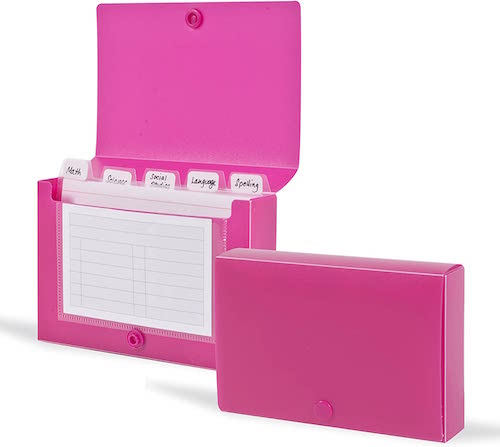
Similarly, although we don’t discuss them often, there are a variety of uses for magazine files. For example, you can use them to store:
- Magazines — Duh! But don’t keep all of your magazines forever, or the foundation of your house will buckle. Instead, magazine files are great for maintaining the most recent month of your subscriptions. When the new ones arrive, you can sub them in for last month’s issue. Magazine files are also useful for keeping oft-referenced magazine issues on a particular topic, such as holiday issues for recipes (though I’d still suggest creating your own recipe file system, as I suggested in Calm Cooking Chaos (Part 1): Organize Your Paper Recipes).
- Store Catalogs — If you like ordering from catalogs, or just have fun flipping through them and dreaming about what you might buy, neatly stashing catalogs in a magazine file keeps them tidy and accessible. Do note, however, that almost all catalogs have the same items in them month and after month, just with different layouts and updated pricing, so there’s no need to keep old catalogs once the new ones arrive.
- Travel Brochures, Maps, and City Guides — Although I’m not ready to get back on airplanes (which felt like germy tin cans even before COVID), I had so much fun on my Smithsonian tours of Italy (2018) and the UK (2019) that I keep the most recent Smithsonian Journeys catalog of trip options so that I can refresh my inner aspirational traveler. You might like to keep a magazine file of local city guides on a side table in your guest room to help overnight visitors consider where they might like to dine or travel.
- Instruction Manuals — For simple manuals, a file folder works fine, but depending on how many manuals you keep, and the sizes of them, or if you’re short on filing space, you might want to maintain a bookshelf of matching magazine files. Consider separate magazines files for different categories, such as:
- Major household appliances (water heater, refrigerator, washer/dryer, electric garage door)
- Kitchen appliances (air fryer, food processor, bread maker, microwave)
- Home theater electronics (televisions, stereos, DVRs)
- Computer hardware and software (including peripherals like printers and scanners)
- Communication devices (phones, digital assistants like Home Pod or Alexa)
- Personal electronics (smart watches, ebook readers, pedometers, heart rate monitors)
- Specialty manuals (exercise equipment, home medical equipment)
- College Catalogs — Once your kids start taking the PSATs and other pre-college tests, they will receive a shocking number of catalogs for colleges and universities in far-flung places. (A few years ago, I went back to my childhood home and found that my teenage closet was still filled with multiple paper grocery sacks of college catalogs circa 1984-1985, and I would not be hyperbolic in stating that at least 20% were, mystifyingly, from Valparaiso University in Indiana.) Try to keep only the catalogs for schools to which they’re likely to apply (and not your dream schools).
- Phone/Address Directories — We rarely see old-style phonebooks, the ones suitable as booster seats for toddlers. Many communities no longer have “white pages,” at all, and where “yellow pages” exist, they’re often about the thickness of a magazine. Church and school directories are often only available online. But if you do have bound directories, keeping them all together in a magazine file makes it handy when you need to make a call.
- Takeout/Delivery Menus — You probably use your phone to order delivery or get takeout. But new restaurants will still stick their menus under your windshield or between your screen door and front door, so whether you want them or not, you’ve probably got a pile of them. Don’t just stack them on the microwave or stick them in a kitchen drawer — but do keep them if the food appeals to you. When Paper Mommy, my sister, and I are together in my sister’s city, we often have to juggle phones to plan food delivery. My sister has an Android, so she can’t Airdrop a menu to the two of us (Apple users); instead, she tells me the name/URL of the restaurant, and I look it up and then Airdrop it from my phone to my mother’s iPad. It’s a whole process even before we start figuring out what we want to order. Having a takeout menu collection might make it much easier. Just plop the ones from which you’re likely to order in a magazine file.
I recently found a few intriguing magazine files.
First, Ikea’s TJABBA (a variation on their only-slightly pricier but less adorable TJENA magazine file) is currently on sale for only 99 cents/2 pack, so I suspect it won’t be around long, but it’s so cute!
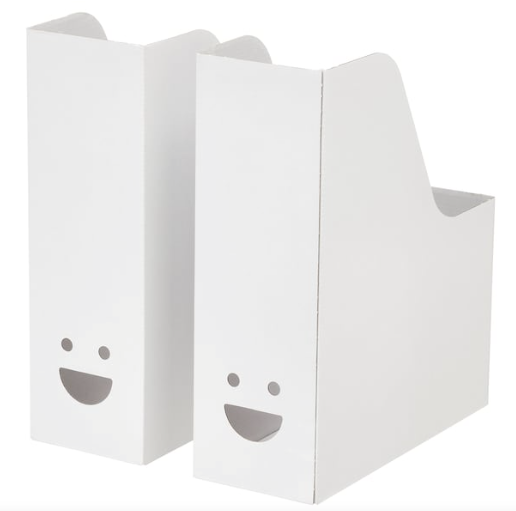
The smiley face design is made by adding two tiny punch-out circles above the open space used to pull the file off of the shelf. You get a sneak peek of the contents but still get to keep the “messy” side of the magazine file toward the wall.
The TJABBA files are easy to assemble and can collapse and fold up to save space if you don’t need them for a while. They measure 9 3/4″ deep, 11 3/4″ high, and 4″ wide.

If you prefer to support independent small businesses and don’t mind waiting a little extra time for shipping, the Bluble shop on Etsy has magazine files designed to look like townhouses. They’re handmade of “woodlike” (or solid color) laminated high density fibreboard.

There are three styles of these magazine files:
# 1 measures 34.7 cm high, 11.0 cm wide, and 23 cm deep
# 2 measures 34.3 cm high, 9.3 cm wide, and 23 cm deep
# 3 measures 34.5 cm high, 8.0 cm wide, and 23 cm deep
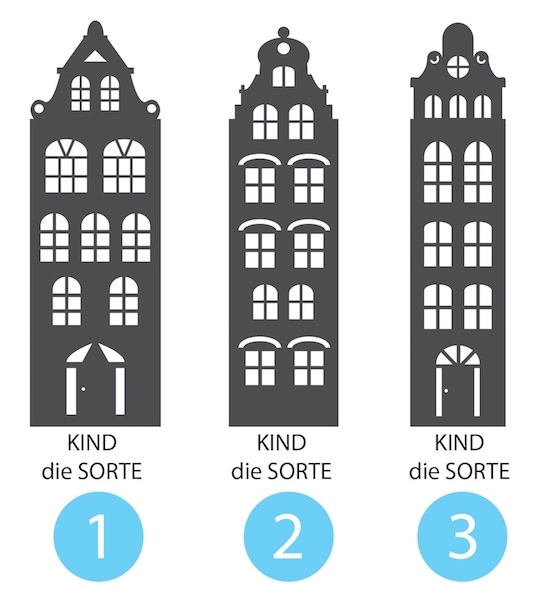
You can select any of the three styles in a variety of colors, depending on what kind of cityscape you’d like to create on your shelf. The options are maple, oak, pine, cherry, apple, nut, “wenge” (sort of darker brown), black, grey, and white.
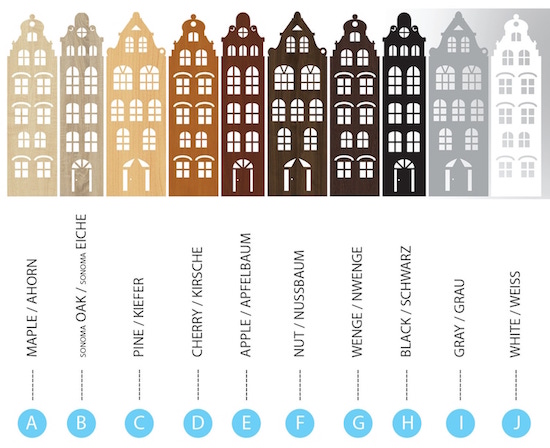
These Bluble storage solutions are $5.70/each, which seems incredibly reasonable for a hand-made townhouse-style magazine file, but Etsy calculated that shipping from Germany to my own zip code would be $28, so this might be better if you are planning on buying many of them for practical décor and not just to hide in a cabinet.
If you order, be prepared to state the number for the type you prefer along with the letter for the finish you want. (I’m fond of the wider townhouse #1 in pine or white, but you could mix-and-match to create your own cityscape).
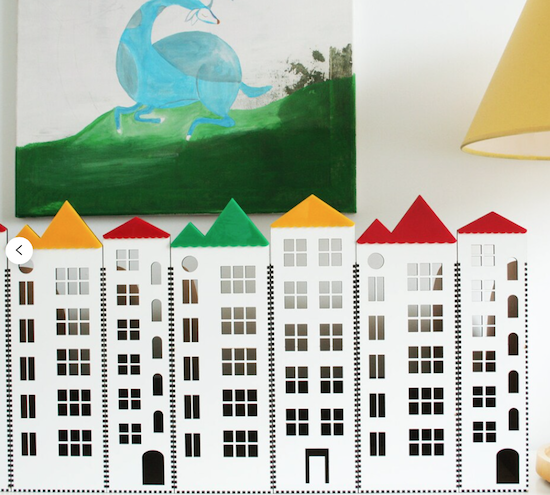
Bluble also makes a version of these townhouse magazine files with different window and door stylings and colored rooftops. The color options are navy blue, blue, light blue, mint, green, light green, black, violet, red, orange, and yellow. These magazine files run $6.23/each.
SOLVE STORAGE FOR A TON OF PAPER
It can be really annoying when you have a lot of paper that you need to store, but there are a variety of solutions depending on whether you have a little bit of a lot of paper or a whole lot of a lot paper.
Traditional (manilla) file folders are scored on the bottom (near the crease), so with a little bit of effort, the bottom of the folder can go from a sharp fold to a boxy-bottom, but that can only help add contents for so long. Plus, if you increase the bottom surface area of your file folder by folding it at the creases, fewer folders will fit in a traditional hanging folder, and eventually, that’s going to present a challenge.
Box-bottom hanging folders and expandable files are the traditional solution, and you can generally find them in sizes that providing expanding room for one-to-four inches of paper storage space, but they’re not particularly attractive.
Recently, I came across a product from our friends at Smead, a 3.5″ Hanging File Pocket with an interesting design.
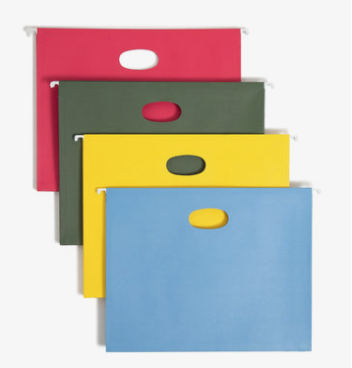
Smead 3.5″ Letter-Sized Hanging File Pockets
Suitable for collections of lots of bulky documents that you need to both hang and transport, the 3.5″ Hanging File Pocket is strong enough to expand to 3 1/2″ and has oval die-cut handles to make it easier to lift and transport a large collection of papers.
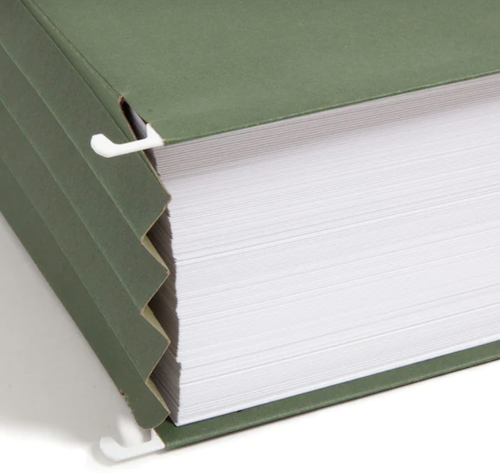
These 3.5″ Hanging File Pockets have full-height gussets (reinforced accordion-like sides rather than the typical open-sides you find with hanging folders). The gussets ensure that the paper contents of the pockets will stay secure and won’t get stuck on the file rails when the pocket is removed from a file drawer.
While the accordion style sides will expand to up to 3 1/2 inches, they take up minimal space until/unless the expansion for extra capacity is needed. For example, if you’re putting in documents for one fiscal quarter, no expansion is necessary, but as you add more paper for additional fiscal quarters, more expansion can occur.
The Hanging File Pockets come in two sizes:
- Letter-sized are 11-3/4″ wide by 9-1/4″ high, not counting the hanging rods, which add an additional inch (total) of width
- Legal-sized are 14-3/4″ wide by 9-1/4″ high, not counting the hanging rods, which add an additional inch (total) of width
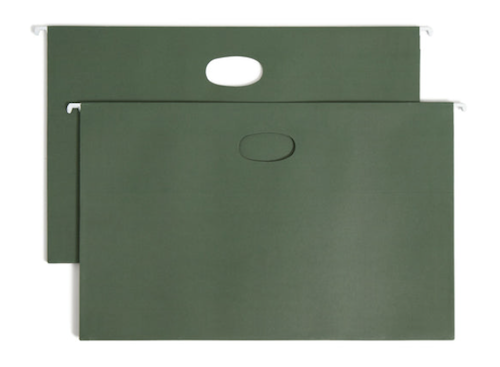
Smead 3.5″ Legal-Sized Hanging File Pockets
The letter-sized file pockets come in standard green or multi-color (red, green, yellow, and blue); the legal-sized version are only available in standard green.
(Boo! I wish someone at Smead or any of the other file supply companies could tell us whether green hanging folders and jackets are somehow less expensive to produce. Like, is Army Green a less expensive coloring agent? Why are filing solutions in pretty colors almost always more expensive?)
I should note, these Hanging File Pockets are priced for corporate use for lawyers, accountants, and people who wear serious suits each day. The pockets, and specifically the die-cut ovals that make these heavy-duty hanging file pockets so appealing, aren’t really designed for residential or home office use, the assumption being that the average person or small business isn’t going to need to keep an entire ream of paper in one folder or pocket.
The pricing is:
- $38.50 for four of the letter sized, multi-color (red, green, yellow, and blue) 3.5″ hanging file pockets (Yes. Almost $40 for four hanging pockets!)
- $75.33 for ten of the letter-sized, standard green 3.5″ hanging file pockets
- $83.61 for ten of the legal-sized, standard green 3.5″ hanging file pockets
- There is no option for the multi-color hanging file pockets in a legal size
These 3.5″ Hanging Pocket are only available directly from Smead.
Happy Spring from Paper Doll HQ, and please let me know if you spot any fanciful or fun paper storage solutions in the wild and I’ll be happy to credit you in a future post.
What’s in a Name? “Addressing” Organizing and Productivity
THE MISTER PRODUCTIVITY PODCAST
Recently, I had the delightful experience of appearing on an episode of The Mister Productivity Podcast, hosted by Mark Struczewski (pronounced stru-CHESS-key).
When Mark initially contacted me, I recognized his name, but not the name of his podcast until I realized that the show I knew as the Mark Struczewski Podcast been renamed as The Mister Productivity Podcast in late 2022. (As you’ll soon see, naming/labeling things is a theme in today’s post.)
The show is targeted to solopreneurs, with a mission of helping “banish overwhelm, reduce stress, and get more done.” However, I find that most of his content is applicable for all professionals and anyone trying to thrive in a world of too much sensory overload.
Over almost six years, Mark has covered the gamut of productivity-related concepts, both on his own and with an intriguing variety of guests (like friends-of-the-blog Francis Wade and Art Gelwicks). He’s talked about everything from leadership, virtual work, and goal setting to sleep, confidence, and mindset. My favorite of all of his episode titles is Are You a Winnie The Pooh, a Tigger, or an Eeyore?
The episode in which Mark interviewed me is entitled Organizing Old School in 2023. Once we discussed what Mark and I have in common besides a passion for productivity, we got down to a meaty conversation that covered a wide variety of topics including:
- The Pomodoro Technique “Police” and modifying the method to work for you
- The essential nature of brain reboots for our productivity and mental health
- The power of analog in a digital world, including paper planners, journals, and notebooks
- The role of the mind-body connection in note-taking at school and in meetings, as well as in journaling.
- Systems and tools for improved productivity, including a solution orientation and an understanding that the definition of the “best” tool isn’t what you think it is.
If you’re a longtime Paper Doll reader, you won’t be surprised to hear some of my disclosures, both personal (that I am not an outdoorsy person) and professional (the value I place on going back-to-basics with analog productivity tools).
During our discussion, Mark also referenced the literal nature-based practice of grounding, which I referenced in a larger context in Toxic Productivity Part 5: Technology and a Hungry Ghost when discussing Brad Stulberg’s The Practice of Groundedness: A Transformative Path to Success That Feeds — Not Crushes — Your Soul.

In that part of the conversation, Mark referenced a documentary called The Earthing Movie: The Remarkable Science of Grounding, available on YouTube, which looks at the psychological and physical benefits of maintaining a connection to the earth.
I hope you’ll listen to my episode of Mark’s podcast, and if you enjoy it, please consider subscribing to The Mister Productivity Podcast on Apple Podcasts, Spotify, Google Podcasts, Audible, Stitcher, Amazon Music, Pandora, JioSaavn, Deezer, Listen Notes, or wherever you get your juicy podcasting goodness!
THE ADDRESS BOOK
A while ago, friend-of-the-blog Hazel Thornton recommended a book to me. That’s not unusual, as we’re real-life pals as well as buddies on Goodreads, and we generally enjoy similar reading, both in non-fiction and fiction. So, when Hazel told me about Deirdre Mask’s The Address Book: What Street Addresses Reveal About Identity, Race, Wealth, and Power, I was intrigued.

To be honest, I was expecting it to be about issues like the 20th-century American practice of redlining, where banks discriminate against certain neighborhoods or areas populated mainly by people of color and/or low-income residents, denying credit or insurance. In actuality, this book is a fascinating, eye-opening, and wide-reaching look at global history and socioeconomic movements related to street addresses.
And, as often happens when I’m reading books that involve history and culture, I found that it all relates to organizing! You’ll have to stick with me here as I geek out and show how it all connects.
The Meaning of an Address
Have you ever thought about what an address is, and what having one (or not having one) could mean for you? In the 21st century, without an address, you can’t apply for a job, even though employers would almost certainly contact you by email, phone, or text. Without a fixed address, you can’t register to vote. And because health and auto insurance rates are determined by the county in which you live, and sometimes the specific address at which you dwell, your address can be your destiny.
A Brief History of Addresses
The book tells fascinating historical tales. For example, it traces the increasing understanding of how cholera epidemics spread, and shows how John Snow (the Victorian era physician-turned-cholora detective — not the differently spelled Jon Snow of The Game of Thrones) used maps of London to trace the origin and spread of the disease.
Nowadays, it’s hard to imagine life without street addresses, but before the 1700s, while there were street names, numbered street addresses were almost non-existent. Then, they suddenly came into being — independently — in various locations in Europe and the Americas.
One major example involves Maria Theresa, the Empress of the Habsburg Empire. (Don’t worry if you don’t remember her from Social Studies, but she was the mother of Marie Antoinette.) Because she was losing the 7 Years War, Empress MT (as I’m sure her friends called her) needed soldiers, but feudalism was still going strong, and the landlords didn’t want to send their serfs.
So, Maria Theresa sent military officers and civil servants to paint house numbers on all doors, and created a census of able-bodied men. (Sadly, her representatives used cheap ink, which blurred in the winter rain and snow, just like badly hand-labeled file folders splashed with coffee.) While Maria Theresa’s efforts mainly failed, it shows how numbering addresses along a street makes it easier for a government to identify, tax, and conscript individuals.
So, something that seems obvious to have, like a numbered street address, and beneficial to have (whether for pizza delivery or mail call or an ambulance coming to your aid) was not necessarily inevitable, and not always positive in nature.
In the 21st century, addresses and maps are no less essential to finding the origin of diseases as well as the location of those who are lost or injured, only now organizations like Missing Maps can offer assistance.
Missing Maps uses remote volunteers to manually trace satellite imagery into OpenStreetMaps. Then, community volunteers add in local detail and identifying information about neighborhoods, street names, and evacuation centers.
Armed with this mapped information, humanitarian organizations can plan “risk reduction” strategies, disaster response activities, and find people during emergencies. Just because there are no addresses doesn’t mean they can’t be created outside of a local or national government plan.
Mask also covers how the lack of street and home addresses in Kolkata (formerly Calcutta), India keeps people from getting Aadhaar cards, biometric identity cards. Without these cards, citizens cannot get access to health services, food subsidies, education, or any of a variety of social services.
Some of the causes date to colonialism, while others are modern, but all lead to continued inequity. And this is certainly not just an issue in India. Here at home, lack of street addresses in rural West Virginia have delayed emergency services and missing addresses on Native American reservations in Utah have short-circuited voting rights.
Addresses — and the lack thereof — are a big deal not only with regard to how we organize ourselves, but how we are organized by others.
Technological Solutions When No Addresses Exist
Organizations like Addressing the Unaddressed are working hard to help create unique geo-based postal addresses for each of the 1.4 million residents of the Kolkata slums, and are using Google’s Plus Codes to do so.
Another fascinating option for creating pseudo-addresses is something called What3Words.
Sometimes, we have to give locations that don’t lend themselves to addresses. In the book, Mask tells the story of a rural health clinic in South Africa where ambulances are in short supply, and patients may live in unmapped locations where they’d be unable to specify to ambulances (or even taxi drivers) specifically where they were located. In a less agonizing example, there are music festivals or temporary outdoor events where specific locations (tents, Port-o-Potties, stages) lack real ways to identify and direct people to them.
What3Words has divided the entire world into 3 meter by 3 meter squares, and each square has been assigned three words, which you can look up on the company’s free map in a browser or the What3Words app. So, the area of the front door of Maple West Elementary School (which I attended back when dinosaurs roamed the earth) has been assigned the “address” of prowess.hollow.lavished.
My car is currently parked at orators.broccoli.gulls. The middle of White House Rose Garden is army.likes.jukebox. And the clock tower in Orvieto, Italy, my favorite town I visited on my 2018 trip, is at yards.potions.cosmetic.
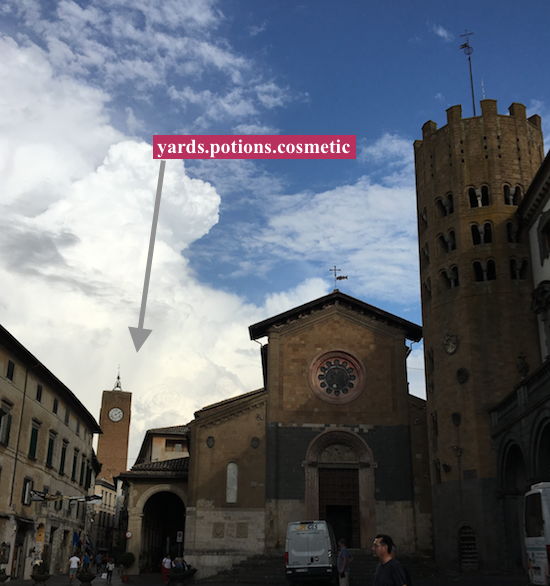
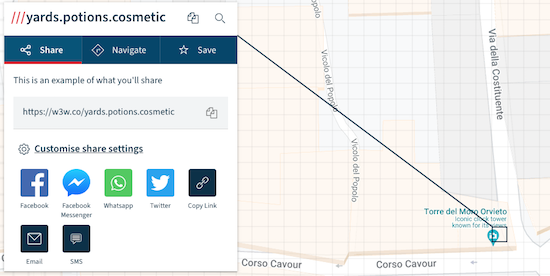
Experts in linguistics work to make sure that a word in one language won’t be confused with a homonym and that naughty words (in any language) don’t make the cut. And care is taken to make sure that words aren’t too long or confusing. Apparently the longest words are used for locations in the middle of the oceans, deserts, or in the Arctic.
The Rest of the Book
The Address Book also covers complexities of science, history, and culture.
- neurobiology, and the relationship between memory, “place neurons,” and the hippocampus, working to develop multi-sensory maps and explaining how the ancient Romans found their way in a complex city without any maps
- the pottymouth origins of London street names and how “niceties” modernized not only the names but the cultural significance of streets and neighborhoods
- how Philadelphia led the world in implementing numbered streets
- the ugliness in the revision of street names under the Nazis and later, Stalinization, in Europe, Confederate street names in the United States, and post-Apartheid street names in South Africa.
- how street names and numbered addresses can be faked for those who have the money ($11,000, via cashier’s check or money order) to buy classier-sounding vanity addresses in New York City!
ADDRESSES, NAMING CONVENTIONS, AND ORGANIZING
As I traveled through time and across continents reading The Address Book, I was repeatedly considering that how we are organized and labeled in the world determines whether a government can locate us (for good or ill), how emergency services come to our assistance, how prospective employers can find us, and more.
This further prompted me to consider the way in which homelessness — addresslessness — can perpetuate lack of ability to seek out social services, get education, or obtain a job. As a professional organizer, I immediately saw the connection between how we label who lives where in our cities, towns, and countrysides and how we label what lives where in our filing cabinets and our computers and our minds.
The advantage is that we can change the address to which we assign our possessions much more easily than we can convince 911 services that our vanity address, which doesn’t exist on GPS, is where we are actually located.
Organizing clients are often surprised to learn that the names applied to locations in their homes or spaces can be modified to make their lives easier.
Room Addresses
You can change what you call a room to redefine what happens there. “The nursery” becomes “Johnny’s room” and after Johnny’s long out of college, it’s “the craft room.” But we don’t have to wait for major household transitions to change the names/addresses of our spaces.
Clients lacking an official playroom for their children found toys got strewn everywhere and their little ones were unhappy without a designated space that was their own. The parents were uncomfortable with their tiny humans playing unsupervised in upstairs bedrooms, but were tired of stepping on LEGOs in the kitchen.
Looking around, I found that they had an enormous formal dining room — one that they never used, and one that lacked a dining table, dining chairs, or a china cabinet. They’d moved in before acquiring that kind of “grownup” furniture and with life and kids keeping them busy (and without a lifestyle that included formal dinner parties), the room was just an empty space.
When I suggested they use the room as a playroom for at least a few years so that the kids could play in close proximity to the kitchen, family room, and home office, all on the first floor, the clients were puzzled. “But it’s a dining room,” the husband remarked with uncertainty. “It says so on the blueprints.” The wife laughed. “It would be great to have the kids down here, but are we allowed to do that?” They were! You are!
After we chatted a bit, I made a copy of the printed floor plan we’d been looking at earlier in the day, and printed a “Playroom” label on my label maker, and covered the words “Dining Room” with it. By the time I’d come for our next session, a comfy rug had gone down on the cold wooden floor of the former dining room, brightly colored toy bins and book shelves had be relocated to the space, and both the tiny humans and the full-sized ones were delighted.
Elsewhere, I’ve found that an “address” can mean destiny. At the risk of making too direct an analogy, a person without an address can’t get social services; papers without an address (a labeled folder or digital location) can’t get accessed, processed, or used.
A client family all referred to a particular room in the house as “the scary room” and nobody ever went in; the door was opened just enough to throw things in.
When we purged the room and reorganized it, I encouraged them to all use a new name to inspire keeping the room from getting scary again. Temporarily, they called it the “sunny” room, because it was now a lovely, sunny space. It inspired the family to use it as a more social space for the teens and their guests, and the name stuck.
Space/Zone Addresses
When I became a professional organizer, I started reading books by Judith Kolberg, the founder of the National Study Group on Chronic Disorganization (now the Institute of Challenging Disorganization), a fellow member of my chapter and now, I’m proud to say, a friend. Two of her books, Conquering Chronic Disorganization and What Every Professional Oragnizer Needs to Know about Chronic Disorganization, really hit home.

Her concept of “wholistic organizing” considers the way clients, particularly those with chronic disorganization, see the world and their spaces differently. She introduced the idea of themes, “a way of holding a whole together while you take it apart.” As her example, she shed light on how she and her client, a doctor, renamed spaces in a way that made sense to him.
An expert on the human body, the doctor was able to re-envision his office systems much more clearly when Judith helped him break things down into The Brain (his leather office chair, where his research, reading materials and resources lived), The Heart (a separate section of papers related to the doctor’s volunteer work at a children’s shelter), The Leg Bag (holding items that needed to be taken when he went on errands), and so on.
Re-addressing a zone or space can help your brain make sense of what belongs there, allowing you to remove (and relocate) things that don’t belong and remember to put objects away with related items.
File Addresses
Because I am a Paper Doll, I have a lot of experience helping clients deal with files and paper clutter. In most cases, files should be labeled according to a series of rules that help you access them when you need them. I’ve covered that in many classic posts:
Family Filing—As easy as (eating) pie
Financial Filing—Scrapbooking snapshots of your money’s life
Mom, why is there a receipt stuffed in the turkey?
I Fought the Law…and the Paperwork Won!
Patient: “Doctor, it hurts when I do this.” Doctor: “Then don’t do that!”
Paper Dolls Live In Paper Households
I Hope Nobody Ever Writes a Nasty Tell-All Called “Paper Doll Dearest!”
Paper Doll Gives You the Business (Files) — Part 1
Paper Doll Gives You The Business (Files) — Part 2: Reference Papers
Paper Doll Explains How To Avoid Paper Management Mistakes — Part 1
How To Avoid Paper Management Mistakes–Part 2: Fat Vs. Skinny Jeans
But just because there are rules doesn’t mean all rules work for everyone. Years ago, I had a client who was going through a divorce and had to deal with a lot of legal paperwork related to depositions, custody arrangements, and the like. Unfortunately, the divorce was acrimonious and the client’s children were distraught each time they heard about or anything related to the situation.
My client wanted to keep the papers handy, but found that just having a “Divorce” folder on her desk led to distress when her younger daughter walked by her desk. I suggested that we rename the folder “Dallas Project” after we’d shared a joke about the country song “I’m Going Through the Big D and Don’t Mean Dallas.” My client knew exactly what was in the file, but to her children, it appeared to be just another work project.
I’m sure I was guided to make this suggestion by Judith Kolberg’s advice about “muttering.” Her books explained that sometimes clients had a fear of filing, of putting things away and not being able to find them again, and I’ve definitely seen this over the years. By watching how clients muttered concepts to themselves about specific papers, it would be easy to see and hear how clients thought of their documents, and labels (basically, addresses — where these papers would live) would be unusual, but clear.
Thus, a folder I might call “Tax Prep 2023,” a client might think of as “The Tax Man” (and humming The Beatles’ The Tax Man while filing might make the concept more concrete). Some of Judith’s funny examples for action and reference files were:
- Friendly Correspondence
- Hostile Correspondence
- Stuff I Can Never Find When I Need It
- Did I Get Paid For These Yet?
- I Have Got to Call These People
My point, and I do have one, is that what we call something — whether it’s a paper or digital file, a zone in our office, a room in our home, or otherwise — helps determine where it will go and how easily (and how likely) we will access it and use it.
Don’t be afraid to be creative and “bend” the rules once you know them; if you can confidently find your possessions or direct someone to them, consider it a success.
Privacy in Your Home Office: From Reality to Fantasy
When Virginia Woolf wrote about having A Room of One’s Own almost a century ago, she wasn’t being entirely literal. She was talking about the lack of opportunities for expression that women in her day had. “A woman must have money and a room of her own if she is to write fiction,” Woolf wrote.
Of course, this was mainly a metaphor for all of the lack of access women of her era (and most eras) experienced: lack of money to access education, lack of career choices, lack of ability to guide one’s own future. “A room of one’s own” in terms of the metaphor is complex, but the concept has stood out in popular understanding both in the figurative sense as well as the literal one since the 1920s, when Woolf published the essays based on her lectures.
What does this have to do with organizing and productivity?
GIMME SOME SPACE (FOR MY STUFF)
We all — unrelated to gender or age or any of a variety of factors — need our own space to think, to create, to work, to strive toward greatness, and even to be our best selves. Nobody can be “on” 24/7/365. Having no private space amid the chaos, whether that’s in a home or office, eventually prevents us from achieving or even aspiring to achievements.
At the start of the pandemic, there was an enormous push to understand the needs of remote workers. Setting your laptop up at the kitchen table just wasn’t going to cut it. Everyone began to look at ideas for creating remote work spaces that were efficient, effective, productivity-supporting, comfortable, and private.
For an intensive primer on how to create a home office with storage that supports all of your needs, I encourage you to visit the guest post I wrote in 2021 for the excellent storage supply company, meori.
From Dad’s Study to the Modern Home Office covered everything you might want to know about home office design and storage. The post looked at why home office storage usually fails, the questions you should ask yourself to design better home office storage, and key strategies for creating your ideal work and storage space.
Of course, to create a room (or space) of one’s own, you have to look beyond the tangible. For example, for a deep dive into the emotional aspects of working remotely in the ongoing COVID era, you might want to visit my post The Perfect Unfolding As We Work From Home.
From a more interactive behavioral perspective, the classic Paper Doll post R-E-S-P-E-C-T: The Organizing Secret for Working At Home looked at how to create a work environment that ensures that others give us respect, and that we respect ourselves and our own time, energy, and attention.
PRIVACY, PLEASE
Privacy is essential. While we tend to think of privacy in an office setting as the ability to conduct our work without others overhearing our conversations, it’s important to also consider how much we needed to be protected from overstimulation caused by other people’s conversations (or pen-tapping, gum-chewing, or video game playing). We looked at this to some extent in Divide and Conquer: Improve Productivity With Privacy Screens.
Whether we are neurotypical or neurdivergent, we all need to find our own rhythms, and that can involve protecting ourselves from the visual and auditory stimulation that comes from being out in the world. Decades of work environments have taught me how I work best.
When I first worked in television, I had a small, windowless office with old-fashioned, oversized furniture. I had no visual disturbances, but even with the door closed, I could hear the hubbub of a “bullpen” situation right outside my door.
At my next TV station, my office was slightly larger, but near the back of the building, away from noise, and my one window looked out onto an A/C unit and the outer wall of a warehouse. Although I’m an extrovert, when I work I want as little outside stimuli as possible, and this was perfect; with my door closed, I could concentrate and focus entirely on my own thoughts.
My last TV station was in a converted auto sales showroom. The entire front wall of my ridiculously enormous office was made up of floor-to-(high)-ceiling windows looking out onto a parking lot and a busy highway. Others may have envied the space, but I had to keep the vertical blinds closed 90% of the time (both to keep out the blinding sunlight and the visual stimuli).
In my own home-based set-up for more than two decades, my desk faces a blank wall so that nothing beyond my computer screens can distract me. This might be hell for others, but it’s ideal for ensuring my focus.
Your mileage may vary.
FINDING YOUR IDEAL SPACE — REALITY AND FANTASY
You’ll find a lot of advice online for creating your own home office space with minimal effort. For example, you could:
- Remove the accordion doors from a bedroom closet and add a wide but shallow table as a desk.
- Add lighting fixtures and a desk in an alcove under the stairs to create a private Harry Potter-inspired workspace.
- Add a curving curtain rail on the ceiling (like the kind that creates privacy in hospital emergency rooms) to designate a corner of a bedroom or other area of the house as an office and separate the workspace from the rest of the area with a curtain.
- Use IKEA Kallax bookshelves (filled with books) to create a room divider to give a sense of privacy. (Feel free to watch the video with the sound off; the AI robotic voice insists on spelling Kallax out each time. The future is weird.)
But again, the internet abounds with such options. I thought it might be fun to look at a variety of standalone office ideas that range from the inexpensive and realistic to the when-you-get-that-huge-advance-on-your-great-American-novel option.
Sanwa Home Privacy Tent
Do you remember Party of Five? The mid-1990s Fox Broadcasting show about five young siblings trying to survive after a family tragedy launched the careers of Neve Campbell, Matthew Fox, Jennifer Love Hewitt, and Lacey Chabert, among others.
When I saw this first product, I was immediately reminded of how, in the earliest seasons, Chabert’s character Claudia created her own bedroom by putting up a tent in the middle of the living room. The Sanwa Home Privacy Tent (AKA the 200 Tent001) is designed for a similar purpose, carving out private space in the middle of pre-existing space.
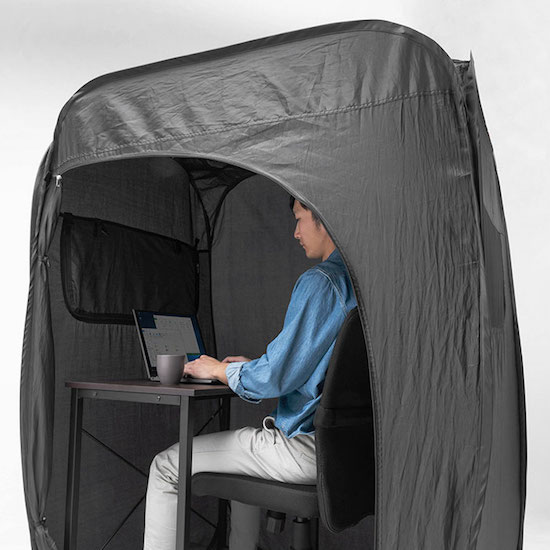
It’s a basic nylon tent, not very large, but adequate for one person, a small desk for a laptop, and a lamp or other lighting source — to create a distraction-free workspace. Designed for indoor use, it’s suitable for studying or working. The super-portable tent weighs only 6 pounds, including the case, and measure 35″ x 43″ by 59″.
There’s a skylight/rooftop opening if you’d like more natural light, a side window, and a zippered entrance so you can be available for office hours (or for visits from your pets.) Admittedly, it’s not very pretty, but if you’re feeling overwhelmed by all of the sensory inputs in your home, apartment, or dorm, setting this up for some private workspace could be just the ticket for eliminating your stress.
The instructions apparently only come in Japanese, but as the video shows, assembly looks very intuitive — it pops open like a mesh laundry basket!
Sold for about $125 at various stores online, it’s currently sold out at the Japan Trend Shop where I first found it. (It is in stock if you want to purchase it directly from Sanwa in Japan for 7980 yen, or a bit over $61.)
Alternatively, if you search Amazon for “indoor tents,” you’ll mostly find children’s tents and playhouses for under $60, but I have to admit that I envy something breezy like this indoor playhouse. (It’s regularly about $110, but at multiple times over the last few weeks, I’ve seen it on sale for under $65.)

Steelcase’s Office Pod Tent
Looking for something a little less cramped, more designer-friendly, and envisioned for grownups? Steelcase, known for office and classroom furniture as well as filing cabinets, has a whole line of nifty solutions.
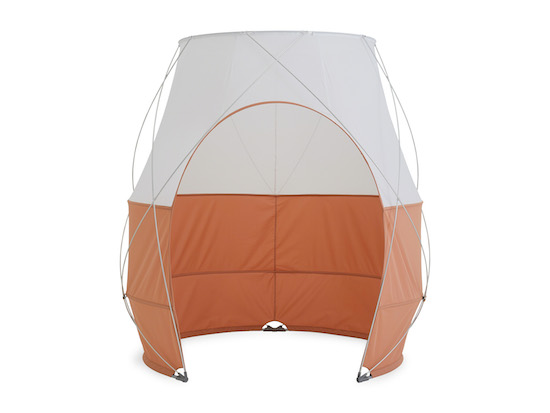
The Office Pod Tent is a freestanding pod made with a flexible aluminum frame. The top is open to provide air flow and to let in natural light. It’s also open on one side, so it won’t induce claustrophobia (but also won’t be as private as if you could close a door). Still, it limits distractions and provides a space that’s a little snazzier than what you’d get in an office, cubicle, or your dining room.
Basically, you’re going to feel like you’re on an upscale, modern camping trip. The Office Pod Tent is 92″ high. The base has a 76″ diameter, and because the frame creates bowing at the sides, it’s 88″ at its widest point. You’re definitely going to have more space than with the Sanwa tent! The aluminum frames and poles are standard silver with platinum-colored plastic connectors to secure the fabric to the frame, keeping the shape intact.
The spec sheet notes that the Office Pod Tent can be fully assembled in under one hour with two people. (I’m going to ignore how much that sounds like the beginning of a word problem in fifth grade math class.)
The Office Pod tent is available in three color “families: Sheer (white), Ascent (green), and Era (orange-ish) and can be can be specified in one solid color or in two color family combinations:
- Sheer
- Ascent/Era
- Sheer/Era
- Ascent/Ascent
- Sheer/Ascent
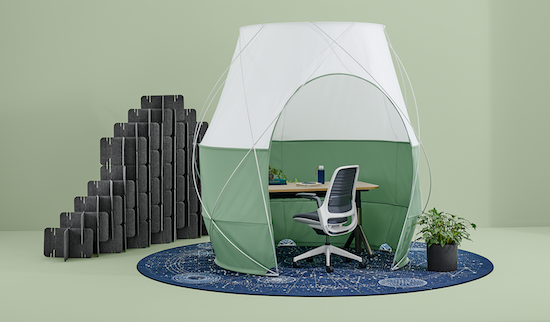
Steelcase actually designed the Office Pod Tent to be used in traditional office situations, either for creating alternatives to cubicles or introducing cozy, private lounge settings in the office. But you can definitely see how you could use this in a space in your home, or to create space for onboarding new employees in a small starter office.
Steelcase Work Tents is a collection of privacy solutions – inspired by tents, but designed for the workplace.
The Office Pod tent must be purchased from an authorized Steelcase dealer. While I was unable to locate a price for the Office Pod Tent, I did find reference to a price point of $570 for Steelcase’s Boundary Tent (which is actually a room divider and not a tent). The line also includes Steelcase’s Table Tent (which is less of a tent and more of a table divider or privacy shield).
Alternative Temporary Office Pods
While researching this topic, I found quite a few alternative alternatives. For example, there’s a UK option for rent or purchase of inflatable office pods of varying sizes reflecting trippy colors. While it’s not really a fit for your random home office, something like this would be very cool if you were trying to set up a private meeting space at a conference or if you were having an event at your small office location.
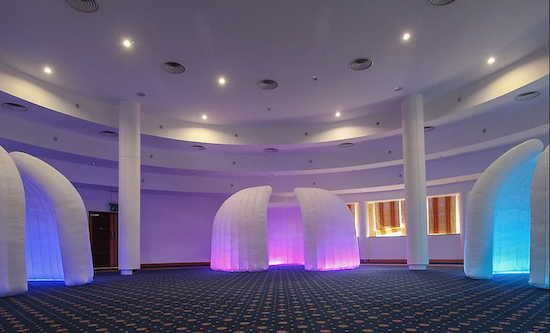
UK-based Optix Inflatable Structures’ carries Pop-Up Office Pods in 3′ x 3′, 3′ x 4′, 4′ x 5′, and 5′ x 6′ options, and they have a variety of sizes for temporary meeting rooms.
Phone Booth Options
Unfortunately, there don’t seem to be many mid-range options in the home/office pod category, so you’re either looking at tents or full-on structures. At the high-priced, “dream” end of things, most options are tiny “phone booth”-style rooms that are not for the claustrophobic or the faint-of-pocketbook.
The various PoppinPod options from Poppin starts pricey and goes off into the stratosphere. There’s the Poppin Om Sit and Poppin Om Stand (below), both available in black or white, starting at $7,999.
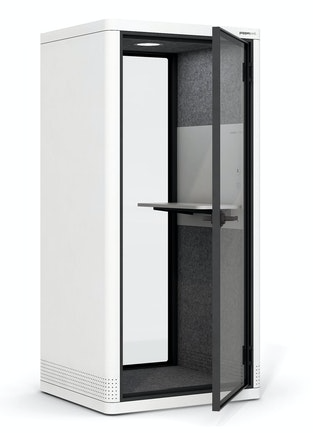 It comes with a built-in work surface and is ideal for when need to take confidential phone or Zoom calls. The rest of the line continues with the Kolo Collection (Kolo 1, Kolo 1+, Kolo 2, Kolo 4, and Kolo 6), all with sliding doors and providing work or conference space.
Prices range from $10,999 to $47,999, so you’re not going to put one of these in your living room unless you’ve had a lifelong dream of pretending you’re Max and Agent 99 in the Get Smart cone of silence.
Talk Box Booth has four models, with the FOLD version the most resembling the old-fashioned Superman-changing-into-his-cape-and-tights version. For $5,775 without assembly costs (or for an additional $550 for expert assembly), Talk Box Booth’s FOLD starts at 39.4” wide x 35.4” deep x 90.2” high for the basic model. It has a bi-fold door, steel construction with a white powder-coat finish, and an adjustable height desk, so you can choose to sit or stand.

There’s an automatic fan that turns on as soon as you enter the FOLD, and the air circulates every few minutes to maintain comfort. Two electrical outlets and two USB ports allow you to keep all of your devices charged as long as the FOLD is plugged into a standard 120V outlet.
(Other Talkbox Booth lines include SLIDE, a sliding-door one-person booth, as well as the DOUBLE (which can accommodate two people) and a STUDIO (which can hold one to four people).
Loop Phone Booths are a similar line, but definitely offer the snazziest solutions for soundproof teeny office space.
Loop Solo is colorful and charming, and while small and squished, somehow feels both retro and modern. Seating one person, the 550-pound Canadian-made pod is 80.5″ high x 47.5″ wide by 29.5″ long.
The exterior is hardwood, while the interior is made of durable laminate and the 10mm thick tempered glass comes with a frosted option. The back panel can be cork, felt, or glass. If you choose glass, you’re going to be trading off having a feeling of more space for accepting more visual sensory inputs, so you’d need to know which would bother you more.

The cozy upholstered seat has an ergonomic backrest, and there’s a concealed magnetic door closure to make sure your Zooms are secure. A work desk is included and you can get an optional tempered glass whiteboard for taking notes and crafting ideas.
The Loop Solo uses a standard power outlet (with optional network and USB ports), has LED lighting, a positive pressure two-fan ventilation system, and an occupancy sensor.
No assembly is required and the Loop Solo is shipped in one piece, designed to fit through tight doorways or narrow halls, and claims to be the only plug-and-play pod of its kind on the market.
Unfortunately, you have to call to request a price quote, but there appear to be a variety of options in terms of types of wood and interior colors, so if this is more than a dream, you could contact Loop for a serious inquiry. (Be sure to come back to the comments section and share pricing with us!)
(Other Loop options include a soft-sided Loop Flex, a four-person Cube, which resembles a cozy diner booth with double-glass doors, and pre-fab Access conference rooms.)
If this still isn’t enough to satisfy your tight-squeeze office dreams, be sure to check out Cheapism’s Over-the-Top Home Office Pods for Working From Home and Urban Office‘s lines of office pods and dens & huddles. My favorite is the Jenson Hut Office Den, which feels simultaneously Space Age and like a Mad Men-style throwback.
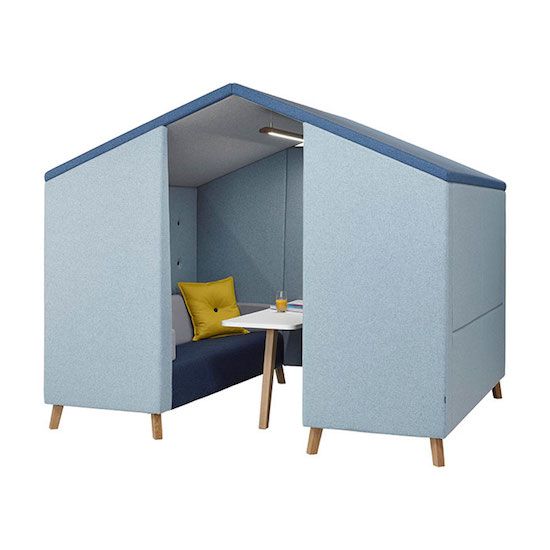
Fantasy or reality, however we create our workspaces, we must give ourselves an environment that grants us space for our work items and privacy for our thoughts and communication.
Somewhere between a repurposed kid’s desk and the dining table, between a pillow fort and a pricey office set-up, there’s a work space that’s right for you. The key is knowing what elements are essential for your satisfaction and what experimental aspects you can accept or reject.
What’s non-negotiable in your own work space? Please share in the comments!
Highlights from the 2023 Task Management & Time Blocking Summit
As you know from my post Surprising Productivity Advice & the 2023 Task Management & Time Blocking Summit a few weeks ago, I was set to spend three days at the beginning of this month attending, and being a panelist and presenting at the summit. This is the fourth year I’ve been involved, and it was definitely the best yet.
The theme of this year’s summit, One-Size-Doesn’t-Fit-All. Now what?, is dear to my heart. In February, the summit’s creator, Francis Wade, and Productivityist Mike Vardy delivered a pre-summit session to set the stage. Generally, Francis posited, when people are struggling with productivity (and this is true of tangible organizing struggles, too), they seek out experts, “gurus” who identify their so-called secret formulas. “Do this and all will be well!” And that may be true, but only for a while.
No one system for anything — career paths, life balance, making cookies, or having an organized and productive life — works for every person in every situation. At some point, it’s essential to take the guru’s advice and customize it for yourself so you can live an authentic life.
Even Marie Kondo, whom I chided for insisting her way was the one-true way (in my post The Truth About Celebrity Organizers, Magic Wands, and the Reality of Professional Organizing) has had to face the fact that her way doesn’t exactly work for the kid-filled life she now embodies. (See all the various recent articles with titles like “Professional tidier Marie Kondo says she’s ‘kind of given up’ after having three kids.”)
Early on, especially pre-internet, there were no centralized places to access productivity advice. Then, so many people got into David Allen’s Getting Things Done (GTD to those in the know) that it was evangelized everywhere. But with the expansion of the web, “productivity porn” proliferated, and people had (and have) access to so many options.
The problem? Whatever popular productivity methods are out there, people aren’t all the same. They are unique. As I presented in “Paper Shame” — Embracing Analog Productivity Solutions in an Increasingly Digital World:
Because I know my own style, I know what works best for me. Because I stay abreast of all of the options out there, I know how to suggest what might be best for my clients. And my job is to know that what works for me won’t work for each of my clients, and what works for my overwhelmed, 30-something client with ADHD and a toddler won’t be the same as for my single-dude on-the-road salesperson client or my new-retiree client whose spouse was just diagnosed with Alzheimer’s. We’re each unique.
So, it’s important to know that it’s normal if the productivity strategies that work for your bestie don’t work for you. As you read blogs and books and incorporate advice, instead of accepting every bit of it “hook, line, and sinker,” Francis encouraged what he calls an ETaPS framework.
Simply put:
Evaluate your current situation and needs
Target where you want to move the needle (and by when)
Plan how you’re going to incorporate change into your approach, and get
Support through coaches, friendly accountability, and exposure to a wide variety of opinions and methods.
The summit was one stellar way to get that exposure.
These three jam-packed days included 27 recorded video presentations as well as live interviews, panel discussions, and networking at digital Zoom-like tables. It would be impossible to share all of the highlights, which ranged from Olga Morett‘s compassionate, vulnerable approach to “unmasking” and self-exploration for neuro-diverse individuals to Hanifa Barnes‘ framework for building without burnout (which included a deep dive into understanding circadian rhythms and body clocks for chronotypes — apparently I’m a cross between a wolf (night person) and a dolphin (insomniac).
 Dolphin photo by Ádám Berkecz on Unsplash
Thus, rather than providing a full recap of the summit, I’m going to share highlights and snippets that caught my attention, and which I look forward to sharing with my own clients.
QUICK BITES
“The menu is not the meal.”
Henrik Spandet, while talking about the differences among task management, calendar management, and meeting management, cautioned participants to remember that a task list is merely a list of opportunities, just as a menu is a list of dining alternatives. One must prioritize to maximize the experience. You can’t expect to do it all, or do it all at once. (He did not, however, discuss the advantages of eating dessert first.)
“If you’re not doing what you’re supposed to be doing, just sit.”
Carl Pullein‘s take on self-discipline dovetails with my own advice for dealing with writer’s block, and it’s kind of like the reverse of the bartender yelling, “You don’t have to go home but you can’t stay here.” You don’t have to perform the task you’ve set for yourself, but if you don’t, then you can’t do anything else. No perfectionist procrastination by tidying your desk; no mindless scrolling.
Sit. Just sit.
And in sitting and not doing, you may find yourself motivated to start writing, creating, or tackling whatever you’ve been avoiding. If not, you will find yourself having to face the reason for your avoidance, which may prove equally productive.
During a third-day “Boundaries, Burnout and Balance: Finding Peace When Working from Home” panel with Renee Clair, Clare Evans, and Olga Morett, the concept of “the booty hour” came up — and how getting the butt-in-the-chair is that make-or-break moment.
Do, or do nothing, is a powerful choice. We are so fixated on never being bored that the idea of having to do nothing may make the thing we are avoiding suddenly a much more compelling alternative!
“What gets measured gets managed — even when it’s pointless to measure and manage it, and even if it harms the purpose of the organization to do so.”
Too often, Peter Drucker‘s quote is truncated as “What gets measured gets managed” but the full quote is so much more powerful. In other words, be aware of how your methods and strategies impact your work, but do not get so caught up in the minutia of how many emails you’ve cleared (or not), and focus on the bigger picture of accomplishing what you want and need to do.
Don’t spend so much time tweaking your systems to get a micro-percentage point of difference. Know what metrics will help you achieve the return on investment of your time, energy, and attention, and focus there. Prioritization can feel abstract, but pay attention to what has the greatest impact on your life, and what brings you closest to your goals.
“Busy leads to burnout; productivity leads to prosperity.”
Ayana Bard‘s message at the start of her five-part approach to mindfully productivity has been in my head for the past week. Her approach involves gaining clarity (and understanding yourself and your tasks so that you can prioritize), knowing where your time is actually going (by doing a time audit), and managing your attention and (mental, emotional, and physical) energy.
Ayana accented the importance of mindfulness (i.e., paying attention with purpose), and noted that practicing mindfulness is easy to skip but not easy to do. (Hence the practicing part, eh?) She recommends incorporating mindfulness of your energies with regard to ultradian rhythms by working 90 minutes at top performance, taking 20 or so minutes for healing and recovery, and then starting another 90 minute cycle of top performance.
BOOK RECOMMENDATIONS
Professor Bret Atkins‘ presentation The Zen of Ten offered lists of ~ten (though he cautioned, not “top” ten) books (both well-known and a second list of sleepers), podcasts, videos, terms, and tools. The big-name list included works by David Allen, Steven Covey, Cal Newport, and Brian Tracey, as well as the “habits” triumvirate of The Power of Habit by Charles Duhigg, Atomic Habits by James Clear, and Tiny Habits by BJ Fogg.

Slightly lesser-known gems ranged from The Autobiography of Benjamin Franklin (worthy of a future Paper Doll post), Ryan Holiday’s The Daily Stoic, Tony Buzan’s The Mind Map Book, 1908’s How to LIve on 24 Hours a Day by Arnold Bennett, and 4000 Weeks: Time Management for Mortals by Oliver Burkeman, about which I wrote extensively in Toxic Productivity Part 3: Get Off the To-Do List Hamster Wheel.

There is no way to do his superb lists justice (and will be revisiting his other recommendations in future posts), but I will note that out of 22 highlighted books (yes, there were a few bonuses), there was only one book authored by a woman: Molly McCarthy’s The Accidental Diarist: A History of the Daily Planner in America.

I note this because it’s a more damning comment on the publishing industry than of Atkins and his discernment. But that’s also a topic for a future day!
Other books recommended by presenters were:
Why We Sleep by Matthew Walker
Time Surfing: The Zen Approach to Keeping Time On Your Side by Paul Loomer
SCOPE — IT’S NOT JUST A MOUTHWASH
Trevor Lohrber felt that the true key to time management is often reducing the scope of a task rather than trying to increase your productivity and ability to do more. After all, our time is limited by strictures — where we have to be and when and how soon the work must be completed. Trevor presented three concepts, but it was the idea of pacers that caught my attention.
Did you ever take an exam in school and spend so much time writing the first part of your essay that when they called “15 more minutes!” you had to rush through your remaining points?
Although the point of deep work is to get into flow, Trevor points out that we often hit a wall when we look up and realize, “Oops, I’ve run out of time!” He suggests that by becoming more aware of time passing while we’re within a block of time, we can adjust our scope.
Trevor encourages using gentle timers at fixed intervals during a time block; for example, every 15 minutes during an hour-long work session. They key points are that these aren’t alarms (in that they’re not alarming), but gentle sounds, like an ocean or wind chimes; set your “snooze” to 15-minute increments and you can brush it away with the flick of your finger across your phone.
The idea isn’t to startle you out of flow, but just lightly alert you to the passing of time so you can stop to consider whether you need to limit the scope of what you’re doing now so you can finish the whole task on time.
The benefits of Trevor’s approach is that these “moments of mindfulness” keep you from going down any rabbit holes and ensure you’re repeatedly reassessing the work to be done in the time allotted. It allows you to work smarter because you are reassessing your scope regularly through the process, and improve your focus because you’re more aware of the scarcity of your time. (Trevor also cautions that this is not ideal for creative tasks, like writing a key chapter in a novel, because that focus can lead to tunnel vision, something you want when you’re trying to finish your accounting but not so much when you’re trying to develop dazzling prose.)
THE HOCUS POCUS OF FOCUS AND WHAT’S GOING ON IN OUR BRAINS
Achieving focus is the Holy Grail of productivity. We can do a brain dump to make sure we’ve examined all of our obligations, prioritize so we can work first (and longest) on what matters most, and create blocks of time dedicated to that deep work.
But how do we gather the motivation to get our tushies in the chair and then maintain our focus to actually get it all done?
This is where mindset is essential. Misha Maksin talked about the flow state, something we’ve covered here extensively, starting with Flow and Faux (Accountability): Productivity, Focus, and Alex Trebek (in the section called Sidebar on Flow and the Unpronounceable Mihali Csikszentmihalyi), and how four “mega” time wasters (anxiety, overwhelm, indecision, and procrastination) block our ability to achieve flow.
He casts it as a question of whether we are in a “primal state” where we feel we are under threat, ruled by our sympathetic nervous system, and using closed, contractive survival thinking, vs. in a “powerful state” ruled by the parasympathetic nervous system, thinking in an open and expansive, creative way. I mean, wouldn’t you prefer to be curious, compassionate, and joyous vs. fearful, anxious, and overwhelmed? I know Ted Lasso would!
Misha explained how the mechanism of unproductive behaviors starts with beliefs driving our thoughts, which then drive our emotions, which lead to our actions, and then results, and those results then determine our core beliefs. This means that results are both initially determined by past beliefs and reinforce future beliefs, in a perpetual cycle that, if our beliefs about ourselves or our abilities are negative, our results very likely will be, also.
However, we can rewire our mindset so that the driving force is not our beliefs but our decisions. Per Misha, if decisions determine thoughts, which activate emotions, which motivate actions, which produce results, which reinforce decisions, keeping us in that productive “powerful state,” — we have a much better shot at attaining flow in our work and joy in our lives.
The key, Misha posited, was to notice when our brains are moving us to that ineffective “primal state” and use our tools to focus on making wise, proactive decisions rather than being ruled by the negative self-talk often inherent in our beliefs. Perhaps easier said than done, but it’s a powerful switch. We can decide to get our butts in the chair now rather than repeat a belief ingrained since childhood that we “always” procrastinate.
DRIVEN TO DISTRACTION
Dr. Melanie Wilson identified a three-part approach to changing reaction distractions, and while there are practical elements, this is basically a psychological approach.
- Adopt a new identity, eschewing the one that says “I am an easily distracted bunny” and trading it for one that says, “I’m a focused, productive person.” This echoes what James Clear says in chapter 2 of Atomic Habits.
- Identify your unmet (emotional) needs so you can stop using ineffective, distracting coping mechanisms. Wilson notes that certain feelings lead us to distract ourselves with unproductive alternatives — overshopping, overeating, drinking, gambling, compulsive social media scrolling — and that the common advice to replace those habits with more productive ones (go for a walk, read a book) fails because they don’t get at the underlying emotion that drives the self-distraction. If we can identify the negative emotion, we can satisfy it with planned activities that do satisfy it. For example, Wilson’s personal example was having ADHD and craving novelty. By planning her days with lots of intentional novelty built in, she was less likely to seek distractions (like compulsive shopping) when she was supposed to be doing deep work.
- Acknowledge troubling issues (what she calls “gnawing rats”) instead of avoiding them. Wilson notes that scheduling quiet time to think (and not merely to meditate), journaling, praying, or planning time to deal with a distracting issue, you’ll be less likely to experience the harsh (and distracting) negative side effects of those problems, like sleep issues, IBS, heart trouble, etc.
BEGIN WITH PERFECT
We know there’s no such thing as perfection in achieving a schedule that doesn’t overwhelm. That said, there was a repeated theme across the summit, the idea of starting with a “perfect” or “ideal” week, beginning with a completely blank schedule.
Carl Pullein advice was to:
- Block out your sleep for the amount you really need, not the amount you usually get
- Create a morning routine and block time for that (and if that’s not when you want to be doing physical self care, block out the optimum time for that for your needs elsewhere in your schedule)
- Section off one or more blocks for communication (like replying to emails) rather than having it be the task you return to each time you transition between meetings or projects
- Create space for “dynamic” aspects of your calendar that change, like appointments. Carl noted that we all need to have blocks on our schedules for our “Core Work” — basically, the thing for which we are paid. For me, that’s time working with clients, and those blocks are fixed; I work on weekday afternoons. For a salesperson, that time is spent on sales calls, not in staff meetings.
- Set boundaries for the available times for these elements (obviously, depending on the level of control you have over your own schedule). For example, Mondays are my Admin Days when I don’t see clients, and I only schedule personal appointments (doctor, dentist, haircut) on Mondays; if your energy levels make it hard for you to be creative in the late afternoons, make sure your core work isn’t scheduled at those times.
Anna Dearmon Kornick and Trasetta Washington both took a similar approach, hewing closely to the formulation laid out in the well-loved “Rocks, Pebbles, and Sand” story of filling a jar.
Using slightly different language, Anna described the elements as:
- boulders — the immovable, important, but non-urgent essentials of life, like health and wellness, and maintaining our major interpersonal relationships,
- big rocks — our high-priority, important-and-urgent-but moveable aspects of work, particularly our deep work focus,
- and pebbles — everything else, the non-important/non-urgent to-dos from laundry to errands to all the random reports and meetings that endlessly tend to crowd us out of our own lives if we do not preserve our boundaries.
Anna encouraged designing one’s week with four concepts in mind:
- Parkinson’s Law — Basically, work expands to fit the time available.
- Planning Fallacy — Due to an optimism bias, we consistently underestimate the time it takes to complete tasks.
- Time Blocking — The act of carving out specific sections of our schedule for specific categories of tasks
- Task Batching — Grouping thematically or platform-related tasks together, like replying to emails or sourcing graphics for blow posts.
Meanwhile, Trasetta added an element to the story, with the professor being prepared with containers of big rocks, pebbles, sand, and two beers (indicating always having time in your schedule for a friend). Her approach to designing the perfect week included color-coding (and name-theming) calendared categories with:
Green Machine — tasks that drive revenue
Blue Skies — educational and personal development
Mellow Yellow — self-care and rest activities
Red Tape — meetings, commutes, and essential but ultimately unimportant activities
She also added “advanced” operations, color-coding them as:
Orange Operations — general business operations
Violet Vision — planning and strategic activities
Purple Passion — tasks related to community and spirituality
TECH OR NOT TO TECH, THAT IS NOT THE QUESTION
My own presentation,“Paper Shame” — Embracing Analog Productivity Solutions in an Increasingly Digital World, delved into the idea that focusing on what we need to do and then getting it done varies; it can be helped or hampered by a system or platform depending on our own personal needs and characteristics.

In our live panel, Ray Sidney-Smith led me and Misha Maksin through a discussion of “Paper vs. Digital in Time Management,” but it was less of a debate than the title might imply. We acknowledged that we each embrace a hybrid approach, whether by choosing disparate methods for different areas of our lives, or by combining them.
This year’s summit had the fewest presentations on using particular types of technology, and instead looked at platform-agnostic approaches to understanding your task management needs at a personal level. For example, Dr. Frank Buck‘s presentation on handling multiple projects looked at removing the friction often inherent in task management from three perspectives: using an analog (paper) approach or either of two different digital models.
Again, not only does one size not fit all people, it doesn’t even fit all different versions of ourselves.
That said, Gynanendra Tripathi introduced us to his new player in the productivity realm, AlphaNotes, which seeks to help users “carve out their own trusted system for employing GTD elements.” They concentrate on leveraging digital storage and “lightning-fast query” ability to store and access information to support getting things done.
ONE SIZE FITS YOU — TODAY
During a live recording of the Productivitycast podcast at the summit, Ray led Francis, Augusto Pinaud and Art Gelwicks in a lively debate and discussion about the concept of “one size fits all” within the framework of productivity.
Francis posited that we are inherently greedy — we want to do more and achieve more, and the concept of “more” means that we will eventually outgrow many of the systems, tools and methods we have in place. Augusto reflected on what happens when we reach capacity — this is where our geeking out on productivity (and not just productivity tools) comes into play.
Our skill sets may stay the same, but our tools may need to change. To the idea that “one size fits all” with regard to tools and platforms may fit just for that particular function, Art made a great metaphor about “pants” in the closet. Tuxedo pants, sweatpants, work pants, etc. all serve one narrow function, but each is not appropriate for other functions.
They’re all pants, they served the needs you have at a particular time, but we have to accept that we probably won’t find one pair of pants to rule them all. We have to stop to think, “What fits you now” and:
“What productive pants do you have on today?”
Later, during networking, a bunch of us continued the “one size fits all” and “productivity pants” metaphors and I got to shock the Art, Trevor, and many of the men, who had no idea that women’s clothing sizes are not based on measurements (waist, inseam, neck circumference, etc.) as mens’ are but are often arbitrary and conflicting, and that even the same size across different clothing designers, or the same size across different styles in the same designer’s line, won’t fit the same.
Just trying to buy a pair of pants can adversely impact productivity! Maybe we can discuss that at the 2024 summit?
Follow Me