Archive for ‘Productivity’ Category
Paper Doll Suggests What to Watch to Get More Organized and Productive
You may have heard that for the first time in 15 years, the Writers Guild of America has gone on strike. What they’re asking for is reasonable, especially in light of all that’s changed in the television industry (including streaming services). Meanwhile, you may find yourself with a shortage of your favorite shows to watch.
You’ve got lots of options to fill your time. You could read a book (or several), in which case, you might seek guidance from 12 Ways to Organize Your Life to Read More — Part 1 (When, Where, What, With Whom) and 12 Ways to Organize Your Life to Read More — Part 2 (Reading Lists, Challenges & Ice Cream Samples) Or you could get out in the sunshine or hang out with friends.
But what can you do if you really like to sit in a comfy chair and watch things on a glossy screen? Well, if you’ve already exhausted every English-language comedy and drama on Amazon Prime, Apple TV, Netflix, Hulu, Paramount+, Disney+, and YaddaYadda+, you could try watching one of the many Korean-language dramas on Netflix. (I recommend Extraordinary Attorney Woo — it’s charming and delightful.)
Or you could try something completely different. Today’s post offers up a mix of webinars and actual TV programming designed to help you live a better, more productive, more organized life.
DAILY DOSE MINI CHALLENGES
Could you use a little support in reaching your goals? My cool friend Georgia Homsany runs Daily Dose, a wellness company celebrating its 3-year anniversary! How do you celebrate three years of supporting people’s health and wellness needs through corporate and individual endeavors? With three really cool weeks of 5-day mini-challenges! And I get to be part of one of them!
- 5-Day Positivity Challenge (May 8-12) — Learn how to conquer stress and negativity with simple reminders and healthy habits to transform your mindset. (It starts today!)
- How to Overcome Perfectionism (May 15-19) — Learn how recognize the signs of perfectionist tendencies, understand the negative effects of it, and gain skills to minimize the idea of perfection in your workplace and personal life.
- Declutter Your Space and Schedule (May 22-26) — Receive actionable advice to help you get motivated, make progress, and gain control over the life and work clutter that weighs you down. From chaotic mornings to cluttered desks and screens to procrastination and wonky schedules, I’ll be telling you how to make it all better.
Yup, that last one is my mini-challenge. And you KNOW how much I pack into whatever I deliver.
For each mini-challenge, you get:
- Video content delivered daily over the course of five days. Videos are designed to be short and to the point so you can learn and get on with your day to incorporate the advice.
- Email and/or text reminder notifications — and you get to set your reminder preference!
- An interactive platform to ask questions and chat with other participants.
Plus, there’s a BONUS: Each participant will also be entered in a raffle to win one of three wellness prizes! (One (1) winner per challenge.)
The cost is $25 per challenge, or $65 for all three! (And remember, the first challenge starts today, Monday, May 8th!) So go ahead and register before it falls to the bottom of your to-do list!
Declutter Your Space and Schedule
If you have questions or want to sign register for all three, email Daily Dose with “5 Day Mini Courses” in the subject line. And say hi from me!
HOW TO FIX MEETINGS
Graham Allcott of Think Productive is the author of How to be a Productivity Ninja: Worry Less, Achieve More and Love What You Do, which has a prominent place on my bookshelf.

He’s also written How to be a Study Ninja: Study Smarter. Focus Better. Achieve More (for students), Work Fuel: The Productivity Ninja Guide to Nutrition, and more.
Graham and Hayley Watts, his writing partner on their book, How to Fix Meetings: Meet Less, Focus on Outcomes and Get Stuff Done, are offering a free Zoom-based webinar this week, on Tuesday, May 9, 2023. (Note that Graham and Hayley are in the UK, and the start time listed is 2 p.m. GMT, which is 9 a.m. Eastern Time, so please synchronize your watches accordingly.)

If you struggle with attending (or scheduling) meetings that should have been emails, if you have no planned itinerary for meetings, if your meetings tend to go on forever, and especially if your meetings don’t seem to ever achieve anything, this should be a good webinar to help you find your way forward. In Graham’s own words,
“Our approach to meetings in the book is much like Think Productive’s entire approach to productivity: it’s all about making space for what matters. That means eliminating so many of the unnecessary and unproductive meetings we have, but then in that space that we’ve created, we are able to focus in on the meetings that make a difference. The ones where collaboration and consensus generate the magic and momentum.”
They practice what they preach, so the webinar is only 45 minutes…and unlike broadcast TV, there are no commercials!
If you like what you see, you might want to sign up for their other upcoming free webinars (Human, Not Superhero on May 17, 2023, and Getting Comfortable with Mistakes and Imperfection on June 7, 2023), as well as their YouTube channel and paid public workshops.
Not only is the material great for building productivity, but everything is delivered in posh UK accents!
THE GENTLE ART OF SWEDISH DEATH CLEANING
Over the years, I’ve read a lot of books about organizing and decluttering, and am often conflicted. If you read my post, The Truth About Celebrity Organizers, Magic Wands, and the Reality of Professional Organizing, you know how I feel about celebrity organizers (and non-professionals) offering up advice that’s one-size-fits-all and doesn’t take into account individual’s personal situations, mental health, family and work obligations, home sizes, and comfort levels. In short, such an approach does not please me!
But that doesn’t mean I eschew all books on the topic, either by celebrities or non-professionals. Five years ago, I read The Gentle Art of Swedish Death Cleaning: How to Free Yourself and Your Family from a Lifetime of Clutter with curiosity but few expectations.

The author, Margareta Magnusson, wasn’t a professional organizer; she hadn’t even been previously published. Was this going to be another “hygge” kind of movement where everyone and his brother would take a cultural phenomenon and profit off of it? Was “death cleaning” even actually a thing in Sweden? And would the advice be any good?
First, I got a little taste of Magnusson’s style by watching this interview clip.
Eventually, I sprinted through the book. Here’s an excerpt from the Goodreads review I wrote at the time:
“Gentle” in this book’s title is the key to guiding your expectations. If you’re looking for a detailed how-to book on decluttering, this is not your resource. It’s something else, and as a professional organizer, I’m inclined to say it’s something better. Swedish artist Margareta Magnusson, self-reportedly somewhere between eighty and one hundred years old, is experienced at döstädning, translated as “death cleaning,” but meaning the essential downsizing one should do in one’s 60s, 70s, and beyond so that one’s children and friends are not left with the sad labor of separating the wheat from the chaff and risking missing gems among the clutter.
Magnusson is like a worldly but sweet elderly aunt, writing lightly amusing, firm-but-gentle, philosophical guidance for her friends and age cohorts. If you’re in your 40s or younger, you may roll your eyes at this book, thinking, “Oh, I know that!” but as a professional, I can tell you that the difference between knowing you should dramatically reduce your clutter (or not acquire it in the first place) and doing it represent a chasm as vast as the ocean that separates us from Sweden. […]
Some of Magnusson’s tips are about dealing with what you keep, rather than about letting go of items. My favorite, and one that I think we all need to hear every so often, came after her story of boating with friends and the constant loss of the boat keys, and how a small hook for the key inside the cabin door might have improved upon the crankiness of the participants. She said, simply, “Sometimes, the smallest changes can have amazing effects. If you find yourself repeatedly having the same problem, fix it! Obvious.” Perhaps, but do you always follow that obvious advice?
Magnusson seems uncertain about my own profession, noting that she thinks it’s important, when death cleaning, to seek out advice on things like the best charities to which to donate certain items, how to deal with beautiful items with no monetary value, and the wisdom/safety of gifting or donating potentially dangerous items. Elsewhere, she expresses the notion that she sees the value in professional organizers but worries about the cost (of many hours of help) if one is reluctant to actually let go of things. I can’t disagree with her. This is why she slyly uses her book to (again) gently encourage people to work toward understanding the wisdom of really looking at their possessions and considering what they really need and want as they age.
Again, her philosophy rather than her step-by-step advice is the value of the book. In one section, Magnusson offers some conversation starters for younger adults to help their elderly parents and grandparents (or those approaching their dotage) consider the very issues that she raises in the book. In another, she lays out how possessions can yield strong memories, but that one shouldn’t be sad if one’s children don’t want/need the unusable possessions just to remain attached to the memories.
At no time is Magnusson harsh; she’s wistful.[…] She says, “You can always hope and wait for someone to want something in your home, but you cannot wait forever, and sometimes you must just give cherished things away with the wish that they end up with someone who will create new memories of their own.” Lovely, and true, and yet so hard for so many people to accept.
There were two small areas of the book I particularly liked. First, Magnusson very briefly speaks of how death cleaning has traditionally been a woman’s job — women have historically been the caregivers, they live longer, they want to avoid causing trouble for the kids, etc. But although she is a woman of advanced years, she doesn’t give in. She notes that women of her generation were brought up not to be in the way, and to fear being a nuisance, and then notes, “Men don’t think like I do, but they should. They, too, can be in the way.” Death cleaning must be an equal-opportunity endeavor.
The other parts of the book I especially liked involved her focus on “private” and “personal” things. I won’t spoil the paragraph on “private” things except to say that what caused a few reviewers to call Magnusson “dirty” for one small paragraph in an entire book causes me to declare her refreshing. (I laughed out loud, joyfully.) This is not a prim old biddy, but a woman who has lived, and who understands that leaving behind one’s truly “private” items is not quite fair to those you predecease. The “personal” section that I enjoyed was the notion, towards the end of one’s time on the planet, of having a small box, about the size of a shoebox, for things that are yours alone. Think: love letters or a small whatnot that gives you pleasure but that will mean nothing to anyone after you’re gone, and which you can easily advise others to toss if you so choose.
As no translator is listed, I believe that Magnusson, herself, wrote the English version of this book. (Perhaps it was written for an English-speaking audience and Swedes have no need for what may seem like common sense to them?) This gave the text a warm, quaint feeling, as Magnusson’s English is excellent, but perhaps a tad formal. Yet she is not old-fashioned, nor are her ideas, and her recognition of the importance of technology will set at ease the minds of potential readers who might feel this book is too behind the times for them.
[…]If you are overwhelmed by clutter, certainly you can read this book, but don’t expect a primer on decluttering and creating new systems. (Better yet, call a professional organizer!) But do read this book to immerse yourself in the mindset that Magnusson puts forth, and you will likely find yourself more at ease with the notion of letting go of excess as you go through life.
I even liked the book enough to read her follow-up, mostly a memoir of her fascinating life, The Swedish Art of Aging Exuberantly: Life Wisdom from Someone Who Will (Probably) Die Before You.
So, I was surprised and delighted when my colleague Hazel Thornton told me that there was going to be a TV show based on the book, and then let me know it was launching before I’d even seen the trailer (below).
I’m generally dubious about reality shows, especially organizing-related reality shows. They can be exploitive or silly, reductionist or melodramatic. I haven’t made my way through all of the episodes yet, but many of my colleagues have praised the sense of hope the show puts forth, both for the individuals portrayed on the show and for the useful new lives of the possessions that have been “death cleaned” out of their homes.
A note about the tone of the show. While Magnusson’s writing is, indeed, gentle, the show is produced and narrated by comedic actress Amy Poehler, who has been known to be on the sarcastic side, and the show has some instances of adult language (including the words George Carlin once noted could not be said on television), so if you are sensitive or uncomfortable with such, or tend to watch programming around impressionable children or adults who are uncomfortable with such language, please proceed cautiously.
The team is made up of Ella, a professional organizer, Kat, a psychologist, and Johan, a designer, and the show is thematically similar to Queer Eye for the Straight Guy, produced by the same company. Some of my colleagues have called attention to the fact that the team’s practitioners are Swedish, so some sensibilities are quite different from our attitudes and practices in North America.
As I haven’t had the opportunity to finish the entire series, I’m still formulating my thoughts, but I think only good things can come of looking at our time left and making the best use of it by not letting possessions weigh us (and those who live on after us) down.
The Gentle Art of Swedish Death Cleaning is streaming on Peacock; there are eight episodes in the first season, each ranging from 46 to 56 minutes in length. If you have cable, you can likely watch it for free (with commercials); if you do not have cable, you can subscribe to the Premium version for $4.99/month or Premium Plus for $9.99/month, and access it directly on a variety of devices and through services you already have.
HOW TO GET RICH
Of my many complaints over the years about how organizing and productivity concerns are portrayed on television, the one that bothers me most has less to do with attitudes, performances, and advice, and more to do with what gets completely ignored.
Almost every organizing show I’ve ever seen has focused on decluttering residential spaces!
It’s not that this isn’t important; it’s just that it’s not the only important thing. I’ve yet to see a television program designed for mass viewership that covers procrastination, productivity, organizing one’s tasks and time, or anything that goes into organizing non-residential, non-storage space. Even office organizing gets ignored. (One minor except: Tabatha’s Salon Makeover included small segments of workspace organizing in a hair salons.)
I’ve also noticed that there have been very few shows for a mainstream audience on organizing personal finances, an important sub-speciality for NAPO financial organizers and daily money managers in the American Association of Daily Money Managers. Financial organizing — everything from budgeting to investment planning to decluttering bad financial habits — is definitely important for leading a healthy, productive life.
And yet, how many reality or educational shows have you seen about personal finance? Suze Orman used to have a weekly call-in advice show on CNBC, the reruns of which you can see on Amazon Prime using Freevee, but that was more like watching a radio show and you only got narrow slices of people’s lives.
I preferred Til Debt Do Us Part, a Canadian show with Gail Vaz-Oxlade, where she visited the homes of a few different individuals and families each episode and doled out applicable financial advice.
How to Get Rich, led by Ramit Sethi, author of I Will Teach You To Be Rich, reminds me of a louder, glitzier version of Vaz-Oxlade’s show.
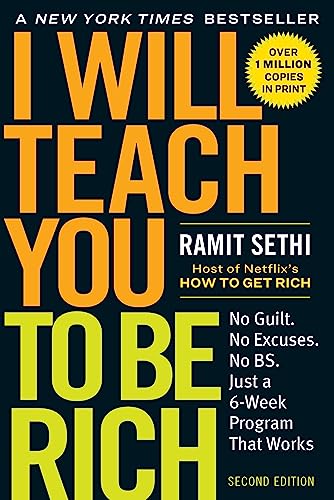
Over the course of eight episodes in this first season, Sethi meets with couples and individuals and offers financial (and seemingly life-coaching) advice to help them reach their goals. Sethi has degrees from Stanford University: a BA in Information & Society (in Science, Technology & Society) with a minor in Psychology and an MA in sociology (Social Psychology and Interpersonal Processes, and he’s a writer and entrepreneur. As far as I can tell, though, he’s not an accountant or Certified Financial Planner; he’s a self-labeled financial expert, so before you implement his financial advice, speak to a licensed expert in your state or jurisdiction.
That said, the advice he provides to the guests on the show are generally common-sense on researchable topics. He comes out in favor of renting rather than buying when the cost of buying is excessive, and against multi-level marketing (MLM) in such a way that really makes clear how, mathematically, expectations of success are similar to middle school athletes expecting to be NBA All-Stars.
Like the majority of organizing shows, there’s not a lot of opportunity to provide in-depth financial organizing solutions or guidance. It’s TV, and TV is designed to entertain first and foremost, to keep hitting the dopamine centers in the brain in order to encourage viewers to keep watching.
That said, shows like How To Get Rich (and The Gentle Art of Swedish Death Cleaning, all those other organizing shows) do one great thing. They call attention to the fact that pain points can be soothed, that bad habits can be reversed, and that there is hope if you are willing to seek guidance and make behavioral changes.
The first season of How to Get Rich is on Netflix.
I’m not just a fan of good narrative television; my first career was as a television program director and I served on my network’s Program Advisory Council, giving network executives feedback on programming and scheduling. You can take the girl out of TV, but you can’t take TV out of the girl. As such, I hope the deep-pocket corporations come to the negotiating table with the WGA and work out a deal that is fair to the hardworking professional writers who create the comedies and dramas, the TV shows and movies, that entertain and enliven us.
Until then, whether it’s an educational webinar or a edutainment reality show, I encourage you to mix some organizing and productivity into your viewing habits. And please feel free to share in the comments any recent shows, webinars, or other programming that slakes your thirst for guidance toward living your best possible life.
Paper Doll On Understanding and Conquering Procrastination
Nothing is so fatiguing as the eternal hanging on of an uncompleted task. ~ William James
We all procrastinate. Everyone knows that it’s irrational to put off doing something until the quality of the work might suffer. It’s obvious that it doesn’t make sense to keep not doing something when the deadline is fast approaching. And yet, at least sometimes, everyone procrastinates.
WHAT IS PROCRASTINATION?
Contrary to what you might have been told in your childhood (or even more recently), procrastination is not about laziness. Rather, it’s a self-protective mechanism.
Research shows that we use procrastination as a technique to regulate our moods. More specifically, to regulate, manage, and prioritize a negative emotion in the present over the negative outcome of our procrastination in the future.
Instead of delving into the science and scaring you off with words like amygdala and prefrontal cortex, here’s a cartoon to ease you into what’s actually happening in your brain when you procrastinate.
WHAT TRIGGERS PROCRASTINATION?
The tippy-top expert on procrastination, Canadian professor of psychology Timothy Pychyl of Carleton University in Ottawa, is the author of Solving the Procrastination Puzzle.
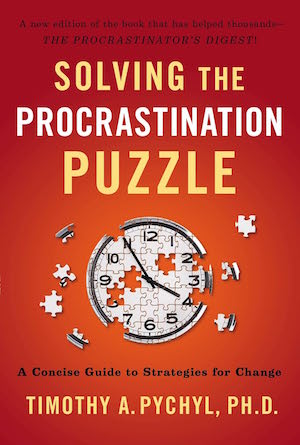
According to Pychyl, there are seven triggers that cause people to procrastinate:
- Boredom — Whether a child is delaying doing homework because the assignment isn’t challenging or an adult is facing a stultifying task (vacuuming, I’m looking at you!), doing anything stimulating (even if it’s counterproductive) may feel better than doing the boring thing.
- Frustration — The task itself may be frustrating because it’s full of difficult, fiddly little steps, like putting together a spreadsheet from multiple sources of data or figuring out how to build an Ikea desk without any written instructions; or, you might be frustrated because the work involves dealing with annoying members of your team.
- Difficulty — When something seems like it’s going to be too mentally or physically taxing, it’s comforting to procrastinate. Sometimes we tell ourselves that we’re preparing, or doing pre-work, to set the stage for the difficult task, but there are only so many pencils your teen can sharpen before settling in on that calculus homework.
- Lack of Motivation — This may seem the same as boredom, but it’s actually more complex. Boredom is mostly about the task; some activities are just inherently lacking in stimulation. But motivation relates to internal drive. Even if you aren’t happy in your current role at work, you may not be that excited about applying for a new job (perhaps because of depression, anxiety, or fear of change). You have to see the benefit of working on your resume and prepping for an interview as steps toward a personal goal of being more professionally confident, rather than just items to be completed to “get a job,” which may not be inherently motivating.
- Lack of Focus — Mental focus depends on physical and emotional stimuli as well as external stimuli. A variety of emotional concerns related to the task at hand — fear of failure, being embarrassed in public, losing a scholarship or a job — as well as unrelated issues like family or relationship troubles, or health concerns, can detract from your focus. Similarly, working in a crowded or noisy space, or even in an environment with visually distracting elements, can dilute your focus. Some people need to turn down the radio while driving to find the address they’re seeking; others need a tidy desk in order to read, even if the desk is outside their line of sight. You can’t focus if you’re hungry or tired, either.
- Feeling Overwhelmed — Too much of too much will always keep you from taking clear action. In the professional organizing field, we talk about suffering from decision fatigue and often say, “The overwhelmed mind says ‘No’.” Have you ever stood in the toothpaste or shampoo aisle and been shocked by the ridiculous number of competing alternatives? Similarly, if there are many different ways to approach a talk (writing a blog, replying to an email, making a plan for a move), overwhelm may lead us to just physically or mentally wander away.
so much to do pic.twitter.com/fiSm7Y2Erg
— poorly drawn lines (@PDLComics) December 21, 2022
- Being Overworked — Burnout is definitely a trigger for procrastination. If you’ve ever worked day-in and day-out on a project such that by the time you got home, you had literally no mental space or physical energy to do anything, even to prepare food, that’s a sure sign of overwork. Alternative options might be more or less pleasant (think: socializing or housework), but you might choose to lay on your couch and mindlessly scroll through social media instead of either thing you were supposed to do. Overwork eliminates the energy necessary for doing anything in the now, so everything gets pushed to a theoretical later.
Of course, Pychyl is not the only one to define triggers for procrastination. Others have identified fear of failure, impulsiveness (sometimes associated with ADHD), and generalized anxiety. Various executive function disorders can make it difficult to sequence or prioritize tasks.
The point is, procrastination is not laziness, but a conscious or even subconscious need to not feel icky now, even if you’re going to feel doubly icky later.
Procrastination is not laziness, but a conscious or even subconscious need to not feel icky now, even if you're going to feel doubly icky later. Share on XPRACTICAL STRATEGIES TO COMBAT PROCRASTINATION
Obviously, once you identify your trigger to procrastinate, you can employ techniques to reverse the behavior. For example, if a task is boring, like housework or working out, you might pair it with music or a streaming TV show.
It also may be helpful to take away the temptations of more entertaining options. Lock your phone in a drawer — having to unlock it to play Candy Crush may give you the necessary pause to stick with your task. If you’re tempted by websites that are more entertaining than the work you’re supposed to be doing, lock yourself out of those websites (for whatever time period you set) by using a website-blocking program like:
Cold Turkey — works with Windows and MacOS
Focus — works with MacOS-only
Forest — designed for your phone, it works with Android, iOS, and in your Chrome browser
Freedom — works with Windows, macOS, iOS, Android, in as a plugin for Chrome
LeechBlock — works in various browsers, including Chrome, Firefox, Edge, and Opera (but not Safari)
Rescue Time — works with Windows, macOS, Android, iPhone, and iPad
Self-Control — works with acOS-only
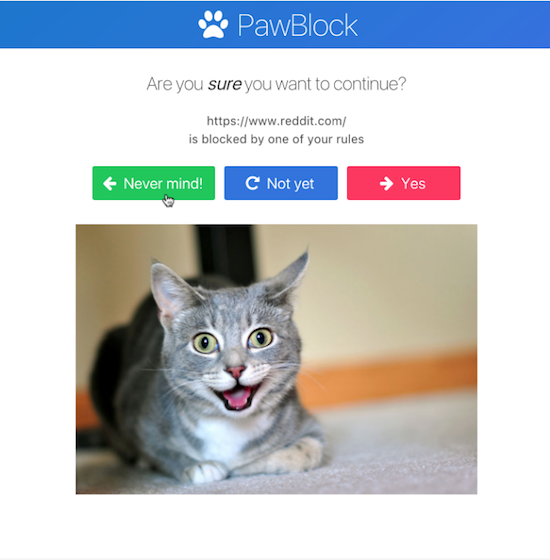
There’s also Paw Block, which, while it only works as a Chrome or Firefox extension, has the benefit of showing you pictures of kittens from the around the internet when it prevents you from accessing distracting websites.
If you’re frustrated by the elements or situation of the task, you might bring in a friend or colleague to help you do it, someone who doesn’t have the emotional connection to the stressors that are throwing you off. They don’t necessarily need to perform the tasks, but just body double with you so you feel soothed and less frustrated.
You can break down difficult tasks into the tiniest possible elements, or seek a supervisor’s guidance, so the annoyances seem less annoying. (It’s tricky in the moment, but you might also try to reframe “difficult” tasks as challenges and contests with yourself.)
If you’re feeling unmotivated, see if you can find a short-term reward. (Cake? Cake is always good! But a refreshing walk outside after finishing the first of three elements of a task may help you get your head back in the game.) For a deeper lack of motivation, work with a therapist or coach to help you identify the meaningful benefits you can get from doing the things at which you tend to procrastinate, or possibly find a life path that eliminates those tasks. (If creating PowerPoint slide decks gives you a stomachache, maybe you need to consider becoming a lumberjack or a lighthouse keeper. Not everyone wants to be an knowledge worker, and that’s OK!)
If your procrastination is due to floundering focus, determine what’s contributing to the lack of focus. If it’s internal (troublesome thoughts and emotions), consider meditation, walking in nature, and talking through the excess thoughts with a friend and/or in therapy.
But if it’s external, if you’re feeling attacked from all sides by an overload of sensory stimuli, you may need to declutter and organize your space or move your workspace elsewhere (or invest in noise-canceling headphones). But it’s possible you’ll want to see if an ADHD or other diagnosis might help support your efforts to get assistance dealing with distractions.
Overwhelm may seem a lot like frustration. While you may be frustrated by just one (big) annoying thing, overwhelm feels like you’re getting pelted with dodge balls from all directions. It’s a good time to sit down with someone who can help you see the Big Picture and identify the priorities and sequences. Professional organizers and productivity specialists excel at helping you battle overwhelm and get clarity.
And if you’re overworked and experiencing burnout, it’s time to have a realistic discussion with your partner, therapist, boss, and anyone else who can help you achieve balance before you suffer health consequences more serious than just the emotional distress related to procrastination.
In the short term, some meditation and schedule modifications might work, but if you’re experiencing chronic overwork, more intense career and life changes might be necessary. Start by revisiting my series on toxic productivity, below, and pay special attention to post #3.
Toxic Productivity In the Workplace and What Comes Next
Toxic Productivity Part 2: How to Change Your Mindset
Toxic Productivity Part 3: Get Off the To-Do List Hamster Wheel
Toxic Productivity, Part 4: Find the Flip Side of Productivity Hacks
Toxic Productivity Part 5: Technology and a Hungry Ghost
You’re more than your job pic.twitter.com/qAHwtnT6Ux
— Junhan Chin | Illustrator (@junhanchin) August 31, 2022
EMOTIONAL AND INTELLECTUAL STRATEGIES TO COMBAT PROCRASTINATION
Making changes in your space and schedule, breaking your projects into smaller tasks, and giving yourself rewards are all smart practical solutions, but they’re external. Changing your external world can only eliminate some of the obstacles to your productivity. To truly conquer procrastination, experts advise making internal changes as well.
Admit it!
Denial is not just a river in Egypt. When you catch yourself procrastinating, acknowledge it. Once you call your own attention to the fact that you’re delaying doing the thing you’re supposed to be doing, you can look at that list of triggers and say, “Yikes! I’m avoiding writing this report. Why is that?” You can’t solve a problem if you don’t realize it exists. Admitting it gets you halfway to a solution.
Forgive yourself
This isn’t the same as letting yourself continue to procrastinate. And just like forgiving someone else isn’t the same as saying that the undesirable behavior never occurred, forgiving yourself gives you the opportunity to recognize that past behavior doesn’t have to dictate future performance.
A 2010 study by Michael J.A. Wohl, Timothy A. Pychyl, and Shannon H. Bennett entitled I Forgive Myself, Now I Can Study: How Self-Forgiveness for Procrastinating Can Reduce Future Procrastination found, as the title indicates, that students who forgave themselves for procrastinating on preparing for exams earlier in the semester were far less likely to procrastinate on studying for the next exams.
You’re human; if you were a perfect person … well, you’d be the first one ever. Forgive yourself for having procrastinated in the past.
Practice self-compassion
Related to self-foriveness is self-compassion. Researchers found that people who procrastinate tend to have higher stress levels and lower levels of self-compassion, and theorized that compassion cushions some of the more negative, maladaptive responses that cause repeated procrastination.
Think of it as similar to overeating. If you cheat on your diet, low self-compassion might get you so down on yourself that you figure, “I’ll never lose this weight. I might as well just eat the whole ice cream carton!” But if you’re able to have self-compassion, you may tell yourself, “Yup, I did eat more than a half-cup serving of ice cream. But I understand why I did it. Next time, I’ll try drinking a glass of water and walking around the block first. Or maybe I’ll go out and eat the ice cream on the front porch, where the rest of the carton won’t be so accessible!”
(Seriously, whoever thought half a cup of ice cream was an adequate serving, anyway?)
Be intentional
All of the alternatives I described up above for seeking assistance and changing your environment (and the ones we’ll discuss next week) will only happen if you place your intention and attention on making changes.
Yes, this means a little extra labor on your part. If you know you procrastinate because you anticipate interruptions (from co-workers in the office or tiny humans when remote-working), you’re creating a problem before the problem exists, so you’re missing out on productivity before you need to and then again when the problem actually occurs. (And then you’ll spend the time after the interruptions being resentful about them, and that will lead to less productivity, too!)
Once you know what you’re up against and which triggers present a problem for you, build time into your schedule to plan your way around the obstacles and triggers. That might mean seeking out time with professionals who can help you, whether those are therapists, professional organizers, productivity specialists, or life or career coaches.
Embrace consistency
The various popular books on forming habits, like James Clear’s Atomic Habits, all agree that it starts with changing your identity, and seeing yourself as “the kind of person who” does things in a more agreeable, positive way.
Showing up daily is easier than showing up once in a while. pic.twitter.com/5CrOdIQjCu
— Sarah Arnold-Hall (@saraharnoldhall) February 6, 2023
One of the ways you can prod the formation of that kind of identity is to develop consistent actions and behaviors. In order to be the kind of person who goes to bed on time (and thus, can get up on time), you need to jettison the behavior of doom-scrolling for hours before bed. To consistently do that, you might set an alert on your phone for 8 p.m. to put the phone away, somewhere far from the couch or your bed. (Afraid you won’t get up on time if the phone isn’t near your sleeping area? Revisit my post from last summer, Do (Not) Be Alarmed: Paper Doll’s Wake-Up Advice for Productivity.)
Be a Self-Starter
You’ve heard me talk about activation energy before. In my post, Rhymes With Brain: Languishing, Flow, and Building a Better Routine, I wrote:
We also depend on activation energy. Because the hardest part of what we do is the getting started, we have to incentivize ourselves to get going. There are all sorts of ways we can trick ourselves (a little bit) with rewards, like pretty desk accessories or a coffee break, but the problem is that action precedes motivation. We’re not usually psyched to get going until we have already started!
Action precedes motivation. We're not usually psyched to get going until we have already started, whether it's a runner's high or Csikszentmihalyi's flow. Share on XA huge key to breaking the procrastination habit is getting started. After all, Sir Isaac Newton’s First Law of Motion states that a body at rest tends to stay at rest and a body at motion tends to stay in motion. (OK, it actually says, “a body at rest will remain at rest unless an outside force acts on it, and a body in motion at a constant velocity will remain in motion in a straight line unless acted upon by an outside force.” But this isn’t Physics 101.)
Did you watch the cartoon at the start of this post? (It’s OK if you skipped it; just scroll up and watch now and we’ll wait.) If you did watch, you know that you’re more likely to feel negative emotions about a task when you’re avoiding it, but when you’re actually doing the task, it doesn’t feel so bad.
So, get yourself in motion so that you can stay in motion! Get yourself past the hurdle of starting and that small victory of starting, and the realization that it wasn’t as bad as you feared, might make you less likely to procrastinate the next time you’re facing that same challenge.
GET STARTED AT GETTING STARTED
Once you’ve read all of the preceding advice, you still have to get your butt in the chair. (OK, yes, you could use a standing desk. Let’s not be pedantic!) There are two key ways to do that.
First, embrace accountability. As I’ve previously described in these various posts, borrowing willpower from others by getting support from “partners in crime” can be just the motivation you need to get started and stick with it, whatever the “it” is:
Paper Doll Sees Double: Body Doubling for Productivity
Paper Doll Shares 8 Virtual Co-Working Sites to Amp Up Your Productivity
Count on Accountability: 5 Productivity Support Solutions
Flow and Faux (Accountability): Productivity, Focus, and Alex Trebek
Second, even when you’ve got accountability support (and especially when you don’t), there are techniques for helping you get started on tasks in ways that feel hopeful, and that make finishing seem possible.
So, come back for next week’s post, Frogs, Tomatoes, and Bees: Time Techniques to Get Things Done, where we’re going to be doing a deep dive into a variety of well-known and sleeper strategies for eliminating procrastination. We’ll be talking about tomatoes and frogs, blocks and tocks, and so many numbers that you’ll think we’re in math class. (But I promise, just in case you tended to procrastinate on math homework, there will be no trains leaving Chicago at 120 miles per hour.)
Until next time, read more about the nature and causes of procrastination:
Why You Procrastinate (It Has Nothing To Do With Self-Control) ~ The New York Times
Why People Procrastinate: The Psychology and Causes of Procrastination ~ Why People Procrastinate
6 Common Causes of Procrastination ~ Psychology Today
7 Triggers of Procrastination ~ ChrisBaily.com
Procrastination triggers: eight reasons why you procrastinate ~ Ness Labs
When you tend to procrastinate, what triggers tend to haunt you? What methods do you use to keep procrastination at bay?
Privacy in Your Home Office: From Reality to Fantasy

When Virginia Woolf wrote about having A Room of One’s Own almost a century ago, she wasn’t being entirely literal. She was talking about the lack of opportunities for expression that women in her day had. “A woman must have money and a room of her own if she is to write fiction,” Woolf wrote.
Of course, this was mainly a metaphor for all of the lack of access women of her era (and most eras) experienced: lack of money to access education, lack of career choices, lack of ability to guide one’s own future. “A room of one’s own” in terms of the metaphor is complex, but the concept has stood out in popular understanding both in the figurative sense as well as the literal one since the 1920s, when Woolf published the essays based on her lectures.
What does this have to do with organizing and productivity?
GIMME SOME SPACE (FOR MY STUFF)
We all — unrelated to gender or age or any of a variety of factors — need our own space to think, to create, to work, to strive toward greatness, and even to be our best selves. Nobody can be “on” 24/7/365. Having no private space amid the chaos, whether that’s in a home or office, eventually prevents us from achieving or even aspiring to achievements.
At the start of the pandemic, there was an enormous push to understand the needs of remote workers. Setting your laptop up at the kitchen table just wasn’t going to cut it. Everyone began to look at ideas for creating remote work spaces that were efficient, effective, productivity-supporting, comfortable, and private.
For an intensive primer on how to create a home office with storage that supports all of your needs, I encourage you to visit the guest post I wrote in 2021 for the excellent storage supply company, meori.
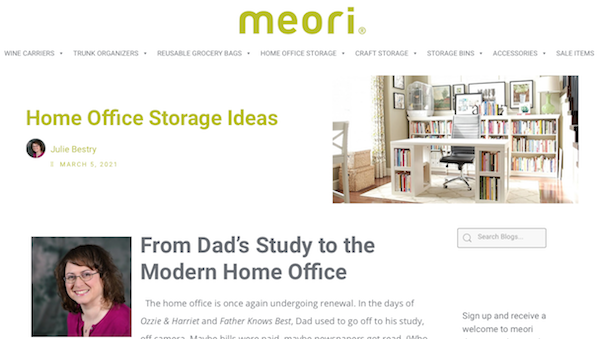
From Dad’s Study to the Modern Home Office covered everything you might want to know about home office design and storage. The post looked at why home office storage usually fails, the questions you should ask yourself to design better home office storage, and key strategies for creating your ideal work and storage space.
Of course, to create a room (or space) of one’s own, you have to look beyond the tangible. For example, for a deep dive into the emotional aspects of working remotely in the ongoing COVID era, you might want to visit my post The Perfect Unfolding As We Work From Home.
From a more interactive behavioral perspective, the classic Paper Doll post R-E-S-P-E-C-T: The Organizing Secret for Working At Home looked at how to create a work environment that ensures that others give us respect, and that we respect ourselves and our own time, energy, and attention.
PRIVACY, PLEASE
Privacy is essential. While we tend to think of privacy in an office setting as the ability to conduct our work without others overhearing our conversations, it’s important to also consider how much we needed to be protected from overstimulation caused by other people’s conversations (or pen-tapping, gum-chewing, or video game playing). We looked at this to some extent in Divide and Conquer: Improve Productivity With Privacy Screens.
Whether we are neurotypical or neurdivergent, we all need to find our own rhythms, and that can involve protecting ourselves from the visual and auditory stimulation that comes from being out in the world. Decades of work environments have taught me how I work best.
When I first worked in television, I had a small, windowless office with old-fashioned, oversized furniture. I had no visual disturbances, but even with the door closed, I could hear the hubbub of a “bullpen” situation right outside my door.
At my next TV station, my office was slightly larger, but near the back of the building, away from noise, and my one window looked out onto an A/C unit and the outer wall of a warehouse. Although I’m an extrovert, when I work I want as little outside stimuli as possible, and this was perfect; with my door closed, I could concentrate and focus entirely on my own thoughts.
My last TV station was in a converted auto sales showroom. The entire front wall of my ridiculously enormous office was made up of floor-to-(high)-ceiling windows looking out onto a parking lot and a busy highway. Others may have envied the space, but I had to keep the vertical blinds closed 90% of the time (both to keep out the blinding sunlight and the visual stimuli).
In my own home-based set-up for more than two decades, my desk faces a blank wall so that nothing beyond my computer screens can distract me. This might be hell for others, but it’s ideal for ensuring my focus.
Your mileage may vary.
FINDING YOUR IDEAL SPACE — REALITY AND FANTASY
You’ll find a lot of advice online for creating your own home office space with minimal effort. For example, you could:
- Remove the accordion doors from a bedroom closet and add a wide but shallow table as a desk.
- Add lighting fixtures and a desk in an alcove under the stairs to create a private Harry Potter-inspired workspace.
- Add a curving curtain rail on the ceiling (like the kind that creates privacy in hospital emergency rooms) to designate a corner of a bedroom or other area of the house as an office and separate the workspace from the rest of the area with a curtain.
- Use IKEA Kallax bookshelves (filled with books) to create a room divider to give a sense of privacy. (Feel free to watch the video with the sound off; the AI robotic voice insists on spelling Kallax out each time. The future is weird.)
But again, the internet abounds with such options. I thought it might be fun to look at a variety of standalone office ideas that range from the inexpensive and realistic to the when-you-get-that-huge-advance-on-your-great-American-novel option.
Sanwa Home Privacy Tent
Do you remember Party of Five? The mid-1990s Fox Broadcasting show about five young siblings trying to survive after a family tragedy launched the careers of Neve Campbell, Matthew Fox, Jennifer Love Hewitt, and Lacey Chabert, among others.
When I saw this first product, I was immediately reminded of how, in the earliest seasons, Chabert’s character Claudia created her own bedroom by putting up a tent in the middle of the living room. The Sanwa Home Privacy Tent (AKA the 200 Tent001) is designed for a similar purpose, carving out private space in the middle of pre-existing space.

It’s a basic nylon tent, not very large, but adequate for one person, a small desk for a laptop, and a lamp or other lighting source — to create a distraction-free workspace. Designed for indoor use, it’s suitable for studying or working. The super-portable tent weighs only 6 pounds, including the case, and measure 35″ x 43″ by 59″.
There’s a skylight/rooftop opening if you’d like more natural light, a side window, and a zippered entrance so you can be available for office hours (or for visits from your pets.) Admittedly, it’s not very pretty, but if you’re feeling overwhelmed by all of the sensory inputs in your home, apartment, or dorm, setting this up for some private workspace could be just the ticket for eliminating your stress.
The instructions apparently only come in Japanese, but as the video shows, assembly looks very intuitive — it pops open like a mesh laundry basket!
Sold for about $125 at various stores online, it’s currently sold out at the Japan Trend Shop where I first found it. (It is in stock if you want to purchase it directly from Sanwa in Japan for 7980 yen, or a bit over $61.)
Alternatively, if you search Amazon for “indoor tents,” you’ll mostly find children’s tents and playhouses for under $60, but I have to admit that I envy something breezy like this indoor playhouse. (It’s regularly about $110, but at multiple times over the last few weeks, I’ve seen it on sale for under $65.)

Steelcase’s Office Pod Tent
Looking for something a little less cramped, more designer-friendly, and envisioned for grownups? Steelcase, known for office and classroom furniture as well as filing cabinets, has a whole line of nifty solutions.

The Office Pod Tent is a freestanding pod made with a flexible aluminum frame. The top is open to provide air flow and to let in natural light. It’s also open on one side, so it won’t induce claustrophobia (but also won’t be as private as if you could close a door). Still, it limits distractions and provides a space that’s a little snazzier than what you’d get in an office, cubicle, or your dining room.
Basically, you’re going to feel like you’re on an upscale, modern camping trip. The Office Pod Tent is 92″ high. The base has a 76″ diameter, and because the frame creates bowing at the sides, it’s 88″ at its widest point. You’re definitely going to have more space than with the Sanwa tent! The aluminum frames and poles are standard silver with platinum-colored plastic connectors to secure the fabric to the frame, keeping the shape intact.
The spec sheet notes that the Office Pod Tent can be fully assembled in under one hour with two people. (I’m going to ignore how much that sounds like the beginning of a word problem in fifth grade math class.)
The Office Pod tent is available in three color “families: Sheer (white), Ascent (green), and Era (orange-ish) and can be can be specified in one solid color or in two color family combinations:
- Sheer
- Ascent/Era
- Sheer/Era
- Ascent/Ascent
- Sheer/Ascent
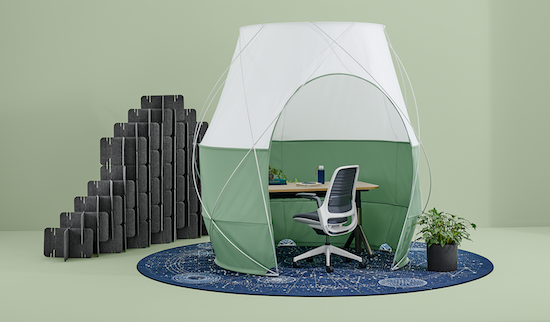
Steelcase actually designed the Office Pod Tent to be used in traditional office situations, either for creating alternatives to cubicles or introducing cozy, private lounge settings in the office. But you can definitely see how you could use this in a space in your home, or to create space for onboarding new employees in a small starter office.
Steelcase Work Tents is a collection of privacy solutions – inspired by tents, but designed for the workplace.
The Office Pod tent must be purchased from an authorized Steelcase dealer. While I was unable to locate a price for the Office Pod Tent, I did find reference to a price point of $570 for Steelcase’s Boundary Tent (which is actually a room divider and not a tent). The line also includes Steelcase’s Table Tent (which is less of a tent and more of a table divider or privacy shield).
Alternative Temporary Office Pods
While researching this topic, I found quite a few alternative alternatives. For example, there’s a UK option for rent or purchase of inflatable office pods of varying sizes reflecting trippy colors. While it’s not really a fit for your random home office, something like this would be very cool if you were trying to set up a private meeting space at a conference or if you were having an event at your small office location.

UK-based Optix Inflatable Structures’ carries Pop-Up Office Pods in 3′ x 3′, 3′ x 4′, 4′ x 5′, and 5′ x 6′ options, and they have a variety of sizes for temporary meeting rooms.
Phone Booth Options
Unfortunately, there don’t seem to be many mid-range options in the home/office pod category, so you’re either looking at tents or full-on structures. At the high-priced, “dream” end of things, most options are tiny “phone booth”-style rooms that are not for the claustrophobic or the faint-of-pocketbook.
The various PoppinPod options from Poppin starts pricey and goes off into the stratosphere. There’s the Poppin Om Sit and Poppin Om Stand (below), both available in black or white, starting at $7,999.
 It comes with a built-in work surface and is ideal for when need to take confidential phone or Zoom calls. The rest of the line continues with the Kolo Collection (Kolo 1, Kolo 1+, Kolo 2, Kolo 4, and Kolo 6), all with sliding doors and providing work or conference space.
Prices range from $10,999 to $47,999, so you’re not going to put one of these in your living room unless you’ve had a lifelong dream of pretending you’re Max and Agent 99 in the Get Smart cone of silence.
Talk Box Booth has four models, with the FOLD version the most resembling the old-fashioned Superman-changing-into-his-cape-and-tights version. For $5,775 without assembly costs (or for an additional $550 for expert assembly), Talk Box Booth’s FOLD starts at 39.4” wide x 35.4” deep x 90.2” high for the basic model. It has a bi-fold door, steel construction with a white powder-coat finish, and an adjustable height desk, so you can choose to sit or stand.

There’s an automatic fan that turns on as soon as you enter the FOLD, and the air circulates every few minutes to maintain comfort. Two electrical outlets and two USB ports allow you to keep all of your devices charged as long as the FOLD is plugged into a standard 120V outlet.
(Other Talkbox Booth lines include SLIDE, a sliding-door one-person booth, as well as the DOUBLE (which can accommodate two people) and a STUDIO (which can hold one to four people).
Loop Phone Booths are a similar line, but definitely offer the snazziest solutions for soundproof teeny office space.
Loop Solo is colorful and charming, and while small and squished, somehow feels both retro and modern. Seating one person, the 550-pound Canadian-made pod is 80.5″ high x 47.5″ wide by 29.5″ long.
The exterior is hardwood, while the interior is made of durable laminate and the 10mm thick tempered glass comes with a frosted option. The back panel can be cork, felt, or glass. If you choose glass, you’re going to be trading off having a feeling of more space for accepting more visual sensory inputs, so you’d need to know which would bother you more.

The cozy upholstered seat has an ergonomic backrest, and there’s a concealed magnetic door closure to make sure your Zooms are secure. A work desk is included and you can get an optional tempered glass whiteboard for taking notes and crafting ideas.
The Loop Solo uses a standard power outlet (with optional network and USB ports), has LED lighting, a positive pressure two-fan ventilation system, and an occupancy sensor.
No assembly is required and the Loop Solo is shipped in one piece, designed to fit through tight doorways or narrow halls, and claims to be the only plug-and-play pod of its kind on the market.
Unfortunately, you have to call to request a price quote, but there appear to be a variety of options in terms of types of wood and interior colors, so if this is more than a dream, you could contact Loop for a serious inquiry. (Be sure to come back to the comments section and share pricing with us!)
(Other Loop options include a soft-sided Loop Flex, a four-person Cube, which resembles a cozy diner booth with double-glass doors, and pre-fab Access conference rooms.)
If this still isn’t enough to satisfy your tight-squeeze office dreams, be sure to check out Cheapism’s Over-the-Top Home Office Pods for Working From Home and Urban Office‘s lines of office pods and dens & huddles. My favorite is the Jenson Hut Office Den, which feels simultaneously Space Age and like a Mad Men-style throwback.
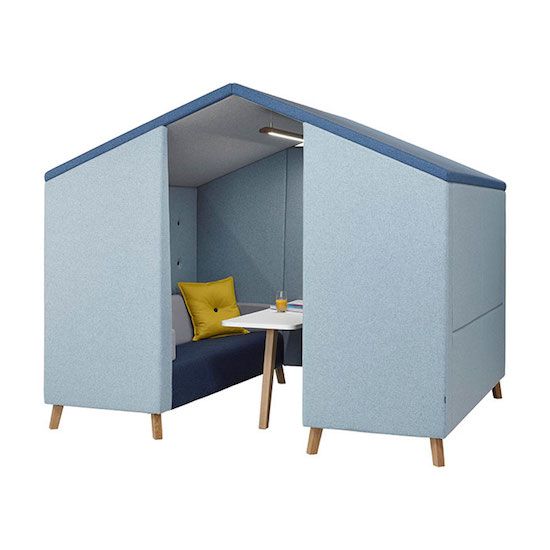
Fantasy or reality, however we create our workspaces, we must give ourselves an environment that grants us space for our work items and privacy for our thoughts and communication.
Somewhere between a repurposed kid’s desk and the dining table, between a pillow fort and a pricey office set-up, there’s a work space that’s right for you. The key is knowing what elements are essential for your satisfaction and what experimental aspects you can accept or reject.
What’s non-negotiable in your own work space? Please share in the comments!
Highlights from the 2023 Task Management & Time Blocking Summit
As you know from my post Surprising Productivity Advice & the 2023 Task Management & Time Blocking Summit a few weeks ago, I was set to spend three days at the beginning of this month attending, and being a panelist and presenting at the summit. This is the fourth year I’ve been involved, and it was definitely the best yet.
The theme of this year’s summit, One-Size-Doesn’t-Fit-All. Now what?, is dear to my heart. In February, the summit’s creator, Francis Wade, and Productivityist Mike Vardy delivered a pre-summit session to set the stage. Generally, Francis posited, when people are struggling with productivity (and this is true of tangible organizing struggles, too), they seek out experts, “gurus” who identify their so-called secret formulas. “Do this and all will be well!” And that may be true, but only for a while.
No one system for anything — career paths, life balance, making cookies, or having an organized and productive life — works for every person in every situation. At some point, it’s essential to take the guru’s advice and customize it for yourself so you can live an authentic life.
Even Marie Kondo, whom I chided for insisting her way was the one-true way (in my post The Truth About Celebrity Organizers, Magic Wands, and the Reality of Professional Organizing) has had to face the fact that her way doesn’t exactly work for the kid-filled life she now embodies. (See all the various recent articles with titles like “Professional tidier Marie Kondo says she’s ‘kind of given up’ after having three kids.”)
Early on, especially pre-internet, there were no centralized places to access productivity advice. Then, so many people got into David Allen’s Getting Things Done (GTD to those in the know) that it was evangelized everywhere. But with the expansion of the web, “productivity porn” proliferated, and people had (and have) access to so many options.
The problem? Whatever popular productivity methods are out there, people aren’t all the same. They are unique. As I presented in “Paper Shame” — Embracing Analog Productivity Solutions in an Increasingly Digital World:
Because I know my own style, I know what works best for me. Because I stay abreast of all of the options out there, I know how to suggest what might be best for my clients. And my job is to know that what works for me won’t work for each of my clients, and what works for my overwhelmed, 30-something client with ADHD and a toddler won’t be the same as for my single-dude on-the-road salesperson client or my new-retiree client whose spouse was just diagnosed with Alzheimer’s. We’re each unique.
So, it’s important to know that it’s normal if the productivity strategies that work for your bestie don’t work for you. As you read blogs and books and incorporate advice, instead of accepting every bit of it “hook, line, and sinker,” Francis encouraged what he calls an ETaPS framework.
Simply put:
Evaluate your current situation and needs
Target where you want to move the needle (and by when)
Plan how you’re going to incorporate change into your approach, and get
Support through coaches, friendly accountability, and exposure to a wide variety of opinions and methods.
The summit was one stellar way to get that exposure.
These three jam-packed days included 27 recorded video presentations as well as live interviews, panel discussions, and networking at digital Zoom-like tables. It would be impossible to share all of the highlights, which ranged from Olga Morett‘s compassionate, vulnerable approach to “unmasking” and self-exploration for neuro-diverse individuals to Hanifa Barnes‘ framework for building without burnout (which included a deep dive into understanding circadian rhythms and body clocks for chronotypes — apparently I’m a cross between a wolf (night person) and a dolphin (insomniac).
 Dolphin photo by Ádám Berkecz on Unsplash
Thus, rather than providing a full recap of the summit, I’m going to share highlights and snippets that caught my attention, and which I look forward to sharing with my own clients.
QUICK BITES
“The menu is not the meal.”
Henrik Spandet, while talking about the differences among task management, calendar management, and meeting management, cautioned participants to remember that a task list is merely a list of opportunities, just as a menu is a list of dining alternatives. One must prioritize to maximize the experience. You can’t expect to do it all, or do it all at once. (He did not, however, discuss the advantages of eating dessert first.)
“If you’re not doing what you’re supposed to be doing, just sit.”
Carl Pullein‘s take on self-discipline dovetails with my own advice for dealing with writer’s block, and it’s kind of like the reverse of the bartender yelling, “You don’t have to go home but you can’t stay here.” You don’t have to perform the task you’ve set for yourself, but if you don’t, then you can’t do anything else. No perfectionist procrastination by tidying your desk; no mindless scrolling.
Sit. Just sit.
And in sitting and not doing, you may find yourself motivated to start writing, creating, or tackling whatever you’ve been avoiding. If not, you will find yourself having to face the reason for your avoidance, which may prove equally productive.
During a third-day “Boundaries, Burnout and Balance: Finding Peace When Working from Home” panel with Renee Clair, Clare Evans, and Olga Morett, the concept of “the booty hour” came up — and how getting the butt-in-the-chair is that make-or-break moment.
Do, or do nothing, is a powerful choice. We are so fixated on never being bored that the idea of having to do nothing may make the thing we are avoiding suddenly a much more compelling alternative!
“What gets measured gets managed — even when it’s pointless to measure and manage it, and even if it harms the purpose of the organization to do so.”
Too often, Peter Drucker‘s quote is truncated as “What gets measured gets managed” but the full quote is so much more powerful. In other words, be aware of how your methods and strategies impact your work, but do not get so caught up in the minutia of how many emails you’ve cleared (or not), and focus on the bigger picture of accomplishing what you want and need to do.
Don’t spend so much time tweaking your systems to get a micro-percentage point of difference. Know what metrics will help you achieve the return on investment of your time, energy, and attention, and focus there. Prioritization can feel abstract, but pay attention to what has the greatest impact on your life, and what brings you closest to your goals.
“Busy leads to burnout; productivity leads to prosperity.”
Ayana Bard‘s message at the start of her five-part approach to mindfully productivity has been in my head for the past week. Her approach involves gaining clarity (and understanding yourself and your tasks so that you can prioritize), knowing where your time is actually going (by doing a time audit), and managing your attention and (mental, emotional, and physical) energy.
Ayana accented the importance of mindfulness (i.e., paying attention with purpose), and noted that practicing mindfulness is easy to skip but not easy to do. (Hence the practicing part, eh?) She recommends incorporating mindfulness of your energies with regard to ultradian rhythms by working 90 minutes at top performance, taking 20 or so minutes for healing and recovery, and then starting another 90 minute cycle of top performance.
BOOK RECOMMENDATIONS
Professor Bret Atkins‘ presentation The Zen of Ten offered lists of ~ten (though he cautioned, not “top” ten) books (both well-known and a second list of sleepers), podcasts, videos, terms, and tools. The big-name list included works by David Allen, Steven Covey, Cal Newport, and Brian Tracey, as well as the “habits” triumvirate of The Power of Habit by Charles Duhigg, Atomic Habits by James Clear, and Tiny Habits by BJ Fogg.

Slightly lesser-known gems ranged from The Autobiography of Benjamin Franklin (worthy of a future Paper Doll post), Ryan Holiday’s The Daily Stoic, Tony Buzan’s The Mind Map Book, 1908’s How to LIve on 24 Hours a Day by Arnold Bennett, and 4000 Weeks: Time Management for Mortals by Oliver Burkeman, about which I wrote extensively in Toxic Productivity Part 3: Get Off the To-Do List Hamster Wheel.

There is no way to do his superb lists justice (and will be revisiting his other recommendations in future posts), but I will note that out of 22 highlighted books (yes, there were a few bonuses), there was only one book authored by a woman: Molly McCarthy’s The Accidental Diarist: A History of the Daily Planner in America.

I note this because it’s a more damning comment on the publishing industry than of Atkins and his discernment. But that’s also a topic for a future day!
Other books recommended by presenters were:
Why We Sleep by Matthew Walker
Time Surfing: The Zen Approach to Keeping Time On Your Side by Paul Loomer
SCOPE — IT’S NOT JUST A MOUTHWASH
Trevor Lohrber felt that the true key to time management is often reducing the scope of a task rather than trying to increase your productivity and ability to do more. After all, our time is limited by strictures — where we have to be and when and how soon the work must be completed. Trevor presented three concepts, but it was the idea of pacers that caught my attention.
Did you ever take an exam in school and spend so much time writing the first part of your essay that when they called “15 more minutes!” you had to rush through your remaining points?
Although the point of deep work is to get into flow, Trevor points out that we often hit a wall when we look up and realize, “Oops, I’ve run out of time!” He suggests that by becoming more aware of time passing while we’re within a block of time, we can adjust our scope.
Trevor encourages using gentle timers at fixed intervals during a time block; for example, every 15 minutes during an hour-long work session. They key points are that these aren’t alarms (in that they’re not alarming), but gentle sounds, like an ocean or wind chimes; set your “snooze” to 15-minute increments and you can brush it away with the flick of your finger across your phone.
The idea isn’t to startle you out of flow, but just lightly alert you to the passing of time so you can stop to consider whether you need to limit the scope of what you’re doing now so you can finish the whole task on time.
The benefits of Trevor’s approach is that these “moments of mindfulness” keep you from going down any rabbit holes and ensure you’re repeatedly reassessing the work to be done in the time allotted. It allows you to work smarter because you are reassessing your scope regularly through the process, and improve your focus because you’re more aware of the scarcity of your time. (Trevor also cautions that this is not ideal for creative tasks, like writing a key chapter in a novel, because that focus can lead to tunnel vision, something you want when you’re trying to finish your accounting but not so much when you’re trying to develop dazzling prose.)
THE HOCUS POCUS OF FOCUS AND WHAT’S GOING ON IN OUR BRAINS
Achieving focus is the Holy Grail of productivity. We can do a brain dump to make sure we’ve examined all of our obligations, prioritize so we can work first (and longest) on what matters most, and create blocks of time dedicated to that deep work.
But how do we gather the motivation to get our tushies in the chair and then maintain our focus to actually get it all done?
This is where mindset is essential. Misha Maksin talked about the flow state, something we’ve covered here extensively, starting with Flow and Faux (Accountability): Productivity, Focus, and Alex Trebek (in the section called Sidebar on Flow and the Unpronounceable Mihali Csikszentmihalyi), and how four “mega” time wasters (anxiety, overwhelm, indecision, and procrastination) block our ability to achieve flow.
He casts it as a question of whether we are in a “primal state” where we feel we are under threat, ruled by our sympathetic nervous system, and using closed, contractive survival thinking, vs. in a “powerful state” ruled by the parasympathetic nervous system, thinking in an open and expansive, creative way. I mean, wouldn’t you prefer to be curious, compassionate, and joyous vs. fearful, anxious, and overwhelmed? I know Ted Lasso would!
Misha explained how the mechanism of unproductive behaviors starts with beliefs driving our thoughts, which then drive our emotions, which lead to our actions, and then results, and those results then determine our core beliefs. This means that results are both initially determined by past beliefs and reinforce future beliefs, in a perpetual cycle that, if our beliefs about ourselves or our abilities are negative, our results very likely will be, also.
However, we can rewire our mindset so that the driving force is not our beliefs but our decisions. Per Misha, if decisions determine thoughts, which activate emotions, which motivate actions, which produce results, which reinforce decisions, keeping us in that productive “powerful state,” — we have a much better shot at attaining flow in our work and joy in our lives.
The key, Misha posited, was to notice when our brains are moving us to that ineffective “primal state” and use our tools to focus on making wise, proactive decisions rather than being ruled by the negative self-talk often inherent in our beliefs. Perhaps easier said than done, but it’s a powerful switch. We can decide to get our butts in the chair now rather than repeat a belief ingrained since childhood that we “always” procrastinate.
DRIVEN TO DISTRACTION
Dr. Melanie Wilson identified a three-part approach to changing reaction distractions, and while there are practical elements, this is basically a psychological approach.
- Adopt a new identity, eschewing the one that says “I am an easily distracted bunny” and trading it for one that says, “I’m a focused, productive person.” This echoes what James Clear says in chapter 2 of Atomic Habits.
- Identify your unmet (emotional) needs so you can stop using ineffective, distracting coping mechanisms. Wilson notes that certain feelings lead us to distract ourselves with unproductive alternatives — overshopping, overeating, drinking, gambling, compulsive social media scrolling — and that the common advice to replace those habits with more productive ones (go for a walk, read a book) fails because they don’t get at the underlying emotion that drives the self-distraction. If we can identify the negative emotion, we can satisfy it with planned activities that do satisfy it. For example, Wilson’s personal example was having ADHD and craving novelty. By planning her days with lots of intentional novelty built in, she was less likely to seek distractions (like compulsive shopping) when she was supposed to be doing deep work.
- Acknowledge troubling issues (what she calls “gnawing rats”) instead of avoiding them. Wilson notes that scheduling quiet time to think (and not merely to meditate), journaling, praying, or planning time to deal with a distracting issue, you’ll be less likely to experience the harsh (and distracting) negative side effects of those problems, like sleep issues, IBS, heart trouble, etc.
BEGIN WITH PERFECT
We know there’s no such thing as perfection in achieving a schedule that doesn’t overwhelm. That said, there was a repeated theme across the summit, the idea of starting with a “perfect” or “ideal” week, beginning with a completely blank schedule.
Carl Pullein advice was to:
- Block out your sleep for the amount you really need, not the amount you usually get
- Create a morning routine and block time for that (and if that’s not when you want to be doing physical self care, block out the optimum time for that for your needs elsewhere in your schedule)
- Section off one or more blocks for communication (like replying to emails) rather than having it be the task you return to each time you transition between meetings or projects
- Create space for “dynamic” aspects of your calendar that change, like appointments. Carl noted that we all need to have blocks on our schedules for our “Core Work” — basically, the thing for which we are paid. For me, that’s time working with clients, and those blocks are fixed; I work on weekday afternoons. For a salesperson, that time is spent on sales calls, not in staff meetings.
- Set boundaries for the available times for these elements (obviously, depending on the level of control you have over your own schedule). For example, Mondays are my Admin Days when I don’t see clients, and I only schedule personal appointments (doctor, dentist, haircut) on Mondays; if your energy levels make it hard for you to be creative in the late afternoons, make sure your core work isn’t scheduled at those times.
Anna Dearmon Kornick and Trasetta Washington both took a similar approach, hewing closely to the formulation laid out in the well-loved “Rocks, Pebbles, and Sand” story of filling a jar.
Using slightly different language, Anna described the elements as:
- boulders — the immovable, important, but non-urgent essentials of life, like health and wellness, and maintaining our major interpersonal relationships,
- big rocks — our high-priority, important-and-urgent-but moveable aspects of work, particularly our deep work focus,
- and pebbles — everything else, the non-important/non-urgent to-dos from laundry to errands to all the random reports and meetings that endlessly tend to crowd us out of our own lives if we do not preserve our boundaries.
Anna encouraged designing one’s week with four concepts in mind:
- Parkinson’s Law — Basically, work expands to fit the time available.
- Planning Fallacy — Due to an optimism bias, we consistently underestimate the time it takes to complete tasks.
- Time Blocking — The act of carving out specific sections of our schedule for specific categories of tasks
- Task Batching — Grouping thematically or platform-related tasks together, like replying to emails or sourcing graphics for blow posts.
Meanwhile, Trasetta added an element to the story, with the professor being prepared with containers of big rocks, pebbles, sand, and two beers (indicating always having time in your schedule for a friend). Her approach to designing the perfect week included color-coding (and name-theming) calendared categories with:
Green Machine — tasks that drive revenue
Blue Skies — educational and personal development
Mellow Yellow — self-care and rest activities
Red Tape — meetings, commutes, and essential but ultimately unimportant activities
She also added “advanced” operations, color-coding them as:
Orange Operations — general business operations
Violet Vision — planning and strategic activities
Purple Passion — tasks related to community and spirituality
TECH OR NOT TO TECH, THAT IS NOT THE QUESTION
My own presentation,“Paper Shame” — Embracing Analog Productivity Solutions in an Increasingly Digital World, delved into the idea that focusing on what we need to do and then getting it done varies; it can be helped or hampered by a system or platform depending on our own personal needs and characteristics.

In our live panel, Ray Sidney-Smith led me and Misha Maksin through a discussion of “Paper vs. Digital in Time Management,” but it was less of a debate than the title might imply. We acknowledged that we each embrace a hybrid approach, whether by choosing disparate methods for different areas of our lives, or by combining them.
This year’s summit had the fewest presentations on using particular types of technology, and instead looked at platform-agnostic approaches to understanding your task management needs at a personal level. For example, Dr. Frank Buck‘s presentation on handling multiple projects looked at removing the friction often inherent in task management from three perspectives: using an analog (paper) approach or either of two different digital models.
Again, not only does one size not fit all people, it doesn’t even fit all different versions of ourselves.
That said, Gynanendra Tripathi introduced us to his new player in the productivity realm, AlphaNotes, which seeks to help users “carve out their own trusted system for employing GTD elements.” They concentrate on leveraging digital storage and “lightning-fast query” ability to store and access information to support getting things done.
ONE SIZE FITS YOU — TODAY
During a live recording of the Productivitycast podcast at the summit, Ray led Francis, Augusto Pinaud and Art Gelwicks in a lively debate and discussion about the concept of “one size fits all” within the framework of productivity.
Francis posited that we are inherently greedy — we want to do more and achieve more, and the concept of “more” means that we will eventually outgrow many of the systems, tools and methods we have in place. Augusto reflected on what happens when we reach capacity — this is where our geeking out on productivity (and not just productivity tools) comes into play.
Our skill sets may stay the same, but our tools may need to change. To the idea that “one size fits all” with regard to tools and platforms may fit just for that particular function, Art made a great metaphor about “pants” in the closet. Tuxedo pants, sweatpants, work pants, etc. all serve one narrow function, but each is not appropriate for other functions.
They’re all pants, they served the needs you have at a particular time, but we have to accept that we probably won’t find one pair of pants to rule them all. We have to stop to think, “What fits you now” and:
“What productive pants do you have on today?”
Later, during networking, a bunch of us continued the “one size fits all” and “productivity pants” metaphors and I got to shock the Art, Trevor, and many of the men, who had no idea that women’s clothing sizes are not based on measurements (waist, inseam, neck circumference, etc.) as mens’ are but are often arbitrary and conflicting, and that even the same size across different clothing designers, or the same size across different styles in the same designer’s line, won’t fit the same.
Just trying to buy a pair of pants can adversely impact productivity! Maybe we can discuss that at the 2024 summit?
Paper Doll Interviews Motivational Wordsmith Kara Cutruzzula
Welcome back to another installment of our rare Paper Doll series of interviews with colleagues and special guests. I’ve interviewed productivity specialist Melissa Gratias, academic/life coach and inventor Leslie Josel, genealogy organizers Janine Adams, Jennifer Lava, and Hazel Thornton, and life coach/author Allison Task.
Today, I’m excited to introduce you to journalist/writer/editor/playwright/lyricist/librettist Kara Cutruzzula (rhymes with Methuselah!), friend-of-the-blog and purveyor of motivational oxygen.
We met when I subscribed to Kara’s newsletter Brass Ring Daily in 2019. She’d provided a link to a spec script she’d written for Gilmore Girls, one of my all-time favorite TV shows, and I wrote a fan-girling email to tell her how brilliant and talented she was, the subject line of which was, “My neighbor was awakened by my raucous laughter thanks to your Gilmore Girls script!” Kara’s ear for dialogue and how she made secondary and tertiary characters like Michel and Lane absolutely shine were impressive.
Paper Doll readers may initially wonder what Kara’s talent for capturing the distinct voices of characters on a hit television show has to do with organizing and productivity, the bread-and-butter topics here on this blog. But you’ll soon see — and it all started with that get-to-know-you chain of emails where Kara and I traded our insights about the process of getting things done — and the frustration of not getting things done.
it’s OK to archive that email you never responded to back in August 2021.
it’s also OK to respond! yes, today!
less OK is staring at in your inbox for another six months.
free yourself. one or the other.
— Kara Cutruzzula (@karacut) February 22, 2022
We kept finding ways to work together and support one another’s efforts. I interviewed Kara about newsletter writing and magazine editing for a monthly meeting of the NAPO Authorship & Publishing Special Interest Group and then she interviewed me for a great feature for Forge, Medium’s personal development outlet. Readers, that piece, Now Is the Right Time to Declare Bankruptcy on Your Projects, is so good, you should open it in another tab right now so you don’t forget to read it.
And Kara just interviewed me for the soon-to-premiere season #2 of her Do It Today podcast! If you find productivity compelling, or you could use a little motivation to turn your dreams into reality, get to know Kara!

EVERY SUPERHERO HAS AN ORIGIN STORY
Paper Doll: Could you tell Paper Doll readers about your early life and college years? I know you majored in English at UCLA. What did you plan to do when you finished school?
Kara Cutruzzula: Hearing this question makes me laugh because…I didn’t have a solid plan! My Big Idea was to move to New York and find a job “working with words.” (So cute!) I was applying for internships and editorial assistant jobs every day. Book publishers, magazines, websites, university presses, you name it.
A few weeks after graduating I bought a plane ticket and took advantage of the generosity of my aunts Gina and Jo by crashing on a pull-out couch in their apartment (we called it “the nook”) and crossed my fingers I would find something to do. Then I did.
This highlights something that’s come up over and over again in my career: First you leap, then you figure it out.
You have used your words to craft a set of interlocking and parallel careers. Basically, you’re a polymath (a fancy-pants way of saying Renaissance Woman). Your fascinating and diverse experience includes work as an editor, writer, newsletter creator, playwright, lyricist, and podcaster.
Did (or how did) your internships in film and TV prepare you for the career path you’ve had? How did you get your start in writing for online outlets?
In hindsight these unpaid college internships (at a film development company, at a publicity firm working on Oscar campaigns, and a B2B travel magazine) laid stepping stones for the future. I loved taking the bus (yes, I was the rare LA bus rider) to the 20th Century Fox lot to work at the film development company.
Sure, I picked up chopped salads for the executives, but I also read and wrote coverage of screenplays and TV pilots, and covered assistants’ desks when they were out of the room. (To this day, there’s still nothing scarier to me than “rolling calls” — placing and returning phone calls to intimidating execs at a lightning-fast pace!)
Working at the travel magazine was a great stroke of luck, too. The editor-in-chief, Ken, kindly set me up on an informational interview with a magazine editor when I moved to New York. No job came from that interview, but even a short getting-to-know-you meeting is a huge lift to your spirits when you’re 21 and don’t know anyone in the industry.
As for writing, if you caught me during the first five years of my career, I wouldn’t have called myself a writer at all! In 2008, I was hired as a culture intern at The Daily Beast, a then two-month-old website founded by editor Tina Brown. The team was small, maybe 15 people, and that was my real education. I helped the culture editor plan out culture coverage — what was the site going to cover and how were we going to cover it? — and transcribed interviews and contacted publicists and all sorts of other tasks.
Then I became a homepage editor. Remember, this was back in 2008. We weren’t getting traffic from social media. People actually visited a website’s homepage. As a homepage editor, you were responsible for story placement, headlines, photos, and deciding what needed coverage on the Cheat Sheet — basically “the mix,” as Tina called it. What did people want to read? (Actually, being a homepage editor was scarier than rolling calls!) But there was a real sense that what you were doing was important. You were covering the news. Everyone was incredibly invested, and the team was brilliant.
After The Daily Beast merged with Newsweek in 2010, I moved over to the magazine side to edit and assign stories for the back-of-book section covering film, TV, theater, fashion, and a back-page feature called “My Favorite Mistake,” where I interviewed James Earl Jones, Barbara Corcoran, Richard Branson, and other fun folks. But I got a crash course in magazine editing. Very different from editing for a website! You can only fit so many words on a page. I loved it.
This is a very long way of saying I was primarily an editor for four years. It was fun and rewarding and also exhausting. Newsweek published its Last Print Issue in 2012 (it’s since been resurrected) and I was laid off.
I didn’t want to work full-time at another magazine or website. (This was 2012; freelancing was a little less common than it is now.) So I thought: What else is out there?
Over the next 10 years, I became a writer.
GRABBING THE BRASS RING
You launched Brass Ring Daily in 2017. What caught my eye in those daily emails and the (now) 1000+ newsletter archive was the fact that while you were writing about disparate aspects of your own life, theater, and things that were going on in the world, you were blending motivational quotes, advice about productivity and self-empowerment, and doing it all without trying to sell anything. And Vanity Fair called it, “A life coach in your inbox.”

What prompted you to start the Brass Ring Daily? What has meant the most to you about the experience?
I became a freelance writer and editor — I even spent a solid three years as a travel writer — but I was also holding these monthly “summits” at my apartment where creative folks and friends would talk about projects and share resources.
[Paper Doll Editor’s Note: My late, great high school history teacher, Mr. Fred Murphy, would have wanted me to draw the parallels between Kara and Madame de Staël, an 18th- and 19th-century Frenchwoman and writer, famous for connecting the greatest minds of her era in salons.]
I took notes during these meetings so that one editor’s name or that great productivity tool was recorded for anyone who needed it. I wrote up a summit recap and sent it out to the group.
After a year or two, my friends Alison and Daphna asked if I ever thought about starting a newsletter. So…I did! And it’s the smartest thing I’ve ever done for my career and also my sense of self as a writer. I always tell people to own something for themselves, even if that something is small.
The newsletter gave me a daily deadline that wasn’t attached to an editor or assignment. I didn’t have to answer to anyone, except my own nagging guilt if I skipped a day. And it gave me a place to collect all the inspirations, book quotes, and my own thoughts on creating. The newsletter collects them and allows me to let them go — basically, it’s my most important tool for organization!
[Paper Doll Editor’s Note: Brass Ring Daily often has delightful cameos by baby animals.]
WORDS AND MUSIC: KARA’S NAME UP IN LIGHTS
You’re also a musical theater lyricist and librettist, and from your newsletter, I know you’ve worked on a wide variety of projects as part of the BMI Musical Theatre Advanced Workshop and the BMI Librettists Workshop. Can you tell readers about Letters from May and The Marvelous Mrs. Maisel Musical?
The Kara of 2008 would think it is completely wild that the Kara of 2023 writes musicals. I got into the BMI Workshop, which has been around since 1961; the workshop self-describes as “the setting where the writers of A Chorus Line, Little Shop of Horrors, Nine, Ragtime, Avenue Q, Next To Normal, and The Book of Mormon, among many others, learned their craft.”
For the first two years, lyricists and composers attend a two-hour weekly workshop and present songs they’ve written and get feedback from the room. I only cried like five times. Learning something new is hard. Being a beginner is hard. Thankfully, now I cry much less often.
Lyricists and composers attend a two-hour weekly workshop, present songs they've written, and get feedback. I only cried like five times. *Learning something new is hard. Being a beginner is hard.* ~ @karacut Share on XLetters From May is a 10-minute musical written with composer Kristoffer Bjarke as our first-year project. It tracks the life of an artist, May Dalton, over 50 years as she wrestles with questions of fame and sacrifice. Last year, it was produced at a festival in New York, which was a joyful experience after the pandemic knocked the wind out of the sails of many musical theater writers (myself included).
During year two of the workshop, composer Ron Passaro and I adapted [the Amazon Prime TV show] The Marvelous Mrs. Maisel into a musical, which was another great joy.
Musicalizing such strong and vivid characters was a fun challenge — and of course, Julie, you know I love Amy Sherman-Palladino’s writing more than anything. [Paper Doll Editor’s Note: Sherman-Palladino created Gilmore Girls, Maisel, and the under-appreciated Bunheads, which starred Broadway’s beloved Sutton Foster. It’s streaming on Hulu. Thank me later.]
Right now, Kristoffer and I are developing Marathon, which is an original one-act musical which takes place entirely during a race. It’s about patience, persistence, and finding the capacity within yourself to do hard things.
THE TURNING POINT: MOTIVATION & GETTING PUBLISHED
I usually ask interviewees, “What would you say was the turning point that helped you identify your true calling and fine-tune what you do professionally?” But you seem to be what folks have been calling a multipotentialite. Have you HAD a turning point, or are you still discovering many different true callings, all around your love of words?
LOL. I usually feel like I have no idea what I’m doing and also like I’m just getting started. The last 15 years have felt like a prolonged learning process — a stage I named “percolation” in Do It Today. Culture editing informed my freelance writing; editing influenced my lyric writing; and on and on. I want to do a lot of things and am always worried about not finishing enough or over-thinking what I’m making.
One kind of guiding light over the past 15 years was following random flickers of interest. What sounds interesting? Where do I want to go? What do I want to learn? I’ve never regretted going toward those new endeavors.
Writing is obviously a passion for you. Your first book was Do It For Yourself: A Motivational Journal, beloved by readers and reviewers for the combined uplifting wisdom and snazzy design. For people struggling, procrastinating on doing the big things that would make their hearts sing, you offer exercises to change mindset, overcome obstacles, and pursue follow-through.

How did you come to publish it? Can you tell us about that writing experience? What did writing that book change in your life?
Do It For Yourself actually came from writing my newsletter! Madeline, an editor at Abrams, read my newsletter and reached out — the publisher wanted to release a motivational journal and she said she liked my writing style and point-of-view. At the time, I was working as a consultant at Money Magazine covering personal finance and careers, and I had also just gotten into the BMI Workshop.
But I’m a big believer that you can do almost anything if there’s a clear goal and end date. Your life organizes itself around these important pillars. So I wrote the journal in a few months, then it was published, oh, 18 months later! (Book publishing exists on its own timeline.)
pov you find out the motivational journal that TikTok & Pinterest keep selling out is by none other than @karacut !! pic.twitter.com/NFA54npegZ
— delia (@delia_cai) June 23, 2021
Seeing people connect with the journal and hearing how it improved their own practices and projects has been incredibly rewarding. It was also nice to create something tangible and concrete, and beautiful enough that people want to display it on their nightstands (or their TikToks).
This past fall, you published Do It Today: An Encouragement Journal, the second in your “Start Before You’re Ready series. I reviewed and profiled it in-depth last month in Paper Doll Presents 4 Stellar Organizing & Productivity Resources. It is freakin’ superb!
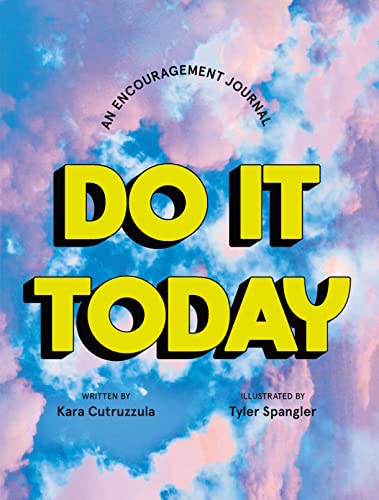
Can you tell us how this book came together? With its accent on motivation and productivity, I have to ask, did you write this for yourself? Do you follow the advice and follow the journal prompts yourself?
Do It For Yourself kind of took off — it’s currently in its ninth printing! — and my editor and I started talking about a possible follow-up. I asked myself, what might people need right now? And the answer was obvious: encouragement. Encouragement to try new things, pick up old projects, bounce back from rejection, and expand their web of connections.
So this journal features short essays and prompts along those lines — and yes, I wrote this entirely for myself because I needed all this encouragement, too. If you don’t connect with the work you’re putting out there, it’s unlikely it will resonate with other people. You have to believe it! I need constant reminders about all of these things and often turn back to the journal, hoping a prompt will thaw some frozen part of my brain or create a new idea. And it does.
You’re not a coach, but your books play a cheerleading, guiding role in helping your readers create and achieve. Aside from what you write in your newsletter, do you test your advice out on your friends and fellow creators?
I’m lucky enough to have many brilliant friends and collaborators and we bounce ideas around all the time. From “can you read this email and let me know if it sounds OK” to “could you edit this draft” or “do you want to set a mutual deadline by Friday to accomplish that nagging task?” So all of this “advice” is actually a distillation of what I’ve witnessed and experienced around other people.
The writing experience is different for every author. In the lingo of NaNoWriMo, there are “plotters” (writers who outline) and “pantsers” (those who write by the seat of their pants). What are you? What’s your writing routine like?
I do not like outlines. Let me rephrase that: I HATE OUTLINES. But I have convinced myself to try to outline – or reframe what an outline is in order to make it less painful. For my last two journals, I wrote a loose structure, basically a paragraph of what I wanted to cover in each chapter. I’m working on a new screenplay right now, and forced myself to write a bullet point list of scenes I wanted to include. Technically that’s an outline, but my brain still resists that word. Figuring out what I want to say usually comes from the writing itself.
My routine is all over the place. Some days I’ll write nothing, other days I’ll write 10 pages! If a deadline is involved, I’ll get it done — it’s the old journalism training, knowing that the story had to be finished by a certain time or the page in the magazine would be left blank. You gotta get it done.
HOW WE ARE DOING IT TODAY
As I wrote in my review of Do It Today, my favorite part of the book was the section on “percolation,” or letting yourself have an idea on the back burner without having to constantly “produce,” non-stop, and noted that it reflected a lot of what I’d been writing about combating toxic productivity.
If you had to pick one journaling exercise/section from the book that you wish everyone would try, which would it be?
Oooh, I love writing thank you notes to rejections! Failures and rejections are a part of life. But I try to remember that you get to choose how you respond. Rejection often stings, but I’ve found writing and sending off a thank you to whatever opportunity turned me down frees up a lot of mental space and allows me to move forward.
Writing and sending off a thank you to whatever opportunity turned me down frees up a lot of mental space and allows me to move forward. ~ @karacut Share on XSo if you didn’t get that residency/client/gig/opportunity, try not to simmer in the angst for too long. Consider why you were so drawn to it in the first place and use it as an arrow to move forward. Write a little thank you and get ready to start the next big thing.
What have readers been telling you is their favorite exercise/section?
Chapter two is called Start Before You’re Ready, and that idea seems to resonate with readers. Asking yourself, “What is the next smallest step I can take?” and then “How long will it actually take to complete?” changes your perspective. You’re getting honest!
So instead of saying “I need to reorganize my entire office,” I might ask myself, “Which area is giving me the most angst right now?” and “How long will it actually take to go through it?” The same idea holds true for our work and creative projects. Get honest with yourself about time estimates; it’s much less intimidating than a scary, open-ended task.
Last summer, as part of the launch of the Do It Today journal, you started the Do It Today podcast, where you interview people about how they are spending their days while they’re deep into creation mode or working on solving a problem. As you’re gearing up for season two, will you describe what this podcast experience meant to you?
For most of last year, I felt like I was floundering. Truly. When you’re in charge of structuring your days, the freedom is nice but also overwhelming.
I wanted to know: How do other people do it? What does another person’s day look like? How do they overcome obstacles? How do they do their best work? So I impulsively started a podcast, mostly as an excuse to ask people I admire slightly invasive questions about their work and creative processes. Our conversations were incredibly encouraging, and I can happily say this year I’m in a much better daily groove, thanks in part to hearing about other people’s strategies.
I’m gearing up to release next season, featuring a wonderful interview with you Julie, and also a Broadway producer, a personal finance expert, an author and keynote speaker, and an A-list screenwriter. There are so many common threads and themes between how people work — it’s extraordinary to see.
THE CURTAIN CALL
What else should Paper Doll readers know about you, your life, your take on motivation, creativity, and musical theater? What’s on the highlight reel of your life these days?
It’s never too late to try something new!!! That deserves three exclamation points.
I’m surrounded by people making big career pivots, adopting new skills, moving around the world, and also doing the less glamorous and equally hard work of showing up for their most meaningful work day after day. You can do it, too. I’m cheering you on! (That might be my most-used slogan.)
My highlight reel right now consists of seeing lots of theater with my husband Colin (we just got married in December!) and taking winter naps with our rescue cat, Lula. And leaning into work and activities I actually enjoy. Everything else either gets paused or cleaned out. Life’s too short.
Before we wrap things up, tell us what’s next for Kara Cutruzzula, multipotentialite and musical maven?
My third book, Do It (or Don’t): A Boundary-Creating Journal is coming out September 12, 2023 and is now available for pre-order! Get ready to do a deep dive into setting boundaries for your projects, creativity, and relationships. (This is an area I wanted to work on myself, so figured we could all work on it together!)

This year I’m developing the musical and also turning back to screenwriting and playwriting, and have some big goals attached to those mediums. I’m also having fun connecting with people through my newsletter.
Most of all, I’m embracing empty space. It’s kind of like leaving one drawer in the closet completely free, and not believing you have to fill it up right now. I’m leaving a little space in my calendar for what is going to light me up in the future — whether that’s tomorrow or two months from now.
And that is music to a professional organizer’s ears.
Follow Me