Archive for ‘Psychological’ Category
Paper Doll’s Ultimate Guide to Memento Mori and Appreciating Your Time

Pardon me, handsome stranger, would you happen to know the time?
I can’t find a trace of 1988 or ’89.
If you see the daredevil ghost of my youth go racing by (woah-yeah)
Will you flag him down and let him know I’ll be running a good ways behind?
A Tall Stand of Pines, ©1998 Jeff Holmes/The Floating Men (From the album The Song of the Wind in the Pines)
If you’ll indulge me, let’s start with the inspiration for this post. Last weekend, after five years of avoiding all large groups out of an abundance of COVID caution, I did something essential for my mental health. I saw my favorite band in concert two nights in a row.
I started seeing The Floating Men perform in 1993, and went to just about every gig near me until the last time they performed in Chattanooga, in 2010. I’d also seen them in Johnson City and Nashville, TN, and most memorably, for 30th birthday (with family and friends) in Atlanta.
Their songs range from keening heartbreakers to joy-filled romps, all with complex lyrics and reflecting a louche, delightfully misspent life. I am an old, overly cautious soul, so I’ve lived a misspent youth vicariously through those songs. Seeing The Floating Men’s live made me unceasingly happy.

The Floating Men, Barrelhouse Ballroom, January 19, 2025
The bandmates’ “real” careers took them all over the country, so it had been a long time since they played together. But the fandom, The Floatilla, remains loyal. When the band scheduled one Nashville show in 2024, it sold out in moments; they added another night, and the same thing happened; and a third night. No tickets for me. But for this year, they scheduled one (and then two) shows in Chattanooga, and five years of caution gently stepped aside. Echoing Robert Frost, I can only say, “And that has made all the difference.”
In Act V, Scene 5 of Shakespeare’s Richard II, the erstwhile king bemoans that:
I wasted Time and now doth Time waste me.
King Richard II was indecisive, squandered opportunities, and was forced to relinquish his crown. Time was once a resource he could have directed, but once imprisoned, time became a force that eroded his life and meaning.
Last week, in How to Use Time Tracking to Improve Your Productivity, I wrote about time tracking as a tool for mindfully ensuring that your actions align with your goals and values. That post focused on the minutes and the hours, the nitty-gritty of our lives.
However, I keep coming back to the expression, “The days are long, but the years are short.” We “manage” our time (our days), seeking out new ways to be efficient and get specific tasks done. But fewer of us are adept at working on the bigger picture, making sure that the larger aspects of our lives intentionally arc toward meaning.
Today, we’ll look at how we perceive time and ways to elevate our appreciation of the passage of it in order to organize a life that better reflects what we want. We’ll also review tools to help us achieve a more ongoing sense of mindfulness about the passing of the days (and years) of our lives.
APPRECIATE THE SPEED OF TIME
When Daylight Saving returns, and you Google (for the seventh time) how to change the clock in your car, do you grumble that it feels like we just fell back, and now we were springing ahead? But you’ve also sat in interminably long meetings, shocked that each glance at the clock shows only a minute has passed.
What time “is” and what it feels like can be very different.
Time is a precise, but in some ways, arbitrary set of measurements for something we have never fully understood. St. Augustine believed that time actually just “sits between our ears.” There’s no actual external, objective, universal time; our measurement of time has (mostly) become culturally accepted, but it’s just by collective agreement that we measure time in 60 increments of seconds, 60 minutes, etc.
(Admittedly, the 24-hour day is fairly fixed by the Earth’s rotations, but the number of days in a year is a convention. The Jewish calendar, for example, has lunar months, 28 days each; to make up for the “extra” time, there’s an additional month in a leap year.)
For more on the history, philosophy, psychology, physics, and neuroscience of time, I recommend In Why Time Flies: A Mostly Scientific Investigation by Alan Burdick.

In a BBC article from September, Why Children Perceive Time Slower Than Adults, Teresa McCormack, a professor of psychology at Queen’s University in Belfast, notes that children’s comprehension of time is understudied. We know that tiny humans’ concepts of linear time are limited, and their understanding of time as a dimension (with a sense of duration) is slow to develop.
Adults, however, have both the vocabulary to mark spans of time and understanding of how time works:
- time is unidirectional and linear (outside of time travel movies)
- time is unified such that there is only one timeline (again, outside of fiction), and
- time is event-independent (meaning it’s objective, continuing while we sleep, and existing independent of human perception). Trippy!
But aside from vocabulary and complex neurology, why do kids experience time as moving quickly but it seems to pass more quickly as we age?
One simple answer, explained well on the Inverted Passions blog, is that we have a biological imperative for survival which prompts us to take note of anything that helps us make predictions regarding the future.
Investment legalese says “past performance does not guarantee future results,” but we know that things that worked for us before (or conversely, that caused awkwardness or danger) might happen again; our brains hold onto whatever helps us make predictions. But, when something novel happens, our brains stop and pay attention!
When you’re little, everything is novel. Every experience, whether the cause-and-effect of flipping a light switch or what a sneeze feels like, is new. That’s why we have granular memories of our youths through our college days, but why, other than our first days on a job or meeting our significant others, the rest of adulthood starts to blend fuzzily together.
Our adult lives are routinized; patterns repeat; life whizzes by. Yesterday is like tomorrow is like January 87th; it’s all the same. But we remember each day of our big vacations, doing new things in new places, perhaps with new people.
Predictability helps keep us alive, anthropologically-speaking, but novelty is what allows us to reflect on a life well-lived.
Predictability helps keep us alive, anthropologically-speaking, but novelty is what allows us to reflect on a life well-lived. Share on XMEMENTO MORI AND THE PASSAGE OF TIME
Are you familiar with the term memento mori? It’s Latin, meaning “Remember you must die.”
A reminder of the fleeting nature of life and our impending mortality may sound depressing, but it’s been used in literature, art, and architecture, and as a meditative practice, throughout history. None of us gets out alive, so we need to make our lives more about meaningful moments and less about to-do lists rivaling the length of CVS receipts.
Memento mori helps us realign our priorities — or at least take note when we are not living according to our stated values.
It’s worth revisiting Toxic Productivity Part 3: Get Off the To-Do List Hamster Wheel, where I wrote the following:
REVISITING FINITUDE: THE MACRO AND MICRO APPROACH
Our time on this rock is limited. A central tenet of Oliver Burkeman’s 4000 Weeks: Time Management for Mortals is the ability to see the shortness of life, examine your goals and values, and maximize spending your time on what matters most. This isn’t some hippy-dippy philosophy that says that if we all stop worrying about work or making money, we’ll find ourselves in a vast utopia.
Rather, it notes that life is hard, life is short, and feeling like you only have a right to be here if you’re accomplishing things that make money — whether for your company or yourself (even, or especially, if you are your company) — leads to frittering away the most valuable commodity: life.
Tim Urban’s stellar Wait But Why blog broke ground in this arena. Allowing for a little more time on the planet than Burkeman, Urban posited that we might have 90 years of life, so 4680 weeks rather than 4000.
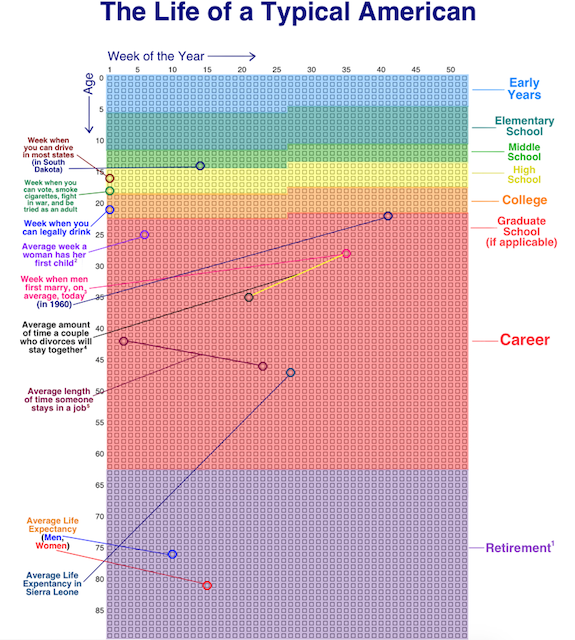
One of his most famous posts, back in 2014, urged readers: visualize your life in years, your life in months, your life in weeks, your life in number of remaining SuperBowls…to appreciate what you do with your time.
For example, I’ve got got 2860 of my weeks behind me. It’s tempting to use these kinds of visualizations for dismay; certainly they can lead to existential angst and even more productivity dysmorphia. “See?” one might yelp! “I have even less time to make the widgets! To earn the money!” And yet, as we’ve seen over the last two weeks, that attitude just leads to focusing more on the quantifiable value you create for others; we want to look at quality, not quantity.
But, we can still turn to Urban for guidance. As a follow-up to his macro look at the finitude of life, he developed a way to organize and examine our lives at the micro level in 100 Blocks a Day.
Inspired by Urban, nomadic programmer Jama of Notion Backups, has identified a way to pause and reflect, giving perspective on where you are, chronologically speaking, in your day (rather than in your life). Rectangles.app gives you a quick glance at how much of today has gone by, in ten minute increments, as of the point in your day when you click the link. Click later in the day, more boxes turn green.
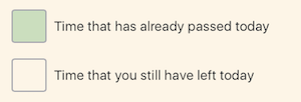
For example, when I visited and took this screenshot, I’d made it through 93 1/3 ten-minute blocks in my day.

When faced with how much of your day has passed and how much is left, you might have the following reactions:
- Yikes, I’d better get cracking! (A good motivation if you’ve been staring at social media or playing a video game for hours on end, for sure.)
- Yikes, I’ve been working and working, and I’ve only written 17 TPS reports and attended 5 hour-long meetings! (A likely sign of productivity dysmorphia creeping in around the edges.)
- Yikes, all I’ve done all day is work. I haven’t talked to anyone I love, I haven’t exercised or gotten any fresh air. I haven’t laughed. (And here’s where the magic might begin!)
If you’ve been experiencing signs of burnout due to toxic productivity, give this approach a try. Click on Rectangles and think about the day you’re having. Maybe even text the link to a friend, describe your day thus far, and get a reality check from someone who sees you more clearly.
Expanding from how much time is in a day (1440 minutes) to how much time is left in our lives, memento mori yields perspective. There are digital and analog options for helping you do just that.
ANALOG APPROACHES TO MEMENTO MORI
The Meditative Marble Method
Purchase a bag of colorful marbles and display them in an attractive glass jar. Create a ritual such that each day (or perhaps weekly, on Saturday or Sunday), you remove a marble from the jar and think about what you accomplished and gave your life meaning the last day (or week). This isn’t how many blog posts you wrote or how many new clients you signed on, but the intentional awareness of meaningful time spent with your partner, child, or friends, or special things you did to make your life a little more worthy of reflection.
Now, move the marble out of the jar to somewhere else (like an identical jar). If you planned to use this ritual weekly, you’d need to buy at least 52 marbles; daily, you’d want at least 366 (to cover leap year).
Perhaps carry that day’s marble around with you in your pocket to give you a visceral reminder all day that your time has precious value.
Perpetual Calendars
In my prior television career, I sent a lot of faxes, and that meant a lot of cover pages, and you always had a field to write the date. Unless you’re time traveling, it’s not 1997, so we’re not sending faxes much anymore. Instead, most of us check our phones or give a shout to Siri to see what the date is.
Just as digital time feels vague and unmoored from the rest of the hour, seeing just today’s date doesn’t give a sense of how today relates to the rest of the week or year.
Something more three-dimensional may help you be contemplative about the days as they pass.
See the MoMA Sliding Perpetual Calendar, designed by Giancarlo Cipri.
The Sliding Perpetual Calendar is made of plastic (so, not particularly environmentally sustainable) and measures 12 high x 9.2 wide x 0.3″ deep. You can mount it to the wall or prop it up on its included pegs. Each day, slide the red dots down the chutes-and-ladders (OK, just chutes) to select the day, month, and date. It’s currently available from MOMA for $48 ($43.20 for members).
Make the changing of the date into a device-free daily ritual and an opportunity to be mindful and intentional about the activities with which you fill your life.
Any perpetual calendar with moving pieces will work for this purpose. Other options:
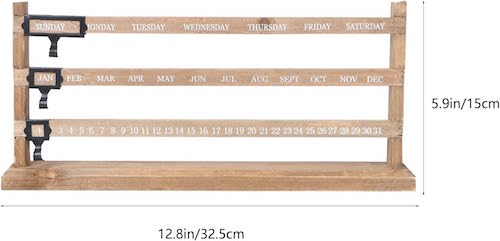
Vosarea Perpetual Desk Calendar is wood, so it’s a bit better for the environment, and measures 12.8″ wide x 5.9″ high. (There’s no information on depth.) While it takes up horizontal real estate, the footprint is minimal. Amazon has it for $18.19 with a digital coupon.
ComiHome Perpetual Calendar Date Desk Calendar measures 10″ wide x 10″ high and has a sleek, modern look. This magnetometer calendar has a circular ring for the month and day of the week, a horizontal plane for displaying the date, and three magnets for selecting each, manually. It comes in red and black, or black and white and runs $22.99 at Amazon.

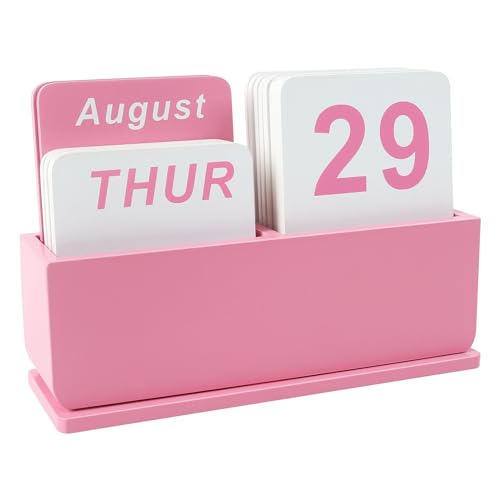
Deerine Wooden Block Perpetual Calendar is an upgrade the old-school block/cube calendar. It comes in pink, green, blue, black, and wood-grain, and runs $13.99 at Amazon. It measures 5.9” wide x 1.92” deep x 4” tall and is made of wood.
Journaling
It’s easy for days and then months to zip by without giving any thought to intentions beyond getting through the day. It’s like how the calendar pages flip and fly off in old black-and-white movies to let you know that significant time has passed. In old photo albums, you can gauge the passage of time by the change of hairstyles and clothing. But to percieve the changes (or lack thereof) in ourselves, a snapshot isn’t enough.
I’ll admit, I’m not skilled at journaling or adept at looking at my life as a big picture. I’m more of a to-do list person. I often write the blog posts I need to read, so I suspect that’s why I’ve been thinking about memento mori.
There are numerous apps for journaling, but I believe we’re more likely to put in emotional effort and pour out heartfelt thoughts on paper. I encourage you to try an analog journaling method if you are able. Something as simple as a One Line a Day journal for capturing the most vivid or uplifting aspects of life might be a good start.

Use Visual Time Trackers
Print or buy a copy of the grid squares from the Wait But Why post referenced above and track your life in weeks by shading the squares.
CONSIDER YOUR MORTALITY DIGITALLY
These apps are designed specifically to encourage memento mori.
Death Clock
The Death Clock app, available for iOS and Android, uses your answers to a questionnaire about your age, sex, lifestyle habits, and nation of residency to predict a death date. It’s not quite as grim as it sounds. Death Clock is AI-powered to help increase your longevity by helping users understand the impact of current habits on life expectancy and encourage making changes to live a longer, fuller life.
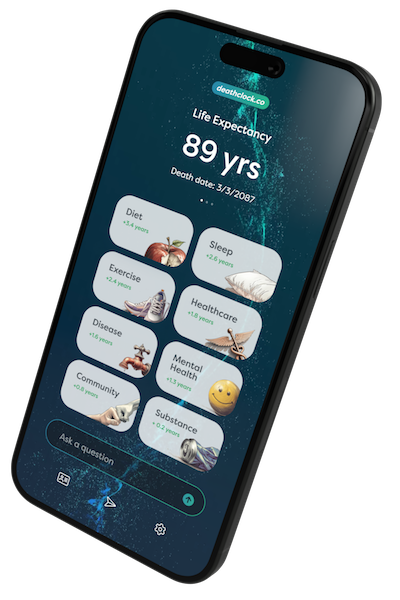
Their makers describe it: “It’s like having a personal grim reaper, but with health tips.” The app is free, but some features require a paid subscription.
Life: Just One
Life: Just One, created by Julien Lacroix for iOS, was inspired by the Wait But Why post. It’s designed to help users recognize that their time is precious and make the right decisions by allowing them visualize the approximate number of years, months, and days they have left on this earth.
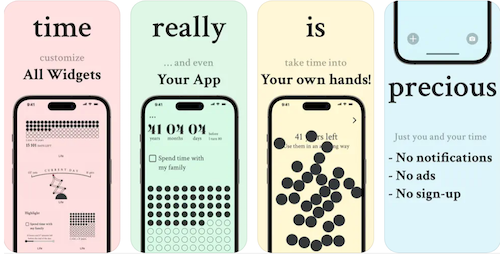
Atypical for apps these days, it pushes no notifications, has no ads, and there’s no sign-up. It collects no life data. The basic app is free, though the Pro level unlocks widgets, a “life in weeks” section, and full customization.
WeCroak
WeCroak was inspired by a Bhutanese folk saying:
To be a happy person, one must contemplate death five times daily.
Each day, the WeCroak app sends five notifications to invite users to stop and contemplate death (and, by extension, the value of life).
Rather than coming at predictable times, the “invitations” arrive randomly and can arrive at any moment (“just like death,” their web site states). Upon receipt, users open the app to reveal a quote from a poet, philosopher, or notable thinker on the topic of death and may choose to pair contemplation with conscious breathing or meditation.
The WeCroak app is free to use on a variety of platforms including Mac, iPhone, iPad, Apple Watch, Apple Vision and Android.
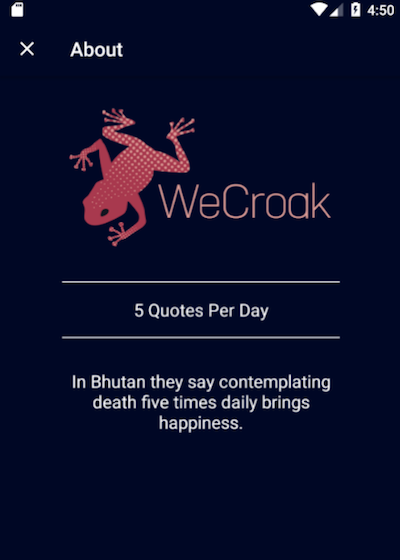
Additionally, WeCroak has subscription-based Leap programs, providing challenges to help “face impermanence in all its aspects and live better lives today.”
Life Clock
Life Clock is a simple, platform-agnostic website. Enter your birthdate and time, and the result is a swiftly moving digital readout of your age to 12 post-decimal point places. Click the right arrow to get your age in months to ten decimal places; click again to get your age in months; click again for your age in days, hours, minutes, seconds, and milliseconds.
You can even see your age in lunations (lunar cycles), dog years, fortnights, galactic years, kilometer light traveled, Poincaré recurrence times (a theorem which theorizes that everything that’s happening now will happen again in exactly the same way!), heartbeats, your age in Friends or Game of Thrones marathons, and more! The data isn’t deep, but offers perspective.
Related apps include 0280, Mori Master, Life Left, and Memento Mori Stoic Reminder.
Ask AI Bots to Play Jeeves
Super-techie? Let AI remind you that life is short and precious:
- Schedule Telegram to deliver daily memento mori reminder messages or affirmations.
- Learn how to make a reminder bot on Discord with dotReminder.
- Contemplate life’s impermanence with Memento Mori GPT-Reflective AI Companion
- Use a service like Replika or create custom bots.
ORGANIZE AND ALIGN YOUR LIFE WITH YOUR VALUES
You know the story of the professor, the jar, the rocks and the sand, right?
Once you see your life racing by, you may be inclined to focus on the big rocks. In addition to applying all of the organizing and productivity lessons this blog shares weekly, try a strategic approach.
Audit Your Life
Identify what really matters to you. Sit quietly and write down your top 5 values: being more present in your children’s lives, leaving a professional, personal, or financial legacy, improving your health to live better longer, having more adventures, being creative, etc.
Look at your calendar and your bank account. Examine how you spend your three currencies: time, money, and attention.
Does your spending reflect your values? Are you giving time to your priorities or just whatever is loudest?
Look at how you spend your three currencies: time, money, and attention. Look at your calendar and bank account. Do they reflect your values? Share on XWrite a Personal Mission Statement
Channel your inner marketing director and figure out what you want your life legacies to be. Post your mission statement where you can see it.
Organize Your Life to Invest in Meaningful Experiences
What are your big rocks? If it’s time with loved ones, personal growth, and joy, do you have inviolable time for vacations, family dinners, or learning opportunities scheduled?
I’ve often referenced Laura Vanderkam’s book Tranquility by Tuesday: 9 Ways to Calm the Chaos and Make Time for What Matters. Her Rule 6 encouragesus to have identify one “big adventure” (lasting perhaps half a weekend day) and one “little adventure” (lasting an hour) each week to introduce novelty.
As Vanderkam has explained, “We don’t ask where did the time go when we remember where the time went.”

What’s keeping you from scheduling adventures?
For five years, I had so few “adventures,” I can count them on one hand, twice meeting up with Nashville colleague Sara Skillen for day trips and last summer’s 1900-mile round trip road trip to see Paper Mommy and go to my college reunion. My two-night adventure of going to see The Floating Men was transformative, reminding me what I want in my life.
Revisit Your Audit Periodically
Memento mori isn’t a one-and-done proposition. Build time into your day, your week, your month, and your annual review to put more life in your life.
Memento Vivere
Author Annie Dillard said, “How you spend your days is how you spend your life.”
Actress Kelly Bishop (A Chorus Line, Dirty Dancing, Gilmore Girls) wrote in The Third Gilmore Girl: A Memoir, “Don’t cry because you think your best days are gone. Smile because you had them in the first place.” So make sure you have them!
Memento mori (“Remember you must die”) has a sibling concept: Memento Vivere — Remember to live. Make every moment count: through mindfulness, gratitude, engagement, a sense of purpose, and celebration.
The lyrics to the song at the start of this post are a little salty for a “family” organizing blog, but I want to share my love of The Floating Men with Paper Doll readers. You can find their catalog on Spotify and Apple Music, and lots of (mostly ancient) concert video on their YouTube channel. And for the first time since 2009, they’ve got a digital EP, #Reoverimagined, with new (joyous) songs and fun bonuses, including:
Thank you, readers, for this extra-long indulgence, and thanks to Jeff, Scot, and The Floating Men for more than three decades of reminding me to (really) live!
 |
 |
Jeff Holmes & Paper Doll (left); Scot Evans & Paper Doll (right) — Barrelhouse Ballroom, 1/18/25
How to Use Cathedral Thinking and Intentional Words to Organize Your Year

We’re not quite a week into the year. And yet, if you had resolutions, you may have already broken them. Vowed to eat healthy, but that boozy New Year’s Day brunch blew that plan out of the water? Planned to exercise daily, but those two days back at work wore you out, so you slept in instead of going to the gym this weekend?
You aren’t alone. In fact, the second Friday in January is known as Quitter’s Day because so many people have already tossed their resolutions by that day. Research by Baylor College of Medicine found that 88% of people give up their New Year’s Resolutions by the end of January; a large percentage of the remainder part ways with their resolutions before the end of April.
WHY DON’T NEW YEAR’S RESOLUTIONS WORK (FOR MOST PEOPLE)?
It’s not that resolutions can’t work, but that people generally go about them in the wrong way.
Unrealistic Expectations
It’s cute when three-year-olds tell you they’re going to be princesses, basketball stars, or wizards. But if you’re a grownup and you “resolve” that you’re going to change who you are in some massive way, your ambitious goals may get in the way of reality.
If you set an aspirational goal that’s so ambitious that you can’t possible achieve it, you’re guaranteeing that you’ll be discouraged each time you hit a setback or your progress is glacial.
Think about what I wrote in Paper Doll Explains Aspirational vs. Inspirational Clutter. Just as when you fill your space with tangible aspirational clutter, filling your head with an aspiration to achieve something lofty without the any undergirding infrastructure guarantees disillusionment and falling short.
Black-and-White Thinking
It’s common to approach goal-setting with an all-or-nothing mentality.
“Either I will publish a Pulitzer Prize-winning novel this year (even though I haven’t written anything since college)!” or “I’m going to keep this house perfectly organized every day from now on (even though I haven’t seen my keys in three weeks)!” leads people to give up when they hit the first bump in the road, so they stop writing or putting things away.
Too often, people craft their resolutions as, “I’m going to completely change how I behave” and that means that the minute they revert to their innate habits, they declare a loss. (A hot fudge sundae doesn’t mean your diet is dead and buried; tomorrow, have a salad.)
We don’t need a new year, or a new month, or even a new day to continue on with our goals. As I talked about in Organizing A Fresh Start: Catalysts for Success, we can always find new opportunities to re-set.
Shame-based Motivation
- Are you a carrot or stick person? Are you motivated to win something for the glory or by fear of not achieving?
- Are you more likely to go after a goal because it’s something you truly desire, or because you’ve been guilted into it?
- Do you want to achieve something because it’s your dream, or because you’ve been conditioned through social pressure (or from your mother-in-law or your work frenemy) to do something?
If you only set a goal because someone makes you feel bad about who you are now (whether in terms of your shape, your status, or your accolades), that extrinsic motivation probably isn’t going to have staying power to get you out of bed to run on a rainy morning or to get your butt on the piano bench to practice scales.
If you’re focused on something negative and are shamed (or shaming yourself) into changing who you are, that self-criticism is going to prevent you from making any sustainable change.
And whenever we don’t meet our resolutions, that above-mentioned black-and-white thinking can lead to low self-esteem, feelings of inadequacy, and poor mental health.
Lack of Strategic Planning
If you rang out the old year by resolving to “lose weight in 2025” or even to “lose 25 pounds in 2025,” you were resolving to magically achieve something. You can’t really “do” a resolution.
This is why the concept of SMART goals is so popular, because they promise that if you sit down and define your goals by making them specific, measurable, attainable, relevant, and time sensitive, and strategize how you’ll take action, when, and how often, and are clear on your purpose, you’ll stand a better chance. I’ve written about that often, and back in 2014 in Achieve Your Goals: Modern Truths Behind the Urban Legend, I spelled out my alternative steps to really making your goals come alive.
Merely stating your resolution without spelling out the strategies and actionable tactics is a recipe for a pretty weak soup of achievement.
For more on the problematic nature of New Year’s resolutions, read:
- The Psychology Behind Why New Year’s Resolutions Fail (VeryWellMind.com)
- New Year’s resolutions often don’t last. Here’s why they fail and how to keep them, according to an expert. (CBS)
- Why New Year’s Resolutions Don’t Work (And What You Can Do Instead!) (Forbes)
Instead, Make Real Change Through Intentions and Habits
Set positive intentions — When you do create goals, focus on whatever you want to achieve because the goal uplifts you, not because you’re trying to avoid something. (Will you be delighted, or will you only be avoiding a negative result? Unless you’re motivated by the stick, find the carrot…or the cookie.)
Have a plan, not a dream — Identify any obstacles you’ve faced in the past anticipate what may arise in the future so you can develop strategies to overcome them.
Set small, achievable objectives — You’re not going to put away everything the minute you are done with it, but you can set a timer for ten minutes before your lunch break to file away everything that’s piled up on your desk during the morning. Keep breaking down large aspects of change into ever-smaller, more manageable tasks.
In fact, if you really want to change your behaviors, I suggest reading (or re-reading) James Clear’s Atomic Habits: An Easy & Proven Way to Build Good Habits & Break Bad Ones.
Clear’s book is one of the most approachable guides to making small behavioral changes so that you can replicated them and build on them to achieve what you want.
Treat yourself with kindness — Don’t beat yourself up over backsliding; use it as an opportunity to investigate what’s tripping you up and look for creative solutions. The goal is to catch yourself winning.
Acknowledge that setbacks happen to everyone; focus on progress, not perfection. (Perfection is boring! Figuring out why you always throw your coat on a chair instead of hanging it up or always procrastinate about refilling prescriptions gives you opportunities to win!)
Seek — and accept — support! — There’s a reason people say it takes a village and that no man is an island. Humans are social animals; we’re not meant to do it all ourselves. Whether you seek the support of family or friends, delegate lesser tasks to staffers so you can focus on improving your unique skills, or work with a counselor, therapist, or professional organizer who can provide accountability and training, don’t feel like you have to go it alone.
GO LONG; MAKE A CHANGE
I’m just not a fan of resolutions. I am far more enamored of changing habits. If resolutions work for you and help you make a fresh start, go for it. But if you struggle with resolutions, it’s OK. There are better ways to introduce change in your life.
Longtime Paper Doll readers know that I’m a big fan of using words to create a positive mindset. Once I have a vision for what I want my life (or my year) to look like, I can build a theme and see if each habit or action dovetails or departs from that theme. And we’re going to look at that in a moment. But I’ve recently been introduced two additional concepts for guiding your thoughts and actions.
Cathedral Thinking
Greta Thunberg has been quoted as saying, “Avoiding climate breakdown will require cathedral thinking. We must lay the foundation while we may not know exactly how to build the ceiling.”
Oooh, cathedral thinking! I’m picturing time-lapse video of a cathedral being built from the foundation upward as the people and the city around the area change and grow over decades and centuries.
I was unfamiliar with the term “cathedral thinking” before I heard Thunberg’s quote, and did some research. Officially, cathedral thinking is a mindset focused on long-term planning and thinking about the future rather than the present. Originating in medieval Europe, the concept developed from the fact that builders of grand cathedral began projects they knew would not reach fruition in their lifetimes; they were thinking generationally.

Duomo di Orvieto (Orvieto Cathedral) Umbria, Italy @2018 Julie Bestry
Cathedral thinking is a way to view the problems we face as challenges requiring effort — sometimes collective effort by that village — and an investment of time, and perhaps money, over the long haul. When you’re talking about building literal cathedrals, that long-term planning, investment in the future prioritization of sustainability can create a tangible monument to the work you’ve put in.
But ever since I heard Thunberg’s quote, I’ve been thinking about how cathedral thinking applies to building our future selves. Maybe our initial goals are short-term: to get our homes or offices organized, or to learn how to say no to obligations that don’t fulfill us, to go to the gym, or start eating healthy.
But none of these goals exist in a vacuum. We don’t want to lose weight because the number on the scale is somehow meaningful. We’re not decluttering (merely) so that our homes look more orderly. We’re not culling the energy vampire tasks from our schedules so we’ll have a more balanced work-life schedule. Those are the interim benchmarks; those are the foundations and scaffolding and various levels of the cathedral of our individual selves.
But our true cathedrals are who and what these habits will help us become. Better eating, exercise, self-care, stress-reduction, and organized spaces mean that we will be happier, healthier, and alive and vital for longer so that we can be with the people we love, doing the things we care about.
Anyone doing a reality check knows we don’t write books to become rich; almost no published authors are making that kind of bank; nor are artists. Instead, it’s about legacy.
James Clear suggests that we can change our habits by aligning them with our identity. “I am the kind of person who eats five servings of vegetables a day” or “I am the kind of person who hangs up her clothes” may not be true, yet, but it’s tying acts to the self-image to which one aspires.
As long as that identity isn’t so aspirational as to seem out of reach, it can override the tendency we all have to blow off our goals when we just aren’t feeling it; when we just don’t wanna.
Your aspirational goals are part of your legacy, and your legacy is going to take a lifetime to build. You are a cathedral. Start by laying the foundation, and keep the future generations (that is, iterations) of your identity moving forward.
Make a Change
I’m sure you’ve heard the saying that “insanity is doing the same thing over and over again and expecting different results.”
We all struggle. Change is scary. Fear of failure, fear of success, and annoyance (and avoidance of annoyance) keep us stuck, year after year.
Recently, I was thinking about how, ever since the start of the pandemic, I’ve felt stuck. I work hard to stay safe, in terms of my health. I still wear a mask in indoor public settings and avoid crowds. But in the last six weeks, I’ve still had health issues; first, as I reported last month, I had a rough bout of vertigo; then mid-December, I had a cold (and it was, though lingering, just a cold). I petulantly resented that I’ve taken all of these precautions, have missed out on a lot of the joys of life in these years since 2020, and still got sick.
We all take precautions to protect ourselves professionally or personally, to avoid pain (the stick) but that often means we never get the carrot or the cookie. Eventually, as I wrote about in Paper Doll Says: Don’t Get Stuck in a Rut — Take Big Leaps, we have to get out of our comfort zones.
This was in my head when I had a conversation last week with the always-fabulous Deb Lee, productivity consultant, connector-of-humans, and amazing friend. Deb was talking about marketing and entrepreneurship expert Amy Porterfield, and how she often advises people to Do Something Different. You can listen to Amy’s podcast, #497: Do Something Different: A Method For Getting Unstuck, for a sense of how this philosophy, of doing something in a different way, can shake you out of your rut, blow out the cobwebs, and bring new ideas and new opportunities.
And it wasn’t just Deb quoting Amy. Within a day, my colleague and the best darned Evernote Expert you could want to know (and I’m saying that as someone who has been an Evernote Certified Expert for the past decade), Stacey Harmon of Harmon Enterprises, echoed the same idea. In her newsletter, she talked about how she chooses a word/concept of the year, and for this year, Stacey wrote,
“For 2025, I’ve chosen “Do things differently. Get different results.”
(In her newsletter, she talks about how each year, she creates a custom Evernote Home cover image containing her word or phrase of the year, overlying a photo that’s attractive to her and is in alignment with her goal. Read more about how Stacey tracks her word/phrase of the year in Evernote.)
Although hers isn’t my phrase for 2025, I’m borrowing the inspiration to remind myself to spread my wings a bit more and embrace a larger life.
USE YOUR WORDS TO ORGANIZE THE LIFE YOU WANT
Most years, I blog about the advantage of selecting a word or phrase of the year to create your mindset. While resolutions state where you want to end up and goals allow you to spell out the habits that can get you there, words or mottos for the year are different.

Scrabble Tile Photo by Brett Jordan on Unsplash
Whether you pick a word or phrase or song doesn’t matter. Rather, all formats of these words allow to set your intentions for where you want to focus your energy for the coming year in a way that uplifts and expands instead of setting restrictions and boundaries.
Last year, in Toss Old Socks, Pack Away 2023, and Adjust Your Attitude for 2024, I talked about my approach to each new year.
In particular, I went deep and wide into the concept of the personal review, a method for reflecting on the year that’s ended to get a sense of what is really meaningful to you (in categories like health, finances, professional development, business, relationships, personal growth, and community) for guiding your approach to the new year.
I recommended the amazing Year Compass, for doing your annual review and for developing your hopes, dreams, goals, and plans for the coming year.

And I’d picked the word UPGRADE as my guiding word of 2024, but explained that it was battling it out with PRONOIA. I wrote:
Don’t worry if you’ve never heard of it. Honestly, the first time I heard the word, I assumed it was made up. It’s opposite of paranoia; a person experiencing pronoia believes that the world around them conspires to do them good. Obviously, taken to extremes, it might seem like psychological or spiritual irrationality.
But Buddist principles haven’t been working for me, I’m still trying to get a handle on the Stoics I talked about in Toxic Productivity Part 2: How to Change Your Mindset. I feel the pull of a bigger change in my life, and I think “pronoia” dovetails with the idea of a life upgrade.
Thus, I keep coming back to the Carly Pearl song in which I first heard the word “pronoia.”
This year, I’ve decided to upgrade the word “pronoia” to be my personal life motto. The concept that the world conspires in your favor is just too inspiring to apply to only one year.
Once you do your personal review, you’ll know what you want to accomplish this year, and more importantly, why. Maintain the motivation and energy of your “why” with a word or phrase that reflects the overall concept you want your year to engender. It’s not about losing weight, or maybe even health, but a word that reflects beyond the literal to the the larger idea of how you want to feel. Maybe buoyant or lighthearted or delighted?
Consider:
- a word of the year
- multiple words (like a trio of words) of the year
- a quote or motto or mantra of the year
- a song of the year (or a song title, or a lyric)
Whatever you select is your personal theme for the coming year. Whatever you want to remember about your goals and your attitude is what this word or phrase or mantra will reflect.
But don’t just leave your word sitting there on a notepad. Your goal is the best product or service — it’s the business of you. Use your (organized) space to keep your attention on your intention for the year, the building of your personal cathedral.
Advertise your theme word(s) anywhere or everywhere it’ll catch your attention. Don’t let it fade into the woodwork!
Promote your theme to yourself wherever you need a little push to live in accordance with the values you’re setting for yourself. Display it:
- on a sticky note on the fridge or your bathroom mirror
- on a bookmark you’ll see each time you open or close whatever book you’re reading
- on a both sides of the door leading to and from your garage, so you’ll be reminded of it when coming and going
- on one of those fun little felt word board with changeable letters placed so you see it from your desk chair or wherever you spend the most time
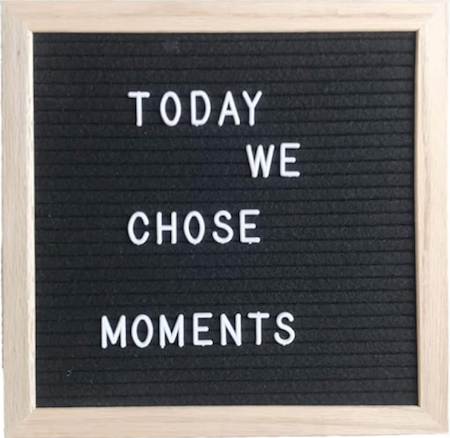
- on the lid or door of the washing machine, to remind you that those “adulting” tasks deserve appreciation
- on the door to your closet so you’ll be reminded to dress and act in accordance with your theme
- as the title of a vision board, along with images reflecting the meaning of your motivating words, phrases, and songs.
- on the lock screen of your phone
- as the desktop graphic of your computer
- on whatever software allows you to customize your home screen (like Stacey’s advice for Evernote Home)
Don’t just engage your visual sense. Add an auditory component:
- Change your wakeup alarm on your phone to your theme song.
- Record yourself speaking your word or mantra (or have a loved one do it) and use the sound file as an alarm to remind you periodically at a point in the day when your inspiration is likely to flag.
- Recite your word or phrase every night before you go to sleep and upon waking. Make it a mantra.
Whatever you pick should soothe and motivate, providing you with clearer sense of the vision you want your actions to reflect. Picture it on a banner as you cross the finish line, or carved into the marble over the doorway of your personal cathedral.
Find Your Inspiration
You don’t have to rush to find your word or phrase. A year is 365 days and we’re only six days in. And if you find that the word your pick is ill-fitting, like a jacket that’s too tight in the shoulders, you can change it.
To get you started, peruse:
Choose a One-Word Theme: We Review Our 2024 Themes and Reveal Our 2025 Themes (Happier Podcast with Gretchen Rubin)
One Word Themes for 2025 (Gretchen Rubin)
How To Choose A Word Of The Year (Elizabeth Rider)
New Year Intention (Jonda Beattie)
246 Word of the Year Ideas for a Better 2025 (GoodGoodGood.co)
2025 Word of the Year Ideas (Morgan Harper Nichols has 60 great, often unexpected words)
2025 Word of the Year (and 100 ideas for yours) (Elizabeth McKnight)
Paper Doll’s Words of Intention
I’ll be honest — I’m not ready for 2025. I usually use the last two weeks of the year to do my annual review and find the right word or phrase for the coming year. But, as mentioned, I had the creeping crud from the week before Christmas until close to the new year, and haven’t yet found my word. I’m leaning toward ENGAGE.
I liked having a word and a song last year, and keep hearing Florence and the Machine’s Dog Days Are Over running through my head, but suspect it’s one of those songs where I’m not sure that the lyrics mean what I think they mean. I’ve noticed that Natasha Beddingfield’s 2004 hit, Unwritten, is playing everywhere lately, and feel like it’s speaking to cautious, perfectionist me:
I break tradition
Sometimes my tries are outside the lines
We’ve been conditioned to not make mistakes
But I can’t live that way
Songwriters: Danielle A. Brisebois / Natasha Anne Bedingfield / Wayne Steven Jr Rodrigues
Unwritten lyrics ©2004 Sony/ATV Music Publishing LLC
Whatever I choose, I’m considering the advice of Deb and Stacey, and remembering the words of essayist and novelist Susan Sontag, in her Reborn: Journals and Notebooks, 1947-1963, where she emphasized courageously taking leaps and embracing change:
“I must change my life so that I can live it, not wait for it.”
Do you have a word, phrase, motto, or song of the year to support your 2025 mindset?
Organize Your Way Out of the Winter Doldrums

Sigh. the musical Annie may be right that “The Sun’ll Come Out Tomorrow,” but the sun never came out yesterday.
Granted, it was a rainy day, but in addition to the dark, dreariness of the day, and the too-swift passing of a December Sunday, the sun went down without my noticing because it really never seemed to come up. As I may have alluded to in Organize Your Sleep When the Clocks Change and Beyond, I’m not much of a fan of Standard Time. I like lots of sunshine, and particularly want long, light evenings to run errands and move about in the world.
We’re in a darker, gloomier time of the year here in the Northern Hemisphere. That, combined with the wonkiness of the end of the year, makes this a weird time. Some folks are delighting in preparing for the holidays, getting ready to entertain and celebrate, but over and over, I’m hearing from friends and clients alike that they aren’t quite “feeling it,” or at least not yet.
A few people have asked, having jokingly, if there are ways to organize yourself out of feeling out of sorts at the end of the year. I think there are.
This is the final “normal” week of the year. Next week is Christmas and the start of Hanukkah, and the week after, is New Year’s. While many folks are (or will be) with family and celebrating, there are many who are feeling a walking-through-molasses sluggishness at this time of year. Half their co-workers are out of the office, and while some clients are expecting attention, there’s a widespread, tacit understanding that nobody is starting anything new for the next 2 1/2 weeks.
So, if you’re in your annual happy place, please feel free to skip this week’s post. But if you’re grumbling about the dark and the cold, about another year over and about the “meh” of it all, I have some suggestions.
COPING WITH THE “BASEMENT WEEKS” OF THE YEAR
These weeks aren’t just the bottom of the year. They can feel dark, cold, even soggy. There’s a hurry-up feeling just before the holidays and, for most, a drop-off in delight between the holidays and again at the start of the year.
But winter really can be the most wonderful time of the year if you have the right mindset, according Kari Leibowitz, PhD., a Stanford-trained psychologist. She’s written a book on how to improve mental health by changing how you think about the winter months.
Leibowitz moved to Tromsø, Norway, above the Arctic Circle, to live for a year. For two entire months, the sun doesn’t rise in Tromsø! You’d think everyone there would be crabby and stabby during that time, but she found that the community approached the season with a chipper mentality. She similarly explored places on earth with “some of the coldest, darkest, longest and most intense winters, and discovered the power of “wintertime mindset”— viewing the season as full of opportunity and wonder.”
To help those of us (who can at least feel grateful that we’re not above the Arctic Circle) starting to struggle with finding inspiration this time of year, Leibowitz wrote How to Winter: Harness Your Mindset to Thrive on Cold, Dark, or Difficult Days.

Get Psyched for Winter
Liebowitz says that changing our mindsets about winter is key. Apparently, we tend to psych ourselves out, adopting a mindset that assumes that winter will be grim, so it feels that way. I get it. As a professional organizer, I’ve seen how often people expect that organizing will be boring and that they’ll be grumpy, so when they do it on their own, it is. They’re surprised when a professional organizer comes in and treats the experience as hopeful and (dare I say it?) entertaining?
As an organizer, I approach working with a new client, or even a new session, by focusing on the possibilities of finding delight. I see myself, in partnership with a client, as an explorer, a detective, an anthropologist, and more. Because I expect fun, I will (generally) find it (and get to share it with the client).
Confirmation bias is the tendency to look for, and interpret, new evidence as confirmation of one’s existing beliefs or theories. If you expect winter to be misery-inducing, you’ll find signs of it everywhere.
Easier said that done? Maybe not. Instead of seeing winter as two potentially fun (but possibly disappointing) weeks followed by months of darkness, we can look for ways to see winter, as a whole, as fun.
Create a Winter Wonderland in Your Space
I’m sure you’ve heard about hygge. A few years ago, books about hygge, the Danish approach to winter coziness, was all the rage. (If you need an introduction, The New Yorker‘s 2016 piece, The Year of Hygge, the Danish Obsession with Getting Cozy, is a great place to start.)
Western articles about hygge tend to focus on the physical atmosphere. Every single piece will reference candles. The Danes are very big on candles being comforting. Personally, I worry about candles getting knocked over. If you have pets and tiny humans, consider safe alternatives to lit candles, like fairly lights or tiny, flickering LED tea lights.

If you have a fireplace and don’t have to worry about kids or creatures in close proximity, consider making a ritual out of lighting a nightly fire to increase the cozy atmosphere.
There’s no official hygge-ness to it, but I think it’s wise to create a winter beverage station. Think about the coffee stations you see in bed & breakfast venues and boutique hotel lobbies. Consider investing in a cute tray and a variety of teas, coffees, mulled ciders, and hot chocolates. Buy a few tiny bottles of flavoring syrups, or fill a glass canister with mini-marshmallows. Whether you’re working from home or recovering from exposure to a snowy day, your daily beverage experience can be a ritual for emotional, as well as physical, warmth.
If you’re up for some “scentsational” improvements, extend the scents of the holiday season and use essential oils like cinnamon, pine, or citrus. (Generally, I prefer unscented products, but am obsessed with buying citrus-scented foaming hand soaps. Even before COVID, I was in the habit of washing my hands as soon as I came in from the outside world — you never know what supermarket shelf had germs! — and those citrusy, foamy bubbles and warm water are a great transition when you first come in out of the cold.)
Increase comfort in various places in your house. Plush blankets are soft, warm, and nurturing. The weather outside may be frightful, but you can feel snuggly the whole day (and night) long.
Fellow GenXers may recall how cozy it was to wear leg-warmers in the 1980s, both inside and outside. You might think leg-warmers disappeared when Jane Fonda workout videos did, but they’re still available in a variety of styles and colors.

It’s not necessarily hygge to use them this way, but on a day where you need a lift, dance around your house to a TikTok video and pretend you’re an extra in an episode of Fame.
Organize Your Winter to Embrace Hygge Attitudes
In addition to the physical comforts that can improve your mood in the winter, there are hygge-related attitudes (irrespective of holidays) that can give you some uplift when you’re struggling against the (literal or figurative) darkness.
- Be present — It’s so easy to get caught up in the news and crummy things happening halfway around the world or just elsewhere near you, but miss the small treasures in your own life. Be present in the moment by stepping back from technology. For more reasons and inspiration, read my post, Celebrate the Global Day of Unplugging.
- Add pleasure rituals to each day — You can counteract the glumness of winter by adding little treats to your day (and to the days of everyone around you). Call a friend to come over and hang out while you bake cookies. Of course, winter treats don’t have to be caloric. Come home after a work day to glory in a bubble bath. Try skincare rituals that may have seemed like silly luxuries before, like a face- or full-body sheet mask.
- Create a cadence to the week with personal and social rituals — Rituals added to the ebb and flow of your week can make the winter pass more quickly. For the next few months, try having a standing date with friends, whether it’s a low-effort Sunday dinner (rotating houses), board-game afternoon, or a movie night. Consider pancake/waffle breakfasts on Saturday with the kids and experiment with different types recipes or shapes. The key is that you don’t have to go out in the winter weather (though you could) to have something to look forward to each week that’s not a big production, but that will lift your spirits.
- Practice gratitude — Hey, at least you don’t live above the Arctic Circle. At least we don’t live in horse and buggy days and have to get our drinking/cleaning/bathing water from the river. At least there’s Zoom and Door Dash and electricity. Be thankful for small mercies, for loving friends, or for whatever you don’t have that you don’t want. Journal, write gratitude lists, or write notes to the people to and for whom you are grateful! Imagine how getting such a note could brighten their winter days!
- Volunteer — If you’re having trouble even feeling grateful, consider volunteering with a local charity, at a shelter (for unhoused persons, for victims of domestic violence, for animals looking for their forever homes, etc.).
- Practice mindfulness — The Polish website Prze Kroj’s Mindfulness Exercises for a Cold Day provides a variety of approaches to reframing the thoughts we have about the stagnation of these dark days (“Oh, no, another year is ending and I still haven’t written my novel!”) and offers ideas for positive reinforcement and self-awareness.
Behave “As If” and Upgrade Your Winter Activities
I will never ski. I ice skate maybe once every fifteen years. You know how some people are “at one” with nature? I am at two with nature.
But Leibowitz found that the folks of Tromsø found ways to spend their winters living more closely in sync with nature, adapting to the seasons by giving in and taking cues from our animal friends. Perhaps we need not hibernate, but that hygge coziness (resting more, slowing down) apparently blends nicely in concert with Thumper and Bambi (playing outside).
So, following Leibowitz’s advice that we act as if we were outdoorsy folks, we could:
- Take an energizing walk when the sun is out. (You may recall from the Organize Your Sleep When the Clocks Change and Beyond that getting daylight helps reset the body clock so our insides know that it’s time to go night-night.)
- If you’re not me, try a winter sport or activity that’s less about competition and more about having fun: ice skating, sledding, skiing (downhill or cross-country), snowshoeing, tubing, tobogganing. etc.
- You don’t have to be athletic. You and the neighbor kids (or the cute neighbor guy, if your life imitates a Hallmark movie) can make a snowman or build a snow fort.
Love and Other Indoor Sports
Of course, you don’t have to go outside. Leibowitz recommends the dark winter months are ideal for engaging in “low-arousal positive activities,” — activities that give us a warm glow rather than ruddy faces and iced-lung wheezes.
If you’d like to explore an activity that makes the winter brighter or cozier but without having to put on your shoes, winter is a great time to organize your hobby exposure.
- Take up a craft or hobby. Give yourself permission to be terrible at knitting or painting. Nobody needs to know.
- Explore an online class (live or recorded) to learn how to do something (cook, take better photographs, do those viral social media dances) or just to know something (about the Holy Roman Empire, or what are the other parts of a cell, because all you remember is that mitochondria is the powerhouse of the cell, and there must be more to it).
- Take up an indoor physical activity. Every January, people sign up for gym memberships as part of New Year’s resolutions. They go a few times and their motivation peters out. Don’t let winter beat you up or guilt you out. Try an online exercise class. There’s a reason why Yoga with Adriene is a perennial favorite, even with those of us with wonky balance and no flexibility. Adriene and her doggie offer a comforting yoga practice, and you don’t have to switch out of your jammies and into Spandex. (Though you might want to try out the aforementioned leg-warmers!)
Conversely, go the reverse route. Instead of trying something new, reinvigorate yourself with the love of something old.
From my late twenties and through my thirties (and beyond), I had a favorite regional band, The Floating Men. They weren’t MTV-famous, but I attended their small- and medium-sized venue concerts in various cities where I lived (or traveled to) and always felt immense joy as we all (The Floatilla) sang along and danced with revelry.
The band stopped playing gigs as their grownup careers got in the way, but last year, they announced they were going to start performing again. There wouldn’t be shows every few weeks, but there would be a show in Nashville and I was jazzed! But it sold out in moments. They added a second show. It sold out right away again. I shrugged and figured I’d just comfort myself with the CDs that have sustained me for decades.
I was surprised and delighted when they announced a show here in Chattanooga, and I managed to get tickets; that show, too, had sold out quickly and a second night was added, and as frugal as I am, I arranged to go to that show, too. I’ve been listening to the band’s music for a long time, but in the months since I bought the ticket, I listen much more often, singing out loud and dancing around the house. I’m remembering the concerts, but also the joy of hearing the music for the first time, or introducing it to others. Sometimes, recalling old loves can kindle new sparks.
What old loves can you bring back into your life? (No, don’t call your ex.)
- Re-read books that brings you joy or comfort — I re-read all the Jane Austen novels almost every year. (This winter, I’m considering a movie marathon over weeks, watching every movie based on an Austen novel.)
- Listen to music from your youth — Listen to your tangible music formats or go to Spotify, but pretend it’s your senior year of high school or college and play what thrilled you back then. If it’s Squeeze’s Singles – 45’s and Under, let me know in the comments and we can sing Tempted together over Zoom.
- Re-binge your favorite shows from way back — Chances are good that there are shows you loved back before there were DVRs (or even VCRs). Watch them again, and maybe share the love with a partner, friend, or kid who never experienced the show the first time through. (I’m ready for a Buffy the Vampire Slayer rewatch.)
- Listen to podcasts that review the stuff you loved — I’m a sucker for podcasts where fans talk about TV shows, but also where actors talk about the shows they were in, and each show focuses on one episode. I loved The West Wing Weekly when there was a new episode every week, and my plan is to start listening to I Am All In, Scott (Luke Danes) Patterson’s Gilmore Girls podcast.
And as long as I’m talking about Gilmore Girls, have you seen the new Walmart commercial with the cast?
Unlike some of the rest of us, Lorelai loves winter. If you’re a fan, you know how happy she gets when she can smell snow.
The point of all of this is that you can use the darkness of winter as permission to slow down, rest, and rebuild for a coming spring. Soon enough, we’ll be talking about all you want to accomplish for the new year. Until then, maybe reinvigorate yourself gently?
A PERSPECTIVE TO HELP YOURSELF LET GO
Organize Your Holiday Gift-Giving With Social Science Research

It’s that time!
Every December, my professional organizing colleagues and I write blog posts about giving (and asking for) clutter-free gifts, experiential gifts, and gifts that that help you be more organized.
The years I’ve written about consumable gifts, I’ve made myself so hungry that I’ve stopped blogging halfway through to eat close approximations of whatever I’ve researched. And I’ve coveted experiential gifts of practicality, adventure, education, and pampering. I still want the Petite Cheese Storage Vault that I wrote about in Paper Doll’s Holiday Gift List: Warm Their Hearts and Fill Their Tummies.
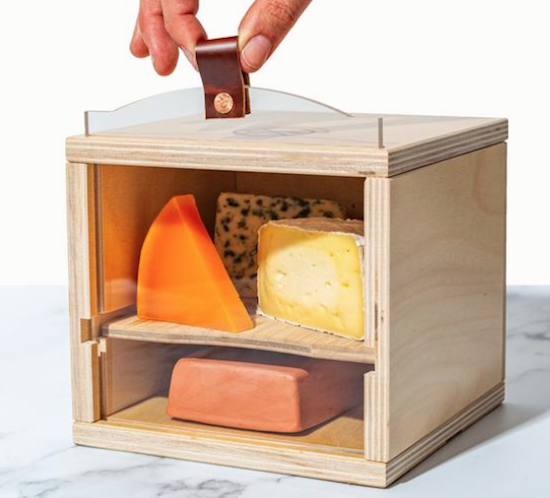
Apparently it no longer exists, though Cheese Grotto™ seems to have a nice approximation!
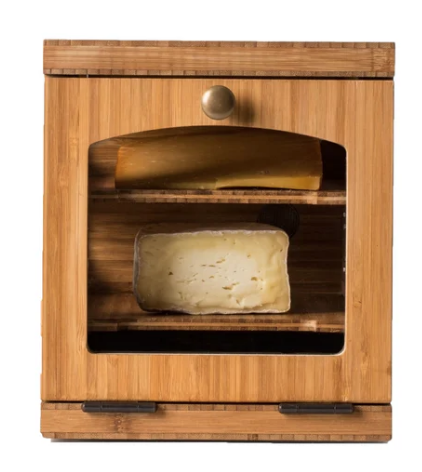
But recently, I’ve been reading some scientific research that may help organize and improve the gift-giving process and reduce some of the (emotional and financial) stress around gift-giving.
HABITUATION AND THE DELIGHT OF GIVING
I’m reading Look Again: The Power of Noticing What Was Always There, by Tali Sharot and Cass R Sunstein.

The book is focused on helping us appreciate habituation, the way we are less and less delighted by things — from tangible items to our homes to our relationships — as we get used to them, and how we can change our behaviors (take breaks from our spaces, our habits, social media, and our habitual ways of living) to “resparkle” and appreciate our lives more.
The authors even quote economist Tibor Scitovsky’s classic, The Joyless Economy: The Psychology of Human Satisfaction, explaining that “pleasure results from incomplete and intermittent satisfaction of desires.”
In other words, things are more fun when we do them intermittently, rather than constantly. It’s one reason why we get delight from giving and getting gifts at the holidays. Goodies are nice, but we’d probably get bored, or at least habituated, if we got gifts every day. (OK, yes, I’m sure we’d all like to test that theory out.)
Early in the book, Sharot and Sunstein talk about the values of happiness (however you define it) and having a meaningful purpose are key to enjoying life, but that we tend to habituate to both happiness (new jobs with new salaries or new relationships) and meaning.
As an example, you might enjoy bingeing a TV show, which isn’t particularly meaningful, and the ROJI (return-on-joy-investment, in my own silly coinage) will wear off; conversely, you may invest your time in volunteering, which is fulfilling and purposeful, but you may not be particularly happy if the effort is laborious or wearying. (Why is it that good deeds can be both uplifting and exhausting?)
The authors note that one exception is the joy and meaning that comes from raising children, and they posit that we habituate much more slowly to the “satisfaction” that results from doing things for (or giving things to) others.
They evaluated and built on the social science research of Ed O’Brien and Samatha Kassirer in People Are Slow to Adapt to the Warm Glow of Giving in the journal Psychological Science, and found that if individuals were offered a $5 treat day after day for five days, the sense of joy wore off quickly.
However, when people were given (or “won”) similar funds to spend on others, day after day, while the delight they experienced did lessen somewhat, over the course of the week, they habituated to the “warm glow of giving” much more slowly. Per Sharot and Sunstein, giving “provides a greater sense of meaning than getting” and according to O’Brien and Kassirer, this is because focusing on the act of giving is inked to feelings of social connection, and by extension, value.
This doesn’t mean that you’re always going to feel great about giving your sister-in-law a gift that you know from past experience she will return. However, from an organizational perspective, keeping this concept in mind might help you avoid procrastinating on getting that “difficult” gift.
For example, when you’re dealing with the hubbub of the holiday season and are perhaps feeling dubious about the prospect of shopping or giving the “right” gift, or are even wondering if your efforts will be for naught because the other person won’t be getting you a gift that is as nice or that takes as much effort as you’re putting in, take a breath.
Gift-giving isn’t obligatory, and you need not go into debt for the holiday season. But it’s also not so that you’ll get a gift of equal value and effort. (I mean, it can be, but it shouldn’t be. Let’s organize ourselves out of these habits and attitudes.)
If you are giving gifts, and the shopping and the lists and the traffic are all giving you a headache, pause. Go have a hot cocoa (or whatever overly frothy Starbucksian beverage is your fave) and think about the fact that you’re going to get more sustained joy out of giving gifts that you might think.

Cocoa photo by Sixteen Miles Out on Unsplash
Give yourself kudos and let yourself feel some delight with the knowledge that science says gift-giving is good for you.
WHAT SCIENCE SAYS ABOUT GOOD GIFT-GIVING
Did you know there’s serious research into what goes into giving a good gift? In fact, there’s a lot of it.
In the Society for Consumer Psychology Journal, Julian Givi and his team reviewed more than 160 published research papers on the topic and reported on their findings in An Integrative Review of Gift-Giving Research in Consumer Behavior and Marketing. (If you’re into reading social science research, there are links to the source material at the end of their abstract, and you can read some of the papers through Google Scholar. However, social science research tends to be a little dry, and you might nod off into your egg nog.)
Why understand the science of good gift-giving if we know the mere fact that giving gifts makes us happy?
To start with, a lot of gifts end up in the landfill. According to one estimate in 2017, five billion pounds of gift returns ended up in the landfill! And an updated 2020 estimate placed that figure at 2.6 million tons, and yes, this is just counting the United States. If we give better gifts (and here’s a one of many plugs for experiential gifts, that don’t take take up space anywhere, let alone a landfill), we’ll be kinder to the environment.
Experiential Gifts for the Win!
Every year, I sing the praises of experiential gift-giving. For example, here’s what I said last year, in Paper Doll on Clutter-Free Gifts and How to Make Gift Cards Make Sense:
The social-psychological research is sound — experiential gifts are both more memorable and more satisfying.
Memorable
With rare exceptions of special surprises and greatly anticipated gifts, we tend not to remember the tangible stuff we get. (This also means we often don’t remember the gifts we’ve bestowed on others; my organizing clients and I have discussed how we’ve received quite a few “repeats” from well-intentioned loved ones.)
Tangible gifts rarely take us out of the way we live; they fit into the lives we already lead. We may be changing what we’re wearing or how we’re cooking or what we’re playing with because the new gift varies the activity (as an accessory), but experiential gifts are uniquely different from how we spend our everyday lives. Participating in an experience changes our cognitive and physical lives in a few ways.
Part of the fun is anticipatory. When we get a tangible gift, we unwrap it and then…what? Maybe we’ll use it, maybe we’ll put it away until we think of wearing it or using it (or attempt reading the manual to learn how to use it). But when we get a gift of an experience, from the time we receive the gift card or certificate or gift announcement, we begin anticipating everything it involves. We research and get a sense of what might happen. Our imaginations take the gift we receive and add flourishes to what has been given to us.
When we get a gift of an experience, we begin anticipating everything it involves. We research and get a sense of what might happen. Our imaginations take the gift we receive and add flourishes to what has been given to us. Share on XGive someone a gift that allows them the excitement of anticipating the experience on top of the experience itself and it will be a gift that delights on the holiday, during the intervening period until the experience, and then later in retrospect in the relived and shared memories of the experience. Whoohoo! Now compare that to a sweater or a gadget (if your recipient hasn’t specifically asked for a sweater or that gadget) and you can see how an experiential gift is more nuanced and layered.
Uniquely Satisfying
Experiential gifts are unique. Human beings are social animals and even when we don’t intend to be, we are competitive. We log onto social media, see what our co-workers or our exes’ new partners got for gifts and we compare. Even if we loved our gifts before we logged on, if they got a fancier upgrade or a snootier brand, our holiday cheer is just a bit tarnished. Even if our tangible thing is somewhat superior, the excitement doesn’t last.
However, we don’t compare experiences in the same way. Even if we both went to the same escape room or to Las Vegas or on a cruise, the variables — who we’re with, the weather, our moods, etc. — are going to be so different that there’s no valid comparison. Our experiences are unique to us.
But guess what, it’s not just me saying that!
In reporting on his research review, Givi said that the published papers he looked at found several interesting things about experiential gifts.
What a Girl (or a Guy) Wants
First, as much as we professional organizers have tried to persuade you that experiences are the way to go, gift-givers like giving material gifts but recipients really want gift of experiences. In “Remember me, will you?”: Overusing Material Gifts for Interpersonal Memory Management, researchers found:
Givers are more likely than recipients to consider the memory consequences of gift options, as givers intuitively use material gifts as interpersonal mnemonic devices to facilitate the recipient’s retrieval of giver-related memories. As such, this preference discrepancy occurs in various stages of developing relationships but is mitigated in very close relationships.
In other words, “Hey, mom, remember when I got you that expensive hair dryer made by the people who made your vacuum cleaner?”

We’re often focused on trying to make sure our recipients remember not just the gift (which, as I’ve already suggested above, is less likely with tangible things than experiences) but remember that we were the ones who gave it. I mean, I don’t want to say we’re being manipulative when we do that, but there’s obviously some ego involved. Are we buying love? Are we jockeying for position in the family hierarchy relative (no pun intended) to our siblings? Are we trying to get our in-laws to stop referring to us by our significant other’s ex’es name?
Personally, I suspect that if you give your Aunt Sylvia a gift certificate for a massage or Gramps a National Parks pass, they’re going to remember where the gift originated from a lot more than they would with a fuzzy sweater or a book about World War II.
Don’t Focus on the Face!
Second, not only do we not give people what they want (leaving aside the people — usually teens — who are very specific about what they want), but research says that we tend to give people what will yield a more (visibly) positive reaction than one what will actually satisfy them!
In The Smile-Seeking Hypothesis: How Immediate Affective Reactions Motivate and Reward Gift Giving, researchers found (through six (!) studies) that people put a lot of effort into giving gifts based on what they anticipate the recipient’s reaction will be, “independently (and even in spite of) anticipated recipient satisfaction.”

(When the first of my friends had a child, I put way too much effort into imagining how they’d react when opening the gift. Given my terrible job trying to wrap a stuffed lion, I suspect the emotion was pure relief that the gift was finally uncovered!)
If you’re dealing with a five-year-old, the “affective reactions” and their feelings about their Barbie or video game will likely be the same, but adults mask their true feelings and give socially-acceptable reactions to gifts. (Think about how moms and dads made a huge show of getting misshapen clay ashtrays as gifts even if they didn’t smoke, or how fancy-pants successful young adults in Hallmark movies give their parents expensive but impersonal gifts when the parents just want their kids home for the holidays on their reindeer milk farm.)
One other intriguing thing: this “reaction-maximizing preference” where givers focus on reaction rather than recipient satisfaction was lessened when the gift wouldn’t be opened in the presence of the giver.
Apparently, we try to psychoanalyze our recipients and figure out what’s going to make them make us feel good about what we gave them. If we’re not going to be there to see their faces, especially in this era where almost nobody sends thank you notes, we don’t fret as much about their reactions.
Maybe this explains why we’re less likely to give experiential gifts? There’s a ritual involved in unwrapping a gift and showing it off to all in attendance, and you can’t really do that to the same effect with a gift certificate, theater tickets, or a fancy reservation.
We don’t know that’s what we’re doing, so it’s not like we’re monsters, but maybe now that we know, we can reign in this behavior? (If nothing else, you can share this post with your significant other so that when your whole family is exchanging gifts and you get something wildly inappropriate that you know you’re supposed to gush over, you can tug on your ear Carol Burnett-style to share an understanding of the ridiculousness of the situation.)
Build Stronger Connections
Third, Givi found another reason for giving gifts of experiences that I’ve never touched on in all the years I’ve written about this topic. He notes that in Experiential Gifts Foster Stronger Social Relationships Than Material Gifts in the Journal of Consumer Research, Cindy Chan and Cassie Mogilner found that, as the title notes:
…experiential gifts produce greater improvements in relationship strength than material gifts, regardless of whether the gift giver and recipient consume the gift together. The relationship improvements that recipients derive from experiential gifts stem from the intensity of emotion that is evoked when they consume the gifts, rather than when the gifts are received. Giving experiential gifts is thus identified as a highly effective form of prosocial spending.
Which is all a dry, academic, social science-y way of saying that when you give someone an experiential gift — even if they’re not going to be having the experience with you — it strengthens the bonds between you.
And further, the Big Wow of emotion doesn’t come at the moment when you tell someone that you’ve bought them tickets to Hamilton (though they’ll likely be super-psyched) or a year’s supply of car washes; it comes when they’re all dressed up and humming “The Room Where It Happens” or driving through the car wash without having to open their wallet.
Other Findings About Gift Giving
Skip the novelty gifts — Once again, gift-givers are focused on the moment the gift gets unwrapped.
I get it. You see something cute or funny or outrageous and want to see your giftee’s expression when they see they got Big Mouth Billy talking bass, but aside from the fact that it’ll be one of the first things their eventual professional organizer will be helping them let go of, recipients are focused more on the long-term utility of a tangible (non-consumable) gift.
Skip grand but meaningless gestures — Similarly, a gift that evinces shock, surprise, or humor isn’t as big a draw as things that are useful. If your recipient has an Amazon wish list, look at it and select a gift from it. (If you must do something that reflects your personality, make that a stocking stuffer or night 7 Hanukkah gift.)
Rethink gift cards — As I wrote about last year, gift cards give people flexibility. Yes, there are some negative connotations surrounding gift cards among the Silent Generation and older Boomers. But the younger people are, the happier they are likely to be if they get a gift card that reflects their tastes. (Still, unless they asked for it, don’t give your spouse a gift card as their main gift. Figure out what they really want.)
If you give a Dungeons & Dragons dungeon-master a gift certificate to her favorite game store or a fashionistas gift cards to their favorite clothing shops, letting them pick out what’s perfect for them, you’ve ensure that the thought does, indeed, count, and the thought is that you know them well enough to guess, at least generally, and care enough not to impose your own tastes.
Don’t be afraid to be sentimental — Researchers (such as in the Journal of Personality and Social Psychology) have found that people tend to avoid giving sentimental gifts because they may seem schmaltzy or fear they will miss the mark. A candle or a picture frame may seem safe, but is “safe” the way you want to go when giving a gift to someone you love? I think not.
And again, as with experiential gifts, sentimental gifts have a value that keeps you off the hedonic treadmill.
You remember the hedonic treadmill, right? As I wrote in Toxic Productivity Part 2: How to Change Your Mindset,
In the famous story of Diderot’s dressing gown, the French philosopher was gifted a fancy robe to replace a tatty one. As Diderot got used to his new dressing gown, he came to see his sense of self as defined by its finery. He felt dissatisfaction with his older possessions and began of spiral of 18th century keeping-up-with-the-Joneses consumerism, replacing the perfectly good items associated with his old life and going into debt to keep up with the identity of the new.
Just as experiences are unique and uniquely satisfying, sentimental gifts that recall (and reinvigorate) personal relationships — gifts like photo books, albums, family recipe collections, and anything that evokes memories — are unique to those involved. You don’t habituate to sentimental gifts the way you do to an air fryer or bathrobe.
So, to wrap it up:
- Remember that gift-giving will make you feel good.
- Take your ego out of gift-giving and focus on the recipient’s needs and tastes.
- Give gifts of experience because they’re meaningful, recipients like them, and it’ll bring you closer together.
- Don’t focus on the big reveal (when they unwrap the gift) or your recipient’s social-norm-induced reaction.
- Think about what they asked for, what you know about their tastes, and what will make them really happy.
RECAPPING THE BEST OF PAPER DOLL’S GIFT-GIVING ADVICE
If you need some inspiration for what to get the people in your life this holiday season, I invite you to explore some of my posts over the last few years.
Paper Doll on Clutter-Free Gifts and How to Make Gift Cards Make Sense
Paper Doll’s Ultimate Guide to Clutter-Free Experiential Gifts: Adventure, Practicality & Pampering (Note: this is one of my of all of my holiday posts over the last 17 years.)
Paper Doll’s Ultimate Guide to Clutter-Free Experiential Gifts: Educational
MORE GOOD ADVICE FROM MY COLLEAGUES
Collectively, my colleagues have written too many stellar posts on giving great clutter-free, experiential, or organizing-themed gifts over the years for me to name them all. However, I think you’ll enjoy taking a peek at these recent posts:
Great Organizing and Productivity Gifts for 2024 from Seana Turner of The Seana Method is chock-full of gifts that — if you are set on giving someone something to unwrap — will solve organizational problems without screaming “I’m practical and boring!” (I’m partial to the rechargeable lamp and the cool yoga storage tube.)
Tons of No-Clutter Gifts for the Holidays from Sabrina Quairoli of Sabrina’s Organizing focuses on consumable gifts (so, yummy!), memberships, and charitable donations, as well as her Sabrina’s take on experiential gifts with days/evenings out and lessons.
Plus, The Spruce interviewed three professional organizers for their 5 Holiday Gifts That Will Only Make Your Home More Cluttered, According to Organizers, and I have to say I agree.
That said, I have to admit that I’m a sucker for coffee mugs with messages or images that delight. Several years ago, my colleague Dr. Regina Lark gave me a coffee mug with a funny (though naughtily unprintable in a “family” blog) message that delights me each morning that it comes up in my rug rotation. Also, I really like my Mr. Rogers mug. (His sweater changes colors when you pour in a hot beverage!)

Again, this is where knowing your recipient is important!
As this post goes to press, you’ve got about two and a half weeks until Christmas and the start of Hanukkah. I hope today’s post and the links to past advice will help you find delight in giving.
Organize Your College-Bound Student for Grownup Life: Part 3

Parents, you’re counting down the precious days left with your college-bound students. Meanwhile, they’re counting down until they experience “freedom” and (gulp) adult responsibilities. In recent posts, we’ve covered a wide variety of skills and information to ensure they are prepared for the world beyond having you as a backup ride, bank, chief cook, and bottle-washer.
Organize Your College-Bound Student for Grown-Up Life: Part 1 identified essential legal documents and insurance policies, and reviewed the key financial skills every first-year student needs.
Organize Your College-Bound Student for Grownup Life: Part 2 looked at communication skills, staying safe on campus and off, and the under-appreciated life lessons of mastering laundry.
This third installment of the college life skill syllabus delves into keeping all the time management balls in the air, developing an academic safety net, being a safe car operator, and social etiquette to ensure good relationships. There’s even a smattering of bonus life skills. Because, no matter whether your kids are leaving for college tomorrow or in four years, your job is to make sure they know how to be adults by the time they are adults.
We finish up with with a bibliography of reading resources for you and for your college-bound student.
HOW TO MASTER TIME AT COLLEGE
In high school, time is fairly regimented; the bell rings every fifty minutes, moving students on to their next classes. There’s study hall to get a start on homework, and teachers provide periodic, staged deadlines for students to show their progress and keep from falling behind; they turn in a topic idea, then a bibliography, outline, first draft, and finally a completed report. Class periods before tests are earmarked for reviews. Academic prep time is spoon-fed.
In college, the freedom to set your own schedule has the drawback of requiring an adult sense of perspective on prioritizing what’s important (and not just urgent or fun). Wide swaths of free time must be divvied up and self-assigned: for studying new material, doing problem sets, completing projects, and preparing for exams.
Food and clean clothes are not delivered by magic fairies; they may require transportation, funds, labor, and time!
College-bound kids may not want to take advice regarding time management, but try to start conversations to get them thinking about how to:
- Wake up on time — If they can’t count on conscientiousness, encourage them to make breakfast plans with a friend who can swing by prod them. Also, point them toward Do (Not) Be Alarmed: Paper Doll’s Wake-Up Advice for Productivity.
- Develop a schedule — In order to make time for academics, extracurriculars, sleep, exercise, and self-care, discuss the value of time-blocking and planning an ideal week, then tweaking as the semester goes along. Keeping a schedule in one’s head is a recipe for disaster; a paper or digital planner makes sure nothing falls through the cracks. A few helpful guides:
-
- Highlights from the 2023 Task Management & Time Blocking Summit
- Surprising Productivity Advice & the 2023 Task Management & Time Blocking Summit
- Paper Doll Shares Secrets from the Task Management & Time Blocking Summit 2022
- Struggling To Get Things Done? Paper Doll’s Advice & The Task Management & Time Blocking Virtual Summit 2022
- Playing With Blocks: Success Strategies for Time Blocking Productivity
- Develop and maintain healthy routines to support their goals — Brainstorm ideas for how to ensure healthy habits (exercise, eating actual meals somewhere near meal times, etc.) by linking activities to make a chain of positive behaviors.
- Don’t fight your body clock — In business, we’re often made to feel like there’s something wrong with us if we’re not morning people, but in college, people look askance if you don’t want to party all night. There’s no shame in needing an early night if you have an 8 a.m. class.
- Get out in front of procrastination — We procrastinate because we’re nervous about how something will turn out. We’d prefer our Present Self feeling comfortable; Future Self is on its own.
Explain how to beat procrastination by understanding its causes and then incorporating good planning, prioritizing, and decision-making techniques (like the Eisenhower Decision Matrix), and locating accountability support. These Paper Doll posts can help:
-
- Paper Doll On Understanding and Conquering Procrastination
- Use the Rule of 3 to Improve Your Productivity
- Frogs, Tomatoes, and Bees: Time Techniques to Get Things Done
- Count on Accountability: 5 Productivity Support Solutions
- Paper Doll Sees Double: Body Doubling for Productivity
- Flow and Faux (Accountability): Productivity, Focus, and Alex Trebek
- Paper Doll Shares 8 Virtual Co-Working Sites to Amp Up Your Productivity
They can even try some Study with Rory Gilmore videos, including this one that incorporates the Pomodoro Technique!
I can’t think of a better expert for your college (and college-bound high school) students, especially those with ADHD, than my fabulous colleague Leslie Josel. She’s the one who developed an amazing Academic Planner for middle-grade and high school students, and I interviewed her for Paper Doll Peeks Behind the Curtain with Superstar Coach, Author & Speaker Leslie Josel.
Order Leslie’s book, How to Do It Now Because It’s Not Going Away: An Expert Guide to Getting Stuff Done, before the semester gets too far, and you’ll help your first-year college student conquer procrastination, develop excellent study skills, and really dissipate their stress.

Your high school students will benefit too, and they’ll have these skills in the bag by college!
Other real-world manners and etiquette tips college-bound students might not have absorbed:
Dining
- Know which is your bread and which is your drink — Make the OK sign with both hands on the table in front of you. One makes a lowercase “b” (on your left) and “d” (on your right). The “b” for bread means your bread plate goes to your upper left; the “d” for drink means the glass to your upper right is yours. Don’t butter an entire slice of bread or roll and then eat it (except at your own breakfast table). Break off a bite-sized piece of bread, apply butter (or jam, etc.) and eat. Chew with your mouth closed.
- Wait until everyone has been served (or seated with their dining tray) to eat. Don’t gobble your food. You are not Cookie Monster.
- Don’t rush to leave before your companions are done eating. (If you need to leave to get to class, apologize for not staying until the others are finished.)
- Know when and how much to tip in restaurants, for pizza delivery, etc.
Social Interactions
- Introductions — Know how to properly introduce yourself and others in a social setting, with first and last names.
- Handshake — Offer a firm (not limp, not crushing) handshake, smile, and make eye contact. (If eye contact makes you uncomfortable, remember, it’s not a staring contest. Connect, then look anywhere in the general vicinity of the other person’s face.)
- Personal space — Respecting others’ personal space in social and professional settings requires situational and cultural awareness and understanding the nuances of physical boundaries. Don’t touch people without asking.
- Phones — Don’t look at your phone when you’re eating or socializing with others unless responding to something urgent. Put phones away when at the meal table.
- Thank You Notes — A good thank you note, sent promptly, goes a long way to show appreciation after receiving a gift, being hosted, getting interviewed, or being the beneficiary of an act of kindness. (See last week’s section on communication skills.)
- RSVP — Explain that not replying to an RSVP inconveniences a host. Replying in a timely manner and committing to that response helps the host plan (financially and logistically).
- Online social interactions — A digital footprint lasts forever, and online behavior matters. Being a jerk online has the potential to ruin a reputation just as much as being a jerk in public.
- Networking — Your college kid isn’t thinking about the business world, but people help and do business with those they know, like, and trust. Help them see the importance of strengthening connections by sharing personal stories where maintaining connections, being generally useful, and even sending a LinkedIn connection request with a personalized message can mean a lot down the road.
Cultural Sensitivity
Good cross-cultural etiquette means not judging people who don’t follow the above guidelines.
Respect diversity. Understand cultural differences in manners, and be open to learning and adapting when doing study abroad or interacting in other cultural settings.
Use language that’s respectful, inclusive, and kind.
CARE FOR THE CAMPUS CAR
@the_leighton_show The low fuel warning also doesn’t stop my wife from going to @target #teenagers #drivinglessons #driving #parentsoftiktok #funny
Even if your student has been on the road for a few years, being a car owner (or responsible party) is different from driving Mom’s car to school. Car care can be a mystifying area of adulthood.
Oversee that inspections and major maintenance gets done when your student is home for breaks, and jointly go through the recommended auto maintenance schedule in the car’s manual. Help them figure out how to either do basic car care or to get it done professionally.
Teach the basics, like how to:
- Fill the gas tank before it’s only 1/4 full (and not when the gas light comes on). This is especially important if they attend school in wintery locales.
- Fill the tank on a schedule, not when it’s empty, but perhaps every Saturday after lunch. (And don’t try to put diesel in a non-diesel vehicle!)
- Download an app for finding the best gas prices, like Gas Buddy.
- Know how to check the oil before the oil light comes on. Oil and filter changes don’t have to be done as frequently as they used to, due to synthetic oil, but it still must be done.
- Know how to check tire pressure and fill tires properly.
- Know what the dashboard lights mean. — I once heard someone call the tire pressure alert the “Surprise Light.”

- Understand how to check and change fuses, replace windshield wipers, and know when to seek a professional mechanic.
Prepare them for emergencies. They should:
- Know how to jump start a car — If you’re sending your kids off to college with jumper cables, teach them how to use them! Consider also writing out step-by-step instructions and tucking them in with the cables.
- Know how to change a flat tire — Not everyone has the physical strength to change a tire, and not all locations are safe. Spring for a membership in AAA or similar roadside emergency service for your student, and make sure they know how to use the app.
- Know what to do in case of an accident, or if someone breaks their window or steals the car:
DON’T GET SCAMMED AT COLLEGE
According to a study by the Better Business Bureau, 18-24 year-olds are more often victims of scams than senior citizens! Teaching college students to recognize and avoid scams is crucial. Encourage a skeptical mindset.
Common Scams Targeting College Students
Just as I wrote about scams that target seniors in Slam the Scam! Organize to Protect Against Scams, there are many that specifically target college students, including:
- Scholarship and grant scams — Legitimate scholarships don’t ask for fees.
- Student loan scams — Be wary of companies that promise to forgive or lower student loans for a fee. Confirm loan information through the school’s financial aid office or consult government (.gov) websites like Federal Student Aid.
- Housing scams — When seeking off-campus housing, avoid listings requiring upfront payments before touring properties. Use reputable rental sites; don’t send money via wire transfer.
- Job scams — Know that legitimate employers don’t ask for bank information until you’ve been officially hired. Be wary of job offers promising high pay for minimal work.
Watch for Red Flags
- Urgency and high pressure tactics — The world is full of deadlines, but scammers use fear of missing out to create a sense of urgency. Don’t become a victim by being pressured to act quickly without time to analyze what’s happening.
- Unsolicited Offers — Be dubious about any unsolicited contact from outside of the school’s usual resources, whether by email, phone, or (especially) text, whether seeking personal information or offering services, funds, or assistance.
- Unusual Payment Methods — Students need to understand that payment by check or credit card is normal, but requests for payment by gift card, wire transfers, or cryptocurrency are hallmarks of scams. Legitimate transactions use secure, traceable payment methods.
- If a financial loan, grant, paid internship, or side hustle seems “too good to be true,” especially if the college’s financial aid office or academic departments doesn’t know anything about it, it’s likely a scam.
Always do independent research and verification. Check websites, Google to make sure phone numbers and addresses aren’t fake, and seek unbiased reviews. Consult trusted sources, including professors and advisors, college financial aid and work/study divisions, and yes, parents.
Online Safety
Gen-Z will be dubious that parents can advise them on online safety, but talk about:
- Privacy Settings — Adjust social media privacy to limit personal information visible to the public.
- Phishing Scams — Be wary about emails, texts, or social media direct messages that appear to be from trusted individuals or institutions but ask for personal information or money, or contain suspicious links. Pick up the phone and verify by calling people or institutions directly.
- Secure Websites — Look for “https://” in the URL and the padlock icon in the URL bar before entering personal or financial information!
Report Scams
- Report scams to campus security, local police, and organizations like the Federal Trade Commission (FTC) fraud division, the Consumer Financial Protection Bureau, and the U.S. Department of EducationOffice of Inspector General (OIG).
- Document — Keep records of all suspicious communications and transactions to support resolving issues.
RANDOM LIFE SKILLS
I lived in the International Living Center at Cornell for all four years of college. Of 144 students in our dorm, only about 15% were from North America; whether they were the youngest freshman or the oldest grad students — from ages 16 to 34 — many students experienced some sort of culture shock.
College is already its own kind of culture shock. Your students shouldn’t hesitate to ask for help. That said, adopting an attitude of weaponized incompetence instead of seeking to learn how to do something themselves may eventually annoy roommates, friends, and professors. In these last days before college, make sure they know:

- How to tell time on an analog clock — Additionally, it appears that many GenZers are miffed when GenXers and Boomers use expressions like “a quarter ’til” or “half past” because they think it’s some kind of code. And does your student understand time zones?
- How to use public transportation — If your kid will be living in a city where subways, light rail, or busses are essential for moving around, they’ll need to learn…fast. If you don’t know how to navigate, where to stand, or how to pay, ask someone who does know to give you and your student a lesson in the basics.
- How to read an actual map — GPS can be flawed. GPS (and cellular service) can go down. Being able to read and understand both digital and paper maps is a key navigation skill. (So is orienteering, but if your kid is leaving for campus in a week or two, it may be too late.)
- How to hide emergency money — “Mad money” was a 20th-century term for having some cash set aside so you could escape a bad date and get home safely. You never know when you might need money or an approximation thereof and Apple Pay won’t cut it.
A friend recently recalled how fellow students used to keep subway tokens in their penny loafers in the 1980s. My grandfather, Paper Mommy‘s dad, was interviewed by a newspaper in the 1930s after being robbed outside of a hotel; he reported that hadn’t lost all of his cash because he’d hidden some bills in his socks!
Advise hiding a few dollars inside their phone case.
- How to unclog a toilet or a drain — Bonus points for teaching them how to turn off the water at the source. It may not be necessary in the dorms, but once they have an apartment, knowing how to find the shutoff valve for an overflowing toilet, sink, or washing machine will be a nifty skill.
- How to change a light bulb — Yes, seriously. Turn it off and let it cool before unscrewing it. As with screws, hoses, shower heads and similar items: righty tighty, lefty loosey.
- How to sew a button back on.
- How to swim — Yes, we’re cutting it close in mid-August, but some schools (such as my alma mater) required and still require swimming proficiency (for safety’s sake).
No matter how much these three posts have tried to cover everything, it’s likely you’ll have your own submissions for Chip Leighton’s The Leighton Show by the end of the school year. (The caption is the same, but this one is different from the videos in the last two posts.)
@the_leighton_show What’s your street name?? #text #college #freshman #son #daughter #mom #dad #humor #greenscreen
RESOURCES FOR COLLEGE-BOUND STUDENTS
The Adulting Manual by Milly Smith

The Naked Roommate: And 107 Other Issues You Might Run Into in College by Harlan Cohen

RESOURCES FOR PARENTS
Articles for Parents of College-Bound Students and New College Students
- 15 Life Skills Every Kid Should Know Before They Leave for College (SheKnows.com)
- 70 Life Skills Your Kid Needs Before College (MommyPoppins.com)
- 11 Things Your Kid Should Know Before They Leave For College (Huffington Post)
- 100 Essential Life Skills Teens Need to Learn at Home (Grown&Flown.com)
- First kid heading to college next year – what do you wish you knew/wish your parents had known before you went? (Reddit)
- College Parent Central
- A Parent Guide to Supporting Your College-Bound Student (Study.com)
- Tips for Parents/Families of First-Year Students (UC Santa Cruz)
Support and Advice Groups for Parents
- CollegeConfidential.com Parents’ Forum
- College Parent Insider’s Group
- Facebook groups for parents of students at your child’s college — Search Facebook for “parents” and the school’s name. Official groups may be moderated by school personnel; others are independent and moderated by fellow parents.
- College-based forums — Some colleges set up their own online forum or listserv for parents. Google “parent groups” or “parent forum” and your child’s school, and you will find sites like this one from the University of Minnesota.
Note: there’s a balance between asking group members to recommend an emergency dentist for your first-year who just cracked a molar and being a “helicopter parent” who tries to stir up controversy over a professor who gave your student a B. Check out Before You Join That College Parents Group on Social Media… at CollegeInitative.net.
Follow Me