Archive for ‘Psychological’ Category
Paper Doll on the Magic of Making Lists
THE APPEAL OF A LIST
Paper Doll is a sucker for lists.
My childhood diaries (y’know the kind, pink with a lock that could easily be opened by a bobby pin) were just page after page of my mini-me wishes and hopes.
One of the first organizing-related books I ever purchased (when I was still in high school, back when dinosaurs roamed the earth and the top song on the Billboard charts
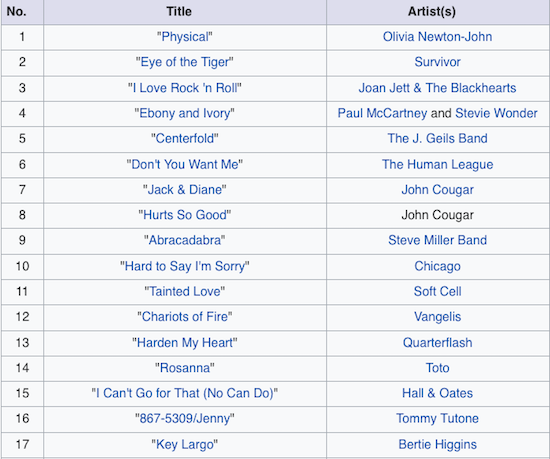
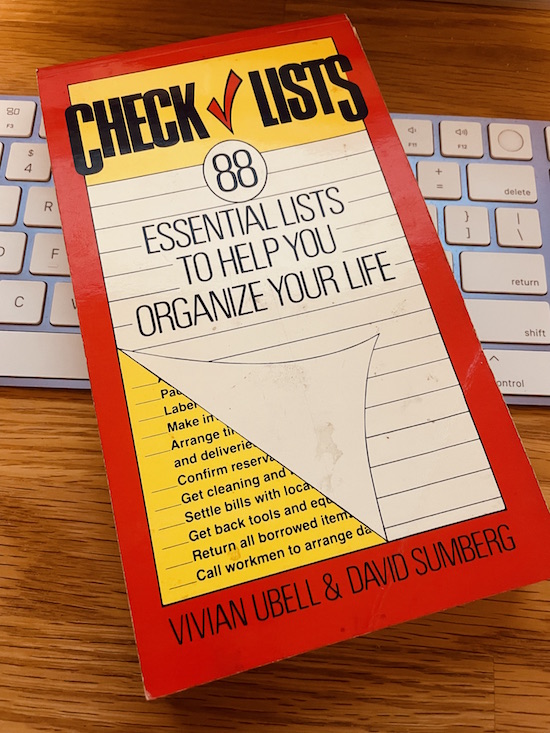
was Olivia Newton-John’s Physical), which still sits on my bookshelf, was Checklists: 88 Essential Lists to Help You Organize Your Life. It contains a wide variety of lists my 15-year-old self assumed would be, as the book title indicated, essential for becoming an adult.
Many of the lists were, and still are, useful. The “What To Do” checklists started with life transitions like how to find a roommate, plan a wedding, prepare for having a baby (or adopting one), buy a new or used car, or get ready for a move. These continued on through less happy events, like what to do if you’re going through a separation or a divorce, are a victim of a burglary, have to stay in the hospital, or need to plan funeral arrangements.
I will grant you that many of these step-by-step To Do lists, such as how to apply to college or for a mortgage are outdated these forty (gasp!) years later, and I can’t say I ever found the lists for buying a summer home or putting my boat in the water particularly useful. Oh, but the aspirational aspect of it all!
The other sections of the book were equally magical, with checklists for packing (for everything from a day at the beach to — I kid you not — sending your child to boarding school) to hosting social events (from children’s birthday parties to showers to Christmas dinners and Passover seders). And even after 20 years as a professional organizer, I still take a gander at the “What to Have” checklists for organizing every space from tool boxes and medicine chests to linen closets and garden sheds.
Even last week, when I was perusing the new books shelves at my public library, I couldn’t bring myself to bypass 52 Ways to Walk: The Surprising Science of Walking for Wellness and Joy, One Week at a Time.

It’s not that I don’t know how to walk; I get my 10,000 steps every day. But I was captivated by a portion of the introduction, where author Annabel Streets (yes, a book on walking by someone named Streets!) writes:
Nor is walking merely step-counting or “exercise.” Yes, good physical and mental health are happy by-products. But the joys of walking are infinitely greater than clocking up steps. Think of it as a means of unraveling towns and cities, of connecting with nature, of bonding with our dogs, of fostering friendships of finding faith and freedom, of giving the finger to air-polluting traffic of nurturing our sense of smell, of satisfying our cravings for starlight and darkness, of helping us appreciate the exquisitely complicated and beautiful world we inhabit.
However, had the title on the spine not seemed like a ready-made list, I’d surely have moved on without it.
The world has been conspiring to put lists on my mind even more than usual lately, and if you don’t mind the presumption, I’d like to share some of the thoughts I’ve had regarding list-making.
USE LISTS TO SET (AND MAINTAIN) BOUNDARIES
Last Thursday, I was reading James Clear‘s weekly newsletter. If you’re not familiar with Clear, I encourage you to read his excellent Atomic Habits: An Easy & Proven Way to Build Good Habits & Break Bad Ones.

While I’m careful to keep my inbox lean, I confess that I subscribe to many (perhaps too many) newsletters for inspiration for this blog and to find resources for my clients. Some are on organizing and productivity; others are financial. I enjoy many of the AARP newsletters, particularly Sisters from AARP, which celebrates and offers wisdom for Black women. And though they profess to be about mindfulness, mental health, and positive psychology, I realize that many of the newsletters are written for millennials and Gen Z. I’m voracious.
Clear’s 3-2-1 Newsletter avoids any and all of the excesses many of my other newsletters display; his is pared down to the essentials: three wise (tweetable) quotes from Clear himself, two quotes from others, and one question for the week. (Last week’s remarkable question, “What is a small but courageous choice you can make today?” has floated through my head for days.)
A short “list” itself, the newsletter is what I, in all my years of blogging, can never aspire to: brevity. But I do not begrudge Clear’s success because you, my dear readers, are often the benefactors of the concepts he shares. Last week, he linked to a tweet by Jenée Desmond-Harris, a writer, editorialist, editor, and the current Dear Prudence for Slate.
I started dividing my to-do list into 1) things I have to do, 2) things I want to do, and 3) things other people want me to do. Life changing! I often don’t get to 3 and I finally realized omg, is this what it means to have boundaries?! ???
— Jenée (@jdesmondharris) June 26, 2021
I loved this tweet. First, I always try to teach my clients that when they’re overwhelmed and overburdened by a To Do list that is more a Could Do list, they need to check to make sure what they’re doing brings them closer to their goals.
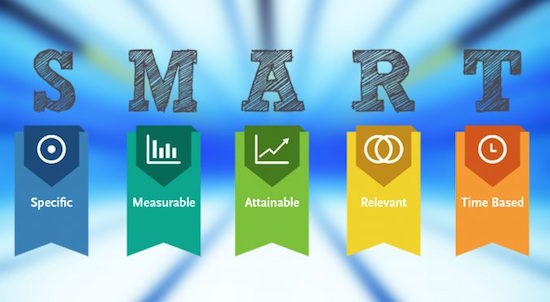
When you're overwhelmed and overburdened by a To Do list that is more a *Could* Do list, check to make sure what you're doing brings you closer to your goals. Share on XAnd I’m sure you’ve heard me say that, more important than SMART goals (which are specific, measurable, attainable, relevant, and time-specific) are SMARTY goals, where they Y represents values and ideals that are YOURS.
If you are constantly laboring toward goals that are not your own, but are your spouse’s, your parents’, or society’s, you will eventually come to resent the labor and the sense of obligation, and likely passive-aggressively (or just aggressively) rebel, possibly without even realizing it, but to your detriment.
Second, I appreciated this tweet because it dovetails nicely with a quote from one my colleagues. Four of my veteran professional organizing colleagues — Maria White, Yve Irish, Karen Sprinkle, and Nancy Haworth — and I are in a mastermind group. To help us achieve our goals, we start each week sharing our intentions; at the end of the week, we report back on how well we’ve done, and discuss our obstacles (and whether they’ve been internal or external).
Yve, famous for her enthusiastic Memojis when sending cheerleading texts, replied to one of my weekly emails with, “Woohoo Julie! Two great organizing sessions and they both booked follow-ups! I think you got all of the important things done. Much of the not-dones are items from someone else’s To Do list.”
Until then, I’d been feeling a little down about not having achieved everything in my (admittedly overambitious) list. But Yve was right. The things I hadn’t completed had not been, in the words of Jenée Desmond-Harris, things I had to do or things I wanted to do.
They were things someone else wanted from me, tasks for which I had not obligated myself. Without recognizing I’d done it, I’d practiced that mantra found photocopied and posted on assistants’ desks nationwide: “Lack of preparation on your part does not constitute an emergency on my part.”
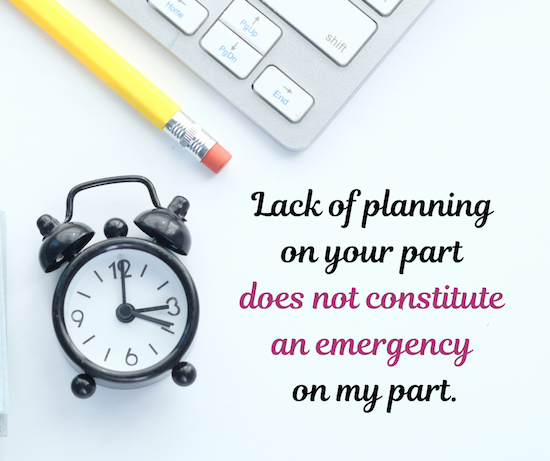
I was focusing on the important and urgent tasks on my own To Do lists. I was guarding my own boundaries.
When we make our To Do lists, perhaps we should consider dividing them into these categories, what we must do and what we want to do, and put the oxygen masks over our own noses and mouths first before attending to others (tiny humans notwithstanding).
USE LISTS TO DECIDE WHAT YOU WANT FROM LIFE
Desmond-Harris, as well as my colleague Yve, got me thinking about the kinds of lists we create. We all have task lists, those To Do items, whether analog or digital, that get us through our days or weeks. At the micro level, these lists help us achieve our smaller, more discrete goals.
But what about our big ticket goals? Do you keep lists of those?
I went back to the post I wrote at the start of this year, Review & Renew for 2022: Resolutions, Goals, and Words of the Year to think about goals and visions. I found plenty of lists there, including Gretchen Rubin’s list of 21 things she’d wanted to do in 2021. Of course, she’s got a 22 in 2022.
When I got to the end of the post, I saw I’d linked to Jack Canfield‘s post on creating vision boards. About 16 or 17 years ago, Jack Canfield (of the Chicken Soup for the Soul books) was a guest speaker at a NAPO Conference. He’d just authored The Success Principles: How to Get From Where You Are to Where You Want to Be, and everyone heading to conference was buzzing about it.

It’s been enough years (I was still in my thirties!) that you’d think the book would not have had such a hold on me, but the “assignment” on page 28 has held a fascination for me ever since.
In the chapter “Decide What You Want,” Canfield suggests readers make an “I Want” list and delineate 30 things you want to do, thirty things you want to have, and thirty things you want to be — before you die.
Readers, I went to an Ivy League college. I have a Master’s degree. I started my own business. But I have to tell you, writing out these three lists was the most difficult intellectual experience of my life. I’ve carried this folded-up list in my daily planner all of these years, taking it out with some frequency, and occasionally adding something new or checking off an accomplishment. My inability to complete the lists sometimes makes me wonder if I need a therapist or a life coach!
I only managed to come up with 11 things I wanted to do, of which I’ve done three (including finally reading Anna Karenina last year); and though I got to check off visiting the UK, the most exciting things I’ve done since creating the list, visiting Italy and publishing my book, didn’t even make the list! My imagination was too confined!
Similarly, my list of (tangible and intangible) things I wanted to have only made it to item 15. I’ve only acquired three, but those three (including my little, red Kia Soul) give me joy each day. And my shortest list, of things I wanted to be, only reached eight items, of which I’ve only achieved one.
And yet, I’m happy with my life and with my lists. The things we want at any given time help shape the choices we make; but the choices we make can shape what we want next.
The things we want at any given time help shape the choices we make; but the choices we make can shape what we want next. Share on XSometimes, our lists (like the ones in my elementary school diary) may seem silly in retrospect; others show us how far we’ve come.
What would you put on Jack Canfield’s lists? What are:
- 30 things you want to do?
- 30 things you want to have?
- 30 things you want to be?
DO YOU NEED A NEEDLE LIST?
About a month ago, the Huffington Post published a piece by Kelsey Borresen called Want to Declutter Your Brain? Cross Something Off Your Needle List. I read it within a day or two of publication, agreed with the general gist, and went on about my life, not having given it much thought. Since then, there hasn’t been a day when it hasn’t shown up in one of those many newsletters to which I subscribe or appeared in my Twitter feed.
The article is needling me!
It’s easy to see why. I encourage you to read it in full, but the basic concept is that we all have these things on our To Do lists that we fail, repeatedly, to do. Usually, they aren’t huge projects, but fairly simple tasks that we avoid, over and over. And yet we cross them off today’s task list and dutifully put them on tomorrow’s, where they will fail to be attended to for several days (or weeks) hence. And they’ll continue to needle us.
Quoting an Instagram post of chef/author Serena Wolf, who coined the term, Needle Lists are filled with the small tasks that create that hum of low-level anxiety as we continue to fail to accomplish them.
It’s the donation bags in our trunk (or worse, blocking the front hall) that haven’t been taken to charity. It’s the sink that’s full of dishes because the dishwasher of clean dishes hasn’t been unloaded. It’s the thank you notes that have gone unmailed (or unwritten). And for the past two weeks, for me, it was the oil change that I planned to get each day, but by the time everything else got accomplished, my mechanic had closed for the evening.
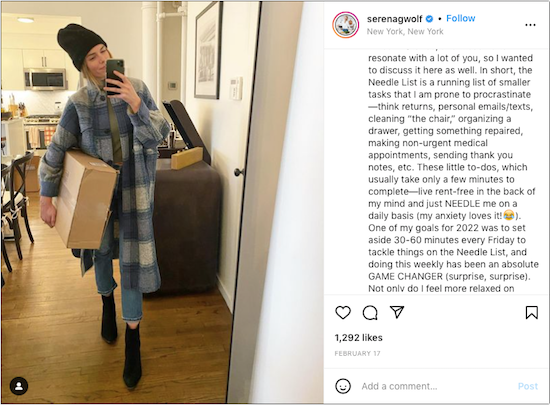
Wolf’s plan, simple but a bit of genius, was to set aside 30-60 minutes each Friday to tackle items on her Needle List. She notes, “Not only do I feel more relaxed on weekends, but it also makes me more productive during the week because I find it easier to focus with less mental clutter. The batching mentality also helps relieve any stress/anxiety when a new Needle List item pops up because I can drop it into Friday’s brain basket.”
Happily, this goes along with advice I’ve shared about time-blocking, here:
Playing With Blocks: Success Strategies for Time Blocking Productivity
Paper Doll Shares Secrets from the Task Management & Time Blocking Summit 2022
Time blocking basics are key to the Needle List. Wolf has a place to collect these otherwise needling, cringe-provoking tasks.
She sidesteps the problem of there being no “Someday” on the calendar by scheduling these tasks for a fixed block, on Fridays. (For you, it might be a Saturday morning or a Monday afternoon or a Wednesday lunch hour.)
And she goes through her week confident that a task won’t fall through the cracks, so she can stop constantly reminding herself that there’s something undone.
If you’d like to try making a Needle List and time blocking a part of your week to address these things in a batch, I’d encourage you to use a tickler file to its best advantage.
Let’s say, like Wolf, you’re going to block Friday afternoons to stop things from needling you. Why not write yourself notes (so you’ll think about what you have to do, in a nuanced way, rather than just constantly thinking of what you will do) and collect them with receipts, items to mail, etc., in that Friday slot of the ticker file. Anything left incomplete this Friday gets moved to the next Friday opportunity; it’s no longer hanging over you; it’s been rescheduled!
THE POWER OF LISTS
- Lists can be organizational — they create structure and boundaries.
A shopping list ensures that you purchase what you need, and assuming you don’t go into Target (because it’s impossible to leave Target with just what’s on your shopping list) you won’t buy what you don’t need. Gift wish lists (including wedding registries) make it more likely that people won’t waste their money on things you don’t want or need, that won’t mesh with your values or fit your physique.
A To Do list helps you do a brain-dump of everything you know you must accomplish, and then create lists of tasks, whether in the order you intend to accomplish them or batched in groups so that you can take them from list-mode on paper (or in an app) to time-blocking mode on your calendar. And if your lists are divided, as Desmond-Harris suggests, into what you must do and what you want to do, leaving those things others want you to do for last (or never), safeguarding your boundaries, how many more of your big-ticket goals might you achieve?
A packing list, and other travel-related lists, can ensure that you consider your needs and wants without last-minute pressure. (Take Paper Doll’s 5 Essential Lists For Planning an International Vacation, for example.)
Lists of books we want to read, movies and television programs we want to watch, and places we’d like to visit create structure and boundaries without greatly limiting our options. When we’re faced with an Amazon or Netflix full of titles, lists of recommendations can keep us from wasting time surfing or making mediocre choices.
- Lists can relieve anxiety.
Trying to remember everything you need and want to do is exhausting. It’s also untenable. That’s where lists come in.
A well-done, properly-approached list can prune the stress out of your life. A massive list written on both sides of piece of paper, with items you need at the market combined with 5-year-plan types of projects without distinct tasks is not a well-done list.
Neither is anything scribbled on the back of an envelope, or on 63 sticky notes on every vertical and horizontal surface around you. Lists that live in all the different in-boxes of your life, in email and Asana and Evernote, in the notebook in your bag and the whiteboard in your office, are too likely to discombobulate you.
Some people swear by David Allen’s Getting Things Done, which, when followed closely, is a love letter to lists. I appreciate GTD and teach it to clients whose style it fits, but find elements of it to be overly complex.
Others swear by list-based bullet journaling, created by Ryder Carroll,
but which has long since taken on a life of its own, and which I (and many of my clients find intimidating in its modern form).
Personally, I’m a fan of the 1-2-3 list. I believe in the philosophy that if it won’t fit on a Post-it®, it won’t fit in your day, so I counsel overburdened clients to look through their master lists, brain dump lists, and inboxes, and for any given day, find one big task, two medium-sized tasks, and three small tasks which are their absolute must-do items for the day, the ones that if that’s all they complete, they’ll declare victory.
This is why, when I first teach clients how to use a tickler file (you have read my Tickle Yourself Organized, right?), I’m often discouraging them from piling too many things in any one day’s slot. I may write without brevity, but I coach others to embrace it!
- Lists can be aspirational.
As with Jack Canfield’s entries, not every list is designed to accomplish the things listed in that book I bought back in 1982. Yes, we need lists to tell us what to do, pack, and purchase. But for envisioning the possibilities in our life — and for reviewing with less embarrassment than reading our teenage journals — lists can help us imagine different lives.
Might you make a list of other careers you could have? Other cities (or countries) in which you might live? Other personal attributes you’d like to have, or habits you’d like to extinguish?
There are days (or years) where we feel boxed in, where it can be difficult to imagine a different “we” that we could be. Vision boards are highly touted for helping people imagine how (and as whom) else they might live. However, I’ve found that whenever I clip photos to create a vision board, they always end up being full of tall, lithe women with long ponytails, doing yoga with lush, green mountains in the background. Eventually, I learned that I don’t want to do yoga; I just want to be a tall, lithe woman with a long ponytail.
For me, vision boards don’t work for expanding my self-view, but lists do. Perhaps they will for you, too?
What lists are essential in your life? Please share in the comments!
Organize To Reverse a Bad Day
Summer Tears by Mark Seton (Creative Commons License)
In a perfect world, our time and task management wouldn’t depend upon our moods. Unfortunately, we don’t live in a perfect world.
In theory, our organizational systems should be designed so that we can accomplish our goals whether we’re feeling motivated or not. That’s the whole point of a system, to give us a framework when something external or internal prevents us from feeling our usual drive to achieve.
Last September, in Rhymes With Brain: Languishing, Flow, and Building a Better Routine, I wrote:
We also depend on activation energy. Because the hardest part of what we do is the getting started, we have to incentivize ourselves to get going. There are all sorts of ways we can trick ourselves (a little bit) with rewards, like pretty desk accessories or a coffee break, but the problem is that action precedes motivation. We’re not usually psyched to get going until we have already started!
Action precedes motivation. We're not usually psyched to get going until we have already started, whether it's a runner's high or Csikszentmihalyi's flow. Share on XWe may not feel like working out, but once we’re dressed in our best approximation of Venus and Serena, or the yogi of the moment, or whichever quarterback is getting all the endorsements, and have gotten ourselves warmed up, we’re well on our way.
When we lack our usual oomph, our knowledge of the benefits of staying organized may not be enough to keep us motivated to track our expenses, pay our bills on time, file our papers, and stick with our routines, but if we nudge ourselves with giving it just a little try (“just five minutes” or a Pomodoro of 25 minutes or whatever), we may find ourselves able to get into flow.
In other words, well begun is half done.
In that post on languishing, I talked about how to get past the (likely pandemic-induced) blahs and generate flow. We looked at several rhymes-with-brain solutions:
- Abstain from the distractions that steal your focus.
- Retrain your brain by shaking up the synapses and making different connections.
- Restrain yourself from frequenting the people who eating up your time and energy.
- Constrain your work areas and minimize the space they take up to keep from spending all your energy looking for your supplies and resources instead of using them to achieve your goals.
- Contain those items in the areas you’ve constrained (above).
- Maintain your successful routines.
- Attain (and explain) knowledge to keep your brain active.
- Gain momentum and jump-start your enthusiasm.
If you haven’t read that post, skedaddle over to it first, as conquering languishing might be just what you need.
BEYOND LANGUISHING
The problem with productivity is that sometimes, we’ll be going along just fine and hit a brick wall. If languishing is the “blah,” a really bad day is the “waaaaaaaaah.”
Judith Viorst captured it best in the title Alexander and the Terrible, Horrible, No Good, Very Bad Day. Whether you remember it from childhood, babysitting days, or from parenthood, you know what she means. There are days that can go wrong and completely wreck our moods and take our whole day off course.

Maybe it starts small: you accidentally pour the orange juice into your
Perhaps you have a fight with a loved one or the person with whom you get along the least well (that’s a nice way of saying it, right?) gets a promotion or media attention or some other kind of success.
Or maybe something truly terrible (but still in the realm of “bad day”) happens, like a fender bender or news of impending layoffs at work.
When a few small bad things happen in sequence, no matter how strong your intention, the collective experience tends to upend your schedule, foul your mood, and destroy your day. If you let nature take its course, you may feel better after a delicious grilled cheese sandwich or a tearful phone call to your bestie, or your bad morning may turn into a bad day that scrolls into a bad week.
So, let’s not let nature take its course. Let’s stop that bad day in its tracks.
ORGANIZE YOUR WAY OUT OF A BAD DAY
Organizing your space, time, and thoughts can be powerful. It can even prevent catastrophes. But other times, the best it can do is make catastrophes less catastrophic. At those moments, we must accept what has happened, or what is happening, and turn inward to control our response.
Insert a Break
Anyone who has ever used a word processing program knows the command to Insert Page Break makes sure that there’s ample white space between one set of content and another. You insert a page break between chapters in a book, or between sections in a report. It keeps unrelated material from flowing together.
In your time management, when you’re having a bad day, take a pause to keep your bad morning from flowing into a bad afternoon.
Let’s say something annoying happens at 9:45 a.m. Depending on how resilient we’re feeling, we may get a fat-laden snack from the vending machine or take a walk to get some fresh air, and then regroup. If that little break is enough to reverse course on your bad day, count it as a win!
Embrace Time Blocking
But if you’re feeling resentment from multiple recent annoying things bubbling up inside of you, you may be at risk of bringing the whole day down. Here’s where your break needs to be a little more focused. This is where we can steal from the concept of time blocking.
We’ve explored time blocking often, most recently in Playing With Blocks: Success Strategies for Time Blocking Productivity. At its most basic, time blocking focuses on creating chunks of time for particular activities.
The whole notion is that an endless to-do list never sets aside fixed time for the categories of activities we claim to value. If we are constantly putting out fires and dealing with interruptions, the most important tasks never get done. With time blocking in the way we normally approach it, there are some basic tasks:
Start with a brain dump of everything you need to accomplish.
Group all your tasks into categories. At the time, I said, Work categories may not be all that different from school categories. You had math (now it’s bookkeeping or bill-paying) or English (now correspondence, marketing projects, or reading for fun). All of those activities were regulated by a fixed schedule that ensured you had ample time to focus on each subject. A bell triggered transition time. Your schedule even accounted for lunch and phys. ed. to keep your brain and body healthy.
Schedule your blocks so that you guarantee yourself set time for dealing with each important category.
I also said to “bubble-wrap” your time blocks with buffer time, so instead of trying to having Zoom meetings and major projects back-to-back, you’ll have recovery time.
Sometimes, life circumstances require you to replace a planned day with different activities. But by grouping categories of tasks into blocks, it’s easier to slide the tasks around and move them to where they’ll fit.
And this is where time blocking comes into play on a bad day. When teaching clients how to time block, I usually suggest they make use of 90-minute blocks. Just focusing on the workday, and not taking into account your early mornings and what you’re trying to deal with from dinner to bedtime, it’s easy to see we have not one big blob of a day, but multiple blocks:
- Early Morning
- Late Morning
- Early Afternoon
- Mid-Afternoon
- Late Afternoon
Let’s say you have a run-in with a co-worker or get bad news from your boss in the early morning. Or you have a fight with your spouse or a frustration with a parent in the drop-off line at school. Or, someone is wrong on the internet!
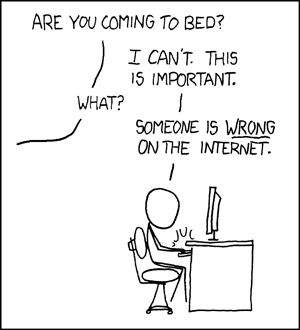
©XKCD/Randall Munroe (Creative Commons License)
It is so freakin’ easy to let an ugly mood settle into your day like a bad cough in your chest. If inserting that page break into the story of your day did work, your next option is to tell yourself that the day isn’t lost.
Take a deep breath. If you’re actually time-blocking, look at the the blocks you have on your calendar and figure out what’s the next possible block you can slide to a different day so that you can use your Bad Day Rescue Toolkit (see below) to get out of your funk.
If your day is not so carefully blocked out, mentally flip through your obligations for the next several hours until a good dividing line appears. If it’s 11:30 a.m., declare bankruptcy on your late morning block, know that lunch is a built-in daily mental health repair kit, and try to move or cancel whatever is in that first block in the afternoon.
The point isn’t to run away and join the circus, but to give yourself ample time to treat the yucky experience as a bad chunk, rather than an entire bad day. Then apply chocolate, or a soothing phone call, or an unplanned yoga class, or whatever, to the bruise forming from your crash with whatever ruined your mood. Instead:
- Acknowledge that something unpleasant happened.
- Give yourself permission not to deal with all of your emotions regarding the experience right now.
- Take responsibility for clearing the decks for the next block (or two) so you can recuperate.
- Use your Bad Day Rescue Toolkit.
- Find your path to resilience.
Create a Bad Day Rescue Toolkit
More than a decade ago, Daniel Powter had a hit with the song Bad Day.
My favorite part of the lyrics is when, after cataloguing the various travails, Powter sings, “You need a blue sky holiday.”
Every person’s Bad Day Rescue Toolkit will include different items, but use these ideas as a guidepost. The key is to organize as much of this now, when you’re having a fine or neutral day, so you’ll have it when you need it.
- Make a list of the phone numbers of your most upbeat and/or most supportive friends.
Note: these may not be the same people. Scroll through your phone and think about who you might call if you need to vent or need to be perked up. My BFF is my go-to when I need to vent, and I try to be that for her. I’m not as good at refraining from trying to fix the situation as she is. (If you just want to vent, tell the person that before you get started.)
But here’s a sneaky tip. Try to tell the whole story of whatever frustrated you only once, to just one person. Get it out — all the “grrrrr, arghh” — and then move on to the rest of the experience. If it’s the right time to start looking for support with solutions, do that. Otherwise, invite your callee to distract you. Let them tell you about an awful situation at work, something ridiculous their mother-in-law said, or what’s making them bananas these days. (Try to avoid politics. That’s giving us all bad days.)
- Keep a browser-bar folder on your computer or phone for websites that distract and amuse you — better yet, sync them for easy access. On Mac/iOS, back them up to iCloud. And here’s an article for How to Sync Browsers Between Your Phone and PC.
Similarly, start maintaining a folder (digital or paper) of jokes, funny stories, cartoons, or goofy memes. If you’re on Twitter, use the bookmark tool to save those long, ridiculous threads where people report silly family stories or embarrassing tales.
Airport cashier: “Have a safe flight.” Me: “You too!” I CAN NEVER COME HERE AGAIN.
— Jenny Lawson (@TheBloggess) November 1, 2015
This classic is one of my all-time favorite threads, and by the time I get days into the contributions, I usually end up looking like the laughing-crying emoji.
For professional humor, I particularly like comics that are gentle. My favorites are:
Liz Climo’s The Little World of Liz books and Twitter feed
Dinosaur Comics and Twitter feed
Nathan W Pyle’s Strange Planet comics, books, and Twitter feed
recently I started drawing a series called ✨Strange Planet✨
here is a thread of these comicshttps://t.co/WcqCOljAIJ pic.twitter.com/uuYnqeuCc8
— Nathan W. Pyle (@nathanwpyle) February 21, 2019
- Start saving videos that make you happy.
It’s shockingly easy. Make sure you’re logged into Google (because Google owns YouTube) and then whenever you come across a video that makes you laugh or lifts your spirits, click on the SAVE button to the lower right of the video.

This is how you create a playlist. When the little window pops up, click “Create New Playlist” and give your playlist a name, like Make Me Happy! You can also decide whether this playlist is public or private.
- Consider making YouTube playlists of other kinds of videos, like travelogues or workout routines — anything that focuses on what take you out of your head long enough to regroup.
Sometimes, you don’t even need to do the workouts (though it helps). Consider watching The Kilted Coaches. (Your mileage may vary.)
- Create a playlist of songs that reverse crankiness.
Having grown up in the era of mix-tapes, I found the late-90s/early-00’s experience of trying to make CD mixes frustrating.
Nowadays, most folks are going to make playlists directly in Spotify, so whether you want to do it on the desktop or via mobile, here are Spotify’s directions for creating playlists. (And, of course, if you prefer to watch videos along with listening to your music, you can search out your favorite songs on YouTube and follow my directions above.)
If you’re not that up on popular music, you can also search online for happiness-including playlists that other people have created. For example, The Ultimate Happy Playlist on Spotify runs almost two-and-a-half joy-inspiring hours and has more than 10,000 followers. From Katrina and the Waves’ Walking on Sunshine to Pharrell Williams’ Happy to many less obvious choices, it’s a good starter for dissipating a bad mood.
- Build up your success folders.
As we’ve discussed before, having tangible folders for papers and digital folders (generally for email) allow you to keep proof of your successes to read when you’re feeling down on yourself.
In my prior career, I had one particular manager who bore a striking resemblance to Dilbert’s evil, pointy-haired boss — I’m not sure what exactly went on during his long lunches, but depending on his mood, he’d either hunker down in his office or roam around to a pick a fight. He was once heard to scream at a hapless employee, “Everyone hates you because you use too much copy paper!”
That was the point when I first recognized how valuable and life-affirming it can be to keep written copies of positive comments.
You might have an email from a client saying that they couldn’t have accomplished their goals without you, or a handwritten thank you note that shows appreciation for something you’ve done for a friend. Or you might just get a note that says, “You’re the best!” or “You really made me laugh.”
The point is that we never know when an evil, pointy-haired boss, or a bad boyfriend, or a good person having a bad day is going to do or say something to puncture our self-confidence. You can’t organize your way out of being disappointed in a representative of the human race, but gathering up the equivalent of a positive affirmation in the form of someone else’s handwriting (or over their email signature block) can really help reverse a bad day.
Other options to develop for your Bad Day Rescue Toolkit might include:
- a happy list — Whether you keep a note on your phone or have a sprawling list at the back of your journal, keep a running list of things that please you. My own list is a heady mix of things my friend’s four-year-old has said (most recently, with a big sigh, “HOW am I ever going to find a wife?), experiences I love (like waking up, seeing I have hours before the alarm will go off, and going back to sleep), funny lines from beloved TV shows like The West Wing and Ted Lasso, and a sub-list of just completely unexpected experiences that always remind me that you never know what might happen next!
- a workout plan with moves that boost your endorphins, or a bookmarked schedule of live exercise classes (in-person or remote) for when you need some human interaction along with your running/biking/downward-dogging.
- a set of mantras to get you going again (whether it’s a serious one, like “I am not defined by one mistake” or one that makes you laugh, with expletives not deleted)
- a meditation app — Good Housekeeping has put together a list of the 15 Best Meditation Apps of 2022. Calm and Headspace get all the media buzz, there are lots of good alternatives, including quite a few that are free.
- essential oils — OK, to be fair, I really don’t know anything about essential oils. Mostly, I know that my favorite scent is a grilled cheese sandwich, but many people swear by essential oils, either in the bath or through a diffuser. And I hear lavender oil can release tension. (If you’ve tried this option, let us know in the comments.)
When It’s More Than a Bad Day
Obviously, all of these suggestions are for resources that will help you tackle a garden-variety bad mood or bad day. If you find you’re having more back-to-back bad days or weeks than simple organizing can handle, please give yourself the gift of qualified professional support.
Call your health insurance Member Services number or check their website for mental health providers in your network. If you are experiencing a mental health emergency, please know that you can call NAMI (the National Alliance of Mental Illness) hotline at 800-950-NAMI or text “NAMI” to 741741, or the National Suicide Prevention Lifeline at 800-273-TALK (8255)
A Parting (Musical) Note
I hope you’re having a good day right now and that this post has helped you prepare for the future, in case you need to turn a bad day around. Please share your own ideas for organizing your way out of a bad day in the comments section below.
Finally, when I originally created this post, YouTube would not let me share the official video for Bad Day, which you can now see up above. Over the past few years, so many people have told me through the years that it lifts their spirits, so in case YouTube makes the official video unavailable again, I wanted you to have the option to at least hear the song and read the lyrics. [Editor’s note: I’ve had to replace the video multiple times, as it keeps getting taken down, but this lyric video is by Daniel Powter himself, so it’s likely to stay available.]
While there are a variety of explanations for the neurological or psychological mechanism, but truth is that sometimes a sad song helps turn a bad day around.
Paper Doll Introduces 5 New and Noteworthy Books By Professional Organizers
When we think of books about organizing (and books by professional organizers), there’s a tendency to focus on the how-toaspect. “Have these problems? Follow these steps.” Done-and-dusted, as my favorite BBC shows would say. There are many, many books like that, identifying the problem and offering turnkey solutions.
None of the books I’m sharing with you today follow that kind of recipe-for-success strategy. They’re deeper, wiser, and recognize the complexities of life that prevent us from robotically following a set of numbered tasks to get from chaos to serenity. Not all of the books I’m going to share with you today will appeal to every reader, but all are written by colleagues whom I respect and admire.
Professional organizers have opinions. LOTS of opinions. And they’re generally backed by years of expertise, continuing education, and research. The authors I’m sharing with you today have dug deeply into the vast quagmires of our human brains (and of society, itself) to understand the intricacies that got us where we are, the challenges we (individually and collectively) face, and the strategies for moving forward.
NON-FICTION
Emotional Labor: Why A Woman’s Work Is Never Done by Dr. Regina F. Lark, Ph.D, CPO® and Judith Kolberg

Whatever you think this book is, based on the title, it’s not just that. You’ll be surprised when you sit down to explore the social, economic, and historical threads interwoven to understand the idea of “women’s work” and why that expression is much more than just outdated concepts of divided gender roles. If it were just that, it would be interesting, but it wouldn’t be as compelling as it is.
Let’s back up. Maybe you’re familiar with the concept of emotional labor due to the Gemma Hartley piece, Stop Calling Women Nags—How Emotional Labor is Dragging Down Gender Equality from Harper’s Bazaar several years ago (which itself served as a precursor to Hartley’s eventual book, Fed Up). Or maybe you figure you’re too busy doing labor (physical or emotional) to get anything out of this. Au contraire, my friend!
Emotional labor, as defined in the book, is “the invisible, unnoticed, unwaged, unwritten, undervalued work women do at home and in the paid workforce.” It’s all about the “internalized gender role expectations that lead women to feel hyper-responsible for tending to the “niceties of life.”” And gracious, there’s a lot of that work!
Let’s start with Lark’s introductory video for the book. (If this piques your interest, and I suspect it will, it’s worth going through the whole Emotional Labor playlist of videos.)
The book traces the sociological understanding of the concept of emotional labor (including a vast Emotional Labor Checklist, which I guarantee you will recognize from your own life). Elements include everything from planning and facilitating medical appointments for everyone in your family (your kids, sure, but also your spouse who’d gladly leave such appointments undone or up to you, and for elderly relatives), to being responsible for the (tangible) organization of your home and (temporal) management of family life.
Emotional labor isn’t just about housework, but as the book explains, it’s about “noticing” what needs to be done and adding to your mental load for keeping track — which child won’t eat dinner if the foods touch, if the ketchup need to be refilled, who needs to be picked up when (and reminded of what), and what needs to be tracked, considered, prepared, done, and evaluated — all with consideration of everyone else’s emotional needs. Emotional labor involves keeping tabs on everything, and as our modern browser metaphor goes, we’ve all got dozens (or hundreds) of open tabs.
Emotional labor involves keeping tabs on everything, and as our modern browser metaphor goes, we've all got dozens (or hundreds) of open tabs. Share on XThe book especially concentrates on “kin work” in terms of all of these activities as they relate to keeping nuclear and extended family ties strengthened. But it doesn’t ignore all of the elements of obligations that ending up resting with women in the workforce, from making sure the break room fridge doesn’t get gross to ensuring everyone receives a birthday card signed by the entire staff.
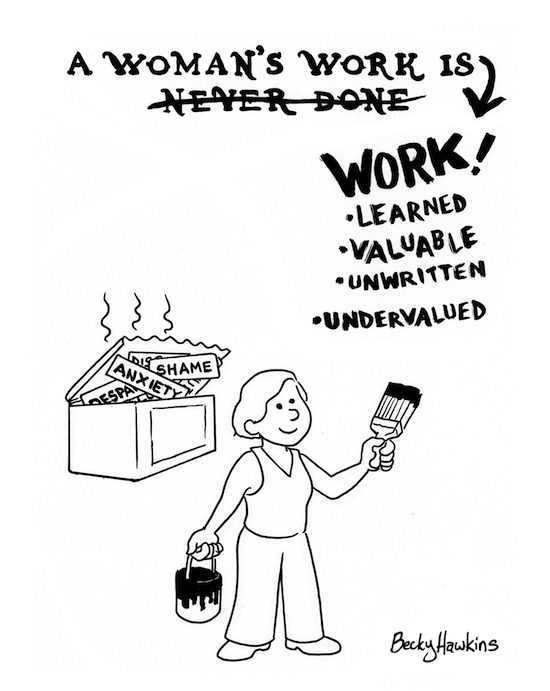
Emotional Labor provides an impressive historical perspective of socioeconomic issues over the last several hundred years. Then (as you’d expect, because it’s written by professional organizers) it delves into some key issues related to emotional labor and organizational skills, including high expectations and low self esteem, cognition and executive function, and the key skill of “anticipation.”
All of these concepts contribute to the focus of the second half of the book, disrupting the long-held narrative surrounding emotional labor throughout the lifecycle, learning how to delegate in a new, more functional way, and concepts (and solutions) for making our personal and professional worlds more equitable. Not a short order!
The book is extensively researched and ends with a robust set of end notes and resources for learning more about the various tendrils of the sprawling topic. As collaborator, Kolberg references that, for Lark, this book represents the “integration of feminist history, women and organizational challenges, and social change.” Whether you’re interested in social and economic history or just why the heck you are so overwhelmed and frustrated, this book will open your eyes and give you plenty to think about and discuss.
Lark is the author of Psychic Debris, Crowded Closets: The Relationship between the Stuff in Your Head and What’s Under your Bed. Her collaborator, Judith Kolberg, is the standard-bearer of professional organizing and author of Conquering Chronic Disorganization, ADD-Friendly Ways to Organize Your Life, and so many other books you should read (and then read again).
Emotional Labor: Why A Woman’s Work is Never Done and What to Do About It is available in paperback and Kindle.

This book was actually published at the very end of 2019, just a few months before the world got caught up in the whirling dervish of COVID. Any big, scary goals (or even small, delightful ones) that most of us had on New Year’s Day 2020 got short shrift in a matter of a couple of months. But that shouldn’t deny Organizing and Big Scary Goals its place in the sun.
You all got a preview of this book earlier in the year, when I wrote Paper Doll Recaps the NAPO2021 Virtual Conference and attended Skillen‘s session,This is Scary: Embracing Discomfort to Help You and Your Clients Succeed. Skillen’s comment about pushing through fear, “Learning to tolerate discomfort lessens its power over you,” is still echoing in my head seven months later.
Skillen’s writing makes you feel like you’ve sat down with your kindest, most truth-telling friend, and her wisdom is punctuated with warm humor that dissipates any fear that might (OK, will) arise from thinking about, well, fear. Organizing and Big Scary Goals follows various clients through their challenges and successes; each chapter starts with intriguing quotes and ends with “Scribbles,” exercises to think and write about how you can apply each chapter’s lessons (both emotional and practical) to your life.
And throughout the book, Skillen shares her own bicycle-related bogeyman to show that she is no more immune to fears than any of us; by sharing her vulnerabilities, the lessons become even more relatable.
Organizing and Big Scary Goals looks at the various types of obstacles we face, including self-criticism, perfectionism, shame, self-doubt, backsliding, and difficulty with life transitions. Skillen focuses on organizing, and how all of these elements stand between us and the homes and lives we might wish to have, but the concepts for dealing with these fears can be applied in a broader, more overarching way to any big project or change you’d like to take on.
If you’re looking to read a book in December to help you get out of a fear-based rut and into a motivational mode for 2022, snuggle up on your sofa with a hot chocolate (the marshmallow count is up to you) and let Sara share the real deal.
It’s available in paperback, on Kindle, and as of this year, as an audiobook.
Mind Body Kitchen: Transform You & Your Kitchen for a Healthier Lifestyle by Stacey Crew

First, if you’re thinking this is a diet book, let me slap that celery-and-cottage-cheese thought out of your head.
Crew is both a professional organizer and Certified Health Coach (as well as the author of The Organized Mom: Simplify Life for You & Baby One Step at a Time). So, it’s understandable that she has integrated the cognitive and emotional, the physical, and the organizational to create a positive, supportive approach to improving your health and home.
Using her health coaching skills, Crew has (thankfully) jettisoned the obsolete (and often dangerous) cycle of dieting and embraced an approach that involves understanding (from an emotional, as well as intellectual, perspective) cravings, instincts, and the mind-body connection. She guides the reader to improve mindset, better understand the basics of nutrition, make healthier eating decisions, and develop a strategy for daily physical movement without making it all a drag.
Because Crew is an organizer, she gives the reader a real-world method (and not an unattainable, glossy magazine set of buzzwords) for creating an organized kitchen that supports making simple, healthy meals. Her kitchen advice covers organizing the pantry and refrigerator, the kitchen gadgets and tools that are really worth owning, and “what to embrace & what to avoid when it comes to certain foods.”
And because we don’t just live in our kitchens (a particular truth for Paper Doll, who mainly subsists on PB&J and takeout sushi), Crew uses her organizing skills to help readers detox and declutter to “create a truly healthy home.”
Mind, Body, Kitchen is so new that it’s not officially out yet — it’s being released next week on December 1st, but you can pre-order it now and by the time you’ve polished off the last of the Thanksgiving leftovers (and given up on buttoning your jeans) you’ll be ready to dig in. You can even read the first two chapters now, online.
Most books that come out in hardcover aren’t available in paperback until months later, but you have your choice of formats: hardcover, paperback, or Kindle. It’ll be available at Amazon, Barnes & Noble, and Target.
Filled Up and Overflowing: What to Do When Life Events, Chronic Disorganization, or Hoarding Go Overboard by Diane Quintana, CPO®, CPO-CD® and Jonda Beattie, M. Ed.

Quintana and Beattie are stellar in many respects. They were already known for their individual professional organizing practices and the books they’ve published independently, as well as their collaborative writing for children, Benji’s Messy Room and Suzie’s Messy Room. They are experts in our field.
But the word that I most often hear describing both of them is compassionate. This compassion is reflected throughout their newest collaboration, which explores and guides readers through the complex realm of hoarding disorders and related challenges.
Too often, the mass media approaches organizing through one of two lenses, a practical “let’s make this pretty” approach for situational disorganization and a frenzied, exposé-oriented hunger when looking at those who struggle with hoarding disorders and related (but very different) organizational challenges. Quintana and Beattie bridge the chasm between those two approaches and bring compassion to those who are often engulfed in derision from others and shame from within.
Filled Up and Overflowing uses case studies from the authors’ own client practices (protecting identities, of course) to help individuals and their loved ones better understand and support individuals for whom excess “stuff” (even when it is to the point of endangering them) is a comfort.
The book spells out the power of words and the dangers and insensitivity of “labeling” those challenged by hoarding tendencies; it also clarifies what hoarding is and is not and explains that both environments and behaviors that look like hoarding to laymen might be chronic disorganization, situational hoarding (triggered by a life event), passive age-related decline, and various neurological and cognitive conditions. In each case, the authors vividly illustrate clients who are three-dimensional humans and not merely labels or or a collection of behaviors to be judged.
Throughout the book, the authors clarify not only why and how people’s situations come to be as they are, but what to say and how to help and support, rather than steamroll, those whose spaces have become chaotic and overwhelming. The book focuses on compassion (there’s that word again!), understanding, communicating, and assisting. The latter is illustrated through a collection of strategies for both those struggling with their possessions, as well as family, friends, social workers, mental health providers, first responders, and others to help create safer, more supportive environments.
The book also includes a variety of references and useful resources.
I should note, I have a personal interest in this book. A few years ago, the authors conducted a presentation for our NAPO chapter on several of the concepts at the heart of this book, including the differences between hoarding disorders and so many of the look-alike behaviors. I was transfixed, and fan-girled my way to the front of the room to gush, insisting that this was a book (!) in the making, and that LOTS of people (and especially our colleagues) needed this information. Yes, Paper Doll considers herself a muse!
Filled Up and Overflowing is available in paperback and for Kindle.
FICTION
Emotional labor, fear, the challenges of healthier living, and hoarding and related situations. Although the books are written in uplifting and compelling styles, that is pretty heavy content.
Perhaps you’d like something a little lighter, perhaps some fiction?
There aren’t many novels actually written about professional organizers by professional organizers (who know what they’re talking about). Until recently, only Valentina Sgro’s Patience Oaktree books (including Patience and the Porsche, Photographic Memories, A Mess of Fish and Other Tidbits, and Heart of a Hoarder) came to mind. And while I would love to see more Patience books, there is a newly published book with a professional organizer front-and-center.
Perfectly Arranged by Liana George

In full disclosure, Liana and I were co-chairs of (take a deep breath to say this whole thing) the National Association of Productivity and Organizing Professionals’ Authorship and Publishing Special Interest Group. (AKA: the NAPO A&P SIG.)
As buddies in support of professional organizers who are also writers, I got to read a very early beta version of Perfectly Arranged, the first in what’s already set to be (at least) a three-part Hopeful Hearts series, with more books coming in 2022 and 2023.
I warned Liana that I rarely read fiction anymore, and when I do, it’s mostly re-reads of Jane Austen or piles and piles of speculative fiction (think: time travel rather than space operas); and I’d definitely never read a novel in the Christian genre. Well, unless you count Christy, but that was a plucky Appalachian Anne of Green Gables/teacher kind of novel that became a series with Kellie Martin, Tyne Daly, Tess Harper, and two smokin’-hot guys (a minister and a doctor a with Scottish accent) between which Martin’s Christy was forced to choose.
That said, I was charmed by Liana’s turns of phrase and her deep research. I don’t want to spoil the story, so I’ll just give you a broad sense of the first-person narrative.
Nicki Mayfield, the protagonist is a plucky professional organizer facing a shortage of clients and funds, considering “hanging up her label maker” when she agrees to take on one (possibly final) job with a wealthy, eccentric, and prickly woman. However, the process of organizing turns up some clues to a client’s family mystery, which leads them on an adventure in China. Of course, there’s the requisite self-doubt and misunderstandings that populate contemporary fiction, especially “chick-lit.”
The early draft I read in early 2019 has been revised, of course. It’s been several years since I first got to know Nicki Mayfield and the characters who populate her life, but I remembered certain settings as though I were replaying (the surely eventual Lifetime TV) movie version in my head; I’m now reading along in the final (published) version, noting the differences but still getting to the same places.
For more about the background of George’s book, you may want to read the pieces in her Perfectly Arranged press tour. Having discussed our writing projects together, I’ve always been intrigued by the motivation for her book. When Liana George was living in China, her father called and requested she visit Shanghai and take a photo of what was at a particular address; the situation that prompted that request was the impetus for this story, and it’s fascinating to see how it all unfolds.
I was captivated by the original tale, and I’m looking forward to seeing how the book has grown and matured.
Speaking of matured, I still haven’t matured beyond sharing clips from TV shows, so here’s the opening “saga cell” from Christy. In case you were wondering about my stance in Christy’s love triange, I was TeamNeilMacNeil (the Scottish doctor).
Happy reading!
Disclosure: Some of the links above are affiliate links, and I may get a small remuneration (at no additional cost to you) if you make a purchase after clicking through to the resulting pages. The opinions, as always, are my own. (Seriously, who else would claim them?) For more information regarding how Best Results Organizing handles affiliate links, please see the affiliate section of the site’s Privacy Policy.
Unpacking: Paper Doll Explores a Video Game About Organizing
[Editor’s Note: This is not a typical Paper Doll post, but it is about organizing, so don’t worry that I’ve changed the focus of the blog. Also, if you click on any of the links in the first few paragraphs and get distracted playing classic games in your browser, don’t forget to come back and read the rest of the post!]
UNPACKING
I have limited experience with video games. Which is to say, I played the tennis-like Pong at a friend’s house when it first came out around 1972 and delighted in PacMan (and Ms. Pacman) while waiting for my Pizza Hut meal to be served, during my adolescent years.
And I even plunked myself down to play Super Mario Bros. when I was in graduate school and needed something obsessive and concentration-focusing to take my mind off what the heck I was going to do with my life when graduate school was over.
But game strategy, manual dexterity, competitiveness, and the ability to bonk a cartoon plumber’s head upward onto a brick to make a mushroom appear (if I’m recalling correctly) — none of these have ever been my strong suits.
In the past three decades, my interaction with video games has been limited to helping my clients pare down their video game collections, organize what they keep, and sell or donate the remainder. I haven’t played, or had any desire to play, any games until last week, when Australian game developer Witch Beam released Unpacking. My Google News feed knows me too well, and upon last week’s release, I was inundated with articles and reviews about this intriguing game.
The company describes Unpacking as a “Zen puzzle about unpacking a life.”
The game has eight chapters or levels, each corresponding to a move to a new “home” — a childhood room, a college dorm, one’s own apartment, sharing a space with a significant other, etc. — all for an unnamed, unknown protagonist. It starts in 1997 and continues forward to today. As players, we are never explicitly told the story of this character, but through her possessions, a certain intimate bond is formed.
The game has been described as “part item Tetris, part home decoration.” You select digital cardboard boxes, open them, and through the game, put the items away. There are pre-ordained slots or shelves; the game is designed as a puzzle, and the goal isn’t to throw everything higgledy-piggledy but find the logical home.
To move to the next level, you need to generally put things where a reasonable person might think they should go. That said, as part of the accessibility features of the game, you can apply the “allow items anywhere” option to eliminate the puzzle element. With this choice, you can’t really put an item in the “wrong” place any more than you could in your own home. (Still, please don’t store extra pantry items or clothes in the bathtub; we professional organizers have seen that in the real world, and it’s just not a great option.)
So, just like at your house, you can put things in weird places. And while I haven’t seen a treadmill or Peleton in the game, I’m betting that just like in real life, you can hang your clothes on exercise equipment. As a player, you get to decide where things belong, but you have to obey the laws of physics and geometry. You can’t fit square pegs in round holes or ten pounds of whatever into a five-pound bag.
I find it appealing that there’s no competition and no timers counting down. But there are, apparently, 14,000 different audio sounds to go along with tucking items in nooks and crannies, setting a toothbrush in a water glass, arranging books on shelves and supplies in drawers, and so on. If you lift a T-shirt to a hanger placed on a rod, the shirt hangs; move it lower to a stack of shirts, and it self-folds. (If only actual unpacking, organizing, and indeed, laundry day, were so magical.)
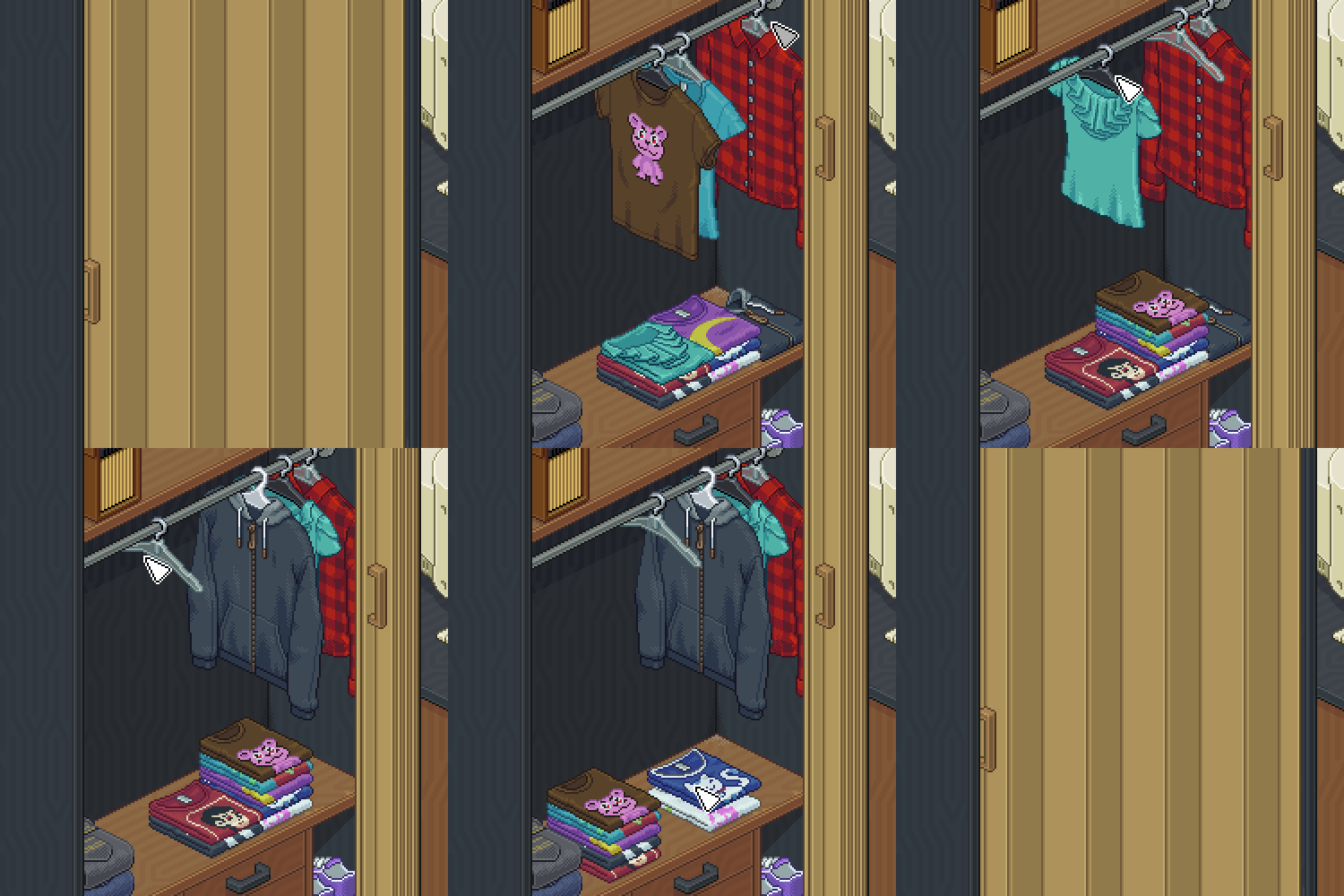
In addition to putting things away (that is, giving them homes), you can change the color signature of the room, add some on-screen stickers to decorate, take photos of a completed room, and add those photos to a scrapbook, complete with a “handwritten” description of your move-in experience.
Here’s a peek at the game’s launch trailer:
Throughout it all, there’s a soundtrack from a BAFTA (British Academy of Film and Television Arts) award-winning composer, Jeff van Dyck. If video game soundtracks are your thing (Yes, I’m looking at you, my friend Chris!), you can listen to Unpacking’s soundtrack on Spotify and purchase it in all the usual music-buying places like Amazon, Apple Music, Bandcamp, etc. (And no, Chris, I’m not listening to this in the car on any road trips.)
Warning: I should also note that, assuming you’re reading in North America, there will be some oddities in the rooms and homes in Unpacking. The refrigerators are not the full-sized ones we have, but those smaller, under-counter ones that are barely bigger than dorm fridges. The bathtubs have the glass half-walls I saw in Europe; I’ve yet to figure out how one manages not to soak the half the bathroom, but at least there’s no need to run any water in the actual game.
I’ve seen reviews calling the game calming and endearing, but also cathartic and moving. (Of which, I have more thoughts, below.) As a professional organizer, of course, I found this tweet hopeful:
Y’all, I already knew @UnpackingALife is a great game, but my daughter is cleaning her room and I was impressed with how much better it looks than normal.
She told me “Unpacking really helped.” Holy crap ? Best game ever!!!! pic.twitter.com/WQNhT3fHd7
— Dr. Ashley Godbold ????? (@ashleygodbold) November 6, 2021
And for those who wonder how much detail is available to organize exactly how and where you want things to be, this tweet gives you a sign:
We definitely didn’t expect this kind of creativity from our replay feature, but we love it so much! ??
Credits: @carellogyhttps://t.co/wZe1SQpICc pic.twitter.com/115WshTfLj
— Unpacking ? Out NOW! (@UnpackingALife) November 7, 2021
Unpacking is available for a variety of platforms, including Windows, Mac, Linux, Nintendo Switch, and Xbox One and runs $19.99.
ACCESSIBILITY
In the real world, unpacking and organizing a new home, whether a dorm room, a studio apartment, or a multi-bedroom family house, can be a massive headache. Imagine how much more difficult is must be for those with physical disabilities or distracting cognitive challenges (ranging from ADHD to traumatic brain injury). This is just one reason why many clients call in NAPO or NASMM professional organizers who specialize in relocations to work some video game-like magic in setting up a new space.
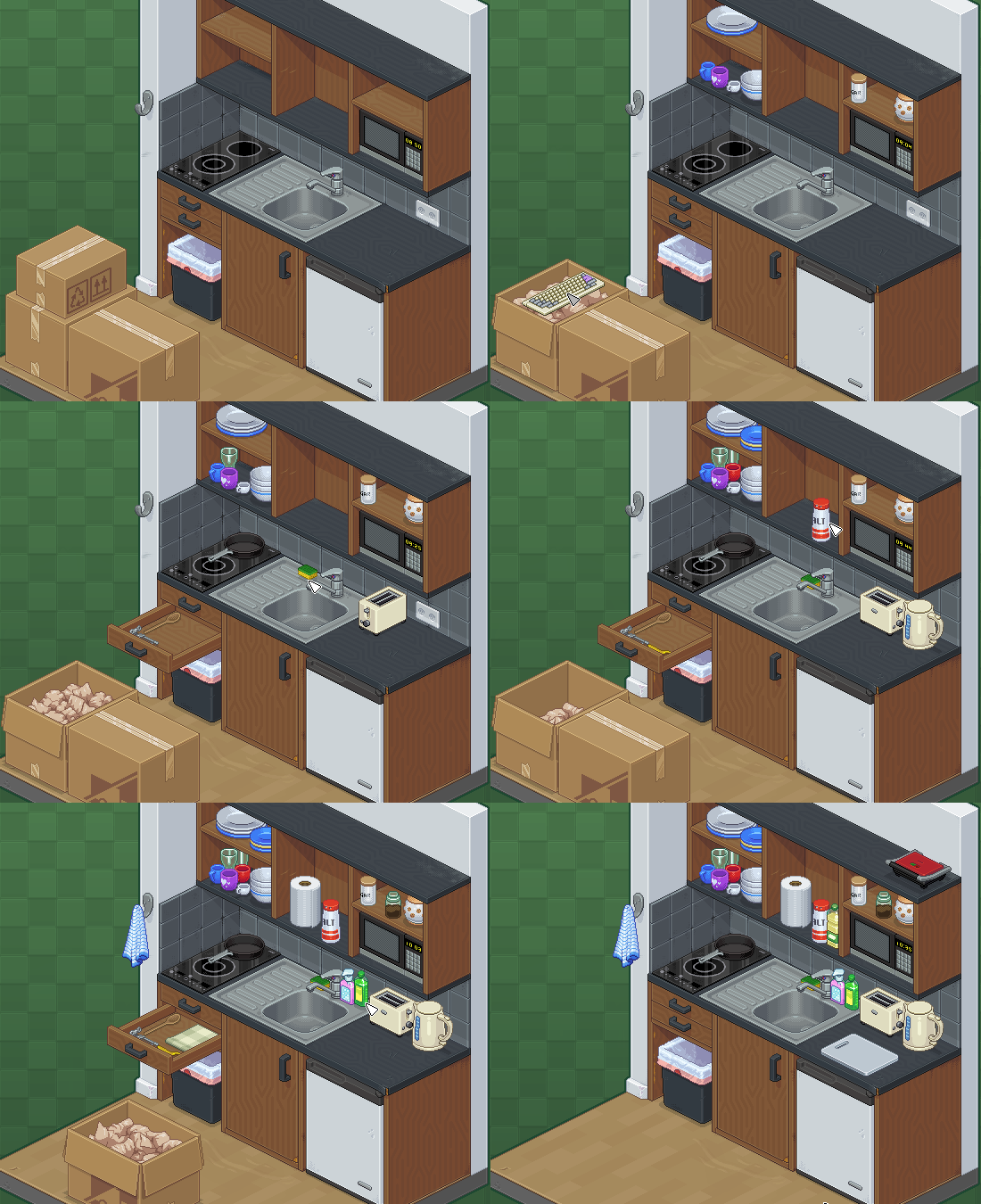
I can’t be the only person who gets flashbacks to Bewitched watching this sped-up kitchen unpacking/organizing scene play out. Seriously, compare it to Samantha Stevens working her tinka-tinka-tink:
There are no in-game professional organizers, but Unpacking‘s developers prides themselves on its accessibility features.
For those needing visual assistance, the user interface buttons can be enlarged, and you can zoom in on the screen; if you’ve made a booboo, the red “invalid” outline (remember what I said about the laws of physics?) can be changed to a different color. And you can disable the animation feature for room-swapping (in case you unpack a box of kitchen items when you’re in the living room) to avoid motion sickness.
In terms of audio assistance, the game lets you operate soundtrack music and sound effect volumes separately, and there are no audio-exclusive cues for game play, so players who can’t hear don’t miss any of the essential game features.
For cognitive accessibility, the game has no penalties; there’s minimal text, and reading skills (in English or otherwise) are not required in order to play. And, as mentioned, you can turn off the puzzle angle to be allowed to put things anywhere.
There are also a variety of mobility-related accessibility features. None of the actions require pressing more than one button at a time, clicking-and-dragging, holding down buttons. Computer versions support playing via a mouse and keyboard, a game pad, or touch (“on supported hardware,” they note) and you can play one-handed with just a mouse. The Nintendo Switch version of the game supports (and I quote, because I have no idea what this means), “gamepad, touch, and gyro in two-handed and one-handed configurations.” Controls are re-mappable when necessary to support a user’s accessibility needs.
While Paper Doll is neither a gamer nor a reviewer, I think it’s important to accent accessibility features in products, and while this does not arise often when I talk about notebooks and storage options, I intend to be more cognizant of such issues in future posts.
UNPACKING THOUGHTS ABOUT UNPACKING
Having missed three decades of video game development, I am, at best, only peripherally aware that not all games are multi-player shoot-em-ups and car-racing (and crashing) extravaganzas. Certainly I knew about The Sims, a series of simulation games where players create virtual people, build them homes (and families) and play with their careers, activities, and moods and desires.
Apparently, this approach is called a sandbox game, an open-ended type of video game where players have a freedom of movement for their creations and there are no pre-set goals. (If only we humans felt that much ease in creating our lives and risking change!) The popular Minecraft, with it’s blocky 3D people and infinitely expanding world of raw materials, tools, and create-able structures is similar.
Unpacking feels like it belongs in a world tangential to these sandbox games; there’s freedom of movement, no timers or competition, and you can’t lose your character’s life by unpacking things in the wrong order or organizing things “wrong.” But like real life, there is a very solid goal for you as the in-world character: unpack in an organized way to live your life.
In Vice‘s Unpacking Is a Lovely Game About the Power of Seemingly Mundane Objects, Moises Taveras has created a great introduction to the game beyond the broad strokes. Through it I learned some spoilers and realized that there was more depth of insight to be had beyond how many frying pans could be fit into a cabinet:
The “challenge,” a term I’ll throw around incredibly loosely, becomes finding where everything fits best. It’s a logic puzzle, so as long as you’ve been in a kitchen, a bedroom or bathroom, you’ll be able to sufficiently reproduce a functional home. … There’s a joy in getting it all right, but the greater one to me was playing a game that, in bits and pieces, understood the relationship we build with the things we collect.
But there’s more. After I learned of Unpacking, I started reading every review I could find, and what’s particularly gripping about the game is how you get to see the protagonist’s life unfold through her possessions (and those with whom she shares her space). It reminded me of Sam Gosling‘s book, Snoop: What Your Stuff Says About You.

Gosling, a professor of psychology, wrote, in an almost gumshoe detective approach, about how we intentionally and unintentionally create, define, and communicate who we are to the world through our possessions. Published in 2008, before we all defined ourselves via social media, it’s a fascinating look at how our stuff — the essentials, the practical items, the sentimental things, and the clutter — exposes who we are. It seems Unpacking is designed to do that, too.
Kotaku‘s Ari Notis posits, interestingly, in Unpacking Might Have the Worst Video Game Boyfriend of the Year, that there’s more to this game than pattern recognition and matching items with logical spaces. This was the article that really caught my attention, as Unpacking seems to reflect the more complex, nuanced aspects of organizing, the ones our clients struggle with, and the ones we professional organizers are brought in to solve.
The issue isn’t that the home is too small, but that the boyfriend’s items are fixed in place, leaving our protagonist limited in her options for her own things, including as to where she can put her framed diploma. (The review notes it only fits under the bed, but a commenter posits that one can, at least temporarily, place it on the wall above the toilet? Um, yeah. No.) The Kotaku review continues:
September 2010 is the first level in which Unpacking feels truly cramped. Your things—your dolls, video games, and battered kitchen supplies—won’t fit within the confines of the level’s default setup. Instead, you also have to move the dude’s existing stuff around to make room. (There’s also the sense that you’re invading someone else’s space, given the mishmash in aesthetic tastes.) You eventually fit everything, but you do the entire task all alone. It is off-putting, to put it charitably, that this dude who was fully planning on moving in with someone didn’t even bother to make an inch for his incoming partner.
As a professional organizer, I’ve worked with clients whose homes had more than adequate space, but (very) adult children had left behind all the possessions of their childhoods, dorm rooms, and even early apartments, limiting the space available for their parents to use. (This is why I tell clients, “Don’t become the curator of the museum of other people’s things.”)
For years, I've warned my clients: Don't become the curator of the museum of other people's things. Share on XAnd I’ve had clients who felt like (sometimes unwelcome) visitors in their own homes, like the wife whose husband had filled every closet with his own clothes and possessions, leaving her to hang her things on doorknobs throughout the house.
This is all to say that at first glance, this game might seem like little more than a slow-moving version of the afforementioned Tetris or those square, plastic, 16-tile games where you move the jumbled tiles to create the face of a lion. From what I can tell from these reviews and the game play videos I’ve watched, I suspect that Unpacking offers a robust, intriguing opportunity to self-soothe through in-game organizing, even if one struggles with organizing in one’s own spaces, while gaining insight into a fictional character through analysis of her possessions.
Apparently, video games have come a long way from when the plumber was trying to save the princess.
Are you intrigued, but you just aren’t the video game player type? I was surprised to learn that there are actual video of video game play on YouTube. If you don’t mind commercials, you can watch someone else play the game. This version runs two and a half hours (and the player has turned off the music soundtrack):
WHAT’S MISSING FROM UNPACKING
Granted, I’m not a video game designer, and I have zero idea what someone would find compelling in this or a similar kind of gentle, experiential video game. But I know organizing, and let’s face it, unpacking is about organizing from the ground up. Instead of rearranging the deck chairs on the Titanic, as organizing can sometimes seem when you’re overwhelmed, you’re beginning with a clean slate (but admittedly, a whole bunch of boxes of chalk).
However, as far as I can tell, Unpacking is missing a few essential elements that might make it better reflect the real world experience. Namely:
- Paper — We start when the protagonist is a little kid, so I really wouldn’t expect much more than the putting away of books and maybe tucking some homework into a backpack or drawer. And perhaps it’s because I’m a professional organizer who specializes in paper, but I’d want to see how the character develops some method for unpacking and organizing the paper in her life to help make sense of it. Yes, she’s got that aforementioned diploma, but throughout her life, upon each move, she’d have leases and bills, perhaps a marriage license, and a mortgage or title. (Again, Unpacking is Australian. Maybe they have much simpler paper lives? Though I doubt it.)
- Donations — Every possession that’s unpacked seems to be kept the goal is to find someplace for it; anything jettisoned seems to disappear in the unseen transitions between levels. Though it appears there might be a trash can in some rooms (and emptied cardboard boxes and packing paper magically go *poof* when tapped), but there’s seemingly no box into which to put castoff clothes, toys that are no longer age appropriate, or any of the items that no longer fit her life once she (and you) move to the next level.
On the plus side, one feature I’d feared missing seems to have been considered: continuity. When I began researching this post, I was going to note that from when the character sets up her childhood bedroom in 1997 to when she moves in with her boyfriend in 2010 to the end of the game, there are unrealistically few items that carry through. But perhaps my experience as a professional organizer, working with people who often have difficulty letting go of possessions, has skewed my idea of how much carryover from move-to-move is realistic. (Or maybe I haven’t grasped that the level of detail I see in people’s homes can’t be emulated in a video game?!)
According to Fanbyte‘s Natalie Flores in Unpacking Is a Zen Puzzle Game about the Joys of Moving in and Moving On, each of the levels of the game shows both an upleveling of the character’s possessions and a through-line of much-loved items:
As the protagonist experiences the many changes that life brings, I was glad to see certain items from her childhood — like her stuffed animals and game consoles — still show up in boxes I emptied years later in her life. I felt similarly as I saw her upgrade her small cassette player to a boombox, and her art supplies evolve in variety and sophistication.
I was also sad when the game indicated a portrait that was previously on display — and which I had assumed was still meant to be that way — now belonged inside the kind of cabinet destined to rarely be opened. I felt similarly, too, as I realized certain items she once undoubtedly cherished (and that I had unknowingly grown attached to) no longer accompanied her on the journey. Unpacking truly embodies the act of unpacking in the sense that you’re often surprised by what you take out of any given box. As well as what you don’t. That surprise is heartbreaking as often as it is pleasant.
Finally, perfectionists beware. Moving for a stranger can be as overwhelming as doing so for yourself. Tom Orry of VG247 wrote, in Game Pass Gem: Unpacking is the kind of game you wish you’d thought of, that he’d had no interest in unpacking or organizing before playing the game, but “I can’t believe I’m enjoying placing dishes as much as I am.” However, he quickly got caught up:
I’ve seen a fair few people talking about how Unpacking is a nice relaxing game, but I’ve found it anything but. For one, I want the rooms to look perfect. Books must be placed in order of size, shoes must be neatly placed together, jeans folded, buttoned shirts hung, socks all in one place. And that mark of the wall must be covered by a poster or a picture frame.
And good lord, please let me put all the tea and coffee making things together. I simply won’t abide having the sugar in a different cupboard to the coffee. And why do I have to choose which of my childhood toys get to go on a shelf and others hidden away? I’m thinking about one mistake I made as I write this. I think subconsciously I’ve become the person whose belongings I’ve been dealing with. Are they sad that I put the pig soft toy away? I think they probably are. I’m sorry. There just wasn’t room.
Before you consider playing, consider this a warning.
OTHER REAL-LIFE ORGANIZING AND LIFE MANAGEMENT GAMES WE NEED
Finally, I’ve been thinking about the kinds of “adulting” and life skills games people (like professional organizing clients) could use in addition to this kind of unpacking and organizing effort. Different areas of organizing one’s life take different cognitive and executive function skills, and I’d love to see game developed for these needs.
Financial Management — Years ago, Urban Ministries of Durham put up an interactive, in-browser game called Spent.
The point of the game is to challenge those who go whole hog on the concept of “You should pull yourself up by your bootstraps” to get a sense of the daily reality for some people. In this game, you must get a job and an apartment and deal with the unexpected challenges of illness (and hospital bills) and car repairs (and breakdowns). I have played Spent many times, and have almost always lost. The text-only game, with somewhat ominous music, induces stress. I think a money management “game” where you can’t lose, but can learn better options, would be a great opportunity for high schoolers (and grownups).
Time Management — The same kind of intriguing artistry and thought put into Unpacking could be used to create space in one’s schedule for work (or school), adulting skills (like laundry and grocery shopping), exercise, and relationships.
Paper Management — Come on. I’m Paper Doll, what did you expect?
Hey, video game developers, if you’d like some outside advisors, I know some great professional organizers to offer you advice!
Let me know what you think of the idea of Unpacking. Would you find it soothing to unpack and organize these spaces, or would you get overwhelmed? What other life skills games do you think are needed? Please share in the comments!
Rhymes With Brain: Languishing, Flow, and Building a Better Routine

Are you having trouble getting back in the saddle?
Yes, I know, this is not your first rodeo. You’ve had to get back into a routine before: after the easy pace of summer, after the winter holidays, after vacations.
But perhaps this feels a little different? Maybe you’re distracted because this is the first time you’re headed back into the office after a year and a half of working remotely? Or perhaps you’ve realized that you can’t keep working from your kitchen table anymore, and it’s time to really get back into a routine.
There are a few reasons why you might be feeling at loose ends. First, you might be stuck in the past. It happens to all of us. Last week, in Emerson, Angelou, Ted Lasso, Tashlich & Zen Monks: Letting Go for a Fresh Start, I walked you through rituals and mantras for helping you let go of past mistakes and frustrations.
A LESSON ON LANGUISHING
Perhaps the problem isn’t the past, but the present. Over the summer, the New York Times got a lot of attention for a piece called Feeling Blah During the Pandemic? It’s Called Languishing. (Depending on where you’re located, you might have more luck with this link to the piece.)
Some people have flourished as a result of the past 18 months; people who’d lost time with their families due to long work hours, commutes, and work travel were sometimes able to bask in the joy of remote work; others were able to put energy into side hustles that became true callings and got to leave careers that weren’t fulfilling.
Meanwhile, of course, many others have found working and just getting through life to be agonizing. This has been a period of distress, whether a constant onslaught or troubles that come in waves, worrying about keeping themselves and their families healthy, coping with financial strife, and being expected to work and act as if all of this {picture me waving my hands all around} was remotely normal.
So, for some, after the initial period in Spring 2020, life has been a collage of yoga positions and perfectly golden sourdough bread. For others? Let’s just say Edvard Munch could easily time travel from 1893 to 2021 and paint The Scream all over again. (Except he’d have needed to draw a mask.)

But in between flourishing and drowning, the Times article found that many of us are having trouble gaining traction because we’re languishing. It’s not depression or anxiety, but in an excerpt of the piece, we see exactly what’s making it difficult for many to get back into a routine:
In psychology, we think about mental health on a spectrum from depression to flourishing. Flourishing is the peak of well-being: You have a strong sense of meaning, mastery and mattering to others. Depression is the valley of ill-being: You feel despondent, drained and worthless.
Languishing is the neglected middle child of mental health. It’s the void between depression and flourishing — the absence of well-being. You don’t have symptoms of mental illness, but you’re not the picture of mental healtheither. You’re not functioning at full capacity. Languishing dulls your motivation, disrupts your ability to focus, and triples the odds that you’ll cut back on work. It appears to be more common than major depression — and in some ways it may be a bigger risk factor for mental illness.
The author of the piece, Adam Grant, is a organizational psychologist at the Wharton School at the University of Pennsylvania, and his TEDTalk really clarifies what languishing is, and how it negatively impacts our motivation and focus, and thus, our productivity. It’s definitely worth watching:
Cheatsheet: the best predictor of well-being (and thus, I’d say, productivity) is not optimism, but flow. We’ve talked a lot of Mihaly Csikszentmihalyi’s concept of flow recently in Back-to-School Solutions for the Space-Time Continuum and in the spring in Flow and Faux (Accountability): Productivity, Focus, and Alex Trebek (where you also learned how to pronounce Mihaly Csikszentmihalyi).
Flow is that experience when you’re completely absorbed in what you are doing. Time and space and your annoying neighbor and the fight you had with your teenager and the stresses you’re feeling all dissolve, or are at least held at bay, and you are completely focused, without distraction, on what you’re doing. It might be a creative endeavor like playing a piece of music or writing a blog post; it could be playing with your child or dining with your family; and if you’re lucky when you’re sitting down to work, it’s whatever you’re supposed to be doing.
Grant advises us to have some small, achievable goals to work toward to chip away at languishing and give us the opportunity to achieve flow. I have a few more ideas to add to his.
So, having looked at how to let go of past troubles in last week’s post, now let’s look at how we can make your near future an opportunity for flow so you can get back in the saddle.
FLOW FACTORS THAT RHYME WITH BRAIN
Abstain
There are all sorts of distractions, from within and without. Some come at you, and some you go out of your way to pick up. You know what leads you down a rabbit hole. Maybe it’s social media. (OK, yeah, it’s probably social media.) Maybe it’s the news. Maybe it’s one TikTok or YouTube video someone sent you that leads to you watching the next and the next, and suddenly you’ve missed lunch.
I’m not saying that you should eschew all social media or news reports or videos. But instead of reaching for your phone first thing in the morning when you wake up, or while you’re eating breakfast, making it more likely that you’ll be late to your desk (and in a less chipper and more distractible mood), consider alternatives activities.
Retrain
From bed to desk, whether that involves a commute or a stroll down the hall, your brain needs buffer time. You definitely can’t be expected to go from zero to 60 with work (or life) mere minutes after you were in La La Land. Retrain your brain by selecting different types of sensory inputs from your usual fare.
Instead of starting with the news and social media, how about reading a book, a short story, or a few non-news-related articles while eating breakfast? What if you read a poem before getting out of bed, and then spent your shower-and-grooming time thinking about what the poem means, both the words on the page and what it means to you?

I’ve covered a number of ways to have more opportunities to read:
12 Ways to Organize Your Life to Read More — Part 1 (When, Where, What, With Whom)
12 Ways to Organize Your Life to Read More — Part 2 (Reading Lists, Challenges & Ice Cream Samples)
How To Make Your Reading Time More Productive With Book Summaries
If you complain that you never have time to read, this eliminates that problem along with the trouble of a whirring mind. You’ll “make” time by trading a task that swallows you up (like doomscrolling) for one that can give you gentle practice at immersion and flow. And if your prep time in the morning requires a lot of hands-on work (packing lunches, walking the dog), an audio book or a podcast can give you that immersion in an auditory instead of visual way.
If you don’t think you can focus on words and meanings longer than a tweet, explore listening to a genre of music that’s new to you. If you like rap, try Broadway. (Hamilton blends the two.) If you only listen to country, noodle the dial to a jazz station. Retrain — shake up your brain.
Restrain
If you’re not unwittingly seeking out obstacles to flow, both in advance of getting things done and once you’ve started, it may be others standing in your way. Perhaps one of the parents in the pick-up/drop-off line wants to gossip and (no matter how entertaining) doesn’t seem to understand that you’ve got a deadline, a doctor’s appointment, or something else that requires your immersive attention.
Build some muscles for restraining that tendency to go along to get along. I’m not suggesting you wear dark glasses and a trench coat so you won’t be seen by Social Suzie, but perhaps you can cut her off at the pass and let her know for the next few months, you have to be on a daily conference call at “oh-will-you-look-at-the-time?!” If she’s someone you do want to hang with, schedule a phone call, a Zoom lunch, or a weekend walk (to get your steps in) at the park. You don’t have to eliminate people from your life, just be more deliberate about what part of your life (and schedule) they can take up.
Constrain
Restricting how much space you take up for your work and resources means fewer attempts to find things, fewer guesses where something might be, and more time to do the important work on your plate.
If you’re working remotely, your whole house may be available to you for work, but that doesn’t mean you should take up all of that space. Sure, you could work on your bed, at your dining table, and with your computer on the coffee table when you’re on the floor with your back against the bottom of the couch. But should you? Nope.
Create an atmosphere where a space is designated for a task. If you do expense reports in the bedroom, you’re letting your financial brain seep into the space that should be for sleep, rest, and intimacy, making it more likely that math-y concepts will pop up into your mind when you’re trying to, um, do something else in that space. If you work where you hang with your family or binge-watch Netflix, you lose that delineation between work and life, making it harder to leave work at work, already made difficult when you’re working from home!
Contain
If you’re back to working outside the home, you already have a space assigned to you, whether that’s a desk in an office, a counter in the bank, a conveyor belt in the cashier line, or the cockpit of a plane. (If it’s the latter, can you hook a girl up with some of those Biscoff cookies? Yum.) And if you’re working from home, it just makes sense to promote one space in your home to your ideal workspace.
But either way, limiting the spread of your stuff is going to make it easier for you to focus and get into flow.
So, as you move to contain the things round you, you’ll want to clear your desk of excess and keep your workspace for the project or tasks you’re working on now, or at least today. Read the Paper Doll classic article, Clean Desk Club to make your deskspace functional, hygienic, and secure. If paper clutter is the problem, read If You’re Drowning in Paper, Build a RAFT.
And for a detailed look at how to organize your home office so it’ll deliver opportunities for you to be comfortable and focused, explore the bonus-sized guest post I did for meori, Home Office Storage Ideas: From Dad’s Study to the Modern Home Office.
Containing and constraining aren’t just about tangible items. They’re also about how we schedule our time. If we have a long to-do list with nothing prioritized, no game plan, and no firm schedule, chances are, we’re going to spend more energy thinking about what we have to do than actually getting started.
Developing routines, where we can put the efforts of part of our days and weeks on autopilot, is a key. To help you contain your worktime and constrain your output to acheive the most good, start with the advice in these posts:
Playing With Blocks: Success Strategies for Time Blocking Productivity
Checklists, Gantt Charts, and Kanban Boards – Organize Your Tasks
Getting in the flow so you can get back to a (hopefully better) routine means setting boundaries in your time as well as your space. (That’s where that time-blocking post really comes in handy!) We all know that we never get enough done if we only do what we feel like doing. Most of us never feel like working out or vacuuming or writing monthly reports.
Just as our stuff has to have a place to live in our desk, our tasks need a place to live in our schedules. Merely giving them homes is a super way to jump-start ourselves back into the saddle if we were loosey-goosey with our schedules all summer (and even before).
We also depend on activation energy. Because the hardest part of what we do is the getting started, we have to incentivize ourselves to get going. There are all sorts of ways we can trick ourselves (a little bit) with rewards, like pretty desk accessories or a coffee break, but the problem is that action precedes motivation. We’re not usually psyched to get going until we have already started!
Action precedes motivation. We're not usually psyched to get going until we have already started, whether it's a runner's high or Csikszentmihalyi's flow. Share on XIf you are struggling to get back into the thick of it with your routines, the best way to “contain and constrain,” time-wise, is to borrow accountability support from others as described in:
Count on Accountability: 5 Productivity Support Solutions
Flow and Faux (Accountability): Productivity, Focus, and Alex Trebek
Maintain
One of the best predictors of future productivity is past productivity success. Stop and think about when and how you are good at maintaining your routines.
What is it that has helped you in the past?
- Interspersing short work sprints with breaks? Embrace the Pomodoro Technique.
- Deadlines? Borrow a friend as an accountability partner to give you some external spinal fortitude!
- Physical activity and/or time in nature to get your creative juices flowing? Block times for daily mid-afternoon walks. Research shows that shinrin-yoku, the Japanese concept of “forest bathing,” has a variety of benefits, including mental focus, increased energy, improved mood, decreased blood pressure and stress hormones, and boosted immunity.
Know where you excel. Every professional organizer and productivity expert will look at your systems and resources and ask some variation of “What’s already working?” The key is to build strategies on the foundation of your success and link future approaches atop them.
Attain (and Explain)
Remember how I said, earlier, that developing routines and going on autopilot helps? But I also said we should do it for part of our days and weeks. But we can’t be on autopilot all the time.
Our brains will atrophy if we don’t keep learning.
If you’re having trouble getting back into a routine, add something to your list that will energize your brain. For me, when I’m in the doldrums, practicing Italian with Duolingo peps me up. If I’m having trouble motivating myself to reply to a frustrating email or draft a blog post, a few challenging lessons in the Italian future perfect tense will have taken me out of the doldrums. (That’s a future perfect tense joke, readers. OK, yeah, more tense than funny.)
What can you do that will shake the cobwebs loose, improve your cognitive function, boost your self esteem, and get you revved up to sit at your desk and do the next important thing?
- Learn/practice a language.
- Look ahead in your child’s schoolwork and study the concepts (long division, the parts of a cell, the causes of World War I, the themes in War and Peace) so you can discuss them together.
- Find something you’re curious about and become an expert on some small element of it. You don’t have to know everything, but if you know one thing really well, it’ll give you confidence to explore all sorts of areas of your current work, and maybe help you consider bold, new options for work and life.
- Develop a skill, whether it’s silly or serious, visually creative or experiential.
Once you attain this knowledge or skill, you can share it with others. You really know you’ve learned something when you can explain it to someone else. And when someone asks you how you were able to get back into your post-summer, post-pandemic routine so easily, maybe you can answer them in Italian or in Ubbi Dubbi!
(Shoutout to all my GenX readers for whom “Zoom” will always mean “Boston, Mass 02134” rather than video conferencing.)
Gain
It’s impossible to get excited about doing the same thing every day, day in and day out. There’s a difference between being in a groove and getting stuck in a rut, between having a routine and things being routine. All these years later, I still feel sorry for this guy.
Gain momentum by jump-starting your enthusiasm. The easiest way to do that is to have a goal to look forward to or an achievement toward which you’re striving. As with learning a new skill, I know it seems counterintuitive to add something to your activity list when you’re trying to buckle down and commit to what’s already hard to accomplish.
Most of the time, I implore my clients to let go — of excess clutter, obligations that don’t meet their goals and values, outdated ideas that no longer fit who they’re trying to become. That’s logical; cutting down the excess lets you focus on your priorities.
We could eliminate excess, only work on the work tasks and projects we’re assigned (or which we’ve assigned ourselves), and keep our heads down and our noses to the grindstone. But with our heads down, we’ll never see the sun, and with our noses to the grindstone, well, I’m not sure, but I think we’d have sore, pointy noses.
But we’re not robots. Just as learning helps us expand our minds and gain confidence, having aspirations and goals gives our lives purpose. Consider the Japanese concept of Ikigai (sounds like icky guy), or “reason for living,” or Viktor Frankl‘s wisdom in Man’s Search for Meaning.
As humans, having something to aspire to in our work and in our lives, beyond a paycheck and the same-old, same-old, imbues our days (and thus our lives) with meaning. Think of something you’d like to achieve and build time into every week, preferably every day, as part of your routine, to move you closer to that goal. Maybe you want to write a book, plan the trip of a lifetime, train to be a Rockette — the what doesn’t matter, as long as it’s your what.
Embracing a gain in your life as you head back into a day/week/life of routines will be easier when you’ve planned space in your schedule for anticipatory joy.
Just be sure to reject perfectionism on the way to spelling out your gain. The key to improving your delight in getting back into a routine is that it will grant you space in your schedule to do everything that matters, including that aspirational entity that gives it all meaning. Think progress, not perfection.
On August 23, 2021, author Sam Thielman tweeted:
Just want to say this thing I haven’t written is fantastic. Gets better and better the more I don’t write—it contains every conceivable line of inquiry yet has a single, easily understandable throughline. Prose is perfect. Can’t bring myself to destroy it by actually doing it
— ? (@samthielman) August 23, 2021
Take action every day. Get back in the saddle. Get back on the horse. It may not be your first rodeo, but it can be your best rodeo yet!
Best Results Organizing
6220 Shallowford Road, Suite #224
Chattanooga, TN 37421
Office: (423) 899-7151
 |
 |
 |
Privacy Policy
All rights reserved.
Follow Me