Archive for ‘Productivity’ Category
Paper Doll Picks: Organizing and Productivity Podcasts
FINDING THE RIGHT EXPERTS
I’m often the most tech-savvy person my clients know. One lovely client in her eighties often greets me at the door and just hands me her iPhone. “There’s a devil in it,” she half-jokes, and she’s happy to relinquish it to me for what is usually an easy fix.
Conversely, my college friends, mostly guys, laugh at the idea of me being technological. On the phone, I once fretted over having possibly failed to install memory in my computer because it didn’t “click.” After an hour of various difficulties culminating in the uncertainty over installing the memory, I groused, “Shouldn’t it click? Y’know, like how after I put on my lipstick, I close my compact and it makes a satisfying click?!” They’re still teasing me about that apparently “non-techy” description.
There’s an old expression: In the land of the blind, the one-eyed man is king. Leaving aside the able-ist nature of the expression, I feel comfortable using this to explain that while some people feel that “a little knowledge is a dangerous thing,” I think that the more you know, the more you realize that you don’t know, and the more inspired you are to seek out experts.
As such, I’m starting a new feature, Paper Doll Picks, where I will occasionally provide links to bloggers, authors, and other experts to whom you can turn when you need a little extra help.
As a Certified Professional Organizer, I’m an organizing and productivity expert. As an Evernote Certified Expert (formerly Evernote Certified Consultant), I know more than your average user. And, as a former television executive and lifelong TV viewer, I can spot when an infinitesimally small clue (a cough, a camera shot resting an extra second on a wine glass, or a character’s lingering glance) means something and will be able to connect it with things that happen seven seasons later.
But in the kitchen, I’m a perpetual newbie and need to turn to Paper Mommy. (For a variety of life skills — cooking, addressing an invitation to an ambassador and spouse, medical stuff of all stripes, I turn to her. We call it Opening the Mommy Encyclopedia.)
Nobody is expected to know and be able to do everything. Sometimes, that other old rubric is important: it’s not what you know, but whom you know!
Today, I want to introduce (or re-introduce you) to some excellent podcasts and podcasters.
THE APPEAL OF PODCASTS
If you don’t listen to podcasts, stick with me here. I admit, I don’t listen as often as many people seem to do. But when you’re walking or working out, when you’re stuck in a doctor’s office waiting room or waiting for a much-delayed flight (as Paper Mommy is doing, just as I’m writing this), podcasts have distinct advantages.
They’re as informative as blog posts and articles, but you can take it in while doing other tasks. Every try reading a blog post in the bath? You can’t read an article while driving, and if your commute is by train, subway, or car, audio is far less marred by bumps. (You won’t get carsick listening to an organizing podcast, but watching text bounce up and down may not be good for your equilibrium.)
Another nifty advantage to podcasts is that you can control the speed at which you listen to (or watch) podcasts! I listen to almost everything on 1.25x speed because I’m an impatient person. When a speaker talks at “normal” speed, I feel like I’m being held captive by Dory in Finding Nemo when she’s speaking Whale. Sooooooooo slowwwwwwww!
Conversely, when I’m trying to listen to podcasts in Italian, the language I’ve been diligently studying for 4 years, the organic speed of language just zips right past me, and I only get a handful of words. By the time I realize I understood anything, they’re onto the next topic. Listening at .75x helps me make out the words without going into Dory mode.
ORGANIZING AND PRODUCTIVITY PODCASTS
These are a few of my favorite podcasts in the realm of organizing and productivity.
NAPO Stand Out Podcast
The NAPO Stand Out Podcast — This official podcast of the National Association of Productivity and Organizing Professionals began in 2018 with an interview of its first guest, my stellar and stylish colleague Geralin Thomas of Metropolitan Organizing. Now, it’s just a few shows away from its 100th episode.
The NAPO Stand Out podcast offers up compelling interviews with NAPO members and subject matter experts (like author Gretchen Rubin, friend-of-the-blog Allison Task, whom I interviewed in Paper Doll Interviews Life Coach, Author, and Kid-Schlepper Allison Task, and Indistractable author Nir Eyal).
For the first few years, the show was hosted by Sarah Karakaian of Nestrs. (You might know Sarah and her husband, a home improvement, design, staging, and short-term rental management team from HGTV, their Thanks for Visiting AirB&B podcast, or Instagram.)
Now, the podcast is hosted by Canadian professional organizer and TV personality Clare Kumar, an all-around cool chick with a laugh that can draw in even the grinchiest of grinches. Clare specializes in helping Highly Sensitive Persons (HSPs) optimize their professional performance, and she has her own podcast, Happy Space with Clare Kumar, all about helping HSPs find their own happy spaces.
The NAPO Stand Out podcast invites organizers, productivity experts, and anyone interested in these fields to listen in as guests share their successes, challenges, best practices, proven strategies, industry developments, and fabulous anecdotes.
Take a peek at the most recent episode, Discover Your Organizing Style, where Clare interviews Cass Aarssen about how her own struggles with clutter led her to create the Clutterbug Organizing Styles.
Watch and listen to past episodes through the archives at Apple Podcasts, Spotify, YouTube, Stitcher, and elsewhere.
Smead’s Keeping Your Organized Podcast

Smead’s Keeping You Organized — It still breaks my heart a bit that this magnificent video and audio podcast, hosted by John Hunt, is no longer being produced. It was an amazing podcast designed to provide all manner of practical and philosophical organizing and productivity information to viewers.
John is a delightful interviewer — you can see him being interviewed for an early episode of the NAPO Stand Out podcast, here — and all sorts of North American professional organizers got to share their expertise.
Happily, all 278 episodes of the show are still available, including the eight times I was the guest. You can listen or watch those here, or at the episode page:
041: Secrets to Organizing a Small Business
108: Fears that Keep You from Getting Organized
153: Paper vs. Digital Organizing Part 1
154: Paper vs. Digital Organizing Part 2
203: How to Get Organized When You Have an Extended or Chronic Illness – Part 1
204: How to Get Organized When You Have an Extended or Chronic Illness – Part 2
263: Essential Lists for Organized Travel – Part 1
264: Essential Lists for Organized Travel – Part 2
Sadly, all of my appearances were from before I had a decent video podcast background or lighting, so you may want to listen rather than watch (or risk being distracted by weird shadows and my often–weird hair).
The Productivity Lovers Podcast
The Productivity Lovers Podcast is hosted by two of my friends and colleagues, Certified Professional Organizers Cris Sgrott of Organizing Maniacs and Deb Lee of D. Allison Lee.
Both are organizers and productivity specialists; Cris is also a coach and speaker who specializes in senior move management and helping people with chronic disorganization and ADHD. Deb is a digital productivity coach and possesses one of the greatest analytical minds of anyone I know. (Deb’s my go-to for solving online platform kerfuffles, but also for making sense out of things that seem incomprehensible.)
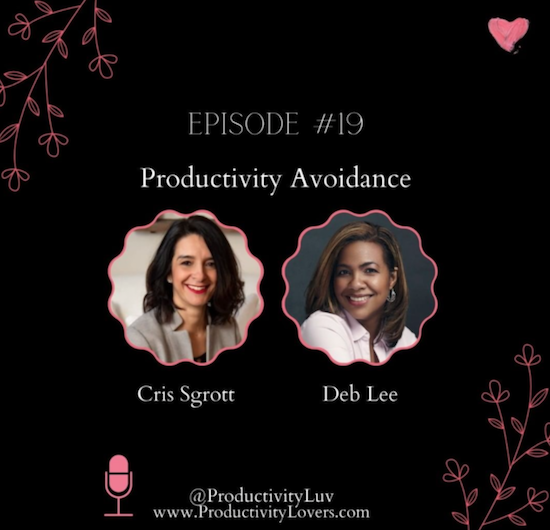
Launched one year into the pandemic, Cris and Deb’s podcast was a balm for any lonely organizer’s (and organizing client’s) soul. Listening along when I get my 10,000 daily Fitbit steps in or watching the video version as if I were Zooming with them, I often find myself talking back to these ladies, forgetting that I’m not really part of the conversation — because they are that warm, friendly, funny, and honest.
At least once an episode, I laugh at how they make one another laugh, with much of the humor coming from their mismatched productivity styles. Deb is all-digital; Cris is hybrid but leans into her love of paper planners. Cris calls herself a Hot Potato Productivity person, while Deb is super-focused.
Cris and Deb cover all sorts of productivity issues, from paper planners to Inbox Zero, the Pomodoro Technique to how organizing is portrayed in the media. Every episode is a lighthearted conversation between two friends, but the audience is never forgotten, as they invite our responses on their Facebook, Instagram, Twitter, and YouTube pages.
Come for the conversation, stay for the detailed show notes and discussion points. Pick from the audio versions via your favorite podcast app or on the episode page; watch for the video version on YouTube a week or two later. Here’s a recent episode, to give you a taste.
Organize Your Stuff
Organize Your Stuff — My colleague, buddy, and fellow mastermind group member, Maria White of Enuff With the Stuff hosts this podcast, which invites people from all points along the organizing spectrum to help them see possibilities.
While Maria has been on hiatus for a bit, there are 37 episodes covering topics ranging from “Do You Trello?” (yes, dear readers, I do!) and “Organized Adulting” to “Finally Accomplish Goals Using the 48 Week Achievement Guide” (with our fellow masterminder, Karen Sprinkle) to “Drastic Downsizing for Tiny Living” (for folks eager to learn more about living in a tiny house). Maria accents self-compassion and realistic approaches as she interviews industry experts and provides her insights and tips on organizing.
Organize Your Stuff is audio-only, so feel free to take it with you wherever you go, whether via Apple Podcasts, Spotify, Google Podcasts, or on the Organize Your Stuff episode page. Take a tiny taste of the show as we pull episode #14, Tickle Yourself Organized, out of the vault. As you may have guessed, she interviewed me, your own beloved Paper Doll!
Anything But Idle (and the Super-Friends)
Anything But Idle is hosted by Ray Sidney-Smith and Augusto Pinaud, and it would be one of my favorite podcasts even if these guys didn’t delight me by inviting me on the show on occasion.
Ray is the Ryan Seacrest of productivity podcasters; he’s everywhere! In addition to Anything But Idle, he currently hosts or has previously hosted oodles of productivity-adjacent podcasts, including:
- The ProductivityCast with Augusto and regular contributors Francis Wade (about whom I’ve written several times, including at Paper Doll Shares Secrets from the Task Management and Time Blocking Summit), and Art Gelwicks. The show explores personal productivity and includes interviews with experts, reviews of both the scientific literature and mainstream media takes on productivity, and looks at technology’s role in, and effects upon, achieving what you set out to do.
- Getting More Done with Evernote, where Ray talks about product updates, interviews Evernote experts (including staff of the big green elephant company), and answers submitted listener questions. The show has been on hiatus since last year, but Ray is re-launching soon, and I’m going to be a guest. Whoohoo!
- Productivity Book Group — This is a quarterly book club and podcast rolled into one, and the archives include episodes dating back to 2013. You could create an entire productivity-themed reading list from the archives of this show, read the books, and then listen to the associated episodes to augment your understanding. The show isn’t limited to professional productivity; one recent episode focused on Clea Shearer and Joanna Teplin’s The Home Edit.
- ProdPod — Dating back to 2011, this might be the one that started Ray’s podcasting empire. In under two minutes, each podcast explores a productivity-related topic, like minimalism, procrastination, burnout, or indecision.
While I am a Certified Evernote Expert, Ray lives and breathes Evernote, and is one of two people (fellow organizer Stacey Harmon is the other) to whom I turn when an Evernote issue makes my hair hurt.
But back to Anything But Idle!
Ray partners with Augusto Pinaud, a bilingual productivity and technology sweetie pie of the highest order. His company, Productivity Voice, is the umbrella over Augusto’s coaching services, books, and podcasting work. In addition to co-hosting Anything But Idle and the ProductivityCast with Ray, Augusto has hosted Connecting Invisible Dots, a limited-run podcast focused on looking at the big issues, like personal definitions of time, achieving focus, and understanding priorities.
Wow, and all those shows don’t even include all of the podcasts represented by Anything But Idle’s regular guests. (Sometimes I think I may be the only guest they’ve ever had who doesn’t have a podcast!)
Anything But Idle bills itself as the “Productivity News Podcast.” Every week, Ray and Augusto introduce productivity and technology stories in the news and discuss their relevance. Guests are given the opportunity to read (and think about) the articles and editorials in advance, so listeners are treated to a lively, informed discussion. This opens up the floodgates for really wide-reaching, unexpected, extemporaneous chat; as a guest, I’ve felt supported, and as a viewer or listener, I always feel entertained and better informed.
Each week also includes a round-robin opportunity for each person to present a technology or productivity resource. There’s always at least one thing (and usually many) to make you go “hmmmmm.”
You can watch the podcast live or catch up on past video versions of the episodes at the show’s YouTube page; the show is live at 6 p.m. EST most Monday nights. (Click “Set a Reminder” on the show page to make sure you don’t forget.) If you prefer audio versions, you can peruse the Anything But Idle episodes archive, or subscribe and listen on your favorite podcast app at Apple Podcasts, Google Podcasts, Android, Spotify, or Stitcher.

The most recent episode is up in all locations, but you might find it fun to watch their 100th episode. I was a guest, and a REALLY fun time was had by all.
Frank Buck: Productivity for Total Control & Peace of Mind
Frank Buck: Productivity for Total Control & Peace of Mind — Dr. Frank Buck is a longtime educator and educational administrator, as well as a fellow Evernote Certified Expert. (He’s also another familiar face on Ray and Augusto’s podcasts!) Frank is the author of several books, including the most recent, Get Organized Digitally! The Educator’s Guide to Time Management.

Frank’s podcast is full of warmth and patience, and you can see how his expertise as an educator informs everything he discusses on his podcast, now starting its fifth year.
Whether you’re a novice in technology who bemoans the devil in your iPhone, or a more advanced user of technology and productivity methods, Frank will make you feel at ease. From email to notetaking, task management to creative procrastination, digital tools to financial oversight, Frank’s short podcasts are charming and wise. (I’m going to be a guest on one of his upcoming shows and we had such a great conversation planning it that I imagine his biggest podcasting challenge will be getting me to shut up!)
Listen to Dr. Frank Buck’s most recent podcast episode (below) and all shows at the episode page, on Spotify, or at any of your favorite podcast platforms.
A Plethora of Podcasts
The podcasts above are just some of my favorites for listening to and watching, and for sharing with my clients. Others I’ve shared in the past include:
Penny Zenker, Positive Productivity Podcast — Penny focuses on leadership and productivity, and has had an amazing array of guests over the past several years. You can see my two episodes with Penny here:
- Boosting Productivity With Paper Planners Part I (Transcript)
- Boosting Productivity With Paper Planners Part II (Transcript)
The Productivityist — Mike Vardy needs no introduction; he’s been featured on the pages of the Paper Doll blog many times. With 421 shows completed, Mike is a veteran podcast host (and a popular guest), and he never talks down to his audience. You could grab one of those episodes and find compelling interviews and insightful commentary. You might want to start off with episode 418, where Mike interviews minimalism expert Joshua Becker on “Things That Matter.”
The Productivity Show by Asian Efficiency — Thanh Pham and (longtime friend-of-the-blog) Brooks Duncan host this popular podcast. I often find the episode titles to be provocative and fun, like “Are You a Jerk If You Use Calendly?” (to schedule appointments) or “Are GTD Contexts Useless? Is Productivity Hurting Young People?”
And if my own favorites aren’t enough, you might want to check out Feedspot’s list of the 35 Best Organizing and Decluttering Podcasts to Listen to in 2022, and their 60 Best Productivity Podcasts to Listen to in 2022.
Are you a podcast person? Do you have a favorite among the shows listed above? What organizing and productivity podcasts do you never miss? Please share in the comments!
If you do listen to podcasts, please remember to like, subscribe, and share, just like you comment on and share blogs (like this one!) on your social media feeds. Showing the love helps podcasters and bloggers grow their audiences, help more people, and (in the case of those with sponsors or advertisers), afford to keep going.
Also, why don’t I have a podcast?
How to Organize and Track Your Packages and Mail
As mentioned before in these pages, Paper Doll loves mail! I love walking to the mailbox to get my mail, opening my mail and culling all the “shiny stuff” (the junk advertising inserted in bills), and picking up packages. I also enjoy sending greeting cards and packages, though I’m as likely as anyone else to let the nice folks at Amazon do most of my shipping for me.
Mail-related disorganization usually starts when people neglect to show up for mail call. Mail piles up, junk mail intermingles with important bills and insurance renewals, and a mess can ensue. We’ve talked before how to make life more efficient by handling mail strategically.
But sometimes, even people who do show up for mail call encounter some frustrations in trying to keep inbound and outbound mail tasks from cluttering their time and space. So, today, I have a roundup of solutions to help you keep tabs on mail and packages.
INFORMED DELIVERY FROM THE UNITED STATES POST OFFICE
Over the past several years, there have been, shall we say, “issues” with postal delivery. Things that used to arrive within a matter of two or three days can now be delayed for a week or more. It’s definitely been a frustration, but we can hope that the $107 billion overhaul of the USPS, via the Senate’s recent passage of the Postal Service Reform Act of 2022, should bring huge improvements. But the USPS has one feature right now that can ease your mail experience.
Informed Delivery is a free service from the USPS. You just sign up for an account using your preferred email address and password. Once you verify your identity, you will get a daily email showing what is due to be delivered to you that day.
The top section of each email shows you a black-and-white photograph of the front of your First Class (letters, cards, bills) and Third Class (advertising and junk mail) mail. For Second Class mail (newspapers and magazines), you generally get a notice that there’s a piece of mail for which there is no photograph. Fourth Class (media mail, like books, CDs, or DVDs) will generally show up under packages.
Below the postal mail section, there are two Informed Delivery sections related to packages: Arriving Today and Arriving Soon. The packages usually have tracking numbers associated with them, so you can see from where an item is traveling with one click.
You can get USPS tracking updates for your incoming packages, add special delivery instructions, manage requested email or text notifications regarding package deliveries, and even schedule redelivery if there’s a potential issue with when a particular package is set to arrive.
Informed Delivery has a secure online dashboard, so you can log in via any browser to see what mail is due, which is convenient if you’re trying to avoid logging into your email (like when you’re on vacation). Once you log in, you’ll have clickable access to any of the past seven days of delivery information, plus a weekly summary count of the number of mail pieces and packages you’ve received.
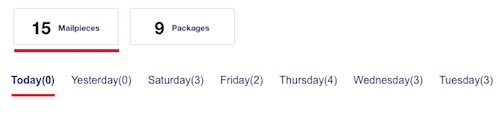
The dashboard also has a simple checkbox system where you can notify the post office if a package they’ve said would be delivered has not been. I’ve been using Informed Delivery for several years, and can only recall a few occasions where items were not delivered on the expected day, and none where the item did not arrive within one day.
In addition to email and the dashboard, you can also check your Informed Delivery via the USPS Mobile app for iOS or Android.
You may be wondering why you might want to know what’s coming in your mail.
Well, it all depends on your situation. For example, if you’re getting a package with perishable items, you’re going to want to make sure you head to the mailbox soon after the postal carrier arrives to get that package into the house on a sweltering (or frigid) day. Sometimes, you might be getting something in the mail that you want to keep as a surprise from other household members.
For me, it’s helpful to know if I’ve received checks in the mail; the postal carrier arrives after I leave for my client days, so if I know I have a check in the mailbox, I head toward my house, first, after a client session, before heading onward to the bank. (Yes, I can and sometimes do use mobile deposit, but that’s a subject for a different email.)
My mailbox is one of hundreds in two large mailbox banks on either side of my complex’s driveway, about as far as you can get from my front door and still be on the property. I’ll admit, even though I love mail, there are “in-office” days when it’s cold and raining and I really, really don’t want to go out only to find that the only mail I’ve received is a postcard ad. And our mailboxes are tiny (and weird, arrayed like small, vertical shoeboxes), so I don’t want to skip a day only to find, the next day, the box is crammed with two day’s worth of mail. Informed Delivery helps me know what’s what!
THE MAGIC OF GOOGLE
What if you are expecting a package (or have sent a package) and have the tracking number in hand? Sure, you can navigate over to the FedEx, UPS, or USPS websites, but you don’t have to.
Just pop over to Google and type in your tracking number. While you might possibly get other search results as well, you’ll definitely get a prominent box on the screen showing your shipping carrier and tracking number. Click the tracking number and it’ll take you directly to the tracking information for that package and carrier.
Seriously, it’s that easy.
This works great when the sender has given you the tracking number but not told you which shipping company they’ve used. This is common when you make a purchase from a third-party seller through a company like Ebay or Etsy. The sender may even have created the tracking number as a link in a confirmation email — but you know better than to click a link in an email from a stranger, right? Just copy-and-paste the tracking number into Google and you’ll be directed right to the official courier’s tracking page for your package.
HOW LONG IS THIS GOING TO TAKE? CHECK THE SERVICE STANDARDS MAP!
Let’s get back to the post office. Let’s say you want to mail a payment, send a birthday card, or get those save-the-date cards on their way for a big party, an event for work, or a wedding. As long as you’re sending First Class mail, cards, or flats (large envelopes), I’ve got a nifty tool for you.
USPS has a lesser-known service called Service Standards Maps as part of their Postal Pro division:
Select the service type — The USPS refers to this by “originating,” “destinating” (which is not a word in any non-USPS vocabulary, but the meaning is obvious), and “destination entry” (for which I’ve been unable to get a clear explanation).
Select the mail class category — Choose from First Class Letters and Flats, First Class Parcels, Marketing Mail, Package Services, Parcel Select and Parcel Select Lightweight, or Periodicals (magazines/newspapers).
Select the zip code and city name — Note, you can’t type in your 5-digit zip code. Instead, use the drop-down to find the first 3 digits in your zip code, and it’ll show you a corresponding city.
You can also click a box to see the cities in alphabetical order, instead, but be sure to cross-check to make sure the first three digits match your zip code. As we’ve learned from The Simpsons, there are a lot of Springfields out there!
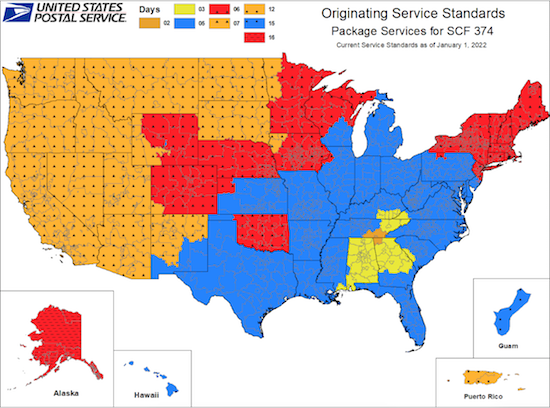
The resulting map will give you a good (and hopefully accurate) idea of how long your mail will take to get where it’s going. It’s not ideal to know that it’ll take three days to get to Atlanta from my house (when I could drive that in 90 minutes) or 16 days to get to Alaska (not that I know anyone there), but forewarned is forearmed!
WHAT IF YOU HAVE A LOT TO SHIP AND TRACK? THERE’S AN APP FOR THAT!
Maybe you’re not worried about mail and shipping for your home and family, but perhaps you sell things and have to ship them hither and yon?
Parcel is a neato-keen shipment tracking tool, but up-front, I’ll warn you that the apps are only for Mac and iOS (including iPhone, iPad, and Apple Watch, in case you need to track your shipments while you’re running a marathon)! You can, however, log in via any browser, if you must.
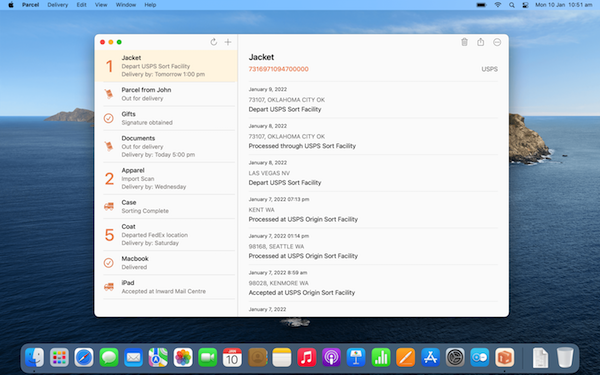
Parcel supports more than 300 different worldwide carriers including FedEx, UPS, USPS, DHL, Royal Mail, and, well, more than 295 more!
Tracking many packages manually is no fun. You’re constantly copying-and-pasting tracking numbers and checking daily to make sure that things are still on their way. Parcel is designed to keep you updated on all aspects of your shipments by notifying you about every “delivery event” with push notifications on any Mac or iOS devices. (However, note that push notifications require a premium subscription for $4.99 per year).
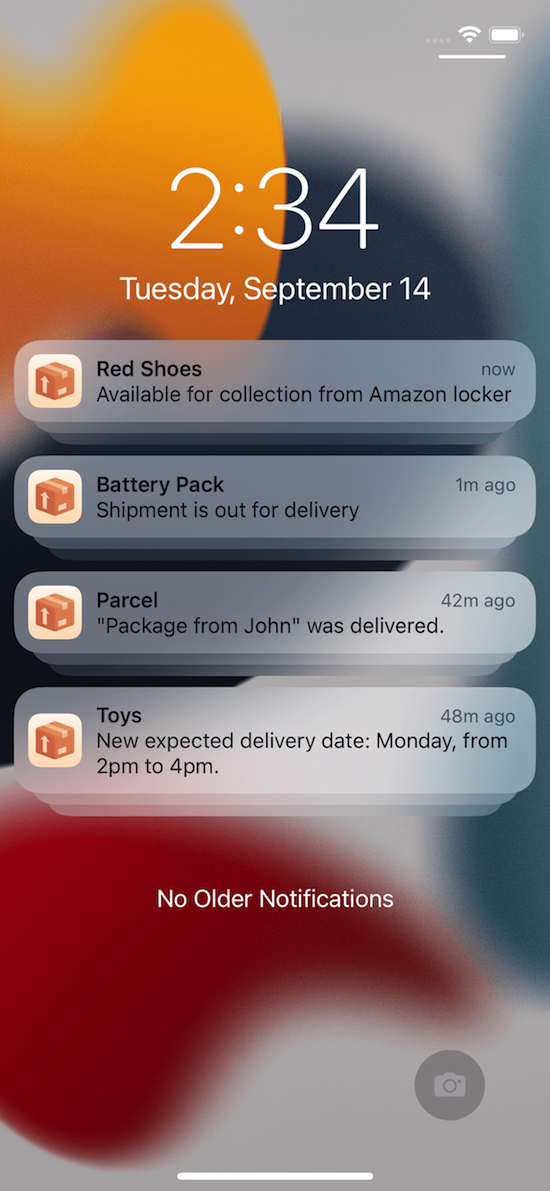
Other Parcel features include finding where your deliveries were and are and seeing that overlaid on a map, a day counter for keeping track of how long your package is in transit, and a barcode scanner. Plus, if you sell items through Amazon, Parcel has a secure Amazon integration.
Of course, Parcel isn’t the only multi-carrier tracker service. There are oodles! Others include:
- PackageMapping — While this site only tracks 17 courier services, if you’re in North America, that should be enough. Not only will you get package status updates by text, but you can see your package’s location overlaid on a map. Animated graphics tell you whether the most recent status for your package was via road, plane, boat, train, and more. (No word on whether there are animations for donkey mail or carrier pigeons.) If you create an account in the app, you can track all of your packages on one dashboard and get tracking notifications.
- Pkge.net tracks 750 delivery services on four continents.
- 17 Track is a free site and iOS and Android app that supports tracking more than 700 international postal services and couriers. Enter up to 40 tracking numbers in a single block on the 17 Track website, and they’ll give you a detailed breakdown of each package’s progress, individually.
WHAT ABOUT GETTING RID OF CARDBOARD BOX CLUTTER?
Do you save every Amazon box you get, because you just know you’ll need a box for shipping something, or for taking donations, or for helping your kid get that working, scale-model volcano to school?
I get it. As a professional organizer, I see lots and lots of cardboard boxes piled up and tipping over, and everyone has a good reason for why. But come on.
How many boxes do you have? Do you even know? Step away from the blog for a minute and go count. Maybe get them all into one room. Scary, I know.
Now, how many boxes have you really (really, really) used for shipping or whatever in the last month? Do you get incoming boxes often enough that you could replenish your stock in the course of a month? If so, it’s time to downsize your box collection.
If you’ve had the box for your microwave or printer (or other similarly BIG cardboard box) for more than a month, it’s time to cut it down, flatten it, and send it to recycling (or offer it up to your neighborhood Freecycle/Buy-Nothing group).
For those small and medium sized boxes, reduce your collection by two-thirds (to start). So, if you have nine boxes from Amazon, Bed, Bath, and Beyond, Kohl’s, or wherever you’ve become addicted to shopping over the past two years, let go of six of them. If you’ve got 24, well, get down to eight but try to let go of more. And then when new boxes come into your home, let go of the older ones. Insects love the adhesive that holds cardboard boxes together, and you don’t want to attract them, right?
For a less unwieldy option for small-to-medium items, consider Scotch Flex & Seal. I wrote extensively about this amazing stuff in This “Magic” Product Makes Shipping Packages as Easy as Wrapping Leftovers back in December 2019. (Ah, we were all so young and innocent then.) The following is an excerpt of what I wrote then.
3M is a marvel of innovation. The same parent company that brought us Post-It® Notes and Command hooks has done it again. They’ve invented a shipping solution that requires keeping less packing material and fewer supplies, takes less time, and creates a smaller dimensional weight for the things you ship.
And, honestly, I’m not persuaded that it isn’t some kind of magic.
Scotch™ Flex & Seal Shipping Roll
First, let’s get an overview of the product, with some fun, bouncy music.
Cool, eh? So, let’s dig deeper. How does this product save space, time, and money?
Eliminate clutter
What do you keep on hand for shipping packages? Boxes, right? Probably lots and lots of Amazon (and other) boxes. Maybe USPS “priority” boxes (which always seem to be way too large or just a little too shallow)? A family member bought a gorgeous Kitchenaid stand mixer and had it shipped. It came in a glossy, specially-carved Kitchenaid box (with a photo of the mixer on the package) inside a matching, plain, cardboard Kitchenaid-branded box (each with specially-placed handles for ergonomic carriage) and the whole thing was inside a box that would have made a nice toddler playhouse.
I bet you don’t just hoard boxes. I bet you have bubble wrap. (And not nice rolls of bubble wrap, but pre-used bubble wrap that someone in your house has popped and flattened along the edges, right?) Or maybe you have styrofoam peanuts. Or those clear, little balloons that look like nothing so much as an inflated zip-lock sandwich bag without the zipper?
And where are you storing these cardboard boxes, bubble mailers, poly bags, bubble wrap, and package stuffing? Probably wherever you can find to put it, and likely not in a very sound system. (No, I’m not peeking in your windows while you’re sleeping. Promise!)
Because the Flex & Seal allows you to customize your package to fit precisely around the edges of your item, there’s no wasted space and no unnecessary padding to keep on-hand. Scotch’s marketing claims to save up to 50% on supplies, time, and space vs. using boxes. I don’t know how they arrived at that statistic, but it does mean that you can take up less space, and the roll can be stored horizontally or vertically, like a rolled-up yoga mat.

Save time
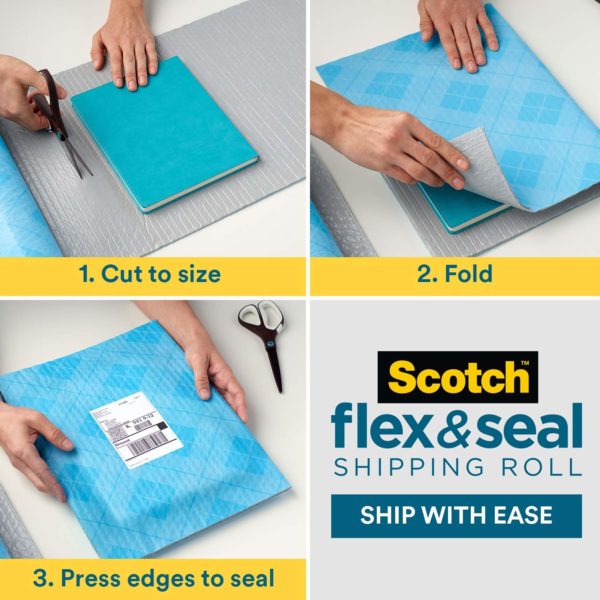
My clients are invariably piling up to-be-shipped items on the dining room table or on kitchen counters because they anticipate (often correctly) that it will be time-consuming to find a suitably-sized box, pad and pack the item(s) safely, and seal everything confidently. Scotch™ Flex & Seal Shipping Roll promises make packing as simple as:
- Cut a piece of the roll long enough to sandwich the item you’re shipping.
- Fold the Flex & Seal over whatever you’re shipping.
- Press to seal it by continuing to press around the three (non-folded) edges. (Imagine you’re wrapping your Thanksgiving leftovers in aluminum foil before putting them in the freezer. Or, as the product’s web site says, “Make sure you’re pressing gray surface to gray surface. A helpful way to remember it: Do not wrap like a present, fold and press like a calzone!”)
That’s it. Print out your label and affix it to the package. Wheeeee!
Secure and immobilize your package
Scotch™ Flex & Seal Shipping Roll may look like a prettier version of bubble wrap, but it harbors a secret superpower. Flex & Seal is constructed with three layers.
The blue outer layer is tough and durable, making the package water-resistant and tear-resistant. The clear middle layer is bubble wrap, but seems slightly less inflated (and is difficult to pop), creating firm cushioning for the package.
And the grey inner layer is MAGIC. (OK, I’m sure it’s science, but Paper Doll can’t figure out how it works!) This inner layer’s “adhesive technology” makes it stick securely to itself but not whatever you’re shipping!
Scotch™ Flex & Seal Shipping Roll sticks to itself and not to what you put inside! What kooky shipping witchcraft is this? Share on XOnce you fold the Flex & Seal over your item (sandwiching it), just press firmly for a guaranteed seal. Folded and smushed (for another scientific term), the Flex & Seal conforms to the shape of whatever you’re shipping, immobilizing it to protect against wiggling during shipping.

Save money
The marketing for the Flex & Seal Shipping Roll notes that by eliminating extra packing and shipping supplies, and securely sealing around the shape of whatever you’re shipping, it can reduce the package’s dimensional weight. That should reduce your costs. Yay!
Scotch™ Flex and Seal Shipping Roll comes in four sizes:
- 10′ long x 15″ wide
- 20′ long x 15″ wide
- 50′ long x 15″ wide
- 200′ long x 15″ wide (suitable for small business shippers or people with LOTS of grandchildren)
Scotch™ Flex & Seal Shipping Roll is available online at Amazon and Shoplet, and at Target, Walmart, Office Depot, and Staples. Prices range from about $9 for the 10′ roll to $99 for the 200′ roll.
Wondering about the catalyst for today’s post? I direct you to last Friday’s Twitter thread of frustration, brought on by a two-day shipping problem where FedEx locally couldn’t figure out how to deliver a package, couldn’t communicate with me, couldn’t communicate with their own customer support and vice versa. To solve that, dear readers, it took insisting on being connected with Resolution Support.
So, Tina @FedEx called back today. Left one voicemail on landline w/my correct address but saying they’d been told I have a new one, and another voicemail on my cell, misreading (by one digit) my address & saying they were told I moved. Both messages directed me 1/6 https://t.co/DOsAi0C2yQ
— Julie Bestry, CPO® (@ProfOrganizer) March 18, 2022
Happily, it all turned out fine, in a particularly cheesy way:
To those DMing for details: It was a delayed, Wednesday in Memphis, yesterday & today in Chattanooga, (perishable) birthday present from @CraigJetMetFan via @DakinFarm. The freezy packs were warm but the cheese-y goodness within was still nice and cold. https://t.co/zRn4393ENH
— Julie Bestry, CPO® (@ProfOrganizer) March 18, 2022
Paper Doll Shares Secrets from the Task Management & Time Blocking Summit 2022
What did you get done last week? Was it everything you wanted to accomplish? Did you use a paper calendar or a digital one? A task app or sticky notes? Do you have SMART goals? Am I freaking you out?
Longtime readers know that I seek out all types of continuing education, including each annual NAPO conference. After 2020’s conference was canceled, I was delighted to get to participate in a virtual version, as I told you about in Paper Doll Recaps the NAPO2021 Virtual Conference.
I’d also attended a productivity summit and the last two years of the Task Management and Time Blocking summits, and have spent the last several months preparing to attend the third, as I referenced in Struggling To Get Things Done? Paper Doll’s Advice & The Task Management & Time Blocking Virtual Summit 2022.
Readers, let me just tell you, last week from Thursday through Sunday, I was entirely geeked-out over all things related to task management, time blocking, scheduling, goal achievement.
And while we explored all manner of strategies, techniques, and tools for getting more done, there was definitely an undercurrent of something more valuable in this year’s conference. Over and over, there were presentations and videos that delved into examining the “why” of getting things done.
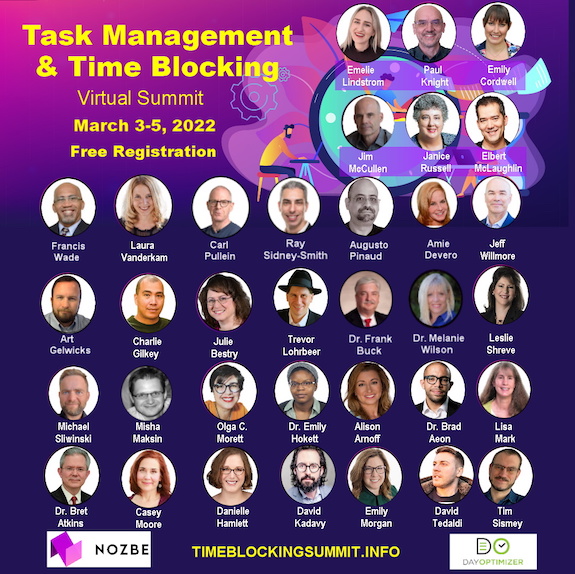
It would destroy your time management and mine if I shared every amazing detail, but even just the personal highlights are staggering. The summit was a combination of live presentations and panels as well as a series of about a dozen videos each day, and live (video) networking.
Out of the box, after the welcome, we began with a presentation from trainer and coach Jeff Whitmore about intentionality. Jeff talked about the reckoning we collectively saw, both with the onset of the pandemic and now, with the Great Resignation. We’re turning our backs on busy work, on “meetings that could have been emails,” and the experience of being buried in tasks for tasks’ sake, and turning to pondering what we really want — out of our careers, and more deeply, out of our lives.
In a theme that came up over and over during the conference, he talked about identifying the bigger picture of what you want in life and why, and focusing on tasks that drive those goals rather than letting all the competing sensory inputs of notifications and calls and emails determine what you do.
NOVELTY VS. THE FLATNESS OF TIME
The first morning continued with summit founder Francis Wade interviewing noted author, Laura Vanderkam, and her theme posited practical ways make life richer and more nuanced.
For me, Vanderkam’s interview was immediately reminiscent of what I talked about in Does Anybody Really Know What Time It Is? 5 Strategies to Cope With Pandemic Time Dilation in terms of the way our lives seem to sometimes be an endless slog from day to day. It’s Monday again. It’s time to cook dinner again. As I noted in the chat discussion, sometimes it seems like I look up, over and over, and I’m blowing my hair dry again.
Vanderkam’s research suggests that to get out of these ruts, we need more novelty, texture, and richness in our time and our tasks. To this, Francis quipped, “less skim milk, more milkshakes.” After a brief foray for praising Ben & Jerry’s Chunky Monkey, Vanderkam suggested one main tip for preventing the automating and routines that make for good task management from diluting the texture of our lives.
Vanderkam encouraged everyone to plan life in weeks, and to identify one “big adventure” (lasting perhaps half a weekend day) and one “little adventure” (lasting an hour) each week to introduce novelty. The purpose? As Vanderkam noted, “We don’t ask where did the time go when we remember where the time went.” Aha. Mindfulness!
As @LauraVanderkam noted, *We don't ask 'where did the time go?' when we remember where the time went.* Share on XVanderkam has been studying a wider array of methods for making a Chunky Monkey milkshake out of life. She conducted a nine-week research study with 150 people, having them track their time and studying their time satisfaction and time weariness before and after trying each of nine approaches, from the big and little adventures for making life more memorable to setting a fixed bedtime for yourself so you can “see how many hours the day really has in it.”
The results of Vanderkam’s research will be published in her forthcoming book, Tranquility by Tuesday: 9 Ways to Calm the Chaos and Make Time for What Matters.

GEEKING OUT WITH GTD
Another highlight of the summit was an Oxford-style debate on the proposition of whether the notion of organizing by contexts in David Allen’s seminal Getting Things Done is still valid. GTD methodology lets you conceptualize, and then act on, tasks depending on various features. And if this seems a little too “inside baseball” or geeky to you, I can only say that it was…and it was great. By ten minutes into the debate, I found myself shouting back at the screen (muted, of course) and adding lively comments to the chat.
Back in the early days of GTD, contexts were pretty much considered as where the next action could be done, or what equipment you’d need to perform it.
So, a context might have been “at the store,” or “on the phone” or “at my computer.” Thus, the question is, when all of your next actions — like buying pens on Amazon or having a phone conversation with a client or emailing or searching the web to get clarity on an issue — can be done with just one small piece of metal, glass, and plastic that fits in your pocket, do contexts still matter?
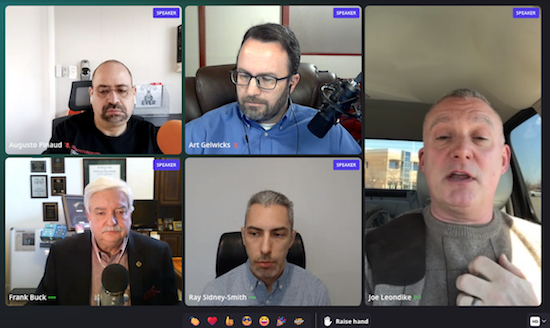
(with apologies to the guys for not catching a single one of them smiling!)
One team was Drs. Frank Buck and Joe Leondike; the other, Augusto Pinaud and Art Gelwicks. Always-unbiased Ray Sidney-Smith (host along with Augusto of my beloved Anything But Idle video podcast) served as the debate moderator. Sparks (politely) flew, but in the end, it came down to semantics and the notion of the evolution of David Allen’s philosophy. (And yes, we know the GTD debate panel was all guys, but I assure you, this was a matter of scheduling complexity. Women were invited to participate!)
My take? Yes, David Allen meant contexts to be more specific, but that was two decades ago. Now, tags (like you’d use in Evernote or Gmail) serve as your context. It’s not “computer” but “Amazon” or “LinkedIn,” the places you go (even if you’re only “going” with your fingertips) to perform a task that really matters.
Then again, I’m a proponent of the idea that whether you’re talking about Getting Things Done or KonMari, the Pomodoro Technique or even my own tickler files, hewing to the letter of any productivity or organizing law instead of empowering yourself to embrace the spirit of it is silly.
What matters is what works!
A NEW (TO ME) TIME BLOCKING METHODOLOGY
We tend to see the same systems and strategies repeated over and over: GTD, time blocking, the Eisenhower Matrix (urgent/important), the Pomodoro Technique, etc. But David Tedaldi of Morgen (one of the summit’s sponsors) introduced us to an approach that was brand new.
Tedaldi’s actual presentation was Tools for Time Management: Help or Hurdle? (which dovetailed nicely with my own presentation, on going “retro” to avoid the drawbacks of technology…of which, more later). As the founder of a company that developed a calendaring system for “professionals who manage multiple accounts, who want to schedule meetings faster, or need to keep track of tasks and appointments in a single, safe place,” he obviously believes in tech tools.
But he also acknowledged that using new tools fractures our time as we have to expend effort (and use our work time) to learn how to use these tools. But wasn’t what made the session memorable for me. Instead, that was Tedaldi talking about a new time management method that is simple, but with commitment, could be life-changing.
It’s called the 90-90-1 Method. (I initially misunderstood Tedaldi’s beautiful accent and thought it was the 1991 Method, and was imagining it had something to do with the Hubble telescope, C&C Music Factory’s “Gonna Make You Sweat” or Silence of the Lambs. Sadly, nope.)
Put forth by Robin Sharma in an 2014 post called You 2.0, the recommendation was to the point:
“For the next 90 days, devote the first 90 minutes of your work day to the one best opportunity in your life. Nothing else. Zero distractions. Just get that project done. Period.”
The 90-90-1 Method, per @RobinSharma: *For the next 90 days, devote the first 90 minutes of your work day to the one best opportunity in your life. Nothing else. Zero distractions. Just get that project done. Period.* Share on XWhat is your big, bold, audacious life goal? Want to write a book? Run a marathon? Show your child or spouse or friends that they are priorities in your life? Instead of making these things the sand that flows around the “big rocks” in your life, show up! For the next 90 days (which surely falls in line with the precepts of the popular book, The Twelve Week Year: Get More Done in 12 Weeks than Others Do in 12 Months), spend the first 90 minutes of your day focused on the ONE thing that you (claim) you care the most about.
Wow! (I know, right?)
PAPER DOLL TOOK A SPIN (OR THREE) ON THE DANCE FLOOR
Previously a panelist and moderator, I got to add presenter to my resume at this year’s event!
My video introduced attendees to the benefits and logistics of using a tickler file, based on my now-classic ebook, Tickle Yourself Organized.
But my real passion was asking people to consider the notion that as useful as digital calendars, automated scheduling software, and task management apps can be, technology isn’t always the best way to get a mental handle on what we need to do and prompt us to do it.
Think about time. Kids, people with ADHD and other neuro-diversities, and many other people have trouble conceptualizing the passage of time — how long is 15 minutes? What does an hour look like or feel like?
We used to be able to look at analog clocks and perceive, with the sweep of the minute and second hands, how we were getting closer to the top of the hour. With digital clocks, 10:01 or 11:47 just doesn’t feel tangible or real.
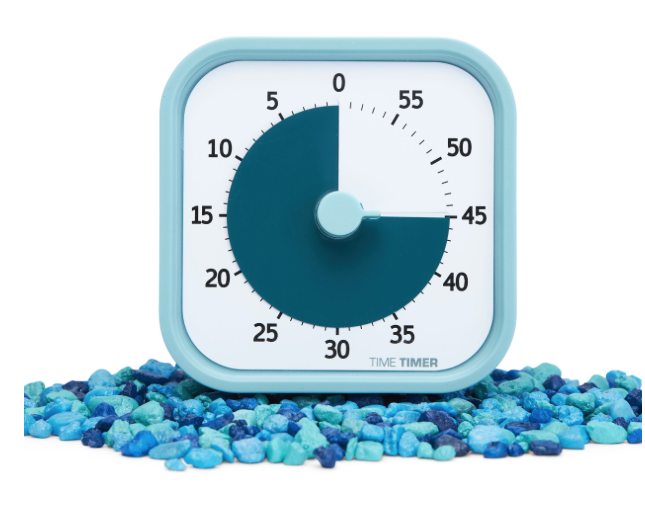
This is why Time Timer has proven so successful with students, non-traditional learners, and clients trying to be more productive. With them, you can see time. You can see the PASSAGE of time.
Research shows that something similar happens with handwriting notes vs. taking notes on a computer. When you’re trying to take notes in a class, if you’re typing, your instinct is to take a transcription of what the speaker is saying, word for word. The words come out of the speaker’s mouth, into your ears, and kind of bypass your brain & head to your fingers.
BUT, when you handwrite, your brain engages and picks out key phrases, identifies essential elements, and helps you translate the presentation into something you understand so that you could explain it to someone else. Going retro by hand-writing your notes gives you an advantage.
One of the 21st-century problems with task management and time blocking is that all of the technology makes our tasks feel too vague and intangible. For many of us, to get things done, we need our resources to be “grippy” or “sticky” or they cease to have a sense of urgency or importance; when we only see due dates or blocks of time TO do something, we lack essential nuance and context.
There’s no novelty or uniqueness in a one-line task in an app to trigger related memories or brainstorm tangential thoughts. When you enter a task in an app, it’s kind of like transcribing those lecture notes; it sort of bypasses your brain. (I think it’s one of the reasons that the more colorful, artistic Bullet Journal approaches became so popular.) Writing things down on paper, and manipulating the words and the paper, gets the brain engaged at a level you don’t see with digital apps.
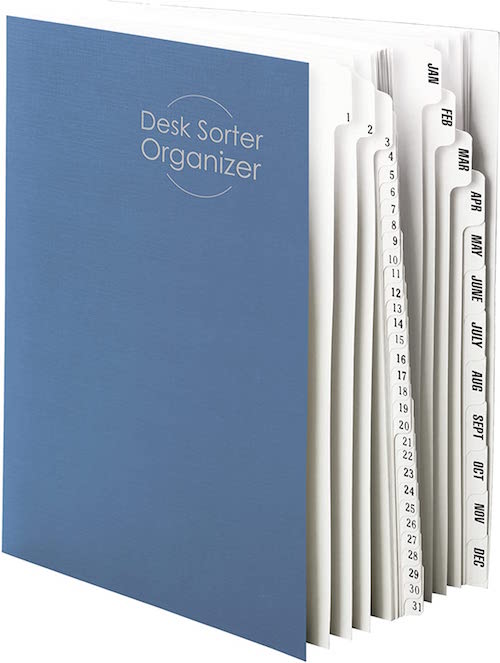
By blending time management and time blocking skills with paper resources, we can have a hybrid system (analog and digital) that lifts the weight of worry off our shoulders. We can eliminate the fear that tasks will fall through the cracks, assure that we focus on starting work rather than just noting when it’s due, and replace a sense of overwhelm with one of empowerment. Enter the tickler file!
HAVE A LITTLE COMPASSION
I was also on a Q&A Panel moderated by Casey Moore, along with Olga C. Morrett of Mujer Cronopio. As counterpoint to reviewing my more tactical approach to organizing and time management, delightful Olga, a Venezuelan currently freezing her tushy off in Montreal, spoke expanded on her presentation, Compassion as the Key to Your Productivity.
Our lively panel closed out the summit on Saturday, and I think half of the time was spent with us riffing on points the other had made, not counting the unexpected tangent about Titanic, including the idea that plunging into your tasks without planning not only can put you at risk of drowning, but can endanger the mental health of those you love. And, of course, we all agreed that there was definitely room on that floating door for Rose and Jack.
But I really want to share two key concepts from Olga. First, she talked about how self-compassion is an antidote for perfectionism and noted that “The human experience is imperfect. We are entitled to fail. It’s part of the process.”
And, to show yourself compassion, start with looking at your calendar. What you put in your schedule shows how you distribute your resources: your investment of time, money, energy, and attention shows what you you really value. If you’re not investing in yourself but everyone else’s priorities, then you aren’t showing self-compassion.
ZZZZZZZZZZZZZZ
I also took my turn as a moderator on a panel entitled, Is Sleep On Your To-Do List? A Look at Time Management and Wellness. Sleep is necessary for us to be creative, strategic, productive, and neurologically healthy. Poor sleep wrecks productivity, but time management failures can destroy our ability to sleep.
I got to interview Dr. Emily Hokett, an academic sleep researcher and expert on achieving better sleep, and Casey Moore (see above, who was pinch-hitting for our colleague Lisa Mark, whose daughter had a baby the week before the summit–mazel tov!). We talked about how poor sleep effects everything from our stamina to our relationships, and covered a pillowcase full of tips about good sleep hygiene, blackout curtains, and the winning tip for me — getting enough sunlight so that your body can tell the difference between day and night.
THE KIDS ARE ALRIGHT!
Last year, we met four California high schoolers who came together to solve what they saw as serious problems in the time and task management app space. And they weren’t doing it for school credit or for money, but to help make people’s lives better!
Condution is an impressive open source app, and these young founders invite users and other coders to contribute. I tested the beta version last year, and it was as impressive as the guys themselves, and shockingly professional.
Only two of the four, Jack and Micah, made it to the summit. The other two were at SAT prep! Francis teasingly asked if they do normal teen things (oh, they do! Especially sports and music) and if they were on TikTok. (Nope). If you ever worry about the intentions and philosophy behind strides in the tech world, look no further than these young men. Here’s the video that started it all:
SO MUCH MORE
I’ve barely touched on the summit’s wise takeaways, which ensures there will be a lot to pepper in future posts. Eventually, we have to talk about task stacks from Trevor Lohrbeer, the founder of Day Optimizer. It simultaneously adds elements of gamification and diligence to the act of conquering your task list.
You can see a sneak preview of Danielle Hamlett‘s Willpower, Productivity, and Marshmallows, where she shared life-altering advice on how to amp up willpower.
And I don’t know where to begin with the insights shared by Amie Devero, but I’ll be pondering the Arrival Fallacy for a while, which is the false belief that once we “make it” — finish our tasks or attain our goal or reach our destination, we will reach some kind of everlasting happiness and be “done.” There is no inbox zero for all our life’s tasks.
At one point in the conference, Francis was hit with a bit of an epiphany about how all these sessions ostensibly about task and time management were about purpose and intention. When he extemporaneously said the following, I wrote is on a sticky note:
Task management is purpose conveyance.
ALL ACCESS PASS
If you’re bummed that you missed the summit, you can still get in on everything except the live networking. (I mean, I’m good, but I can’t help you time travel! Yet.)

Pick up a Premium, All-Access Pass (a $4700 value for $249) and you get a year of 24-7 access to all summit content, plus a digital copy of Francis’ book, Perfect Time-Based Productivity.
I leave you with four questions:
What big and little adventures will you add to your week to create novelty and make your life more milkshake and less skim milk?
What do you think of the 90-90-1 method?
Look at your calendar: are you showing yourself compassion?
Is your take management conveying your purpose?
Organize Your Writing: NaNoWriMo 2021
Photo of Typewriter by Patrick Fore on Unsplash
It’s November, and that means it’s time for NaNoWriMo.
Not familiar with National Novel Writing Month? You will be, by the time you finish this post. Not a writer? That’s OK, because many of the resources and concepts are applicable to your goals of getting organized at school, at work and in your life.
THE BASICS OF NANOWRIMO
Every November, NaNoWriMo participants commit to writing a 50,000-word novel between the first and 30th of the month. You’re encouraged to start planning and outlining in October, but all that matters is that starting after midnight (in your local time) on November 1st, you start writing a new novel (or a fresh rewrite of an old one), and aim to finish before the end of the month. Each day, you can update your progress and get cute little badges (if that’s your style).
There are plotters (people who create detailed outlines) and pantsers (those who prefer to write by the seat of their pants. (Not sure whether you’re a plotter or pantser? SkillShare Blog has some guidance.) And there are rebels, who aren’t writing novels at all, but screenplays, non-fiction, comic books (though, I suppose a graphic novel is nonethless a novel).
If you’re enough of a rebel to pick a different format, but not so much of a rebel that you’d independently write without thousands of others doing the same thing you’re doing, it’s OK. The NaNoWriMo police won’t strip you of a win if your creation looks less like a novel and more like an epic poem, Iliad & Odyssey-style.

Once you have hit the 50,000-word benchmark, you can upload your novel and the NaNoWriMo website will verify your word count. If you hit that 50K, you’re a “winner!” (Whoohoo!) That means you’ll get a certificates and a banner you can display on social media and your website, and you can purchase a T-shirt in the site’s store. And you’ll have the righteous satisfaction of knowing you can write a book, even if you don’t choose to publish or even share it with anyone.
During the course of the month, you can benefit from a variety of writing and productivity assistance and accountability support:
- Discussion Forums
- Writing Groups
- Regional Support
- Writing Buddies
- Pep Talks from Professional Writers (including past talks from lots of writers you probably already read!)
Of course, as a Paper Doll reader, you already know the importance of accountability, but as a reminder, you may want to peek back at:
Count On Accountability: 5 Productivity Support Solutions
Flow and Faux (Accountability): Productivity, Focus, and Alex Trebek
What really excites many NaNoWriMo peeps are the various special offers available to participants and to “winners” (i.e., those who hit their 50K goal). From discounts on writing software like super-platform Scrivener, to book-planning Plottr, to grammar-checker/style editor ProWritingAid, participation has its privileges.
A BOUNTY OF RESOURCES
In 2015, I wrote Organizing Your Writing for NaNoWriMo and More. I talked about creating a road map and preparing to write, setting a schedule, creating a theme song to psych you up for writing, conquering writer’s block, and staying motivated. I anticipated it would be a one-time kind of post, because organizing writing seemed like a narrow focus. Readers thought otherwise, and I kept getting request for most posts on the topic.
So, in 2017, I revisited the concepts of organizing your writing for a month-long series of NaNoWriMo posts. There’s a bounty of information and resources in these posts from the vault, and I’ve added some bonus information below; I’ve checked (and where necessary, replaced) the links and removed (or warned about) anything that’s no longer valid.
[Note: because the posts were originally from 2017, various software and services have increased in prices, and because we live in a world where capitalism abounds, those rates will surely go up again, so rather than chasing down price changes for each, I encourage you to check rates before purchasing anything.]
Of course, I’m not just going to tell you what I wrote about in years-ago posts. Halloween may be over, but there are treats below!
(I think this was my first attempt at create a graphic in Canva. A writer, I am. A designer, I am not.)
Paper Doll’s How To Organize Yourself to Write for NaNoWriMo 2017
This post covered how to:
Identify your goals — this is key to any project. You’ve heard of SMART goals, where it’s essential to create goals that are specific, measurable, attainable, relevant, and time-based? Well, with my organizing clients, I always make sure that the reason we’re working is based on SMARTY goals — that Y assures that your “why” is based on YOUR goals. Just as it’s hopeless to get organized to solely to please your mother-in-law or to lose weight so your significant other will pay more attention to you than the TV, your goals for why you want to write are as unique as you are, and the post lays out four possible ways to reach your Y/why.
Organize your inspiration — Some of us are motivated by the carrot, others by the stick. (Of which, more later.) Some of us, like my writer-pal Dava Stewart of Smiling Tree Writing, get motivated by embracing nature. Paper Doll, on the other hand, needs an air-conditioned, bug-free environment without the sound of crickets or frogs.
Organizing your writing time — I teach my clients, “Don’t put things down, put them away.” The word away ensures that something has a home, where it lives. Just as with tangible items, tasks and projects require homes in your schedule if you hope to accomplish them. Remember, someday is not a day on the calendar!
Don't put things down, put them away. AWAY ensures that something has a home. Just as with tangible items, tasks require homes in your schedule. Remember, SOMEDAY is not a day on the calendar! Share on XThat post also offered some suggestions for seeking expert advice. If any of these issues resonate with you, that first NaNoWriMo post from 2017 is worth a visit.
Paper Doll’s NaNoWriMoMoMo (Novel Writing Month Monday Motivation)…Even for Non-Writers
This post was a compendium of advice about motivation. Everyone’s motivation has suffered over the course of the pandemic, and inspiration has been hard to come by. This post pulled from different resources to help amp up motivation to get started and keep going. Plus, who else but Paper Doll would offer up a post with Confucius, Kermit the Frog, and Hugh Jackman?
If your spirit is willing but your flesh is weak, sleepy, and full of Halloween candy, the above post should give you a motivational boost. (You could also send all your leftover Reese’s Peanut Butter Cups my way; sharing is caring, and what better way to be motivated than to share your bounty?)
Paper Doll’s NaNoWriMoMo(nday): Organize Your Writing Platforms for Maximum Focus
Sure, you can write the Great American Novel in Microsoft Word, but the truth is, most writers need a little more support from their writing platforms. This post covered the beloved Scrivener, which is probably the best-known and most beloved, as well as the most sworn-at writer’s software around. It has so many bells and whistles for organizing your writing and research and giving you the equivalent of surround-sound (surround-vision) of bulletin boards, note cards, and success-tracking that it can be overwhelming.
I also guided you toward the amazing resource of Joseph Michael, founder of Learn Scrivener Fast. Watch his Twitter account for announcements of his free webinars to get a taste of how much of a wealth of experience he has to offer to provide clarity about Scrivener. Today, I add the advice to get to know Anne Rainbow of Scrivener Virgin. She’s another tremendous resource for learning the best ways to organize your writing and research.
The post also reviewed a number of minimalist platforms designed to help narrow your focus and keep your eyes on the writing ball. These included IAWriter, Ulysses, Ilys (which literally keeps you focused by only letting you see one letter at a time, preventing you from editing and getting lost in writerly analysis paralysis), Zen Pen, and The Most Dangerous Writing App In the World. In terms of carrot and stick approaches to focus, the latter is the ultimate stick; you set the time frame (5 seconds? a minute?) but if you stop writing for longer than the amount of time you’ve allowed, everything you’ve written gets deleted. Permanently. (Prefer a carrot to a stick? Keep reading!)
Paper Doll’s NaNoWriMoMo(nday): 10 Tools to Organize Your Writing, Editing, and Proofreading
Writing comes from the heart, but creating good writing that people are willing to read means that you need to address the technical aspects. Ernest Hemingway said, “Write drunk. Edit sober.” And many of the solutions I offered were more for the post-NaNoWrimo editing stage of the writing experience.
I wax eloquent and gushed about my beloved Jumpcut, a (free) Mac menu-bar doohickey that lets you do the “and paste” part of cut-and-paste or copy-and-paste, even if you cut something six cuts ago and forgot to paste it. Jumpcut remembers. Unfortunately, it looks like the PC clipboard manager I suggested has gone to the website graveyard, other free solutions exist. If you tend to copy but forget to paste, or realize too late that you want a snippet you’ve written back again, Softclick has compiled a list of clipboard managers for Windows.
The post also covered proofreading and editing tools like Grammarly and Hemingway, to which I’d now add ProWritingAid for those wanting business-class editing support (and are willing to pony up $20/month or $79/year for a 67% discount, or $399 for a lifetime subscription). I also looked at online dictionaries and text expanders for automating your snippets of repeatable brilliance.
Paper Doll’s NaNoWriMoMo(nday): Writing Challenges, Dictation Tools, & Organized Writing Advice
This series-ender was a bit of a mish-mash. It looked at the concept of other kinds of writing challenges as well as writing support software and services for dictation, and rounded out the month with a stack of NaNoWriMo advice. (Stick around for more of that good stuff!)
But you didn’t think I was just going to update you on a four-year-old blog series, did you?
CARROT VS. STICK
In the original post, Organize Your Writing Platforms for Maximum Focus, one of the platforms (The Most Dangerous Writing App in the World) took the stick approach. That might work for getting your juices flowing writing what Julia Cameron, author of The Artist’s Way, calls morning pages. But if the first decent draft of chapter 3 went up in a puff a smoke because you stopped too long to admire it, I suspect you wouldn’t be very inspired to keep writing. The stick may motivated, or it might beat you into submission!
For some people, avoiding pain is the best way to spur them along. But others prefer the carrot — the reward. For them, consider:
Are you having trouble getting going on something you need to write? Maybe a novel, but maybe a report for work, a long-overdue note of gratitude? Just plunk down with The Official Written Kitten in your browser.
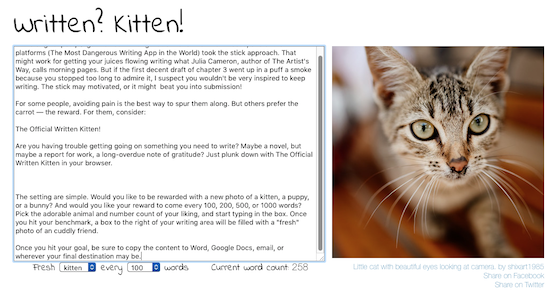
The setting are simple. Would you like to be rewarded with a new photo of a kitten, a puppy, or a bunny? And would you like your reward to come every 100, 200, 500, or 1000 words? Pick the adorable animal and number count of your liking, and start typing in the box. Once you hit your benchmark, a box to the right of your writing area will be filled with a “fresh” photo of an cuddly friend, such as Little cat with beautiful eyes looking at camera by shixart1985.
Once you hit your goal, be sure to copy the content to Word, Google Docs, email, or wherever your final destination may be to save your creation. If you click the share buttons under the photos, that pop up, your Twitter or Facebook followers will see the adorable animals (selected from Flickr), but not what you’ve written.
MAKING GOALS, BREAKING THEM DOWN
50,000 words sounds like a lot, even over a month’s time. Divide that equally by 1667 words sounds a bit more manageable. (For a hint, that’s about half the length of a typical Paper Doll post.) And certainly, you could aim for 1667 words per day. But realistically, not everyone’s life rolls steadily along with an equal number of pockets of time available for writing.
Certainly, time blocking is one solution. And for that, harken back to last February’s Playing With Blocks: Success Strategies for Time Blocking Productivity for a deep dive in how blocking your time will help make sure nothing falls through the cracks in your busy, busy life.
Pacemaker is one interesting resource for trying to organize your writing slots. It’s designed as a simple, flexible goal planner for writers and students to help making writing projects seem less overwhelming. Whether you’re NaNoWriMo-ing or trying to finish your thesis, Pacemaker can help you sort out the possible writing pathway. Pacemaker notes you can try one of multiple methods to do work in a set block of time (month, quarter, year, etc.):
- Steady — With this pattern, you aim to write the same amount (whether that’s number of words or number of pages) each day.
- Rising to the Challenge — Think of this as akin to how you build up your number of reps at the gym. While the number of words written starts out small, if you increase your word count quota each day, you’ll build up that writing muscle.
- Biting the Bullet — For some people, baby steps don’t work; instead of rising slowly to the challenge, this method encourages tackling large chunks of your writing goal at the beginning of your schedule so that the pressure is off as the days taper down. Given that NaNoWriMo takes place in November, with Thanksgiving travel (in non-pandemic years, at least) and holiday prep taking up lots of the end of the month, this might be ideal for those with big end-of-the-month plans.
- Mountain Hike — Too freaked out to bite the bullet, too busy near the end of the month to rise to the challenge? This strategy puts the bulk of your effort at the center of your period.
- Valley — This effort is the reverse of the mountain hike. Work hard at the start and the end, but give yourself some leeway in the middle.
- Oscillating — This strategy mixes heavier and lighter loads, but in a regulated way.
- Random — Some people function better when their obligations are a surprise. Paper Doll generally avoids surprises; I like to have everything neatly planned out. Surprises give me hives. But if not knowing what to expect revs your engine, perhaps being asked to write 500 words on Tuesday but only 27 words on Wednesday might be right up your alley. And Pacemaker notes that there are 20 million googol different ways to write 50,000 words in 30 days so if you pick the randomized route, you’ll never get bored!
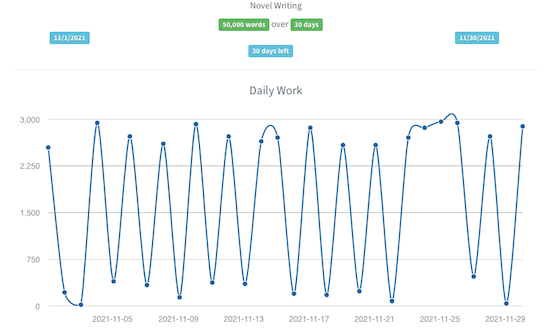
(This is the random method; if you were looking at the actual graph instead of a screen shot, you could hover your cursor over any dot to see how many words you should write.)
Pacemaker lets you customize further by deciding if you want to do more, less, or nothing on the weekends. You can also select an intensity of work, on scale from gentle to hard core, and even reserve some number of free days at the end!
So, with Pacemaker, you set up a plan by naming your project and determining what you’re trying to accomplish. (While Pacemaker is writing-friendly, you can also set it up for a variety of other related or unrelated projects, from editing and proofreading to saving, spending, running, training, and more.) If you are writing, you can pick a project type, like novel, conference paper, dissertation, speech, etc.
Next, set your goals, including length and length type. So, you can pick 50,000 words to finish a novel for NaNoWriMo, or 250 stanzas for your epic poem, or 13 verses for your song to rival Alice’s Restaurant (another November tradition). Then note your start and finish dates.
You log your efforts as you go along, and then they’re displayed for you however you prefer: as a table, graph, calendar, or bar chart (though that’s a premium feature). Below is the calendar version of a randomized Pacemaker attempt at a novel in one month.
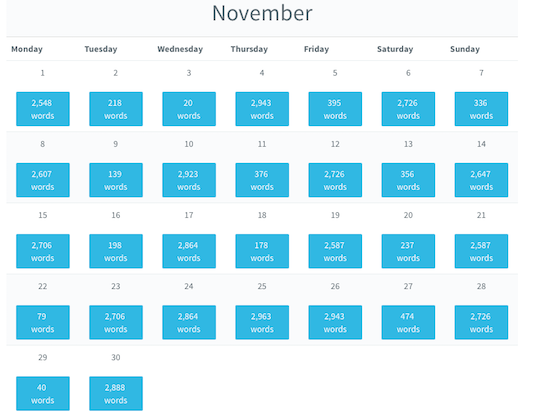
Check out their sample plans. Pacemaker is free, but there’s a premium version for $8/month or $72/year.
TRACKING YOUR SUCCESS
What we measure, we pay more attention to, and are thus more likely to improve. We tend to think of keeping score as a having a competitive purpose, but we need not compete against anyone but ourselves. Measuring the results of our efforts, and tracking them over time, gives us a reality check that helps us refine and tweak what we do.
When we’re watching our weight, tracking the numbers on the scale may help, or may demoralize us; noting whether we’re wearing the jeans that are one size up (or down) from what we wore last season may be a bit more compelling. Whether we’re tracking how much we’re saving for a big purchase (or paring down our debt), whether we’re tracking our scores on practice tests or our words written toward a goal, knowing how we did is a powerful resource!
Austin Kleon adapted a simple “Don’t Break the Chain” printable from his popular The Steal Like an Artist Journal to help make sure you keep up with NaNoWriMo (or any thirty-day challenge).
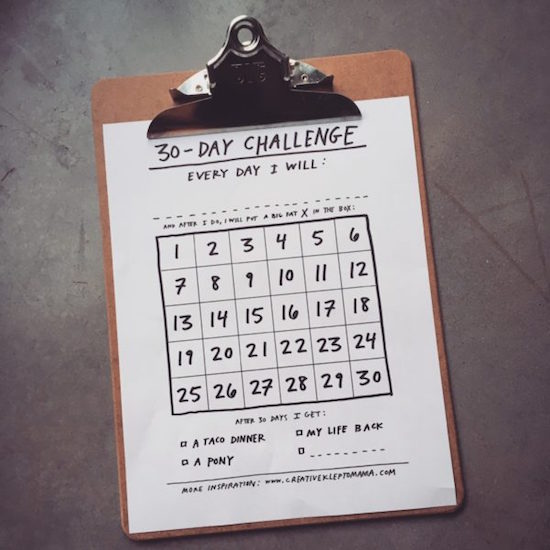
©2017 Austin Kleon
I like the fact that it doesn’t merely give you a chance to put “a big, fat X” through any day you’ve worked toward your goal, but there’s a choice of “carrots” (just like the kittens in Official Written Kitten) at the bottom to remind you how you’ll reward yourself. Kleon’s carrots are a “a taco dinner,” “a pony,” and getting your “life back” but there’s a space to put your own reward.
And once again, I want to encourage NaNoWriMo-ites (and anyone else) to investigative designer Dave Seah‘s free 2021 NaNoWriMo Word Counting Calendar.
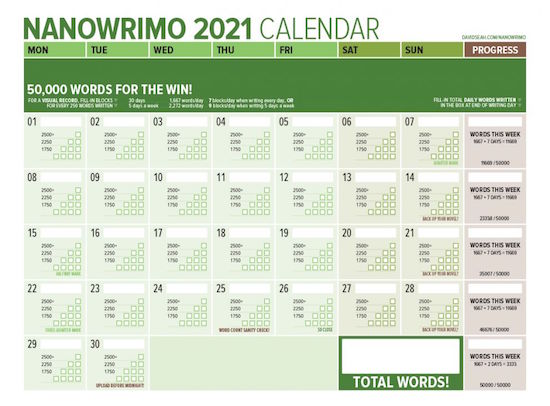
©2021 David Seah
There are six different color versions; the classic PDF version is green, but I’m partial to the pink and purple, and there’s also blue, orange, and noir-ish black & white.
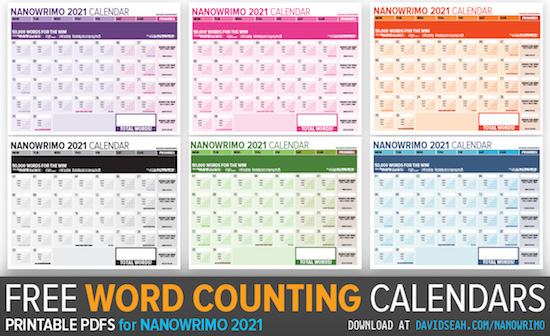
©2021 David Seah
ORGANIZE YOUR MIND FOR NANOWRIMO AND OTHER (WRITING) PROJECTS
Participating in NaNoWriMo this Year? Here’s How to Make it Through — My favorite tip is #9, to celebrate your wins and ignore your losses. However, sometimes looking at our losses gives us an opportunity to identify how we can improve on our efforts — at writing, but also at organizing, getting in shape, or handling projects — the next time. So maybe we should celebrate our wins, not take our losses personally, but let them be instructive tools.
Write a 50,000-Word Pulp Novel Before Breakfast: My easy no-outline way of writing short novels in four weeks — Even if you’re not going to write a pulp novel, there’s good writing and project management wisdom here.
The NaNoWriMo Survival Guide: Advice from Past Winners
On Writing: The Only NaNoWriMo Tips You’ll Ever Need
Your Essential Guide to Completing NaNoWriMo in Evernote
10 Steps to Get Started with Scrivener for NaNoWriMo
And, finally, in case you feel like you need more training and inspiration in writing, Open Culture has a list of free online writing (and journalism) courses. They’re all MOOCs (massive open online courses) from US and international universities. From classes on creative writing and the crafts of character, plot, and setting at Wesleyan to advanced grammar and punctuation at UC Irvine, maybe feeliing like you’re back at school will help you get into the swing of writing.
Whatever projects you work on this month, remember to make sure the goals are truly yours, that you block space in your schedule and break down the tasks into small, workable elements, and that you track your accomplishments to stay motivated.
Happy November, and happy NaNoWriMo from YoLoPaDo, your loving Paper Doll.
Rhymes With Brain: Languishing, Flow, and Building a Better Routine

Are you having trouble getting back in the saddle?
Yes, I know, this is not your first rodeo. You’ve had to get back into a routine before: after the easy pace of summer, after the winter holidays, after vacations.
But perhaps this feels a little different? Maybe you’re distracted because this is the first time you’re headed back into the office after a year and a half of working remotely? Or perhaps you’ve realized that you can’t keep working from your kitchen table anymore, and it’s time to really get back into a routine.
There are a few reasons why you might be feeling at loose ends. First, you might be stuck in the past. It happens to all of us. Last week, in Emerson, Angelou, Ted Lasso, Tashlich & Zen Monks: Letting Go for a Fresh Start, I walked you through rituals and mantras for helping you let go of past mistakes and frustrations.
A LESSON ON LANGUISHING
Perhaps the problem isn’t the past, but the present. Over the summer, the New York Times got a lot of attention for a piece called Feeling Blah During the Pandemic? It’s Called Languishing. (Depending on where you’re located, you might have more luck with this link to the piece.)
Some people have flourished as a result of the past 18 months; people who’d lost time with their families due to long work hours, commutes, and work travel were sometimes able to bask in the joy of remote work; others were able to put energy into side hustles that became true callings and got to leave careers that weren’t fulfilling.
Meanwhile, of course, many others have found working and just getting through life to be agonizing. This has been a period of distress, whether a constant onslaught or troubles that come in waves, worrying about keeping themselves and their families healthy, coping with financial strife, and being expected to work and act as if all of this {picture me waving my hands all around} was remotely normal.
So, for some, after the initial period in Spring 2020, life has been a collage of yoga positions and perfectly golden sourdough bread. For others? Let’s just say Edvard Munch could easily time travel from 1893 to 2021 and paint The Scream all over again. (Except he’d have needed to draw a mask.)

But in between flourishing and drowning, the Times article found that many of us are having trouble gaining traction because we’re languishing. It’s not depression or anxiety, but in an excerpt of the piece, we see exactly what’s making it difficult for many to get back into a routine:
In psychology, we think about mental health on a spectrum from depression to flourishing. Flourishing is the peak of well-being: You have a strong sense of meaning, mastery and mattering to others. Depression is the valley of ill-being: You feel despondent, drained and worthless.
Languishing is the neglected middle child of mental health. It’s the void between depression and flourishing — the absence of well-being. You don’t have symptoms of mental illness, but you’re not the picture of mental healtheither. You’re not functioning at full capacity. Languishing dulls your motivation, disrupts your ability to focus, and triples the odds that you’ll cut back on work. It appears to be more common than major depression — and in some ways it may be a bigger risk factor for mental illness.
The author of the piece, Adam Grant, is a organizational psychologist at the Wharton School at the University of Pennsylvania, and his TEDTalk really clarifies what languishing is, and how it negatively impacts our motivation and focus, and thus, our productivity. It’s definitely worth watching:
Cheatsheet: the best predictor of well-being (and thus, I’d say, productivity) is not optimism, but flow. We’ve talked a lot of Mihaly Csikszentmihalyi’s concept of flow recently in Back-to-School Solutions for the Space-Time Continuum and in the spring in Flow and Faux (Accountability): Productivity, Focus, and Alex Trebek (where you also learned how to pronounce Mihaly Csikszentmihalyi).
Flow is that experience when you’re completely absorbed in what you are doing. Time and space and your annoying neighbor and the fight you had with your teenager and the stresses you’re feeling all dissolve, or are at least held at bay, and you are completely focused, without distraction, on what you’re doing. It might be a creative endeavor like playing a piece of music or writing a blog post; it could be playing with your child or dining with your family; and if you’re lucky when you’re sitting down to work, it’s whatever you’re supposed to be doing.
Grant advises us to have some small, achievable goals to work toward to chip away at languishing and give us the opportunity to achieve flow. I have a few more ideas to add to his.
So, having looked at how to let go of past troubles in last week’s post, now let’s look at how we can make your near future an opportunity for flow so you can get back in the saddle.
FLOW FACTORS THAT RHYME WITH BRAIN
Abstain
There are all sorts of distractions, from within and without. Some come at you, and some you go out of your way to pick up. You know what leads you down a rabbit hole. Maybe it’s social media. (OK, yeah, it’s probably social media.) Maybe it’s the news. Maybe it’s one TikTok or YouTube video someone sent you that leads to you watching the next and the next, and suddenly you’ve missed lunch.
I’m not saying that you should eschew all social media or news reports or videos. But instead of reaching for your phone first thing in the morning when you wake up, or while you’re eating breakfast, making it more likely that you’ll be late to your desk (and in a less chipper and more distractible mood), consider alternatives activities.
Retrain
From bed to desk, whether that involves a commute or a stroll down the hall, your brain needs buffer time. You definitely can’t be expected to go from zero to 60 with work (or life) mere minutes after you were in La La Land. Retrain your brain by selecting different types of sensory inputs from your usual fare.
Instead of starting with the news and social media, how about reading a book, a short story, or a few non-news-related articles while eating breakfast? What if you read a poem before getting out of bed, and then spent your shower-and-grooming time thinking about what the poem means, both the words on the page and what it means to you?

I’ve covered a number of ways to have more opportunities to read:
12 Ways to Organize Your Life to Read More — Part 1 (When, Where, What, With Whom)
12 Ways to Organize Your Life to Read More — Part 2 (Reading Lists, Challenges & Ice Cream Samples)
How To Make Your Reading Time More Productive With Book Summaries
If you complain that you never have time to read, this eliminates that problem along with the trouble of a whirring mind. You’ll “make” time by trading a task that swallows you up (like doomscrolling) for one that can give you gentle practice at immersion and flow. And if your prep time in the morning requires a lot of hands-on work (packing lunches, walking the dog), an audio book or a podcast can give you that immersion in an auditory instead of visual way.
If you don’t think you can focus on words and meanings longer than a tweet, explore listening to a genre of music that’s new to you. If you like rap, try Broadway. (Hamilton blends the two.) If you only listen to country, noodle the dial to a jazz station. Retrain — shake up your brain.
Restrain
If you’re not unwittingly seeking out obstacles to flow, both in advance of getting things done and once you’ve started, it may be others standing in your way. Perhaps one of the parents in the pick-up/drop-off line wants to gossip and (no matter how entertaining) doesn’t seem to understand that you’ve got a deadline, a doctor’s appointment, or something else that requires your immersive attention.
Build some muscles for restraining that tendency to go along to get along. I’m not suggesting you wear dark glasses and a trench coat so you won’t be seen by Social Suzie, but perhaps you can cut her off at the pass and let her know for the next few months, you have to be on a daily conference call at “oh-will-you-look-at-the-time?!” If she’s someone you do want to hang with, schedule a phone call, a Zoom lunch, or a weekend walk (to get your steps in) at the park. You don’t have to eliminate people from your life, just be more deliberate about what part of your life (and schedule) they can take up.
Constrain
Restricting how much space you take up for your work and resources means fewer attempts to find things, fewer guesses where something might be, and more time to do the important work on your plate.
If you’re working remotely, your whole house may be available to you for work, but that doesn’t mean you should take up all of that space. Sure, you could work on your bed, at your dining table, and with your computer on the coffee table when you’re on the floor with your back against the bottom of the couch. But should you? Nope.
Create an atmosphere where a space is designated for a task. If you do expense reports in the bedroom, you’re letting your financial brain seep into the space that should be for sleep, rest, and intimacy, making it more likely that math-y concepts will pop up into your mind when you’re trying to, um, do something else in that space. If you work where you hang with your family or binge-watch Netflix, you lose that delineation between work and life, making it harder to leave work at work, already made difficult when you’re working from home!
Contain
If you’re back to working outside the home, you already have a space assigned to you, whether that’s a desk in an office, a counter in the bank, a conveyor belt in the cashier line, or the cockpit of a plane. (If it’s the latter, can you hook a girl up with some of those Biscoff cookies? Yum.) And if you’re working from home, it just makes sense to promote one space in your home to your ideal workspace.
But either way, limiting the spread of your stuff is going to make it easier for you to focus and get into flow.
So, as you move to contain the things round you, you’ll want to clear your desk of excess and keep your workspace for the project or tasks you’re working on now, or at least today. Read the Paper Doll classic article, Clean Desk Club to make your deskspace functional, hygienic, and secure. If paper clutter is the problem, read If You’re Drowning in Paper, Build a RAFT.
And for a detailed look at how to organize your home office so it’ll deliver opportunities for you to be comfortable and focused, explore the bonus-sized guest post I did for meori, Home Office Storage Ideas: From Dad’s Study to the Modern Home Office.
Containing and constraining aren’t just about tangible items. They’re also about how we schedule our time. If we have a long to-do list with nothing prioritized, no game plan, and no firm schedule, chances are, we’re going to spend more energy thinking about what we have to do than actually getting started.
Developing routines, where we can put the efforts of part of our days and weeks on autopilot, is a key. To help you contain your worktime and constrain your output to acheive the most good, start with the advice in these posts:
Playing With Blocks: Success Strategies for Time Blocking Productivity
Checklists, Gantt Charts, and Kanban Boards – Organize Your Tasks
Getting in the flow so you can get back to a (hopefully better) routine means setting boundaries in your time as well as your space. (That’s where that time-blocking post really comes in handy!) We all know that we never get enough done if we only do what we feel like doing. Most of us never feel like working out or vacuuming or writing monthly reports.
Just as our stuff has to have a place to live in our desk, our tasks need a place to live in our schedules. Merely giving them homes is a super way to jump-start ourselves back into the saddle if we were loosey-goosey with our schedules all summer (and even before).
We also depend on activation energy. Because the hardest part of what we do is the getting started, we have to incentivize ourselves to get going. There are all sorts of ways we can trick ourselves (a little bit) with rewards, like pretty desk accessories or a coffee break, but the problem is that action precedes motivation. We’re not usually psyched to get going until we have already started!
Action precedes motivation. We're not usually psyched to get going until we have already started, whether it's a runner's high or Csikszentmihalyi's flow. Share on XIf you are struggling to get back into the thick of it with your routines, the best way to “contain and constrain,” time-wise, is to borrow accountability support from others as described in:
Count on Accountability: 5 Productivity Support Solutions
Flow and Faux (Accountability): Productivity, Focus, and Alex Trebek
Maintain
One of the best predictors of future productivity is past productivity success. Stop and think about when and how you are good at maintaining your routines.
What is it that has helped you in the past?
- Interspersing short work sprints with breaks? Embrace the Pomodoro Technique.
- Deadlines? Borrow a friend as an accountability partner to give you some external spinal fortitude!
- Physical activity and/or time in nature to get your creative juices flowing? Block times for daily mid-afternoon walks. Research shows that shinrin-yoku, the Japanese concept of “forest bathing,” has a variety of benefits, including mental focus, increased energy, improved mood, decreased blood pressure and stress hormones, and boosted immunity.
Know where you excel. Every professional organizer and productivity expert will look at your systems and resources and ask some variation of “What’s already working?” The key is to build strategies on the foundation of your success and link future approaches atop them.
Attain (and Explain)
Remember how I said, earlier, that developing routines and going on autopilot helps? But I also said we should do it for part of our days and weeks. But we can’t be on autopilot all the time.
Our brains will atrophy if we don’t keep learning.
If you’re having trouble getting back into a routine, add something to your list that will energize your brain. For me, when I’m in the doldrums, practicing Italian with Duolingo peps me up. If I’m having trouble motivating myself to reply to a frustrating email or draft a blog post, a few challenging lessons in the Italian future perfect tense will have taken me out of the doldrums. (That’s a future perfect tense joke, readers. OK, yeah, more tense than funny.)
What can you do that will shake the cobwebs loose, improve your cognitive function, boost your self esteem, and get you revved up to sit at your desk and do the next important thing?
- Learn/practice a language.
- Look ahead in your child’s schoolwork and study the concepts (long division, the parts of a cell, the causes of World War I, the themes in War and Peace) so you can discuss them together.
- Find something you’re curious about and become an expert on some small element of it. You don’t have to know everything, but if you know one thing really well, it’ll give you confidence to explore all sorts of areas of your current work, and maybe help you consider bold, new options for work and life.
- Develop a skill, whether it’s silly or serious, visually creative or experiential.
Once you attain this knowledge or skill, you can share it with others. You really know you’ve learned something when you can explain it to someone else. And when someone asks you how you were able to get back into your post-summer, post-pandemic routine so easily, maybe you can answer them in Italian or in Ubbi Dubbi!
(Shoutout to all my GenX readers for whom “Zoom” will always mean “Boston, Mass 02134” rather than video conferencing.)
Gain
It’s impossible to get excited about doing the same thing every day, day in and day out. There’s a difference between being in a groove and getting stuck in a rut, between having a routine and things being routine. All these years later, I still feel sorry for this guy.
Gain momentum by jump-starting your enthusiasm. The easiest way to do that is to have a goal to look forward to or an achievement toward which you’re striving. As with learning a new skill, I know it seems counterintuitive to add something to your activity list when you’re trying to buckle down and commit to what’s already hard to accomplish.
Most of the time, I implore my clients to let go — of excess clutter, obligations that don’t meet their goals and values, outdated ideas that no longer fit who they’re trying to become. That’s logical; cutting down the excess lets you focus on your priorities.
We could eliminate excess, only work on the work tasks and projects we’re assigned (or which we’ve assigned ourselves), and keep our heads down and our noses to the grindstone. But with our heads down, we’ll never see the sun, and with our noses to the grindstone, well, I’m not sure, but I think we’d have sore, pointy noses.
But we’re not robots. Just as learning helps us expand our minds and gain confidence, having aspirations and goals gives our lives purpose. Consider the Japanese concept of Ikigai (sounds like icky guy), or “reason for living,” or Viktor Frankl‘s wisdom in Man’s Search for Meaning.
As humans, having something to aspire to in our work and in our lives, beyond a paycheck and the same-old, same-old, imbues our days (and thus our lives) with meaning. Think of something you’d like to achieve and build time into every week, preferably every day, as part of your routine, to move you closer to that goal. Maybe you want to write a book, plan the trip of a lifetime, train to be a Rockette — the what doesn’t matter, as long as it’s your what.
Embracing a gain in your life as you head back into a day/week/life of routines will be easier when you’ve planned space in your schedule for anticipatory joy.
Just be sure to reject perfectionism on the way to spelling out your gain. The key to improving your delight in getting back into a routine is that it will grant you space in your schedule to do everything that matters, including that aspirational entity that gives it all meaning. Think progress, not perfection.
On August 23, 2021, author Sam Thielman tweeted:
Just want to say this thing I haven’t written is fantastic. Gets better and better the more I don’t write—it contains every conceivable line of inquiry yet has a single, easily understandable throughline. Prose is perfect. Can’t bring myself to destroy it by actually doing it
— ? (@samthielman) August 23, 2021
Take action every day. Get back in the saddle. Get back on the horse. It may not be your first rodeo, but it can be your best rodeo yet!
Follow Me