Paper Doll
Paper Doll Finds Fashion-Forward File Totes
Dear Paper Doll:
I admit, I’m a fashionista. My mobile phone has pretty skins so I can make it match my outfits. I try to be digital, but some of my life (OK, a lot of my life), including my family stuff and work stuff, exists on paper and I spend a lot of my time going to meetings in other locations. I need something stronger than a file folder, prettier that those brown accordion files that lawyers use and neater than tossing it all into my bag. Help me be mobile without being a mess!
As a professional organizer, I work with many clients who need their papers organized for maximum mobility.
Work — Do you travel by plane, train or automobile for your career? Even if you’re all about digital documentation and living in the cloud, you’ll still have trouble going entirely paperless. And, unless you’re selling software (or the concept of software-as-a-service), you’re going to need some kind of paperwork (brochures, contracts, specifications, etc.) to share with prospective and actual clients.
Search and Research — Imagine yourself visiting schools with your college-bound teen. Universities are all super high tech, and application forms whiz through cyberspace, but there are still mountains of brochures, lists, instructions and forms to collect, review, and return. Similarly, if you’re thinking of relocating for a new job, as you tour a possible community, you’ll be collecting everything from housing applications to fliers telling you which restaurants deliver.
Medical paperwork — As I’ve discussed at length in my Vital Signs series (here and here, especially) on medical paperwork, there’s so much information and documentation you need to carry with you to appointments, tests and consultations. Although a three-ring binder works wonders, it’s not the only option.
Personal projects — Whether you’re a PTA parent or a genealogy guru, when you amble far from home or your office, you’re going to need to corral the papers related to committees, projects and tasks.
We’ve talked at length about all the different ways to keep your paperwork organized when you have to be mobile:
Trapper Keepers & Diaper Bags–Keys to Organizing Mobile Paperwork (Intro)
Mobile Mavens: Keeping the Personal Paper Portable When You’re Out and About
A Culinary Model for Successful Mobile Offices
All of those solutions for carrying papers are valid, but they tend to lean heavily on options for schlepping a whole lot of papers at one time. Beyond that, today’s reader wrote in because she wanted something that’s not only utilitarian, but fashion-forward as well. Thus, we’re looking for some lightweight totes that aren’t exactly lightweights in their file toting categories. Well, I’ve got some doozies for her (and you)!
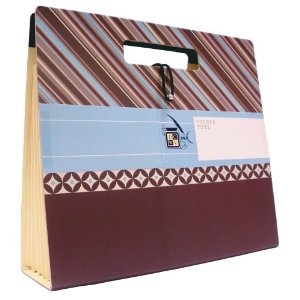
Die Cuts With A View (DCWV), a standout in the scrapbooking and crafting market, has a sideline in pretty little file totes. While form is given priority over function, the latter hasn’t been given short shift. Each 10 1/4″ high x 11 3/4″ wide tote has seven divided file compartments and a tiny elastic closure at the top that leaves no impediment for one-finger carrying. The DCWV totes are designed to match the rest of their style lines with file folders, clipboards, three-ring binders, note cards and photo albums.
In addition to the Loft style, above, DCWV’s design lines include
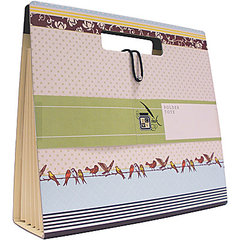
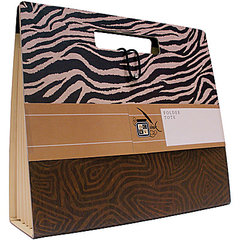
MiCasa and Safari (above), and each retails for about $13.49.
My favorite tote line is from Galison, based on the stylings of designers and artists as varied as Paula Smail and Andy Warhol, and works from various museum exhibits. Below is Smail’s Henry Road tote in all its pretty-in-pink glory.
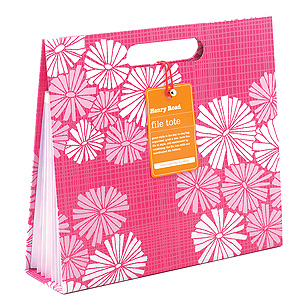
The durable reinforced paper tote measures 11 1/2″ high x 12 1/2″ wide x 3 1/2″ deep, has eight interior dividers and a fashion-coordinated elastic closure. The Galison file tote retails for about $20.
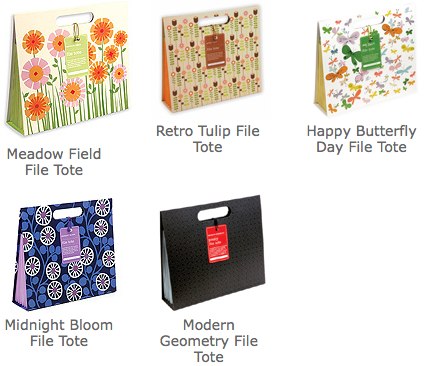
Although the current Galison File Tote line is lovely, it’s worth searching Amazon for their Pretty File Tote line extensions, which includes the William Morris (he of the belief that one ought “Have nothing in your houses that you do not know to be useful or believe to be beautiful.”) Morning Garden design:
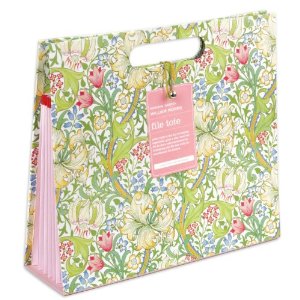
Perhaps you like the lines of the above totes but are looking for something a little less sedate? College students and others on the cutting edge might particularly like the very similar file tote at Room It Up.
RIU’s slightly more squarish accordion-style File Folder Totes measure 11 5/8″ high x 12 7/8″ high x 3 1/2″ deep and have eight divider slots. Reinforced paper gussets strengthen the totes and increase paper capacity. They come in bold, psychedelic patterns like Bright Bloom, SoHo Swirl and Dream Dot (pictured below):
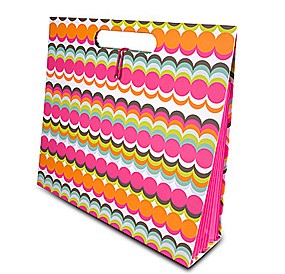
and are priced at a student-friendly $12/tote.
If all of this color isn’t quite your thing, or you prefer to create and show off your own pretty folders and designs, The Container Store’s Our Translucent File Tote may suit the minimalist in you.
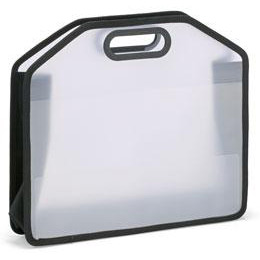
A bit wider than the other totes, Our Translucent Tote is 15″ wide x 13″ high x 4″ deep and is made of translucent polypropylene side panels bound with reinforced black polypropylene/canvas. Reviewers give this tote high marks, both for its durability and low price of about $6.
If the translucent approach seems vaguely familiar, it may be because Paper Doll previously reviewed the Peter Walsh [In] Place System. Sold separately from the introductory kit, the [In] Place Tote is available at Office Max.
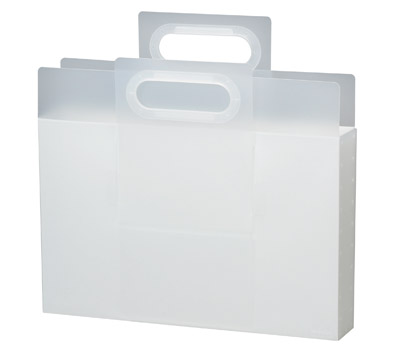
The translucent, water-resistant polypropylene material is durable, and the handles are expandable/collapsible for convenience. This tote can be used with regular files, but is designed to work particularly well with the whole [In] Place System of translucent (and slippery) document envelopes, sleeves and file folders. The tote retails for $10.49.
Designer school and office accessory store Carolina Pad‘s Hot Chocolate line includes totes that are a little boxier, with reinforced edges and shaping more in line with a traditional portfolio case or oversized lunch box.
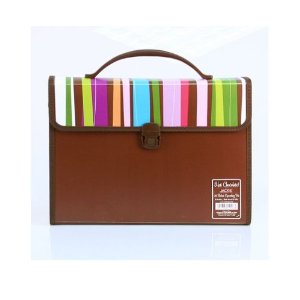
The polypropylene Hot Chocolate totes, including the Pixie Sticks pattern displayed above, measure 13″ wide x 10″ high x 3″ deep and have 26 divider pockets. The totes are water-resistant and have flip-over tops with attached briefcase-style handles and plastic twist closures.
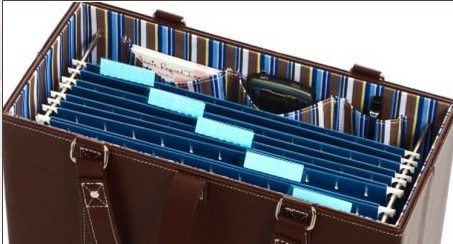
Are you seeking refined elegance? We’ve previously-reviewed the gorgeous and durable JamieRaquel LIFEStyle Totes:

which certainly do make a bold, beautiful statement. However, they are designed for carrying a weighty bulk of paperwork and accessories.
But what if you want Big Time Glamour without big guns (you know, bulky biceps)?
I’d originally planned to share the Audrey five-file and eight-file totes from Russell + Hazel, which came in gloriously chic black and white designs, and which had been patterned after vintage Hollywood pieces.
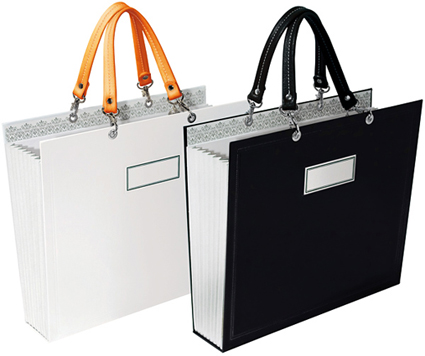
The Audrey measured 11 1/4″ high x 12 3/4″ wide x 2 1/2″ deep, and came with detachable leather straps, a glossy coated exterior, a stylish interior pattern and tabbed pockets. The luxuriously sleek design was suitable for active use by Audrey Hepburn or Grace Kelly. It didn’t even tip over from a standing position.
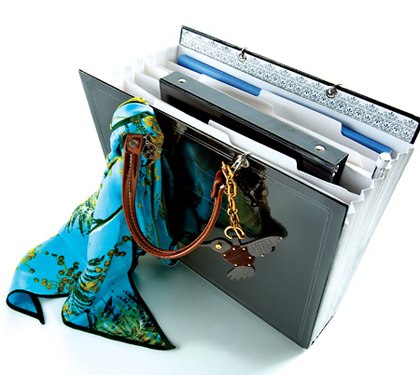
Sadly, between the time Paper Doll discovered the Audrey and when there was an opening in the editorial calendar, Russell + Hazel discontinued the line. However, while I am a bit crestfallen, I’m happy to note that upscale style isn’t completely absent from the fashion landscape.
The Bella Leather Expandable Totes from See Jane Work are handcrafted from fine Italian leather.
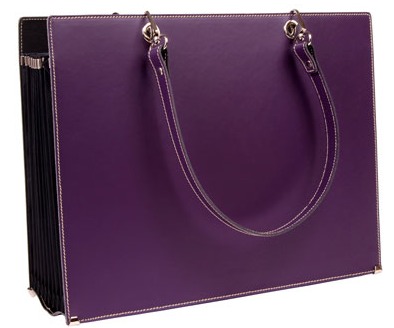
The totes are available in four rich colors (Black, British Tan, a soft Pink and a rich Purple that deserves to be called “aubergine”) and have nine sturdily-gusseted pockets:
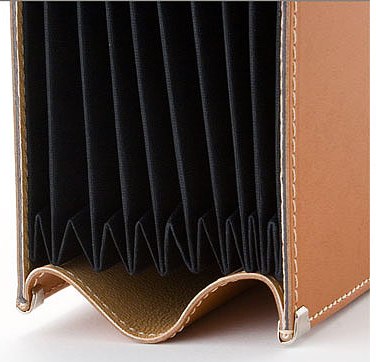
The Bella totes have detachable leather handles with elegant contrasting stitching detail, making them not only easier to carry than typical expanding file totes, but decidedly more fashionable. Retailing at $96, the Bella line carries a heftier price tag, but you’re likely to own it for much longer and be even more inspired to carry it and make a splashy, yet classy, entrance.
Finally, if you live your life such that the aesthetics of class and elegance take a backseat to packing a wallop of a message, To and Fro Totables from Perpetual Kid will help you get that message across loud and clear:
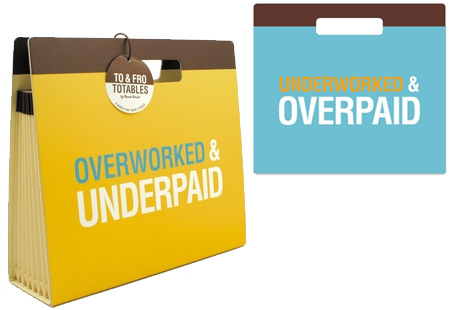
Measuring 11 1/2″ high x 13″ wide x 3.5″ deep, these reinforced accordion sided totes have messages on both sides, which are sometimes contradictory:
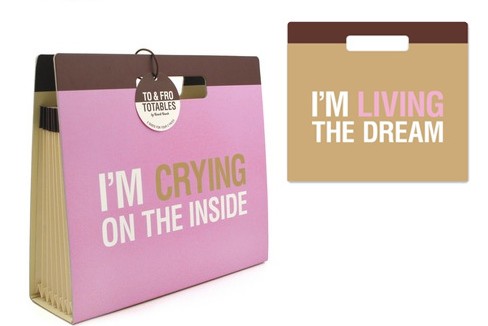
The To and Fro tote line offers the take-work-home gal (or guy) an opportunity to show some spunk. (Just remember what Mr. Grant told Mary Richards about employees having spunk!) The To And Fro Totables run about $13 to $16.
Wherever you go, whatever you do, just remember that your own personal style, and not that of a file tote, is what will carry the day. And if anyone disagrees, send ’em to Paper Doll. I’ll set them straight for you!
Paper Doll Sends a Summer Postcard
Recently, a loyal reader wrote in to inquire if I ever get tired of organizing paper, and wanted to know what other things are going on at Paper Doll Central when I’m not writing this blog.
As to the first question, I have to admit, I’m a geek. I really do love organizing all kinds of paper, and probably wouldn’t get bored even if I were setting up family filing systems every day of the week.
As for what else I’m doing during this wacky heat wave, you might expect that I’d be tempted to say “as little as possible” — but the truth is, Paper Doll has been wildly busy this summer. Consider today’s post an old-fashioned postcard for filling you in on my activities.
BIG ORGANIZING IDEAS FOR SMALL PEOPLE
July is Purposeful Parenting Month, and in support of that, I’ve been exceeding the boundaries of paper organizing in quite a few ways. For example, last week, I wrote about helping children get organized for Tiffany Merritt’s fabulous
Stuff Parents Need blog. The first part, Teaching Your Kids to be Organized (Hallelujah!!!), ran last Monday, July 18, and the second part, Getting Your Kids Organized, ran on Thursday, July 21.
For those of you unfamiliar with Stuff Parents Need, be assured it’s not the kind of product review site that encourages conspicuous consumption of things that turn into clutter. Fellow Chattanooga-based blogger Tiffany, the mother of an active and adorable two-year-old little girl, tests and evaluates products and isn’t afraid to speak her mind. She focuses on resources that she feels provide value to growing families and eschews those that just fill up space. No wonder we get along so well!
Stuff Parents Need also runs giveaways (like this one) fairly frequently. Paper Doll readers know that just because something is free, doesn’t necessarily mean it’s worth bringing into your space, but a detailed review offers insight into a product’s relative merits. Even if you’re not a parent or even a Savvy Auntie, you’ll likely be entertained by Tiffany’s charming narratives and frankly adorable pictures.
As for Purposeful Parenting Month, guest posting was only part of how I celebrated. I also worked with an organizing client to create systems in a truly progressive homeschool classroom (which actually inspired the post Paper Doll Adjusts the Vertical Hold: Space-Saving Solutions from a few weeks ago).
And by the time you read this, I will have just finished a presentation on organizing families of multiples for the Chattanooga Area Mothers of Multiples Club, a local chapter of a national organization providing resources and camaraderie for parents of multiples. (If you or someone you know has twins, triplets or a “higher order of multiples”, you might want to check out the National Organization of Mothers of Twins Clubs (NOMOTC) for support.)
SMALL ORGANIZING TIPS FOR BIG PEOPLE
Although much of July has been focused on organizing tiny humans, Paper Doll isn’t always thinking small. Sometimes, I’m thinking about small ways to make big changes, and in that way, I’ve enjoyed the opportunities I’ve had recently to participate with other professional organizers and similarly-minded souls as part of an ongoing project put together by Stephanie Calahan.
Stephanie has come up with a great way to crowdsource productivity tips and solutions. Just last week, Paper Doll contributed to Creative Uses for 3M Post-It Notes (you can see my response at #17), a collection of responses that serves as a great companion piece to Paper Doll‘s own post from last July, Organizing With Post-It Notes: Revenge of the Floozies! I really enjoyed sharing the spotlight with colleagues such as Ellen Delap, Lisa Mark, Janet Barclay (of whom, more later), and Cena Block.
Of course, this hasn’t been my only foray into playing in this cozy productivity sandbox. Please also peruse some other recent contributory/participatory organizing, time management and productivity tip-a-paloozas, including:
JOINING THE CAUSE, SPREADING THE WORD
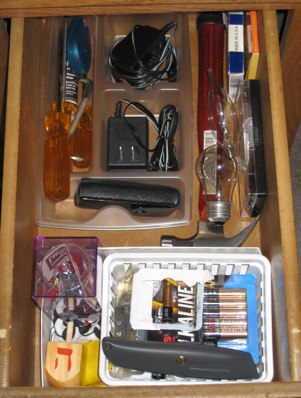
This summer also included the fun opportunity of participating in the inaugural post of Krista Colvin’s new series as part of The SHEbang. In The Organizer’s House, Krista gives readers the opportunity to peek behind the curtain into the homes of other professional organizers. So, breaking from the expected, I posted not about paper, but about my junk drawer!
And if that weren’t enough to keep me busy, I wrote a (not-so) little testimonial for our friends at Rubbermaid. And no, it’s not about the fabulously Top Secret product I hinted about here (the launch for which my sources say will now be in October), but about Rubbermaid’s new Glass with Easy Find Lids. Click on the Reviews section to find my Fridge to Oven to Table contribution at the Rubbermaid site (which, although I submitted my name, lists me as an anonymous professional organizer) or you can see the review on Amazon.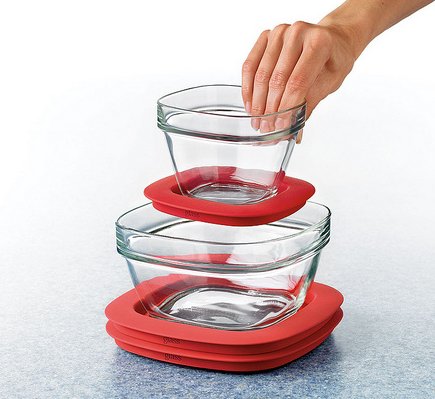
I’D LIKE TO THANK THE ACADEMY
My favorite part of being a professional organizer involves helping others — whether that’s through the Paper Doll blog, hands-on organizing, my new foray into virtual organizing and time management services, public speaking (whether for specialized audiences like the Moms of Multiples or last Saturday’s presentation as part of Chattanooga’s Stress Away Day), or media appearances. But it would be disingenuous for me to say it’s not a little heady to have one’s work appreciated by others.
In that respect, I’m proud to say that Paper Doll has been included in Tracy Myers’ Best 50 Blogs About Reducing Clutter, where I am in excellent company with many of my professional organizing colleagues.
Speaking of fine company, I am honored that Paper Doll was recently named a


Star Blogger as part of the monthly Professional Organizers Blog Carnival run by Janet Barclay of Organized Assistant. Star Blogger status is conferred once an organizing blogger’s posts have appeared ten times in the carnival series. Right now, I’m tickled to stand among the (currently) one dozen Star Bloggers. I’ve lost count as to how many Paper Doll posts have been part of the carnival, but I can tell you that the most recent was in July’s The Fun Side of Organizing.
So, although almost all of us are melting from the heat, be assured that Paper Doll Central remains active and engaged in the fight against disorganization. I’m gratified that you’re reading the blog, and there’s so much more to be found at Best Results Organizing, including the monthly newsletter, Best Results for Busy People.
Until next we meet, let me just say:

Having an organized time! Wish you were here!
Paper Doll Bids a Wistful Farewell to Savings Bonds
It’s the end of an era. Last week, the Bureau of Public Debt announced that effective January 1, 2012, financial institutions will no longer sell paper savings bond certificates. This move is in alignment with the U.S. Department of Treasury’s initiative towards all-electronic transactions, as announced in April 2010.
It’s estimated that eliminating “over-the-counter” paper certificate sales will save $70 million over the course of the next five years. Indeed, as of December 31, 2010, the government had already stopped selling paper savings bond certificates through payroll deduction plans, so this was the logical next step. The combined elimination of payroll deduction sales and individual OTC sales is predicted to save $120 million over the next five years.
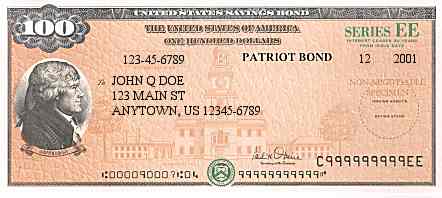
Of course, savings bonds themselves aren’t being eliminated — just the certificates. You’ll still be able to purchase bonds though the TreasuryDirect website. You just won’t be able to roll them up, tie them with ribbon and present them as gifts to your loved ones. You won’t be able to hoard them in your bedside drawer or roll around on a pile of certificates (not that Paper Doll would want to hear about it if you did.) You can still invest, but there’s no more pomp or circumstance about it.
U.S. Public Debt Commissioner Van Zeck recently stated, “Savings bonds are very much a part of this country’s history and culture, and will remain a part of America’s future – but in electronic form…It’s time for us to take a 1935 model and make it a 21st century investment tool….Investors will no longer have to worry about misplacing, losing or storing paper savings bonds.”
While that’s true, investors may now have to worry about misplacing password-protected account cards or slips of paper onto which they’ve written their bond numbers, or about web fraud. But it might be argued that, collectively, we’ll be losing something else, as well.
KEEPING THE NATION’S BOOKS
The elimination of paper certificates saves the government space (for storing savings bond certificate stock and other tangible resources), expenses for tangibles (ink for printing, certificate paper stock, postage, and envelopes), and fees paid to banks and credit unions for processing bond applications. Financial efficiency is a good thing.
It’s uncertain, though, what kind of impact the change will have on sales of savings bonds. It’s been reported that sales rates for savings bonds have decreased 53% since 2001, and digital sales accounted for only 11% of the $1.2 billion in savings bonds purchased from October 2010 through June 2011.
Maybe most consumers didn’t know they could purchase bonds electronically, but with 89% of purchases in that period being paper certificates, one has to wonder whether going digital might dramatically decrease the number of people buying savings bonds overall. It depends on whether they’re buying them for inflation-hedging investments or more ineffable qualities.
THE SENTIMENTAL VIEW
Great-Grandma and Great-Grandpa, who probably still revel in the ritual of going to their bank branches to purchase saving bonds for the newest acorn on the family tree, will have a few options. If they’re web-savvy, they can use TreasuryDirect; if not, perhaps their kids or friends will help them pursue the online process. Or, more likely, they’ll get a crisp $50 or $100 from Ye Olde Bank and skip buying savings bonds altogether.
And it’s not just the older generation. While I-series bonds currently have a nifty 4.6% return, EE-series bonds, at 1.1%, don’t exactly yield exciting returns on investment. Then again, people don’t buy them, at least as gifts, solely for the ROI. People also give savings bonds because of the old-fashioned visual and tactile appeal.
As a professional organizer, I’m happy about the increased efficiency and reduced costs. And yet, as Paper Doll, I’m a little melancholy at the shuttering of yet another lovely, old-fashioned tie to the past. Sure, I’d long since gotten used to the idea of “book entry” (i.e., digital) stock ownership in lieu of having actual stock certificates. Somehow, keeping tangible stock certificates around made me feel a bit like Scrooge McDuck, hoarding my gold! But savings bonds?
Savings bonds have always brought to mind a semi-antiquated but memorable way to deliver a gift spanning time, from past to present to future. I received savings bonds upon my birth and bat mitzvah, and have blogged previously about how my college crowd has made it a tradition to collectively give savings bonds when anyone in our group gives birth or adopts. When I purchased my first car, the bulk of my down payment came from bonds issued in 1967, and before cashing them in, I took time to read the old typefaces on the certificates and the sprawling handwriting styles on the accompanying cards’ sweet, optimistic messages.
OTHER CLOUDS ON THE HORIZON
For investors, the situation is somewhat dependent upon how smoothly the transition works. The old Legacy Treasury Direct system whereby investors could purchase and redeem Treasury bills and other securities by telephone or mail is also being phased out in favor of an all-digital plan, but has been fraught with glitches and marked by complaints from older investors.
In addition, two other practical issues are in play. First, the TreasuryDirect web site, although improved, is still not as fluid or intuitive an interface as, say, Google. It can be clunky. Also, there’s growing consumer concern about hacking and web fraud. Even if the interface is improved and TreasuryDirect’s web security rivals that at Fort Knox, perception becomes reality. Because savings bonds are not essential, poor PR could keep resistance high and purchase rates low.
WHAT IT MEANS FOR YOU: YOUR OLD CERTIFICATES
If you already have paper savings bond certificates, you can still redeem them at banks and credit unions, as always. If you have a savings bond which hasn’t yet matured, but was lost, stolen, eaten by the family pet or otherwise destroyed, you’re OK. It can be reissued in paper certificate or electronic form. (Paper Doll wonders why paper certificates are allowed for replacing old certificates when everything else is going digital.)
WHAT IT MEANS FOR YOU: GIFT-GIVING
Effective January 1, 2012, if you want to buy a savings bond for yourself or as a gift, you’ll first have to sign up for a TreasuryDirect account:
1) Provide your name, email address, bank or credit union routing and account numbers, and your taxpayer ID (Social Security or Employer Identification number).
2) Create a username and password and choose your security questions. (Safeguard the information you choose!)
3) Once your account request is processed (which can take up to 14 days, so plan ahead), you’ll receive an access card which will enable you to manage your account.
Next, to actually buy a gift bond, you’ll need to know a recipient’s full name, Social Security number, and, if applicable, TreasuryDirect account number. When the gift bond is processed, the recipient will receive an email, announcing the receipt of the gift in his or her TreasuryDirect account. You can also print a savings bond gift certificate, which makes the whole transaction a little less mundane than buying a Bobblehead on eBay via Paypal.
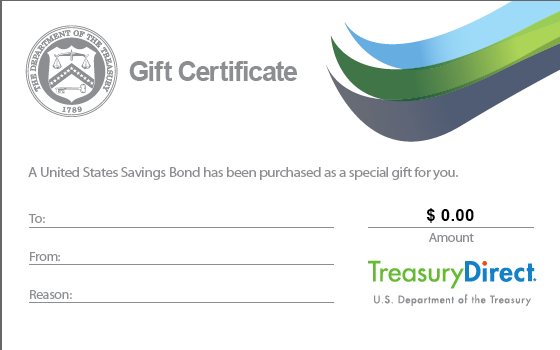
If you give a bond to a minor, the bond is placed in an online gift box until he or she reaches 18 years of age. At that point, the newly-minted adult can open his or her own TreasuryDirect account. Parents who wish to maintain a little extra control (or secrecy) can open their own TreasuryDirect accounts through which they can create custodial accounts in which the gifted bond may be safely kept.
Gee. Fun. Wow.
Sigh.
WHAT IT MEANS FOR YOU: A BIG CHANGE FOR THE INVESTOR CROWD
Along with the elimination of paper certificates, there’s a new change that primarily impacts serious investors. Currently, you’re limited to $5,000 in paper savings bond purchases, per year, for each bond series (EE and I bonds), plus another $5000, of each, per year, via the Treasury Direct website.
As of 2012, however, the limit will just be $5000 in purchases from TreasuryDirect. So, hey, Big Spender, if you were counting on buying $10K of each series of savings bonds per year, you’ll have to scale back and invest elsewhere.
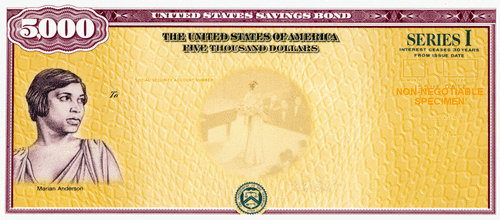
There’s one exception. Currently, you can request to receive up to $5000 of your federal income tax refund in I-series savings bonds, and that won’t change with the new rules. Thus, while $10,000 of saving bond investment purchases via paper certificates have been cut out, you can recoup half that lost opportunity via your refund. It’s believed that for 2012, at least, those tax refunds via I-series bonds may be available as paper certificates.
WHAT’S NEXT FOR YOU?
Buying savings bonds electronically isn’t new. The government has been selling Series EE and I savings bonds electronically, 24/7/365, through TreasuryDirect since 2002. Opening and maintaining a TreasuryDirect account is free. Once you create your account, you can:
—Purchase, manage, and redeem Series EE and I electronic savings bonds for yourself.
–Purchase electronic savings bonds as a gift for someone else.
—Convert the Series EE and I paper savings bonds certificates you already own to electronic format via the SmartExchange feature.
—Enroll in a payroll savings plan at work so you can purchase electronic savings bonds, the cost for which gets deducted just like taxes, insurance, 401(K) contributions, United Way donations and other similar payroll deductions.
—Invest in other U.S. Treasury securities (like T-bills, notes, bonds, and Treasury Inflation-Protected Securities (TIPS).
GOT BONDS?
As of July 1, 2011, there were 45 million matured, unredeemed savings bonds worth approximately $16.2 billion, just sitting there. Are any of them yours? Be sure to check the savings bonds you own via TreasuryDirect’s Savings Bond Calculator (to see the current value) or Treasury Hunt (to see if you’ve got money waiting for you).
SOME PARTING ADVICE
The last time I wrote about savings bonds was in January 2008, in the post Lost and Found: Savings Bonds (and saving yourself a headache later on). While some of that advice may become moot, much of it will remain useful until all of the 672 million outstanding paper savings bonds (both matured and not-yet-matured) — worth $181 billion — are cashed in. Thus, please avail yourself of the advice in that post if you want to know how to:
- Record and safeguard your savings bond certificates and associated information outside of the TreasuryDirect savings bond management system
- Locate and/or replace missing savings bond certificates
- Redeem savings bonds
Of course, you could opt to exchange your paper savings bond certificates for digital versions using SmartExchange. Then, at least, you won’t have to worry about which bonds are held digitally and which are still held via paper.
Readers, what do you think? Will you miss savings bond certificates? Will you embrace the digital system completely? Do you have any savings bond stories? Please share your thoughts in the comments section below.
Paper Doll Adjusts the Vertical Hold: Space-Saving File Solutions
When we talk about organizing our paperwork, we usually think of employing horizontal space: desktop file boxes, traditional filing cabinets, hanging file milk crates stacked on the floor or arrayed along windowsills and counters, and so on. Even my beloved tickler file,
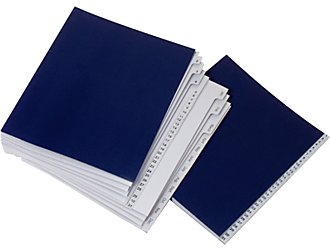
which can be stored vertically, is usually maneuvered onto a desktop or into an in-tray.
Sure, there’s always some lip-service paid to using open filing on shelves, such as how medical and dental offices shelve patient file jackets. And, of course, for reference and financial information, in particular, we discuss using three-ring binders to collate and contain paper.
Still, all of these options require horizontal space on floors, desks, and counters. We replace the cluttered stacks and piles with neat systems that nonetheless co-opt a similar amount of real estate on the same floors, desks and counters. It’s tidy. It’s systematic. And it still leaves no room for doing a waltz or tango around the room.
The bulk of our reference paperwork will probably always need to take up some floor space. Even those three-ring binders need bookshelves, and most of us will find it easier to bring in a free-standing bookshelf than to try build our own into the walls. But the good news is that there’s an overlooked alternative for maintaining action files, handy reference and the other types of papers that tend to take up space in our desktop file boxes and file risers: vertical space!
We’re all, even Paper Doll, guilty of forgetting to maximize vertical space. We display our shoes on the floor when we could use hanging shoe organizers on the backs of doors. We fill our drawers with children’s items and gadgets and our garages with piles of sports equipment when there are superior vertical solutions like Gear Pockets and Simply Stashed:
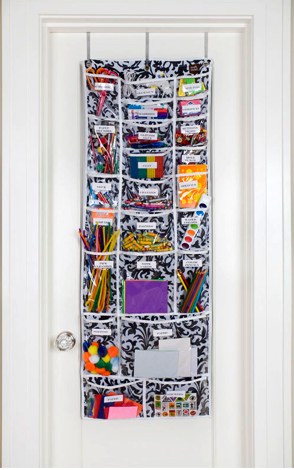
available directly from Christy Designs (at which Paper Doll readers get a 10% discount for using the code BESTRESULTS) or from OnlineOrganizing.com.
Today, in hopes of freeing up some space for impromptu tangoing, we’re going to look at some great paper-related vertical storage solutions.
PLEASING PORTABILITY

The Container Store’s Translucent Cascading Letter File Tote combines vertical storage with portability for an appealing small-scale filing solution.
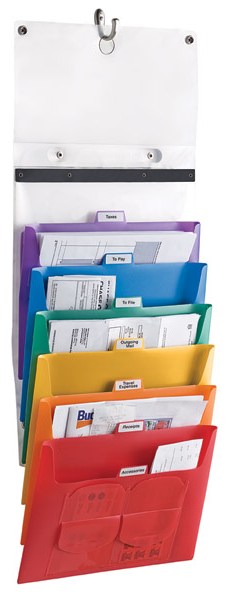
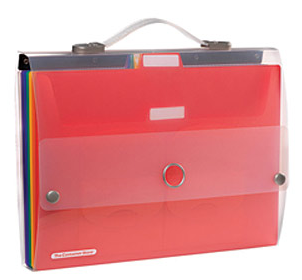
The tote measures 13 3/8″ wide x 1 1/2″ deep (when closed) x 10″ high (when closed) or 33 1/4″ high (when hanging open). The sturdy polypropylene pockets are colorful, but just translucent enough to offer a peek at the contained documents.
Each pocket bears a tab for describing the contents, similar to the labels on traditional hanging folders, while whatever interior (manila or colorful) folders selected can be labeled separately. The front pocket (when hanging) has mini-pockets for essentials like business cards, coins or stamps, and when fully closed and arranged for portability, the outer case bears a pocket for quick retrieval of parking passes or ID cards.
When open, the reinforced grommet allows for the tote to hang from any hook, and the rainbow of pockets, contents secure within, simply cascade downward. With the depth at only 1 1/2 inches, any yard-high area of clear wall space will suffice. Just decide whether you’d rather opt to hang it for standing or seated use and position your hook accordingly.
On the down side, to maintain durability and portability, there are only six pockets, and the red-orange-yellow-green-blue-violet theme might not be to everyone’s tastes. However, this small size makes it perfect for time-limited projects like tax planning or college applications, where documents must be kept together but also remain portable.
The Translucent Cascading Letter File Tote retails for about $15.
LIGHT, SOFT, DURABLE

Scholastic’s File Organizer Pocket Chart, designed for traditional classroom use, also offers practically flat file and paper storage for home-school classrooms, cubical offices, home offices, and family information centers (in pantries, mudrooms and kitchen-adjacent areas). The ten letter-sized pockets measure 14.7″ wide and are suitable for use as in-boxes, or kids could keep them next to their study areas, with one pocket for each class or extracurricular activity.
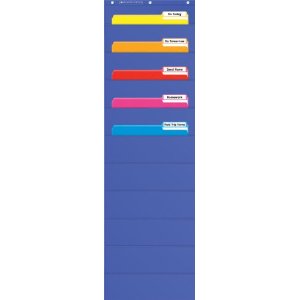
Weighing in at only about 8 ounces, the blue File Organizer Pocket Chart is made of a flexible plastic, and the reinforced grommets make it easy to “install” on hooks, pegboards, doors or walls in under ten seconds.
The File Organizer Pocket Chart can be found at Amazon, Scholastic’s Teacher Store, and various office and teaching supply stores for $10 to $15.

Educational Insights makes a similar product, the Space Place Classroom Organization Center. The washable red nylon organizer can be rolled or folded for easy storage between projects. It has three heavy-duty grommets and can be hung just as Scholastic’s File Organizer Pocket Chart, above, but has twelve 7″ deep file folder-accommodating pockets instead of ten.
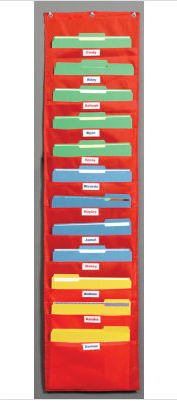
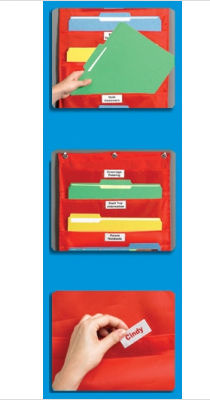
The lightweight 10.5 ounce organizing caddy measures 14″ wide and 55″ high. Each pocket has its own clear label holder to enable insertion of labels (of which 36 blank labels are included), though traditional label maker tape will adhere to the rayon pockets, as well.
Because the organizer is made of rollable, foldable nylon, it not only works for the uses previously discussed, but would also be an excellent choice for mobile professionals like regional managers, traveling nurses, pharmacy supervisors and other professionals who rotate among multiple service locations.
The Space Place Classroom Organization Center can be ordered directly from Amazon, teaching and office supply stores, and ToysandGamesOnline.com, with prices ranging from $11 to $18.

If you’re looking for a smaller version of the above items, perhaps to help a pre-schooler “organize” his or her art projects and coloring books, OnlineOrganizing.com carries the EZ Pocket Hanging Project Organizer. 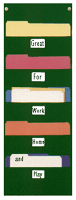 The 100% cotton canvas organizer is hunter green and measures 16″ wide by 44″ high. The five pockets are wide enough to accommodate both letter and legal sized files and papers.
There are just two reinforced grommets at the top for hanging, and each pocket has adhesive-backed clear label holders. (Blank labels are included with each kit.) The EZ Pocket Hanging Project Organizer runs about $27.95.
THE BIG PICTURE

For those seeking the light-weight convenience and slim depth of the above options but a wider surface area, Smethport Organization Center Pocket Chart fits the bill.
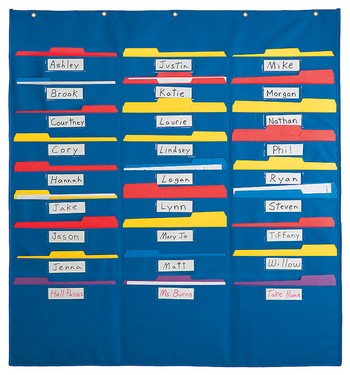
The durable, washable blue nylon pocket chart has 27 letter-sized pockets arrayed in three columns of nine pockets each. Each nylon pocket has its own smaller translucent plastic pocket for holding dry-erase cards (included with the package) or index cards up to 3″ high.
The Organization Center Pocket Chart measures 40″ high x 37 1/2″ wide, can be found at Amazon and teaching supply stores, and retails for about $25.
All of the above options are lightweight and (relatively) portable, but if you’re ready to commit to a stable filing system, there’s one more alternative to view.
A MORE PERMANENT OPTION

Professional organizers have been buzzing over RackitFile, which presents a serious vertical filing option.
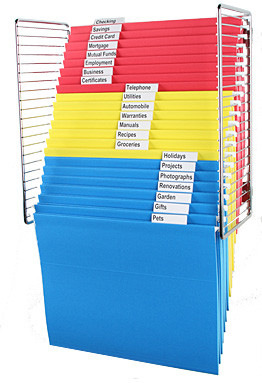
This drawer-less filing system mounts on solid vertical surfaces and juts out from the wall farther than the other solutions covered above, but has multiple benefits to outweigh its heftier profile. Rackitfile is based on the proprietary Walfile System, which uses a combination of vertical and horizontal space to double the depth of files, yielding 12 inches of filing space in six inches of actual depth.
The Rackitfile’s Walfile System begins with the mounting of a durable steel frame with 22 laddered rungs for hanging a full set of letter or legal-sized files. The Rackitfile can be mounted on most vertical surfaces via the enclosed wood/particle board screws and what the company calls “the best drywall anchors on the market”. The kit includes a mounting template installation instructions.
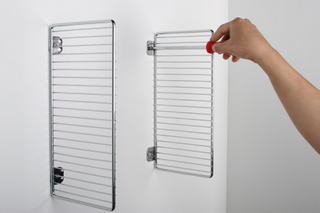
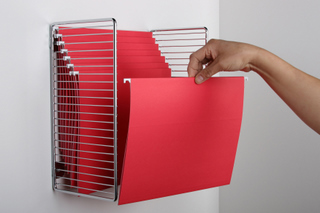
Once mounted, the Rackitfile extends 6 inches from the wall. Although the steel frame is only 12 3/4″, once all hanging files are loaded, the entire system measures 21 inches in height. Far sturdier than the other products we’ve reviewed, if mounted with the specialized drywall anchors, the weight rating for the whole unit is 90 pounds.
Rackitfile can be purchased directly from the manufacturer. One kit, including shipping, retails for $24.98 CDN (about $28.92 US), and the company offers bulk discounts for purchasing 3, 5 or 15 units.
These are just a sampling of the educational and office supply tools available for reducing your horizontal footprint and making use of your vertical space. When your real estate is at a premium, think about filing up, up and away!
Paper Doll Considers the Future of Paper
As I write this, today is all about a specific piece of paper. On the first Independence Day after I started writing Paper Doll, I merely shared the text of the Declaration, because no commentary was really needed. Nobody debates the weighty significance of that document in our nation’s history, nor, indeed, in the grand scheme of history, outright.
At a recent networking event, a new acquaintance inquired about my client work and then asked, somewhat bemusedly, if he’d heard correctly, that I blog about paper. He spat out the word paper as if we were discussing hoop skirts or the Whig Party. To this digital wunderkind, paper’s role in his life was as insignificant as the napkin with which he wiped away his pizza drippings. While he undoubtedly didn’t mean to be derisive, he was dubious that the subject of organizing paper had much impact now, or that it would in the future.
Upon reflection, it occurs to me that I answered a bit defensively. Having researched and prepared numerous presentations on the topic, I was able to provide statistical evidence on how and why Business Week’s 1975 prediction of the Paperless Office didn’t come to pass. And certainly, for my clients, and for the many readers who write in with questions and topic suggestions, the piles of paper, the deluge of documents, the clutter of scraps and statements continue to be problematic. But more and more often, to solve the needs of the more digitally-minded masses, I find myself offering technological solutions along with standard paper fixes.
Thus, on a holiday weekend where we celebrate the endurance of revolutionary (pun intended) ideas committed to paper, I find myself considering the future of paper, in all its forms. As I began to search the web, I was somewhat comforted by revisiting the pilot episode of The Tomorrow Show, Mo Rocca’s webcast about Tomorrow’s Paper.

(Go ahead. Watch it. We’ll wait.) Nonetheless, it’s intriguing to think, not just from an organizing perspective, but from a more general one, what’s going to happen with our paper?
Money — Certainly, paper money has its disadvantages. It’s easily lost or stolen, fares only moderately well after a few tumbles in the washer and dryer, fades, crumples, and can be eaten by pets. And paper money has competition. Electronic payment via credit card has existed for more than half a century, and similar payments via debit cards have encroached on the use of paper money for more than 25 years. Moreover, mobile payment, using cell phones as a digital wallet, began in Japan and now influences purchasing behavior worldwide.
Indeed, our neighbors to the north are eliminating the paper portion of paper money altogether. Starting in November 2011, in order to combat counterfeiters and increase currency durability, Canada will replace paper currency with money made of paper-like plastic polymers.
And yet, it is hard to imagine teaching your pre-schooler the relative value of money using toy cell phones. Will small businesses mount screen caps of their first digital dollars earned above the cash register card processor? Paper Doll believes that a combination of sentiment and various unfortunate truths about living at or below the poverty line (including an inability to afford the fees of using traditional banks) will keep cash as king for a while longer.
Checks — For years, Europeans have been laughing at the quaint use of checks by North Americans, as reflected in the first comment in a recent blog post on Apple issuing MobileMe refunds. Further, over the next seven years, Britain will begin outlawing the use of paper checks such that by 2018, “The check’s in the mail” (well, I guess in the UK, they’d say, “The cheque’s in the post!”) will be an antiquated reference, like dialing the phone or playing a record. The move will save $2 billion in paper processing and 45,000 trees, annually.
What about us? Aside from that nice $20 birthday check from Grandma or the oversized faux lottery check, we might not miss checks given how many people already use electronic funds transfer for online bill payment and credit or debit cards for point-of-purchase acquisitions.
Paper Doll is more worried about how the lack of checks (which, admittedly, I’ve almost entirely stopped using) will impact the already-slipping diligence with which people should oversee their money. I fear that when you cease to write checks, you’re even less likely to manually reconcile your “checkbook” or keep a register at all. And lack of organized control over financial information too often leads to lack of control over actual money.
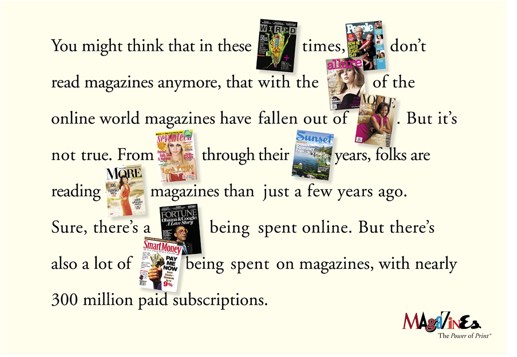
it’s fairly obvious that although we’re more likely to read People in the tub than take our iPad in with us, magazines will also have to adapt or die. And can you imagine a child’s delight at reading a pop-up book or tracing a finger along the route of Harold’s purple crayon ever being paralleled by a digital device?
Phone Books — A few years ago, I wrote Phone Books: A Jaundiced Look at Yellowed Pages. Unlike many other types of paper, this product, at least, was something of which most of us were tired. While certainly we’re still mired in the opt-in/opt-out negotiation for the future of phone directories, the future looks a bit brighter for those hoping to say good riddance to bad paper.
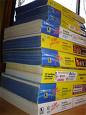
Just last week, U.S. District Court Judge James L. Robart ruled that Seattle’s opt-out ordinance did not violate publishers’ First Amendment rights. In addition, he ruled that the benefits to the city, in terms of waste reduction and the privacy of residents, outweighed whatever burdens might be placed on the three litigant phone book publishers’ interstate commerce rights. Between May 2011 and last week, when Seattle residents were finally able to opt out of the books, and last week, 35,000 households opted out of receiving the books. Between digital alternatives and consumer dissatisfaction, the future of phone directories is coming to an end.
Maps — It seems likely that in the age of GPS apps built into our phones and cars, there’s little room in our future for paper maps, at least the kind that are impossible to fold into their pristine former arrangements and tucked neatly away in glove compartments. There’s a wealth of blog posts and discussion in the world of cartography on the impact of digital upon the traditional paper map, but none charmed me as much as a line from Peterman’s Eye:
…But no electronic display ever encouraged me to get delightfully lost the way studying a real map will do.
Indeed, how many young (and young-at-heart) adventurers have posted maps of their nation, their continent or their planet, using pushpins as markers to show where they’ve been and where they’ve dreamed of going? Paper Doll has a Doctors Without Borders world map affixed to a door, to ensure I can continue to learn geography, and understand the “where” behind the “what” on the news.
And can you ever imagine anyone getting excited about a Treasure GPS?
Letters — Sadly, between email, texting and the price of postage, most people don’t write letters anymore. I worry about the future of excellent greeting card shops, like the one owned by a friend, even as I jot off silly, ephemeral greetings via snarky SomeECards. And yet, ever hopeful, I still stand by what I wrote in Zing Went the Strings of My Heart: Organizing Your Love Letters.
The more I thought about the future of paper, the more my thoughts spiraled. To Do lists have become To Do apps, which I continue to cover, despite my love of a good paper list and the visceral satisfaction of checking off completed tasks. What about coupons? Even as Extreme Couponing captivates the nation,

I can’t imagine that location-based digital couponing programs like Yowza or the new American Express/Foursquare project won’t slowly overtake clipping coupons from the newspaper…and not only because of the demise of the newspaper.
Then I thought about birth and marriage certificates, passports and other essential documents that are as meaningful to us as individuals as something like the Declaration of Independence is to us as a nation. While holograms and RFID chips are being added to passports, and municipal governments store vital documents digitally, there does not yet seem to be an alternative to paper versions of these legal records.
In imagining the future of paper, I keep coming back to the concept I’ve shared with you multiple times. While paper will not always be the practical choice, human beings are not automatons and will not always choose what is practical. No text will ever replace a love note. I’ve saved decades of cartoon self-portraits of PaperMommy (which she includes in envelopes sent via U.S. Mail, laden with coupons, and occasionally checks). And sometimes, paper proves the passion with which we approach our lives. I’m still both appalled and charmed by the blog post from Anonymous Lawyer, where he states:
I never thought about it before, but I can’t imagine ever getting to a point where there wasn’t all this paper. You just can’t walk into an associate’s office, slam your laptop on his desk, and scroll down to the place where he made a mistake. You need to have that brief printed out, you need to be able to tear those pages right in front of eyes, to scatter them wildly across the room, to fill the sheet with red lines and crosses and corrections, to crumple those papers up, toss them in the trash can, light them on fire, and watch them burn. Sure, we could probably afford to destroy a couple dozen laptops a day just to make a point that we demand perfection — but paper just works so much better for that.
Finally, though we may call it up on the web at a moment’s notice, tourists from all over the world still stand in line at the National Archives in Washington, DC, and file reverently past the display of the Declaration of Independence.
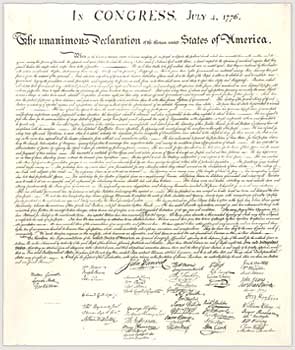
I think paper’s future is secure for a while longer. To me, at least, that’s a truth that is self-evident.
Follow Me