Archive for ‘Paper Organizing’ Category
8 Brainy Tips to Organize Your Holiday Spending
It’s time for the seasonal shopping juggernaut. Usually, I’d focus on recommending holiday gifts of experiences and consumables (i.e., stuff to do and stuff to eat, rather than stuff to install, assemble, store, and eventually, dust), but you’re probably heading out into the fray, anyway, if not this weekend, then at some point in the coming month.
Before you risk sleep, life and limb, and your retirement fund to shop for your loved ones (and their loved ones, and piano teachers and soccer coaches, and the paper boy and the shampoo girl), and before you come home with twice as many gifts for yourself that you weren’t planning to acquire in the first place, Paper Doll has some research-based guidance for facing this shopping season.
ADOPT A HANDS-OFF POLICY
In 1990, research on the Endowment Effect showed that the mere act of touching an object creates a feeling of ownership. This is why we professional organizers sometimes hold things up for our clients to make purging decisions instead of handing them over — it allows them to make a more dispassionate, less emotion-based decision.
Now, Professors S. Adam Brasel and James Gips at Boston College have found that touching things on a screen has that same impact, triggering the brain to spend, acquire and own. Their paper in the Journal of Consumer Psychology, Tablets, Touchscreens, and Touchpads: How Varying Touch Interfaces Trigger Psychological Ownership and Endowment discussed their findings that if you’re using a touch screen, it increases the Endowment Effect almost as much as touching the actual item, and makes you less aware of factors like price.
So, if you’re shopping in the store, keep your hands in your pockets or wear your winter gloves. (Also, you’ll avoid germy germs!) If you’re shopping online, use your laptop or desktop to shop, or if you must use your phone or tablet, wait until you’re using a mouse or trackpad to make the final purchase.
SNIFF OUT THE CLUTTER
Keeping clutter from building up depends not only on jettisoning what you don’t need, but also in keeping things from coming into your space altogether. To do that, beware of consumer psychology tricks that retailers play.
We’ve all heard of baking cookies during real estate open houses – it tricks the brain into thinking the house is more cozy. Consumer psychologists have found that our olfactory senses (i.e., our sniffers) impact the memory and emotion centers in the brain more than sight, hearing, and even touch, and controls our emotional reasoning, which is behind most of our purchasing decisions. (We may do extensive research before making purchases, but in the end, we buy what makes us “feel” best.)
If you find yourself making impulse decisions in stores that have lots of fragrant stimuli like lotions, flowers, or candles, consider these strategies. Whenever possible, shop online so you’re better able to limit sensory inputs to 2D visual stimuli, which tend to focus on facts (prices, features, measurements) rather than emotions. When you do shop in person, take along a friend who can help you avoid temptation. It helps if that friend has allergies, it’ll keep you out of the shops that practice olfactory sneakiness!
WATCH OUT FOR BULKING UP
Have you ever noticed how, when the signs say “Limit: four per customer,” that people feel the need to acquire the absolute limit? In research published in the Journal of Consumer Research, Cornell Professor Brian Wansink and colleagues found that quantity limits imposed on purchases can tempt consumers to buy twice as much or more of any product than they’d otherwise have considered.
Scientists call this concept ‘Anchoring and Adjustment’ — with lower-priced items, most people see the limit as the optimum number or amount to purchase. If shoppers buy less than the limit, it still tends to be more than they’d originally planned to buy, if they’d planned to buy anything at all.
With higher priced or luxury items, like iPads or video games, a purchase limit implies that there’s some level of scarcity, and many consumers infer that scarcity means a higher inherent value, making them desire the item more. You’re not likely to buy more than one iPad Air at a time, even if the limit is, say, three to a customer, but somehow knowing you can ONLY have three makes the one you intend to purchase somehow seem more valuable. Pretty sneaky, eh?
How can you countermand these retailing tricks?
— For lower-priced items, decide how much of something you want or need before you leave the house, and put it on your list. Once in the store, ask yourself if buying three times as much as you planned will save you (and your giftee) more than the frustration of having no space in the kitchen or closet.
— For big-ticket items, remind yourself that the purchase limits are not just there to ensure equal access, but to boost consumer enthusiasm. That should make you resent the tactic enough to think more reasonably as to whether you want the item in the first place.
DON’T BE LIST-LESS. AND DON’T BE LISTLESS.
Whether you’re shopping for ingredients for the holiday open house or presents for Grandma and Uncle Joe, don’t shop aimlessly.
Have you ever come home from the grocery store to find you not only didn’t purchase everything you intended to buy, but that you’ve got oodles of things you hadn’t even planned to get in the first place? Or you tell yourself, “Oh, I’m sure that will be the perfect gift for … somebody.”
You already know that shopping when you’re hungry tends to make you buy more. But did you know that doesn’t just apply to food? Research shows that maintaining even levels of blood sugar helps us make better decisions – about what foods and products to buy, but also about the values of things and how much money to spend. But even if you are hungry when shopping, you can prevent impulse buying.
A study with the scary title of The Future Is Now: Temporal Correction in Affective Forecasting, published in the Journal of Organizational Behavior and Human Decision Processes, found that even if shoppers are hungry, simply shopping with a list helps consumers stick to purchasing what they intend. The lesson?
RESTRAIN YOUR IMPULSES
Your method of payment can actually help or hinder your ability to shop wisely (and thus limit your potential clutter). A study published in the Journal of Consumer Research found that paying with cash instead of credit cards decreases the number of impulse purchases consumers make. While the study focused on food purchases, anecdotal evidence suggest this applies to other purchases, too. Other solutions to organize against impulse buys:
— Have a budget. Know how much you can reasonably afford and make a game of trying to stay within your target zone.
— Use cash when you’re likely to buy small, disposable items like quick meals and items near the register (especially when you’re tired and hungry after a day of shopping).
— Save credit cards for when you buy tangible items of significant value or “big-ticket” purchases like travel. Credit cards offer purchase protection and other advantages, but it can be a bit depressing to find that you’re paying for a mediocre meal you ate five weeks earlier.
— Save up for moderate or large purchases. Your appreciation for something will grow if you spend months socking away the money; you’ll do a better job of researching features and the item is less likely to become clutter.
BE A GOOD NEIGHBOR
You probably didn’t need research to tell you that when big box stores come in to an area, the number of retail jobs actually decrease and that wages and benefits decrease.
We are all implored to shop small, and shop locally: to purchase from our neighbors, friends and members of our community, rather than chain stores. I really haven’t figured out what the excellent Simon & Garfunkel song “America” has to do with shopping at local small businesses, but Small Business Saturday is happening again this Saturday, November 29, 2014.
Yes, the song pulls at our heartstrings, and yes, it coaxes us to use American Express cards. Paper Doll is not eager to encourage you to amass shopping debt. However, if you do have an AmEx card, and are planning to shop at all this Saturday, you can take advantage of the opportunity at the above link to register your card (or all of your AmEx branded cards), and any purchases you make at local small businesses registered with the program will earn you up to three $10 statement credits per card.
So, instead of Starbucks, visit your locally owned coffeehouse for your mid-shopping break, and treat your companion (the one whose allergies kept you from overspending, up above), to a nice snack.
BE FRUGAL SO YOU CAN BE GENEROUS
Paper Doll’s own non-academic research yields useful tools for organizing your finances so the shopping budget goes further.

Ebates rocks! Imagine if every time you walked into your favorite store, a doorman slipped you a tip.
Ebates began as a shopping portal. You clicked on the name of the online store, were taken to the store’s site, and any purchase you made gave you cash back. Now, it’s even easier with the Cash-Back Button installed in your browser. Shop online as usual, and Ebates gives you a little on-screen alert that if you make a purchase at that store, it’s worth 3% (or 5%, or whatever) back. Click, which reloads the page and through the magic of cookies (the non-edible kind), Ebates knows you bought something at whatever store, and then you get a cash-back check. Apple’s the least joyous — you only get 1% back; the magazine subscription company I use yields 15%. Most are anywhere from 2-10%, with all sorts of extra bonuses and discounts. The Ebates app for iOS and Android has deal alerts and scan-and-compare features.
I keep waiting to hear that there’s something secretly malevolent about Ebates, but after using it for years, it’s all still good. But here’s the main thing — there’s no work (beyond signing up for the account). How’s that for organizing your finances and time management?
Disclosure: If you use my affiliate link above to register with Ebates, I’ll get rewarded for the referral. If you have concerns about that, you can just manually go to ebates.com and sign up all on your own.

Retail Me Not is another superlative solution for reducing online shopping expenses. Stores send out mailers and include discounts in catalogs, but if you’ve avoided paper clutter all year, there’s no reason you should be punished during the shopping season.
Whenever you’re planning to make an online purchase, go to Retail Me Not and enter the name of the online store at which you’re shopping. Chances are good that a discount code (or several) will pop up. Either click the link provided, or copy and paste the code at checkout to lower your cost.
Another solution is to type “[name of store] free shipping” into your favorite search engine to, yes, get a code for free shipping!
GET MANY HAPPY RETURNS
Know the return policies for the online and brick-and-mortar stores at which you buy presents. Check out Paper Doll Organizes Your Many Happy Returns for guidance. And be sure to request gift receipts from the cashier when you’re shopping in person.
Finally, whether you’ll be dozing on the couch, making snow angels or planning your holiday shopping assault strategy, I wish you all a happy, healthy Thanksgiving.
11 Ways To Organize Your Focus With Ambient Noise
Are you a shush-er, or a shush-ee?
When you drive down the street, searching for a house number, do you turn your radio down? You’re probably a shush-er — you need quiet to focus.
When you sit down at your desk to work, create, or do homework, does silence make you jittery? You may be a shush-ee. You need sound to help you maintain your concentration.

THE MOST STRESS-ER-FUL TIME OF THE YEAR
College students are dealing with the end of the semester, writing papers and studying for exams. Worker bees have the usual deadlines, but with the added stress of end-of-year projects and quotas, as well as two major challenges to productivity and focus:
Time is at a premium. In addition to work, you’ve got holiday shopping, and travel, and school concerts and recitals, and a plethora of tasks crowding you out of your carefully crafted time management system. (OK, some of you are laughing at that last part.)
Distractions are high. Everyone’s playing holiday music. Kids (and grownups) are sugared-up and noisier than usual, the weather is unpredictable, forcing you to carve more time out of your work to leave early enough to get where you’re going, and there’s mounting pressure to finish things before the new year, as if there’s a moral failing in carrying projects over.
ADD SOUND TO DELETE FURY
Blast those distractions out of the water with big audio dynamite. (OK, not this Big Audio Dynamite.) Or, if not blast, lull you into the right cognitive mood for learning and/or creating.
According to Is Noise Always Bad?: Exploring the Effects of Ambient Noise on Creative Cognition, in the Journal of Consumer Research,
“A moderate level of noise enhances creativity compared to both low and high levels of noise. Moderate background noise induces distraction which encourages individuals to think at a higher, abstract level, and consequently exhibit higher creativity.”
Not all sound/noise is created equally, and it’s not all experienced in the same way by everyone. We can generally agree that we won’t be focusing if someone runs their fingernails on a … OK, I won’t say it. You know. But while one person might be able to do geometry homework to heavy metal, another might be easily distracted by the sound of a steady radiator hiss.
So what can you listen to if you want to maintain focus?
This isn’t a science blog, but it helps to know a bit about what colors of noise can do.
- White noise uses sound across all frequencies from high to low, with a “flat” spectrum. It’s considered helpful for deep focus on tasks such as studying, reading or writing.
- Pink noise combines both low and high frequency sounds, creating an effect akin to a waterfall or shower, creating a soothing, spa-like auditory environment. So, if you’re stressed and want to relax before giving a presentation, leading a meeting, or even coping with holiday carpool schedules, go pink.
- Brown noise sticks with the lower frequencies, creating a rumble-y, tumble-y, riding-on-a-train auditory sensation. While it’s said to be useful for aiding sleep, it also works well to mask external noises like when your co-worker snaps her gum or your ice maker clunks loudly.
HAVE A SHOWER AND SOME COFFEE

Do you get your best ideas in the shower? Showertime’s Virtual Shower can help you create that environment without drenching your computer.
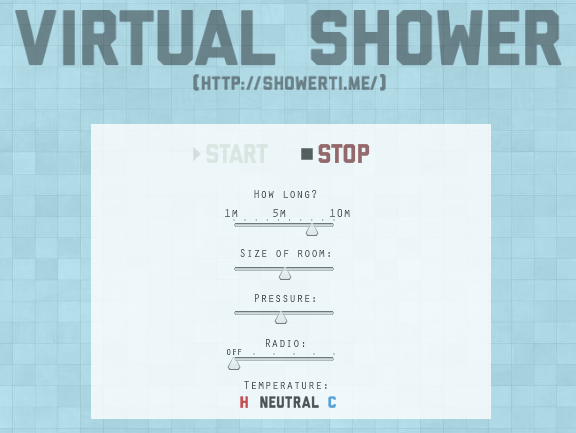
It’s browser-based — just click on the link and pick the settings you prefer:
- How Long — Select options from 1 to 10 minutes.
- Size of Room — The volume and echo changes as you enlarge or reduce the size of your shower spa.
- Pressure — The intensity of pressure generally correlates with volume and robustness of the audio
- Radio — Pick from a handful of shower-themed musical choices (Splish, Splash, Singing in the Rain, Rubber Duckie, Raindrops (Keep Falling On My Head), or soft jazz).
- Water Temperature — Choosing Hot, Neutral or Cold lets you change the screen’s color scheme.
Click Start to get going. If you’re feeling a bit like Janet Leigh and think you hear a knife-wielding psycho (or just need to move on to another task), click Stop.
Virtual Shower is free.

Coffitivity appeals to our omnipresent coffeehouse culture. If you’re a Silent Sam or Sally, you may wonder how anyone could want to do work in a coffeehouse, let alone feel like they are while at home or the office. But Coffitivity’s take on that same Journal of Consumer Research study is:
“According to a peer-reviewed study out of the University of Chicago, “A moderate level of ambient noise is conducive to creative cognition.” In a nutshell, this means that being a tiny bit distracted helps you be more creative. This is why those AHA moments come when we’re brushing our teeth, taking a shower or mowing the lawn!”
When you go directly to the web site, the first thing you hear is the busy humming of a coffeehouse: people talking, the occasional click of a keyboard, cups and silverware clinking against tables. The Cafe Library includes different types of background sounds: Morning Murmur is a more gentle hum, while Lunchtime Lounge is a little more energetic, and University Undertones has more collegiate chatter. There’s a premium level subscription ranging from $3-9, which offers Paris Paradise, Brazil Bistro or Texas Teahouse, though the site says the premium level is currently unavailable.
Use Coffitivity in your browser or get the app for iOS or Android.
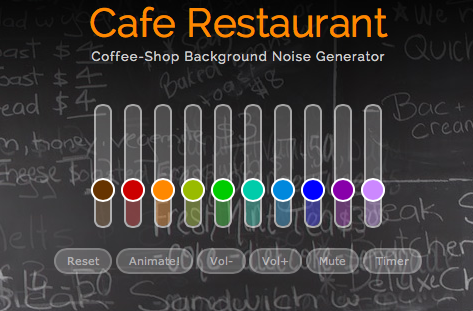
Cafe Restaurant from MyNoise.net, though less well-known, offers a similar, though more customizable, service. It’s available for the browser and in an iOS app. (An Android version is in the works.)
Use the sliders to adjust audio element styles that include the levels of Rumble, Restaurant, Chatter, two separate levels for Babble, Mess, Cafeteria, Cafe, Table and Kitchen.
MEDITATE AND FOCUS
Perhaps you’d like a less caffeinated approach?

Calm makes you feel like you’re meditating…while getting a massage…at a yoga retreat. It’s got a very Zen with a capital Zzzzzzzzz approach. The settings are not entirely intuitive, but you get to select from among a variety of background visuals: a summer field, rays of sun on the ocean, waves along the beach, flowing water. The musical selections appear to be pre-set and all by musician Kip Mazuy, though you can cycle through the nature audios (waves, flowing water, etc.) to choose your preferred sounds.
Select guided calm for 2, 5, 10, 15, or 20 minutes for a hypnotic guided meditation, or use the timer to listen to the environmental options.
For more features than are offered in the browser, the Calm app is free, with in-app upgrades, for iOS and Android.

Focus@Will describes itself as “a new neuroscience based web tool that uses specially sequenced instrumental music to increase your attention span up to 400% when working and studying. Our tool helps extend your productivity cycle and effortlessly zones out distraction.”
Music options include low-, medium- and high intensity choices, and a variety of music channels, including Classical, Focus Spa, Up Tempo, Alpha Chill, Acoustical, Cinematic, Ambient, Water, Baroque Piano, ADHD Type 1, and others.
Other features included a productivity tracker and the ability to set timed sessions to fit with your planned work schedule. For example, if you use the Pomodoro Technique and work in 25-minute increments, you can set the music to end when your alarm goes off.
Focus@Will offers a 30-day free trial with limited access to the proprietary music, after which subscriptions are $4.9/month or $44.99/year for full access to the music library. Use it in your browser or via the iOS and Android apps.
WHEN THE WEATHER OUTSIDE IS FRIGHTFUL…OR NOT
Noisli isn’t just a white noise generator; in fact, the quirky service isn’t just any one thing.
It can be used solely as an audio system. In this regard, you can click on any number and combination of the icons to select sound options: rain, thunderstorm, wind, forest (mainly birds), leaves (rustling in wind and rain), stream, seaside, water (as from a faucet), bonfire, summer night (crickets), coffeehouse, train, and fan shop. Use sliders to increase or decrease the intensity of each sound chosen.
Noisli is also a color generator. After you bring it up on the screen, options morph through different color palettes. In full disclosure, Noisli is my favorite of all of the options, not just for the sound alternatives, but because all of the colors are so comforting.
But here’s where it gets interesting. Noisli is also a distraction-free, markdown-based text editor. (Markdown is a simplified formatting language, a kind of text-to-HTML converter for people who don’t want to have to learn HTML.) The colors in the window continue to change, but otherwise, it’s just a big, blank screen. You type plain text (or with markdown syntax) and whatever you type will be saved locally, even if you close your browser (though there is a button to save and download whatever you write).
Noisli is free in your browser; the iOS app is $1.99.
A Soft Murmur has no text editor and the browser background (which may be waves or a very up-close-and-personal view of coffee) is static, but it’s stylistically similar to Noisli. Select from icons depicting rain, thunder, waves, wind, fire, birds, crickets, a coffee shop, a Tibetan singing bowl (uh…OK) and pure white noise.
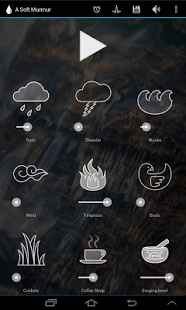
The Meander function causes the volumes of any selected sounds to randomly increase or decrease. The timer allows you to set increments ranging from 1 to 999,999 minutes (whoa!) and to determine whether you want the audio to start and stop or fade in and out.
A Soft Murmur works in the browser; an Android app is free, with in-app upgrades of $1.49.
SLIGHTLY LESS STORMY WEATHER
Fire, wind, water, rain…and singing bowls? If you prefer fewer input options, there are a variety of services.
Rain, Rain, available as a free Android or iOS app, gives you lots of alternatives (rain, waves, fountains, blizzards, crackling fires), with even more choices if you choose to upgrade to a premium version. Adjust the audio, set the timer, and sit back.
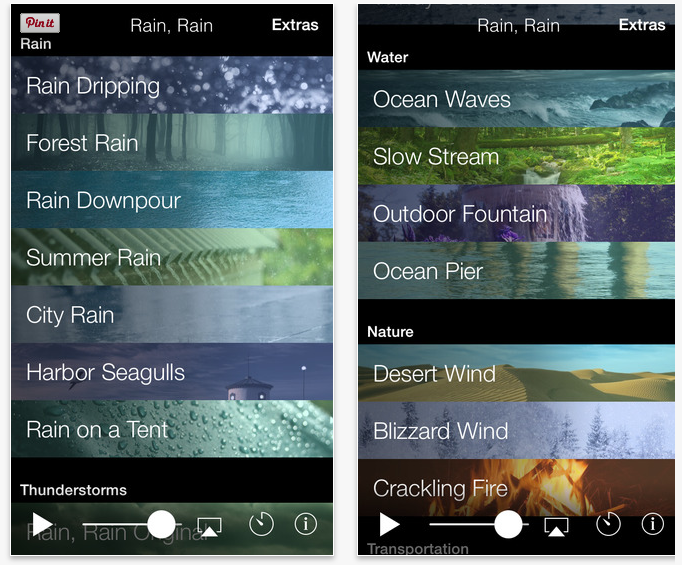
One of the nicest features is that you can lock your device and Rain, Rain will continue to play. Pause, adjust the volume, or change the tracks from the lock screen.
Rainy Cafe offers a fairly minimalist browser interface. Turn the cafe sounds on or off. Turn the rain sounds on or off. Adjust the volume for either or both. That’s it. Easy choices for a rough day.
Rainy Mood is both more and less minimalistic than Rainy Cafe. On the browser, there’s nothing adjustable. Just listen to rain. (OK, and occasional thunder.)
If you get either the iOS app ($3.99) or the Android app ($2.99), you can adjust the volume of the rain and the thunder (including “100 unique thunderclaps”). You can also simultaneously play anything from the music library on your device or in your Spotify account.

Snowy Mood is a browser-only experience that appeals to my roots as a native of Buffalo. (Play on Chrome for the best performance.)
I focus best on long-term strategic thinking when taking walks. I sometimes miss the sounds of walking across the Cornell University campus during the quiet nights of Study Week. Snowy Mood provides exactly that experience. The audio soundtrack is simply the plodding of heavy boots crunching through thick snow, with an occasional howl of wind. It becomes almost hypnotic after a while. For those who need the extra inspiration, the screen shots cycle through a handful of unpeopled snowy scenes.
These options only skim the surface. Search your favorite app store or search engine for terms like “sound generator” and “white noise” to find hundreds of options for your preferred device and format. But if you’re playing the audio loudly and without headphones, don’t be surprised if someone shushes you.
All About That Place (Where You Write Things Down)
To improve something, you must first observe & document it. Pen on paper once a day is a sufficient start.— Garrick van Buren (@garrickvanburen) November 17, 2014
Life and the internet have been conspiring recently, causing me to think about the issue of organizing one’s thoughts, and particularly, organizing them with pen on paper, as van Buren describes, rather than by typing.
Over the course of a few weeks, in addition to a speaking engagement and regular client work, I was involved with helping organize Chattanooga’s Second Annual Diabetes Expo. For all of these projects, there were little tasks, insights and just plain blobs of information coming up on my horizon. I encountered information I had to share with others (immediately as well as on delay), and had to juggle oodles of swiftly changing logistics, with not a lot of time to capture, let alone massage and manipulate, the data.
Before and during the expo, I was on my feet, running the length and width of a room the size of a high school gymnasium, plus up and down two short flights of stairs. (My Fitbit loved me that day!) Trying to walk and talk and type on an iPad just didn’t work, and I quickly gave up and went back to my beloved purple legal pad and pen.
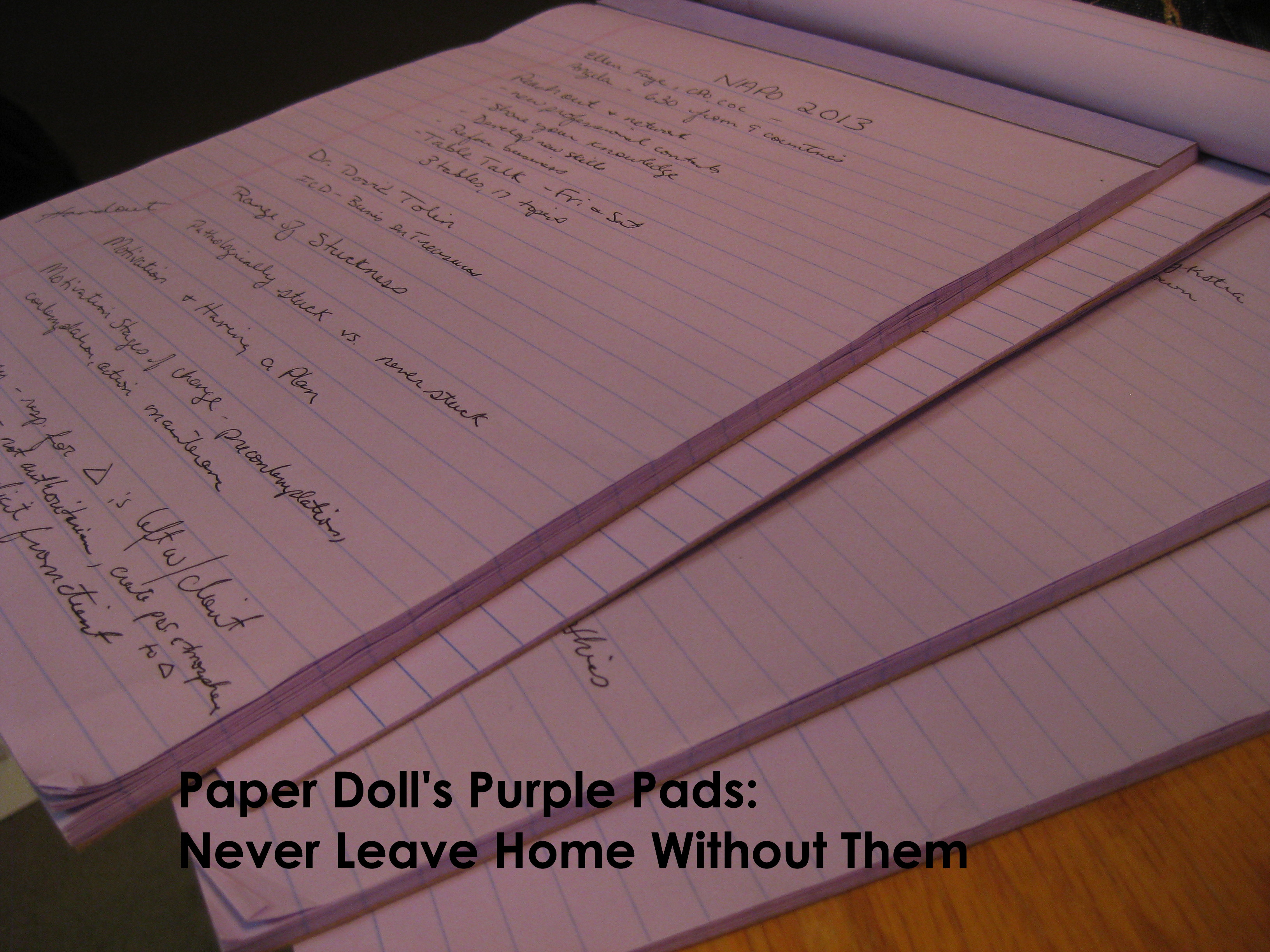
A page for problems needing solutions. A page for the mapped layout of all of the vendors. A page for checking off received door prizes. A page for changes we want to make to improve the process next year. You get the picture.
Was my handwriting abysmal and probably illegible to anyone but myself? Absolutely. But when my arms were full, I didn’t fear the budget-busting consequences of dropping my legal pad as I would have with my iPad.
After the month’s early hubbub, as I plowed through all I’d missed reading from my email and RSS feed and Twitter favorites, I eventually noticed the synchronicity of multiple open tabs in my browser. To borrow from Meghan Trainor:
It's All About That Place (Where I Choose to Write Things Down) Share on XFirst, I came across professional organizer Carrie Peeples guest-posting on Monica Ricci‘s blog, Your Life. Organized. Carrie wrote about The Secret To Shutting Up Your Busy Brain, and mentioned that:
The act of writing tells your brain that you’ve already processed that information and don’t have to worry about it. It frees your brain to do other things like focus on traffic or solve the next problem. The more you spend time trying to remember something the more time you’re NOT getting other things done.
This is known as the Zeigarnik Effect. Unless we rehearse or repeat things like phone numbers, or the beloved “a loaf of bread, a container of milk, and a stick of butter,” little details disappear from our short-term memories.
And a bigger deal, over the longer term, is that we tend to worry about the things where we’ve failed to achieve closure.
So, Carrie hits on the essentials: get it out of your head and down on paper (or the digital equivalent of paper), and your mind can go from the basic “what” and move on to more robust “why ” and “where” and “how” of the issue. When you write on a sticky note, it makes the information stick. Except, longtime readers know that I don’t want you to write on a sticky note or any other floozies (AKA: loose scraps of paper). I want you to have a notebook (paper or digital) that suits your capturing style. But do CAPTURE the information or ideas before they seep out of your brain and into the ether.
Next, Patrick Rhone of The Cramped, an entire blog dedicated to the analog writing experience, discussed a question of great importance: Why Analog? He delved into just a few of the reasons why handwriting something (vs. using your opposable thumbs to text it, or telling Siri to remember it) is advantageous. Rhone talks about the depth of history of the written language vs. digital data, the siren song of our personal notations, and the way a written draft shows the step-by-step thought process (including messy strikethroughs) that tend not to be visible with what we type. But my favorite of his points is this:
Writing by hand helps me retain more information. Countless studies show that the act of writing by hand is better for both retention and comprehension of ideas than typing them digitally. It engages the senses and synapses by a factor more than digital. I write by hand because it is the best way for me to remember and learn.
The Cramped also pointed me in the direction of Sienna Craig’s Huffington Post blog from earlier this year, entitled Reasons to Love Writing by Hand. Craig, a Dartmouth College professor, expresses surprise when her students report handwriting as creating an obstacle between the self and the expression of self. She writes:
One particularly eloquent student described handwriting as a kind of out-of-body experience: “It just doesn’t feel like it is me writing if I am not on a computer,” she said. This floored me, because for as long as I can remember, writing by hand has felt like an essential way for me to not only grapple with the world, but also to try, as the ancient Greeks remind us, to know thyself. My love for writing by hand takes many forms, and like most love affairs, is bittersweet, twisted in places, not immune to paradox and contradiction…
The entire essay is definitely worth a read (once you’ve finished this post, of course), but it’s her comment about paradox and contradiction that especially struck me, though I wasn’t immediately sure why until DocumentSnap‘s Brooks Duncan retweeted his The Paperless Conference from earlier this year. In it, Brooks — Paper Doll friend and resident expert on going paperless — included various references to my own blog post, NAPO2014: Taking Notes–The Paperless Experiment. That post includes citations of the research Rhone mentioned, above, about the superiority of writing (vs. typing) for comprehension and retention.
But it also gave me some stylistic insight.
Like Sienna Craig, I’m quick to note that I’m not a Luddite. (I hope my techie posts on digital signatures, Evernote and digital photography attest to that.) But I finally realized where the contradiction lies for me: between creating and capturing.
When I’m attending a class and taking notes, or working with clients, when I am doing a consultation on the phone or trying to understand a doctor’s instructions, my instinct is always to capture information on paper. However, when I draft my Paper Doll blog posts, when I write a set of complicated instructions or a delicate email, my fingers itch to reach out for the keyboard.
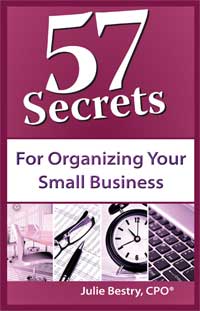
And certainly when I wrote 57 Secrets for Organizing Your Small Business, the words and phrases made their debuts in Microsoft Word, Evernote and drafts of emails. (My publisher would want me to note that Secret #4 in the book is Be Faithful To Your Information-Capturing System, and explains how to ensure the preservation of important thoughts and information, no matter your preferred capturing style. Y’know, like if you wanted to buy a holiday present for someone with this issue. Just sayin’.)
In essence, I’ve learned that for me, I hand write to take information in, to help my brain process it. But when I create, handwriting is an impediment — it slows me down. Perhaps it’s because I honed my typing skills in December of my freshman year of college, with a friend’s Mac and three term papers to type in one weekend, and now mfffflpffffl years later, my typing speed can keep up with my thoughts while my spidery, aging penmanship cannot.
Before these last few weeks, I hadn’t thought about when and why I choose to use analog vs. digital, paper vs. screen. I only knew that I do, and that it was instinctual. Dear readers, what about you? Are you like Patrick Rhone, all about the pen? Do you emulate pretty-much-paperless Brooks Duncan? Or are you more like Sienna Craig and myself, somewhat self-aware of your contradictory capturing relationship?
Wherever your incoming and outgoing thoughts live, it’s all about the place where you capture them so that you can set your mind free.
Organizing? Let Your Voice Be Heard! Answer the NAPO Survey!
You have the power! Yes, you! You have the power to let your opinions be heard and to help shape the direction of the organizing and productivity industry.
The National Association of Professional Organizers is conducting an online survey to ask members of the public (that would be you, gentle readers) about your attitudes and behaviors related to organizing. Don’t worry, it’s all confidential! Nobody’s going to snap pictures of your junk drawer (I mean, mountain of miscellaneous magnificence) or tell your boss how many times you were late for work last week.
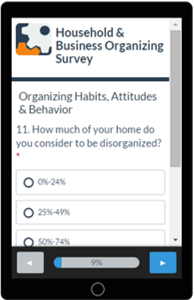
Ready to share your thoughts on how organizing (or the lack thereof) impacts your life? Want to give the industry some feedback about professional organizing and productivity services? This is your chance. And all of us — members of NAPO — will truly appreciate you sharing your insight.
The survey only takes a few minutes of your time, and lets you use the power of your voice (or, y’know, clicking fingers). Stand up (or, sit down — we’re easy that way) and be counted!
Click now to take the NAPO Household and Business Organizing Survey.
Or, if you just adore using QR Codes (and really, who doesn’t?), you can aim your smart phone’s camera right here:
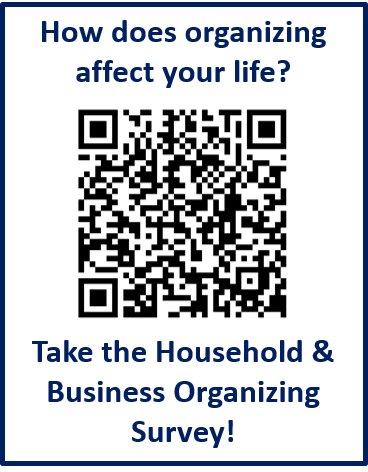
and the survey will be at your fingertips. Don’t wait. Operators are standing by. (OK, they’re not. It’s the 21st century and this will all go into a data set. There are no operators. Really.)
6 Resources to Read More Books, Drop By Drop
In 1841, throngs of New Yorkers, old money and new immigrants, alike, swarmed the docks to ask arriving travelers from England whether Little Nell in Charles Dickens’ The Old Curiosity Shop was alive or dead. Before the book was available as, per se, a book, it had been serialized, weekly, as many Victorian-era novels were published in installments in magazines and newspapers. Dickens’ own The Pickwick Papers had proven the initial success of the serialized format, and everything from Alexander Dumas’ The Count of Monte Cristo (139 installments) to Harriet Beecher Stowe’s Uncle Tom’s Cabin (forty weekly installments) gained popularity by percolating readers’ coffee-like addiction to the stories, drop by drop.
The past two Paper Doll posts covered organizing your reading space for more reading time and offered 12 tips for organizing your reading time. At the end of the latter post, I noted that reading in micro-bursts was one way for busy people to squeeze reading opportunity into daily life. Today, we’re going to look at some technology to assist in that very goal.

DailyLit is an online service that helps you read both literary classics and new fiction in short installments, entirely at your convenience. It’s the oldest and largest distributor of serialized fiction, dating back to 2006. As of 2013, it’s owned by Plympton, Inc., a San Francisco-based media technology company now immersed in digital publishing.
The process is simple. Sign up with your email address to create your account. From there, you browse the DailyLit categories or book selections by title, author, recency of addition or rating. When searching by author, you can also drill down by publication date and price (if there is any).
Choose a book that tickles your fancy, then determine how often and when you want each installment to arrive in your email inbox. If you get so engrossed in the story that you can’t wait until your next delivery, you can click “next installment” to jump to the next nibble. If you’re too overloaded with work or life to even read one installment and you need to take a break for a while, you can log into your account to pause delivery until you’re eventually ready to resume reading — in a day, a week, or whenever.
Installments generally take under twenty minutes to read, and you can read each installment wherever and however you normally check your email — on your computer at work, on your phone while waiting in line or for a meeting to start, or on your tablet, scrunched down into your sofa. You’re already reading email throughout the day, so having an oasis of calm (or a thriller, if that’s your preference) pop up amid the project updates and meeting requests can boost your mood as well as your reading progress. If you choose, you can skip your email and opt to read an installment through your browser on the book’s DailyLit page.
A DailyLit account is free, as are many of the books, which are either in the public domain (like pre-1923, out-of-copyright classics), under Creative Commons licenses, or by arrangement with specific publishers. Conversely, most of the modern titles, still under copyright, are only available for serialization for a fee, generally between $1.99 and $4.99.
Literary categories include broad themes (classics, contemporary) as well as genres (science fiction, horror, mystery, humor and satire) and special topics, including banned books and coming-of-age novels.
The service also offers DailyLit Originals, serialized novels and short story “bundles” written by award-winning and emerging authors. The Originals are designed to be read in short installments delivered over the course of about a month.

Rooster is an iOS app-based service which combines Plympton sister site DailyLit’s timed reading installments with curated suggestions for books to read. Instead of picking your own titles, Rooster seems to consider itself a book club for really busy people. Each month, Rooster pairs a classic novel with a contemporary selection. As Rooster describes it, “Both are great on their own and together they’re even better, like a fine cheese with the perfectly selected wine.”
Rooster allows readers to adjust font size and style as well as background color. Users schedule their book installments to be delivered at preferred days and times: mornings, afternoons or evenings, daily or specific days per week, etc. As with DailyLit, users may jump ahead to the next installment if their thirst for fiction (or available time) inspires them to do so.
The classic/contemporary pairings are neither obvious nor simplistic. For the March 2014 launch, the selections were Herman Melville’s Billy Budd and Rachel Kadish’s I Was Here. A navy tale and a thriller might seem mismatched, but central conceits of both include morality, cruelty and innocence. This month, it’s Kurt Vonnegut’s Galapagos and Audrey Niffenegger’s The Time Traveler’s Wife, with themes of love, evolving humanity and hope.
Could your friendly neighborhood librarian curate some nifty matching titles for you? Sure, but would he or she send them in tiny drips so you wouldn’t be tempted to miss a staff meeting or forget to make dinner? And, as the Washington Post noted, “War & Peace looks so much less daunting as a serial tale consumed every day at lunchtime like The Days of Our Lives.”
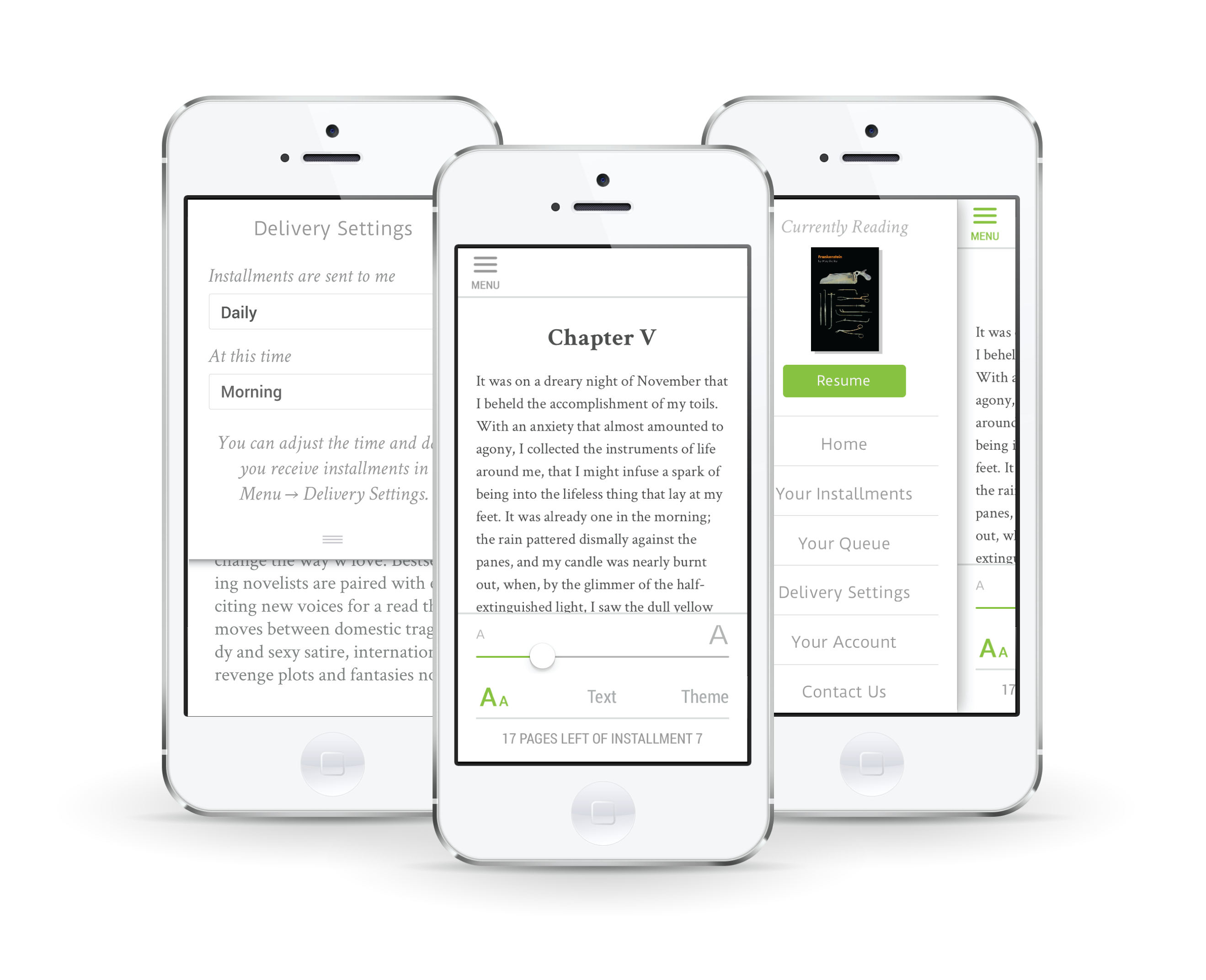
Based on the Rooster team’s research regarding the average person’s commute time, the app divides books into 15-minute installments. (Paper Doll bristles at this concept. Leaving aside average reading speed, which an increasing number of online outlets, like Medium, rely upon, commute times pretty much assume readers are living in urban areas and commuting by public transportation — or, perhaps, by limousine. 15 minutes is a reasonable installment length, but I’m dubious about presupposing the type of commute a busy wanna-be reader might have.)
The Rooster app is available as a free download with a one-month free trial. After that, the subscription service is auto-renewed at $4.99/month, charged to users’ credit cards via their iTunes accounts.
Note, with both Daily Lit and Rooster, readers/subscribers do not actually own the titles they read. As with Oyster, which we’ve covered previously, users merely “borrow” the right to the content.

Dripread, a literary nod to the IV drip feed one might get in a hospital setting, feeds cultured nutrition to the overworked, time-strapped, aspiring reader. The process is straightforward:
- Sign up for a free account.
- Brows by author or one of 37 categories and select a book that’s already in the Dripread library OR upload a digital book from your own collection. (Note: Uploads have to be in the ePub format, but as we’ve noted previously when talking about ebooks, you can use Calibre to modify the formats of the books in your digital library for this purpose.)
- Check your email. Dripread stores your e-book and then serializes a “page” and mails it to your registered email address. Read and digest it all in bite-sized chunks.
And honestly, you don’t even have to create an account. If you only want to make use of Dripread books, and not upload any of your own, you can just subscribe to get serialized installments of an existing book in the library. Just type in your email address and click “Start delivery of this book.”
You can read your Dripread installments on any computer or device where you read your email, like smart phones and tablets. You can also have Dripread email directly to your Kindle email account. Once you start receiving installments, if you’ve got more time (or more cravings), skip to the next installment by clicking a link at the bottom of your email. Click “Done Reading” at the end of an email to trigger Dripread that you’re ready to move forward.
There’s absolutely no charge for any aspect of the Dripread service. That’s in part because all of Dripread’s books are classics in the public domain. There also aren’t a ton of options — hundreds, rather than thousands. Unlike Rooster, you’re completely in charge of what book you’ll be reading. (So, there are no surprises, but then again, there are no surprises. It really depends on what you prefer.)
Finally, Dripread has a separate feature called PageFetch. Let’s say you come across a really long article in The Atlantic or The New Yorker or Slate (or a professional journal online). Sure, you could save it to Instapaper or Pocket and keep coming back to it during tiny spots of free time, but PageFetch lets you paste the URL for whatever long piece you want to read, provide your email, and Dripread will break it into five installments and serially email them to you.
ALTERNATIVE SERIALIZED OPTIONS

The printed word isn’t the only way to serialize a story. If you’re a busy bee but don’t love the idea of checking out your literary installments with your eyeballs, one alternative is Podiobooks, a free (donation-supported) service that serializes audio books and distributes them via RSS feed, just like a podcast. (You may also just click on any of a book’s “episode” links to listen to it directly from your computer.) It’s kind of like how Mom or Dad read you one chapter a night before tucking you in; you just had to listen.
Podiobooks’ titles aren’t classics, but new books (generally fiction) from authors looking to get your attention.

Wattpad is an app-based social network where thousands of writers serialize and shape their professional and not-so-professional attempts at literature. Wattpad stories are free, but are generally WIPs (works in progress); as battle-scarred fan-fiction readers will warn you, it’s possible that the author might never complete the book you’re reading. However, with 35 million visitors per month and more than one thousand story uploads per day, you can feed your hipster, I-found-it-first, cravings.
After exploring the options outlined above, if you still don’t have enough time to read (or listen to) traditionally short installments, there’s always Twitterature. Yes, the 140-characters-at-a-time platform is one way to get your story fix. As a promotional device for his new First Impressions: A Novel of Old Books, Unexpected Love, and Jane Austen, the follow up to his stellar The Bookman’s Tale, Charlie Lovett summarized Pride & Prejudice over multiple weeks of tweets.
Mr. B cracked up by letter from Collins saying Lady C is unhappy about Lizzy/Darcy engagement. #prideandprejudice
— Charlie Lovett (@CharlieLovett42) October 6, 2014
(Lazy tenth grade boys everywhere are grateful.) But some authors really are debuting their micro-works as Twitter serials, and there’s even a Twitter Fiction Festival.
Whatever method you’re considering, drop by drop, bit by bit, the passages combine, the chapters coalesce, and if things work out well, these micro-bursts of reading are putting it together, bringing you closer to your goal of having more books in your life. And isn’t that the art of making art?
Follow Me