Archive for ‘Paper Organizing’ Category
Paper Doll and the Very Inspiring Blogger Award
Blogging can be exciting (when you see the “shared” count go up, up, up on a post over which you labored), as well as disheartening (when the comments are few and there’s no hubbub, Bub). But blogging is also a passion. For me, as Paper Doll, I am so full of words — of advice about organizing, opinions about products and services, of remnants of songs and snippets of commercials and bits of popular culture — that I don’t think I could refrain from blogging.
Because of this, I was delighted and humbled that friend-of-the-blog Janet Barclay of Your Organizing Business honored me with the Very Inspiring Blogger Award, which recognizes bloggers “who work hard to keep the blogosphere a beautiful place.”
It was especially meaningful to me that it came from Janet, whom I’ve known for most of my organizing career. A former professional organizer who served on the National Board of Directors of Professional Organizers in Canada (POC), Janet moved on to become an international star as a virtual assistant specializing in professional organizers and their unique technology needs. Because Janet writes and speaks about blogging, and helps her clients turn their thoughts into sites and blogs, her words in honoring me were especially heartwarming…and funny:

That’s literally the nicest way anyone has ever told me that I talk (and write) a lot, and truly an honor.
LESSER KNOWN THINGS ABOUT ME
It’s suggested that VIB winners share up to seven things about ourselves that most people likely do not know. Given that I’m made of words, I’m dubious that there’s much of importance that one couldn’t garner from reading this blog. However, here’s a taste of what Paper Mommy would want me to share:
- Like Janet, I’ve now been self-employed longer than I’ve worked for anyone else. (Advice to college students: you never know where you’ll end up. Take business classes!)
- When I was three years old, I had an imaginary husband. (What can I say? I was advanced.) His name was Mr. Parker. One day, while my mother was unavailable, I answered the phone — imagine booming self-confidence from a Cindy Brady voice — and the client calling for my father identified himself as Mr. Parker. I told him, in all seriousness, “I have a husband by that name,” and proceeded to take a take a message. Poor, confused man.
- I’m originally from Buffalo, New York, but have lived exactly half my life in the north and half in the south. Do not ask me to debate the merits of bagels vs. grits. It won’t be pretty.
- When I was about five years old, I was waiting at the bus stop when a chow chow dog approached. I was terrified of animals, in general, but this dog bore a striking resemblance to a wild animal. I tried to run home, but the school bus was coming in one direction, and the dog in the other, both headed toward me, and I apparently went running a few steps in each direction, back and forth, screaming, “Help! Mommy! A lion!”
 Perhaps now, my colleagues who opine that they are “at one” with nature may understand why I say that I am “at two” with nature.
 - Prior to becoming a professional organizer in 2002, I worked as a television program director, which is much like being an organizer for a TV station. I met the casts of Seinfeld, Mad About You, Living Single, and The Garry Shandling Show (Jeffrey Tambor rocks!), as well as Dr. Ruth, William Shatner, Mark Wahlberg (the game show one, not the Marky Mark one), David Hyde Pierce and Henry Winkler.

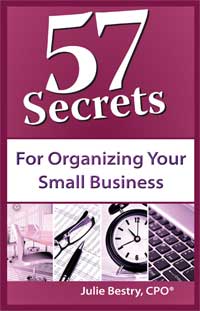
- Organizing is my passion, and I truly want my clients and readers to benefit from whatever I learn and can share. I invite you to read not only the Paper Doll blog, but also the variety of general organizing articles and be aware of my special reports and books. Speaking of which, if you’ve got paper clutter (and you probably do, if you’re reading this blog), I think you’ll get a lot out of 57 Secrets for Organizing Your Small Business.
- I couldn’t survive without Jane Austen, The West Wing, Gilmore Girls, old black-and-white movies, Billy Joel, Elvis Costello, and Coffee Crisp candy bars (which come, incidentally, from Canada, as does Janet Barclay).

PAYING IT FORWARD
I’m always proud to be considered an expert in organizing and productivity, particularly with relation to paper management. But nobody becomes an expert without learning from the brilliance of others, and I’m eager to pass along the Very Inspiring Blogger Award to the bloggers who inspire me to learn more every day.
Jeri is a triple-threat. First, she writes her own blog, the eponymous Jeri’s Organizing & Decluttering News, where she mixes organizing wisdom with reviews of resources that are functional, aesthetically pleasing and downright nifty. From surfboard storage to kitchen organizing, from clutter avoidance to superior staplers, there is simply nobody with better search skills than Jeri, and she turns that research into clean, clear, useful writing.
But Jeri doesn’t limit her genius to her own pages. Jeri also blogs weekly for the design web site Core 77, where she finds and shares the most gorgeous and well-designed organizing products and lends her insight to how, when, where, and by whom these products are best used. And Jeri’s also a weekly blogger from the hub of the organizing blogosphere, Unclutterer*, where she dispenses advice on topics as wide-ranging as recycling, photo scanning, aging in place, and coping with inherited possessions.
If there’s something to be known in the organizing world, Jeri will find it and share it in a comprehensive and comprehensible way.
*I could write a whole other post about Unclutterer and its Editor-in-Chief, Erin Doland, who is, to my mind, the funniest person on Twitter.
Janine’s Peace of Mind Organizing Blog is a gem! Janine, a Certified Professional Organizer, may not be quite as prolific as Jeri, but I find myself returning to Janine’s blog over and over for inspiration here at Paper Doll HQ. When I didn’t quite understand Mark Forster’s innovative series of task management systems (Autofocus and Superfocus), Janine had me covered. When clients have questions about organizing their genealogy research, Peace of Mind and Janine’s other blog, Organize Your Family History, are my go-to resources. My favorite of Janine’s posts will always be her gorgeous take on task management BINGO.
What I love most about Janine’s posts is that they are smart, funny and straight to the point. She injects herself and her spirit into every post, so it’s like getting a letter from a savvy, enthusiastic friend.
When I wrote a testimonial for her book, The Professional Organizer’s Bible, I called her an iconoclast. But she’s also the icon who created the original OnlineOrganizing.com web site that gave a start to so many of the current slate of professional organizing bloggers, myself included.
I like to think of Ramona as our fairy godmother in biker boots, and her blogs, Beyond Organized, Who Wants to Get Organized? and Living In a Tin Can (about her organized life in an RV), cycle through almost two decades of Ramona’s experience in the organizing and productivity field, so you never know what’s going to pop up.
Lest you think I’m only inspired by the ladies of organizing, be assured, I’m a regular reader of some fabulous fellas, as well.
Deron is an organizing expert who loves technology, and like Paper Doll, is a Mac user. If that weren’t enough to make us fast friends, Deron writes LONG posts for his Bos Organization Blog. Really long. Like, longer than mine! Some are philosophical, like his How Organizing Can Help a Worried Mind. Others combine digital wisdom with organizing advice, like his No More Shoeboxes: Steal My Expense Tracking Workflow. Deron has even taken it upon himself to share his insights on the work of other bloggers and writers, such as in his PhD-level thesis treatment of another VIB winner (see below) in his A Detailed Summary of Brooks Duncan’s Paperless Document Organization Guide.
But for inspiration, no productivity post has captivated me like Deron’s 21 Quick Actions You Can Do Today To Change Your Digital Life Forever. I’m working my way through, and you should, too!
Can technology be inspiring? Can talking about going paperless be motivational? If Brooks, the man behind DocumentSnap is doing the talking, it sure can.
Technology moves quickly. There are either 73 different ways to achieve something you want to do, or no apparent way to do it at all. Brooks brings clarity to issues related to scanning, Dropbox, Evernote, Hazel, and all the other technology that helps you be more productive and less paper-cluttered.
What really delights me about Brooks’ blog is that not only does he explain things I wish I knew more about, sometimes he answers questions I didn’t even know I had, as Change Mac Default To Search The Current Folder did two weeks ago. It’s already saved me from yelling at my computer countless times!
All of the above bloggers inspire me — to learn more about organizing, productivity and technology, to share knowledge with readers, and to keep growing as a professional organizer and as a blogger. I appreciate Janet giving me this award, but just as much, I’m grateful for the chance to share these special bloggers with you.
Hanging Around — An After-Market Hanging File Solution That Works
As a professional organizer, I spend a good deal of time explaining to people that organization and productivity require two kinds of systems, physical and behavioral. Usually, I’m cautioning people not to rely too much on the physical — the shelves or the tubs or the apps or the tools. That’s because one’s behavior, one’s ability to stick to a system and to make changes only when something has been analyzed and found wanting, is the ultimate key.
You can have a seemingly ideal set-up of tubs on shelves, or digital files in a logical hierarchy, but if you always toss your craft supplies on the dining table or save every download to your computer’s desktop, no brilliant and pristine system can help you. It’s funny then, when I spend so much time downplaying the tangible resources in favor of the behavioral, that I’m talking today about organizing and productivity supplies, especially ones that don’t work.
Think about some of the physical things that slow you down:
- Staplers that put a crimp in every staple so that only one side of it “takes” and the other fails to attach. (Do you stop to fix or replace the stapler? Do you end up using a paper clip that makes your folders lumpy or grabs up too many pieces of paper at once?)
- Apps that auto-quit every third time you select them. (Do you research a replacement app? Do you stop get technical help? Do you just live with the annoyance?)
- Color-coded systems that break down every time you run out of a red folder. (Do you leave piles of un-filed papers until you get around to buying the color folder you need?)
- Cabinet shelves that are too deep to reach more than the front half, or stuck in corners where it’s too dark and tight to reach anything at all. (Do you install lazy Susans and keep items in more easily reachable open-top tubs, or do you just struggle?)
To this list, I add the after-market hanging file system. Most filing cabinets and file drawers have built-in hanging file rails for letter and/or legal sized hanging folders. But some down-market, cheaper filing cabinets and older desks have drawers with no rails at all. “Not a problem,” the vendors and garage sale purveyors promise. “You can buy after-market hanging file systems.” Well…
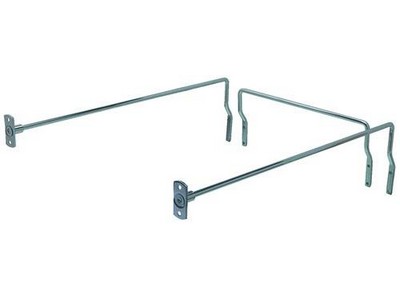
I will now tell you the secret truth. These never work. They can be difficult to put together. (Not IKEA-level difficult, but enough to make you contribute to the office curse jar.) They’re often uneven in height, so they wobble like a table in a bad restaurant — but you can’t fix them by wedging sugar packets underneath. They’re usually unevenly spaced across the span of the top, so that files may hang well on the front of the rails, or on the back, but rarely in the middle, and files won’t slide smoothly, tending to fall off the rails on one side or the other. And most after-market hanging rails SQUEAK! (No, not with cute stuffed animal, mouse-like squeaks, but fingernails-on-the-blackboard squeaks whenever the drawers slide or the files are moved about.)
For all these reasons, I encourage clients to make sure that when they purchase desks or filing cabinets, or have them built for new homes, that they make sure that file rails are built-in. If I’m with a client who doesn’t have filing furniture and doesn’t have the option to acquire something new, I usually recommend file crates.
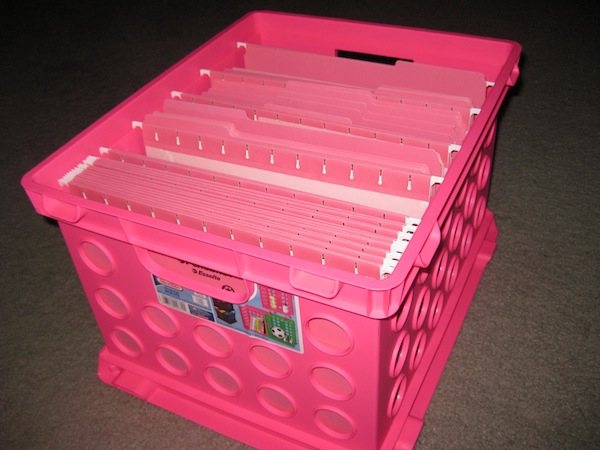
They’re portable, stackable, incredibly inexpensive, generally of high enough quality to suit one’s needs, and they don’t squeak.
Sometimes, however, clients truly need a working after-market hanging file solution for inside drawers and cabinets. That’s why I was delighted to speak with our friends at Smead earlier this year at the National Association of Professional Organizers Annual Conference and Expo as they debuted their new hanging file product.
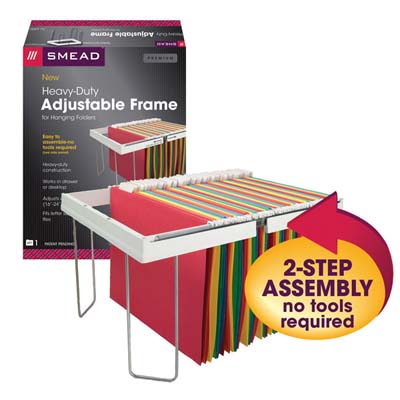
The Smead Heavy-Duty Adjustable Frame for Hanging Folders is designed to adapt to various filing situations. Paper Doll put it through a series of roughhousing tests and found that it was up to snuff. The frame is:
- Easy to assemble and requires no tools. The plastic frame (with a metal base) snaps together easily.
- Adjustable — a simple pull or push lets you adjust it to a variety of drawer lengths, anywhere from 16″ to 24″ in length.
- Balanced — whether you position the frame inside a file drawer or on your desktop, there’s no wobble.
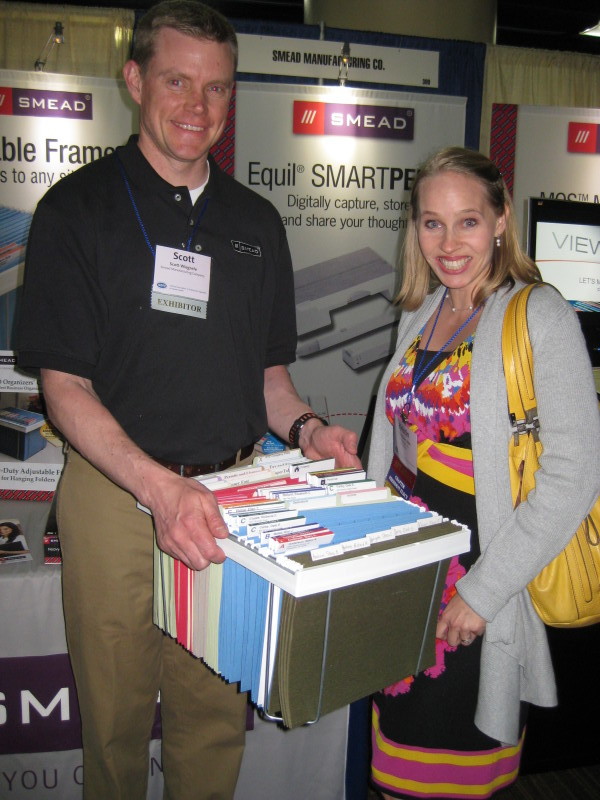
- Portable — with most after-market hanging file systems, trying to move the files from one cabinet to another, or over to a central desk for special projects, can be a nightmare. As the photo below (with my colleague Kristin Diver and Smead representative Scott Wiegrefe) illustrates, the Smead Heavy-Duty Adjustable Frame lets you lift, carry and reposition files without an unexpected game of 52 Pick-Up.
- Squeak-free!
Smead’s Heavy-Duty Adjustable Frame for Hanging Folders can be found at Amazon for about $23 and at traditional office supply stores.
As always, any physical system is only as good as the behavioral system you have in place. This hanging file frame won’t file your papers for you. It won’t purge files at the end of the fiscal year. And it won’t make you stop and think about whether the documents you’re saving or the nomenclature you use actually make sense, or will make sense in six months or six years. For that, you’ll want to go back to the basics of filing.
- Paper Control 101
- Paper Control 102–Advanced Topics & Office Hours
- Paper Control Graduate Seminar–Very Important Papers
- Paper Control–Open Book Exam
- Paper Doll Gives You the Business (Files) — Part 1
- Paper Doll Gives You The Business (Files) — Part 2: Reference Papers
But an easy-to-assemble, squeak-free, smoothly-running filing frame will help you eliminate some of the reasons you might be procrastinating on tackling your work or home office filing system. And that’s a great place to start.
NAPO 2015 Expo: Magically Organize Your Writing with the Equil® Smartpen 2
We professional organizers are pretty easy to intrigue, but hard to impress. We like novelty, and you can hear our oooohs and aahhhs across the ballroom floor at the NAPO Organizing Conference and Expo when a vendor lengthens a folder tab, come out with a poly version of a product formerly only available in paper, or builds a better hanging folder.
But as much as we appreciate novelty, we’re quick to note shortcomings as well. We’re dismissive of features we can’t see our clients actually needing, and we’re dubious of also-rans — the third or fourth or fifth practically identical copy of a product or app that doesn’t improve upon the original.
One of the products that caught Paper Doll‘s eye, and kept it focused, at this year’s Expo is a hybrid, bringing two separate but related processes together. In the past, we’ve focused on paper hybrid office products:
- An Organized Hybrid: The Evernote Smart Notebook By Moleskine
- From Paper to the Cloud: Ampad Shot Note
- It’s a Notebook! It’s a Whiteboard!: 3 Dry-Erase Notebook Innovations
In the above cases, we’ve looked at notebooks and notepads that work two ways. But what about a writing implement that can do double-duty?
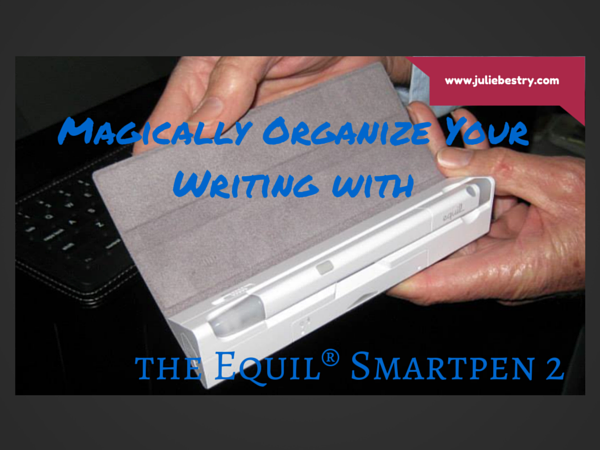
Equil® SMARTPEN 2
Friend of the blog, Smead, is known primarily for paper-related office products (e.g., folders, organizers, dividers, folios, etc.), and we’ll get to the newest of them in an upcoming post. But recently, Smead has been acquiring interesting and useful tech and tech-ish products, like the MOS: Magnetic Organization System for cable and cord organizing, Stick N Find bluetooth trackers, and MOS Spring Cables for strong, tangle-free syncing, charging and playing audio.
The Equil® SMARTPEN 2 is the latest innovative acquisition, and it’s a doozy. What does it do? The SMARTPEN 2 lets you:
- Create handwritten notes, sketches and diagrams on real paper (whether that’s a fancy Moleskine or a cocktail napkin). But it can also be used as a stylus to write and draw on your iPad, which the company claims it does with superior accuracy. (Paper Doll‘s drawing skills would be a poor test of this acuity, I assure you.)
- Capture writing and doodlings and digitally transfer them to Windows, Mac, iOS and Android devices without scanning or snapping photos.
- Save, modify and share the digital version of your notes (so you’ve got the original paper version, suitable for framing on your wall or locking in your safe deposit box, and the digital — even modified — version in the cloud or on your devices.
- Oh, and that modification? It includes the ability to convert your handwriting into readable, searchable, editable printed text.
- Share via email, Facebook, Twitter, and other social media, or upload to the cloud for saving and sharing to Evernote, Dropbox and iCloud.
- Whatever you create with the Equil® SMARTPEN 2 syncs across all of your devices, so wherever you are, you’ll be able to create anew or access what you’ve already written.
THE BASIC ELEMENTS
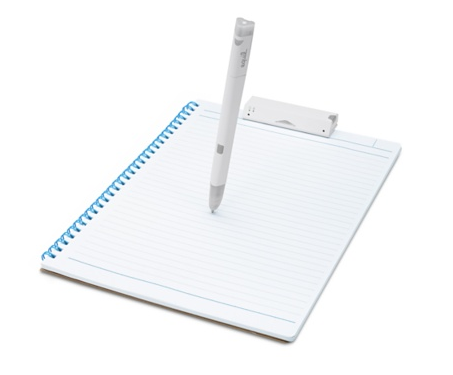
The Equil® SMARTPEN 2 looks like an Apple product. It’s all white-on-white, and comes packaged in a streamlined charging cradle, a triangular base into which the two operational parts snap, and the case comes with a grey “wrap” (called a convenience case) similar to the iPad Smart Cover.
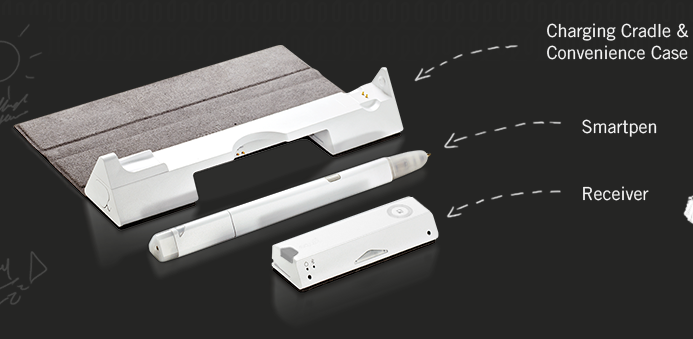
The Pen — This is a technology-“enabled” pen. That means it’s a real pen, on its own, and uses regular ballpoint ink cartridges. It’s pressure-sensitive, so it can capture every nuance of what you draw, and if you press heavily (and perhaps repeatedly), with insistence, the pen knows you’re doing the equivalent of bolding your text and SHOUTING with intensity.

In order to save the battery life, the pen goes to sleep if you don’t write for a while. One press of the small button atop the pen wakes it up, and that same button functions to alert the receiver to a “new page” (creating page breaks) and to let you go back and forth between saved pages of notes.
The charging cable includes one replacement ink cartridge.
The Receiver — At first glance, the 3″ W x 1/2″ H receiver device looks like a clip for a clipboard, and it fastens to the top of your notepad or paper in a similar manner. The pen and the receiver connect via magic (OK, infrared and radio frequency communication). The receiver determines the boundaries of the page and flashes a small red light to alert you when you’re getting too close to the top or the bottom edge of what it can detect.
As you write with the pen, the receiver device saves your notes in the built-in memory.
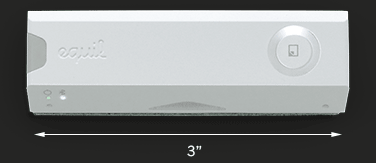
The receiver holds 10,000 pages of notes. When you reconnect your pen to your digital device, you automatically receive an alert about any new notes, which are ready to be imported.
You can digitize your notes in real time, but it doesn’t matter if you’re not connected to your phone or other device when you’re in creation mode. When you are ready, at the touch of the button on the top of the receiver, whatever you’ve created can be uploaded from the device and imported to your computer, phone, or tablet. (Not your fancy watch, though. At least, not yet.)
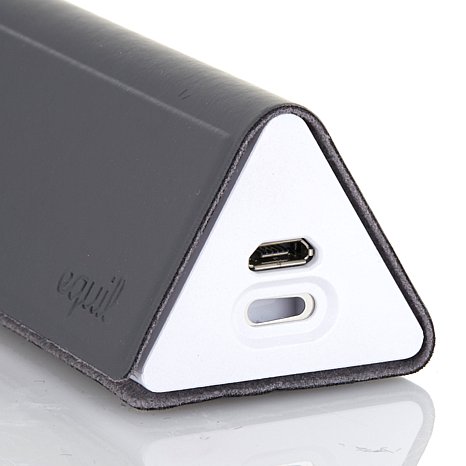
The pen and receiver are rechargeable, and the specs claim you can write or draw for eight hours between charges. Just pop both the pen and receiver into the USB-compatible charging cradle. (The receiver has a battery life indicator and a charging indicator, so you shouldn’t have any surprises.)
The SMARTPEN works with two free apps:
Equil Note — This app lets you save and organize any of the written notes you take with the SMARTPEN 2. Edit, enhance, and share them with friends and colleagues. Convert your handwriting to text for easy editing and sharing.
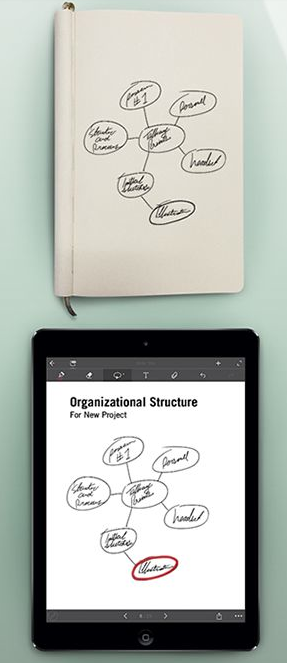
Equil Note has apps for iPhone, iPad, and Android mobile devices, as well as Mac and Windows for desktop use. It’s available in English, French, Spanish, German, Italian, Portuguese, Russian, Chinese (Simplified and Traditional), Japanese, and Korean.
Equil Sketch — The sketch app lets you draw with a finer degree of control, and includes digital options like multiple brush styles and layering. You can start a picture on paper, and finesse it on the screen.
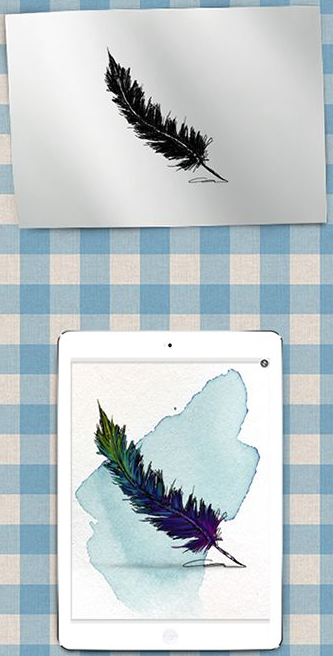
Through the apps, you can digitally choose from a variety of colors and pen tips, and up to 600 levels of pressure sensitivity, and then add more text and/or photos, digitally. You can also tag your notes so you can search and locate your content quickly.
The Equil Sketch app is only available for iPhone, iPad and Android digital devices (not desktop), and is compatible with all of the same languages as Equil Note, except for Korean, Portuguese, and Russian.
PRICE
The Equil® SMARTPEN 2 retails for $169.95 from the Equil shop, or for about $149 from Amazon, Apple and Best Buy. Access to the apps is free with a purchase of the pen.
THE FINE PRINT
There’s glossy marketing, and then there’s the occasional factual balloon pop.
Although the press materials reference doodling on a napkin, and the pen can capture notes on paper as small as a sticky note, the official specs say that the recommended paper size is 250mm x 330mm (9.85″ x 13″) or smaller — that’s anything below Letter size (US standard) or A4 (UK standard) — and notes that things “may not work properly if the paper is too small for the receiver to clip on and may have writing recognition issues if the paper surface is rough. (i.e., cardboard).“ So, don’t plan to write on something the size of a postage stamp or your next summer camp care package.
Next, the Equil® SMARTPEN 2 communicates to your digital devices through bluetooth pairing — if you’ve ever used a bluetooth headset for your phone or a keyboard for your iPad, you know to prepare for some set-up time before you can get started. One note I found in the FAQ caused a slight pause: “Make sure to go through bluetooth pairing process each time you switch the devices you are using with Equil JOT.” It’s not entirely clear whether this means you have to pair the pen each time you switch from your tablet to your phone, or just the first time for each. FYI.
Finally, the SMARTPEN 2 measures 1/2″ around the thickest part of its triangular shape, slightly thicker than a traditional Sharpie. It tapers down as you get closer to the pressure-sensitive pen-tip. Still, if you’re used to a slender, rounded pen, the grip of this might take some practice for creating fine detail.
Take a look at the Equil® SMARTPEN 2 in action.
THE COMPETITION
The Equil® SMARTPEN 2 isn’t the first to combine writing on paper with writing on a digital device and making it all interactive. (Even the SMARTPEN 1, the first iteration, wasn’t exactly first.) The Livescribe Smart Pen series (including the newest Livescribe 3, the Sky WiFi, and Echo, and older iterations) was the first to break out in this area, and for many years, I would gush when techie colleagues would show off their Livescribes. The Livescribe pens also had an embedded audio recorder, so you could tap a portion of your notes to hear what was being said contemporaneously with whatever you wrote. Pretty grand!
But the SMARTPEN 2 continues to have one advantage over the various Livescribe versions that can’t be overlooked. You can use the Equil® SMARTPEN 2 with pretty much any type of paper or notebook, so you can stick to your preferred notebook style, but after all these years, the Livescribe options still require that you buy special digital paper notepads to work. Paper Doll doesn’t know about you, but while I’m occasionally willing to shell out for a truly exceptional gadget, having to buy pricey notepads just so the pen can work is a deal-breaker for me.
WHO IS IT FOR?
Obviously, not everyone needs a smart pen. If you’re fine with keeping handwritten notes and rarely need information in digital form, you can pass. If you spend your time sitting at a desk, fully Wi-Fi-enabled, or are good with the “thumby” thing, typing without a real keyboard, even when standing or walking, it may not be for you. The SMARTPEN 2 is ideal, however, for those who are on-the-go, often standing, or in rough-and-tumble surroundings. I’m thinking of my client who is usually up in a bucket truck, using his iPad to take notes but risking damage to his expensive gadget. Or camp counselors checking kids in for the summer and taking notes of parents’ special requests. Engineers and architects, working on-site. Community physicians and nurses who don’t have immediate access to electronic medical records and are taking notes on-the-fly.
With the handwriting recognition feature, particularly the ability to turn handwriting into text, and the ability to use regular paper, the Equil® SMARTPEN 2 is worth some attention.
I’d love to hear your thoughts.
NEET & Cozy Cables: A NAPO 2015 EXPO Organizers’ Choice Award Winner
Everybody complains about cable storage. You can’t swing a lightning cable without hitting a blog post or video or Pinterest page on keeping cables untangled, separated, and safe, whether via retail products or DIY methods. For example:
- Paper Doll’s Cable Conundrums & the MOS: Magnetic Organization System
- Organizing the Cords Under Your Desk! by Helena Alkhas
- Cords and Cables and Labels and Controlling the Cables: 3 Novel Solutions by Jeri Dansky
- 10 Ways To Get Cables Under Control by Gina Trapani
- Organize, Store and Buy Computer Cables Wisely by David Caolo for Unclutterer
- How To Tame Cable Cord Chaos (video) by Lori Marrero
- Untangle Your Life: Living Organized With Cables and Cords by Apartment Therapy
- 61 Clever Cord Organizers
However, most of the standard stabs at keeping cables and cords organized seem to focus on cables that stay put in your home or office. Other than Paper Doll-recommended Grid-It!, a past NAPO EXPO fan favorite, we rarely see much about how to corral cables in transit so they don’t get tangled in our book bags, purses and when we’re on the go. Happily, the NAPO 2015 Annual Conference and Organizing EXPO had an exciting new entry in the world of cable organization.
NEET Cable Keeper
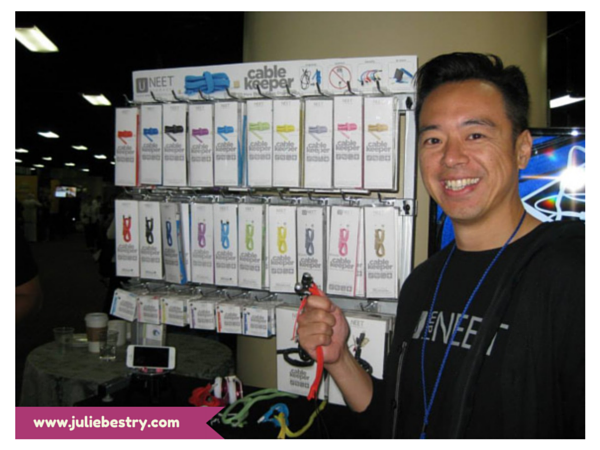
(©2015 Julie Bestry. Peter Chin, founder of NEET Products.)
Winner of the 2015 Organizers’ Choice Award, the NEET Cable Keeper is the equivalent of a tea cozy for your cables, if your tea cozy were crossed with a hoodie crossed with a corset. Each long, colorful strip of cloth material — NEET calls it a “shell” — isolates a single cord or cable from any other, and then includes these essential features:
Zipper — Here’s where the hoodie action comes in. There’s no threading your cable or cord through a complicated maze of plastic molding. (If you’ve ever tried to replace a drawstring in a pair of sweatpants, you know how frustrating that can be. Yes, you can attach a safety pin to guide the string, inch by inch, but ARGGGGGHHH, just recalling that makes Paper Doll grumpy.) Merely lay the cord or cable down across the NEET Cable Keeper and zip it up!
The bottom of the shell is flared, which allows you to encase larger USB ends, and it has ample space for multiple cables to be enclosed.
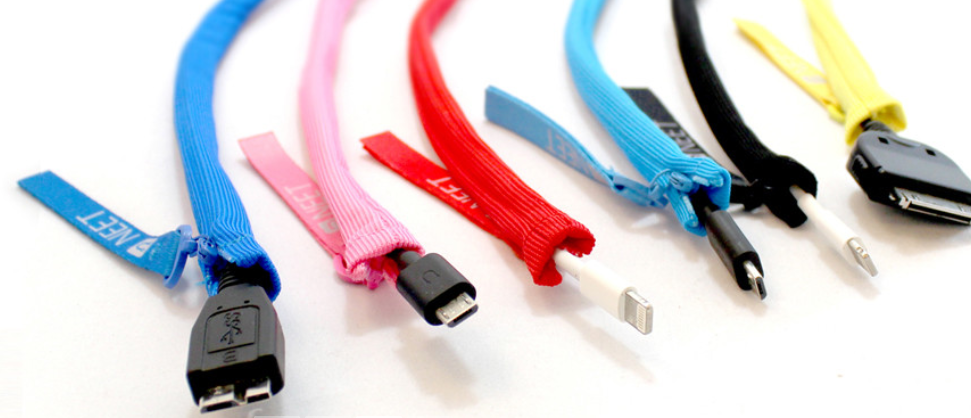
Structured Wire — Sewn into the length of the cloth strip is a bendable wire, much like the stays in a (modern) corset, that provide support stiffness and support. The structured wire services two purposes:
- It protects your cables and cords from damage. There’s no chance you’ll repeatedly fold your cord so tightly that the plastic coating will wear away, or accidentally crush it in a slammed filing cabinet drawer, damaging the delicate internal wires.
- It provides support for the whole cable or cord, making it suitable for wrapping neatly around your wrist as a bracelet, turning it into a loose necklace, or otherwise, bendy, gooseneck-lamp-style, making it beautiful as well as useful. NEET’s website even shows how to bend it into a stand for a smartphone.
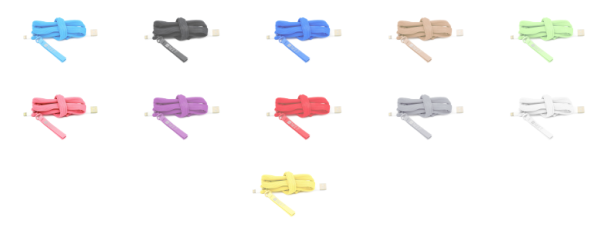
Colorful Wardrobe — The NEET Cable Keeper comes in a variety of colors, so you can tell at a glance from across the room whether the cable you’re spotting is your Kindle charger or your Apple Lightning cord. The NEET Cable Keepers come in black, blue, gold, green, light blue, pink, red, purple, silver, white and yellow.
After you zip your cable cozily into the NEET Cable Keeper, like a toddler into a snow-suit, you’re set. It becomes part of the cable itself, so you have no additional pieces to carry or potentially lose; there’s no reason to take it off, unless you’re one of those people who likes to change the colors of your accessories on a daily basis. (Really, stop that.)
Take a peek:
You can get the Keeper two ways, both designed for mobile device cables measuring 3 feet (or about 100cm) or longer and 1/4″ in diameter. If your cable is longer than 3 feet, the width of the Keeper will accommodate you gently folding it before zipping it up.
- NEET Cable Keeper M, with just the Keeper, is $12.
- NEET Cable Keeper M with either a Micro USB cable or an Apple Lightning cable is $18.
It’s available directly from the NEET, and via Amazon, The Grommet and a few other retailers.
Although they are not yet available for purchase, NEET is developing a line of cable organizers for ear buds, laptops, home entertainment, and professional use such as for DJ’s and audio/visual work.
If you own a business and think it would be cool to brand these NEET Cable Keepers for your own customers, NEET founder Peter Chin says, “The NEET Cable Keeper is customizable! We can customize NEET for you to promote your company, event, and brand. Great for corporate giveaways, employee retention programs and brand awareness. Send us a message and we will gladly connect you to our authorized customization partners.”
Zip, wind and organize. Neat (I mean, NEET), eh?
NAPO 2015: Conference By the (Organizing) Books
Longtime readers of the Paper Doll blog know that the majority of the time, I’m writing about paper and information flow, and how to keep it all managed, but there’s one time each year where we go beyond to explore all sorts of organizing knowledge and innovations. Every year, just after the National Association of Professional Organizers’ Annual Conference and Organizing Expo, we spend weeks talking about the education and the products that can help organizers and clients (and you!) get and stay better organized and productive.
This year, I’m starting the series with something new about the NAPO conference experience. NAPO members have access to a variety of Special Interest Groups (SIGs), sub-groups that help NAPO members focus on their areas of concentration. SIG offerings support those who work with students and seniors, who specialize in relocations or small businesses, who speak and coach, who deal with technology and protect the environment, and more. Paper Doll is a member of the Authorship and Publishing SIG (led by my colleagues Debbie Lillard and Deb Cabral).
This year, as part of the NAPO EXPO, the Authorship and Publishing SIG ran a bookstore booth, carrying some of the industry’s best-loved books, authored by our own SIG members. This included newly released titles, classic organizing books, and recorded media and information products created by our members, whose number includes true celebrities of the organizing world, including Judith Kolberg and Barbara Hemphill. We even had a day and a half of fancy-schmancy book signings!
All of this was put together by organizing profession ROCK STAR authors Donna Smallin Kuper and Ramona Creel, who quickly, efficiently, and creatively constructed an outlet for organizing authors to spread the gospel (if you will) of organizing and productivity.

(That’s iconoclastic, straight-shooting Ramona at the left, Paper Doll in the center, and prolific writer and speaker Donna on the right. Trivia note: both Ramona and Donna are full-time RV-ers. Apparently genius preserves well in tin cans!)
If you’re reading this but were unable to attend NAPO 2015 and feel like you missed out, never fear — Paper Doll has you covered! I’ve listed each of the books and resources from our booth here, with links so you can check them out in depth, and perhaps make them part of your own personal library. Where possible, I’ve linked to Amazon paperback copies (because, well, I am your Paper Doll); you should be able to easily navigate to Kindle versions. (Please note that these are affiliate links and I will receive brownie points in the form of green pieces of paper if you purchase after clicking through this links.)
Home/Life Organizing Books
A Mom’s Guide to Home Organization by Debbie Lillard
DeClutter Your Life NOW! A Motivational Guide to Tackle All Aspects of Clutter in Your Life by Deborah Cabral
Make Room for Clarity by Rick Woods
How to Declutter and Make Money Now (2nd Ed, 2015) by Donna Smallin Kuper
50 Shades of Organizing…Your Life by Susan Unger and Lauri Mennel
Organize This! Practical Tips, Green Ideas, and Ruminations about your CRAP: Clutter That Robs Anyone of Pleasure by Vali Heist
Now What? A Simple Organizing Guide by Diane Quintana
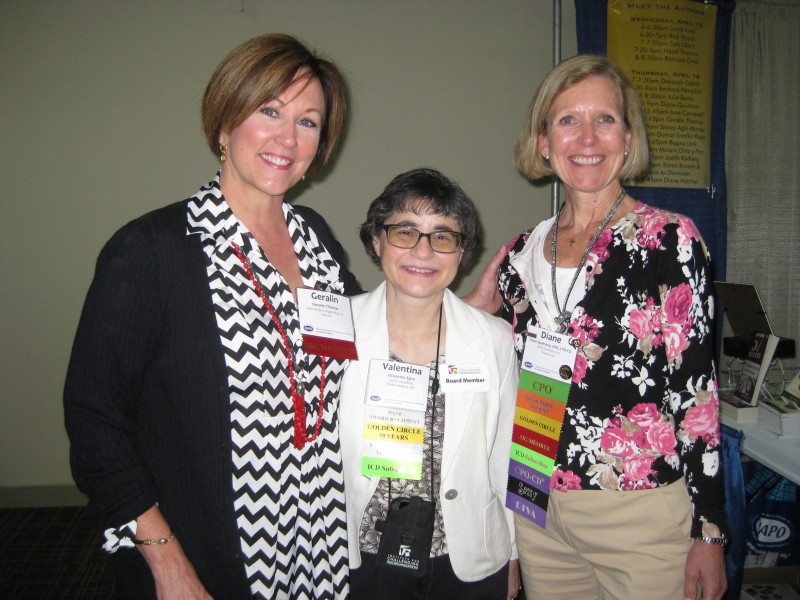
(On the left is TV superstar Geralin Thomas; on the right is my longtime NAPO-Georgia friend and colleague and chronic disorganization specialist, Diane Quintana. They’re flanking the lovely and talented Valentina Sgro, author of the Patience Oaktree novels. Val wasn’t displaying her books, but she came out to support those of us who were!
Organizing Paper at Home: What to Toss and How to Find the Rest by Barbara Hemphill
The A-To-Z of Getting Organized: A Grown-Up Picture Book for the Chaotic and Cluttered by Ramona Creel
Life Cycle Organizing Books
Don’t Toss My Memories in the Trash – A Step-by-Step Guide to Helping Seniors Downsize, Organize and Move by Vickie Dellaquila
The Organized Bride’s Thank You Note Handbook: Let Systems and 101 Modern Sample Thank You Notes Take You from Overwhelmed to Organized by Stacey Agin Murray
Business Organizing Books
57 Secrets for Organizing Your Small Business by Julie Bestry (Hey, that’s Paper Doll!)
Don’t Agonize: Organize Your Office Now by Diane Hatcher
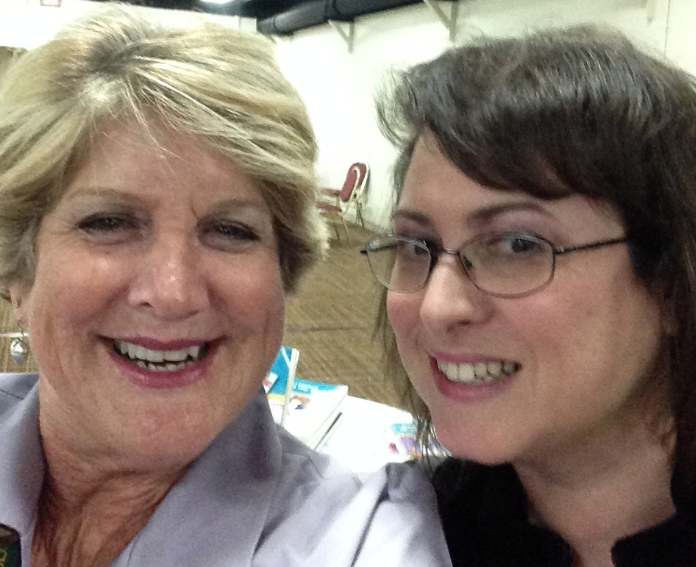
(The indefatigable Diane Hatcher has been keeping South Floridians on their toes since 1998!)
Professional Organizing Business Books and Resources
Before the Big O: Professional Organizers Talk about Life before Organizing by Regina Lark
Custom-Branded Clutter Flow Charts by Hazel Thornton
The Professional Organizer’s Bible: A Slightly Irreverent and Completely Unorthodox Guide for Turning Clutter into a Career by Ramona Creel
Student Organizing Books
What’s the Deal with Teens and Time Management by Leslie Josel
The Academic Planner: A Tool for Time Management by Leslie Josel
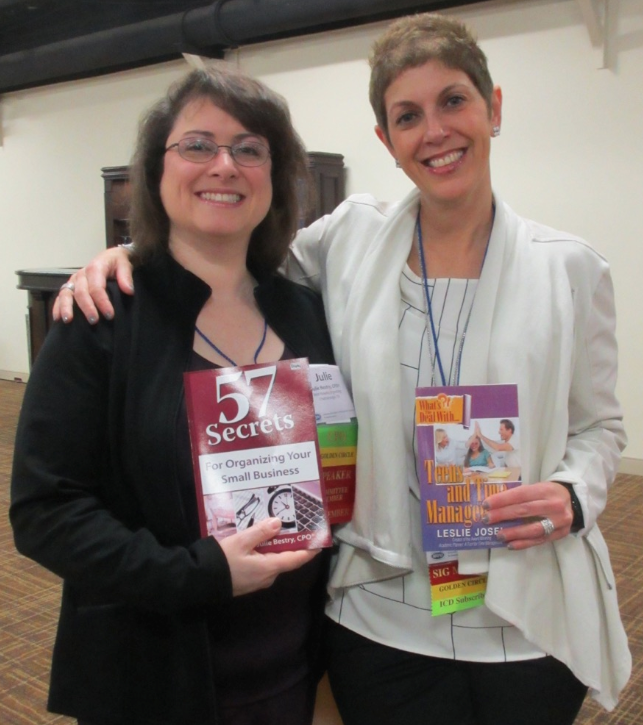
(The clever Leslie Josel is a fellow alumna of Cornell University. It’s obligatory that I note: GO BIG RED!)
Psychology Books
Psychic Debris, Crowded Closets: The Relationship Between the Stuff in Your Head and What’s Under Your Bed (2nd Ed., 2014) by Regina Lark
Chronic Disorganization and Hoarding Books
ADD-Friendly Ways to Organize Your Life by Judith Kolberg
Getting Organized in the Era of Endless by Judith Kolberg
Get Rid of Your Stuff Flash Cards by Judith Kolberg
From Hoarding to Hope by Geralin Thomas
Fresh Start: Overcoming Chronic Disorganization Group Manual by Karen Kruzan and Barbara Jo Dennison
Rise Above Your Stuff by Karen Kruzan and Barbara Jo Dennison (This title is new; check back often for an updated link.)
Inspirational Books
Less Clutter, More Life by Barbara Hemphill
Clear the Clutter, Find Happiness by Donna Smallin Kuper
For the Gifts We All Come Bearing by Jane Campbell
Time Management Resources
The Streamlined Time Solution by Miriam Ortiz y Pino
Until 2016…
I believe that the resurgence of a NAPO authors’ booth (we had one a decade ago, but it fell by the wayside) under the auspices of the Authorship and Publishing SIG is good for everyone. Professional organizers will be inspired by their colleagues to share their advice, which will, in turn, give the public more of an opportunity to see a wider variety organizing and productivity concepts and strategies presented by new voices and in different styles.
I’m inclined to believe that the authors of the above books — experts all, on productivity and organization — help bring that belief closer to reality.
Follow Me