Paper Doll
Happy Mother’s Day From Paper Doll HQ
As you read this, I’m celebrating Mother’s Day with the Paper Doll blog’s true inspiration — the celebrity who taught me how to sort, declutter and put things back where they belong. Longtime fans know her as Paper Mommy.
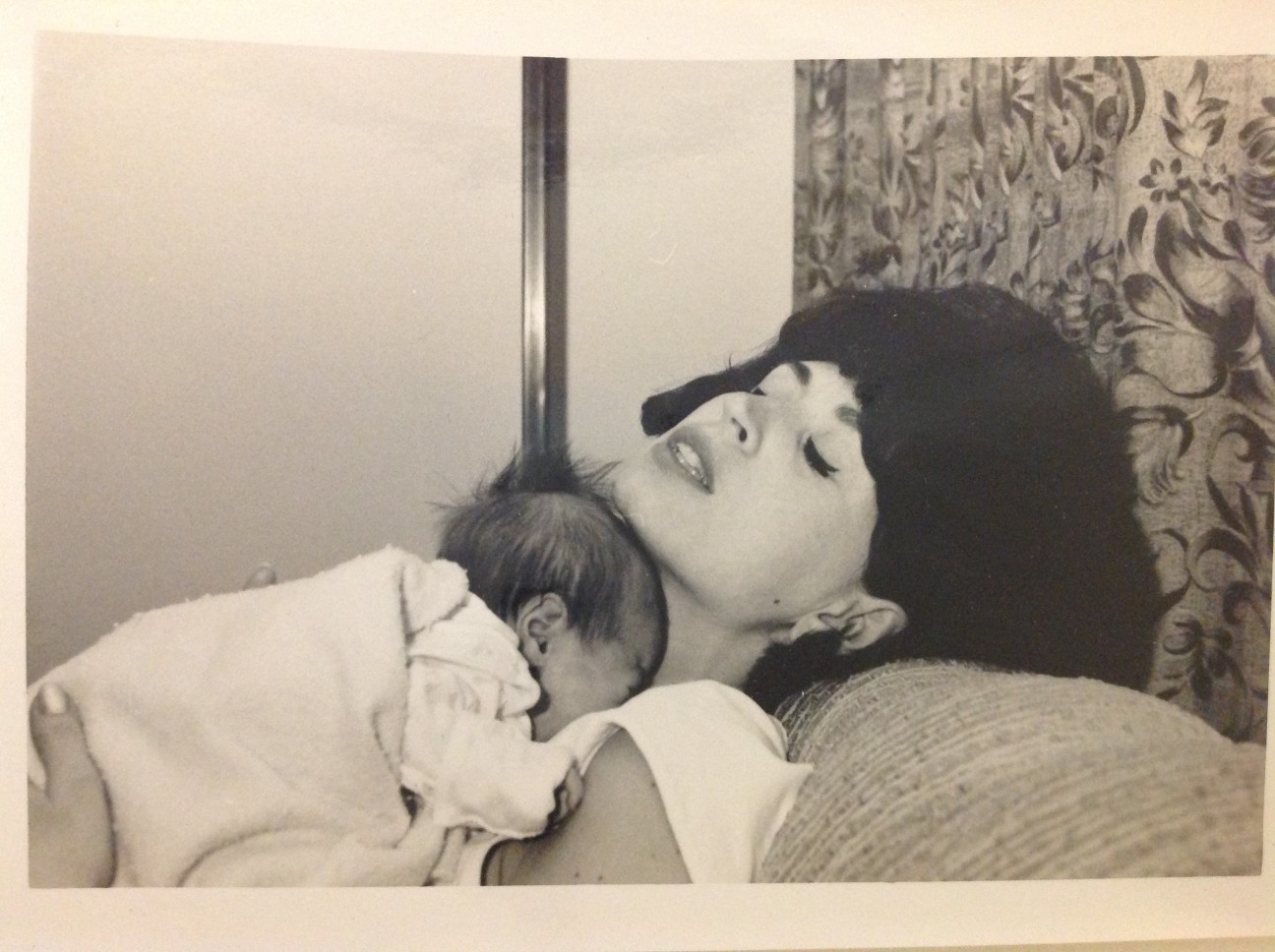
A Place for Everything and Everything In Its Place: Paper Mommy Finds Storage Space for a Tiny Human
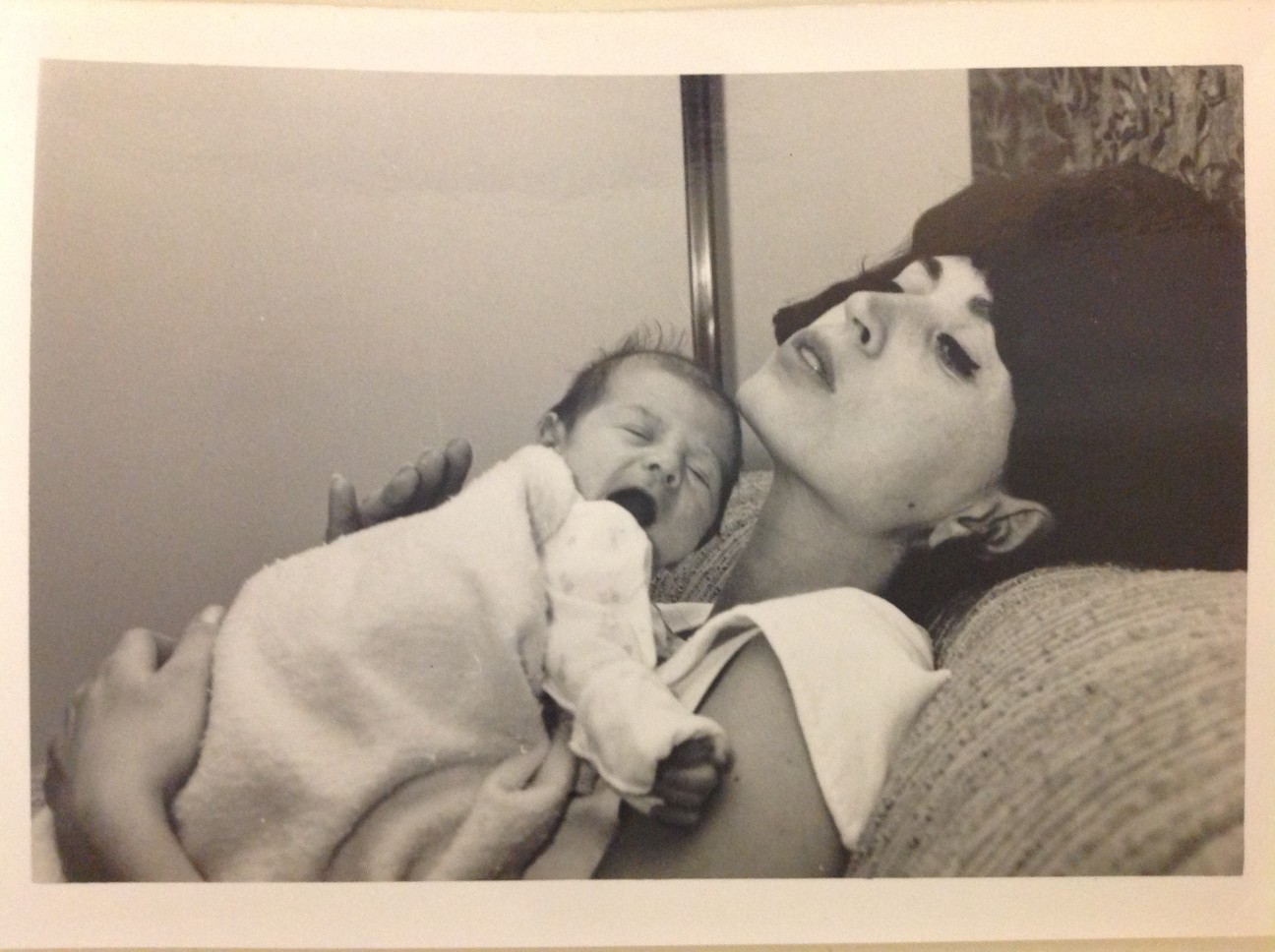
Paper Mommy, March 1967, realizing what a big mouth Paper Doll would have. “Oy.”
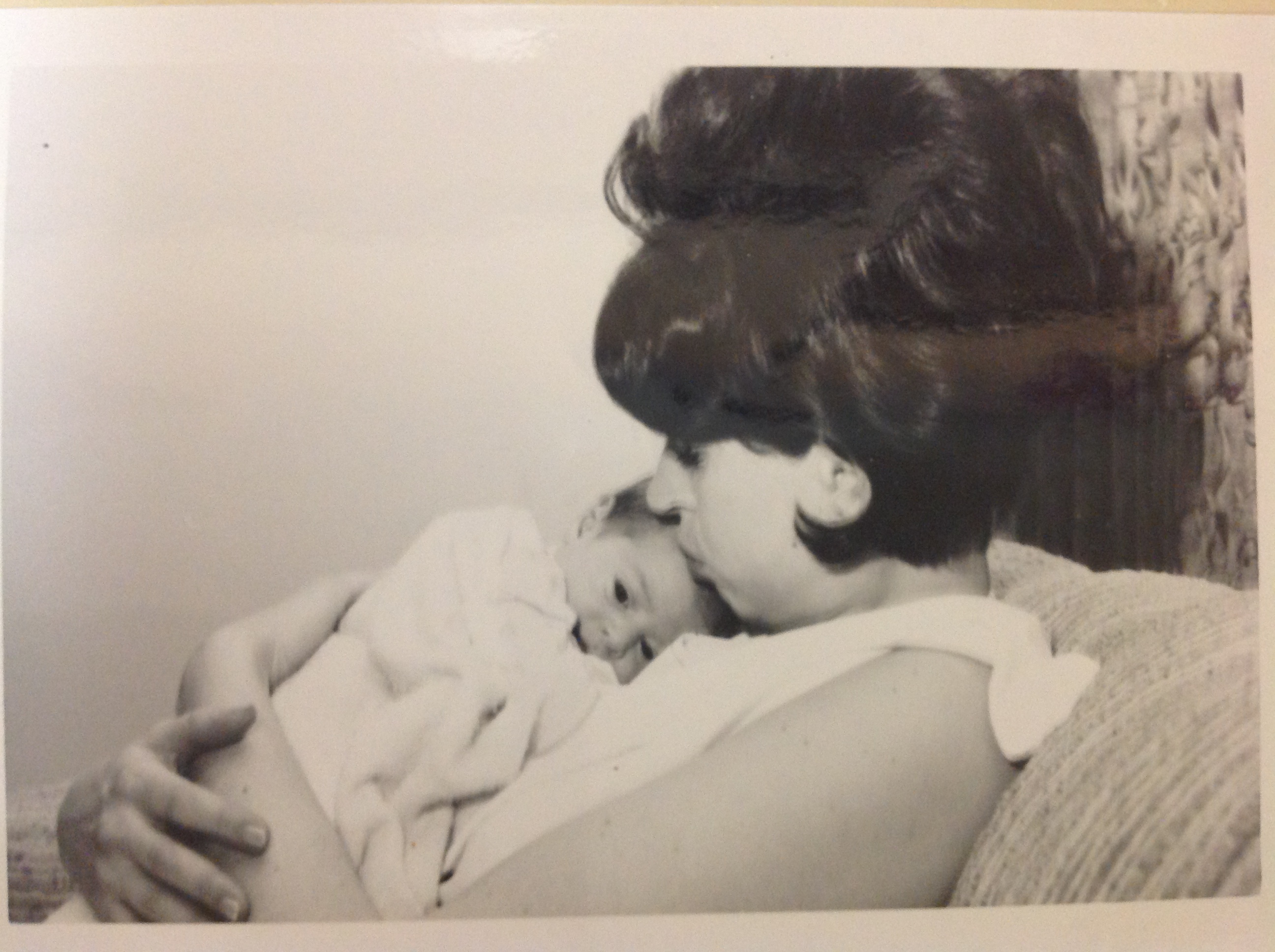
Paper Doll tells Paper Mommy, “I think I’m gonna like it here.”
Happy Mother’s Day, Paper Mommy…and to all the mommies (and kids, and kids at heart) out there.

Presto, Change-o! NAPO Expo 2013 Shape-shifting Organizing Products #3: Ampad Versa Crossover
Yet another shape-shifting organizing tool from the Expo at this year’s annual National Association of Professional Organizers Conference caught Paper Doll‘s eye. Merely changing how something looks may dazzle fans of Transformers (Have you heard? They’re robots in disguise!), but to pass the Paper Doll sniff test, a product has to not only change shape, but also improve function.
In our last two posts on binders and notepads, we’ve looked at how small features and format changes can really modify the user experience and not merely the appearance. Today, we’ve got one more item that has potential in that arena.
Ampad Versa Crossover Notebook
At first glance, the Ampad Versa Crossover looks like an unassuming Navy blue spiral notebook. (Such is the stealthy sneakiness of shape-shifting organizing products!)
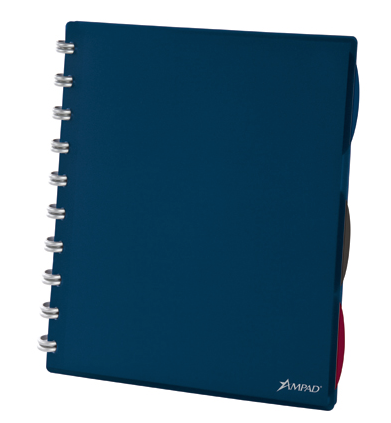
But upon further inspection, the benefits and added features of the Versa Crossover become obvious. First, it’s not a spiral notebook at all, but like the Staples Arc notebook I reviewed last year, the Versa Crossover Notebook is customizable and held together with plastic discs instead of wires. And the system appears to be less a notebook, and more a combination of notebook, binder, and day planner, all in one. Indeed, nothing is permanently bound at all!
The Basics — The front cover is made of sturdy poly; the rear cover is actually a flexibly poly doubled-flap that unlocks and folds out to display a plastic dual-pocket setup: one full-sized pocket and one half-pocket. The two surfaces can be folded together to click into place at the rear of the notebook or the outer flap (the part that doesn’t serve as the back cover) can be folded over a stack of pages to create a section divider, hiding some papers for security or improved focus.
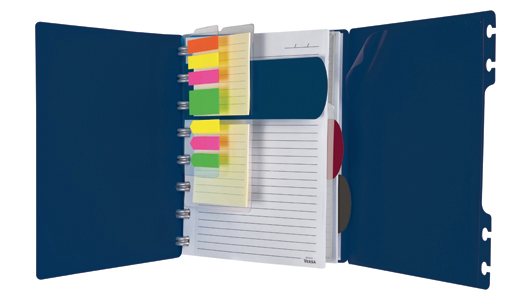
Flags — Each Versa Crossover Notebook includes a re-positionable plastic backing sheet bearing a combined total of 105 colorful tape flags and mini-highlighter flags. Position it at the front of the notebook, at the start of any section, or just prior to whatever note page you’re currently using.
Task pads — Ampad includes a larger plastic sheet with two stacks of thirty 3″ lined, sticky note task pads.
Clear poly security pocket — Use it to gather receipts, parking validations, tickets, business cards and more; then seal the envelope with the secure upper corner closure, and reposition the entire pocket to wherever is most convenient.
Plastic dividers — Three stiff-but-flexible, narrow, translucent poly section dividers, in black, blue and burgundy/red are included with every notebook. They can be positioned at any level of the page, and the dividers extend about a quarter of a inch beyond the outer notebook margin to enable easy access to just the right papers.
The key to the Versa Crossover Notebook’s appeal, however, is that the paper — indeed, all elements of the notebook, including the covers, flaps, flags, task pads, pockets and dividers — can be re-positioned anywhere in the notebook. That’s because instead of being attached by spiral wires, everything is held in place by the discs nestled perfectly inside uniquely shaped oval “tabby things.” (Ampad hasn’t provided a better name, so that’s what I’m calling them. They’re not quite key-shaped, or even sideways mushrooms. I’m sure Ampad would welcome improved nomenclature. Paper Doll sure would!)
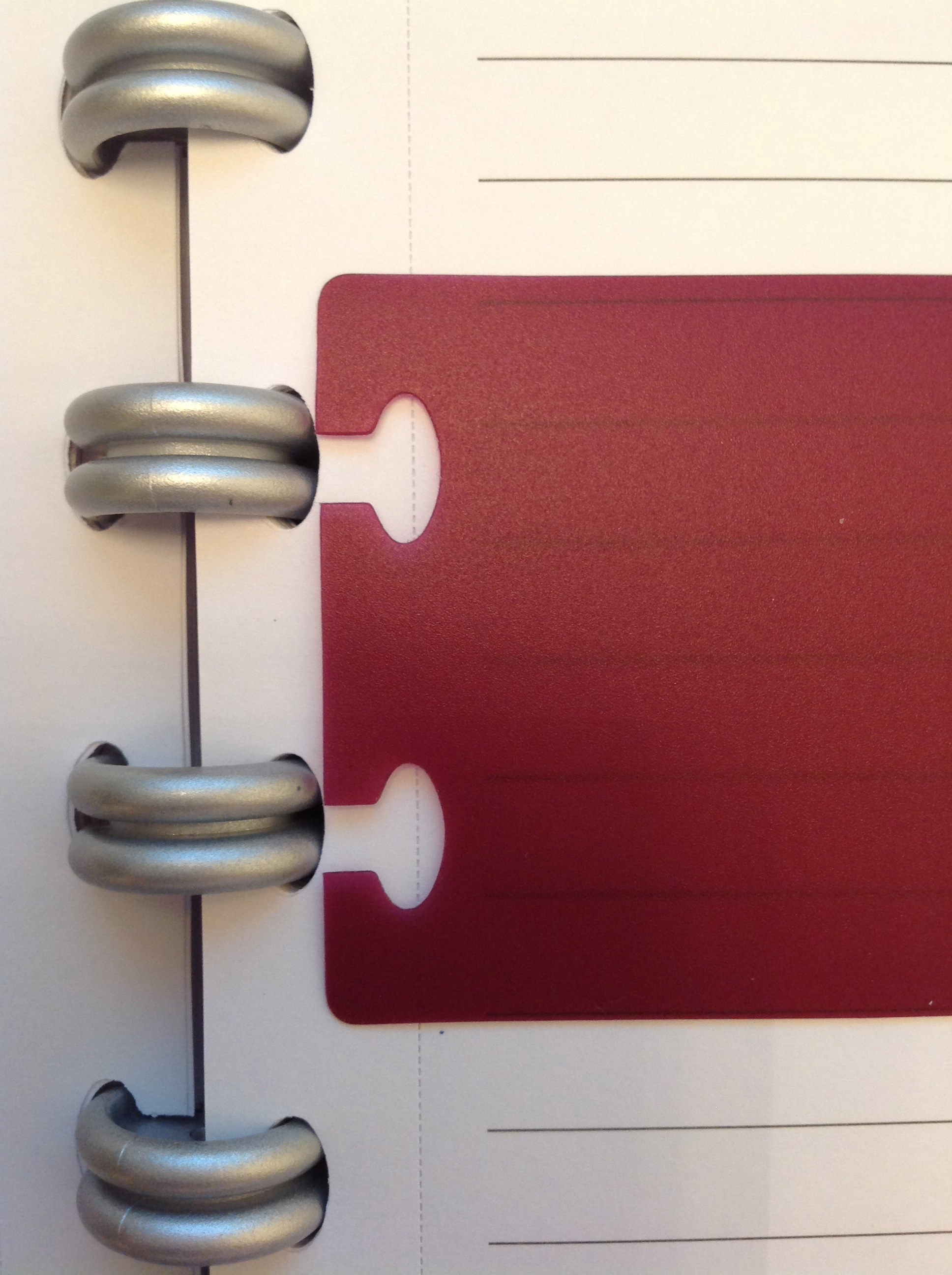
You might assume the paper would be hard to re-position, or would rip or become messy, but after repeated experiments at a secure Paper Doll testing facility (OK, my dining table), I found that the stiff paper held up to rigorous re-positioning (though the process worked best when at least three or four sheets, and as many as a few dozen, were relocated simultaneously).
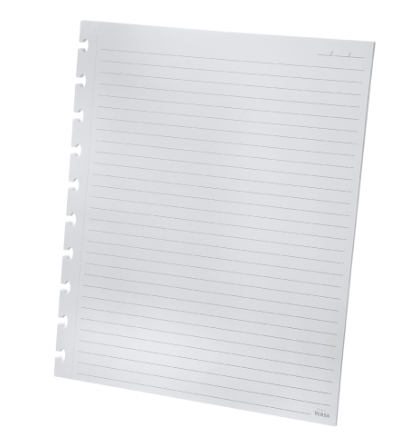
Each ruled sheet, lined on both sides, is pre-marked to remind you to put the date at the top (to improve chronological filing options) and perforated, yielding about 5/8″ margin from the edge of the page, giving ample space for the “tabby things.” (Seriously, have you got a better name?) Although the notebooks come with wide-ruled pages, graph paper is available in refill packets.
In addition to the Versa Crossover’s shape-shifting capabilities in general, I like that this notebook is especially lefty-friendly (in terms of handedness — you know this is an apolitical blog). Pages are lined similarly on both sides, so one can either choose to just write on the “reverse” side of pages, or flip everything upside down to create easily-accessed pages to the left of the rings.
The heavy duty Versa paper is appealingly thick and I’ve found that gel ink pens do not tend to bleed through to the reverse, making it easier to get complete use out of all of the paper provided.
However, I have a few suggestions to make the Versa Crossover Notebook fully customizable. First, from a utility perspective, Ampad needs to provide a hole punch to punch “tabby thing”-shaped holes in paper other than the ruled and graph paper already available. Users need to be able to insert their own documents (itineraries, boarding passes, calendars, etc.) into the Versa system.
Speaking of which, a blank calendar page would not go amiss as an addition to make this a little more planner-like and worthy of the price (see below). An optional business card holder would amp up the professional potential of this organizing tool.
Ampad’s official video walks the user through all the permutations.
The Versa Crossover Notebook comes in two versions, letter-sized and 6″ x 9″; 60 wide-ruled sheets come standard; both ruled and graph-style refill packets contain 40-pages of letter-sized or 5 1/2″ x 8 1/2″ sheets. Other accessory refills include double stacks of 3″ square sticky note sheets and tape flags; both varieties adhere to a plastic backing cut with “tabby things” to be inserted and re-positioned anywhere in the Versa Crossover.
The Versa Crossover Notebook is so new that I’m not seeing it listed at major office supply retailers like Staples and Office Depot. However, Amazon is pricing the letter-sized version at slightly above $17 and the smaller version about one dollar less. No pricing on refills was available at press time. (I realize I was on hiatus for twelve weeks, but my gracious, prices have really gone up on basic office supplies, especially those with whiz-bang ingenuity.)
Be assured, we still have oodles more organizing products to show off from the 2013 NAPO Expo. Come back soon!
Presto, Change-o! NAPO Expo 2013 Shape-shifting Organizing Products #2: Ampad SimpleSort Crossover
Each year at the National Association of Professional Organizers annual Conference and Expo, one of our favorite booths to visit is Esselte’s. The Esselte family, famous for Pendaflex and Oxford filing and office products, has added Ampad to the brood. Oh, but this is not your fourth grade teacher’s Ampad, with the same old boring notepads. Ampad has come a long way, Baby!
The Collating Conundrum
Longtime Paper Doll readers at the old site know that I’m a fan of legal pads. My preference is purple, because it’s easy to spot amid any cluttered client environment, but pink or blue pads work just as well.
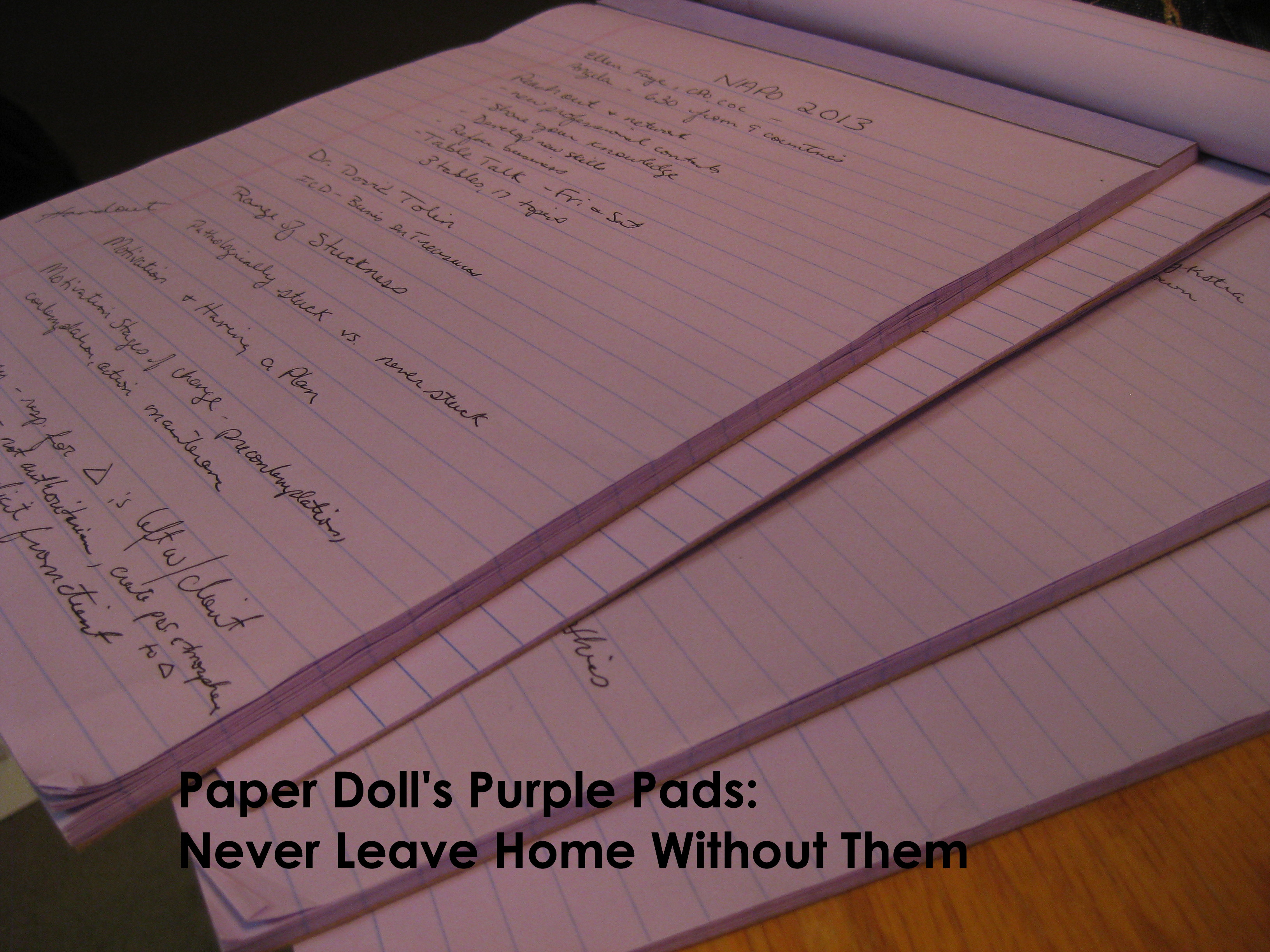
Everyone else has yellow or white notepads, so by keeping to the rich pastels, I’m more likely to spot my pad quickly, and in twelve years haven’t (yet) left a client site without it safely tucked in my bag.
The key to making perforated-at-the-top legal pads work for you is to make sure you keep similar items together. You can try to select different pads for different tasks (home improvement, individual work projects, party planning), and label the front page so you don’t mix up the pads, but it’s easy to be thrown off the mark. For example, one day last week, I was taking notes on a live teleclass when I got interrupted by a telephone call from a prospective client. Weighing the value of finishing the teleclass vs. taking the prospect call and later listening to the recording of the teleclass, I opted for the latter. Quickly, I flipped to the next page to take notes on my conversation. Later that night, when the teleclass recording was available, I started with a fresh page, but that still meant my papers — on the pad — were jumbled.
Eventually, I will tear off the pages for the teleclass and stack them with my Continuing Education Unit documentation for my next BCPO recertification. And the prospect’s page will either go in his client folder, if I’m hired, or a mass prospect folder, if not. But until I know, it’ll stay on the pad, sandwiched between unrelated items, and not exactly easily located. (Yes, even professional organizers may grab the wrong notepad sometimes.)
There are suitable alternatives to perforated legal pads, like three-ring binders, such as the Staples Better Binder we discussed yesterday. With a binder, you use loose-leaf paper, and sorting is as simple as opening the rings and moving any given sheet behind an appropriate divider. Just sort all your papers by (sub)category and group similar items together.
But binders are bulky. They’re great for storage, but it’s hard to take notes in a binder when you are in a classroom or lecture setting and don’t have a desk on which to spread out your notetaking paraphernalia. Experience has taught me that my left-handed clients can’t take notes in ringed binders at all. Sure, you can take notes on loose-leaf papers and only insert them in binders when you’re done with the course or session, but then you need to carry a clipboard or other hard surface, since there’s no cardboard or other type of backing to create a writing surface.
You can use spiral notebooks, of course, but then you’re faced with the same problem as with perforated pads — no way to collate the papers until you remove them from the notebook. Worse, you’re left with raggedy pages and the detritus from edges torn away from the spiral wire…unless you get the spiral notebooks that also have perforations. A spiral in a spiral, this is.
Introducing The Ampad SimpleSort Crossover Writing Pad.
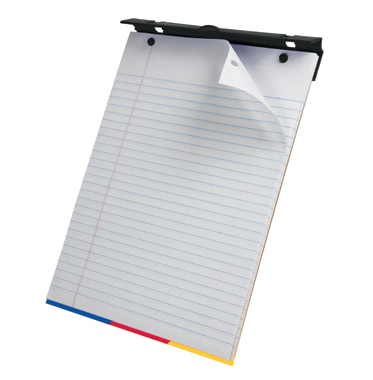
At the top, instead of holding the papers together with glue above a perforation, as you usually see with legal pads, there’s a hard plastic shell (Ampad calls it a “binder clip”) that flips upward to reveal little nubs. The shell snaps down over the nubs, holding the individual sheets in place. The two-hole-punched papers are perforated, so you can tear them off whenever you like, but for use on the pad, you can play musical chairs.
If, over the course of a day, you take notes on chemistry, math and literature (or are writing pages on your marketing plan, budget and To Do list), just flip-up the plastic shell, lift out the papers and enclosed section dividers, 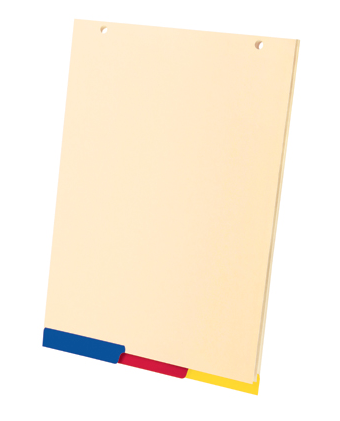
shuffle everything to your preference, and insert the individual paper pages wherever they belong. Simple. Sorted.
For you visual learners, here’s a video direct from Ampad to get a sense of how the SimpleSort Crossover works.
The Ampad SimpleSort Crossover comes with a reusable plastic “binder clip,” 80 individual, re-positionable sheets of 8 1/2″ x 11″ wide-ruled, perforated, two-hole-punched notebook paper, and three re-positionable tabbed dividers (in blue, red, and yellow).
The SimpleSort Crossover is sold in office supply stores and retails for about $7.99, with replacement pads (also 80 sheets) running $3.99 and replacement divider 3-packs selling for $2.99.
Paper Doll is a touch frugal, so this seems a tad pricey to me. I’d also be bored using white paper all the time, so I hope the line expands to colored replacement sheets. I think it’s definitely worth checking out, but if you’d prefer budget options, you can always clip loose-leaf paper to a clipboard and carry a few manila folders behind the loose paper for keeping related notes together. (Or use a three-hole punch once you get home to store your notes in a binder.)
The SimpleSort is just one of Ampad’s whole new line of innovative products. Keep watching this space, as in coming days, we’ll be looking at other high- and low-tech paper maintenance options that let the user shift from one mode to another in order to stay productive.
Presto, Change-o! NAPO Expo 2013 Shape-shifting Organizing Product #1: Staples Better Binder
In science fiction, some of the scariest bad guys are the ones who can change shape or appearance with the wave of a hand. It’s been a while since the good guys embraced that skill — Samantha Stephens’ little tinka-tinka-tink could change her from suburban housewife to femme fatale with one little nose twitch. (Man, I wish I could do that!) However, at the 2013 National Association of Professional Organizers’ Conference and Expo (about which I wrote last week), a few new organizing-related products used their shapeshifting superpowers for good and not evil.
Bound For Glory
Ringed binders hold a great deal of appeal in the world of organizing and productivity. Unlike hanging and manila tabbed file folders, binders are sturdy and stand upright of their own accord on desks and shelves. Binders are perfect for categorizing by chronological periods, as we see with brokerage and other financial statements, and are ideal for keeping large chunks of related information (such as one might use for attending lots and lots of committee and board meetings at a NAPO conference) easily accessible. If you drop a folder, the contents may fly everywhere; with binders, you’ll merely break a toe. (Painful, but certainly more organized, from a purely paper perspective.) 😎
However, binders have some downsides. A collection of binders can take up excessive desk and shelf space. That’s fine when you’re grabbing the materials on a regular or frequent basis, but once the contents of a binder have moved from active and essential use to reference status, you don’t really want to use your prime desktop real estate for bulky binders you won’t need to touch. And, though you wouldn’t value a binder above rubies and pearls, even standard, quotidian binders can be pricey, so using them for one or two projects over the course of a binder’s lifetime, and never switching out the contents, is a waste.
Sure, once a binder’s contents go from hot to lukewarm to ice-cold, you can take the papers out of the binder, create file folders, label them and pop them away into cold storage (i.e., reference file drawers or boxes). But file folders aren’t built to handle the bulk that’s usually stored in binders, so you’ll need to label multiple file folders and divide the contents into constituent sub-categories. It’s not a big deal, but sometimes you might hope for a more convenient solution.
Another problem with most binders is that they’re poorly made. Binders are generally manufactured with two pieces of thick cardboard for covers, a narrower piece of cardboard for the spine, all enclosed in latex and plastic-coated sheaths, while the metal interior spine and circular rings (which are often clunky and imperfectly aligned) are permanently attached. If the coating frays or peels away from the stiff boards, or if the cardboard bends, the ring housing becomes useless.
Staples Better Binder
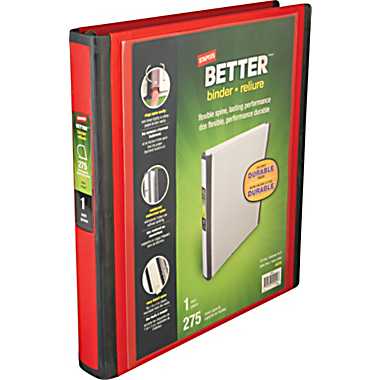
Staples has come up with something surprisingly new and charmingly improved. The Staples Better Binder is made of latex-free solid plastic for the covers and spine, attached not with easily-torn plastic, but reinforced at solid, flexible rubber joints to make it heartier.
The D-rings are strong, easily-opened with a touch of a button, and fit back together neatly, not with jagged teeth, but a male/female paired closure.

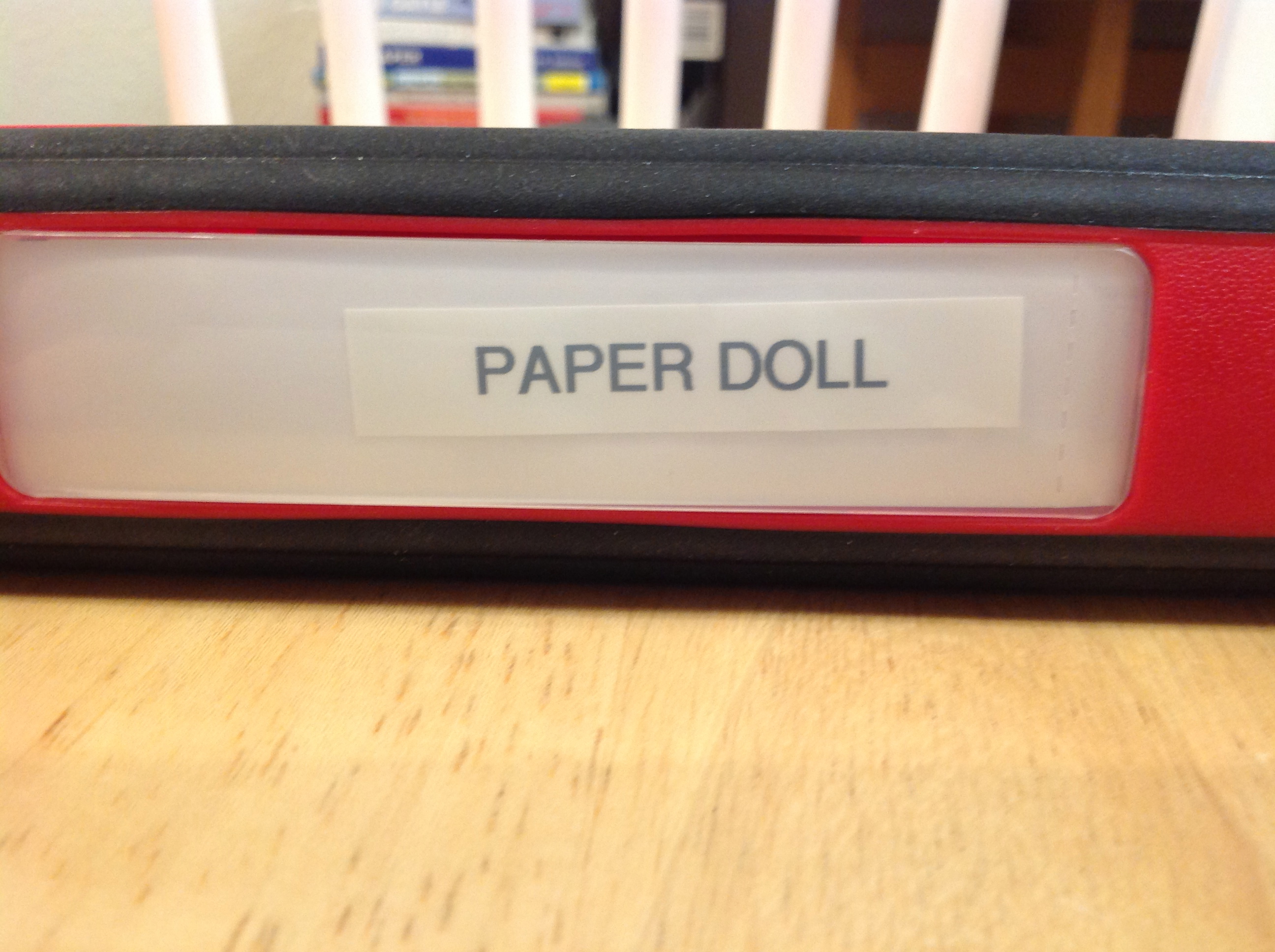
The binder offers some nice labeling options. The front cover has a clear, heavy-duty transparent pocket for large-scale labeling — select a decorative page, a phone list, even “Diary! Keep Out! This Means You!” on a full-size piece of paper, and just slide it in. Instead of applying a label to the outside spine, the plastic spine has a clear label window into which you can insert a replaceable tab on the interior, allowing you to update the binder title and keep it protected, without dealing with peeling labels or sticky adhesives.
Through hundreds or thousands of openings and closings — to review homework assignments on the Industrial Revolution, company meeting briefings (that make modern staffers feel like they’re indentured servants, albeit with free WiFi), or employee handbooks covering everything from open-toed-shoe policies to records retention schedules — the binders stay snappy-looking and flexible. The interior front and rear covers also have curved, easily-accessed, clear plastic pockets, allowing you to keep track of handouts even when you don’t have a three-hole punch at the ready.
Yes, these advances make this a better binder, per se, but what makes the Staples Better Binder truly a BETTER BINDER, worthy of capital letters, is the shape-shifting capabilities. The metal spine and D-rings of the Staples Better Binder are removable! These Removable FileRings are held firm with a tongue-and-groove alignment, so a simple sliding mechanism keeps them in place or releases them, at your pleasure.

Simply grasp and pull the rubber ends of the ring housing to release the metal from the interior plastic spine of the binder.
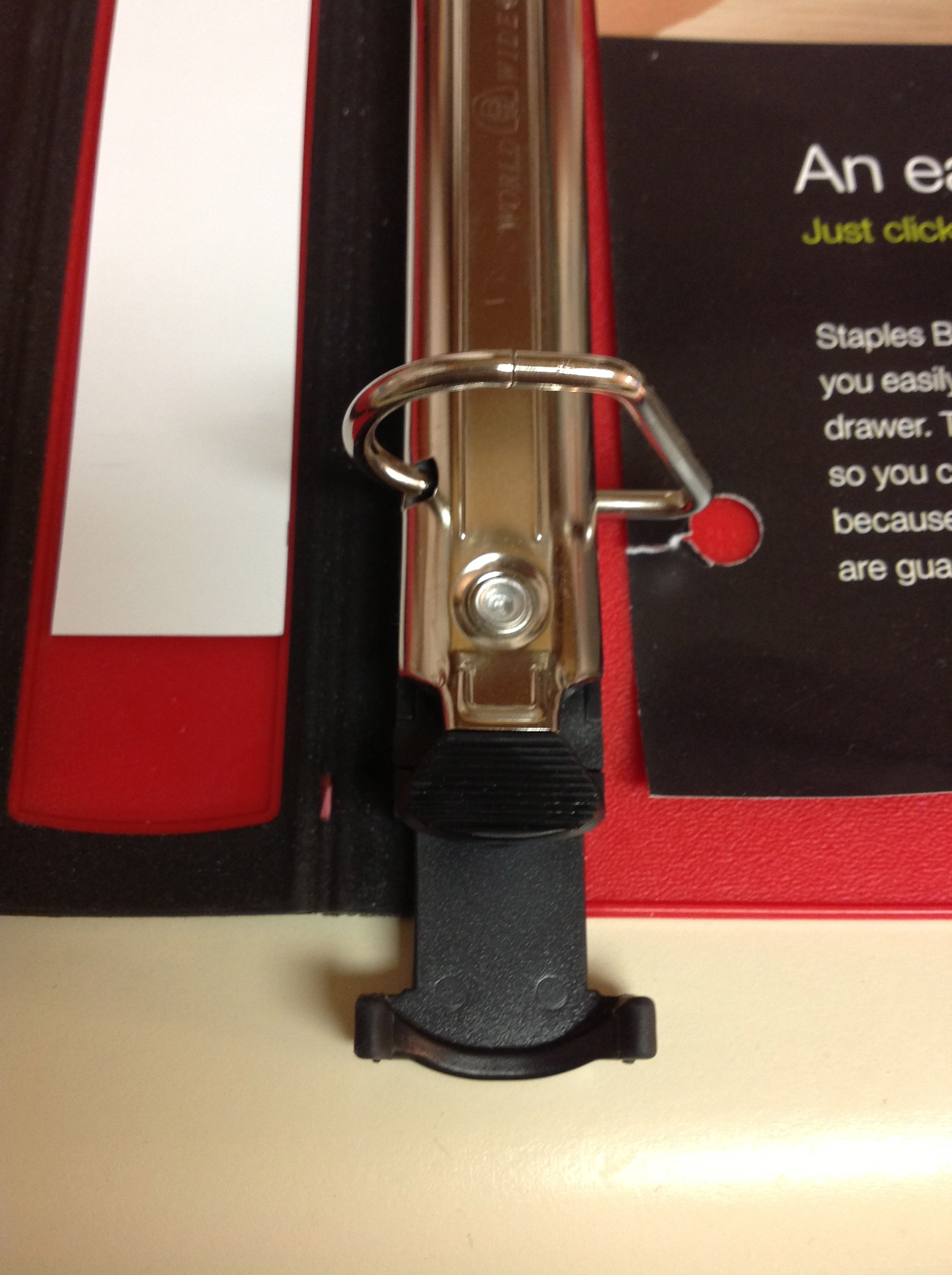
Lift it up and away from the binder, flip it over, and the ring housing serves similar duties as a file folder, keeping all of the material together, while the rubber ends work like metal arms of a hanging folder. You can even label the back of the ring housing so you can read the contents from above and access the contents you want as easily, if not more so, than you might have from a series of file folders. Nifty, eh?
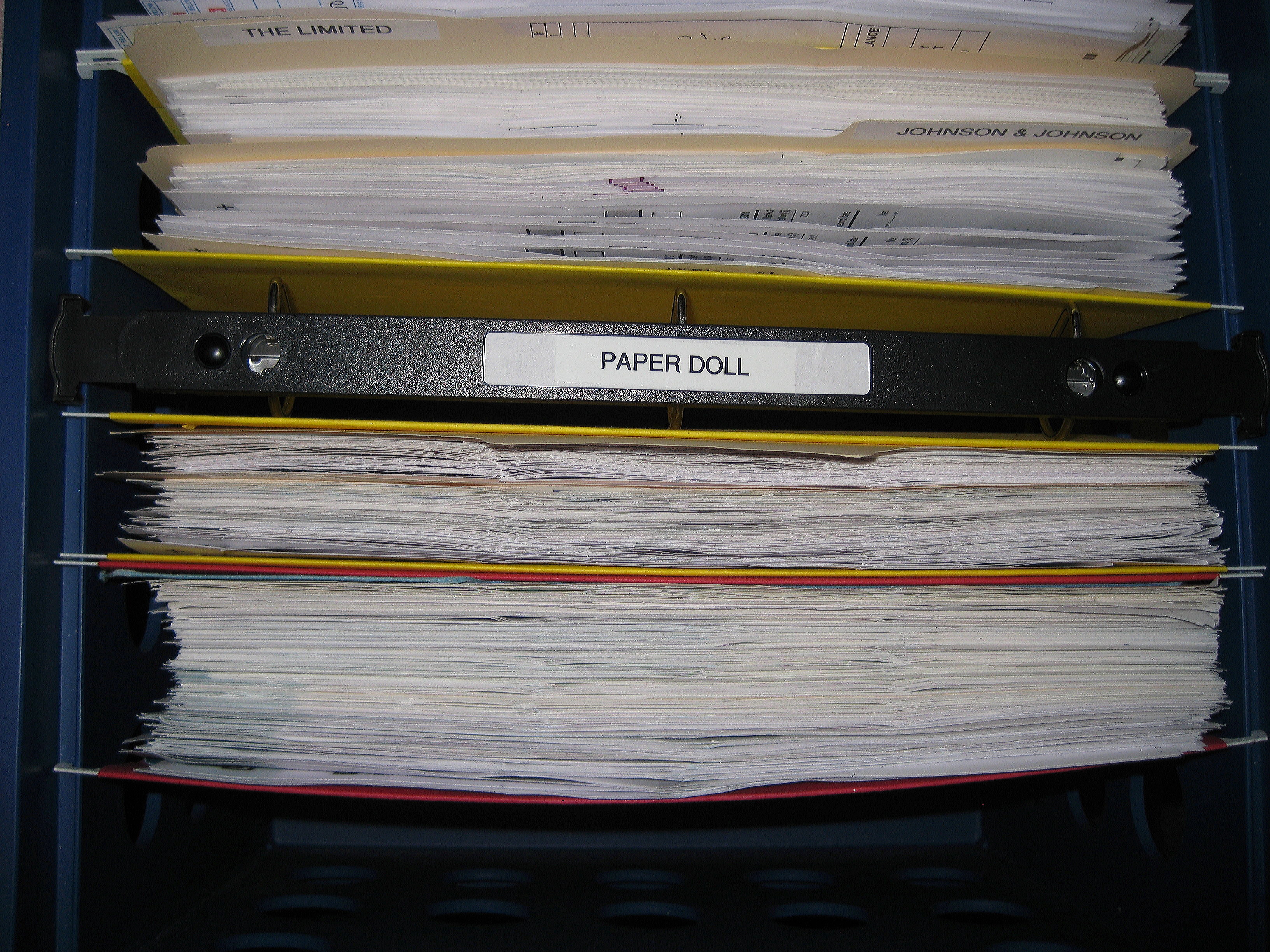
But what of the binders? Now what good are they, without rings? Additional FileRings are sold separately, so you can actually reuse the reinforced binder shells over and over, moving the rings to your filing cabinet to store whatever documents must be saved — without muss, fuss or waste. (Of course, you Paper Doll readers know to evaluate whether you actually need to maintain papers and don’t file things willy nilly, right?)
For the official word on how the Staples Better Binder fits into your paperwork organizing protocols, check out the official video:
My fabulous colleague Deb Lee also made a video with Staples rep Margaret right in the noisy NAPO 2013 Expo hall, illustrating exactly how the removable FileRings work. (Deb makes great organizing videos, so be sure to subscribe to her YouTube channel.)
The reusable reinforced binder shells, suitable for 8 1/2″ x 11″ paper, come in multiple sizes (1″, 1 1/2″, 2″ and 3″), accommodating paper capacities ranging from 275 to 600 sheets, and in 14 colors (black, white, red, orange, yellow, green, olive, blue, teal, dark teal, pink, fuchsia, plum and purple).

Prices range from $8.49 to $14.49, and the Staples Better Binders are, not surprisingly, available only at Staples. As they are a little pricier than standard binders, I’d advise saving these for when you’re schlepping your binders from home to work (or school) to committee meetings. You’ll want to use these when you’re mobile and your binders are more in danger of getting bumped around; use the traditional binders when they’re just sitting on your shelves, getting treated more tenderly.
All Staples Better Binders are guaranteed. For life.
[Note: The Better Binder Mini has the same exterior attributes — latex-free plastic covers with rubberized reinforced spine and edges — but no removable rings. The 1″ capacity Mini is designed for 5 1/2″ x 8 1/2″ paper.]
If you think you’d like to give the Staples Better Binder a try, now is the perfect time. Staples is offering a 50% off coupon at the web site. (Just scroll down to the second row and print for your in-store coupon.) Act soon, as the discount is only good through this Saturday, May 11, 2013.
The Staples Better Binder wasn’t the only organizing-related super shapeshifter at the NAPO Expo. Watch this space for other reviews of neato organizing products and services.
[Disclaimer: A Staples Better Binder was included in every NAPO 2013 attendee’s conference bag, including Paper Doll‘s, without any inducement to comment. All opinions are my own. Who else would claim them?]
NAPO 2013: Loud, Proud and Ridiculously Organized
A little over a week ago, I left Paper Doll HQ bound for New Orleans, Louisiana, land of bayous and beignets, for my annual pilgrimage to the National Association of Professional Organizers Annual Conference and Expo. It’s like a university semester crossed with a high school reunion, with a liberal dash of food tours and luggage envy. More than 630 attendees, hailing from nine nations, helped make this event a thrill yet another year. (This was my twelfth consecutive NAPO conference. I can’t wait until next year to make it a baker’s dozen!)
In coming posts, I’ll be sharing the intriguing products and services I spotted at the expo, but for now, know that your trusty reporter worked so hard (ahem) and spoke so much (no surprise!) that she completely lost her voice. By the time Saturday dawned, six full days after I arrived in NOLA, I was communicating with raised eyebrows, flapping jazz hands, and squeaks that must have confused the native Gulf Coast fauna.
To that point, a big shout-out goes to colleague Liz Jenkins, CPO® of A Fresh Space in Franklin, TN, who played virtual assistant and returned telephone calls to prospects on my behalf when I was unable to squeakingly do so.
Liz is president of the NAPO-Nashville chapter as well as chair of our 2016 conference in Los Angeles. Yes, we organizers plan far in advance. See Liz here, pictured with Help A Reporter Out founder Peter Shankman, who spoke with the Golden Circle veteran NAPO organizers early the final day of conference about How The New PR is Spelled “Customer Service.”

Peter then closed out our conference with his stirring keynote on Reinventing the Art of Networking, focusing in part on how (in my words, not his) being a mensch is good for business. Peter’s hefty new book, Nice Companies Finish First: Why Cutthroat Management Is Over — And Collaboration Is In, was likely responsible for more than a few “excess weight” luggage fees! (OK, it would have been, except professional organizers are clever and probably just wore extra layers of clothing while flying in order to make room in their suitcases.)
Of course, there were other big names in attendance at our New Orleans festival of productivity.
Our opening keynote speaker, hoarding specialist and psychologist Dr. David Tolin, presented Unmask the Potential in Your Clients: Helping Mainstream Clients Get Unstuck – Lessons Learned from Clinical Psychology. The loud (but tidy) throng of organizers settled down just enough to hear the practical essentials that dovetail with encouraging motivation, including developing a sense of client autonomy, challenging thinking errors, and problem-solving training. Later in the conference, Dr. Kelly McGonigal presented The Willpower Instinct, based on her book of the same name, with cutting-edge research and practical applications for promoting the development and nurturance of willpower.
The brilliance didn’t stop there. The always-entertaining Dr. Ari Tuckman taught two breakout sessions of incredible material for professional organizers to use with their clients and their own occasionally overwrought selves. One, Motivation to Climb the Mountains, had attendees buzzing, and I’m already putting the lessons from How To Remember to Remember into practice…even in the writing of this post!
And be assured that the multi-year love-fest between NAPO members and Maine’s own Rich Brooks of Flyte Media (seen here with your swooning reporter) continued apace:

Rich presented sessions on Mobile Marketing for Professional Organizers and Turning Likes Into Paying Clients.
Of course, fellow NAPO fellow members taught compelling pre-conference and conference sessions that had tweeters and Facebookers thumb-wrestling themselves to share the genius. To even make it to the conference, Monica Ricci‘s partner-in-crime for Speak Up!: Crafting and Delivering Killer Presentations, Lisa Montanaro, had to battle planes, pains and automobiles, showing her commitment to the subject, and to us.
Other sessions ranged from the purely practical, like Tackling an Estate Clearance and Organizing: Eyes Towards Re-Design, to the technological, like Technology Solutions for Happier Clients, Digital Filing Systems: Smart Organizing, and Google: Tools to Organize.
Yours truly even got to share the stage with the outgoing and incoming Board of Certification for Professional Organizers presidents, Audrey Lavine and Helene Segura, respectively, for our presentation on BCPO Certification: You’ve Got Questions? We’ve Got Answers!
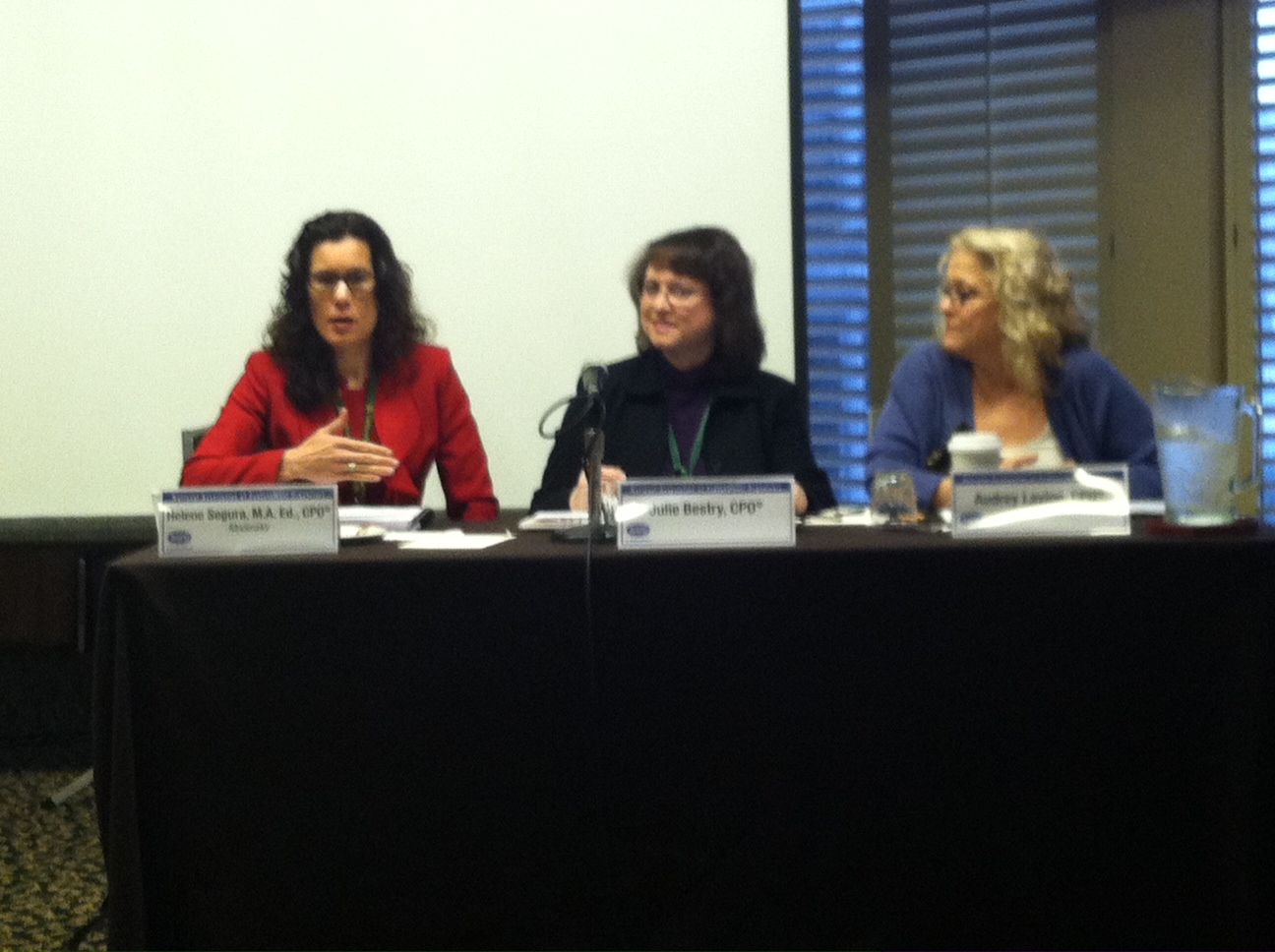
It’s a little fuzzy, but at this juncture, we were either exploring the finer points of Continuing Education Units Arithmetic 101 or debating whether payment in chickens counts as remuneration. (We were slated at 7:45 in the morning. Can you imagine the entertainment factor if we’d been in Prime Time?)
For a complete sense of all the things that kept your favorite professional organizers busy, from Maximizing Productivity for Business Clients to Understanding a Student’s Organizing Style, just take a gander at the chock-a-block program schedule.
Yes, we were busy learning, but be assured we were playing, too. Look at the fun my NAPO-Georgia chapter had, just trying to organize a lunchtime photo shoot when the official photographer didn’t show up!
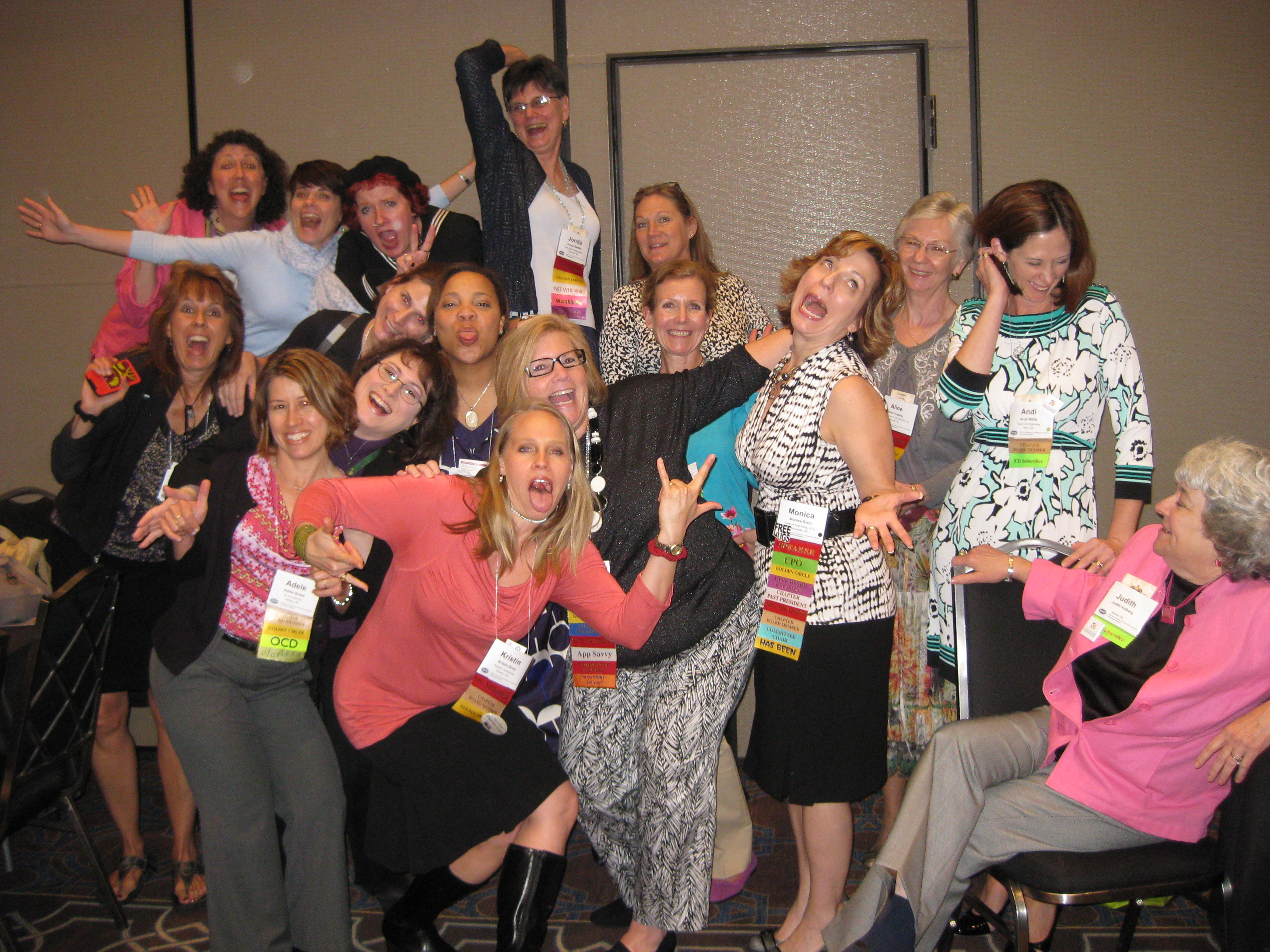
In case you want to see us looking a little classier, the official photo, and all of my other shots of conference and the expo hall can be seen here:
NAPO 2013: Pre-Conference Photos (taken during joint NAPO and Board of Certification for Professional Organizers board events)
For more perspectives on NAPO 2013, I refer you to the brilliant Deb Lee of SoHo Tech Training, who created a page for Live Virtual Coverage of the events. (Deb’s also responsible for ensuring that this post didn’t look like an addled fourth grader was set loose in WordPress Land! Thanks, Deb! It takes a village, and you’re my Mayor of Technology.) And to keep it all in the family, check out what The Clutter Princess, Janice Simon, said in her guest post on Deb’s Organize to Revitalize blog — it’s called 630 Organizers Walk Into a Hotel.
And finally, lest you think (even after looking at the above photo) that we professional organizers were dull girls (and a few boys) with all work and no play, you should know that we had plenty of fun socializing on Bourbon Street and dining (and sometimes, dancing) into the wee hours. For example, here (with my conference roomie, financial organizer Nanette Duffey, PDMM, and UK-bound, Professional Organizers of Canada immediate past-president Jackie Hollywood Brown), we prepared for a lovely dinner at Muriel’s off Jackson Square:
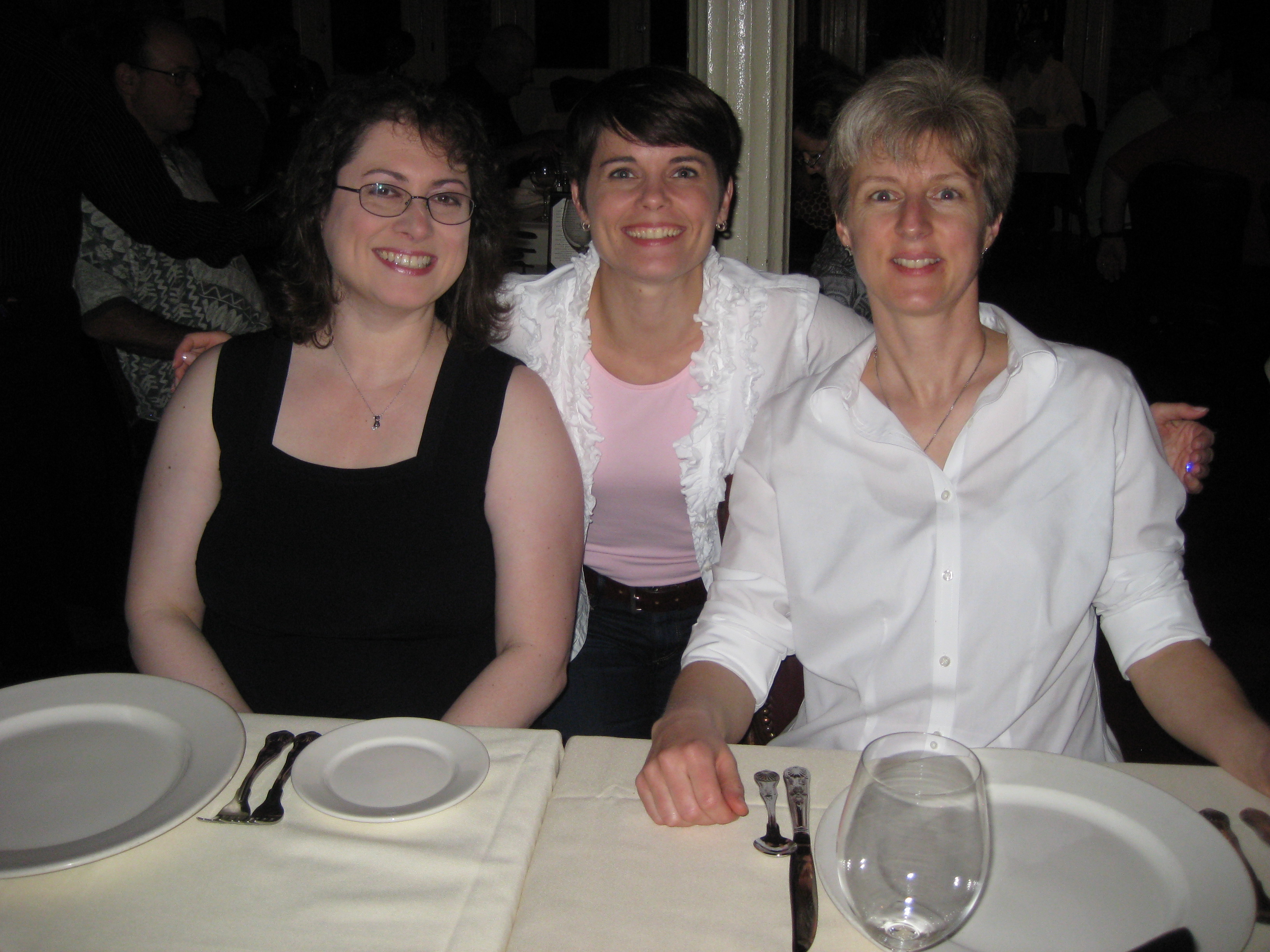
before attending to the reason for the whole evening:
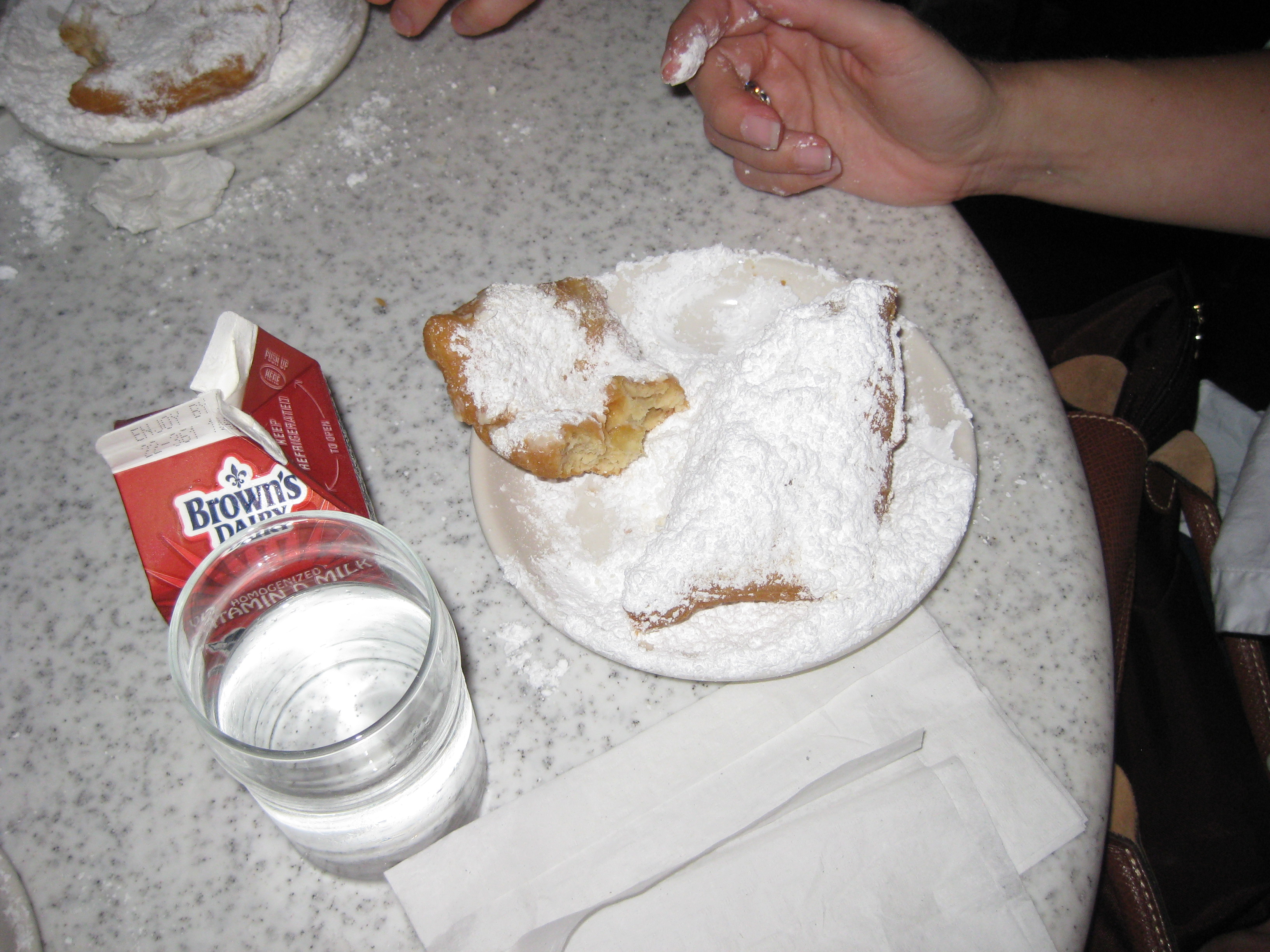
delicious beignets at New Orleans’ famed Café du Monde. A good time was had by all.
Next time, we’ll begin exploring all the fascinating and fun organizing tools and services presented at the NAPO expo. (And yes, there were some absolutely fabulous paper-related productivity solutions that I already covet.) I can hardly wait!
Follow Me