Archive for ‘Timers’ Category
How to Use Timers for Improved Productivity and Focus — Part 2: Pick the Right Timer
Future, noun. That period of time in which our affairs prosper, our friends are true, and our happiness is assured.
~ Ambrose Bierce, The Devil’s Dictionary
Bierce’s satire aside, the future is unpredictable, and no matter how speedily we attempt to get there, by the time we arrive where the future was, it has moved off again, always out of our grasp. Time is slippery that way, and the only control we have over time is how and what we choose to do with it.
Last week, in How to Use Timers for Improved Productivity and Focus — Part 1, we looked at a variety of ways to use timers to help us be more focused and productive at home and at work, for ourselves on our own or with our work teams or families.
Today, we’ll look at the qualities of what makes a “good” timer, in general and for you, specifically. A lot more goes into your choice than just being able to keep track of time as it keeps on ticking, ticking, ticking into the future.
WHAT MAKES A GOOD TIMER?
You could use an hourglass for noting the passage of time: two (attached) transparent glass bulbs, voluminous grains of sand, and gravity. Hourglasses have existed since the 16th century BCE and offer an somewhat accurate way of time keeping, whether to decorate your mantle or play a mean game of Boggle.

Unfortunately, an hourglass requires you to stop what you are doing, look over at it, and be able to gauge what those collective grains of sand mean.
It’s not very helpful for those who hyper-focus (as they’d never remember to look at the hourglass in the first place) in order to pace themselves. Worse, for those who are prone to easy distraction, hourglasses are silent; by the time you discern the ratio of sand on the top to sand on the bottom and calculate how much time you have left, you’ll have forgotten what you were writing or doing in the first place!
Hourglasses also lack the precision you’ll need if you want to make a soufflé.
So, let’s first look at the basic characteristics of a good timer.
A Good Timer Must Be Simple
It doesn’t matter whether you use a digital timer (or app) or an analog clock timer, though there are features of each style that will make you more likely to enjoy the experience and therefore stick to it.
The first essential principle is that a timer must be easy — preferably intuitive — to operate. You shouldn’t need a thirty-page manual or a YouTube video to figure out how it works.
A Good Timer Should Offer A Bonus
If a timer doesn’t offer something more than or different from what you’ve already got, why are you looking for something new?
Why buy a physical timer that’s not materially different from the kitchen timer on your stove?
If a turn of a dial and a loud, angry buzz will suffice for you, if you only need one timer set at a time, if all your work is done in proximity to the kitchen — why look further?
Similarly, why download an app that does what your phone’s countdown timer can already do?
We professional organizers caution clients that buying more and different bins and storage items won’t solve problems if you don’t purge excess and sort what remains. Similarly, if you’re not using the various timer apps you’ve already downloaded, and there’s nothing materially different about the ones you’re coveting in the app store, back away from the screen!
If a timer can’t do anything but replicate the features you already have available to you, it’s not a benefit; it’s clutter. So, either identify what’s not already satisfying about the timers you have at your disposal, or investigate what else is prompting you to keep shopping for a solution.
A Good Timer Integrates with What You Already Have
A timer should have the capacity to work with your calendar or to-do list, if necessary. You shouldn’t have to learn an entirely new app’s system for scheduling, time blocking, or task completion. If you’re using your timer in conjunction with a virtual meeting, it should integrate with the meeting software (as we discussed last week).
Does the timer you’re considering play nicely with whatever you’re already doing, or does it force you to jump through hoops.
- Got a physical timer that fits in with your desk vibe, so it doesn’t look like a leftover from your 7th-grade math class? Stellar! But if your tangible timer topples off your shelf or is too big to fit in your school or work bag, you’re going to leave it behind.
- Do you need a timer app that syncs with your calendar or to-do list, or at least fits with your digital-only life?
There’s no best timer solution because we all need and want different things. The key to your timer helping you succeed is if it helps reinforce routines and habits you already love (or at least are learning to try to love).
The key to your timer helping you succeed is if it helps reinforce routines and habits you already love (or at least are learning to try to love). Share on XA Good Timer Shows You the Shape of Time
Time is measured in hours, minutes, seconds, even milliseconds, and yet it can seem amorphous. With the exception (as we’ll discuss later) of those who feel anxious working against a visible countdown clock, the prospect of using a timer delivers a great advantage: helping you see the progress of time at a glance.
You want a visual cue that says, “Look! Time is passing… but don’t panic,” — not one that leaves you feeling like Indiana Jones watching the stone door close.
The less cognitive effort and physical attention it takes to check in, the more you stay in flow. And the more you stay in the flow, focused on your goals, the more productive you will be. The timer is there to help you be motivated to start working, and then to prompt you step away when it’s time to rest.
When you look away to see if here’s any time left on the timer, you should be able to quickly refocus on your work. That means your time remaining needs to be displayed clearly and cause no confusion so you can slip seamless back into task mode.
Conversely, if you’ve been resting (or goofing off) and need to get back to work on the next Pomodoro, or must keep the roast from turning into a charcoal briquette, you’ll want a loud (enough) yoo-hoo to help you transition to the next stage!
A Good Timer Should Be Frictionless
If a timer is annoying or awkward to use, you’re going to find reasons to avoid using it. Setting a timer should be as easy as turning a dial or scrolling to the correct time and pushing a button or toggling it to ON.
A tangible timer should either be mechanical and battery-free, or the batteries should be easy to replace with the kinds of batteries you already tend to have on hand, usually AA or AAA. (A client of mine recently bought a large number of small flashlights to keep around her house in case of a power outage; she didn’t realize that they required 3.7 volt lithium ion batteries, so she had to purchase special batteries and a charger. Always check what kind of batteries a gadget requires!)
The annoying truth is that humans are willing to go to ridiculous levels of effort to avoid easy solutions to their problems.
Look at the number of children (and adult significant others who act like children) who won’t lift the lid off the laundry hamper in order to put dirty clothes inside. They’ll pile laundry up on top or just drop things on the floor rather than taking that teeny bit of one-second, lift-the-lid effort to use the hamper.
Thus, anything that creates friction — batteries that die quickly, an app that requires you to log in every time you want to use it — is going to slow you down or prompt you to avoid using it altogether.
When you're looking for a timer to help you be more productive, anything that creates friction — batteries that die quickly, and app that requires you to log in every time — is going to slow you down or prompt you to avoid using it… Share on XA Good Timer Is Process-Agnostic
No, this has nothing to do with timing a Sunday morning or Friday night sermon. Rather, whatever timer you choose should let you develop your own personal system. Francesco Cirillo, the inventor of the Pomodoro Technique, used a process of trial and error to develop the idea of working in no more than four 25-minute sessions with a five-minute break between each.
It’s a popular strategy and definitely helps conquer procrastination. But as convenient as 25/5 Pomodoros are for students struggling to hunker down and study or work on problem sets, these are not magic productivity numbers.
If I wrote this blog in 25-minute chunks, I’d likely be interrupting myself just as I started to get my creative mojo flowing. Instead, I tend to use modified Pomodoros or the 52/17 Method when I’m writing because I can get into more of a flow. However, for boring admin work like accounting or filing, I’ll often opt for 15-minute time blocks because I know I will try to “beat the clock” to get as many tasks as possible done in an hour.
As we’ll see, a timer needs to fit the way you want to use it for you to achieve maximum productivity.
HOW TO IDENTIFY THE BEST TIMER FOR YOUR NEEDS AND PERSONALITY
Beyond the basics of a good timer, what makes a timer fit your path to productivity depends largely on your style and the kind of work you’re trying to accomplish. As we discussed last week, this could involve anything from a team brainstorming meeting at work to getting the laundry folded before company comes, preventing hyper-focus when dealing with email or just getting out the door on time.
Even with all of the basics in play, there are a variety of customizations that will make-or-break your timer experience.
Aesthetics of a Timer
A timer, whether for strict Pomodoros or just to make sure you don’t let the pasta water boil over, needs to invite you to use it.
If you’re a no-nonsense type of person, you may want a digital timer that lets you pick the work and break durations quickly, with no fuss, and that’s all!
If your aesthetic tastes tend toward the cozy and traditional, you might prefer something nostalgic like the traditional tomato-shaped timer; if you have a cute and twee aesthetic, your ideal timer may look like this:

Nuoswek Mechanical kitchen timer
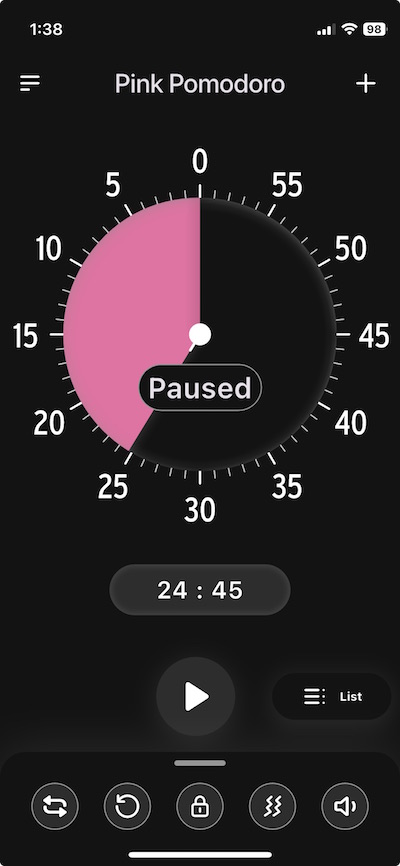
If you’re opting for a digital timer, you might want to be able to adjust the brightness and color. Some people can’t abide the standard screen for a digital app and immediately opt for dark mode; others want a timer set to their personal color aesthetic.
For example, when I’m in the Time Timer app, even though I almost always prefer to use light mode on my screens for writing and surfing, I like dark mode for timers. For me, that makes the timer blend into the background and I can quickly regain my focus after checking the timer.
Similarly, I usually select pink or purple timers, but I have clients who color-code timers for specific tasks: red timers for high-impact work, blue timers for meditation, green for exercise, and so on.
Perhaps the visual aspects of a timer are less important to you than the auditory ones. Maybe you prefer your timer to have an alarm or musical alert that won’t be jarring.
In the comments on last week’s post, my colleague Sabrina Quairoli noted that using timers can make people anxious. That anxiety can come from the concept of a timer itself, or from the sound the timer makes. If it’s the sound, it’s a matter of selecting a timer with customizable auditory options.
If the concept of a timer with the time ticking down quickly makes you antsy, you’re going to want to avoid a digital timer showing the seconds slipping away as if you’re trying to make your Oscar acceptance speech before the orchestra plays you off the stage.
Instead, opt for a timer with a soothing visual approach, one that doesn’t show the second-by-second passage of time. Rather, select one that indicates the overarching passage of time (the minutes or chunks of time) without the more granular metrics.
For example, all of Time Timer‘s analog timers that use a colored disk would be appropriate for a more gentle approach to illustrating the passage of time.
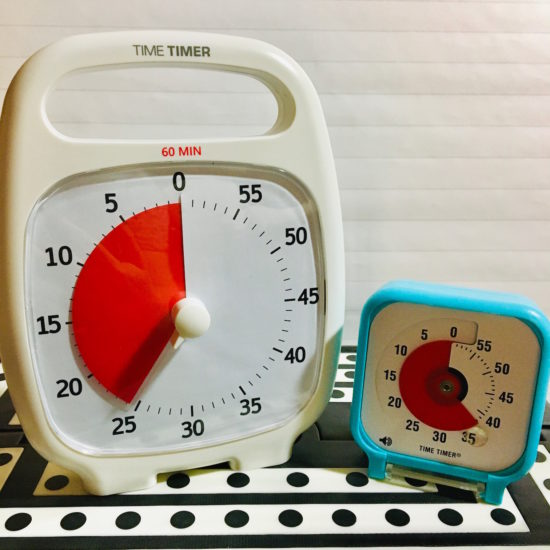
Note: The TimerTimer Twists, have both an analog and digital countdown; if seeing those seconds disappear stresses you out, skip those versions.
Customizability without complexity
You want a timer that will adjust to your rhythm, whether you’re a 25-minute Pomodoro purist for blogging or a “give me 43 minutes because that’s how long (without commercials) it took Columbo to solve a crime” computer code bug tracker.
Consider whether you just want your timer to just block time and alert you when your scheduled time is up, or if you prefer it to automatically set alternating work and rest intervals. Some timers will let you set any increments you want, at least up to 99 minutes. Others are fixed, and will only let you set the timer in five minute increments.
If you’re hoping to use the timer to for cooking, exercising, or for medical purposes (like the seconds after self-administering an injection before you can remove the needle, or the number of seconds to do breathing exercises), you’ll want to be as granular as possible, so seconds and minutes will be key.
Teachers and parents may prefer short-format timers to help kids see and feel the duration of time: of five minutes in time-out, ten minutes of quiet reading, fifteen minutes until bedtime. Meanwhile, knowledge workers will likely need larger chunks of measurable time, from 25 minutes to two hours.
Affective Design Customization
Affective design is an approach that focuses on creating products, services, and experiences that evoke emotions (or, for some purposes, avoid evoking the wrong emotions) in users.
In other words, you want to pick a timer (or selection of timers) with emotionally-supportive vibes (as the kids say). Think about the reason you’re setting up your timer, and how you want to feel while you’re working and, in particular, how you want to feel when the timer goes off and you’re being alerted to the need to transition.
Some people want Mister Rogers with a gentle ding or buzz to remind them that, “Hey, friend, you’re doing great, and you deserve the reward of a five minute break.” (Bonus material: Mr. Rogers Neighborhood episode: Waiting for Time to Pass.)
Others want Judge Judy slamming the gavel to say, “Time’s up, sweetie!” in so harsh a manner that there’s no chance you’ll go back to TikTok or forget to use the restroom if you’ve been hyper-focusing way too long.
As we’ve alluded, may want to adjust your sound options to create the best vibe. Do you want to be be shaken to attention to make sure you’ll stop doomscrolling and get out the door to pick your kid up from ballet? Or might you prefer a soothing trill of music to signal the end of a writing session (without a din) so that you won’t forget that brilliant turn of phrase you were just starting to write?
One-and-done or loop-de-loop?
Just as you may need to consider how in-your-face a timer should be to help you be as productive as possible, you also should think about how attentive a timer you want.
If you’re cooking something and are afraid either your body or your mind will stray, a one-and-done timer will suffice.
Conversely, there are a number of reasons you might want to set repeated or looping cycles, such as if:
- you’re training yourself to tidy up your work area for five minutes every hour
- you want to take breaks between sessions, whether you’re doing a 25/5 Pomodoro, following the 52/17 Method, or considering any of the other productivity techniques in Frogs, Tomatoes, and Bees: Time Techniques to Get Things Done.
- you’re following the advice in Take a Break — How Breaks Improve Health and Productivity and following the 20-20-20 Rule for your vision. (Every 20 minutes, look 20 feet away for 20 seconds to prevent eye strain!)
A looping function is especially nice if you tend to overstay your planned breaks between tasks. Setting a repeated work/break timer prevents “I’ll take a five-minute break” from becoming a Netflix bender.
You may not always want to create repetitive cycles, but a timer that can repeat or remind you to reset will help automate your habits. (Generally, you’ll need a digital timer if you want cycles to loop automatically.)
Discretion is the better part of timing
In addition to considering what’s the best timer for your own situation, you may need to seek one with discreet modes for the benefit of not disturbing the people around you. For example:
 Sleeping baby by Ivone De Melo
- sleeping babies (or easily startled pets)
- roommates or housemates (particularly those on different sleep, class, or work schedules)
- co-workers in cubicles or open-format offices
- fellow library or coffee house patrons
In such situations, you’ll want a timer with the stealth of a Mission: Impossible agent (not the drama of a WWE competitor making a grand entrance.
If you often find yourself working (or otherwise needing to focus) while in the company of others with different focus agendas, consider whether it might be to your advantage to find a timer with alternatives to an audible “time’s up” alert. A gentle blink or color shift can be just as effective as a sound.
Picking a timer for someone else
We all want the timer equivalent of Mary Poppins — practically perfect in every way — but the truth is that we will always have to consider the task involved and personality of the user. Additionally, you may need to identify timer solutions for people with special auditory or visual challenges (like the Time Timer BRAILLE 8”) or medical needs.
In other words, the timer your seven-year-old needs to focus while doing math homework may be very different from what your fifteen-year-old needs to get up from an hour of gaming and leave for band rehearsal.
And both of them may need something very different from what you need from a timer at work or that Grandpa needs to remember to take his medication after dinner.
None of this means you have to spent a fortune on timers; just knowing the advantages of particular features will allow you to discern what will work best. In the next post in this series, we’ll examine traditional and novel timers for improving productivity and yielding the just right amount of focus.
What timer features are the most important to you? How does do these change depending on your work or life contexts?
Organize Your Sleep When the Clocks Change and Beyond
Are you feeling wonky? If you live in North America, you turned your clocks back (or let all your digital ones do it themselves) over the weekend. (If you live in the UK, you did it a week ago. I don’t know what’s up with that, but you may still be feeling wonky.)
Although most of the negative effects of time change happen when we are springing forward to begin Daylight Saving Time, falling back to end it can still leave people struggling to wake up and feeling out of sorts for a few days, leading to some bumps in productivity.
So, if you’re feeling a little rough, don’t worry. Today’s post offers some gentle tips for feeling a little more at ease when the time on the clock and the time inside your head don’t feel friendly toward one another.
HELP YOUR BODY ADJUST TO THE TIME CHANGE
Whether you’re dealing with the time change in the spring or fall, the best way to adjust is always to shift your schedule gradually.
Unless you’re the kind of person who misses all the reminders about the clock change and shows up an hour late (or early) to Sunday brunch, or worse, for work on Monday, you have advanced warning. When the time change is on the horizon, adjust your bedtime and waking time by ten or fifteen minutes each night for several days prior. (Make a note on your calendar to start this at the beginning of March; Daylight Saving Time starts on March 9, 2025! I’m already counting down.)
This kind of incremental approach is supposed to give your body the time to adapt. Of course, we’ve just changed the clocks, so that option is out. Still, consider the following steps for helping your body adapt to the time shift. You’ll find that these steps are generally the same ones for attaining recuperative sleep, overall.
Be the Early Bird and Get Morning Sunlight Exposure
I’ll be the first to admit, I’m terrible at mornings. I’d happily take a flight or attend a Zoom at 3 a.m. before going to sleep, but I’d be hopeless doing the same things at 7 a.m. Early morning sunlight makes me growl. However, my science-y pals swear that natural light will help reset our internal clocks.
The research on circadian rhythms says that cycles of sunlight and nighttime darkness keep our bodies synchronized with our environment and signal our “circadian pacemakers.” This pacemaker is particularly sensitive to light in the morning and the evening, so evening light (such as we have all summer) causes a phase delay, so we don’t get tired until later and then we wake up later. Conversely, when we are exposed to bright sunlight in the morning, it causes a “phase advance,” and we start getting sleepy earlier and awaken earlier.

Sunrise Coffee Photo by Taryn Elliott
So, exposure to sunlight signals your body that it’s time to wake up; just some light permeating through your eyelids will have some kid of wakey-wakey-eggs-and-bacon-y effect. So, actually spending twenty minutes outside in the morning will help you feel less sluggish.
If the temperature allows it, take your breakfast out onto your back patio or balcony; you can enjoy your morning coffee on your front step, but if you amble out in your jammies, at least make sure you’re properly covered up as the school bus goes by.
Improve and Optimize Your Sleep Environment
We hear it all the time: it’s important to set a consistent sleep routine.
If you’ve been living the life of a college student (or a new parent) and are all out of whack (and this has been compounded by the end of Daylight Saving Time), be patient with yourself. Know that your body will need time to adjust to whatever changes you make, but sticking to a regular bedtime and wake-up schedule (sigh, even on weekends) will improve your odds of getting better quality sleep and more of it.
Research shows that your sleep experience will improve if you consistently do the following:
- Keep your bedroom dark. Close your blinds or curtains. If you have old-style horizontal Venetian blinds, you may find they let in too much light. If so, try twisting them “backward” such that the curved portion faces outward. Alternatives are the more modern, wider, vertical blinds or roller shades in darker colors.
Another great option is a blackout curtain, which is designed to eliminate as much natural light as possible. Note that the longer the curtain extends from the bottom of the window toward the floor, the less light will seep out.

If there’s a curtain gap (which always seems to happen when you’re staying in a hotel), try pinching the curtains together with clothespins or the clips of a skirt hanger.
Admittedly, if you block out all natural light, you won’t be awakened by the brightness and warmth of the sun. This increases both the importance of getting into the sunlight once you DO wake up and also necessitates a less natural method for shaking yourself out of slumber. For the latter, check out Do (Not) Be Alarmed: Paper Doll’s Wake-Up Advice for Productivity for tips on heeding that wakeup call.
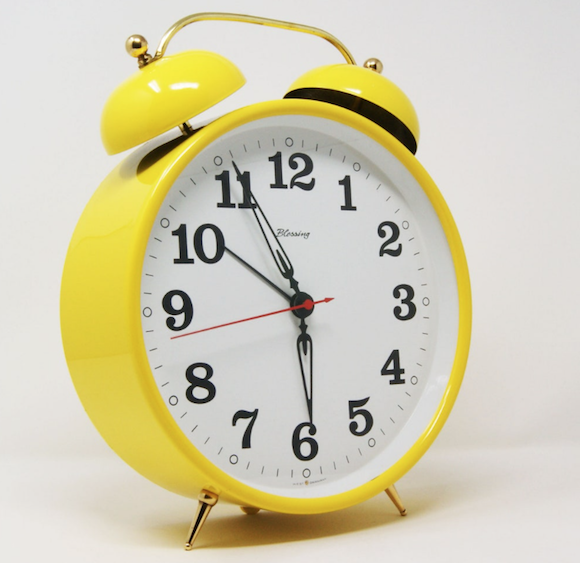
Don’t forget about tiny unnatural lights. So many digital devices blink or glow. My smoke alarm has a blinking green light. Routers and DVRs and all sorts of devices have blueish glows.
In my bedroom, I have an old-fashioned Caller ID box (connected to an old-school, weighty corded landline). It blinks. Incessantly. Every time I have a message, the red light starts blinking again. Listening to the voicemail message and deleting it has no impact; I must manually clear the Caller ID box. (Sigh. It’s a tradeoff. I love the large handset of this ancient phone, but it has no caller ID. The box serves its purpose of letting me know if the inbound call is from a delightful soul or yet another robocall about my auto warranty. But that red blinking light!)
If you’ve got bright or blinking LED lights on gadgets in your sleeping area (either at home or when traveling), consider getting a sheet of removable, adhesive blackout stickers to stem the indoor light pollution.

In addition to adjusting your lighting while you’re sleeping, train your body to sense the cycle of day and night by dimming your household lights as bedtime approaches. Experts say that lowering the lights helps signal your body that it’s time to wind down. Think about how you can gradually reduce your exposure to artificial lighting in the evening (without risking bumping into the furniture).
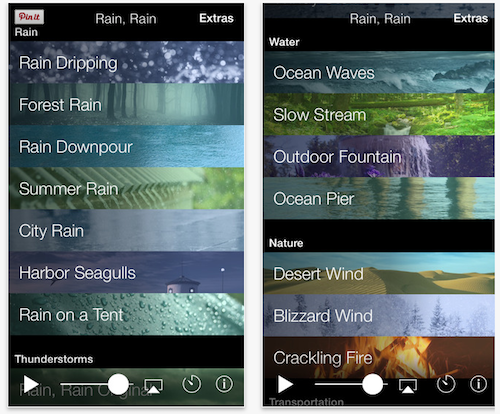
- Create a quiet environment. Quiet doesn’t necessarily mean silent. I prefer a combination of white noise: my central HVAC fan is turned to on (instead of auto, so I’m not constantly jarred by that thunk of it turning off) and my Rain, Rain thunderstorm app as I described in 11 Ways To Organize Your Focus With Ambient Noise. (Sometimes, what you want to focus on most is being blissfully unconscious.)
“Quiet” doesn’t only include your sleeping space, but also your mental space. Limit cognitively or emotionally intense activities before bed. Have you ever played a video game before bedtime and then found that your brain continues playing the moves in your head when you close your eyes? If you’ve spent hours reviewing a spreadsheet pre-jammy time, you might see those columns and rows and be unable to turn off your in-brain Excel.
For a few hours before bed, limit any activities that are emotionally stressful or require a high level of concentration. The goal is to avoid keeping your mind too active before bed, as that will make it harder to find your personal Sandman.
- Maintain some chill. The experts estimate that the best temperature for sleeping is between 60° and 67°F. Obviously, if you’re shivering, it’s going to keep you awake, but experiment lowering the ambient temperature combined with your preferred number of blankets. If you’re a “hot sleeper” or are at a period in your life when you’re experiencing hot flashes — let’s call them power surges — consider cooling pillows and bedding.
- Keep your bedroom organized. Yes, your eyes are closed once you’re asleep, but a cluttered room presents a few obstacles to falling asleep easily, or falling back asleep after a trip to the bathroom or to check on a tiny human.
I teach my clients that “the bedroom is for sleep, rest, and intimacy.” If your bed, nightstand, and floor are covered with children’s toys, you will be distracted from all three of those purposes, and you’re more likely to step on a piece of LEGO and wail in pain, keeping you from falling back asleep and your partner from sleeping soundly.
The bedroom is for sleep, rest, and intimacy. If your bed, nightstand, and floor are covered with children's toys or office work, you will be distracted from all three purposes. Share on XIf your computer is open next to your bed, or your work desk lives in the bedroom, or your credit card bills are piled near where you sleep, the chance of disturbed sleep is higher because those items will subconsciously cue your brain to fret over them when you’re trying to fall asleep.
Declutter your bedroom so that the floor around your bed is free of tripping hazards, and so the only things visible are those that are functional or soothing. I know, it’s easier said than done, but even taking a few moments to tidy your space (and training yourself and others not to bring non-bedroom-y things into your room in the first place) will have a positive effect.
Don’t be Blue!
As we talked about in Celebrate the Global Day of Unplugging, screens (computer, phone, tablet, or TV) and particularly the blue lights of screens from your devices, can interfere with your body’s ability to produce melatonin.
Find alternatives to screens in the bedroom, and consider different pre-sleep habits that don’t involve screens. You could journal, read a tangible book, do simple stretches while listening to soothing music, memorize a poem, or practice an uncomplicated craft. Define “uncomplicated” as you choose, but needlework that doesn’t require bright task lighting is going to be better than a craft that involves scissors, glue, and (eek!) glitter.
Don’t Do the Dew — and Limit the Moonshine, Too!
You may not think that one more fizzy beverage or cup of coffee will make a big deal, but a 12-ounce cup of Mountain Dew contains around 54 milligrams of caffeine. (An eight-ounce cup of coffee has 95 milligrams of caffeine!)
Caffeine can stay in your system for hours and have a detrimental effect on your sleep, so experts suggest avoiding it after mid-afternoon. (Yeah, I know this one is a toughie. What’s a diet Coke without the oomph of caffeine?) Remember, the goal is to relax your body so that you’ll sleep well and have natural energy for work or school the next day.
The experts similarly encourage people to limit drinking alcohol in the pre-sleep hours. One might aassume alcohol encourages relaxation, but it actually disrupts the sleep cycle, making sleep less restorative. For those who choose to imbibe, know that doing so earlier in the evening will minimize the negative impact on sleep.
Watch Out for Midnight Snacks
Experts encourage us to avoid heavy meals or snacks in the late evening. Larger meals closer to bedtime can take longer to digest and disrupt sleep.
However, if you’re hungry, that may also make it hard to fall asleep. Personally, I find that a small protein-packed snack and a tiny bit of carbs (like a handful of almonds or a few cheese and crackers stacks) helps my body find dreamland. Experiment to find what works for you.
Watch Your Daytime Habits
We tend to think of our pre-bed activities as the key to falling asleep, but getting our full eight (or more) hours requires a bevy of other self-care habits.
- Participate in an active lifestyle — This doesn’t mean you have to train for the Olympics or spend every day at the gym. But physical activity helps you sleep better.
Consider a yoga, tai chi, or qigong regimen in the evenings as shown in the following videos, or go for an early morning walk (with the bonus of getting morning sunlight).
Bedtime Yoga with Adrienne
5 Minute Tai Chi Flow for a Restful Night’s Sleep
Qigong for Sleep with Nick Loffree
If you are already active, just remember to avoid vigorous exercise close to bedtime, as it can be too stimulating, making it harder to fall sleep.
- Learn how to relax — It’s hard to conk out when our brains are focused on what’s stressing us out. However, even when we’ve cut down our mental focus on stressors, our bodies tattle on us. We hold stress in our muscles and joints.
In addition to practicing the physical relaxation techniques described in the above videos, find ways to mentally relax as you approach bedtime. Maybe you’re good at meditating — I’m not — but there are so many other options, too. Learn deep breathing exercises, journal, or take a warm bath before heading to bed. Do whatever you can, both throughout the day and as sleepy time approaches, to progressively relax your mind as well as your body.
- Hydrate throughout the day — We live in a hydration nation. Everyone seems to have a giant water bottle named Stanley. Being well-hydrated prevents fatigue, which helps maintain overall energy levels so you can avoid late-day napping, stay active, and adapt not just to the time change but to unexpected changes in your schedule.
An Occupational Health and Safety Administration (OSHA) report, The Cognitive Effects of Proper Hydration, spells out the key benefits of staying hydrated, including improved focus and short-term encoding of memories, better long-term memory recall, and improved critical thinking skills.
Additionally, research shows that “low water consumption tends to lead to worse moods, as well as headaches, confusion, and tiredness” and better hydration makes people feel calmer and in better moods. The steadier your mood, the more likely you’ll be relaxed enough to sleep well at night.
However, slow your hydration pace as you approach bedtime so you can minimize disruptions to your sleep. (If you wake up for a bathroom break, you’ll almost certainly never get back to that steamy dream with Jason Momoa.)
Don’t stop hydrating altogether, though. Our brain tissues have no way of storing water, and our waking brains need some hydration at least every two hours to function optimally. Drink water upon awakening to help you start your day.
- Watch out for naps — If you’ve had a rough night, a nap can help you recover, but keep it brief, to no more than 20 to 30 minutes.
Additionally, avoid napping late in the day (so, no pre-dinner snoozing), as it can interfere with your ability to fall and stay asleep at night. (If you’re feeling draggy, try drinking some cold water to pep you up!)
Instead, trying following one of the international approaches to early afternoon napping and recuperative resting that I outlined in Take a Break for Productivity — The International Perspective.
Additionally, the Mayo Clinic has some good advice for taking naps effectively in Napping: Do’s and Don’ts for Healthy Adults, and the book Take a Nap! Change Your Life. purports to change the reputation of naps for the better and help people improve their health through the right methods of napping. (You could always listen to the audiobook; worst case scenario, it’ll put you to sleep!)

Make Waking Up in the Morning More Appealing
For some of us, no matter how hard it is to fall asleep, we can’t bear to get out of our cozy beds. Consider organizing your resources so that whatever you have to face in the morning is desirable. Here are a few ideas:
- A pleasant alarm — that seems like an oxymoron, doesn’t it? — that gently wakes you, or one set to a radio station that will make you laugh or want to sing is a great way to nudge you from sleeping to wakefulness.
- A cozy bathrobe or dressing gown helps ease the shock of moving from your comfy bed to a house set more for cooler sleeping temperatures than warm wakey-uppies.
- A new shower head — TikTok kept tempting me and I finally gave in and bought one of those new filtered, hand-held shower heads. (It’s even got a doohickey so you can use it like a garden hose to clean the shower.) Whether you want a shower massage or a rainforest effect, upgrading your morning shower routine gives you something to look forward to. You may not jump out of bed, but perhaps you won’t grumble so much.
- A breakfast fit for Sleeping Beauty — In the ideal world, Jeeves would serve breakfast in bed. Failing that, aim for some special food or beverage treats, to make the morning meal inviting for the senses.
- Start a new morning routine — If you don’t have enough of an opportunity to read, put a good book by your breakfast setting and instead of doom-scrolling social media. Take a brisk ten-minute walk around the block instead of checking morning emails. Call your BFF (but only if she’s likely to be awake already) and develop your plans to take over the world.
Organizing your morning to do just a few things differently could yield all sorts of bonuses as the day goes on.
Organizing your morning to do just a few things differently could yield all sorts of bonuses as the day goes on. Share on XTake Your Sleep Health Seriously
If you have more than occasional trouble falling or staying asleep, don’t take things into your own hands.
- Don’t self-medicate. We already discussed how alcohol disrupts sleep patterns, but it’s common for frustrated sleepers to seek out other (problematic) ways to self-medicate via over-the-counter options.
Even the commonly suggested solution of melatonin supplements are not suitable for everyone. For example, melatonin can lower blood sugar, causing hypoglycemia in people with diabetes; it’s also contraindicated for people taking blood pressure medications, blood thinners, certain contraceptives, and anti-convulsant medications. (People who are pregnant or breastfeeding, or who have autoimmune or seizure disorders or clinical depression should also not take melatonin.)
- Talk to a medical professional. Paper Doll is a professional organizer, not a sleep doctor (and I don’t play one on television). If you consistently have trouble falling or staying asleep, confer with your healthcare provider to make sure you don’t have an underlying medical condition (like sleep apnea) contributing to your difficulties. If you do learn that you have a sleep disorder, you may also want to find a sleep specialist through one of the following
American Academy of Sleep Medicine (AASM)
American Academy of Dental Sleep Medicine (AADSM)
Your ability to be productive and organized in the daytime depends in large part of you successfully organizing your sleep at night. Sleep well!
WHEN WILL WE BE RID THIS INFERNAL CHANGING OF THE CLOCKS?
Your phone and computer likely change their own clocks. Your oven and microwave clocks likely do not. The clocks on my cordless landlines are triggered to change when receive an inbound call! I have a relatively glucometer (for testing blood sugar) and spent Sunday morning struggling with a multi-panel instruction sheet that made me feel like I was trying to fold a 1950s Rand McNally street map! There’s a reason so many people’s VCRs used to blink 12:00 all the time.
It’s not difficult. It’s just a little frustrating. We’re a quarter of the way into the 21st century. Shouldn’t we be past this by now?
If you are wondering why we still have to change the clocks, you’re not alone.
Those who would rather see the clock change go the way of the dodo cite sleep disruption and the resulting loss of productivity as well as increased risk of traffic accidents (in the spring and fall), mental health struggles (including Seasonal Affective Disorder) caused by decreased post-work/school hours of sunlight, and increased crime (because bad guys prefer their evil-doing in darkness).
The problem is that nobody can agree one whether to have permanent Standard Time (as in Hawaii and Arizona) or Permanent Daylight Saving Time. More than a dozen states have already passed legislation in support of keeping DST year-round, arguing it provides a better quality of life, with more light in the evenings. Paper Doll is generally in this camp. If you’re stuck at work all day, you probably want sunlight greeting you at the end of your workday so the winter hours don’t feel like drudgery. However, if you’ve got little kids, you probably don’t want them waiting for the school bus in the dark every morning.
Whether we go with Standard or Daylight Saving Time, there’s no way to make everyone happy, at least not until our AI overlords can update all of our clocks (and our circadian rhythms) in one fell swoop. Perhaps that’s why, although the Sunshine Protection Act of 2023 (which would have made DST permanent as of last year) received unanimous consent from the United States Senate in March 2022, the bill has languished in the House of Representatives. Sigh. How very disorganized of them.
Assuming our leaders don’t straighten this out, we’ll be changing our clocks yet again this March, so let’s at least take an opportunity to laugh about it, courtesy of the Holderness Family.



Follow Me