Archive for ‘Paper Organizing’ Category
Paper Doll’s 6 Organizing Secrets to Kick-Start Your 2018
We’re a few days into the new year, and people are still buzzing about resolutions (Paper Doll doesn’t make them) and theme words or mantras (mine for 2018 is LAUNCH). Americans’ top New Year’s resolutions always include losing weight, straightening out finances, and breaking bad habits, but according to market research, 80% of resolutions are broken by the second week of January. It doesn’t have to be that way.
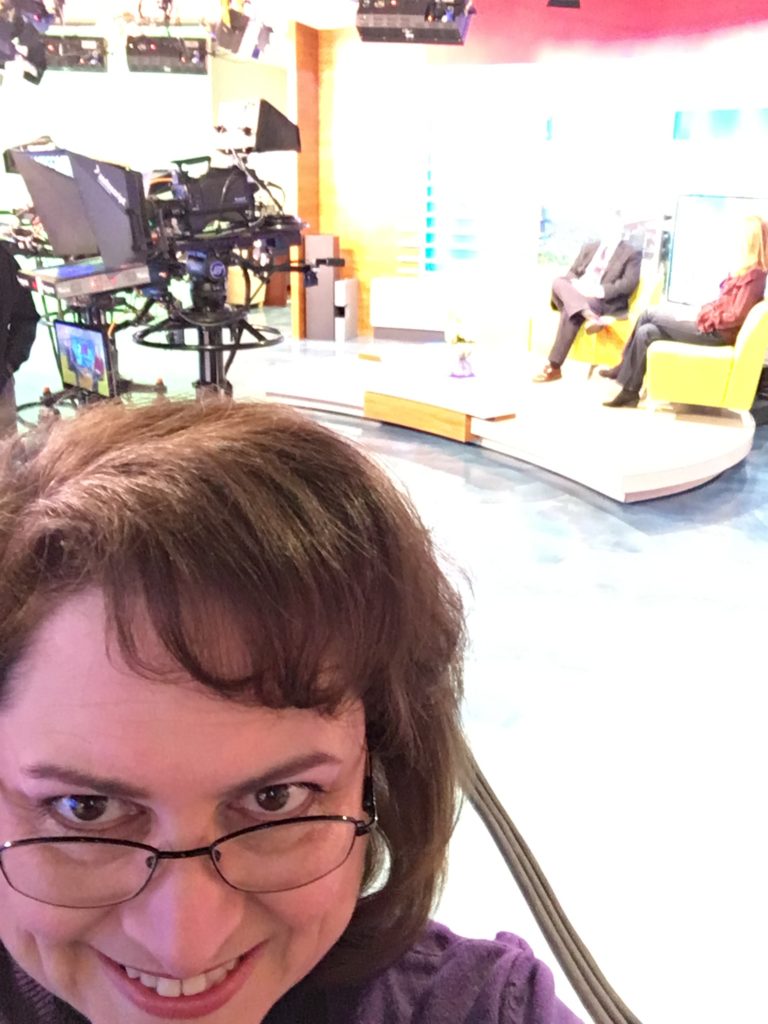
January is National Get Organized Month, and I was on my local NBC affiliate’s morning lifestyle program today, sharing my organizing philosophy and providing tips on how you can kick start your resolution to get organized this year. The conversation was free-flowing, covering some specifics of organizing, but also delving into the personal. For example, Julie Edwards, the host of 3 Plus You, asked me whether you can “make” your children become organized adults. I said that I believe that like anything else, the best way to help your children is to teach useful skills and model good behavior.
WRCBtv.com | Chattanooga News, Weather & Sports
When I was asked about how to deal with different personal organizing styles, I pointed out that within families (and with co-workers), the key is to maintain good communication, and understand that just because someone’s organizing approach is different from yours, it’s not “wrong.” It just may not be right for you.
Here are some tips I think will help you get a running start to achieving your organizing goals in 2018.
1) FOLLOW THE ICE CREAM RULE
I tell my clients, “Don’t put things down, put them away.” The word “away” presupposes you’ve already got a location in mind. But good organizing systems have two parts: the where & the how. When you bring groceries home, you put the ice cream away in the freezer immediately to keep from having a melted, sticky mess. It’s very rare for someone to put away the toilet paper or breakfast cereal before the frozen foods. The freezer is the “where” but putting the ice cream away first is the “how.” It’s so innate, you don’t even think about.
Clutter comes from deferred decision making. With ice cream, you don’t even have to stop and think; it’s instinct. With everything else in your life, when you go shopping (or even when offered things for free), decide on a home before you buy or bring it in. Once it’s in your space, build fixed time into your calendar for how/when you’ll deal with maintaining it or getting it back to where it lives. (When will you do laundry? When will you file financial papers? What will be your trigger — when the laundry basket or in-box is full, or will you put it on your calendar?)
Remember: “Someday” is not a day on the calendar.
2) EVERYTHING SHOULD HAVE A HOME…BUT NOT EVERYTHING HAS TO LIVE WITH YOU
I say this to every prospective client. The eople calling me are focused on the idea of creating systems and order, but don’t always recognize the larger truth, that not everything you own needs to stay in your orbit forever. If it’s broken and you’re not willing to spend the time or money to repair it, let it go. If you have an emotional attachment to something that’s broken, outdated, or takes up too much space to keep, take a photo of you holding it or wearing it. Then set it free!
Give what is no longer age, size, or lifestyle-appropriate new life via charity or consignment. Let it be a blessing to someone else. Setting up a donation station in your home is as easy as putting a box or plastic tub in your utility room, mudroom, or garage. When you’re doing laundry or sorting through toys in the playroom, if it doesn’t fit your life, take it to the donation box right away. When the box is full, log the contents (if you’ll be taking a deduction), and deliver it to your favorite non-profit. Don’t wait until you have lots of boxes – one box of useful items or clothes, sent on its way, is more useful to others than mountains of boxes that never make it out of your home.

3) DON’T FIGHT CLUTTER WITH MORE CLUTTER
I love The Container Store as much as the next professional organizer. But buying oodles of storage containers – bins, boxes, tubs, and shelves – can only help you organize if you pare down to what you need and want.
Think of it this way: when you see a great outfit at the store, it’s not realistic to say, “Hey, I’ll buy this now and then lose 30 pounds to fit into it.” Even if you do declutter the personal poundage, you never know from where, exactly, that weight will disappear, so shouldn’t buy the new outfit hoping you’ll lose weight in the right places to fit into it.
I’m not saying not to acquire storage containers, but don’t do it first. Once you pare down, pick colorful, fun containers that suit your needs, space, and tastes.
4) TAKE BABY STEPS & DECLARE SMALL VICTORIES
When it comes to clutter, it’s not the space it takes up in your house, it’s the dent it puts in your life! If you’re late every day because you can’t find your keys and your kids can’t find their homework, it’s a much bigger deal than a cluttered guest room closet or drawers of old birthday party pictures that haven’t been scrapbooked.
Focus on your biggest daily stressors, break them down into small, actionable steps, and solve those first. You don’t need to do it all at once, but if you develop a habit of doing a little bit at a time, once your space is straightened up, maintenance will feel natural.
Go through just 5 hangers or one drawer each night. Clear a counter for the daily launch pad of essential items to get out the door. Hang a key hook by the front door and make it a nighttime ritual with your kids to check everything is there that you’ll all need the next day.
5) DECLARE BANKRUPTCY ON CLUTTER DEBT & STOP FEELING GUILTY!
Give yourself permission to declare bankruptcy on the “debt” of unworn clothes three sizes too small or catching up on reading months of magazines. Holding onto something just because you spent money on it or because it was a gift doesn’t make it any more valuable or useful; it just ends of costing you time (dusting or caring for it), space (that you could use for more important things), or money (spent on dry-cleaning or storage rental).
If you’re overwhelmed with thousands (or tens of thousands) or unread emails, magazines, catalogs, junk mail, or check out the classic Paper Doll post, A Different Kind of Bankruptcy, to give you some step-by-step action items.
Don’t feel guilty! Remember, supermodels on those magazine covers are airbrushed and Photoshopped. They don’t really look like that. The same is true with the rooms you see in home and garden magazines. Nobody actually lives in spaces like that – those rooms were specially designed and curated to look “perfect.” No dual-career families with toddler toys and pre-teen soccer team sleepovers live in those magazine homes. Cut yourself some slack.
6) FOLLOW THE BUDDY SYSTEM
Getting your space, time, and priorities in order can be overwhelming, but you don’t have to go it alone. Weight Watchers and 12-step programs succeed because they give people accountability and support. To help you reach your organizing goals, buddy up with:
- Your spouse – Trade tasks you don’t particularly love (like laundry for balancing the checkbook) and you’re less likely to procrastinate on doing what you enjoy.
- Your kids – Children love to “catch” adults breaking the rules and best them at competitions. Make organizing a game – play Beat the Clock to see who can collect the most things that don’t belong in the living room before the song ends, and then work together to put the items away. Make a rule that anything found on the wrong level of the house goes in a basket by the stairs, and everyone must take something (one item for little ones; the whole basket for grownups), and let everyone have a chance to “blow the whistle” on those who forget.
- Friends – Make organizing social. Invite a friend over for lunch and to help organize your closet or kitchen this weekend. Then do the same for your friend’s pantry or laundry room next week.
- A professional organizer – As a Certified Professional Organizer®, I know how much my clients get out of having someone who knows the ropes guide them in making solid decisions and developing systems to surmount those challenging obstacles. Find a professional organizer near you by using the search function for the National Association of Productivity and Organizing Professionals (NAPO).
May you have a happy, healthy, and organized 2018!
Paper Doll’s NaNoWriMoMo(nday): Writing Challenges, Dictation Tools, & Organized Writing Advice
Today is the first weekday after a long holiday weekend. If you traveled or entertained, you probably have a pile of laundry to deal with and an aversion to one more bite of turkey. If you’ve been participating in NaNoWriMo and working on a novel (or, as a rebel, on something else), you may have just realized that you have about 3 1/2 days in which to hit your 50,000 words. If you’re back at your desk for work or school, you’re probably feeling pressure to produce reports and emails and all manner of communications when you’d really rather be snuggling under a blanket. I empathize.
Just as your meals this weekend were leftovers – hopefully not too pejorative a term – today’s post is full of leftover bits of appetizers and side dishes and desserts that couldn’t quite fit in all of this month’s overstuffed Monday posts. From motivation to productivity to time management to resources for organizing your content, there will always be new things to say about organizing yourself to write. (Ah, well, there’s always 2018!)
HOW TO ORGANIZE YOUR WRITING PROJECTS WHEN IT’S NOT NOVEMBER
The November NaNoWriMo experience is motivating, but sometimes we’re not ready to jump in with both feet, especially in November, a month with holiday travel and shopping and enough tasks to bump creative writing off of the schedule.
Luckily, NaNoWriMo has an official alternative for you called Camp NaNoWriMo. The official word:
Camp NaNoWriMo is a virtual writer’s retreat, designed for maximum flexibility and creativity. We have Camp sessions in both April and July, and we welcome word-count goals between 30 and 1,000,000. In addition, writers can tackle any project they’d like, including new novel drafts, revision, poetry, scripts, and short stories.
If you’re already registered for NaNoWriMo, you just use the same (free) account. Otherwise, it’s a quieter version of the big event, with support and prizes, including discounts on software, tools, and classes.
One major difference between National Novel Writing Month and Camp NaNoWriMo is that there’s no obligation to write a novel. Everyone’s a rebel at camp!
Another difference is that while there are myriad discussion forums for NaNoWriMo, Camp NaNoWriMo assigns you to a cabin with approximately 20 other campers, in virtual writing groups. You can choose to be sorted into a cabin randomly or according to your age group, genre, and/or word-count goal. Alternatively, you can create (or be invited to) a private cabin with friends or project partners. As we’ve discussed many times, from an organizing perspective, having accountability partners is a huge boon to reaching your goals.
Editor’s Note: The 85K Writing Challenge has closed its doors, and clicking on the original links will take you to some nefarious places on the web. I have deleted the links but left the description so you can get some idea of the kinds of alternatives to NaNoWriMo available.
But be assured, for those of you who write for pleasure (or aspire to fame), NaNoWriMo isn’t the only game in time. There’s also 85k90, which bids you to write 85,000 words in 90 days with a simple motto: Write. Edit. Prep. Publish.
Originally, the writing challenge formed to help writers use January through March to get a major writing project completed. Unlike NaNoWriMo, it could be fiction or non-fiction (Master’s thesis, anyone?). But the project grew, and now offers guidance for the whole writing-to-publishing process. Starting each January and going through December, the year-long 85K Writing Challenge moves through a series of five types of productivity cycles. It starts with the original 90-Day Write cycle (AKA: the 85K Writing Challenge), a 60-Day Edit cycle, a 60-Day Prep cycle, a 60-Day Publish cycle, and three strategically scheduled 30-Day Finish cycles to allow you time to catch up rather than falling further behind.
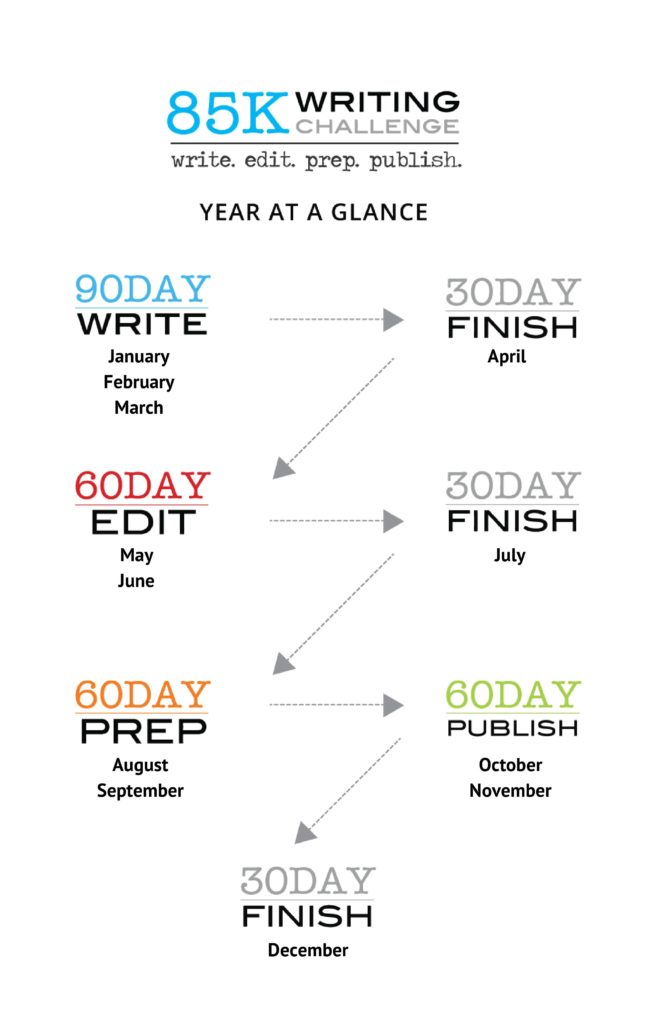
Think of a Finish cycle like the buffer you allow yourself when trying to get to an appointment. That extra time relieves you of worry when obstacles are placed in your path. Now, you can confidently address any challenges and then return to your area of focus.
So, if my posts this month tempted you to try a writing challenge like NaNoWriMo but the notice was just too late and you couldn’t get started until you saw all of my November resources, here’s a chance to regroup. Arm yourself with what you’ve learned this month, and then start fresh in January with 85K90’s main blog posts:
85K90: 90-Day Write
85K90: 60-Day Edit
85L90: 60 Things to Do Before Publishing
85K90: 60-Day Publish
If you’re not sure why participating in a group challenge may be for you, head back to the first post in this NaNoWriMoMo(onday) series to see what motivational advantages (for your writing, as well as the rest of your life) this might bring.
SPIT IT OUT: TRANSCRIPTION AND DICTATION
Last week’s post, filled to the brim with writing, editing, and proofreading resources was pretty popular with the student and office-worker crowd, as well as the aspiring and professional writers among you. More than a few of you requested tips for writing with clarity when you think (or talk) faster than you type and can’t get it all down.

Rev.com is a transcription service with a 24-hour turnaround time. You can record a file of yourself (or a group of people) speaking and then upload the file via the web or provide a link if your file is hosted on the back end of your site, in Dropbox, or wherever. The Rev folks then transcribe your audio (or video) from MP3, MP4, WMV, AVI, OGG, WAV, or a number of formats of which Paper Doll had never even heard, and they send you back your transcription in a Word document. The fee? $1/minute.
Rev will also do captioning for the hearing impaired at the same $1/minute, captioning of videos for $7.50/minute, and translations for 10 cents/word. Although Rev uses technology to help improve the transcriptions, the work is transcribed by a team of hand-picked freelancers, so you don’t get a garbled Google or Siri-style transcription of what you really, really didn’t say.
One of my organizing clients conducts interviews with business representatives all over the world. During these interviews, they explain how they make use of his company’s software products, and my client molds their stories into case studies presented by his company’s marketing department. A lot of ground is covered, often with interviewees with accents that are not always easy for my client to parse. When I told him about Rev, he may have been dubious that a company offering services at such a low price could deliver what he needed, but decided that a short test-run would be a worthwhile investment. Once he saw the results, my client was sold!
Rev is not an inexpensive option if you’re trying to dictate your entire novel, but if you’ve got limited time (or need to write for work during your commute), it’s a good option to get you started, and if you need transcriptions for your podcast, board meeting minutes, or anything you can’t get down on paper (or bytes) without losing momentum, it’s worth considering.
Obviously, there are other local and national/international transcription services out there, including:
However, Rev is the only non-local service I can vouch for. Whatever you write, you want to inspect the sites, check their reviews, make sure there aren’t different rates for “first-draft” transcriptions vs. polished ones, and clarify the privacy and security policies of the individual services.
What if you don’t want to trust someone else with your stories, interviews, podcasts, or other material that needs to be set in written form? There are always human-free technology options.
Dragon dictation software – Nuance makes Dragon NaturallySpeaking software for professionals, attorneys, medical practitioners, law-enforcement officials and a wide variety of others. For personal use, check out Dragon Home for PC users ($75); Dragon for Mac ($255), Dragon Anywhere (from $15/month to $150/year) with apps for iOS and Android.
I’m sure you’ve noticed that your computers, tablets, and phones all have dictation functions. For example, if you hit the fn (function) key twice in rapid succession on an Apple keyboard, you may dictate directly to your Mac. On a PC, select Windows Speech Recognition from the Ease of Access accessory in Windows.
On iOS and Android apps, you’ll generally find a microphone icon to the left of the spacebar, and clicking it will allow you to dictate. And within software and apps, dictation options are becoming more common. For example, in Word, select “Start Dictation” from the Edit menu (on Macs) or select “Speech” from the Tools menu on PCs; in Evernote, select the microphone icon from the tools options.
Generally, though, I wouldn’t recommend dictating your novel into a text field on your phone! Save dictation for when you have a rush of ideas and have to get them out of your head faster than your fingers could keep up.
MIXED BAG TIPS TO ROUND END NATIONAL NOVEL WRITING MONTH

The Evernote blog often has great tips for organizing your writing, and writers of all types sing Evernote’s praises. Consider the following:
- A Novel Strategy: How to Organize Big Writing Projects
- 12 Creative Writing Templates for Planning Your Novel
- NaNoWriMo: Planning a Novel With Evernote Templates
- I Wrote a Novel Entirely in Evernote. Here’s How.
- Plan, Prepare Your NaNoWriMo Novel with Evernote
And finally, in addition to the advice I’ve offered throughout this series, you might want to peek at the thoughts here for getting started, keeping going, and finishing up:
- Keeping Organized As a Writer
- Stuck in the Middle: Conquering Writer’s Block
- How to Get from Halfway Done to Finished First Draft
- 9 Steps to Help You Write a Good First Draft in a Month
As today is the last Monday of NaNoWriMo, this will be our final NaNoWriMoMo(nday) post. If you’ve missed what I’ve shared so far, please catch up anytime at:
Paper Doll’s How To Organize Yourself to Write for NaNoWriMo 2017
Paper Doll’s NaNoWriMoMoMo (Novel Writing Month Monday Motivation)…Even for Non-Writers
Paper Doll’s NaNoWriMoMo(nday): Organize Your Writing Platforms for Maximum Focus
Paper Doll’s NaNoWriMoMo(nday): 10 Tools to Organize Your Writing, Editing, and Proofreading
Whether you’re writing novels or holiday newsletter, I hope your writing experience is a little more organized!
Paper Doll’s NaNoWriMoMo(nday): 10 Tools to Organize Your Writing, Editing, and Proofreading
Writing is both an art and a science. Whether you’re tweeting or Facebooking, emailing or blogging, submitting reports at work or publishing the great American (or Canadian or Peruvian) novel, you need inspiration to come up with the big idea and a felicity of expression to say something in a compelling way. But writing is also a technical endeavor. Messy writing – poor grammar, confusing syntax, typographical errors, spelling shenanigans – all make it hard for anyone to be devoted to your brilliance. Today, we’re exploring tools to make it easier to write, edit, and proofread so that your work shows up in its party finery and not rumpled gym clothes.
EDITING AND PROOFREADING

Jumpcut – Have you ever been going along, writing and editing, and you cut something to copy it elsewhere, only to make some other tiny adjustment and realize you lost the hugely important text that you cut first? Yes, sometimes you can Control-Z your way out of that booboo, but often you cut something and only realize twenty minutes (and 30 edits) later that you really need that URL, that scientific notation, that turn of phrase, and your computer has overwritten what you cut or copied before with what you cut or copied just now.
Jumpcut is a free Mac application that will save your butt! It allows you to store (and easily retrieve) up to 99 items cut or copied to your clipboard. Once you download it, just double-click the resulting .tgz file to open it, and drag the application (with the little scissors icon) to your Applications folder. Then click to launch Jumpcut and a scissors icon will appear in your menu bar at the top of your screen.
From then on, whenever you cut or copy a piece of text, Jumpcut adds it to the stack of clipped items, which you can access from the menu bar by clicking on the scissors icon. If you prefer to avoid mouse/trackpad clicking and keep your hands on the keyboard, you can use a “hotkey” – the default is Control-Option-V, but you can change it however you like. A small grey box will pop up with the most recent cut/copied item displayed. Not what you want? Just arrow up or down to find the clipping you seek.
Jumpcut isn’t specific to any program – whether you’re in Word, Google, Twitter, WordPress, or whatever, anywhere on your computer, you can find what you’ve previously cut or copied. Even if your computer shuts down or the power goes out, your buffer of clipped items remains intact.
Jumpcut hasn’t been updated since 2009, and that hasn’t been a problem, but it’s unclear whether it will work with Mac’s High Sierra operating system.
Not a Mac person? Clipboard History, also free, offers a Windows alternative to Jumpcut. If you’re looking for more robust clipboard buffering for syncing across computers and mobile devices, the MakeUseOf website has a few blogs to get you started:
- 5 Best Mac Clipboard Manager Apps To Improve Your Workflow
- 6 Free Clipboard History Managers To Track What You Copy & Paste
- Sync Your Mac & iOS Clipboard with Command-C & Scribe

Grammarly is like having an angel on your shoulder, alerting you to spelling, grammar, and punctuation errors as soon as you make them. At its basic level, Grammarly comes as a free browser add-on and as desktop apps for Mac and Windows. For example, Grammarly for Safari (my preferred browser, but it also works with Chrome and Firefox) corrects for my sausage-finger exploits when I’m typing on WordPress, Facebook, LinkedIn, and pretty much anywhere else when I’m on the web. However, the Grammarly for Mac app syncs with any native Mac apps (like the WordPress app for writing this blog), and of course, Windows apps.
What’s nice about Grammarly is that it finds, illustrates, and then explains a wider array of grammatical and syntax errors than Word or similar program-specific spellcheckers and lets you accept a correction with the tap of your Enter key. It’s suitable for all styles of writing, from blogs and social media posts to longer documents.
If “exotic” words you use often tend to get flagged by your regular spellchecker, you can add to program-specific libraries, but if you want a cross-platform solution, Grammarly has you covered. I also like that Grammarly has a much better sense of when a word has been used in the wrong context, so it catches properly spelled words that, as homophones, make your sentences (and you) non-sensical.
Whenever Grammarly is running, you’ll see a tiny, green, fairly unobtrusive dot in the lower right corner of whichever field you’re writing; if it turns red, you’ll know you made an error even if the red-underlined mistake has scrolled upward or otherwise out of your immediate view. If you want to track how you’re improving with your writing, you can have it send you weekly reports summarizing the kinds of errors you tend to make.
Upgrade to a premium plan at $29.95/month (or $59.95/quarter, or annually for $139) and you get advanced checks for punctuation, grammar, context, and sentence structure, vocabulary improvement suggestions, and genre-specific writing style checks. There’s also a plagiarism detector, and Grammarly can help academic writers include citations in ALA, MLA, and Chicago Manual of Style formats.
Grammarly does have one huge drawback. Although there’s a free Microsoft Office add-on – it only integrates with the Windows version of Office, so if you’re a Mac person and use the desktop (non-cloud) version of Office, you’re out of luck.

Ernest Hemingway was famous for saying “Write drunk; edit sober.” As Paper Doll is a teetotaler, I can’t advise as to the drunk part, but Papa’s namesake app has some sharp features to let you edit, hangover or otherwise.
Hemingway Editor isn’t a spelling or grammar checker; rather, it’s more like a friendly editor (or high school English teacher) who lives inside your computer and uses a stash of colored highlighters to call attention to where you’ve ambled away from the ranch while writing. Hemingway highlights long, complex (or run-on) sentences and common errors. If you’ve started to ramble or sound a little too snooty, Hemingway knows.
Let’s say you want to write a letter of complaint to your insurance company or senator. You know that a direct, concise note will work best. Go to the web version, click on the box saying “write” (at the top right of the screen) and enter your text. If you’ve already written your letter, just copy and paste the text onto the screen, and you can format (adding bold, italics, multi-style headers, block quotes, bullets, numbered lists, and links) as you like. See it in action:
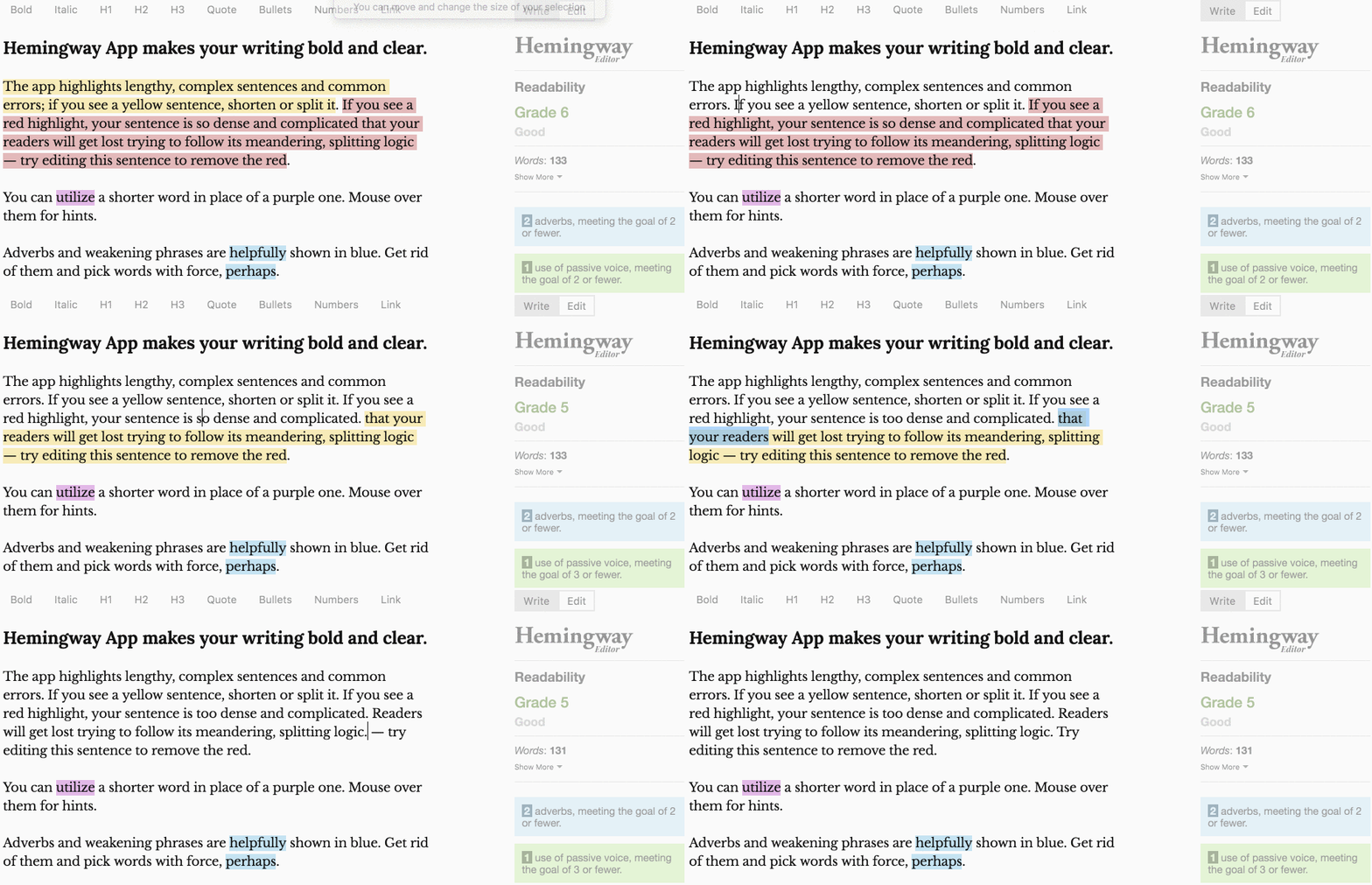
Then, hit the “edit” button (also at the top right) and the web software will color-code your sentences. Yellow means it’s a little long or meandering; red means it’s very hard to follow. Purple refers to unnecessarily complex words or phrases, and blue means you’ve used an adverb. (Hemingway notoriously had a grudge against adverbs; your mileage may vary.) Green means you’ve used the passive voice, weakening your writing. Once you know what’s wrong, you can edit to eliminate the highlighting and see what Hemingway thinks of your changes.
The software also tells you the grade level at which you are writing, and it counts your letters, characters, words, sentences, and paragraphs. If you like to tell readers how long it will take to read a post and don’t want to use a plug-in, it will calculate how long it will take for your audience to read what you’ve written.
The online version is free, and fine for short pieces of writing. For longer documents, consider the desktop version of Hemingway Editor, which lets you publish directly to WordPress and Medium, and has formatting for HTML and Markdown so you can export to any online platform. You can also export to Word, or send your changes directly to editors and colleagues, avoiding the evils of Word’s Track Changes function.

OneLook Dictionary isn’t your typical online dictionary. Sure, it’ll provide a definition of a word, but it can also find words and phrases that start or end with the word, are related to the word, or related to a general concept.
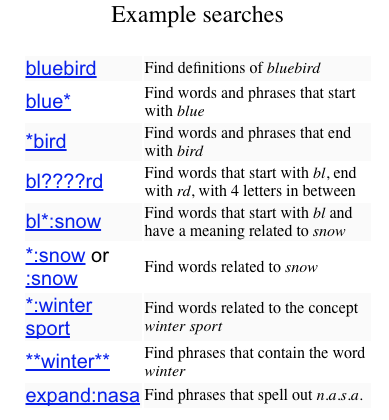
The sister site, OneLook Thesaurus and Reverse Dictionary, comes to your aid when your brain is full. Perhaps you know what you mean but can’t find the specific word you want. Or maybe you know that the word you want has something to do with “ontological” but that’s too stuffy for what you want to write. Describe a concept and it returns a list of words and phrases related to that concept. You can then filter by soundalike words, rhyming words, meter, primary vowel sound, and more.
TEXT EXPANSION
Do you ever feel like you’re writing the same thing all the time? Scientific terminology? Instructional material? Sample dialogue? For some things, you can create a template and copy and paste chunks of writing, but there’s a better way: text expansion.
Think of text expansion like Google’s auto-complete function. You only type part of a phrase, but Google knows what you really want to say and supplies it. With text expansion apps, you can create “snippets” or shortcut phrases to allow you to automatically type words, sentences, paragraphs, and even whole templates for letters and documents with just a few keystrokes. You can also use it to fix your most commonly made typos (“teh,” anyone?) or create multiple signature blocks. (I like that I can type *JAB on any document and fill in my name, Certified Professional Organizer credential, business name, URL, email, phone number, shoe size…you get the picture. Four characters and done!) Text expansion is also helpful when you need to share difficult-to-remember URLs or call up hard-to-parse HTML code.

TextExpander works on Mac, Windows, and iOS devices and is available on a subscription basis for $39.96 annually or $4.16 if billed monthly. Take advantage of the 30-day free trial to see how it works for you.
If you’re not a fan of subscription models, there are two popular alternatives.

PhraseExpress has multiple (standard, professional, and enterprise) versions for Mac ($24.95-$49.95) and Windows ($49.95-219) and apps for iOS (free) and Android (free). There’s also a less robust Windows-only freeware version of PhraseExpress.
Another non-subscription text expansion option is Breevy ($34.95).
But I’ll share a little secret with you. Although all of the above options are heartier, the Mac does have a built-in text expansion tool. Go to System Preferences and navigate to Keyboard (it might be under “Language and Text” depending on your MacOS). Find the Text tab, and you’ll see where you can enter “Replace” (the thing you’ll type) and “With” (the content you want to appear).
For example, if I type “FollowUpDraft” in an email, it will type a three-paragraph follow-up message for when I haven’t heard back from a reply I’ve written to a prospective organizing prospect. I have similar text snippets for replies to people wanting to ask questions about my profession or who want to shadow me. It saves me hours of writing each week, and I only have to revise a few words here and there.
I should note, most of what I know about text expansion I learned from the great Brooks Duncan of Documentsnap. Any failures of imagination to explain the concept, however, are all mine.
~~~
Whether you’ve been writing a novel for the NaNoWriMo challenge or have just been penning TPS reports for work, I hope these NaNoWriMoMo(nday) posts have been helpful. If you’ve missed any, you can catch up here:
Paper Doll’s How To Organize Yourself to Write for NaNoWriMo 2017
Paper Doll’s NaNoWriMoMoMo (Novel Writing Month Monday Motivation)…Even for Non-Writers
Paper Doll’s NANOWRIMOMo(nday): Organize Your Writing Platforms for Maximum Focus
Until next week, happy writing, and Happy Thanksgiving!
Paper Doll’s NANOWRIMOMo(nday): Organize Your Writing Platforms for Maximum Focus
[The following post was originally published in November 2017; content, features, links, and prices, have been updated to reflect available information as of July 2024.]
In ye olden days, serious writing required pen on paper or tapping on a typewriter, or some combination thereof. Then came computers with Wordperfect (and MacWrite, for my fellow 80s kids), and now, most people write using some of the standard software and app platforms most readily available to them: Microsoft Word, Apple Pages, or Google Docs. Each has its advantages as well as demerits, including bloated features that distract from the writing process or elements that don’t quite do what we wish they magically should.
If you’re writing a term paper or a letter of complaint, these big guns, which are likely already part of your regular writing routine, will suffice. But there are so many other platforms you may wish to consider to help you organize your resources, improve your writing focus, and be more productive.
Previously, we’ve looked at how to organize yourself to write for NaNoWriMo and other projects and how to get and maintain your motivation. As we continue our writing-themed Mondays in November, we are looking at options for selecting a writing platform to keep you organized and focused.
ROBUST WRITING PLATFORMS

Scrivener — For serious writers (from novelists and playwrights to journalists and academics), Scrivener seems to be the biggest poorly-kept secret out there. Everyone seems to know of it, though most seem to have some trepidation about getting started with it.
Scrivener is a heavy-duty professional writing tool created by writers for writers. At its most basic, it’s a ring-binder, a scrapbook, a corkboard, an outliner, and text editor all rolled into one. Use it to organize your thoughts on notecards in the virtual corkboard mode, view your research and writing in side by side windows, and use one of Scrivener’s templates to get the ideal format.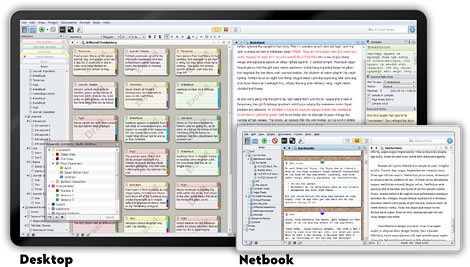
Create narrative or conceptual structure with easy drag-and-drop tools and write in a clean, distraction-free environment. Scrivener makes it possible to write a long presentation or a complete manuscript for a book in a way that a regular word processing application really can’t. Put all your research into it, and break it down into small, manageable chunks (almost like writing on index cards) so you don’t have to constantly scroll up and down 20 (or 200) pages of a document to locate what you need. Then weave everything together to form one unbroken manuscript.
To help you keep track of your goals, there’s a visual feature for seeing your progress toward particular word counts, whether by chapter or document. When you’ve written and edited to your satisfaction, Scrivener lets you format your work to various industry standards and export documents suitable for sharing or for publishing print books or ebooks.
Scrivener is available for Mac or Windows ($59.99), as a bundle of Mac and Windows ($95.98), and iOS ($23.99). To get a feel for what it can do for you, Scrivener’s creator, Literature and Latte, created a video:
Scrivener is complex to customize and comes with an incredibly detailed on-screen tutorial. But the biggest downside to Scrivener is that there’s so much available to you, so many features to accomplish so many different functions, that you’re likely to be overwhelmed. Happily, there’s a particular Scrivener expert I can recommend.
Joseph Michael, AKA @Scrivener Coach on Twitter, is the dude to know. Over the last few years, I’ve taken a few webinars he’s offered via other writers and bloggers I follow, and learned more with less frustration in a no-cost one-hour webinar than I did reading the already superb Scrivener for Dummies. (It’s a good book, but not everyone can translate text instruction into learning computer skills.)
I suggest that if you have or get Scrivener, that you follow Joseph Michael for his Scrivener Ninja Tips:
#Scrivener Ninja Tip: Create a link inside your Scrivener document with this drag and drop tip. #writing pic.twitter.com/37GpBUsvHs
— Joseph Michael (@ScrivenerCoach) November 6, 2017
If you’re really serious about learning all that the software has to offer, though, consider his Learn Scrivener Fast courses. I’m not a shill for him; I just know that no matter where I go on the web, when Scrivener comes up, Joseph Michael’s name is mentioned in short order, and I can honestly say that he ties with my tech-oriented organizing colleagues Deb Lee and Kim Oser for offering the most detailed, fluff-free, information-laden presentations on the planet.

IAwriter — This platform is designed to help eliminate all of the distractions of the menus, toolbars, and icons that may keep you from focusing on what you’re trying to say, rather than how it should look. Explaining their approach:
The cover letter for your dream job. The business proposal that will turn everything around. The love letter, telling them how much you care. Why is it so hard to get started? Few of us grow up without a fear of being judged for our writing. So we pause, we hesitate, we procrastinate, while others advance. In iA Writer, we stripped away everything that might stand between you and how you feel, so that you can write from the heart. This is how great writing gets started.
Features for creating this distraction-free environment include:
- Custom templates find you the form you need.
- Focus Mode dims everything except the current sentence, allowing you to maintain focus, much like how a typewriter’s limited view kept writers in the moment.
- Night Mode puts light text on a dark screen, which is easier on the eyes, especially when writing at night.
- Syntax highlights find weak verbs, unnecessary or repetitive words, erroneous conjunctions. etc.
- Content blocks allow embedding of photos, tables, and text.
- Document library lets you search, sort, and swap between documents all from your current window.
- File export enables exporting your IAwriter document to WordPress for your blog or website, Medium, or HTML, or to Word (.docx) or PDF.
- Multi-Markdown language lets you format and edit for a streamlined but powerful visual approach.
- Keeps track of which things you write and what you’ve copied and pasted from other sources to ensure you don’t accidentally plagiarize. (External sources are dimmed; what you write is in regular text.)
For the person who needs minimalism but doesn’t want to learn any coding and just wants to click a big B for bolded writing, iAWriter will have some tradeoffs. There are a number of video tutorials to help you learn Markdown, exporting and sharing skills, and setting preferences.
While IAwriter was created for a Mac environment, it is now available for all of your desktop, laptop, and mobile settings. After a free trial, you pay for each version of IAwriter as a separate software item, per platform. It’s $49.99 for Mac and iOS (iPhone/iPad), $29.99 for Windows, and Android $29.99 (or $9.99 for an annual Android subscription).
Also, it’s Stephen Fry’s favorite writing platform.

Ulysses — Are you a Mac or iOS person and who wants a clean, spare writing platform? Ulysses clears the decks. From a focus and productivity perspective, Ulysses is all about keeping your fingers on the keyboard and your eyes on the prize.
There’s a markdown-based text editor, so you don’t have to fiddle with fancy formatting or styles. Ulysses includes a built-in grammar- and style-check to help you avoid mistakes and set the fitting tone for your content. It works with more than 20 languages, offering suggestions for capitalization, punctuation, semantics, redundancy, style and more.
Once you’ve finished writing, you can transform your content into a variety of formats: PDFs, Word documents, blog posts, or ebooks — at a keystroke. (If you use it for blogs, you can create features images, tags, and excerpts directly from within Ulysses.)
If you have a specific character limit, set your goal and have Ulysses track your progress toward it. If you have various clients, or different types of projects (or project-owners), you can organize your creations in separate folders for easy access.
All your writing projects get store in Ulysses’ library, so they’ll sync and be available on all of your devices, no matter where you are when inspiration strikes.
Ulysses has been around since 2003, but is constantly being updated. As recently as June 2024, they added internal links between projects and navigation history tracking, and if you previously tried Ulysses, you review all the new features since I originally wrote about the platform in 2017.
Ulysses is designed with a basic, distraction-free interface — but you can explore hundreds of styles and themes in dark or light mode.
The organizational tools include a single library, which autosaves everything you create, hierarchical groupings, so you can keep track of sub-projects, and attachments (PDFs, images, keywords, etc.) which can be associated with a document without being inserted into the document, and filtered searches. You can also easily set word or character goals and share your progress via social media.
Syncing with iCloud and across iOS/MacOS devices is automatic, and you can add Dropbox folders to your text library. For exporting and sharing, you can export in multiple file formats (text, HTML, epub, PDF, and Word), or publish to WordPress, Ghost, Medium, or Micro.blog. There’s a Live Preview feature, so you can see how changes will look when published side-by-side with the changes as you are making them.
Ulysses uses subscription-based pricing, so after a fully-functional free trial, it’s $5.99/month or $39.99/year, or $10.99/six months for qualified students.
WRITING PLATFORMS THAT KICK YOUR INNER CRITIC IN THE TUSH

Ilys, a web-based option, was designed to help writers drop-kick writer’s block and push past self-doubt.
The conceit of Ilys is that it only lets you see one letter at a time, and won’t let you edit until you’ve written your pre-set number of words. There’s even a Ninja mode, where you can’t see any letters you’ve typed at all!
The idea is that Ilys creates a “state of complete absorption and effortless creativity [which] can lead to a profound sense of satisfaction and accomplishment. it can enhance your productivity boost your confidence and self-esteem, and help you express yourself with clarity and ease.”
Obviously, this is only suitable for decent touch-typists, but it’s a huge boon for writers who tend to self-edit every other word stymied by writer’s block. Here’s how it works in the creator’s own words:
Once you get into writing, you’ll have your bare-bones screen with just a few signposts to let you see where you are and where you can go within Ilys.
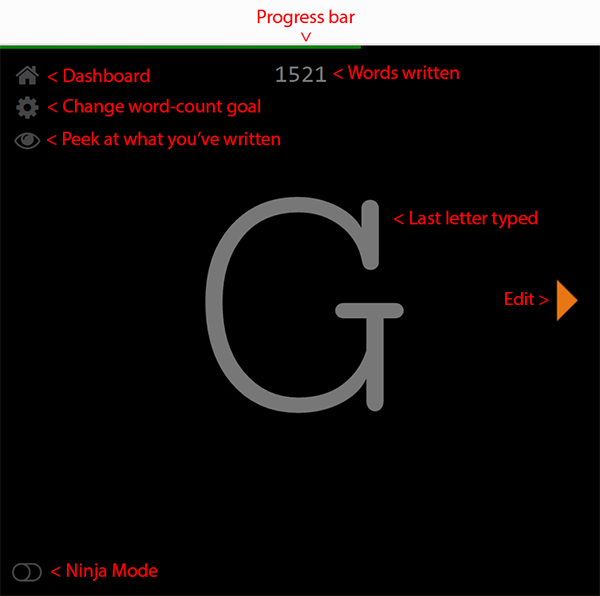
To start an Ilys writing session, enter how many words you want to write. Then just start writing, because there’s nothing else you can do. You can’t go back, delete, or edit anything until you have reached your word count goal. (There is an “eye” icon you can click to view what you’ve already written, in case you can’t remember the name you gave a character, or if you need to refer to a statistic you’ve typed.)
Ilys tracks your progress, identifying where you excel and where writing output dips. Because many writers profess that consistently writing a set number of words per day (irrespective of quality) is the key to success, Ilys is focused on providing a realm in which to keep on writing.
Everything is autosaved, just in case you accidentally delete something (or change your mind). Your data is stored, encrypted, online, until you’re ready to export your work to a word processing platform for more complex formatting.
Ilys offers a free 3000-word 500-word trial; after that, it’s $10.08 $11.11/month (or $99.99/year for 60% 25% off with an annual subscription).
Editor’s note: prices/trial information is no longer visible on the platform site, and it appears the site stopped providing information to non-registered users sometime between 2021 and mid-2024. However, you can use Ilys Classic — an even more bare-bones version, by going to the link and scrolling to the bottom to set your word goal. If you try to exit without having reached your goal, the page will show you what you’ve typed thus far and prompt you to return to the page. Once you have hit your goal, an arrow appears to take you to your viewable content.

The Most Dangerous Writing App, like Ilys, is web-based, and offers a similar, if potentially-paralyzing, approach to shutting down your inner critic. Instead of focusing on a word count, you set the time frame: 5, 10, 20, 30, 45 or 60 minutes, hit “Start” and commence writing.
While you write on the minimalist, unformatted screen, the web app counts your characters, words, and typing speed. If you stop typing for 5 seconds, everything you have written thus far disappears. Once you hit your writing time limit, you can copy and paste (no exporting!) your writing so you can edit and format elsewhere.
The whole concept is to free yourself from constraints and self-doubt by focusing all of your attention on your words. You can write in night mode or go full-screen to hide your desktop, but otherwise, this free web app is all about scaring you into letting the words flow!
To Paper Doll‘s mind, this approach is more suitable for Julia Cameron-inspired “morning pages” or following writing prompts than adhering to an outline for a long-form document. In fact, since I originally wrote this blog in 2017, The Most Dangerous Writing App has added a random prompt generator, so you might want to use the browser-based app to warm up before you get started on your serious writing for the day.

ZenPen is another free, web-based platform.
Actually, it’s barely a platform. It’s a bare-boned writing space with no distractions. None. Zip. When you first click on the link, you’ll see instructions to highlight all of the instruction text, hit delete, and start writing. When you do, all you’ll see on the page is:

See the very faint icons in the upper left corner? That will help you navigate. You can toggle to a full-screen mode, invert colors and go to dark mode, set a target word count, or save your text.
If you must format what you’re writing so that it makes sense to you, just click on any word or phrase you type and a tiny pop-up menu appears to bold, italicize, link, or create a visual marker for quoted material. Save and download what you create in plain text, Markdown or HTML for editing elsewhere.
Whether you choose a robust platform to complete your work of a lifetime or just select one of the web apps to free yourself to write without self-criticism, I hope you find a solution that works for you.
In our next NaNoWriMo Monday, we’ll be looking at wide variety of resources to help you organize your actual text and be more productive with your time. We’ll cover everything from proofreading and editing solutions to transcription options, all designed to help you write faster and create clearer communication, whether for your big novel or a workplace memo.
For related content, see:
- Organize Your Writing Time for NaNoWriMo 2022
- Organize Your Writing: NaNoWriMo 2021
- Paper Doll’s NaNoWriMoMo(nday): Writing Challenges, Dictation Tools, & Organized Writing Advice
- Paper Doll’s NaNoWriMoMo(nday): 10 Tools to Organize Your Writing, Editing, and Proofreading
- Paper Doll’s NaNoWriMoMoMo (Novel Writing Month Monday Motivation)…Even for Non-Writers
- Paper Doll’s How To Organize Yourself to Write for NaNoWriMo 2017
- Organizing Your Writing for NaNoWriMo and More
Paper Doll’s NaNoWriMoMoMo (Novel Writing Month Monday Motivation)…Even for Non-Writers
I always tell prospective clients that organizing isn’t about the stuff. It’s about the person who owns the stuff. That means that getting what you want out of the organizing process depends on getting what you want – a new set of behaviors – out of yourself. Whether you are organizing tangible things (your desktop and workspace, your home, your office) or organizing your time (work obligations, personal projects, family responsibilities, self-care), or organizing your thoughts (plans for the future, dialogue for your novel, deciding whether the other person loves you or just loves vanilla)…getting where you need to go depends upon organizing yourself.
But how do you get there? Last week, in Paper Doll’s How To Organize Yourself to Write for NaNoWriMo 2017, we talked about identifying your goals for writing, organizing your time, and charting your progress, but the truth is that motivation is an underpinning of all success.
In The 7 Secrets of Writing from the Best Writers in the World, Chad Grills collected advice about why to write as well as what to do to write better. My favorite quote from the article is from Steven King, who notably said, “Amateurs sit and wait for inspiration, the rest of us just get up and go to work.”
In my book, 57 Secrets for Organizing Your Small Business (for which I’m working on the second edition) I said that action precedes motivation. We all want the end result: we want to be fit, eat beautiful meals, have organized homes. Not many of us are super-jazzed to get up at dawn to head to the gym, shop and prepare for hours to make magazine-perfect dinners, or develop organizing systems. (Even we professional organizers have trouble getting motivated for our own projects!)
You know what motivates? Small victories! Sit down to write and notice that your word count gets to 500. Then you realize that you’re almost a third of a way to your daily goal of 1667, and you’ll be inspired to keep writing! Head to the grocery store with the recipe for that soup or appetizer whose magazine photo makes you salivate and bring home those ingredients – your investment of time (and money) will inspire you to start chopping! Waiting to be inspired to declutter your room might keep you waiting forever – start by picking up all the clothes that need to be hung, folded, or laundered and get them to the right place, and you’ll start to notice the momentum building.
Organizing a ritual helps, too. Many of my work-from-home clients have trouble getting started; there’s no clear delineation between being at home (lazing over coffee and Twitter, running a load of laundry, chatting on the phone) and the work day when there’s no supervisor peering crankily over the cubicle’s edge. Develop a ritual, whether it’s going out for coffee and then returning to work, or exiting via the garage door, walking around the block, and come back in the front door. It helps trigger that school-bell alert that it’s time to change tasks. Develop a ritual for when it’s time to sit down to write, and soon enough, like Pavlov’s dog, you’ll be conditioned.
There’s a writing ritual story, likely somewhat apocryphal, about Victor Hugo. It’s said that he had his valet take away all of his clothes, and left naked, he had no choice but to write, as he could not go out until his valet would reappear at the appointed hour. In other versions, he was left swathed head-to-toe in a huge knitted shawl, the 19th-Century version of a Snuggie or Slanket. Whatever the truth, without his ritual, the world may never have been graced with The Hunchback of Notre Dame or Les Miserables, meaning we might never otherwise have heard Wolverine (I mean, Hugh Jackman) sing “One Day More.”
Remind yourself why you’re doing this project and develop strategies that reflect your personality. I tell my clients that getting organized (or anything else we do) has to have more than a goal in mind. Knowing you want your living room, dining room, and kitchen to be clear of detritus may be the goal, but why? Is it because you’d like to invite friends over for coffee or dinner parties to keep the loneliness of the cold winter months at bay? Being able to socialize without obstacles or embarrassment is the motivation to keep working toward your goal.
So, just as we discussed last week, know why you want to write. Two recent organizing and productivity posts offer a little inspiration for thinking about your whys:
In Taking A Binge Approach to Organizing Projects in the now-defunct Unclutterer, Alex Fayle talks about the concept of binge projects (like NaNoWriMo and 30-day challenges) and compares the benefits. See what he has to say about creating overall goals, breaking down tasks, getting support, developing positive peer pressure, gamifying your approach, silencing your doubts, and achieving your results.
Meanwhile, Gretchen Rubin, author of such books as The Happiness Project, Better Than Before, and The Four Tendencies, looks at NaNoWriMo from the perspective of how to get from having a creative or entrepreneurial impulse to actually completing a project. In Signing Up for “NaNoWriMo”–National Novel Writing Month? Here’s Why It Works, Rubin looks at what it is about turning thought into deadline-oriented action that actually works for the Upholders, Questioners, Obligers, and Rebels (the four tendencies she’s defined and made famous). Rubin borrows from her own Better Than Before to see how habit strategies like convenience, monitoring, scheduling, loophole-spotting, and taking first steps can help you thrive and excel at NaNoWriMo (and other such challenges).
Finally, over at the blog for Reedsy, a publishing assistance platform, they’ve collected 41 Insider Tips for Winning NaNoWriMo 2017. My favorite tips are:
12. If you can’t block off a few hours each day, write in several shorter ‘sprints’.
In organizing, as in writing, too often people feel that if they can’t devote hours to a project then it is not worth attempting. But just as this article notes that you can use these sprints to get your creative juices flowing, you can do the same with your organizing.
In the five minutes you’re on hold with your credit card company, pull the expired spices out of your cabinet and make a list of what you need to replace. In the fifteen minutes before your favorite show comes on, go through two drawers in your dresser and move the sweaters you haven’t worn for a few seasons to the donation pile. And while you’re waiting for the water to boil for your pasta, open today’s mail, toss out all the exterior envelopes, move the bills to your bill-paying station, and shred those convenience checks and unwanted credit card offers!
16. ‘Perfect is the enemy of good.’ It isn’t exactly best friends with NaNoWriMo authors either.
Professional organizers tell our clients all the time: “Done is better than perfect.” If perfectionist procrastination is keeping you from starting a project because you fear it won’t be ideal when it’s done, then don’t aim for ideal. Just aim for done! Just as you can always edit and revise with writing, you can always modify your organizing systems, whether on your computer, in your paper files, or around your home.
40. Go through your manuscript and cut out all the words you don’t need.
Admittedly, timing is everything. For NaNoWriMo, you should write first, then edit. In organizing, it’s the opposite. Edit – cull, purge, pare down – whatever you don’t need, whatever you can find online (if it’s information), borrow from someone else (if it’s tangible), or cancel altogether (if it’s an obligation crowding you out of your schedule). Let it go.
I hope today’s post helped organize your motivation, whether you’re writing, decluttering, or working on any other kind of project.
Next NaNoWriMo Monday, we’ll be focusing on some tech tools to organize – whether you’re writing for NaNoWriMo, for work, or for academia. Meanwhile, I dare you to have read this whole post and not hum “One Day More” for the rest of your Monday.
Follow Me