Archive for ‘Paper Organizing’ Category
Organizing in Retrospect: A Confessional Look Back at 2020
I can’t imagine that 2020 was anyone’s favorite year. A global pandemic, a contentious election cycle, civil upheaval undergirding fights for justice, and unpredictable macro- and micro-economies were not on anyone’s wish list. Indeed, even the idea of a wish list seems preposterous now, as Robyn Schall explains:
This has absolutely finished me off I love her pic.twitter.com/6DaI0gxDEe
— wap rem x (@jackremmington) November 15, 2020
The year had other dashed hopes, disappointments, and dark moments. The National Association of Productivity and Organizing Professionals had to cancel April’s annual conference with only a few weeks’ advanced warning. A “girls’ getaway” to Ireland vanished. My inspiration to write disappeared as well, as writer’s block was my sole visitor in 2020.
Certainly the worst of all, Paper Mommy fractured two vertebrae just a few weeks into quarantine, leading to months of agony. I miss my mom, I miss my clients, I miss seeing people’s smiles. If anyone asks, tell them Paper Doll says this year has been yucky.
I miss my mom, I miss my clients, I miss seeing people's smiles. If anyone asks, tell them Paper Doll says this year has been yucky. Share on XIS HINDSIGHT 20/20 IN 2020?
Many of us in the productivity realm encourage our clients to pick a word or phrase for the coming year to help guide our mission. I’ll admit, I’m as guilty of magical thinking as the next person. I had feared that “Abundance” could bring an abundance of negative things. In retrospect, then, my choice of “Ample” seems almost absurd. (I’d even developed a funny social media tagline. “Ample: It’s not just for bosoms anymore!”) This year had an ample supply of absurdities.
Being a professional organizer and productivity specialist involves working from a position of positivity. Indeed, as we approach Thanksgiving, we’re all supposed to focus on gratitude, on the experiences and people who made the prior year worthwhile.
I’m sure I’m not the only one who has been finding it hard to reflect on this year and find positivity. Maybe it’s the same for you?
Some years seem best dealt with by offering a Viking funeral. “Set 2020 aflame and put it out to sea,” I often thought as March 243rd dragged on. However, my accountability partner and awesome colleague Dr. Melissa Gratias recently wrote a post called Taking Inventory of 2020 with Duct Tape, Henry the VIII, and Forrest Gump that put her own year in perspective. For her, this was an exercise in silencing her inner critic.
Read Melissa’s post, then come back and sing some Herman’s Hermits before you spend the next 5 weeks hearing nothing but Jingle Bells and Rudolf the Red-Nosed Reindeer.
We’re often quick to criticize ourselves for all that we did not get done; this is even more true in 2020. I touched on this in my favorite post that I wrote this year, The Now Normal: When the New Normal Changes Quickly. There, I said simply that “It’s OK to not be OK.” It’s OK if you’ve had eight months at home with no commute and you still haven’t written the Great American Novel or downsized your closet into a capsule wardrobe.
Similarly, Melissa reminds readers in her post that our days, our years, and our lives are not merely the lowlights and highlights, but the a rich tapestry of everything that happened. To that, Paper Mommy would add that it’s important to consider all the things that didn’t happen, but not in a “my trip got canceled” way. In response to the question, “Tell me something good that happened today,” Paper Mommy has been known to respond, “Well, nothing bad happened today.” She’s not damning with faint praise. That’s her brand of positivity.
In response to, 'Tell me something good that happened today,' @PaperMommy has been known to respond, 'Well, nothing bad happened today.' She's not damning with faint praise. That's her brand of positivity. Share on X
So, to echo Melissa’s efforts, I thought I’d share some of my activities. (That said, my inner critic cuts me a lot more slack than hers. I’m just amazed we’ve made it to Thanksgiving week!)
TALKING (LITERALLY) ABOUT ORGANIZING AND PRODUCTIVITY
For much of this year, I’ve been unable to visit with my clients. I’ve touched base by phone and email, making sure they’re healthy and supported, and I’ve added virtual organizing and productivity services to my offerings. But the main way I’ve been able to share my thoughts has been via the internet.
Ray Sidney-Smith is a productivity/technology/management triple-threat consultant and trainer. I met him when we trained together as Evernote Certified Consultants, and he has become a bigwig in this area. In October, he asked me to be a panelist on the Anything But Idle podcast he hosts with Augusto Pinaud, bilingual productivity coach and all-around sweetie. Here’s the video, but you can listen at the episode page and subscribe via the links on the sidebar. Don’t be too surprised when I geek-out about paper planners.
Although my Halloween costume as a Work-From-Home solopreneur wasn’t quite as creative as Ray’s or Augusto’s, you won’t doubt my enthusiasm. Plus, my co-panelist was Penny Zenker, Focusologist, motivational speaker, and (Halloween) pirate. Thanks to meeting her on the Ray and Augusto’s show, I’ve now been a guest on two upcoming episodes of Penny’s Take Back Time podcast. (Watch this space for official scheduling.)
Earlier in the year, I was also guest on Maria White‘s Organize Your Stuff podcast, where Maria and I had a long talk about one of my favorite paper organizing topics, tickler files. (You do know about my ebook, Tickle Yourself Organized, right?)
Listen to my episode on Maria’s show here, and be sure to subscribe in Apple Podcasts, Stitcher, Spotify, or wherever you get your juicy podcast goodness.
WRITING ABOUT ORGANIZING AND PRODUCTIVITY
As I mentioned, I had a pretty severe case of writer’s block this year. Or, actually, multiple cases, as it tended to come and go. Thus, I did not write the second edition of my first book, or the first edition of my second book.
However, when I was asked by others to write guest posts, ghostwrite, or contribute advice, I did manage to shoo the writer’s block away. Often, what I was asked to write was about organizing things other than paper, which helped clear the cobwebs. For example:
I wrote about how to keep kitchen pantries clean and organized in Home Organization: Tips from Professional Organizers for Porch.com.
When Redfin asked me to talk about how to tame the chaos in your child’s room for How to Get Your House in Order without Buying Anything New, I wrote more than they could fit, and now I’ve got a chapter for a book I hadn’t even anticipate writing when the pandemic began.
For Realtor.com, I held forth on 4 Types of Clutter: How Many Are You Hanging Onto?, including sentimental clutter, painful clutter, “sunk cost fallacy” clutter, and all that clutter related to one’s self-image.
And I was especially proud to have my advice appear in four different issues of Real Simple Magazine this year in pieces penned by Leslie Corona. If you’re a subscriber or picked these issues up on the newsstand, or if your public library is offering holds on magazines, you can find these articles in your print issues:
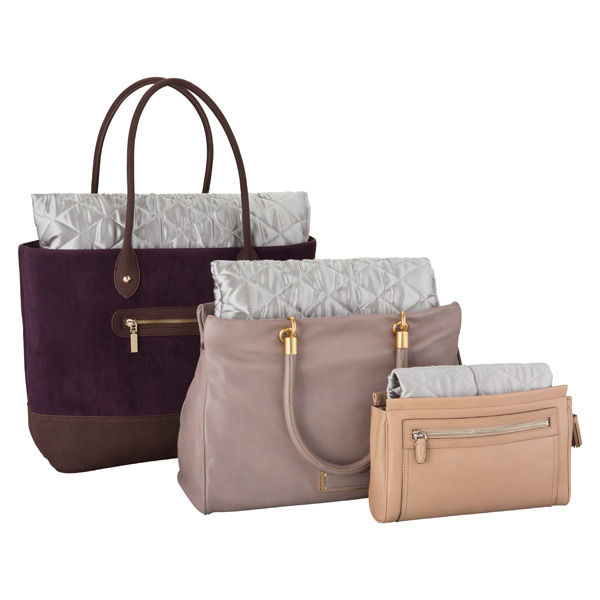
Organizing Challenge: Stow Your Purses and Totes in the February 2020 issue, pages 52-53, also appears in truncated form online as 3 Smart Ways to Keep Your Handbags and Totes Organized. Researching this topic was so much fun, it inspired me to write Organized Purses? It’s In the Bag!
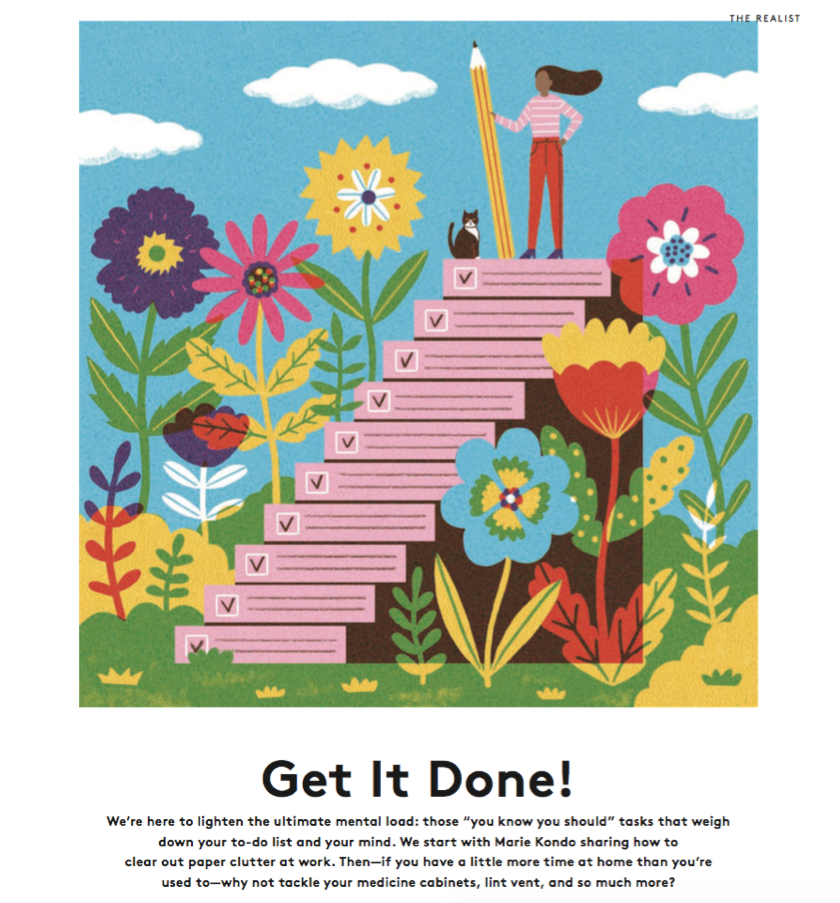
For Real Simple’s big May 2020 “Get It Done” section, I contributed to Get it Done: Refresh Your Medicine Cabinet, page 58. Though the advice pre-dated COVID, it ended up being timely.
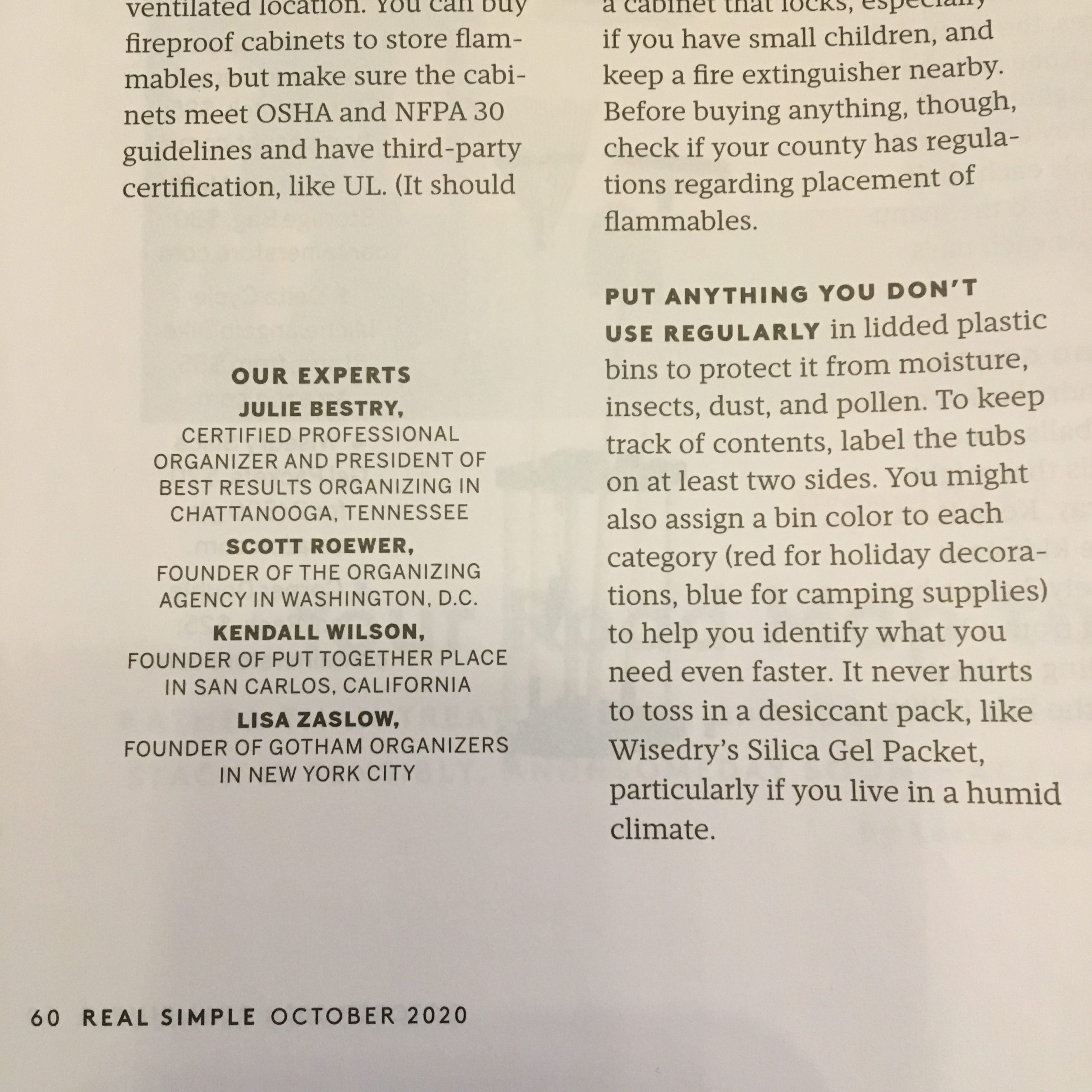
The most involved Real Simple piece was Your Road Map to a Tidy Garage, found on pages 58-60 in the October 2020 issue, and I was delighted to be tagged as a Real Simple “expert” along with NAPO colleagues Scott Roewer and Lisa Zaslow!
Long before the pandemic, Real Simple had asked me to weigh in on advice and products for organizing technology for travel. Travel soon became a hazily recalled habit of the past, like visiting malt shops or riding street cars, and that article never saw the light of day. Happily, a bit of the advice found new life as November 2020’s Organizing Challenge: Down to the Wires on page 50.
HELPING SOMEONE ELSE BE PRODUCTIVE
As I mentioned at the end of The Now Normal post, one of the things I did after lockdown began was edit Melissa Gratias’ book, Captain Corona and the 19 COVID Warriors. My role was small (Melissa is already a great writer) but satisfying, especially as the book took off. First local newspapers picked up the story, then People Magazine. A smile still spreads across my face when I hear Akil Jackson narrate Captain Corona.
And finally, even with writer’s block refusing to pack its bag and go, I feel really good about the blog posts I wrote this year, whether I was sharing advice for getting through a global pandemic or guidance for organizing time to read, or eliminating “tolerations” by using a shower curtain hook shaped like Marlo Thomas in That Girl.
LEARNING A LITTLE SOMETHING
In March, nobody could have imagined how much of our time would be spent tucked away at home, but I did anticipate that client work would be delayed for at least a few months. At first, my enthusiasm for continuing education was boundless, and I took a wide variety of NAPO courses and independent classes on:
Productivity — Oh my goodness, there were so many classes on productivity systems and tools, including the Getting Things Done rubric and using Evernote. (I watched so many webinars presented by my genius colleagues Stacey Harmon and the aforementioned Ray Sidney-Smith!)
Special topics in organizing — Like most of America, I found myself locked in multiple Zoom rooms a day. I took live classes like Color and Space Planning In Organizing: Personality, Autism, and ADHD, and Making Your Memorabilia Meaningful, and watched recordings of classes I’d abandoned live when technology failures amped up my stress level. (Was any sentence used more often than “You’re on mute!” this year?)
Higher Self coursework — I watched a recording of a NAPO University class called Bringing Meditation and Mindfulness Into Organizing and Productivity. By this point, probably late May, around the time I should have been in Ireland, my patience for Zoom coursework reached a low ebb. I was failing at being at all meditative or mindful! Hence, like Melissa (and half of the people I know), I took the exceptional (and free) Yale course, The Science of Well-Being, reinvigorating a passion for learning positive psychology (if not an interest in meditation).
Personal development — Although I’ve been studying Italian through Duolingo for two and a half years, by the time the pandemic started, I’d fallen into the habit of practicing all the lessons that came before everything got really hard.
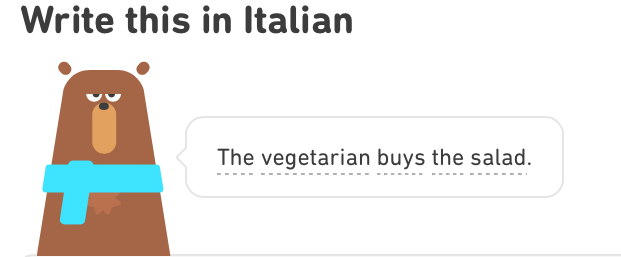
Let’s just say, it was more fun translating “Non puoi finché non finisci la cena” (i.e., “You can’t until you finish your dinner” and “La mia scimmia mangia perché ha fame” (i.e., “My monkey eats because he is hungry”) than it was to push myself into learning the present perfect and past imperfect tenses.
I realized that even though people were quoting The Now Normal back to me, my embrace of “now” didn’t have to mean I only spoke in the present tense!
I also became a little paranoid as Duolingo started feeding me sentences that hit a little too close to home:
- Noi mangiamo molti tipi di formaggio. (We eat many types of cheese.)
- Ho una cucina; però non cucino. (I have a kitchen; however, I don’t cook.)
- Io mangio il formaggio fritto. (I eat fried cheese.)
When you stop interacting with actual people, it feels a little sad when your language learning app knows you so well.
GIVING CREDIT WHERE IT’S DUE
There’s still a little more than a month of this year. I don’t know whether to expect sea monsters or fireworks. I still believe that “It’s OK to not be OK,” and think we all deserve credit for making it this far. If you’re having trouble remembering your accomplishments, ask a friend or two. Chances are that they’re much more observant – and less critical – than your (or Melissa’s) inner critic.
Finally, just in case Melissa’s discussion of Ghost and my clip of Herman’s Hermits wasn’t enough, no reference to “I’m Henry VIII, I am” is complete without this rendition from The Patty Duke Show, the best darn program about identical cousins ever made!
Until next time, I wish you a happy, healthy, and safe Thanksgiving.
Organize Your Health: Parental Wisdom, Innovation, and the New Time Timer® Wash
POOR, UNAPPRECIATED PARENTS
A few decades ago, my best friend called me with a “You’re not going to believe this!” tale of woe. A mom of four, she’d spent her little ones’ formative years teaching them, in age-appropriate ways, the essential life skills, including hygiene tasks like tooth-brushing, bathing, and hand-washing. She always explained how each helped keep them healthy, never stinting on science but also focusing on the “what’s in it for me?” aspect necessary to persuade tiny humans to do anything.
Her little daughter, however, was always reluctant. No matter how much my friend tried to bring home the concept of germ theory in keeping everyone healthy, she still had to remind, cajole, wheedle.
Fast-forward a bit to the day my friend called me. Her daughter had just returned from a day of kindergarten, and, as kids often do, held forth breathlessly on the delights and fascinations of learning something new. My BFF’s daughter solemnly, gravely spoke to my (college-educated in the field of child development) friend as if she were a dim stuffed animal and reported, “Mommy, my teacher said that we have to always wash our hands. There are little invisible bugs that if we touch them and then touch our faces, we could get sick, and if we touch someone else, we could get them sick. It’s very important that you do this!”
Huh. Really?
Mothers the world over know the sad, universal truth. You can’t make someone believe (or do) something, even for their own good, until they are ready. My friend’s daughter had to hear it from an authority figure who wasn’t her mom. Someone who made it interesting and fun in a non-mom way. Her daughter had sagely nodded along in class to earn the approbation of her teacher, and only then did the facts matter to her.
Sometimes, even we know something is good for us and everyone around us, it doesn’t matter who tells us; we just don’t do it. We don’t recycle. Or we don’t back up our computers. Or we don’t assign homes to objects and put things away, and instead toss bills on top of the microwave, where they gather dust.
Some people need to avoid the stick; others need the carrot. Organizing new health behaviors is no different.
WE NEVER WANT TO HEAR THE WORD “UNPRECEDENTED” AGAIN
Early in the COVID pandemic, we were repeatedly told that the best things we could do to avoid exposure to this dangerous virus were:
- Wash our hands.
- Don’t touch our faces.
- Maintain a 6-foot or greater distance from others (AKA: “social distancing”).
- Wear masks.
Many of us got good at figuring out how far apart six feet was. For me, I pictured two shopping carts. CNN had a post called Social Distancing Means Standing 6 Feet Apart. Here’s What That Actually Looks Like with almost giddy cartoon depictions like, “Two Labrador Retrievers standing nose to tail” and a “Man Wearing a Top Hat.”
MOM, HE’S TOUCHING ME!
Some pieces of advice were easier to follow than others. I mean, if you have had the chicken pox or poison ivy, you know it’s hard to keep from scratching an itch. But before COVID, did you ever give thought to keeping yourself from touching your face?
It’s hard! I mean, as an organizing and productivity professional, I can tell you how to turn off notifications on your phone to keep yourself from being distracted, but short of tying your hands to your chair, there’s not a lot of good advice for keeping your hands off your face.
A few weeks into the pandemic, Mike Bodge, Brian Moore, and Isaac Blankensmith developed Do Not Touch Your Face, a machine-learning, in-browser app that, once you granted camera access, would shout, “No!” at you when your hand got close to your face.
We made a little site that will yell at you… whenever you touch your face. Hope it helps you learn to stop touching your face! Try it out: https://t.co/IGNEQZIFAX Made with @mikebodge @lanewinfield #donottouchyourface #coronaoutbreak #COVID19 pic.twitter.com/jL5Ids9UV0
— Isaac Blankensmith (@Blankensmith) March 4, 2020
Weird but helpful, it worked when you were sitting in front of your computer, but not when you were anywhere but there.
Eventually, University of Hawaii Professor Kim Binstead designed the JalapeNO app for Fitbits (and soon, Apple Watches) to help people keep their hands off their faces.
WHO WAS THAT MASKED MAN?
Back in March, who (except doctors) owned a mask, unless it was part of a Grey’s Anatomy cosplay costume? With a shortage of N95 masks and the need for them to get to healthcare workers, entire cottage industries have grown up around creating reusable masks for the rest of us. (A big thanks to friend-of-the-blog Jacki Hollywood Brown and her daughter for the gorgeous masks in Paper Doll‘s theme colors!)
Your favorite sports team? There’s a mask. (Go, team!)
Your alma matter? There’s a mask.
Masks that match your outfit? But of course!
A mask with some snark from regarding your favorite 19th century author? Is a single man in possession of a good fortune in want of a wife? I mean, come on, it’s universally acknowledged!

 TIME TIMER WASH
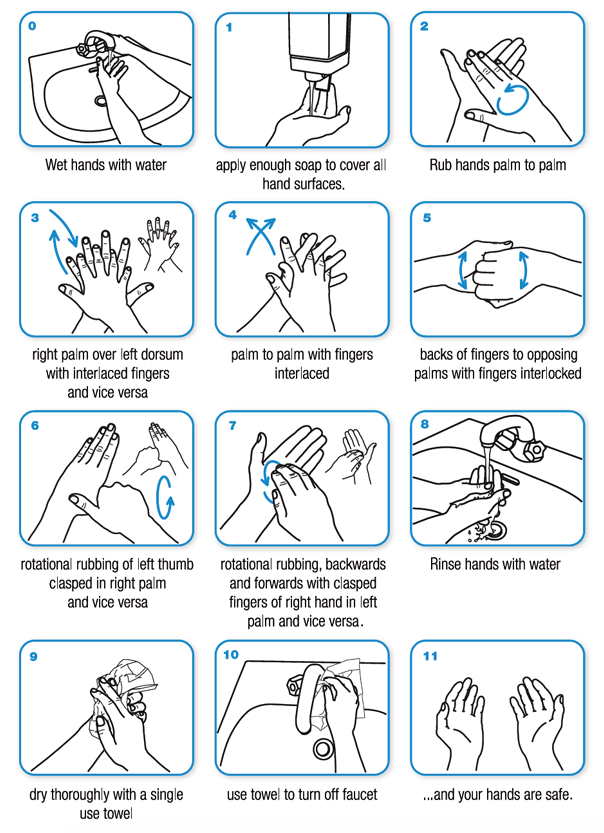
And now we’ve come full circle. Hand washing. In those first few weeks, we learned we probably weren’t washing our hands long enough, even if we were washing them often enough. We’re grownups, we assume we know how to wash our hands, but then the CDC came out with this somewhat daunting 11-step graphic:
Some people were singing “Happy Birthday” to make sure they were doing it long enough, but that got old. I’ve been studying Italian for the past few years, so I started counting in Italian to accompany the ritual. Quattordici. Quindici. Sedici…Venti-due. Venti-tre. Sigh.
So, I was surprised (but delighted) to learn that one of the companies beloved by professional organizers and productivity specialists, Time Timer, had joined the fight for clean hands. The same company I’ve praised in these pages previously (and previously, and previously) for how they help children and adults visualize time has created a special timer to make hand-washing, well, if not fun, per se, less of a chore.
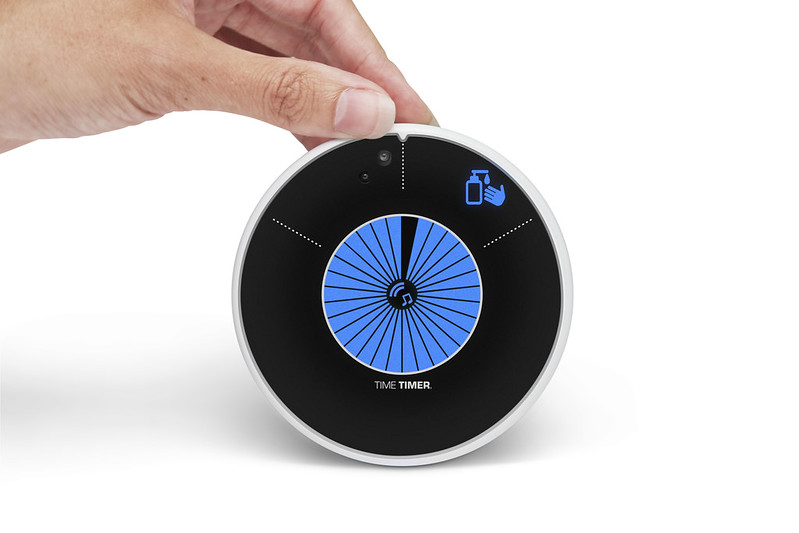
The Time Timer® WASH is a touchless, water-resistant visual timer for hand-washing.
The Time Timer WASH gives kids, impatient grownups, and anyone who isn’t great at judging time a clear, easily understood resource for getting hands germ-free. It’s not exactly a video game, but the lights and sounds encourage children (and anyone who needs a nudge) wash hands for a long enough period to kill germs.
Time Timer has paired advice from the (CDC) and the World Health Organization (WHO) regarding the recommended duration of hand-washing time with Time Timer’s classic “disappearing disk” to help show the passage of time.
- It’s touchless, so there’s no transfer of germs to the timer, and consistent use conditions kids (and, y’know, everyone else) to wash hands for the length of time that’s truly necessary.
- There are no numbers on the dial, so children who haven’t learned to read or tell time can still grasp the concepts of elapsed time and time remaining.
- Research shows that sound can help reinforce behavioral steps but the WASH timer’s music and sound cues are optional, so you can operate it silently in “sound-sensitive” environments (like a pre-school during nap time) or with individuals for whom sound may not be appropriate.
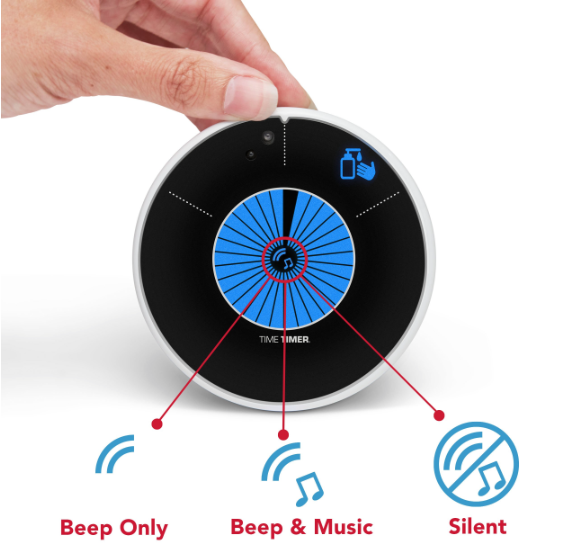
It’s easy to see it being used in bathrooms and kitchens, but also in classrooms and in certain workplaces, like labs, restaurants, anywhere yucky stuff might be encountered.
Start the Time Timer WASH by holding your hand (or slowly waving it) in front of the Timer. There are visual cues from the LCD light-up disc and auditory cues (music and beeps) for the different stages of hand-washing:
- Soaping up (5 seconds)
- Scrubbing (20 seconds)
- Rinsing (5 seconds)
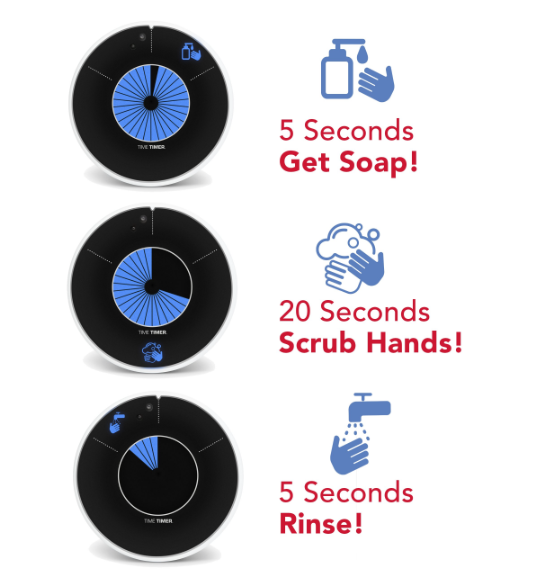
The Time Timer Wash has a variety of placement options. It can stand alone or be hung on the wall, and comes with a suction cup, which can be placed on either the bottom or back of timer. It does requite three 3 AA/1.5V batteries, which aren’t included.
It comes with a one-year 100% Satisfaction Guarantee. Per Time Timer, “If you’re not completely satisfied, return your Time Timer to us within 12 months for a full refund or exchange. No questions asked.”
Time Timer WASH is available for pre-order now for $26.95.
See it in action:
If you’re a parent or teacher, please note that Time Timer is offering a free downloadable Activity Guide to help education elementary-aged children in the importance of handwashing. Per TimeTimer:
This Curriculum-based Activity Guide contains 5 interactive activities for teachers or parents to use with children while teaching about proper handwashing techniques and includes worksheet and activity templates throughout. Adaptions for distance learning and in-home schooling are also noted.
ONE LAST THING
Remember my best friend’s daughter? She’s in her third year of medical school now, working in a hospital while doing rotations through pediatrics, internal medicine, endocrinology, and so on. She washes her hands…a lot!
Affiliate Disclaimer: This site uses affiliate programs to help generate a supporting income which allows us to continue our work and provide you with the best overall experience and valued information. If you have any concerns, we suggest you do not click on any affiliate links found throughout the website or blog. If you are uncertain as to the resulting link’s destination, you may hover your cursor over the linked material to see where it goes. We will always provide you with a company or agency name, which you can type into any search engine in order to reach the site independently of our links. For more information, please see the Affiliate Tracking section of this site’s Privacy Policy linked at the bottom of each page.
How To Make Your Reading Time More Productive With Book Summaries
Over the last few weeks, we took a deep dive into squeezing more reading into your life. In 12 Ways to Organize Your Life to Read More – Part 1, we looked at creating space and time for reading, creating better habits, and making reading a communal experience. In 12 Ways to Organize Your Life to Read More – Part 2, we delved into developing reading lists, changing formats, tracking reading habits, and motivating yourself with challenges. We also touched on sampling books.
One problem my clients often report is difficulty reading the right books. There are so many titles on a topic they need, usually for work, that they never quite get to – or through – many of them.
Today, we’ll look at services offering summaries of important, recommended, and/or best-selling books that your colleagues (and bosses in the C-suite) may be discussing. You want these people to feel like you’re on the cutting edge. However, (especially during the pandemic, when you’re not only a worker-bee but perhaps also an in-house substitute teacher), it’s hard to make time to read all those buzzy-wordy tomes.
So, consider these options CliffsNotes for non-fiction books. These services give you the birds’ eye view of what they feel are the author’s most important points in any book. If the author’s style resonates with you, continue on to read the actual book. If not, you’re a jump ahead of the person who has only half-read a few reviews.
Book Summary Services
Read It For Me – What do you think of the idea of being presented with the “Best of a Book in 12 minutes?” That’s Read It For Me’s theory, that in under a dozen minutes, each audio or video summary can share the biggest ideas from the best books on sales, marketing, leadership, and personal development.
For over a decade, founder Steve Cunningham and his team at Read It For Me have worked with the leadership development programs at companies like Mailchimp, Zappos, Bank of Montreal, AstroZeneca, and Spotify to develop and tailor educational content, the basis for the Read It For Me summaries.
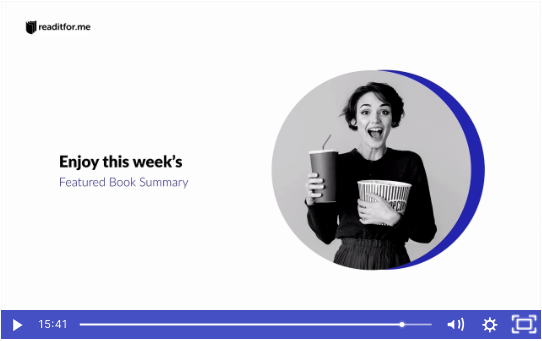
Each week, there’s one “featured” sample book summary video, available at no cost. Visit Read It For Me’s main page and scroll down until you see the friendly lady holding the popcorn and beverage, and click. The first few minutes introduce the platform, and then you can watch the video summary.
For each book summary in the Pro (paid) version, Read It For Me creates both an audio and a video summary (with an accompanying transcript). Just toggle “Listen” or “Watch,” depending on your preference, and with either version, you can read along with the transcript. (Note: the video does not have closed captioning; if you require it, you can open the summary page in a separate window and read while watching the video, side-by-side.)
Once you’ve completed a summary, you can mark it as read to help track your progress. Clicking a little heart icon works just as you’d expect to let you know that it was one of your faves.
Inside your book summary library, you can view all books, or sort by those that are most popular, the ones that you’ve already read, the ones you’ve marked as favorites, or by specific categories, which Read It For Me keeps fairly broad:
- Human Capital
- Innovation/Trends
- Entrepreneurship
- Personal Development
- Marketing
- Sales
- Leadership
Monthly pricing for Read It For Me Pro is $10, with no contract and a free first week. An annual contract is $110, payable in one lump sum. (Keep your eye on the site, as they often offer great discounts on lifetime memberships.) The app is available for iOS and Android, but the site is also well-formatted to access in your browser.
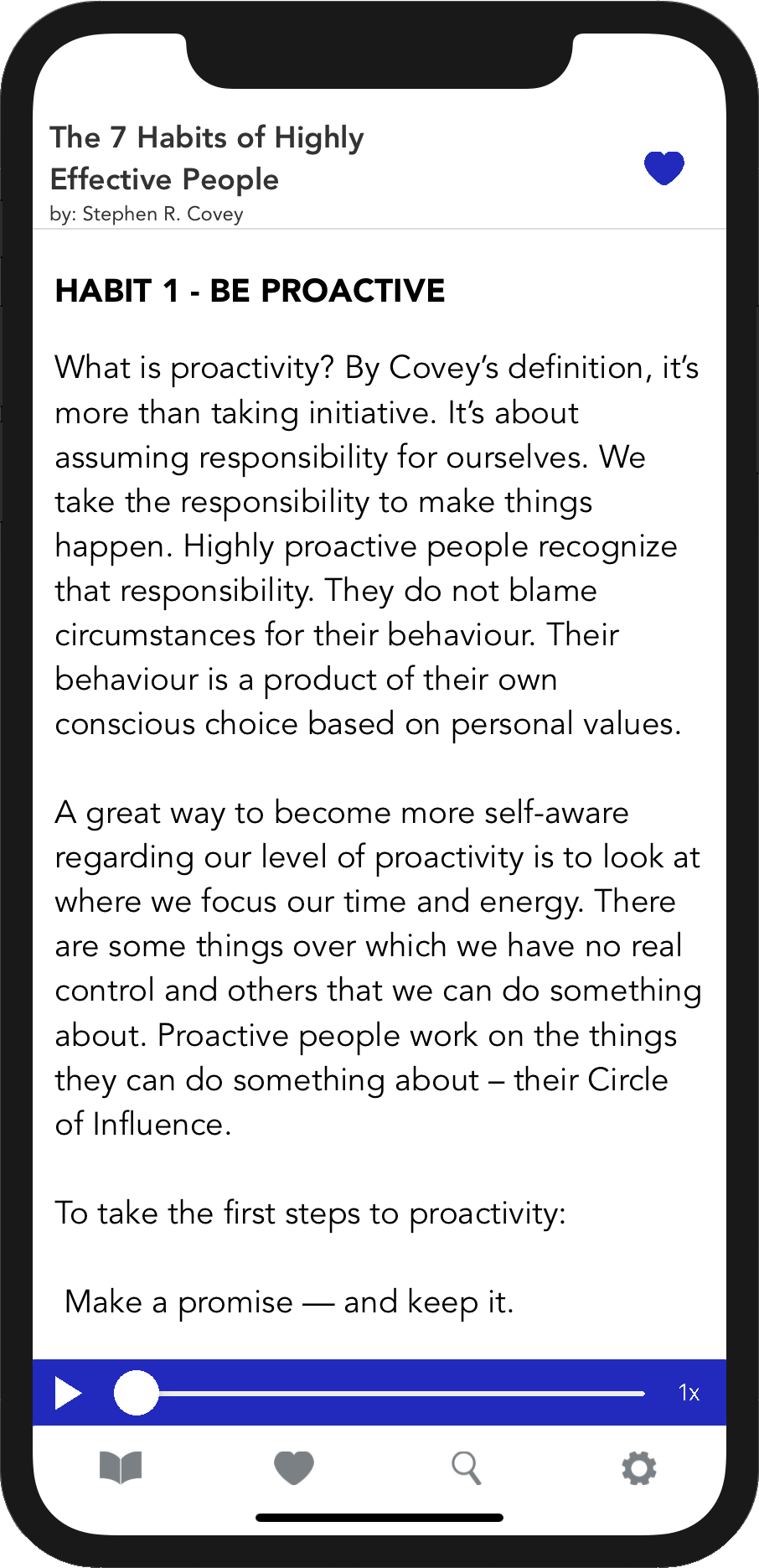
I’ve been a subscriber for about six months, and find the Read It For Me videos make a great (and educational) mental palate cleanser when transitioning between projects, especially in the late afternoon.
I use the summaries both to get a clearer picture of books that I’m not likely to read in full (generally on sales) as well as to get a sense of which books on similar topics would be the best fit for my reading and learning style (like Difficult Conversations: How To Discuss What Matters Most by Douglas Stone vs. Crucial Conversations: Tools for Talking When Stakes Are High by Kerry Patterson and Joseph Grenny vs. Fierce Conversations: Achieving Success at Work and Life, One Conversation at a Time by Susan Scott).
So far, my favorite summaries have been for Ryan Holiday’s The Daily Stoic and Brené Brown’s Daring Greatly.
A few final notes: all of the audios and videos are narrated by the founder, Steve Cunningham, so if you listen often, that can get a little repetitive. (But he’s got a conversational style of summarizing and a fun Canadian accent.)
Also, and of greater concern, the majority of titles are by white men, meaning that there’s a paucity of diversity of thought leaders, in terms of gender, race, and ethnicity. While this is attributable to which authors make it to the best-seller list, and this is common across all of the platforms discussed below, it’s worth noting at the outset.
Blinkist – Based in Germany, the app’s editorial team pulls the key ideas and insights from 3500+ bestselling non-fiction books and transforms them into 15-minute (or shorter) read-or-listen offerings, called “blinks.” Created in 2012, it’s one of the oldest subscription-based book summarizing services and has more than seven million users.
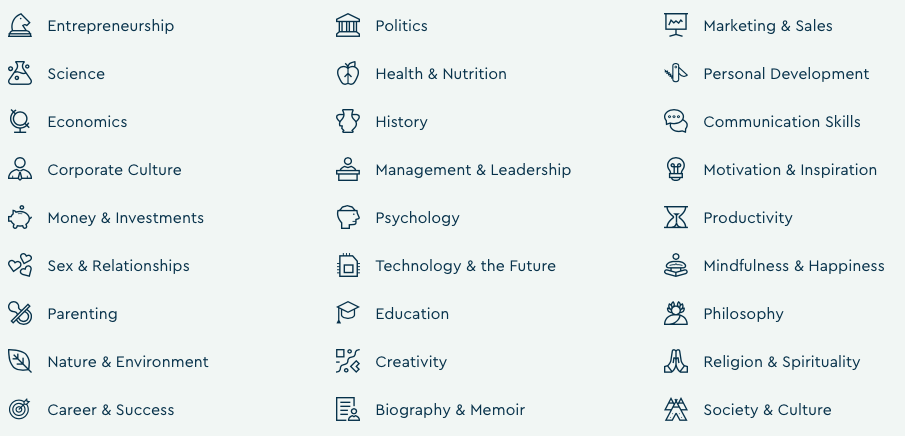
Blinkist offers 27 different reading categories, ranging from productivity and personal development to entrepreneurship and corporate culture, to marketing and economics, and has created a wide variety of intriguing booklists. Not all of Blinkist’s categories are business-oriented, as philosophy, religion, science, politics, history, and more also get the summarizing treatment.
You can view recently-added titles (Laura Vanderkam’s The New Corner Office caught my eye) as well the community’s most popular titles. Every Blinkist summary is created in two versions, so you can read or listen. Personally, I process what I learn much better if I can read it, but some people might prefer to listen first, then read to get the full experience.
In addition to key takeaways and insights, the Blinkist app features curated book lists to help you select the best titles in specific categories. It also suggests new titles based on your reading history, presents new and trending titles, and makes it easy to discover your next preferred summary (or actual book to read). In addition to the app, Blinkist has a podcast, as well as a digital magazine with some compelling content like:
Becoming More Productive Isn’t a Goal, It’s a Habit
Why Are So Many People Struggling With Loneliness
Dare to Read: 8 Non-fiction Books Recommended by Brené Brown
Blinkist has a 7-day free trial, which gives you access to all of the summaries. After that, you can choose the Basic plan, at no cost. This grants you access to one Free Daily Read, but it’s selected by Blinkist, so you’re at the mercy of what they select for everyone. (On the plus side, you and a friend could discuss each daily title, augmenting what you get out of the experience separately.) The Basic “blinks” are read-only.
Alternatively, there are two pricing options for the Premium plan, either $15.99/month or $99.99 billed annually (for $8.34 month). The Premium plan includes the following features:
- Unlimited access to every title
- Audio summaries
- Offline library access
- Highlight the portions of the text summaries
- Forward your highlights to Evernote
- Send your text summaries to Kindle
12 Min – Short for 12 Minutes (because who has time to read the whole word?), 12 Min is similar to Read It For Me and Blinkist. They offer a tiny bit more about their editorial process, noting that the team members “[r]ead the books several times, highlighting and writing down everything, searching for key ideas. Our team meets, discusses and summarizes the most important concepts and ideas” and creates what they call a “synthesized, optimized…microbook” available for consumption in under 12 minutes.
The platform covers thirty non-fiction categories, from standard business fare (like corporate culture and communications, management and leadership, and marketing and sales) to self-help (like health and diet, investment and finance, sex and relationships, and productivity and time management). 12 Min also offers summaries of children’s books, biographies, and memoirs. Search by category, author, or title. The website itself is available in English, Spanish, and Portuguese, and appears to be a Portuguese company.
Each 12Min “microbook” can be read as text or listened to as an audio in the app, and as with podcasts, you can adjust the speed, rewind ten seconds, or fast-forward thirty seconds.
Subscribers can create a new account with Facebook credentials or by creating an email/password combination, and 12 Min is available for iOS and Android. Compared to other platforms, the free trial period is pretty short at only three days, and, frustratingly, the website is not-at-all transparent regarding subscription costs. The iOS description indicates that subscription plans are available as Lifetime (full access to the library “forever,”), “Semestral” (for a six-month semester), and Yearly (for an annual membership).
The Android page indicates that in-app upgrades range from $12.99 to $144, but do not specify further. Eventually, by Googling “12Min pricing” I got to a pricing page to which one apparently can’t navigate from within the site, where it indicates a $69.30 annual price, and states that if you choose not to upgrade to from the free trial, you’ll be place on a “free plan” (also not referenced on the main site), able to read one free summary per day. I’d be eager to know if Spanish- and Portuguese-speaking readers can find more detailed information on the translated pages (linked at the bottom of the site).
Sipreads – This platform claims to offer “Takeaways from the best books, for free.” Categories of books summarized tend to focus on personal development, career success, startups, mindfulness, and happiness.
Launched in the past year by Ali Salah and Basile Samil, this email-based subscription service sends you a notification each week with the announcement of a new title’s summary. Each text-based summary will take about 5-10 minutes to read, and is printed in vision-saving large text with bulleted and numbered lists, bolded key points, and easy-to-read language. For example, here’s a summary of Nir Eyal’s best-selling Indistractible. The individual summaries are archived on the website.
The biggest advantage? Obviously, the $0 price tag. Sipreads has an affiliate relationship with Amazon, so if you find a book intriguing, click through, and buy the book, they get a tiny portion. While it doesn’t increase the book’s cost to the reader, it allows Sipreads to run the service for free.
The biggest disadvantage right now is a question mark. It appears that Salah and Samil write all of the summaries, and there’s no information regarding their professional experience in curation or librarianship, so the reader is left to trust that the summaries are accurate. Thus far, they seem to be. And again, spending no money and no more than 10 minutes reading the summaries means, at worst, you may not get everything you want, but you likely will get a sense of whether a book is for you.
These are only a few of the platforms and apps available for obtaining non-fiction book summaries. Others you might consider include:
- Sumizeit – ranging from a free 3-summary option to $5.99/monthly, 39.99/yearly and $69/lifetime plans
- getAbstract – $99/year for access to 5000 book summaries or $299/year for 20,000 titles
- Four Minute Books – free access to 800 book summaries
- Headway – Often compared to Blinkist for summary quality, it’s considered more user-friendly but has fewer titles; a monthly subscription is $14.99.
Pros and Cons of Book Summary Services
A summary is just that, a summary.
On the upside, you cut out the fluff and focus on the most salient points. If you need to have passing familiarity with the concepts of a buzz-wordy book in your profession, a summary can give you the key insights to keep from embarrassing yourself in conversation.
However, with summaries, you also lose the color, nuance, and richness that anecdotes in non-fiction books deliver. Are you the kind of person for whom insights come from declarative statements or from vivid stories? It’s important to know what kind of learner you are to get the most from a summary experience.
How to Make Book Summary Services Work For You
Don’t multitask. Seriously, it’s 10-15 minutes. Sit at your desk, snuggle on your couch, or otherwise make yourself comfy, but don’t try to dash off emails while you listen or work out while you read.
Take notes. You’re more likely to remember what you learn when you engage. There’s no need to make a transcript of the summary, but try creating a skeleton outline of the main points (or a mind-map, if that’s your thing), and write down any key words or phrases coined by the author, or which you otherwise find unfamiliar.
Develop a learning schedule. As we discussed in 12 Ways to Organize Your Life to Read More – Part 1, creating a specific time in your schedule for reading (after breakfast, before closing up work for the day, etc.) ensures that you will make time for expanding your knowledge. As none of these platforms take more than a quarter of an hour to embrace, you could explore five books each workweek (to get ahead on your backlog).
Read the actual books. If a book summary intrigues you, read the book. For full enjoyment, there’s really no substitute!
12 Ways to Organize Your Life to Read More — Part 2 (Reading Lists, Challenges & Ice Cream Samples)
Last time, in 12 Ways to Organize Your Life to Read More — Part 1, we discussed the first six ways to create order in your space and schedule so you can read more.
- Gather your TBR (to be read) collection.
- Schedule your reading time.
- Create physical space for reading.
- Replace a habit with reading.
- Read with others.
- Be part of a cultural experience.
Today, the list continues with six additional ways to encourage reading more of the things you want and get more enjoyment out of the experience.
7) Develop a reading list with great recommendations.
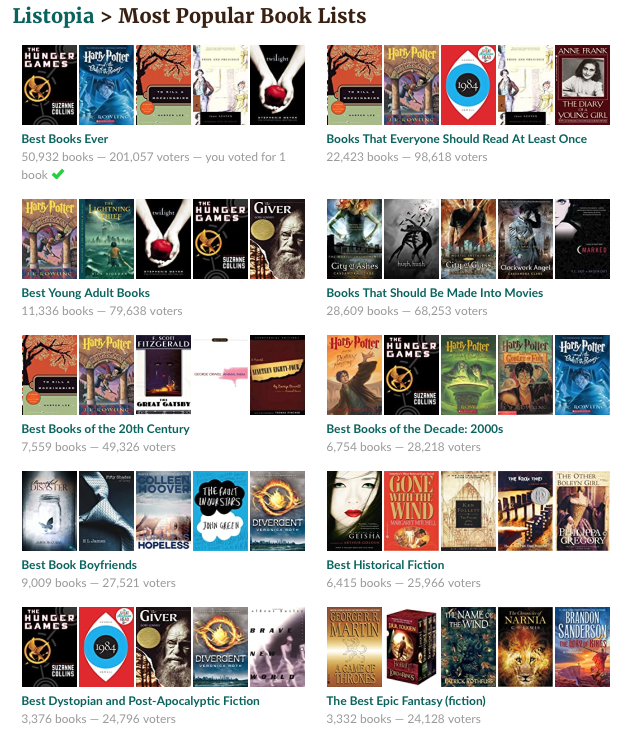
Having that TBR list of books is helpful if you’ve already laid in a supply of next-up titles, but what if you don’t know what you want to read? Goodreads’s Listopia is a great source for pre-existing lists collated from site-wide recommendations, everything from compelling suggestions in Best Time Travel or Best Non-Fiction of 2019 to celebrities’ (and other individuals’) own curated lists, like James Patterson Recommends His Favorite Thrillers to Glennon Doyle’s Books for Challenging Times.
Public library websites have reading lists developed by librarians. And just Googling a topic you’re more interested in will help you find great options. For example, when I typed “anti-racist reading lists” into the search box, I got over 33 million hits, and just selecting the top three yielded sources for a good start:
- New York Times: An Anti-Racist Reading List (compiled by Ibram X. Kendi)
- Phoenix Public Library: An Anti-Racist Reading List (compiled by librarians)
- WBUR-FM, Boston: A Reading List on Race for Allies Who Want to Do Better (compiled by Arielle Gray)
Famous people have famous reading lists. Previously, presidents have made their reading lists public, such as here, and here. Productivity author James Clear maintains a website called 100 Good Books To Read, which recommends far more than 100 books, with lists broken down by category. Billionaire Bill Gates maintains an entire section of his GatesNotes blog for discussing the books he recommends.
There’s even a website called The Reading Lists, collating everything from “Best Tear Jerkers” to “The Most Important Books on Dinosaurs” to “Must Read Books for Aspiring Writers.” Whether you want to find more books like the ones you love, or you want to explore a new genre, there are book lists to serve your needs.
You can also get great recommendations from blogs, podcasts, and apps. For example:
By The Book Podcast – Imagine if you combined a self-help reality show with a podcast about book reviews. For each episode, podcast veterans Jolenta Greenberg and Kristen Meinzer (along with their long-suffering and fan-favorite husbands) summarize a self-help book and then live by the precepts of that book for two weeks.
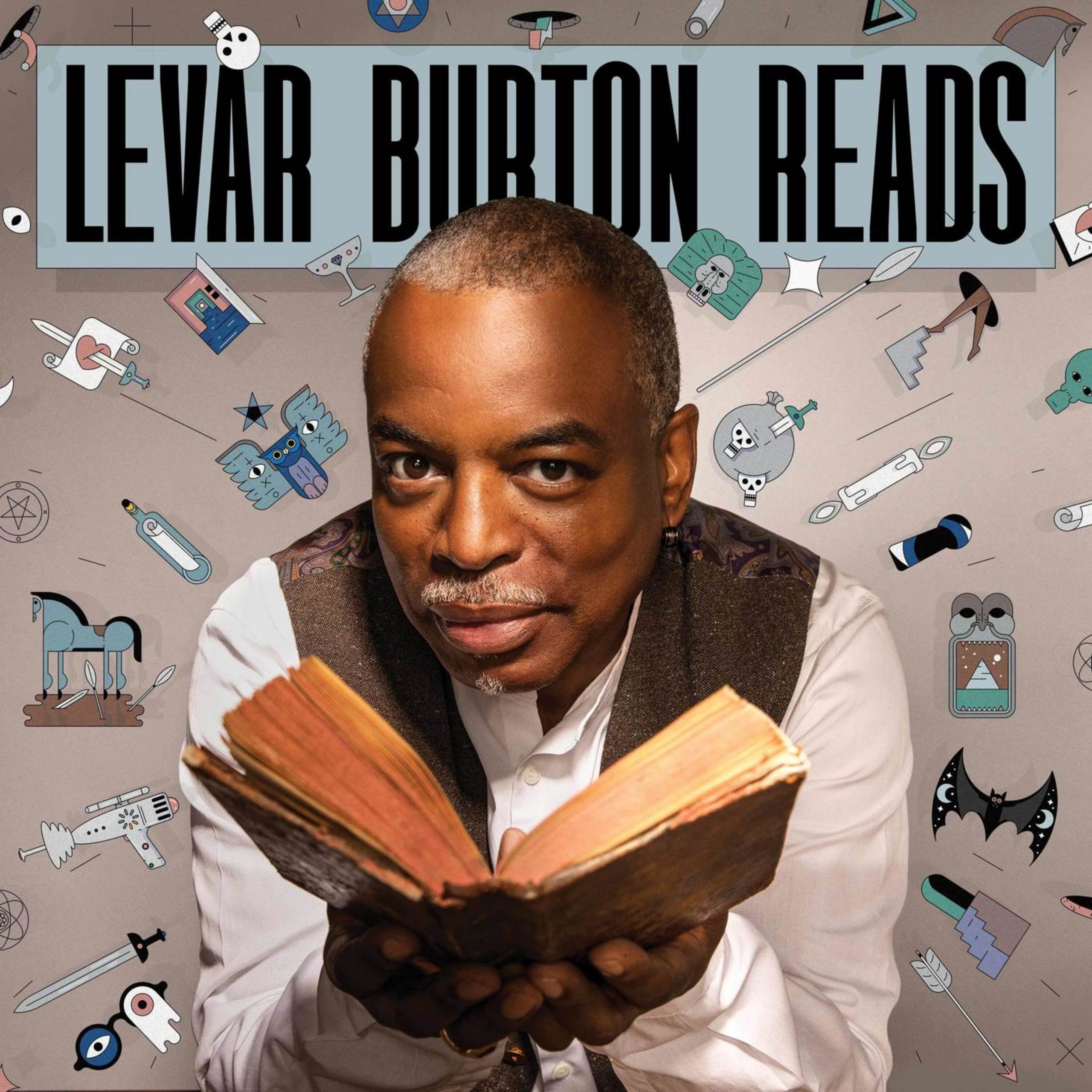
LeVar Burton Reads – Yes, the same Reading Rainbow star who spent 26 years helping get kids excited about reading has an inspiring reading-themed podcast for adults. In each episode of LeVar Burton Reads, now in it’s third year, Burton reads (in the same soothing voice that captivated generations) a piece of short fiction he chooses himself, in genres ranging (in his own words, in a 2017 interview with The New Yorker), “from fantasy to mystery to comedy and, of course, my go-to, science fiction.” Authors represented on the podcast have included Octavia Butler, Joan Aiken, Ray Bradbury, N.K. Jemison, Neil Gaiman, Haruki Murakami, and more.
Five Books – What if, when you wanted to read a book, you could ask experts on that topic what you should read? That’s the premise of Five Books, with an archive of more than one thousand interviews and five thousand book recommendations, offering two new interviews each week. For example, humorist Andy Borowitz gives his list of the best books on comic writing, while biographer Andrew Roberts offers up the best books on Napoleon.
Non-fiction topics cover art, business, economics, history, health and wellness, language, philosophy, politics, psychology, religion, sports, technology and more, and include titles for children as well as adults. Fiction-related recommendations run the gamut of genres from classic and contemporary literature to literary criticism, from crime and mystery to romance and horror, and from poetry to science fiction.
GoodBooks – This site describes itself as “Books recommended by successful people” – with 8500+ recommendations from “the most successful and interesting people in the world.” A little self-aggrandizing? Maybe. But the experts hail from media, technology, journalism, science, education, venture capitalism, design, entrepreneurship, activism, and other professions, and they recommend titles ranging from classics to some of today’s best-sellers, and there’s even a Top 100 most-recommended list. (Is 100 too daunting? How about just enough titles to read a book a month with GoodBooks’ top 12 list?)
Bookfinity – Perhaps you’re less interested in what the experts like to read and would prefer a fairy godparent to zap up the perfect read for you? Bookfinity uses the quirkiness of those social media “Which Marvel superhero are you?”-type quizzes to create recommendations customized for your reading preferences. (One note: you must create an account to access recommendations.) Once in the system, you can rate whether you like or hate Bookfinity’s recommendations for you, improving the algorithm.
8) Change formats.
I am a book snob. I like the weight of a real book, and want to be able to flip back-and-forth, check the “feel” of how many pages are left until the end of the chapter or the book, and even stop to look at the author photo. I tend to forget about books I’ve downloaded to the Kindle app on my iPad, whereas my To Be Read shelf is near and always reminding me what’s next. And honestly, unless I’m listening to an audiobook with a compelling plot, I tend to daydream.
But I grant you – sometimes, you just need to change it up.
You can’t (safely) read a book in the bathtub, but you can put your Kindle (or other ereader) in a zip-lock bag and read until your fingers get prune-y. Your local bookstore or even online shop may run out of stock, but ebooks and audiobooks are available at the click of a button.
During the first four months of the COVID-19 pandemic, my public library was closed and I couldn’t get my usual hefty pile of books. But you know what I could do? I could sit in my PJs at 2 a.m. and borrow digital copies of books at no cost by using my library’s digital platforms like Hoopla, Overdrive (accessible via the Libby app), and RBDigital to acquire books, ebooks, and audiobooks. (They also have magazines, comic books, albums and movies.)
And sometimes, you need a little support. Storyline Online, sponsored by the Screen Actors Guild, features celebrities (like Rita Moreno, Lily Tomlin, Rami Malek, and Kevin Costner) reading children’s books. That might be just what you need to save yourself from another night of reading your tiny human Hop On Pop on repeat, perhaps even giving you time to read your own books.
Experiment to see what book formats you find compelling. If listening to a novel while you cook or drive means you’ll get to submerge yourself in a story you’d otherwise miss, isn’t it worth trying?
9) Track Your Reading
You may wonder how tracking your reading helps you read more. But the more you measure your effort, the more inclined you are to improve that effort. Also, keeping track of what you’ve read prevents you from accidentally buying or borrowing (and then reading) the same book more than once.
The no-effort way to track your reading is to keep your read and to-be-read books separate. Once a book is completed, move it to the “read books” area. Of course, I wouldn’t be much of a professional organizer if I didn’t encourage you to let go of books you’ve read and have no intent (or desire) to read again. But if you let go of books to prevent them from piling up, there’s not much of a record of what you’ve read. However, there are other options.
Keep a reading journal. Take quick notes in your phone or keep track of your reading habits, favorite quotes, and thoughts on what you’ve read in a bullet journal.
Log your books digitally. Opt for something simple, like a sortable Excel or Google spreadsheet. There are also myriad book journaling apps, like Book Log, ReadingList, and Litsy.
Track what you’ve read in a website that lets you log, rate, and review books. I like how Goodreads lets me create a pathway for tracking books. When I hear of a book I might like to read, I enter it in the search box; when it comes up, I click “Want to Read.” If I start reading, I change the status to “Currently Reading” and later to “Read.” Then I can give it from one-to-five stars and write a review.
Marking the book as “Read” puts it into a chart of “My Books,” which I can sort by title, author, average rating, my rating, date I added it to my account, and date I finished reading it. I can also view and edit my reviews from this page, and change the virtual shelf on which I’ve put it. You can add your own shelving categories. Mine include, “Books by My Friends and Colleagues” and “Books That Would Make Good Gifts.”
Logging books comes in handy when someone asks me what I thought of a book. One of my favorite fiction genres is time travel; when you read a lot in one genre, it’s easy to confuse the plots, so seeing my ratings and reviews helps. It also helps me find titles I want to recommend. Recently, a friend told me that her daughter likes reading “art theft” books like Chasing Vermeer. I remembered that I’d accidentally read a book for younger readers along those same lines, but couldn’t recall the author. One quick scroll through the my reading list and I found Walls Within Walls, which I’d read in 2011!
10) Participate in Reading Challenges
I walk for exercise, but until I got a Fitbit, I never stuck to one regimen for very long. For a while, just trying to hit 10,000 steps a day kept me at it, but at the start of 2020, my best friend and I started doing the Workweek Hustle Challenge, where we “compete” (gently) against one another on steps counted. Her son recently joined in and invited us to to achieve certain measures of steps, miles, and minutes of exercise on Fitbit’s BINGO card contests.
Similarly, while I enjoy practicing my Italian lessons on Duolingo, keeping my travel partner’s score (each week, if not daily) gives me that extra boost.
Goodreads runs a challenge where you announce to your friends how many books you intend to read for the year; watch your ticker count up as you read, and note whether you are “ahead” or “behind” for the year. Book bloggers run some pretty famous challenges where you can amass different types of reading experiences: read a book in translation, read a book in a genre you’ve never explored, read a book with fewer than 100 (or more than 1000) pages, etc. You might want to try:
- The Modern Mrs. Darcy 2020 Reading Challenge
- 52 Books In 52 Weeks (multiple challenges)
- World Reading Challenge: Books Around the Globe 2020 (from Tale Away)
- The Master List of Reading Challenges from Girl XOXO (with a fancy and complex tracking spreadsheet to log all of the reading you do for all of the challenges in which you participate)
- Epistolary Reading Challenge (I love a book written in letters!)
- Newberry Reading Challenge (to read Newberry- & Caldecott-winning children’s books)
- Pop Sugar Reading Challenge (There’s also a Summer 2020 challenge.)
- Penguin/Random House #Read20In20 Reading Challenge
11) Read Books About Reading Books
Although it’s not everyone’s cup of tea, I find that reading books about the enjoyment of books boosts my enthusiasm when I’m not feeling up for adventurous bout of reading. Author-Librarian Nancy Pearl, who is so beloved among readers that she has her own action figure, has made a name for herself with her Book Lust series (Book Lust, More Book Lust, Book Lust to Go, and Book Crush), collections that recommend books for every taste, moment, and mood.
Consider books that recommend titles based on books you like or experiences you’re going through, such as Ella Berthoud and Susan Elderkin’s The Novel Cure: From Abandonment to Zestlessness – 751 Books to Cure What Ails You, Mirchael Dirda’s Browsings, and Sandra Newman and Howard Mittelmark’s snarky Read This Next: 500 of the Best Books You’ll Ever Read.
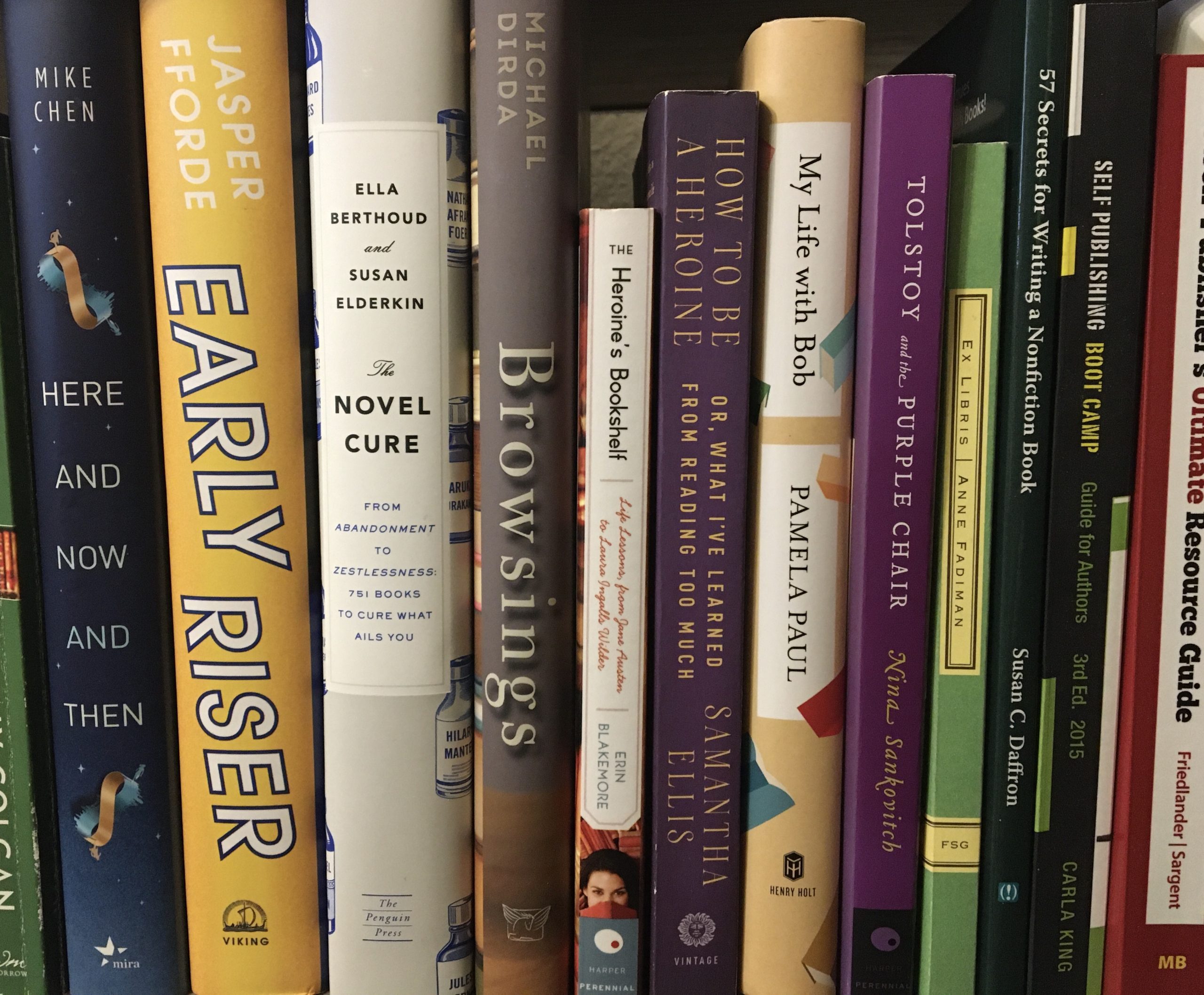
For years, novelist Nick Hornby had a monthly column in the Believer where he detailed the books he’d bought and the books he’d read (with minimal crossover in any given month), and combined short-term memoir and (award-winning) criticism. The columns were collecting in a series of books, including The Polysyllabic Spree, Shakespeare Wrote for Money, and Housekeeping vs. The Dirt.
Finally, there are just some great books of essays about books. The best, for my money, is Anne Fadmian’s Ex Libris: Confessions of a Common Reader, but my TBR still includes:
- My Life With Bob: Flawed Heroine Keeps Books of Books, Plot Ensues
- The Heroine’s Bookshelf: Life Lessons from Jane Austen to Laura Ingalls Wilder
- How To Be a Heroine: Or, What I’ve Learned from Reading Too Much
12) Develop an appetite with an ice cream sample.
No matter how many recommendations you get, sometimes, you just have to sample the material to know if it’s a good fit.
One trick is picking a specific page number, say page 53, and checking out the writing style without any preconceived notions of the book. If that random page appeals, it’s a good sign. We’re not spending much time in brick & mortar bookstores these days, though, so another option is the “Look inside the book” feature at Amazon, which allows readers to read introductions, tables of contents, and sample chapters to get a sense of whether a book is a good fit.
It can be difficult to find a compelling non-fiction book, especially for professionals with so many buzz-wordy titles vying for their attention. For them, there are online services that allow you to sample books by getting summaries of the material.
Next time, we’ll be looking in-depth at sites like Sipreads, 12 Minutes, Read It For Me, Blinkist, and more to help you get a birds’-eye-view of important non-fiction titles and find the books most worthy of you investing your reading minutes.
Until then, happy reading!
12 Ways to Organize Your Life to Read More — Part 1 (When, Where, What, With Whom)
Read any good books lately?
- Does the longest book you’ve read lately end with “Goodnight stars. Goodnight air. Goodnight noises everywhere?”
- Are you being mocked mercilessly by a pile of unread books on your bedside table?
- Maybe you’d like to read that popular novel before it becomes an HBO series?
Paper Doll gets it. Even for the heartiest of readers, there are seasons of life, and in some of those seasons, we aren’t reading. Sometimes, parenthood, work, or a chaotic life gets in the way. Sometimes, there’s a global pandemic giving us all the time to read we could ever want, but we just lack the motivation. (Hey, at least we’re not Burgess Meredith in the saddest episode ever of the Twilight Zone!)
We’ve covered organizing for reading time before, in 12 Tips for Organizing Your Reading Time and Organizing Your Reading Space for More Reading Time. But the world seems like it’s changed quite a bit since 2014, and it’s time to look at some new ways to make your life more reading-friendly.
10 WAYS TO ORGANIZE YOUR LIFE TO READ MORE
1) Gather your TBR collection.
TBR, or “to be read,” may have been a popular acronym previously, but I only learned of it when I started reading the Modern Mrs. Darcy blog. Early on in the quarantine, I had a surprise UPS delivery. My best friend had sent me a bookshelf from my favorite line, Origami Rack. The one she sent me is currently unavailable, but it looks like this…except mine is filled with books, with a corner of the top shelf given over to colorful Post-It® stacks and USB drives.
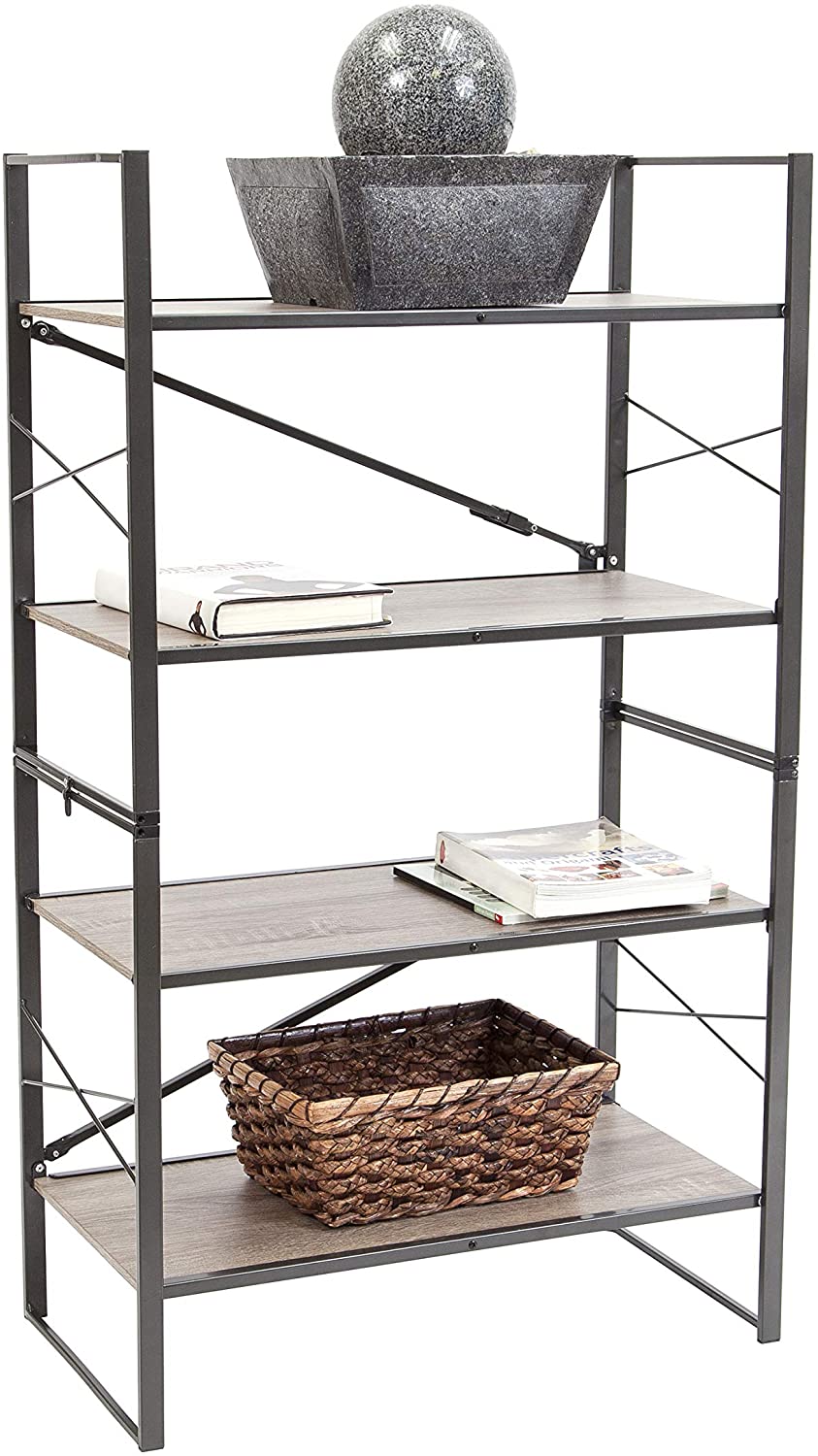
I was so delighted by the bookshelf, I rearranged my office space so that the bookshelf was to my right (appearing prominently in the hundreds of Zoom meetings I was about to have, dramatically improving the aesthetics of my space). I then went through every nook and cranny of my home, collecting every book I had not yet read, and I was shocked at how many unread titles I found:
- 8 novels
- 7 books about reading books
- 6 books about freelance writing
- 9 books about Jane Austen
- 5 books about diabetes
- 4 books about organizing and productivity
- 3 business books, 2 books about the history of Cornell University, and Lin-Manuel Miranda’s GMorning, Gnight! Little Pep Talks for Me and You, which doesn’t really fit any category.
Honestly, I knew I had quite a few unread books, but anticipated they might all fit on one shelf. Having them all in one place, and arranging them by category, made it easier to pick something when the inspiration struck. There are only two novels left, and I’m working my way through the other titles.
Your TBR shelf may just be half a shelf, or your bedside table, or a small square of counterspace. But bringing all of your to-be-read titles together gives you a starting point.

2) Schedule your reading time.
Early during the pandemic, Mike Vardy, The Productivityist, made a short video detailing how to create a good morning routine. When he talked about having 30 minutes of reading time during and after breakfast, it caught my attention.
I have natural points in my day when I might gravitate toward pulling a book off the shelf, usually at the end of the afternoon when I’ve finished my work but am not ready for dinner. Other people naturally read before bed or on their commutes (whether traditional reading on public transportation or listening to audiobooks while driving or riding). These tend to be defaults, times when they’re unlikely to do anything else.
But Mike, like many successful readers, has a firmly-set block in his schedule. He gets up, has breakfast, and reads before any of the chaos of the day can seep in and derail him. He reads before he’s checked email, or made phone calls.
If you’re afraid you’ll get too involved in your book and miss appointments or obligations, set an alarm on your computer, phone, or watch. See if a friend or colleague would like to read at the same time! You could arrange a five-minute phone or text conversation to connect after your reading block to talk about what you’ve read. You’re far less likely to tell yourself “one more chapter…” if you know someone is waiting.
Scheduling a reading block each day doesn’t eliminate the serendipity of coming across some quiet moments where you can hug a book to your chest and get lost in a story. It just means you’re guaranteed some time in your day and space in your schedule for delighting in the written word.
3) Create physical space for reading.
Carving out time for reading is only part of the story. Do you have a place to read? I mean, in theory, you can read anywhere except the shower. I’ve been known to hold my hair dryer in one hand an a good book in another, and I have friends who read in the kitchen while they stir. (Important PSA: Don’t chop and read!)
For some of us, any chair, bed, or square of floorspace will do. If you love to read but avoid reading, you may need a reading nook that’s more conducive to your physical needs. A comfy chair situated outside of the traffic patterns of your house, natural light (or a good reading lamp), a cozy blanket, a small table to hold your phone, beverage, and glasses – doesn’t the idea of this space feel compelling?
Consider employing a currently-unused space for your reading nook, like the corner of your guest room or some open space at the top of your stairs. Basically, if there’s an area in your home that doesn’t require you to move things around to vacuum, that’s a potential reading nook.
4) Replace a habit with reading.
Nancy Haworth, a friend and colleague in my mastermind group (a small group for accountability) shared the following as one of her monthly goals: “Focus on reading books more, rather than getting sucked into social media and news online.”
For the past two months, she’s been reporting what she’s read and how much progress she’s made, both on avoiding the dumpster fire that is the world these days (both in the news and on social media) and on specific books.
This approach would be tough for me. During each transition between activities, from email to writing, or from phone calls to deep work, I instinctively click on news sites to get that dopamine hit. But a recent weekend, during which my schedule was unusually devoid of obligations, I read a 468-page book, and I accomplished it in large part because I avoided turning to news sites and social media.
Are there other habits you’d like to break, or at least bend? If you tend to snack in the mid-afternoon, could moving to your reading nook instead of the kitchen help you accomplish that? If you’ve been working from home instead of the office, chances are that you spend more time sitting at your desk – there’s no cake in the break room or conversations over coffee with colleagues, and there’s no rush to leave work to deal with a commute. If you’re giving the office a little too much of yourself, a few 15-minute reading breaks could be just what you need.
5) Read with others.
Usually, the solitary experience of reading is a comfort. When you read (or reread) a favorite novel, it sometimes seems like you’ve become a quiet (and pleasantly ignored) minor character with a front-row seat to the goings-on. But other books, particularly non-fiction titles focused on topics like business, psychology, history, or current events, create an environment where you want other voices in the room, other people to help you debate whether the author is right, or tease out the true meaning of a paragraph.
Partner with a friend or colleague. It’s like the tiniest possible book club, but arranging with a friend to read a book means you always have something fresh to talk about. You don’t even have to read the same book.
Remember when Rachel and Joey traded recommendations? She read The Shining and he read Little Women?
(Joey’s guidance about putting too-scary books in the freezer isn’t the worst reading advice I’ve heard!) Once, my friend Mark and I simultaneously read one another’s recommendations. I read Great Expectations (meh) and he read Pride & Prejudice (and developed a teeny crush on Mr. Darcy).
Join a book club. Sure, 2020 doesn’t lend itself to attending the typical wine-and-cheese or coffee-and-cake in-person book clubs, but (hopefully) 2020 won’t last forever. Until then, there are all sorts of online book clubs. Book Riot’s How To Join a Book Club Online in 2020 is a good start if you want to share a reading experience with a large group of people reading the same thing, and Time Magazine covered 10 Virtual Book Clubs You Can Join Now.
Or start your own book club. The advantage of starting your own club is that you can set the rules – anything from “No novels by Ernest Hemingway!” to “Only books by left-handed authors!” – and invite like-minded friends. One person can take a professorial lead, members can take turns presenting, or discussion can be a free-for-all.
Friend of the blog Erin Doland, author of Never Too Busy to Cure Clutter and formerly of the Unclutterer blog, recently gathered a gaggle of friends for a virtual non-fiction book club, with discussion in a private Facebook group. The first title was The Inconvenient Indian: A Curious Account of Native People in North America by Thomas King.
Once the world can be social again, NPR’s Life Kit has a great post on How To Start a Book Club That Actually Meets.
6) Be part of a cultural experience.
Sometimes, a book club is a bit too much of a commitment. Maybe you’re an introvert. Or perhaps you’re just not that interested in what others have to say about a reading experience that feels so personal. You can still be part of something larger than yourself.
Have you ever had a book that you just couldn’t tackle, no matter how hard (or how many times) you tried? I’ve given Anna Karenina my best efforts, from my teen years to now in my (muffled static obscuring actual age) years. For (many others) it’s Moby Dick. For them, there’s an audio experience called the Moby Dick Big Read.
The Great American Novel may be great, but it can be daunting. In 2011, a group of artists, writers, musicians, scientists and academics came together for a symposium, sharing their fascination with whales, and it turned into a big fish tale! In other words, you can listen (via Soundcloud, Spotify, Apple Podcasts, or your favorite podcast app) to the 135 chapters (plus the epilogue), told by Tilda Swinson, Stephen Fry, Benedict Cumberbatch, and many others. If this book has been your own white whale and this finally helps you finish it, you can thank me later. Just don’t call me Ishmael.
The National Endowment for the Arts has its own Big Read, an initiative for exposing readers to new genres and ideas and challenges their current tastes in literature. The NEA Big Read sponsors 84 community reading programs, each designed around a single NEA Big Read selection. If your community or library system isn’t participating, you can still pick one of the 25 books in the NEA online library and avail yourself of the discussion questions and multi-media resources.
One City One Book and similarly named “community reads” projects have been operating for more than two decades, with libraries and civic groups encouraging all the people of one community to read the same book. Check your public library system’s website to see what community reading experiences are available to encourage you to read more.
Next time, in part 2, we’ll look at more ways to organize your life for more reading opportunities:
- How to get book recommendations so you can be enthusiastic about reading
- Why (and how) to change reading formats
- The secret to remembering what you’ve read (and liked)
- How to drive your reading mojo with challenges
- The type of book to rev your reading engine
- …and how to develop an appetite for books to better yourself.
Follow Me