Archive for ‘Office’ Category
Paper Doll on The Truth(s) About Standing Desks
Are you sitting down?
That’s what we ask people when we’re about to share upsetting news. Well, if you’re sitting down, and if you tend to be sitting down much of the time, this may not be news if you’ve been paying attention the past few years, but it’s certainly upsetting.
Spending too much time at our desks, plopped down (and probably hunched over), is pretty bad for us for a number of reasons, including those illustrated in this adorable TED-Ed Talk:
Articles like Sit Less, Live Longer and Too Much Sitting May Thin the Part of Your Brain That’s Important for Memory point out the major physical and cognitive problems associated with remaining seated.
But this doesn’t get into the latest and perhaps most important research. According to science writer Gretchen Reynolds, a recent Swedish study published in the British Journal of Sports Medicine suggests that when you sit all day, your telomeres (the tiny caps on the ends of DNA strands) get shorter. Apparently, this is NOT A GOOD THING! As telomeres get shorter, the rate at which the body ages and decays speeds up. Conversely, the study found “that the telomeres in [those] who were sitting the least had lengthened. Their cells seemed to be growing physiologically younger.” Obviously, we all want young cells!
The Push for Standing Desks
So, the experts have said, STAND UP! Why? Well, they figured that for each thing that sitting does to you that’s bad, standing can reverse it.
Let’s start with ergonomics and posture. You can still slump a little when standing, but not to the same extent as when you’re sitting in a chair. So, standing can help you strengthen your core, tighten up your glutes, and strengthen other muscles. There’s also such a thing as Upper and Lower Cross Syndromes, which, when you spend too much time sitting, can lead to tension headaches, shoulder strain, and that oogy feeling of becoming one with your office chair. When you stretch your leg and torso muscles by standing, you’re a bit more fit. Or so the theory goes.
Then there’s your cardiovascular system. Standing while working increases metabolism (vs. sitting down), and the theory is that just by standing, you can reduce your risk of heart disease by increasing your blood circulation. Well, maybe.
The physical advantages of standing vs. sitting make sense. But some researchers have posited that standing has other advantages related to productivity, creativity, and cognition.
With regard to productivity, studies note that while standing, more nutrient-rich blood, more mood-enhancing hormones, and more oxygen can get to the brain. More nutrient-rich blood and oxygen means more cognition, per The Economist, and unless you’re that Danish prince, Hamlet, more thinking means more productivity. (Hamlet, however, really needed a Disney vacation, or at least a mindless afternoon Kardashian-TV.) And more mood-enhancing hormones should, logically (and up to a point), yield more creativity. Whoohoo!
Finally, while a celebrity endorsement doesn’t necessarily imply wisdom, there have certainly been some famous desk-standers, including Ernest Hemingway (who famously said, “Write drunk, edit sober,” so you have to imagine him leaning more than standing), Vladimir Nabakov, Thomas Jefferson, Charles Dickens, Virginia Woolf, and Benjamin Franklin. Good company to keep – though, come to think of it, a number of them were tipplers and likely leaning like Hemingway.
The Tide May Be Turning
Up until recently, everyone had gotten a bit rah-rah about standing desks. There’s money to be made from standing desks, and health and productivity to be gained from standing, per se, so why not try it? Well, standing is well and good, but there’s some doubt as to whether standing desks do that much for you.
Boston Public Radio rather dramatically declared Throw Away Your Standing Desk after interviewing Arthur Caplan, Director of the Division of Medical Ethics at NYU Langone Medical Center about the minimal benefits of just standing while working. (Enjoy the audio for some jokey byplay.)
Further, there’s some shocking reportage that standing desks could be making you dumber! Apparently, a recent study in the journal Ergonomics found that while “due to concerns about excessive sedentary exposure for office workers, alternate work positions,” were studied, but they found that prolonged standing may have negative “health and productivity impacts” and that while creative problem-solving did improve, “reaction time and mental state deteriorated.” Yikes.
So, the answer is, STAND UP, but don’t expect that standing desks are going to yield that many benefits.
The Best of Both Worlds
Use a standing desk if you want (but keep an eye out for muscle fatigue, swelling in your legs, ankles, or feet, and decreased in cognitive function). If your back needs more support, sit at your desk, but set a timer or use an app to remind you to get up from your desk every 45 minutes or so.
Take a brisk walk around the office, do some wall push-ups, or go outside to make a client call and enjoy some fresh air. It’s said that Aristotle’s followers, the Peripatetics, engaged in all of their philosophical discussions while ambling about the Lyceum in ancient Athens. Why not take a page out of their books (scrolls?) and propose West Wing-style walking-and-talking meetings with your colleagues instead of traditional sitting or recently-in-vogue stand-up meetings?
Chances are that movement, rather than just standing, will have a more positive effect, and a change of environment will jump-start your creativity.
Shopping for Your Solution
If you decide you must have a standing desk, Paper Doll has you covered. Really smart consumer sites like Wirecutter like the Fully line of adjustable standing desks, particularly the highly-rated Fully Jarvis Bamboo adjustable standing desk.
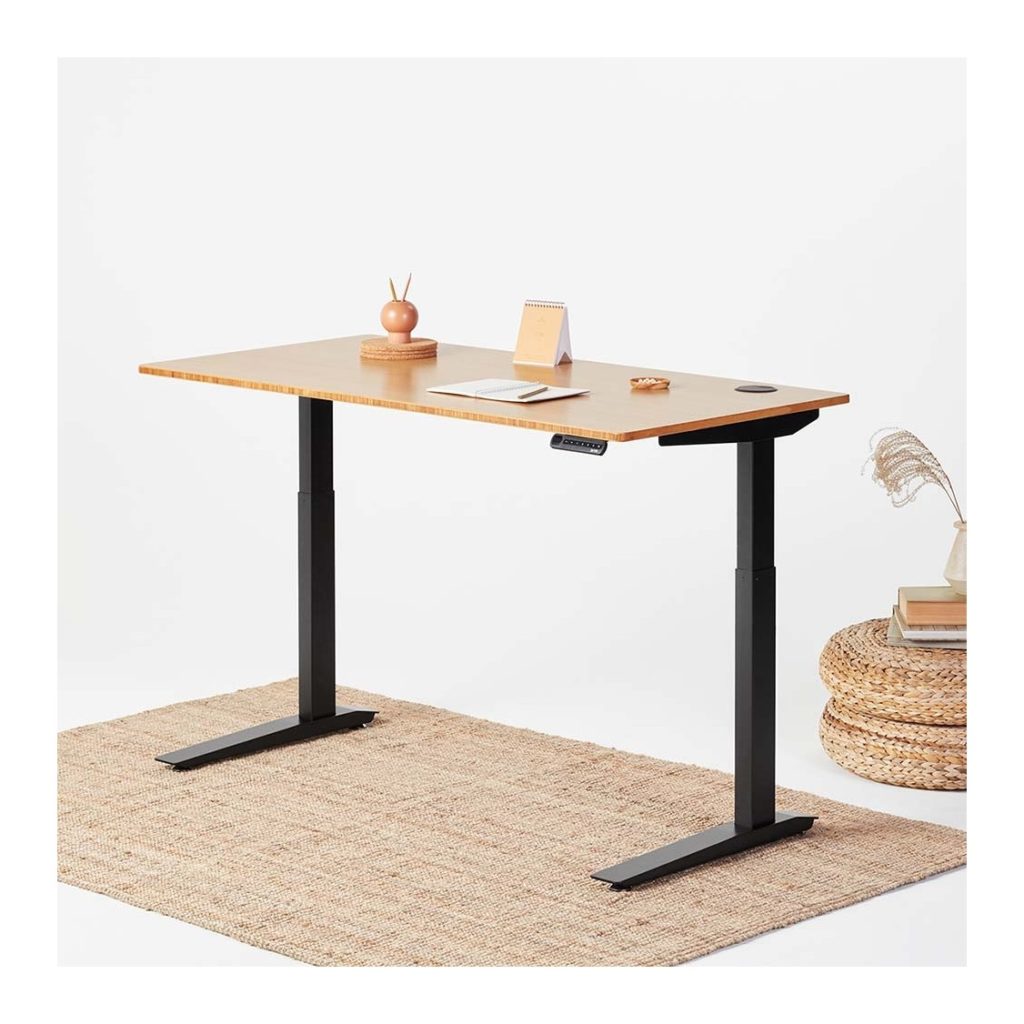
Of course, as with all furniture, prices range from high-end adjustable desks like those of Bush Business Furniture’s Stand 80 series to the DIY standing desk options and ideas on Pinterest.
Perhaps you’ve already got a desk you love. You could try what Paper Doll thinks of as a desk-topper (like a mattress pillow-topper), like HumbleWorks. The spine of the HumbleWorks has multiple slots, making it entirely adjustable. No matter your height, you can put your monitor and keyboard shelves at the correct ergonomic position for appropriate eye level and height.
The “spine” piece folds flat when not in use, so it’s easy to store.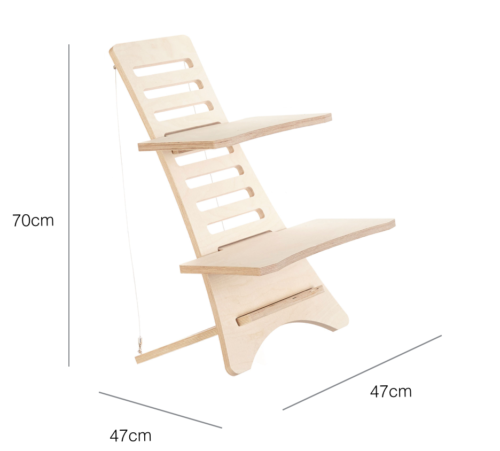
Compare different versions of the HumbleWorks standing desk. For example:
- Stan 1 is compatible with Macs and PC laptops with screens up to 15″, is made of 18mm birch plywood, and is reinforced with steel suspension cables and pins.
- Stan 1.5 is compatible with Macs and PC laptops and desktops with screens up to 17″, is made of 18mm birch plywood, and is reinforced with steel suspension cables and pins.
- Stan 2 is compatible with Macs and PC laptops and desktops with screens up to 27″, is made of 22mm birch plywood, and requires reinforcement.
If you like the wood look but want an alternative that’s more portable (and more price-sensitive) investigate the StandStand, which weighs less than many laptops and can be assembled in minutes. Versions come in bamboo or birch with varying finishes, and in multiple styles (for laptop, laptop-and-mouse, or for two monitors).
Not sure how you feel about the whole standing desk kerfuffle? Not ready to plunk down money for something that may not have a profound impact? Why not start small?
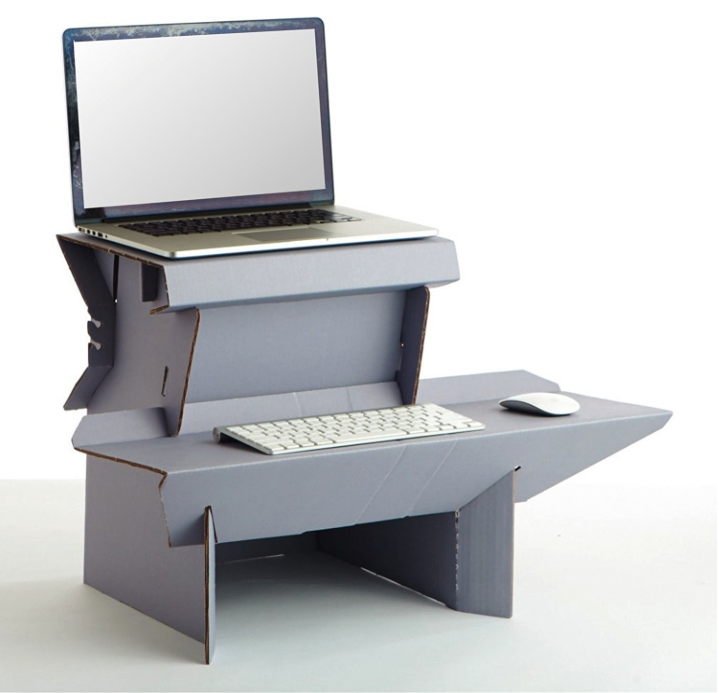
Recently, friend-of-the-blog and Professional Daily Money Manager Nanette Duffey shared her experience with the Ergodriven Spark, a sturdy cardboard standing desk that will only run you $25! It’s not gorgeous, but it gives you plenty of room for your laptop, an external keyboard and mouse, and even a knick-knack or two.
What if you want the best of all worlds? Do you want something fairly portable and full-size? Then your best bet is Refold, a sturdy, stand-up desk made out of thick cardboard! At 14 pounds, it’s not as lightweight as the Ergodriven, but it’s a free-standing desk and will hold 187 pounds! The Refolds come in three sizes: small for petite types (5’2″ and under), medium for those from 5’2″ to 6′, and large for those tall drinks of water over 6 feet.
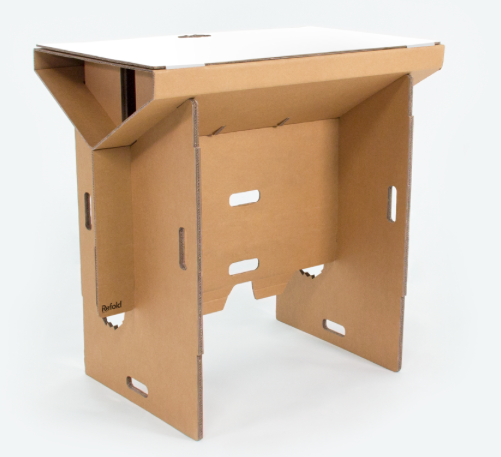
The Refold can have a cardboard or (for a teeny bit more money) a waterproof surface, can be painted or drawn on to customize it, and is fully recyclable. You can also purchase optional legs to turn it into a sitting desk for those days when you just can’t stand it!
One fairly significant note: the Refold is made in New Zealand, meaning that in addition to the $120-$190ish US dollars (depending on your product choice and the exchange rate), you’ll be paying some serious shipping charges.
Safety First
If you decide to keep on sitting, sit safely. Review these essential ergonomic tips for sitting, including:
- Sit with your feet flat on the floor.
- Keep your monitor at the same height as your line of vision.
- Sit so that your elbows are at a 90-degree bend when your hands are on the keyboard.
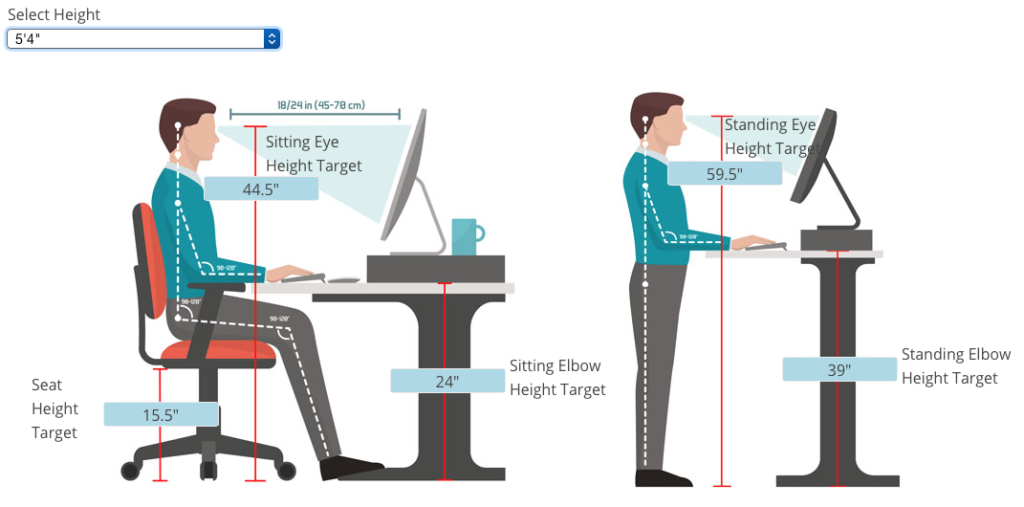
Finally, whether you decide to sit, stand, or work using a combination of both, make time to check that everything measures appropriately for your height. The NotSitting.com website has created an interactive sitting/standing-height desk calculator so that if you input your height, you can see the appropriate heights (whether sitting or standing) for your eyes and your elbows, and know how far your seat should be from the ground and how far your eyes should be from your monitor. For example, the following graphic shows what Paper Doll‘s ideal sitting and standing situation should be.
You’ve been reading this post for a while. Why not stand up, stretch, and take a walk to think about what you’ve learned?
Up Filer: A New Vertical Filing Solution
Got paper?
Of course you do. And most of your papers for your life and work probably live in some typical places: standing up in file folders in desk-top file boxes or step risers, or hidden away in filing cabinet drawers, or flat on your desk (and maybe piled all around it), with whatever is larger and/or on top obscuring whatever is below.
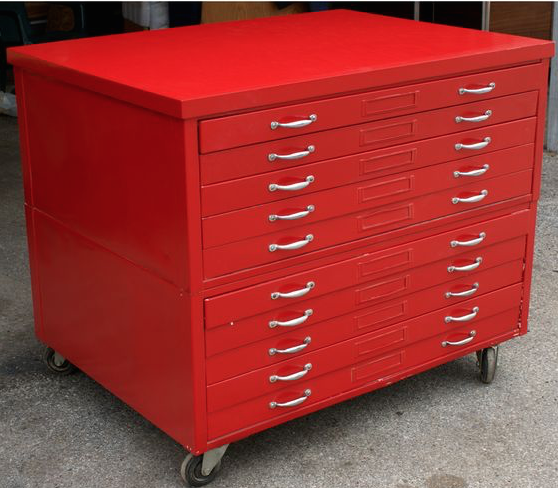
If you have lots of flat, non-bulky paper items, perhaps you’ve invested in a flat filing cabinet, with a variety of drawers to allow art projects, historical documents, and architectural designs nap in relative obscurity, often ignored or forgotten.
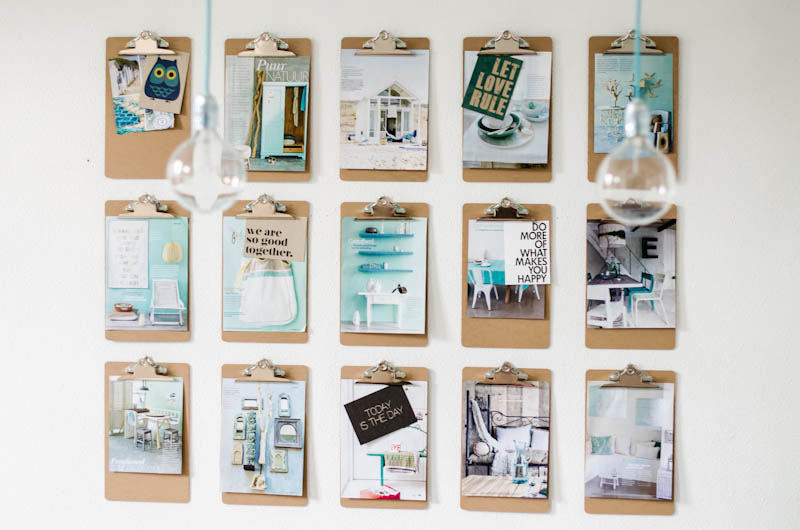
 Or maybe you’ve embraced the vertical approach with creativity — have you piled a bunch of related papers on a series of clipboards and hung them on your wall?
@2013 ASpareAndAPairDIY.com
The problem is that many people find that it’s fairly hard to gain purchase on your projects when they are hidden away. If you’re in a communal office setting, sharing resources and working on projects requires that everyone can have access without having to knock on Joe’s door and interrupt a meeting (or his tearful third-fight-of-the-week with his sweetheart) just to get the updated specs on the current blueprints. While it may seem like more and more of what we do is digital, there is still so much flat, tangible stuff and it needs to be easily stored and fairly accessible.
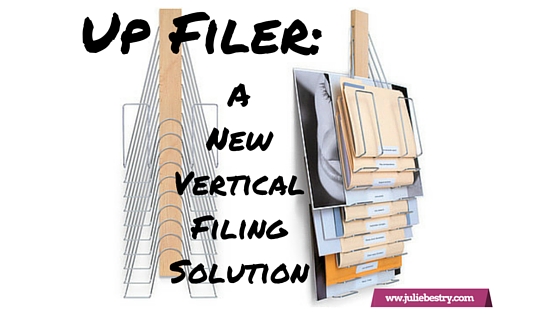
A new solution from Denver-based Westerville Design is a cross between a file step-riser and an on-the-wall clipboard, with a dash of the old-fashioned library newspaper rack and a soupçon of inventiveness.
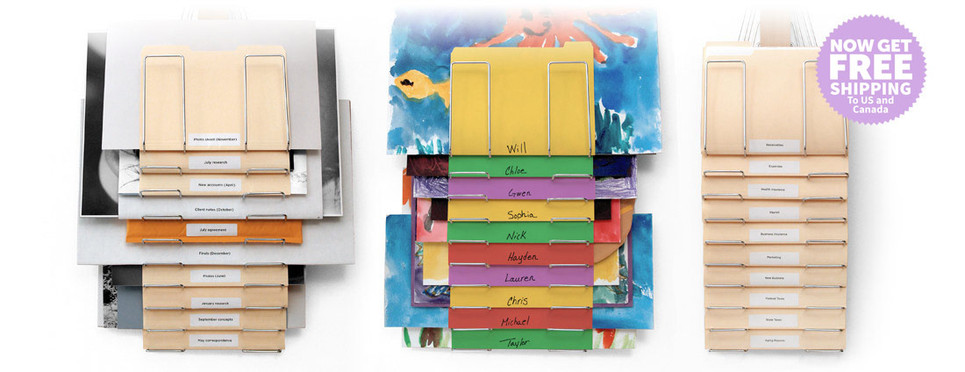
The Up Filer™ Original Vertical Wall File
Each Up Filer™ unit has ten nickel-plated steel hangers designed to hold whatever flat content you need to keep off your desk, like:
- file folders
- blueprints
- design layouts
- photos
- newspapers (remember those?)
The central spine of the Up Filer™ is made of solid maple hardwood, and the full size of the contraption, spine and hangers, combined, is 11.5″ wide x 34.5″ high x 2.5″ deep (29.2cm x 87.6cm x 6.3cm).
You don’t have to limit yourself to uniform height, weight, or thickness of papers or folders. Westerville says both the thickness of the content and the width can vary greatly (though they’ve not provided maximum measurements). The site notes that the height of the content depends on the thickness, but can measure up to approximately 16.5″ (42 cm) depending on the thickness (just as when too-thick file folders tend to stand a bit too tall in a hanging folder, beyond a certain point).
The Up Filer™ Original runs $149.99 and comes with a 60-day money-back guarantee.
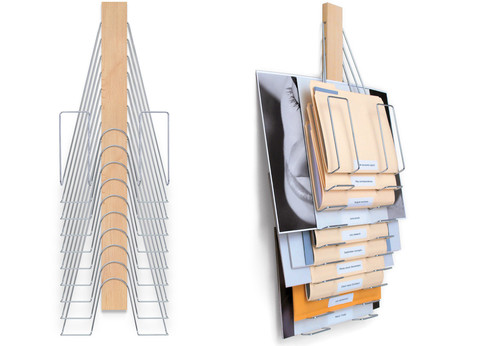
If you’re looking for something with similar capabilities but a little more panache, Westerville Design has you covered.
The Up Filer™ Bamboo Vertical Wall File
The Bamboo version conforms to the same measurements and specifications as the original version, but adds environmentally friendly sustainability with style, and you can select one of three colors (arranged from lightest to darkest)
- Natural
- Light Caramel
- Caramel
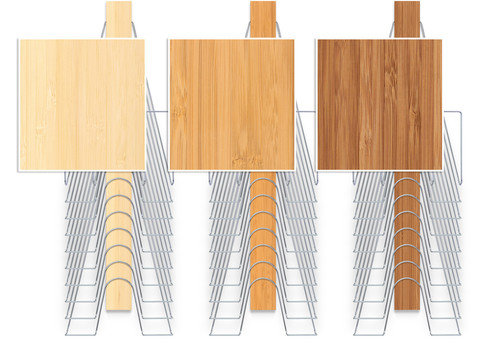
The Up Filer™ Bamboo runs $169.99.
Westerville Design is currently offering free shipping on both versions of the Up Filer™ to customers in the United States and Canada.
Why is the Up Filer™ better for some flat paper and storage displays?
- It doesn’t matter how small or large an item is — the design ensures that it won’t obscure what’s behind it, and it won’t be obscured by what’s on top of it.
- The Up Filer™ saves precious horizontal space and makes use of the always-forgotten-but-so-magical vertical space. The Up Filer™ is wall-mounted, so your flat items get up and out-of-the-way of your workspace.
- It’s easy. The spine of the Up Filer™ holds the hangers, and the pivoting hanger design makes it simple to remove or add items. Just lift a hanger to pop something new into the system or grab what you need.
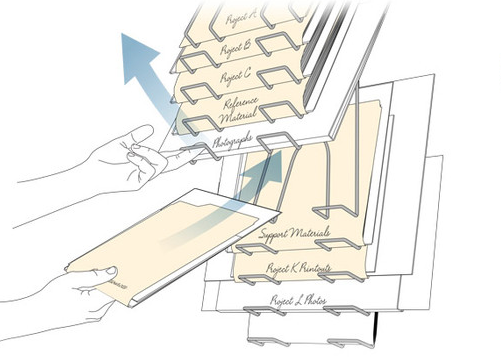
The Up Filer™ system is designed so you put labels at the bottom of each item. It may be unusual at first to see labels at the bottom, but it lets you quickly scan your eyes down the center and see everything at a glance. Nothing will be hidden or forgotten.
In the words of the people of Westerville Design:
It quickly became obvious that it wasn’t just good for designers but would be perfect for engineers, architects, fine artists, teachers or anyone who needs a filing system that keeps all the important stuff visible and at your fingertips.
Not having been able to examine the Up Filer™ up-close-and-personal, my sense of the drawbacks is limited to a few key items:
- The price is pretty up there. Granted, a flat file cabinet is even pricier, but most people and businesses are more likely to opt for a less gorgeous and more cost-conscious storage+display solution.
- Installation/mounting shouldn’t be difficult, but if you’re all thumbs, or have a cubicle, or your home office walls are really just flimsy sheet rock, the stability of this solution may not be adequate.
- Capacity is limited. Each unit has only ten hangers, and thus holds only ten “items,” albeit those that can get fatter or larger than what you can put in a filing cabinet or on a desk-stop step riser.
To get a sense of how the Up Filer™ works, peek at this short (and silent — seriously, none of that common plinking ukulele soundtrack) video.
Of course, if you like vertical paper storage solutions, the Up Filer™ isn’t your only option. At first, I recalled the Rackit File, a wall-mounted hanging file solution I reviewed back in 2011 in Paper Doll Adjusts the Vertical Hold: Space Saving Filing Solutions. (And, of course, that post is full of more portable approaches to vertical filing.)
So, readers, on the up-and-up — would you give the Up Filer™ a try?
R-E-S-P-E-C-T: The Organizing Secret for Working At Home
As recently as a decade ago, if you said you worked from SoHo, you’d be telling people your office was in lower Manhattan in New York City, South of Houston Street. Now, SoHo is an even more fashionable address — six steps away from the coffee maker and five steps from the front door. The SoHo of the Small Office/Home Office movement means that more and more people, whether entrepreneurial in their own businesses or teleworking for companies owned by others, are cutting their commutes (and their overhead) to work where they live.
If you’ve spent much of your career in traditional workplaces, you know how precarious the balance of interpersonal respect can be. You’ve observed the disrespect shown in shared spaces: the guy who heats up his tuna casserole in the break room, scorches the popcorn, and never makes a fresh pot of a coffee; the gal who pops her gum or taps her pen incessantly; the dude who wears headphones but hums along to his personal soundtrack; and all the people who hover in your doorway to converse as if there were an invisible water cooler drawing them near.
The appeal of a home office can seem revelatory by comparison, but it’s much harder to draw boundaries (for yourself and others) in a home office than a traditional work setting. Free of a taskmaster, it’s easy to sabotage yourself and disrespect the value of your work time. It’s vital to respect your own professionalism by setting firm boundaries, and make certain others respect them as well. Rather than stifling you, these boundaries free you to pursue your entrepreneurial dreams.
If you follow the words of the Queen of Soul and demand a little R-E-S-P-E-C-T (from yourself and others), you’ll be better able to achieve your goals.
RESPECT YOURSELF
Start with the right headspace. Try to awaken and get started at the same time each day. If your day begins by getting others out the door, you can still aim to get yourself “to the office” at a set time. Shower, groom yourself, and get dressed – you may not be on a video call, but you will see yourself in the mirror. Reflect an outward professional attitude and you’ll feel it inwardly.
Delineate the start and end of the workday. Create rituals to make the distinction. Leave the house via the front door and re-enter through a side “office” entrance. Drive to a coffee house, even when there’s perfectly good (and free) coffee in the house, and return with hot java and fresh mojo.
Be just as firm about stopping work and returning to your life and family. End the workday with a closing ritual, whether it’s a field trip to the bank or a call with your accountability buddy to set the next day’s goals.
Differentiate your schedule. Improve workflow by scheduling creative time during high-energy, uninterruptible periods, and plan low-intensity tasks during transition/buffer periods.
Remember to block time for each type of activity. Then, if your schedule goes awry (a flat tire on the way to the bank, a school nurse’s call about a sick child), a lower-priority block on any given day can be bumped or rescheduled to make room for the higher-priority category.
Control how and when you interact with others. Unexpected inbound calls can be a huge distraction. Avoid temptation by letting voicemail screen your calls during your work hours. Return personal calls during personal time. (Yes, you can have personal time during your workday, but if you plan those breaks, you run less of a risk of letting a personal conversation obliterate time you need to be spending on projects.)
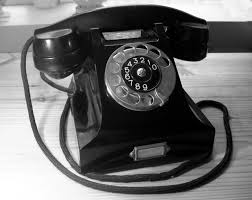
Scheduling phone conversations may seem inflexible, but it can help you focus and avoid the tendency to be overly casual about your time. If you can plan for specific conversations, you’ll feel better prepared when talking with prospective clients, strategic partners, vendors, and members of the media. You will boost your self-confidence and your ability to put yourself forward as an expert.
Let technology be your gatekeeper. Social networking and web surfing offer the water cooler chat and novelty that’s missing from a home office, but it’s easy for five minutes of reward time to turn into an all-afternoon distraction. Curtail excess web surfing and block specific time-wasting sites from your browser with programs and extensions like:
- Keep Me Out
- Minutes Please
- Productivity Owl (Chrome)
- Leechblock (Firefox)
- Stay Focused (Chrome)
Freedom, Self Control (Mac), and Cold Turkey (Windows) work system-wide, so you can’t cheat by selecting a different browser.
If you’re not really sure where or how your online time disappears, Rescue Time can give you a handle on your digital habits.
Know your stimuli style. Some professionals find that “social” white noise aids in focus. If your work is portable, and the atmosphere of a public place isn’t overstimulating, work “off-site” as long as you’re productive. If the visual and olfactory stimulation of a coffee house or park is too intense, stay home and use a white noise app to create more soothing sensory inputs over which you have greater control. Check out some of the options at 11 Ways To Organized Your Focus With Ambient Noise.
Banish clutter. Many of the posts at Paper Doll talk about paper clutter, but organizing your work-related materials is only part of the process of respecting yourself and your space.
Children’s toys and your own hobby paraphernalia are distractions, even if you don’t consciously recognize them as such. Your office needs to put you in a serious, work-oriented mode. That doesn’t mean your surroundings can’t be colorful, decorative and cheery, but your space has to support your work ethic. Consider how you might scale back decorations if you shared your office with a work partner to help you identify where you might pare down the knick-knacks.
Track your successes. Solo work can be isolating. It’s easy to ruminate on shortcomings and give short shrift to small victories. Keep copies of emails of praise, bookmark congratulatory tweets, and save letters of gratitude from clients. Take a bow, and then save it all for the days when you’re feeling low to remind yourself of when you faced a challenge but pushed through!
TEACH OTHERS TO RESPECT YOU
Respecting yourself is the first step to professional success in the home office, but it’s not always easy to convince others to show you the respect you deserve.
Identify “allowed” interrupters. If your kids are at home when you’re working, assign “key personnel,” and make it a rule that only the babysitter, your spouse, or your eldest child can come to you with “issues.” (Obviously, if the absolute only time you’re able to work is during your toddler’s nap-time or you’re the only grownup home with tiny humans 24/7, all bets are off. Paper Doll salutes you.)
Schedule office hours – If your kids are old enough to not require active supervision, or your spouse or babysitter is present, schedule breaks between work sessions to address concerns and questions. But barring real emergencies (involving blood, smoke, or overflowing washing machines), limit breaks to brief designated periods, like the last ten minutes of each hour.
Think your family can’t handle this because it feels too artificial? Teachers are less prone to allow wheedled exceptions than parents, and children abide by schoolhouse rules every day. Be firm, and teach them how to recognize when things are truly urgent and/or important. Of course, this lesson is easier to impart when the tiny humans are not so tiny (or if your spouse is generally adept at impersonating an adult).
Train family members to be solution-oriented. Just as you’d do with staffers in the office, when your peeps come to you during office hours with problems, expect them to offer alternative solutions. This is quite possibly the best training you can give your kids for succeeding in the professional world.
Make your workspace less inviting. Make a clear demarcation between office and home space, just as you separate the time in your schedule. Your office is adult space; deter your kids from playing on your computer by any means necessary. If your children aren’t old enough to entertain themselves, avoid scheduling your work hours during their active playtime, and supervise them in their play areas, not your workspace. Write, email, and return phone calls during their sleep/nap times, but when they need your attention, give it completely and save work for when you can focus. Multitasking is always detrimental, and kids know when you’re not prioritizing them.
Of course, if it’s your significant other who has trouble being left unattended, dissuade hovering by giving loving a embrace and a specific promise of what you will do together (eat dinner, chat about the insurance bill, snuggle) and when. Then be sure to follow through.

Deal with Gladys Kravitz. If in-person interruptions come from lonely neighbors or chatty pals, you’ll need to do more than strictly employing Caller ID and staying away from the windows. Role-play common interruptions with your accountability buddy until you can react with aplomb.
Organize your defenses with body language. Answer the doorbell with the phone in your hand, as if you’re on a call; if you’re a stickler for honesty, consider your task list and recognize that you might be about to place a call. Right? Of course.
Stand firmly in the doorway, hold your phone and perhaps a file folder, smile apologetically, and explain that you’re in the middle of a work project and are on deadline. Suggest they can call after dinner. Do NOT let the person in unless it’s an emergency. (Gossip isn’t an emergency unless it’s celebrity gossip and you’re a gossip columnist.)
Speak like a professional. Let friends and neighbors know that your office being comfortably situated doesn’t limit how seriously you take your career. Help them see that you are serious. If someone implies your work is a hobby, or that you have more flexibility because you don’t have a “real” job, smile if you must, but speak pointedly about tax deductions, returns-on-investment, and how office space rental pricing would cut into profits. Bore them, if necessary. Worried their feelings will be hurt? Ask yourself if they’d be willing to pay your bills if you didn’t make your revenue target this quarter.
Stick to your guns. Know how to respond when others have stepped on your toes. Whether it’s your mother or your neighbor or your kids, their unwillingness to recognize your business as “real” is merely an excuse for not getting things done. You have to train others to respect your boundaries. R-E-S-P-E-C-T.
If you take your business, your priorities, your time, and your space seriously, and lead by example, your family, friends, colleagues, and clients will do so as well.
~~~
Portions of this post were taken from my book, 57 Secrets for Organizing Your Small Business. While it is currently out of distribution, I hope to have a second edition available in the near future.
The Great Mesozoic Law Office Purge of 2015: A Professional Organizer’s Family Tale
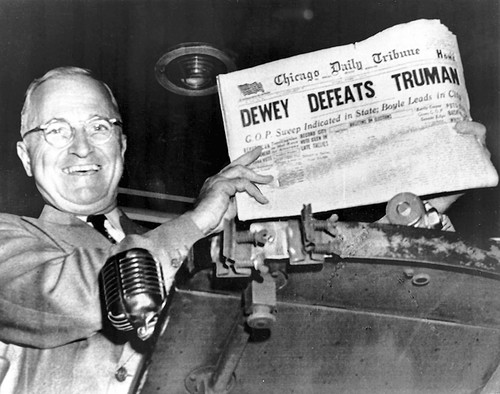
Longtime readers of Paper Doll may have noticed that I’ve been on hiatus for much of the summer. It began in early July, when I embarked on what I detailed to my Facebook friends as The Great Mesozoic Law Office Purge of 2015. My father, a retired attorney and judge, didn’t really walk with dinosaurs, but he began his practice of law just about when Harry Truman struck this pose:
 In his 90’s now, my father had not visited his law office in a few years and it was time to close it down. For about 45 years, my father was part of a downtown law firm. I can recall the scent of leather and old paper, the hum of the IBM Selectric typewriters and the mammoth floor-to-ceiling library. Some time after I left graduate school and moved out of state, that old law firm broke up and my father moved to his own suburban office suite. With him went a (still huge) subset of the books, and all of his case files dating back to 1948. And, honestly, every piece of paper he had ever touched.
With a mind for law but not for organizing or time management, The Judge (as he’s still generally known) was always the antithesis of Paper Mommy, at whose knee my organizing skills were first learned. With a revolving door of secretaries (much like Murphy Brown’s experience), the next two and a half decades did not see an improvement of his solo organizational skills or systems.
THE PROJECT
Prior to my arrival, my mother and sister had reduced the clutter somewhat, discarding office supply catalogs from 1987 and various DOS manuals. (The office never did transition past Windows 3.1.) Still, after months of labor on Paper Mommy‘s part, this was the sight to which I arrived:
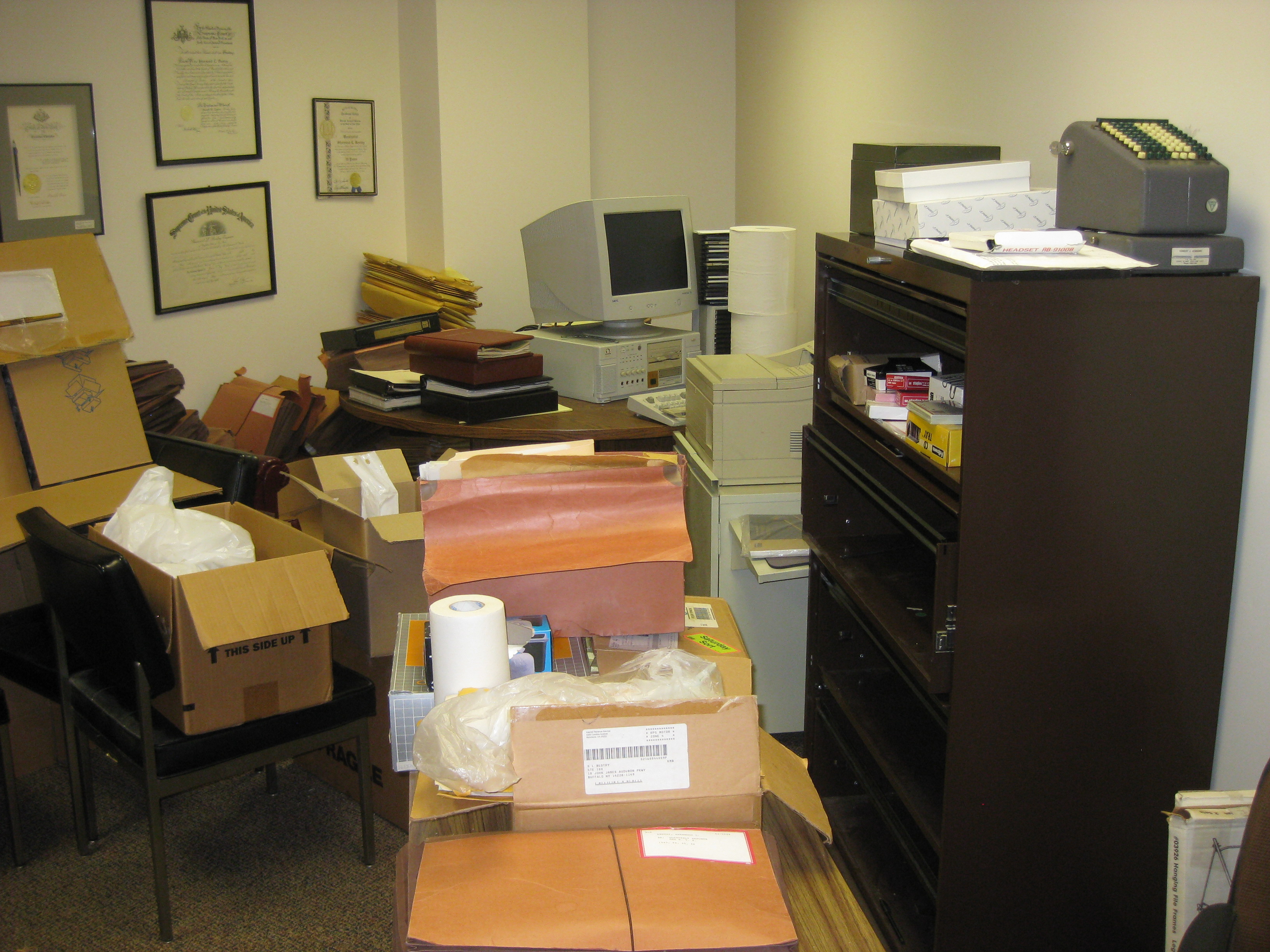
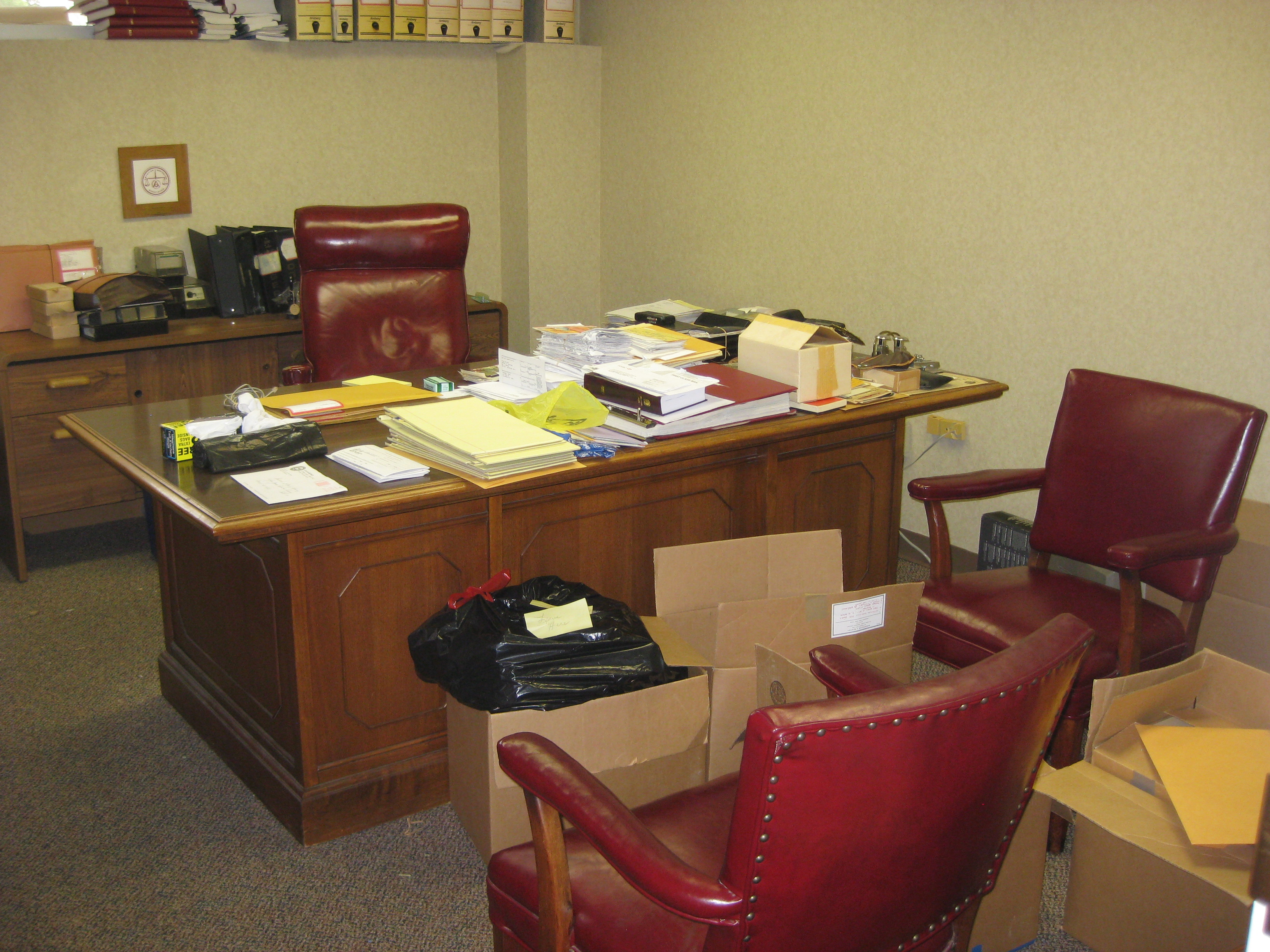
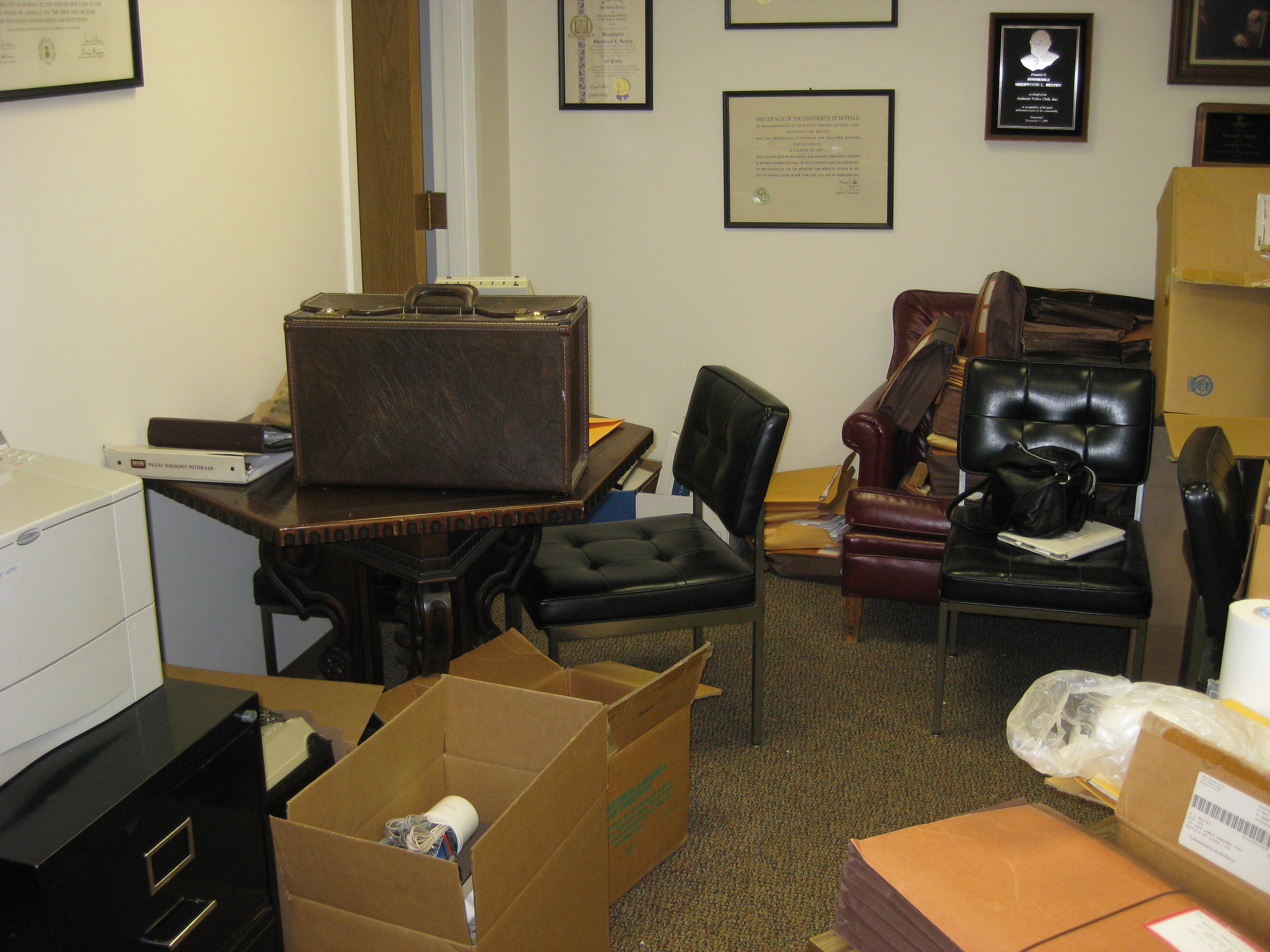
That door back at the far left leads to a file room containing the majority of the 63 completely filled file drawers in the office.
I counted four printers, none much smaller than a VW Microbus, and not one of them was actually hooked up to a computer. That was not much of a hinderance, as the word around the office was that neither of the two computers had worked in many years. There were also two electric typewriters, a step up from the old Mad Men-style Selectrics: one circa 1980, and one portable (likely Paper Doll‘s from college). There was also a photocopier the size of my first dorm room taking up most of the middle of that file room.
Over the course of my time back home, we plowed through the various rooms, identifying items essential to keep for legal, financial, or sentimental reasons, and reducing clutter to four major categories:
- Charitable donations
- Recycling
- Trash
- Shredding
I can’t say we whistled while we worked, but my mother and I chummily shouted questions and guidance back and forth across the rooms. Other occupants of the building often wandered by and peeked in, not shocked by the clutter (about which they knew) but by the steady progress. Even outsiders expressed some curiosity:
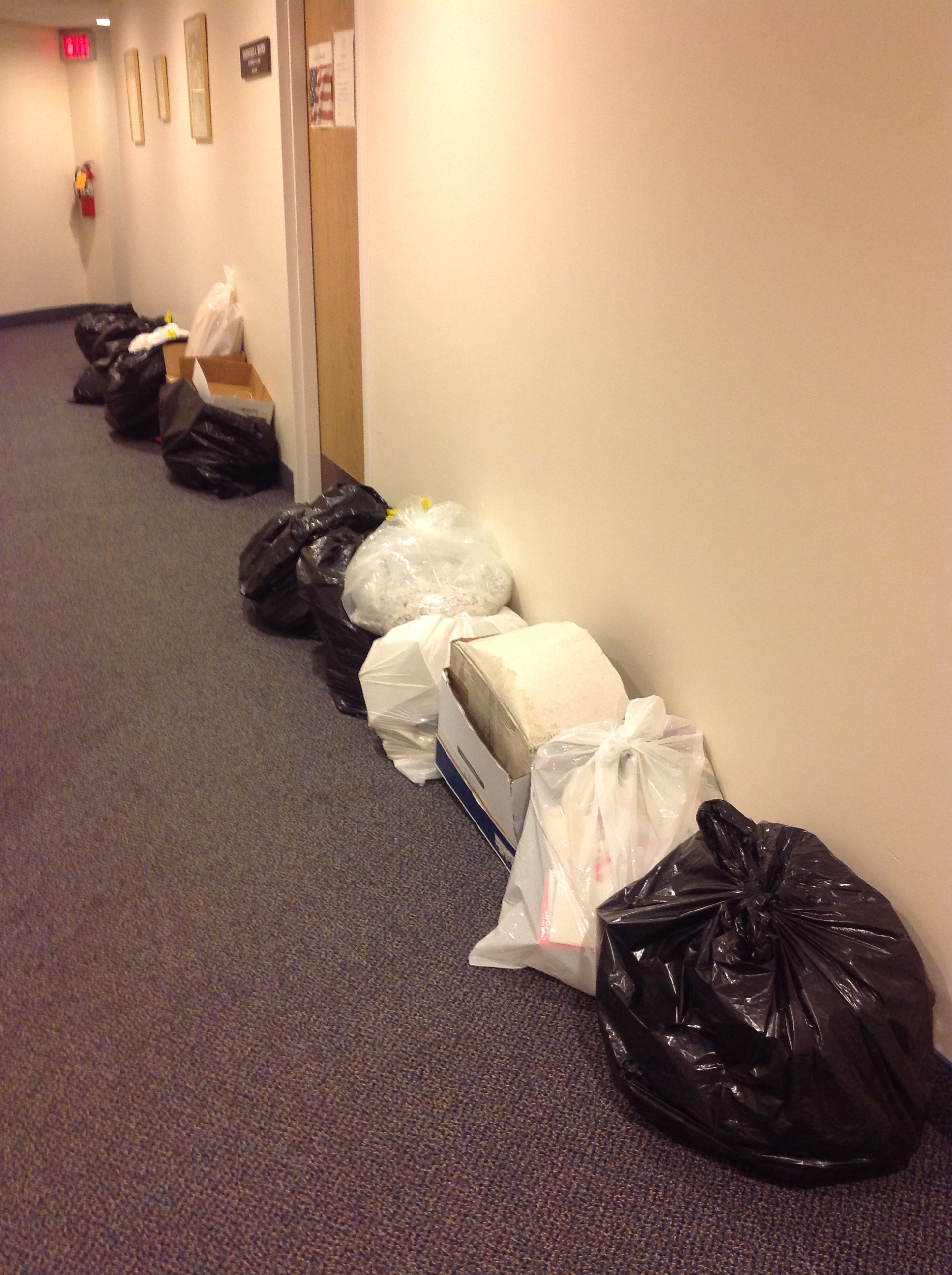
Each day, the hallway filled with satisfying piles of trash bags which magically disappeared overnight.
Each day, as we inhaled the stale air of the Eisenhower era, we forged onward. As with my organizing clients, I tried to give my mother the interesting folders to peruse. Meanwhile, I focused on the Zen-like plodding (of opening each and every file in most of those 63 file drawers) to identify which documents were not exactly as labeled, and to verify whether they could be shredded.
UNEARTHED “TREASURES”
Over the course of week, amid the legal research, pleadings, real estate purchases, and wills of people who have long since gone off to their great reward, we found the expected and the mysterious. Dozens of identically-sized, never-opened boxes of tax-preparation instruction booklets created a faux-brick wall. Long before Costco, my father bought in bulk, and there were boxes and piles of hundreds of pristine yellow legal pads. You may recall a Paper Doll post from earlier in the summer about how terrible most after-market hanging file rails are. Well, we found boxes of them, both used and never opened.
My sister implored me to be sure to find some items worthy of Antiques Road Show. That, sadly, did not happen. Outside of legal paperwork, we found the same kinds of materials that I see in my clients’ homes and offices, things that seemed important when they tucked them away, but not so valuable many years later. Stacks of New York City hotel stationery, bound in a small portfolio, were covered with cramped notes from a bar exam prep course in 1948. This newspaper regaled the activities in our suburb, circa 1975, for the septquicentennial. (Did you even know that was a thing?)
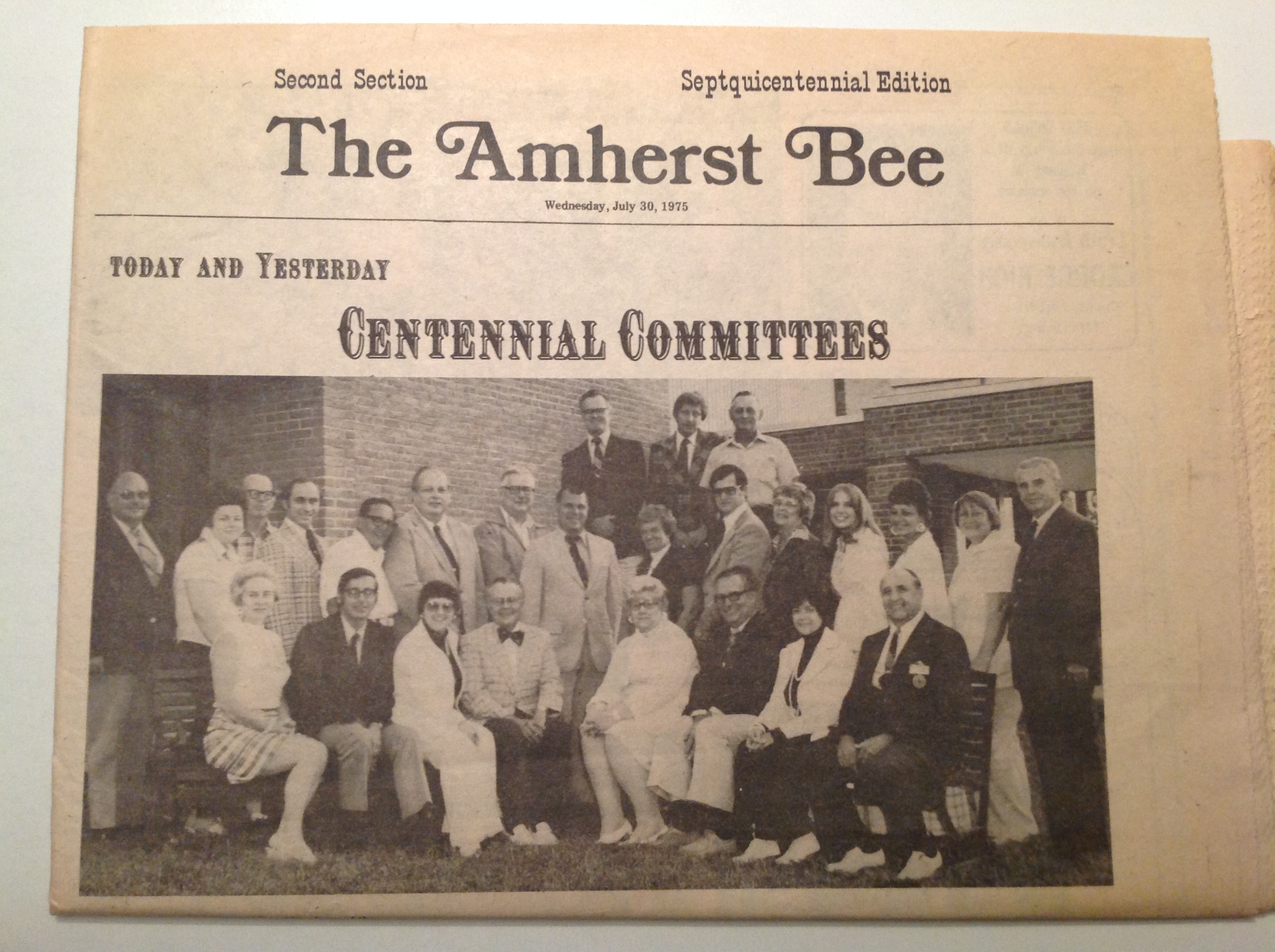
No one in our family, or in our circle of friends, or anyone we could identify, was mentioned. This is the kind of thing about which a client might squirm. “Someone might want it some day.” Perhaps. But we are not curators of a museum for long-gone strangers, and we did not have the space to take on these kinds of obligations.
We also found a sealed envelope with a key to my (maternal) grandmother’s safe deposit box in Florida. She died in 2001, but we knew the box had been cleared out and closed long before that. My father labeled the sealed envelope holding the key, “Key to E’s safe deposit box that has been closed. This key is useless.”
As one does.
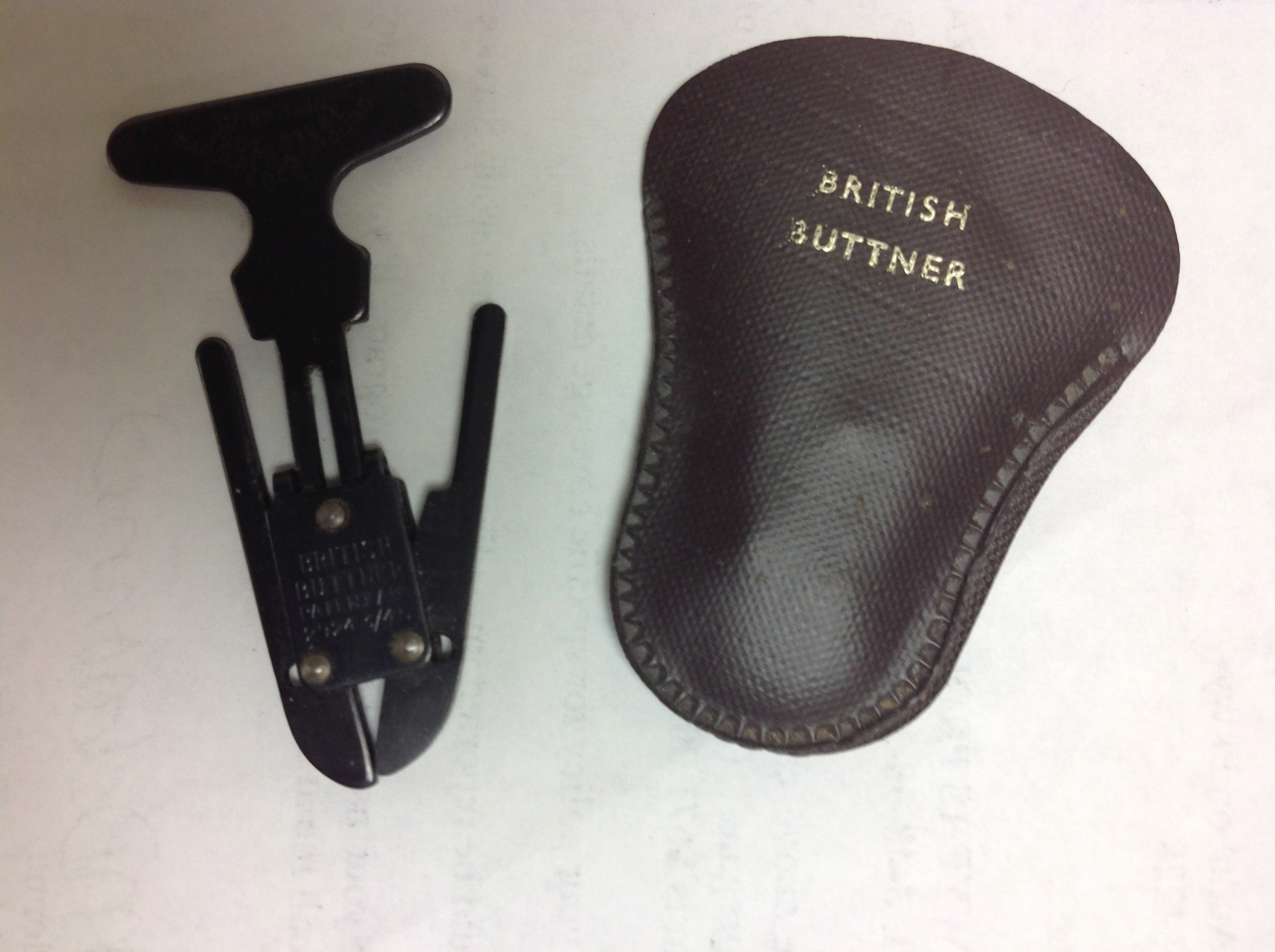
I must admit, we did find some nifty items. The first mystery was this vintage “1945 British Buttner Smoking Pipe Steel Tool w/Hardened Ground Edges,” as eBay described it. We didn’t know what it was at the time, and might never have guessed without the help of Google and friends on social media, as I’d never seen my father smoke a pipe.
Another conundrum was this little machine. Think you know what it is? Not so fast!
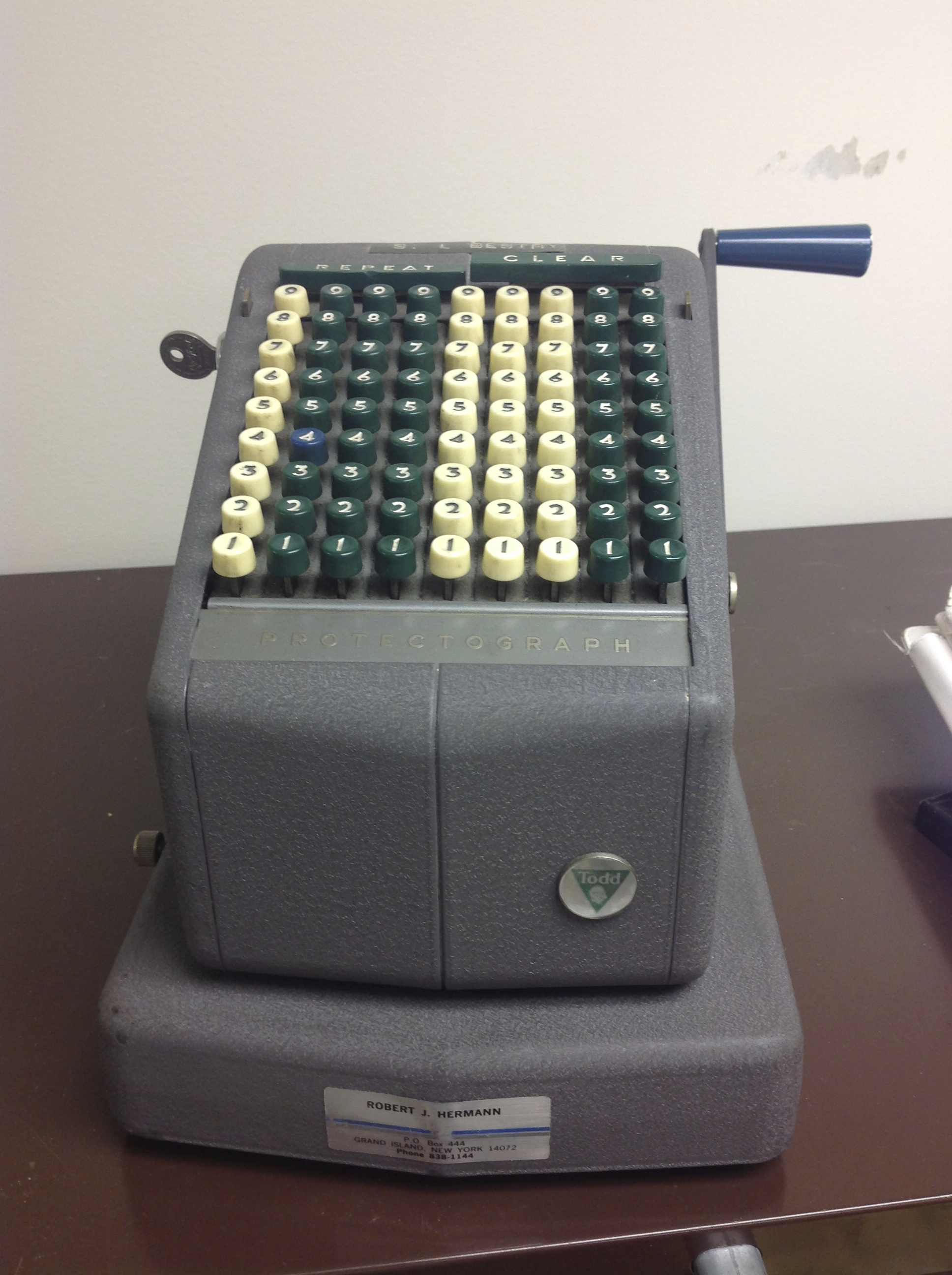
Nope, it’s not an adding machine, in case that’s what you were thinking. A Protectograph is a check-writing machine, and was used long before online banking or Quicken-linked printers.
Intriguing, but a little research showed that these long-kept items had no significant financial value. Indeed, the greatest appeal of anything in The Purge was one of my father’s (many) box-style leather briefcases, which looked like old-fashioned suitcases. We’d set them out in the hallway with the trash, as they were broken and bruised, but a young man in the building was delighted to carry one off, intending to carve it into a retro-style stereo case. One man’s trash is indeed another’s treasure.
Perhaps the most exciting thing to be unearthed during this process was personal rather than tangible. A small stack of letters on onionskin paper, sandwiched between 1970s medical bills, contained an interesting mid-1950s correspondence between my father and a Rochester, New York school district. From those letters, I learned that my paternal grandfather’s first and last names were not originally what I had believed them to be, and I learned the names of both sets of my paternal great-grandparents, people about whom I’d previously known, literally, nothing.
Entirely coincidentally, upon returning from the trip, I was contacted a distant cousin, a family genealogist, who was able to provide two photos of my grandfather. This one, circa 1890, shows him on the right.
Standing on the far right in the next photo, taken a few years later, he appears to be an extra from Downton Abbey.

ENTERTAINMENT VALUE
When I work with organizing clients, we often find unexpected amusement amid the daily labor. This project was no exception.
To get the first set of large boxes of donations out to the car, Kim, the building manager, and Ed, a nice gentleman from an office upstairs, helped me maneuver a large rolling cart. We got it down the ramp, but just as we made it to the parking lot, a front wheel fell off. Ed and I held it up while Kim tried to put it back on. We rolled perhaps 10 feet, and one of the back wheels fell off. Then, after the car got loaded and we started rolling back to the building, the front cart handle fell off, leaving it largely unmaneuverable and me looking for Candid Camera.
However, the big Lucy & Ethel moment came when Paper Mommy and I were taking boxes to the car for another round of donations. After the rolling cart disaster, I opted to carry the heavy box, as my mother was certain she could carry the smaller, lighter box as well as her purse. Unfortunately, when the elevator came, she dropped her key ring containing her house and car keys down the elevator shaft, between the hall and the elevator.
Eventually, the same Ed of the leper-like rolling cart tale, attached some super-strong magnets to the bottom of a metal pole, and when that wasn’t long enough, Kelly, a woman in the building, taped her Apple lightning cable to it. I held open the elevator, Ed held the flashlight and went fishing with the pole, cable, and magnets, Kelli scooped the keys up as they got close to floor level…and my mother prayed.
LESSONS LEARNED
Certainly I wasn’t surprised by the organizing challenges of the Great Mesozoic Law Office Purge of 2015. I practically wrote the book on it. (Oh, wait, I did write the book on it. But don’t buy the used copy on Amazon for a marked-up zillion dollars; wait for the second edition.) None of these tactics should come as a surprise to readers of this blog, let’s review a few of the basics.
Keep personal and business paperwork separate. A few posts to help you start might include:
Business:
Paper Doll Gives You the Business (Files) — Part 1
Paper Doll Gives You The Business (Files) — Part 2: Reference Papers
Paper Doll Shares the Gospel: Creating A Business Bible
Personal:
Family Filing—As easy as (eating) pie
Financial Filing—Scrapbooking snapshots of your money’s life
Mom, why is there a receipt stuffed in the turkey?
I Fought the Law…and the Paperwork Won!
Patient: “Doctor, it hurts when I do this.” Doctor: “Then don’t do that!”
Paper Dolls Live In Paper Households
I Hope Nobody Ever Writes a Nasty Tell-All Called “Paper Doll Dearest”!
Have a system for separating papers into categories. The alphabet may be a great organizing principle around which to file things by name, but it doesn’t work particularly well for active projects and research in progress.
Label your files accurately. Start with How To Avoid Paper Management Mistakes–Part 3: Libel of Labels.
Anticipate acquisitions and develop a plan for periodic purging of active files. Peek at How To Avoid Paper Management Mistakes–Part 2: Fat Vs. Skinny Jeans to get started.
If you run out of room for files, the alternatives are to reduce the number of files (or papers in the files) or create space for archived documents. Trust Paper Doll, a couch is not a superior choice.
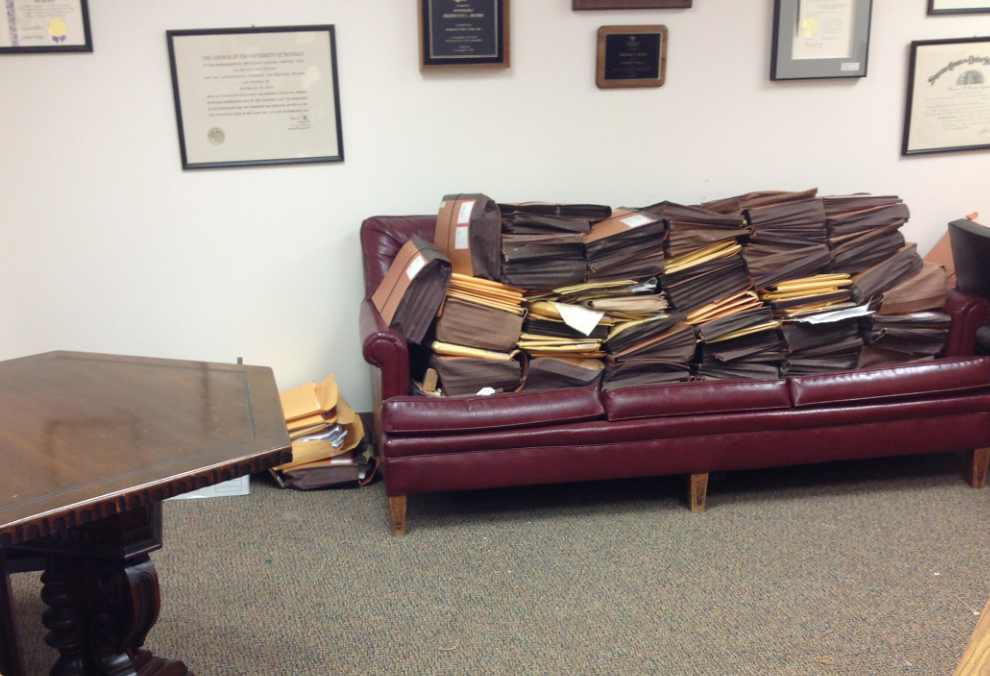
Schedule time regularly to review your possessions and purge items that are not necessary. (Labeling an envelope, “This key is useless” isn’t ideal.)
Don’t keep your system a secret. My father had created a three-page letter for my mother, carefully detailing where important documents could be found. In 1979. While many of the files were in the same cabinets, the cabinets (remember those 63 file drawers?) were not in the same order, nor in the same rooms, nor in the same building they had been. We can only hope the important papers that were in “a big, black metal safe” in the old building were retrieved before relocating, but we will never know for sure.
Document your important papers and their locations, and make sure your loved ones (or co-workers, or other appropriate parties, including your future self) knows what is where. Get some guidance from The Ultimate Treasure Map: Creating A Document Inventory.
The Great Mesozoic Law Office Purge of 2015 is only one of the reasons for this summer’s blog hiatus; you’ll be hearing about other, more exciting projects in the near future. For now, thank you for your patience, for your emails, and for your ongoing readership.
And seriously, don’t drop your keys down an elevator shaft.
Think Outside the (Storage) Box
Do you own three staplers but can never find one that works? Are you always searching for the three-hole punch? There’s a science to arranging your work tools so that you can find exactly what you seek. Start with three questions:
Why are you keeping it?
Uncertainty is often the driving force behind holding on to outdated gadgets or tools that are awkward to use. If you haven’t used it, don’t know how to use it, or could easily use a less spiffy alternative, donate or toss it. (Of course, longtime readers of Paper Doll know that uncertainty is the reason we hold on to papers, notes and formal documents, too, which is why it’s so important to have a good records retention schedule to guide the process.)
Who needs access to it?
In a home-based office, your storage system only needs to satisfy you, but in a communal office environment, territorial disputes abound. Reduce perceived inequities by selecting a neutral storage location that gives everyone equal access without cramping anyone’s workspace.
Office Space, @20th Century Fox
Also consider who should NOT have access to certain stored items. Personnel records, proprietary files, and other sensitive data should be stored in a location with controlled access, by key, combination lock, or password. For home offices, a lockable filing drawer can keep office supplies from becoming school supplies.
How often will you need it?
Frequency of access is inversely proportional to the distance between you and your storage. In other words…
Limit what you keep on your desktop to tools you access frequently throughout the day. Resources you use less often (have you really used that gigantic dispenser of Scotch® tape this month?) should be tucked away, sorted by category and separated by drawer dividers. (Rubbermaid has some nice, basic modular dividers.) Embrace creativity, but emphasize efficiency over form. An Elvis paperclip dispenser may be fun, but if it spills clips across the desk each time you use it, let it go.
Keep only a usable number of supplies at your desk to minimize clutter and maximize efficiency. You may instinctively hoard pens or Post-It® Notes out of fear being caught short, but it’s more efficient to “go shopping” at your private office supply store when you actually need something.
Create a main storage area for your business or home office, with everything from paper to toner, burnable discs to those scary looking devices for adding spiral binding to your presentations. Group related items together, so that all writing implements or inks, or all paper, copier, and printer supplies, are kept together. Keep the most-often accessed supplies at eye-level, and use shallow bins or dishpans to corral loose items. In an office without a lot of horizontal space, consider hanging clear shoe organizers or something like Christy Designs’ Simply Stashed, which works just as neatly in a workplace environment as it does at home.
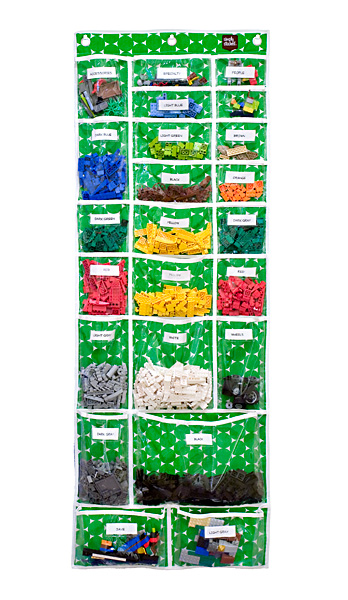
Attach labels to the edges of shelves to make it easier to locate items or identify when supplies are out of place or running low.
In large offices, post a laminated master inventory supply list, including brands and vendor product codes, on the supply cabinet door. For home offices, keep a running list on your legal pad or favorite shopping app.
Finally, no matter how powerful the siren song of the office supply stores may be, don’t buy solutions for problems you don’t even have. It’s an invitation for chaos and clutter.
The above post contains material excerpted from my forthcoming book, 57 Secrets for Organizing Your Small Business, in the 57 Secrets series from Logical Expressions, Inc.

Follow Me