Archive for ‘General’ Category
What’s Your “Receipt Receiver” Style?
All happy families resemble one another, but each unhappy family is unhappy in its own way.
It starts the same for all of us: we make a transaction in the store, trading cash or credit for some goods or services, at the end of which we receive a receipt. At this point the two categories of humanity diverge.
For those of us who embrace organizing and the minutia of financial transactions, we carefully check the receipt for accuracy, note the exchange policy printed on the return, annoy the customers behind us with how slowly we are moving out of their way and then tuck the receipt neatly in the appropriate compartment of our wallet. Upon returning home, we put away our items and place our receipts in the pre-set location at which point we will diligently determine how long, for what purpose, and in what manner the receipts should be stored. Eek. We sound like drones. But organized, efficient drones.
Then, there’s the rest of the world. The individually unique and creative receipt-receivers have lives far too varied and interesting to stop to think about pesky receipts. Instead of considering the receipt as a valuable commodity, something that benefits the holders in terms of tangible proof for tax deductions, rebates, repairs, returns or exchanges, or the accuracy of a charge, the receipt recipients gives receipts all the love, care and attention one gives used chewing gum wrapped in tissue. They let the salespeople stick the receipts in their shopping bags, or they crumple the receipts in their palms as they stuff their gloved hands deep into their coat pockets, or they push the wrinkled receipts to the bottom of their purses to mingle with others of their kind. Eventually, receipts likely find themselves in piles on the microwave, atop the dresser drawers, or on a side table.
Yes, Mr. Tolstoy, these folks may lead dizzying lives of excitement, but they are startlingly similar in their approach to receipt clutter: grab, crumple, stuff, lose, bemoan!
The purpose of today’s post is not to sing the praises of minutia and diligence, nor to review last November’s post about which receipts should be kept and why. Instead, let’s look at the four main ways you can organize your receipts to suit your purposes.
No-Tech, No Expense–If you lead the simple life…
If you don’t have to create expense reports, are unlikely to have tax-deductible receipts and you aren’t tracking your expenses to create or maintain a budget, the most common reasons to keep your receipts (even temporarily) are to make sure your bank account or credit card was charged accurately and in case you later wish to repair, exchange or return your purchase. In most cases, your receipts will outlive their utility within 30-60 days, depending on how long your statements take to arrive (assuming you’re not checking accounts online) and the individual stores’ return policies.
If this is your situation, make your life as simple as possible:
- Empty your pockets, bags, purses and wallets each evening to make sure you have all of your receipts. Set an alarm on your cell phone or computer to remind you to do this until it becomes a habit.
- Toss receipts for cash experiences like fast food meals and non-returnable tangible items (unless you are tracking all expenses for your budget) .
- Gather the day’s receipts and put them on top of yesterday’s receipts in the basket or clip you’ve designated for this purpose, preferably at or near your bill-paying center. (If you’re persnickety like Paper Doll, put the receipts in reverse chronological order by timestamp, too. Chances are, however, only Paper Doll is this neurotic.)
- After the close of each month, put the receipts in a number 10 envelope, write the month and year on the envelope and keep the envelope handy until you’ve checked your bank and credit card statements against the receipts for accuracy. Keep the envelopes in a manila folder in the FINANCIAL section of your family files.
- Consider keeping big-ticket (furniture, electronics) receipts in a separate file. For more on financial filing, please see this post from last November.
No-tech, Minimal Expense–If you prefer a little more style or panache…
Keep your receipts someplace a bit more charming. First, follow steps 1-3 under the no-expense method above, but stow your receipts in a container designed for the purpose, the Receipt Keeper Shopping Wallet or even a small poly accordion-file receipt-holder, the kind often used for coupons.
High-Tech, High Touch–If you need to carefully organize and analyze…
If you don’t just save receipts, but need them for budgeting, business and expense-tracking purposes, you’ll want to step things up a notch. High-tech organizing of receipts is dependent upon scanner hardware and scanning software. If you think you’d like dealing with scanning your receipts without any help from the experts and like figuring it all out on your own, just check out this OnlineOrganizing.com article on using scanners. Otherwise, some shortcuts may be in order.
You may have seen mention of the NeatReceipts Scanalizer 3.0 Professional Mobile Scanner in magazines or online, and if you’ve traveled through many of our nation’s airports in the past few years, you may even have seen a live demonstration of how the hand-held scanner works.
Neat Receipts is only about the size of a three-hole punch, so it won’t take up much the valuable real estate on your desktop and can even fit in your suitcase. It may be small, but for do-it-yourselfers, particularly households that don’t want to invest in a huge, bulky scanner or professionals who need something flexible for use on the road, Neat Receipts has some cool features.
Basically, the little scanner and associated software allows you to scan each bill or receipt (and even business cards) and then by the same magic that CardScan figures out which words on a business card belong in which field of a contact management program (how does it DO that?), Neat Receipts not only scans but develops whole little categorized databases and reports. But the information doesn’t need to just sit there. Once you scan and organize your statements and expenses, you can then export the information to your spreadsheets (like Excel or Google’s free version), TurboTax, Quicken and QuickBooks. It’s even accepted by the IRS! And, for people like Paper Doll, it’s especially intriguing because it’s a hardware/software combo that’s Mac-compatible.
So, Neat Receipts is great if you like learning new software (though it seem easier than most, perhaps on par with learning iTunes). But what if you don’t want to deal with hardware or software, and like my friend mentioned at the start of this post, you just want it all to go awayyyyyyy?
High-Tech, Moderate Touch–You want cool software options, but know you won’t read the manual…
There’s a cutely-named option that’s getting a lot of buzz lately. So much buzz, bloggers have called it Netflix for receipts. So much buzz that I suspect an upcoming Paper Doll post will look at the features in depth. For now, though, I’m intrigued enough to consider Shoeboxed, and its associated service, Receipt Mail In, and urge you to see if it’s a good solution for you.
Shoeboxed itself is free and doesn’t require you to download any software. It lets scan in your paper receipts or take digital photos and upload them, or, and this is a really cool feature, lets you set up an email address with them such that the receipts for online purchases go directly to your account! The online Shoeboxed account then organizes your receipts into “shoeboxes” (like folders, but more whimsical) to sub-categorize your purchases. Thus far, it’s a lot like Neat Receipts except for specific functions of the software and the fact that your account being online lets you access it even when you’re away from your own computer.
But if you’re looking for the hands-off approach, peer into Shoeboxed.com’s Receipt Mail-In Program. It has a monthly charge, but it’s for those who really don’t want to deal with this stuff on their own. It’s also probably not for the light user, or the family who saves receipts for casual just-in-case use. But if you’re a solopreneur or an on-the-road professional, it seems like quite the time-saver. Once you sign up for an account, it works like this:
- Gather up all your receipts.
- Stuff them in a pre-paid envelope (along the lines used by Netflix).
- Shoeboxed scans and processes all your receipts and mails them back to you (in case you want to stuff a pillow with them).
- You get access to all of your categorized receipt/expense information in your account, online, ready for you to manipulate and sort as you prefer.
Someone else does all the work and you don’t have to sort, collate or date any of the information. No paper cuts. It’s not for everyone, but it’s a mighty cool idea.
We’ll return to this subject again after Tax Day. For now, make Paper Doll happy. (Consider it a belated birthday present.) Dig out all the crumpled receipts at the bottom of your winter coat’s deep pockets and from the floorboard of your car. C’mon. You know you’ll be glad you did.
À la recherche du temps perdu/Remembrance of Things Past
“I don’t really care how time is reckoned so long as there is some agreement about it, but I object to being told that I am saving daylight when my reason tells me that I am doing nothing of the kind. I even object to the implication that I am wasting something valuable if I stay in bed after the sun has risen. As an admirer of moonlight I resent the bossy insistence of those who want to reduce my time for enjoying it. At the back of the Daylight Saving scheme I detect the bony, blue-fingered hand of Puritanism, eager to push people into bed earlier, and get them up earlier, to make them healthy, wealthy and wise in spite of themselves.”
We lost an hour this past weekend. Actually, if you’re like most people, you lost more than an hour. First, there was the change to Daylight Savings Time, which thanks to a relatively recent Congressional mandate via the Energy Policy Act of 2005, came a month earlier than we’ve experienced in the past.
Then, you walked around your house, noticing you needed to re-set clocks that don’t automatically update, checking clocks that do automatically update (such as on your cell phone and caller ID) and then bemoaning that because of Congress’s change, all the devices that used to update automatically (computers, VCRs) no longer do so if they were produced before the new regulations.
Then, if you had not yet followed Paper Doll‘s advice here, you may have spent more time searching for the instruction manuals to re-set the clocks in the house, only to realize when you got in your car on Sunday afternoon or Monday morning that you needed to dig the auto manual out of the glove compartment to change that clock, too.
Indeed, just thinking about this may have made you stop in the middle of reprogramming the time on your computer to Google (as I did) about DST, pop over to Amazon to check out Spring Forward: The Annual Madness of Daylight Savings Time by Michael Dowling, or read the fascinating blog post inspired by Downling’s book at The Dilettante’s Dilemma about how this inconvenience could be a huge conspiracy by the Golfing, Grilling and Candy-making Industrial Complex.
Then, amused enough to proceed with your weekend, if you followed the advice of wise people everywhere, you took this opportunity to remind yourself of the other things you should be doing on a twice-yearly schedule. Did you test the batteries in your smoke detector? Test your carbon monoxide detector? Run a household fire drill with your family?
Perhaps the next thing you knew, it was dinner time, and you’d failed to read and recycle your Sunday newspaper (which sits on your kitchen table, still), sort your papers (see, you knew Paper Doll would bring this around to her bailiwick), open your tickler file, pay your bills or do anything remotely productive.
At least I’m guessing that was the case at your house, too. Paper Doll bought a new shredder this weekend, and spent all that lost time reviewing and then shredding old bank statements, credit card statements and other no-longer necessary financial and personal papers. (Paper Doll is not yet self-actualized enough to shred old love letters.) Hopefully, you know the importance of shredding documents, but you may wonder why I chose a weekend already foreshortened to do it.
Well, Paper Doll has a birthday this week (not a big one, at least in terms of significance, though grocery baggers insist on calling me ma’am), and the end of a year always seems like a good time to shred, I mean shed, the insignificant items of the past and move forward.
Which brings us to today’s lesson, if there is one. We have to declutter the past from the present in order to make room for the future.
I’m not sure what Marcel Proust would think of today’s self-indulgent post (assuming he could even read idiomatic 21st century English), but as he’s the reigning (non-X-Files) expert on lost time, I hope he and the less retrospective (but far crankier) Robertson Davies don’t mind my taking their names in vain as I eat my cake and close out another year.
Here’s to another cycle around the sun (whether we “save” our daylight or not) and to reducing paper (and other) clutter!
Magazine Mayhem and Malaise
Two weeks ago, I confessed that yes, even Paper Doll is an avid collector of magazines, and how I combat the almost-inevitable build-up of magazine renewal cards and the insidious junk mail pile-up of disingenuous (OK, fibbing) magazine subscription departments. Then last week, we reviewed how the power of the potential knowledge implicit in our magazine collections make it so hard for us to let go of the glossy, fat bound issues as well as the clippings we’ve taken from them. As I said then,
I really hope you took my advice (and my confessed addiction to Reese’s Peanut Butter Easter Eggs) to heart and are on the way to internalizing the notion that merely possessing (but not using) dust-covered magazines (or exercise videos, or language tapes) will not actually make us more knowledgeable (or slender and ripped, or fluent in French). Thus, I really hope you’ve pared down your collections to the clippings or full issues that represent the bare minimum of what you already use or (being realistic with yourself) will use.
So today, let’s talk about how to store the magazines (or vital information clippings) that remain.
MAGAZINE CLIPPINGS
No-tech Solution–Welcome to the infinite wonders of three-ring binders. For those of you who clip just the essentials from your magazines, you can organize the material with a few three-ring binders, a box of sheet protectors and a few sets of notebook dividers.
To get an idea of how to use the 3-ring binder idea for clippings related to cooking, for example, you can revisit this previous Paper Doll post.
As a professional organizer, I find organizing inspiration and advice in just about all of those seventeen magazines (with the possible exception of Entertainment Weekly, which merely keeps me charming and sane). If I shlepped a whole magazine collection around in my trunk every time a client wanted help visualizing what a solution might look like, my car might bottom out. Instead, one lovely three-ring binder includes a wide variety of residential organizing categories/sections, including:
- Organizing tools
- Offices/Desks/Filing
- Bedrooms
- Living areas
- Kitchens
- Closets
- Pantries
- Utility rooms/Mudrooms
- Garages/Basements
- Organizing papers (yes, this category is often the inspiration for Paper Doll posts)
Other three-ring binders include web site URLs, articles and references for time management, life balance, identity theft, stress-relief, and a whole host of non-residential/non-business categories.
What kinds of categories of your clippings might you sort? How about gardening plans (sectioned by plant type or season), home remodeling dreams/plans (categorized by room), family health advice (sectioned by illness/wellness type, with grouped articles on topics such as nutrition, exercise, first aid, colds/flu, chronic illnesses specific to yourself/your family) or finances (with sections for articles on savings, investments, retirement, college-planning, etc.).
High-tech Solution–Are you on a first-name basis with your computer? Do you caress your Blackberry lovingly when you think others aren’t looking? If you own a scanner and are comfortable with technology, save and organize your vital clippings with a program like Scanalog.
While any scanning program would suffice, it’s in your interest to use a scanning program that actually indexes and catalogs the articles in question. Scanalog is designed specifically for scanning, categorizing and indexing articles and clippings to keep information organized. Once you scan in the articles, the system allows you to tag the information with either 11 pre-set categories and 102 pre-set sub-categories, or you can create your own, and the articles are condensed into teeny tiny JPEG format files. (How? Don’t ask Paper Doll. I’m still trying to figure out how photocopy machines work!)
MAGAZINES
Before you read further, I implore you to go back to last week’s post, discouraging you from keeping any but the current issues or truly favorite issues (such as holiday issues of Southern Living if you do a lot of entertaining at the holidays, or back-to-school issues of Seventeen Magazine if you’ve got adolescent daughters). That said, sure, you’re going to want to have a neat way to display magazines:
Zero expense, minimal style–If you have fewer than a half dozen magazines each month, and you are careful about tossing old issues when new ones arrive, it should suffice to fan the magazines out on the coffee table or keep one neat pile (with edges squared) on a side table in a common room. Do not let your family use the magazines as coasters.
Minimal expense, minimal style–If you want to store the current month’s magazines tidily, check your local Dollar Store (or regional alternative) for shallow, lightweight baskets, sans handles, for storage. The advantage of such shallow baskets is that you won’t be inclined to try to overstuff them. Of course, the disadvantage is that the titles will not be immediately viewable, as you’ll only be able to see the magazine on top.
An alternative is to check out the corrugated paper, plastic or mesh magazine holders common in retail stores like Target or Wal-Mart or office supply stores. These let you “file” your magazines so you can see the spines. However, magazine holders have a “permanent” feel about them, and your general goal is to keep most magazines only temporarily!
Moderate Expense, Maximum Style–If you’re the sort who always believes form must surpass function, then you’ll want to invest (either money or time) in magazine displays that delight you. If you’re the crafty type, acquire the aforementioned low-expense cardboard or plastic magazine boxes and decorate them to your heart’s content. Do people still do decoupage?
If, however, you are like Paper Doll and were sadly born with out the crafting gene, fear not. There are beautiful magazine file boxes available for displaying your current issues or saved collections neatly and attractively. At OnlineOrganizing.com, for example, you can find the nifty Blooming Bins Magazine Holders pictured below:
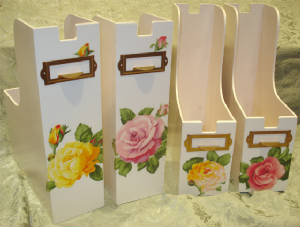
Pretty…and just in time for Spring!
More Mountains of Magazines: Information Clutter Cures
So what’s our deal with magazines and clippings?
It’s a universal truth that knowledge is power, which might explain why so many of us feel such anguish about letting go of magazines, newspapers and the clippings taken from them. Subconsciously, we feel like if we hold onto the material, we’ll automatically possess the knowledge inside of them.
Unfortunately, our logic is flawed. Buying and storing piles of exercise videos (that we never look at, let alone actually use) will not give us six-pack abs. Our refrigerators may be filled with nutritious food, but if we only snack on drive-through fare and Reese’s Peanut Butter Easter Eggs, the perishable food will grow stale and moldy, and our hearts and waistlines will show no improvement.
If your office, kitchen, desk, or car is littered with clipped articles and scraps torn from the newspaper, you are clutter-rich but information-poor. After all, what does it benefit us to possess useful information–or for that matter, useful gadgets, supplies…or anything, really– if we can’t find it when we need it or put it to use on our own timetable, rather than when it happens to flutter to the floor or cause us to trip over it? A newspaper blurb about how to get rid of aphids or glossy article about how to avoid identity theft is merely clutter unless it is immediately retrievable when we want it.
Concentrate on these keys to gaining power from bound and clipped information:
1) Know what to keep (vs. what to toss out); and
2) Know where to keep it.
The approach is similar whether you are dealing with individual bits of information or entire issues of newspapers, magazines, and professional journals. Today, we’ll talk about what to keep (and toss) from your piles of information; next week, we’ll tackle WHERE we should corral the info-goodies we deem worthy of keeping.
LOOSE SCRAPS
To decide what to keep, in terms of loose scraps of information, ask yourself the magic questions:
- In what circumstances (when, where, why, and how) would I use this?
- If your need is not immediate, are you likely to need or want this information in the next 6-12 months?
If the likely need won’t arise for over a year (such as wedding planning articles when your eldest child is barely in junior high), wait until the need exists and then get more appropriate and up-to-date information. Investment and travel information, in particular, is incredibly perishable.
If you will not be in the market for a new car, camera or computer in the next few years, holding onto unread articles about today’s models is a waste of space and effort. By the time you’re ready to shop, there will be up-to-date articles with information about the pricing and features you really need.
- Can this information be retrieved in other ways?
- Could you access this same information via the telephone book, the Internet or by calling an expert?
If so, using the prime real estate of your desk, kitchen counter or bedside table to maintain piles of fluttery magazine clippings is counterproductive.
- Do I already possess similar or better information on this subject?
If you subscribe to a specialty magazine on A.D.D., finances or travel, chances are good that a very general article from the newspaper won’t yield superior information. Not all information is equally valid, equally valuable or equally well-presented. Save the best and discard the rest.
- For whom am I saving this?
So often, we clip articles for friends or family members but forget to pass them along. If you must share the informaton, call your friends and read the blurbs aloud to them (or their answering machines) and be done with it!
We often take undue responsibility for making sure others in our lives stay informed on topics ostensibly of interest to them. It’s fine to occasionally clip an article if you have access to a resource your friend does not, but the codependency clutter you’ve amassed on someone else’s behalf isn’t good for anyone. Stop being the curator of museum of your friends’ minds!
BOUND READING MATERIAL
If you have piles of magazines, newspapers, or professional journals, ask:
Have I read this cover-to-cover at least three times out of the past five issues?
If the answer is no, you probably lack either the sustaining interest or the time to devote to the material. After all, a 6-week-old newspaper or last month’s Newsweek no longer reflects current events, but history. The summer gardening tips in last Spring’s Southern Living issues might very well be interesting, but if you haven’t gotten around to reading them by the following winter, it’s time to let them go.
The great thing about the American magazine industry is that topics are cyclical–there will be another article on the same topic, whether it’s “10 Marketing Tips For Your Small Business” or “Best Exercises For A Flatter Tummy” or “How To Organize For Tax Season”, coming up in just a few issues, so you need not fear ridding yourself of a gem amid the clutter. What goes around…comes back around!
A few tips for dealing with the magazine/newspaper backlog:
Throw it all out and start with a clean slate. Starting fresh is liberating, and it makes you less likely to backslide. Donate the magazines to your library’s book sale or local medical clinic (but be sure to remove your address label).
Set a deadline…so that any unread monthly magazine more than two months old gets tossed. Say goodbye to unread weeklies after two weeks, or newspapers from the past week by Sunday night…and consider canceling your subscription. You can always read back issues at the library when you have more time.
Block time to catch up on your reading. Find the best chance for “quiet time” in your schedule. Locate the magazines you want to read in a To Read pile or basket near where it’s convenient for you to read, and actually schedule time, whether for 15 minutes or an hour, into your day or week. Professionals can take advantage of canceled appointments to catch up on reading professional journals. Busy parents can carry a tote bag to read in the car-pool line.
Pan for gold. Instead of reading magazines cover-to-cover, scan the table of contents and go directly to the articles that interest you, bypassing the glossy ads. Tear articles of interest out of 3 to 5 magazines or journals at one sitting and put them all in a manila folder you can carry in your tote or briefcase to read when you are stuck in a ridiculously long line at the Post Office or waiting to see the dentist. Toss finished articles in the trash wherever you are, and feel confident that your brain is certainly a more secure place to store information than the floorboard of your car.
Do team reading. Don’t feel you have to read everything that’s published on a particular subject–share the load. Band together with colleagues with a plan that each of you will cover one major trade journal; meet for lunch or coffee on a weekly or monthly basis to discuss the articles each of you reviewed. You’ll be well versed in your topic of choice and you’ll pay more attention knowing you’ll be accountable for sharing the knowledge with someone else.
Remember, information equals potential knowledge, and therefore potential power. Achieve your potential…attain your power…but get rid of the scraps.
Next week: how to store the magazines and information that’s left over after following the advice in today’s post. (And, of course, if anyone has any ideas how to live a healthy and nutritiously balanced life on a diet subsisting of the aforementioned Reese’s Peanut Butter Easter Eggs, be sure to let Paper Doll know. That’s information worth keeping!)
Mountains of Magazines (And Renewal Cards)
Whenever I get married, I start buying Gourmet Magazine.
She’d stopped reading the kind of women’s magazine that talked about romance and knitting and started reading the kind of women’s magazine that talked about orgasms, but apart from making a mental note to have one if ever the occasion presented itself she dismissed them as only romance and knitting in a new form.
Paper Doll loves magazines. You might expect that a professional organizer specializing in eliminating paper clutter would limit herself to only a few such indulgences. In fact, I subscribe to seventeen publications. Doubt my count? Kiplinger’s, Money, Newsweek, Budget Travel, Cooking Light, Oprah, Real Simple, TV Guide, Entertainment Weekly, More, Pink, Self, Entrepreneur, 1-to-1, New York Enterprise Report, Organize and Cornell Alumni Magazine.
Let’s leave aside the magazines themselves and how one can be so addicted to the concept that possessing magazines means possessing all the vital knowledge (cough, cough) contained within. We’ll be talking about that next week.
The potential for magazine clutter aside, can you imagine how many of those little subscription cards flutter out onto the living room floor? Sometimes, you can’t even make it from the mailbox to your front door without chasing the feathery flight of these cards. Further, are you despairing, along with me, of all the “reminder” mail, cajoling and importuning us to renew, reminding us that our SUBSCRIPTION HAS ALMOST ENDED.
The truth is, the magazine subscription departments depend on our being disorganized. Last Fall, Hal Morris, in his Grumpy Editor blog, reported:
Example: Money magazine, in the Time Inc. family, sends out renewal reminders to subscribers a half year prior to current expiration dates. But wait. That’s when the “third renewal notice” goes into the mail. With it, a separate form message, identified as coming from the circulation manager, is rather gruff. Its opening line reads:
“This is the 3RD NOTICE we have sent about your MONEY subscription. We have yet to hear from you. It’s important that you take action NOW…”
Those words sound like a warning communication from the Internal Revenue Service.
Yeesh! The magazine monsters–pardon, the magazine subscription services people–figure that you won’t recall when you subscribed or renewed, so they’ll keep filling your mailbox, hoping you’ll keep on renewing subscriptions without checking the actual expiration dates. They even count on you not checking to see if your recent subscription payment went through! It would be easy for them to tempt the unprepared and disorganized into purchasing multiple subscriptions and wasting hard-earned money. But, dear reader, that need never happen to you again!
With a tiny bit of effort and even less maintenance, you can turn one rainy/snowy/slushy afternoon into a Magazine Mail Makeover.
1) Gather one copy of each magazine to which you subscribe. (Yes, Paper Doll hopes that you only have one issue of any given title in your house at any one time, but we’re not going to belabor the point this week.) Pile them up in front of you.
If you happen to toss or recycle magazines soon after you read them (good for you!), you may not be able to recall all the magazines to which you subscribe. Check the accounts payable section of your personal life system to see if you’ve kept the subscription confirmations that have been sent to you. (If not, consider creating a file folder now so you’ll be prepared the next time you subscribe or renew a subscription.)
2) Create a master magazine list. I practically live on my computer, so I prefer using a Microsoft Excel or other spreadsheet program. As I’ve mentioned previously, you don’t even need to pay for a spreadsheet program, as there are myriad free ones available at:
- Zoho
- Open Office
- Neo Office (Open Office for Mac users)
- ThinkFree
If you’re not a spreadsheet kind of person and have fairly legible penmanship (or penwomanship, which Paper Doll lacks), you can create a chart with paper and pen.
3) List the names of all the magazines to which you subscribe along the first (vertical) column. Don’t worry alphabetizing them; if you’re eager to do so, remember that you can use the sort function to alphabetize or organize by expiration date or even cost. If you’re handwriting this, you’re probably not the type to worry about alphabetizing anyway. ☺
4) List the following category titles along the top (horizontal) row:
- Magazine Name—That’s easy, as it’s listed right on the cover.
- Expiration Date—Look at your mailing label. The expiration date may be clearly written above your name as JAN 09, or you might have to look at a series of numbers until you recognize something that says 012009 to indicate January 2009. If your magazine came wrapped in cellophane and you’ve already tossed the label and wrapper, just leave this cell on the spreadsheet blank; you’ll be able to fill in the cell when you get your next issue.
- Subscription Phone Number—Flip open your magazine to the masthead –that where the magazines physical address is listed, plus all of the names and titles of founders, directors, editors, publishers and so on. (If the masthead goes on for many pages, you’ll find the phone number at the very end.) Near the bottom of the page, in tiny print, you’re likely to find “For subscription inquiries” with an 800 number.
- Web Address – In most cases, a subscription inquiry phone number will suffice, but for those of you who prefer doing things on the web, most magazine web sites have a menu link for subscriptions listed along with the subscription phone number. It’s my experience, however, that calling gets you immediate gratification and better service.
- Subscription Cost (or, note that it was a gift)—It’s helpful to know what you paid for a subscription, because those reminder cards can be sneaky, offering discounts in vague percentage-off terms that fail to compare apples to apples. If you received a discount rate when you first ordered, make a notation of that. (Sometimes, you can even call the 800 number before your issue is due to renew and ask for a discount that matches the price you previously received. It never hurts to ask, and having this information arms you for negotiations.)
Don’t worry if you can’t find some of this information now, but in anticipation of when/if you re-subscribe, remember to fill in these fields before you renew anything.
As with charitable donations, the mail requests start coming within months of your last payment, but there’s no reason to hold on to those request and let them pile up around you.
5) Make a notation on your calendar or keep this master magazine list in your tickler file for the month before a subscription is set to expire–renew then, and only then. For example, on March 1st, you’ll note that a subscription is up for renewal in April, and can pay at that time.
Armed with this information, you won’t be tempted to respond to every magazine renewal request that comes along. Keep the list on your computer or a printout near your desk and check each renewal “reminder” that pops into your mailbox against your list. Unless you’re within one month of your renewal date, toss the reminder out. You can be assured that future reminders will arrive; you will not be caught short without any precious issues.
Those of you who stockpile issues of National Geographic or Southern Living may be shocked to hear that while I read every issue of every magazine to which I subscribe, I never let more than a day pass when the old and new issue are both in the house at once. (You can boo and hiss now, if you like. I’ll wait.) In coming posts, we’ll talk about some reasonable ways to deal with the magazine pileups that take over our spaces. For now, use the next blast of icky whether to snuggle up with your magazine pile and make a master magazine list to be sure you and your money are not soon parted.



Follow Me