Archive for ‘General’ Category
Vital Signs: Maintaining Your Family’s Medical Records–Part 1 (Paper)
Quick! Do you know when you received your last tetanus booster shot? What’s the address and contact number of your health insurance company? Has your blood pressure (or cholesterol or other test results) changed much over the past few years?
Some time ago, we discussed the importance of maintaining a medical records section of your Family Files. In that post, we discussed why it was important to maintain your own medical records (rather than depending on the doctor to safeguard them), as well as what kind of medical contacts and documents needed to be saved.
Most of us live in hope that we’ll never need to review our old medical information. For many, just popping a copy of our medical, dental and vision records in a folder acts as karmic insurance against needing to procure or review that information. However, sometimes life does not go according to plan.
As we’ve been discussing over the last few weeks (here and here), it’s not only beneficial but sometimes essential to gather information before and during a medical emergency to help you receive the best medical treatment possible. Later, when the crisis has passed, and you have to start making the rounds of new doctors (often specialists in ailments you previously might have thought were the names of not-yet-developed nations), you’ll need to have a variety of information at your fingertips in order to fill out forms (even the same forms, over and over, at the same doctor’s office you visited just the week before), to apply for disability or Worker’s Compensation, to answer your doctors’ inquiries, to catch any inconsistencies or better understand explanations.
The question is, how much do you need to know in advance and how should you gather this data?
Low-Tech, No Cost
If you’re the type who loves to follow my advice for free or almost-free options for filing recipes or documents, you might like creating your own database of information, either handwritten on notebook paper or printed from the computer, using Microsoft Excel or Word (or the free Google versions of each) for easy maintenance and revision. Contain all of the following in a plain three-ring binder for ease of access and portability.
To get started, capture the information you should know by heart, but which you might forget in an emergency, or even if you’ve had a particularly stressful day, as well as the information you would otherwise have to keep looking up. This can include:
Basic information (about you, or about the individual to whom the notebook refers):
- Name, full address, phone numbers (home, work, cell)
- Age and birthdate (yes, it does seem redundant, but medical forms almost always ask for both. In a frazzled moment, it’s easy to forget your age (especially if you’re forever 29), and if one of your children were ill, it’s understandable that you’d become so nervous that you might mix up their birthdays)
- Emergency medical contact‘s name, full address, phone numbers (This is especially important if your emergency medical contact is a sibling or friend who changes phone numbers often. If you rely on speed-dial, it will be hard to recollect the number when you urgently need it.)
- Employer’s contact information, including your supervisor’s name and contact information, if applicable for Worker’s Compensation or other labor-related documentation
- School contact information, especially if your physician will have to write a letter documenting your (or your child’s condition) to allow for either a return to classes/activities or permission to abstain from them.
- Primary insurance information, including your group number, your personal identification number, the insurance company’s member service phone number and the provider service phone number. (This should be on your insurance card; for convenience, you could photocopy the front and back of your card rather than writing down all of the information.)
- Secondary insurance information, the same as described above. (Not sure what secondary insurance is? Think of that Aflac-quacking duck. Sometimes, primary insurance will cover 80% of your bills after you’ve hit your deductible, up to the total of your out-of-pocket medical costs. Secondary insurance may reimburse up to 80% of the remaining out-of-pocket costs–that is, what’s not covered by your primary insurance.)
- Primary care physician’s and applicable specialists contact information and list of hospitals where they have admitting privileges.
Medical History/Information:
- Allergies (to medicines, foods, etc.)
- Blood type (No medical establishment is likely to take your word for this; they’ll have to draw blood anyway. However, knowing your blood type and Rh factor can help in other circumstances, such as when particular blood donor types are needed.
- Immunization records (including those received for military service or travel abroad)
- Medications (including dosages, instructions regarding frequency and time of day, the prescribing doctor’s contact information, and the name, phone number and location of your regular pharmacy)
- Medical diagnoses and treatments for chronic and acute medical conditions (including treating physicians and their contact information)
- Surgical and hospitalization history (dates, hospitals, physicians and their contact information)
- Family medical history, including your parents’ names, and their pertinent medical histories (diseases/diagnoses/treatments); depending on your conditions, you may need to maintain medical history for your siblings and other close relatives.
Legal Documentation:
- Photocopy of your Living Will/Advanced Care Directive
- Photocopy of your Durable Power of Attorney for Healthcare
- Proof of citizenship or identity
An Inexpensive Calendar
Physicians and forms often ask for dates: when was the date of your last “whatever”? When did each particular symptom start? How long have you had that cough? Tuck a 12-page calendar (the kind local merchants or insurance agencies give you for free) into the front pocket of your three-ring binder to help you visualize and track your symptoms and recall important dates.
Wow. Sounds like a lot, eh? So what if you’re afraid you’ll forget to include something, or you prefer to have a little more guidance. As always, myriad pre-printed options are available to those of you who aren’t do-it-yourselfers in the record-keeping realm:
Low-Tech, Moderate Cost 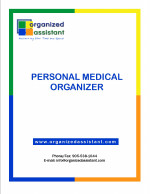
Personal Medical Organizer was developed by my blogging colleague, Janet Barclay. She reports that the sections in her binder include spaces for documenting contacts, a medical history and symptom diary, medications, copies of medical reports and correspondence, and even a place to safely locate receipts from doctors’ visits. Although this organizer is produced in Canada, it is designed to be suitable for patients throughout North America and elsewhere.
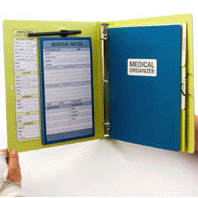
Medical Organizer Kit sold at OnlineOrganizing.com includes a three-ring binder with nine tabbed sections, storage pockets for sorting and storing important documents, and medical tracking charts. The kit allows you to track your appointment times, treatment instructions, medical histories, contacts, prescriptions, dental care and more.
Low Tech, Higher Cost
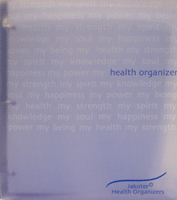
Jakoter Health Organizer provides a higher-end approach to tracking your medical information. In addition to thirteen pre-labeled 8.5″W x 11″H pocket folders to maintain medical paperwork (including test results, correspondence with physicians, hospital and medical bills and receipts), this organizer includes forms for prompting you to remember the questions to ask your doctor, a chart to list major health “events” including visits to the ER, hospitalizations and surgeries, information for keeping track of appointments, and more. (For those who feel the need for something fancier than typical three-ring binder, this organizer offers a choice of a vinyl or faux leather cover.)
High Tech, Moderate Cost–To Be Continued
More and more often, we’re hearing about how computerizing medical records is central to healthcare reform. It’s a distinct advantage for our physicians when they can log into a hospital database and pull up our medical records electronically, without delay for delivery or deciphering handwriting. We can anticipate that along with questions about privacy concerns, there will continue to be a push for electronic record maintenance.
That’s great for the doctors, but what about you, as the patient? How can you use technology for maintaining your medical records? From flash drives with pre-loaded data programs to online medical vaults to Google Health, we’re faced with all sorts of alternatives for organizing medical records digitally.
Next week, we’ll be exploring various digital medical recordkeeping options to help you limit the paper clutter, avoid confusion due to creative handwriting or lost paperwork, and increase the ease of portability of your records. Until then, Paper Doll has some homework for you–consider it a prescription for healthy medical recordkeeping. Read what the Privacy Rights Clearinghouse has to say about maintaining your medical records and the drawbacks of doing so online.
Until next week, stay healthy and safe. (And really, do find out when you last had a tetanus booster shot.)
Vital Signs: Gathering Information During/After A Medical Emergency–Part 2
Last week, we talked about how essential it is to get all your ducks in a row long before you experience a medical emergency. Having the information you’ll need (whom you can call, where to go, etc.) to get you quick assistance and that first responders will need (about pre-existing medical conditions, allergies, current prescriptions) to begin treatment, builds the foundation for medical experts to give you the care you require. That’s life-saving organization.
Once you arrive at the hospital, information will fly around quickly, and aside from the insurance paperwork you’ll fill out for the hospital’s benefit, little data will be in paper form for your benefit. Today, we’ll look at some of some of the best ways to gather the information to ensure that you can be your own patient advocate.
LOG EVERYTHING
Paper Doll is an impatient patient, so I’ve learned not to sit idly while awaiting tests or meds scheduled for a particular time. But in order to advocate on your own behalf (or that of a loved one), you have to track all the information you can. The best tools to allow you to do this? A legal pad and a pen. 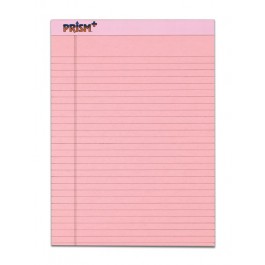
Why so old school? That fabulous laptop or smart phone or tablet on which you take notes for everything else in your life faces two troubling constraints. First, you may run out of juice before you run out of ER wait-time; second, if you’re dependent on the web, you may be disappointed to find neither cellphone signal nor Wi-Fi (free or otherwise) in your emergency room or even your hospital room.
Legal pads, on the other hand, allow you to take real-time notes linearly, require no batteries, can be flipped over to the reverse in the unlikely event that you fill all the page fronts before being assigned a room, and replacement pens are easier to come by than computer-compatible chargers and a free electrical outlet. (You definitely do not want to unplug any of the machinery in an ER or hospital room without permission.*)
Right now, you’re thinking “But Paper Doll, if I’m in the ER, I’m probably in pain. I could be panicking. How can I possibly know, let alone remember, what to write down? If my child or some other loved one is in anguish, how can I stop to write about what’s going on?”
Excellent question.
Obviously, if your ER visit involves agonizing or painful experiences, you’re not going to have the desire, dexterity, or diligence to write down what’s happening. That’s why it’s so important to have someone with you in the Emergency Room and when you’re first admitted. That’s also why it’s so important, as noted last week, to think carefully about who will take you to the hospital.
As for what you can do for a loved one, know that collecting information is probably one of the most beneficial things you can to do help the patient. In some cases, it’s not even safe for you to offer ice chips, but acting as their patient advocate, their eyes and ears and medical secretary when they can’t do so themselves, is an invaluable service you can provide.
So, what should you note?
- Write down the name (and position) of every person who comes in to “do” something to you.
In most hospitals, each staffer wears an official badge saying something like “Dr. Carter– Emergency Physician” or “Kiki–Patient Transport Specialist.”
If badges are flipped backward, ask them to identify themselves. Case in point: A young woman came into my ER “curtain area” and started asking me questions about my insurance and trying to verify my Social Security number. She was wearing jeans and a fleece jacket and no discernible identification. I asked her, politely, who she was and could she show me her identification badge. To her credit, she apologized for having it covered up. (Paper Doll figures that if you’re wearing a hospital gown that leaves little to the imagination, the hospital staffers should at least have to show their ID!)
- Write down what they tell you they THINK has happened.
If you have a broken arm, your diagnosis will be fairly obvious to you. However, if you’ve come in with symptoms that could indicate any of a number of conditions, especially ones which will require more testing to verify, ask them to explain the possible diagnoses. This will help you ask better questions and better understand why certain tests are performed. It will also help if/when you talk to your medical circle. (See below.)
- Write down what they tell you is GOING to happen.
If a resident or attending tells you that you’ll be undergoing tests, being hospitalized, having an IV inserted, or anything else, ask them if these orders have been/will be written, and when they believe the action will take place. This doesn’t guarantee anything will happen according to plan, but it will help guide your actions regarding whether you send your loved one to the cafeteria or if you will have time to place some phone calls.
- Write down the names of the medications, the conditions, the tests…
Get the details of any orders, including specific test/med names. This information is useful when trying to understand your treatment (again, when talking with your medical circle), but will also be helpful down the road when you are reviewing your itemized hospital bill. If you know what orders/treatments are planned, and which actually take place, you’ll be able to note any discrepancies later on.
Medical professionals are generally excellent, but they are also human. Being alert and aware (as much as one can be when emotions are heightened in such situations), and organizing/recording information, can help you make sure that everyone is on the same page.
During my ER visit, after I felt a significant time had passed, I asked the nurse to find out what was the delay in having my ultrasound. She stated that no ultrasound had been ordered. I was able to flip through my notes and find that at 2:45 p.m. Dr. Looks-Too-Young-To-Be-A-Resident stated the orders had been placed for an ultrasound, and ask the nurse could she either check the orders again or ask said resident to pop back in for a second. (Note: Paper Doll asked really nicely.) Magically, a patient transport person arrived within three minutes to whisk me off for that very same ultrasound.
Hospitals are busy places; sometimes instructions are given verbally and take time to be transferred to written or digital status. I’m not advising you to bug the doctors. But if you or your spouse-turned-patient-advocate can keep abreast of what’s allegedly supposed to happen, it’s more likely things will go according to plan.
- Write down the time anyone tells you anything, and when they tell you things may/should happen.
There’s a clock in every ER curtain area, for reasons too dismal to discuss. If you’ve watched ER or Grey’s Anatomy, you know why. At one point, I was told that a particular medicine would be given at a particular time, and that I’d receive a blood test at another specific time, and the times between them were somewhat important. The nurses were incredibly efficient during my stay, but once I noticed that more than a half an hour had passed since I should have experienced the oh-so-lovely blood test, I did ask specifically about the explanations the doctor had given regarding timing.
Paper Doll has a ridiculously, annoyingly good memory. However, an emergency room experience (let alone the tests and medicines) can have a dizzying effect on both the patient and his/her loved ones. When you or the person you’re attending is undergoing the emergency, keeping a log of every person with whom you have an important interaction is a good way to keep your idle hands (and brain) busy doing something useful. You’ll experience less anxiety if you have a linear sense of what is happening/has happened, and you won’t have to worry about whether you’ve forgotten or misunderstood something.
Of course, you can skip noting the comings-and-goings of cleaning staff (unless they unplug your IV) or the nutrition department (even though you’ll be expected to eat breakfast before 7 a.m., lunch at 11 a.m. and dinner at, I kid you not, 3:55 p.m.), but that legal pad can otherwise be a rich source of information and a way to get a handle on everything you’re hearing. It also lets the hospital know that you and your loved ones are really alert to patient care, and assuming you are kind and polite in every interaction, they’ll be happy to help keep you informed. So ask, ask, and ask again!
- Ask about your test results — what do they mean?
- Ask about your diagnosis.
- Ask about your prognosis. How might this effect your life short-term and long-term?
- Ask about what you should/shouldn’t do while in the hospital and upon release.
- Ask when your symptoms (if any) should subside and what you can (and cannot) do to ameliorate the situation.
- Ask about anything that is not clear. Write it down. Read it back.
Seriously. This is not the time to be embarrassed about not understanding a medical term or the reason why something is done. The more you understand, the better you can adhere to instructions. You’re not a robot, and you will be far more inclined and able to follow instructions that you comprehend fully.
YOUR MEDICAL CIRCLE
All of the foregoing helps you organize information during the emergency portion of your ER/hospital visit. Later, you’ll be surfing the web and getting anecdotes from friends who have had (or know someone who’s had) similar experiences.
Paper Doll trusts you that you will only take medical advice from your own physician! That said, it’s helpful to have your own medical circle.
Last week, after I proposed that you collect information regarding who you’d call in an emergency, it occurred to me that you’ll also want a list of people you can call after a medical emergency. Brainstorm names of people you know with medical experience — who not only may have more time to chat with you, but who know you well enough to explain things in a way that works.
For example, I remembered that my acupuncturist was also a nurse, but didn’t recall that a dear client’s wife (residing just around the corner), currently a pharmaceutical salesperson, was formerly an intensive care nurse. Two college friends are physicians (a pediatrician and a child psychiatrist — certainly helpful for when I act like a cranky toddler), and Paper Mommy has collected a lifetime of friends who happen to be in the medical profession.
I encourage you to make a list of everyone you know — relatives, friends, siblings and spouses of friends, pals on Twitter and Facebook — anyone who is or has been a:
- doctor
- nurse
- physician’s assistant
- pharmacist
- physical therapist
The point of this is not to get medical advice, per se, but to acquire comfort and guidance from someone who has the time and patience to sympathize with your boo-boos.
Store this list with your other organized medical records, a topic which we’ll be discussing over the next few weeks.
Stay healthy!
*The film Sparks was directed by a friend with whom Paper Doll went to graduate school. I’m pleasantly amazed that my paper-related blog has finally given me an opportunity to reference the short film…even if it did require a stint in the hospital to yield the inspiration.
Vital Signs: Organizing For A Medical Emergency, Part 1
In last week’s post, I shared that I’d just had an unfortunate surprise, a trip to the emergency room (sans George Clooney) and hospitalization. The upside of being a professional organizer and blogger is that almost any situation provides useful or entertaining ideas for Paper Doll to share with her readers. (This is not to say that if the ER had provided a George Clooney doppelgänger that I wouldn’t have abandoned you all in the time it takes to say “leaving against medical advice,” but let’s leave that aside for the moment.)
Today, we’ll discuss some essentials for organizing information to help you (and first responders) during the initial moments of a medical emergency. In future posts in this Vital Signs series, we’ll talk about how to collect, organize and maintain your personal medical data to guide your doctors and make it easier for you to understand your diagnosis and follow your treatment. Further on, we’ll talk about dealing with the paperwork that comes after the medical emergency: prescriptions, appointment cards, bills, superbills (seriously, that’s what they’re called!), “explanation of benefits” statements, test results, and more.
But first, the best time to organize for an emergency is before one happens, and there are two categories of information you’ll need to get straight:
- Information you’ll need to get help, alert your loved ones and locate your doctor
- Information someone else (like a first responder) will need to ensure that no treatment causes you more harm than good
INFORMATION YOU WILL NEED
- Whom would you call first in a medical emergency?
Are you picturing a face? (Is it your mom? Maybe my mom?) A phone number? Depending on your lifestyle, an answer may not come easily. And if it’s difficult to imagine whom you’d call when you’re calmly reading a blog, imagine what a scary medical emergency might do to scramble your synapses.
Many years ago, our family doctor and his wife (a nurse) lived just down the street. When my mother fell and skinned her knees, a quick yelp brought quick help, medical proficiency and a sense of comfort. Nowadays, however, our own personal (i.e., preferred) first responders may live many streets, zip codes or states away.
Perhaps you think you’d yell for your spouse or significant other, but what if the medical emergency happened when he/she was traveling, or even across town at work? Maybe you’d call your best pal who lives just one driveway over…but what if your friend is in the carpool line at school with the cell phone turned off?
Some medical emergencies require calling 9-1-1…
but often people downplay how serious their own medical conditions might be. Sometimes we worry about “making a fuss,” fear we’d be embarrassed if a chest pain turned out to be indigestion, a racing heart “merely” a panic attack, an injured limb only bruised. Are you ever shy about getting medical help? Get over it! Know when you should call 9-1-1! Otherwise, if you are alone (either because everyone is away, or because you’re an independent singleton), call your doctor or the nearest Ask-A-Nurse call center (check with your local hospitals or insurance company), but remember that the best medical attention is the one you get when it can still do the most good.
During a medical emergency, you may be physically incapacitated; it’s also possible that the stress of the situation could keep you from thinking clearly. That’s why you need to create a plan, now, when you are healthy and clearheaded.
If you’re a parent, you’ve probably painstakingly created an emergency plan for use by babysitters, something that provides names, numbers and a hierarchy of whom to call if something goes wrong. Do the same sort of thing now. Sit down with a loved one or close friend today to create an emergency contact list to keep by the phone. (Copy these numbers into your cell phone, too.) Whom would you call first? What if they weren’t available?
- Whom would you call next?
Give yourself at least three options of people you’d absolutely call without wavering. If you’d hesitate, even for a moment, fearing “Oh, I hate to bother him/her,” then rethink the name…or your attitude.
In addition to your emergency contacts, be sure to include your numbers for:
- your physician(s)
- your doctor’s or nurse’s direct line (and/or emergency line)
- your dentist
- your 24-hour pharmacist

- Where would you need to go?
When my medical emergency struck, I called my doctor’s emergency line, and the nurse instructed me to go to the hospital’s emergency room immediately! (“Do not pass go. Go not collect $200.”) In my head, I could envision the quick route and felt competent to get there. However, although I’ve lived in the same location for over a decade, I did not realize that the emergency departments in my nearby suburban hospitals do not treat major emergencies. My nurse informed me that if I went to the local hospital, I’d just be transferred by ambulance to one of the big hospitals downtown, so I needed to head directly downtown.
In some communities, different hospitals, emergency rooms and urgent care locations specialize in different medical needs. Talk to your primary care physician or specialist to find out where’s the first place you should seek treatment for various concerns (trauma or broken bones, intense pain, signs of stroke or blood clot, heart, etc.).
Also, make sure you know which medical providers are in or out of your health insurance provider’s network. Obviously, the quality of medical care is the primary issue, but to protect your sanity and your finances, along with your health, whenever possible you should use in-network providers to ensure the majority of your emergency medical costs will be covered.
INFORMATION FIRST RESPONDERS WILL NEED
In the best case scenario, if you need to call 9-1-1, you will be alert enough to assist the professional first responders and emergency room staff with questions regarding your identity, your emergency contacts, your medical status and other pertinent information. But in case you can’t speak for yourself, organize your information to speak on your behalf.
- Who should they contact on your behalf?
By now, you should have heard of ICE, or In Case Of Emergency, the idea for which was promoted by Bob Brotchie of the UK’s East Anglia Ambulance Service and popularized via emails ever since 2004.
The idea is simple. If you are unconscious or otherwise incapacitated, first responders and others should be able to reach your most important contacts — your mom, your spouse, etc.
You merely enter the name(s) and phone number(s) of these loved ones or emergency contacts under the listing ICE in your cell phone directory; first responders and hospital staffers have been trained to look there. (Paper Doll is a big fan of listing the ICE name along with the person’s real name/nickname and phone number, like “ICE: Mom–Sheila [phone number]” or “ICE: Husband–George Clooney[phone number],” to make it easier for your loved ones to be reached. For more on the advantages and few drawbacks of the ICE program, read further here.
- What medical conditions/allergies do you have?
If you have a serious chronic medical condition like epilepsy or diabetes, it’s essential that first responders know this right away; similarly, if you are allergic to medications, bee stings or certain ingredients (like eggs), your treatment could be adversely impacted if first responders don’t have all the facts.
If you do have such a condition, you’ve already probably been warned to wear medical alert jewelry, such as a bracelet or pendant, and/or to keep a notification card in your wallet, near your driver’s license or identification card.
If you don’t already have a medical alert card in your wallet, you can make one yourself on an index card, or generate one here (just scroll down) that you can print out and tuck in your wallet.
- What drugs/medicines are you taking? In what dosages?
Next week, we’ll be talking about organizing your medical history to present it to any new doctor. But in an ambulance or the emergency room, medical professionals may not have the time or opportunity to read a lengthy history, and you may not be in a position to share what you know. It could be imperative for them to know what medicines you’re taking to ensure that standard medical procedures don’t conflict with your current regimen.
If you’re currently taking insulin, heart medications, blood thinners or other essential drugs for a chronic condition, first responders need to know ASAP. Keep a card in your wallet detailing the medicine’s names and dosages, as well as the name and number of the prescribing physician.
Note: If you have multiple health conditions and are taking a laundry list of prescribed drugs, help the paramedics help you. Keep an information sheet detailing the name(s) of your condition(s), medicines, dosages, physician and pharmacy information and contact names/numbers right on your refrigerator. To help figure out what else you might want to post, check out the free Vial of Life kit to see how it works.
I hope that neither you nor anyone you love ever experiences a medical emergency. However, as nobody ever expects a medical emergency (or the Spanish Inquisition*, for that matter), the best defense is a good offense. Just as with backing up your computer and maintaining your car, organizing your medical emergency resources is best done when you are healthy and serene. See you next week. Be safe and healthy!
*If you’re not familiar with Monty Python’s Spanish Inquisition sketch, I can’t think of anything better designed to de-stress you after thinking about medical emergencies.
Except maybe the Argument Clinic sketch or the Ministry of Silly Walks sketch. Ironically, you probably don’t want to watch the Hospital sketch.
[For more, see Vital Signs: Gathering Information During/After A Medical Emergency–Part 2.]
An Unexpected Post, A Poor Imitation of George Clooney
Readers, this was not the post I intended to write today.
Within hours of putting up last week’s post, Come Time Traveling With Paper Doll, on organizing to communicate with (and make things easier for) your future self, I found myself wishing I’d been able to time travel to warn myself of what was coming next. As that post was filling your monitors, Paper Doll was being rushed to the emergency room for the first (scary) day of a week-long hospital stay. Yikes!
I wish I could gush with smug pride and tell you I was calm, unemotional and awe-inspiringly brave in the face of distress.
I wish I could tell you I didn’t eye the 15-year-old resident or her possibly-22-year-old attending a bit warily. (“Are you sure you’re old enough to drive?”, I was tempted to ask the distaff Doogie Houser.)
I wish I could tell you I was a charmingly patient patient and captivatingly witty, entertaining the ER and nursing staff with bon mots and organizing tips, decluttering the IVs and systematizing the oddly-shaped bedside tubs. (Seriously, whoever thought these


were a good shape for anything was getting too little oxygen or too much from the medicine cart!)
In fact, with a lifetime of dedicated viewership of St. Elsewhere  and Chicago Hope
  and Grey’s Anatomy
and ER  and often most terrifyingly, House
  (did you SEE that toe fall off last week?), I know just enough (read: way too little combined with way too much) for my own comfort. I properly guessed and discussed the diagnosis and much of the treatment, and was able to answer medical history questions thoroughly. However, that didn’t keep me from turning into a relieved but whimpering baby once Paper Mommy‘s flight landed.
Organization can perform something akin to miracles, but just can’t prevent medical emergencies. Stopping for a split second in the heat of the moment to grab my day planner, insurance coverage cheat sheet and a blank legal pad made all the difference in helping me feel secure and more in control during a situation in which a patient can control very little.
In the coming weeks, when I’m back to full strength, I plan to post some advice on dealing with medical and insurance paperwork and show how having the right paper can calm you during a medical emergency, help your doctors take care of you, enable your loved ones to reach you (and vice versa) and maximize your safety and the sanity in what can be a scary experience.
Right now, however, Paper Doll must convalesce, forsaking sitting at the computer for long stretches. Instead, I’ll be resting and making sense of the release orders and Get Well cards, the medical instructions and the insurance claims. And I’ll be contemplating where George Clooney was when I needed him.
Come Time Traveling With Paper Doll
Stephen Hawking thinks travel tourism isn’t likely, because we’re not surrounded by visitors from future days. Carl Sagan thought maybe these travelers from the future are here, but just aren’t sporting their “My parents went to Pompeii to see Mount Vesuvius erupt, and all I got was this lousy T-shirt” memorabilia.
The truth is, the more I think about organizing, the more I realize that it’s an entire system for time travel…if only in one (forward) direction. After all, the reason we organize is so that we can find what we need (in the future, when we’re looking for it) and have the right information so we can know what we need to know (when we need to know it).
Organizing is far less about the aesthetics of how things look now than how they will function when we need them to, and everything we do to organize our homes, our offices, our schedules and our lives is geared toward making our futures successful. For example:
- We can file our auto insurance policy in the legal section of our family files system, preferably in the legal section, so that in the future, if ever we are in an accident, or wish to compare the elements of our policy with a new option, we’ll be able to find the information quickly.
- We can store charitable contribution confirmation letters and receipts for tax-deductible expenses in our current year’s tax prep folder so that, in the future, when we prepare our own taxes or turn the material over to our accountants, we’ll maximize our deductions.
- We can organize business cards and contact information for essential people in our card file or computer database so that, in the future, if the baby breaks out in red spots, we can find the pediatrician’s number; if the toilet starts overflowing, we can find the not-too-expensive-and-makes-late-night-housecalls plumber we adore.
- We can place pieces of paper (coupons that trigger us to take our cars in for oil changes, invitations that remind us to buy wedding presents, bills that have to be paid or questioned) representing tasks we have to perform in the future in a date or month slot of our tickler files. (Loyal Paper Doll readers know that I believe so strongly in the organizing powers of a tickler file that I wrote an ebook,
 Tickle Yourself Organized, to help everyone maximize the benefits of this almost magical tool.)
 - Sometimes, the best way to get information to our future selves is to avoid paper altogether.
For short-term messaging, I often advise clients to use technology to send non-paper messages to their “future selves”. For example, if a person scribbles a note to remember to buy Reese’s Peanut Butter Cups on the way and sticks it in his pocket, how likely is he to remember to look in the pocket just prior to passing the grocery store? Not very likely! However, setting the alarm on your cell phone for about 5 or 10 minutes prior to when you’ll be in the vicinity of the store is an easy way to send a message to your future self and get the task completed.
Call from home to leave reminder voicemail messages to complete work tasks; call the house from work to leave messages regarding household tasks; and call from your cell to leave messages regarding both is. It’s a little bit of time travel combined with another sci-fi standard, communicating with an alternate-reality version of yourself. (Let’s hope the alternate versions of you don’t scarily sport different features like creepy mustaches and evil laughs.)
Sometimes, we need to get a message to our future selves while an idea is fresh in our minds. Wouldn’t be useful, when we’re still smarting from the emotional tribulations of spending time with our hopped-up-on-Thanksgiving-turkey annoying cousins, to send a message to our pre-Thanksgiving-selves for next year with some soothing advice to avoid the same conversational pitfalls? How about reminding your future self of the travel inconveniences you faced after this trip, so you’ll be forewarned before next annual conference?
You may be wondering what got Paper Doll on this time travel kick. Last year, I reviewed some To-Do list sites, including the now defunct I Want Sandy and the no-longer-free Jott, which allowed you to send messages to your Future You. However, I’ve recently become aware of some sites that allow you to send emails in the same manner:
 Future Me.org is a website designed to let you speak with your future self. (While it would certainly be more helpful, at times, to have our future selves send email back in time to advise us, it seems they haven’t worked the kinks out on that yet.) The premise simple. Enter an email address for yourself that you believe will be valid in the future, create a header and message, and specify the date of delivery. FutureMe does not require any registration, so you could use it anonymously to communicate with future versions of others, as well as yourself.
Use it to congratulate yourself for an accomplishment you (hopefully) have achieved by the time of receipt, to motivate you to take action, or to keep prompting you with the idea for that Great American Novel. If you’re planning to take a trip a year from now, send yourself an email to arrive about a month in advance of the trip in order to remind you in which drawer, file or safe you’ve placed your passport.
FutureMe is currently set to allow messages to be sent up through 2037; one imagines the founders assume we’ll have mastered real time travel by then.
 Future Mail, unlike FutureMe, requires a simple registration. You supply your email address and password, then click on a link in an opt-in confirmation email. From there, once you’ve identified your time zone, you can create a new subject line and message to be delivered at the time and date of your specification.
You also have two options; the message can be delivered as email and/or as part of a public RSS feed for a personal “blog” it sets up on your behalf. Unlike Future Me, Future Mail only allows you to send this mail to registered address and not anonymously to other recipients.
 Mail to the Future.org (not to be confused with the now-defunct MailtoTheFuture.com) is a third option for having a fun (one-sided) chat with your future self. Aesthetically, the site is more visually pleasing than either bare bones competitors, FutureMe or FutureMail; you can also email friends in addition to yourself, though not anonymously.
To register, supply your email address and name; MailTotheFuture.org then provides you with your temporary password, which you can change at any time after logging in, via the “Change Your Settings” function. To send your message, you specify the year, month, date and hour for message delivery, create a subject and message content, and your time travel has begun. You cannot specify the moment.
The biggest disadvantage is that MailTotheFuture.org uses Central European Time to set the time zone. Thus, if you don’t live somewhere longitudinally similar to Albania, Malta or San Marino, unless you’ve consulted a world time zone map or converter, your email may arrive some number of hours earlier than you anticipated. (Paper Doll has always suspected that time zones are a subtle form of time travel, but that’s a subject for another day.)
 Letter Me Later is definitely the most advanced version I’ve found among the free options for sending email at a future date. (In fact, this blog post was already set to go live when a message…possibly from the future…instructed me to look into LetterMeLater.com!) I sense that while the other sites were designed specifically for a fun one-off experience, LetterMeLater.com’s founders envision a more complete online email experience…with an added benefit of time travel.
LetterMeLater.com makes date setting flexible, so you can either send email on a specific date, or you can specify “in 72 hours”, “next Thursday”, “tomorrow at 3:15p”. LetterMeLater.com also allows for html messages and attachments to emails, features not seen in the other free accounts.
You can also send messages via LetterMeLater.com without actually visiting the site (once you’ve created your account); instead, you can send from your own email account, using your personalized LetterMeLater.com email address. The site allows you to import contacts, send emails with CC and BCC options, and even send text messages.
[LetterMeLater.com has an additional nifty feature for blog and website owners: a widget you install so that your readers can send their friends nifty information about your site/blog, either now or for far-future receipt.]
FutureMe.org, FutureMail, MailtotheFuture.org and LetterMeLater.com all currently provide free accounts. Paper Doll generally advises against expenditures for fun, non-essential organizing tools, but there are paid services out there, including:
 l8r has a free demo and allows you to schedule email to yourself and others at some future date. However, l8r’s focus is the paid service ($1.99 for 100 emails, $4.99 for 500 and $9.99 for 1000), which provides for sending one message to multiple recipients, sending html and not just plain text, appending attachments, and avoiding both the l8r-branded signature block and a six-month account expiration.
A potential problem related to using all of the above future-email sites is ensuring that the address to which you send the email will still be working in the future. Lifehacker columnist extraordinaire Gina Trapani has some timeless advice for future-proofing your email address.
Readers, please remember, organizing is your own best defense against the vagaries of the unknown future. Organize your papers, your resources and your information so you can access what you need, when you need it. Whether you’re living life linearly or manage to prove Stephen Hawking wrong and become a time tourist, it’s always good to be able to tell yourself where you’ve put your passport.


Follow Me