Paper Doll
Paper Doll Marks The Calendar for a Successful 2012
~Sren Kierkegaard
After six weeks of frenzied counting down the days, we’re in that fuzzy stage when the Advent calendars have been put a way, NORAD’s Santa Tracker has been reset, and we’re running out the clock on the final days of the year. The end of the calendar can make us feel like we’re peering over the precipice into the great unknown.
WHAT DOES YOUR CALENDAR MEAN TO YOU?
For those of us who believe surprises are rarely of the diamond bracelet and lottery winning variety and tend to manifest as flooded basements and influenza, calendars provide comfort. Knowing as much as possible about what will happen when gives us a sense of control. Novelist Lucinda Rosenfeld says, of men,
We order our salad dressing on the side because we are control freaks. We’d like to control you. Because we can’t, we control lettuce.
For those of us who fiercely (if self-deludedly) seek to be captains of our destinies, calendars are our life preservers. We act as thought capturing every vacation or task, birthday or dental appointment, in writing, will act as a talisman against the vagaries and whims of fate. We know, deep down, that organizing (our time or space) can’t prevent catastrophes, but we gain confidence from the idea that it can, at least, make them less catastrophic.
Others fall at the opposite end of the continuum, feeling that life is an adventure, and hewing an existence inside boxes on the calendar is too much like being boxed in… regimented… trapped.
But most people fall somewhere in the middle. They want organization as well as freedom, structure along with spontaneity. They like the idea of keeping a planner or calendar, but may not be faithful to the process. What about you?
- Do you carefully maintain one (paper or digital) calendar to keep you from missing all the important dates in your life?
- Are you juggling one calendar at work, another for personal activities and a life-sized calendar for your family in the kitchen…one where nobody seems to remember to write “Bring cupcakes for the PTA bake sale”?
- Do you often use the prior year’s calendar well into the new year, augmenting it with scribbled sticky notes?
- Do you have salon and dental appointment cards taped to your fridge, blocked by birthday party invitations and months-old reminders?
- Is there any room in your calendar system for your plans and dreams?
OLD SCHOOL OR NEWFANGLED?
Gone are the days when a free calendar from the bank or the butcher sufficed. Now, the varieties and types of calendars are endless — digital or paper, ring-bound or spiral, sizes from compact to legal, hourly or by daypart, daily or weekly. It’s no wonder people tend to change systems each year, or abandon systems altogether before the winter is through. The options are dizzying.
There are two big questions people always ask about calendars. The first: paper or digital? More and more, people disclose embarrassment they’re not using digital calendaring systems, and those who are often doubt they’re using them well. The truth is, high tech isn’t for everyone. Even those of us who practically live at the keyboard aren’t always satisfied by digital calendars.
If you don’t currently have a system that works for you, give some thought to how you tend to keep track of things.
- Are you a linear thinker?
- Do you know the shortcuts for DVR-ing your favorite shows?
- Do you enjoy reading gadget manuals? (Are you at least willing to do so?)
- Are you far more likely to pull up an app like Remember the Milk or Workflowy than scribble notes on paper?
- Do you need to share your calendar with colleagues located far away?
- Do you remember to sync and back-up diligently, and keep your gadget charged and close at hand? (Be honest!)
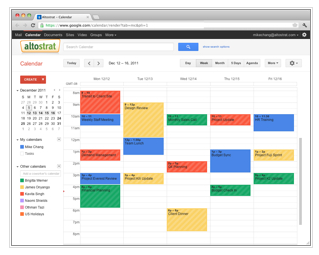
If this sounds like you, a digital calendar may be your personal scheduling GPS! Explore Google Calendar, Apple’s iCal, or Microsoft Outlook’s calendar. Then, research reviews of the best productivity apps for your smart phone and verify how well they sync with your favorite calendar. However, if you’re more likely to answer the following questions affirmatively, then paper calendaring may be your best bet.
- Do you tend to remember landmarks rather than directions?
- Do you consider yourself a tactile person, remembering clothing, books, etc. at least in part by the way they feel to the touch?
- Do you color-code appointments and obligations by life category or family member?
- Do your creative juices flow more easily when you hand-write, rather than type?
- Are you constantly frustrated by your electronic devices?
Either way, the type of calendar system you use is far less important than your level of commitment to whatever system you pick.
PENCILING IN THE ESSENTIALS
Pick a calendar that lets you see a month at a glance with ample space for writing notes for each individual day. When we compartmentalize and consider only tasks set for Tuesday, we might not take into account a late meeting the Monday night prior or an early flight on Wednesday morning. Context matters when judging the ebb and flow of time.
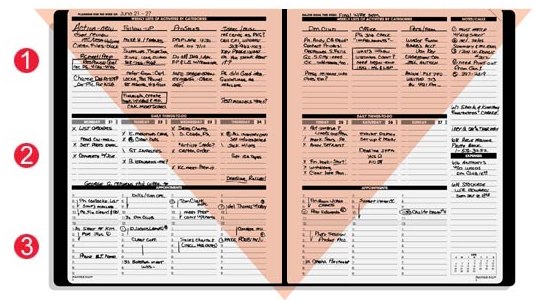
Select a planner that has enough space. If you have sprawling and not-so-neat penmanship (like Paper Doll), a pocket-sized planner may cramp your style, literally and figuratively. If your digital screen limits characters, will you be able to track all the information you need?
Take your planner everywhere. This isn’t usually a problem with digital divas, but if you’re only in the habit of carrying your paper planner to work functions, rethink the style and size of what you use so that you’re comfortable taking it everywhere (and remembering to bring it home with you).
Schedule everything that’s fixed or obligatory before taking on any new responsibilities.
1) Review this past year’s calendar, month by month, and copy all the recurring events — birthdays, monthly meetings, conference calls, convention dates, etc.
2) Plan ahead for special events associated with your children’s school, parenting groups, community associations and your house of worship. For your professional life, find out when the local business expos, trade shows and networking events will be scheduled. Block time on your calendar to attend.
3) Schedule time for health. Call to make medical appointments for yourself and for your family. Remember doctors (including specialists), dentists, orthodontists, and eye doctors, and plan out the most convenient times to have inconvenient tests like mammograms and colonoscopies. Your life is an open book at this point in the year: schedule fitness training sessions and exercise classes, massages and pampering.
4) Get your (financial) house in order. Schedule appointments with your CPA for early-to-mid February, by which time you should already have all your 1099s, W-2s, and whatever other paperwork you need. It’s also a great time to plan appointments with people who can help you make your life, finances and time more orderly — financial and estate planners, insurance representatives, and professional organizers.
5) Brainstorm for your future. Your calendar can be a vital asset for reaching your big dreams and goals. Want a new job? Block time to set up informational interviews or take continuing education. Dreaming of getting fit? Pair up with a friend to take evening yoga or cardio classes instead of going out for fattening dinners.
SINGLES OR DOUBLES
Remember I said there are two big questions? People ask whether they should have separate calendars for work and family. An abundance of experts advise using only one planner. As they say,
The man with one watch always knows what time it is.
The man with two watches is never sure.
If you keep one calendar for family activities and another for work, you’ll never know if your child’s recital conflicts with a major client presentation, or if you’ve scheduled yourself to attend a work conference the week of school vacations. Concurrent, overlapping but non-inclusive calendars are a recipe for disaster.
However, while it might be ideal, it’s not always feasible to have only one calendar. To keep all your bases covered, I suggest the following:
- Have a PORTABLE calendar or planner for everything in your own life. You have to be able to verify your prior obligations before you can confer with the orthodontist, the PTA bake sale planning committee or the Vice President of Mid-Western distribution. That means you have to have your calendar with you at all times, whether it’s paper or digital. If your system allows it, differentiate professional from personal obligations via color-coding.
- Have an ALL-FAMILY calendar at home in a high-traffic area or use something like Cozi if your family is wholly high-tech. Make it clear that it’s everyone’s obligation to post the dates for soccer games and band concerts, corporate retreats and slumber parties.
- Schedule SYNC TIME. No, this isn’t just a reminder to sync your smart phone with various computers (manually or via the cloud). Busy families need face-to-face time each week to confer, make updates, and confirm that nothing has changed or moved. Implement a family meeting to keep it all together.
MAKE A COMMITMENT!
Engage with your engagement calendar.
Even the best system won’t work if you don’t mark every appointment down and then check frequently to see what’s scheduled. If you’re the type who forgets to check your calendar, use a few technology and accountability techniques:
1) Set an alarm on your cell phone to ring at the end of every workday to remind you to check your calendar for the next day and/or the coming week.
2) Develop a family dinner tradition and ask, “What’s on your schedule tomorrow?” Listen to the answers.
3) Schedule daily time with your work assistant or virtual assistant to review newly-added obligations and the next day’s agenda.
4) Keep motivated with appealing colors, auditory alerts or even calendar stickers.
5) Schedule your next appointment (with your client, doctor, salon, etc.) before leaving. If you aren’t traveling with your calendar (tsk, tsk) ask them to call you the next day to set up your next appointment.
6) Build administrative time into your schedule. Whether you’re a stay-at-home parent or a business executive (or a tearing-your-hair-out hyphenate), your schedule has to reflect time to plan what you do as much as it reflects the actual things to accomplish. Paper Doll schedules Admin Mondays to tackle planning, marketing, and finances. Figure out what works for you and set that time in stone.
Having a system but not using it can make you crazy. Get committed…so you won’t have to be committed.
Happy New Year! Paper Doll hopes your 2012 will be happy, healthy and clutter-free!
Paper Doll Says: Contribute With An Open Heart, Not A Cluttered Desktop
By popular request, Paper Doll is revisiting (and updating) a favorite topic: dealing with the clutter of incoming charitable giving requests.

Have you noticed that in the weeks since Thanksgiving, your mailbox is as fully and robustly overstuffed as you were in the late-night hours preceding Black Friday? Your postal carrier is struggling and your daily mail piles are exhibiting a growth spurt.
It’s not just ads and coupons, inveigling you to spend your precious little green bits of paper, and unless you’re the most popular kid in class, it’s not all holiday greetings. A huge contribution to all that Mail Call Clutter comes from requests for charitable giving!
It’s easy to become overwhelmed. Certainly, you want to help support causes about which you’re concerned (children, healthcare, the environment, animals, education, poverty…and the list goes on), but you may be troubled by some challenging obstacles to philanthropy:
Limited Funds — No one person (not even Bill Gates, Warren Buffett or Oprah), possesses the funds to solve all of the world’s troubles. Even the folks on Forbes Magazine’s 2011 list of the 400 Richest Americans can’t do it all. Do you wonder if your contribution, even if it’s more than you can comfortably provide, has the power to make a difference?
Competing Interests — Weighing charitable giving options against one another can paralyze you into doing nothing, letting the piles of requests (the letters and the envelopes and the “gifts” of greeting cards and address labels) creep across the kitchen table and overtake your office desk.
Just as you couldn’t take as much as you wanted from the Thanksgiving buffet because your elastic waistband might snap, your finances are finite and the number of charitable giving options, even just the non-profits actively seeking your help, are practically infinite. Responding to each request is no more suitable than ignoring them all but still letting the papers clutter your surroundings. The guilt of non-responsiveness will clutter your heart and mind.
Confusion Over Repeated Requests — Non-profits aren’t trying to grab your money dishonorably (as magazine subscription services do); nonetheless, they serve up an onslaught of requests, leaving you confused as to whether you’ve actually donated or not. If you give to Charity A in December, not only will you receive repeated requests over the ensuing months for “Special Giving Opportunities” to Charity A, but in many cases, you will receive requests from similarly-themed Charities B, C, D to double-Z because many non-profits earn revenue by selling their lists.
Bah. Humbug.
So, how can you resolve these frustrations?
First, give up the guilt. Receiving address labels doesn’t obligate you to make a donation any more than receiving a holiday card from a stranger obligates you to send him one. Pleading advertising copy isn’t a free ticket on the Guilt Trip Express. Use your brain so you can give from the heart.
Next, instead of choosing between the weight of guilt or the fear of exceeding your holiday or monthly budgets, remember that there are alternatives to feeling pressured into writing a check to every cause that owns a bulk mail stamp. And none involve getting a sub-prime loan, robbing street-corner Santas or letting charitable clutter creep through your home. Instead:
1) Plan your charitable giving budget. The only way to give with your heart, without resentment, is to budget your donations as you would budget for all other expenditures.
It may shock those of you conditioned by “This offer is available for a limited time only. Operators are standing by!” but non-profits are always in need of money. You may get dozens of requests for donations in December, but your contributions will be no less valuable, life-saving or appreciated if sent three or six months down the line. Pace yourself.
Create and label a manila folder to collect all of the requests you receive for holiday donations, and during a quiet moment on New Year’s Day or after, sip some hot cocoa and review them. Make a note on your calendar and treat this as if it were a formal appointment with the director of each of the non-profit organizations.
Select the charities that mean the most to you. Ask yourself, “If I could donate to only one charity, which would give me the greatest joy to help? Which would make me feel the most satisfied in my choice?”
There’s no wrong answer. While one person might donate to help political prisoners in an impoverished nation, another might choose to support an animal shelter two blocks away. Medical research to find a cure for a disease that afflicts millions is no more or less “right” than giving to one neighborhood family whose home burned down in a fire. The weight of the whole world is not on your shoulders. Give with confidence that while you handle your share, millions of other similarly good-hearted people are doing the same.
Remember: you can’t give to everyone, but you can feel good about everyone (and everything) to whom you choose to give.
As you sort through the requests, determine:
How much can you comfortably afford to give each month? Recall other pledged obligations, like to your house of worship, alma mater or public broadcasting stations.
How often do you want to donate?
How many charities will you select?
Do you want to give to 12 charities, and assign one to each month of the year (or perhaps four, with one per quarter)? Tuck the envelopes away in your tickler file or bill-paying center.
Keep the spirit of giving alive throughout the year without being overwhelmed or over budget.
Prefer to give to a few particular charities all year long? Set up a recurring donation on the same day of the month through your online bill-paying system. (You could schedule payments via credit card, but that costs non-profits extra merchant account fees.)
2) Budget cash for ad hoc giving, such as when you encounter a bell-ringer or want to purchase a meal for a homeless person.
Set aside $5 or $10 in singles in a separate section of your wallet so you can make unplanned donations without breaking your budget. After all, it’s hard to give with an open heart if you’re feeling resentful about a pinch in your pocketbook.
3) Partner with others to achieve a charitable giving goal. For example, propose that you and your networking colleagues or your Zumba buddies donate the monetary equivalent of one networking lunch or one post-class smoothie toward a specific charitable goal.
To keep the spirit going all year, create a charitable giving club the same way you’d start an investment club. Instead of collecting articles about stocks and mutual funds, collect the brochures and request letters from non-profits and bring them to your group meetings. (You’ll be less inclined to let a charitable request languish atop your microwave if you know a group member feels passionately about that cause.)
4) Educate yourself about charities. Learn about the charities to which you are considering giving financial support. Find out what percentage of donations will be used for funding programs, research, etc., and what percentage goes towards advertising, administration, etc.
 The Better Business Bureau’s web site for charities offers Wise Giving Reports, explains charity accountability standards and provides background information on all the non-profits in the accredited charity directory.
 CharityNavigator‘s newly expanded 2.0 ratings system evaluates the financial health of thousands of America’s largest charities. Browse by charity name or category, and check out the blog, articles and charity ratings.
 The American Institute of Philanthropy operates CharityWatch.org. Review the A-Z (well, A-Y, from the AARP Foundation to the Youth Development Fund) listings of hundreds of charities to learn more about their operations.
 GuideStar.org lets you verify a charity’s legitimacy, learn whether your prospective contribution will be tax deductible, view a non-profit’s IRS Form 990, or find out more about its programs, mission statement and financial activities as rated by volunteers, donors and clients.
5) Give donations that keep on giving.
Consider gifts that will live on, long after you’ve made your donation.

Microlending organizations like Kiva allow people to lend small amounts of money, via the internet, to micro-financing institutions in developing countries. Your money partners with other donations to meet a recipient’s financial needs for starting a small business abroad. Select by business type, read the profiles and pick the recipients of your loan/donation. When that loan is repaid, your money goes back into a kitty to help others. Give a Kiva gift certificate and combine gift giving and charitable giving.

Heifer International lets you donate a flock of ducks, a trio of bunnies or a share of a water buffalo to help families and communities around the world become self-reliant. Again, a gift certificate lets you combine two types of giving, heaping the gleeful honor of “ownership” on your recipients near and far.

“Give” your knitting sister a Knitter’s Gift Basket (or a 10% share), and a farming family will get a llama, an alpaca, a sheep and an angora rabbit.

GlobalGiving connects donors with over 1000 charitable projects searchable by region, campaign or beneficiary. For example, Creating Hope International and the Afghan Institute for Learning combine to provide cloth, tools and a tailoring course so Afghan women can become self-sufficient.
Some people have everything, need nothing, and want only world peace and tranquility. But even the most high-minded of us like unwrapping something shiny. Revel in special opportunities to provide gifts that, while not tangible for the giftee except in the form of a certificate, provide ineffable meaning for them and something essential and tangible to the third-party recipients — the hungry, the impoverished, the innocent, and the needy.
Finally, no matter how you give, make a notation on the request letter to show how much you donated, on what date, using what method (check, credit card, etc.). File the letter in the tax prep section of your family files until you receive an official confirmation of your donation.
Of course, you need not always give money. Donating gently-used possessions, time and service to non-profits can be even more valuable than the amount of money you could afford to donate.
Keep the spirit of giving…just let go of the piles of requests.
Paper Doll’s 2011 Holiday Gift List: Favorite Things Edition
What are the best gifts to give to prevent clutter?
As a professional organizer, I think that the best gifts aren’t things at all. They’re experiences. There’s even academic research from various studies to back this up, including those funded by the National Science Foundation and one conducted by professors from Cornell University (my alma mater!) and the University of Colorado. The findings? That experiences (like vacations and concerts) are more likely to bring a sense of happiness, or at least satisfaction, than material possessions (like clothing and electronic gadgets).
Part of this stems from the fact that we can visually compare our possessions with those belonging to our friends, and feel that what we have is lacking. It’s much harder, however, to compare experiences, which are so much more personal, and the memories of our experiences gain value over time because they are all the more “ours” for that personalization.
Don’t buy it? Close your eyes and try to remember three tangible gifts you got last year. Or even one from the year before that. With few exceptions, the joy of receiving material goods fades from our memories…but each time we recall pleasant experiences, we tend to relive the action as if we had tiny TIVOs in our heads.
This year, give yourself and your loved ones the gift of a clutter-free holiday season. Instead of scavenging stores and wrapping oddly shaped boxes, give experiences that will never have to be stored, exchanged, dry-cleaned or dusted. Consider these clutter-free gift categories, excerpted from my ebook, Simplify the Season and Save Your Sanity.
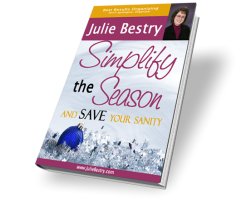
Gifts of Entertainment — Buy your loved ones tickets to professional or college sporting events, concerts, or comedy clubs. Take them to the symphony or present them with tickets for a lecture series, winery tour or theater event. A booklet of movie vouchers, season’s tickets for the theater or even a weekend trip to see a Broadway or Vegas show will yield fond memories long after the big event.
Gifts of Pampering — For friends with too much stress or not enough money, give certificates for haircuts and styling, spa facials, or relaxing massages. (Yes, even macho men like “sportsmen” spa packages.)
Gifts of Adventure — For the thrill-lovers on your list, consider certificates for hot-air balloon rides, rock climbing or zip lines. Race fans might love the NASCAR Racing Experience or the Dale Jarrett Racing Adventure. Athletes will appreciate a week of baseball fantasy camp, pre-paid rounds of golf, or time in the batting cages. For the more casual (and loosely-defined) adventurer, bowling, miniature golf, or paintball work equally well.
Gifts of Practicality — Any driver would benefit from gift certificates for oil changes, car washes and detailing…even memberships in AAA or a similar auto club. Multiple months or even an annual subscription for internet service, Netflix, cable or satellite TV, or cellular service are practical but charmingly unexpected. For college students or those on a fixed income, comping these expenses can really lighten the load.
Gifts of Education — Knowledge is power, and skills, once learned, can last a lifetime. Consider cooking, music, or self-defense lessons. Pre-pay for a series of classes in ballroom dance, quilting, horseback riding, driver’s education, scrapbooking…whatever delights the people on your list who thirst for knowledge.
Gifts Of Whole New Year — Secure a fishing license, a U.S. National Parks pass, or a year of alumni or professional association dues. Memberships at local attractions like zoos, art galleries, science museums, and historical societies may even be reciprocated by sister organizations when your recipient is traveling nationwide.
Gifts of Organization — Such gifts aren’t just practical; they can be sanity-saving!
For a friend or colleague who is drowning in disorganization, paper shredders, fire safes, and label-makers are great clutter-reducing gifts. (Colleague Liz Jenkins reports that Staples has some super-low prices on label-makers this week, including a Brother PT-90 for $9.99 and a PT-2030 for $29.99!)
A year of off-site cloud-computing backups via Mozy, Carbonite or CrashPlan will keep someone’s digital files streamlined and the data safe and accessible, letting your recipient sleep better at night.
And, of course, you can give (or request) a personalized clutter-reducing option — a gift certificate for time with a professional organizer.
There are a variety of other great organizing-themed gifts. Paper Doll is no Oprah, but I’ve made a list of a few of my favorite things for the favorite people on your list.
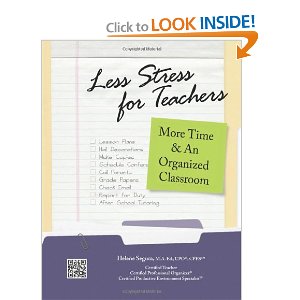
1) The (Hardworking but Overwhelmed) Teacher — My colleague Helene Segura‘s new book, Less Stress For Teachers: More Time and an Organized Classroom, will help teachers tame the chaos so they can focus on what they do (and love) best.
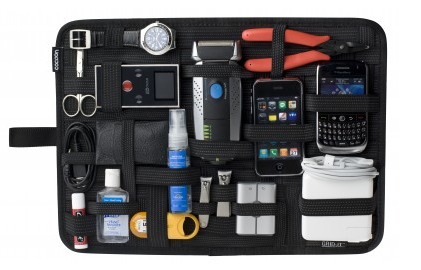
2) The Traveling Tech Guru — Does someone in your life have a commute or a schlep with pockets and bags full of chargers and gadgets? Grid-It! from Cocoon Innovations was one the most popular of all of the items I reviewed from this year’s NAPO Conference and Expo. (I’m still moping that I got to the Grit-It table too late to get one of the giveaways, so I’ve put it on my own wish list!)
3) Your Favorite Iron Chef — Would your chance of getting your favorite dinner increase if the chef in your house could find the counter under all of those recipes? Consider a one-year gift subscription to Eat Your Books, as reviewed here just a few weeks ago.

4) The Super-Shoppers — You know those moms (and dads) who make sure that the household never runs out of toilet paper or graph paper or construction paper (yet always manage to stay under budget)? Those shoppers have special needs. For them, I have a few favorites:
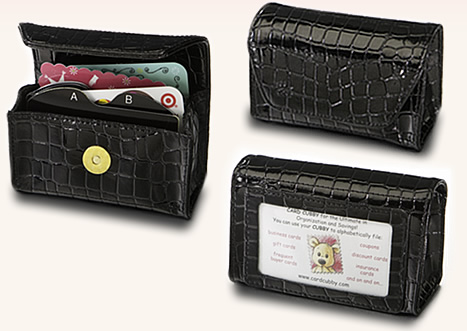
- I never get over the simple utility and stylish presentation of the Card Cubby, suitable for gift cards, loyalty cards, and all forms of ID. (For background on this nifty item, see one of Paper Doll‘s 2010 NAPO expo reviews.)
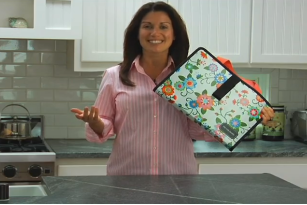
- For all those treks to the grocery store, the pharmacy, the toy store, and the public library, your Super-Shopper has amassed a fine collection of re-usable tote bags which are threatening to take over the mud room, the kitchen, and the trunk of the car. The Tote Buddy, which I reviewed back in May, brings order to that chaos.
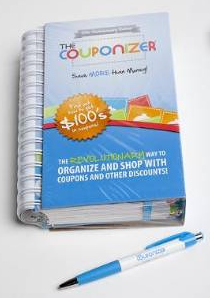
- Whether your Super-Shopper is set for a debut on Extreme Coupons or just likes to save a few shekels here and there, The Couponizer ensures that cents-off makes good sense.
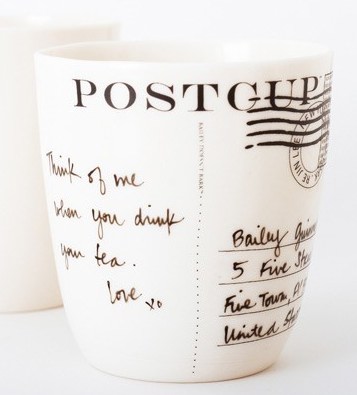
5) Loved Ones At a Distance — Do you have a special someone who won’t make it back home for the holidays? Consider this eminently more practical version of a post card, the Postcup! Long after post cards yellow and fade, your message will live on in this customizable mug from Design Milk.
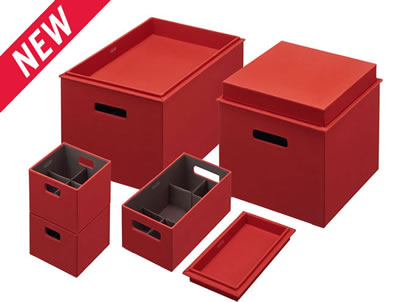
6) The Keepers of the Home (and Office) — Readers, you know how crazy it made Paper Doll to have to keep the Rubbermaid Bento Boxes a secret between April’s NAPO Expo sneak peak and October’s official launch. Now, this sublime line of gorgeous, practical storage can make any home or office more efficient and delightful. (Buy extras — you know you’ll want to keep a set for yourself.)
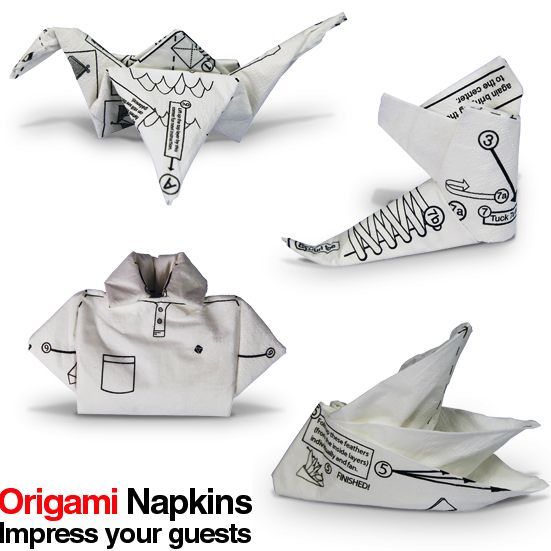
7) The Hostess With the Mostest — Do you know (or are you) a host or hostess with great party mojo but not the best culinary time management? If a little more kitchen time is necessary, the guests can be kept busy with Origami Napkins from Spinning Hat.
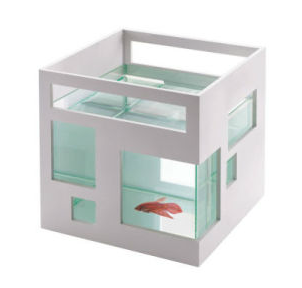
8) Fishy Friends — Truth be told, Paper Doll isn’t much of a pet person, but I imagine I might get along swimmingly (hee! swimmingly!) with the inhabitants of this not-remotely-paper-related gift. But there’s something terrifically nifty and organized about this Umbra Fish Hotel. The individual “suites” are stackable, in case you want to go condo!
Happy gifting, and when loved ones ask what you want for the holidays, tell them you’d like a clutter-free gift — either an experience you can remember always or a something that can add a little organization to your life.
Paper Doll Wraps Up Some Alternatives to Wrapping Paper (Part 2)
Readers, last week we explored ways to keep all the wrapping paper, ribbons and supplies of the holiday season…under wraps. Today, we’re going to examine some alternatives to using traditional rolls of wrapping paper to help you accomplish multiple goals at once:
- Decorate your gifts with festive, attractive (or at least serviceable) wrapping without purchasing new paper.
- Save money.
- Reduce your carbon footprint and protect the environment a bit.
- Solve wrapping conundrums that formerly yielded messy, crumpled, adhesive-lumped blobs.
If that last benefit seems out of place, then you’re probably one of those people who generally wraps everything from lounge chairs to vacuum cleaners with equal and impressive aplomb. Paper Doll is pleased to have you as a reader, but will never give you a self-wrapped gift for fear of offending your aesthetic sensibilities. Let’s just say that I’m lucky my best friend’s little boy looked past my miserable attempt to wrap a stuffed lion. The circle of life was more a dodecahedron of Scotch tape and rough angles. Readers, it was not pretty.
Thankfully, we have other options.
FUROSHIKI
The coolest alternative to wrapping paper comes by way of Japan. Furoshiki, the Japanese art of gift wrapping, is stunning. Using techniques to fold cloth, much like origami involves folding paper, furoshiki allows one to turn any ample sized piece of material into a practical yet artistic creation. Wrap a gift (or packages for easier carrying) using basic techniques illustrated at Japan’s Ministry of the Environment furoshiki page.
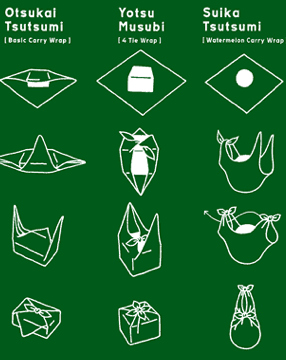

The idea is to re-purpose (or invest in) beautiful, reusable cloths, such as those carried by Furoshiki.com, in any of a variety of designer or traditional patterns and multiple sizes. Longtime readers will not be surprised to find that Paper Doll is transfixed by not-so-December-esque options in pink, like this Sakura (Cherry Blossom) furoshiki design:

If you’re wondering how two wine (or sparkling cider) bottles like this

could be transformed into something softly, daintily wrapped as this:
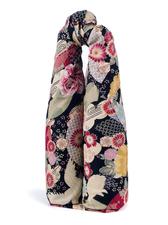
Without tape, ribbons or a glue gun, you can transform a present into a wrapped work of art — provided you’ve got the manual dexterity and the ability to transform the conceptual into the tangible. The web abounds with instructional help for taking your wrapping to the next level.
For example, while it’s not immediately apparent, you can click on each of the finished product pictures on the Furoshiki.com techniques page
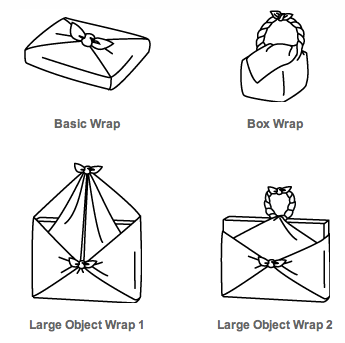
to be guided by step-by-step IKEA-like directions. (That is, the descriptions refer to A and B…but there are no letter designations on the sketched diagrams.) And you can find more instructional videos on how to do furoshiki at WikiHow, Collection du Japon, WazukiShop.com, and Hizen-ya.co.uk.
But perhaps these instructions and videos made you feel as klutzy and all-thumbs as I did when I watched the popular Japanese viral video on how to fold T-shirts. If that’s the case, don’t worry, there are still many attractive, environmentally-friendly wrapping options for people like us.
RECYCLE
Sometimes, you need to wrap a gift in a hurry, and you may not have wrapping paper or a beautifully designed piece of cloth. When something is better than nothing, consider what you might already have on hand that could make an ordinary gift really stand out.
Go On a Map Quest
Do your recipients have wanderlust or are they only accidental tourists? Although companies sell recycled maps as wrapping paper, why not dig through your glove compartment, your travel bag and your I’m-going-to-scrapbook-it-someday pile of vacation memorabilia of subway maps

and recycle your own collection? Think big–old, scrolling road maps that predate the Eisenhower Highway System, or think small–maps of theme parks or museums that match the recipients’ tastes.
See You In The Funny Papers
At best, you were going to recycle those old Dilbert and Marmaduke comics anyway. Why not give them another life as holiday wrapping? Small children love brightly colored paper and aren’t going to be more impressed by high gloss, so why not give them some Sunday funnies with their fun? (If you’ve got pen pals on distant shores, consider making a comics trade at some point during the year. Wouldn’t it be neato for a kid who has newly discovered TinTin to receive the books wrapped in Belgian comics?
Read the Writing On The Wall
Or at least make use of the wallpaper. Do you have bits of wallpaper, shelf paper, Kraft or butcher paper or any other decorative or craft-oriented paper that’s going to waste? Call upon your arts & crafts skills, or let the kids paint, crayon or doodle a masterpiece for wrapping Grandma and Grandpa’s presents.
Deck the Halls with Aluminum Foil
It’s shiny. It’s smooth. You can make it crinkly if you want. It form-fits to whatever shape or size you’re wrapping, and you often don’t even need tape. Add a ribbon, colored twine, stickers, a blown-up balloon (or multiples) and you’ve got a surprise star from the drawers of your kitchen. (C’mon, they sell wrapping paper that looks just like aluminum foil. Why not go to the source?) When you’re all done, you can use the foil to scour your oven racks and perform other amazing tasks.
CONTAINMENT POLICY
When something is too oddly shaped to wrap the wrapping around it (like that aforementioned stuffed lion), contain it instead.
Bang the Drum
A clean coffee canister or cookie tin works great for hiding the true shape of a gift, and you’ve got a make-shift percussion instrument after the unwrapping is over. (OK, maybe you want to hide the latter fact.)
All-In-One
Depending on your choice of gift, the gift itself can be the container. Take a moment to envision what kinds of gifts are made complete by the container in which they come:
- Gardening bag filled with tools
- Bright plastic bucket with bath or beach toys
- Sports-themed bag loaded with the paraphernalia of choice — bowling ball in a bowling bag, a nine iron in a golf club travel bag, yoga togs, bricks and mat in a yoga duffel
- Glass jars or canisters filled with the fixings for a hearty soup or a favorite dessert
Put a Little Bounce In Your Step
Lidded, opaque Rubbermaid totes (Get it? Bounce? Rubbermaid?) are already
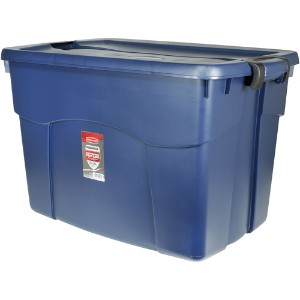
colorful, simple, and perfect for disguising the shape of large or unwieldy gifts. The more your present’s wrapping serves as a decoy, the more surprised and delighted the recipient will be!
SOFT SERVE
Sometimes, your containment policy needs a softer touch.
Don’t Lose Your Marbles: Fabric Gift Bags
Remember those nifty little bags for holding onto your marbles? If Home Ec didn’t put you at risk for ruining your permanent record, you might consider sewing your own treasure bags per the tutorial at Australian blog Threading My Way. Or, pretend you’ve time-traveled to the Little House on the Prairie era and use a decorative pillow case tied at the top with a ribbon. (Ma and Pa and Baby Carrie will be thrilled!) Conversely, you could buy the little bags. And don’t tell me you’ve never heard of people re-using those oh-so regal Crown Royal bags for
everything from masking the true shape of tiny presents to corralling Scrabble tiles. Drop it in, pull the drawstring and postpone learning those deft furoshiki methods for another year.
Don’t Forget Fabric GIFTS
Who says you can’t wrap a gift in a gift? Take your heavier, more solid gifts and wrap them them your choice of a second, fabric gift: a silk or wool scarf, pashmina, baby blanket, or colorful beach towel. If the main gift is big enough (think: bicycle or sled), consider wrapping it in (or perhaps draping it under) a gift of a comforter, fleece blanket or sleeping bag. (You could opt for a Snuggie or Slanket, but…don’t. Just don’t.)
RERUNS
Rejoice In Holiday Reruns
It works for It’s A Wonderful Life and Santa Claus is Coming To Town! You can always reuse the least-wrinkled wrapping paper, gift bags, tissue paper, bows and ribbons from last year. However, if you’ve got snooty recipients or your willingness to go green doesn’t extend as far as re-using wrapping paper from year to year, at least save the scraps for your nearest crafting pals to use for decoupage, paper mche, scrapbook page borders, or origami…which brings us back to where we started, with Japanese solutions to our wrapping paper conundrums.
Perhaps it can be easy being green. I think if he could take time away from his current film’s press junket, Kermit would be proud of what we’ve done here.
It’s a wrap!
Paper Doll Wraps Up the Holidays and Makes It All Stick (Part 1)
When we talk about paper clutter, we’re usually discussing functional paper — files, coupons, contracts, insurance policies, and papers that trigger activities we have to perform. Rarely do we have a serious discussion about paper that, while serving a purpose, is mainly aesthetic in nature. Until the holidays, that is, and then all the rules change.
Do you find yourself searching under beds and in the backs of closets, trying to locate the right piece of wrapping paper to fit an oddly shaped box? Have you ever spent painstaking hours trying to get a present wrapped just right, with the side flaps (somewhat) even and the bows just where they ought to go, only to find your family had turned into paperniverous creatures of mayhem the minute the presents were unveiled?
Whether you’re talking about getting it all together to wrap the gifts, or dealing with the detritus after they’ve all been opened, this is the time of year to deal with wrapping paper clutter!
BE A SINGULAR SENSATION
Some people wear a signature scent or have a signature wardrobe color. Tiffany & Co. is known for those iconic blue boxes.
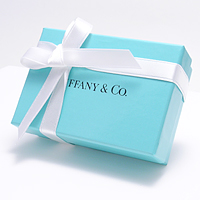
Why don’t you opt for a signature color for the holidays? Then, you’ll only have to buy rolls of one type of paper instead of searching for appropriate patterns and risking running out of paper at the last minute. And you won’t have to worry that your teenage nephew will take offense at teddy bear wrapping or that Uncle Joe will be teased about his Barbie-clad crime novel.
Pick a festive color or neutral pattern that works for everyone. Red and green are Christmas-specific and blue is considered a Hanukkah standard. Why not pick a shimmery gold or silver that covers all eventualities, and then add an elegant ribbon or bow? For kids’ gifts, take a page out of the Paper Mommy encyclopedia and affix small candies like Tootsie Rolls or colorful, cellophane-wrapped (American-style) Smarties all over the top of the package.
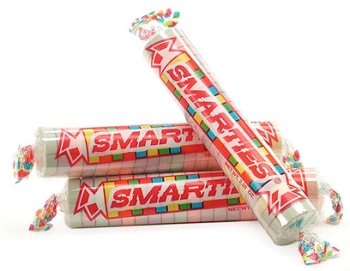
(Trust me, the kids will be much more careful about unwrapping their presents to ensure they don’t accidentally toss one precious candy.)
Experiment with having a signature wrapping paper color just for one season — it’ll save time and effort, and you may never go back to having dozens of rolls of oddly-sized, mismatched wrapping paper.
MAKE IT STICK
If you like the idea of a monochromatic wrapping style but still feel the need for a little more jazz, dress up your wrapping with some spectacular tape. Brooklyn-based designer Karl Zahn’s Oboiler has some smashing black and white lace tapes (50 yards per 2″ wide roll, $10 each)
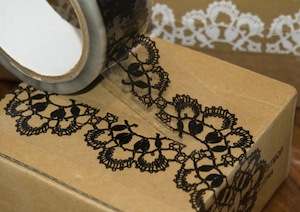
(Thanks to Dr. Joe Stirt of the blog Book of Joe for the excellent pointer to the lace tape, as well as to the yet again sold-out Marie-Hlne de Taillac jewel tape. Joe is not only “the world’s most popular blogging anesthesiologist,” but he’s the source of information on the niftiest of gadgets and doodads. What professional organizer Jeri Dansky is to stuff for organizing, Dr. Joe is to…everything else.)
Duck brand’s EZ Start printed packaging tape has exciting new designs for packing up a special gift with pizzazz, including a chipper Cinnamon Snowflake and a black and white Paisley.
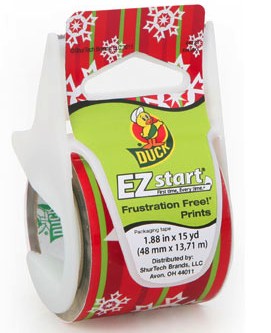
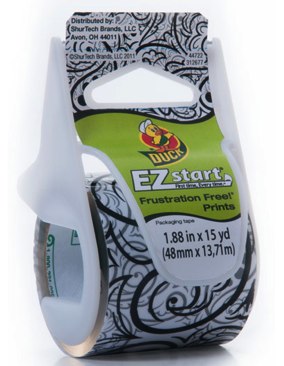

Japanese washi paper tape is another impressive alternative to traditional tape. Washi, a handmade paper with adhesive backing, is used for decorating, crafting and scrapbooking, as well as for wrapping packages. It’s similar in consistency to masking tape, but is smoother and available in bright colors and appealing patterns.
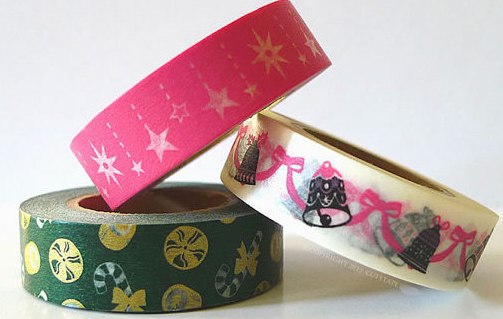
It can be hard to find washi paper tape in brick-and-mortar stores, but the Texas-based Etsy shop Pretty Tape has a wide variety of washi to solve all your wrapping, decorating, scrapbooking and “oooh, pretty!” tape needs, including this cheery stars/bells/candy cane set ($8.50/set of 3).
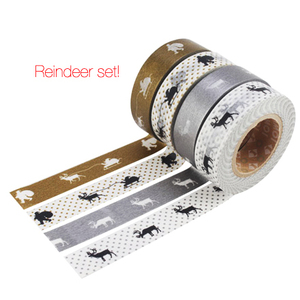
Paper and soft goods distributor The Hach has a few love holiday samples including mTape’s 1.5 cm wide Reindeer set (gold, silver, and silver polka dot reindeer, and gold polka dot Santa):
and a 1.5 cm Angel set (gold angel, gold polka dot angel, green candlesticks, and red polka dot candlesticks). The Mistletoe set (green and red mistletoe, gold and red mistletoe, green/gold stripes and red/gold stripes) comes with two 7-mm rolls and two 3-cm rolls. Sets are $20, and individual tape rolls may also be purchased separately for $4-$6 each.
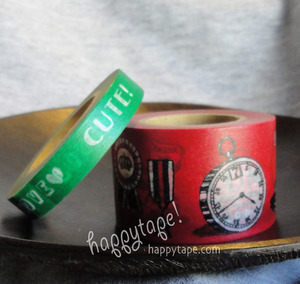
Happy Tape has numerous collections of Christmas-themed washi, including this vintage two-roll set (50′ rolls of 7 mm green and 30 mm red) for $9.75.
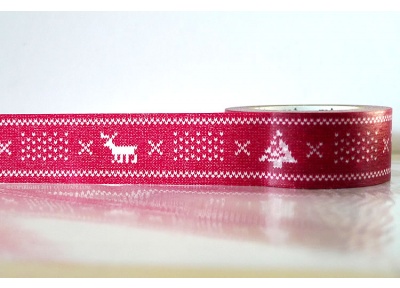
Cute Tape carries an adorable Knit Reindeer Christmas Tree pattern perfect for wrapping up those holiday sweaters ($7.50/10 m long, 20 mm wide roll).
Unfortunately, I’ve yet to find any washi tape suitable for Hanukkah or Kwanzaa (or Solstice or Festivus, for that matter). If you know of a purveyor of other winter holiday washi paper tape, please leave a note in the comments with the name of the company. (Reminder: As a protection against spam, the comments section doesn’t allow linking.)
HEY, MR. DJ! CREATE A WRAPPING STATION
Once you have the right paper, it helps to have a central location for all of your wrapping paraphernalia: wrapping paper, ribbons, tape, scissors (for cutting paper and curling ribbons), a straight edge or ruler (for cutting paper evenly), note cards and sparkly pens (if you’re into that kind of thing). You could invest in Martha Stewart Gift Wrap Hutch:
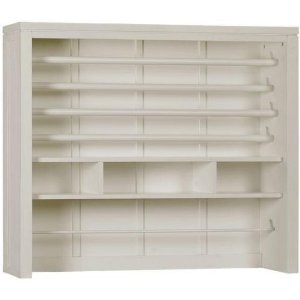
but I suspect that if that kind of finery were your style, you probably wouldn’t be reading Paper Doll.
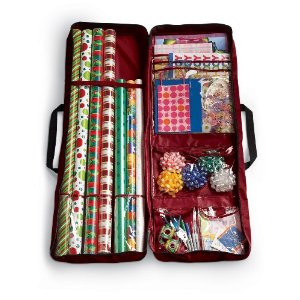
or any of a variety of vertical wrapping paper & supply caddies, like the Gift Wrap Vertical Organizer or the Gift Wrap Work Station, both from The Container Store:
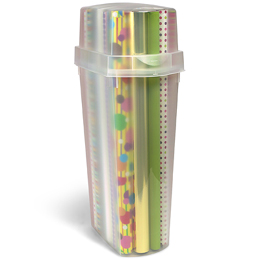
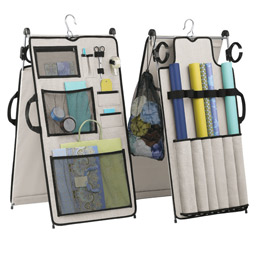
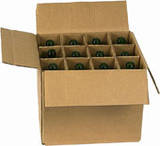
If you just want to stash your wrapping paper tidily and keep it somewhat portable, but don’t care as much about your style of containment, consider using a wide umbrella stand or clean liquor store “cell box” (with dividers) to stash your wrapping paper upright.
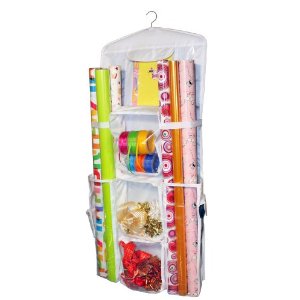
And, if you lack the floor space that even a typical vertical arrangement might provide, a hanging gift wrap organizer, like this one from Jokari works well inside a closet or bedroom door or even flush against one side of a coat or guest closet.
If you keep a lot of different kinds of supplies (ribbons and bows, pretty tapes, pinking shears and scrapbooking scissors) for your wrapping, keep them organized and all in one place in your wrapping station, even if that means owning extras of a few items. Running to the kitchen to get scissors and digging through your children’s backpacks for a straight-edge ruler will just waste time when speed and efficiency are at a premium. (You want to get things wrapped before everyone gets home/wakes up/wanders in, don’t you?)
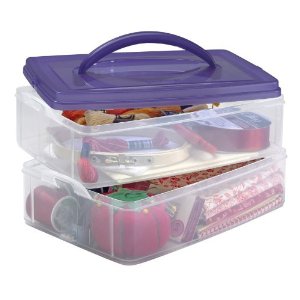
A simple tool box (or a medium Bento Box) will keep stored wrapping supplies tidy. Similarly, the multi-layer Snapware Craft ‘N Stack Storage containers are superb for corralling all the accoutrements for your upcoming wrapping extravaganzas in one place.
WRAPPING RETHOUGHT
While wrapping paper is the traditional way to present gifts with flair, there are a variety of alternative (and planet-friendly) ways to decorate presents until the big reveal. Next week, we’ll unwrap a whole slew of surprising, attractive, eco-friendly and economical wrapping options.
Until then, I leave you in good hands by directing you to The Holidays Made Simple: Easy Gift Wrapping With Gift Bags and More, a post by my great friend and the afforementioned blogger extraordinaire, Jeri Dansky.

Follow Me