Paper Doll
Paper Doll Redirects the Mail (Part 2): Temporary Changes of Address
AT YOUR TRAVEL DESTINATIONS
If you’re planning to stay with friends, you can have mail sent Care Of whomever you’re visiting. However, in some countries, post offices will only deliver paper mail to residences; packages must be picked up at postal offices.
Mail and packages can be directed to a hotel, resort or youth hostel where you have fixed reservations and plan to stay for a while. However, I would only suggest this as an option for emergencies. Hospitality staffers have high turnover, and there’s a good chance your mail might get lost in the shuffle.
If you plan a meandering, date-non-specific trip, you’ll need something more official.
POST RESTANTE
Practically every nation has a system in place for holding mail for individuals lacking permanent mailing addresses, enabling travelers to pick up mail at a time convenient for their itineraries. In most of the world, this system is called Poste Restante. It’s also called General Delivery in the United States and Lista de Correos in South America.
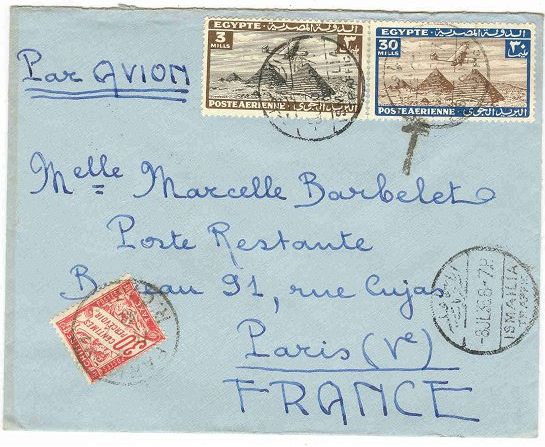
Back in the days before email and cell phones, this was a popular way of receiving mail when you couldn’t (because of local service issues) have mail delivered to your place of residence, or if you didn’t know in advance exactly where you’d be staying.
Senders address letters or packages — of which, more later. After arrival at the destination city, recipients must go the post office with their passports (for proof of identification) to collect whatever mail is waiting. Many international post offices even have special counters ( la concierge service) for Poste Restante.
There may be a charge for Poste Restante, though unless a nation is rife with systemic corruption (in which case perhaps you might wish to stay home?) the fee tends to be only about fifty cents per mailed item. In the era of email and cell phones, you’d probably only want to use Poste Restante for packages or vital documents, or in countries where larger delivery carriers, like FedEx and UPS, are absent or will have difficulty finding you.
Address Poste Restante mail in the following format (with words capitalized as indicated):
LASTNAME, Firstname
Poste Restante
Central Post Office
City/State/Province/Prefect/Whatever
COUNTRY
Of course, you’ll want to contact a post office in your destination city to verify if they hold mail, where the central post office is located and if there are any additional concerns regarding formatting.
If you will be staying somewhere that Arabic, Asian, or Cyrillic lettering predominates, ask a native speaker to write the address on paper, then scan it and send a PDF to anyone who might be sending you mail. The sender can then print a copy and affix it to the envelope or package alongside the English version (which is necessary to get it out of North America).
If you’re using General Delivery in the United States, the format is:
Firstname Lastname
GENERAL DELIVERY
City, State ZIP-9999
Whatever the city, use 9999 for the ZIP+4 addendum. The main post office for each community is supposed to hold mail for up to 30 days. If you don’t pick it up, it will be returned to sender, so don’t get any nifty sci-fi ideas about sending mail to your infant grandchild and putting a notation in your will to have him pick up a package thirty years hence. Leave that to Nicolas Cage.
AMERICAN EXPRESS CLIENT LETTER SERVICE

Novels from the late 40’s and 50’s referenced international travelers visiting American Express offices to pick up mail. That wasn’t just a work of fiction.
Any traveler can receive mail at American Express Travel Service offices worldwide — it’s free if you hold an American Express-branded card, but if you’re willing to pay a small fee, non-cardholders can use the service, too. Note, it’s only for paper mail, and not packages, which means you’ll probably only want to use it if you have something that cannot be emailed, like a replacement credit card or late arriving visa (not the credit card — the kind that goes with your passport).
For American Express cardholders, if a letter doesn’t arrive before you’re ready to leave, you may request that they forward it to another American Express Travel Service office of your choosing, at no cost.
Not all Travel Service offices participate in the Client Letter Service. Plan ahead by locating American Express Travel Service offices along your itinerary, and call to verify that they are part of the Client Letter Service.
MAIL FORWARDING SERVICES FOR CRUISERS, TIN CANNERS AND EXPATRIATES
While the above options work fairly well for the peripatetic, other mobile types need to receive all of their mail on a regular basis. RV traveling and cruising is popular with retirees and free spirits (like OnlineOrganizing founder Ramona Creel), and in the last few decades, mail forwarding services have popped up specifically to assist these travelers.
The process is generally similar across all providers, though each has its own bells and whistles:
1) Select a service provider and activate your account.
2) Authorize the service to receive and handle your mail by filling out and notarizing Form 1583 — Application for Delivery of Mail By An Agent. Fax multiple forms of identification, as well, to guard against identity theft and mail fraud.
3) Direct all mail to the new address you’ll be assigned– this includes First Class mail, like letters and bills, as well as magazines and other subscriptions. Provide this address to retailers, from Amazon to Zappos, whenever you make an online or phone purchase.
4) All mail will go to the service’s central sorting location. (Some services have one main street address; others have multiple locations nationwide.)
5) The forwarding service will sort your mail and scan the envelopes and outer packages on a daily basis, uploading the information to your account.
6) At your convenience, log into your account to view and manage your mail. With the better services, you’ll be able to view general information, like the sender, parcel type, weight and dimensions and an item description.
7) Based on your preferences, navigate the online account management to direct the service to act on each letter, magazine or package. Choose to have the mail sent to you, held or discarded. If you’ve received multiple packages (purchases, birthday presents, etc.), direct them to be consolidated into one larger package for shipping.
8) Different services have different shipping schedules and pricing structures, so determine how often you want to receive your mail and select accordingly. When you are ready to receive all of your mail (including packages), the mail forwarding service will put your shipment together with all of the necessary documentation to get it to you.
Mail forwarding services have multiple advantages. You can:
- Eliminate junk mail.
- Bundle just the mail you need.
- Repackage your purchases and mail into larger containers, decreasing the overall cost of shipping (vs. individual shipping costs for multiple items)
- Shop via mail order, even from companies that don’t ship outside of North America.
- Some companies will provide letter and magazine storage. This is usually free for a short period (30-45 days), after which a small fee, often $1 per pound or box, is assessed.
Caveat emptor! There are services that provide only shipping, without the ability to view your mail online. Paper Doll strongly urges against using such companies. Similarly, avoid companies that don’t accept credit card payment. Payment by check isn’t merely inconvenient when you’re traveling; you’ll also lose the consumer protections so many credit cards provide. Consider skipping companies that grant only P.O. Boxes, rather than street addresses; otherwise, the service won’t be able to receive inbound packages via UPS, FedEx and other carriers.
Again, not every mail forwarding company offers every feature. Carefully review each for the availability of:
- Insurance
- Real street addresses (vs. post office boxes)
- Online management
- Scanning of documents/envelopes
- Repackaging/Package consolidation
- Junk mail disposal
- Mail shredding
- Credit card acceptance
- Clear, easy-to-understand monthly/contract rates with no “gotchas” (Make sure you know in advance if there’s a sign-up fee, repackaging fee, etc.)
A few of the better-known mail forwarding services are indicated below. (Please note, this is for informational purposes only and are not recommendations.)

US Global Mail has three levels of service — Personal, Personal Pro and Business class — ranging from a low of $11.25/month for a two-year contract to a $50/month business plan without a contract, paid month-to-month. US Global Mail allows you to use a shipping calculator to determine which of four international carriers you prefer for forwarding mail and packages to your location. 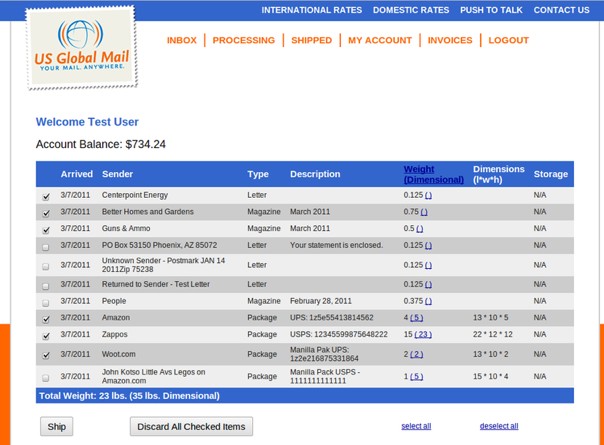
US Global Mail has an excellent slide show tour for viewing exactly how you can navigate your online account management.

Earth Class Mail recently accented its business-oriented features. (Thus, while services are expansive, they might be overkill for a backpacking college graduate or new retiree.) Earth Class Mail’s general mail and parcel forwarding is $19.95/month, plus fees for special services, and you get an address in Beaverton, Oregon. If you have simple needs, this service allows your mail to be forwarded without online management.
Earth Class Mail’s virtual mailroom provides online management. In addition to general services (sorting, scanning, shredding, and shipping), you may forward to multiple addresses, in case you prefer a document you received to be sent to your attorney, CPA or colleague. You can select an official address (PO Boxes or street addresses) in any of 19 cities.
Full time recreational vehicle (RV) travelers may want to peruse the following:
Escapees RV Club
Family Motor Coach Association
MY RV Mail

In addition to mail forwarding services at various rate levels, 24-year-old St. Brendan’s Isle provides additional specialized services for cruisers, full-time RVers, business executives, traveling nurses and Merchant Marines. Unlike most services, which bill monthly to a credit card, St. Brendan’s Isle starts with a $100 deposit, from which monthly charges are deducted.

USA Box is designed specifically for international travelers who want their mail and packages shipped abroad with ease. Rates are dependent upon the nation to which mail will be forwarded.
Whether you’re traveling for work, study, fun or are just on the lam from “The Man”, there’s a mail forwarding service for your needs.
Paper Doll Redirects the Mail (Part 1): Permanent Changes of Address
Recently, I’ve been receiving questions about dealing with the red tape involved with changing addresses and having mail directed elsewhere. One client found that her dream house, just across town, became available, and she and her husband snapped it up. The only wrinkle? The move was accomplished so quickly that she hadn’t had time to submit a change of address. Overwhelmed by all of her obligations, she was driving back to her old (unsold, and basically abandoned) house each day to get the mail.

Another client is already concerned with how her daughter’s mail should be handled. The college student will be spending the summer semester abroad but fears coping with mail sent to her parents’ home, her current dorm, her apartment for the fall semester and her little summer sublet.
Yet another client was delighted to find a new job, but less enamored with the idea of relocating for six weeks out of every fiscal quarter to train new divisions as her company expands. A singleton, she’s got no logical person to ask to process her mail.
Relocating, whether it’s permanent or temporary, whether it’s the whole family or just one person (a child going off to college, a spouse ejected after a divorce), can be freeing as well as frustrating. However, with some careful planning, handling your change of address needn’t stress you out.
Today, we’ll start with the essentials for managing a permanent change of address.
TRUST, BUT VERIFY
Verify your exact address with your real estate agent, landlord or apartment complex management. Make sure your new home is properly identified as Lane, Road, Court, Boulevard, Circle — the wrong one could send your mail to neighbors in nearby culs-de-sac.
Double-check to make sure you’ve properly heard the directional terms, like 129 West 81st Street (Jerry Seinfeld, in Apartment 5A) and ask for sound-alike numbers (five/nine, fifth/sixth) to be spelled out (in case you get Mr. Rogers’ old 4802 Fifth Avenue).
If you’re buying a recently-constructed home, triple-check. In some instances, the developer may have changed the street names between when the plans were originally submitted to the post office and the municipality put up the street signs. Also make sure your street is actually registered with the post office — believe it or not, developers sometimes forget this step.

Search for your address at the United States Postal Service Zip Code Lookup site. Enter what you have of the address, and it should return the proper zip code, including the four-digit extension.
Finally, if your address will be complex or have multiple parts, try to think of a fun or goofy way to make it clear and memorable. For example, I might say, “Shallowford Road — not a deep Chevy, but a shallow Ford.” Silly? Yes, but you (and they) will remember it.
WHO NEEDS TO KNOW? WHO’S ASKING?
Once you know to where you’re relocating, start spreading the news. The following should help get you on your way to recalling everyone you need to notify.
Government Agencies
The Internal Revenue Service — It shouldn’t be surprising that the IRS really wants to make sure they know how to find you. But it’s also to your advantage, to make sure you don’t miss out on any refunds or important notices. Just fill out IRS Form 8822 — it was just updated in January 2012 — and you’ll be good to go.
Social Security Administration — If you or someone in your household receives, or will receive, disability, retirement or survivor benefits and you live in any of the 50 states, the District of Columbia, Puerto Rico, the U.S. Virgin Islands, Guam, the Northern Mariana Islands, or American Samoa, you can use the online system to change your address. For Supplemental Security Income (SSI), however, there is no online option. You’ll have to either visit a Social Security Office in person or call 800-772-1213, Monday through Friday, 7 a.m. to 7 p.m. EST.
Department of Veterans Affairs — Has a member of your household been in the military or do you receive military benefits? Are you the executor of a will or responsible for the estate of someone with military experience? Make sure the VA can find you.
U.S. Citizenship and Immigration Services — Most resident non-U.S. citizens need to report their changes of address within ten days of moving within the United States or U.S. territories and can do so via an online form. The process can be complicated, however, so if you’re not a diplomat or tourist but have a pending immigration case, you might want to avail yourself of the explanation of rules.
Voter Registration Offices — If you are moving to a new municipality, you will have to re-register with your local board of elections. However, if you are moving within the same congressional district, it is likely that you can merely send a change of address form.
Department of Motor Vehicles — Select your state’s DMV to get the right contact data and search for an online change of address page and registration information.
Toll Pass Agencies — Be sure to update your toll pass accounts like New York’s E-Z Pass, Massachusetts’ Fast Lane, Louisiana’s Geaux Pass, Texas’ TXTag and Illinois’ i-Pass.
Unemployment Office — If you relocate while receiving unemployment benefits, it’s essential to keep your state’s unemployment agency notified. BankRate.com has an easy-to-use directory of state offices.
Financial Institutions
Banks and Credit Unions — Contact any company at which you hold accounts
Brokerage houses — For your retirement and non-retirement investments
Credit reporting agencies — Start with Equifax, Experian and Trans-Union and review all the companies that track and report on you. Begin with the classic Paper Doll: Who Knows Your Secrets? series, starting with From Big Sister to Little Brother.
Insurance companies — For auto, medical, dental, life, umbrella and business policies
Lenders — List credit card companies and holders of auto loans, mortgages, personal loans, etc.
Utility Companies
Electric company
Gas company
Sewer service provider
Trash/Waste/Recycling service providers
Water company
Internet service provider
Telephone companies (cell and land line) — Note, the taxes you pay on cellular phone service are determined by the county in which you are registered. If you stick with online billing, it may be to your advantage to keep your cell service registered to your old zip code.
Television service provider — cable or satellite
Household Services
Alarm company
Housekeepers
Lawn and garden care
Pest control
Pool maintenance
Snow plowing/shoveling
Medical Providers
Internists
Pediatricians
Specialists (OB/GYNs, ophthalmologists, endocrinologists, etc.)
Dentists
Orthodontists
Veterinarians
Pharmacies
Other Professionals
Attorney
Accountant
Bookkeeper
Financial advisor
Schools/Caregivers
Daycare providers — for children or elderly family members
School administrative offices — preschool, elementary, middle, or high schools as well as college, whether you are a student, parent or alumni
Online Contacts
Amazon.com and other retailers with whom you have created wish lists
Ebates and other companies from which you commonly receive rebates
Hotel, airline and other frequent-user accounts
Paypal and other online financial organizations
Affiliate programs from which you are expecting commissions.
Personal/Other Contacts
Extended family and friends
Civic organizations and clubs to which you belong
House of worship and religious organizations
Subscription services — Magazines, newspapers, Netflix or video services, game subscriptions, music or movie clubs, etc.
Catalogs — Only contact companies for catalogs you wish to keep receiving.
Business Contacts
Professional associations
Licensing and certification boards
Formal networking groups
This is for business-related personal mail. Obviously, your company should maintain a separate database of client, customer, vendor and association contacts to receive change of business address notifications.
SPREAD THE WORD
Making individual online notifications to government offices and various companies is easy, but not particularly efficient. The most popular way to make sure that nobody is forgotten is to use the Official United States Post Office Change of Address Form. You’ll be asked to designate whether your change of address is permanent or temporary (for which a six month change, renewable once, is allowed).
The site is considered secure, and you will receive an email confirmation from the United States Postal Service once you have successful changed your address. You can even get up to $500 worth of coupons as you process your change through the site.
The service isn’t free — but is practically so. In order to dissuade merry pranksters and ne’er-do-wells, the site charges $1 to your credit card, less as a fee for service and more to protect against fraud.
Paper forms are so 20th century, but you can pick up and drop off change of address forms at your local post office. If you’ve already moved and are still finding your way around, click to find your local post office.
There are also free online services, like Change of Address Form.com and Change of Address.org. However, given that they forward your information to the postal service anyway, Paper Doll is inclined to tell you to go to the source.
TEMPORARY CHANGE OF ADDRESS
There are a variety of reasons one might change addresses, and relocations aren’t always permanent. In fact, sometimes its not just the leave-taking that’s temporary — there are situations (when traveling long-term for work, retiring to live the RV or cruise lifestyle, etc.) when you’re neither here nor there. Your permanent address may exist, but you’re not there, and where you are isn’t always where you will be (tomorrow or next week or whenever).
In our next post, we’ll look at options for handling temporary changes of address, from mail forwarding services to digital forwarding to old-school general delivery and poste restante. Until then, to make sure you get your Paper Doll delivered wherever you’ll be, sign up for the RSS feed. See you at the next mail call!
Super Paper Doll Saves the Day! Organizing Comic Book Collections
Comic books. Graphic novels. Whatever you call them, and whether they’re kept for sentimental reasons or investment purposes, they’re definitely not kid stuff.
Organizing comic books involves two separate but equally important elements, physically organizing the actual books and maintaining an informational database so that you know what you have, where it’s kept, and the features that determine the value.
PHYSICAL ORGANIZATION
1) Handling comics
I may sound like your mother (or Paper Mommy), but washing your hands removes surface oils, preventing damage to the covers or pages. Serious collectors might even want to try the white glove treatment. Handle comic books by the open edges of pages rather than the spines or stapled edges. Avoid fully opening thicker books, which creates stress marks and creases on the spine.
2) Storing comics
Archival products exist specifically for organizing comic books:
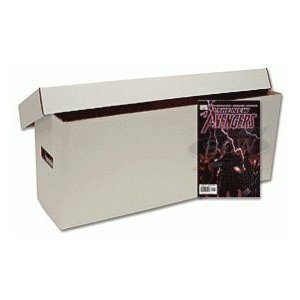
Boxes — Collectors prefer archival-quality, acid-free cardboard boxes in one of two sizes. The first, called Long Boxes, are 27.25″ long by 7.5″ wide by 10.8″ high, and hold approximately 300 comic books. Short Boxes are 15.75″ long by 7.5″ wide by 10.75″ high, and hold about 100 comic books.
Mylar Sleeves — These bags are considered the container of choice for individual comics. If you’re just trying to maintain a tidy collection, with no anticipation of keeping comics for investments, the sleeves aren’t essential. However, because they do keep dust, dirt and moisture away from the comics, mylar sleeves are superior to other alternatives. They come in two sizes: the smaller 6 7/8″ by 10.5″ fit standard-sized comic books, while larger books, like graphic novels and annuals, should be contained in 8″ by 10.5″ sleeves.
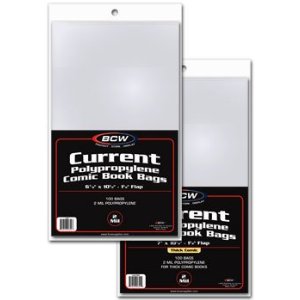
Backboards — Comic book aficionados use boards between vertically-stored books to prevent damage to the corners, edges and spines. For archival purposes, the boards should be acid-free; most are manufactured this way but degrade over time.
For shorter-term storage purposes (i.e., less than five years), collectors can buy boards with 24-point solid bleached sulfphate coating on one white side, against which the book rests. For longer-term storage, collectors prefer virgin, alkali-buffered backboards. Put the book on top of the board, and slide the book/board combo into the mylar sleeve.
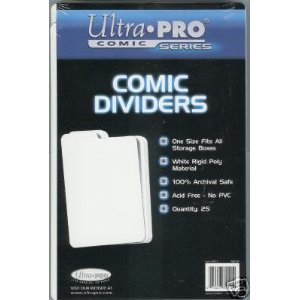
Divider boards are used to divide sets of titles. The name of each title or series should be written (or affixed with tapes printed by label makers) on the index tabs of the dividers.
Storage conditions are crucial. Humidity, extreme heat and bright sunlight are like kryptonite to comic books. Create a bat cave for your comics — keep them dry (in 50-60% relative humidity), cool (preferably at 70 F or below) and away from direct sunlight (and preferably, in a dark storage space). Avoid storing collections in basements or near pipe-bearing walls to lessen the risk of water damage.
Be sure not to pack comics too tightly together. Doing so won’t merely squish the books, potentially damaging the pages, spines, and corners. Tightly packed comic books, like overstuffed filing cabinet drawers, will make you reluctant to put away newer acquisitions, leaving them open to the elements, more likely to become damaged and disorganized.
3) Supervising your collection
If you collected fine china figurines, you’d make time to dust your collection and inspect it for damage. You need to check your comics, too, to make sure they show no signs of mold, mildew, fading, bleeding or color transfer.
4) Organizing your comics
There are two general options:
Organize meticulously, such as alphabetically by sub-collection (e.g., each Marvel superhero) and then chronologically by issue date or issue number.
OR
Organize loosely, perhaps by date of acquisition or by no feature at all, but carefully index exactly what comics are in which boxes, at which positions.
Surprised by the second option? Zam! Pow! I’m a bit shocked to suggest it, but as I researched this topic, I found that comics have much in common with the current discussion among professional organizers regarding organizing email and electronic files. While many of us still believe in creating specific folders and sub-folders and keeping similar items together, other organizers follow the notion that search, rather than system, should be the focus.
Organizing by individual collection intuitively makes more sense, because all items of a particular type (like Spiderman issues from 2000-2010) are immediately accessible. However, if you have a large collection, this involves filing away each item in the appropriate box. It also involves creating a box numbering system which can get complex if you overflow box 6 with S (Silver Surfer, Spiderman, Superman, etc.) but box 7 already has T-starting comics. Such a numerical system would yield Library of Congress or Dewey Decimal complexity fairly quickly.
Conversely, though I’m loathe to suggest it, simply storing newly acquired books and logging them in an indexing system (so that their exact placement requires only a quick keyword search for retrieval), is probably the wave of the future.
CATALOGING AND INDEXING
A basic spreadsheet can be used to keep track of your collection. It may suffice to merely track the title, issue number, and box number or location. However, if you’re going to make the effort to design a database, create columns for a variety of data points or key tags, including:
Publisher
Series
Title/Subtitle
Main character
Second characters
Publication date
Issue number
Price paid
Estimated value for insurance purposes
Location (Physical location in house/office, box number and position)
Condition
Comments (regarding condition, acquisition history, etc.)
Once you’ve created your database spreadsheet, you’ll be able to use the Filter and Sort functions to search by specific parameters. It also makes sense to create a header row and use “freeze headers” so that when you scroll up and down (or to the left and right), the informational headers will remain in place, limiting confusion when you’re entering information in cell DD837.
Keep backups on flash drives, external drives and/or in cloud solutions (like Dropbox). If your collection has significant value, keep a digital or paper copy of the updated information in your safe deposit box or fireproof safe for insurance purposes. To navigate your collection quickly, keep a printed index near your collection boxes.
If you’re serious about your comic book collection, investigate the various digital database options available, whether via software installed on your computer or an online service. Visit online forum discussions and chat with your favorite comic book store proprietor to determine which cataloging system fits your organizational (and financial) needs. Some popular options include:

Stash My Comics is considered a leading free comic book cataloging website, with a database of hundreds of thousands of comics already listed. Once you create an account, import your “stash” (information regarding the elements of your collection) and search the extensive database in order to add items and view publisher-provided and other details, including estimated values of certain issues. Create folders and sub-folders to organize your comics for your needs.
Stash My Comics lets you set and revise the tags and categories under which any title is listed, create an automated “pull list” to stay aware of newly-released material, create and share wish lists, and search by a variety of features, including publisher, characters, creators and more.
Stash My Comics is supported by advertising and user donations.

ComicBase is reputed to have the world’s largest comic book database and integrates information on 450,000+ titles. Owners can use the barcode jump feature to directly access a title’s information using the EAN/UPC number printed on the cover. For power-owners who want to purchase, sell or evaluate collection data when away from home, ComicBase can track a collection’s purchase cost and generate various inventory reports.
ComicBase has four editions, and upgrading between systems is simple. The download-only Free version handles collections of up to 500 titles and includes 250 cover images. CoverBase Express is available via download or CD for $49.95 and can handle any size collection and provides 5000 cover images, as well as one year of free downloadable price and issue updates.
ComicBase Pro, for power users, is a $129 database package, available via DVD-ROM. It includes 20,000 full-color images, expanded storyline information, creator credits, price history graphs and customizable fields. The Pro edition also includes support for wireless devices. The ComicBase Archived Edition comes on 3 DVD-ROMs, includes 240,000 high definition full-color images, exclusive creator interviews, and downloadable covers. The Archived Edition is $299.

Collectorz Comic Book Database Software works for Mac and Windows. Enter titles via your keyboard or use a hand-held scanner (or even your cell phone) to read the cover barcodes, and the system will automatically download a variety of information from the database regarding a comic book’s features.
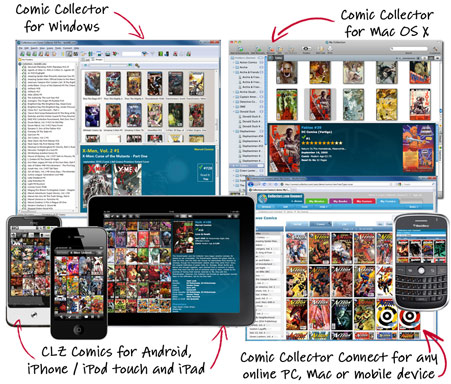
Collectorz allows you to add comics, manage and edit your database, and create customizable views of your collection by your preferred organizing patterns. For example, you can view by list, images, or cover flow (just like in iTunes). Other features allow you to export and share your comics lists, and more.
The downloadable version of Collectorz Comic Book Database Software comes in a Standard Edition for $29.95 or a Pro Edition for $49.95.
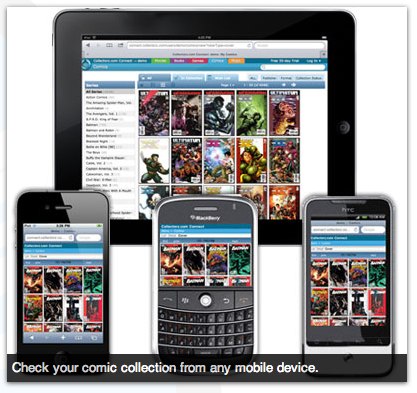
If you prefer a non-download solution granting access to your collection information from anywhere, the Collectorz Comic Collector Connect is an online-only solution.
Sign up for a free trial by providing your email address or logging in through Facebook. After the trial, Comic Collector Connect is $19.95 per year.
INSURANCE, APPRAISALS and GRADING
Comic book collections aren’t generally covered under standard homeowners’ or renters’ insurance policies. Speak to your insurance agent regarding a separate rider to cover all possible eventualities, including theft or damage due to fire, burst pipes or other unanticipated events.
For valuable collections, it’s worth having grading, completed by nationally respected experts, such as CGC Comics or Professional Grading eXperts. Such a service will include an appraisal by a panel of comics experts, and encapsulation, or official sealing in an archival acrylic “well” using alkali buffers. Additionally, if you need to “breach containment” to show a prospective buyer an item in your collection, such a service will re-seal the comics and provide certification of the ongoing value.
GOING DIGITAL
With greater use of Kindles, Nooks and iPads, digital comic books and graphic novels may eventually usurp the paper versions. While it exceeds the limits (in content and character count) of this post, I encourage you to read Whitson Gordon’s excellent Lifehacker post, A Comic Book Lover’s Guide To Going Digital.
Paper Doll Sees the Writing On the Wall: Part Two — Chalking It Up
Pop Quiz!
Do you know the recipe for paper disaster?
It’s a house or office full of sticky notes, torn pages from spiral notebooks and scribbles on the backs of napkins and envelopes, with no rhyme or reason, let alone system, for pulling it all together. Sometimes, we need folders and tickler files and clipboards. Other times, digitally scanning the information is the solution. But these options work best when you need the information at your fingertips, palm-sized, at arm’s length and eyeball height.
But what do you do when you need your ideas and information super-sized?
Last week, we talked about the inventive ways in which whiteboard paint can be used to expand the creative canvasses on which we track messages, mind-map ideas, list To Do items and generally get thoughts out of our heads and onto firmer ground (or firmer walls, actually). A stellar advantage of whiteboards and whiteboard paint is that information that is transitory in nature can be made memorable, accessible and useful…and then can be deleted without wasting paper or even having to bother with recycling.
Paper is superior in many circumstances, but for sharing vital messages or story-boarding a plan for all to see, taking over some wall space can be ideal. However, the corporate-birthed whiteboards are not the only option. We can also go back to basics — to kindergarten, even — to delight in the utility of chalkboards.

CHALKBOARD PAINT
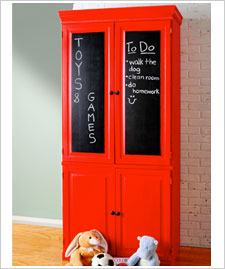
We tend to think of those old, squeaky chalkboards as the province of academia. But chalkboards have come a long way (since we were babies), Baby. Turning your nearest garage, mudroom, or hallway wall into a message center or creative space or giant notepad is as simple as picking up some acrylic chalkboard paint from your nearest Lowe’s or Home Depot, or ordering online.

We tend to think of chalkboards in terms of the standard Grammar School Green or Senior High Slate Grey. Benjamin Moore eschews a vibrant wall, and like the original Model T’s, its Studio Finishes chalkboard paint comes in quarts of any color you want — as long as it’s black.
Quarts of Krylon brush-on paint also come only in black, take 60-minutes to dry to the touch, and 24 hours before they’re ready to use. Krylon 12-ounce cans of spray-on chalkboard paint create durable slate-like finishes that are dry to the touch 15 minutes after application, and fully dry after three hours. It’s safe for use on wood, metal, glass, plaster, ceramic, paper and paper mch. But green and black are your only options.
With standard Rust-Oleum chalkboard paint, which comes in quarts for use with rollers or brushes (and needs three days to dry), and spray paint for direct application (taking just 24 hours to dry), green and black chalkboard surfaces are just the beginning.
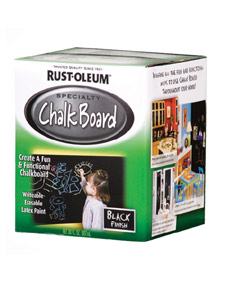
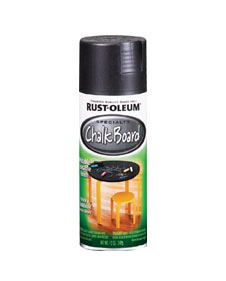
Rust-Oleum makes a Chalkboard Tint Base in stirring (no pun intended) colors like Raspberry, Fresco Red, Garnet, Periwinkle, Grape Fizz, Deep Teal, Banner Blue and six others.

Just add the tint to the basic chalkboard paint to jazz up your workspace or make an area of your home a little more colorful. With or without tint, the paint can be applied to metal, wood, masonry, drywall, plaster, glass, concrete, unglazed ceramics, hardboard and just about any fixed surface on which you might like to write or draw.
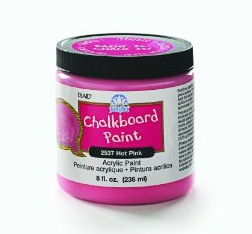
Modern chalkboard paint provides a panorama of other colorful options. For smaller spaces, like a drawing board just the right size for your pre-schooler, or to create a chalkboard just big enough for desk-side notes-to-self, Plaid Enterprise’s Folk Art line has ten color options in eight-ounce jars – somber shades like Camouflage, Green and Slate Gray, along with peppier Purple, Red and Hot Pink.
Hudson Paint has thirty remarkably bright and vivid chalkboard paint colors,
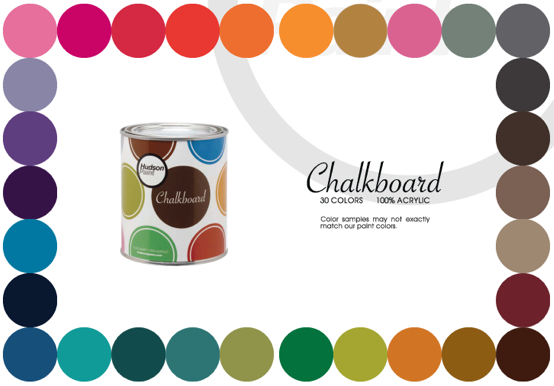
from Paper Doll‘s favorite (Genius Pink Genius) to a classy (High Society) taupe. These paints come in eight-ounce, quart and gallon containers.
Once you’ve picked your paint, pencil-sketch your measurements and then apply painter’s tape to delineate the borders. Start by painting a small portion of your wall to get a sense of how it works for you. Once it’s dry, keep a bright supply of art chalk in a plastic bucket so that the whole family can leave reminders and alerts: “Tomorrow is trash day!” or “Watch out for broken glass in the kitchen!”. You can even “play restaurant” and put up tonight’s dinner menu. In the office, create mind maps to plan your next big project or track progress on particular goals.
DECALS
Of course, some of you are no more likely to pick up a paintbrush than Paper Doll is. If you’re not a Do-It-Yourselfer, instead of painting a chalkboard, consider peel-and-stick chalkboard decals for designing areas sized to fit your life and work spaces.
Wallies makes 9″ x 12″ vinyl-backed, peel-and-stick, removable and re-positionable chalkboard sheets that are perfect for individual drawings and memos, or for grouping to create erasable calendars. They come in standard Slate Gray,
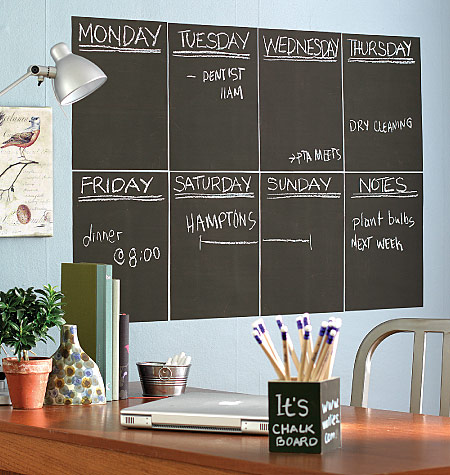
Blueprint Blue 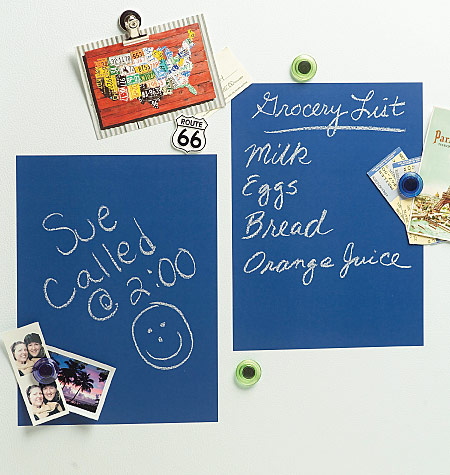 and Grape
 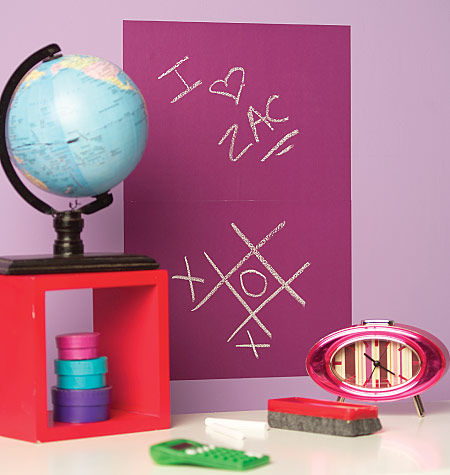 , at $16.99 for four sheets or $9.99 for two.
If you prefer a larger canvas for your shining ideas, Wallies carries a 25″ x 28″ Big Chalkboard for $24.99.

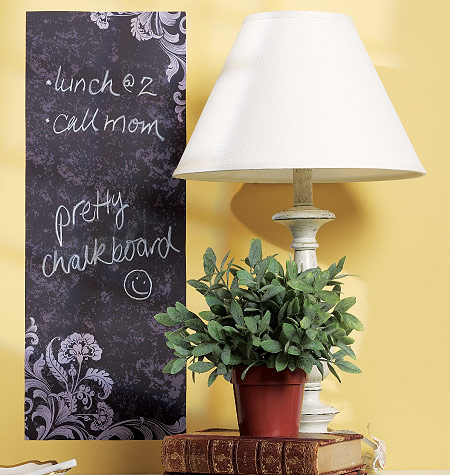
And for a little cozier atmosphere, Wallies also carries decorator styles of decals, like this $9.99 Frilly Chalkboard.
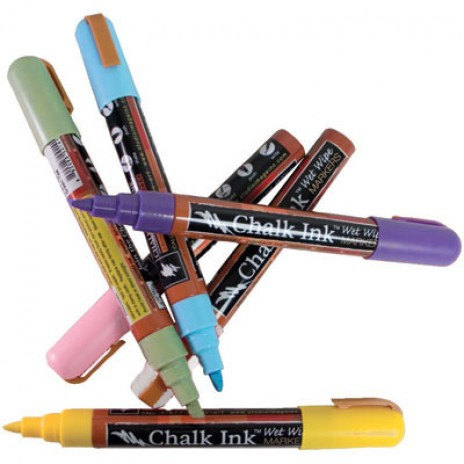
Simple Shapes is an other vinyl-backed chalkboard decal option, which, instead of chalk, uses innovative dust-free, smear-proof, wet-wipe, 1mm or 6mm Chalk Ink™ chalkboard ink pens.
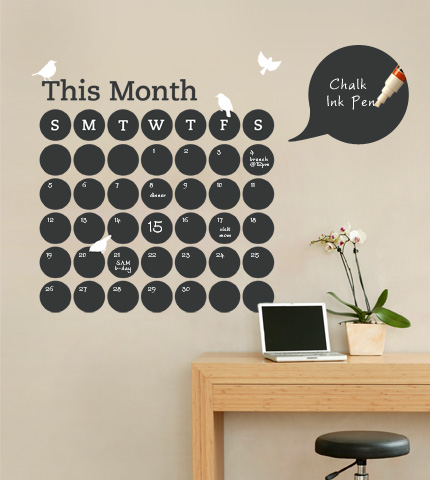
For elegant chalkboard calendars, Simple Shapes has a 43″ x 27″ classic gridded set-up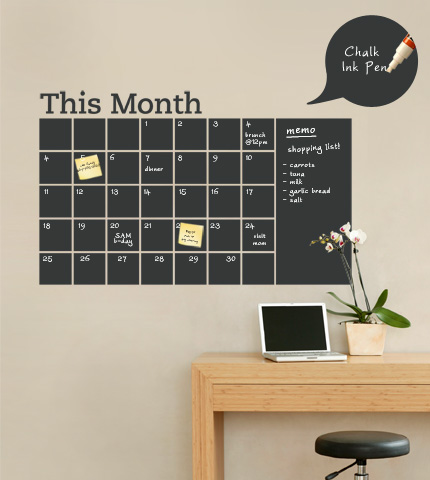 for $64, also available without the vertical memo section, for $35. The calendar portion, which appears to be 30+ separate decals, is actually applied as one piece. For those who prefer to round out their days (pun entirely intended) with a big, visible calendar, Simple Shapes has a similar 32′” x 32″ option for $68.
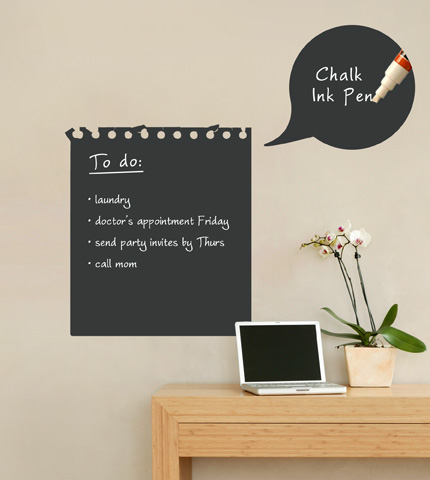
For a fun wall-sized alternative to a ripped-from-the-notepad piece of paper, there’s a 20″ x 23″ chalkboard wall memo decal.
A WEDDING SEATING CHART MADE IN HEAVEN
One hopes that a marriage will last longer than most chalkboard doodles. Still, Paper Doll wishes to honor the Best In Show strategy for using chalkboarding to organize information. Wedding Coordinator La’Di Events covered a simple piece of birch plywood with chalkboard paint and, using colorful Chalk Ink™ pens, created a fun seating chart for a client’s wedding.

@2010 La’Di Events
PERMANENCE
I’m sure some of you might be worried about what would happen if you organized your thoughts on chalkboards, as discussed today, or the whiteboards we looked at last week. You know how easy it is to pile up papers around you to assuage your fear of losing proof of your epic genius. (It’s why you probably never delete anything from your computer, either.) But just because chalkboards and whiteboards are erasable doesn’t mean all of the information is need be permanently erased.
Recall Paper Doll‘s advice about saving sentimental clutter. I shared the utility of that childhood taunt — Take a picture, it’ll last longer! There’s no reason why you can’t snap a digital shot of your important storyboards, work plans or calendars on a daily or weekly basis. If you’re afraid an over-ambitious cleaning crew (or “helpful” child) will wipe your brilliance off the wall — and off the map — just snap!
Keep the greatness eternally — just skip the paper clutter. End of lesson.
Paper Doll Sees the Writing On the Wall: Part One — Dazzling With Dry-Erase
It’s hard to believe that it’s been more than a year since I wrote Morning, Noon and Night: Alternatives To Paper. I’m delighted to find that it’s been one of the most popular posts for people to revisit. So, for the next few posts, we’re going to dig deeper into the paper alternatives that can help us lead more organized lives.
There are times when only paper will do, and there are certainly times when digital alternatives reduce clutter, streamline efforts and provide excellent solutions. And then there are the times (like the drizzly days we discussed last week) when neither is quite right. In particular, when you need to see the whole story writ large, the writing on the wall, as it were, you really need a big idea to see the big picture.
“PEEL. STICK. DONE.”

At-A-Glance WallMates™ (from MeadWestvaco) brings the advantages of dry-erase boards to the world of planning. And, as we know, planning is an essential ingredient in productivity for organizing your time and tasks.
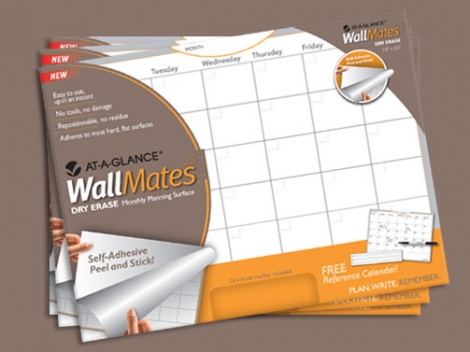
WallMates™ are self-adhesive, re-positionable dry-erase writing surfaces. They’re made of thick .5 mil (0.127 mm) vinyl and backed with removable, medium-tack, pressure-sensitive adhesive. WallMates™ are like the 3M Command-brand hooks we professional organizers love so much. They’re easy to install, require no special tools, and hold firmly, but they can be easily removed and placed elsewhere, with no damage to the clean, hard, dry surfaces to which they are affixed, and no residue is left behind. Because the adhesive portion is thick, it’s less likely to curl or wrinkle.
WallMates™ come in four styles — three planners and one blank writing page:
- Weekly — 24″ x 18″ vertical layout with a weekly (Monday-Sunday) undated format
- Monthly — the undated monthly (Sunday-Saturday) block calendar comes in three horizontally-arrayed sizes: 12″ x 18″, 18″ x 24″ and 24″ x 36″
- Yearly — 18″ x 24″ vertical layout with a 12-month, dated yearly calendar for long-range planning
- Blank Writing Surface — available in three sizes: 12″ x 18″, 18″ x 24″ and 24″ x 36″, positionable horizontally or vertically, as desired.
The company estimates that each WallMate™ can be used approximately 10 times. Each WallMate™ comes with a 3-year self-adhesive reference calendar and a dry-erase marker.
WallMates™ are modular, and can be used paired or in groups to keep track of progress, important notes and dates, and the blank writing pages can be arrayed vertically or horizontally to create useful planning spaces. For example, each monthly calendar page could be flanked by vertically-arrayed medium-sized blank writing pages, or the smaller monthly and blank surfaces, positioned horizontally, next to a vertical weekly page, could provide a tight grouping of big-picture planning options:

WallMates™ can be used on painted drywall, stainless steel, wood, glass and painted metal. Understandably, it’s less suitable for interior brick walls or stucco, as the bumps and voids in the surface area mean uneven surfaces, or fabric-covered walls because lint becomes fused to the adhesive material.
WallMates™ would be great for offices and conference rooms, makeshift classrooms, dorm rooms and even kitchens or hallways, and can be used with any brand or type of dry-erase marker. They can be cut to fit unique spaces, in case your office is that weird cubby under the stairs with an angled ceiling.
WallMates™ can be purchased from Amazon or wherever you buy office supplies, and elements retail from $9-$25.
PAINT THE TOWN
Idea Paint says,
Whether it’s a whiteboard that just doesn’t offer enough room, a classroom budget exceeded by the cost of available resources, or a child’s drawing that needs to expand beyond the boundaries of an 8″ x 11″ piece of construction paper, sometimes, you need to create a bigger canvas.
IdeaPaint can turn any surface into a seamless dry-erase surface, whether for brainstorming in an office:

or trying to set a creative mood:

In work spaces, you begin with a primer coat of BASE, or other recommended primer, and then select one of three IdeaPaint products, each available in kits which contain enough paint to cover 50 square feet of surface. Each kit also includes a roller, stir stick, can opener and Wet Paint sign, and retails for $175.
CREATE is their newest line of easy-to-apply, odorless dry-erase paint which can be applied with a roller or spray applicator. There seems to be a little confusion regarding CREATE’s available colors. The web site says CREATE comes in white, Glance Gray, Show Sand, Natural White, Big Gray — no relation to Big Grey (Meredith) and Little Grey (Lexie) on Grey’s Anatomy, Arena Blue, Fresh Green and Mod Beige. (But let’s be honest: not only has there never been a truly mod beige, mod hasn’t even been mod in a very long time.) However, a recent blog post lists a few other limited-availability colors.
PRO is a super-durable, solvent-based dry-erase coating. It comes with a lifetime warranty and is available in these five, muted, office-appropriate colors.

CRE-8 (yes, one imagines it’s very confusing to explain whether you want CREATE or CRE-8 when ordering by phone) is a high performance water-based dry-erase paint that comes with a 10-year warranty. (CRE-8 came first; CREATE is apparently IdeaPaint 2.0.) It comes in the five calming colors above, as well as Gray, Orange, Light Green and IdeaPaint-Brand Blue.
At home, the new water-based product of choice is the aptly-named HOME paint, available in kits designed for 6, 20 or 40 sq. ft. of coverage. HOME is designed to help create smaller writing/drawing spaces — perfect for kids’ tabletops, playhouse interiors, playroom walls, fridges or doors. HOME is currently available only in white and kits retail for $30, $75 and $140, respectively.

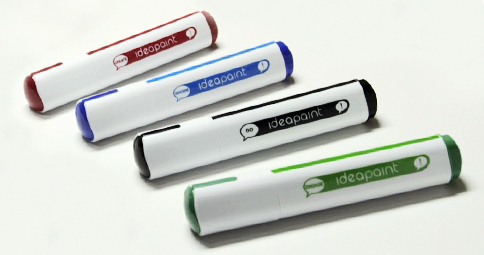
Draw or write on IdeaPaint with standard dry-erase markers, or pick up some cheerily bright, low-odor, ergonomic WRITE markers.
IdeaPaint has environmental advantages, too. Instead of sending reams of paper to the landfills, you can create ideas and designs on one renewable surface. IdeaPaint can even be applied on old, not-so-gently-used white boards to refresh their surfaces.
IdeaPaint also has a smaller carbon footprint than traditional dry-erase boards, whose energy-hogging manufacturing includes baking and curing, whereas IdeaPaint is simply stirred. As it’s lighter than an actual whiteboard, less fuel is needed to ship IdeaPaint to your destination.
IdeaPaint is formaldehyde-free, conforms to all U.S. EPA regulations (including California) and is certified low-emission paint that is both LEED compliant and GREENGUARD Children & School certified. For classroom and home use, it can replace allergy- and asthma-inducting chalk dust particulates.
GIVE ‘EM A WINK
For some people, aesthetics are as important as function — if it’s not pretty, they won’t see it, remember it or do it. Unfortunately, we don’t all have the artistic ingenuity to make a bold statement on our own. Paper Doll is known for Pictionary skills so poor that my freehand cows, cars and maps of the United States are largely indistinguishable. For people like me, there’s a better way.

Unlike IdeaPaint, which paints a color onto a surface to turn it into a dry-erase board, Wink (Walls Love Ink) creates a clear coating over whatever painted or paintable surface you already have. So if you’ve got your own perfectly-blended proprietary shade of pink (and seriously, who doesn’t?) and want to mind-map your big ideas, you can make it all write-on/wipe-off with the application of one clear coat of Wink.
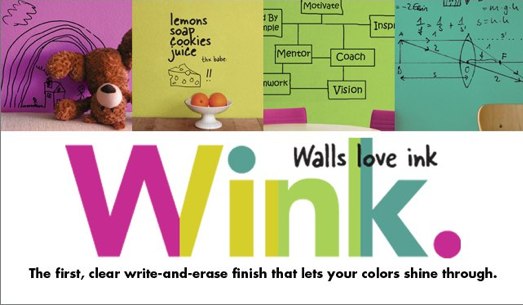
Wink is a low-VOC (volatile organic compound), water-based, environmentally-friendly, odorless product. One $175 kit covers up to 90 square feet and appears pretty easy to apply. However, Wink’s web site says that it should be mixed and “installed” (I think you and I would say applied) only by professional installers. Make of that what you will.
Wink is currently available only in the United States.
MAKE IT POP

WallPops makes dry-erase calendars and removable wall decals for organizing your time and space with color and flair. Their mix-and-match peel-and-stick design elements of dots, stripes and squiggles can be used purely for aesthetic purposes, for offices, nurseries, playrooms and elsewhere:

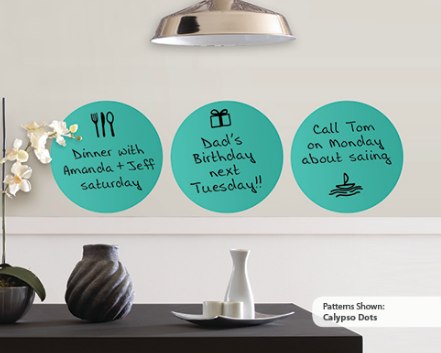
However, the options for organized messaging and planning really caught Paper Doll‘s design eye. For simple reminders, 13″ re-positionable/removable, write-on/dry-erase dots ($14.99 for a set of three)
and 13″ x 17 3/4″ dry-erase bordered-boards ($14.99/board)

with whimsical names and zippy colors will snazz things up. The dry-erase calendars ($11.99-14.99), also 13″ x 17 3/4″, can be used on their own,

in multiple-month sets ($20.99),
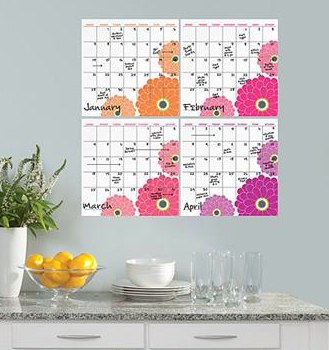
and/or in tandem with the similarly-themed dots and borders, to create colorful, unified themes. And for those who prefer free-style to traditional calendaring, WallPops makes write-on/wipe-off Apps Weekly Dots

and day-of-the-week Holiday Dots (both 14.99 for sets of eight 4″ dots on two 13″ x 13″ adhesive sheets).

All WallPop dry-erase items come with a dry-erase marker.
Will all of these glorious options, how could anyone ever dare to say that organizing is about as much fun as watching paint dry?

Follow Me