Paper Doll
Who Knows Your Secrets? Part 3: Get A CLUE About Insurance Reports
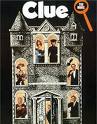
Oscar Wilde may not have known it, but his statement is applicable to how much of a mystery our own financial “secrets” can be, even to ourselves. Sure, you may be skilled at sussing out that Colonel Mustard did it in the library with the candlestick. But what if Mrs. Peacock, the agent from your insurance company, Mustard Mutual, canceled your homeowner’s policy with a pen stroke? Would you know why, or what it meant?
As we’ve been discussing over the past few weeks, just by going through our daily lives, someone gets to collect a paper trail of information about our activities. Consumers tend to know about credit reports and FICO scores, but are less likely to know about the various Big Brother agencies (TeleCheck, Checks Systems and EWS) keeping tabs on banking and checking habits.
We tend to worrying about dumpster-diving identity thieves, but it turns out that there are many others out there legitimately (if inaccurately) gathering and disseminating information about us. Indeed, the more Paper Doll digs, the more it seems that when it comes to consumer awareness of insurance paper trails, nobody has a clue!

CLUE is the Comprehensive Loss Underwriting Exchange, operated by ChoicePoint, a division of ChoiceTrust. CLUE maintains a huge claims history database of basic policy information, including name, date of birth, policy number(s), plus various claim information, including the date of loss/damage, type of loss incurred, the amounts paid to the policy holder (or, occasionally, to another party), and a description of the property covered. Claims information generally goes back anywhere from three to seven years.
No mystery, right? All this data enables insurance companies to access past claims information when they’re risk-rating, underwriting or renewing an insurance policy. Unfortunately, as with most of the reports developed by third parties, information about us is not always accurate or complete.
TAKING THE FALL FOR SOMEBODY ELSE
Take, for example, Jim Deck of Nashville, TN. He was notified of a huge increase in his renter’s insurance due to adverse information in his CLUE report, which included a reference to a car accident where an insurance company paid out a significant amount on a policy. The only problem? The car in the reported accident wasn’t Mr. Deck’s, but his mother’s, and he hadn’t resided at the same address as his mom in 13 years. The record of an accident claim by someone at the same address can end up on the wrong person’s report.
Not worried? You might want to reconsider that. Even if your parents, your post-college roommates, or your current spouse all have blemish-free insurance records, if people who lived in your apartment before you rented, or bought your home after you moved, total strangers (because they reside or resided at the same address as listed on your CLUE report–even if you never lived there at the same time) could prevent you from getting insurance or cost you an arm, leg or other beloved body parts in increased interest rates.
THE CLAIM THAT NEVER WAS!
The CLUE report may also include negative information resulting from claims you decided not to make! Let’s say you call your insurance company to make an inquiry as to whether something would be covered–perhaps water or smoke damage–but then never make a claim. Maybe the cost of repairs would be less than the cost of your deductible; maybe you were just worried about what that ice storm brewing outside might do to your roof.
If your little call is reported by your insurance company to the Comprehensive Loss Underwriting Exchange, unless you reside in a state that forbids such practice, your policy could be canceled, failed to be renewed or have rates increase…all because of an inquiry that never even led to a claim!
It’s not just the little guy who suffers; distribution of inaccurate information is an equal opportunity experience. According to the Privacy Rights Clearinghouse, at an August 4, 2003 press conference on unfair insurance practices, the California Insurance Commissioner reported that the Chief of the Consumer Services Division of California’s Department of Insurance was turned down when he tried to insure his new home. A seriously flawed CLUE report showed five claims: two were for properties the seller owned in a different city, two were coverage inquiries that never resulted in actual claims, and the final claim was resolved and shouldn’t have been used to determine his eligibility in the first place.
(Paper Doll imagines, though, that the Chief of the Consumer Services Division of the California Department of Insurance probably got expedited assistance. I don’t envision the Chief listening to The Girl from Ipanema on ChoicePoint’s on-hold Muzak for hours on end.)
YOUR DREAM HOME BECOMES A NIGHTMARE
If you’re considering buying a home, you’d want to know what kinds of homeowner insurance claims have been made against it. First, you’d want to know if there are any recurring problems (flooding, roof damage from neighboring trees, etc.) that make the home less attractive or will cost you higher insurance premiums.
Beyond that, even if you’ve never, personally, made an insurance claim, if a property comes with its own history of repeated claims, such as for water damage, the property itself could be blacklisted, preventing you (as new owner) from getting insurance coverage at any cost!
The U.S. Fair Credit Reporting Act only allows CLUE reports to be accessed by the owner, insurer or mortgage institution for the property. However, before you buy the house, you can request that the current owners of the property order and provide you with the CLUE report for the house. (You might be doing them a favor; if they’re like most consumers, they probably don’t even have a clue…about their own CLUE report.)
CLUE’S PARTNER IN CRIME
Insurance companies use two main tools to determine how likely you are to file a claim on your policy:
1) Your CLUE report; and
2) Your insurance score is based mostly on your credit score, along with other public records information. Yes, it may seem that the insurance companies are assuming inability to pay bills on time makes one more likely to have hail damage, but it’s not always so simplistic.
Because credit scores include records of personal bankruptcies, tax liens, garnishments (for taxes, child support payments, etc.), foreclosures, and civil judgments, the insurance companies feel they can get a pretty good feel for a potential policy-holder’s ability to honor the payment contract and deal honestly with regard to making claims.
Different insurance companies use different models to develop insurance scores, so it’s a good idea to ask your agent (or prospective agent) about the model his or her company uses. Because the ways in which insurance companies use credit information can vary widely, a good resource for understanding all the issues is Consumer Brochure — Alaska: Understanding How Insurers Use Credit Information.
Paper Doll leaves it to you readers to decide how predictive you think even accurate credit score information is in the development of a score to determine insurance risk. Nonetheless, various states have passed laws curtailing the use of credit report data in insurance scoring, and the Federal Trade Commission has ordered nine major insurance companies to submit information regarding their use of credit reports in determining insurance scores.
With these two factors determining how (and at what rates) you can get homeowner’s and auto insurance coverage, it’s time to get a clue…about your CLUE! In fact, professional organizer and Daily Money Manager Nanette Duffey says, “Knowing and understanding the contents of your CLUE report provides useful and no-cost information to consumers. Reviewing your report, especially after experiencing a significant insurance claim, is empowering. I consider it one more step towards becoming a financially savvy and confidant consumer.”

GET YOUR CLUE REPORT
Because ChoicePoint, the major provider of property loss reports, including those generated by CLUE, is considered a consumer reporting agency under the FACT amendment to the Federal Credit Reporting Act, you have some consumer protection. This means you can order a free copy of your CLUE report, annually. To obtain your report:
- Go to ChoicePoint’s ChoiceTrust.com page.
- Click on “Review Your FACT Act Disclosure Reports” and register as a new member.
- Once you’ve registered, click on the “Personal Insurance Reports” link at the top of the resulting page.
- Select “Learn More” on either the CLUE Personal Property report or the CLUE Auto Report. (Don’t click on the lower level, where they combine the free CLUE report with an insurance report, as that option is not free).
- Select “Both Reports” under Order Options and then provide multiple screens of personal information–including answers to an “Identity Information Quiz” to prove that you actually are who you say you are. (You didn’t think they were going to make this easy, did you?)
- Print your order confirmation…but DON’T CLOSE THE WINDOW. This report is designed to be viewed online, and you’ll have access for only 30 days, so click the “Continue” button to view (and print) your reports.
You may also call 866-312-8076 or mail your request to:
C.L.U.E. Inc. Consumer Disclosure Center
Attn: FACT Act Request
P.O. Box 105295
Atlanta, GA 30348
ChoicePoint will then send you a form you can fill out and return by mail.
The Federal Credit Reporting Act also ensures that, over and above this free report, if you are ever denied homeowner’s or auto insurance, your policy is canceled, your coverage is limited, or your premiums significantly increase, you are entitled to an additional free copy of your report.
If any of the above occur, your insurance company must provide you with an adverse action notice. You’ll have 60 days from receiving the notice to request your free CLUE report. Upon receiving it, you can dispute any inaccurate or incomplete information and ChoicePoint must investigate and correct any errors; if you’re dissatisfied with the results of the investigation, you have the right to file a statement to that end, which will appear in all future reports.

A-PLUS
Finally, while ChoicePoint’s CLUE report is the major suspect in the mystery of your insurance paper trail, Insurance Services Office (ISO) does offer its own, lesser-known competing report, based on information reported by over 1,400 insurers to the Automobile-Property Loss Underwriting Service…also known as the A-PLUS. These reports are governed by the same Federal Credit Reporting Act FACT dispute policies as described above in the CLUE section, so it’s definitely worth your time to obtain your report annually and if you ever receive an adverse action notice.
A-PLUS reports can’t be downloaded or viewed online; rather, they are mailed within 15 days of a request. To order your own A-PLUS report, call 800-627-3487. For more information, you can visit ISO’s A-PLUS page.
Readers, please solve the mystery of your own insurance paper trail: get a CLUE and earn an A-PLUS.
Who Knows Your Secrets? Part 2: Checking Up on Your Checking History
But wait, there’s more! (Lots more!)
You already know that the three credit reporting agencies (Equifax, Experian and Trans-Union) keep track of all the activity on your credit cards, mortgages, loans and medical accounts. But they aren’t the only ones checking out how and where you spend your money. For years, two companies, TeleCheck and Chex Systems, have been tracking negative consumer checking activity and reporting the information to banks, credit unions and other financial institutions. They also serve retail companies, verifying the validity of checking accounts and helping calculate risk associated with checks written to merchants.
According to a 2008 Identity Fraud Survey Report conducted by Javelin Strategy & Research, “new account” fraud cost the financial services industry $14.7 billion in 2007 and cost the victims an average of $1,066 per case. Thus, it’s understandable that banks seek help to screen applicants for new bank accounts for any kind of history of abuse or financial fraud. Because retail stores suffer from account fraud as well, they require services for verifying identification and dealing with risk management.
That’s where TeleCheck, Chex Systems, and one newcomer, EWS, come in.

Chex Systems operates as both a check verification system and a consumer credit reporting agency (and as such, is governed by the Fair Credit Reporting Act, as we discussed last week), collecting and reporting data regarding consumer banking habits, bounced checks, overdrafts, deposits of fraudulent checks, and general suspicious account activity.
Approximately 80% of U.S. banks and credit unions subscribe to one or more of the Chex Systems reporting services to help them determine whether you will be allowed to open a checking or savings account. Just one negative item in your Chex Systems profile will likely close bank doors to you, and negative reports stay in your profile for up to five years.
Also, many consumer advocates have concerns about Chex Systems’ practices, claiming that unlike Equifax, Experian and Trans-Union, which collect and report both positive and negative elements of a person’s financial history, Chex Systems reports only negative data. Various websites and blogs, such as StopChex.com, have been developed to help consumers deal with issues related to Chex Systems and to identify banks that do not use Chex Systems’ services.

TeleCheck, a FirstData company, operates check verification and risk analytics services for retail stores, utilities and other organizations. For most people, their first awareness of TeleCheck might come if a cashier reports that a check transaction has been declined. The cashier will then give the customer a “courtesy card” with a contact number for TeleCheck, a seven-digit record number for the transaction, and a code to help TeleCheck determine the reason for the decline.
The frustrating thing for many consumers is that while TeleCheck does not provide the cashier (or even the retail establishment) with any information regarding a person’s bank balance, it still feels like a stinging rejection. The customer may have a history of bounced checks…or it could merely be the result of TeleCheck not having enough information about the customer on file!
TeleCheck’s computers have various “risk models” in place to analyze transactions, and if TeleCheck lacks the data to make any predictive risk assessment, any check processed via TeleCheck will be declined. (It’s like rejecting any and all prospective computer dating matches if no photo is supplied…only it’s done in public, while you’re in line, surrounded by friends, neighbors and cranky shoppers.)
If there’s nothing actually wrong with your checking history, TeleCheck claims they can “help you establish a positive file” by providing them with the record on the courtesy card, your driver’s license information, the bank routing and account numbers at the bottom of the check, and, if a bank (rather than a retail outlet) rejected the check, your Social Security number, as well. As of yet, there’s no request for blood type or preferred pizza toppings.
It’s bracing to think that a company you’ve probably never heard about can wield so much power. However, an advantage of TeleCheck seems to be that if there is some question regarding unpaid check debt, once the vendor confirms that the debt was paid (even if you did originally make a banking error), TeleCheck will remove the item from your record. (Otherwise, records of unpaid check debt stay on your TeleCheck profile for seven years.)
Early Warning Services, or EWS, the new kid on the block, was created as a jointly owned venture of Bank of America, JPMorgan Chase, BB&T Corporation, Wachovia, and Wells Fargo. Like Chex Systems and TeleCheck, EWS also collects data about consumer banking activity, primarily bounced checks and excessive overdrafts.
You might think that if you’ve never bounced a check, you’d be safe. It isn’t quite that simple.
The problem? As with credit histories, the information being collected about you may be incorrect, either because of the nefarious activity of someone who has stolen your identity or merely because someone along the financial food chain mistyped a digit and linked your good name with someone else’s checkered past.
What can happen if erroneous information (either due to identity theft or clerical error) gets included in your TeleCheck, Chex System or EWS profile? Retailers could refuse to accept a check you present for payment.

Imagine the embarrassment of finally getting to the front of a checkout line to buy a week’s worth of groceries or a whole slew of holiday gifts, presenting your check and identification, and having the cashier call over the manager to explain, in a voice loud enough for the people behind you to hear, that your check will not be accepted.
Or, imagine being dissatisfied with your current bank, or moving to a new city and needing to open up an account with a bank with local branches, only to find that your bank of choice is refusing to open a new account because of so-called negative activity in your profile.
In the past, someone with a spotty banking history could shop around for a small bank or credit union that did not subscribe to the Chex Systems or TeleCheck services. However, with the advent of EWS and the increased need for financial institutions to fight fraud, it’s highly unlikely that someone with a damaged record would be able to either beat the system or blissfully ignore trouble caused by an identity thief. Thus, as with checking your credit reports (and score) annually, it’s essential you know who knows your checking “secrets”.
To obtain free copies of your reports, go to:
Chex Systems and then click on “Order Consumer Report” and follow the prompts.
TeleCheck and then click on “TeleCheck Consumer Assistance”. Then click on “Request Your TeleCheck File Report”, select “Annual File Report” and provide the requested information.
Early Warning Services Call 800-325-7775. Currently, there’s no way to request a copy of your report online.
Of course, just ordering these reports and not doing anything about them is about as helpful as buying exercise DVDs and putting them on a shelf. Carefully review each entry and dispute any errors, both with the reporting agency and, if applicable, a merchant or creditor. The Fair Credit Reporting Act requires that reporting agencies take action within 30 days to investigate the errors you report, so mark your calendar, stay alert and be vigilant about correcting any inaccuracies.
To keep negative items from appearing in your Chex Systems, TeleCheck, or EWS profiles , you’ll want to take the following precautions:
1. Balance your checkbook. Yes, really. Financial responsibility begins with knowing how much money is in your checking account. Reading your monthly statement (or checking it periodically online) and reconciling with your own records makes it far more likely you will catch near-overdraft balances and incidences of identity theft.
2. Understand that there’s no such thing as “float“ anymore, especially since the 2003 passage of the federal Check 21 Act. Assume the money is gone from the account the moment you write the check, instead of hoping it will take a few days for a transaction to be finalized, and you’ll eliminate your risk of overdraft.
3. Know that deposits will not always clear immediately. If you deposit one check and write another check on the same day, don’t assume the deposit will be credited to your account before the check you wrote gets debited.
4. Know your bank or credit union’s policies regarding crediting and debiting accounts. Many banks have a policy of applying daily debits from largest to smallest. In such cases, you are far more likely to have multiple overdraft fees (which further decrease the balance in your account).
Let’s say you have $2500 in your account. In the span of two days, you deposit $1500, write checks for $1800 for your mortgage, $300 for your insurance payment, and $100 for utilities, then made four ATM withdrawals of $50, four debit card purchases of $25 and five of $5 each. If your bank tends to hold deposits even two days, your total amount debited would be $2525, or $25 more than your balance (as your deposit would not yet have been credited). However, if your bank processes daily checks and debits from highest to lowest, each of your $5 purchases would incur an insufficient funds fee of, for example, $39. Thus, instead of having a negative account balance of $25, you’d have -$220. Ouch!
5. Don’t close any checking account until you make sure all checks have cleared and that you’ve canceled all repeating auto-drafts, automatic transfers and/or debits, and that you’ve paid all applicable bank fees.
6. Notify your bank if replacement checks you’ve ordered fail to arrive, or if the box(es) appear to have been opened, even if no checks are missing. Identity thieves find sneaky uses for the information they purloin; you’ll want to change your bank account number right away.
Finally, if adverse information in your Chex Systems, TeleCheck, or EWS profiles is the result of your own past financial mistakes (other than fraud), there is an alternative that will help you erase your blacklisted status and open a checking account.

Checking Network USA, an FDIC partner, offers a series of classes and workshops on financial responsibility. If someone takes and passes the courses (whether online or in a classroom setting) and is granted certification, checking account access to Checking Network USA’s partner financial institutions is eased.
See you next week, for more in our ongoing series on who knows your secrets and who is following your personal paper trail.
Who Knows Your Secrets? Part 1: From Little Sister to Big Brother
Years ago, the best way to keep your personal information truly private was to hide the key to your Barbie diary or leather journal in a safe place to protect against the prying eyes of your precocious little sister.

Will The Real Paper Doll Please Stand Up?
A Boy Named Sue May Hate His Name (but that doesn’t mean you can steal it!)
The Big OUCH!!! (Medical Identity Theft–Part 1)
Doctor, It Hurts When Total Strangers Do This! (Medical Identity Theft, part 2)
Lost and Found: GONE in 6 seconds: Your Wallet!
What’s In Your Wallet? (Part 3): A Little Insurance Policy
We’ve also repeatedly touted the importance of checking your credit reports from the three credit reporting agencies, either directly:
Equifax 800-397-3742
Experian 800-525-6285
Trans-Union 800-680-7289
or via the truly-free AnnualCreditReport.com (and NOT via the pirate-hat-wearing, infectiously-cute-jingle-singing “Free”CreditReport.com” guys  ). And just recently, we reviewed the importance of purchasing and reviewing your FICO score and knowing how your score is determined so you can improve your numbers.
But all of this advice begs the question: while you’re busy trying to hide access to all of this information from the bad guys, and checking the accuracy of what the alleged (and I’m using the term loosely) good guys have to report about your financial activities–who ELSE has private information about you?
And I’m not just talking about your college roommate or your personal physician. There are two big issues at hand regarding who has found the key to your grown-up Barbie diary:
1) Who is allowed to get access to your credit report?
and
2) What other information is being collected about all of us, and by whom?
At the risk of going all George Orwell on my readers (and having all the Paper Doll posts deleted from the internet, as his books were removed from Kindles this summer), it’s hard to deny: Big Brother is watching.
With regard to the first question, it might surprise you to know who is allowed to get access to your credit report. While we may argue against whether it’s fair that an possibly-arbitrary algorithm determines our creditworthiness, we don’t often discuss (or even realize) all the ways our credit reports are used to evaluate us as we go about our daily lives–in ways that don’t even necessarily have to do with whether we are creditworthy to buy a home or vehicle.
Section 604 of the Fair Credit Reporting Act allows credit reports to be accessed for a variety of purposes. As summarized by the Electronic Privacy Information Center:
- Applications for credit, insurance, and rentals for personal, family or household purposes.
- Employment, which includes hiring, promotion, reassignment or retention. A CRA [consumer credit reporting agency] may not release a credit report for employment decisions without consent.
- Court orders, including grand jury subpoenas
- “Legitimate” business needs in transactions initiated by the consumer for personal, family, or household purposes
- Account reviews. Periodically, banks and other companies review credit files to determine whether they wish to retain the individual as a customer.
- Licensing (professional)
- Child support payment determinations
- Law enforcement access: Government agencies with authority to investigate terrorism and counterintelligence have secret access to credit reports
Given the ostensible purpose of credit reports, some of these make immediate sense. Applications for credit certainly require an evaluation of creditworthiness. As your diary-key-purloining little sister way say, “Duh!”. Account reviews, since they don’t adversely impact the credit score and because one can opt-out of such reviews, may seem logical, as they help institutions determine if they will tender us offers of (increased) credit. And one can understand how child support payment determinations might depend on the provision of complete and unbiased financial records.

However, it gives Paper Doll pause to think that potential employers may make judgments about one’s suitability to create an advertising campaign, run a forklift or ask “Do you want fries with that?” based upon the number, dollar amount and payment history of your credit card and medical bills. As a professional organizer, I certainly encourage responsible and timely payments of debts, but I’m dubious that late payments of bills are realistic predictors of on-the-job behavior in most professions and industries. (In the words of the Monk theme song, I could be wrong…but I don’t think so.)
It’s possible that for positions requiring a high governmental, financial or corporate security clearance, a thorough background check would be required to ensure that a job applicant might not be bribed into acquiescing to inducements to spy or leak information. (More on background checks, next week!) But credit reports, in the absence of other deep-background research, might be unlikely to serve as a crystal ball for determining someone’s ability to handle sensitive information.
According to Smart Money Magazine, at the start of this decade, up to 92% of the top 100 automobile insurance companies were using credit reports to determine whether to underwrite new policies and how much to charge the policy-holders whom they did sign. With regard to how credit reports yield a determination of not just credit-worthiness, but insurance risk, one imagines there should be a research study — indeed, multiple research studies — detailing some sort of correlation between how many fender-benders one has been in and how much one owes to American Express, but insurance experts seem to be keeping mum on how they know such a correlation exists. (This industry-wide belief is the basis of insurance credit scoring, which we’ll be discussing later in this series.)
It’s unclear what kind of professional licensing might be best served by giving licensing boards access to credit reports. In the absence of a criminal or civil lawsuit, or claims of some kind of improper behavior, would a licensing board really be able to determine professional suitability to be a pharmacist, attorney, or physician, based solely upon an individual’s credit payment history? Even a certified public accountant with a bad credit history doesn’t necessarily lack the requisite knowledge to complete your taxes just because he’s inept at getting his own bills paid. (What was that about the cobbler’s children going barefoot?)

With regard to all of the above bulleted categories except the last, the credit reporting agencies (i.e., credit bureaus) can and must report to you regarding who has requested to view your information. With regard to law enforcement access, however, it’s interesting to note that while the Attorney General must report (twice per year) to Congress regarding whose credit reports have been sought by the FBI, we as consumers are not allowed to know (nor are the credit bureaus allowed to tell us) if the FBI has requested and viewed our credit reports.
Indeed, under the USA Patriot Act, the FBI, CIA, the Department of Defense and other counter-intelligence agencies can issue a National Security Letter requesting access to your credit report, and the credit bureaus are not permitted to alert you to this fact.
Paper Doll is neither a consumer law expert nor enough of a scholar of macro- or microeconomics to have a public opinion on whether these legal non-credit uses for the information in our own credit reports are, or should be considered, necessary or appropriate. The Barbie diary example actually comes back into play. Obviously, annoying little siblings should never be able to peek at the content of our diaries (just as identity thieves should never be able to access private financial data). However, there’s certainly vigorous debate among parents as to whether there are legitimate reasons to breach the privacy of their teens in order to protect them (or, by extension, others) from danger.
I offer no opinion. However, I think it’s important that, as consumers, we know what paper trails we’ve (perhaps unwittingly) left out there in the world, and who might be following them.
Credit reports are not the only collections of personal information on display. In the coming posts in this series, we’ll look at the financial, medical and behavioral data about each of us being tracked, like:
- Who tells retailers if that check you’ve written is any good?
- Who maintains a database regarding your risk as a homeowner’s and auto insurance policy holder?
- Who keeps track of what kind of apartment renter you have been or may be?
- Who (besides your doctor and your insurance company) is keeping tabs on the procedures you’ve had done and the medicines you’ve been prescribed?
- Who knows that you return most of your birthday presents for cash or don’t bother to try outfits on, figuring you’ll just return what doesn’t fit?
- Who (besides Miss Meanyface, your third grade teacher) keeps track of your permanent record?
- Who knows if you were arrested for protesting the Vietnam War or South African apartheid?
Knowing who collects the information is only the first step in knowing which of our secrets are out there. We’ll also talk about how to access the information in your various profiles (i.e., how to see your own diary) to verify accuracy–to prevent identity theft, save money and safeguard your reputation.
See you next week. Until then…please don’t keep Paper Doll a secret.
Ruminations on Readers: Bibliophiles, Bibliomaniacs and You
A truly good book teaches me better than to read it. I must soon lay it down, and commence living on its hint. What I began by reading, I must finish by acting.
~ Henry David Thoreau
George Carlin famously asked “Have you ever noticed that anyone driving slower than you is an idiot, and anyone driving faster than you is a maniac?” Carlin’s own little theory of relativity has been on my mind this past week, not because of the disparate personalities on the road, but because of the divergent personalities of the book people.
There are all sorts of “book people” out there, and as a professional organizer and student of life, I’ve seen examples of many. I’m still awed by a decades-ago visit to Mark Twain’s house in Hartford, and particularly his floor-to-ceiling library. Not yet an organizer, I nonetheless found the idea of a room entirely dedicated to reading, with adequate shelving to (safely) hold a growing collection, sliding ladders, cozy lighting and comfortable seating to be an ideal. Every book had a home and could be accessed easily, and in both Twain’s time and my own, a staff was available to keep the books free from dust, grime, mold and any other dangers to literature, history and knowledge. One quick tour around the library made me feel that I knew the man, or at least knew the value he placed on reading, which is sometimes almost the same.
But I’ve also worked with clients so deeply tied to the idea of possessing certain books (as opposed to reading them) that nothing in my professional organizer’s arsenal could dissuade them. Some clients point vaguely to humidity-wilted, tilting towers of cobwebby, nibbled cardboard boxes, assuring me that all the books within them are essential and can never be purged. That they may not have been touched, let alone read or cared for, in decades, is a subject some are unwilling to entertain.
There have been numerous others who refused to “set free” books that were so water-stained and covered with mold that it was hard to make out the text, or who thought an adequate compromise involved taking a scissors to the margins of the books to cut away the “worst” of the mold, as if inhaling slightly fewer spores might be satisfactory. We are not talking about first editions; some of these books were acquired as bargain books and could easily have been repurchased for less than the cost of a cappuccino.

And recall the classic Twilight Zone episode Time Enough At Last, in which Burgess Meredith delivers his tortured portrayal of Henry Bemis, the last man on Earth, who finally has a lifetime to read and an almost endless supply of books…who accidentally breaks his glasses. No bibliophile can watch that and not feel anguish.
Book people feel fiercely about their books.

Film critic Roger Ebert’s blog post last week really struck a chord with readers, including Paper Doll. Reader comments are still growing a week after the post appeared, and his fascinating Books Do Furnish a Life post is gripping reading. Indeed, before we turn a metaphorical page, please go read his post…and even a smattering of the hundreds and hundreds of passionate reader comments…and then come back here. It’s OK, I’ll wait patiently. (I’ve got some books I can read in the meantime.)
Ebert is, at times, a great writer. He is also a great reader, and is not unaware of the complexities and difficulties his passion for books can cause. (Perhaps ironically, given the context of collecting vs. hoarding or even over-collecting of books, it’s on-point to note that Ebert’s post title is a riff on Anthony Powell’s Books Do Furnish a Room, the tenth in a twelve (!) book novel series, A Dance to the Music of Time.)
The professional organizer in Paper Doll battled her own inner bibliophile in reading Ebert’s post. Certainly, I could imagine discouraging him from keeping the inkless pens in the broken mug or the Tandy 100, capable of holding no more than 100 KB of data! And I would discourage the keeping of second (and third and fourth) copies of books (except for “reading” duplicates of valuable first editions, which one would wish to keep pristine).
However, as much as I love my career as a professional organizer and strive to help my clients trade chaos and dysfunction for serenity and a functional household or workspace, I understand the distress one faces when having to let go of books just because there is not adequate space for storage. (Of course, space is always the material issue. When one has sufficient space to store books, there is never any discussion of whether there will be sufficient time to ever read them.) It takes vigilance to keep the books from outpacing the space set aside for them, and it takes forbearance to purge the books that you love not for the writing, but for the memories associated with them.
There is the logical…and then there is the book lover.
Ebert’s post was only one inspiration for today’s Paper Doll ruminations. A few days earlier, I heard a fascinating Bob Edwards Weekend radio interview (click for the podcast) with journalist Allison Hoover-Bartlett, author of The Man Who Loved Books Too Much: The True Story of a Thief, a Detective and a World of Literary Obsession.

Hoover-Barlett’s book investigates the seamier side of rare book collecting, including an in-depth profile of John Charles Gilkey, who posed as a book dealer but who was, in fact, a thief who stole from rare book dealers and collectors.
The author’s depiction of how “book detectives” and the literary community came together to catch Gilkey sounds almost like a spy thriller. That the brazen thief Gilkey responded to Hoover-Bartlett’s inquiry as to whether he’d ever taken a book from a library with an appalled “No! That would be stealing!” just adds another bit of anecdotal evidence that books can make us a little…kooky…and no book lover is entirely immune.
Of course, an occasionally overzealous affection for books that might surpass available storage space does not necessarily eliminate one from the ranks of advisors. In the past two years, I’ve been confident in the advice I’ve imparted on personal libraries, from the practical, including:
Book ’em, Danno! Organizing Your Beloved Books
Shhhhh….We’re Organizing the Library
to the goofy:
No Fooling–Fabulous, if Not Functional, Ways To Organize Your Books
Be a Fool (for Organizing Your Books) Extravaganza
The continuum on which book-collectors, book-lovers and book-hoarders exist is hard to dissect or analyze; there are those who can sell or donate books they were given but not those they selected themselves (or vice versa), those who can let go of recent acquisitions but not those they’ve possessed for decades (even if they’ve never read them) and there are those who steadfastly hold on to every book because of a sense of the literary version of potential energy each title seemingly possesses.
Certainly, at the deep (and scary) end of the spectrum, there’s book hoarding, and though Paper Doll does not specialize in hoarding, I can share with you some behavioral and philosophical differences between collecting and hoarding.
- Collectors experience a sense of pride in ownership; that pride is evinced by creating a system for displaying the possessions in the collection. (Mark Twain and those who maintain his library come immediately to mind.) The system need not be “perfect”, but it enables bibliophiles to share their love of their possessions with others by showing off what they’ve collected…in some manner. As I often tell clients, “Don’t put things down; put them away.” Away is a concept which requires that any item in a collection has a home, where it belongs, and where it can be lovingly displayed. It is a heartbreaking truth for book-lovers to accept that there is a limit to how many books they can own. Professional organizers can help with creative solutions, but if you live in a phone booth, you just can’t keep your grand piano.
- Bibliomaniacs, or book hoarders, will likely have no system; instead, vertical, horizontal and upside-down piles of books, arranged without thought of author, category or inherent value, will appear on every flat surface. In extreme cases, bathtubs, beds and ovens will serve as storage. Book hoarders may speak of their “collections” lovingly, but the lack of loving treatment of, or organizing system for, the items may be reflected by embarrassment (an unwillingness to show or share the so-called collection) and an inability to find (or even actually know) what is owned, leading to repeated purchases of the same titles.
Not everyone has a passion for books. In NPR book critic Maureen Corrigan’s book Leave Me Alone, I’m Reading: Finding and Losing Myself in Books, she recalls Mr. (Josiah) Bounderby of Charles Dickens’ Hard Times, who sees books only as commodities. Corrigan says of these “Bounderbys” in modern life, “Books just don’t register with this crowd. They think I lack common sense; I think they lack a part of their souls.”
Nonetheless, I think many more of us than one might assume harbor a belief in the power of books. As Elie Wiesel said, “I feel that books, just like people, have a destiny. Some invite sorry, others joy, others both.”
Unlike most of my posts, this one does not seek to provide how-to instructions. (For that, read or reread the older posts linked, above.) Instead, this is a reflection on what books mean to us each, individually, and how our treatment of our personal libraries may reflect more about us than the titles within them. I’d love to hear what Paper Doll readers have to say about books–as their passions and their possessions–and how they are able (or not) to balance the lack of space to house them and time to read them with the yearning to possess the knowledge or concepts within.
- Are there books you are simply unable to set free, even though you know in your heart you will never read them again (or even once)?
- Do you own books on subjects that hold no appeal for you?
- Do you buy/acquire books even when your To Read pile has become a To Read room?
- Is it enough for you to just read a book without owning it? Or can/do you take advantage of your public library, BookMooch
 or PaperBackSwap
  to read some books without adding them to your permanent collection?
 - What would “enough” books look like to you?
Finally, one last book quote upon which we can ruminate, on a crisp autumn day:
The buying of more books than one can possibly read is the soul’s way of trying to achieve infinity.
~Author Unknown (Seen on a poster in a San Francisco bookstore)
Happy 2nd Anniversary, Paper Doll Readers
Last year, we celebrated the first anniversary of the Paper Doll blog with the traditional first anniversary gift of–no surprise–paper. This year, flummoxed by how to observe the blog’s second anniversary and shoehorn in paper when the traditional gift is cotton, I was excited to learn that paper is the traditional second anniversary gift in the United Kingdom. So, please imagine any text in this week’s post being spoken with an English (or Irish or Scottish or Welsh) accent of your choosing:





Too often in this blog, paper gets the bum’s rush. In recognizing that the influx of paper causes you readers anxieties related to finances, taxes, and even guilt associated with sentimental paper obligations, Paper Doll finds you digital alternatives so you can avoid paper and numerous workaround solutions to avoid the obstacles papers can place in your way. This summer, we revisited the top ten categories of past posts on how to break free from paper clutter.
Given all this, perhaps we spend too little time talking about the joy that paper can bring into our lives. In 2008’s Valentine to Paper, I spoke of how the affection a reader holds for the tangible experience of snuggling up with a good book will never be replaced by the efficiency of the Kindle. No USB-supported digital picture frame will ever be so lovingly protected as the photos received by World War II G.I.s, far from home, with only a snapshot of their best gals to keep them warm. And I assure you, no doting mother will ever believe there’s an alternative to seeing a paper diploma (framed and under glass that’s lovingly-polished daily). For some things, there are no substitutes for paper.
So, once again, in celebration and observation of another cycle around the Sun, I’d like to share just a few of the non-practical, non-essential delights in the world of paper.
It’s hard to fathom how he does it, but German paper artist Simon Schubert created this spectral hallway reflection below (see the ghostie?) with mirrored depths…by folding a piece of plain white copy paper.

Unless you read German, navigating these architectural design masterpieces, Escher-esque interior staircases and the other masterworks on this site can be a bit difficult. Instead, visit Schubert’s site’s PapierArbeiten section and just click on every darn one of the amazing 48 pieces he achieved solely by folding. (Don’t forget to pick your jaw up off the floor.)
We move from the spectral to the versatile to view the neato-keen paper sculptures of English artist Clive Stevens. The vibrant artistry of Stevens’ galleries can range from colorful three-dimensional charmers like this quaint Gamekeeper’s Cottage
 to an Explorer series of white-on-white depictions of the voyages of adventurers Roald Amudsen, Cheng Ho (Zheng He), Magellan, Erik the Red, Ibn Battuta and (below) James Cook:
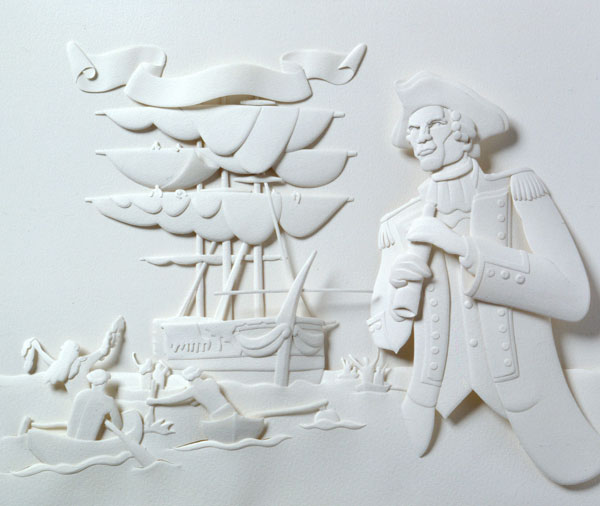
If you’ve got a desire to mix your inner Imelda with a love of whimsical paper, be sure to check out Puerto Rican artist/designer Carlos N. Molina‘s origami paper shoes (which I found through the fabulously quirky Lushlee blog):

Of course, not all paper that enchants us is tucked away in art galleries or designer boutiques. As this flickr find from the collection of David Ngo indicates, sometimes, just a piece of paper in the right place at the right time (a bulletin board, a blank wall, a telephone pole, etc.) is all we need to turn that frown upside down:
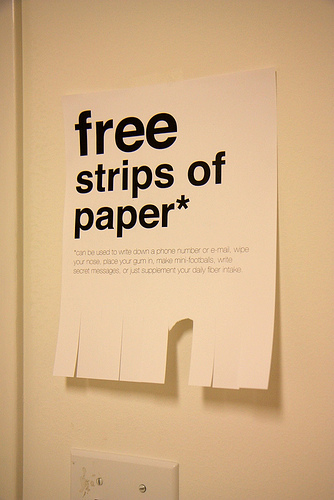
The fine print reads: “can be used to write down a phone number or email, place your gum in [sic], make mini footballs, write secret messages or just supplement your daily fiber intake”. (Don’t think it’s that cute? Try reading it in a British accent.)
In parting, I encourage you to spend at least a few moments today thinking about the paper in your life that uplifts you–a love letter saved from long-gone college days, a get-well card written in crayon, with some of the letters missing or carried to the next line, and even the mortgage paperwork that reminds you there’s a reason why you got up and went to work today. We’ll be back in the land of the practical next week; until then, join with Paper Doll and love thy paper.
Happy anniversary, Paper Doll readers, and thank you for your comments, queries and suggestions. Here’s to a great third year!

Follow Me