Paper Doll
NAPO 2010 Conference Expo Recap Part 1: Boxing It Up
One week after my return from this year’s conference, whose theme was “Innovate. Connect. Inspire”, I’m still reviewing the notes I took during the presentations of our amazing keynote speakers, Tim Sanders, Gina Schreck and Monica Wofford. I’m also wowed by my colleagues, whether it’s the brilliance of their sessions (particularly those taught by Lauren Halagarda, Scott Roewer, Brandie Kajino and Allison Carter), or the delight of their companionship as we toured Columbus, Ohio’s Short North district in search of the unusual flavors at Jeni’s Ice Cream. Mmmm. Ice cream.
Our 2010 Expo offered another fine selection products for helping make lives easier and more organized. Over the next few posts, I’m eager to share with you some of the paper-related treasures we professional organizers encountered.
Each year, I find that a theme begins to coalesce in the NAPO Expo showcase, and this year, it was all about boxing up your papers, but each had its own twist. This week, we’ll review some of the innovative ways paper (including vital documents, memorabilia and more) are gathered up, collated and preserved for easy access.
Tote That Barge, Lift That Bale (of Papers)

One of my favorite new products came from the Alpha-Omega Collection by KC Streamline Concepts. Yes, at first glance, the main product does look like a typical desktop, open file box. And it is. It’s got a few nice bells and whistles, like the front kangaroo-pocket for a notepad and pen, and dated tickler file inserts (because you know how Paper Doll loves tickler files). The Standard Edition is made of ABS plastic and comes in Licorice, Caramel or Blueberry. The oh-so-classy Executive Edition is made of solid wood in Honey Maple or Cherry stains.
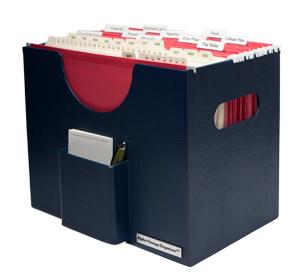
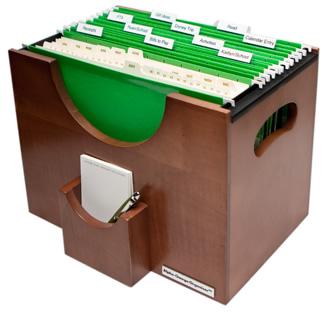
Each carrier comes with the following:
One Biannual Calendar
12 Monthly Folders
31 Daily Folders
1 two-inch Extra-Capacity file folders to hold the monthly and daily folders
10 Action Folders with 10 customizable blank tabs
50 Note Cards
While the boxes are lovely, it’s the Alpha-Omega portable totes that really snapped up my attention! The faux-leather (in Blackberry, Cherry or Coconut) are a huge step up from the hard-side plastic lunchbox-style file totes we usually see. Sure, you can carry a handful of files in a nice portfolio, but if you’ve got a small file crate’s worth of paperwork, this tote is really nifty.
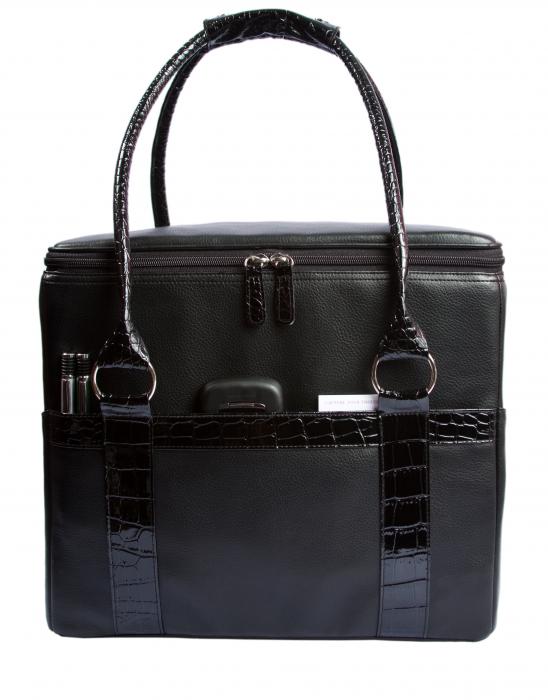
The tote completely zips closed, and has extra long purse-style strap handles that snap together in case you’d prefer a sturdier grip. You can select the faux crocodile accents or opt out, and the interior is nicely lined. The outer pockets wrap all the way around, with the front ones operating like the kangaroo pocket on the Alpha-Omega boxes, and the others yielding ample space for small items. Select the color of the box/case, then pick coordinating hanging file colors.
College Bound? Remember Everything, Kit & Caboodle!

When I wrote my article, Organizing Your College Search And Application Process, the one thing that dismayed me was that for those students or families who were not comfortable creating a Do-It-Yourself filing system, there were few pre-created alternatives. I’m pleased to see that College Caboodle has taken that need seriously.
The College Caboodle is designed to be a centralized organizing system for all of a college-bound student’s VIPs (Very Important Papers), including copies of:
-College Applications
-College Essays
-Letters of Recommendation
-Grade transcripts and copies of standardized test scores
-Community Service Activity Summaries
-Scholarship Applications
-Financial Aid Applications and FAFSA Forms
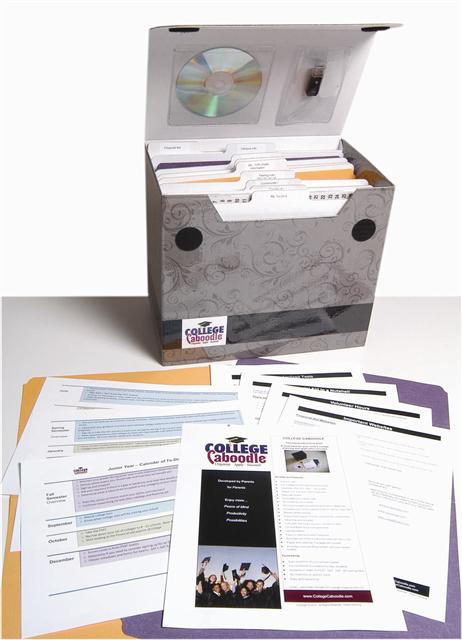
In addition to creating a streamlined filing system for documents, the College Caboodle includes a monthly/quarterly calendar of To-Do items for college aspirants from ninth grade through graduation, easy-to-use forms and checklists to make sure no task is forgotten, pre-labeled folders, resource web sites for application and scholarship assistance, and an instructional CD. The top of the Caboodle box includes plastic pockets for the CD and for a flash drive to maintain essay and application back-up copies. There’s also a built-in tickler system at the front for making sure those tight senior-year deadlines don’t get missed.
The College Caboodle is not inexpensive. However, for parents who have never been through the complex college application process and/or those families who are uncomfortable with organizing the mass of papers and deadlines associated with applying to college, the College Caboodle reassuringly contains all the elements to ensure that no ivy-covered stone goes unturned.
Do Not Pass Go. Collect 200 Report Cards, Photos and Ribbons!
1StopBox has developed a product line for keeping all the memorabilia of life in coordinated kits designed to all fit in a translucent bin of your choosing. The signature product, the Kid’s 1 Stop Box (in designs themed for boys or girls), includes four elements:
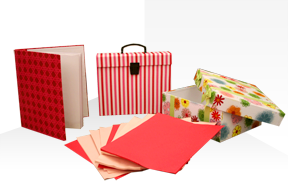
A Removable File Case, which holds all the VIP documents for each child: birth and/or adoption certificate, Social Security card, passport, immunization records, report cards or transcripts, etc.
A File System with nine coordinated expandable files (and pre-printed labels) keeps track of children’s artwork, school and independent projects, and non-VIP papers from nursery school through high school.
A Photo Album contains all of the official photos, including annual school pictures, camp photos, team and individual sports portraits, newspaper and magazine clippings and any other scrapbook-worthy or album-appropriate item.
A Keepsake Box holds three-dimensional memorabilia, like medals and ribbons, small trophies, videos or DVDs.
Future sets will include 1 Stop Boxes for babies, wedding-planning and even pets.
Greeting Your Memories In One Tidy Album

Paper Doll readers know that I’m not particularly eager to encourage you to keep all of the greeting cards you receive. However, if you do want to gather up cards in a collated display, the Greeting Card Keeper Card Album from Card Memories does provide one solution for storing keepsake cards and preserving them safely.
Each greeting card can be inserted into an acid-free Memory Sleeve so one can view both the interior and exterior of any card without having to remove it from the sleeve. The sleeves come in medium or large in order to fit standard sized/shaped greeting cards. Unlike the plastic sheet protectors designed for files or glassine stamp/photo album pages, these are more rigid and durable.
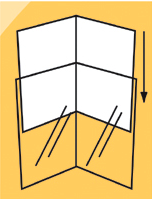
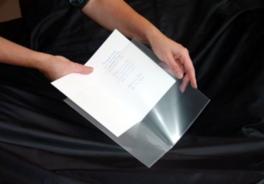
The individual Memory Sleeves fit any three-ring binders with holes punched for a standard 8 1/2″ X 5 1/2″ sheet size (medium) or 9 1/2″ X 6″ sheet size (large). (Binder rings must be spaced 2 3/4″ apart for the medium sleeves and 3 1/2″ apart for the large sleeves.) Each sleeve has a separated, plastic “margin” to prevent binder rings from rubbing against the cards.
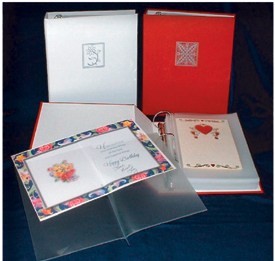
Sleeved cards can be sorted by category (birthdays, anniversaries, graduations, etc.) or by date and inserted in any of the company’s various albums. The albums come in medium (8″ X 5″) and large (9 1/4″ X 5 3/4″), and in various styles, including .055 gauge post-consumer recycled plastic milk jugs, in Chili Pepper Red, Cashmere Rose and Stargazer Blue, which come with twenty memory sleeves. Large albums, which include 25 memory sleeves, are available in linen or faux leather, black or red polyethylene plastic, or clear, Raspberry or Blueberry polyproplyene .030 gauge plastic.
The only flaw I can see in the Card Memories line (aside from creating a containment solution that might lead some to keep a larger card collection than is suitable) is that the sleeves are adapted for traditional cards, such as those from Hallmark. Those tall, narrow, tending-towards-silly cards one sees in gift shops and drug stores would not fit these sleeves or albums. However, this is a new product, and one may expect expanded product lines in the future.
Securing Your Vital Interests

One particular item on display at the Expo was not new, but has yet to be mentioned in Paper Doll posts, is Securita’s Vital Records Portavault. Its purpose isn’t merely to collect and collate the very important papers I’m always talking about, but also to make it easy to grab them & go in an emergency. Securita identifies the four basic advantages of the Portavault, in that it helps one:
Identify the vital records and documents one ought to keep in a centralized location. (Yes, Paper Doll has done that for you here and here, for example, but not everyone remembers to take notes!)
Organize the collected essentials in a portable three-ring binder with tabbed sections for individual categories.
Store the documents in acid-free record protectors to preserve readability.
Transport all of the essential papers in one binder, quickly, in case of emergency.
The process for collecting and organizing vital documents in the Portavault is simple. Affix an identifying label to an empty record protector. Then, run off to find the appropriate document(s), and once located, insert into the labeled record protector. Lather. Rinse. Repeat.
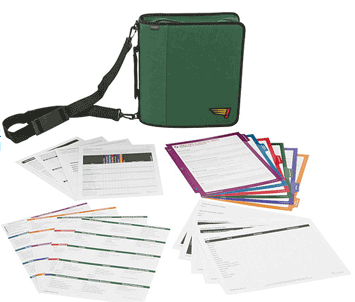
The Portavault’s exterior carrying case (with handle and shoulder strap) includes a pouch for storing keys, important cards, flash drives and cash. The Portavault’s interior houses the three-ring binder, guidelines for storing vital records, disaster-planning advice, 60 pre-printed labels identifying important documents, 30 acid-free record protectors, and a glow-in-the-dark identification tag, in case the onset of your emergency takes place at night or when the power is out.
This is just the tip of the Expo iceberg. Please return to Paper Doll for more 2010 NAPO Expo treasures, including the newest in office supply solutions from favorite stalwarts Smead and Pendaflex, and a new eco-friendly calendar that lets you see the big picture (by seeing the forest and saving the trees). We’ll delve into the digital solutions for preserving your vital information and memories and keeping your daily data at your fingertips. We’ll even revisit some electronic options that have upgraded their offerings.
Until then, pardon Paper Doll while I go back to thinking about that amazing Jeni’s ice cream. Mmmmmm.
Green-Eyed But Not-So-Monstrous: More Eco-Friendly Paper & Goodies
Preparing for last week‘s Paper Doll post yielded such an embarrassment of riches regarding environmentally-friendly paper of unusual provenance (straw, stone, sugarcane and, if you’ll pardon the expression, poop), that there wasn’t enough space to detail some of the other nifty paper-related products we’ve seen recently. While I feverishly work on a recap of the great products I just saw at the National Association of Professional Organizers annual conference and expo, I hope you’ll peruse these additional Earth-friendly products.
Reading Between the Lines
White Lines, a Swedish company, has created an interesting twist with a carbon-neutral writing paper.
Historically, most writing paper has been white with black lines. That’s meant bazillions of gallons of bleach to provide bright backgrounds to contrast with dark lines. Plus, the dark lines can be distracting to some users, and are even more visible on photocopies, yielding hard-to-read copies.
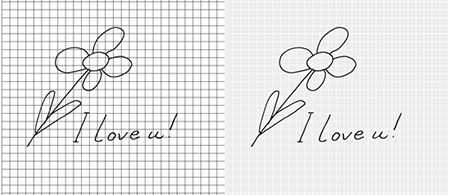
Swedish designer Olaf Hansson wondered what would happen if he could create paper without distracting dark lines that also didn’t glare in bright light. Eventually, he devised a series of paper products with white lines against a light grey background.
Why?
Well, first, aesthetics. Whitelines paper is toned, so strong light doesn’t glare as ordinary paper can. Further, the low contrast between the lines and the background reduces visual distraction. Hansson notes, “When using a pen, the interference between the supporting line and the pen mark is obvious…they compete [for] your attention in the same visual space.” However, Whitelines’ lighter background and faint white supporting lines decrease any visual interference, making it easier to see what you’re creating, whether in words or pictures. Also, the white supporting lines tend to disappear when photocopied, making copies crisper and easier to read.
Next, environmentally speaking, Whitelines claims that their notebooks have very low environmental impact throughout the production and logistics chain. The paper in Whitelines’ pads comes from saw mill chips and wood thinned from managed forests. Sweden’s managed forests are continually harvested and re-planted, and they have a long national history of integrated and natural reforestation.
Yes, it’s still paper made from trees, but Whitelines’ paper is manufactured at Nymolla Mill, an ultra-modern Swedish pulp and paper production plant which re-uses the carbon dioxide in a closed-loop and uses no chlorine in the manufacturing process. Nymolla Mill is certified in accordance with Chain of Custody FSC and PEFC, and there are no CO2-emissions from the plant. Whitelines minimizes the carbon footprint by transporting large batches by boat, and offsetting those carbon footprint values by planting trees in Uganda.
Perfect? No. But it’s an improvement over traditional paper production, and Whitelines even tracks and labels each notebook with its own carbon footprint, via a life-cycle inventory, in collaboration with the North Environment and Weather Agency and Stockholm’s Royal Institute of Technology.
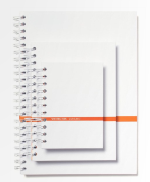
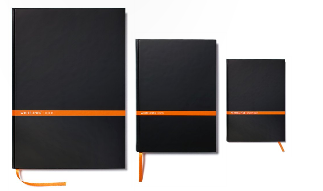
Whitelines’ patented paper is available with a variety of binding styles, including saddle stitch, orange glue, “perfect” bound (as you see in paperback books), wire, spiral, and hardbound, and can be purchased through retailers worldwide and in the U.S.
Help the Earth Rebound

ReBinder is an online green store offering various FSC-certified post-consumer recycled products. These include ReSponse business cards made from 100% recycled fibers and ReBadge, compostable name badges and badge holders made from plant products instead of plastic. But two particular items caught Paper Doll‘s eye.
The first, the original ReBinder three-ring binders, come in three versions: the no-frills Original, made from heavy-duty corrugated cardboard, the ReBinder Select, made from 100 pt. chipboard, and the Professional, which takes the chipboard base of the Select and adds an elegant black cloth spine.
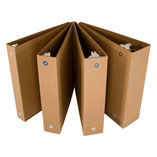
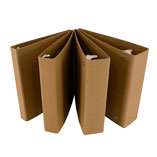
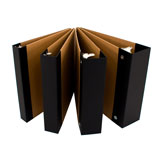
To get a sense of what the big deal is between vinyl binders and paper, you need only look at their explanation of the materials, process and end result.
ReMark Pens look like regular plastic black-ink ball point pens. They feel like regular plastic black-ink ball point pens. But in a nice departure from the “if it quacks like a duck” rule, the ReMark is not a plastic pen at all. It’s not even petroleum-based.
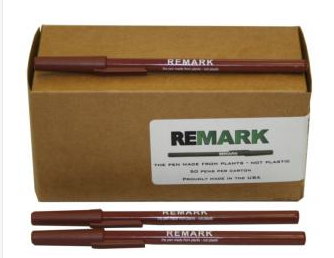
Instead, ReBinder makes the pens out of a cellulose acetate polymer made from either organic cotton or wood harvested from North American certified sustainable forests, and a plant “plasticizer” (which sounds like a torturous exercise machine, but is merely what makes it look and feel plasticky). The plasticizer is made out of grape-seed oil!
The whole pen is compostable. If you happen to have a compost heap next to your backyard garden, that’s a nifty green option. However, those of us who aren’t quite so eco-centric can gather up a box-worth of ReMark pens after they run out of ink, and mail them back. ReMark will grind up old pens and make new ones from the detritus!
Calculating Your Options

Whatever kind of paper you choose, it helps to be well-informed. The Environmental Defense Fund’s Paper Calculator helps you quantify and compare the environmental attributes of various paper products. For example, you can compare specific paper types with those of higher recycled content, or compare the combined environmental impact the paper your company or organization uses today with potential alternatives. The calculator tends to focus on paper types like uncoated freesheet (i.e., copy paper), groundwood (newsprint, magazines) and corrugated paper and paperboard at various levels of bleaching. (I suspect it’ll be a while before we’ll have the opportunity to compare paper made from alternative items like stone, wheat or sheep poop.)
May I Have a Do-Over?
No matter how many times we’re told that a paperless office is on the horizon, it just doesn’t seem to be true. Sure, consumers are heading out, en masse, for iPads, Kindles and Nooks, and we’re slowly but surely moving most people towards online banking, but the reality is, most offices still feel a striking need to handle tangible representations of information.
Enter: PrePeat, a high tech printer that makes “paper” virtually reusable. The inkless, tonerless printing process lets you reuse the document you’ve printed, over and over. No, this isn’t that old trick of loading your paper tray with used paper, merely flipped to the blank side. This is something quite ingenious. To start, watch the video
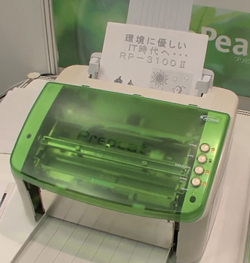
to get a sense of how simply the PrePeat can be operated.
Sanwa Newtec‘s Prepeat doesn’t rely on paper or ink. Instead, you feed in special heat sensitive PET plastic sheets, and a precision thermal head prints out gray scale text and images. Then, when you’re done with the printout, you just feed the same sheets through the printer again, and a different temperature setting erases whatever was printed on it before, allowing you to print fresh documents.
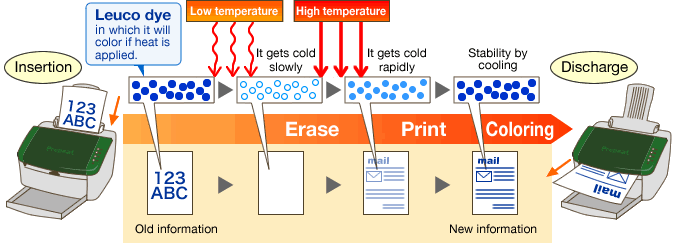
This Japanese entry into the printer market, like concept cars not quite ready for prime time, is pretty pricey at $5,500, with each sheet of special plastic paper retailing for $3.30, available only in lots of 1000. It’s not exactly for printing out soccer team contact numbers. However, the plastic sheets, unlike paper, are almost endlessly reusable (well, each sheet handles about 1000 uses), and you’ll never have to buy ink or toner. Designed, at least initially, for large companies, this presents an eco-friendly option that uses almost no consumable products–no trees to cut down, no ink cartridges to recycle — and could limit printing costs at large companies that tend to print in excess.
Shooting Holes In That Theory
Since it doesn’t look like we’ll be using the PrePeat for home or student printing any time soon, it’s worth exploring other green printing options. For example, while environmental concerns usually focus on tree-based paper, we could try using a font that requires less ink.
Spranq, a Dutch agency, has developed the Ecofont, designed to extend the life of ink cartridges and toner. The agency focused on investigating how much of a printed letter could be removed while maintaining readability. This wasn’t just a matter of serif vs. sans-serif; they found they could achieve very serviceable results with a font that had itty-bitty circles of unprinted areas, intentionally left blank in the middle of each line. The circles, especially at smaller font sizes, have no adverse impact on legibility–it’s as if you used a miniature hole-punch on each of the letters. You can print out a test document, to see for yourself.
The original Ecofont typeface is based on an open source (i.e., freely distributed) font called Vera Sans and uses up to 20-25% less ink or toner than traditional fonts. Ecofont can be used with Windows, Mac and Linux computers, and works best when printing in 9- to 11-point, as larger fonts tend to render the “holes” visible to the naked eye. You can download it for free, or purchase home, small business or enterprise versions to print “holey” variants on typically-used fonts like Arial or Verdana.
Want Not? Waste Not!

Have you ever printed an email, web page or article and found that the final page had nothing except a signature block, web site URL and page number, or legal disclaimer? Are you frustrated when a web site has no printer-friendly version, so you end up printing color ink-rich ads and logos? What a waste of ink and paper!
Being more diligent with your Print Preview screen solves the former problem, but not the latter. GreenPrint limits what you print to only the pages you need and want, to reduce printing by about 17% and decrease printing costs per year by ~$100. Once installed, the GreenPrint software stands as a barrier between your printer and your web browser, email program or whatever software from which you’re trying to print, and automatically detects extraneous items like useless final pages, leaving them out of the print queue.
GreenPrint is a middleman–you send your document to GreenPrint, it evaluates what’s worth printing, and then sends the revised bits and bytes onward to the printer. Or, send the revised document to GreenPrint PDF, a virtual PDF printer, to create a PDF version of the web page, email or document, without all the gobbledegook. If you prefer more control, you can operate GreenPrint manually, or be hands-off and let it act on your behalf to make printing decisions.
GreenPrint comes in home, small office and enterprise versions for Mac and Windows Vista PCs. There’s also a World version, without most of the bells and whistles, available for free download, provided you’re willing to view some “tasteful” advertising.
Feeling green-eyed for some of the niftier items reported in these last two posts? Read between the lines, compost, calculate, reduce use of ink or toner, save on purchase costs, and encourage environmental awareness, all with a few mouse clicks.
Going Green Around the Earth(Day)–Environmentally-Friendly Paper
This Thursday, April 22, 2010, is the 40th Earth Day. In celebration, Paper Doll has traveled the globe (from the keyboard, maintaining a small carbon footprint) to identify some unusual and environmentally-friendly paper options.
The typical paper used in copiers, faxes and printers used to be “virgin”. Trees got cut down and turned into paper, while society got chain letters and photocopies of people’s tushies, and our forests started looking sparse. Then there was recycled paper, but even it was originally made from trees. Today, we’ve got some international alternatives to paper’s usual provenance, making it a little bit easier, if a little weirder, to be green.
Spinning Straw Into…Copy Paper?
Nature’s Paper reminds me of Rumplestilskin, who exacted a price for helping the imprisoned farmer’s daughter spin straw into gold. Considering that our natural resources are precious, it’s not that surprising to learn that now we can manufacture copy paper from straw.
In Australia alone, tens of millions of trees are cut each year to produce paper for the Down Under populace, but Nature’s Paper has developed a way to turn leftover wheat straw into paper instead.
Normally, when wheat is harvested, grain is used to produce goodies like cereal and flour, but the wheat straw and waste hull are left behind to decompose. Nature’s Paper gathers that wheat straw and converts it into a paper pulp. Then, they power their industrial plant and heat the recycled water they use to clean the paper, all with an organic biofuel made from the the waste hull.
While the typical paper whitening process involves bleach or chlorine, which can only be used twice before disposal (often risking ground water contamination), Nature’s Paper has a chlorine- and bleach-free, sustainable process to safely whiten the pulp to create bright, white copy paper. They even manage to convert their manufacturing waste product into the cardboard boxes to hold the paper!
Reviewers say Nature’s Paper looks and feels just like wood-based copy paper. Check it out yourself — request a sample from its U.S. distributor, Enviro Green.
Can We Still Play Rock, Paper, Scissors If It’s Rock, Rock, Scissors?
If you didn’t have paper, you could get your message across by writing a short note on a rock and throwing it in someone’s direction. A few companies are taking that a step further, bypassing the possibility for concussion, and creating paper out of stone.
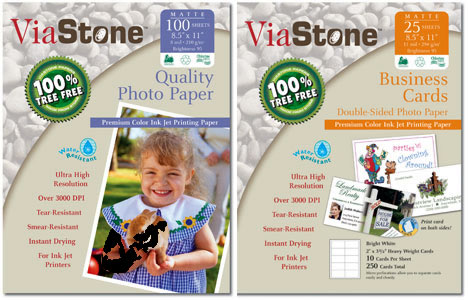
ViaStone’s biodegradable, tree-free paper production requires no toxins, chemicals or even water, and is designed specifically to work with inkjet printers. ViaStone’s process creates paper from a combination of natural stone, mineral powder and some trace non-toxic resins. (California-based Via Stone’s website is still under construction; perhaps it’s hard to build a computer out of stone.)
Obviously, rock paper isn’t quite as sustainable as that made from wheat straw–we can’t grow new rocks. If the extraction of limestone were exponentially increased to make paper from stone available in large quantities, at a level competitive with tree-based paper products, there would be some impact on our balance of resources, but certainly nothing approaching that used to make conventional photo printing or card stock paper from trees.
ViaStone isn’t the only stone cold eco-friendly solution out there.
TerraSkin is made of 75% mineral powder and 25% non-toxic resin, and like other stone paper products, requires no water for production, and therefore creates no water-based pollutants, and inorganic mineral powder residue can either be reused as part of the production process or returned to nature.
Next, TerraSkin’s high proportions of inorganic mineral powder mean that used paper will degrade back into mineral powder when left out in nature within approximately three to nine months–so whether it becomes litter or landfill, it will have minimal environmental impact. Or, one could incinerate TerraSkin paper because the non-toxic resins won’t emit smoke or poisonous gas by-products.
In addition to photo-quality paper, TerraSkin has been used in everything from Burt’s Bees’ soap wrappers to the Metropolitan Museum of Art’s glossy gift bags.
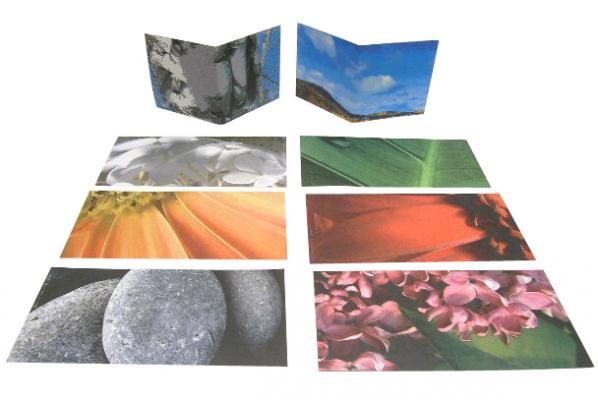
Of course, few people are willing to make a trade-off, compromising on quality in order to be environmentally friendly. (Remember learning cursive writing on that recycled lined paper? I swear, there were small twigs sticking out of that stuff!) TerraSkin is becoming renowned for its unique texture and nifty printing capabilities. Paper made from rock has no fibers, so it doesn’t absorb ink like tree-based paper, and uses about one-third less ink than regular paper. The ink doesn’t bleed, so the paper delivers crisper, cleaner, images. Like other stone-based paper, TerraSkin is also very durable–it’s tear-resistant, water-resistant and strong.
FiberStone is another major player in the rock paper business. It’s composed of about about 80% calcium carbonate, the limestone collected as waste material from quarries used for the construction industry, with about 20% high density polyethylene, a non-toxic resin. The resin acts as a binder for the mineral powder, creating a water- and tear- resistant paper that is nonetheless soft, smooth, and of bright white quality. Also like other stone paper products, production of FiberStone’s Natural Stone Paper requires no water and causes no toxins to enter the air or groundwater. Production is acid-free, bleach-free, chlorine-free…and guilt-free.
FiberStone’s paper takes a little longer to photo/bio-decompose than others — approximately 14-18 months. However, it also seems to have slightly more applications than just copy, photo and premium coated paper for inkjet printers. It’s also suitable for synthetic paper and film products (like Tyvek envelopes and medical packaging), green shipping/packaging supplies and PVC sheeting. It’s even FDA-approved for use in bulk and individual food packaging for shelf-stable and refrigerated or frozen foods. And, because, like all stone paper, it’s water-, grease- and tear-resistant, it’s ideal for field journals or even sob-resistant diaries for prone-to-tears teenagers.
FiberStone paper products are only available through a few affiliate vendors, but you can request a sample of FiberStone’s eco-friendly adhesive labels.
Would Paper By Any Other Name Taste As Sweet?

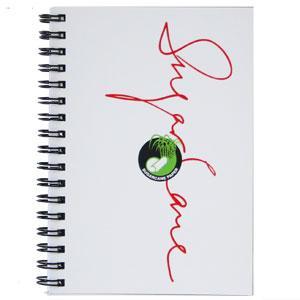
O’Bon is an environmentally-minded school and office supply company originally known for a line of pencils made from newspaper instead of wood. O’Bon is passionate about running programs to educate children about sustainability and the environment, deforestation and recycling, so it’s no surprise they’d jump at producing paper products made from bagasse, a sugarcane pulp. (Sugarcane is weed-like, requiring little fertilizer or water, making it an excellent sustainable crop.) O’Bon’s line of bagasse-based notebooks are strikingly colorful and vivid, with 100% recycled cardstock covers and sugarcane pulp pages lined with soy-based inks.
Oh, POOP!!!
Mr. Ellie Pooh is a line of paper made from, well, elephant poop. And not just any elephant poop, but Sri Lankan elephant poop…and therein lies a tale.
Approximately one-tenth of the world’s 40,000 Asian elephant population lives in Sri Lanka, in a precarious balance with a populace that finds them an inconvenience. In other parts of the world, elephants are killed for their tusks to supply the ivory trade, or for their meat, but in Sri Lanka, the agricultural community has killed the elephants to prevent them from trampling their crops and destroying their only source of revenue.
Mr. Ellie Pooh is a company that hopes to prove to the Sri Lankans that the elephants can be economically valuable for a new, environmentally sustainable, revenue source. Not to get too scatological, elephants are vegetarians, so their waste is nearly 100% raw cellulose. Mr. Ellie Pooh has developed a manufacturing process that cleans the elephant dung, collected from inhabitants at Sri Lankan elephant orphanages, and combines 75% cleaned dung with 25% post-consumer (recycled) paper to create a hygienic, acid-free (and odor-free), linen-quality, papyrus-like paper with a delicate texture suitable for writing and crafts.
Mr. Ellie Pooh paper production involves no toxic chemicals, and the bonding agents used are all natural, including alum and rosin, with water-soluble salt-based dyes for coloring. The 100% handmade paper products products are bleach-free and acid-free, and the perfect pH for use in photo albums and scrapbooks.
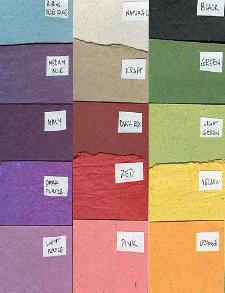
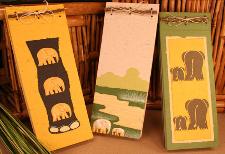
The company has partnered with elephant paper specialists Maximus, on Project Peace Paper, to help reduce the long-standing conflicts between humans and elephants in Sri Lanka’s rural villages. They plan to launch paper re-cycling plants in multiple rural areas and provide training in paper making techniques to the villagers, helping develop a larger sustainable industry.
So, no trees are harmed in the production of this type of paper, and with an average adult elephant producing up to 50 kilograms of dung per day, this paper can be a reliable, renewable source of income for Sri Lankans, thereby improving the plight of the elephants. Mr. Ellie Pooh products can be purchased at scrapbook supply stores, zoos, and various paper vendors throughout North America.
Mr. Ellie Pooh isn’t the first company in the field. In case you’re wondering how someone got the idea to make paper from elephant waste in the first place, that’s the story of a Mr. Wanchai of the bluntly-named Elephant Dung Paper. After visiting a local natural paper production facility and later, the Thai Elephant Conservation Center, he put number two and number two together and paper-making history was made.

Creative Paper Wales, the only craft paper company in all of Wales, was not to be outdone by the pachyderms of Sri Lanka. With their paper mill, located in the adorably-named Snowdonia National Park, Creative Paper Wales produces paper products like holiday and greeting cards, writing paper sets, gift wrap and wedding invitations…
…all from cellulose fiber extracted from Welsh sheep.
Collected sheep waste is completely sterilized by boiling in a special pressure cooker at over 120 degrees centigrade, and then washed repeatedly until it’s been reduced to half its original weight, yielding fibers for the paper process and a by-product of sterile liquid fertilizer that is made available to local farmers.
Cellulose fiber is blended with other recycled pulps, sieved, and then sheets are stacked and layered with felt to keep them from adhering to one another. Immense pressure squeezes out any remaining water, causing the cellulose fibers to tightly bond, making it unexpectedly strong. Finally, the papers are hung to dry in the mill’s roof rafters.
Creative Paper Wales doesn’t just make paper from sheep stuff–they also use waste paper, textile mill cutoffs and rag. Their Florevelopes™ are made with living wildflower seeds, so after you read a letter, you can tear up the envelope, soak it overnight in water and plant it…to grow more wildflowers!
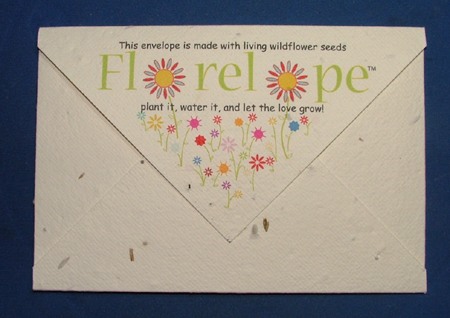
Who would have imagined that straw, stone, sugarcane and…something else, could all be used to create paper that reduces adverse environmental impact? We can only imagine what paper products the future has in store. Happy Earth Day!
Special Post: Secure Your ID Day: BBB-Sponsored Shredathons on Saturday
On Saturday, April 17, 2010, 55 Better Business Bureau locations are helping you observe Secure Your ID Day by sponsoring community shred-a-thons.
Will The Real Paper Doll Please Stand Up?
A Boy Named Sue May Hate His Name (but that doesn’t mean you can steal it!)
The Big OUCH!!! (Medical Identity Theft–Part 1)
Doctor, It Hurts When Total Strangers Do This! (Medical Identity Theft, part 2)
So moms and dads, small business owners, volunteers and professional organizers, gather up any paper (and computer discs) with personally-identifying information (but which you no longer need), and transport it (securely!) to your one of the participating U.S. or Canadian Better Business Bureau locations. BBB-partnered document destruction specialists in your area will shred your documents (for free) and help you preserve your good name.
 Remember, you are the only you you’ve got.
A Mysterious Stranger Will Declutter Your Paper: Organizing Fortune Cookie Fortunes
An admirer is concealing his affection for you.
Confession: the above are taken from the slips of fortune cookie fortunes I found in my own home this week. I have a sneaking suspicion there might be others, hiding in dark corners of jewelry boxes, an old wallet, possibly bookmarking and Jane Austen. (Poor Jane, who never knew the joys of Crab Rangoon, sweet & sour anything, or the delights of Kung Pao!)
WHY FORTUNE COOKIES?
Paper Doll does not obsessively dine on Chinese takeout meals. And my home is generally lacking in other kinds of paper clutter and floozies. So why have I saved these? And why, when I usually talk to you about organizing serious paperwork like financial and medical files, or solutions for dealing with paper trail overwhelm, am I talking about these inconsequential slips of paper?
Well, I could blame it on Erin Doland, the dazzling Editor-in-Chief at the Unclutterer blog. A few months back on Twitter, Erin had recommended The Fortune Cookie Chronicles by former New York Times journalist, Jennifer 8 Lee. Given Erin’s reputation for good taste in writing, fellow blogger Jeri Dansky and I jumped in.
It’s not hard to explain why the book resonated so much with me.
Love of good food? Check.
Fascinatingly delivered history lessons about the immigrant experience over the past century and a half? Check!
An entertaining catalog of culinary anthropology detailing how Chinese food became so popular in the United States, even in tiny towns dotting the South and Midwest and in Orthodox Jewish communities? Check!
A collection of mysteries about that darn General Tso, how Chinese cuisine launched a food delivery revolution, and even the true origins of fortune cookies? Check and mate!
But all of these fascinations would not have been worthy of a Paper Doll post. What does this have to do with organizing?
Around the same time I was reading Lee’s Chronicles, I noted, not for the first time, that almost any time I organized a desk, whether at a business or in a home office, and often, when I organized kitchens and bedrooms, we’d turn up a handful of loose fortunes. Occasionally, they’d be push-pinned to a bulletin board or taped up on a computer monitor or slid under a glass desktop. In general, however, these clients were not the type to hold on to either floozies or loose scraps of other “omens”, like daily horoscopes. There seems to be something special about fortune cookie fortunes.
What is it about fortune cookie fortunes that makes so many feel the need to save them? What’s the difference between Paper Mommy scribbling “You’re going to do great today!” on a piece of scrap paper from her desk, tucking it in with my peanut butter sandwich, and a fortune cookie fortune?
I asked people on Twitter and Facebook what they do with their fortunes. Some professional organizers, like Julie Bavington, were straightforward about ejecting the clutter: “Fortunes are just paper scraps. I toss ’em.”
Others, such as a usually-organized marketing expert I know, said “Sometimes I keep the REALLY great ones, but after a while they disappear. As in, I have no clue where I put them.”
FORTUNE SAVER PROFILES
I’ve found three types of fortune savers. First are those who tend to save everything, not by decision, per se, but through lack of making decisions regarding what to keep or toss.
Second are the people who feel really strongly about portents and omens. According to Lee, it’s common for some people to burn “really good” fortunes right there in restaurants in order to ensure good luck, a custom I imagine has been greatly reduced by the removal of ashtrays from restaurants now that most states have eliminated smoking in eateries. These people, if they aren’t “burners”, may have developed their own personal superstitions, where it just doesn’t feel right to let go of the fortunes, as if it will scatter the good luck.
For this second type, it will do no good for me to make the point that these fortunes are generated by freelance fortune writers, fed into a computer and spat out according to an algorithm of so many of fortune #2735 every so many seconds. Intellectually, they know that the slips of paper carry no power…but they feel better…safer…holding on to them.
The third type knows just the opposite. They know that fortune cookie fortunes, like photos, upbeat horoscopes and encouraging notes from our loved ones, have immense power. Fellow professional organizer Janice Simon replied to my fortune cookie inquiry on Twitter, saying “I kept some of my fortunes in a jar and would pull one out when I needed a pick-me-up.” We know our best lipstick, our lucky baseball caps and the fortune that says An admirer is concealing his affection for you can put a little extra spring in our step. We, ourselves, imbue fortunes with the power to raise our spirits. We, turn our good fortunes into self-fulfilling prophecies. (Haven’t you noticed most people only toss their boring or disappointing fortunes?)
So why not hold onto some of the better messages…as long as we can keep them corralled in an organized fashion, so they don’t shower down around our feet every time the air conditioner blows? If you can’t part with your fortune cookie fortunes, there are quite a few options for keeping them organized.
BOOK ‘EM
Jennifer 8 Lee writes about Michael Moskowitz, who, in order to keep track of his own favorite philosophical fortunes, ended up backing the foreign manufacture of a Fortune Album. The Floridian couldn’t purchase just one, so when Lee interviewed him, he still had crates of unsold albums to unload. Lee’s book must have brought him good fortune, though, because the site now states that there are only 300 albums remaining!
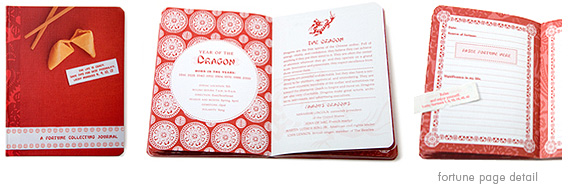
Paper Doll is also charmed by the Spoon Sister’s fortune cookie album, with a place to paste fortunes and jot down related thoughts.
Of course, you could also tape or staple fortunes to pages in any notebook, from a fancy Moleskine to a speckled composition book, and write journal entries about with whom you dined and what thoughts the fortunes brought to mind.
SHOOT THEM
With everything from not-so-gently loved stuffed animals to broken rocking chairs to poufy dresses fifty years out of fashion (and taking up more than their fair share of the closet), we professional organizers often recommend some variation on the old taunt: “Take a picture — it’ll last longer!”
Indeed, each photo of tangible objects can reduce the clutter without adversely impacting the memory or the feeling you equate with the item. Consider collecting the loose fortunes from around your house, arranging them on a piece of paper (Perhaps red? That sounds like good feng shui!), and take a photo. The digital version would make great wallpaper for your computer, or you could put the snapshot up on your bulletin board for inspiration.
BLOG THEM
You wouldn’t be the first, or the last, if you transcribed the messages on those tiny slips and turned them into blog posts. Paper can burn or fade, but thanks to the Wayback Machine, even long-abandoned web sites and blogs now live forever.
Blogger Josh Madison devoted an entire post dedicated to hundreds of his collected fortunes. (Paper Doll‘s favorites? The time management-themed “An inch of time is an inch of gold” and the focus-oriented “Dedicate yourself with a calm mind to the task at hand.” Apparently paper organizing isn’t a very common fortune motif.)
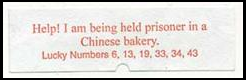
Although submissions to Weird Fortune Cookies ended last year, there’s a fine collection of the bizarre and silly, including this often-told classic:
GET KOOKY
The FortuneKookie.com is a fortune cookie themed social networking site that gets a little kooky with the various options for storing your cookie messages without actually keeping the slips of paper. Sign up for a free account, create your profile, and start logging in the fortunes you receive, which you can do via the web site or your mobile phone.
You may choose to share your fortune, either at your personalized URL (e.g., http://FortuneKookie.com/PaperDoll) or via social networking on FortuneKookie’s Facebook application or tweeted directly to your Twitter stream. Or, you can just use the site as a digital notebook to keep track of your fortunes. Click the on-screen cookie to get your daily fortune, horoscope-style. Even purchase a fortune shirt, a customized T-shirt with your favorite fortune from among their collection…or use one of your own.
GO OLD SCHOOL
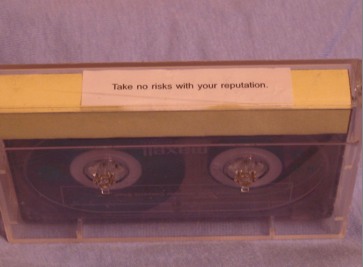
Those of Paper Doll‘s readers who were born in the 90’s or after probably don’t remember a world before CDs, but somewhere beyond the golden age of vinyl and the forgettable age of 8-tracks, we made mix tapes for our friends, and found that fortune cookie slips were the perfect size to serve as nifty, if inexact, labels for those cassettes.
GO HIGHBROW…OR LOW-TECH
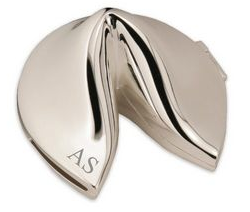
For some, precious metals and jewels are the only way to be organized. For them, this engraved silver fortune cookie keepsake box from Memorable Gifts might do the trick.
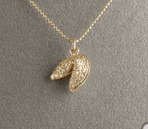
However, this 14 karat gold fortune cookie pendant with Pav diamonds from Neiman-Marcus is purely for show.
For the more handicraft-oriented, memorabilia-enchanted, DIY crowd, any small box or tin could could be decoupaged with a collection of fortunes and then used as a keepsake box for future acquisitions. Again, Paper Doll isn’t necessarily a proponent of keeping massive quantities of fortune cookie slips, but if you’re inspired to be a collector, a centralized location will at least keep your showcase tidy.
THERE’S AN APP FOR THAT
What if you’re watching your weight and can’t afford to be tempted by piquant cuisine? There’s even a free fortune cookie application available for iPhones and the iPod Touch that lets you shake your screen or tap it to break open the photo confection (because that’s the way the cookie crumbles) and reveal your fortune. The creators of the app must know how difficult it is for people to let go of their fortunes, because there are options to share the digital versions via email or social networking profiles.
Whether you toss your fortunes when the meal is over or treat the messages with the affection normally accorded to love letters, whatever your fortune cookie personality, Paper Doll wishes you great fortune and an organized life!
Follow Me