Paper Doll
Safeguard Your Very Important Papers: Safe Deposit Box Basics
Paper Doll worries about your VIPs — your Very Important Papers. Usually, we talk about what those VIP documents are, how to locate them, and where to keep them (generally speaking, in terms of filing hierarchies). But what about the safest places for your VIPs? Today, we’ll be talking about safe deposit boxes.
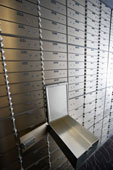
YOU MIGHT NEED or WANT A SAFE DEPOSIT BOX…IF:
–You want to keep track of where your vital documents are located and want them all in one central and safe location.
–You want a completely private location in which to store and review your documents or possessions. (Image how different Mad Men‘s Don Draper’s life would have been if that top desk drawer hadn’t been tempting Betty with its secrets!)
–You want your loved ones to have easy access to important documents even if you are unavailable (traveling, ill, etc.)
–You want to protect your important documents (and possibly other possessions, such as fine jewelry, coin collections, medals, photographs, and written or photo/videographic home inventories for insurance purposes) from theft, fire, flood or natural disaster.
–You recognize that most home safes portable enough for you to take with you during a disaster would also be portable enough for thieves to carry away into the night and that the combinations aren’t generally very hard for thieves to crack.
–You have family heirlooms and precious documents that are too delicate to be left in the open in a home where children, pets and others could cause damage.
–Your insurance company may discount your homeowner’s insurance if you notify them of the use of a safe deposit box for valuable assets. Most (but not all) insurance policies will cover the value of possessions stored in a safe deposit box. Call your agent to ensure you have all the protection you need — and are given all the discounts you deserve.
YOU MIGHT NOT NEED or WANT A SAFE DEPOSIT BOX…IF:
–You’re comfortable scanning your documents (to a hard drive or flash drives stored off the premises or to a storage site in the cloud, like Dropbox) and aren’t that worried about maintaining the originals. Some people don’t worry that much about fire, flood or theft and have so few vital documents that they are willing chance the cost of replacement fees.
–You relocate often due to your family, work, academic or volunteer obligations.
–You can’t afford safe deposit box rental prices.
–You hate banks and credit unions, prefer to live off the grid and don’t want “The Man” to know where you are or what documents you possess.
If any of these apply to you, a portable fireproof, waterproof safe might satisfy your needs. However, as noted above, such safes can be easily purloined and cracked.
HOW TO RESEARCH A LOCATION AND BOX
Take some time to do your research to determine the best safe deposit box solution for your needs.
1) Select a bank branch convenient to your home or work — Many full-time workers can get away to the bank on their lunch hours, but might not be able to access the bank as conveniently from home. However, if your spouse will be more likely to access the box than you, having it close to his/her office, or closer to home, might make more sense. Think about when you’ll want to access the box, either for retrieval or for putting items in.
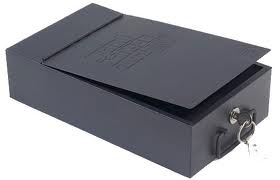
2) Compare prices — Generally, it makes sense to get a safe deposit box at your own bank, as customers get discounted pricing.
Also, consider how big a box you need, as rental rates vary by size (from $15 to a few hundred dollars per year). While the depth of safe deposit boxes are standard (generally about 18-22 inches), the height and width dimensions come in multiple categories. The smallest boxes are usually 3″ x 5″, but unless you have very few documents, you’d have to roll your papers to make them fit. Medium boxes range from 3″ x 10″ to 10″ x 10″. The largest safe deposit boxes in consumer banks tend to be about 15″ x 15″, though larger specialty boxes can be arranged at banks that cater to clients who have large financial holdings.
3) Ask about policies and fees. What are the key replacement fees? What are the charges for drilling boxes if keys are lost? Is there comfortable (or any) seating available in the vault, in case you need time to go through the contents of your box and need to sort documents?
HOW TO RENT A SAFE DEPOSIT BOX
Decide whether you want to share access with someone else: your spouse, parent(s), child(ren), business partner(s) or friend(s). You can’t just designate someone as a co-owner and give them a key. They’ll have to sign the signature card and show photo ID — both at the time of rental and to gain access.
If you don’t intend to share, make the time to designate a Power of Attorney or agent to act on your behalf for financial and other urgent matters if you’re ever unable to access the box yourself. However, designation of a Power of Attorney ceases upon your death. Eventually, the executor of your will can gain access (depending on the probate and estate procedures of your state), but this can be a lengthy process. Some states will allow you to create a temporary executor clause to speed the process, but regulations are not uniform in this regard. You can, however, appoint a trustee to oversee any of your assets you place in a trust; the trustee can then access the box after your death. Complicated? Very. If your possessions and documents are relatively simple, you’re probably better off naming as co-renter someone in which you can place great trust (like Paper Mommy).
Make an appointment. No, it’s not essential, but you might feel better about setting an appointment to sit down with a bank representative to deal with the paperwork. Also, not all bank branches have available boxes. By calling ahead, you can determine whether you wish to be placed on a waiting list or will need to select an alternative branch. Be prepared to fill out some forms, sign a lease agreement and pay for the initial rental term. Make sure co-renters are available to come to the appointment as well.
Bring your photo ID. Co-renters should do the same.
Bring the items you wish to store. Before you leave the house or office, create an inventory list, and bring a copy of the list with you. As you place the items or documents in the box, check them off your list.
Bring your camera and take a photo of the items in the box. The date-stamped photo and list will help you keep track of what’s inside. (Take a photo and/or adjust your list when you add or remove documents or possessions.)
Bring a few zip-lock plastic bags for protecting items in case of floods or sprinkler system malfunctions. Most file folders will fit in gallon-sized bags. If you’re safeguarding delicate non-flat items (and your box is large enough) Tupperware or Rubbermaid food containers also afford protection from water damage. Put a label with your name and contact information inside the container so that items can be identified as yours in the aftermath of any disaster.
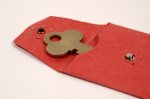
Keep your key somewhere safe and memorable. If allowable, make a copy of your key (or purchase a second, if one is not made available for free). Even if someone has your key, he or she should not be able to access your safe deposit box, as proof of identification and signature is required in tandem with a key. Key loss, however, may require drilling of the box — at prices exceeding $150.
OTHER CONSIDERATIONS
If you are a singleton and haven’t made arrangements for another person to have signature access, designate a Power of Attorney for financial issues. This way, if you are stranded abroad, disabled, or comatose, your loved ones will be able to help oversee necessary activities on your behalf.
Possessions can still be damaged or stolen. Faulty sprinkler systems, actual fires, floods and yes, even bank robberies, can lead to loss or damage of your items. This is why it’s necessary to maintain an inventory at home of the contents of your safe deposit box, just as you might keep an inventory of your possessions at home in the box.
The contents of your box will not be available 24/7/365. There’s a reason they’re called bankers’ hours — generally 8a – 5p, Monday through Friday, with some wiggle room on Saturday mornings and occasional late Friday hours. But banks are closed on federal (and some state) holidays, Sundays, and more than 12 hours of every day, from dinnertime to breakfast.
Access to your safe deposit box can be frozen. For example, if you are involved in a dispute with the Internal Revenue Service, the IRS can block your access. Also, if law enforcement officials (including the Department of Homeland Security) believe you and/or the contents of the box are related to illegal activity (drugs, guns, explosives, or illegally-obtained items), a court order can be issued to give law enforcement access to the contents of your box.
Your safe deposit box can be declared “abandoned” — if you stop paying your rental fee, maintain no communication with the bank, and nobody in your family or overseeing your estate is aware that you possessed the safe deposit box, the contents of the box will eventually be turned over to your state’s Unclaimed Property division. Make sure your loved ones or legal representatives know you have a box, where it is, and the location of the key.
WHAT YOU SHOULDN’T KEEP IN YOUR SAFE DEPOSIT BOX

Large amounts of cash — First, you’re not earning any interest. Second, cash is less accessible in your safe deposit box than in your bank account, from which you can at least make withdrawals or debit purchases. Third, cash (and any other assets) kept in your safe deposit box (as opposed to an actual account) won’t be protected by the Federal Deposit Insurance Corp., nor covered under FDIC rules. (Cash in your bank account is insured up to $250,000 per depositor per bank; cash in your box isn’t insured at all.) Currency is less likely to catch on fire or be accidentally thrown away than if you stored it in your mattress, but it is otherwise one of the worst things you can keep in the box.
Your will — If the only legal copy of your will is in your safe deposit box, unless you have a co-renter, your family will have to secure a court order to access the will…and the rest of the box…speedily. Whenever possible, your attorney should keep an original of your will; just keep copies in the box.
Anything you will need in an emergency — Obviously, this will vary widely by user. For most people, any international travel comes after months of planning and preparation. However, if you work for a multi-national corporation that flies you around the world at a moment’s notice, or if you’re an international spy, you probably aren’t going to want to wait until the Tuesday morning after a federal holiday to run into the bank to get your passport. (Or, y’know, passports (plural), if you’re a spy.)
Original, sole copies of vital documents that your family might need if you become incapacitated — If you are the only person to have access to your safe deposit box and you have not designated someone as having Power of Attorney (or have stored the only existing copy of the Power of Attorney paperwork in the box), lack of access to an original of your living will/medical directives and other life or end-of-life instructions could create major problems. In general, if the original or any document (other than your will) is going in the box, keep sharp copies at home (or in the cloud).
There are a variety of sources online to help prompt you regarding what documents you might want to keep in your safe deposit box, including my ebook, Do I Have To Keep This Piece of Paper?, which identifies what documents need to be kept, how long to keep them and the best locations for doing so.
Not everyone needs a safe deposit box, but not knowing the facts isn’t a good enough reason to leave your papers unprotected. Be safe.
Happy 3rd Anniversary, Paper Doll Readers!
Paper Doll
strives, week in and week out, to keep these posts useful and entertaining. Long-time readers know how passionate I am about the research that goes into finding the information and the goofiness that goes into the writing — all to help you lead more organized lives. It’s exciting that after three years, we’re still going strong, and I’m thrilled to continue the anniversary tradition begun in 2008 and carried on in 2009.I’m proud of the in-depth projects we’ve done, like the six-week series on decluttering books, the four-part series on paper-related organizing products displayed at this year’s NAPO conference, the three-part series on organizing tax paperwork, Get Organized Month’s four-week series on paper control and organizing basics and last autumn’s super-sized six-part Who Knows Your Secrets? series about the agencies and organizations collecting paper trails on you and your financial life.
I’ve also loved researching and writing many of the one-off posts. Some were timely (like about the U.S. Census, the CARD Act and the need for new Puerto Rican birth certificates); others were timeless How-To posts, as in how to:
— replace Social Security statements
— go green with greeting cards and office supplies, or
— create document inventories
And of course, we had posts that mixed organization and fun, like those about organizing board game rules and fortune cookie fortunes.
Writing a blog requires inspiration, and I get that from you, my lovely readers, and from the wealth of ideas out there in the clutter piles and magazine articles and news stories I encounter. Usually, it’s easy to come up with a topic, but hard to remember that brevity (and not book-length posts) are the soul of wit.
Sometimes, however, writing a blog about paper is like being pecked to death by ducks, with motivational and technological frustrations at every turn. That’s why I like to use the anniversary post to share some of the paper-related delights that lift my spirits when I’m feeling less like a Paper Doll and more like a wastepaper basket.
Speaking of ducks, Paper Doll was thrilled to receive permission to share this charming original work by Canadian artist Mui-Ling Teh called 3 cm Family Swim:
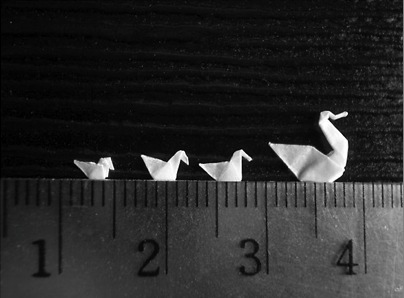
If you’re not fascinated, double-check the scale of the ducklings. When I saw Mui-Ling Teh’s page of amazing miniature origami at her RedBubble store, I was charmed. For those of you already looking for 2011 wall calendars, please be sure to check out each spectacular month of her calendar pages. (My favorite is December’s Arctic Playground, but use the comment section to tell me what you liked best.) For those of you who like to be dazzled at Zazzle, note that Mui-Ling Teh has a Zazzle store at http://www.zazzle.com/muiling* (and yes, the asterisk is intentional…think of it like a smooch from a tiny origami duckling).
While some of the paper art that inspired me was as small as miniature origami, other items that caught my attention were larger than life, or at least life-sized. For example, Chilean artist Don Lucho’s Casa De Carton art installation drew clicks on blogs all over the world when he built an entire apartment out of cardboard and paper — furniture and dcor included:

From cardboard bathrooms (with handmade toilet paper) to kitchenettes with cardboard spatulas,
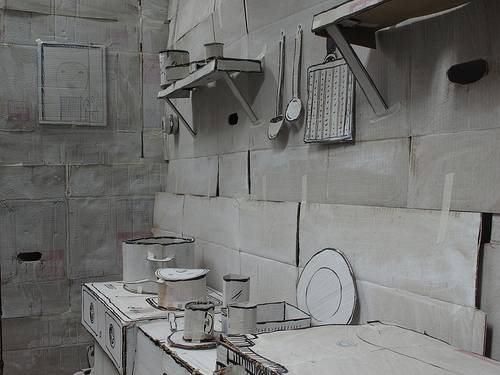
Lucho recycles packing materials into eco-art that wows the onlooker. For more of his projects, including a life-sized (but bloodless) cardboard auto accident, check out the posts at Pulpfactor and RebelArt.
In a blog that covers the gamut from recycling to conspicuous consumption, I’d be remiss to leave out Japanese artist Yuken Teruya’s work — he makes art trees out of the sides of the shopping bags in which his art is displayed! Be sure to click on each of The Saatchi Gallery’s Yuken Teruya works, from a McDonald’s take-out bag to the Louis Vuitton shopping bag below:
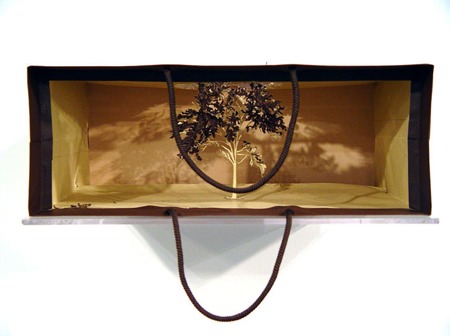
(Since last year’s anniversary post covered paper art shoes, it’s nifty to present the art of shoe bags. Next year, who knows? Shoebox art?) Be sure to check out the colorful Le Bon Marche bag and the stunning Marc Jacobs bag!
So, what might have come out of those shopping bags? While there were numerous newspaper-based dresses from the eco-fashion designers at last month’s Green Catwalk Event in New York City, Paper Doll feels that nothing they created is as stunning as the Louise Goldin paper dress created for Coutts & Co. in London:

(Curious about how it was constructed? There’s a video!)
Given that we’ve just finished a six-part series on book-related paper, the whimsy of UK papercut artist Su Blackwell requires a spotlight:

Talk about fairytales coming to life! Paper Doll is a huge fan of Jasper Fforde’s witty Thursday Next series (starting with The Eyre Affair), where “real-life” people can jump into books and interact with literary characters. Don’t you wish you could join this tea party? Blackwell’s visually arresting papercut art spans the literary spectrum from Alice to Peter Pan to Narnia. I can’t stop looking at her Woodcutter’s Hut:

It’s a temptation to cross the Atlantic to see Blackwell’s current Remnants exhibition at the Bront Parsonage Museum in Haworth (through the end of November). Can’t travel? Be sure to visit Blackwell’s site to view other book sculptures, installations and amazing commercial projects.
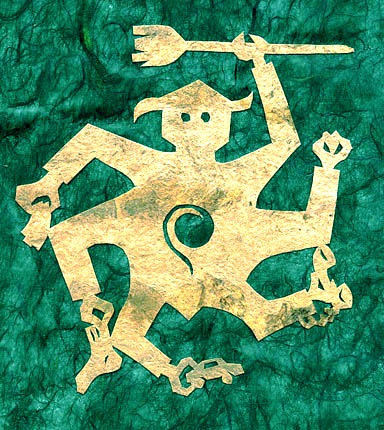
Papercut artist Rick Jones captivated me first with the title, Small Gods of Domestic Chaos, and then with the artwork, itself:
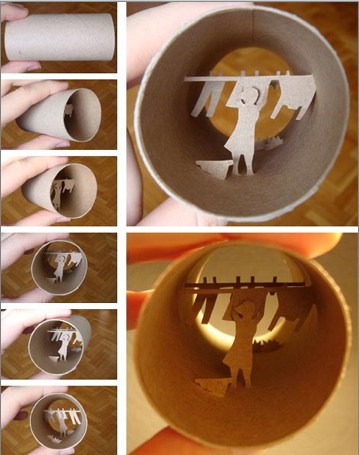
And what could be more domestic than the scenes created by Anastassia Elias, who crafts miniature worlds inside toilet paper rolls. Her three-dimensional Rouleaux projects miniaturize, with depth and clarity, tableaux raging from tango lessons to classroom studies, a visit to the zoo (and specifically, the giraffe pen) to sports scenes, and even laundry day:
Andrea Dezs was born in Transylvania, lives in Queens, NY, and creates for a world beyond imagination. She came to my attention through a New York Times article which displayed, among other pieces, a colorful painting of Star Trek-like aliens in leotards and deelyboppers. But her papercuts and silhouettes, from the political to the commercial (including an album cover for the Dixie Chicks spin-off group, Courtyard Hounds) to the “What is…oh my…will you look at that?!” are particularly captivating. This piece is one of multiple companions to Richard Rodriguez’s Final Edition: Twilight of the American Newspaper that ran in Harper’s Magazine in 2009:
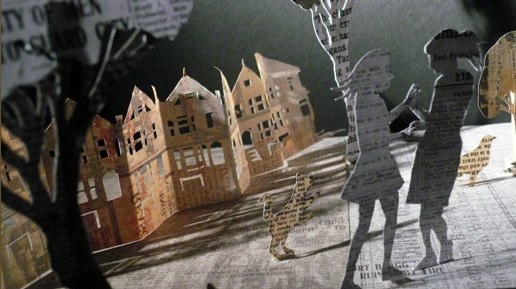
For you left-coasters, Dezs’s exhibition at San Francisco’s Frey Norris Museum goes through November 6, 2010.
This week, we are fanciful. Next week, Paper Doll will begin a fourth year of focusing on organizing paper to save you time, money and effort. Until then, please celebrate the entertainment value of paper. Meanwhile, I’m headed off to learn how to create a papercut city skyline for my paper dolls.
Thank you for three wonderful years!
Reducing Book Clutter (Part 6): Audio Books
There’s an ineffable quality to the warm memories brought on by that simple request. For most of us who love books — who love reading — the joy of the written word started with the joy of the spoken word. Amid “Once upon a time” and “In a land far, far away,” we developed our need to hear “just one more”. Stories warm our hearts and give our souls something to savor. It’s no wonder that we readers fill our spaces with books until every nook is overflowing.
In the first four installments of this series, we covered ways to reduce the clutter of books by changing the method of acquisition: renting books for adults and children, swapping books via web sites and borrowing from the library. Last week, we turned to changing the actual formats of books to help reduce clutter — via ebooks. In our final installment, we’re looking at listening…to audio books.
ADVANTAGES
Low-clutter — From an organizational standpoint, audio books reduce clutter because of how little actual space they need. Books on cassette offered little organizational advantage–in fact, one book (even abridged) required multiple cassettes. Books on CD slowly replaced tapes, and though CDs are compact and take up less space than tapes, they don’t dramatically reduce the pile-up. However, CDs can be ripped to .mp3 and other formats, so a book that takes up a dozen or more discs (which might get lost, separated from one another or stepped on) can be transferred to a computer, iPod or other audio player.
Portability — The ability to carry multiple books in digital format, whether on a computer or gadget, means never having to “weigh” your book options, literally or figuratively, whether you’re traveling around the globe or shlepping to the moon on your treadmill.
Affordability of Devices — While audio books, like ebooks, generally carry a cost, there is a decided advantage in the gadgets one may use to “read” audio. While the Kindle and Nook are priced in the hundreds of dollars, an .mp3 player can be had for as little as $10 (though, of course, most of us are tempted towards the pricier iPod line).
Paired Tasking — As a professional organizer, I eschew multitasking. You can’t effectively do two things at once if intellectual involvement is required for both. However, audio books let you do one thing that no other format allows — you can read when your hands and eyes are otherwise occupied. Audio books, particularly in digital format, let you commute (in your own vehicle or via public transportation), work out, travel, do housework or almost anything else that requires physical, but not mental, focus. Your eyes can be open or closed, your hands full or empty…and you never have to leave the story.
Interoperability of Formats — Burning a CD to .mp3 or changing from one format type to another is relatively simple and problem-free.
Immediacy — Although there aren’t currently any super-speedy sci-fi methods of acquisition along the lines of Amazon Kindle’s Whispernet, you can purchase an audio book (as a digital file) and begin listening immediately. No trip to the library or bookstore is necessary.
Environmental-Friendliness — The pressing and packaging of CD versions aside, audio book files require a relatively small carbon footprint.
DISADVANTAGES
The Voice — When you read, your imagination substitutes the voice type and vocal mannerisms, the verbal tics and aural characteristics of the characters in fiction. Even before you saw the big-screen versions of favorite books, you just “knew” how Mr. Darcy or Albus Dumbledore should sound. Most fiction audio books have one voice (sometimes the author, sometimes a famous actor, sometimes an unknown reader) relaying the story, and while audio book producers generally do an excellent job of ensuring that you know whether you’re hearing a character (and which one) or the narrator, the creative experience of reading is altered.
Of course, in another way, it’s very much the same experience as having a book read to you as a child, and that can make the experience enjoyable in an altogether different way.
The Feel — As referenced last week with ebooks, the tactile sensation of reading a traditional book is missing from the audio book experience.
Higher Costs of Books — Fewer people buy audio books than tangible books, decreasing the economies of scale of production. And, of course, it costs more to produce an audio book (with talent, directors and producers) than a traditional book. However, as digital formats don’t require storage or additional print run costs, we may anticipate increased price parity in the future.
No Reference Material — With fiction, the story is all. However, with nonfiction audio books, footnotes, end notes, reading lists, glossaries and other extras are generally lost.
No Searchability or Bookmarking — Audio books don’t just lack tables of contents and index material. With a traditional book, or even an ebook, you can manually or digitally search for text or phrasing or bookmark pages or sections. With an audio book, you can return to where you stopped, but you can’t quickly find specific passages or sections unless you a) have a counter and b) previously noted the counter position.
Impermanence — Although audio booksellers can’t steal back books sold after the final sale (as in our Orwell tale last week), two issues remain:
1) Technology Failures — A computer or gadget crash can damage your ebook library, and any titles you haven’t backed up. (So back up frequently!)
2) Changing technologies — Unlike the myriad ebook formats, there are relatively few popular audio book formats: .mp3, .wma, .ogg and .aac. Although CDs and digital files are hardier than tape, the lack of backward compatibility means that unlike a family Bible or favorite novel, it’s doubtful that anyone will pass down a library of .mp3s to their great grandchildren.
FREE AUDIO BOOKS
There are numerous sources for purchasing audio books, of which Audible (which offers a free 14-day trial) seems to be the most highly esteemed. However, as Paper Doll‘s mission is as much to help you organize your little green pieces of paper as it is to declutter your bookshelves, I’d like to review the least expensive options for acquisition:
Your Public Library — Many public libraries allow cardholders to “borrow” audio books. Peruse your library’s web site for references to NetLibrary or Overdrive, or search Overdrive to see whether your library is a member, providing DRM-free audio books. Depending on your library, there may be a limit on the number of audio books you can borrow concurrently. Downloads are “returned” automatically after a limited borrowing time.

Project Guttenberg – The Audio Books Project — The same Project Gutenberg we discussed last week, which offers thousands of public domain ebooks, has a wide variety of public domain audio books read by volunteers as well as texts read by computer. In English, choose from Aesop to Emile Zola; there are more than a dozen non-English languages with large collections, and a few dozen other languages, from Afrikaans to Yiddish, represented as well.

Learn Out Loud maintains a library of over 25,000 audio book titles, of which 2000+ are free. While most free audio book sites lean towards fiction offerings, Learn Out Loud concentrates on non-fiction — you’ll find a treasure trove of books on arts and entertainment, business, history, philosophy, politics, religion, science, self-development and more, downloadable for free in the .mp3 format. Place free titles in your shopping cart as if you are purchasing a book, place your order, then follow the steps to “My Downloads” to get your audio book.

Audio Books for Free isn’t the prettiest site on the web, but all of their titles are produced with professional actors/readers, directors and producers. Registration is required but free, and then you can search by genre and title, and even filter by language, play time, author, reader, and, if you’re a sensitive soul, filter out “strong language”, murders and adult themes. For a one-time $100 fee, you can gain access to higher quality audio formats.

Books Should Be Free offers hundreds of free public domain audio books suitable for the iPod or any .mp3 player. Classic titles are available in languages ranging from Ancient Greek to Urdu and in genres as varied as historical fiction, romance and sci-fi to humor, poetry, memoirs and religion. For each book, there’s a synopsis, a link to the Wikipedia entry, an audio preview and a link to the Project Gutenberg text version. (In the same vein as Charlotte Bronte’s “Reader, I married him”… Readers, I’m listening to Jane Eyre as I blog.)

Podiobooks delivers serialized chapters or sections of audio books by RSS, as if they were podcasts, to your iTunes or other podcatcher or RSS reader that handles embedded media. Alternatively, listeners can listen “live” or download episodes of books directly from the site, without any subscription. Unlike most free audio book sites, these titles are not out of the public domain, but are actually newer works. Some authors choose to make their books available for free to increase exposure, while others hope free audio versions will incline readers towards buying tangible copies, as well.
LibriVox is a non-commercial, non-profit library of free public domain audio books, but with a twist — books, even individual chapters, are read and recorded by users rather than professional actors or readers. You can subscribe to LibriVox’s thrice-weekly podcast to listen to the current book. Or, browse the entire catalog or search by author, title or genre to find what you want, then either download a zip file of an entire book or subscribe to it in iTunes. Listen through your computer, copy to your gadget of choice, or burn to CD. If the site’s goals intrigue you, consider volunteering to record yourself reading a beloved book or even a chapter.
Thought Audio is a small but growing free library of classic literature and philosophy texts in .mp3 format (available for live listening or free download). If you’d rather bypass the downloading of each segment separately (ideal for sequential listening or those with slow download speeds), a $10/year Zip Pass lets you download an entire (zipped file) book with one click.

Americana Phonic offers audio narration of American historical works and current government works in the .aac format. Make history come alive–for free. Haven’t you always want to do your yoga to a soundtrack of The Federalist Papers? (No? It’s just me? Sigh.)
Want more? Gizmo’s Freeware has a list of 64 sites for acquiring free audio books. Search by genre or by site name.
LOW-COST, LOW-TECH OPTION
Cracker Barrel — If you’re on the road a great deal and haven’t yet sprung for an .mp3 player, consider this novel approach for satisfying your literary cravings from the people who satisfy your biscuit and gravy cravings. Purchase a Book-on-Audio CD at any of their 400 locations in thirty-eight states. Titles tend to be new or recent releases. Listen, then return at ANY Cracker Barrel for a full refund (less a $3.49/week rental). Lather, rinse, repeat. For long-haul drivers, serious commuters and others who spend too much time in the car, this can be a fun, low-cost option that fosters a “one in, one out” approach for keeping the clutter of audio book CDs at bay.
I hope you’ve enjoyed this ramble through the various approaches to reading to your heart’s content while minimizing the tangible clutter of reading material. No matter where you acquire your books or in what format you devour them, Paper Doll wishes you happy reading!
Reducing Book Clutter (Part 5): Electronic Books
Until now, this series on decluttering books has focused on methods of acquisition and dispersal: renting, trading and borrowing. But one reader wrote me after the first post, rejecting the premise of the series — she couldn’t get past the notion that books could equal clutter.
Books, per se, are not clutter, but too many books without homes (shelves, cases, etc.) and no system to care for or retrieve them, does constitute clutter. Renting, trading and borrowing offers the opportunity to acquire books, read them, and, for those titles one is unlikely to read again, send them on their way. Imagine if you “kept” every television program or movie you ever watched or every song you ever listened to, whether on tape or CD or DVD. Eventually, you would run out of space, and without space, you lose organization.
But what if space were not an issue? MP3s help us acquire and keep the music we love without fear of being crowded out of our homes. Thus, this week and next, we’ll focus not on methods of acquisition, but formats which minimize clutter while maximizing our enjoyment of books.
EBOOK BASICS
Ebooks are electronic versions of books, formatted to be read on computers, cell phones or special electronic ebook readers. Devices include Amazon’s Kindle, Barnes & Noble’s Nook, Apple’s iPad, Sony’s Reader and various others.
Different devices accept different formats. For example, Amazon created the proprietary AZW format specifically for use with the Kindle, but there are multiple formats that work on computers as well as most gadgets, like .epub, .pdf, .html, .txt, .mobi, etc.
ADVANTAGES
Portability — If you’re a voracious reader, carrying the multiple books you’re reading concurrently can be a pain. Having one small, manageable device giving you access to thousands of titles whenever you want is pretty appealing.
Searchability — Don’t you hate it when you can’t find that one phrase or statistic you need? I am forever seeking my favorite literary snippet, from Suzanne Finnamore’s Otherwise Engaged:
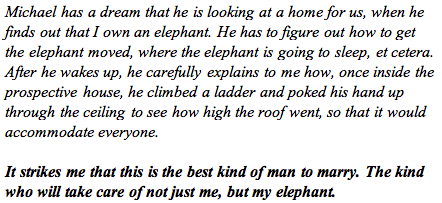
Yes, I can just use a bookmark or tape flag, but what if a book were full of important quotes? Most ebook reader software offers search as a feature, and browser-based platforms let you use your browser’s search function. With many e-reader software formats, you can not only search, but also bookmark and annotate material without any damage to the original or fear of your bookmark fluttering away into cyberspace while reading Winnie the Pooh and the Blustery Day.
Immediacy — Whether you’re using Amazon’s Whispernet or the internet, the moment you want an ebook, you can order and/or download it and access it within minutes, without ever getting out of your chair.
Savings — Because ebooks cost less to produce, in most cases that cost savings trickles down to the reader.
Environmental Friendliness — Sure, metal and plastic go into the making of these devices, but no trees are killed, and there’s practically no carbon footprint associated with “manufacturing” ebooks.
DISADVANTAGES
Tactile sensation — There’s nothing like curling up with a favorite old book. Depending on the titles in your personal library, you may be able to tell which book is which by the color, binding, typeface, heft, feel of the pages…even the scent. When you read digitally, every book feels the same. Kinda beige.
Digital Rights Management — Unlike hard-copy books which you own in full, ebooks with DRM protection can’t be copied, sold or shared. (Barnes & Noble does have a two-week LendMe feature.) The books you buy are yours, but not “all” yours.
Impermanence — As long as you don’t drop your book in a bubble path or let a three-year-old attack it with scissors and crayons, there’s not much you can do to a traditional book to make it unusable. This is not the case with electronic books.
If you have an ebook saved to your computer or e-reader and have not backed up (to Dropbox, Carbonite, etc.), a crash can wipe out your library. (Note: Kindle users can store their titles in their accounts and gain access even if their hardware fails; unfortunately, one can only save Amazon purchases and not free books acquired elsewhere).

There are other back-up options. For example, Bookworm is a free personal ebook library where you can store (and read) your digital books. Once your epub-formatted titles are uploaded, Bookworm organizes the chapters and individual pages for easy navigation and browsing, and you can search for specific words, phrases or references. Read books directly from your Bookworm library on any mobile device or online.
Changing technologies also cause impermanence. Floppy discs gave way to very un-floppy diskettes, and now everything’s on CD or flash drives. Technology is often not backward compatible. One has to wonder how easy it will be to access the books bought for the original Kindle or Nook a dozen years from now.
Commercial mistakes also lead to impermanence. Last year, when Amazon learned it had mistakenly sold digital copies of certain George Orwell books to Kindle users, consumers awoke to find Amazon had used wi-fi to remove the books from their Kindles overnight and credit their accounts. How very 1984! Imagine your corner bookshop proprietor sneaking into your home late at night to retrieve a copy of the book you bought last week and leaving a $20 bill on the bookshelf in its place. Creepy.
Format incompatibility — As noted above, there are different formats and they do not always play nicely with one another. When I asked on Twitter what people didn’t like about their e-reader devices, almost every response was a variation on “No easy way to convert existing PDFs to Kindle-friendly/reflowable format…” It’s not always easy, but it is possible.
Calibre is a free, open source (Windows-, Mac- and Linux-compatible) application that lets you manage all of your ebooks across multiple platforms and formats. Use Calibre to import and manage titles in your collection, one title at a time or whole directories, synchronize multiple devices and most importantly, convert between formats. Calibre can convert among all of the following digital book formats: epub, FB2, lit, lrf, mobi, PDB, PDF, PMLZ, RB, RTF, TCR and txt.
Stanza is a similar freeware application for use with the iPad, iPhone and iPod Touch. It supports exporting a wide variety of formats for use on various third-party devices and provides access to an online catalog of thousands of free classic books. You can also use Stanza to organize your library share books by dragging titles into your iTunes library.
MIXED BLESSINGS
Annotating — You can annotate an ebook (in many formats), but because you’re doing it digitally instead of manually, it’s not the same tactile experience. Thus, annotating an ebook doesn’t go as far for fixing a concept in memory as taking notes might.
Bookmarking — Many formats allow for bookmarking. But if you normally use sentimental objects or visually appealing bookmarks in your tangible books, finding your place in a digital book lacks the same pizzazz.
Sharing — A true joy of reading is sharing with others. Depending on the device and format, DRM restrictions may prevent you from sharing your ebooks. With a PDF, it’s as simple as emailing an attachment or putting it in a shared Dropbox folder. However, Nook’s LendMe only lets you lend any book one time, and with Kindle, you can’t share at all.
BEST OF BOTH WORLDS
Ebooks offer the opportunity to acquire books immediately, carry multiple titles at once and search with ease. Tangible books are sentimental and romantic and just feel right. Of course, there’s no need to choose between the two. Once you find a format you like, acquire ebooks for titles you’re likely to read only once (or for a limited period of time); buy your favorite books and works by your favorite authors in tangible versions that let you keep the experience alive. Have your cake and eat it, too.
FREE BOOKS
There are countless sources on the web for purchasing books in electronic form, from massive bookstores like Amazon and Barnes & Noble to individual websites that sell PDFs you can read on your computer (like my own Tickle Yourself Organized). However, the best way to experiment with a new option is to do so without any potential for loss. The following are excellent free options for ebooks, available in formats that should work on most e-readers as-is or with some file conversion:

Project Gutenberg is the original ebook repository, started in 1971 as a project to digitally archive cultural works specifically for electronic dissemination. Download over 33,000 free books to your computer, iPad, Kindle, Nook, Sony Reader, iPhone, iPod Touch, Android or smart phone for free. The copyright on all Project Gutenberg titles have expired in the U.S., putting them in the public domain. Most books are available in plain text, but epub, PDF, HTML and other formats are available, too. Search by author, title or genre, or browse the online bookshelves, whether from your computer or digital device.

ManyBooks has an attractive interface offering over 28,000 free digital books and a variety of digital conversion tools so you can read the book you want in the format most useful to you. Register for free, then browse by author, title, genre or even language, and peruse the site’s list of new and recommended titles. Categories range from adventure to women’s studies, banned books to instructional titles, cookbooks to correspondence, plus the standard fiction and non-fiction. You can get RSS feeds of newly listed titles to discover unexpected gems.

Feedbooks is a particular boon to Kindle users, who sometimes have difficulty getting non-Amazon public domain books onto their devices. Download the Feedbooks Kindle-formatted catalog via your built-in browser or download to your computer and copy it to your Kindle via USB cable. With your wireless access turned on, browse, select and download from Feedbooks just as you would from Amazon, only the books will be free and in the public domain.
Your Own Public Library — Visit your public library’s website to see if they offer the ability to “borrow” ebooks. Library Finder at Sony’s Reader Store helps you locate a library, and as long as you have a library card suitable for a brick and mortar branch, you should be able to access epub- and PDF- formatted ebooks for free.

Perseus Digital Library — How do you feel about Greek and Roman classics? If “All Gaul is divided into three parts” is up your alley, then Catullus, Cicero, Virgil, Homer and the gang are waiting here for you to download them in .txt format.

Books In My Phone allows you to acquire books that are either out of copyright or licensed under Creative Commons, but you don’t need an e-reader. Any java-enabled cell phone becomes a book reader, and BIMP’s reader software is packaged with each book. Search books by author, title or category tag, from either your computer or cell phone. Then either download the book to your computer to install on your phone later (using no cell minutes) or download books directly to your phone (incurring cell provider charges). If a call interrupts your reading, you can pause the book; it automatically remembers where you left off when you open the “book” again.

DailyLit — If you’re not sure how you’d like reading non-paper versions of books, get a taste test by receiving bits of books by email. DailyLit is a free service that breaks books down into short installments and emails them to you. Read on your computer, smart phone or PDA. You choose how many installments you wish to read each day, and you can “push” to have more installments sent right away, whenever you like.
Whether you choose to read just some or all books electronically, knowing that ebooks are an option can help you keep your ebook clutter at bay.
Reducing Book Clutter (Part 4): Borrowing Returning–A Library Love Letter
“Whatever the cost of our libraries, the price is cheap compared to that of an ignorant nation.”
~ Walter Cronkite
“Libraries will get you through times of no money better than money will get you through times of no libraries.”
~ Anne Herbert
“There is not such a cradle of democracy upon the earth as the Free Public Library, this republic of letters, where neither rank, office nor wealth receives the slightest consideration.”
~ Andrew Carnegie
Over the last few weeks, we’ve talked about how to reduce the clutter of books in your space by changing the method of acquisition. First, we reviewed renting books for adults and children, and then we discussed the merits of participating in book swapping web sites. Starting next week, we’ll look at ways of changing the actual formats (audio, electronic, etc.) of books to help reduce book clutter.
September is National Library Card Sign-up Month, and in its honor, today, before we go onward with more high tech solutions, we’re going to cover one more old school option: libraries!
Paper Doll has a special affection for libraries. From the day after I turned 16 until I left for college, I was a page in at Williamsville, New York’s Clearfield Public Library. As much as I love being a professional organizer, I cannot imagine a better job than page. I got to organized books! Patrons returned books to the front desk and the giant, echo-y, outdoor metal book bin, and abandoned unshelved titles willy-nilly all over the library. We pages got to put books away, reorganize the shelves, make recommendations, and help readers check out.
Indeed, the only thing that ever saddened me about working in the public library was working at the check-out desk and hearing a parent stifle a whining, begging child by hissing “No! You have enough books!” While I now realize most of these overburdened moms and dads were probably thinking of the clutter of lost books and late fines, Paper Doll could only wonder what that strange phrase could possibly mean. “Enough books?” Enough books, like enough chocolate or enough George Clooney, still puzzles me.
LIBRARY WOES
In recent posts, I’ve touched on some of the drawbacks of libraries (besides all that shushing). In a bad economy, patrons turn to their libraries to save money while satisfying a collective literary sweet-tooth. The problem? Those same economic downturns lead municipal governments to chip away at the budgets for libraries, meaning, as we’ve said before, curtailed branch hours, reduced staffing at libraries, reduced acquisitions of new titles and fewer circulating copies.
Paper Doll can only imagine what Benjamin Franklin, founder of Philadelphia’s first lending library, would have thought if he’d time traveled here in the past year or so. In 2009, Philadelphia’s proposed (but defeated) Plan C budget would have forced the closing of the entire Philadelphia Free Library system! And what would old Ben have thought if he’d heard Fox Chicago News’ conjecture that libraries might be a waste of public money! Of course, one imagines his chagrin would have been tempered by pride in the response from Mary Dempsey, Chicago’s Public Library Commissioner, whose every word Paper Doll advises savoring.
Nonetheless, budget issues aside, at least while our libraries stand, they are an excellent source of information, education, entertainment and culture, and today’s post is as much a love letter to the concept of libraries as it is an exploration of another alternative method for conquering book clutter. Thus onward to borrowing…and returning…library books.
THE BASICS
Unlike the recent posts, there aren’t a lot of complicated instructions for making use of your library. In fact, you almost certainly know what to do:
1) Find your local library system/branch.
2) Acquire a library card, if you don’t already have one. Anyone can use a public library, but to borrow books and other items, you’ll need a card, and to get a card, you’ll need proof of identity and of residence in that city, town, county or parish. Usually, a picture ID bearing your address or a combination of ID and postal mail sent to you at that address will suffice. If you live outside the community your preferred library serves, you can usually acquire a card for a small fee — less than the cost of one hardcover book.
3) Borrow books (as well as magazines, CDs, DVDs and any other resources your library has in its collections) for periods ranging from one week to one month. Many library systems will let you renew books and put books on hold online, using your library card account number.
4) Return items on time. Public library late fines generally vary from as little as five cents to about a quarter, per day–not much for one book, but if you’ve got a dozen books out at a time and have a propensity towards forgetting to return them, the costs can mount.
KEEPING TRACK OF YOUR LIBRARY BOOKS
A few weeks ago, I noted that one way to avoid losing track of borrowed library books (especially children’s books) is to designate one shelf or table where all borrowed items live. Teach your children and family members to return items to that space when the reading, listening, watching or playing is over. This decreases the likelihood of titles getting lost or mixed in with family possessions and increases the chance that items will be returned on time.
An alternative, one that’s admittedly more likely to work if you’re a solo borrower and not the keeper of the family’s borrowed treasure, is to keep all library books — except the one currently being read — in an official library book bag or tote. Yes, you still might misplace one book, but it keeps the others from getting buried under household clutter.
Paper Doll is generally in favor of totally-free access to books. However, if you have multiple children close to the same age, who tend to read (and misplace) the same books and blame the losses on one another, you might want to develop an in-house library system. Yes, it means a little more labor for mom and dad, but it helps teach responsibility. Keep all the books in one location, preferably out of easy reach of the kids, and have them “sign out” books they want to read and sign them back in again, so it’s at least clear who last had any given book…though it still won’t magically find one your child has left on the bus.
There are a variety of ways to remind yourself to return your library books. Some simple options:
–Before leaving the library with your books, set an alarm on your cell phone or PDA for the day BEFORE the library books are due. (Depending on whether you’ve borrowed 7-day and 28-day books, you might have a few different due dates.)
–Before leaving the library, use Remember the Milk or any of the many varieties of online To-Do sites to remind you when to return the books.
–Once you get home, post the charge sheet (the little receipt your library gives you, noting the dates) on your family bulletin board and/or mark the dates on the family calendar.
–If you tend to borrow so frequently that you’ve got dozens of books with numerous due dates out at once, set a recurring weekly alarm on your phone or task on your computer to log into your library’s online account. You may still miss a date or two, but by a day rather than a full week.
–Get in the habit of visiting the library on the same day each week. Regular rituals not only get your children in the lifelong habit of reading and library-going, but will make the whole borrow-and-return process more ingrained.
–Ask a little elf for help:

Library Elf is an internet service designed to help library patrons keep track of what they’ve borrowed and when items are (or were) due. The service is available in the United States and Canada, as well as for some patrons in the UK, Australia and New Zealand.
Library Elf has two levels of service. At the basic (free) level, any one single user gets email alerts of books that are due or overdue (according the notification frequency they’ve specified). Premium users can keep track of multiple cards/accounts and receive additional benefits: RSS feeds, text message alerts for titles on hold that have become available, iCal and Elf calendars with borrowing summaries, and email support.
Premium membership costs $12/year to monitor one library card or $20/year to oversee multiple cards. New users receive a free trial period (three weeks or 6 alerts) at the premium level, after which service continues at the basic level unless a user opts to upgrade.
Library Elf has partnered with numerous “subscriber” library systems around the country. Is yours one of them? Patrons who register through libraries that are already Library Elf subscribers receive the multiple-card premium service at no cost.
(Paper Doll wonders if perhaps it’s not quite in the best interest of libraries to be too active in reminding patrons of their overdue books. Aren’t their budgets somewhat dependent on fines? Then again, what institution embodies the concept of selflessness as much as the public library?)
THE LIBRARY ANNEX: THE EXTRAS
In addition to libraries being the perfect source of reading (and other) material with a built-in deadline that encourages you to frequently gather your book clutter and remove it (even if only temporarily, until you acquire more books), your public library system is a source of magnificence.
The American Library Association’s list of 52 Ways To Use Your Library Card and SavingAdvice.com’s Jennifer Derrick’s 27 Free Things At the Library are a great start, but I invite all of my readers to share their favorite, even unexpected, library offerings. Whether your library means a place to discover books on topics you didn’t know existed or a quiet, air conditioned locale to check today’s newspaper, whether it’s a venue to take a workshop on organizing or a cozy nook to take your children for story hour…what does your library mean to you?
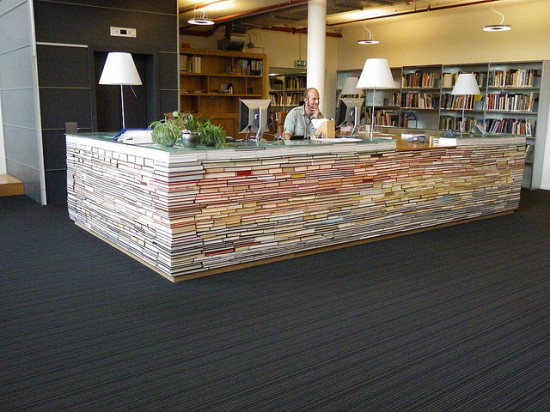
And just to show that even libraries are sometimes at a loss as to what to do with extra or outdated books that will likely go unread, the library at the University of Delft in The Netherlands boasts a reference desk made of repurposed books:
Finally, another library-related way you can declutter your collection of books and magazines? Donate them to your public library system’s annual book sale. The revenue from selling your books helps fund all of the great programs at the library, and you have the benefit of getting a tax deduction while decluttering your home of the reading material you’re not likely to revisit.
Next week, we continue our book-loving saga with the digital side of reading. The plan for the remainder of this blog series is to focus on no-cost and lost options, so even if you’ve never listened to an audio book or think reading a book on a screen is sacrilege, I hope you’ll be back for more.
Follow Me