Paper Doll
The Gift Card Revolution (Part 3): Top 10 Tips For Organizing Your Gift Card Experience
We should give as we would receive, cheerfully, quickly, and without hesitation; for there is no grace in a benefit that sticks to the fingers.
Over the last few posts, we’ve discussed the relative merits and drawbacks of gift cards, looked at how the changing regulations improve consumer rights, and examined the traits that the best cards have in common. We also looked at how to get rid of unwanted cards without giving up on the monetary value they hold.
Gift cards, the sleek, modern embodiment of gift certificates, help you give portable, desirable, clutter-free gifts that ensure your loved ones get what they really want. As we head into gifting season, Paper Doll encourages you to keep the following in mind to keep your gift card usage organized:
1) Purchase, give and redeem gift cards with confidence by knowing the regulations. As a reminder, the main highlights of the new rules are:
- Gift cards can’t expire for at least 5 years from date of issuance or the last date the card was loaded/reloaded with funds (provided it’s a store gift card or general-use prepaid card, and not a phone card).
- Gift card issuers can’t charge inactivity or dormancy fees for at least 12 months after the last use, whether that involves redeeming or adding funds.
- Every gift card must include disclosure of fees, an expiration date and a toll-free telephone number or website where you can get more information.
Read the fine print. Although the new federal regulations (and any more stringent regulations your state may have in place) provide more legal protections than previously, as I mentioned a few weeks ago, the ECO Card Act exempted cards produced prior to April 10, 2010 from the new disclosure agreements until January 31, 2011. Thus, while the cards you buy from this February onward are required to have all terms (expiration dates, fees, etc.) listed right on the card, the ones you purchase this holiday season may not bear all the essential information.
Since the new rules do require retailers to provide the details via general advertising, signage in the stores, language on their websites and during customer service calls, don’t feel squeamish about searching out the information and insisting cashiers or customer service reps provide you the necessary information before you plunk down your money.
2) Get the best deals. First study, then shop.
Review the research from Bankrate’s study to know what features each merchant’s card has, and peruse ScripSmart’s Best Cards list from last week to build your own version of Oprah’s Favorite Things. Be sure to skip the merchants on Scripsmart’s Cards To Avoid list.
Find the best discounts on the cards you’ve decided to purchase. Stick with companies that offers a 100% guarantee, like Plastic Jungle and Gift Card Rescue, as we discussed last week. Also consider checking out

GiftCardGranny, which acts like Expedia or Travelocity, but for gift card sites. GiftCardGranny receives the inventories of the major gift card discounters and displays all options so you can compare apples to apples (or iTunes to iTunes) to get the best discounts. Once you find the deal you want, click through GiftCardGranny’s site to take you to the discounter to make your purchase.
GiftCardGranny also helps you check your gift card balances. If your pre-new regulations card lacks a toll-free number, or your two year old has taken a Magic Marker to the surface of your gift card, just click through GiftCardGranny’s gift card balance page to get the toll-free number, web address and, if applicable, store locator for brick-and-mortar merchants.

EBates, best known for digital rebates providing cash back for shopping online through the EBates portal, offers a nifty gift card incentive. Since EBates is a portal, you’re really doing all of your online shopping at the actual web sites of your favorite online merchants — you’re just getting there through a middleman. Imagine if every time you walked into your favorite store at the mall, there were a doorman who slipped you a tip. It’s like that.
When you sign up for an EBates account and then purchase a gift card after clicking through their site, they’ll credit you and give you cash (well, a check) back…with no paperwork required! How organized!
Get extra bang for your buck when using your gift cards online. Use your favorite search engine to locate discount or coupon codes. For example, Google “YummyRestaurant discount code” or “SuperCoolStore coupon code” and review what comes up at sites like Retail Me Not, Current Codes and Coupon Cabin. Canadian readers can use Retail Me Not’s Canadian page, Good Bazaar and Voucher Codes. When you shop, you’ll either go through the portal to apply the discount or be alerted to type in a provided coupon code at checkout, lowering your initial cost; then apply your gift card to the total.
3) Avoid fraud.
Whether you buy a gift card at the store or via one of the online discount marketers, once you get the gift card home, call the toll-free number or check the online URL to verify the balance on your card. It should equal what you paid. If not, call or return to the store as soon as possible and speak to Customer Service. If you purchased from a discounter, take advantage of the 100% guarantee to get a replacement card or your cash back.
(If you got the item as a gift, let your benefactor know. If he or she still has the receipt, you can report the fraud and have a fair chance of having the value replaced.)
4) Read the business headlines.
Know who is on the brink of bankruptcy or in the middle of restructuring. Unless you’re buying a card you know will be used right away, opt for stores with robust bottom lines. Whether you follow mainstream media or web sites like Google Financial News or the online Wall Street Journal, educate yourself.
5) Help your recipients get all they deserve.
If you purchase a gift card in a large denomination, or you believe the recipient might not use it right away, ask the cashier for a gift receipt. Then, keep your receipt for your records, as necessary, and provide the gift receipt along with the card to your recipient.
If you purchase gift cards online, route all your online receipts to one “Gift Receipts” folder on your hard drive. It will make it easier to verify purchase dates and forward the information to your recipients.
Let your recipient know that it’s the purchase (or fund reloading date) that starts the expiration clock–not the date on the card. After a card’s expiration, your giftee can call the toll-free number and request a new card. Retailers must do this for free or return the remaining balance.
6) Organize your own gift cards in an easily-accessible place.
For brick and mortar stores, convenience is key–you don’t want to hold up the lines. If you only have a few cards, dedicate a pocket of your wallet for gift cards, or keep them with your cash, as they act as faux money.
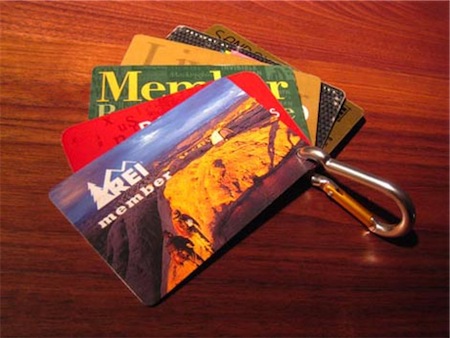
To organize multiple gift cards for power shopping, work with your personal style. If you’re a no-frills person, use a heavy-duty hole punch to punch a hole in a corner of each card, carefully avoiding the magnetic strip, bar code or information regarding the toll-free phone number or URL. Then run all of your cards on one inexpensive keyring or carabiner, just as we discussed doing for retailer loyalty cards.
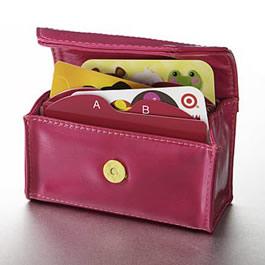
If you prefer a more fashionable method for organizing gift cards, consider keeping a Card Cubby (as I reviewed here) in your bag.
Whatever your style, take time to review what cards you have before a shopping spree.
For gift cards you’re most likely to use at an online store, tidily keep cards together in a petite (6-1/2″ x 3-1/2″) Smead Tag Along Organizer
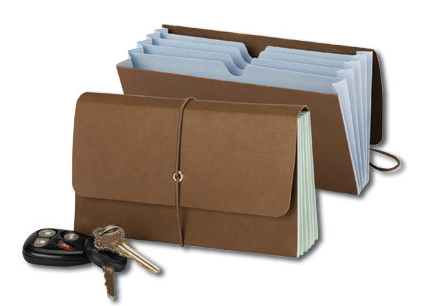
at your bill-paying station or computer so you can remember what cards you have when it’s time to make an online purchase.
7) Remember to use your cards.
Get in the habit of checking which restaurant cards you possess before making lunch dates or dinner plans. If you’re likely to forget you ever even received gift cards, make notations on your calendar or a recurring appointment alarm on your cell phone and/or computer to remind you to check which cards you own. Just re-familiarizing yourself with which cards you posses will help keep the cards at the top of your mind; having your cards with you, when and where you shop, will make you more likely to reap the rewards your cards have to offer.
Keep track of the last time you used your cards, too. Whenever you spend money or load more funds on a gift card, use a mini Post-It or even write the date on the back of the card with a Sharpie. This will help you keep track of when those 12-month inactivity fees will kick in.
8) Restart the clock. Because many cards are reloadable, consumers can extend the expiration period as well as the dormancy period. Thus, if you have balance on a card that’s likely to start earning a service fee for dormancy, add $1 to the balance, thereby restarting the inactivity/dormancy clock for another 12 months.
9) Re-gift, sell, or donate the cards you know you’ll never use to maximize the value.
10) Cash in your bounty!
The clock is ticking, so don’t procrastinate. We all have a tendency to save things for special occasions. Too often, the opportunity to enjoy something is put off so long that we miss out. So, use the good china, wear your best outfit, and cash in those gift cards before the chance is gone.
Make any day a special occasion. Instead of letting your gift cards languish, gather your friends or family together to dine out with you and use that restaurant card. Buy that nifty gadget or new book or attractive sweater, content that it makes no dent in your budget and yet lets you pamper yourself. You deserve it.
Research proves the best and most memorable gifts are clutter-free, those that allow recipients to enjoy experiences rather than things they’ll have to dust, dry clean or store in the attic. Thus, focus on gift cards for experiences: restaurants, theater tickets, cooking classes, spa treatments, etc.
For more clutter-free gift ideas, particularly those in the easy-to-wrap gift card category, as well as advice on how to maneuver through the holiday season unscathed (financially, emotionally and in good health) please check out my ebook, Simplify the Season and Save Your Sanity.
The Gift Card Revolution (Part 2): Get the Best Deals, Avoid Fraud, and Set Bad Cards Free
Last week, we reviewed how new regulations regarding gift cards help gift-giving consumers and their recipients keep more of the value of their cards. Knowing the protections available is a great start, but there’s more you can do to improve your gift card experience. Today, we’ll weigh the relative value of gift card options, protect you from fraud, and review ways to unload unwanted gift cards for a financial (or charitable) benefit.
THE BEST AND THE WORST
Those new regulations cushion the impact of the worst offenders, putting a buffer between consumers and those annoying fees and expiration dates. But that doesn’t mean all cards of the same denomination have the same value. To borrow from George Orwell, some gift cards are more equal than others.

Bankrate.com studied and ranked 54 of the most popular gift cards on features ranging from existence and types of expiration dates and fees to the availability of online balance checking and free shipping.

In this study, Bankrate examined 46 retailer cards for mass retailers (from Target and Walmart to Macy’s and Nordstrom), restaurants (ranging from McDonald’s and Taco Bell to the more upscale Bonefish Grill and Maggiano’s), clothiers (like Old Navy and The Gap), and specialty merchants (like bookstores, spas, office suppliers and home improvement stores). Bankrate also reviewed eight network-branded (Visa, Discover, MasterCard and American Express) cards.
Bankrate found, as we discussed last week, that most Closed Loop (i.e., retailer) cards have few fees and don’t expire. Most Open Loop (network branded) cards, however, generally come with fees at the time of purchase as well as more fees after purchase, such as inactivity and administrative fees. The eight Open Loop cards Bankrate surveyed all charged purchase fees at the point of sale, and all but two had expiration dates.
So, while your recipient will have a wider array of purchase options if you give a Visa or American Express gift card, it’s going to increase your up-front costs and decrease the actual gift value for slow-pokier recipients. Thus, if you have any familiarity at all with your recipients’ tastes, Paper Doll advises selecting a retailer card instead of a network-branded card. If you’re truly worried that you can’t identify their preferences, opt for a card at a store that offers a wide array of goodies, like Target or Kohl’s, to maximize the bang for your buck.
It’s worth reviewing Bankrate’s list of cards before setting out on your next gift card shopping spree.

ScripSmart is an online service that helps members keep track of the expiration dates of their gifts cards, “nags” them to make use of the cards they’ve registered, and alerts them if their cards are in danger due to issuers’ impending insolvency.
ScripSmart also reviews and scores gift cards based on 30 specific features and policies. “Great” cards fall in the 80-100 range — sort of an honor roll of gift cards, while “Average” cards sit in the 60-79 range and “Buyer Beware” cards fall below 60.
ScripSmart recently posted a list of gift cards to avoid. (You weren’t really going to buy anyone a Rite-Aid gift card for the holidays, though, were you?)
Remember last week’s quiz regarding the most highly regarded organizing-related gift card? Coming in on top of ScripSmart’s list of best gift cards, with a score of 99%, is a favorite “Big Box” shrine to organization, The Container Store.
A WARNING ABOUT INSOLVENCY
Sure, web sites like ScripSmart are great for alerting consumers to perilous gift card purchases, but readers, please, use your common sense. As Circuit City, KB Toys and The Bombay Company gift card holders learned a few years ago, when a retailer goes belly-up, gift cards become entirely worthless. The CARD Act has no provisions to protect consumers from retailer insolvency, and companies don’t have to sequester funds to refund unusable gift cards. So, don’t buy gift cards from retailers whose looming bankruptcies make the nightly news.
A WARNING ABOUT FRAUD
Consumer watchdogs note that fraudsters often copy the numbers off pre-loaded gift cards and use them to make online purchases. Then, when consumers eventually purchase those cards and go to redeem them, they find the balances are reduced or at zero. Paper Doll cautions readers to purchase gift cards that are loaded with funds at the time of purchase.
CASH IN YOUR UNUSED GIFT CARDS
Yes, the point of giving someone a gift card is to solve the problem of what to give the person who has everything, wants nothing, or is too picky to enjoy whatever you might select. But as a recipient, you may not have everything, may want something, and may not be (all that) picky, but might still receive gift cards for stores or service providers that just don’t fit your personal style. Some cards, if you’ll pardon the this week’s inevitable theme, are turkeys!
So what can you do?
Well, you could re-gift a card. It’s much easier to re-gift a gift card than other unwanted gifts, as they’re less likely to collect dust and their box edges aren’t apt to get dented when shuffled around the house. But maybe nobody in your circle really wants a gift card to Yarn Emporium or Guns & Groceries. Maybe all your friends are organic-only vegetarians and you’d like to unload a gift card for Omaha Steaks. Then what?
You could sell gift cards using the same venues you’d use to get rid of other gifts that don’t fit your style: eBay, Craig’s List, or even offer it up to the highest bidder on your favorite social networking site (provided the gift-giver isn’t isn’t apt to get wise and un-friend you). You can also donate gift cards to charities or even individuals.
Paper Doll thinks a better alternative (other than charitable donations) is to find a gift card exchange site that will purchase your gift cards for a large percentage of the face value and act as a middle-man to broker your card to buyers. For most of these sites, sellers merely type in the retailer and dollar amount and an offer price pops up instantly. Some sites to consider:

PlasticJungle.com is a popular trading post, enabling consumers to buy, sell, trade and donate new and partially used gift cards. Plastic Jungle is best known as a resource for quickly selling unwanted gift cards at 65% to 92% of the verified card balance, depending on how sought-after a particular merchant’s card might be.
Plastic Jungle doesn’t purchase all gift cards — the face value must be at least $25, and the company deals in only a few hundred popular cards, including Best Buy, Land’s End, Macy’s and AMC Theaters. However, you can sell a card even if it doesn’t bear the full face value. So, if you have a $50 card with $35 left, once Plastic Jungle verifies the balance, you’ll get your hefty cut. Also, sellers are given the option to donate some or all of the sale proceeds to any non-profit.
Plastic Jungle resells gift cards at a 10-16% discount off the card’s face value, and you can set up a wish list to be notified when a particular gift card becomes available. All transactions are guaranteed.
GiftCardRescue gives you three options: sell your gift cards for cash and receive 60-85% of the face value, exchange unwanted cards for Amazon gift card credits 5% higher than the amount you’d receive in cash, or buy gift cards, discounted 10-30%. A $25 card I tested, one produced before the new regulations kicked in, with about 10 months remaining before expiration, could earn me $17.50 in cash or $18.37 in Amazon credit.
GiftCardRescue buys the cards of approximately 300 merchants. Select the merchant from a drop-down box, enter the value and expiration date (if there is one), and get an offer quote. To sell, register for an account, arrange to receive your check, and mail your gift card. It’s that simple. GiftCardRescue mails payment within two days of receipt of cards. Transactions are 100% guaranteed.

Cardpool purchases gift cards at up to 92% of the face value, sells them at discounts of up to 30% off, and promises payments for sold cards will be sent within 24 hours of receipt. Like Plastic Jungle, you can donate proceeds of your sale to charity; however, Cardpool offers only two non-profit options: Andre Sobel River of Life Foundation or City of Dreams. [Editor’s note: Cardpool no longer appears to have a relationship with any non-profits.]
Cardpool differs from its competitors in a few ways. First, Cardpool only purchases and sells cards without expiration dates or associated fees. This means you need not worry about comparing cards based on any feature except the products and services your recipient can purchase.
However, unlike many of the other sites, while Carpool guarantees purchases up to $1000, transactions are only guaranteed for 100 days. Paper Doll is concerned that given how often people forget about their gift cards for months on end (an experience next week’s post is designed to help ameliorate), a mere one hundred days is not enough time for some recipients to realize there’s a problem, notify you and achieve a resolution.

Swapagift.com has a slightly different approach for buying consumers’ unwanted cards. If:
- You have a card on Swapagift’s Preferred Merchant list,
- the balance on a gift card is between $25.00 and $300.00, and
- the card has no pending expiration,
then Swapagift will purchase the card immediately, for 60, 65 or 70% of the current value, depending on into which Preferred Merchant list category the card falls. You mail the card, and they mail the money. However, if you want cash faster, you can visit one of 600+ Swapagift certified partner locations, usually kiosks inside brick-and-mortar financial services storefronts, like Western Union and check-cashing venues, and they’ll pay you the same day.
Swapagift also sells cards at up to a 25% discount via partner site GiftCards.com.
Next week, we’ll review the top ten tips for decluttering the gift card experience. We’ll look at buying, pricing, giving, organizing and enjoying gift cards — so you can save money, you and your recipients can save time, and everyone can maximize the value of well chosen clutter-free gift cards. (Paper Doll isn’t kidding. There are some serious money-saving tips in next week’s post!)
Until then, Paper Doll encourages wise gifting and wishes you a healthy, happy, and safe Thanksgiving.
The Gift Card Revolution (Part 1): What The New Regulations Mean For You
The shopping season is upon is. While we’d like to delight in finding the perfect presents for friends and family, we are often stymied by obstacles. Busy schedules or inclement weather may keep us from getting out to the stores. Perhaps there are people on our lists for whom, no matter how hard we try, we’re just uncertain what item (or size) would be right. This is exactly why the gift card was invented.
Actually, it’s why the gift certificate was invented, but in 1994, Blockbuster (remember them?) started using plastic gift cards to replace gift certificates, which had begun being counterfeited in large numbers. Gift cards have become so popular over the last decade and a half that the National Retail Federation reports that 57% of Americans rank gift cards as their first choice for holiday presents.
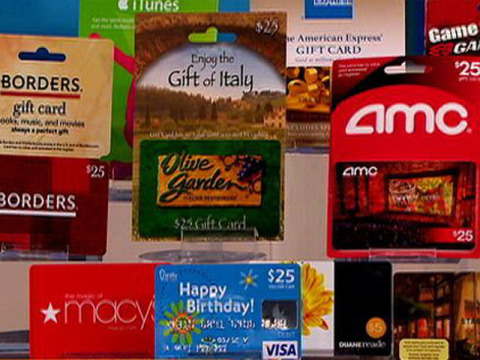
A survey by Visa found that 85% of respondents would appreciated receiving a branded gift card, and 65% prefer gift cards to “non-essential” gifts like scarves or cologne. And as of this season, members of Facebook will be able to buy and send retailer gift cards via the social networking site.
ADVANTAGES
It’s been a long time since gift cards were seen as boring or generic gifts. It’s not just that recipients are eager to replace Aunt Gertrude’s tastes with their own. Gift-givers, recipients and retailers all benefit from gift cards due to:
Portability — Shipping costs are high and always increasing, but gift cards are small, light and can be mailed, along with a holiday card, at no extra cost.
Traveling over the river and through the woods to Grandmother’s house for Christmahanukwanzaakah? Once you, your spouse, the kids, Fluffy and Rover and everyone’s accoutrements make it into the car, along with refreshments and gadgets and “Mom, he’s touching me!!!!”, oversized or oddly shaped giftwrapped presents offer one headache too many. And air travel with gifts adds insult to injury. Not only must we now pay extra just to bring luggage on the plane, but security rules require gifts to be unwrapped, such that we must now cringe at the hands of strange TSA agents pawing the delicate gifts transported to loved ones. Gift cards, conversely, fit the SUV or the carry-on bag without muss, fuss or cringe-inducement.
Uniform size — Gift certificates varied widely in dimensions and materials. They were usually too large to tuck neatly in wallets and tended to get thrown in drawers and baskets until they were long-forgotten and eventually expired. (Yes, that happens with gift cards, too, but at least the size gives them a fighting chance.)
Visual appeal — Many gift cards bear attractive, whimsical or message-laden designs to counteract the generic size and shape.
Electronic system authorization — Unlike bus and train cards or the ubiquitous Vendacards Paper Doll used in college to make photocopies, gift cards don’t have stored values. Instead, gift cards are encrypted at purchase with dollar values stored in centralized data banks. This is good for retailers, because stores need not worry about counterfeiting, and good for consumers, because one phone call allows provides access to the current balance without having to keep up with receipts.
DISADVANTAGES
Unfortunately, for many years, most consumers remained unaware of the serious drawbacks of plastic gift cards, including the existence of administrative, inactivity and dormancy fees, expiration dates, and the comparative differences between Open and Closed Loop gift cards.
Open Loop cards are “network-branded” cards issued and backed by financial institutions like Visa or American Express and can be used practically anywhere those institutions’ credit cards are accepted. Closed Loop cards can only be redeemed at the issuing retailer; for example, Walmart, Bed, Bath and Beyond or iTunes. While Closed Loop cards tend not to have expiration dates or administrative fees, Open Loop cards expire and pile on fees. (After all, as with credit cards, the big guys make their money not from the purchases you make, but from fees — like those associated with you forgetting you’ve got the gift card in the first place.)
THE NEW RULES

Back in February, Paper Doll told you about the Credit Card Accountability, Responsibility and Disclosure Act, or CARD Act, designed to enact new consumer protections. What you may not know is that while the CARD act was primarily about credit cards, it also included some nifty provisions related to gift cards, which went into effect on August 22, 2010. These new regulations level the playing field — with all retailers, in all states, subject to the same federal guidelines.
The highlights in the consumer’s favor:
Longer Periods Before Expiration — One year limits are old news. Now, gift cards can’t expire for at least 5 years from date of issuance. That means five years from the date of purchase for gift certificate-style cards, or five years from the “date of last load of funds (in the case of a store gift card or general-use prepaid card)”, according to the Federal Reserve.
Gift Cards Expire — But Your Money Doesn’t! — This is the biggest news, and the aspect Paper Doll thinks the media has failed to report loudly enough. If the expiration date on your gift card passes, but there’s still a balance on the card, call the card company at the toll-free number and request a new card. Retailers are required to either do this free or return the remaining balance. (So, when you purchase a gift card and notice the expiration date is only 4 years and three months away, you might want to let your recipient know the date of purchase…that’s what starts the meter running.)
No Inactivity Fees…at least for the first year — Retailers aren’t allowed to apply inactivity fees until at least 12 months after the last use of the card — whether that use involves decreasing or increasing the value of the card. So, if you’d like to give Grandma a gift card for her favorite store, restaurant or spa chain, but she’s only up from Boca Raton in the summertime, don’t fret. Those inactivity fees won’t start for 12 months, rather than the previous one to six months that were often standard.
Monthly Fee Limits — Now, no more than one fee of any type can be applied to the card in any one month. So, for example, if you’ve not used a gift card in more than 12 months, while a retailer may charge an inactivity fee or an administrative fee, it can’t charge both.
Written Disclosures — Every gift card must include the following in writing: disclosure of fees, an expiration date and a toll-free telephone number or website where you can get more information about the card.
Stronger State Laws Still Reign — If you live in a state with even more stringent laws than those provided by these regulations, your state’s law will prevail. To find out more about the regulations that pertain to gift card purchases in your state, the National Conference of State Legislatures has put together this summary of state regulations, current as of September 2010.
There is one drawback associated with the new rules. Retailers may still charge a one-time fee when you purchase a gift card. However, this tends to only occur with Closed Loop “network branded” cards, which generally charge $3-7 per card; store cards rarely have fees associated with purchase.
Lastly, these new regulations only apply to actual gift cards, and not to reloadable cards for pre-paid phone service or rechargeable (credit card-like) debit cards, loyalty cards or rebate cards.
A HITCH IN THE GIDDYUP
Although the law passed in late 2009, retailers protested that in order to make the original deadline, upwards of 100 million otherwise serviceable gift cards would have had to have been destroyed, and gift card manufacturers might not have been able to produce replacements in adequate numbers in time for the holidays. Thus, via the ECO Gift Card Act, a codified “interim final rule” from the Federal Reserve, Congress exempted cards produced prior to April 10, 2010 from the new disclosure agreements until January 31, 2011.
So, you just know that lots of stores nationwide will still have pre-April 2010 cards hanging next to cash registers from Portland, Maine to Portland, Oregon and everywhere in between during the 2010 shopping season.
All is not lost, however.
Under this ramp-up period exemption, retailers can’t just party like it’s 1999…or 2009. Card issuers are required to use alternate methods to inform consumers and gift card recipients about card fees and terms of usage…they just don’t have to have the messages printed on the cards. They can alert us through general advertising, signage in the stores, language on their websites and even during “customer service calls”, though one wonders how intently an agitated homeowner, drowning in soap bubbles from an over-agitated washing machine, will be paying attention to gift card mumblings from a customer service telephone rep.
Learning how the new regulatory protections apply to you is a great first step, but there’s more to know.
Next week, we’ll explore services for identifying and buying the best gift cards while avoiding cards from companies potentially in financial distress. We’ll also discuss how you can protect yourself from gift card fraud and organize the gift cards you receive to minimize loss and maximize rewards. And we’ll check out some exciting new options for turning the gift cards you know you’ll never use into cash.
Until next week, here’s a mini-quiz. (No cheating by Googling…just offer up your best guess.)
Morning, Noon and Night: A Day of Fun Alternatives to Paper
Granted, I was attending the birthday party of a two-year-old and was surrounded by tiny humans who couldn’t have cared less about my presence (except when I was holding up the line for birthday cake), but it’s always fun to observe them in their natural habitat. They communicate in their own foreign (as much to one another as to us) dialects, greet one another with hugs or bonks on the head, and toddle off in their own personal planetary rotations. There’s no “Let’s do lunch”, no “I’ll friend you if you’ll follow me”. Perhaps it’s an unrefined sense of object permanence, but toddlers have no need to set in motion future contact; nor do they need to fix their brilliant ideas in permanent form. They really have no need for paper. Not so with giants.
Near the end of the event, one of the grown-up attendees wanted to trade contact information. I offered my card, but she had none of hers with her. Absent any note paper, this lovely woman found the quickest solution — she grabbed a crayon and scribbled her information on a party napkin.
Sure, many people have those cell phone apps that allow them to Bump their phones together to exchange information. And, of course, we normally get through our days using numerous technological solutions that replace tasks we once performed with paper.
But this got me thinking about the situations in which we find ourselves where there isn’t necessarily a technological alternative to paper. There are times when we’re away from our desks, our offices, our notepads, computers and gadgets, or caught with our hands otherwise occupied. There are times when technology can’t come to our aid, and there’s no paper in sight…or sometimes we just want a fun alternative.
Today, we’ve got a few unconventional ways to organize our thoughts and information without benefit of technology or paper.
Waking Up: Remember the Essentials…While You Lather. Rinse. Repeat.
Paper Doll gets the best ideas for blog posts while in the shower. Sometimes I use Dale Carnegie’s refined mnemonic Pegging Method for remembering things until I can get toweled off, but I often wish I had a voice-activated recorder or just a better way to take notes in the shower.
Some of my friends with children have been known to use their kids’ washable Crayola Bathtub Crayons  on the shower walls to capture brilliant ideas, but the word on the (Sesame) street is that the crayons tend to melt into nothingness if left in water too long.
Let’s face it, reaching a dripping hand out of the shower to write on toilet paper with an eyeliner pencil isn’t exactly optimum. As an alternative to paper, I have to admit I’m enamored by the idea of the Erasable Shower Note Tablet from eTravelGear:
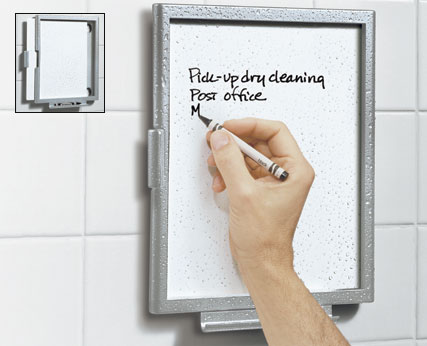
Use the enclosed waterproof crayons to jot down your To Do items, song lyrics, or even messages for the next person in the shower. The tablet includes a crayon caddy to keep your writing implements handy and affixes to the shower wall with suction cups. (Note, suction cups’ suction success (say that three times fast!) varies by shower wall type (e.g., tile, ceramic, glass, plastic, etc.). If your best ideas strike you just as the hot water hits your scalp, or you’ve ever kicked yourself for letting your moment of inspired genius spiral down the drain along with the Clairol Herbal Essences, this tablet might be your saving grace.
Writing on the mirror with lipstick would probably make you feel like an extra in a horror film (and would ruin a perfectly good lipstick), but various sources report that you can safely use a dry erase marker on glass and mirrors. If your beautiful mind beholds the mathematical answers to the universe while you’re shaving or drying your hair, the dry erase marker offers a nifty one-handed solution. Later on, copy to paper or snap a digital photo, and when you’re ready to move on, make your messages, artwork or equations disappear with a dry erase eraser or paper towel. (Of course, be sure to test any dry erase marker on a tiny, not-so-visible portion of the shower door, window or mirror, and don’t dare try this with antique glass.)
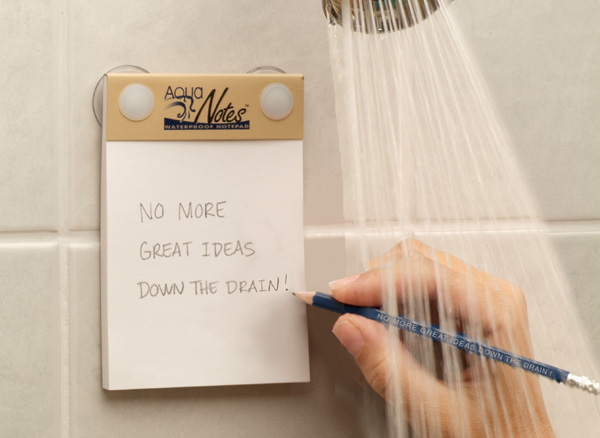
Finally, not so much a paper alternative as an alternative kind of paper, AquaNotes has created a waterproof notepad so durable you can even write on it underwater. Each perforated sheet is 3 1/2″ by 5 1/4″, and the 40-sheet pads are recyclable and printed with soy-based ink. AquaNotes attaches to the shower wall with suction cups.
Plan Your Afternoon During Lunch
Do you ever thirst for better time management when you’re in the middle of a meal?
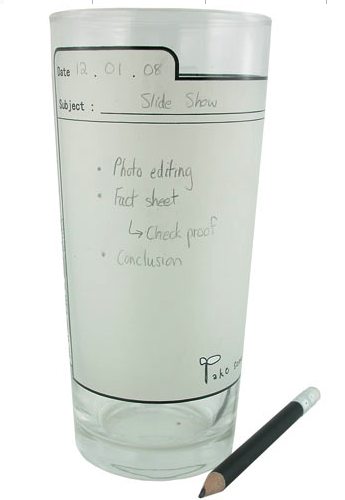
 smaller mug version, but it seems you have to contact Made By Humans directly to purchase the mug in lieu of the glass.
On the Run and Having Fun
More than a few people, famous and otherwise, have caught the public eye when solving the “no paper” problem by writing on themselves. If you’re inclined to write on your hand, but wish for a smudge-free alternative, the To-Do Tattoo from Fred & Friends offers a whimsical yet eminently practical solution.
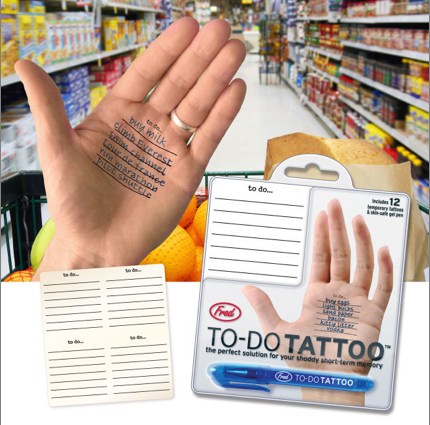
Each package includes a dozen transparent, skin-safe, adhesive “To Do” forms, ready to adhere to your hand (or wherever else you’re likely to need your notes). Just write your reminders with the enclosed washable-ink gel pen, tackle your To Dos and dispose. For the truly forgetful, this isn’t a particular cost-effective solution, and Paper Doll wishes it could go without saying that To-Do Tattoos should not be used in lieu of studying for that geometry quiz.
Family Communication Isn’t Too Cool for School
We tend to think of squeaky chalkboards as the province of the academic world, and there’s very little call to turn your garage or mud room wall into a classroom. However, you can take a page out of your grammar school dcor textbook to find a super paper-free communication alternative for your family.
Pick up some chalkboard paint from your nearest home supply store. Although Crayola’s chalkboard paint has been discontinued, Rustoleum, Krylon, and Benjamin Moore all still manufacture it, and you needn’t settle for Schoolroom Green. Colors come in stony black, rich red and a variety of other fun shades.
Next, pencil-sketch your measurements, use painter’s tape to delineate the borders and paint a small portion of your wall. Once it’s dry, keep a bright supply of art chalk in a plastic bucket so that the whole family can leave reminders and alerts: “Tomorrow is trash day!”, “There’s broken glass in the kitchen!”, “We love you, Daddy!”, “Welcome Back!” and so on.
If you’re not a Do-It-Yourselfer, instead of painting a chalkboard, consider peel-and-stick chalkboard cutouts from Wallies, ranging in size from super-sized for calendars:
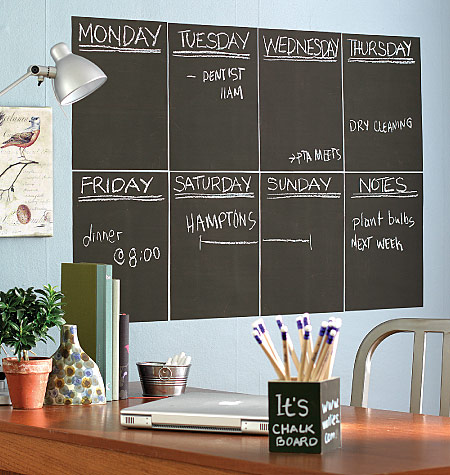
to cozier decorator styles:
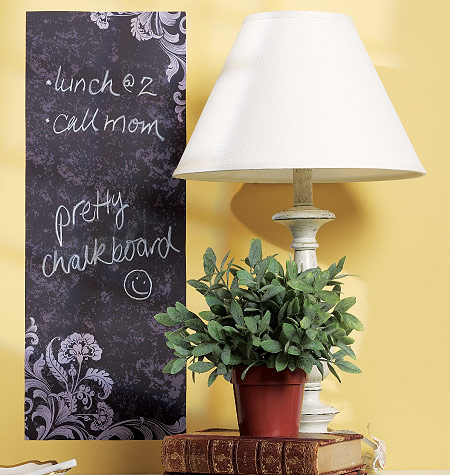
Wallies also carries various dry erase peel-and-stick removeable/repositionable options.
Leave A Bedtime Reminder
If you and your beloved sleep on separate shifts, you may find yourselves communicating more often by note than in person. A somewhat impractical but quite charming paper alternative is the Note Me Pillow from Veinticuatrodientes.
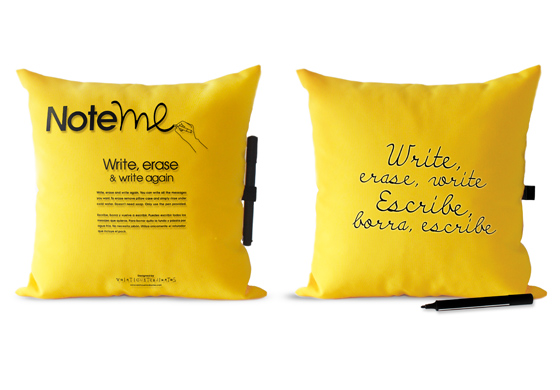
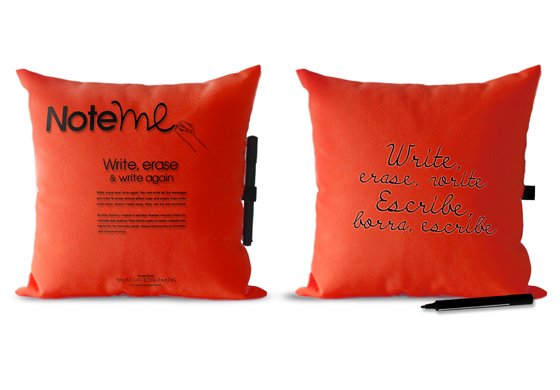
Simply write your message on the colorful pillowcase with the enclosed pen. (“Honey, please make sure the doors are locked and the lights are out before you go to sleep!”) To erase, just run the pillowcase under cold water — no soap necessary. The pillows come in yellow, red, orange, white and green.
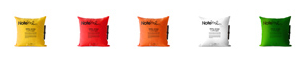
The web site for Veinticuatrodientes, Spanish for “twenty-four teeth”, says, “When you put your biggest smile in your face, the most you can show is twenty four teeth.” Paper Doll assumes one could easily write more smile-inducing messages on these tablets, showers and mirrors, chalkboards and pillows, than mere quotidian To Do lists and household reminders…but this is a family blog, so I’ll leave that to your individual imaginations.
Paper Doll Stops and Smells the Paper Roses
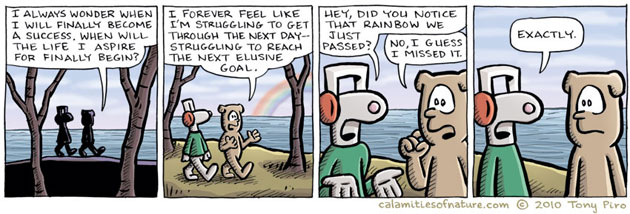
(With huge thanks to Tony Piro for making Calamities of Nature available for distribution among fans, and especially for solving my technical difficulties in getting this particular strip to conform with OnlineOrganizing.com’s fun margins.)
Organizing is a journey, not a destination, and sometimes we need to pull over for the scenic view. Readers, this week, Paper Doll is taking time to stop and smell the paper roses, so I can return to you refreshed, revitalized and ready to tackle all the paper organizing topics of which you’ve ever dreamed (and some of which you’ve never imagined).
While I’m away from the computer for a few days, I encourage you to check out a few of my favorite blogs on organizing, time management and productivity. Most of these people are prolific bloggers, so you’ll have plenty to peruse in my absence, and all of them are wise, wonderful and witty.
Janine Adams’ Peace of Mind Organizing
Ramona Creel’s Who Wants To Get Organized?
Jeri Dansky’s Jeri’s Organizing and Decluttering News
Erin Doland’s Unclutterer
Nanette Duffey’s Piggy Bank Pixie Picks (try saying that three times fast)
Ann Bingley Gallops’ Open Spaces Feng Shui
Aby Garvey’s Creative Organizing Blog
Craig Jarrow’s Time Management Ninja
Brandie Kajino’s SOHO Solutionist
D. Allison Lee’s Organize To Revitalize
Lorie Marrero’s The Clutter Diet
Monica Ricci’s Your Life. Organized.
Rubbermaid’s Adventures In Organization Blog
Geralin Thomas’ Managing Modern Life
I hope to see you all back here next week! Until then, keep organizing, but remember that organizing is only a means to an end. Organizing your paper (and your home, office, car, purse, schedule and life) gives you more time to spend with the people you love, doing the activities about which you are passionate. Take time to smell the roses and keep watch for those (double) rainbows.
Follow Me