Archive for ‘Paper Organizing’ Category
Toxic Productivity Part 5: Technology and a Hungry Ghost
THE MANY TENDRILS OF TOXIC PRODUCTIVITY
I checked in with a friend the other day to see how her new job was going. Her company, an international conglomerate, had laid off several people over the past six months, including my friend, but also did some internal hiring. She’d been excited about getting the new job, but seemed blue when we spoke.
“I’ll be honest,” she told me, “if I hadn’t already worked for this company for years, I’d think I was incompetent. This is really hard.” My friend, a veteran of many, many promotions for merit, is definitely not incompetent. It turns out that only one person had ever held this position before, and was fired after being unable to keep up with the demands.
When I hear these stories from my clients, the first thing I do is get a sense of whether the problem is that someone needs more support or guidance at work. In terms of support, even though she’s at the same company, my friend’s work situation is different, and she’s no longer got the support of a team structure; rather, everyone is on his or her own, with no cross-training and no backup. The company still seems to have unreasonable expectations of how much can be humanly accomplished, as we discussed at the start of this series, in Toxic Productivity In the Workplace and What Comes Next.
Next, she and I talked about the Pareto Principle (AKA: the 80/20 Rule, which we discussed last week in Toxic Productivity, Part 4: Find the Flip Side of Productivity Hacks) and I asked my friend if she’d talked with her boss about priorities, and what the most important aspects of the job needed to be right now.
Remember, 80% of the success comes from 20% of the effort, so finding that 20% can eliminate a lot of the stress and busy-work, creating more mental energy to tackle other aspects of the work.
The Pareto Principle says 80% of the success comes from 20% of the effort, so finding that 20% can eliminate a lot of the stress and busy-work, creating more mental energy to tackle other aspects of the work. Share on XI pointed out that, as a valued employee, and as the second person to try to tackle this role, she might be in a position to (gently) point out these unreasonable expectations. (Yes, this is a touchy issue, but it’s the best way to determine if the problem is bad management practices or merely lack of corporate awareness of how many human-hours it takes to accomplish certain tasks.)
My friend then noted that a colleague of hers, another “island” unto himself in a position similar to herss, has been in his role for about a year and a half. Apparently, this guy regularly works until midnight and starts again before traditional work hours, and works through the weekends.
If you’ve been reading this series all the way through, you may agree with me that this is a sign that the worker has internalized the unsustainable expectations and toxic productivity demands of the company.
This isn’t just a problem for my friend’s co-worker. Yes, he’ll probably burn out, which will be bad for him. It’s bad for my friend (and everyone else at her level) because workers with families, non-work obligations and, y’know, lives, can’t reasonably live up to this automaton-like worker-bee behavior. Nor should they try. So, the worker who has internalized toxic productivity (and who may or may not have productivity dysmorphia), is contributing to the escalating expectations for unsustainable productivity throughout the division, even throughout the company!
In other words, he’s screwing over his colleagues, who are now left positioned between having inferiority complexes and developing productivity dysmorphia to compensate (thereby risking their own mental health, their relationships, and more) or having to leave the company feeling like failures, and the company will need to hire new workers and the cycle will begin again. Oy.
Such is the state of many modern workplaces. Terrifying, isn’t it?
And, as we have discussed over the last several weeks, a corporate structure isn’t necessary for this to take place. There’s a hustle culture out there for all of us who work on our own, solopreneurs and small business owners alike, who are cowed by common practices into believing that nothing we are doing is enough, and that we need to keep up with the Joneses (our colleagues or competitors, and not merely our neighbors) at all cost.
EMBRACE NEW VALUES AND PRINCIPLES
The drive to deliver — to produce — misses the point. I posit that as much as you may (or may not) enjoy creating, your purpose on the planet isn’t to produce documents or deliver services or create or to make money. Your purpose is to enjoy yourself and help the people you love enjoy themselves, too.
We’re here to be fulfilled, not to produce widgets, and if enough of us demand that we be treated (and treat others) as humans rather than producers, we might achieve this very thing.
This can feel like pretty hippy-dippy advice in 2022, but I stand by it.
So, first, let’s start with the wisdom high performance coach Sarah Arnold-Hall puts forth about results, not hours.
Let’s start valuing results created, not hours worked. pic.twitter.com/yebU0Zwrq8
— Sarah Arnold-Hall (@saraharnoldhall) May 13, 2022
Now, on its own, this could create a huge feedback loop into productivity toxicity. Produce more, create more, do more! Grrrr. Arrrrrgggh. But we’re not going to do that.
Instead, we’re going to bear in mind what we learned in Toxic Productivity Part 2: How to Change Your Mindset about the necessity of downtime. Those hours when we’re not working are as important as, if not more important than, the hours we are working.
The task-positive brain network, which we use to take all of our accumulated knowledge and turn it into something useful, helps us focus our attention, arrive at solutions to problems, and confidently make decisions. But we can’t do any of that if we don’t also make use of our default mode network, the way our brain blisses out and thinks about anything except the problem at hand when we’re sleeping, resting, relaxing, and enjoying our loved ones and life.
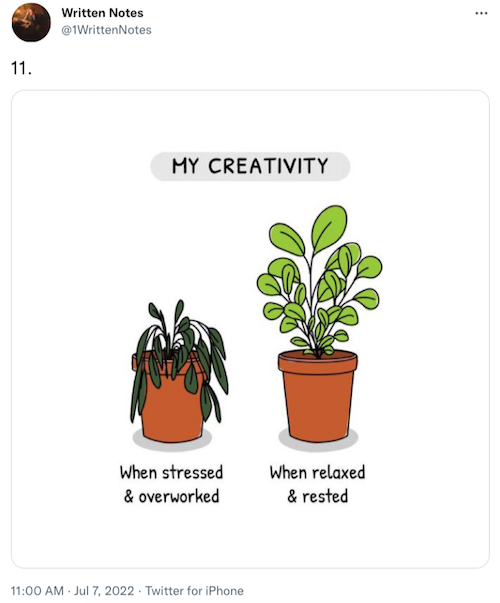
So, once you accept that success isn’t about the hours worked but the worth of what you’ve done in those hours, you have to pivot to understanding that more and more of your hours have to be given over to the downtime that allows you to create anything worthwhile. Recognizing the finitude of life is key to that attitude change. (Remember that when you get to the end of this post!)
So, what have we learned about healthy productivity?
- It’s not about spending all of your hours on work.
- To make the work you do accomplish valuable, you need to change your mindset and have more downtime.
- Downtime isn’t scrolling through TikTok or Netflix, but truly letting your brain rest and recover — through non-competitive exercise, better sleep, eschewing multitasking, increasing opportunities for a quiet mind, and asking yourself the essential questions about the life you’re currently living and how it compares to the one you truly want — as we discussed in Toxic Productivity Part 3: Get Off the To-Do List Hamster Wheel.
- We can use the same productivity tools designed to help us overcome procrastination and get more done to slow ourselves down to the speed of life. This includes embracing better and smaller (atomic) habits, using the Pareto Principle to focus on what’s truly worthy of being a priority, employing the Pomodoro Technique and block scheduling to focus our work time and ensure our break time.
— Liz Fosslien (@fosslien) June 23, 2022
What else can we do?
CONSIDER TECHNOLOGY’S ROLE
It’s easy to think that technology is essential to productivity. Look at how much more humanity accomplished after the Industrial Revolution vs. when we had an agrarian society. How much more could we accomplish with telephones than when we had to wait for the postal service or telegrams? Certainly we got much more accomplished once we added email to our resources, right? (cough, cough) And surely we’ve reached a pinnacle of productivity now that we have Slack and Asana?
Hopefully, you detected my sarcasm. Yes, technology yields vast improvements in our ability to communicate quickly (if not always clearly, as the multigenerational confusion over emoji and whether ending sentences with periods is an insult have proven), but all of these aspects of technology have led to the always-on misery we discussed at the beginning of the series. France gets it; most of Europe gets it. The US does not yet get it.
We have an inalienable right to disconnect, but it’s going to take all of us, together, to stand up and keep secure that right.
Communication technology is not the only problem.
Along with communication technology, these last few decades have seen a growth in productivity technology, from software and apps that help us brainstorm, assign ourselves (and others) tasks, and conquer our foibles and deficiencies in terms of procrastination, motivation, focus, capturing information, organizing our thoughts, collaborating on projects, and so on.
I am not a Luddite. I believe in the power of technology to make things easier, but sometimes we’re making the wrong things easier. Take collaboration. While Thomas Jefferson wrote the original draft of the Declaration of Independence, historians (including Pauline Maier in American Scripture: Making the Declaration of Independence) have shown how the handwritten edits suggested by the members of the Second Continental Congress became a complicated collaboration.
.jpg) In a document listing colonial grievances against the King George III, members of the Congress made Jefferson take out references to slavery and put in references to a Supreme Being (and fishing rights). The handwriting was that of Secretary Charles Thomson; he controlled the document’s additions, deletions, and revisions requested and/or demanded by the cacophony of voices representing 13 colonies.
In a document listing colonial grievances against the King George III, members of the Congress made Jefferson take out references to slavery and put in references to a Supreme Being (and fishing rights). The handwriting was that of Secretary Charles Thomson; he controlled the document’s additions, deletions, and revisions requested and/or demanded by the cacophony of voices representing 13 colonies.
Now imagine that same collaborative product in Microsoft Word’s Track Changes or Google Docs’ comment section. Now multiply the different voices and competing methods listed on this Wikipedia entry listing types of collaborative software. (I’ll wait while you scroll.) If you know how to be productive in one technology, you might still be flummoxed in another.
The number, variety, complexity, and interoperability (and lack thereof) of technology solutions can be overwhelming.
Have you ever heard about a new task app and wondered if it could be the solution to all of your troubles? Have you tried Todoist? Anydo? TeuxDeux? Remember the Milk? Things 3? Google Tasks? What about more complex productivity suites, like Basecamp? Trello? Clickup? Asana?
In case you were wondering if I’d suggest one app to rule them all, I’m afraid that’s not the case.
The truth is, the best productivity app is the one you’ll use. The one you’ll commit to learning, commit to using, and the one you won’t “cheat” on when another shiny app starts flirting.
The truth is, the best productivity app is the one you'll use. The one you'll commit to learning, commit to using, and the one you won't 'cheat' on when another shiny app starts flirting. Share on XUnfortunately, some productivity technology overwhelms even the most diligent users. This may be because the information we get out of our productivity technology is only as good as the information we put in, and we humans are already overwhelmed.
All of these apps, working at the speed of light (and life), can’t prioritize for us. We capture tasks with the click of a button, but we are so pressed for time (and productivity) that we fail to take the requisite moments to figure out what work has value and what is busywork.
So, are we supposed to get rid of technology altogether to combat toxic productivity?
Remember how I said I wasn’t a Luddite? Well, I’m not asking you to be one either. Chances are, if you work for a company that you don’t own, you’re stuck with some technology required by your workplace. But in the areas where you do have control over which types of technology you use, I often suggest that my clients put technology completely aside for a little while.
If you’ve got a task app or other tech that works well for you, stick with it. But if you feel beaten down and bruised by the very tech that’s supposed to keep your head above water, try slowing everything down.
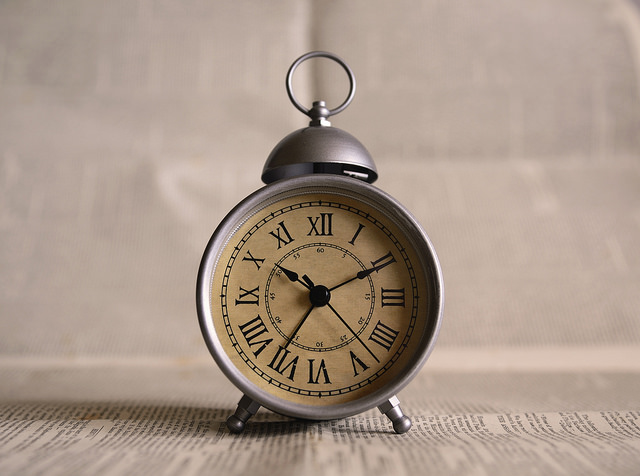
- Go analog with your time displays. Wear an analog watch, or set your fancy Apple Watch or Fitbit to display time in an analog manner. Do the same with the display for the clock app on your phone. Seeing time as it ticks by will help you appreciate the finitude of time and feel more in tune with how much you can reasonably accomplish in an hour or a day. (You might want to brush up on Back-to-School Solutions for the Space-Time Continuum for more ideas.)
- Opt for paper over tech to learn key productivity skills. I’m a Certified Evernote Expert, so I realize all of the excellent benefits of collating your clipped websites, inbound emails, saved articles, etc., digitally, tagging them, and organizing them into notebooks. But when you’re overwhelmed, sometimes having your resources, your printed instructions, and other task-triggering action paperwork right in front of you, without need for WiFi or even electricity, can help you slow down and focus without the buzz of the digital world.
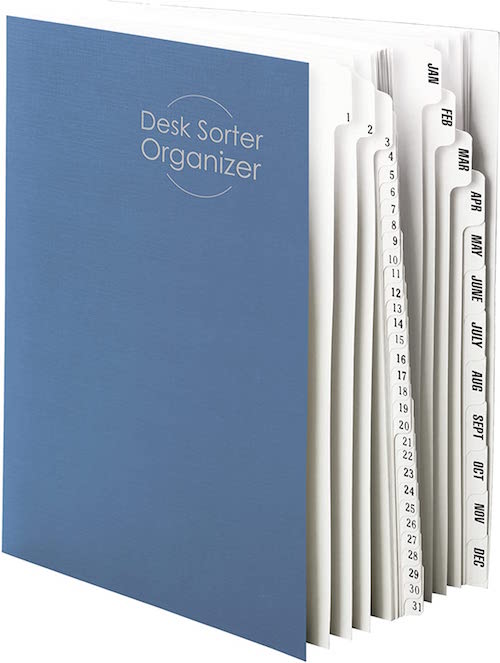
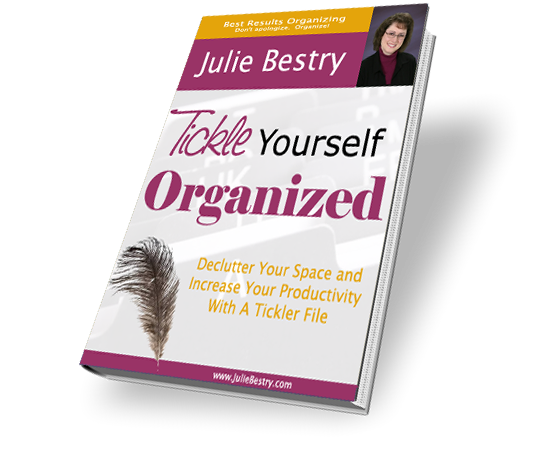
One of the many reasons I recommend tickler files for my overwhelmed clients is that learning the process of looking at task-triggering papers and making qualitative decisions (regarding priorities) and chronological decisions (regarding when you can reasonably accomplish specific tasks) is an essential skill for improving productivity in a healthy way. It’s the reason I wrote Tickle Yourself Organized.
- Consider bullet journaling. I’ll be honest, bullet journaling stresses me out. I understand that it’s not necessary to embrace the fancy, artistic designs some people use, but the very hands-on, tangible customization options overwhelm me, and the idea is to achieve healthy productivity by removing overwhelm. But I’m not you. Hundreds of thousands, perhaps millions, of people swear by bullet journaling for tracking tasks and other information. They can’t all be wrong.
PULL IT ALL TOGETHER AND HALT A HUNGRY GHOST
Hopefully, over this past month, you’ve come to recognize that not only are you not a robot, but that it’s unacceptable for anyone — your company, your clients, your mother-in-law, or you — to expect non-stop labor from you.
If machines don’t operate at 100%, why do we expect so much from ourselves?
— Junhan (@junhanchin) May 24, 2022
You’re a living, breathing human being. But you may have a ghost in your machine.
In Brad Stulberg‘s recent post The Constant Restlessness You Feel Has a Name, he describes how many of us experience a constant grind he calls “heroic individualism.”
Heroic individualism says that you will never have enough, be enough, or do enough. It is an endless gauntlet of more. While it may lead to decent short-term performance, long-term, it is a recipe for disaster. This is because long-term fulfillment depends upon things that are inherently inefficient and unproductive, at least on acute timescales.
Sound familiar?
When you look at the ten symptoms of heroic individualism that Stulberg lays out, some of it bears a striking resemblance to toxic productivity and Anna Codreo-Rado‘s perception of productivity dysmorphia, such as:
- Low-level anxiety and a sensation of always being rushed or in a hurry — if not physically, then mentally.
- Not always wanting to be on, but struggling to turn it off and not feeling good when you do.
- Feeling too busy, but also restless when you have open time and space.
- Successful by conventional standards, yet feeling like you’re never enough.
Stulberg’s describes the Buddhist concept of the hungry ghost:
The hungry ghost has an endless stomach. He keeps on eating, stuffing himself sick, but he never feels full. It’s a severe disorder.
The modern world that so many of us inhabit depends on the creation of hungry ghosts. But you, me, all of us can choose to opt out of this game. We don’t have to become hungry ghosts. We simply need to step back and reflect upon what it is that we actually want. Simple, sure. But not necessarily easy.
To combat this hungry ghost, this toxic productivity, this productivity dysmorphia, Stulberg recommends the concept of groundnessness.
His book, The Practice of Groundedness: A Transformative Path to Success That Feeds—Not Crushes—Your Soul, combines research from psychology, neuroscience, and sociology (as we looked at in the first three posts in this Toxic Productivity series), as well as religious and philosophical teachings from Buddhism, Taoism, and our old friend-of-Seneca, Stoicism.

The first of Stulberg’s five points of groundedness is having a realistic sense of where you’re starting on this journey, which I’d argue includes comprehending the role we play in letting toxic productivity into our institutions and our lives.
You can catch up on any part of the series here:
Toxic Productivity In the Workplace and What Comes Next
Toxic Productivity Part 2: How to Change Your Mindset
Toxic Productivity Part 3: Get Off the To-Do List Hamster Wheel
Toxic Productivity, Part 4: Find the Flip Side of Productivity Hacks
and for other perspectives on toxic productivity, you might wish to read:
What is toxic productivity? And 5 tips to overcome it (Trello)
When Doing is Your Undoing: Toxic Productivity (Psychology Today)
Put Avoiding Toxic Productivity At The Top Of Your To-Do List (Vogue UK)
Feeling Burnt Out? Meet Toxic Productivity & Grind Culture with Rest
Thank you for coming along on this five-week tour of how we (individually and as a society) are struggling with unsustainable expectations surrounding productivity. I hope you will share these (and other Paper Doll) posts with those whom you feel the material will help.
And if you’ll pardon my indulgence after putting 15,000 words into this topic, I’d like to share part of the lyrics of my favorite song, Viena by Billy Joel, which has some wise things to say about this topic.
Slow down, you crazy child
You’re so ambitious for a juvenile
But then if you’re so smart, well, tell me
Why are you still so afraid? Mm
Where’s the fire, what’s the hurry about?
You’d better cool it off before you burn it out
You’ve got so much to do
And only so many hours in a day
But you know that when the truth is told
That you can get what you want or you can just get old
You’re gonna kick off before you even get halfway through, ooh
When will you realize Vienna waits for you?
Toxic Productivity, Part 4: Find the Flip Side of Productivity Hacks
If you reside in the United States or Canada, you’re coming off the end of a long holiday weekend, an opportunity to rest, relax, and regenerate.
Do you feel relaxed? Or do you feel the itch to be accomplishing something on your to-do list? Do you feel that whatever you got done last week might not quite be enough, and that by taking an actual weekend off — not just two whole weekend days, but an extra holiday — you’re coasting? Cheating? If so, you definitely won’t be the only one.
PREVIOUSLY ON PAPER DOLL…
Throughout this series on toxic productivity, we’ve looked at what society can do to vanquish unsustainable expectations, how we can change our outlook and mindset, and what we can physically do to loosen the ropes with which we’ve bound ourselves. Before we go any further, I encourage you to catch up on the concepts and references we’ve looked at so far:
Toxic Productivity In the Workplace and What Comes Next
Toxic Productivity Part 2: How to Change Your Mindset
Toxic Productivity Part 3: Get Off the To-Do List Hamster Wheel
We can lobby for changes in societal expectations regarding excessive corporate demands on our productivity. We can read wisdom (and get therapy) to examine how we’ve internalized toxic belief systems and developed, as Anna Codrea-Rado calls it, productivity dysmorphia.
We can even recognize the finitude, or shortness, of life, and get off the hamster wheel by adding mindfulness and rest (in terms of non-competitive exercise) and more recuperative sleep, eliminating multitasking, and digging deeply to figure out what we want out of life and who we are.
But if none of that floats your boat, even if I’ve convinced you that toxic productivity is a danger to you, your loved ones, and society, these measures may just be too hard to incorporate in the life you’re already living. Trust me, I get it.
USING THE PRODUCTIVITY HACKS YOU KNOW AND LOVE
So, today, we’re going to look at the same productivity strategies, tactics, and “hacks” that are recommended to conquer lack of productivity — whether that’s a problem with procrastination, prioritization, or planning —and see if we can find ways to use them to stem the tide of toxic productivity.
Start At the Atomic Level
In James Clear‘s Atomic Habits, he posits that all of our outcomes — our productivity (for good or ill), our self-care, our financial state — are a “lagging result” of our habits. In other words, there’s a cumulative effect of what we do that, when repeated over and over, leads to where we’ve arrived.
To achieve what we want, Clear believes that we generally either try to change our habits in the wrong way, or we try to change the wrong things. Clear notes that we approach things in three ways:
- We try to change our outcomes (achieve more work, make more money, lose a certain amount of weight).
- We try to change our habits.
- We try to change our identities — including our belief systems, our views of the world, and our self-images.

Heady stuff. But it doesn’t work.
Clear’s approach is to flip the order and the magnitude of these strategies, and start by building identity-based habits, focusing on who we aspire to be (the non-smoker, the half-marathon runner, the person who can feel proud of their work output without working ourselves to death), and making itty-bitty, teeny-weeny changes at the atomic level (think of atoms, or even sub-atomic particles, not atomic as in “big boom bomb”).
To Clear’s mind, starting with these small steps helps you make the leap from “I’m the kind of person who wants be X” to “I am the kind of person who does X” to “I’m the type of person who is X.” (No, unfortunately, it will not help make Paper Doll a ballerina.)
From a productivity perspective, Clear builds on the now-famous research of Charles Duhigg in The Power of Habit: Why We Do What We Do in Life and Business.

That research focused on four stages: Cue, Craving, Response, and Reward. From a toxic productivity perspective, the cue may be some kind of request in our inbox or voicemail, or even seeing what one of our colleagues is doing, and feeling like we have to learn to emulate that behavior.
That feeling of “Ooooh, my successful colleague just started a YouTube channel and is getting all of this attention. I want to feel respected and admired, so I need to add videos to my repertoire of what I deliver to the world.”
The response in this case might be you buying video equipment, writing scripts, and pushing yourself beyond your capacity to start developing these videos, and the reward might be the sense of achievement of having completed it. You’ve satisfied that craving! Yay!
Wait, yay? Are you sure?
Rewards are supposed to teach us which cues and cravings will make us feel good. But remember what we said a few weeks ago about the hedonic treadmill, how you get used to a certain level of productivity and thus no longer feel any level of excitement or satisfaction? Time after time, your automatic process of building your habits may be contributing to your sense of productivity dysmorphia!
So, how can we use Clear’s ideas to help us create better habits that will separate ourselves from toxic productivity? Clear’s book is too packed with wisdom for me to cover its value in a blog post, but here are two methods to try, based on his teachings. His guidance is in bold type.
To embrace healthier habits that will get you away from the cues to keep working:
Make It Obvious — If you want to get in the habit of taking a walking break at lunch, put your lunch bag (or wallet) on top of your walking shoes.
Make It Attractive — Arrange to take a yoga class or go for an adult beverage (or ice cream, or an afternoon tea) with a good friend. Make taking a break social to remind you of when your life was fun. Then do fun stuff!
Make It Easy — Block time on your schedule for non-work things so nobody can steal your self-care by making a Calendly request for time that isn’t available. That person will never know that you’re not in some other “productive” meeting.
Make It Satisfying — Make those get-off-the-hamster-wheel experiences delightful; if you’re an introvert, don’t schedule social things that will steal your energy, and if you’re a hiker, don’t book a yoga class because it seems socially preferable. You do you, boo!
To break your bad (toxic) productivity habits and get off that hamster wheel of constantly feeling like your value depends on your output:
Make It Invisible — To reduce your exposure so you don’t experience the cues to constantly feel like you’re not doing enough, reduce your attention to requests when you don’t need to deal with them. Turn off your notifications unless you’re waiting for a particular response. Stop checking your email every 15 minutes; check it in the morning, right after lunch, and about an hour before the end of the day. Otherwise, focus on your priorities, not other people’s.
Yep, this is the same advice I’d give you if I were encouraging you to be more productive; the point isn’t to be less productive, per se, but to feel less driven by those cues to feel like your value equals your productivity!
Make It Unattractive — The point here is to re-adjust your mindset (as we discussed in the second post in this series). You want to accent the benefits and importance of avoiding the bad habits (of working through lunch, checking email when your kid is talking to you, etc.). Maybe a photo posting your last blood pressure test or the lyrics to Cats In the Cradle will remind you of what hyperfocusing on productivity costs you. (Wait, you don’t know that song? Grab a tissue!)
Make It Difficult — This is about increasing friction so it’s harder to work long hours and feel obligated to keep going when you’re completely wrung out. Set your computer to turn off every day at 5 (or 6 p.m., or 4:30 p.m.). Delete one-third to one-half of the available time slots from your appointment scheduling software. Prioritize yourself on the schedule (and see the time-blocking section, below).
Make It Unsatisfying — You know what makes you tick. Would the social cringe of failing to knock off work and go home (after you’d promised to do so) do the trick? For good or ill, the fear of disappointing your spouse might not be enough, but support from an accountability partner, someone without the guarantee of unconditional love? Could work!
Normally, we’d use accountability to get us working, but sometimes, having a body-double for the “last hour” of the day will ensure we shut down when we need to. If that’s the case for you, reread Count on Accountability: 5 Productivity Support Solutions for some key ways to get help honoring your goal to respect yourself, your time, and your value.
Two P’s Against One: Conquer Toxic Productivity With the Pareto Principle and the Pomodoro Technique
There are two popular strategies in the productivity realm we experts apply to help people not only achieve more, but more of the right thing. Sneakily, these two concepts can also help you get off that hedonic treadmill.
Let’s start with the Pareto Principle, which you might know as the 80/20 Rule. It comes from a theory of economics that says that 80% of outcomes come from 20% of causes, and it’s been found that 80% of successes come from 20% of efforts or sources. This is one of those weird concepts that while not always perfectly true, is surprisingly accurate.
Freelancers will find that 80% of their money comes from 20% of their client base. All those toys your kids are actually playing with (and the apps on your phone that you actually use)? About 20% of them are what’s yielding the most activity.
Use the Pareto Principle to figure out what of the work you’re doing is actually the vital work. The deep work (in the words of Cal Newport). The meaningful work. The work that appears in the Eisenhower Matrix’s “important and urgent” quadrant!
Look at your list of everything you accomplished today. Wait, you don’t know what you did?
You probably added “done” things to the to-do things so you could cross them off. But if not, look at your outbound emails, your calendar, your “recent documents” and “recent spreadsheets.” Going forward, you might track your time with an analog list on paper or software like Toggl or Rescue Time.
Look at everything you’re doing and measure the value — is it financially remunerative (does it pay?!), is it helping you grow professionally or personally, is it emotionally rewarding? It’s very likely you’ll find that the vast majority of your work’s value is coming from 20% (OK, or even 30% or 40%) of your output.
Use the Pareto Principle to give yourself permission (there’s another P-word!) to stop doing everything! With luck, you’ll be able to appreciate all that you have accomplished, focus less on what you didn’t complete, and eliminate a bit more of that productivity dysmorphia.
Same results. Different expectations. pic.twitter.com/fXbf6gY1AA
— Janis Ozolins (@OzolinsJanis) March 27, 2022
Next, let’s look at the Pomodoro Technique, developed by Francesco Cirillo. We’ve discussed this many times on the pages of Paper Doll, most recently in Does Anybody Really Know What Time It Is? 5 Strategies to Cope With Pandemic Time Dilation, but at it’s most reductive, you decide what you want to work on, you set a timer for 25 minutes, and you work on just that thing until the timer goes off. Then take a break.
This is another tactic we productivity gurus use to help clients get their butts in the chair; to conquer inertia, we encourage someone try just five minutes (on the treadmill, writing a blog post, studying a chapter), and more often than not, this is enough to get someone over the hump and keep the mojo going.
However, the Pomodoro Technique also works to dissipate toxic productivity because breaks are built in. In usual circumstances, the Pomodoro-er is thinking, “Sigh, OK, I have to do this. But in 25 minutes I get to take a break.” To the person who struggles to let go of their sense of worthiness being tied to their output, being forced to take a break is a real eye-opener! Permission to stop working is one thing; being required to stop is a much bigger deal!
For more on the Pomodoro Technique:
Take It From Someone Who Hates Productivity Hacks—the Pomodoro Technique Actually Works
Explore Being a Kid Again: See How Playing with Blocks Can Flummox Toxic Productivity
We’ve already talked a lot about time blocking. Your best bet is to review:
Playing With Blocks: Success Strategies for Time Blocking Productivity
Paper Doll Shares Secrets from the Task Management & Time Blocking Summit 2022
How to Use Block Scheduling to Revamp Your Workflow (Wired)
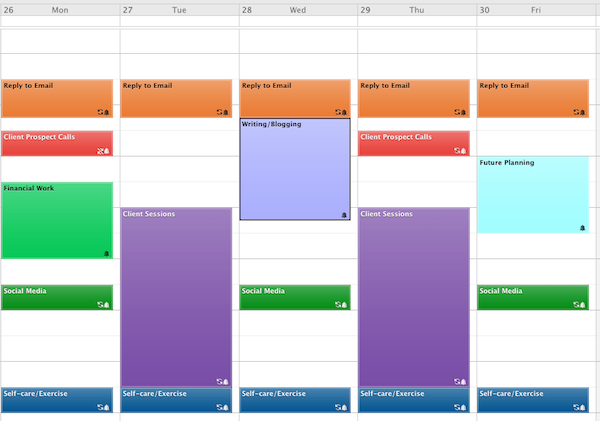
Usually, when we discuss time blocking, we’re trying to fit as much into our limited, valuable, time as possible, to make sure we create homes for all the work that’s necessary to do. But we’ve already established that not everything we’re doing is of equal value.
When we want to circumvent toxic productivity, reduce busy-ness in favorite of doing our most important work, and get a hearty mix of what we discussed back in the second week, we need to think about our brains!
In that post, I explained that using our central executive network (think: executive function, not CEOs), or task-positive brain network, activates to help us use our memories of previously-acquired information to comprehend new information, focus our attention, come up with solutions, and make decisions.
But our brains also need to operate in the default mode network — it’s what your brain is thinking about when nobody’s expecting anything from you.
What does that have to do with time blocking? Simple — block time to do all those things we talked about in Toxic Productivity Part 3: Get Off the To-Do List Hamster Wheel that turn active the brain off for a little while. Just blocking your time, without considering downtime, will let you get a lot done, maybe even the right stuff done, but it won’t reduce that drive to be “always on.”
In his July 3rd email, How to Be a Productivity Ninja author Graham Allcott talked three ways to use his attention: to create, to collaborate, and to chill.

When you block your time, “create” is going to be anything that achieves that deep work, that 20ish% of effort to yield the 80ish% of success. Allcott says, “When I’m in Create mode, my mindset is disciplined, closed and distraction-free.”
“Collaborate” is as you’d guess, all of those meetings and calls and emails, those Zooms and those moments you’re in shared documents. And it’s the collaboration (whether anticipated or unanticipated) that often steals the time we need to spend on the other two C’s.
And, obviously, “chill” is about engaging the default mode network by disengaging from the task-positive brain network.
When you put together your time blocks, be sure to consider all three elements. Balancing your creative and collaborative time with your chilling time will help your step off the hamster wheel and live a healthier, more fulfilled, and less toxic life.
Momentum matters more than perfection. pic.twitter.com/ju76b7gsqj
— Sarah Arnold-Hall (@saraharnoldhall) April 6, 2022
Give yourself a break. Give yourself some grace. Give yourself a more organized space, more planning time on the calendar, and more opportunities to “win” by not expecting so damned much of yourself.
With so much to consider regarding toxic productivity, there’s actually one more post to round out the series. We’ll be looking at how tools, whether analog or digital, can help or hinder us as we seek to reduce the toxicity of our productivity. And then we’ll close with a little philosophizing and sum up all we’ve discussed.
Until then, I hope you’ve found some of this helpful to reduce any of the unwelcome stress you may feel as you approach the second half of this year.
Toxic Productivity Part 3: Get Off the To-Do List Hamster Wheel
“Nothing is so insufferable to man as to be completely at rest…. He then feels his nothingness.”
~ Blaise Pascal, Pensées
Two weeks ago, in Toxic Productivity In the Workplace and What Comes Next, we looked at the external forces that drive unsustainable expectations and eventually burnout. We also examined what other industrialized nations have been doing to stem this dangerous trend.
Last week, in Toxic Productivity Part 2: How to Change Your Mindset, we examined productivity dysmorphia, the disconnect between objective achievements and our emotions about those accomplishments. When we experience productivity dysmorphia, the very act of pursuing productivity (to the neglect of all else) means we lose the ability to savor or enjoy what we have accomplished.
That second post focused on the ways to change our mindset about productivity. We examined how hedonic adaption gets us so used to our status as achievers, as worker bees, that eventually we will be unable to sustain that behavior and burn out. We reviewed the research that showed our brains require downtime and countered the many myths that exist about productivity.
Most importantly, we started a discussion regarding the role of work (and achievement, in general) in our identities, starting with Charlie Warzel and Anne Helen Petersen asking “Who would you be if work was no longer the axis of your life?” and considering the “finitude” of life (in the words of Oliver Burkeman and the Stoic philosophy of Seneca). We left off in contemplation that our value is not in what we do but in who we are — in being, not doing.
Today, we’re going to explore developing an appreciation of being over doing, seeing how our actions need not be achievements, per se, but can be experiences, valued solely for the potential delights they offer.
REVISITING FINITUDE: THE MACRO AND MICRO APPROACH
Our time on this rock is limited. A central tenet Burkeman’s 4000 Weeks: Time Management for Mortals is the ability to see the shortness of life, examine your goals and values, and maximize spending your time on what matters most. This isn’t some hippy-dippy philosophy that says that if we all stop worrying about work or making money, we’ll find ourselves in a vast utopia.
Rather, it notes that life is hard, life is short, and feeling like you only have a right to be here if you’re accomplishing things that make money — whether for your company or yourself (even, or especially, if you are your company) — leads to frittering away the most valuable commodity: life.
Tim Urban’s stellar Wait But Why blog broke ground in this arena. Allowing for a little more time on the planet than Burkeman, Urban posited that we might have 90 years of life, so 4680 weeks rather than 4000.
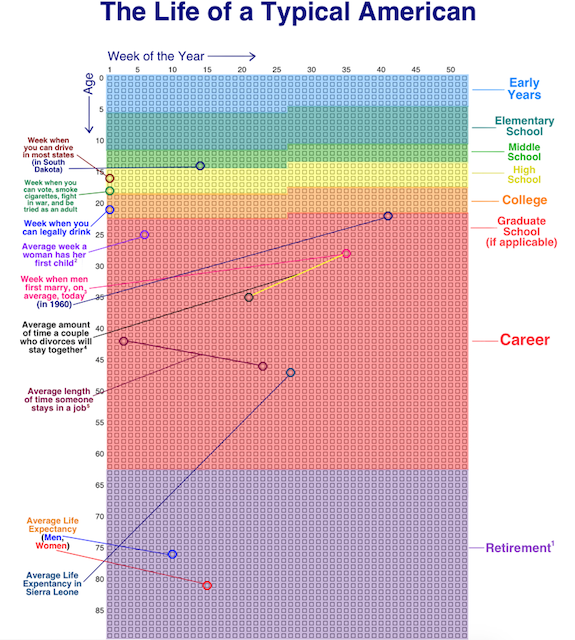
One of his most famous posts, back in 2014, urged readers: visualize your life in years, your life in months, your life in weeks, your life in number of remaining SuperBowls…to appreciate what you do with your time.
For example, I’ve got got 2860 of my weeks behind me. It’s tempting to use these kinds of visualizations for dismay; certainly they can lead to existential angst and even more productivity dysmorphia. “See?” one might yelp! “I have even less time to make the widgets! To earn the money!” And yet, as we’ve seen over the last two weeks, that attitude just leads to focusing more on the quantifiable value you create for others; we want to look at quality, not quantity.
But, we can still turn to Urban for guidance. As a follow-up to his macro look at the finitude of life, he developed a way to organize and examine our lives at the micro level in 100 Blocks a Day.
Inspired by Urban, nomadic programmer Jama of Notion Backups, has identified a way to pause and reflect, giving perspective on where you are, chronologically speaking, in your day (rather than in your life). Rectangles.app gives you a quick glance at how much of today has gone by, in ten minute increments, as of the point in your day when you click the link. Click later in the day, more boxes turn green.
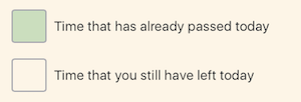
For example, when I visited and took this screenshot, I’d made it through 93 1/3 ten-minute blocks in my day.

When faced with how much of your day has passed and how much is left, you might have the following reactions:
- Yikes, I’d better get cracking! (A good motivation if you’ve been staring at social media or playing a video game for hours on end, for sure.)
- Yikes, I’ve been working and working, and I’ve only written 17 TPS reports and attended 5 hour-long meetings! (A likely sign of productivity dysmorphia creeping in around the edges.)
- Yikes, all I’ve done all day is work. I haven’t talked to anyone I love, I haven’t exercised or gotten any fresh air. I haven’t laughed. (And here’s where the magic might begin!)
If you’ve been experiencing signs of burnout due to toxic productivity, give this approach a try. Click on Rectangles and think about the day you’re having. Maybe even text the link to a friend, describe your day thus far, and get a reality check from someone who sees you more clearly.
HOW TO GET OFF THE HEDONIC TREADMILL & STOP KEEPING SCORE
If you’ve gotten this far in this blog series, you might recognize that you (or someone you care about) is experiencing signs of toxic productivity or productivity dysmorphia. If you have trouble valuing what you’ve already accomplished, and especially if you experience difficulty spending your time on anything you can’t point to as an accomplishment, this section is for you.
We aren’t going to begin by saying, “Stop doing so much work” because that’s too big a step. Instead, I’m going to ask you to review the forthcoming suggestions and pick one or two to try, and carve out time in your schedule for doing them. Consider, on your first day, taking two or three of those boxes above, and before they pass by and turn green, experiment. Walk. Nap, Meditate.
Take a Walk
Exercise is great for us — it clears our heads and lets us reset to that default mode network we learned about last week from Jay Dixit’s We’re Doing Downtime Wrong in NeuroLeadership.
Of course, not all exercise is equal. Yoga is supposed to be good for us because it’s (mostly) gentle on the body, it focuses on correct breathing techniques, it improves strength, balance, and flexibility, it eases pain and benefits cardiac health, it dissipates stress, and much more. But yoga’s particularly advantageous for drop-kicking toxic productivity because there’s no scorekeeping.
Yes, I suppose you might feel competitive with the person next to you in class (not that you have to take a class) who has a more fluid downward-facing dog than yours. But in general, completing a yoga class feels less like, “I am a valid person because I can check today’s yoga off my list” and more, “Wow, my neck is no longer making that clicky-sound when I turn to the right!”
Contrast this with golf, for example, famously called, “a good walk spoiled.” (And no, trivia buffs, Mark Twain didn’t say that. He died in 1910, but the first reference to it was in 1948. The originator is a mystery.) Golf, indeed any game that involves precision and scorekeeping, probably isn’t going to help decrease your sense of always chasing after the next accomplishment, the next win.
Let’s start by stopping. Let’s stop counting our steps and counting the filled rings. (I’m not saying you can’t monitor your health-based metrics, but try strapping your Fitbit to your ankle to keep yourself from obsessively checking your step count.)
The great thing about walking is that there’s very little else of a truly productive nature, in terms of output, at least, that can be done while walking. You can’t handwrite, and while you can type or dictate into your phone, anything more than the odd inspiration is going to slow your pace and then stop you altogether, either because you’ll have forgotten to walk or you’ll fall right into a fountain.

For your mental health, the best thing you can do is just walk and explore your thoughts. Of course, that can be scary. Sometimes, the basis of toxic productivity is that one keeps working to avoid one’s thoughts. (Therapy can really help with that. Nudge, nudge.)
If you’re truly uncomfortable being alone with your own thoughts, try listening to soothing music or, if you must, a podcast. But the idea of this particular exercise (no pun intended) is to ease you into the notion of being comfortable doing nothing that earns you gold stars, nothing to check of the list. Try to walk to just walk.
One resource that might help is 52 Ways to Walk: The Surprising Science of Walking for Wellness and Joy, One Week at a Time by Annabel Streets.

From walking for meditation to walking barefoot, from walking in the rain to “walking like a Pilgrim,” (which, one assumes, is different from The Bangle’s Walk Like an Egyptian), the book explores unusual ways to incorporate walking in your life, and bits of research to give you some why to go with your what.
For example, did you know that a study published in Brain Research found that walking regularly and varying your speed results in improved concentration? (Maybe you can encourage your kids to take walking breaks between study sessions! There’s the benefit of that default mode network again!)
The key is to add activity to your daily experiences. Toxic productivity and the resulting burnout comes from failing to nurture your whole self, leading you to only envision yourself as a means of production, no more than livestock or a machine. Investing in yourself as a full human being helps break apart that idea that you must contribute productively at all times to be of value at any time.
Investing in yourself as a full human being helps break apart that idea that you must contribute productively at all times to be of value at any time. Share on XEmbrace Sleep
Are you feeling like you’re “always on” and that sleep will just leave you further behind?
This may seem hypocritical for anyone who knows Paper Doll in the real world. I am a notoriously “bad” sleeper, if you want to be judgmental about it. For the better part of half a century, I’ve been going to sleep later and later, about when the roosters wake and the “time to make the doughnuts” guy meets himself at the door.

But although I have had a lifelong difficulty with getting to sleep, I am blessed with the ability to fall back asleep. And I’ve built my life (at least these last two decades) around working when my body clock makes me the most creative (afternoons with clients, late nights for writing) and getting all the sleep I want and need, just not at societally-approved times. I’ve accepted that my different sleeping patterns are atypical, and I would never sacrifice sleep in order to cross more tasks off my list.
Sleep is essential for our health. Did you know that getting poor sleep or not enough sleep leads to obesity? Sleep deprivation leads to higher levels of ghrelin (the hormone that tells your body when it’s time to eat) and lower levels of leptin (a horomone that regulates energy balance and inhibits hunger).
These levels are correlated with increased hunger, particularly with cravings for fat-dense and carbohydrate-dense foods. (Um, like doughnuts. Sorry about that.) And eating more of these kinds of foods increases the “neuronal reward pathways,” which can spur a sort of addictive response in the brain. (Note: I mean no disrespect and am not fat-shaming; I reference this solely for those concerned about dietary-related health.)
What the heck does this have to do with productivity or organizing or any of what this blog is about?
To be productive, we need to be able to disengage and re-set. There are many ways we accomplish this, but the brain depends upon sleep to flush toxins and achieve this re-set. The more sleep we lose due to “hustle culture” and the need to accomplish more and more, the less we can actually do. In 2011, a Harvard Medical School study found for the average worker, insomnia led to the loss of 11.3 days’ worth of productivity each year.
And the American Academy of Sleep Medicine found that “compared to those who regularly got 7 to 8 hours of sleep, those who reported getting 5 to 6 hours experienced 19 percent more productivity loss, and those who got less than 5 hours of sleep experienced 29 percent more productivity loss.”
It’s not just that lack of sleep makes us too loopy to grasp statistics or zoom through our work. It’s not just that missing our zzzzz cuts down on our to-do list checkboxes, but it makes us cranky and short-tempered with our bosses and clients, our friends and our loved ones.
And this isn’t a little thing. Chronic insomnia (whether it’s brought on by the stresses of toxic productivity or because we avoid sleep to keep working) is a risk factor for developing clinical depression and anxiety — and good luck trying to be productive when battling those!
So, getting adequate and high-quality sleep can not only help us be more productive; it can help us develop the mental health and physical stamina we need to support ourselves in crafting a life that places rest and life satisfaction on equal (if not higher) footing than constant productivity. A few highly recommended books on sleep include:
Why We Sleep: Unlocking the Power of Sleep and Dreams, by Matthew Walker, PhD.

The Sleep Solution: Why Your Sleep Is Broken and How to Fix It, by Dr. W. Chris Winter

And nighttime sleep isn’t the only kind of sleep to consider. Napping has value as well. I encourage you to peruse The Nap Ministry | Rest Is Resistance (both the blog and the forthcoming book) and consider that if you judge yourself for napping (or sleeping in general), that’s a good sign that you’re sinking into the trap of toxic productivity and undervaluing your health as you overvalue work tasks.

Stop Multitasking
We’ve talked about multitasking many times before, usually under the guise of eliminating the distractions that hurt our productivity. But multitasking can be tricky. In We’re Doing Downtime Wrong, Dixit identified common traps where multitasking detracts from mindfulness, which is another key to helping us both re-set our brains and get off the hamster wheel of feeling like we have to be always-on.
In Dixit’s words, “doing the dishes while listening to a true crime podcast” isn’t real downtime. Just do the dishes. Let your mind wander. Give yourself permission to just exist!
Shhhhhhhhhh
You may be wondering what quiet has to do with toxic productivity. Sure, we know that silence, or at least the absence of distracting noise, can improve our productivity. For example, a German study just prior to the pandemic proved that using noise-canceling headphones can improve focus, cognitive performance, and employee satisfaction in open-office environments.
We know that sound pollution distracts us; it keeps us from getting into the zone for deep work. But again, as with walking and other non-work tasks, we need to introduce more silence into our non-work time to normalize quiet and make the busy humming of accomplishment only one, but not the primary, experience of life.
Create opportunities in your life for a little more zen. Try driving with the radio off. (I know, it’s hard!) Consider dining without the TV on. Embrace quiet outside your body so you can hear what you need to tell yourself.
Ask the Hard Questions
Author Josh Kaufman has a blog post entitled 49 Questions to Improve Your Results. While that sure sounds like an invitation to more chase-your-tail productivity, the questions are a deep dive into self-analysis for improving your life satisfaction.
Kaufman organizes these questions under the following over-arching categories:
- Do I use my body optimally?
- Do I know what I want?
- What am I afraid of?
- Am I confident, relaxed, and productive?
- How do I perform best?
- What do I really need to be happy and fulfilled?
But don’t just read the ones I’ve bulleted above. I encourage you to read and think about the sub-questions Kaufman invites you to consider, from “What “states of being” do I want to experience each day?” to “What environment do I find most conducive to doing good work?” to “How often do I compare myself to my perceptions of other people?”
Questions like these may help develop a pathway out of any toxic tendencies.
Life is all about balance ⚖️ pic.twitter.com/hkWVCfE5Aq
— Product Hunt ? (@ProductHunt) June 17, 2022
Consider what a constant race for productivity is costing you
The more you’re caught up in toxic productivity, whether it’s pressed upon your by your work environment or you’ve developed productivity dysmorphia all on your own, it’s easy to make excuses. If you’re not continually productive, you might lose your job. You might lose your clients. You might lose your competitive edge.
But what else might you lose in this constant thrum of busy-ness?
In a recent newsletter, Graham Allcott wrote 10 Reasons To be Less Busy. It’s superb, and was one of the inspirations for me to look at toxic productivity on a larger scale. I encourage you to read the whole piece.
In the introduction to his list, where he acknowledged that our society makes that busy buzz of productivity into a badge of honor, Allcott noted:
The old saying is “if you want something done, ask a busy person”, but I’d add that if you want something done efficiently or with quality, then ask someone who is calm, focused and is good at saying “no”.
So let’s stop being busy. And let’s stop the glorification of busy, too. We need recognise what it really is – an inability to relax, an addiction to flattery or excitement, and an inability to make choices that make space for what matters.
Bam!
As with Burkeman’s Four Thousand Weeks, Allcott recognizes that life is fleeting and promising that you will slow down someday, when X occurs or Y is finished, is chasing your life away.
Just a few of my favorite bits from Allcott’s list are:
1. When you’re busy, you don’t see the bigger picture. That means that you’re missing opportunities or leaving easy wins on the table.
4. Being busy is the biggest cause of accidental unkindness.
5. Being busy doesn’t make you more productive. In fact it’s the opposite. The law of diminishing returns in knowledge work kicks in closer to 30 than 40 hours. Putting in more hours generally just means a lower average hourly return for your time. You’re far better off aiming for a well-rested and well-focused 30 hours than a frazzled 40+.
10. You don’t need to worry so much. You do enough. You are enough.
And then, with more wisdom per pound than in any newsletter I’ve read recently, Allcott asks you to ask yourself, “What difficult choices could I make this week, to unapologetically make space to be less busy and more me?”
In the next installment of this series, we’ll be looking at how we can take the advice, skills, and tools designed to make us more productive (in what often becomes a toxic way) and use them to our advantage in making us better at more life-affirming achievements.
Until then, can you see yourself employing any of these practices to slow down the speed of life? Please share your thoughts below.
Toxic Productivity Part 2: How to Change Your Mindset
Last week, in Toxic Productivity in the Workplace and What Comes Next, we addressed systemic toxic productivity, when the workplace demands a seemingly endless series of achievements, undue (and unreciprocated) loyalty, and more of one’s heart, soul, and time than is reasonable. We also touched on the concept of personal toxic productivity, or productivity dysmorphia.
Going forward, we’re going to look at what we can do to give ourselves some grace and separate our productivity from our identity. Today, we’re focused on changing the way we think about ourselves and what we accomplish.
But first, let’s look at three stories that illustrate what toxic productivity is not.
WHAT TOXIC PRODUCTIVITY IS NOT
Story #1: At the end of April, my delightful colleague Linda Samuels wrote a blog post entitled How to Successfully Let Go Now Even If It’s Only For Today. In that post, she described how she enjoys getting things accomplished and often feels compelled to do so. She had a list of what she intended to accomplish on that particular Sunday, but was beckoned by the beautiful spring wearther and instead enjoyed a day in nature with her husband. In my blog comment, I gently teased her:
LOL, I’m glad you let go, but I think I see your problem right away, Linda. You had a to-do list for a Sunday. Sunday is the weekend. You’re not supposed to DO anything on the weekends except eat, play, and be entertained in the first place! 😉 No housework, no work-work, just enjoying yourself. I’m glad you let go; now we need to help you plan letting go as your weekend task so you don’t even try to work!
Linda is not an example of toxic productivity. She’s self-driven, but she also knows how and when to let go and grant herself buffer time to enjoy life.
Story #2: Another colleague (we’ll call her X), is a real go-getter. She had been working to create a virtual course, but has not yet made it go live because she’s so busy with her client load and is booked through the end of the summer. Disappointed that she hasn’t completed this combined educational/marketing tool, we’ve pointed out that the whole purpose of making people aware of one’s expertise is to get clients, and she already has more clients than spaces on the calendar! The girl is in serious demand!
Meanwhile, a few months back, X contracted COVID. Luckily, she had very mild symptoms, but of course she was quarantining. With no work to do, she headed outside and spent her quarantine weeding her garden! (Apparently, X didn’t know that the only acceptable reaction to being ill is to mope, wear fuzzy socks, and intersperse reading trashy magazines with bingeing guilty pleasure TV!)
X is also not an example of toxic productivity. She’s a product of a particular cultural background that especially prizes hard work and efficiency, but she also enjoys vacationing with her husband and entertaining friends around her pool.
Story #3: My BFF is a full-on, leaning-in career woman now that her children are all grown, but I recall a time when, for the 43rd conversation in a row, I was giving her a hard time about working so hard. She was raising four kids, volunteering in many realms, and though she had a bad case of bronchitis, was — as I was speaking with her on the phone — making cupcakes for a school bake sale!
As only a BFF can push, I pointed out that 1) she was sick and did not need to be doing anything for anyone else, 2) she could have sent her husband to the store to buy cupcakes, and 3) nobody wanted her bronchitis-germy cupcakes anyway! (I’m sure my voice went up three octaves by the time I got to the end of my diatribe.)
If I didn’t know better, I might think my BFF might be an example of toxic productivity. But she’s actually an example of systemic expectations of mental load, emotional labor, and American women unintentionally embracing the societal view that a woman’s value is based on what she does for others. (For superb writing on how to counter this, check out Emotional Labor: Why A Woman’s Work Is Never Done and What To Do About It, by my colleagues Regina Lark and Judith Kolberg.)

So, toxic productivity isn’t always what it seems. But also, what you do is not who you are.
REVISITING PRODUCTIVITY DYSMORPHIA
Last week, I referenced Anna Codrea-Rado piece, What is Productivity Dysmorphia?, for Refinery 29. In it, Codrea-Rado, a successful author, pointed out some of the hallmarks of productivity dysmorphia as she experiences it and as others have described it:
- a difficulty experiencing pride in one’s accomplishments
- a focus on what could have done better or what more could have accomplished
- a disconnect between objective achievements (what you might put down on your “have done” list) and emotions about those accomplishments
Codrea-Rado says of productivity dysmorphia that:
It is ambition’s alter ego: the pursuit of productivity spurs us to do more while robbing us of the ability to savour any success we might encounter along the way.
In particular, I was intrigued that by Codrea-Rado interview with Dr. Jacinta M. Jiménez about hedonic adaption. Usually, we talk about hedonic adaption, or the hedonic treadmill, in terms of our desire for tangible things.
In the famous story of Diderot’s dressing gown, the French philosopher was gifted a fancy robe to replace a tatty one. As Diderot got used to his new dressing gown, he came to see his sense of self as defined by its finery. He felt dissatisfaction with his older possessions and began of spiral of 18th century keeping-up-with-the-Joneses consumerism, replacing the perfectly good items associated with his old life and going into debt to keep up with the identity of the new.
Hedonic adaption applied to the sense of one’s productivity is compelling. Like Diderot and his dressing gown, the more we accomplish, the more we expect of ourselves, and the more we build our identities on a foundation of being the kind of person who accomplishes things. Initially, we may delight in what we have already done, but soon the new “finery” of our most recent client acquisition, business coup, or media exposure becomes the baseline, and we hunger to accomplish more and more (as we appreciate our successes less and less).
Of course, there’s more to all of this, as Codrea-Rado’s piece shows: gender, race, class, mental health, neurology, and how society views performance within and across groups all determine how we view (and mischaracterize) our own performance. There’s no wonder that a tweet like this might resonate.
“how do you do so much?” it’s a little thing called never feeling like i am doing enough ?
— ashley ray (@theeashleyray) June 13, 2022
And it’s also no wonder that there’s finally a backlash against a culture that promotes productivity above all, as seen in books like Jenny Odell’s How To Do Nothing: Resisting the Attention Economy and pieces like The Frustration With Productivity Culture in The New Yorker.
HOW TO CHANGE THE PRODUCTIVITY MINDSET
So, what can we do to approach being productive in a way that’s healthier for society and for ourselves? I’m a professional organizer, not a mental health professional, so the first thing I recommend when I’m working with clients to help them be productive on their own terms is to listen.
Each person’s story is unique, and the solutions for finding the right combination of tools and solutions to “right-size” their productivity is going to be unique, too. We start where they are.
That said, I’m a big believer in recommending therapy if someone’s sense of self doesn’t reflect objective reality. But beyond a therapeutic approach, any and all of the following may prove fruitful in achieving a healthy productivity mindset.
Debunk the Common Myths About Productivity
There’s a lot of bad productivity advice out there, and a lot if it will make you feel bad about yourself. For example, there are oodles of articles, podcasts, and books telling you that if you want to accomplish the goals you set, you have to rise early in the morning, to which I say:
PIFFLE!
I have been a night-owl since childhood. My creativity comes alive at night. My clients know that my brainpower increases as the day goes on. (And I write all of these Paper Doll posts in the post-midnight hours.) Before 10 a.m., I’m cranky and poorly disposed to craft a useful sentence.
So, productivity myths abound.
I suggest you start with this excellent article Linda Samuels shared with me, Your Productive Brain, by Dr. Dean Burnett with the BBC Science Focus. From the time you awaken, to the claim that “we all have the same 24 hours” (which I’ve previously debunked here, often), to the false equivalency between busy-ness and productivity, the piece is eye-opening.
Chances are that if your identity is based in how much you accomplish, you might have trouble embracing the idea of doing less? But what if science told you that that would be the best way to get more done, or at least more done well?
Jay Dixit’s piece in NeuroLeadership entitled We’re Doing Downtime Wrong explains that cognition depends on two different brain networks. The central executive network (think: executive function, not CEOs), or task-positive brain network, activates to help us use our memories of previously-acquired information to comprehend new information, focus our attention, come up with solutions, and make decisions.
But this aspect of our brain doesn’t work alone! The other is the default mode network — it’s what your brain is thinking about when nobody’s expecting anything from you. (So, for Paper Doll, that would be either Reese Peanut Butter Cups or Doctor Who.) And we NEED this network if we want to be creative! That’s why, when we’re having trouble solving a problem and we go away to take a shower or go for a walk, the answer seems to magically come to us!

Light Bulb Moment Photo by Pixabay
We need downtime for our brains to make those big, creative leaps. All work and no play makes Jack and Jill decidedly dull kiddos.
So, if you focus all of your attention on being productive because your identity is forged in what you accomplish, you might want to remind yourself (until you gain a more healthy self-image) that getting stuff done (well) requires periodically doing nothing.
This only touches on one part of the NeuroLeadership piece. We’ll be coming back to it next week when we look at physical, tangible ways we can change our responses to toxic productivity.
Embrace a Completely New Philosophy of Work…
I was intrigued by How To Care Less About Work by Charlie Warzel and Anne Helen Petersen in The Atlantic. The piece ties what we discussed last week, regarding how corporatized expectations of our productivity can help determine (and warp) our sense of our own value to the solutions individuals can take to reconfigure how we see the value of work as just one part (and not the most important part) of life.
Without calling it toxic productivity, as such, Warzel and Peterson recognize that we are all, collectively, having a bit of angst these days, these years. Instead of the quarter-life crisis everyone was worried about a few decades ago, it seems we’re all having what the authors call “the existential crisis of personal value.”
And in response, we’re all trying to be as productive as possible, whether we are working for others (as described last week) and being squeezed dry of our creativity and humanity, or if we are solopreneurs, self-employed, and small business owners doing it to ourselves, all in the hope that we will discover what Warzel and Peterson eloquently call our “purpose, dignity, and security.”
Oy.
The piece makes several points, but I keep returning to one central question the authors ask: Who would you be if work was no longer the axis of your life?
The authors also invite readers to consider a time when work meant things done at work, for pay — recall being a newspaper carrier or a restaurant server, where labor had a distinct end point. Then they ask, what did you do with your unscheduled time, just because it was what you liked to do? And to clarify, they note they are asking about what you did…
Not because it would look interesting if you posted it on social media, or because it somehow optimized your body, or because it would give you better things to talk about at drinks, but because you took pleasure in it.
I don’t know about you, dear readers, but this sure gave me pause.

Child on Bike at Sunset Photo by Clark Young on Unsplash
They continue:
Once you figure out what that thing is, see if you can recall its contours. Were you in charge? Were there achievable goals or no goals at all? Did you do it alone or with others? Was it something that really felt as if it was yours, not your siblings’? Did it mean regular time spent with someone you liked? Did it involve organizing, creating, practicing, following patterns, or collaborating? See if you can describe, out loud or in writing, what you did and why you loved it. Now see if there’s anything at all that resembles that experience in your life today.
From these questions, Warzel and Peterson stand in for the therapists and encourage the embrace of those joyous things. Not Arts & Crafts to develop a side hustle for Etsy but for the radical delight of painting or drawing or fiddling with crayons and pipe cleaners and sparkly glue. Not biking to get a count for your Fitbit or fill the rings on your Apple Watch, but for the sheer joy of the wind in your hair. Not dancing because it burns calories or to get likes on your TikTok version of Lizzo’s latest song, but because of the sheer exuberance it brings you.
Consider the possibility that what you are when you are working is not who you are, or at least not all that you are. And not to put words in the authors’ mouths, but find your bliss. Find your crayons on pipe cleaners.

…or Embrace a Completely New Philosophy of Life
Last year, I read Oliver Burkeman’s Four Thousand Weeks: Time Management for Mortals. Combining psychology, ancient and modern philosophy, spirituality, and a bit of popular culture, it slaps a reality check on the constantly turning wheels of productivity culture.

Burkeman invites us to embrace “finitude” — the understanding of the shortness of life.* Starting from the premise that, given an average life span of 80 years, he notes that we have just 4000 weeks, give or take, on the planet. As you approach week 3972 or so, do you really think you’ll look back and be unalterably happy that you spent most of those weeks doing TPS reports (yes, another Office Space reference) or making cold calls or quantifying your worth in checked-off boxes or bank balances?
In the book, Burkeman posits some questions that I think most of us who dabble with productivity dysmorphia might find mind-blowing:
- Is it possible you are holding yourself (and others) to impossible standards?
- Are you holding yourself back from doing certain things you really want to do because you don’t think you are smart enough, experienced enough, talented enough, or just plain enough?
- Are you doing what you are doing because you’re trying to be the person you think others expect you to be? Or the person you’re “supposed” to be (as if that were even a thing)?
- How would you live your life, your years, your days differently if you stopped focusing on what you achieve.
Pretty heady stuff, eh? Nobody is saying run off to the beach to be the next Gidget or Moondoggie (oh, gee, is anyone under 50 going to get that reference?), but perhaps we shouldn’t center our achievements, especially if we’re having trouble appreciating them in the first place.
Burkeman avoids providing productivity hacks, but he does have some atypical advice for living with an appreciation of the finitude of life. Some are obvious — get rid of the technology (like social media) that doesn’t add to the joy of your life, not because it steals time from what you accomplish, but because it steals time from what makes you happy.
Burkeman also recommends some pretty philosophical tasks that can’t be quantified, which has the benefit of taking you off the productivity merry-go-round. For example, we know that the brain appreciates novelty; we remember what happens on vacations because everything is out of the ordinary. So, he recommends avoiding routine (the things we productivity experts often praise) and seeking novelty in the “mundanity of life.”
He also suggests building a habit of instantaneous generosity, wherein you act on thoughts of doing a kindness in the moment when you think of it. It’s certainly the opposite of the advice we usually see about maintaining focus on our tasks. But again, we’re trying to improve our life satisfaction rather than our joy in ticking one more task off of our to-do list.
*Does “the shortness of life” sound familiar? In On the Shortness of Life, Stoic philosopher Seneca wrote, “It’s not that we have a short time to live, but that we waste so much of it.”
In case you assumed (as I did) that the Stoic philosophers were all Spock-like and devoid of emotion (based on a common (mis)understanding of the usual meaning for “stoic,”) I’ve got some delightful news for you. The Stoics, and Seneca in particular, offer up great advice for coping with life and making it feel like more than just a race to the finish line. David Fideler’s Breakfast with Seneca: A Stoic Guide to the Art of Living is a great place to start for an ancient approach to our modern productivity mindset problem.

Consider This Baby Step for Adjusting Your Productivity Mindset
Matt Haig, the author of some truly compelling novels like The Midnight Library and How to Stop Time has written a remarkable book I turn to time and again. It’s called The Comfort Book, and I’d recommend it to anyone who is dealing with depression or anxiety, or a broken heart or a moment (or several) of doubt, or the experience of living in the 21st century.

As I was preparing this post, what Haig wrote about “Being, Not Doing” felt particularly apt.
You don’t need to exhaust yourself trying to find your own value. You are not an iPhone needing an upgrade. Your value is not a condition of productivity or exercise or body shape or something you lose via inactivity. Value is not a plate to be continually spun. The value is there. It is intrinsic, innate. It is in the “being” not the “doing.”
“You are not an iPhone needing an upgrade.” Damn, Matt Haig, that’s good.
As we part ways until next time, if you hold onto one thought during the internal struggle over how much you’re getting done: It’s in the being, not the doing.
As this series continues, we’re going to be looking at specific ways we can change our physical actions to help our brains accommodate a different view of our productivity. This will include focus, sleep, silence, nature, walking, companionship, technology (and the absence of it), and more.
And in the final installment, we will circle back around to productivity techniques. Not hacks. Not ways to get more done in less time so that you can cross the finish line to then do something else productive. Rather, we’ll look at some modern productivity science and so we can complete what is essential and then walk away from doing and focus on being.
Until then, please feel free to share your thoughts about the dark side of personal productivity.
Toxic Productivity In the Workplace and What Comes Next
WHAT IS TOXIC PRODUCTIVITY?
Productivity is a good thing, right? You’re hitting the goals you (or your team, or your boss) set, you’re working effectively (on the right things) and efficiently (zooming steadily toward your accomplishments). What could be bad?
Toxic productivity is when that drive to be productive is taken to unhealthy extremes. In a toxic work environment, employees lose motivation and self-esteem due to the external forces created by employer policies and/or management, as immediately recognizable in the now-classic Office Space.
However, toxic productivity can also stem from unhealthy expectations for what personal productivity should look like, and this can be driven by the workplace, by parental and educational influences since childhood, and even by genetic makeup.
Self-generated toxic productivity reads as workaholism, a drive not only to be productive at all times (and sometimes at all costs), but to appear productive at all times. In the past year, it has been called productivity dysmorphia, an expression which if not coined, was certainly popularized by Anna Codrea-Rado. (We’ll dig deeper into her article next time!)
Because it is the impulse for productivity as a process, rather than the achievement of the end result, that characterizes a sense of success, for someone suffering toxic productivity, there’s no sense of satisfaction. For the workaholic, there’s always an aching pit in the stomach that the end result could have been better or that they could have accomplished more. There’s no joy in crossing the finish line, because there’s always another finish line.
Those dealing with workplace-driven toxic productivity may fear losing seniority status or career security if productivity decreases. But for those whose identities are tied to what they have accomplished, self-esteem is often derived from getting stuff done, so it can be hard to find a personal off-switch. Work/life balance — a dubious concept in the first place — is hard to achieve when you identify your value in life by what you achieve at work.
For those whose identities are tied to what they have accomplished, self-esteem is often derived from getting stuff done, so it can be hard to find a personal off-switch. Share on XAre you asking, “What’s the problem?” Focusing on productivity means high achievement, and if your sense of self is measured by what you achieve, how will you ever get off that roller coaster? How will you ever stop chasing the high of “having done the thing” you set out to do? When do you get to breathe?
If you always feel that you should be getting more done, you may feel guilty when you’re not producing — and this can include needing that sense of accomplishment through housework, hobbies, or any competitive impulse where the drive eclipses the enjoyment.
If you feel more and more worn out rather than energized by whatever you do, that’s toxic. And like any poison, it will drain you of your vitality.
An obsession with productivity can not only lead to a lack of productivity, but can eventually cause leisure sickness, where during your downtime, with family, or while on vacation, you’re unable to relax and enjoy the moment, as you may become disconnected from the idea of existing without working toward a productive end.
Today’s post is going to focus on toxic productivity in the workplace, and what’s being done to countermand it. Next week, we’re going to dig deeper and look at how we can target toxic productivity and productivity dysmorphia at the individual and societal levels to be productivite in a more healthy way.
TOXIC PRODUCTIVITY AROUND THE WORLD
Have you ever heard of 996? China made the news last year because many workers were on a 996 schedule, working 9 a.m. to 9 p.m., six days a week!
Meanwhile, in Japan, there’s a corporate culture that leads to workers performing up to 80 hours of overtime, often unpaid, each month. It’s called Karōshi, “death by overwork,” and it’s marked by an extreme performance of company loyalty, both on and off the clock. Employees, legally granted twenty vacation days per year, regularly fail to take half of them.
For what it’s worth, this overwork doesn’t help Japan’s productivity, which falls behind the United States, France, Germany, Italy, the UK, and Canada.
Lest you think that this is only a problem in the Far East, be assured that this kind of toxic productivity is alive and not-so-well right here in the United States. For example, according to Project Time Off, in 2016, 55% of Americans did not use all of their paid time off. That’s 658 million unused vacation days, one-third of which did not roll over to the next calendar year or get reimbursed financially. Poof. That time off just disappeared, and the dollar value of that time went into company coffers.
In 2019, the last pre-pandemic year on record, 768 million vacation days went unused — and less than a quarter of Americans used all of their available paid vacation! Oddly, a 2019 study showed that one in three Americans would be willing to take a cut in pay in order to get unlimited vacation days. This is pretty puzzling. Workers want more vacation, but they’re unwilling or unable to take all of the paid days they have!
Why might this be? A recent TikTok (sigh, yes, I’ve become one of those people) showed an imagined conversation. A representative of Human Resources was cheerleading the advent of summer work hours, where staff would be allowed to leave at 3 p.m. on Fridays. Dubious, the worker asked if workload expectations would be scaled back accordingly.
The “boss” character noted that staff would be encouraged to work late on Thursday evenings to make up the workload. After the employee pointed out the irony, the boss character noted that, simply put, they wanted both the same level of productivity and credit for offering work/life balance.
The grim humor aside, this is the reality for most workers, and it’s not just about vacation hours. More and more, I’m seeing articles about “sad desk salads,” popularized by the Jessica Grosse novel of the same name.
From Life Is Too Short for Work Salad to The “Sad Desk Lunch” is Now Even More Depressing as Employees Return to the Pandemic-Era Office to this older (not-entirely-comedic) video, Sad Desk Lunch: Is This How You Want to Die?, the toxic drive for productivity (or to appear productive) is dangerous.
The problem isn’t salad, but dining at one’s desk while continuing to work through lunch. We know the continued sitting is bad for physical health. The lack of socializing (even for introverts) and inability to take cognitive breaks from labor (and physical breaks from the workplace to get fresh air) are bad for mental health.
None of this is new. Workers’ fears of being replaceable and the corporate message of being a “company man” or “company woman” have been around for a long while. And now, there’s an overwhelming uncertainty as we struggle through a third summer of COVID and into inflation and a prospective recession. (Sorry, this isn’t the usual chirpy Paper Doll topic!)
Of course, if there’s been one positive of the these past 2 1/2 years, it’s that workers are no longer willing to be taken advantage of. I’m sure you’ve noticed that there are fewer cashier lanes open in stores, and most restaurants have signs on the front door, warning patrons that they are short-staffed. While I don’t want to get political, I completely agree with this tweet:
Periodic reminder: there is no labor shortage. There is a shortage of jobs that treat workers with dignity and an excess of corporate greed.
— Robert Reich (@RBReich) June 10, 2022
CONQUERING TOXIC PRODUCTIVITY FROM THE TOP DOWN
The tweet’s point is apt, but the question becomes, how can we maintain healthy productivity in the face of corporate greed?
In the middle of the 20th century, that was a role filled by unions. Now, productivity will be controlled in three ways: by governments setting policies for the betterment of society, by companies recognizing their long-term self-interest in treating employees better, and by individuals either working from within to change company culture or leaving for different workplaces or starting their own businesses.
(Full disclosure: A little more than twenty years ago, I left a toxic industry, and a particularly toxic workplace, and became a professional organizer. The impact on my physical and mental health was an absolute net positive. But, of course, becoming self-employed is not a panacea for everyone, as we’ll discuss in greater detail in next week’s post.)
Japanese efforts to counter Karōshi were iffy at best; they mandated that employees took their vacation days and set corporate office lights on timers to go off at 10 p.m. And, like the TikTok example, they shortened work hours on the last Friday of some months, but it turns out this was more of a marketing effort to get workers to use their off hours to shop!
So what might actually work?
Curtailed Office Hours and Remote Work
You may have seen on the news last week that 70 companies of varying sizes, from mom-and-pop restaurants to corporate entities, in the United Kingdom are testing 4-day workweeks this summer. Like the TikTok example with a token carving away of two hours, these blue-collar and white-collar workers will be paid for their usual (generally, 40) hours per week, but will only have to show up for 80% (so, generally 32 hours); in most cases, the same level of productivity will be expected.
On the one hand, this will give parents the opportunity spend more time with their children, and all workers the chance to make medical appointments and attend to other life necessities. On the other hand, if workers are on-site (whether in offices, restaurants, or stores), they’ll lack the appealing flexibility of work-from-home jobs that became so popular during the earlier stages of the pandemic.
And the research does overwhelmingly show that WFH office workers did not need micromanaging and were as, or more, productive than when they were in the office. Indeed, an Owl Labs study found that, “On average, those who work from home spend 10 minutes less a day being unproductive, work one more day a week, and are 47% more productive.”
That said, there are people who missed the camaraderie of the office and the transitional headspace of commutes. Remote work is one way to improve working satisfaction and defuse the toxic productivity bomb, but it isn’t a solution for everyone.
Better Work/Life Boundary Expectations
In 2016, France took a different approach. Recognizing that the digital, always-on era means that office employees can’t achieve “work/life balance” if there’s increasingly little daylight between their “work obligations” and their actual lives. So, France amended its labor laws such that in any company of 50 employees or more, you cannot email an employee after official work hours.
BOOM!

French Café Photo by Stephanie LeBlanc on Unsplash
Imagine leaving work, going to a café, and not having to be bothered about work until the next workday!
This “right to disconnect” rule isn’t the only thing France has done to improve quality of life. All workers get 30 paid vacation days a year and 16 weeks of fully paid family leave. For comparison, the United States has no nationally guaranteed paid vacation policy and no national policy guaranteeing any paid family leave. Just saying.
Oh, and in case you didn’t make it to 1:48 into the video at the top of this post, France is second only to the US in terms of productivity (GDP per hour worked).
A year after France created this right to disconnect, Italy did the same, and then Spain! In 2018, Belgium followed suit, announcing that 65,000 federal civil servants would no longer have to answer calls or emails from their bosses outside of working hours. Portugal passed a labor code banning employers from pestering employees during their “rest period” except for emergencies, and this applies to both office workers and remote workers. Managers who breach the policy can be fined!
Oh, and last year? Ireland instituted a right to disconnect rule applying to all employees. Your boss can’t contact you by email, phone, or text during your off hours.
Does your workplace (or nation) have any policies that ameliorate the tendency toward toxicity? Please share in the comments, below.
Next week, we’re going to continue this series by delving more deeply into what we, individually, can do to shut down personal tendencies toward toxic productivity and reverse productivity dysmorphia. We will examine:
- Healthy productivity strategies
- Ways to unplug from work and from a sense of obligation to do rather than just be
- Beneficial habits and routines
- A reading list for seeing yourself, and what you accomplish, in a more wholesome way.
Follow Me