Archive for ‘General’ Category
Lost and Found: GONE in 6 seconds: Your Wallet!
Even if you’ve never experienced it, your imagination can conjure that sinking feeling in the pit of your stomach. You reach into your pocket, bag, drawer or center console of your car…and grasp thin air. Your wallet is gone. Not “darn, I left it on my dresser”, but “ohmygosh, mymoneymycardsmyidentity, OhNoooooooooo!!!!!”
If you’ve pared down your wallet and only keep the essentials, you’re already a step ahead. Last week, we reviewed the three main ways to keep an inventory of what’s in your wallet to protect yourself in the event of a worst case scenario. Whether you:
- Use a Wallet Protection Services;
- Create a Photographic Inventory (via photocopying or scanning); or
- Maintain a Digital Database (in a spreadsheet or financial program)
you will still have to make some calls–either to the wallet protection services to set the wheels in motion, or to each of the card-issuing companies/agencies whose contact numbers you wrote down when following last week’s advice. Next…
1) DON’T PANIC!
Your wallet is not your child, spouse, parent or pet. Losing your wallet is an inconvenience and having one stolen is a violation, but the precautions you’ve taken up until now will help you get on the road to recovery quickly. Breathe deeply, call a friend to keep you company as you go through the calling process, and remember that getting mad will just slow down the process.
2) PRAY OR WISH, BUT DON’T BE BAMBOOZLED!
Facing a potentially lost or stolen wallet, I’ve seen people go through those five stages of grief, including bargaining. Carefully retrace your steps, check under the cushions, in pockets and darkly-lined bags and on the floorboard of your car, but even if you’ve prayed to St. Anthony, wished on a star or tried to be Buddhist about it (recognizing that attachment to possessions causes pain), there comes a point at which you have to accept your wallet is gone and take action.
But first, be cautious. If you get a call from someone claiming to have found your wallet, it could be good news, or it could be the thief, scamming for a bigger payoff. If it isn’t showing on your Caller ID, ask them to supply a phone number so you can call them right back (from a quieter location, with a stronger cell connection… whatever it takes). If possible, type the number (with area code) into Google to identify who is really calling you.
Ask specific questions regarding how/when/where they found your wallet. Finally, do NOT agree to meet at your home or theirs. Arrange to meet at a nearby police station; if that’s not possible, select another location that is very public, preferably a bank lobby or somewhere else with security cameras.
Is Paper Doll cynical? Perhaps, but I’d rather we were all cynical and safe, than endangered Pollyannas.
3) GEAR UP FOR YOUR CALLING SESSION
This may take a while–you might want to ask for the afternoon off of work, and/or arrange for someone else to handle carpool or watching the kids. The more you had in your wallet, the longer you will be on hold.
Time is of the essence; as long as you contact your credit card/debit card issuers, the most for which you can be held liable is $50 (each), but a fast response should mean you’ll owe no money at all. Once you’re sure the wallet is gone, don’t hesitate!
4) FILL OUT A POLICE REPORT
Even if you think you threw out your wallet with the fast food tray, a police report is essential in case you face any future incidents of identity theft. (For more on protecting yourself against identity theft and recovering from it, check out Paper Doll‘s series, starting here.)
Depending on your community, you may be able to fill out a police report by phone, or they might have a patrol officer in your area. Conversely, you might have to go down to the police station. Eat first; as with emergency rooms, you might be waiting a long time.
Take a legal pad and be sure to write down the date of the report, the report or case number, the full name and badge number of the police officer who took the claim, and a contact number for the officer or at least the department. If possible, try to convince them to let you leave with a copy (even an unofficial photocopy) of the report.
5) CALL YOUR MAJOR CARD ISSUERS
Armed with the wallet inventory we discussed last week, call each credit card company or bank that issued each of your cards. For each call, note of the following on your notepad:
- The name (Discover, Chase Visa, etc.) and last four digits of the card number
- The date of your call/card cancellation date
- The name and, ID number of the representative to whom you spoke
- A direct number for follow-up calls and confirmations
- The date and method by which your replacement card should arrive
- Any special information the representative imparts
6) CONTACT YOUR BANK OR CREDIT UNION
Depending on what was in your wallet (i.e., spare checks, your ATM card, etc.), you will probably want to cancel your checking and savings accounts and open new ones. The bank should link the accounts so that checks YOU wrote on the old account will still clear, but confirm this with the bank.
As with the cards, write down the name of the person who helped you and get a contact number. If you have a good relationship with your branch manager, you may want to handle this in person rather than calling, to get the tender loving care you need right now.
Your bank should also contact Telecheck and any other check confirmation companies to make sure that “new” checks printed with someone else’s address won’t be accepted.
Special note: Do you have automatic withdrawals?
Do you have automatic withdrawals (from either your credit card or your bank account) for your mortgage/rent, utilities, credit card payments, gym memberships, Netflix/Blockbuster, IRAs or other investments, or anything else on an ongoing basis)? If so, ask your bank and credit card companies whether they will link the already-in-place automatic withdrawals to your new accounts or if you will have to contact each company to make alternate arrangements.
If you have to do it yourself, review your financial files to see which expenses are drawn on which cards or accounts. Then, call or go online to change the withdrawals to reflect the new account numbers.
7) CONTACT THE CREDIT REPORTING AGENCIES–PLACE A FRAUD ALERT!
| Equifax | 800-525-6285 |
| Experian | 800-397-3742 |
| TransUnion | 800-680-7289 |
If you’re shopping for a house, car or other type of loan, or if you’re seeking employment, a credit freeze won’t work, but if none of these situations apply, request a credit freeze from each agency and be sure to get a Freeze ID or PIN from each. Keep an eye on your credit reports at AnnualCreditReports.com, and again, if you think you’ve become the victim of identity theft, review the advice here.
8) REPLACE YOUR DRIVER’S LICENSE
In most locales, it’s illegal to operate a motor vehicle without your driver’s license in your possession. Keep a copy of the police report with you if you must drive, and try to call or get to the Department of Motor Vehicles within two business days of losing your wallet. Some DMV’s keep photos on record, but if you hated your picture and are willing to spend an extra $5 or $10, they’ll let you get a spiffy, new photo.
9) CONTACT YOUR HEALTH (and, if applicable, AUTO) INSURANCE COMPANIES
You will need a new health insurance card; if you carry your car insurance in your wallet instead of your glove compartment, call your auto insurance company too. Again, write down the names of the people you talked to, their contact information and the method and date by which new cards should be expected.
10) REPLACE OTHER OFFICIAL IDENTIFICATION CARDS
As discussed, shouldn’t have been carrying your Social Security card in your wallet, but if you had other military or government ID, rush to replace these, as well. Usually, it’s more important to protect yourself financially, by making bank and credit card calls. However, if you are in the military and need to get on base or might be called upon to deploy quickly, or are a military dependent, make this step a higher priority.
11) CONTACT THE MINOR CARD ISSUERS
Go through your inventory of non-major, non-ID cards (like store cards, price clubs, auto clubs, library, etc.), report the loss/theft and get replacement cards. If necessary, supply new credit card and/or banking information to keep accounts current.
12) BE WATCHFUL, BE SAFE!
If you left a key in your wallet (even though Paper Doll peskily warned you NOT to), call a locksmith and have your entire house re-keyed–immediately. (If you rent, alert your landlord.) Even if you didn’t have a key in your wallet, if you are a victim of theft of your wallet, you might be targeted by the bad guys as a further victim. Check your home security, keep the outside lights on and be cautious entering and exiting your home and workplace and approaching your car.
13) GET SOME SPENDING MONEY
It’s dangerous to walk around without any cash or spending power. If you have any ID at all, or your bank branch knows you, write and cash a check (from your new account) for enough mad money to get you through the next few days. If you have no identification at all, ask a friend to cash a check for you.
14) BUY A NEW WALLET — and HOLD ON TIGHT!
Losing or having a wallet stolen is inconvenient, but if you take the proper precautions, it doesn’t have to be a misery.
What’s In Your Wallet? (Part 3): A Little Insurance Policy
The last time you heard that a friend’s computer has crashed, didn’t you vow to do a better job at regularly backing up your hard drive? Has the tale of an aged retiree on a fixed income ever prompted you to check the status of your 401(k)? And when you hear that someone’s wallet or purse has been lost or stolen, don’t you start imagining what you should be doing to safeguard the contents?
Don’t just think. Do!
There are all sorts of mental and physical precautions you can take to prevent yourself from misplacing your wallet or having it stolen, but today, we’re going to review the three main options for protecting yourself in case your wallet IS ever torn asunder from your loving embrace.
1) WALLET PROTECTION SERVICES
Way back in the pre-web era, when dinosaurs roamed the Earth and DiscoverCard was still a novelty, they offered cardholders a service called The Register. For $33 dollars for three years of service, cardholders could fill out an extensive form listing every credit and identification card, number, expiration date and 800 number and mail it in. (Yes, people still mailed this kind of personal data. That’s right, in 1988, a little 25 cent stamp offered the vaunted protection equal to shouting Civis Romanus! (“I am a Roman citizen”) in ancient days.)
In return, if your wallet were ever lost or stolen, one call to the service would have operators scampering about to identify your missing cards and documents, call all of your card issuers (including your Department of Motor Vehicles and your local police) to report the loss/damages, order replacements, and protect your reputation and credit lines with the initiation of anti-fraud measures.
Ah, but that was long ago and far away.
Recovery services through your credit card company still exist, like The Register’s modern-day equivalent DiscoverCard’s Wallet Protection Services. Individual identity theft protection companies like Trusted ID, IdentityGuard, and WalletLock from Lifelock also offer lost-wallet services. These are sold at rates ranging from $2.99-$40/month and often include identity theft protection services, like credit report monitoring.
Pros:
- Peace of Mind
- Limited Effort
If you have many, many credit and other cards in your wallet (in other words, if you ignored my advice here and here), if you place a high dollar value on your time or are easily annoyed by the Muzak you will hear while waiting on hold to report each missing item, if you are comfortable letting one institution have control over all of your personal information, this kind of service can suit your purposes. Plus, if your wallet escapes you during travel, when you’re least likely to be able to make use of options #2 and #3, this will let you sleep soundly on any business or pleasure trip.
Cons:
- Monthly charges
- Relinquished control (concerns over security and accuracy)
- Extra effort to update records
Aside from having to pay for what amounts to an insurance policy for a tiny piece of (portable) real estate, you may experience stress over relinquishing control of your data to a third party–especially if you are more fearful of the hacking of corporate records than someone sneaking into your office to spy on your computer.
Also, concern over bureaucracy and trusting someone else to correct your records accurately can leave you second-guessing the service. If you spend all that money, month in and month out, over the years, you don’t want to check up on your service to make sure they adequately handled every call.
2) COPY THE CONTENTS OF YOUR WALLET
Alternative 1: PHOTOCOPY
For every email you’ve received from wives of Nigerian dictators hoping to share a small fortune with you, you’ve probably received (from my mom, if not your own), advice to protect you against the dangers of modern life: how to prevent being carjacked, how to tell if you’re having a heart attack, how to alert other drivers that an evil mob boss has locked you in the trunk of his car.
So too, you have probably received the advice to photocopy the front and back of every card in your wallet. This ensures that you:
A) Have a pictorial record of everything you carry in your wallet
B) Are aware of all of your card numbers, the exact name (with or without initials) listed as cardholder for each, and expiration dates
C) Know your CVV Security Codes
D) Have the 800 or other toll-free numbers to report a lost or stolen card
Pros:
- Everything listed in A-D above
- No monthly expenses incurred
Cons:
- You’re unlikely to take the photocopied page(s) with you if you are traveling.
- You have to make all the phone calls yourself.
- You’re responsible for safeguarding the photocopy and/or updating when you add or change cards.
- Access to a public photocopy machine requires a small charge
- By emptying your wallet in public, you risk being distracted, leaving items behind in, or near, the copy machine.
Alternative 2: SCAN
You can accomplish the benefits of Alternative 1, with fewer of the cons, by scanning your cards instead of photocopying them.
If you have easy access to a standard scanner (the kind that looks like a photocopy machine), it works the same way…lay the items in related (ID cards, credit cards, etc.) columns/rows, copy, flip them like pancakes to the other side, and copy again.
If you use a portable scanner like Neat Receipts, the process will take you longer, as you’ll be doing one at a time, but even this has a built-in advantage: by methodically taking one item at a time out of your wallet, scanning it and returning it, there’s relatively little likelihood that you’ll lose anything.
Whichever alternative you choose:
- Select a safe copy/scan location
- Return everything your wallet (triple-check under the copier lid)
- Safeguard your copies of your records
3) MAINTAIN A DIGITAL DATABASE OF YOUR CARDS
Instead of photocopying or scanning, create a spreadsheet with the following information in columns along the top:
- Card/Item
- Issuer (i.e., bank, credit card company, library, etc.)
- Expiration Date
- Name on Card
- Number on card
- Security Number
- 800 or toll-free number to report loss
- Web site URL for each issuer (with username/password)
Spreadsheets aren’t your only option, of course. If you use personal finance software like Quicken or MSMoney, you can enter this data in your system.
One caution: There are multiple online personal finance services, like Wesabe and Mint, that will allow you to maintain this information on their servers. Paper Doll loves the web, but at the risk of sounding like a Luddite, I’m not yet comfortable enough with online security of smaller web companies to recommend this method.
If you’re a controlophile (and doesn’t that sound better than “control freak”?), I’d advise sticking with a system you can maintain at home, without access to the internet.
Pros:
- No ongoing charges
- Easy to update
- Easy to safeguard file with a password
- Portable for trips, if you carry a password-protected flash drive
Cons:
- More labor-intensive (to start) than the other options
- You must double-check against sloppy typing, especially of numbers
- You must take pains to guard the security of your information
- You’ll still have to call each number in the event of a theft or loss
PUTTING THE PREPARATION TO WORK
Whichever of the above options you choose for protecting your wallet in advance of a catastrophe, please know that time is of the essence once you realize your wallet is gone.
With most cards, as long as you make an effort to contact the card issuers once you know your wallet is missing, your maximum exposure is $50/card. Companies will often cover all fraudulent charges as long as you alert them in a timely manner, and obviously, alerting them is easier when you know WHAT you’ve lost.
If your wallet is stolen and you selected options #2 or #3, you must hunker down with a pen and pad of paper to call and report each missing item. Next week, in the final post of this series, we’ll walk through all the steps of what to do if your wallet has disappeared.
So, off you go–index the contents of your wallet and you can sleep easily tonight. Unless you haven’t yet backed up your computer or checked on that 401(k)…
What’s In Your Wallet (That SHOULD Be)?
Are you carrying around security ID badges from three jobs ago? Ticket stubs from 1983? Diner register receipts so faded that you can only guess what you purchased from the color of the faded food stain (ketchup? strawberry jam?)?
Last week, we talked about all the things you shouldn’t be keeping in your wallet, and why you don’t want to emulate George Costanza by having an overstuffed wallet that gives you sciatica from sitting upon it or a hunch from it weighing down your purse. We reviewed the first two of Paper Doll‘s Wallet Organizing Rules:
Rule #1: Keep your wallet under lock and key!
Rule #2: Jettison the Junk, Save Your Sanity (and Scuttle Sciatica)!
This week, let’s talk about what SHOULD be in your wallet, and soon we’ll make sure that you’re properly protecting it.
Paper Doll Wallet Organizing Rule #3:
Maintain the essentials (and ONLY the essentials)!
- Driver’s License or photo ID — Even though you may not write checks at points of purchase anymore, even though Visa and Mastercard aren’t allowed to ask you for another form of ID, even if you’re an “excellent driver”
 and are sure you’ll never be pulled over, you should still be prepared to furnish your driver’s license upon request. Your license, or the alternative, a valid photo ID, are best kept behind the little plastic “window” in many modern wallets. It allows you to show your ID without taking it out and temporarily relinquishing it–the less often you remove something from your wallet, the less likely you’ll be to lose it.
 - AAA or auto club card—Paper Doll is a big fan of AAA, as it pays for itself with all of the other benefits of membership, including excellent free maps and travel guides. However, whether you use
 or Joe’s Auto Club and Pizza Parlor, be sure to carry the card in your wallet, preferably right behind your license so that you will be able to access roadside help immediately without worrying that your card is sitting in a desk drawer at home where nobody except Scruffy the Goldfish can hear your voice on the answering machine begging “Pick up, pick UP, PICK UP!” (Free with a AAA card is a bail bond certificate. I don’t imagine many Paper Doll readers are likely to end up in jail, but if you are a AAA member, there’s no harm in carrying this insurance policy.)
 - Auto and home insurance card–In case of an accident on the road, or if a natural disaster or fire displaces you from your home, you need to be able to contact your insurance agent and the folks at the toll-free number quickly. (While it’s helpful to have your agent’s number and the toll-free number programmed into your cell phone, anything from a dead battery to accidental smushing could prevent it from being used.) As with your auto club card, keep your insurance card close to your license. Remember to organize your wallet thematically–keeping like with like.
- Currency–Nowadays, more and more people are depending on their ATM/debit cards in lieu of cash
 . Considering the scary talk out there about how dirty and germy cash can be, Paper Doll can’t fault you if you fall into this category. But do at least keep a little pin money or mad money tucked in for emergencies, or for when you want to impress a client (or a date) by tipping the maitre d’. If you do normally carry cash, consider taking a moment after each purchase to put your money in numerical order: $1s, $5s, $10s, $20s. It may seem a little obsessive, but this helps you stay on budget, keeps you aware of how much cash you are carrying, and ensures your teenager isn’t purloining money from your wallet to buy the next Wii game without your knowledge.
 - ATM/Debit Card–These can be used in more places than checks, you can get cash back from purchases, and you can trade germy cash for germy ATM keypads. However, if you keep a low balance in your checking account, stay aware of how close you are to your limit, in order to avoid overdraft charges. Do NOT keep your ATM passcode in your wallet. Ever. Really.
- Credit Cards–These bits of plastic can be a boon or bane to your financial existence. Recent studies show that people spend more when they use plastic vs. cash, so be cautious. Moreover, just because you are a multiple-card cardholder doesn’t mean you need to carry all of your cards with you. Two major credit cards should suffice (e.g., one for personal expenses, one for business, or one for normal expenses and one for travel and/or emergency expenses). You never need to carry your store charge cards with you; with proof of ID, the cashier will look up your account. Finally, make sure any credit cards you carry are signed and have not yet expired.
- Library Card–Back in March and April, we were talking about keeping our book collections organized. There is no better way to keep unread books from piling up around than taking advantage of your (or your neighbor’s) tax dollars at work. Personal finance blogger Jennifer Derrick recently had a superb post, 27 Free Things at the Library, that should convince you of the value of carrying this card.
- Rewards cards used frequently–We talked last week about how to deal with the rewards cards you rarely use, but if you use your Joltin’ Java or Guzzlin’ Gas rewards card weekly or more often, keep it in your wallet to save $$$.
- Medical alert cards–Even if you have a Medical Alert bracelet for a health condition, be sure to carry a
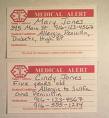 card in your wallet, too, in case the bracelet is damaged or lost. First responders know where to look, but make it easy for them by putting your card in a visible “front” slot of the wallet, near your license. If you don’t have a medical alert card, you can create your own.
 - Medical Insurance cards–You never know when you might become injured or ill. Be sure to have your medical, dental and prescription cards with you at all times.
- Emergency contact–Even if you carry a medical alert card, first responders need to know how to reach your emergency contacts. In addition to having an ICE number programmed into your cell phone, keep a small card in your wallet that says who to call, text or email in case of an emergency.
- Today’s receipts — Seriously, folks, a few seconds of focus will vastly improve your financial life. Make sure the cashier hands you your receipt (rather than putting it in the bag) and tuck it in your wallet, behind your cash. Each evening, empty your wallet of all receipts. Toss the ones for cash (unless you’re creating a budget) and file the credit card and ATM deposit/withdrawal receipts until you can check them against online banking or monthly statements.
- Comfort Item–In general, wallets are utilitarian ways to keep our money and proofs of identity close. But if you’re ever unexpectedly stranded in traffic or a waiting room, having one thing (a photo of a loved one, a prayer card, a folded love letter, a copy of your impressive S.A.T. scores) might help keep your blood pressure from rising. Just be sure to limit your wallet clutter to one comfort item.
Once you’ve jettisoned the junk and pared down to just the essentials…and you know what’s actually in your wallet…it’s time to protect yourself.
Next week, we’ll review the three main methods for preventing sticky fingers and klutzy wallet owners from making a stolen or lost wallet such a painful experience. We’ll review wallet protection services, the popular DIY photocopy machine method and how to create your own Financial Emergency Response spreadsheet).
Until then, reread last week’s post and today’s, and get your wallet in shape. Make sure you can answer the question: “What’s in your wallet?”
What’s In Your Wallet (That Shouldn’t Be)?
No, you haven’t accidentally stumbled upon a Capital One commercial.
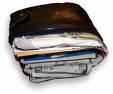 Paper Doll was recently working with a client to help him organize his financial information. When we ran into an obstacle, I said “Oh, well, let’s start with the cards in your wallet. Where’s your wallet?” After a few moments of that deer-in-the-headlights look clients often have, a smile came to his face. “It’s in the truck!” and off he sprinted to get it. He was one of three clients that week whose wallets were in located in unlocked vehicles in driveways or unlocked garages. Yikes!
Paper Doll Wallet Organizing Rule #1: Keep your wallet under lock and key!
Unless you are in the third grade and the only things in your wallet are your class picture and a stick of Juicy Fruit gum, your wallet should be adequately protected. You should keep it in your pocket or purse/bag, and that bag should be within your reach and eyeline at all times. Otherwise, it should be kept out of sight and locked away in a locker at school, a filing cabinet or drawer at work, in a locked car or trunk, preferably in a closed garage (and hidden from view) when motoring, or in a safe place at home.
Not to make you paranoid, but my dear Paper Mommy once had $100 stolen from her wallet AT A FUNERAL! Better safe than sorry.
Paper Doll Wallet Organizing Rule #2: Jettison the Junk, Save Your Sanity (and Scuttle Sciatica)!
The security of your actual wallet, aside, let’s talk about the safety of carrying your overfed wallet on your person. For those of you who are fans of Seinfeld, you may recall George Costanza’s wallet, so overstuffed that it did him bodily harm.
Think that’s just a sitcom trope? Nope! The New England Journal of Medicine (back in 1966) and The New York Times have reported on the back-pain and sciatica dangers of people (usually men) carrying overstuffed wallets in their back pockets.
But there are other excellent reasons not to carry clutter around with you. Yes, your wallet is a subset of “your stuff”, and in the great George Carlin tradition, you “gotta have a place for your stuff”.
However, as we should all know by a now, a cluttered home or office contributes to lost time (spent searching for missing items and redoing work), lost money (everything from lost opportunities to actual lost cash to the lost dollar value of your time when you hold up the Express Lane to dump everything out of your pockets and bags to find your thirty-five cents-off coupon for eggs…only to learn that it expired in 1982!), damaged reputations, increased stress and decreased productivity. Well, a wallet cluttered with unnecessary papers and other items yields the same obstacles.
Here are a few things to remember about your wallet:
- It’s not a photo album.
- It’s not an address book or a client database.
- It’s not a diary or scrapbook.
- It’s not a calendar or appointment book.
- It’s not an archaeological dig-site in progress…yet!
The purpose of your wallet to provide you with a mobile storage device for containing money, simulated money, and things that identify or protect you in order to prevent you having to expend exorbitant amounts of money.
The wisest thing to do is find a clean kitchen table or desk and pull everything out of your wallet. The following things do NOT go back in:
- Your Social Security Card — As we discussed previously, your Social Security card is the Willy Wonka Golden Ticket for identity thieves. Keep yours safely at home in your VIP folder, in your fireproof safe or in your safe deposit box. Don’t carry it around along with your gym membership card and your coupon for 50% your next In-and-Out Burger.
- Your Voter Registration Card — Unless it’s a primary day (in your community) or Election Day, you are wasting valuable space in your wallet and risking losing this card. It’s safer and wiser to keep this in your VIP (Very Important Paper) folder at home until you need it. If you’re carrying it around 24/7/365 because you’re afraid you’ll forget to put it back in your wallet for the few days you’ll need it, just enter a note on your calendar, in your Blackberry/iPhone/PDA or your tickler file. Don’t schlep what you don’t need now because you’re afraid you’ll forget it later!
- A zillion photos of your loved ones — If your moment of zen comes from opening your wallet and looking lovingly upon a photo of your beloved, your kids or your pet, far be it from Paper Doll to harsh your mellow (or whatever the kids are saying these days). But limit it to one or two photos, and for safety’s sake, DO NOT LIST YOUR CHILDREN’S NAMES ON THE REVERSE OF THEIR PICTURES. If someone purloined your wallet, he’d not only have your name and address, but enough information to gain access to your kids at school or camp!
- Your ATM passcode — Duh! Think having it in your wallet but NOT right next to your ATM card is going to fool anybody? Think again.
- Any other passwords or passcodes for entering office buildings, safety gates or computer files. If someone has your wallet and your passcodes, they can effectively become you long enough to wreak havoc on your life. Not scared? Then do not pass go and do not collect $200; go back and read the posts on identity theft (here, and here, in particular).
- Medicare or Insurance Card — IF it includes your Social Security Number — For more on medical identity theft, skip back to the posts here and here.
- Love letters — OK, well, one love letter is acceptable, if it’s the kind of thing you’re likely to remember you have and will actually take out to read for comfort, encouragement or even to pass the time of day if trapped in an elevator.
- Receipts — the ones for cash purchases (which can be tossed immediately, unless you’re constructing a spending map or creating a budget), for credit card purchases or ATM withdrawals or deposits from prior to today (which should have been removed from your wallet nightly and filed away in advance of checking them against your credit card or bank statements)
- Pounds of Loose change — more than a dollar’s worth. Seriously, change is heavy (and dirty). Keep a piggy bank at home and empty most of your change from your wallet every day. Keep a few of each type of coin (to prevent getting back so much change from a dollar that you’ll dislocate your shoulder trying to carry your bag), but keep the rest out of your wallet.
- Spare keys — Again, if a bad guy has your wallet, he knows where you live and probably which car is yours. Do you really want to help him break into your house or steal your sweet ride?
- Video rental cards — Seriously, in this age of DVRs and Netflix, do you really still rent from Blockbuster and Hollywood Video? (Are the stores in your town even still in business?)
- Rewards Cards — If you don’t regularly use a club or rewards card, why carry it daily? Get a little credit card holder with sleeves and pop the cards in. They’re no good for identification purposes, so it’s safe to keep the little holder in your trunk; otherwise, store it somewhere easy to grab if you are planning a visit to a specific store. Better yet, check out the One Club Card that lets you create your own all-in-one rewards/club card (including bar codes) for free.
- Other People’s Business Cards — If you think you’ll be dialing the number often, program it into your cell phone; otherwise, the card goes to your home or office for inclusion in your card file or database. (Do you really think you’ll remember that the business card for the dentist you met on a plane to Albuquerque three years ago is squished between your almost-full SuperSandwich Card and last week’s grocery list?)
- Appointment cards — The little business-card size reminders to get your hair cut, your teeth cleaned, your insides probed and your outsides molded actually remind you of very little when buried in your wallet. When you’re pulling the receipts out nightly, also grab these cards and mark the dates and times on your calendar.
- Condoms — OK, lest you think that Paper Doll is arguing against personal responsibility, let’s be clear. A thinly-wrapped latex protective device is not at its safest, mechanical integrity-speaking, shmushed between layers of credit cards and then sat-upon (or knocked around in a likely-overstuffed bag) for months or years on end. If you’re a teenager and it’s purely for show, have at it; if you’re a grown-up and it’s for go, let’s just say that if you’re aiming for personal responsibility, actually BE RESPONSIBLE and find a safer storage location.
- Clutter/Trash — You know what I mean. Gum wrappers (hopefully without used, discarded gum. To Do lists. Grocery lists. Addresses or phone numbers without names. Expired coupons. Expired credit cards. Movie ticket stubs. Concert ticket stubs. Ballgame ticket stubs. Pay stubs. Book titles. Movie titles. Floozies! Toss them out!
Paper Doll Wallet Organizing Rule #3: Maintain the essentials (and ONLY the essentials)!
Tune in next week, when we talk about what SHOULD be in your wallet, as well as how you can prepare now to protect yourself in case your wallet is stolen.
Until then:
- Find your wallet!
- Remove the clutter and send it on its way.
- Store your wallet somewhere safe.
See you next Tuesday–and remember to bring your wallet!
Monkeying Around: Stop drowning everyone else in paper clutter
Over the last few weeks, we’ve talked about all digital solutions that that provide alternatives to offices cluttered with Post-It Notes and reminders written on the backs of deposit slips. In general, these solutions focused on creating digital To Do lists, or taking advantage of virtual virtual assistants like Sandy and Jott.
Sometimes, however, the cluttering paper reminders don’t fill up our own environment, but pile up around our friends, family members, colleagues or employees as we nag them to accomplish what we need or desire. Then, our stickies and notes and memos add just a bit more fuel to the fire of their (and, if we share space, our) frustration. Let’s face it, no matter how efficient we are, if we’re adding to someone else’s clutter, it’s like raking the leaves and then dumping them in our neighbor’s yard. Sneaky fun, but not entirely a bright idea.
Instead, our friends at MonkeyOnYourBack have a cute solution that yields all the sneaky fun, without grumpy people coming after us with pitchforks.
Registration is simple:
- Fill in a teeny form with your email address, name, time zone and password, and then confirm that you agree with their Terms and Conditions.
- Check your email inbox for a confirmation email to prove you really are who you say you are. Click on the link in the email, and you’re good to go!
By the way, registration is free, as is the service as long as you only have five or fewer “live monkeys” currently active. For a one-time fee of $20, registered users can have an unlimited number of monkeys active at any one time.
(This gives one pause to consider the famed infinite monkey theorem and how we might finally arrive at those infinite number of monkeys typing on an infinite number of typewriters to achieve Shakespearian quality literature and theater. Indeed, with all the time you’ll save by not nagging reminding your loved ones or co-workers, you might be able to create a world-famous blog to unite the populace in updating the theorem to include computers and not just typewriters, but perhaps that’s just Paper Doll‘s fantasy To Do list item.)
Once you’re registered, you have a few options. First, you can create a new monkey (insert your own Darwin joke, folks — Paper Doll tries to steer clear of controversy like that) and send it to a recipient.
The elements are simple: WHO (at what address) do you wish to urge to do WHAT, by WHEN? To create a new monkey, just:
1) Send a monkey to remind…
Enter the email address of the person you wish to nag remind. For example, you could prompt a team member at work to update a spreadsheet, or you could alert your computer-addicted teen that it’s almost dinner time and he should come downstairs to set the table. Thus, you’d type the email of the remindee, teamgoofball@BigCompany.biz or darlingchild@ourfamily.com, just as you would if you were sending an email.
2) To do the following…
Fill in the “brief description”–that is, what do you want them to do?
You also have an option to click on “add a longer description”. For example, if you’ve got a series of instructions you wish to include, or have the urge to pontificate on WHY you are reminding your spouse, yet again, that he has purchased the wrong brand (of toilet paper, charcoal briquettes, luxury automobile, etc.) and you wish him to return it, posthaste, in iambic pentameter, no less, have at it! Monkey On Your Back gives you space to do this.
3) By…
Enter the date and time frame by which you want the task completed; there’s even a calendar you can click to search ahead, so you need not know upon what day of the week your birthday will fall 5 years from now, in case you wish to remind your spouse to buy you candy and flowers.
Please note that Monkey’s web site was created by our friends at AlienCamel in Australia, so they use the date construct popular in most places outside North America: Day of the Week, Date, Month, Year.
You may specify an actual time, or select from pre-created options: “Start of the day”, “Middle of the Day”, and “End of the day”. Sorry to say, you can’t send a monkey to make them do something five minutes ago, as the time travel module has not yet been added.
That’s it! Your recipient will receive an email that looks something like the one below, only with a larger and cuter graphic of the monkey delivering the message.
 Paper Doll has sent me, a highly trained and super-intelligent monkey, to remind you to:
Read Paper Doll’s blog post on Family Filing from 11/6/2007
by Wed, 23 Jul 2008, 5:00 PM
You’ll be sent further reminder emails as the deadline approaches! If you want this monkey to stop bothering you, click here to kill the monkey.
To send your own monkeys, visit http://monkeyon.com
When your recipient (AKA: the remindee) gets that email, he or she has the option to “kill” the monkey, which isn’t as violent as it sounds. When one clicks on “click here to kill the monkey”, the task/reminder is canceled and the recipients have the ability to send you a return comment telling you why they’ve killed the monkey and whether or not the task was completed.
Meanwhile, you can view your “LIVE” monkeys under the “Monkeys You’ve Sent” section, detailing the tasks, recipients, deadlines and status of each. Under each task, you have the ability to edit, “kill” (i.e., cancel) or view the history of each monkey.
There’s even a section to view your own monkeys, those reminders you’ve either sent to yourself (at this registered address) or others have sent to you.
Is it silly? Absolutely, but once someone has tired of receiving memo after note after stickie after stern look, it might behoove you to send a monkey to do your bidding and keep the paper clutter and bad feelings to a minimum.
Right now, the monkeys are just cute, but the developers promise updates with “tricks” our little Curious George-esque workers might do in the future. And let’s face it, if you feel the need to be the monkey on someone’s back, perhaps it couldn’t hurt to monkey around a little to keep everyone from going bananas.



Follow Me