Archive for ‘General’ Category
Whistler’s Mommy Invites Grandchild Moses and Raggedy Andy Warhol For A Playdate
Do you sometimes feel like you’re the curator of the MMOTA (Modern Museum of Toddler Art) or the AMOKAC (American Museum of Kindergarten Arts and Crafts)?
Do you feel obligated to believe a picture is worth a thousand words because you can’t understand half of what your toddler says?
 Have you forgotten what color your refrigerator is because the doors, like museum walls, are covered with all of the major artistic methods–watercolor, oil(y Play-doh), and mixed media (painted, sparkly macaroni)?
Today, we start the second year of the Paper Doll blog, so it seems appropriate, given this auspicious time, to talk about children’s art as our own little cooperative masterpiece of a blog enters its toddler years.
When children are very young, every artistic endeavor may seem like a masterpiece, but soon enough, parents can become overwhelmed by the embarrassment of finger-painted riches. At some point, you realize you’re either going to have to start buying Frigidaires in bulk, or you’re going to run out of display space in this kiddie art gallery you used to call your home.
Unlike the other categories of paper we’ve discussed in the past: bills, to-do lists, references papers, Social Security cards…there’s no agreed-upon records retention schedule available for determining how long one should keep art created by tiny hands. So, today, we’re going to explore some ways of looking at two aspects of handling children’s art: displaying the work and winnowing the collections.
First, before you run to Fridges-Are-Us for your next art wall, recognize that there are alternatives to hanging art where your lunch lives.
THE CLASSICS
Hang a clothesline a few inches below ceiling height (too high for children to climb to reach) and hang paper artwork, attaching it with clothespins. This can be a fun way to decorate your child’s room as well as any other bare but casual area, like a guest room, mud/utility room, playroom or basement. You can make it a permanent display gallery with rotating collections, or you can put on an ad hoc art show.
Invest in a large cork board and affix it to a bare wall. You can display the art as-is, right on the cork, or cover the entire board with dollar-store wrapping paper or white or brown kraft paper. In the latter case, your kids can draw on or decorate the kraft paper (also called butcher paper), first, creating a meta-message of art-on-art.
Wallpaper an unfinished basement. The walls of a basement laundry room are likely to be gunmetal grey and depressing. Charming and colorful children’s art can brighten the area (and the mood of laundry day) immensely. The works can be easily and safely attached to walls with removable Command Picture Hanging Strips.
Frame it or Contain it. Whether you’re a do-it-your-self framer, prefer a fun kid-themed frame or desire opportunities for frequent changes of display as afforded by this 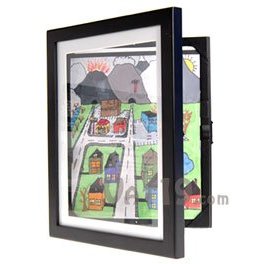 L’il Davinci art cabinet, no rogue art or craft will ever complain that it was framed.
Embroider it! This may not be a classical type of display, but this FeelingStitchy blogger’s crafty talents are put to excellent use in framing and displaying her grandchildren’s art.
MODERN ART
“Take a picture; it’ll last longer.” OK, that saying still sounds a little snarky, but it’s a perfect option for preserving mixed-media and other three-dimensional works of art. Better yet, take a snapshot of your child  holding the masterpiece to keep a historical record your little star during his or her Blue Period.
Scan the artwork using standard scanning software; for larger pieces, you will have more luck with a full-sized scanner than the popular handhelds. Suppress acting on your temptation to color-correct green hair or fix the spelling mistakes that actually make children’s art delightful.
Create greeting cards and calendars 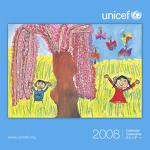 you can share with family and friends. You can make the calendars yourself by laminating pages and having them spiral-bound at Kinko’s or your local printing shop; they can print your cards, too. Or, you can have your favorite online or offline photo developing company mass-produce calendars or cards in bulk.
Upload the scanned art to flickr or other photo-sharing social networking web sites.
Create a web site using a free blog template and upload the art for all the world to see. Send the link to grandparents, family, friends and chat about it on Facebook or Twitter. Let your little Michelangelo or Georgia O’Keeffe develop a world-wide following. (Of course, make sure to use safety protocols and don’t identify your child’s name or location on public sites.)
Use Digital Picture Frames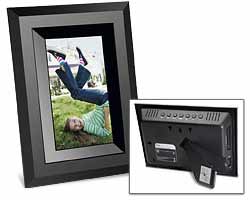 If grandparents or great-grandparents haven’t quite joined the digital age and don’t use computers, it’s OK. You can load a series of photos of the art (as well as snapshots of the whole family) onto a memory card and plug it into a digital picture frame for them. Of course, it can’t hurt to send along an occasional piece of paper artwork along with a letter that says “Dear Grandma and Grandpa” or “Dear Bubbe and Zayde”, or “Dear Baba and Gigi”, or “Dear Abuela and Abuelo”…
AVANT GARDE
Every parent believes his or her child’s art is a tour de force. The parents of these little girls took it the next step, and put their daughters’ art on display at the Peez Leweez coffee house  in Livingston Manor, NY (about halfway between Binghamton and New York City) along with the creations of other local artists. Sales of the works brought in legal tender (which was donated to charity). If you or someone you know owns a bookshop, coffee house or other venue with walls suitable for gallery displays, this could be the bees knees for entrepreneurial types and parents of prolific artistes.
CURATING YOUR COLLECTIONS
Eventually, the issue of art displays will become secondary to the need to conquer piles of paper art. It can become overwhelming, especially in small houses or large families. It’s necessary to pare down your artistic collections. Here’s one process that might work for your family:
Whatever gets created that week is put on display…no exceptions. It doesn’t have to be pretty: Beauty is in the eye of the beholder, and if your second-grader beholds you as a 300 pound giant with three arms all on one side of your body, whose to say she’s not the next Picasso? It’s the Exhibit of the Week!
At the end of the week, take everything down to make room for next week’s work. Ask your child if he or she would like to find one piece to mail to loved ones in paper form. Do not, however, send everything to the grandparents or they’ll end up with clutter!
Next, weed out any the pre-drawn, pre-cut designs from coloring books. Let go of the art that doesn’t really represent your kids’ true abilities–I’m sure the mommy of guy who draws Pilgrims for holiday-themed coloring books is already proud of him, so you don’t have to honor his work. This like an art appraiser, and concentrate on your artist’s originals and not the mass reproduced knock-offs.
Collect what’s left in a flat, clean box. You can buy art storage boxes at The Container Store, but it might be easier to ask your local pizzeria to throw in an extra (unused) large pizza box or two the next time you have a big pizza party. Then, set the art aside to “marinate” (as my colleague Allison Carter says) for a month or more. Once the contents of the box has been out of sight for a while, your kids‘ attachment to the art as well as yours will have diminished, and you’ll be able to select no more than a half dozen to a dozen pieces representative any year of artistic expression.
With this winnowed but elite collection, you can preserve art in paper form in the pizza boxes, or in more formal scrapbooks or albums. Or, you can use long, cylindrical cardboard tubes (e.g., wrapping-paper tubes, mailing canisters or architect’s design tubes). Obviously, however, you may afford to be much less parsimonious with your gallery’s collections if you plan to transfer the art to digital form. Just remember to group the preserved paper collections with other memorabilia and away from the cold and damp prevalent in basements, or the excessive heat or humidity of attics, garages or crawlspaces.
Parents, enjoy your children’s art, and enjoy their creative processes, without living amid layers of flaking paint and piles of crumbling construction paper. Revel in your role as Curator of the Museum of Little Folks’ Art.
First Anniversary Gift for Paper Doll Readers
Happy New Year, Paper Doll readers!
A few of you, reading this upon awakening, are blinking confusedly (like an old VCR perpetually stuck at 12:00) and wondering what I’m talking about. No, you didn’t Rip Van Winkle your way through Election Day and the winter holiday hubbub.
Others are assuming I’m wishing them a L’Shanah Tovah, or Happy Rosh Hashanah (the Jewish New Year), and might be expecting me to metaphor my way into getting prepared to buy calendars (as 2009 is only 92 days away!) or even regale you with esoteric tales of all the different non-January 1st New Year’s Days–not just Rosh Hashanah or Chinese New Year, but also Hola Mohala, Nowruz, Losar, and Gudi Padwa, to name a few.)
This post marks the completion of one year of the Paper Doll blog. Did you know the traditional first anniversary gift is paper?
It’s hard to believe that 52 weeks have whooshed by as we’ve talked about organizing paper files, eliminating paper clutter (aka: floozies) and replacing lost but much-needed paper. We’ve set up family files (including financial, legal, medical, household and personal categories), safeguarded the contents of wallets, and protected against identity theft. We’ve organized our books, our to-do lists, our magazines and our recipes.
To show gratitude for your readership, I was hoping to indulge myself (and hopefully, you) by showing the lighter side of paper. Although this is not, per se, about organizing, let us remember the words of William Morris (the 19th century designer, not the Hollywood talent agency) that guide professional organizers’ endeavors to this day:
Have nothing in your homes that you do not know to be useful or believe to be beautiful.
On most days, Paper Doll talks about paper in terms of utility–what you need…and what you need to discard. Other than photography and books, we tend not to think of the beauty of paper, so today’s post is a little homage to that other side of our pulpy friends in paperville
Mixing the world of paper and creatures (real and imaginary), the blog Village of Joy dazzles with 20 Amazing Origami Art Works. 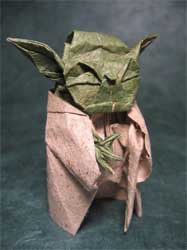 If you know anyone who likes Jedi warriors or unicorns, give it a click!
From the quirky Pictures page of the World News Magazine web site, sample the art of paper in the form of some Amazing Paper Cutouts including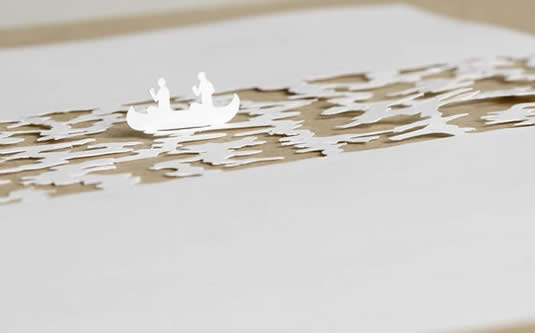
Down the River by the awe-inspiring Peter Callesen.
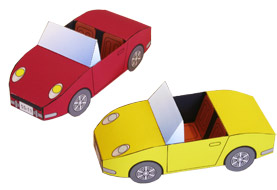
In a few posts, I’ve let slip that Paper Doll isn’t particularly artistic or craftsy. At all. But a girl can dream, and Creative Park, Cannon’s 3d Paper art site, has free downloads for the more adept of you to turn 2-dimensional paper into 3-dimensional art, including animals, dinosaurs, elements of a whole tiny town (from firehouse to amusement park), to little cars like these:
September is just ending, but for those of you already excited about Halloween, 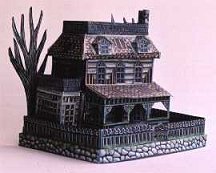 , the free paper toys and masks you can create from the toyshop at Raven’s Blight are eerily cool. Yes, it’s creepy and scary, but beauty is in the eye of the beholder and I am amazed at the artistry involved.
And given some recent stock market activity (ahem), perhaps it’s a good idea if we can appreciate Cool Stuff We Can Do With Paper Money (besides spend it), like:
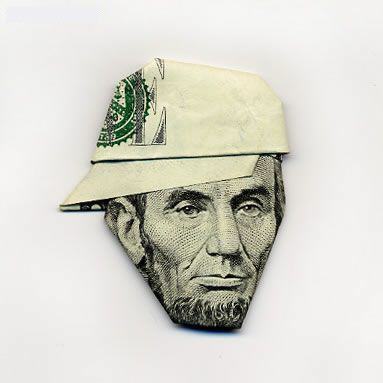 and
and 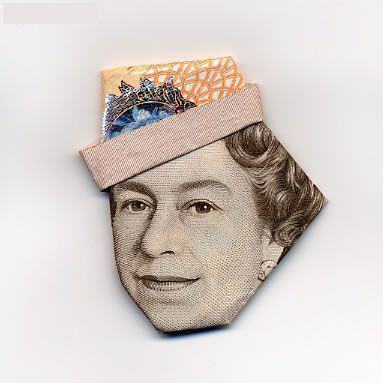
And if you’re looking for paper (money) that looks a little more 3-dimensional, check out the work of Mark Skye, the Dollar Artist, whose sculptured creations range from amazingly functional 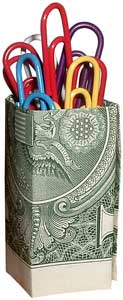 to charmingly fanciful
 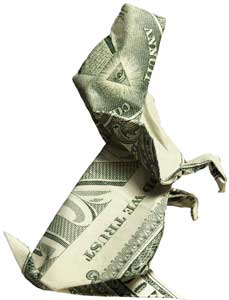 to adorably fashionable
 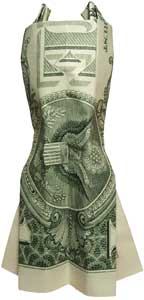 .
.
It’s been a remarkable year, and I want to thank all of Paper Doll‘s readers for the support and encouragement. Hopefully, you’ve noticed some new features around the site, like the RSS feeds and the long-awaited open comments, so you can share your thoughts without registration (or reservation).
Next week, Paper Doll will begin a second year: sharing thoughts, commentary, resources and goofiness on all things related to organizing our paper and our lives. Until then, Happy New Year!
Wanted: An Organized Mind (To Create An Organized Wish List)
Inspired, as always, by the topic of paper organizing but unable to determine the focus of this week’s post, Paper Doll took a break to work out. I’ve been cross-training in preparation for this Sunday’s Chattanooga Komen Race for the Cure, and among my Netflix arrivals was Tamilee Webb’s I Want That Body, with segments like I Want Those Abs, I Want Those Arms, etc. Paper Doll isn’t the most coordinated or focused workout gal, and eventually got distracted.
A loose thread of thought reminded me of “I want…I want…I want!”, a phrase repeated by Eugene Henderson, the protagonist of Saul Bellow’s novel Henderson, The Rain King. I’ll admit I never cared for the book, which seems like Fitzgerald crossed with indigestion. I mostly found it memorable because Ally McBeal once quoted the “I want…I want…I want!” with ferocity.
Ally reminded me of a handful of DVDs I want…and I think you’re getting the picture. A long way to go to get to the topic of keeping track of what we want.
I’ve worked with clients whose paper clutter included large piles of clippings and marked pages, representing what they wanted:
- Layers of thick home dcor magazines illustrating remodeling options…representing anything from a desire for an updated home to a deep-seated annoyance with a spouse, job or life which only a whole new home could deliver
- Printouts from Jeri Dansky’s great blog, Organizing & Decluttering News depicting aesthetically-pleasing and yet entirely practical organizing tools…which, to someone suffering from disorganization, can mean faith, hope and the possibility of being both clutter-free and FABulous!
- Hand-scribbled notes regarding movie recommendations…to view if time and space weren’t so generally out of control
- Catalogs and catalog page clippings with circles and arrows and a paragraph on the back of each one saying which was a prospective holiday gift for whom
Pages and piles representing what people need/want, and in some cases, taking up space that could otherwise be given over to the very thing that’s desired…this is the clutter of want.
Don’t worry–this isn’t a diatribe on consumerism in dire economic times. This is just a way to deal with all the little reminders of goodies you might, someday, if you remember to know that such things exists, kinda, sorta, want to acquire:
1) Don’t keep whole magazines when one or a few items appeal to you.
We’ve talked before about what happens when we become clutter-rich but information poor. When you read a magazine, the point is to learn, absorb, and become entertained; keeping all of your magazines “just in case” you want to find something you saw in an ad or article clutters your life without delivering the goods.
A magazine’s web site will almost assuredly have a searchable database of articles and editorial content, but nowhere on the web or in any magazine will you be able to search and find in which year, issue, and page you saw a golf gadget, wrinkle-reducer or baby outfit.
At the very least (i.e., if the tech-savvy advice down below doesn’t resonate with you), follow my prior advice and/or carefully tear or cut out the few pages reflecting the items you might like to purchase, file the items in a project notebook or interest file, and once you’ve read the rest of the magazine, recycle.
2) Don’t keep whole catalogs.
For those to whom catalogs provide a chance to dream, the suggestion of unsubscribing will seem impossible. Fair enough. So, flip through the pages. Note that the toll-free number and the URL of the company is on at least every other page. Catalogs are designed this way to ensure that if the page depicting the desired item is separated from the catalog as a whole, the consumer can still easily and quickly make a purchase, either by phone or web.
So, instead of holding on to whole catalogs (especially catalogs that are more than one season or year old, depending on frequency of distribution), just keep the page of the nifty item you might like to buy.
3) Don’t save snippets of pages.
Let’s say you’re an Oprah devote and love The O List in the monthly magazine. Each such page has a vast array of nifty products that will transform your life.
If you clip out just the corner of the page depicting the photo, description and ordering info, you’ve got an oddly-angled, 1/5th of a piece of paper…if you’re a regular Paper Doll reader, you know that’s a floozy! Saving a partial piece of paper makes it more likely it will get lost, tossed or otherwise forgotten. So if you see something you must have, clip the whole page and circle the object if there’s any chance that three months later, you won’t recall whether you wanted the ultra-modern steak knives or the solar-powered hair dryer.
4) Don’t print web pages depicting items you want to purchase.
Aside from the tree-killing aspect, it’s silly to print out a page when you’ve got the ability to let the digital representation live right on your computer, either via a bookmark (see #5, below) or screen capture. A web page has clickable, interactive links and the URL you can forward to say “Hey, see the earrings on this page? Hint, hint.” You can’t click on an embedded link on a piece of paper, and a print-out can’t reflect updates in price, inventory status, or other variables.
5) Don’t save ANY pages when you can go digital instead.
Sift through newspapers or magazines as usual Clip all the pictures, ads and other fabulous prospective purchases Collect all the loose pieces of paper in a manila folder to keep with your action papers or a tickler file. Determine how often you want (and can afford) to shop and schedule a shopping block on your calendar or in your PDA. At the appointed day/time, sit down at your computer with the “Stuff To Buy” folder.
No matter what web browser you’re using, you have the ability to bookmark the product description of the item. This is the simplest way to capture the ordering page for whatever you want so that you can access it whenever, wherever you feel the need to make an acquisition. You always know where your computer is; if you have sixteen piles of papers meandering from the microwave to the kitchen counter to the coffee table to the top of your dresser, what’s the chance that you’ll find exactly the clipped page you want when you want it? (Social bookmarking through sites like Digg and StumbleUpon can also help you keep track of prospective purchases.)
A long tower of unsorted digital bookmarks is only marginally less of an annoyance than a tall tower of paper clutter in your home or office. It has the advantage of taking up a small spatial footprint, but it still requires you to carefully search, especially if your bookmarks aren’t organized or even alphabetized.
Instead, create a bookmark folder for “Pending Purchases”, then create sub-folders (and even sub-sub folders if you need more categories) just as you would subdivide a filing cabinet into hanging folders and manila folders. Sub-folders could be labeled as “Holiday Presents”, “Office Tools”, “Clothing”. The key is to divide and label the categories in such a way that you can easily find whatever you’re seeking when a need arises. For example, Paper Doll has a bookmark folder labeled “Fun For Me”, including bunny slippers, a Jane Austen action figure, and this…and I have to admit none of it is for blog research.
Bookmarks are great if you merely want to replace the clutter of clipped pages with a streamlined way to shop. But outside of emailing a link to someone who asks “What would you like for [insert occasion here]
In the past, creating a wish list was like registering for a wedding or baby shower. You went to a store site and marked what you wanted that was carried by that specific store. Like a registry, that still meant you had to tell people where you were registered, and listing too many places seemed greedy. Enter: Universal Wish Lists!
Amazon.com, now lets you register for anything you see at ANY store, anywhere online, on your Amazon wish list. Start a list and add the widget to your browser’s bookmark toolbar to add items to the wish list. Whether you’ve just found something while surfing or are perusing clipped items on your scheduled shopping day, one click saves anything on the web to your wish list.
Froogle’s Shopping List has a universal wish list, too. Just sign into your Google account, and start adding items from all over the web. You can share with others to use it as a wish list, or keep it private so it provides web-accessible bookmarks from any computer. Froogle’s Shopping List lets you annotate product pages with your own comments and sort by price, item or date.
I would be remiss if I didn’t note that there are charity wish lists, too, so instead of being surrounded by piles all the direct mail and clipped print ads for non-profits to whom you’d like to give (or would like donations made on your behalf), you can select the causes closest to your heart.
Until then, when something shiny makes you think, like Henderson, the Rain King, “I want…I want…I want!”, cut the clutter of excess magazines, catalogs and paper, streamline your desires digitally, and you’ll not only be more likely to get what you want, but to find it once it’s yours!
Serious Talk About Emergencies: Are You Ready?
Regular readers of Paper Doll know that if there’s a quirky metaphor or silly reference to be made, this is where it will happen. But sometimes, there are organizing-related subjects into which levity really can’t be injected. This is one of those posts.
September is National Preparedness Month. We’ve just observed the 7th anniversary of 9/11 and the third anniversary of Hurricane Katrina, and our friends from Florida to Texas have seen their homes and communities ravaged by this year’s storms, including Gustav, Hannah and Ike.
Of course, storms and floods, earthquakes and wildfires, and all manner of natural and man-made disasters occur year round. But September is a time of change, second only to early January, when people not only head back to school literally, but start on paths to self-improvement…to get in the habit of getting into habits, to get organized, to prepare. National Preparedness Month is our grown-up opportunity to head back-to-school and rack up some essential credits.
The federal government’s Ready.gov is a great place to start to learn about disaster preparedness. In addition to checklists in a variety of formats, they have videos for helping special audiences (seniors, families with pets, people with disabilities, etc.). Their top three recommendations are:
1) Create an Emergency Kit.
Start with Ready.gov’s officially recommended and additional kit supply suggestions, but depending on your family or work situation, you might also review additional options for emergency resources and your “grab-and-go” 72-hour kit.
Even after you’ve checked all the official lists and considered the retail options, brainstorm with friends and peruse the web to make sure you’ve covered the reasonable contingencies. The point isn’t to carry your house on your back, but trigger important but easily-forgotten items.
You may need items to smooth an evacuation, but you’re more likely to need supplies for staying safely in your home, such as when you ride out a blizzard. To start, inventory your emergency tools and supplies and ask these questions:
- Do your smoke & carbon monoxide detectors have fresh batteries?
- Do you have crank-operated flashlights or combination crank-operated flashlight/radios that will allow you to get see where you’re doing and obtain weather updates even if the electricity is out and the batteries have all run down?
- Have you checked levels and the expiration date on your kitchen fire extinguisher? (Do you even HAVE a kitchen fire extinguisher?)
- Are your home, car and office first aid kits fully stocked?
- Do you have LOTS of bottled water?
- Do you know how to disinfect water if you are unable to boil it?
2) Develop an Emergency Plan for Getting Out and/or Away.
Start with the government’s suggestions to help you create your own plan from scratch, or use pre-created emergency planning books. Either way, develop your emergency plan now rather than later. Once you make your checklists (for what you need, whom to call, where to go and how to get there), maintain multiple copies in various locales, including your glove compartment, the desk drawer at your office and within easy reach of major household exits. Teens and older kids can keep copies in their lockers or backpacks; elementary school kids should have emergency contact cards.
Practice fire drills and escape routes in your home and office, and don’t just talk about it, but walk through the route. Identify a meeting point outside, away from the danger and be sure to designate someone to count heads. Mention your escape routes to overnight guests in your home.
Develop an evacuation plan, with contingency options, for driving your family out of town, and know your community’s civil defense procedures to ensure your plan doesn’t contravene the official route. Make sure your long-distance communications point-person knows the route in case your family gets separated and calls in.
Plan communications alternatives if family or co-workers are far-flung or traveling. Funnel updates to your long-distance point-person.
(And at the risk of Paper Doll sounding like a Luddite, please make sure you have an old-fashioned, no-electricity-needed, landline phone. More and more consumers, particularly the under-30 set, are discarding landlines for all-cell, all-computer communications, but when cell towers are down and wireless gets wiggy, landlines are an important alternative…and the phones don’t need to be charged.)
3) Be Informed.
In general, Ready.gov urges us all to be as informed as possible regarding what disasters may be coming our way, and to know as much as we can about the emergency plans available at every level: family, school, office, community, etc.
Next, know what kinds of disasters might happen in your area. It might be obvious for a newcomer to California to read up on Earthquakes, but other situations might be a surprise. If your new community is far from a river or ocean but experienced surprisingly heavy snowfalls, warm Spring rains could bring flooding. Also, know how your community prepares. As a native of Buffalo, NY, the first “incapacitating” snowfall I experienced in Tennessee ranked up there with a typical Tuesday in my hometown, but I quickly learned that unlike Buffalo, my new home was not prepared to deploy hundreds of snow plows and salt trucks.
Other ways to get involved include reading some in-depth expert advice, including:
Organize For Disaster, by Judith Kolberg, is an excellent sourcebook to help you plan your disaster preparedness tasks, including taking you step-by-step through what you have to know (emergency contact information, passwords and codes, shut-off and lock-down procedures, etc.), establish (safe rooms, fire drills and evacuation routes, communication plans), store and protect.
Homeland Security’s 30 Tips for Emergency Preparedness is also full of good advice and checklists.
If planning get to be overwhelming, share and delegate. Assign individual family members read specific chapters, tips or checklists to and complete associated tasks; middle-schoolers, in particular, love to have an opportunity to show responsibility. Then, together as a household, review everyone’s progress. In office settings, assign tasks and cross-train.
In addition to the three elements of the official approach, above, Paper Doll is always thinking about the paper side of things:
4) Like A Good Neighbor…You’re in Good Hands: Let’s Talk Insurance
- Do you have homeowner’s or renter’s insurance?
- Is your insurance policy up-to-date?
- Is your coverage equal to your recovery needs? Do you have replacement-value coverage? Do you know that replacement value is not the same as market value? Replacement value means insurance will provide funds equal to the pre-loss value, not the original value, of an item.
- Have you included insurance rider for any recently-acquired big-ticket items (including jewelry, high-end computers and electronics, etc.)?
- Do you have a sewage backup rider? If your sump pump fails, things can get ugly…quickly!
- Do you have flood insurance? This can only be purchased from the National Flood Insurance Program and is not part of homeowner’s or renter’s insurance. Gauge your risk and get a price quote.
5) Build An Emergency Fund
Emergency funds are called that for a reason. If your home were destroyed, structurally unsafe or even merely inaccessible for weeks or months, would you have somewhere to stay and financial resources to acquire the essentials, like food, clothing, or medicine? What if your place of employment were destroyed or otherwise had to shut down, even temporarily?
Financial advisors suggest you maintain a liquid account with three-to-six months’ worth of living expenses. If you don’t have these (or any) funds set aside, start now, and continue every week thereafter. If possible, have a set amount of your paycheck directly deposited into your emergency fund, or arrange to have money automatically transferred from your primary account a few days after your paycheck normally arrives.
6) Practice Your Five-Minute Warning
What if you had only five minutes to rescue possessions from home or work?
Your emergency plan will help you safely evacuate your family and make sure you have the absolute essentials. But what about items of sentimental value, non-tangibles like vital information, or other things the insurance company can’t ever replace? What could you safely gather and take with you if you had only minutes to depart?
Does the clutter in your home or office make this exercise depressing? If you aren’t yet sufficiently organized so that you can lay your hands on these items, let some healthy fear be your cue. Start decluttering and store essentials where they’ll be easily reachable. Safely and sanely organize according to these three “H” categories:
Head
- Collect and maintain your VIPs (Very Important Papers).
- Isolate financial records, PIN #s and passwords, insurance policies with agent phone numbers, and computer back-up disks. (You DO back up, right?)
- Remember legal documents like birth certificates, passports, mortgage papers, and licenses to help you recoup post-emergency. Maintain these items and your safe deposit box key in a portable fireproof safe if you have to evacuate.
Health
- Maintain a list of all prescriptions, including dosages, that each family member takes. Maintain a back-up supply of medicines you might need immediately, particularly for allergies, asthma, diabetes and heart conditions.
- Don’t forget occasionally-used items like Epi-pens.
- Keep a copy of your eyeglass prescriptions. If you get evacuated to hundreds of miles from home, chances are your ophthalmologist’s office and Joe’s House of Glasses will be closed and they’ll be gone, too. Post-emergency, you’ll have lots of insurance paperwork to read, so be prepared.
Heart
- In an evacuation, you can’t bring all of your family photos and scrapbooks. But do make sure each of you has one recent photo of every family member in case your family becomes separated.
- Start identifying, copying and/or digitizing photos have so much sentimental value that you’d miss them long after the emergency is over.
Finally, if you think you know everything about getting organized to prepare for and recover from an emergency, check out your Readiness Quotient.
Let’s be careful out there.
Special Post for Paper Doll Readers In the Chattanooga,TN or North Georgia Area
If you live anywhere near Chattanooga or Cleveland, Tennessee or Ringgold, Dalton or Calhoun, Georgia, I’ve got special news for you.
On two consecutive Mondays, September 29 and October 6, 2008, from 6-8 p.m., I’m teaching a special continuing education class on organizing your life. If you like what I have to say on one screen a week as Paper Doll, you’ll get a kick out of two fun-filled, detail-driven nights at beautiful Dalton State College.
Do you want to eliminate clutter and chaos and replace it with serenity? If you’re drowning in paper, if your walk-in closets are too stuffed for you to walk into them, and your Christmas tree is still up from last year, this is the class for you!
We will identify the personal and societal obstacles that make it so hard to get and stay organized — so you can learn to recognize and conquer them, and find your floor under all that stuff.
We’ll get to the root of the financial, personal, professional, and health-related costs of disorganization so you can customize systems that work for you and let go of the unnecessary objects that weigh you down.
Get ready to learn a professional organizer‘s secret tips, skills and systems to help you save time and money, reduce stress and get more done.
To pique your interest, I’ll be talking about (mysterious but) essential concepts like:
- The Flight Attendant Rule
- Riding the Squeaky Wheel
- The Myth of Multi-Tasking: Why Doing It All Means Getting Nothing Done
- Career Day Tips: Becoming A Rocket Scientist to find what you need and a Security Guard to keep your home from free from clutter
- Slap vs. Tickle: Laugh Your Way Through Piles of Paper
- A Home for Everything: The Golden Rule of Organizing
I’ll also go through special topics for organizing the high-clutter areas of your home, including your:
- Kitchen
- Bedrooms
- Play Rooms
- Bathrooms
- Linen Closets
- Garages
- Attics/Basements
Of course, we’ll have lots and lots of time for questions on both nights. If you’re interested in getting some one-on-one “facetime” with Paper Doll and you live in the Chattanooga or North Georgia area (or if you’re up for a road trip) head straight for Dalton State’s fabulous Center for Continuing Education link especially for my class — for getting a head start on your organized home, your organized schedule and your organized life.
And when you attend, be sure to introduce yourself as a Paper Doll reader. I hope to see you there!
Follow Me