Paper Doll
Will The Real Paper Doll Please Stand Up? (Organizing To Prevent Identity Theft)
When Paper Doll was far too young, summers were spent watching soap operas. One particularly nifty option was One Life To Live, where the overarching premise (more so than on any other serial), was that almost every character had a secret life, dual personality or evil twin. Delicious as it was, I always feared the prospect of someone else pretending to be Paper Doll (I guess at that tender age, I was Paper Dolly) and turning in badly done homework. Never could my childish brain have imagined the horrors of someone intentionally taking on my persona to cheat me (or my creditors, or my insurance company) out of money! But identity theft is definitely more frightening than Viki/Niki or Marco/Mario.
Organizing is about saving time and money, increasing productivity and reducing stress, but skipping one small step in the organizing process can actually endanger your finances, your future and your good name. You probably know how important it is to eliminate unnecessary paper clutter, but with identity fraud one of the fastest growing crimes in the United States, it’s equally important to safeguard your personal data.
Each time you rifle through your daily mail or finish preparing your tax return, you may be tempted to discard unnecessary scraps of paper in the trash. Research indicates, however, that the number one source for identity thieves to get your private information is not the Internet or hacking corporate accounts, but old-fashioned dumpster-diving. In the war on identity theft, be sure you aren’t providing the bad guys with any ammunition.
Before tossing any paper into the trash, I strongly urge you to follow these guidelines to protect your hard-earned credit history.
SHRED any documents that can be used to help a thief set up a false version of your identity. These items include unused pre-approved credit card offers, bank and credit card convenience checks, balance transfer forms and anything bearing account or Social Security numbers, PINs or phone/Internet passwords.
CUT UP expired or canceled credit and debit cards into tiny pieces to ensure that no one could piece them back together. Do not be tempted to just cut the card in half. While a brick-and-mortar store would not accept a card cut in two, a thief can still use the numbers to make Internet and catalog purchases and would still have access to the super all-powerful three-digit access code on the signature line on the back of the card.
NEVER PROVIDE YOUR PERSONAL INFORMATION (including Social Security numbers, credit card numbers, account numbers or passwords) via standard email, nor over the phone if you did not initiate the call. If a store cashier asks you to provide your Social Security number on a check, refuse to do so. The momentary annoyance of explaining your reasoning to the store manager is far less than the frustrating loss of time and money spent repairing your damaged name.
On the Internet, credit card purchases are only considered secure transactions if the purchase is made on a page whose address starts with https:// instead of the usual http://. Also, look for a small lock-shaped icon in a corner of your browser window, indicating the merchant has made efforts to secure your personal data.
DON’T GET PHISHED. It’s much more likely that an identity thief would try to steal your personal information via a sneaky email than by phone. Thieves create a false email (and hide behind the mask of your financial institution) for the purpose of getting you to click on their link and enter personal data.
If you ever get an email stating that there is a problem with your bank or credit card account, directing you to click on a link to log in and check or change your information, STEP AWAY FROM THE COMPUTER! Then take a deep breath, delete the email and log in to your account through your computer browser’s “bookmark” or “favorite” listing or by manually typing the usual address into your browser. Some attempts at phishing are crude and laden with misspellings and awkward phrasings. However, identity thieves are becoming very adept at creating sophisticated emails and faux sites which appear identical to the form and style of a financial institution’s logo, font and infrastructure. (Brief sidebar: the IRS never sends you email about your return, refund or rebate!)
MEMORIZE your personal identification numbers (PINs) and passwords. Hide them in safe locations away from prying eyes and hackers. If you have a poor memory and must keep your passwords accessible, consider creating a cheat sheet with the clues instead of the actual passwords. For example, instead of writing down your password of ElvisVermontMaple, write down “1stConcertFavoriteSyrup”, or some equally obscure bit of information to hint at the information only you need to know.
Be sure to keep PINs away from the cards they protect, and never carry your PINs in your wallet. Again, the modern world is keeping your memory fuzzy, write clues. If your PIN is 0401, the clue might be “Don’t fool me” to stand for the date 04/01, April Fool’s Day. When you are given the opportunity to pick your own PIN numbers, NEVER use your birthday or part of your Social Security Number, as identity thieves can find such personal information easily. Aim for numbers representing obscure dates significant for sentimental reasons (like your first kiss) or the combined jersey numbers of your two favorite athletes.
STORE canceled checks, line-of-credit or convenience checks and account statements out of the sight and out of reach of delivery, sales or service workers, pollsters or fundraisers. You may think you’d never let these people past your doorstep, but it’s impossible to foresee what might distract your attention, such as the cries of an injured child from the back of the house.
SIGN new credit cards as soon as they arrive and store them in a safe place, away from your home’s high traffic areas. If it is necessary for you to carry the card with you, immediately put it in your wallet or card-holder, and guard plastic as diligently as you do your cash.
CHECK your credit history report with all three credit-reporting agencies annually. Request reports from:
- Equifax 800-685-1111
- Experian 888-397-3742
- Trans Union 800-680-7289
Due to Federal regulations, you can even get these reports for free, once per year, by going to AnnualCreditReport.com. This site is an official joint venture of the three reporting agencies. Do not be tempted by similarly-titled web sites which purport to provide you with free credit reports, but first require you to pay for membership or purchase other services.
Review the reports to ascertain that no accounts were fraudulently opened in your name. Also check to make sure that you are not listed as an authorized user for any card to which you do not have access. Report any suspicious or incorrect information to the credit reporting agencies immediately.
Also, if you suspect check fraud, contact the major check verification companies to request that retailers using their databases be notified not to accept stolen checks:
- Telecheck 800-710-9898
- Int’l Check Services 800-631-9656 (Note: International Check Services has been acquired by First Data/Telecheck)
- Equifax 800-437-5120
Your credit history is synonymous with your good name. Identity thieves don’t have a shred of decency, so don’t give them a shred of evidence to use against you!
In the coming weeks, we’ll be talking about how to organize to recover from financial identity theft, and also how to protect yourself against the growing crime of medical identity theft. Until then, to learn more about privacy and identity theft, I direct you to the impressive web site for the Privacy Rights Clearinghouse, where you can find, among other things:
- A detailed Privacy Survival Guide
- Sample letters for protecting your privacy and identity
- Identity theft fact sheets, quizzes and case studies
and a cornucopia of essential information to make you paranoid, not only about thieves and evil twins, but about your employer, the government, and the person behind you in the checkout line.
Be alert, be cautious, but be sensible. Don’t let the bad guys turn your life in to a soap opera!
Paper Mommy Knows Best
Although this post appears two days after Mother’s Day, it’s actually being prepared in advance because Paper Doll is having an extended weekend. This post is in tribute to the wise woman of paper, the great cartoonist and epistolary maven, Paper Doll‘s own dear, silly Paper Mommy.

Paper Mommy developed her own intriguing way to organize paper, long ago. Having never worked in an office, she “didn’t know from hanging folders”, but she immediately grasped the concepts of grouping like-with-like. I recall oversized kraft-paper envelopes stored in the cabinet above the oven, with her precise, still-as-she-learned-in-grammar-school handwriting noting whether the envelopes held appliance manuals (dated as to whether they were from “the old house” or “the new house”, though the new house is now 37 years old) or charming, funny letters and newspaper clippings.
Some of the envelopes still hold copies of her hysterically funny letters to friends, such as the one detailing her heroic stint as field trip mom at Beaver Hollow, a fifth grade “camping trip” rarely (and barely) survived by surburban moms–set to the melody of Allan Sherman’s Hello Muddah, Hello Fadduh. Long before home offices were de rigeuer, Paper Mommy had her paper categories broken down in no time flat.
Paper Mommy didn’t have a Blackberry, but her calendar has always been as certain as her love. She was never late to pick up from school or after-school activities, never double-booked, and always remembered orthodontist appointments and special dates. Without benefit of Microsoft Outlook alarms, she also kept a perfectly designed scheduling grid on a small bit of scrap paper so that a sick-bed Paper Doll got her cough medicine, antibiotics, St. Joseph’s Baby Aspirin (remember when kids were all given that?) all at the right times and in the right dosages, with strikethroughs to show the completed dosing. Dr. Paper Mommy was at the ready!
Whether fulfilling her role as political wife or as the coolest-mom-ever to two daughters 11 years apart, she has always had carefully written longhand lists on yellow legal pads, detailing every bit of planning for major events. Countdown schedules, grocery lists, catering or cooking menus, entertainment plans, guest lists, RSVPs–whether planning a birthday party for ten or a political fund-raiser for hundreds, a Bat Mitzvah or a bridal shower, Paper Mommy kept her information so well organized, I suspect that if professional organizers had existed in the 1950’s, she’d have been a founding member of NAPO.
But the paper for which Paper Mommy is best known are her notes and letters. Now, she’d be the first to admit that her spelling can be creative, but considering she was fluent in English first, then Yiddish before kindergarten, and given that she concurrently took Spanish and Hebrew language classes while in high school, is it any wonder that standard American-English spelling might be an impediment to yielding her amazing mix of storytelling, daily reportage, motivational pronouncements and advice?
Paper Doll may argue in favor of limiting memorabilia, but it’s just not possible to toss out the oft-folded notes from school lunches and college care packages and weekly emails of coupons and columns. Perhaps someday there will be the pefect combination of scanning and tangible but space-saving memorabilia storage (something akin to Together Book, but for notes and drawings), to self-publish the crazy, loving, paper proof-positive of my amazingly wise, if wacky, maternal goofball. (Of course, some, like the giant motivational poster-turned-cartoon with paper clothes glued onto paper grocery bag canvases, with a real dollar bill folded, sticking out of the cartoon’s trouser pocket, are deserving of display at art museums worldwide.)
No, Paper Mommy isn’t the only mommy out there with this kind of writing skill, as the fun web site Postcards From My Momma can attest. But Paper Mommy‘s notes, whether written on scratch paper or fine stationery, scrawled on the tops of newspaper and magazine clippings stuffed in with the week’s supply of coupons, or charted on that ever-available long yellow legal paper, have never failed to be endearing, entertaining and colorful. And with every note, there’s always one of her famously self-styled cartoons displaying ample bosom and clown-sized feet, with a relatively up-to-the-minute display of teh day’s (cartoonish, and yet somewhat realistic) hairstyle.
Today, and every day, this blog is dedicated to the woman who taught me the principles of organizing, who understood my need to go to three stores because no two classes could be stored in the same shade of blue, is an exemplary role model for creating a functioning world of paper, and who has always said “I’m proud of you before you even get out of bed in the morning.”
Paper Mommy—you rock!
“Stimulating” Conversation About Getting Organized
Last week, we reviewed the 2008 Stimulus Package and discussed how you could spend your rebate to give you the biggest bang for your buck. In Paper Doll‘s esteemed opinion, the best way to spend your rebate is to INVEST it, not necessarily in the stock market (which, even with dollar cost averaging, isn’t such a sure bet these days), but in yourself.
Don’t put your proverbial cart before the horse in terms of buying organizing tools you aren’t sure you need (for a great review of that topic, I direct you to Jeri Dansky’s recent post). But, in order to save time and money, reduce stress and be more productive, there are certain tools and services that will help you get the job done efficiently, effectively, and dare I say it, joyfully!
Way back in November 2007, I posted what I saw as the bare necessities of keeping your papers organized. Original comments are in green (to symbolize the money you’ll save by getting your paper life organized).
1) A container that holds hanging folders
Choose as simple or as fancy as you like, from a cardboard bankers box to a plastic crate to a metal or wood filing cabinet. If you’re often mobile, you can even try a portable file box on wheels.
These are file containers that will hold the bulk of your REFERENCE files–your financial files, your insurance policies, your Very Important Papers.
So, what kind of diero are we talking about for a filing container? Take your pick from a bevy of options in a wide variety of price ranges.
Fancy-schmancy — like this amazing array of filing cabinets displayed at Apartment Therapy
Mid-range options — neither pretty nor dirt cheap:
- The Container Store’s Bisley line (the 2-drawer, designed for 2 levels of files, rather than the 3-drawer, which actually only has one level of hanging file capacity)
- Staples’ HON 500 Series Vertical Filing Cabinets

Paper Doll-preferred low-cost options:


I know. Totally boring–even if you get the plastic bright fuschia or blue. But the truth is, until you get your files sorted, an open-top system will help speed the process. You’ll be able to see everything in front of you in one tidy package, and shifting sets of files won’t even require getting off your tushy.
Note: the home for your hanging folders need not be pretty, but it must be functional. If the drawers only pull half-way out, or the interior folders brush against the top of the cabinet as the drawer is pulled out, the solution is no good. Feel free to bring a few hanging and interior folders with you when you shop and test your alternatives.
Cost: $7.28 (about a dollar less, if you catch a sale) to multiple thousands
2) Hanging folders Choose the standard (ugly) green, enjoy multi-colored versions even if you don’t plan to color-code, or pick something high falutin’ for inspiration. Hanging folders divide the major sections or categories, but if colors and patterns increase your motivation, go for it!
Start with a package of 50 or 100, and go from there. Standard hanging folders are best, but Pendaflex Box-Bottom Hanging File Folders may be preferable if you have thick, heavy documents to maintain, such as depositions or directories.
Whether you shop at Wal-Mart or go a little more upscale, you’re looking at anywhere from $6 to $25 for more hanging folders than you’ll probably need.
3) Interior folders
Again, it doesn’t matter if you stick with plain vanilla manila, or go for pretty and fancy, as long as you use the folders to separate the sub-categories of your life-on-paper.
Colorful folders will motivate the visually-oriented, but some people need to be more daring. I’ve found pink polka-dotted folders in the stationery section of Target, so don’t feel that you have to travel hither and yon to find inspirational filing accessories. Fun online options can be found here OnlineOrganizing.com (of course), See Jane Work, Kaboodle, Galison-Mudpuppy, and for a startling array, Current (yes, the check-printing people)!
Paper Doll loves pretty paper, but advises sticking to manila or standard multi-color folders for general reference filing. Save the pretty (pricey) goods for special projects, like planning birthday parties or vacations.
Costs range from $4.99 to about $30 for a box of 100.
4) A labelmaker
This can be your hand-held thick Sharpie, or you can opt for something a little higher tech.
There had been a link to my personal Brother labelmaker, but if you read Of Penmanship and Pendaflex two weeks ago, you know there’s a newer, niftier version available.
A really good labelmaker shouldn’t run you more than $29-$40, and should last for eons.
5) Trust in yourself that the piles of papers will soon be conquered.
Priceless.
6) A tickler file
Whether you create one yourself with 43 manila folders (for each day of the week and month of the year) or buy one and use my guidelines in Tickle Yourself Organized, nothing works better for keeping loose papers and thoughts corralled and preventing tasks from falling through the cracks.
$17-$35
7) The services of a professional organizer
This also hadn’t been on my original list, but one of the best things you can do with your stimulus check is avail yourself of the expert wisdom and guidance of a professional organizer. Check out OnlineOrganizing.com’s referral network , the National Association of Professional Organizers and the National Study Group on Chronic Disorganization.
Rates vary by geographic area, level of expertise, the complexity of your needs and the duration of your work together. But even one session with a professional organizer combined with all of the recommended items above (seriously, you don’t need a fancy filing cabinet!) should leave you with enough left over from your rebate to stimulate (and sate) your appetite for a self-congratulatory meal.
Clutter-Free Stimulus Package
Money buys everything except love, personality, freedom, immortality, silence, and peace.
~Carl Sandburg
Have you heard the exciting news? The government is actually a week ahead of schedule–Paper Doll approves of this time management success. So, starting this week, the first of approximately 130 million American households will be receiving their 2008 Stimulus Package rebates … via direct deposit in their bank accounts. (OK, Paper Doll will wait while you click open your online banking window to see if you have your money yet.) It’s also been announced that paper checks, for those who opted for a more tangible rebate, will start going out by May 9, also a week ahead of the previously-announced schedule!
If you’ve been so buried under informational clutter that you haven’t even heard about this rebate, the details are simple:
The vast majority of Americans qualify. You probably do if:
–You have a valid Social Security Number.
–You can’t be claimed as a dependent on a someone else’s tax return.
–You have a either an income tax liability (which means you paid taxes or had taxes taken out of your paycheck) or “qualifying income” of at least $3,000. Qualifying income generally includes any combination of earned income (like from working, but not from rental properties) and/or certain benefits from Social Security, Veterans Affairs or Railroad Retirement.
–There’s an income cap point such that the rebate starts to phase out at $75,000 per person.
And what did you have to do to qualify? Just file a tax return for 2007. (That’s why Grandma and Grandpa got special mailings from the IRS about a month ago with a letter encouraging them to fill out a special 1040A return, even if they didn’t necessarily need to file.) So, even if you didn’t owe any taxes (at all, or beyond the payroll taxes taken out of your weekly check) or normally wouldn’t have to fill out a tax return because you didn’t make “enough” money, it’s worth it to make sure you file, even though it’s already after April 15th. In fact, you have until October 15, 2008 to file your tax return to get this rebate.
Your rebate is not taxable (yay!) and you won’t have to account for it when you file your 2008 tax return next year. However, in addition to the directly-deposited amount or the check you’ll receive in the mail, the IRS will be sending you a letter later this year, verifying the amount you were rebated. SAVE THIS LETTER, preferably in your 2008 Tax Prep folder in your financial section of your family files. As the IRS notes, “if you do not qualify full amount [of the tax rebate] on your 2007 return but you do on your 2008 return, you will need to have the letter as a record of the amount you previously received.” So, even if you didn’t qualify this year, depending on your financial status next year, you might still eventually get a rebate.
So, leaving aside the argument of whether a rebate of up to $600 per person (plus up to $300 per qualifying child under age 17) will do anything for the country on a macroeconomic level, what does this mean at the mini-microeconomic level for YOU and your household?
Let’s look at what one might do with, say, an additional $600 in the coming month:
- Buy essential tangible goods(e.g., food, clothing, shelter, gasoline, diapers, medicines, etc.) or pay for necessary services (e.g., utilities, medical services, school fees, etc.)
- Buy luxury items (like a new digital camera or iPhone, even though yours works fine)
- Save for a rainy day
- Pay down credit card or other debt
- Invest in your future, directly (by contributing to your IRA or a nice no-load index fund for your retirement or any of a number of low-risk options)
- Invest in your future, indirectly (by putting the money towards self-improvement efforts or education)
Now, the government wants to STIMULATE the economy, so they’re not all that thrilled with the idea of you buying the essentials you’re already acquiring anyway, saving the dought or even investing right now. They want you to buy stuff. The truth is, the more conspicuous consumption for which you use your rebate, the happier the government is likely to be. True, there’s unlikely to be much irrational exuberance with the typical family of four getting only up to $1800, but it’s better than a sharp stick in the eye.
So, how about investing in your future by getting organized? What tangible goods or services could you or should buy with your rebate check to help you get your paperwork, household, office and life in order so you can save time and money, reduce stress and be more productive? Stay tuned, because next week, Paper Doll will be reviewing your best priorities for spending your rebate wisely and creatively to invest in yourself and your family’s future.
Until then, watch your bank account and your mailbox, and I’ll see you back here next Tuesday!
Of Penmanship and Pendaflex
As I mentioned in last week’s post, the NAPO conference in Reno included, as it does every year, an expo where vendors get to show off their wares. We were treated to a variety of nifty non-paper-related goodies, including:
Neat Containers–I can best describe this by asking you to picture a game of Jenga, only instead of small wooden pieces, imagine you’re in Land of the Giants (so that Jenga is really big) and the Jenga pieces are made of sturdy and transparent plastic boxes in which you could store stuff. Stack the pieces and let them interlock, but you can pull out various ones without the others tumbling down. It’s a nifty way to store shoes and boots, accessories, or anything else where the item itself doesn’t lend itself easily to stacking without containerizing.
Tote Trac–is a spiffy garage/attic storage system that allows you to make use of all that dead space near the ceiling or rafters to store all the different plastic totes you’ve currently got stacked, gathering dust, around the periphery of your storage spaces. My colleague (and heretofore known as fashion plate extraordinaire) Lorie Marrero blogged about this last week at Clutter Diet Blog, and does more justice to the system than your garage-averse correspondent can provide.
ScrapRack— Paper Doll is, sadly, not a scrapbooker. I know, it’s a terrible failing of mine (or a reflection of my fabulous memory that I don’t need tangible proof of that which I recollect), but there are some scrapbooking geniuses out there, like Aby Garvey and Aby Garvey (nope, that’s not a typo–she’s here at OnlineOrganizing.com and has her own blog elsewhere) and Megan Spears, and Jennifer Crabtree who can keep you better informed about the world of scraps that you should keep. Well, these scrappy ScrapRackers have come up with a way to keep all those papers and borders and doodads (OK, I told you I don’t know about this stuff) portable, so you can access your materials easily at Scrapping Bees without having to schlep your whole portfolio with you. (What? That’s not a thing? There are quilting bees, why not scrapping bees? Be on notice, scrapbookers of the web, if there’s no such thing, I’m trademarking the idea!) There’s even a little video available to see how the ScrapRack system works.
But Paper Doll is all about paper, so we don’t want to get too far afield. There were two vendors who warmed my heart the most.
First, it will come as little surprise to friends that Paper Doll has bad penmanship. Always have. I can concentrate and make it acceptably dainty, sacrificing speed, and thereby wasting valuable time that could be spent watching the newest episode of Lost or crafting this blog. One of the first and greatest joys in my professional life was acquiring a Brother P-Touch 65 Home & Hobby labelmaker to ensure my folders and containers are pleasingly-labled, but the fine folks at Brother have told me my little green pal is obsolete.
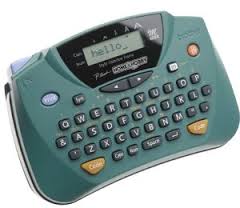
The king is dead; long live the (new) king: the Brother P-Touch 80…the Brother reps actually showed me a whole royal family of labelmakers. My Home & Hobby is still chugging along (in perfect condition, I should note), but an organized person must always plan for the future. Some labelmaker tips:
- Unless you’re a non-typist, get one with a QUERTY keyboard. The Star Trek tri-corder style where the letters are in alphabetical order will drive a touch-typist to distraction.
- “Crack & Peel” labels (much like the shrimp) are easier to use for those without long fingernails. In the olden days, I used to believe that Brother had the better labelmakers while their competitors (like Dymo) had the better label tapes. Now, depending on the tape used by the machine model you prefer, you can have the best of both worlds.
- I’d hate to be sued for saying this, so I’ll be oblique. A certain Doyenne of Domesticity turned poncho-wearing jailbird, whose name rhymes with Siddhartha had previously marketed her own line of labelmakers. It’s been my experience (and those of my clients) that those break easily and have been known to reach their demise while still in their shrink wrapped packages. Forewarned is forearmed.
Another of Paper Doll‘s favorite companies is Pendaflex, part of the Esselte/Oxford/Pendaflex/Xyron family of productivity goodies. (Warning: turn down your speakers if you visit them this week. The site is running a cute-the-first-time commercial for their Earthwise 100% recyclable products (about which we’ll discuss more when the whole world isn’t already caught up in Earth Day talk).
If you’ve been reading this blog for a while, you know that I have a strong affection for real filing systems, in 1/3-cut interior filing folders (of any color or style you prefer), with sub-categoried folders inside of broader categories in hanging folders. Sure, Pendaflex has them all. However, as much as Paper Doll is loathe to admit it, some people just won’t join on the vertical filing bandwagon, and Pendaflex is much more flexible than Paper Doll. Indeed, they developed a whole new system around pilers who don’t want to be filers! (Yes, I’m shocked!)
Right now, when you file, you look in front of you and your files are vertical, perpendicular to your face. Well, with this snazzier version alternative to the pile up, where all your stuff rises in layered heights until it falls or bumps into the wall, you can look down instead of straight ahead, and the tabbed labels of the system are still perpendicular to you. You still need to square the edges, but the PileSmart Desktop organizer tray  makes it easy and their keen clips double as label tabs, so you always know what files and documents are where. More importantly, anyone else who needs to find something amid your piles can do so, too.
Don’t quite get it? Check out Pendaflex’s full downloadable how-to explanation for piling smart. (Paper Doll would still prefer you filed and not piled, but she’s feeling magnanimous now that the jet-lag has receded.)
Happy Earth Day!

Follow Me