Paper Doll
Dylan, Donna, Brenda and Kelly & Your E-Ticket To Democracy
It has been said that democracy is the worst form of government except all the others that have been tried.
There’s a piece of paper out there that allows you to actively participate in our democracy, but first you have to be organized and obtain it.
Paper Doll doesn’t mind stirring up a little controversy when it comes to organizing issues (binders vs. hanging folders, the relative merits of “junk” drawers vs. the uselessness of “miscellaneous” labels). However, this is one post where I hope to deliver an unbiased and balanced perspective.
As such, it would be disingenuous (read: a big fat lie) for me to say I don’t care for whom you vote, but whichever candidates you support or side(s) of the issues you take, I’d hate for disorganization to get in your way.
So first, let’s step back in the Paper Doll Time Machine.
Do you remember Beverly Hills, 90210? No, not the new spinoff premiering this week; the old one with Kelly and Brenda and…wait, that sounds suspiciously like the new series. I mean the one with Dylan’s disaffected Rebel-Without-A-Cause sideburns and Brandon’s earnestly pinched brow.
Way back in 1992, that 90210 had a storyline about upcoming elections. Dylan, having just turned 18, becomes involved with a clean water initiative and wants to vote. He arrives at the Peach Pit and dejectedly informs the gang that it’s too late to register to vote and tries to commiserate with the only other of-age member of the group. Oft-ditzy Donna Martin surprises them all with her organized preparation–she’d already registered to vote months prior! Ha!
Why this callback to the heydey of Fox, boy bands, babydoll dresses and heavily-teased hair? Because we’re closing in on the deadlines for registering to vote on November 4th. In this one instance of life, I urge you all to be Donna Martin and get a voter registration card of your very own.
If you’re an American citizen over the age of 18 who cares at all about any of the following national issues (couched in the most balanced terminology I could create):
- The Economy
- Healthcare–costs and availability, medical research funding, ethics issues
- Energy– costs and availability of domestic and imported fuel
- Foreign Policy–Iraq, Afghanistan, the Middle East, nuclear proliferation, Sudan, Darfur…
- Veterans’ benefits
- The Environment
- Immigration
- Reproductive and Family Issues
and you are not yet registered to vote, please take heed. There’s not a lot of time left for you to get that voter registration card! So:
1)Know your state’s voter registration deadline!
In most states, you have to register to vote at least 30 days prior to the election–and Monday, October 6, 2008 is coming up quickly. In others, you can register by mail until a week prior to Election Day, and in Idaho, New Hampshire and Wyoming, you may register to vote on Election Day at your polling place (though Paper Doll discourages you from waiting that long). Only North Dakota does not require registration to vote. (But if you’re new to town, I advise quickly making friends with people at the local diner in your precinct so you won’t be challenged.)
2)Know your state’s voting eligibility requirements.
You have to be a citizen of sound mind and over the age of 18. Most states have a residency requirement for the county or community, and many states have regulations regarding the voting eligibility of convicted felons. Assumptions are not organized–do your due diligence.
3)Fill out the paperwork.
Registering to vote is pretty easy. Call or drop by your Board of Elections to request an application, or get started online at Rock the Vote (or see the resources listed below for citizens abroad).
4)Take note of the information provided with your card.
In most cases, your voter registration card will inform you of your voting precinct (which determines WHERE you vote) and districts (i.e., Congressional, State Senate, State House, school district, county/city district, etc.) for individual campaigns and referenda.
5)Keep your voter registration card in a safe place.
You don’t need to carry your voter registration card around in your wallet; just file it with your VIP papers in your family files, and make a notation on your calendar to bring your card to the polls on Election Day (or on early voting days, if your state allows voting in the days prior to an election).
Have other concerns? Perhaps you’re thinking:
- “I don’t care about national issues.”
Maybe you don’t, although I think such a reason might be akin to whining that we don’t need to eat vegetables because we have good genes, when the truth is we just hate cauliflower.
We professional organizers try to persuade our clients that acquiring and keeping things “just in case” merely contributes to clutter. That’s true in most cases, but there are certain things we need to keep “just in case” to preserve our safety and security. This includes (but is not limited to):
- driver’s license or identification cards
- Social Security cards
- credit reports from all three credit reporting agencies
- health care records
- passports
- emergency funds
A voter registration card is like all of the above, allowing you to preserve your hard-fought, hard-won right to have your voice count. You may truly not care (enough) about any of the national political issues I mentioned, but you never know when you’ll care about a school board vote that impacts your kids, a pothole on your street or a neighbor‘s teenage beau  boosting Peter Gabriel’s “In Your Eyes” at maximum decibels every night. Preserve your right to have a say in how your community (school district, town, city, state and nation) will be governed. Get a voter registration card…just in case!
- “I don’t identify with just one party.”
Not 100% in the red or blue column? Good for you. While many states require you to register with a particular party to vote in various primaries (i.e., to narrow the field to whomever will eventually be on the ticket on the Big Day), you do not have to be a member of a political party to vote in general and many other elections.
Also, there are other parties besides the Democrats and Republicans. For example, the Green Party, the Constitution Party and the Libertarian Party are all fielding candidates in the 2008 presidential election, and there are many, many other parties at the local and state levels.
And, of course, you can be like Paper Doll, and register as an Independent!
- “I’m a U.S. citizen, but currently live outside of the U.S. or am deployed in the military”.
If you are an American citizen reading Paper Doll from somewhere outside of the U.S., avail yourself of following nonpartisan sites to help you register and vote from abroad:
Federal Voting Assistance Program
Overseas Vote Foundation
Youth Vote Overseas
Election Assistance Commission (Military Voters)
- “I’m not going to be in my political district/precinct on Election Day.”
If you’re away at college, traveling, disabled or recovering from a medical procedure on Election Day, you can submit an absentee ballot by mail, but you must still be registered to vote by your state’s deadline. Register to vote, then contact your county’s Board of Elections or your state’s Secretary of State for an absentee ballot.
Your voter registration card is your E-ticket to the thrill-ride of participating in our democracy. Organize your corner of society — register to vote!
Back to School: Pizza Days, Practice Schedules and Play Rehearsals
Last week, we talked about back-to-school forms and all the paperwork that the school sends for eventual return. However, there’s a whole huge category of paper that comes home every day, especially in the first weeks of school that you’ll need to read, perhaps review with your kids, mark on your calendars and save for reference.
As we’ve discussed before, keeping it all on the fridge doesn’t work.
This paper tends to come in three categories: papers for long-term reference, papers for ongoing reference, and papers requiring short-term reference or some action on your part.
Papers for Long-term Reference–Rarely used
You will want to review these papers at least once, discuss as necessary with your child(ren) and then file away.
- School/Class Rules
- Dress Code
- Ethics Code
Papers for Long-term Reference–Used infrequently
These are items you don’t need every day, but you’ll want to be able to find them when specific issues arise, as indicated:
- Teacher/Administrative Phone Directories–Use when your child will be out of class for an extended time, when you need clarification on a policy or if there’s a problem that needs attention.
- Extra-curricular Phone Directories–Keep track of which other children are participating in the same sports or clubs as your kids. Use to find emergency car-pool buddies and help your child catch up on missed information.
- Class schedules–When you make doctor, dentist or orthodontist appointments, check your child’s class schedule first. While the entire school day is theoretically important, you’d probably rather your child missed lunch, phys. ed., music or art than math, history or science. Elementary kids may not have a carefully-delineated schedule, but middle- and high-schoolers often have complex “third period on even days in B-wing” schedules that require guidelines for parsing. Confer with your kids to be sure you get it.
Papers for Ongoing Reference
These papers contain the kind of information you may want to transfer to the family calendar, but you’ll still want to keep handy to double-check accuracy.
- Extra-curricular Activity Schedules: rehearsals for school plays, practice schedules for sports and class/activity schedules leading up to band concerts. Set aside time to start marking them on the calendar to get a sense of the weekly schedule right away and make sure there are no carpool conflicts or scheduling snafus. Be sure to consider non-school extra-curriculars like scouting, music lessons, martial arts, and dance classes, as well as religious instruction like Hebrew School or confirmation studies.
- School Lunch Menus (monthly or weekly)–If your kids usually take lunch from home but have a few preferred buy-lunch days, let them pick those out and then mark those days on the family calendar. If they usually buy lunch except on “chipped beef on toast” day, mark the calendar to note those are “bring lunch” days. If your kids have no set schedule, post the lunch calendar on the bulletin board (below), and make reviewing the weekly lunch schedule a Sunday task.
- School year calendar (holidays, teacher conference days, half-days)–Again, mark the whole year NOW. Arrange childcare for days when school’s out or early pickups conflict with your (and your spouse’s) work schedule. Copy this information not only to the family calendar, but also your PDA or work calendar so you can mitigate work/vacation conflicts.
- Field trip/class trip information–You won’t know this information at the start of the school year; in general, you’ll only have a few weeks’ notice. As soon as you become aware, mark events on the calendar to avoid conflicts.
Papers In Transit
- Permission Slips–Don’t just sign them; make sure you mark down where your children will be on the calendar in case you need to reach them in a family emergency. Also use notifications of field trips to make sure you’re comfortable with the school’s safety protocols and precautions.
- Forms and applications
- Class fees–Avoid tears and don’t send small children to school with bills larger than you’re comfortable losing. Pay fees by check or mail/deliver them to school yourself.
- Test/papers requiring parental signatures
Different items work best in different places, depending on frequency of use. For papers you’ll want to reference on an almost-daily basis, you’ll want to use your areas of Prime Real Estate. For papers you’re keeping just in case a question pops up, they can be relegated to lesser-trafficked areas.
1. Start with an IN-Tray…
Horizontal trays are more common, but vertical options can work.
Condition your children to empty their bags daily, upon returning home. Make it a ritual to walk in the door, open backpacks, “turn in” non-homework take-home paper (notes from teachers, class schedules, permission slips, etc.) to the IN-tray, then change into play clothes, and finally have after-school snack-time.
Speaking of snack time, lest Paper Doll be accused of contributing to the childhood obesity epidemic, whether snack-time is a healthy piece of fruit or a yummy cookie doesn’t matter from an organizing perspective, but setting aside time to decompress from the workday–and note: school is the career of the 5-18 set–does. Starting this ritual in early childhood gives your kids a chance to wind down from the stresses of the day, have a little nosh and share their day with you; it’s an excellent way to not only keep in touch with the big calendar items, but to create and maintain a bond so your kids perceive sharing their day with you as a normal part of life. (You’ll thank me when they’re teens!)
If your younger kids tend to forget to bring important papers home to you, keep a gallon-sized zip-lock bag in their knapsacks and tell them that ALL papers go in the bag until you sit together to sort them. (For older kids, just threaten to show up in the middle of the school day. Even if you’re a “cool” parent, this should ensure regular take-home-paper service.)
2) Create a Family Calendar…And Use Other Vertical Space Wisely
Be sure your family calendar is large enough to allow ample room for writing on any given day (including weekends) so you can accommodate information regarding field trips, recitals, carpool, parental travel, babysitting arrangements, etc.
Make reviewing the incoming paper in the family “in tray” part of the daily ritual, perhaps right after dinner, before everyone departs to their own private corners of the house. Also make it part of the weekly ritual–on Sunday afternoons, review all the week’s upcoming events so that school/team/performance uniforms are washed, permission slips are signed and ready to be returned and that the lunch-making schedule is covered.
The family calendar requires vertical space–make sure it’s given a position of importance in the house, like on an oversized bulletin board on the kitchen wall or door. School lunch menus also belong vertical and visible.
Emergency numbers (for the school nurse, the family doctor, mom and dad at work, grandparents and contact data a babysitter might need) also fit well in the vertical space of a family bulletin board.
However, avoid clutter and remember that vertical To-Dos tend not to get “to done”. For parents and older kids, consider a tickler file; for little ones, start them off with a To-Do tray for their desks or a personal bulletin board on their bedroom doors, specifically for their own waiting tasks.
3) Create a long-term reference section.
Remember all those papers for long-term and ongoing reference? You can’t just stick them in a drawer or on the fridge, or it will quickly turn to paper clutter and floozies. Instead, consider one of these two options:
School file–If you have horizontal space either on a kitchen counter or family desk, a small open-top desk-top file box with hanging folders is fantastic.
One hanging folder in the front can hold all the calling lists and phone directories for various schools and activities. Then, keep similar categories of manila folders to group information for each child. If you have kids in multiple schools (elementary, middle, high school), you may want to divide the sections by school so as not to confuse the different dress codes or lunch menus.
School binder–Use subject dividers to keep schools or children categorized properly. As the school year goes on, you won’t have the time or the inclination to use a three-hold punch; instead, opt for plastic sheet protectors and just switch out content each year as material changes.
Both options work well for keeping track of reference material. However, the open-top file box is less labor-intensive, especially if you’re used to keeping your family files in order. Conversely, a binder (or even two, if you have multiple kids in multiple schools) is more portable, allowing you to make calls while you are sitting in the carpool lane.
4) End with an OUT-tray…(and Be A Rocket Scientist)!
IN and OUT baskets, either stacked or side-by-side, ensure a home for everything in transit. Here’s where you put papers set to leave the house to make sure they get into the right hands.
First, be a rocket scientist and build a launch pad for the next day. After dinner but before bedtime, set up a launch pad near the door you’ll be exiting, and put your briefcase or gym bag or diaper bag with all the essentials. Follow the same procedure with your kids: gather the book bags, gym clothes, musical instruments, art projects and get them placed by the outgoing door early in the evening. Put a small table or stacked baskets near the door just for that purpose.
Next, go through the OUT-tray and make sure that permission slips, signed application forms and anything else going back to the teachers, coaches or administrators leaves the OUT Tray and goes into the right kid’s backpack. (Again, gallon zip-lock plastic bags work wonders!)
Finally, do a countdown (5…4…3…2…1!) to liftoff—take five minutes to chat with the little voice inside your head and the little (louder) voices of your kids, and ask about unusual events for the next day. Going hour by hour, you should trigger any “Oh, yeah, I need (lunch money, a signed permission slip, a salt map of the French Revolution).”
Parents, send in your school paper questions and I promise to do my homework and get back to you! Until then, have a safe and happy new school year!
Back To School: Don’t Get an F in Forms!
It’s hard for Paper Doll to believe that kids are already back to school. In my native New York State, school always started the Wednesday after Labor Day, but here in the South and in many other areas, including where kids have year-round school, classes are already back in session. So, with a wistful nod to a childhood when it was decidedly not 90 degrees while awaiting the school bus, I’ve been considering all that back-to-school paper.
No, not homework. Not KID paper, but grownup paper…the paper you parents are receiving to deal with the new school year. FORMS!
- An Apple A Day Keeps The Forms At Bay
Is your child starting a new school, either due to a household move or a “rise-up” to middle or high school? If so, get ready for the form deluge, and the most important thing you’ll need is a current copy of your children’s vaccination report. (Not sure if the shots are up to date? Type your child’s birth date here for a personalized plan.) In some school districts, this may get handled during a registration period, months prior to school starting; in others, your child might have a brief period at the start of the year in which to provide the paperwork.
For reference, you must prove that your kids have had the requisite immunizations for polio, measles, mumps, diphtheria, pertussis, tetanus, chicken pox, something sci-fi-ish called a Rotavirus, and more, as well as the dates on which these shots were given. (Yikes! That’s a lot of owies and tears and lollipops!)
So, do you have the paperwork?
If you’ve been following Paper Doll for some time, you may have all of these records in the MEDICAL section of your Family Files. If not, be sure to call your pediatrician today to get the records right away. Offer to come to the doctor’s office (to the well-child waiting room, so you don’t pick up any back-to-school germs) to pick up the completed forms in order to save the office manager the effort (and you, the time) of having the records mailed.
- Save Time. Make Multiple Copies of Forms!
Even with the immunization and medical history forms in hand, chances are good that you’ll be asked to fill out more medical history and release forms requiring you to dutifully fill in three hundred and twelve little check-boxes and explanations regarding chicken pox and broken bones. If you have two or more children, and each participates in one or more extracurricular activity (and yes, apparently the band director needs to know if little Jimmy’s knees are up to snuff), your hand could be cramped until Thanksgiving.
Depending on whether your children’s school is on the semester or the quarter system, you might be even expected to fill out the exact same forms in three, four or six months. Once you’ve filled everything in, maintain photocopies of the immunization and other doctor’s records in your children’s medical folders, and keep copies of the releases and other paperwork in the “school” category of each kid’s Personal section in the Family Files.
- Double-check Numbers for Emergency Contact Forms.
Everybody grouses about having to fill in emergency contact forms each year. After the 53rd form, we’re all reduced to whining “but nothing’s chaaaaaanged since last year!”, just as we’d like to say when we’re asked to fill out the same medical history and insurance forms each time we visit the doctor. Sadly, until we have universal computerized records implanted in our brains, readable via cornea scans, we’ve got to keep churning out the paperwork. So let’s at least make sure it’s worth the effort and do it right.
Although there’s a phone number portability law that says you get to keep your phone number if you change cell (or some land-line) providers, lots of people still switch cell numbers with surprising frequency. Your emergency contacts (Grandma? The back-up babysitter?) may have changed cell numbers since last winter, but since you probably just made the quick change in your own cell’s speed dial, the school was never updated. If you provide work numbers, your contacts may have changed cubicles/offices and gotten new extension numbers. Test all contact numbers!
- Reconsider If Your “Name” Is “Nick”
(OK, let’s all agree a bad “nickname” pun isn’t the worst thing a blog can offer.)
Parents, in order to preserve the safety of your kids, schools are necessarily (if annoyingly) more detail-oriented they were in our day and before. In the “olden” days, a mom could easily drop by school with a forgotten lunchbox and head straight to the child’s classroom. Now, more often than not, at least a few layers of extra security exist between the parking lot and your child’s cubby, and one of these layers involves proving you are who you say you are.
Mom, if the school is trying to reach the Mrs. Amelia Jones-Thorpe listed on all of your child’s paperwork and your voicemail says “Hi, this is Amy Jones, please leave a message”, the school may not be comfortable leaving word that your child has just projectile vomited tri-color Kool-Aid and needs to be taken home. And Dad, if you’re down on all the forms as Charles Phillip Hickenlooper III, but all your identification says “Trey Hickenlooper”, your second grader won’t be easily be released into your care for an early pickup.
When filling out forms for school, be sure to include the variations of your name in all official signatures, especially if you regularly go by a nickname. Sean P. Diddy Puff Daddy Combs, I’m talking to you!
- Create Your Own Forms
In addition to all the forms the school wants you to fill out, there are some you’ll want to create to keep on hand for yourself, and others you may want the school to sign and return to you. Consider:
Does your child have a serious allergy, such as to peanuts or bee stings?
If so, it’s not enough to fill in the generic medical forms. If your school doesn’t have allergy alert forms, create your own. The first page should explain the allergy situation and at minimum should list:
- your child’s full name
- grade
- homeroom teacher’s name
- the type of ALLERGY (in big, bold print)
- symptoms of exposure, if not obvious
- parental and emergency contacts
- primary physician’s name and contact information and
- treatment protocol
For example, if the school nurse has a stack of epinephrine pens stored for use in case of an emergency with your child, all of his teachers should be alerted in advance. The second page should include a form all of your child’s teachers should sign and return to you, acknowledging having read the notice.
If you are the kind of parent who doesn’t mind making a hubbub (and heck, what’s more worthy of a hubbub than a child’s safety?), you might even want to send a letter to the parents of other kids in your tinier tots’ classrooms so they are aware of the danger their lunch choices may pose.
Of course, none of this absolves parents or kids from diligence in avoiding an allergic situation, but forewarned is forearmed.
Does your child have a serious medical condition?
As with the issue of allergies, if your child has diabetes, epilepsy or any other condition which could require immediate action, be sure to notify the school nurse, administration and teaching staff and get written confirmation that they’ve read your notice. Yes, you filled out all those forms, but it doesn’t mean anyone read them. This extra step is your insurance policy.
Do you have parental rights issues?
If you and your ex- (or soon-to-be ex-) spouse have ongoing parental rights issues, or if you have an order of protection against a current or former spouse such that your child cannot/should not be picked up by, or come in contact with, the other parent, notify the school of this in writing and provide a copy of all necessary legal documentation.
Again, creating a note and confirmation-of-receipt form for your child(ren)’s teachers and the administration will create more paperwork, but it will also ensure a greater sense of personal responsibility on the part of the faculty.
Are you always pressed for time?
If time is always at a premium for your family, or if you’re King or Queen of Sleepyland in the mornings and your parental notes sound something like this, it might be helpful to create blank absentee excuse notes in advance with everything filled in except your child’s name (if you have more than one), the date of the absence and the reason for absenteeism.
Put contact information for both parents, even if only one of you signs it, so the school can check in to request further details. (Parents, don’t embarrass your kids by providing too many medical details–you never know who will get sticky little hands on an excuse note. If your school requires more details than “My child was absent on Tuesday, 9/30/08 due to illness”, get a cheat sheet with Latin/medical names for medical conditions.)
Similarly, create blank templates for excuses from gym class (again, if appropriate, choose medical terminology that isn’t too easy for other kids to suss out), early dismissals or tardiness. Create your own form, or print out combo versions already available on the web.
Keep a template in your computer, print out a half-dozen (or more, if your child had as many elementary school sick days as Paper Doll when she was a mere Paper Dolly) and/or keep a few extras in the glove compartment for the days when you’re really pressed for time.
Finally, find out if your school has any plans to go super-high-tech and allow parents to log in to password-protected accounts and fill in online absentee/dismissal/tardiness excuses without resorting to all the paper pile-up.
Today, we’ve reviewed some essentials for dealing with the paper that has to get to school. Next week, we’ll share the best ways to keep track of all the paper that comes home, from permission slips to class schedules, parent-teacher conference notices to vacation day calendars, school lunch menus to volunteer forms.
Believe it or not, there are alternatives to layers of paper on the fridge and the kitchen counter, and there are methods for ensuring that papers (and uneaten sandwiches) don’t outlive their usefulness at the bottom of a knapsack.
Map Mania, Direction Drama
You can’t get there from here.
Of all the papers we collect, no matter how old, wrinkled, stained or obscure, the ones we’re least willing to discard are those containing contact information (even ancient address books where we know the contacts have moved on, not only from those numbers and streets, but sometimes from this mortal coil) and directions. Indeed, I’ve seen clients dismayed by the thought of discarding crumbling maps– unreadable, un-foldable, unusable.
Perhaps there’s some existential longing within each of us, such that we feel that if we know where everyone else is (or at least was, at some point in the space-time continuum) and we know, in theory, how to get to those places (physically), we might be able to figure out where we are (figuratively) and how we got here.
Paper Doll has little existential guidance to offer in this regard. When in angst or doubt, I rely on old Stephen Wright bits:
So I ordered French Toast during the Renaissance.
and change the subject. But if your car is cluttered with hand-drawn maps, sun-faded atlases, computer-printed directions and the like, I do have some suggestions for dealing with your direction(less) paper clutter.
Option 1: Embrace GPS
High technology, high cost
You can get rid of all printed directions and opt for a Global Positioning System (GPS) to get you where you want to go, whether it’s over the river and through the woods, or merely to that new restaurant across town. Paper Doll would be disingenuous, to say the least, to imply having any understanding of how GPS works. (Heck, I’m not too proud to admit I don’t really understand how photocopy machines work). For that, check out the experts; but I do have a few common-sense tips:
Know which type of GPS you need–apparently, there are four different types, though you’ll likely choose among three: in-car navigation, an outdoor portable version or a PDA-installed option. (The fourth, “marine”, version is only if you’re big on fishing and boating, in which case a plethora of street directions probably aren’t your main concern, anyway.)
Opt for the largest, best lit screen, especially if you’ll be driving at night.
Opt for a lightweight and water-resistant model if you’re planning to use your GPS for directions while walking/bike riding, especially in a city setting. (In such cases, the GPS is saving your pockets and backpacks, instead of your car, from being overrun by maps and scribbled directions.)
Ask your friends what they use. It doesn’t matter what the sales guy or gal says about features–you’ll probably never use most of them. You want something that’s easy to figure out and you want to be able to call a friend and say “Joe, I think the GPS is sending me to Guadalajara instead of Green Street…tell me again what I’m supposed to click after I turn the blue doohickey?”, because you know he’s been there before.
Stick to known brand-names. This is true of most electronic equipment–it’s not that mystery-brands are necessarily bad, but you’re more likely to be able to find research, reviews and repair advice for known quantities.
The Big Three GPS industry leaders are Tom-Tom, Garmin, and Magellan. Call upon friends and colleagues for real-world reviews, and use consumer sites and expert review sites like C-Net to get a sense of what to look for in terms of features and how the top choices compare.
Pros: In general, the quality of GPS directions are improving faster than the quality of human beings’ ability to give advice. Your GPS will never tell you to “turn left where the old post office used to be”. Also, most paper clutter can be eliminated, and you’ll no longer need to keep hand-written directions, as successful route selections can usually be saved in the system. (Of course, a good map or atlas is never amiss.)
Cons: People, have you ever seen any episode of the Twilight Zone?? Computers and robots are imperfect (in a way that frustrates us much more than human imperfection) and GPS directions have been known to direct us into lakes, private driveways, prison gates and over embankments. Caveat emptor! Also, there can be a rough learning curve for those of us who aren’t technologically-adept early adopters.
Option 2: Auto-Organizers
No technology, moderate cost
There are a variety of car-tidying tools available that take up minimum space. For example, OnlineOrganizing.com carries this 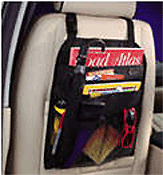 Backpockets Backseat Organizer to provide space for a multiple road atlases, maps and other assorted on-the-road tools. There are even directions on the web for creating your own back-seat car organizer. (Be assured that Paper Mommy is laughing at the notion of any member of Paper Doll‘s family embarking on such an adventure.)
Pros: Map and direction clutter is corralled in one place; reasonable cost; no learning curve.
Cons: With everything organized in the back seat, you’ll need the help of a (literal) back seat driver to reach anything while you’re driving. Also, the very existence of a storage container encourages people to save too much. So, you’ll have to be vigilant about saving only the directions you’ll really need again.
Option #3: Directions Manual
No technology, (very) low cost
Create a directions manual. (For those of you familiar with Paper Doll‘s posts on organizing recipes, you probably expected this to be my preferred option.)
1) Buy a flexible poly three-ring binder and a small box of top-loading three-hole-punched plastic sheet protectors. If you really want to be spiffy, add some subject divider tabs.
2) Eliminate unnecessary directions. If you went somewhere once, especially if it was a while ago, and have no reasonable expectation of going there again, toss it out. It’s OK, even wise, to save directions to places you go infrequently (i.e., to a medical lab for a test needed only once per year) or to which directions are complicated or confusing, but don’t go overboard.
3) Sort your directions into categories that make sense to you. For example, gather up all the MapQuest and GoogleMap printouts, then sort them by travel type (vacation travel, team sports road trips, work travel, etc.) or by locale (in-town “normal” driving so dad can take the kids to ballet when mom is sick, directions to the vacation house, etc.) so you can quickly flip to search by category.
4) Put each set of directions into its own plastic sheet protector. If there are two pages of directions, place them back to back. If there are three or more pages, denote that (“Cabin-Page 1 of 3”) in a brightly colored marker and place pages beyond the initial two in sequential sheet protectors.
5) Sort individual maps by area of the country; then insert one map each into the sheet protectors, with the map title visible.
6) Include helpful* notes of explanation. Neither computer-aided nor dad-designed maps or directions are always perfect. When you encounter difficulty or confusion and then get it worked out, make a notation on your map. That way, if Dad is ever driving without Mom and sees “Don’t veer left at the giant pink elephant–it’s only a driveway, not an access road!”, he’ll know what to do.
Pros: Cheap, easy, adaptable. You can remove a specific sheet protector of directions while taking a trip and easily return it to the notebook when you’re done.
Cons: No social cachet of having a talking robot guide you where you want to go.
*Eons ago, Paper Doll was given directions to her new place of employment, a television station in a rural, Southern community. The directions included the following items of note:
When you think you’ve gone too far (uh, OK…), turn left at Mrs. Winner’s chicken (not knowing this was a chain restaurant, I wondered idly how I’d know Mrs. Winner’s chicken from all the other fowl I imagined loitering at that intersection) and then keep going until you want to turn off the paved road (at which point I realized how little my new boss knew me, to imagine I was the type of person who would ever turn off a paved road) but KEEP GOING.
Sometimes, the directions we receive from the universe are more meaningful than we could ever imagine.
Lost and Found: GONE in 6 seconds: Your Wallet!
Even if you’ve never experienced it, your imagination can conjure that sinking feeling in the pit of your stomach. You reach into your pocket, bag, drawer or center console of your car…and grasp thin air. Your wallet is gone. Not “darn, I left it on my dresser”, but “ohmygosh, mymoneymycardsmyidentity, OhNoooooooooo!!!!!”
If you’ve pared down your wallet and only keep the essentials, you’re already a step ahead. Last week, we reviewed the three main ways to keep an inventory of what’s in your wallet to protect yourself in the event of a worst case scenario. Whether you:
- Use a Wallet Protection Services;
- Create a Photographic Inventory (via photocopying or scanning); or
- Maintain a Digital Database (in a spreadsheet or financial program)
you will still have to make some calls–either to the wallet protection services to set the wheels in motion, or to each of the card-issuing companies/agencies whose contact numbers you wrote down when following last week’s advice. Next…
1) DON’T PANIC!
Your wallet is not your child, spouse, parent or pet. Losing your wallet is an inconvenience and having one stolen is a violation, but the precautions you’ve taken up until now will help you get on the road to recovery quickly. Breathe deeply, call a friend to keep you company as you go through the calling process, and remember that getting mad will just slow down the process.
2) PRAY OR WISH, BUT DON’T BE BAMBOOZLED!
Facing a potentially lost or stolen wallet, I’ve seen people go through those five stages of grief, including bargaining. Carefully retrace your steps, check under the cushions, in pockets and darkly-lined bags and on the floorboard of your car, but even if you’ve prayed to St. Anthony, wished on a star or tried to be Buddhist about it (recognizing that attachment to possessions causes pain), there comes a point at which you have to accept your wallet is gone and take action.
But first, be cautious. If you get a call from someone claiming to have found your wallet, it could be good news, or it could be the thief, scamming for a bigger payoff. If it isn’t showing on your Caller ID, ask them to supply a phone number so you can call them right back (from a quieter location, with a stronger cell connection… whatever it takes). If possible, type the number (with area code) into Google to identify who is really calling you.
Ask specific questions regarding how/when/where they found your wallet. Finally, do NOT agree to meet at your home or theirs. Arrange to meet at a nearby police station; if that’s not possible, select another location that is very public, preferably a bank lobby or somewhere else with security cameras.
Is Paper Doll cynical? Perhaps, but I’d rather we were all cynical and safe, than endangered Pollyannas.
3) GEAR UP FOR YOUR CALLING SESSION
This may take a while–you might want to ask for the afternoon off of work, and/or arrange for someone else to handle carpool or watching the kids. The more you had in your wallet, the longer you will be on hold.
Time is of the essence; as long as you contact your credit card/debit card issuers, the most for which you can be held liable is $50 (each), but a fast response should mean you’ll owe no money at all. Once you’re sure the wallet is gone, don’t hesitate!
4) FILL OUT A POLICE REPORT
Even if you think you threw out your wallet with the fast food tray, a police report is essential in case you face any future incidents of identity theft. (For more on protecting yourself against identity theft and recovering from it, check out Paper Doll‘s series, starting here.)
Depending on your community, you may be able to fill out a police report by phone, or they might have a patrol officer in your area. Conversely, you might have to go down to the police station. Eat first; as with emergency rooms, you might be waiting a long time.
Take a legal pad and be sure to write down the date of the report, the report or case number, the full name and badge number of the police officer who took the claim, and a contact number for the officer or at least the department. If possible, try to convince them to let you leave with a copy (even an unofficial photocopy) of the report.
5) CALL YOUR MAJOR CARD ISSUERS
Armed with the wallet inventory we discussed last week, call each credit card company or bank that issued each of your cards. For each call, note of the following on your notepad:
- The name (Discover, Chase Visa, etc.) and last four digits of the card number
- The date of your call/card cancellation date
- The name and, ID number of the representative to whom you spoke
- A direct number for follow-up calls and confirmations
- The date and method by which your replacement card should arrive
- Any special information the representative imparts
6) CONTACT YOUR BANK OR CREDIT UNION
Depending on what was in your wallet (i.e., spare checks, your ATM card, etc.), you will probably want to cancel your checking and savings accounts and open new ones. The bank should link the accounts so that checks YOU wrote on the old account will still clear, but confirm this with the bank.
As with the cards, write down the name of the person who helped you and get a contact number. If you have a good relationship with your branch manager, you may want to handle this in person rather than calling, to get the tender loving care you need right now.
Your bank should also contact Telecheck and any other check confirmation companies to make sure that “new” checks printed with someone else’s address won’t be accepted.
Special note: Do you have automatic withdrawals?
Do you have automatic withdrawals (from either your credit card or your bank account) for your mortgage/rent, utilities, credit card payments, gym memberships, Netflix/Blockbuster, IRAs or other investments, or anything else on an ongoing basis)? If so, ask your bank and credit card companies whether they will link the already-in-place automatic withdrawals to your new accounts or if you will have to contact each company to make alternate arrangements.
If you have to do it yourself, review your financial files to see which expenses are drawn on which cards or accounts. Then, call or go online to change the withdrawals to reflect the new account numbers.
7) CONTACT THE CREDIT REPORTING AGENCIES–PLACE A FRAUD ALERT!
| Equifax | 800-525-6285 |
| Experian | 800-397-3742 |
| TransUnion | 800-680-7289 |
If you’re shopping for a house, car or other type of loan, or if you’re seeking employment, a credit freeze won’t work, but if none of these situations apply, request a credit freeze from each agency and be sure to get a Freeze ID or PIN from each. Keep an eye on your credit reports at AnnualCreditReports.com, and again, if you think you’ve become the victim of identity theft, review the advice here.
8) REPLACE YOUR DRIVER’S LICENSE
In most locales, it’s illegal to operate a motor vehicle without your driver’s license in your possession. Keep a copy of the police report with you if you must drive, and try to call or get to the Department of Motor Vehicles within two business days of losing your wallet. Some DMV’s keep photos on record, but if you hated your picture and are willing to spend an extra $5 or $10, they’ll let you get a spiffy, new photo.
9) CONTACT YOUR HEALTH (and, if applicable, AUTO) INSURANCE COMPANIES
You will need a new health insurance card; if you carry your car insurance in your wallet instead of your glove compartment, call your auto insurance company too. Again, write down the names of the people you talked to, their contact information and the method and date by which new cards should be expected.
10) REPLACE OTHER OFFICIAL IDENTIFICATION CARDS
As discussed, shouldn’t have been carrying your Social Security card in your wallet, but if you had other military or government ID, rush to replace these, as well. Usually, it’s more important to protect yourself financially, by making bank and credit card calls. However, if you are in the military and need to get on base or might be called upon to deploy quickly, or are a military dependent, make this step a higher priority.
11) CONTACT THE MINOR CARD ISSUERS
Go through your inventory of non-major, non-ID cards (like store cards, price clubs, auto clubs, library, etc.), report the loss/theft and get replacement cards. If necessary, supply new credit card and/or banking information to keep accounts current.
12) BE WATCHFUL, BE SAFE!
If you left a key in your wallet (even though Paper Doll peskily warned you NOT to), call a locksmith and have your entire house re-keyed–immediately. (If you rent, alert your landlord.) Even if you didn’t have a key in your wallet, if you are a victim of theft of your wallet, you might be targeted by the bad guys as a further victim. Check your home security, keep the outside lights on and be cautious entering and exiting your home and workplace and approaching your car.
13) GET SOME SPENDING MONEY
It’s dangerous to walk around without any cash or spending power. If you have any ID at all, or your bank branch knows you, write and cash a check (from your new account) for enough mad money to get you through the next few days. If you have no identification at all, ask a friend to cash a check for you.
14) BUY A NEW WALLET — and HOLD ON TIGHT!
Losing or having a wallet stolen is inconvenient, but if you take the proper precautions, it doesn’t have to be a misery.



Follow Me