Archive for ‘Office Supplies’ Category
An Organized Hybrid: The Evernote Smart Notebook By Moleskine
Reese’s Peanut Butter Cups – “Two great tastes that taste great together.”
Toyota Prius – combines an internal combustion engine with an electric motor
Zedonk – a cross between a zebra and any other equine

A hybrid takes two things that exist perfectly well independently and combines them to make something altogether more fabulous. Today, we’ll look at how two great product brands have united to create something fascinating: The Evernote Smart Notebook By Moleskine.
THE CLASSIC

It was the original little black book, made of moleskin (a thick, cotton fabric with a shaved pile surface). In the 19th and 20th centuries, artists like Matisse, van Gogh and Picasso sketched and painted in them, and authors who couldn’t have been more disparate in writing style or personality, from Oscar Wilde to Ernest Hemingway, scribbled their stories in them. Back then, the notebooks were black, handmade by French bookbinders, and, while utilitarian, represented a kind of artistic chic. The notebooks were for creative geniuses on-the-go.
In the 1980s, it was reported that, “Le vrai Moleskine n’est plus” (“The real Moleskine is no more”) and bookbinders had ceased fashioning them, but in 1997 the product was reborn via a Milanese parent company under the Moleskine brand. A strong marketing campaign and a passion for the ever-expanding line of notebooks made, and makes, Moleskine cool for hipsters and soccer moms, alike.
The features are basic, but beloved: luxurious covers, high-quality acid-free paper, narrow grosgrain ribbon bookmarks and color-matching elastics to keep everything together. Moleskine has followers every bit as passionate and devoted as Apple’s fanboys (and fangirls). Bloggers show off their notebooks and creative doodlings, as at SkineArt, and share their secrets, such as Freelance Switch’s noted The Monster Collection of Moleskine Tips, Tricks and Hacks post.
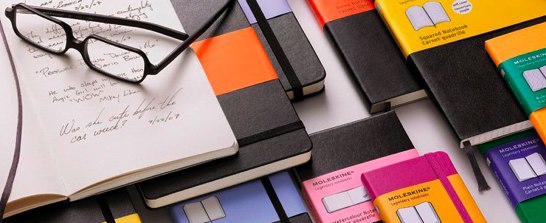
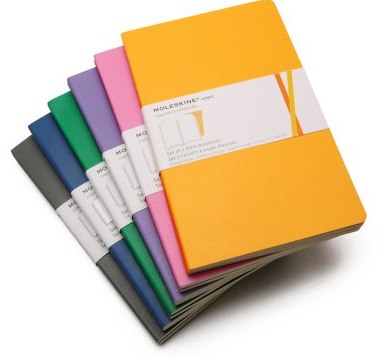
The collections include the original notebooks — ruled and unruled, with interior pockets and without, with squared or rounded edges — diary-like journals, tabbed “Passion” journals (to log one’s favorite books, films, restaurants, recipes, wines, travel locales, etc.), memo books and address books.
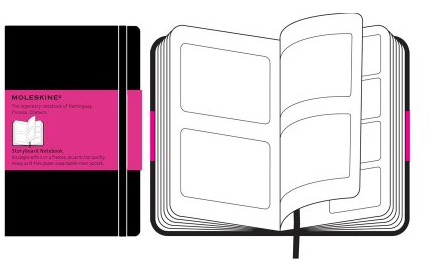
For creative types whose muses delight with other than words, there are sketchbooks, watercolor notebooks, music notebooks, and storyboard books.
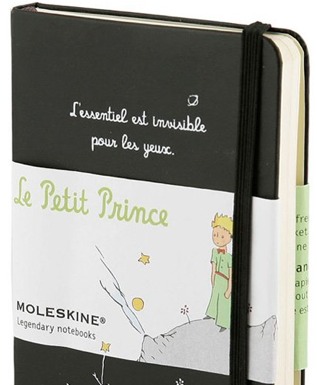
There are even limited-edition collections, with design themes including Peanuts, The Little Prince, LEGO and Star Wars.
Moleskine feeds the addiction for a sensory experience only paper can provide.
THE MODERNIST

Evernote: It’s a service. It’s an app. (It’s two mints in one!) It’s almost an independent nation of global citizens, given that it has ambassadors (including friend of Paper Doll, Brandie Kajino). You probably either use it, or you wonder, “What’s the big deal?”
For the uninitiated, at its most basic, Evernote allows you to take digital things, collect them, and organize them. Anything you save, like a Paper Doll blog post, can be a note. Notes combine into notebooks (like how you have Excel worksheets within workbooks), and all are kept safely within your account, synced across all of your computers and digital devices.
You may wonder why you need Evernote — can’t you just use a bookmark in your browser? Ah, but have you ever clicked on an old bookmark or favorite to find the link you’d preserved yields a disappointing 404 Error message, meaning the page you wanted no longer exists? Evernote doesn’t just preserve the link — it preserves the entire page or document, along with comments, tags and anything else you wish to keep.
The Basics
Install Evernote, create your account and put a little “clipper” in your browser bar — it works much like Pinterest’s “Pin” bookmarklet to speedily grab what you want and tuck it away. Any time you want to save something digital, you can just click on the clipper bookmarklet and up pops a window to walk you through your options.
For example, at some point in the not-too-distant past, I went to Evernote’s page for getting started, and clicked on the clipper, bringing up a little window, as you see below.
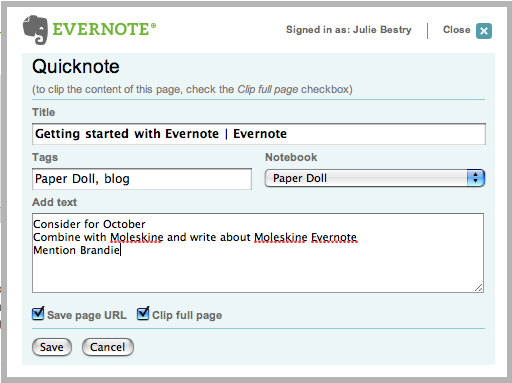
Evernote selects a default title for your note; adjust it as you see fit. Add your tags, select in which notebook (for any of your various themes or projects) you wish the note saved, and add comments or stray thoughts. You can save an entire page, or highlight just one section for faster and more accurate “clipping” of web material (to skip ads and extraneous text or photos). And, of course, you can opt to save the original URL.
Beyond Baby Steps
Evernote saves much more than web sites and text. Instead of using your clipper, log in to your Evernote account and click “New Note” from the main page or within any of your already-created notebooks.
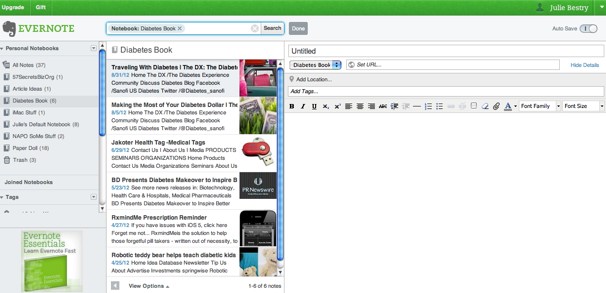
Above, the left column represents my various notebooks and tags; the center column shows previews of various clippings (i.e., notes) and the right column provides a place to create a more complex note, with formatting. Let’s say you have a brilliant idea for a blog post, or a wedding toast, or your packing list for an upcoming trip. Instead of scribbling it down on a random floozy, lock it up on Evernote.
Once in your account, you can drag-and-drop images from your desktop, files, and web pages. For convenience, you can also drag images directly onto any specific notebook (without having created a detailed note) or, for Mac users, directly onto the Evernote icon in your Dock. And it’s not just text and pictures. Record audio and move the .MP3 file to a notebook. Save videos, too. And tweets! Then combine them all in the way that works best for you.
Bing, bang, boom. Your “stuff” is saved to the cloud and synced across all of your devices. Better yet, it’s searchable, so between the native text of what you’ve saved and the keywords you create, you have your own private search engine to find what you want, when you want it, no matter how long ago you clipped or created it, accessible from anywhere in the world.
Now What?
Evernote has myriad uses. I save product reviews, news stories and articles that may be useful for Paper Doll posts and my Best Results for Busy People newsletter, as well as for current and future articles and books I’m writing. A recent discussion on the NAPO email chat found that my colleagues are using Evernote for various professional and personal solutions, including:
- Notes, statistics and ideas for presentations and workshops
- Titles of books, movies and other entertainment to check out later
- Household data, like battery sizes, light bulb wattages and air filter dimensions
- Organizing solutions for particular clients or situations
- Grocery lists (shared across devices with family members who can access them while shopping)
- Collated travel information and directions to use while on vacation or attending conferences
- Party planning and menu ideas, including recipes, organized by meal or ethnicity of cuisine
This is just a smattering of options — Evernote has a video library of tutorials and suggestions for ways to maximize its use. Evernote continues to expand its interactivity with other apps. Draw or hand-write with a stylus on your iPad or tablet in Skitch and Evernote saves it (and even translates handwriting to text). Save news and articles to read later via Pocket (formerly Read It Later) or InstaPaper. Study for exams (or your Jeopardy audition) by creating study notebooks with Peek, and record (with permission) phone calls with CallTrunk.
Evernote is free at the basic level. For $5/month or $45/year, the Premium level grants the ability to upload up to 1 GB each month (handy for photos and lots of files) and have individual files of up to 50 MB. You can also view historical versions of files, take notebooks offline for when you lack web access, collaborate across accounts, hide promotional language, and more.
THE HYBRID: PAPER + DIGITAL = EVERNOTE SMART NOTEBOOK BY MOLESKINE
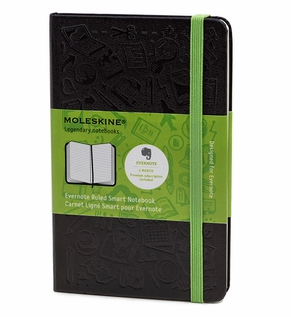
The Evernote Smart Notebook By Moleskine combines the advanced technology of Evernote with the sensory delight of a Moleskine notebook.
Paper notebooks are tangible and concrete. Digitizing provides accessibility, navigation, searchability and a different kind of permanence. What if you could combine the two? What if you could scribble down your thoughts on paper in your own quirky handwriting, then record, modify, and preserve them forever? Now, you can.
The Evernote Smart Notebook by Moleskine lets you create naturally, then use Evernote’s handwriting recognition and search capability to turn your scribbles and scratches into symbols of your brilliance. (Haven’t you always wanted a way to digitally search through piles of handwritten notes to find the paragraph or phrase you needed?)
Affix Smart Stickers to automatically add digital tags to your notes — kind of like built-in QR codes, to take information from paper to the cloud.

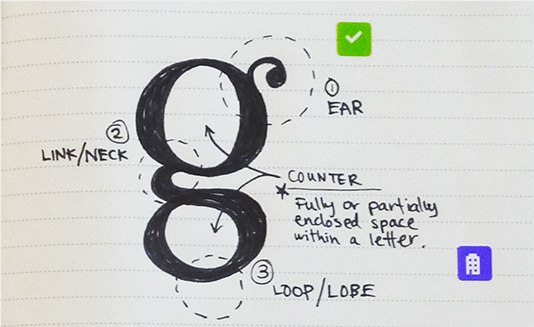
Just write in your notebook, and when you’re done, the Page Camera feature inside Evernote on iOS (on your iPhone or iPad — Android access is still-to-come) recognizes the tiny, square stickers, adds tags to the digital note, optimizes it and files it into a selected folder in your Evernote Digital memory.
Getting Started
Pick one of two sizes: the 240-page Large (5″ x 8 1/4″) notebook for $24.95 or the 195-page Pocket (3 1/2″ x 5 1/2″) notebook for $29.95. Both come with black hardcovers, green elastic bands and four sheets of Smart Stickers (tucked in the back pocket).
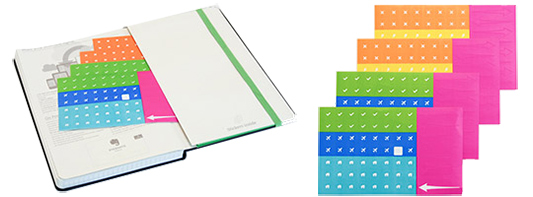
Then select your paper preference: a gridded pattern (like graph paper) or (dotted) ruled paper. You can use pencil or pen, though dark pens will yield the clearest digital results.
Each Evernote Smart Notebook purchase includes a complimentary subscription to Evernote Premium for three months, so your next step is to sign up for your Premium Digital account…and start creating.
This isn’t the first nifty blending of paper and technology. There’s the LiveScribe Echo and Pulse smart pens, which digitally record text written on special notepads and contemporaneous audio. But the Evernote Smart Notebook by Moleskine combines two products you either already use (or would enjoy using) in a stylish, magical and far more affordable manner. It’s prettier than a Zedonk and less expensive than a Prius.
Of course, it’s no Reese’s Peanut Butter Cup…but then, what is?
Paper Doll Writes Between the Raindrops: Waterproof Notebooks
Paper Doll knows you’re keeping track of a lot of information. Chances are good that you use a digital device for jotting down notes on the run. Digital is dandy…except in a downpour. If it’s raining or snowing, a non-digital alternative is often preferable.
That said, paper isn’t always the best way to deal with the problem, either. Rain. Fog. Snow. Humidity. All of these make it pretty difficult to organize your thoughts without ink bleeding through a mess of soggy papers. And if you’re the sort to send an assignment notebook through the washing machine, or have ever found yourself with a squishy pile of drenched notes after righting an overturned kayak, you know that water and paper are not the best of buddies.
Happily, there’s a nifty third option — one that avoids shorted out digital devices as well as soggy papers. Waterproof notebooks!
WATERPROOF SOLUTIONS FOR WATERLOGGED WRITERS
Do you scoff? Do you wonder who really needs such a thing? Waterproof notebooks are stellar options for:
- Private detectives — especially of the film noir variety, as it’s always drizzling in those stakeout scenes
- Military personnel, police officers, and firefighters
- Poolside novelists — when you get the burst of inspiration in the middle of doing the butterfly, can you really wait until you’ve completely dried off?
- Sailors, boaters, fishermen, and lobstermen (and women, of course) — because you really don’t want to risk someone yelling, “iPad overboard!”
- Shower sages — so you don’t forget those notions that come to you mid-shampoo
- Coaches, scorekeepers, golfers and other athletes — because keeping track of stats during outdoor sporting events often means keeping dry notes, even if you can’t keep a dry eye when your team is losing
- Outdoorsy adventurers, campers, and divers — in other words, people who are the exact opposite of Paper Doll, Paper Mommy and our ilk
- Bird-watchers — who don’t seem so bothered by morning mists or summer showers, but whose disposition sours at the thought of losing data on a Wilson’s Warbler
- Agricultural workers
- Geological surveyors
- Veterinarians and vet students specializing in farm, zoo and other large animals
- Engineers and contractors working on outdoor projects
- Seattle residents and the cast and crew of Portlandia
- All the rest of us who might need to keep track of survival information during hurricanes, floods, and other inclement weather
Luckily, there’s no dearth of alternatives in the waterproof notebook market.
THE OPTIONS

Rite in the Rain makes a big splash as a major player in the field of waterproof writing. The All-Weather Notebooks evoke the sense of a bright yellow rain slicker and puddle-jumping boots.
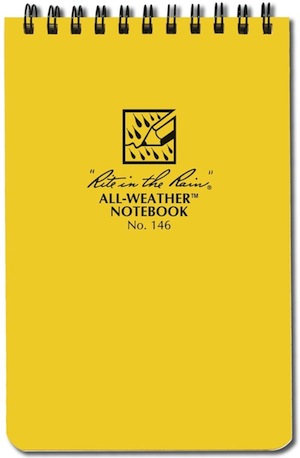
The pages are particularly heavy-duty, tear-resistant and durable — a little humidity, coffee or sleet won’t do them in. They come in two styles: weatherproof and truly waterproof, and it is advised to use waterproof pens with Rite in the Rain notebooks.
Rite in the Rain weatherproof notebooks all include durable polyethylene covers and come in a wide array of styles, including:
Shirt Pocket Notepad — 3″ x 5″, 50 sheets, top-spiral, with a 1/4″ grid pattern. Also available with a buff or green cover — but isn’t the yellow spiffier?
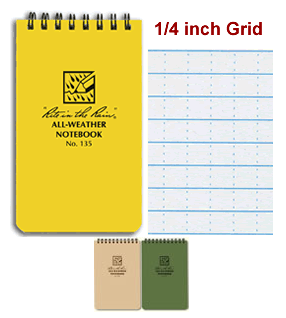
Hip Pocket Notepad — 4″ x 6″, 50 pages, top spiral, with a 1/4″ grid, and also available with the buff or green covers
Reporter’s Notebook — 4″ x 8″, 50 sheets, 1/4″ ruled
Mini Side Spiral Notebook — 3 1/4″ x 5″, 50 sheets, 1/4″ ruled
Small Side Spiral Notebook — 4 5/8″ x 4″, 32 sheets, ruled or grid pattern
Large Side Spiral Notebook — 8 /12″ x 11″, 42 sheets, ruled or grid pattern, rigid back cover for support
All-Weather Sketch Book — 8 /12″ x 11″, 42 sheets, blank, with a top spiral
Other intriguing specialty notebooks include a Beef Calving Record Book, a Fire Investigation Field Book and a Job Hazard Analysis notebook.
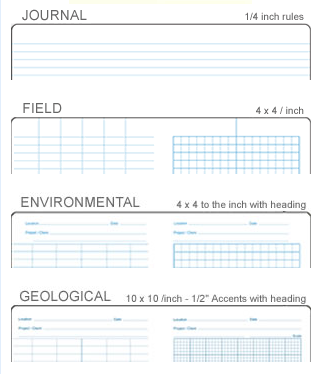
Rite in the Rain Field Books have weatherproof paper and a “fabrikoid” hardbound cover. Each 80 sheet notebook is 7 1/2″ x 4 5/8″ and comes in a wide variety of styles, including universal, field and birder journals, as well as environmental and geology field books, each with its own unique style of ruled lines and grids.
For those who are in over the heads — literally — Rite in the Rain makes DuraRite notebooks for use in extreme weather conditions and even under water. They aren’t as fashion-forward as their bright yellow cohorts, but the DuraRite Shirt Pocket, Hip Pocket and Side Spiral notebooks use an entirely waterproof synthetic paper to ensure the safety of creative and scientific endeavors.
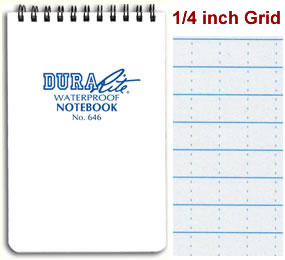
Rite in the Rain’s products retail for $4 to $20. For slightly more, customized versions are available — just choose your page patterns and preferred colors for covers, cover inks, paper and interior text.
Of course, Paper Doll would be a wet blanket if she didn’t provide a few spiffy wet-weather alternatives.

Emergency Zone, whose focus is survival and emergency kits and tools, has an All Weather Memo Pad that comes in a flashy red top-spiral assignment notebook.
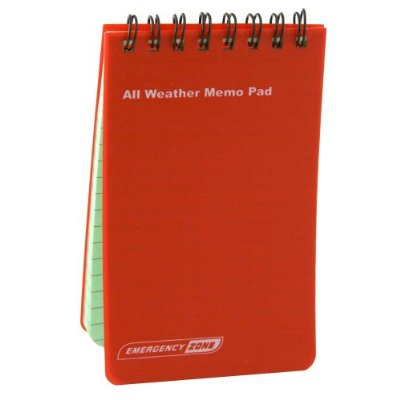
Unlike the Rite in the Rain products, for which weatherproof/waterproof pens are suggested, pencils also work fine with the Emergency Zone All-Weather Memo Pad. Retailing from $3 to $7, it is waterproof and suitable for putting in a Grab & Go bag. No information regarding the number of pages or dimensions was available from the company.

Ritchie Navigation’s Wet Notes are completely waterproof 4 1/2″ by 7 1/4″ pocket notebooks with hard yellow plastic covers over the wide white interior side-spiral binding.
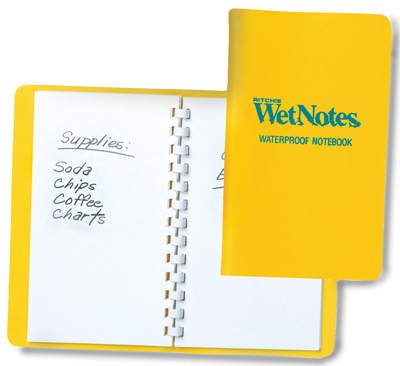
The 45-page notebook lies flat when open and comes with a soft lead pencil. The compass company’s products can be found at marine retailers nationwide. Ritchie also makes a 40-page 3″ x 5″ Wet Notes top-spiral notebook with a similar yellow plastic cover.

The Nalgene Waterproof PolyPaper Notebook is a bit of a conundrum. Scientists likely appreciate Nalgene’s 100-sheet Polyolefin waterproof notebooks for their exceptional durability, water- and chemical-resistance and smudge-proof performance under harsh field conditions.
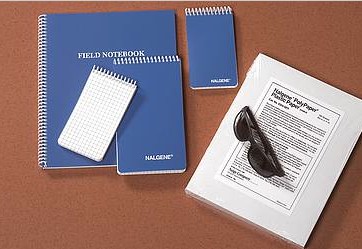
The 4 x 4 gridded paper cannot be used with pencils, but accepts a wide variety of inks, including gels, technical markers and ballpoints. Pages are numbered 1-96, with title and Table of Contents pages at the front. The paper can actually be washed and dried flat, like favorite sweaters!
However, the mystifyingly high price tag of $70.80 per notebook makes one wonder if one has swallowed too much swamp water. Certain that Lab Safety Supply had made a typo, I checked Forestry Suppliers, Inc., only to find their prices merely $2 lower, and Ben Meadow’s forestry suppliers had the same pricing as Lab Safety. Casebound hard-cover Nalgene PolyPaper notebooks are similarly priced at Amazon.
Either I’m missing something vital, or the accounting departments of various university labs are going to erect a monument to Paper Doll once this post goes viral. (Readers, you do intend to make this post go viral, don’t you?)

Wiley’s Waterproof Notebook will do the job, but the water-themed bubbly blue cover may be a little too cute and on-the-nose for some (like our Sam Spade wannabes). It retails for about $7.95 for 64 spiral-bound pages, and a pencil, rather than a waterproof pen, is recommended.
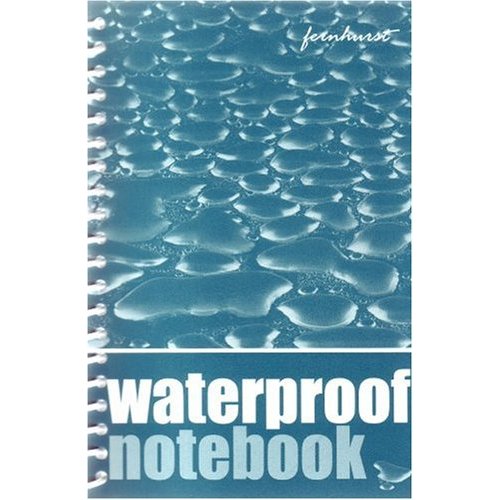
Unfortunately, the exact measurements were not available from the company or their retail outlets. However, if you teach sailing, camping, outdoor biology labs, or other classes where adverse weather is an issue, you can request an evaluation copy to see if it would be suitable for your students’ needs.
INTERNATIONAL WATERS
International readers, you haven’t been forgotten.

The indelicately-named Suck UK is both a product design company and purveyor of odd but enchanting gifts and accessories for the home. I’m particularly a fan of their organizer-friendly products like Peel & Stick postcards and magnetic tea towels.
Suck UK’s Waterproof Notebook has a simple black cover, standard book binding, 100% waterproof paper and is designed to be used with the enclosed graphite pencil.
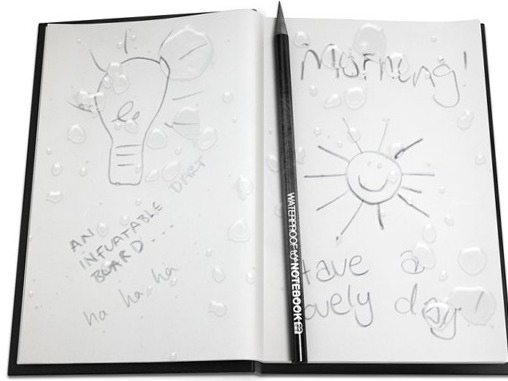
This notebook goes for 8.95 through the UK site, but Suck UK’s delightful products can also be purchased stateside at various sites, including Kris & Company and Ritz Sisters.

Australian readers can pick up Markrite All-Weather hard-cover 80-sheet notebooks, which are sewn with “rot-proof” thread and bound in durable casemade (i.e., turned edge) PVC covers. The soft-cover books are spiral-bound at the top or side, with polypropylene covers and 50 sheets of waterproof, tear-resistant, high rag content paper.
In addition to standard waterproof notebooks, Markrite also makes diving log books, bird-watching books (printed with detailed precision for tracking observation method, strata, and macro and micro habitat detail) and pocket-sized books.

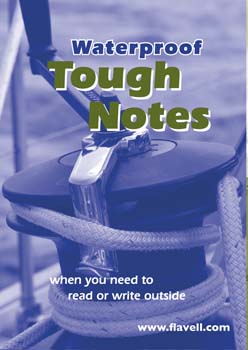
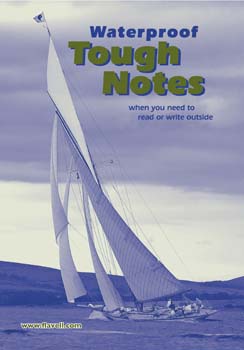
Stationer and printer Flavell Creative Images of Scotland not only purveys Waterproof Tough Notes in multiple sizes (including A4, A5, and A6), but can also print whatever your business, club, group or family needs for any of a ridiculously extensive set of A-Z damp-or-drowning writing purposes.
With all of these options, here’s hoping your attempts to keep your wet-weather documentation organized will meet with smooth sailing.
Paper Doll Adjusts the Vertical Hold: Space-Saving File Solutions
When we talk about organizing our paperwork, we usually think of employing horizontal space: desktop file boxes, traditional filing cabinets, hanging file milk crates stacked on the floor or arrayed along windowsills and counters, and so on. Even my beloved tickler file,
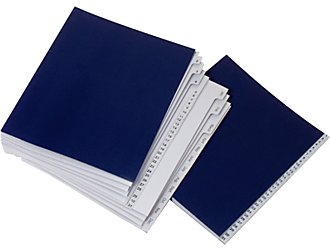
which can be stored vertically, is usually maneuvered onto a desktop or into an in-tray.
Sure, there’s always some lip-service paid to using open filing on shelves, such as how medical and dental offices shelve patient file jackets. And, of course, for reference and financial information, in particular, we discuss using three-ring binders to collate and contain paper.
Still, all of these options require horizontal space on floors, desks, and counters. We replace the cluttered stacks and piles with neat systems that nonetheless co-opt a similar amount of real estate on the same floors, desks and counters. It’s tidy. It’s systematic. And it still leaves no room for doing a waltz or tango around the room.
The bulk of our reference paperwork will probably always need to take up some floor space. Even those three-ring binders need bookshelves, and most of us will find it easier to bring in a free-standing bookshelf than to try build our own into the walls. But the good news is that there’s an overlooked alternative for maintaining action files, handy reference and the other types of papers that tend to take up space in our desktop file boxes and file risers: vertical space!
We’re all, even Paper Doll, guilty of forgetting to maximize vertical space. We display our shoes on the floor when we could use hanging shoe organizers on the backs of doors. We fill our drawers with children’s items and gadgets and our garages with piles of sports equipment when there are superior vertical solutions like Gear Pockets and Simply Stashed:
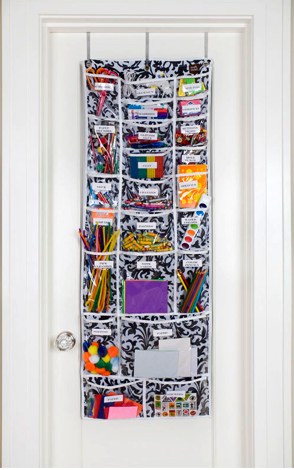
available directly from Christy Designs (at which Paper Doll readers get a 10% discount for using the code BESTRESULTS) or from OnlineOrganizing.com.
Today, in hopes of freeing up some space for impromptu tangoing, we’re going to look at some great paper-related vertical storage solutions.
PLEASING PORTABILITY

The Container Store’s Translucent Cascading Letter File Tote combines vertical storage with portability for an appealing small-scale filing solution.
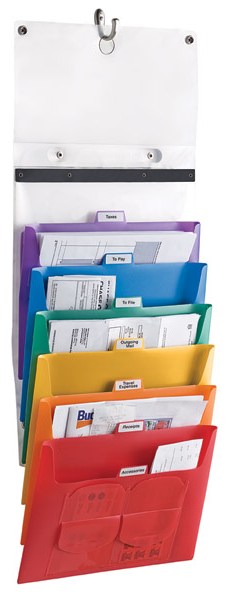
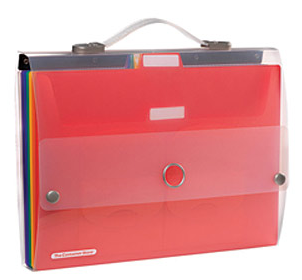
The tote measures 13 3/8″ wide x 1 1/2″ deep (when closed) x 10″ high (when closed) or 33 1/4″ high (when hanging open). The sturdy polypropylene pockets are colorful, but just translucent enough to offer a peek at the contained documents.
Each pocket bears a tab for describing the contents, similar to the labels on traditional hanging folders, while whatever interior (manila or colorful) folders selected can be labeled separately. The front pocket (when hanging) has mini-pockets for essentials like business cards, coins or stamps, and when fully closed and arranged for portability, the outer case bears a pocket for quick retrieval of parking passes or ID cards.
When open, the reinforced grommet allows for the tote to hang from any hook, and the rainbow of pockets, contents secure within, simply cascade downward. With the depth at only 1 1/2 inches, any yard-high area of clear wall space will suffice. Just decide whether you’d rather opt to hang it for standing or seated use and position your hook accordingly.
On the down side, to maintain durability and portability, there are only six pockets, and the red-orange-yellow-green-blue-violet theme might not be to everyone’s tastes. However, this small size makes it perfect for time-limited projects like tax planning or college applications, where documents must be kept together but also remain portable.
The Translucent Cascading Letter File Tote retails for about $15.
LIGHT, SOFT, DURABLE

Scholastic’s File Organizer Pocket Chart, designed for traditional classroom use, also offers practically flat file and paper storage for home-school classrooms, cubical offices, home offices, and family information centers (in pantries, mudrooms and kitchen-adjacent areas). The ten letter-sized pockets measure 14.7″ wide and are suitable for use as in-boxes, or kids could keep them next to their study areas, with one pocket for each class or extracurricular activity.
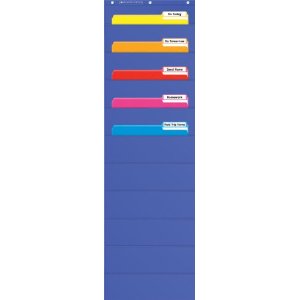
Weighing in at only about 8 ounces, the blue File Organizer Pocket Chart is made of a flexible plastic, and the reinforced grommets make it easy to “install” on hooks, pegboards, doors or walls in under ten seconds.
The File Organizer Pocket Chart can be found at Amazon, Scholastic’s Teacher Store, and various office and teaching supply stores for $10 to $15.

Educational Insights makes a similar product, the Space Place Classroom Organization Center. The washable red nylon organizer can be rolled or folded for easy storage between projects. It has three heavy-duty grommets and can be hung just as Scholastic’s File Organizer Pocket Chart, above, but has twelve 7″ deep file folder-accommodating pockets instead of ten.
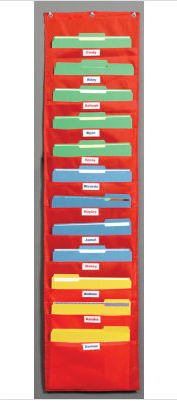
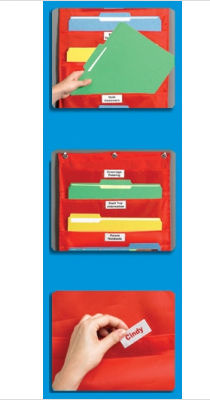
The lightweight 10.5 ounce organizing caddy measures 14″ wide and 55″ high. Each pocket has its own clear label holder to enable insertion of labels (of which 36 blank labels are included), though traditional label maker tape will adhere to the rayon pockets, as well.
Because the organizer is made of rollable, foldable nylon, it not only works for the uses previously discussed, but would also be an excellent choice for mobile professionals like regional managers, traveling nurses, pharmacy supervisors and other professionals who rotate among multiple service locations.
The Space Place Classroom Organization Center can be ordered directly from Amazon, teaching and office supply stores, and ToysandGamesOnline.com, with prices ranging from $11 to $18.

If you’re looking for a smaller version of the above items, perhaps to help a pre-schooler “organize” his or her art projects and coloring books, OnlineOrganizing.com carries the EZ Pocket Hanging Project Organizer.  The 100% cotton canvas organizer is hunter green and measures 16″ wide by 44″ high. The five pockets are wide enough to accommodate both letter and legal sized files and papers.
There are just two reinforced grommets at the top for hanging, and each pocket has adhesive-backed clear label holders. (Blank labels are included with each kit.) The EZ Pocket Hanging Project Organizer runs about $27.95.
THE BIG PICTURE

For those seeking the light-weight convenience and slim depth of the above options but a wider surface area, Smethport Organization Center Pocket Chart fits the bill.
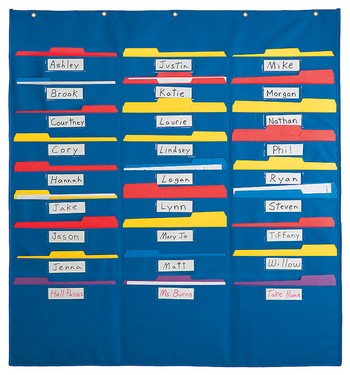
The durable, washable blue nylon pocket chart has 27 letter-sized pockets arrayed in three columns of nine pockets each. Each nylon pocket has its own smaller translucent plastic pocket for holding dry-erase cards (included with the package) or index cards up to 3″ high.
The Organization Center Pocket Chart measures 40″ high x 37 1/2″ wide, can be found at Amazon and teaching supply stores, and retails for about $25.
All of the above options are lightweight and (relatively) portable, but if you’re ready to commit to a stable filing system, there’s one more alternative to view.
A MORE PERMANENT OPTION

Professional organizers have been buzzing over RackitFile, which presents a serious vertical filing option.
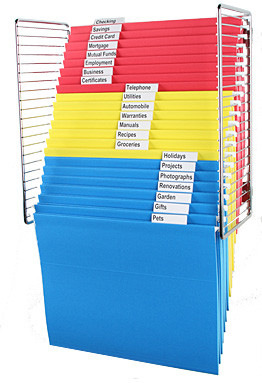
This drawer-less filing system mounts on solid vertical surfaces and juts out from the wall farther than the other solutions covered above, but has multiple benefits to outweigh its heftier profile. Rackitfile is based on the proprietary Walfile System, which uses a combination of vertical and horizontal space to double the depth of files, yielding 12 inches of filing space in six inches of actual depth.
The Rackitfile’s Walfile System begins with the mounting of a durable steel frame with 22 laddered rungs for hanging a full set of letter or legal-sized files. The Rackitfile can be mounted on most vertical surfaces via the enclosed wood/particle board screws and what the company calls “the best drywall anchors on the market”. The kit includes a mounting template installation instructions.
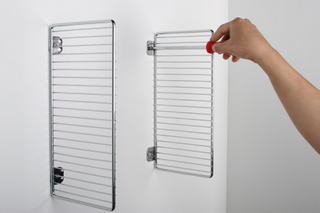
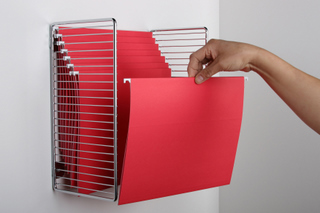
Once mounted, the Rackitfile extends 6 inches from the wall. Although the steel frame is only 12 3/4″, once all hanging files are loaded, the entire system measures 21 inches in height. Far sturdier than the other products we’ve reviewed, if mounted with the specialized drywall anchors, the weight rating for the whole unit is 90 pounds.
Rackitfile can be purchased directly from the manufacturer. One kit, including shipping, retails for $24.98 CDN (about $28.92 US), and the company offers bulk discounts for purchasing 3, 5 or 15 units.
These are just a sampling of the educational and office supply tools available for reducing your horizontal footprint and making use of your vertical space. When your real estate is at a premium, think about filing up, up and away!

Follow Me