When Your European Hotel Room Feels Like an Escape Room — Conquer Confusing Showers, A/C, and Light Switches

You may have noticed that Paper Doll has been on an extended hiatus. Some of it was because I was traveling in Portugal and Spain for several weeks. But be assured, even when I am away from Paper Doll HQ, I am always noticing organizing challenges in my surroundings and seeking solutions.
Are you thinking, didn’t Paper Doll recently share a travel-related post? And that’s true, back in August I did write How to Stay Organized When Travel Goes Off the Rails (or Runway) with advice for dealing with travel kerfuffles, explaining how to organize your travel information, deal with technology failures while traveling, and assert your travel rights. It was a great companion to posts like:
- Paper Doll Organizes Your Space, Money, and Well-Being While Traveling
- Paper Doll’s 5 Essential Lists For Planning an International Vacation
- Paper Doll on the Smead Podcast: Essential Lists For Organized Travel
Drawing on my Portugal and Spain trip, this post narrows the focus to organizing yourself to deal with the smaller, mosquito-bite-level annoyances of hotel travel.
WE CAN’T CONTROL EVERYTHING
Sometimes, there are issues we can’t control. For example, when we arrived in Santiago de Campostela, I seemed to be cursed. We stayed at the oldest hotel in Spain, the Parador de Santiago de Compostela, a 500+ year-old building that was originally a hospital for the those on the Camino de Campostela, a pilgrimage across northern Spain to the Cathedral of St. James.
Though the building itself dated from the time of Ferdinand and Isabella, we’d been assured that it was up-to-date, and in fact, the bathrooms had been remodeled as recently as last year. This remodel did not prevent me (and my college friend and girls’ trip traveling buddy, whom we’ll call Dr. V) from having a Lucy-and-Ethel experience.
Upon our arrival, I went to wash my hands. I barely touched the knob with my ring finger to turn on the water and the entire knob housing fell off into my hand!
Our suitcases were then brought up to the room, so a hotel staffer was nearby; I flagged him down for help, and he sent the engineer, who looked at metal and plastic doodad in my hand, made a face that I inferred meant I was a troublemaker, and communicated to Dr. V in Spanish that he was off to find an essential tool. Within minutes, some spring or other was replaced, and we were back in business.
But wait, there’s more!
Before dinner, my ankles were a little swollen, and because we had both a separate shower (with side-by-side overhead shower heads, which seemed to assume that two people would be showering simultaneously, but in parallel!) and (way across the bathroom) one of those freestanding bathtubs that looked a bit like a gravy boat.
Every since having watched the “Never Bathe on a Saturday” episode of The Dick Van Dyke Show as a child, I’ve always been very cautious in my interactions with hotel bathtubs. So I can assure you, what came next was also not my fault.
(It’s worth watching the entire episode for great belly laughs, but starting from here shows you how Laura Petrie went wrong.)
I turned on the water in the tub, very gently, to ensure that if water was sent to the handheld shower wand, it would not start snaking around and get me soaked.
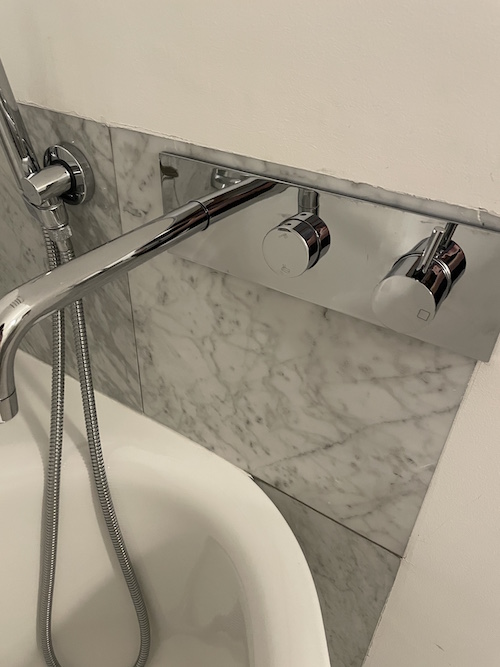 The joke was on me, however, because although the water did come out of the faucet, a river of water also came out from the (right) knob!
Was I on Candid Camera! (Does that reference dates me?)
While the water from the faucet poured into the tub, the water pouring from the knob gushed over the edge onto the floor, flooding the bathroom. By the time Dr V responded to my shouts, I was in chaos.
I handed her the trash can to collect the water and ran to the room phone to call the front desk. But dialing zero did nothing and I couldn’t get the QR code on the front of the phone to pull up the hotel’s information. I ran back to the bathroom and found that Dr. V was trying (and failing) to wedge the trash can between the wall and the bathtub, so it wasn’t collecting any of the gushing water.
I lifted the can up so that water was pouring directly into the can, and balanced it on the edge of the tub; meanwhile, Dr. V figured out how to call the front desk and spoke in fluent Spanish to explain our predicament. As we waited, I posted in our tour group’s What’sApp group; a more experienced traveler suggested we look for a switch or button near the ceiling for turning off the water.

(Not our shut-off valves, but this is what you should seek in a similar situation.)
Just as I spotted two silver fixtures near the ceiling (and well beyond my reach), the same engineer who’d fixed the sink arrived, looking at us as though we were stupid to not know how to turn off a bathtub faucet. He stormed into the bathroom, attempted to turn the knob from which the water was gushing, and (according to Dr. V) began swearing quietly in Spanish.
The engineer had to turn off the water to the entire bathroom (using the magic shut-off valve fixtures), so we couldn’t use the sinks or the facilities; we just went down early to dinner and used the restrooms there. Happily, by the time we had finished dining several hours later, the front desk was able to tell us that the problem had been fixed, and we returned to a dry bathroom with all the towels replaced. (I did not venture another attempt at the tub.)
TOTO, I DON’T THINK WE’RE IN KANSAS ANYMORE
Traveling exposes us to a wide variety of new foods and cultures, and that’s almost always a good thing. But sometimes, you may find that your travels bring you in contact with mystifying differences.
Three main confounding aspects were showers, air conditioners, and electric lights.
These Are Not the Bathrooms You’re Looking For
If you have never traveled abroad, you might not be aware that European bathrooms are often quite different from ours. For example, most bathrooms include bidets.
In many places, such as Italy and the UK, you’ll generally find that there are no electrical plugs in the bathrooms so as to ensure that visitors do not drop their hair dryers in the sink and electrocute themselves.
But there are other bathroom-y things that confuse North Americans, enough that PBS travel guide extraordinaire Rick Steves’ site has a guide, Europe’s Hotel Bathrooms: What to Expect, covering situations far more complicated than I have faced.
In one least-fancy (though still charming) hotel bathroom in Italy in 2018, the shower was so small that Dr. V could not fully stand up in it (and she’s only 5’8″) and when I raised my arms to wash my hair, at least one elbow hit a wall or escaped the confines of the shower curtain. And in many European bathrooms, non-tub showers have only half doors, so unless you stand immediately under the shower head (or handheld shower) and make very few movements, you will soak your bathroom floor. (Allegedly that this makes things easier to clean, but it’s a source of much moaning by Americans abroad.)
In yet another 500ish-year-old building in Porto, Portugal (this time a former monastery adjacent to a former palace), we had an otherwise modern room until you pulled back the curtains to find stone walls.

However, I’m sure the 16th-century monks did not have to deal with the window built into the wall shared between the bathtub and the bedroom, complete with Venetian blinds on the bedroom side, allowing someone in the bedroom to view a person using the bathroom, and vice versa. (This is apparently a global design trend?)

Organize Yourself for Hotel Showers Abroad
The aforementioned design styles require more acceptance than organizational skill (and I doubt there’s a way around organizing the water not to flood beyond a shower’s half-door). However, figuring out how the showers actually work can require diligent effort.
At home, I pull the handle toward me to turn the water on, turn it left or right to adjust the temperature, and pull up on a doodad on the tub faucet to route the water from shower to tub. In other countries, and particularly as you go from hotel to hotel, the possibilities for “grabbing a quick shower” can seem endless. I advise the following:
- When you arrive at the hotel, test the shower. Unlike in US hotels, due to the “half wall,” you will probably not be able to lean/reach in and turn on the water without getting yourself wet, so don’t do this right before you head to a fancy soirée.
- Figure out which knobs do what. This may or may not be difficult. For example, instead of pulling a knob fully toward you, you may find there’s a metal “lollipop” stick extended from the knob, allowing you to tilt the knob toward you to turn on the water. While extended at that angle from the wall, you may be able to turn it right or left to change the temperature. (Or, sigh, you may not.)
- There may also be flat buttons on the knobs.

- You may need to wear your glasses when examining the shower to look for tiny, sometimes microscopic, writing and/or symbols. (Consider using the magnifying feature on your phone.)
- Look for red marking or C for hot or a blue marking or F for cold. However, know that the C may be Italian or Spanish for caldo/caliente but could also mean calor/central for controls. Or, there may be no markings, or ones that are meaningless to you.
- If experimentation fails you, look for the name of the manufacturer and Google “[the name of the manufacturer] + shower + manual.”
- If you are in the UK and unable to achieve hot water, check for a switch outside the bathroom door. Really.
Few of our bathrooms in Portugal and Spain (or on our trips to Italy and the UK) had tub showers. Instead, one knob determined whether the water came out of an overhead “rainforest” shower head or from a slender handheld shower wand that looked more like a microphone.
In less fancy hotels, the handheld wand is your only option. It sits in a holder along a narrow vertical pipe, with a knob to loosen or tighten, allowing you to raise or lower the wand without having to hold it. The advantage is that you can use both hands to lather up; the disadvantage is that at least half the time, the hold will loosen and the wand will slide lower and lower.
On the rare instances that we had a tub, switching between tub or shower (or allowing both) also involved turning a dial affixed to the inside side-wall of the tub. Seriously, you don’t want to face these options first thing in the morning, without coffee or daylight.
One morning, I could not get the water to turn on at all. Eventually, I had to call on Dr. V to help, and we stood — and this is not hyperbole — for five minutes, working as scientists and discussing the variables, turning the top knob to the left and then the right, turning it to the left while pulling on it, turning the top knob and the bottom one simultaneously. Finally, blasted with scalding water but momentarily excited to have any at all, I eventually cried, “But I don’t know what I did!”
When I finished, I noted that the top knob’s lollipop stick was flat with the wall and pointed to the 3 o’clock position; the bottom was also flush with the wall (once turned off) and pointed to the 7 o’clock position, and gently pulling it toward me would turn the water on without changing the temperature.
I conveyed this to Dr. V, but the next morning, I was awakened by her shouting that she could not get the water on, and I sleepily croaked, “Top flat 3 o’clock, bottom toward you and 7 o’clock.” I encourage you to figure out the showers as early as possible in a hotel stay and then write the instructions with a Sharpie on a sticky note and post it near the shower.
I acknowledge that if you live in Europe, I may sound like the proverbial ugly American, but each morning in a new hotel, our group would meet for breakfast and discuss whether we had figured out the various amenities, with the shower (almost) always being the most difficult.
Take Sides — Advice for Peace in Hotel Bathrooms
When traveling with others, assigning sides, particularly of bathrooms but also sides of the closet, the in-room safe, the mini-fridge, and the top surface of the hotel room desk will prevent confusion and loss of items.
In nicer hotels, we found that bathrooms have two sinks, making it easier to organize our toiletries without getting in one another’s way. Where bathrooms are smaller and there’s only one sink and limited counter space (even with some storage below the sink), dividing the bathroom into “yours” and “mine” may seem like something out of a sitcom, but you’ll thank me later.
If you’re traveling to multiple locations, your side of everything is always on the left or right; if your traveling companion tends not to pay attention to boundaries, separating your own towels (even moving them to the closet until you intend to use them) can help keep the peace. Let’s just say you don’t want to end up like Steve Martin in Planes, Trains, and Automobiles.
Keep Your Cool with Hotel Air Conditioning
Air conditioning is not quite as big of a thing in Europe as here, but the hotels in which we stayed promised the availability of A/C through early October. In many hotels, it was as simple as conquering the language barrier (or the pictogram barrier) and figuring out what functions did what.
When you arrive in your hotel room, try to adjust the temperature to what you’d most like it to be when you are sleeping. Almost anyone can muddle through a too-warm or too-cold room for the few minutes you’re in the room during the day, but a trip can be ruined by sleepless nights.
- Make sure you know whether you are turning on the heat (often indicated by a flame or a red thermometer) or the A/C (indicated by a snowflake).
- Adjust the language and change settings to Fahrenheit unless you want to calculate the difference yourself. Officially, the formula is F=(C×9/5)+32, but you’ll get close enough if you double the Celsius temperature and add 32.
- Use the arrows to raise or lower the temperature, usually by half degrees.
- Look for an icon of a running man. In six of the seven hotels at which we stayed during our trip, there was an icon of a running man in the upper right corner of the thermostat display. While traveling, nobody could tell us what it meant. We hadn’t bothered to Google it, but during a post-trip dinner with organizing colleague Ramona Creel, she felt compelled to research it, and found: “The running man icon on a hotel thermostat, often mistakenly thought of as a “running man,” is the “man walking” or “walking man” icon, which indicates that the thermostat is in manual mode. This mode means the temperature is set manually and will not change based on a schedule, unlike other programmed settings.”
- Recognize that in some hotels, the air conditioning units do not turn on if the sensors indicate that the hotel room windows are ajar. (Yes, European hotel room windows open!)
- Know that if you have not turned on the electric power to the room (see the next section), the A/C won’t turn on.
- Sometimes, you will be given a helpful sign. However, you may find that the sign and the thermostat do not match. Note below that three of the five icons in the bottom center of the sign, below, do not appear on the actual thermostat. This, we later learned, was because our hotel in Bielsa, Spain, in the chilly Pyrenees Mountains, did not actually have the A/C turned on. (Possibly in September. Possibly ever.)

If you have difficulties, address the problem with the front desk. In Bilbao, Spain, we failed to check our A/C until the evening, when we found that we could not adjust the temperature more than 3 degrees.
About 11 p.m., I had a complicated conversation with a woman at the front desk in my halting Spanish, followed by a more extensive one with her colleague, in English. He insisted that the default temperature could be lowered by nine degrees; I insisted that it could not. Eventually, he accompanied me to the room, where he pressed the down arrow and pointed victoriously to the screen with whatever the Spanish version of “Ta-Da!” might be, only to realize that it had only lowered three degrees.
Deflated, he said there were no engineers on duty overnight, and we would have to wait until the next day to have the A/C repaired. (And then they forgot to communicate this to the staff. Another piece of organizational travel advice? Double-check everything the night shift promises before you depart for a morning’s travels.)
The next evening, the lovely and charming Eduardo, who spoke no English but seemed to enjoy my Spotify selections while he worked, employed a ladder and drill, took apart the ceiling of our hotel room, and after the better part of an hour with his torso and head invisible to us, replaced a mysterious cylindrical doodad.

As women of a certain age know, sleeping temperature matters.
Traveling is NOT as Easy As Flipping a Light Switch
Having traveled abroad before, Dr. V and I have learned some tricks. For example, we knew that in many hotels, there is no power in your room upon your arrival. You must insert your room key, vertically, to turn on a sensor and allow electricity to flow to the room.

When you check in, make sure that you and your traveling companion each have your own key. Otherwise, if the first person to leave the room departs while you are in the shower and takes her key out of the slot, you will be plunged into darkness. Often, the power does not cut off until ten seconds after the removal, decreasing the likelihood of the departing person recognizing the cause-and-effect.
You, plunged into darkness in a slippery shower will, however, recognize the cause-and-effect.
Also, you may find that in some hotels, in lieu of using your actual hotel room key card, a grocery store loyalty card may work just as well. In four of the five hotels in which we stayed that used key cards and not old-fashioned keys, the cards from prior hotels served our needs.
As with showers and air conditioners, the light switches (which are more rocker panels than switches) in some hotels can be mystifying. Our fabulous tour director for the trip warned us as we arrived at one hotel that although he’s stayed there multiple times, he had, on more than one occasion, had to call the front desk and have someone come up and turn the lights off so that he could go to bed. He was not joking.
In one hotel, Dr. V and I had to sleep with the bathroom light on; elsewhere, one of us had to cope with bright overhead light in the room being on while the other took her (pre-dawn) morning shower because we could only get ALL the lights on. And once, we had to have someone from housekeeping re-program the lights in our room because none of the bathroom lights would come on.
When you arrive in your room, note the following:
- Many hotel rooms have a master switch (whether or not there’s a key card sensor) that turns on the power to all of the other switches (and the A/C). Turn it on, and then you should be able to turn on (and off) the other lights at will. However, anticipate that the cleaning staff will turn this off, and you’ll be starting from scratch when you return to the room each evening.
- There are often duplicate light switches for overhead lights — one by the entry and one in the bedroom area.
- There are sometimes semi-master light switches near the bed that will operate overhead lights, along with the lights that work the bedside lamps. Sometimes, only your companions switch will work the overhead lights…or your bedside light.
- If you have a lamp that you can’t turn off from any switch (even the switch that turned it on), look for an outlet. You may just be able to unplug it.
- Once you figure out what the lights are for, seriously consider labeling a sticky note with what the light does. It may save you from stubbed toes, sleepless nights, and the embarrassment of having to ask Housekeeping for the equivalent of night-night service.
ONE LAST BIT OF TRAVEL ADVICE
Aside from the aforementioned bidet, using your hotel bathroom’s facilities probably won’t be difficult. But public restrooms are a different story altogether.

In Italy and Spain, depending on the quality of the bathroom (bus station vs. fancy restaurant), you may find yourself in a stall without a toilet seat. (Ladies, practice your hovering skills.)
More often, you may find yourself without toilet paper. Once, a bus station bathroom was the only public facility open on a Sunday afternoon. No toilet paper. While awaiting (dreading?) my turn, I shouted to the “the husbands” as we collectively referenced the men on the trip. One hubby pulled a long strip of TP off and handed it to us to parcel out. A moment later, a different husband had jiggled the machinery and pried loose a giant roll of toilet paper, the diameter of a large pizza, complete with the inner metal and plastic fittings, and handed it off to the women.
Paper Doll‘s advice:
- Never pass up an opportunity to use the bathroom.
- Don’t go to the bathroom by yourself. You never know when you’ll need assistance, especially if you’re traveling where you don’t speak the local language.
- Always carry tissues, toilet paper, napkins, or something that approximates their function in your purse, pack, or jacket.
Thank me later.



Parts of this made me laugh, but just as many made me glad that I’m not an international traveler!
Travel is lovely, but you have to go into it with a certain attitude of acceptance. Things will be different, things will go awry. The language barrier actually can make things more fun — if you embrace it. But I’m a creature comforts girl. I have to have a hot, powerful shower; I have to be cold enough (and have it dark enough) to sleep. Sneaking around your own hotel room with your iPhone flashlight because you can’t figure out how to turn on any of the lights is…not optimal. But I do believe that anything survived can become a fun anecdote. 😉
Thank you for reading!
I’m laughing right along as I read this, Julie. I’ve encountered many of these problems. No offense intended, but sometimes Europe just seems from another era to me. Like, we’ve figured out how to make shower doors that keep all the water in the shower now, so….
We had that situation with the card needing to be place on a cruise once. I would have had no idea, but my husband has traveled the globe for work and he comes in very handy for explaining stuff like this.
In terms of the AC, so many places don’t even have it. My niece is living in Germany and she says it was like 80 inside their apartment many times this summer. Another situation that seems “solvable” with a trip to Home Depot.
I guess I lack the wanderlust and am mostly happy to be at home and look at everyone else’s photos from their travels abroad. Not the same as being there, I know. Maybe I’m just getting old!
I get it, Seana. Before my trip to Italy in 2018, I was dubious and worried I was too set in my ways, but the experiences (not counting shower kerfuffles) took me so outside my own head that it yielded so much joy.
All travel requires organization, but travel to somewhere that’s different (and not always “behind” us, but sometimes so far in advance of us, technologically, that it makes no sense) definitely requires a new game plan. Needing an app to enter my room or use the TV in *Massachusetts* in July really brought that home to me.
Thanks for reading!
I had a lot of laughs with this one. I have experienced some of this but never the falling apart bathroom – just one where the shower curtain rod came away from the wall. Tipping in common bathrooms was always a hassle as well as which way do you stand over an open pit. Tipping was necessary to obtain TP at times as well as a towel to dry your hands. My sister taught me to just run my hands through my hair.
I love to travel – fun times!
I’m laughing about the tipping, because the one thing we have NOT encountered over these international trips is a bathroom attendant (not counting the ever-present attendants at the Atlanta airport), but because whenever I can’t get my hands completely dry, I have also dried my hands in my hair as part of the “fluffing” move. It’s a two-for-one!
Ahhh. The wonderful stories the travel adventures inspire! So many situations you encountered. I appreciate the challenges that turning on lights, adjusting room temperatures, and navigating plumbing peculiarities can bring.
Like you, I’ve had some interesting “moments,” like getting stuck in a bathroom stall in Italy because I couldn’t figure out how to unlock to door. Or, being completely mystified in Japan, trying to figure out the self-washing toilet. None of the symbols made any kind of sense to me. And even in the States, when renting Airbnbs, I’ve had difficulty figuring out the light switches and regulating the thermostats. Steve is much better at the technical things than I am. It’s not intuitive for me. Yet, you’d think basic types of functioning should be intuitive. Clearly, they’re not.
Anyway, despite these types of issues you encountered, I’m sure you had an amazing time. And the mishaps make for good stories and posts. Welcome back, Julie! You were missed.
I cannot tell you how many times Dr. V or I crashed into something in the dark, or blinded the other by turning on the lights, or soaked something in the bathroom, or just felt so idiotic because we couldn’t figure something out. (Someday, I’ll have to tell the “Le beep beep” story of the time Paper Mommy and I went to France and made fools of ourselves ALL THE TIME because we didn’t know how to do so many things, from taking a train to using the electronic lock on the room safe.
I have heard stories of Japanese bathrooms since I was a kid; I’m not sure I could figure them out. Generally, I’m good with technical things, but much better when they’re explained with words and not pictograms. Getting stuck in a bathroom stall would freak me out; I still believe stall doors should open outward, not inward, as the space within is already so cramped.
Thanks for reading and welcoming me back. I hope my stories made you laugh.
I traveled throughout Europe with my Italian immigrant parents during my childhood; however, it wasn’t until I was an adult and other adults were mentioning their issues with hotels in Europe that I realized the differences were odd to Americans. Thanks for sharing your experience. I hope you had a fantastic trip.
Heh, we know what know, and we don’t know it’s unusual until we learn that. (I grew up eating artichokes with drawn butter; it never occurred to me that it was weird or fancy. I just like hot, buttery things!) How exciting that you got to travel in Europe with your grandparents; have you been back to Europe as an adult and noticed that things are different now?
Thanks for reading!
Wow, Julie! You certainly had lots of bathroom adventures on this trip. I learned early on to always have tissues with me. Bathrooms in Thailand in the mid-1970’s were not always well equipped.
These were very nice, fancy bathrooms, but yes, I did have some comical kerfuffles. I can’t even imagine Thai bathrooms circa the 1970s, but I think I’ll avoid those when I’m time traveling! 😉
Thanks for reading!
Your descriptions of your experiences are priceless! The added images and videos complete the image I have of the events.
I can’t resist adding a story after bidets and Japanese bathrooms were mentioned. 🙂
On a trip through Japan, while staying in the most elegant hotel of the trip, our 14 year old son found a remote control in the bathroom. Being a guru of all things technical he immediately started playing with it. He later said he thought it might control some audio system. Soon a 12 foot stream of water was arcing across the bathroom from the bidet. His panicked button pushing changed the volume and temperature but did not stop the stream. After what seemed to be an eternity it finally was stopped. Many towels and laughs later the bathroom was habitable again.
I always enjoy your forthright descriptions on your adventures. Well done!
Ha, I think both my adventures and your son’s feel like they’ve been taken straight from a 1970s or 1980s sitcom, like Laverne & Shirley or Bosom Buddies! I’m not surprised to hear that hotel (bathroom) kerfuffles are universal. That was a great (and vivid) story!
Thank you for reading and sharing!