Archive for ‘Philosophical’ Category
Paper Doll’s NAPO 2016 Conference Recap: The Wisdom Edition
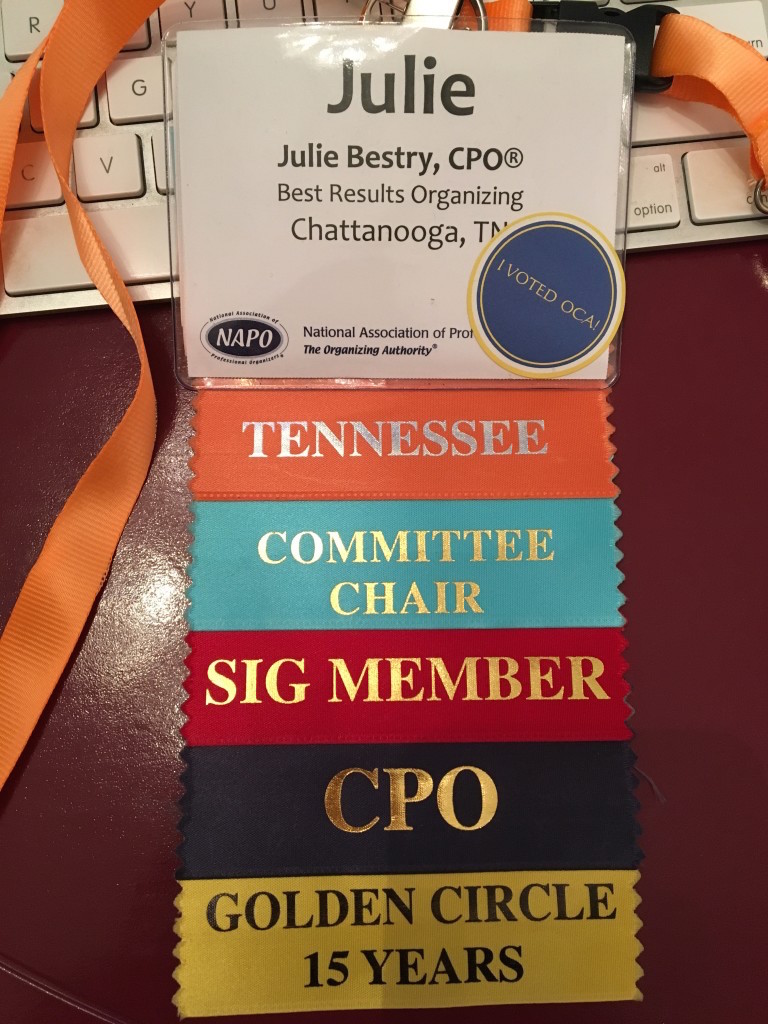
NAPO TIME!
As is the annual tradition at Paper Doll HQ, this is the time of year where we step away from paper-related topics to look at the bigger picture of what’s going on in the organizing world. The Annual Conference and Expo of the National Association of Professional Organizers was held just down the road from me this year, in Atlanta, GA.
 The atmosphere as everyone starts arriving at a NAPO conference is like the first day of summer camp — or a college reunion. We’ve all seen each other on social media, but it’s a delight to view my colleagues when they’re bigger than their one-centimeter high avatars.
The first full day is all about preliminary, but important, activities. On Wednesday morning, I attended the Angela F. Wallace Leadership Forum, where we learned techniques and strategies for encouraging and motivating volunteers. In the afternoon, I participated in lively discussions at our meeting of the Board of Certification for Professional Organizers, for which I serve as the Director of Program Development (also known as the Sacred Keeper of All Rules Persnickety) and as the local grammar and spelling cop.
SETTING THE TONE
Our opening keynote speaker, Scott Greenberg, presented The Third Factor: The Mindset for High-Performance Leadership.
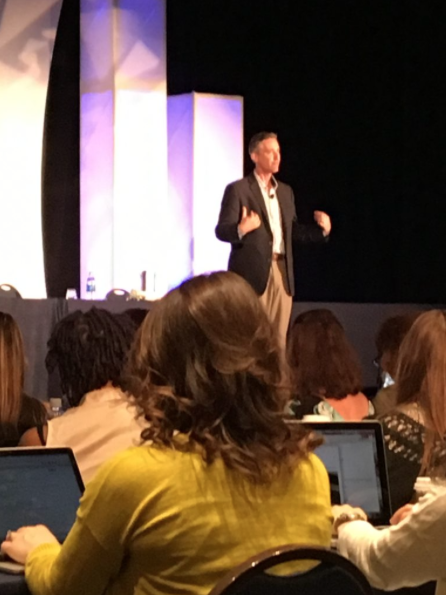
Scott spoke about the three factors that influence success:
- External factors that we can’t personally control, like the economy, what our competition does, the weather, our own DNA,
- Operational factors, over which we have a bit of control, like if we work long enough and hard enough,
- Mindset, or how we think about things, and whether we have a fixed mindset (and believe that we have little-to-no control over our own qualities) vs. a growth mindset, one in which we can improve and grow.
Scott talked about the importance of making interpersonal connections and having gratitude, but my biggest takeaway from his motivational presentation was that it’s not just about the tangible (or even temporal) clutter, but about the “head trash” piled up by our mental hecklers. Scott encouraged us to externalize what these internal hecklers were saying to us so that we could fully appreciate the flaws inherent when we are deprecating ourselves. If you followed any of the tweets from our #NAPO2016 hashtag, you would have seen how much we all embraced Scott’s parting wisdom:
EDUCATIONAL SESSIONS
After the welcome and keynote, we moved on to the meat of our conference sustenance: our concurrent educational sessions, where, over the course of three days, we have the choice of attending one of five classes in each of six concurrent sessions. Somehow, just going to six out of thirty amazing presentations does not seem like enough!
While I work with residential as well as business clients, this year, my focus was on technology and productivity. Courses I took included:
The Art of Tactical Time Management — If you don’t follow the blog and podcast of Mike Vardy, the Productivityist, you’re truly missing out. Perhaps Mike’s presentation resonated with me so much is because it dovetails with what I teach my own clients. For example:
You’ve heard me say this before — if we try to keep things in our heads, or if we leave tangible items out (on our desks, and around our computers, and blocking our doors) to trigger us to think of something, that’s all we do. We think of them, but the energy we waste on remembering something and thinking of it, instead of about it, contextually, is wasted energy. Capture it — write it down on paper or save the thought digitally — and then you can move forward toward your goals.
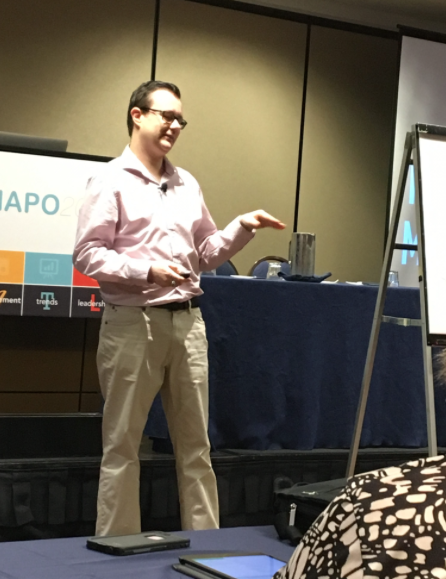
Mike also talked about “time theming” similar to the task-and-time blocking I discussed in my book, 57 Secrets to Organizing Your Small Business (the revised and newly named edition of which will be out later this year). Mike’s time theming (for the year, the month, and the days of the week) is central to his NOW Year Method, about which we learned extensively in the session. I won’t give out those details and spoil Mike’s brilliance — you definitely want to check him out, but I’ll leave you with another of his bon mots.
Other sessions I attended included:
The Paradox of Technology in Business (and Life), in which Nadine Seidman, MSW, MPA, and Nancy Kruschke, CPO®, looked beyond the benefits of technology (communication and collaboration, mobility, and productivity) to the darker costs of technology, including financial (initial and ongoing), physical/health (sleep interruption, neck and back pain), societal (reduced privacy and diminution of etiquette), and psychological (depression, anxiety, and overwhelm). Nadine and Nancy shared great tips for professionals to create “response time policies” for setting expectations for how often, when, and by whom business replies will be made, and encouraged us to unplug ourselves, personally, to recharge. (Just be sure you wait until after you finish reading this post.)
Achieving Balance and Creating Peace with Organizing, where my colleagues Amy Trager, CPO®, and Suzy Margolis Hart used philosophies from the practice of yoga to discuss how we might work better with our organizing and productivity clients. As I once explained on a Smead EZ Grip product testimonial video, Paper Doll has weak, wimpy wrists and appreciates, rather than practices, yoga. However, the messages of this session, from the philosophical — “There is no perfect” — to the practical — how to be non-judgmental, reduce unpleasantness, improve flow, and maintain boundaries — are things we can all use in our work and daily lives.
Down With Digital Clutter, taught by my colleague Pam Holland, seemed to bookend the class on the paradox of technology, and offered up a cornucopia of advice and tools on how to eliminate the clutter that technology builds up. I liked that Pam went against the modern grain (as I do), championing the idea of organizing and building infrastructure for your digital files instead of relying on search technology. My favorite tip, however, and one I intend to keep reminding myself, was that it’s important to remember to empty ALL of the trash. Just as my residential clients are good at remembering to take out their big (usually kitchen) trash on garbage day, while neglecting the tiny bedroom, office, and bathroom trash cans, we all tend to forget that our computers and digital devices have multiple trash cans — not just our desktops, but our emails, our photo collections, and our individual apps, and if they go unemptied, we waste our resources.
Of course, not all of the educational sessions I took were for helping my clients be more productive. The title of my friend and colleague Deb Lee’s Content Marketing: Blogging Tips for Your Small Business practically damns with faint praise what was a 90-minute master class in creating, researching, writing, promoting, and excelling at blogging.
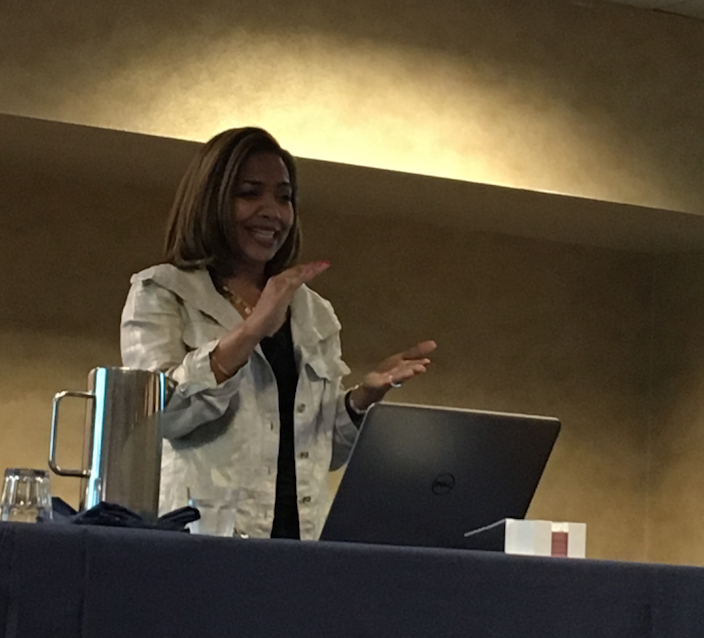
If you are a small business person (or a big business person), there’s nobody better from whom you can learn how to promote your business — so be sure to check out her newly updated D. Allison Lee website to see how her productivity and technology coaching can rock your world. (Nope, this isn’t a paid promotion. Deb is just THAT good that everyone should know about her.)
For those who were interested in other topics, NAPO had them covered with a variety of tracks for classes I’ve not yet mentioned, including:
Business Growth, Marketing, Leadership: Imperfection Rules! Creative Ways to Run Your Business; Coaching Works: Coaching Meets the Organizing World; How to Be an Independent Contractor; Veteran Forum Interactive; How To Keep Your Business from Becoming theIRS! [sic]; What’s Next? Planning an Effective Business Exit Strategy; Strategic Planning to Grow Your Business; Leveraging a Competitive Market: Building Your Personal Brand
Organizing and Productivity: Closets, Pantries, Cabinets, Offices: Beyond the Basics; Photo Organizing Anxiety and How To Overcome It; Transparent Power: Improve Client Outcomes through Direct Communication; Holistic Time Management; Information Afterlife and the Digital Estate Plan
Specific Needs Clients: Still Someone: Organizing Older Adults with Memory Loss; ADHD in the Family: How to Really Help; Play! The Secret Ingredient to ADHD Motivation
Research: Industry Statistics and Trends; Booming Your Baby Boomer Business: Research-based Understanding of this Pivotal Age Group
Special Interest Groups: Moving Made Easy; How Organizers Engage Students; Seven Truths to Becoming a Published Author
Trends, Technology, and Social Media: Power of Email Marketing for Today’s Savvy Organizer; Digital Eyes: Storytelling through Video Marketing; Profit and Value with Online Training
Even if you’re not a professional organizer, I bet you’re envious now!
FOOD, GLORIOUS FOOD (AND KARAOKE)
We professional organizers and productivity specialists take plenty of time to refresh our brains with rest and relaxation — just as we advise our clients. For years, our NAPO meals were almost all taken together, seated at round tables in large ballrooms where the noise and overcrowding made convivial conversation difficult. (It also explains why I had laryngitis by the last day of our conference ever year.)
And let’s be real. Conference food is generally both uninspired and uninspiring. For vegetarians and others with special food requirements, conference dining has also often been a disappointment. (A plate of steamed bok choi does not a meal make!) However, this year, the Atlanta Sheraton did an amazing catering job, and our meals were far superior to anything I’d been served in my last decade and a half of attendance. Still, the hotel could not handle our volume in the traditional way, so we had more buffets and even got to lunch al fresco by the pool.
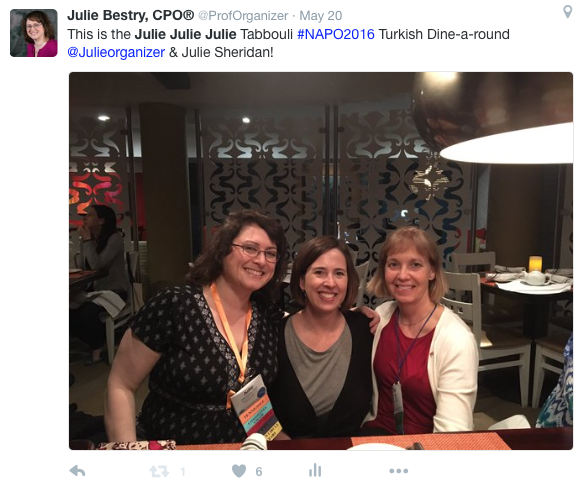
My favorite addition to our meal experience was this year’s Dine-Around experiment, where attendees could sign up to eat in small groups at any of a number of local restaurants within walking distance from the hotel. I was amused to find that although I’d arrived two days before the official start of conference and was only the sixth person to sign up for a Turkish meal at Atlanta’s Truva, I was the third Julie. Hence, this photo caption:
And be assured, lest you imagine that our professional organizing community’s lightheartedness extends only to culinary sustenance, let me disabuse you of that thought. Our NAPO President, Ellen Faye, opened the President’s Reception to all attendees this year for a “Black & White” party that included dancing and karaoke.
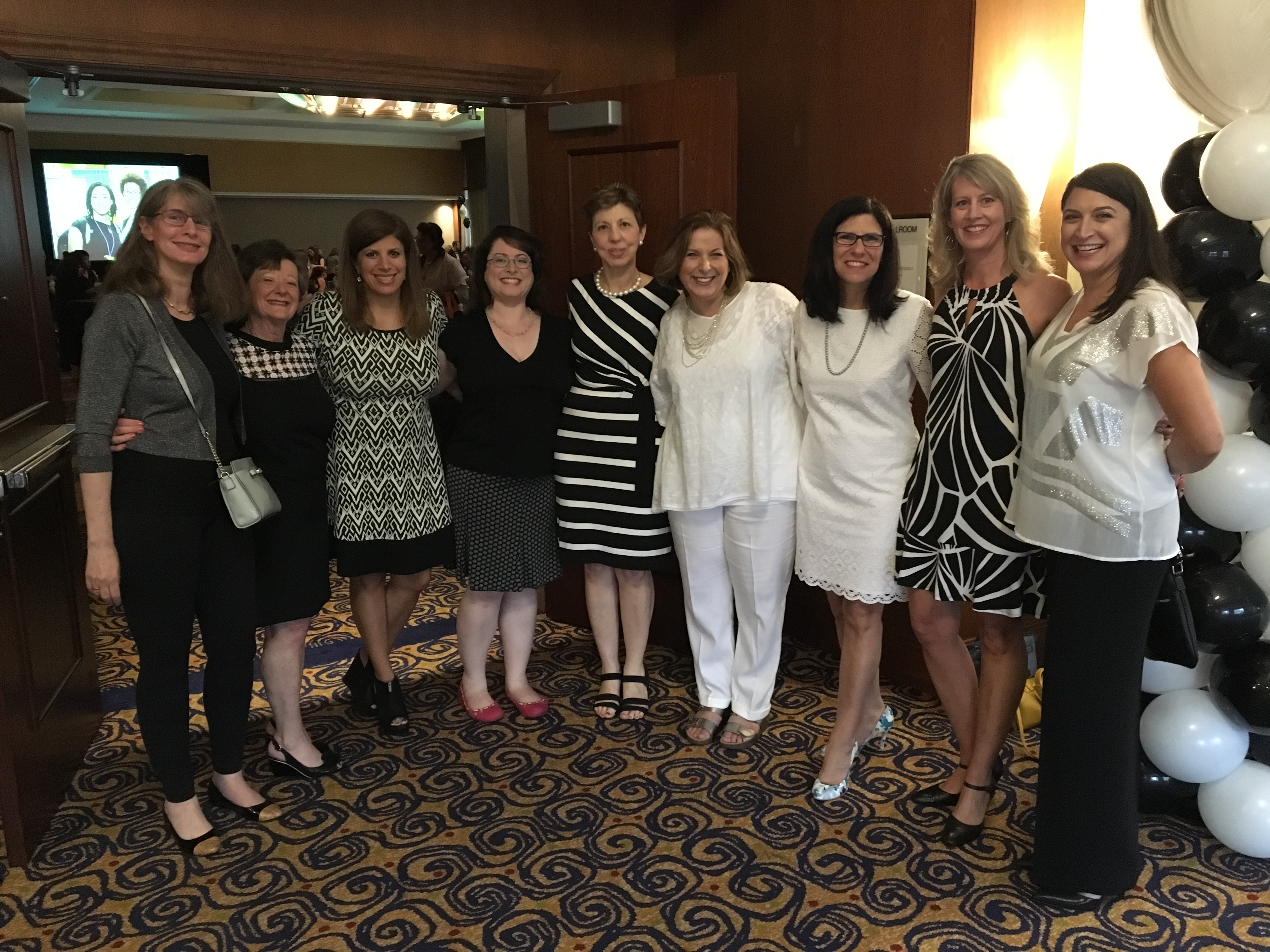
So, while we value our education, professionalism, and camaraderie, don’t ever believe the stereotype that professional organizers are stuffy.
In the upcoming NAPO re-cap posts, we’ll be looking at the products and vendors who can help make your life more organized, including the 2016 winners of the NAPO Organizers’ Choice Awards.
Paper Doll Talks With Smead About Fear & Disorganization
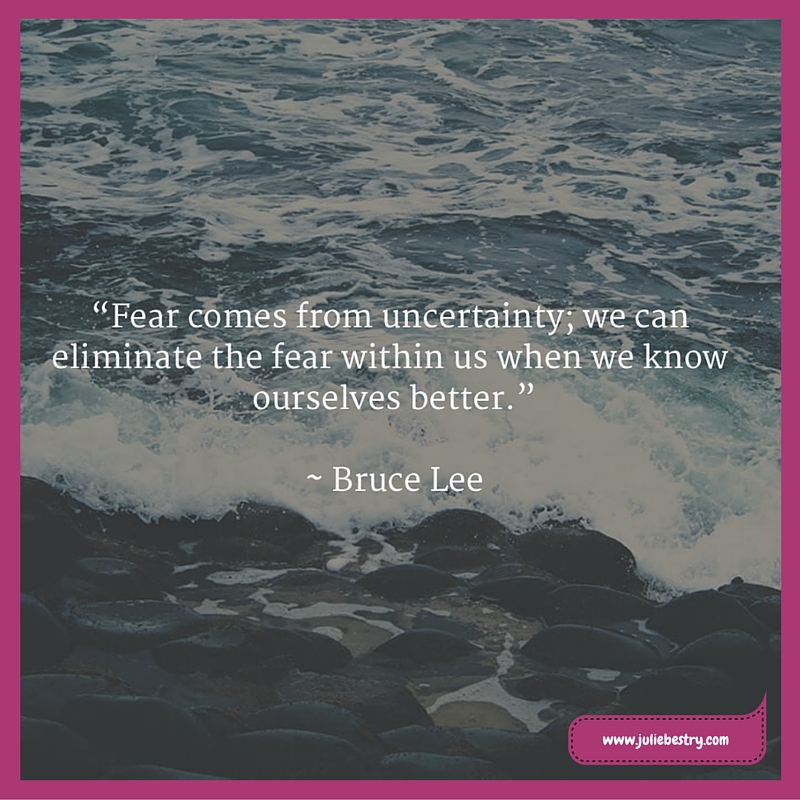
Getting organized can be scary.
Let that idea sink in. Usually, we talk about getting organized from the perspective of practical matters. What’s the most efficient technique? What’s products can streamline the process?
When we do talk about the psychology of getting organized, we’re often focusing on tips and tricks to get us motivated, to eliminate procrastination, or to keep us focused on a system, but we don’t necessarily dig into the idea that there are baseline fears, often unacknowledged, that prevent us from taking the steps we know will improve our lives.
This week, I sat down with John Hunt, host of Smead’s Keeping You Organized video podcast to record a show called “Fears That Keep You From Getting Organized.”
On the show, we talked about some of the fears — unspoken or even unrecognized — that cause us to back away from our organizing challenges without really considering the solutions available. Some of these include:
- Fear of discarding something — whether tangible or informational — because you worry that you might need someday. We call this the “just in case” fear.
- Fear of stifling your creativity
- Fear of potential emotional distress after discarding something
- Fear of losing personal or sentimental attachments to people and memories
- Fear of letting go of things upon which you’ve lavished money, time, or attention — otherwise known as the “sunk cost” fallacy
- Fear of the unknown
Of course, there are other fears that prevent us from achieving our organizing and productivity goals that we didn’t even get to, including:
- Fear of failure — “What if I spent time trying to create order and it turns out I can’t do it? Or I can’t maintain it?”
- Fear of success — “If I declutter and get more organized, people are going to expect more from me and heap more work and responsibilities on my shoulders.”
- Fear of loss of serendipity — “Right now, I’m delighted and surprised when I spend hours searching for something I can’t find, but come across something under a pile that I was looking for last week, or six months ago.”
There are all kinds of fears. I believe that when we acknowledge our fears, we’re taking the first step toward recognizing that we have control over whether to give in to the inertia of fear or break through and empower ourselves for change. I’d love to hear your thoughts on fear and disorganization.
Check out the above video, or if you prefer, you can listen to the audio version of the Smead podcast.
All About That Place (Where You Write Things Down)
To improve something, you must first observe & document it. Pen on paper once a day is a sufficient start.— Garrick van Buren (@garrickvanburen) November 17, 2014
Life and the internet have been conspiring recently, causing me to think about the issue of organizing one’s thoughts, and particularly, organizing them with pen on paper, as van Buren describes, rather than by typing.
Over the course of a few weeks, in addition to a speaking engagement and regular client work, I was involved with helping organize Chattanooga’s Second Annual Diabetes Expo. For all of these projects, there were little tasks, insights and just plain blobs of information coming up on my horizon. I encountered information I had to share with others (immediately as well as on delay), and had to juggle oodles of swiftly changing logistics, with not a lot of time to capture, let alone massage and manipulate, the data.
Before and during the expo, I was on my feet, running the length and width of a room the size of a high school gymnasium, plus up and down two short flights of stairs. (My Fitbit loved me that day!) Trying to walk and talk and type on an iPad just didn’t work, and I quickly gave up and went back to my beloved purple legal pad and pen.
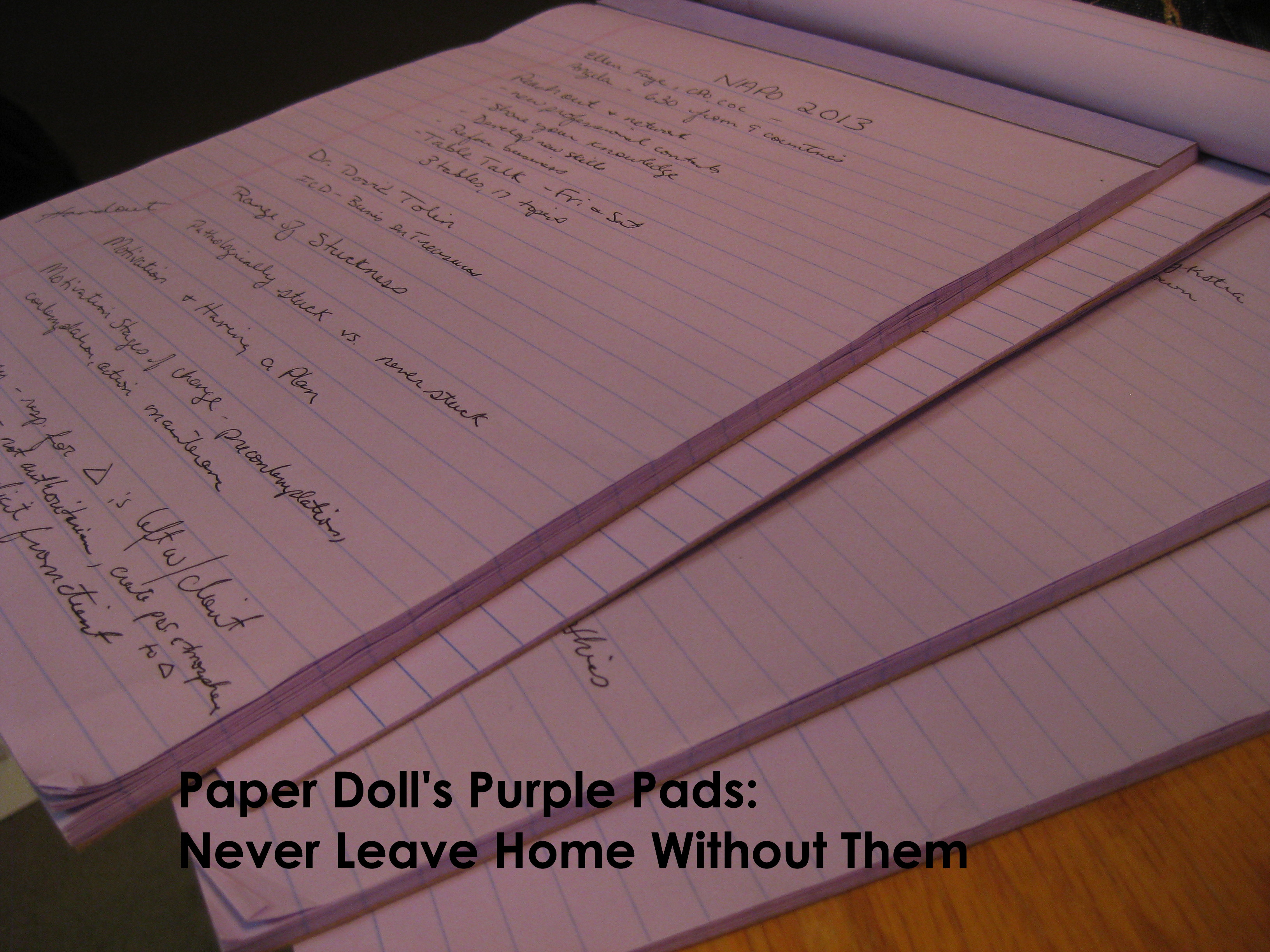
A page for problems needing solutions. A page for the mapped layout of all of the vendors. A page for checking off received door prizes. A page for changes we want to make to improve the process next year. You get the picture.
Was my handwriting abysmal and probably illegible to anyone but myself? Absolutely. But when my arms were full, I didn’t fear the budget-busting consequences of dropping my legal pad as I would have with my iPad.
After the month’s early hubbub, as I plowed through all I’d missed reading from my email and RSS feed and Twitter favorites, I eventually noticed the synchronicity of multiple open tabs in my browser. To borrow from Meghan Trainor:
It's All About That Place (Where I Choose to Write Things Down) Share on XFirst, I came across professional organizer Carrie Peeples guest-posting on Monica Ricci‘s blog, Your Life. Organized. Carrie wrote about The Secret To Shutting Up Your Busy Brain, and mentioned that:
The act of writing tells your brain that you’ve already processed that information and don’t have to worry about it. It frees your brain to do other things like focus on traffic or solve the next problem. The more you spend time trying to remember something the more time you’re NOT getting other things done.
This is known as the Zeigarnik Effect. Unless we rehearse or repeat things like phone numbers, or the beloved “a loaf of bread, a container of milk, and a stick of butter,” little details disappear from our short-term memories.
And a bigger deal, over the longer term, is that we tend to worry about the things where we’ve failed to achieve closure.
So, Carrie hits on the essentials: get it out of your head and down on paper (or the digital equivalent of paper), and your mind can go from the basic “what” and move on to more robust “why ” and “where” and “how” of the issue. When you write on a sticky note, it makes the information stick. Except, longtime readers know that I don’t want you to write on a sticky note or any other floozies (AKA: loose scraps of paper). I want you to have a notebook (paper or digital) that suits your capturing style. But do CAPTURE the information or ideas before they seep out of your brain and into the ether.
Next, Patrick Rhone of The Cramped, an entire blog dedicated to the analog writing experience, discussed a question of great importance: Why Analog? He delved into just a few of the reasons why handwriting something (vs. using your opposable thumbs to text it, or telling Siri to remember it) is advantageous. Rhone talks about the depth of history of the written language vs. digital data, the siren song of our personal notations, and the way a written draft shows the step-by-step thought process (including messy strikethroughs) that tend not to be visible with what we type. But my favorite of his points is this:
Writing by hand helps me retain more information. Countless studies show that the act of writing by hand is better for both retention and comprehension of ideas than typing them digitally. It engages the senses and synapses by a factor more than digital. I write by hand because it is the best way for me to remember and learn.
The Cramped also pointed me in the direction of Sienna Craig’s Huffington Post blog from earlier this year, entitled Reasons to Love Writing by Hand. Craig, a Dartmouth College professor, expresses surprise when her students report handwriting as creating an obstacle between the self and the expression of self. She writes:
One particularly eloquent student described handwriting as a kind of out-of-body experience: “It just doesn’t feel like it is me writing if I am not on a computer,” she said. This floored me, because for as long as I can remember, writing by hand has felt like an essential way for me to not only grapple with the world, but also to try, as the ancient Greeks remind us, to know thyself. My love for writing by hand takes many forms, and like most love affairs, is bittersweet, twisted in places, not immune to paradox and contradiction…
The entire essay is definitely worth a read (once you’ve finished this post, of course), but it’s her comment about paradox and contradiction that especially struck me, though I wasn’t immediately sure why until DocumentSnap‘s Brooks Duncan retweeted his The Paperless Conference from earlier this year. In it, Brooks — Paper Doll friend and resident expert on going paperless — included various references to my own blog post, NAPO2014: Taking Notes–The Paperless Experiment. That post includes citations of the research Rhone mentioned, above, about the superiority of writing (vs. typing) for comprehension and retention.
But it also gave me some stylistic insight.
Like Sienna Craig, I’m quick to note that I’m not a Luddite. (I hope my techie posts on digital signatures, Evernote and digital photography attest to that.) But I finally realized where the contradiction lies for me: between creating and capturing.
When I’m attending a class and taking notes, or working with clients, when I am doing a consultation on the phone or trying to understand a doctor’s instructions, my instinct is always to capture information on paper. However, when I draft my Paper Doll blog posts, when I write a set of complicated instructions or a delicate email, my fingers itch to reach out for the keyboard.
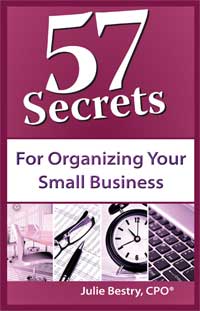
And certainly when I wrote 57 Secrets for Organizing Your Small Business, the words and phrases made their debuts in Microsoft Word, Evernote and drafts of emails. (My publisher would want me to note that Secret #4 in the book is Be Faithful To Your Information-Capturing System, and explains how to ensure the preservation of important thoughts and information, no matter your preferred capturing style. Y’know, like if you wanted to buy a holiday present for someone with this issue. Just sayin’.)
In essence, I’ve learned that for me, I hand write to take information in, to help my brain process it. But when I create, handwriting is an impediment — it slows me down. Perhaps it’s because I honed my typing skills in December of my freshman year of college, with a friend’s Mac and three term papers to type in one weekend, and now mfffflpffffl years later, my typing speed can keep up with my thoughts while my spidery, aging penmanship cannot.
Before these last few weeks, I hadn’t thought about when and why I choose to use analog vs. digital, paper vs. screen. I only knew that I do, and that it was instinctual. Dear readers, what about you? Are you like Patrick Rhone, all about the pen? Do you emulate pretty-much-paperless Brooks Duncan? Or are you more like Sienna Craig and myself, somewhat self-aware of your contradictory capturing relationship?
Wherever your incoming and outgoing thoughts live, it’s all about the place where you capture them so that you can set your mind free.
Follow Me